• RSIF8
    Roll no:14
    story post no:8
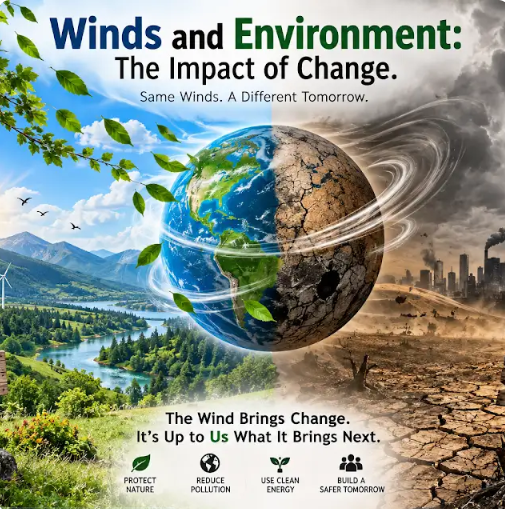
    story post topic:Winds and Environment: The Impact of Change

    # Winds and Environment: The Impact of Change

    I am happy to share that I have **successfully completed my Foundation Level task** on **“Winds and Environment: The Impact of Change.”**

    In this task, I explored the important relationship between **wind, environment, climate, and our daily lives**. I learned how wind plays an important role in our environment and how changes in wind patterns can affect **weather conditions, air quality, pollution, nature, and climate change**.

    I also learned about the importance of **renewable and clean energy**, especially **wind energy**. Wind turbines can help produce clean electricity while reducing our dependence on fossil fuels and helping to lower pollution.

    This task helped me understand that **small changes in our environment can have a big impact on the future of our planet**. It also taught me that protecting nature is not only the responsibility of governments or organizations, but something that **we all can contribute to**.

    Through this Foundation Level task, I improved my **research, creativity, communication, and learning skills**. I am proud to have completed this task and gained valuable knowledge about our environment and the importance of making responsible choices for a better future.

    **Protect Nature**
    **Use Clean Energy**
    **Reduce Pollution**
    **Save Our Environment**
    **Build a Better Future**

    **The wind brings change, but it is up to us to decide what kind of future that change will bring.**

    #WindsAndEnvironment
    #ImpactOfChange
    #FoundationLevel
    #TaskCompleted
    #EnvironmentalAwareness
    #ClimateChange
    #CleanEnergy
    #WindEnergy
    #RenewableEnergy
    #SaveOurPlanet
    #ProtectNature
    #ReducePollution
    #GreenFuture
    #SustainableFuture
    #LearningJourney
    #StudentAchievement
    #FutureReady
    #MakeADifference
    RSIF8 Roll no:14 story post no:8 story post topic:Winds and Environment: The Impact of Change # 🌬️🌍 Winds and Environment: The Impact of Change πŸŒ±β˜€οΈ I am happy to share that I have **successfully completed my Foundation Level task** on **“Winds and Environment: The Impact of Change.”** πŸŽ‰βœ… In this task, I explored the important relationship between **wind, environment, climate, and our daily lives**. 🌬️🌎 I learned how wind plays an important role in our environment and how changes in wind patterns can affect **weather conditions, air quality, pollution, nature, and climate change**. ☁️πŸŒͺ️🌳 I also learned about the importance of **renewable and clean energy**, especially **wind energy**. πŸ’¨βš‘ Wind turbines can help produce clean electricity while reducing our dependence on fossil fuels and helping to lower pollution. πŸŒ±πŸ”‹ This task helped me understand that **small changes in our environment can have a big impact on the future of our planet**. πŸŒπŸ’š It also taught me that protecting nature is not only the responsibility of governments or organizations, but something that **we all can contribute to**. 🀝🌳 Through this Foundation Level task, I improved my **research, creativity, communication, and learning skills**. πŸ“šπŸ’‘βœ¨ I am proud to have completed this task and gained valuable knowledge about our environment and the importance of making responsible choices for a better future. πŸ†πŸ™Œ 🌱 **Protect Nature** πŸ’¨ **Use Clean Energy** 🌍 **Reduce Pollution** ♻️ **Save Our Environment** 🀝 **Build a Better Future** ✨ **The wind brings change, but it is up to us to decide what kind of future that change will bring.** πŸŒ¬οΈπŸŒπŸ’š #WindsAndEnvironment 🌬️ #ImpactOfChange 🌍 #FoundationLevel πŸŽ“ #TaskCompleted βœ… #EnvironmentalAwareness 🌱 #ClimateChange 🌎 #CleanEnergy ⚑ #WindEnergy πŸ’¨ #RenewableEnergy πŸ”‹ #SaveOurPlanet 🌍 #ProtectNature 🌳 #ReducePollution ♻️ #GreenFuture πŸ’š #SustainableFuture 🌱 #LearningJourney πŸ“š #StudentAchievement πŸ† #FutureReady πŸš€ #MakeADifference 🀝
    0 Comments 0 Shares 547 Views
  • #rsisb
    Roll no.239
    maya no.18
    Foundation Level

    The word **“Earth”** is one of the oldest and most meaningful words in the English language. It represents much more than the planet beneath our feet. Earth is our **home, the source of life, the ground we walk on, and a symbol of nature and human existence**. But where did this simple word come from, and how did its meaning develop over time?

    The history of the word **“Earth”** takes us back thousands of years. In ancient forms of English and related Germanic languages, words similar to *earth* were used to describe the **ground, soil, land, and the physical world**. Over time, the word developed into the name we now use for our entire planet. Unlike many planets in our Solar System, whose names are connected to ancient gods and mythology, **Earth's English name is closely connected to the ordinary ground beneath our feet**.

    This connection tells us something important about human history. Long before people understood that they lived on a planet moving through space, they experienced Earth simply as the land around them—the soil that grew their food, the ground that supported their homes, and the world they could see and touch.

    As human knowledge grew, our understanding of Earth changed dramatically. Ancient thinkers observed the sky and began asking important questions about the shape and nature of the world. Over centuries, explorers, scientists, astronomers, and travelers expanded humanity's understanding of the planet. Eventually, space exploration allowed humans to see Earth from beyond its atmosphere. Those images showed something extraordinary: **our vast world is a beautiful, fragile-looking sphere surrounded by the darkness of space**.

    From a scientific perspective, Earth is the **third planet from the Sun** and the only world currently known to support life. It has liquid water on its surface, a protective atmosphere, and a wide variety of environments that support countless living organisms. Its oceans, forests, mountains, deserts, rivers, and grasslands form an incredibly diverse and interconnected system.

    Earth's structure is also fascinating. Beneath the surface are different layers, including the **crust, mantle, and core**. These layers influence many natural processes, including the movement of tectonic plates, earthquakes, volcanic activity, and the formation of mountains. Although we live on the surface, the planet beneath us is constantly changing.

    Life on Earth depends on a delicate balance. **Air, water, sunlight, soil, and biodiversity** all play essential roles in supporting life. Plants produce oxygen and form the foundation of many ecosystems. Oceans help regulate climate and support an enormous variety of life. Forests provide habitats and influence the movement of water and carbon through the environment.

    However, Earth also faces serious environmental challenges. **Pollution, deforestation, habitat destruction, and climate change** affect ecosystems and communities around the world. These challenges remind us that Earth is not an unlimited resource. The choices humans make today can influence the quality of life for future generations.

    Protecting Earth does not always require extraordinary actions. Small changes can make a difference, such as **reducing waste, conserving water and energy, planting and protecting trees, avoiding unnecessary pollution, and learning more about the environment**. Governments, scientists, businesses, communities, and individuals all have important roles to play.

    The word **“Earth”** also has a powerful emotional and cultural meaning. People may come from different countries, speak different languages, and follow different traditions, but we all share the same planet. From this perspective, Earth can be seen as a symbol of our **shared home and shared responsibility**.

    **“Earth” – The History of Our Home in a Word** is therefore a journey through **language, history, science, nature, and human imagination**. The story of this word shows how language grows alongside human knowledge. What once described the soil beneath people's feet eventually became the name of an entire world traveling through space.

    The next time you hear or say the word **“Earth,”** remember that it carries a remarkable story. It connects us to the ancient past, the natural world around us, and the future we are helping to create.

    **Earth is not just where we live—it is the only home we all share. Protecting it is a responsibility that belongs to everyone.**

    ### **Hashtags**

    #Earth #OurPlanet #PlanetEarth #WordHistory #HistoryOfEarth #EnglishLanguage #LanguageHistory #Science #Nature #Environment #ClimateAwareness #ProtectOurPlanet #Sustainability #EarthScience #Space #Astronomy #LifeOnEarth #MotherEarth #SaveEarth #GoGreen #CleanEnvironment #Biodiversity #ClimateChange #Education #Knowledge #LearnAndExplore #OnePlanet #FutureGenerations #EarthLovers #OurHome
    #rsisb Roll no.239 maya no.18 Foundation Level The word **“Earth”** is one of the oldest and most meaningful words in the English language. It represents much more than the planet beneath our feet. Earth is our **home, the source of life, the ground we walk on, and a symbol of nature and human existence**. But where did this simple word come from, and how did its meaning develop over time? The history of the word **“Earth”** takes us back thousands of years. In ancient forms of English and related Germanic languages, words similar to *earth* were used to describe the **ground, soil, land, and the physical world**. Over time, the word developed into the name we now use for our entire planet. Unlike many planets in our Solar System, whose names are connected to ancient gods and mythology, **Earth's English name is closely connected to the ordinary ground beneath our feet**. πŸ“–πŸŒ± This connection tells us something important about human history. Long before people understood that they lived on a planet moving through space, they experienced Earth simply as the land around them—the soil that grew their food, the ground that supported their homes, and the world they could see and touch. As human knowledge grew, our understanding of Earth changed dramatically. Ancient thinkers observed the sky and began asking important questions about the shape and nature of the world. Over centuries, explorers, scientists, astronomers, and travelers expanded humanity's understanding of the planet. Eventually, space exploration allowed humans to see Earth from beyond its atmosphere. Those images showed something extraordinary: **our vast world is a beautiful, fragile-looking sphere surrounded by the darkness of space**. πŸš€πŸŒŒ From a scientific perspective, Earth is the **third planet from the Sun** and the only world currently known to support life. It has liquid water on its surface, a protective atmosphere, and a wide variety of environments that support countless living organisms. Its oceans, forests, mountains, deserts, rivers, and grasslands form an incredibly diverse and interconnected system. πŸŒŠπŸ”οΈπŸŒ³ Earth's structure is also fascinating. Beneath the surface are different layers, including the **crust, mantle, and core**. These layers influence many natural processes, including the movement of tectonic plates, earthquakes, volcanic activity, and the formation of mountains. Although we live on the surface, the planet beneath us is constantly changing. Life on Earth depends on a delicate balance. **Air, water, sunlight, soil, and biodiversity** all play essential roles in supporting life. Plants produce oxygen and form the foundation of many ecosystems. Oceans help regulate climate and support an enormous variety of life. Forests provide habitats and influence the movement of water and carbon through the environment. However, Earth also faces serious environmental challenges. **Pollution, deforestation, habitat destruction, and climate change** affect ecosystems and communities around the world. These challenges remind us that Earth is not an unlimited resource. The choices humans make today can influence the quality of life for future generations. πŸŒΏβ™»οΈ Protecting Earth does not always require extraordinary actions. Small changes can make a difference, such as **reducing waste, conserving water and energy, planting and protecting trees, avoiding unnecessary pollution, and learning more about the environment**. Governments, scientists, businesses, communities, and individuals all have important roles to play. The word **“Earth”** also has a powerful emotional and cultural meaning. People may come from different countries, speak different languages, and follow different traditions, but we all share the same planet. From this perspective, Earth can be seen as a symbol of our **shared home and shared responsibility**. 🀝🌍 **“Earth” – The History of Our Home in a Word** is therefore a journey through **language, history, science, nature, and human imagination**. The story of this word shows how language grows alongside human knowledge. What once described the soil beneath people's feet eventually became the name of an entire world traveling through space. The next time you hear or say the word **“Earth,”** remember that it carries a remarkable story. It connects us to the ancient past, the natural world around us, and the future we are helping to create. **Earth is not just where we live—it is the only home we all share. Protecting it is a responsibility that belongs to everyone.** πŸŒπŸ’šβœ¨ ### πŸ”– **Hashtags** #Earth #OurPlanet #PlanetEarth #WordHistory #HistoryOfEarth #EnglishLanguage #LanguageHistory #Science #Nature #Environment #ClimateAwareness #ProtectOurPlanet #Sustainability #EarthScience #Space #Astronomy #LifeOnEarth #MotherEarth #SaveEarth #GoGreen #CleanEnvironment #Biodiversity #ClimateChange #Education #Knowledge #LearnAndExplore #OnePlanet #FutureGenerations #EarthLovers #OurHome πŸŒπŸŒΏπŸ’šβœ¨
    0 Comments 0 Shares 8934 Views 18
  • #rsisb Roll No.240 Song No.9 Foundation Level ## **The Role of Law: How Legal Systems Maintain Order in Society** Law is one of the most important foundations of a peaceful and organized society. It provides rules that help people understand what is right, what is wrong, and what responsibilities they have toward one another. Without laws, society could become unsafe and disorganized, because people might act only according to their own interests. In this educational video, we explore **the role of law and how legal systems maintain order in society**. We explain how laws protect people's rights, prevent crime, settle disputes, and promote justice and equality. Laws also provide a system through which people can seek justice when their rights are violated. A strong legal system does not only punish people who break the law. It also protects innocent people, supports fairness, maintains public safety, and creates stability in everyday life. From traffic rules and property laws to criminal laws and human rights, legal systems affect many parts of our daily lives. The video also explains why **everyone should be treated equally under the law**, regardless of their wealth, position, or social status. When citizens respect the law and understand their responsibilities, communities become safer, more peaceful, and more cooperative. Through simple examples and easy explanations, this video helps students and viewers understand why laws are necessary and how they contribute to a better society. βš–οΈ **Key Topics Covered:** * What is law? * Why do societies need laws? * How laws maintain peace and order * Protection of human rights * Equality and justice under the law * Prevention of crime * The role of courts and legal institutions * Responsibilities of citizens * How laws resolve conflicts * Why respecting the law is important * The connection between law, justice, and social stability **Learn how law helps transform a group of individuals into a safe, organized, and responsible society.** #TheRoleOfLaw #Law #LegalSystem #Justice #RuleOfLaw #Society #HumanRights #Equality #Peace #SocialOrder #Education #Civics #LegalEducation #JusticeForAll #LawAndSociety #Government #Citizenship #Knowledge #EducationalVideo #Learning #UrduEducation Rehan School Islamabad Campus Asma Shaheen EducationWali Irum Asim Saima Happinesswali https://www.facebook.com/share/v/1S6sC4a2BC/
    WWW.FACEBOOK.COM
    Facebook
    #rsisb Roll No.240 Song No.9 Foundation Level ## **The Role of Law: How Legal Systems Maintain Order in Society** Law is one of the most important foundations of a peaceful and organized society....
    0 Comments 0 Shares 4697 Views
  • Sign the petition !!

    http://www.perdana4peace.org/

    Perdana Global Peace Foundation (PGPF) strongly disapproves and condemns the closure of the Rafah border. Freedom of movement is an inalienable basic human right and must never be made subservient to political considerations, particularly since Rafah Border is the only lifeline the Palestinians of Gaza have to the outside world. PGPF is therefore, shocked and appalled that the Egyptian government claims the closure of the Rafah border is necessary to prevent activity by armed militants. The closure has in fact resulted in collective punishment of the entire population of 1.7 million which is ironically the exact same treatment Palestinians are experiencing at the hands of Israel.

    Gaza has been dubbed the largest open prison in the world due to the blockade. Apart from the mobility for the purpose of having economic activities with neighbouring Egypt, citizens and refugees within Gaza are not able to access much needed health care. The consensus on damages of such measure is clear and overwhelming as restriction to health access violates basic human rights guaranteed by international humanitarian and human rights law. The Palestinian Minister of Health in Gaza reported that hospitals throughout the Gaza Strip are running dangerously low on lifesaving medications and equipment.

    A report by the UN Office for the Coordination of Humanitarian Affairs (OCHA) has revealed that Egypt’s security concerns have managed to limit education of Palestinians wishing to study abroad. Electricity production of a Gaza power plant is at risk of shutting down operations due to a trickling effect of fuel shortage coming from Egypt. "An estimated 600,000 people within the Gaza Strip may not have access to adequate and safe water and sanitation services as a result of increased power outages and lack of fuel," stated the report.

    For the sake of peace and humanity, the Palestinians of Gaza must be allowed to travel. PGPF calls upon all to join this movement to pressure the Egyptian government to reopen the border permanently. The following has been demarcated by the international community in support of opening borders between Gaza and Egypt:

    1) The Universal Declaration of Human Rights article 13 affirms: "Everyone has the right to leave any country, including his own, and return to his country."
    2) The International Convention on the Elimination of All Forms of Racial Discrimination [Article 5 (d)(ii)], states: "State parties undertake to prohibit and to eliminate racial discrimination on all its forms and to guarantee the right of everyone, without distinction as to race, color, or national or ethnic origin, to equality before the law, notably in the enjoyment of ... the right to leave any country, including ones own, and to return to ones country."
    3) The International Convention on Civil and Political Rights [Article 12(4)], states: "No one shall be arbitrarily deprived of the right to enter his own country."

    The continuing acts of genocide against the Palestinians continue. It is unconscionable to remain silent. We call upon all people of conscience to unite & condemn this heinous act of modern day barbarism. We appeal to you to sign this petition and disseminate it to everyone.
    Sign the petition !! http://www.perdana4peace.org/ Perdana Global Peace Foundation (PGPF) strongly disapproves and condemns the closure of the Rafah border. Freedom of movement is an inalienable basic human right and must never be made subservient to political considerations, particularly since Rafah Border is the only lifeline the Palestinians of Gaza have to the outside world. PGPF is therefore, shocked and appalled that the Egyptian government claims the closure of the Rafah border is necessary to prevent activity by armed militants. The closure has in fact resulted in collective punishment of the entire population of 1.7 million which is ironically the exact same treatment Palestinians are experiencing at the hands of Israel. Gaza has been dubbed the largest open prison in the world due to the blockade. Apart from the mobility for the purpose of having economic activities with neighbouring Egypt, citizens and refugees within Gaza are not able to access much needed health care. The consensus on damages of such measure is clear and overwhelming as restriction to health access violates basic human rights guaranteed by international humanitarian and human rights law. The Palestinian Minister of Health in Gaza reported that hospitals throughout the Gaza Strip are running dangerously low on lifesaving medications and equipment. A report by the UN Office for the Coordination of Humanitarian Affairs (OCHA) has revealed that Egypt’s security concerns have managed to limit education of Palestinians wishing to study abroad. Electricity production of a Gaza power plant is at risk of shutting down operations due to a trickling effect of fuel shortage coming from Egypt. "An estimated 600,000 people within the Gaza Strip may not have access to adequate and safe water and sanitation services as a result of increased power outages and lack of fuel," stated the report. For the sake of peace and humanity, the Palestinians of Gaza must be allowed to travel. PGPF calls upon all to join this movement to pressure the Egyptian government to reopen the border permanently. The following has been demarcated by the international community in support of opening borders between Gaza and Egypt: 1) The Universal Declaration of Human Rights article 13 affirms: "Everyone has the right to leave any country, including his own, and return to his country." 2) The International Convention on the Elimination of All Forms of Racial Discrimination [Article 5 (d)(ii)], states: "State parties undertake to prohibit and to eliminate racial discrimination on all its forms and to guarantee the right of everyone, without distinction as to race, color, or national or ethnic origin, to equality before the law, notably in the enjoyment of ... the right to leave any country, including one's own, and to return to one's country." 3) The International Convention on Civil and Political Rights [Article 12(4)], states: "No one shall be arbitrarily deprived of the right to enter his own country." The continuing acts of 'genocide' against the Palestinians continue. It is unconscionable to remain silent. We call upon all people of conscience to unite & condemn this heinous act of modern day barbarism. We appeal to you to sign this petition and disseminate it to everyone.
    0 Comments 0 Shares 5468 Views
  • I hope #Turkish Government is careful with the people and their emotions, and take #Ukraine as a recent lesson , #Turkey has been rising & Some many NOT want to see that happen, so PLEASE be careful mr #Erdegan very VERY Careful !!
    I hope #Turkish Government is careful with the people and their emotions, and take #Ukraine as a recent lesson , #Turkey has been rising & Some many NOT want to see that happen, so PLEASE be careful mr #Erdegan very VERY Careful !!
    0 Comments 0 Shares 2575 Views
  • My name is Jutta Mohamed-Ali from Germany.
    Im a consultant for International Vocational Education & Training.
    At the moment Im still working for Deutsche Telekom AG which is the biggest Telecom enterprise in Europe with 50 worldwide subsidiaries. Please have a look here:
    http://www.telekom.com
    Im working in the education department for the "dual study program".
    If you may kindly send me your e-mail adress, I can send you detailed information about this interesting combination between higher education at University with vocational training in a company. Its working for all kind of subjects: for Business administration and IT as well as for technical engineering programs.
    Graduation will be "Bachelor" or "Master" and the graduates usually are ready for taking positions in lower management directly after finish their study program.
    To describe it short: the German "dual system" of Vocational Education & Training meanwhile became an export best-seller.
    To make a long speech short:: instead of being depend of governmental help, companies work closely together with Universities.
    They develop curricula together.
    They implement a part-time model for students.
    So students can study parttime at University and work in a company the other time.
    F.e. 3 days a week in the company - 3 days a week at University. Students are hired by companies as "employees in training",
    they receive a small salary and the company pays their University fees.
    The result: 3-4 years of theoretical knowledge at University and at the same time: 3-4 years practical working experience in a company. Through the close relationship between business and University deep impact on an state of the techniques curriculum.
    Teaching/Learning whats necessary.
    Its working excellent !

    Im looking for companies which are interested in implementing such a kind of system in their home country.
    Meanwhile Im thinking about coming to Pakistan to meet people personally.
    May you be interested ?

    Best regards
    Jutta Ali
    My name is Jutta Mohamed-Ali from Germany. I'm a consultant for International Vocational Education & Training. At the moment I'm still working for Deutsche Telekom AG which is the biggest Telecom enterprise in Europe with 50 worldwide subsidiaries. Please have a look here: http://www.telekom.com I'm working in the education department for the "dual study program". If you may kindly send me your e-mail adress, I can send you detailed information about this interesting combination between higher education at University with vocational training in a company. It's working for all kind of subjects: for Business administration and IT as well as for technical engineering programs. Graduation will be "Bachelor" or "Master" and the graduates usually are ready for taking positions in lower management directly after finish their study program. To describe it short: the German "dual system" of Vocational Education & Training meanwhile became an export best-seller. To make a long speech short:: instead of being depend of governmental help, companies work closely together with Universities. They develop curricula together. They implement a part-time model for students. So students can study parttime at University and work in a company the other time. F.e. 3 days a week in the company - 3 days a week at University. Students are hired by companies as "employees in training", they receive a small salary and the company pays their University fees. The result: 3-4 years of theoretical knowledge at University and at the same time: 3-4 years practical working experience in a company. Through the close relationship between business and University deep impact on an state of the techniques curriculum. Teaching/Learning what's necessary. It's working excellent ! I'm looking for companies which are interested in implementing such a kind of system in their home country. Meanwhile I'm thinking about coming to Pakistan to meet people personally. May you be interested ? Best regards Jutta Ali
    0 Comments 0 Shares 2219 Views
  • Democratic Governments were designed to Serve the people, So they are like Employees, However if the employees do not work well, The Employer is mostly to blame. If you feel that one of the organizations in your country is not doing well, Please go to them 1 time a week for a social visit, for 1 hour, and talk to them, and ask them what you can do to help them be like how you want them to be, and LISTEN to them, and see how YOU Can help them become how you wish to see them.

    Experience video https://www.facebook.com/photo.php?v=10203475590270095&stream_ref=10

    Rehan Allahwala
    Democratic Governments were designed to Serve the people, So they are like Employee's, However if the employee's do not work well, The Employer is mostly to blame. If you feel that one of the organizations in your country is not doing well, Please go to them 1 time a week for a social visit, for 1 hour, and talk to them, and ask them what you can do to help them be like how you want them to be, and LISTEN to them, and see how YOU Can help them become how you wish to see them. Experience video https://www.facebook.com/photo.php?v=10203475590270095&stream_ref=10 Rehan Allahwala
    0 Comments 0 Shares 1162 Views
  • Democratic Governments were designed to Serve the people, So they are like Employees, However if the employees do not work well, The Employer is mostly to blame. If you feel that one of the organizations in your country is not doing well, Please go to them 1 time a week for a social visit, for 1 hour, and talk to them, and ask them what you can do to help them be like how you want them to be, and LISTEN to them, and see how YOU Can help them become how you wish to see them. If you are in Karachi, you can go with Masood Akbar who goes every wednesday 10 am for the same. https://www.facebook.com/masood.akbar1 Rehan Allahwalaο»Ώ
    Democratic Governments were designed to Serve the people, So they are like Employee's, However if the employee's do not work well, The Employer is mostly to blame. If you feel that one of the organizations in your country is not doing well, Please go to them 1 time a week for a social visit, for 1 hour, and talk to them, and ask them what you can do to help them be like how you want them to be, and LISTEN to them, and see how YOU Can help them become how you wish to see them. If you are in Karachi, you can go with Masood Akbar who goes every wednesday 10 am for the same. https://www.facebook.com/masood.akbar1 Rehan Allahwalaο»Ώ
    0 Comments 0 Shares 832 Views
  • I a citizen of West Pakistan or Pakistan, Want to apologize to all the People of East Pakistan or now Bangladesh for all the wrong doings by the Government of Pakistan and its army, And I feel sorry and my sympathies are with the people of Bangladesh .

    International Reports claim 30,000 to 3 Million People were killed and Thousands Raped at that time - http://en.wikipedia.org/wiki/1971_Bangladesh_Genocide link has more proofs

    I encourage other Pakistanis to do the same, to show respect, as an apology is far better than another brothers anger towards you, which can not be forgiven even by god as per his own command.

    Rehan Allahwala
    I a citizen of West Pakistan or Pakistan, Want to apologize to all the People of East Pakistan or now Bangladesh for all the wrong doing's by the Government of Pakistan and it's army, And I feel sorry and my sympathies are with the people of Bangladesh . International Report's claim 30,000 to 3 Million People were killed and Thousands Raped at that time - http://en.wikipedia.org/wiki/1971_Bangladesh_Genocide link has more proof's I encourage other Pakistanis to do the same, to show respect, as an apology is far better than another brother's anger towards you, which can not be forgiven even by god as per his own command. Rehan Allahwala
    0 Comments 0 Shares 1895 Views
  • Do you believe what your government tells you ?
    Do you believe what your government tell's you ?
    0 Comments 0 Shares 553 Views
More Results