• Episode #300 – Rehan Foundation Interview Series

    In this episode, we are joined by Kimberly Wiefling, an inspiring leadership facilitator, author, entrepreneur, physicist, coach, and innovation expert whose work focuses on helping people and organizations turn “impossible” into INEVITABLE.

    Kimberly Wiefling’s superpower is facilitating breakthroughs — helping managers become leaders, groups become true teams, and organizations achieve things they once believed were impossible.

    She is the author of the globally popular book “Scrappy Project Management,” founder of Wiefling Consulting, and cofounder of Silicon Valley Alliances. For more than 20 years, she has worked with global Japanese companies and organizations across Asia, Australia, Europe, and North America, facilitating cross-cultural workshops and learning experiences designed to improve leadership, teamwork, innovation, and organizational performance.

    Her journey combines science, engineering, business, leadership, and entrepreneurship. A physicist by education, Kimberly spent 10 years at HP in seven different engineering and project management roles, including leading an R&D team developing a new mass spectrometer. She later spent three years in Silicon Valley startups, leading product development teams working across hardware, software, and complex systems.

    Over the years, Kimberly has also helped start, run, and grow multiple small businesses, including a company that reached millions of dollars in revenue with only seed funding from its founders.

    Today, Kimberly focuses on creating powerful learning environments where leaders and teams can discover what is truly possible when they work together effectively. She is also increasingly focused on using her experience, leadership skills, and the rapidly developing power of AI to create positive change and contribute toward a more sustainable future for our planet.

    In this inspiring conversation, we explore:

    • What makes a great leader truly effective

    • The difference between managing people and leading people

    • How to build highly effective teams

    • Creating a strong and healthy organizational culture

    • How leaders can use AI as a “coach in your pocket”

    • Using AI to become a more effective leader and manager

    • The role of innovation in modern organizations

    • Why predictable causes of failure continue to affect organizations

    • How to identify and prevent failure before it happens

    • Turning “IMPOSSIBLE” into “INEVITABLE”

    • How organizations can achieve extraordinary results together

    • Lessons from working with global Japanese companies

    • Cross-cultural leadership and collaboration

    • What entrepreneurship can teach us about leadership and innovation

    • How to create teams capable of achieving the seemingly impossible

    • The importance of experimentation, learning, and adaptability

    • Using AI responsibly to create meaningful positive impact

    • Leadership lessons from Silicon Valley, engineering, and entrepreneurship

    • How leaders can create a more sustainable future

    This episode is a powerful conversation about leadership, teamwork, innovation, organizational culture, AI, entrepreneurship, resilience, and the mindset required to turn ambitious ideas into reality.

    Kimberly reminds us that the biggest breakthroughs often begin when someone is willing to challenge the assumption that something is impossible.

    Because with the right leadership, the right team, the right mindset, and the right tools — IMPOSSIBLE can become INEVITABLE.

    Part of the Rehan Foundation Interview Series

    Episode #300

    Foreigner Episode #28

    Rehan Allahwala
    Shahrukh Ali
    🎬 Episode #300 – Rehan Foundation Interview Series In this episode, we are joined by Kimberly Wiefling, an inspiring leadership facilitator, author, entrepreneur, physicist, coach, and innovation expert whose work focuses on helping people and organizations turn “impossible” into INEVITABLE. Kimberly Wiefling’s superpower is facilitating breakthroughs — helping managers become leaders, groups become true teams, and organizations achieve things they once believed were impossible. She is the author of the globally popular book “Scrappy Project Management,” founder of Wiefling Consulting, and cofounder of Silicon Valley Alliances. For more than 20 years, she has worked with global Japanese companies and organizations across Asia, Australia, Europe, and North America, facilitating cross-cultural workshops and learning experiences designed to improve leadership, teamwork, innovation, and organizational performance. Her journey combines science, engineering, business, leadership, and entrepreneurship. A physicist by education, Kimberly spent 10 years at HP in seven different engineering and project management roles, including leading an R&D team developing a new mass spectrometer. She later spent three years in Silicon Valley startups, leading product development teams working across hardware, software, and complex systems. Over the years, Kimberly has also helped start, run, and grow multiple small businesses, including a company that reached millions of dollars in revenue with only seed funding from its founders. Today, Kimberly focuses on creating powerful learning environments where leaders and teams can discover what is truly possible when they work together effectively. She is also increasingly focused on using her experience, leadership skills, and the rapidly developing power of AI to create positive change and contribute toward a more sustainable future for our planet. In this inspiring conversation, we explore: • What makes a great leader truly effective • The difference between managing people and leading people • How to build highly effective teams • Creating a strong and healthy organizational culture • How leaders can use AI as a “coach in your pocket” • Using AI to become a more effective leader and manager • The role of innovation in modern organizations • Why predictable causes of failure continue to affect organizations • How to identify and prevent failure before it happens • Turning “IMPOSSIBLE” into “INEVITABLE” • How organizations can achieve extraordinary results together • Lessons from working with global Japanese companies • Cross-cultural leadership and collaboration • What entrepreneurship can teach us about leadership and innovation • How to create teams capable of achieving the seemingly impossible • The importance of experimentation, learning, and adaptability • Using AI responsibly to create meaningful positive impact • Leadership lessons from Silicon Valley, engineering, and entrepreneurship • How leaders can create a more sustainable future This episode is a powerful conversation about leadership, teamwork, innovation, organizational culture, AI, entrepreneurship, resilience, and the mindset required to turn ambitious ideas into reality. Kimberly reminds us that the biggest breakthroughs often begin when someone is willing to challenge the assumption that something is impossible. Because with the right leadership, the right team, the right mindset, and the right tools — IMPOSSIBLE can become INEVITABLE. 📌 Part of the Rehan Foundation Interview Series 🎥 Episode #300 🌍 Foreigner Episode #28 Rehan Allahwala Shahrukh Ali
    0 تبصرے 0 شیئرز 407 ویوز 0
  • ACCL Day 153 — Story: The Force Behind Motion: Understanding Newton’s Laws

    The sun was barely up when the science lab doors slid open, and young Ayan stepped inside. Today wasn’t just any day — it was the day he finally understood why things move the way they do.

    As he placed a small toy car on the table, Sir Imran walked in with his usual smile.
    “Ready to learn how the universe pushes you around?” he joked.

    Ayan nodded.

    “Good,” Sir Imran said. “Let’s talk Newton.”

    First Law — The Law of Inertia

    Ayan flicked the toy car lightly. It moved… then stopped.
    “Why did it stop?” Sir Imran asked.
    “Because I stopped pushing it,” Ayan replied.
    “No,” Sir Imran grinned. “It stopped because friction pushed back. Without any forces, things keep going forever.”

    Ayan imagined a car flying endlessly through space — no brakes, no slowing down.
    So that’s inertia, he thought.
    Objects don’t stop unless something forces them to.

    Second Law — F = ma

    Sir Imran handed him two identical cars: one empty, one full of metal weights.
    “Push them both,” he ordered.

    Ayan pushed.
    The light car zoomed. The heavy one crawled.

    “The heavier something is, the more force you need,” Sir Imran explained. “Force equals mass times acceleration. Simple math — powerful truth.”

    Ayan felt like he had just unlocked a secret code of the universe.

    Third Law — Action & Reaction

    Finally, Sir Imran placed a balloon car on the table.
    “Let go.”

    WOOSH! The balloon shot air backwards — the car zoomed forward.

    “For every action,” Sir Imran said, “there’s an equal and opposite reaction. The universe always responds.”

    Ayan watched the car bounce off the wall and laughed.
    It wasn’t just science… it felt like magic.

    The Lesson of the Day

    As Ayan packed up, he whispered to himself:
    “Everything moves for a reason. Forces shape every step we take.”

    Walking out of the lab, he felt the world differently — every motion, every push, every reaction suddenly made sense.

    Newton wasn’t just writing laws.
    He was explaining the story written into every moment of our lives.
    ACCL Day 153 — Story: The Force Behind Motion: Understanding Newton’s Laws The sun was barely up when the science lab doors slid open, and young Ayan stepped inside. Today wasn’t just any day — it was the day he finally understood why things move the way they do. As he placed a small toy car on the table, Sir Imran walked in with his usual smile. “Ready to learn how the universe pushes you around?” he joked. Ayan nodded. “Good,” Sir Imran said. “Let’s talk Newton.” First Law — The Law of Inertia Ayan flicked the toy car lightly. It moved… then stopped. “Why did it stop?” Sir Imran asked. “Because I stopped pushing it,” Ayan replied. “No,” Sir Imran grinned. “It stopped because friction pushed back. Without any forces, things keep going forever.” Ayan imagined a car flying endlessly through space — no brakes, no slowing down. So that’s inertia, he thought. Objects don’t stop unless something forces them to. Second Law — F = ma Sir Imran handed him two identical cars: one empty, one full of metal weights. “Push them both,” he ordered. Ayan pushed. The light car zoomed. The heavy one crawled. “The heavier something is, the more force you need,” Sir Imran explained. “Force equals mass times acceleration. Simple math — powerful truth.” Ayan felt like he had just unlocked a secret code of the universe. Third Law — Action & Reaction Finally, Sir Imran placed a balloon car on the table. “Let go.” WOOSH! The balloon shot air backwards — the car zoomed forward. “For every action,” Sir Imran said, “there’s an equal and opposite reaction. The universe always responds.” Ayan watched the car bounce off the wall and laughed. It wasn’t just science… it felt like magic. The Lesson of the Day As Ayan packed up, he whispered to himself: “Everything moves for a reason. Forces shape every step we take.” Walking out of the lab, he felt the world differently — every motion, every push, every reaction suddenly made sense. Newton wasn’t just writing laws. He was explaining the story written into every moment of our lives.
    0 تبصرے 0 شیئرز 202 ویوز
  • 💻 **Day 138 | Coding Task 🧮** 📊 **BMI Calculator — Calculate, Learn & Understand!** Today, I created a **BMI (Body Mass Index) Calculator** using HTML, CSS, and JavaScript! 🚀 This project helped me practice calculations, user inputs, JavaScript logic, and interactive web design. The calculator displays BMI results, categories, and helpful information through a clean and user-friendly interface. Every new project helps me improve my coding skills and learn something new. Step by step, I’m moving closer to becoming an AI creator! 💡✨ 🎓 **Foundation Level** 🔢 **Roll No: 01** ✅ **Day 138 — Task Completed!** **Rehan School — Learning Today, Creating Tomorrow!** #Day138 #BMICalculator #CodingTask #HTML #CSS #JavaScript #RehanSchool #LearningByDoing #FutureAICreator VIDEO LINK:http://youtube.com/post/Ugkxm4R7_Cv5GJmx6a2C8VssnGX70efz-IxX?si=0zVZPktIrMz6yktu
    YOUTUBE.COM
    💻 **Day 138 | Coding Task 🧮** 📊 **BMI Calculator — Calculate, Learn & Understand!** Today, I created a **BMI (Body Mass Index) Calculator** using HTML, CSS, ...
    💻 **Day 138 | Coding Task 🧮** 📊 **BMI Calculator — Calculate, Learn & Understand!** Today, I created a **BMI (Body Mass Index) Calculator** using HTML, CSS, ...
    0 تبصرے 0 شیئرز 777 ویوز


  • **The Mystery of Flight MH370**

    On March 8, 2014, Malaysia Airlines Flight MH370 disappeared while flying from Kuala Lumpur to Beijing with **239 people on board**. What happened next became one of the biggest mysteries in aviation history.

    The aircraft vanished from civilian radar, and investigators later discovered evidence suggesting that it may have changed direction and continued flying for hours. Despite massive search efforts across the Indian Ocean, the main wreckage has never been located.

    Some debris believed to be from the aircraft was discovered years later, but many questions remain unanswered. What caused the plane to change course? Where did it finally go down? And will the world ever discover the full truth?

    In this video, we explore the disappearance of MH370, the search for the aircraft, the clues investigators discovered, and the theories surrounding this mysterious case.

    **This video is for educational and storytelling purposes.**

    What do you think happened to MH370?

    **Share your theory in the comments!**

    #MH370 #MalaysiaAirlines #PlaneMystery #AviationMystery #UnsolvedMystery #PlaneCrash #Mystery #Aviation #MH370Mystery #TrueMystery #MissingPlane #History #Investigation #OceanMystery
    ✈️ **The Mystery of Flight MH370** 🌊🔍 On March 8, 2014, Malaysia Airlines Flight MH370 disappeared while flying from Kuala Lumpur to Beijing with **239 people on board**. What happened next became one of the biggest mysteries in aviation history. The aircraft vanished from civilian radar, and investigators later discovered evidence suggesting that it may have changed direction and continued flying for hours. Despite massive search efforts across the Indian Ocean, the main wreckage has never been located. Some debris believed to be from the aircraft was discovered years later, but many questions remain unanswered. What caused the plane to change course? Where did it finally go down? And will the world ever discover the full truth? In this video, we explore the disappearance of MH370, the search for the aircraft, the clues investigators discovered, and the theories surrounding this mysterious case. ⚠️ **This video is for educational and storytelling purposes.** What do you think happened to MH370? 🤔✈️ 💬 **Share your theory in the comments!** #MH370 #MalaysiaAirlines #PlaneMystery #AviationMystery #UnsolvedMystery #PlaneCrash #Mystery #Aviation #MH370Mystery #TrueMystery #MissingPlane #History #Investigation #OceanMystery
    0 تبصرے 1 شیئرز 1880 ویوز 21
  • MohsinRSF8
    song title no:11
    Rool no:13

    The Story of Elements: From Carbon to Gold

    The universe is full of incredible stories, and one of the most fascinating stories is the story of the elements. Everything around us—from the air we breathe and the water we drink to the rocks beneath our feet, the plants around us, and even our own bodies—is connected to chemical elements. This journey helps us understand how the building blocks of matter became part of the amazing world we see today.

    The story begins with the early universe, when the simplest elements such as hydrogen and helium appeared. As the universe expanded and changed, huge clouds of matter came together under gravity and eventually formed stars. These stars became enormous natural laboratories where nuclear reactions could create heavier elements.

    Inside stars, incredible temperatures and pressures allow atoms to take part in processes that produce new elements. One important element created through stellar processes is carbon. Carbon is especially fascinating because it can form a huge variety of compounds and plays a fundamental role in life. It can be found in living organisms, plants, fuels, minerals, and different forms of materials.

    But carbon is only one part of the story. Other elements such as oxygen and nitrogen are also essential to the natural world. Elements move through cycles in nature, becoming part of the atmosphere, oceans, soil, rocks, plants, animals, and countless other systems. This shows us that the elements are constantly participating in the processes that shape our planet.

    As massive stars evolve, they can create heavier elements through different nuclear processes. Eventually, some stars reach dramatic final stages and release material into space. That material can become part of future stars, planets, and other objects. In this way, the universe continuously recycles matter and gives elements new places to exist.

    The journey becomes even more fascinating when we reach elements heavier than iron. Powerful cosmic events can create many of these heavy elements. Gold is one of the most remarkable examples.
    MohsinRSF8 song title no:11 Rool no:13 🌌 The Story of Elements: From Carbon to Gold 🔬🥇 The universe is full of incredible stories, and one of the most fascinating stories is the story of the elements. Everything around us—from the air we breathe and the water we drink to the rocks beneath our feet, the plants around us, and even our own bodies—is connected to chemical elements. This journey helps us understand how the building blocks of matter became part of the amazing world we see today. The story begins with the early universe, when the simplest elements such as hydrogen and helium appeared. As the universe expanded and changed, huge clouds of matter came together under gravity and eventually formed stars. These stars became enormous natural laboratories where nuclear reactions could create heavier elements. Inside stars, incredible temperatures and pressures allow atoms to take part in processes that produce new elements. One important element created through stellar processes is carbon. Carbon is especially fascinating because it can form a huge variety of compounds and plays a fundamental role in life. It can be found in living organisms, plants, fuels, minerals, and different forms of materials. But carbon is only one part of the story. Other elements such as oxygen and nitrogen are also essential to the natural world. Elements move through cycles in nature, becoming part of the atmosphere, oceans, soil, rocks, plants, animals, and countless other systems. This shows us that the elements are constantly participating in the processes that shape our planet. As massive stars evolve, they can create heavier elements through different nuclear processes. Eventually, some stars reach dramatic final stages and release material into space. That material can become part of future stars, planets, and other objects. In this way, the universe continuously recycles matter and gives elements new places to exist. The journey becomes even more fascinating when we reach elements heavier than iron. Powerful cosmic events can create many of these heavy elements. Gold is one of the most remarkable examples.
    0 تبصرے 0 شیئرز 915 ویوز 30
  • Mohsin RS F8
    Story post NO:18
    roll NO:13
    Class: Foundation Level
    Made by Me

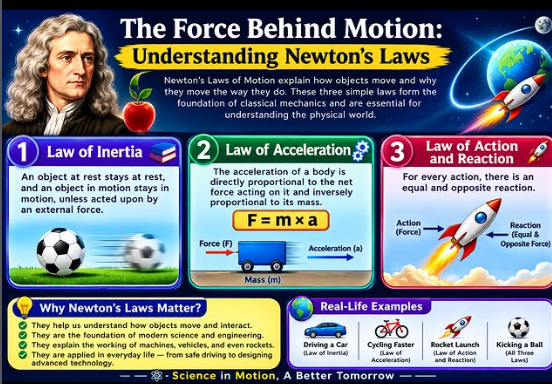
    The Force Behind Motion: Understanding Newton’s Laws

    Motion is one of the most important ideas in physics. Everything around us is constantly affected by forces, whether we notice them or not. A ball rolling across the ground, a car accelerating on a road, a bicycle slowing down, a person jumping, and a rocket launching into space are all examples of motion caused or changed by forces. To understand these everyday movements, scientists use fundamental principles known as Newton’s Laws of Motion.

    Sir Isaac Newton developed his three laws of motion in the 17th century, and they became a foundation of classical physics. These laws help explain the relationship between force, mass, and motion. They allow us to understand not only simple movements around us but also complicated systems involving machines, vehicles, sports, engineering, and space exploration.

    The First Law of Motion, often called the Law of Inertia, explains that an object at rest tends to remain at rest, while an object in motion tends to continue moving in the same direction and at the same speed unless an external force acts upon it. In everyday life, we can see this when a football remains still until someone kicks it. Similarly, when a moving car suddenly stops, passengers tend to move forward because their bodies were already in motion. This law teaches us that objects do not naturally change their motion without a force acting on them.

    The Second Law of Motion explains how force affects the acceleration of an object. It is commonly represented by the equation F = m × a, meaning that force is equal to mass multiplied by acceleration. This law shows that applying a greater force can produce greater acceleration, while an object with greater mass requires more force to achieve the same acceleration. For example, pushing an empty shopping cart is usually easier than pushing a heavily loaded one. This principle is extremely important in the design of vehicles, machines, sports equipment, and many engineering systems.

    The Third Law of Motion states that for every action, there is an equal and opposite
    Mohsin RS F8 🎓✨ Story post NO:18 roll NO:13 Class: Foundation Level 📚 Made by Me 💻🚀 The Force Behind Motion: Understanding Newton’s Laws ⚡🔬🚀 Motion is one of the most important ideas in physics. Everything around us is constantly affected by forces, whether we notice them or not. A ball rolling across the ground, a car accelerating on a road, a bicycle slowing down, a person jumping, and a rocket launching into space are all examples of motion caused or changed by forces. To understand these everyday movements, scientists use fundamental principles known as Newton’s Laws of Motion. Sir Isaac Newton developed his three laws of motion in the 17th century, and they became a foundation of classical physics. These laws help explain the relationship between force, mass, and motion. They allow us to understand not only simple movements around us but also complicated systems involving machines, vehicles, sports, engineering, and space exploration. The First Law of Motion, often called the Law of Inertia, explains that an object at rest tends to remain at rest, while an object in motion tends to continue moving in the same direction and at the same speed unless an external force acts upon it. In everyday life, we can see this when a football remains still until someone kicks it. Similarly, when a moving car suddenly stops, passengers tend to move forward because their bodies were already in motion. This law teaches us that objects do not naturally change their motion without a force acting on them. The Second Law of Motion explains how force affects the acceleration of an object. It is commonly represented by the equation F = m × a, meaning that force is equal to mass multiplied by acceleration. This law shows that applying a greater force can produce greater acceleration, while an object with greater mass requires more force to achieve the same acceleration. For example, pushing an empty shopping cart is usually easier than pushing a heavily loaded one. This principle is extremely important in the design of vehicles, machines, sports equipment, and many engineering systems. The Third Law of Motion states that for every action, there is an equal and opposite
    0 تبصرے 0 شیئرز 635 ویوز
  • RSIF8
    Roll no:85
    Task no:48
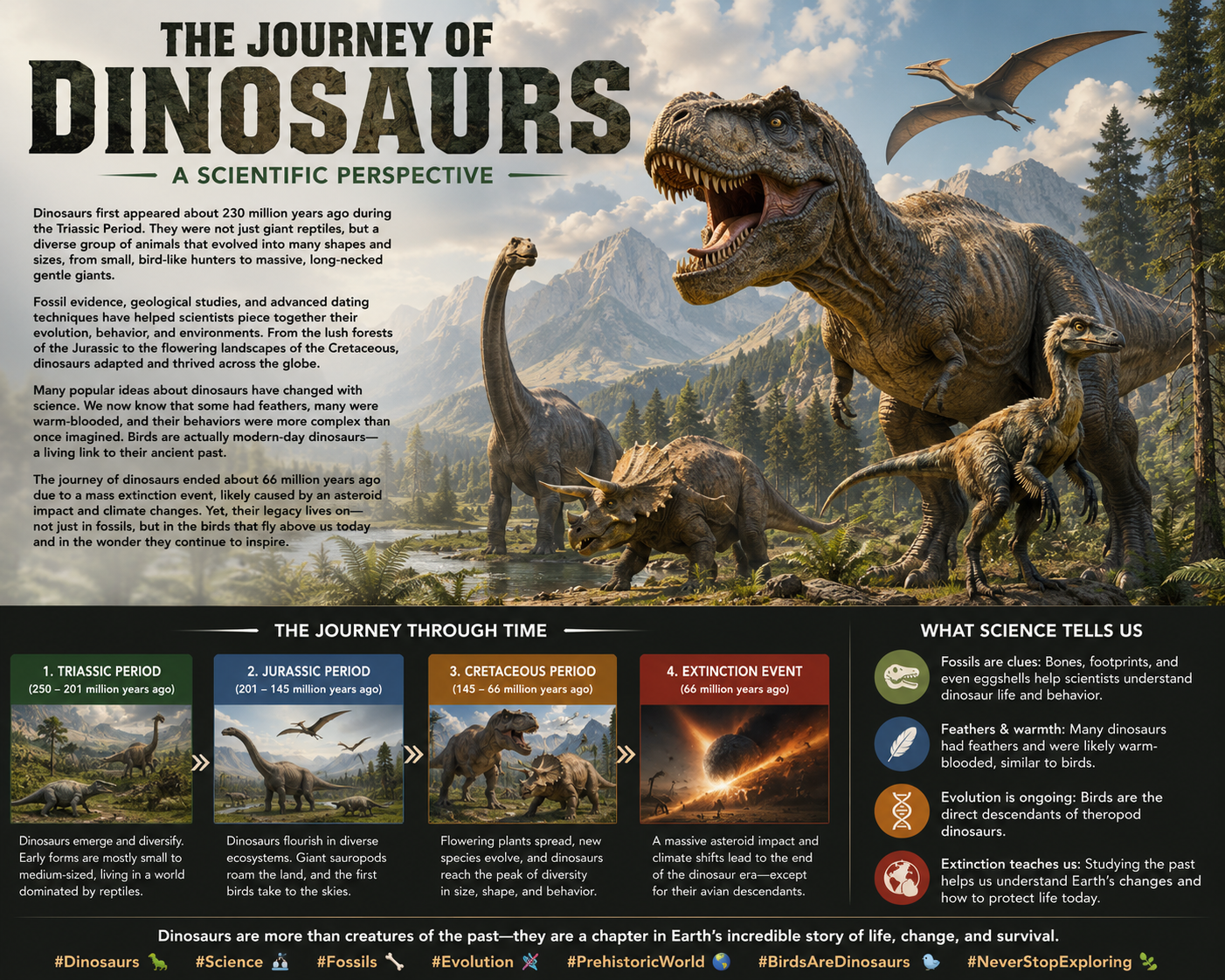
    Task topic: The Journey of Dinosaurs: A Scientific Perspective
    Dinosaurs ruled our planet for more than 160 million years, evolving into countless species that ranged from tiny feathered hunters to gigantic plant-eating giants. Their incredible journey began during the Triassic Period and continued through the Jurassic and Cretaceous periods, shaping Earth's ecosystems in remarkable ways.

    Scientific discoveries through fossils have revealed fascinating details about dinosaur behavior, diets, and even their connection to modern birds. These ancient creatures adapted to changing environments and became one of the most successful groups of animals in Earth's history.

    Their story came to a dramatic end about 66 million years ago when a massive asteroid impact caused a global extinction event. However, the legacy of dinosaurs still lives on through birds, reminding us that evolution is a continuous and amazing process.

    Studying dinosaurs helps scientists understand Earth's past, climate changes, and the evolution of life itself. The journey of dinosaurs is not just a story of extinction—it's a powerful lesson about adaptation, survival, and the ever-changing nature of our planet.
    RSIF8 Roll no:85 Task no:48 Task topic: The Journey of Dinosaurs: A Scientific Perspective Dinosaurs ruled our planet for more than 160 million years, evolving into countless species that ranged from tiny feathered hunters to gigantic plant-eating giants. Their incredible journey began during the Triassic Period and continued through the Jurassic and Cretaceous periods, shaping Earth's ecosystems in remarkable ways. Scientific discoveries through fossils have revealed fascinating details about dinosaur behavior, diets, and even their connection to modern birds. These ancient creatures adapted to changing environments and became one of the most successful groups of animals in Earth's history. Their story came to a dramatic end about 66 million years ago when a massive asteroid impact caused a global extinction event. However, the legacy of dinosaurs still lives on through birds, reminding us that evolution is a continuous and amazing process. Studying dinosaurs helps scientists understand Earth's past, climate changes, and the evolution of life itself. The journey of dinosaurs is not just a story of extinction—it's a powerful lesson about adaptation, survival, and the ever-changing nature of our planet. 🌍
    0 تبصرے 0 شیئرز 1036 ویوز
  • RSISB Roll No:56 Level 2 Work Book A Interview On My Wala No : 01 🎙️ **An Inspiring Interview with Rizwan Ahmed! 🚀💻** I’m excited to share my interview with **Rizwan Ahmed**, a tech leader, full-stack web developer, and founder of **XTechMe**. 🌐✨ In this interview, we talked about his inspiring journey in the technology field, his experience in full-stack development, building commercial web platforms, creating custom business software, and growing his digital agency. 💻📈 We also discussed his experience as an assistant trainer with the **Saylani Mass IT Training Program**, the importance of practical skills, mentoring young learners, entrepreneurship, and the role of education in building a successful technology career. 🎓👨‍🏫 🤖 Another important part of our conversation was **Artificial Intelligence**. We discussed how AI is changing software development, how businesses can use AI, and what opportunities AI may create for developers in the future. Rizwan also shared valuable advice for beginners who want to learn programming, start their own software agency, build real-world projects, and grow their careers in technology. 🌟🔥 🎤 **Interviewer:** Aiza Software Wali 👨‍💻 **Guest:** Rizwan Ahmed 🏢 **Founder:** XTechMe 💻 **Topics:** Full-Stack Development • AI • Software Development • Entrepreneurship • IT Education • Web Development ✨ This conversation is full of valuable knowledge, practical advice, and inspiration for anyone interested in technology and software development. Watch the full interview and learn from Rizwan Ahmed’s journey! 🚀💻 #rizwanahmed #xtechme #aizasoftwarewali #fullstackdeveloper #WebDevelopment #ArtificialIntelligence #SoftwareDevelopment #technology #Programming #entrepreneurship #ITTraining #TechInterviews 🎙️✨ Interview link : https://www.facebook.com/share/v/1DhbXH6NuN/
    WWW.FACEBOOK.COM
    Facebook
    RSISB Roll No:56 Level 2 Work Book A Interview On My Wala No : 01 🎙️ **An Inspiring Interview with Rizwan Ahmed! 🚀💻** I’m excited to share my interview with **Rizwan Ahmed**, a tech leader,...
    0 تبصرے 0 شیئرز 1838 ویوز
  • **Roll No: 2**
    **Batch: 14**
    **Book: ACCL**
    **Task No: 61**

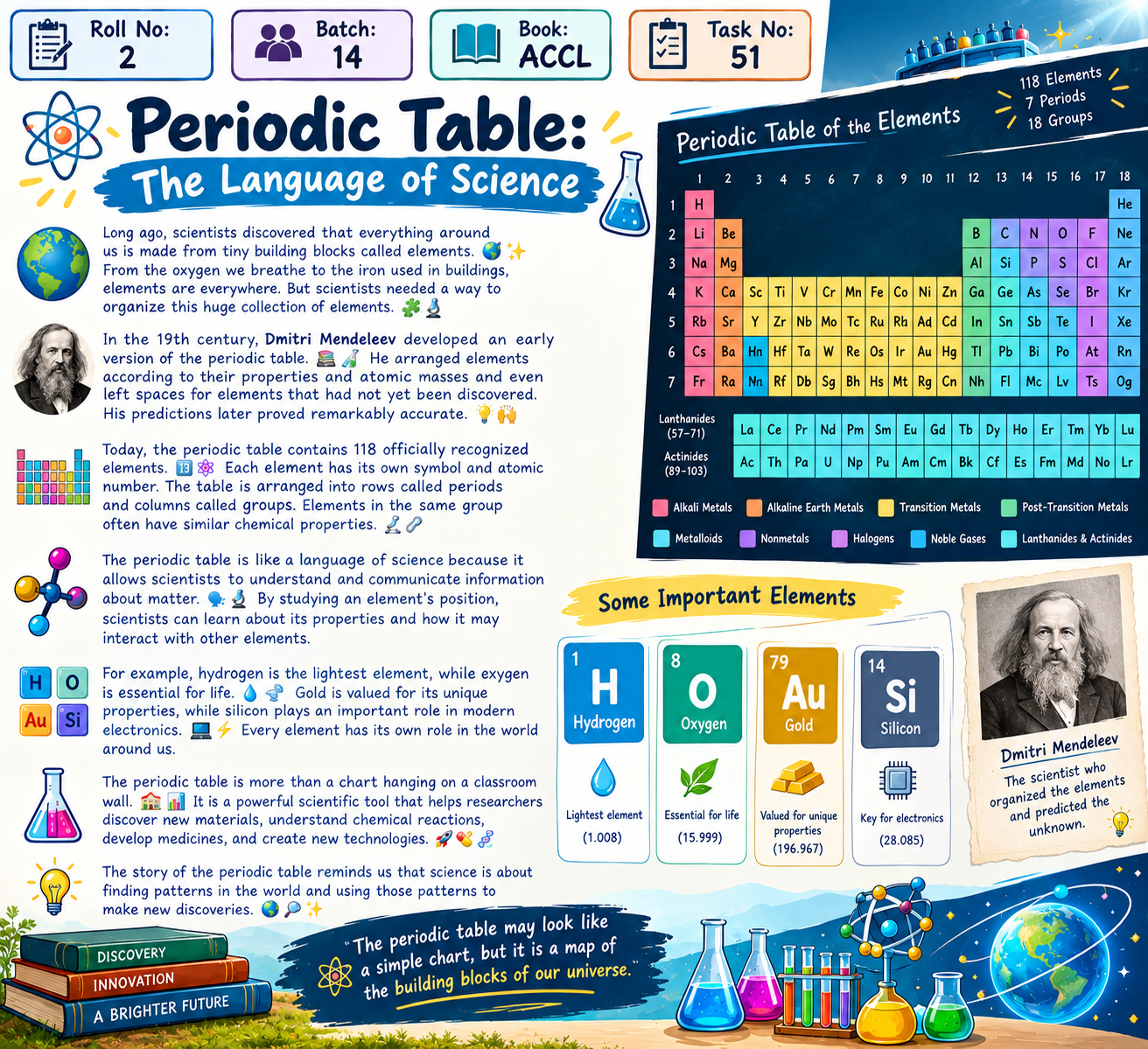
    # Periodic Table: The Language of Science

    Long ago, scientists discovered that everything around us is made from tiny building blocks called **elements**. From the oxygen we breathe to the iron used in buildings, elements are everywhere. But scientists needed a way to organize this huge collection of elements.

    In the 19th century, **Dmitri Mendeleev** developed an early version of the periodic table. He arranged elements according to their properties and atomic masses and even left spaces for elements that had not yet been discovered. His predictions later proved remarkably accurate.

    Today, the periodic table contains **118 officially recognized elements**. Each element has its own symbol and atomic number. The table is arranged into rows called **periods** and columns called **groups**. Elements in the same group often have similar chemical properties.

    The periodic table is like a **language of science** because it allows scientists to understand and communicate information about matter. By studying an element's position, scientists can learn about its properties and how it may interact with other elements.

    For example, hydrogen is the lightest element, while oxygen is essential for life. Gold is valued for its unique properties, while silicon plays an important role in modern electronics. Every element has its own role in the world around us.

    The periodic table is more than a chart hanging on a classroom wall. It is a powerful scientific tool that helps researchers discover new materials, understand chemical reactions, develop medicines, and create new technologies.

    The story of the periodic table reminds us that science is about finding patterns in the world and using those patterns to make new discoveries.

    **The periodic table may look like a simple chart, but it is a map of the building blocks of our universe. **
    **Roll No: 2** **Batch: 14** **Book: ACCL** **Task No: 61** # 🧪 Periodic Table: The Language of Science 🌍🔬 Long ago, scientists discovered that everything around us is made from tiny building blocks called **elements**. 🌎✨ From the oxygen we breathe to the iron used in buildings, elements are everywhere. But scientists needed a way to organize this huge collection of elements. 🧩🔬 In the 19th century, **Dmitri Mendeleev** developed an early version of the periodic table. 📚🧪 He arranged elements according to their properties and atomic masses and even left spaces for elements that had not yet been discovered. His predictions later proved remarkably accurate. 💡👏 Today, the periodic table contains **118 officially recognized elements**. 🔢⚛️ Each element has its own symbol and atomic number. The table is arranged into rows called **periods** and columns called **groups**. Elements in the same group often have similar chemical properties. 🧪🔗 The periodic table is like a **language of science** because it allows scientists to understand and communicate information about matter. 🗣️🔬 By studying an element's position, scientists can learn about its properties and how it may interact with other elements. For example, hydrogen is the lightest element, while oxygen is essential for life. 💧🌬️ Gold is valued for its unique properties, while silicon plays an important role in modern electronics. 💻⚡ Every element has its own role in the world around us. The periodic table is more than a chart hanging on a classroom wall. 🏫📊 It is a powerful scientific tool that helps researchers discover new materials, understand chemical reactions, develop medicines, and create new technologies. 🚀💊🧬 The story of the periodic table reminds us that science is about finding patterns in the world and using those patterns to make new discoveries. 🌍🔎✨ **The periodic table may look like a simple chart, but it is a map of the building blocks of our universe. 🧪⚛️🌌**
    0 تبصرے 0 شیئرز 1159 ویوز
  • #rsisb
    Roll no.231
    song no.16
    Foundation Level


    ## Biology Beats — Long Description

    **Welcome to Biology Beats!**

    Get ready to explore the incredible world of **biology** through an exciting mix of science, discovery, and rhythm! From tiny cells to massive ecosystems , biology reveals the amazing story of life and everything living around us.

    Discover how **cells work**, how our bodies function, how plants grow , how animals survive , and how living organisms interact with their environment. Explore DNA , genetics , evolution , the human body , microorganisms , ecosystems , oceans , and the incredible diversity of life on Earth!

    **Biology Beats** turns fascinating biological ideas into an engaging journey that makes learning science more memorable and fun. Whether you're curious about the human brain , fascinated by microscopic life , amazed by animal behavior , or interested in the secrets hidden inside DNA , there's always something exciting to discover!

    Biology isn't just a school subject—it is the story of **life itself**. From a single cell to an entire rainforest , every organism has a remarkable story.

    Join us as we explore the wonders of life, uncover scientific mysteries, and discover how biology connects **humans, animals, plants, cells, and the entire natural world**.

    ### Emojis

    ‍


    Asma Shaheen EducationWali
    Saima Empowerment Wali
    Irum Asim Leadershipwali
    #rsisb Roll no.231 song no.16 Foundation Level ## 🧬🎵 Biology Beats — Long Description 🌟 **Welcome to Biology Beats!** 🧬🎶 Get ready to explore the incredible world of **biology** through an exciting mix of science, discovery, and rhythm! 🔬🎵 From tiny cells 🔬 to massive ecosystems 🌳🌍, biology reveals the amazing story of life and everything living around us. 🧠🫀🦠🌱 🧬 Discover how **cells work**, how our bodies function, how plants grow 🌿, how animals survive 🐘🦅, and how living organisms interact with their environment. 🌎✨ Explore DNA 🧬, genetics 🔬, evolution 🦖, the human body 🫀, microorganisms 🦠, ecosystems 🌳, oceans 🌊, and the incredible diversity of life on Earth! 🌍🐾 🎶 **Biology Beats** turns fascinating biological ideas into an engaging journey that makes learning science more memorable and fun. Whether you're curious about the human brain 🧠, fascinated by microscopic life 🦠, amazed by animal behavior 🐬, or interested in the secrets hidden inside DNA 🧬, there's always something exciting to discover! 💡 Biology isn't just a school subject—it is the story of **life itself**. From a single cell 🔬 to an entire rainforest 🌴, every organism has a remarkable story. 🌟 🚀 Join us as we explore the wonders of life, uncover scientific mysteries, and discover how biology connects **humans, animals, plants, cells, and the entire natural world**. 🌍🧬🔬 ### 🔥 Emojis 🧬 🔬 🦠 🧠 🫀 🫁 🌱 🌿 🌳 🐾 🐘 🦋 🐬 🦖 🌍 🌎 🌊 ☀️ 🧪 📚 🎵 🎶 💡 ✨ 🤯 🚀 ❤️‍🩹 Asma Shaheen EducationWali Saima Empowerment Wali Irum Asim Leadershipwali
    0 تبصرے 0 شیئرز 1630 ویوز 8
More Results