#rsisb
Roll No 253
Foundation Level
Story Post 23
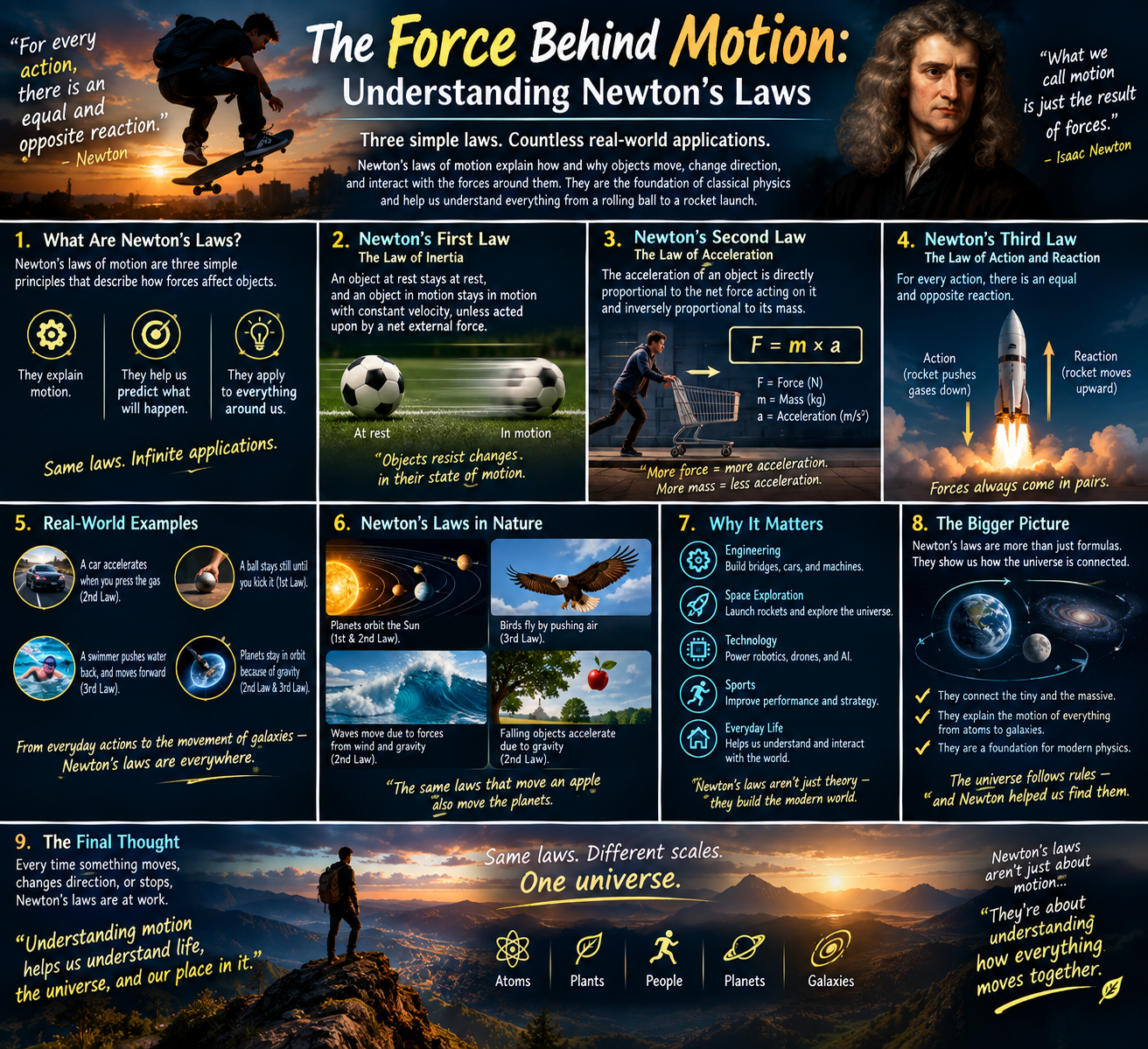
# The Force Behind Motion: Understanding Newton’s Laws
Imagine watching a football fly through the air , a car accelerate down a road , a rocket launch into space , or planets orbiting a star .
These events may appear completely different—but beneath them is the same fundamental idea:
## **Forces control motion.**
More than three centuries ago, **Isaac Newton** developed three laws that transformed our understanding of how objects move and interact. These laws became the foundation of classical mechanics and remain essential to physics, engineering, astronomy, and countless technologies today.
---
# 1. What Are Newton's Laws?
Newton's three laws describe the relationship between:
**Force**
**Mass**
**Acceleration**
**Motion**
Together, they help us explain why objects remain still, why they accelerate, and how forces interact.
From a rolling ball to a spacecraft , the same fundamental principles apply.
### **Three simple laws. Infinite applications.**
---
# 2. Newton's First Law — The Law of Inertia
Newton's First Law states that an object at rest remains at rest, while an object in motion continues moving at constant velocity unless acted upon by a net external force.
This property is called **inertia**.
Imagine a football sitting on the ground.
It stays there until you kick it.
Once moving, it won't naturally change its motion unless another force acts on it—such as friction, air resistance, or another object.
A car requires braking to stop.
A ball slows because of friction.
Objects in space can continue moving with very little resistance.
### **Objects resist changes in their state of motion.**
---
# 3. Newton's Second Law — The Law of Acceleration
The second law explains how force changes motion.
Its famous equation is:
# **F = m × a**
Where:
**F** = Force
**m** = Mass
**a** = Acceleration
This means that increasing the net force on an object generally increases its acceleration, while increasing the object's mass makes the same force produce less acceleration.
Imagine pushing an empty shopping cart .
It accelerates easily.
Now fill it with heavy objects.
The same push produces less acceleration.
### **More net force → more acceleration.**
### **More mass → less acceleration for the same force.**
This simple relationship powers everything from vehicle design to rocket engineering .
---
# 4. Newton's Third Law — Action and Reaction
Newton's Third Law states:
### **For every action, there is an equal and opposite reaction.**
Forces always occur through interactions between objects.
Consider a rocket.
The engine pushes hot gases downward and backward.
The gases exert an equal and opposite force on the rocket, pushing it upward.
The same principle appears everywhere:
A swimmer pushes water backward → the water pushes the swimmer forward.
A bird pushes air downward → the air helps push the bird upward.
You push the ground backward → the ground pushes you forward.
### **Forces come in pairs.**
---
# 5. Newton's Laws in Everyday Life
You don't need a laboratory to see Newton's laws.
They are happening around you constantly.
**Cars:** Engine force changes speed and direction.
**Sports:** Kicking a ball changes its motion.
**Swimming:** Pushing water creates forward motion.
**Cycling:** Pedaling produces forces that accelerate the bicycle.
**Falling objects:** Gravity changes their motion.
**Skateboards:** Pushing against the ground creates movement.
Everyday motion is essentially a continuous interaction between forces.
---
# 6. Newton's Laws in Nature
Newton's laws don't stop at Earth.
They also help describe motion throughout the universe.
Planets orbit stars.
Moons orbit planets.
Comets travel through space.
Waves respond to forces.
Birds generate lift through interactions with air.
Objects accelerate under gravity.
The same physics that explains a falling apple can help describe the motion of enormous celestial bodies.
### **From apples to planets, the same laws operate across nature.**
---
# 7. Why Newton's Laws Matter
Newton's laws are more than equations in a textbook.
They are essential tools for understanding and designing the physical world.
**Engineering** — bridges, buildings, vehicles, and machines
**Space exploration** — rockets, spacecraft, and orbital motion
**Technology** — robots, drones, and automated systems
**Sports science** — movement, speed, and performance
**Transportation** — cars, aircraft, and trains
Modern technology depends heavily on our ability to predict how forces produce motion.
---
# 8. The Bigger Picture
Newton's laws reveal something remarkable:
The universe is not simply a collection of random movements.
Objects interact through measurable forces.
From microscopic particles to massive planets and galaxies , physics provides mathematical relationships that help us understand motion.
The scale may change.
The objects may change.
But the underlying principles remain incredibly powerful.
### **Tiny or massive. Fast or slow. Earth or space. Motion follows physical laws.**
---
# 9. The Final Thought
Every time something moves…
Every time something accelerates…
Every time something changes direction…
**Newton's laws are there.**
A skateboard rolling down a street
A bird taking flight
A rocket leaving Earth
A planet orbiting the Sun
Different events.
Different scales.
One underlying framework.
## **Same laws. Different scales. One universe.**
Understanding motion isn't just about solving equations.
It's about understanding **how the physical world moves, interacts, and holds together.**
### **Once you understand the forces behind motion, the world around you begins to move in a whole new way.**
Asma Shaheen EducationWali
Saima Empowerment Wali
Mishaal TrainingWali
Roll No 253
Foundation Level
Story Post 23
# The Force Behind Motion: Understanding Newton’s Laws
Imagine watching a football fly through the air , a car accelerate down a road , a rocket launch into space , or planets orbiting a star .
These events may appear completely different—but beneath them is the same fundamental idea:
## **Forces control motion.**
More than three centuries ago, **Isaac Newton** developed three laws that transformed our understanding of how objects move and interact. These laws became the foundation of classical mechanics and remain essential to physics, engineering, astronomy, and countless technologies today.
---
# 1. What Are Newton's Laws?
Newton's three laws describe the relationship between:
**Force**
**Mass**
**Acceleration**
**Motion**
Together, they help us explain why objects remain still, why they accelerate, and how forces interact.
From a rolling ball to a spacecraft , the same fundamental principles apply.
### **Three simple laws. Infinite applications.**
---
# 2. Newton's First Law — The Law of Inertia
Newton's First Law states that an object at rest remains at rest, while an object in motion continues moving at constant velocity unless acted upon by a net external force.
This property is called **inertia**.
Imagine a football sitting on the ground.
It stays there until you kick it.
Once moving, it won't naturally change its motion unless another force acts on it—such as friction, air resistance, or another object.
A car requires braking to stop.
A ball slows because of friction.
Objects in space can continue moving with very little resistance.
### **Objects resist changes in their state of motion.**
---
# 3. Newton's Second Law — The Law of Acceleration
The second law explains how force changes motion.
Its famous equation is:
# **F = m × a**
Where:
**F** = Force
**m** = Mass
**a** = Acceleration
This means that increasing the net force on an object generally increases its acceleration, while increasing the object's mass makes the same force produce less acceleration.
Imagine pushing an empty shopping cart .
It accelerates easily.
Now fill it with heavy objects.
The same push produces less acceleration.
### **More net force → more acceleration.**
### **More mass → less acceleration for the same force.**
This simple relationship powers everything from vehicle design to rocket engineering .
---
# 4. Newton's Third Law — Action and Reaction
Newton's Third Law states:
### **For every action, there is an equal and opposite reaction.**
Forces always occur through interactions between objects.
Consider a rocket.
The engine pushes hot gases downward and backward.
The gases exert an equal and opposite force on the rocket, pushing it upward.
The same principle appears everywhere:
A swimmer pushes water backward → the water pushes the swimmer forward.
A bird pushes air downward → the air helps push the bird upward.
You push the ground backward → the ground pushes you forward.
### **Forces come in pairs.**
---
# 5. Newton's Laws in Everyday Life
You don't need a laboratory to see Newton's laws.
They are happening around you constantly.
**Cars:** Engine force changes speed and direction.
**Sports:** Kicking a ball changes its motion.
**Swimming:** Pushing water creates forward motion.
**Cycling:** Pedaling produces forces that accelerate the bicycle.
**Falling objects:** Gravity changes their motion.
**Skateboards:** Pushing against the ground creates movement.
Everyday motion is essentially a continuous interaction between forces.
---
# 6. Newton's Laws in Nature
Newton's laws don't stop at Earth.
They also help describe motion throughout the universe.
Planets orbit stars.
Moons orbit planets.
Comets travel through space.
Waves respond to forces.
Birds generate lift through interactions with air.
Objects accelerate under gravity.
The same physics that explains a falling apple can help describe the motion of enormous celestial bodies.
### **From apples to planets, the same laws operate across nature.**
---
# 7. Why Newton's Laws Matter
Newton's laws are more than equations in a textbook.
They are essential tools for understanding and designing the physical world.
**Engineering** — bridges, buildings, vehicles, and machines
**Space exploration** — rockets, spacecraft, and orbital motion
**Technology** — robots, drones, and automated systems
**Sports science** — movement, speed, and performance
**Transportation** — cars, aircraft, and trains
Modern technology depends heavily on our ability to predict how forces produce motion.
---
# 8. The Bigger Picture
Newton's laws reveal something remarkable:
The universe is not simply a collection of random movements.
Objects interact through measurable forces.
From microscopic particles to massive planets and galaxies , physics provides mathematical relationships that help us understand motion.
The scale may change.
The objects may change.
But the underlying principles remain incredibly powerful.
### **Tiny or massive. Fast or slow. Earth or space. Motion follows physical laws.**
---
# 9. The Final Thought
Every time something moves…
Every time something accelerates…
Every time something changes direction…
**Newton's laws are there.**
A skateboard rolling down a street
A bird taking flight
A rocket leaving Earth
A planet orbiting the Sun
Different events.
Different scales.
One underlying framework.
## **Same laws. Different scales. One universe.**
Understanding motion isn't just about solving equations.
It's about understanding **how the physical world moves, interacts, and holds together.**
### **Once you understand the forces behind motion, the world around you begins to move in a whole new way.**
Asma Shaheen EducationWali
Saima Empowerment Wali
Mishaal TrainingWali
#rsisb
Roll No 253
Foundation Level
Story Post 23
# ⚡🌌 The Force Behind Motion: Understanding Newton’s Laws
Imagine watching a football fly through the air ⚽, a car accelerate down a road 🚗💨, a rocket launch into space 🚀, or planets orbiting a star 🪐✨.
These events may appear completely different—but beneath them is the same fundamental idea:
## **Forces control motion.** ⚡🧲
More than three centuries ago, **Isaac Newton** developed three laws that transformed our understanding of how objects move and interact. These laws became the foundation of classical mechanics and remain essential to physics, engineering, astronomy, and countless technologies today. 🔬⚙️🌍
---
# 🧠⚡ 1. What Are Newton's Laws?
Newton's three laws describe the relationship between:
⚡ **Force**
🧱 **Mass**
💨 **Acceleration**
🏃 **Motion**
Together, they help us explain why objects remain still, why they accelerate, and how forces interact.
From a rolling ball 🎾 to a spacecraft 🚀, the same fundamental principles apply.
### **Three simple laws. Infinite applications.** 🌌
---
# 🛑➡️ 2. Newton's First Law — The Law of Inertia
Newton's First Law states that an object at rest remains at rest, while an object in motion continues moving at constant velocity unless acted upon by a net external force.
This property is called **inertia**. 🧱⚡
Imagine a football sitting on the ground. ⚽
It stays there until you kick it.
Once moving, it won't naturally change its motion unless another force acts on it—such as friction, air resistance, or another object.
🚗 A car requires braking to stop.
⚽ A ball slows because of friction.
🛰️ Objects in space can continue moving with very little resistance.
### **Objects resist changes in their state of motion.**
---
# 💨⚙️ 3. Newton's Second Law — The Law of Acceleration
The second law explains how force changes motion.
Its famous equation is:
# **F = m × a** ⚡
Where:
**F** = Force 🧲
**m** = Mass ⚖️
**a** = Acceleration 💨
This means that increasing the net force on an object generally increases its acceleration, while increasing the object's mass makes the same force produce less acceleration.
Imagine pushing an empty shopping cart 🛒.
It accelerates easily.
Now fill it with heavy objects.
The same push produces less acceleration.
### **More net force → more acceleration.**
### **More mass → less acceleration for the same force.**
This simple relationship powers everything from vehicle design 🚗 to rocket engineering 🚀.
---
# 🚀🔥 4. Newton's Third Law — Action and Reaction
Newton's Third Law states:
### **For every action, there is an equal and opposite reaction.** ⚡
Forces always occur through interactions between objects.
Consider a rocket. 🚀
The engine pushes hot gases downward and backward.
The gases exert an equal and opposite force on the rocket, pushing it upward. ⬆️🔥
The same principle appears everywhere:
🏊 A swimmer pushes water backward → the water pushes the swimmer forward.
🦅 A bird pushes air downward → the air helps push the bird upward.
🚶 You push the ground backward → the ground pushes you forward.
### **Forces come in pairs.** 🔗⚡
---
# 🌍⚽ 5. Newton's Laws in Everyday Life
You don't need a laboratory to see Newton's laws.
They are happening around you constantly.
🚗 **Cars:** Engine force changes speed and direction.
⚽ **Sports:** Kicking a ball changes its motion.
🏊 **Swimming:** Pushing water creates forward motion.
🚲 **Cycling:** Pedaling produces forces that accelerate the bicycle.
🍎 **Falling objects:** Gravity changes their motion.
🛹 **Skateboards:** Pushing against the ground creates movement.
Everyday motion is essentially a continuous interaction between forces.
---
# 🌌🪐 6. Newton's Laws in Nature
Newton's laws don't stop at Earth.
They also help describe motion throughout the universe. 🌌
🪐 Planets orbit stars.
🌙 Moons orbit planets.
☄️ Comets travel through space.
🌊 Waves respond to forces.
🦅 Birds generate lift through interactions with air.
🍎 Objects accelerate under gravity.
The same physics that explains a falling apple can help describe the motion of enormous celestial bodies.
### **From apples to planets, the same laws operate across nature.** 🍎➡️🪐
---
# ⚙️🚀 7. Why Newton's Laws Matter
Newton's laws are more than equations in a textbook.
They are essential tools for understanding and designing the physical world.
🏗️ **Engineering** — bridges, buildings, vehicles, and machines
🚀 **Space exploration** — rockets, spacecraft, and orbital motion
🤖 **Technology** — robots, drones, and automated systems
🏃 **Sports science** — movement, speed, and performance
🚗 **Transportation** — cars, aircraft, and trains
Modern technology depends heavily on our ability to predict how forces produce motion.
---
# 🌌🔭 8. The Bigger Picture
Newton's laws reveal something remarkable:
The universe is not simply a collection of random movements.
Objects interact through measurable forces. ⚛️🧲
From microscopic particles 🔬 to massive planets 🪐 and galaxies 🌌, physics provides mathematical relationships that help us understand motion.
The scale may change.
The objects may change.
But the underlying principles remain incredibly powerful.
### **Tiny or massive. Fast or slow. Earth or space. Motion follows physical laws.** ⚡🌍🌌
---
# 🌅⚡ 9. The Final Thought
Every time something moves…
Every time something accelerates…
Every time something changes direction…
**Newton's laws are there.** 🧠⚡
A skateboard rolling down a street 🛹
A bird taking flight 🦅
A rocket leaving Earth 🚀
A planet orbiting the Sun ☀️🪐
Different events.
Different scales.
One underlying framework.
## 🌌 **Same laws. Different scales. One universe.**
Understanding motion isn't just about solving equations.
It's about understanding **how the physical world moves, interacts, and holds together.** ⚛️🌍✨
### **Once you understand the forces behind motion, the world around you begins to move in a whole new way.** ⚡🔬🌌
Asma Shaheen EducationWali
Saima Empowerment Wali
Mishaal TrainingWali
0 Commentarii
0 Distribuiri
390 Views