



Fondation Level Batch No 4
Roll RSLC #42
Task No #153
Day #153
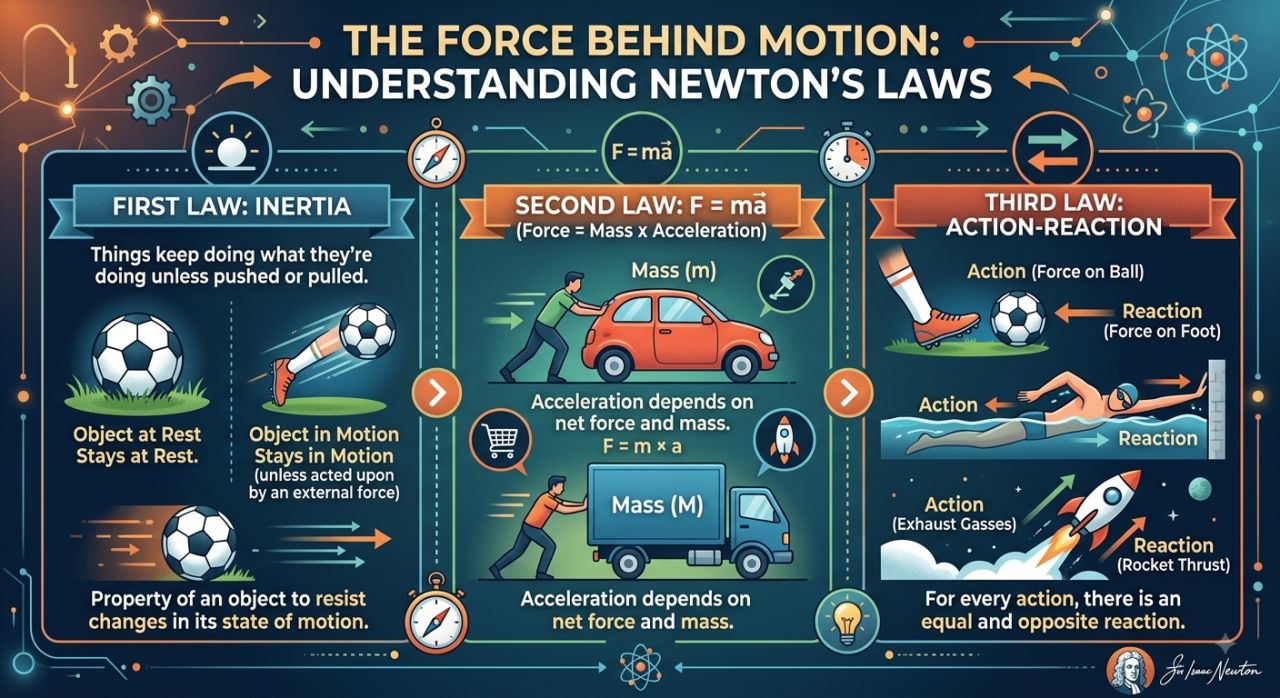
One bright morning, Adam was playing in a park when he noticed a football resting quietly on the grass. He gently kicked the ball, and it suddenly began rolling across the field. Curious, Adam wondered why the ball had moved only after he kicked it. His teacher explained that this was connected to Newton?s First Law of Motion. An object remains at rest or keeps moving in the same way unless an external force changes its motion. Adam realized that even a simple kick could demonstrate an important scientific principle. From that moment, he became interested in discovering the forces behind everyday movement.
Adam then decided to test how different objects responded to force. He pushed a light ball and a heavier ball with similar strength and noticed that the lighter ball moved more easily. His teacher explained Newton?s Second Law, which connects force, mass, and acceleration. Adam learned that applying more force can produce a greater change in an object?s motion. He also discovered that heavier objects usually need more force to achieve the same acceleration. Suddenly, pushing a bicycle, moving a box, or kicking a ball seemed much more interesting to him. He understood that forces were constantly influencing the world around him.
Later, Adam threw a ball against a wall and watched it bounce back toward him. His teacher explained that this was an example of Newton?s Third Law of Motion. Whenever one object applies a force to another object, an equal and opposite force acts back. Adam realized that this principle could be seen when people walk, jump, swim, or ride a bicycle. When his feet pushed the ground backward, the ground pushed him forward. He also learned that rockets move upward by pushing gases downward at high speed. Newton?s Third Law suddenly made many everyday movements easier for Adam to understand.
By the end of the day, Adam realized that Newton?s laws were much more than formulas in a science book. They were powerful principles that explained how objects move, stop, accelerate, and interact with one another. He could see examples of them in cars, bicycles, sports, falling objects, machines, and even rockets traveling into space. The world around him suddenly looked like a fascinating laboratory filled with invisible forces. Adam understood that physics helps us discover the rules behind ordinary events. From a simple football rolling across the grass to a spacecraft leaving Earth, Newton?s laws tell an amazing story about the force behind motion.
#NewtonLaws #Physics #ForceAndMotion #NewtonianPhysics #ScienceEducation #PhysicsExplained #LearningScience
Roll RSLC #42
Task No #153
Day #153
One bright morning, Adam was playing in a park when he noticed a football resting quietly on the grass. He gently kicked the ball, and it suddenly began rolling across the field. Curious, Adam wondered why the ball had moved only after he kicked it. His teacher explained that this was connected to Newton?s First Law of Motion. An object remains at rest or keeps moving in the same way unless an external force changes its motion. Adam realized that even a simple kick could demonstrate an important scientific principle. From that moment, he became interested in discovering the forces behind everyday movement.
Adam then decided to test how different objects responded to force. He pushed a light ball and a heavier ball with similar strength and noticed that the lighter ball moved more easily. His teacher explained Newton?s Second Law, which connects force, mass, and acceleration. Adam learned that applying more force can produce a greater change in an object?s motion. He also discovered that heavier objects usually need more force to achieve the same acceleration. Suddenly, pushing a bicycle, moving a box, or kicking a ball seemed much more interesting to him. He understood that forces were constantly influencing the world around him.
Later, Adam threw a ball against a wall and watched it bounce back toward him. His teacher explained that this was an example of Newton?s Third Law of Motion. Whenever one object applies a force to another object, an equal and opposite force acts back. Adam realized that this principle could be seen when people walk, jump, swim, or ride a bicycle. When his feet pushed the ground backward, the ground pushed him forward. He also learned that rockets move upward by pushing gases downward at high speed. Newton?s Third Law suddenly made many everyday movements easier for Adam to understand.
By the end of the day, Adam realized that Newton?s laws were much more than formulas in a science book. They were powerful principles that explained how objects move, stop, accelerate, and interact with one another. He could see examples of them in cars, bicycles, sports, falling objects, machines, and even rockets traveling into space. The world around him suddenly looked like a fascinating laboratory filled with invisible forces. Adam understood that physics helps us discover the rules behind ordinary events. From a simple football rolling across the grass to a spacecraft leaving Earth, Newton?s laws tell an amazing story about the force behind motion.
#NewtonLaws #Physics #ForceAndMotion #NewtonianPhysics #ScienceEducation #PhysicsExplained #LearningScience
Fondation Level Batch No 4
Roll RSLC #42
Task No #153
Day #153
One bright morning, Adam was playing in a park when he noticed a football resting quietly on the grass. He gently kicked the ball, and it suddenly began rolling across the field. Curious, Adam wondered why the ball had moved only after he kicked it. His teacher explained that this was connected to Newton?s First Law of Motion. An object remains at rest or keeps moving in the same way unless an external force changes its motion. Adam realized that even a simple kick could demonstrate an important scientific principle. From that moment, he became interested in discovering the forces behind everyday movement.
Adam then decided to test how different objects responded to force. He pushed a light ball and a heavier ball with similar strength and noticed that the lighter ball moved more easily. His teacher explained Newton?s Second Law, which connects force, mass, and acceleration. Adam learned that applying more force can produce a greater change in an object?s motion. He also discovered that heavier objects usually need more force to achieve the same acceleration. Suddenly, pushing a bicycle, moving a box, or kicking a ball seemed much more interesting to him. He understood that forces were constantly influencing the world around him.
Later, Adam threw a ball against a wall and watched it bounce back toward him. His teacher explained that this was an example of Newton?s Third Law of Motion. Whenever one object applies a force to another object, an equal and opposite force acts back. Adam realized that this principle could be seen when people walk, jump, swim, or ride a bicycle. When his feet pushed the ground backward, the ground pushed him forward. He also learned that rockets move upward by pushing gases downward at high speed. Newton?s Third Law suddenly made many everyday movements easier for Adam to understand.
By the end of the day, Adam realized that Newton?s laws were much more than formulas in a science book. They were powerful principles that explained how objects move, stop, accelerate, and interact with one another. He could see examples of them in cars, bicycles, sports, falling objects, machines, and even rockets traveling into space. The world around him suddenly looked like a fascinating laboratory filled with invisible forces. Adam understood that physics helps us discover the rules behind ordinary events. From a simple football rolling across the grass to a spacecraft leaving Earth, Newton?s laws tell an amazing story about the force behind motion.
#NewtonLaws #Physics #ForceAndMotion #NewtonianPhysics #ScienceEducation #PhysicsExplained #LearningScience
0 Σχόλια
0 Μοιράστηκε
189 Views