• RSIF8
    Roll no:100
    Task no:13
    Task topic:Mulla Nasrudin's Missing Ring
    The Story of Mulla Nasrudin and the Missing Ring
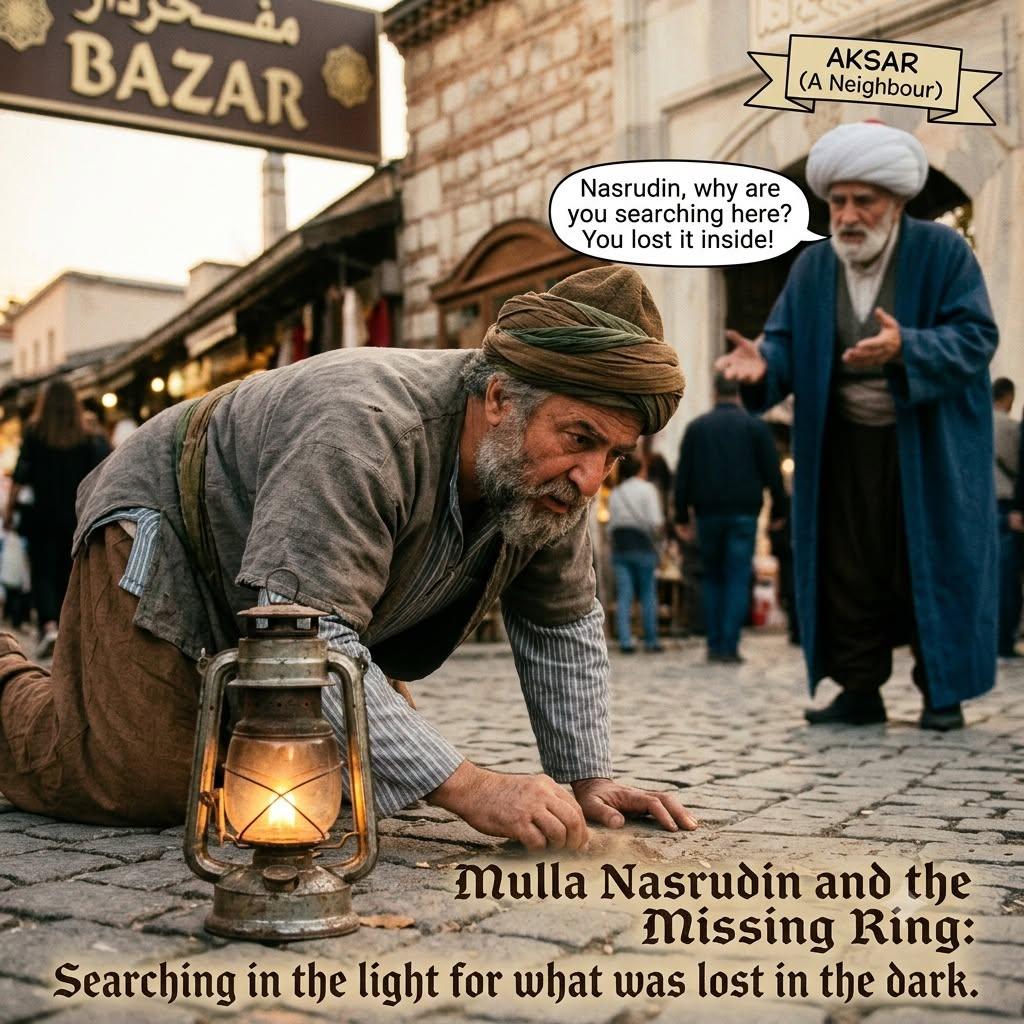
    It was a bustling evening in the heart of the ancient bazaar , but amidst the crowd, one man was completely preoccupied. **Mulla Nasrudin** was down on all fours, frantically brushing aside the dust and peering between the cobblestones.
    Right beside him sat a single, flickering lantern , casting a warm glow over his desperate search.
    His neighbor, **Aksar**, happened to be walking by and stopped in his tracks. Seeing his old friend on his knees looking completely distressed, Aksar called out:
    *"Nasrudin! What on earth are you doing down there?"*
    Mulla looked up, wiping sweat from his brow. *"I'm looking for my ring! I've lost it and I can't find it anywhere!"*
    Being a good neighbor, Aksar immediately knelt down to help. They searched together for a while, combing through the dirt, but found absolutely nothing.
    Finally, Aksar paused, looking around the bright street, and asked a logical question:
    *"Nasrudin, think back. Where exactly were you standing when you dropped it?"*
    Mulla pointed toward his house in the distance. *"Oh, I lost it inside my house, all the way in the back room!"*
    Aksar stared at him in utter disbelief. *"Nasrudin, if you lost the ring inside your house, why on earth are you searching out here in the middle of the street?!"*
    Mulla Nasrudin looked at him calmly and smiled.
    *"Well, my friend, isn't it obvious? It's pitch black inside my house, but out here under the streetlamps, there is so much more light!"*
    > **The Lesson:** We often look for solutions in the easiest, most comfortable places rather than looking where the actual problem lies.
    #MullaNasrudin #MissingRing #NasrudinStories #SufiWisdom #Parable #AncientTales #FolkTales #Philosophy #LifeLessons #WiseWords #BazaarVibes #ClassicStories #StoryTime #InstaStory #DeepThoughts #LookingInTheWrongPlace #Perspective #Mindset
    RSIF8 Roll no:100 Task no:13 Task topic:Mulla Nasrudin's Missing Ring 💍 The Story of Mulla Nasrudin and the Missing Ring ✨ It was a bustling evening in the heart of the ancient bazaar 🕌, but amidst the crowd, one man was completely preoccupied. **Mulla Nasrudin** was down on all fours, frantically brushing aside the dust and peering between the cobblestones. 🧐 Right beside him sat a single, flickering lantern 🕯️, casting a warm glow over his desperate search. His neighbor, **Aksar**, happened to be walking by and stopped in his tracks. Seeing his old friend on his knees looking completely distressed, Aksar called out: 🗣️ *"Nasrudin! What on earth are you doing down there?"* Mulla looked up, wiping sweat from his brow. 😰 *"I'm looking for my ring! I've lost it and I can't find it anywhere!"* Being a good neighbor, Aksar immediately knelt down to help. They searched together for a while, combing through the dirt, but found absolutely nothing. 🤷‍♂️ Finally, Aksar paused, looking around the bright street, and asked a logical question: 🤔 *"Nasrudin, think back. Where exactly were you standing when you dropped it?"* Mulla pointed toward his house in the distance. 🏠 *"Oh, I lost it inside my house, all the way in the back room!"* Aksar stared at him in utter disbelief. 🤯 *"Nasrudin, if you lost the ring inside your house, why on earth are you searching out here in the middle of the street?!"* Mulla Nasrudin looked at him calmly and smiled. 😏 *"Well, my friend, isn't it obvious? It's pitch black inside my house, but out here under the streetlamps, there is so much more light!"* 💡 > **The Lesson:** We often look for solutions in the easiest, most comfortable places rather than looking where the actual problem lies. 🧠✨ #MullaNasrudin #MissingRing #NasrudinStories #SufiWisdom #Parable #AncientTales #FolkTales #Philosophy #LifeLessons #WiseWords #BazaarVibes #ClassicStories #StoryTime #InstaStory #DeepThoughts #LookingInTheWrongPlace #Perspective #Mindset
    0 Comments 0 Shares 315 Views
  • @adam writes

    Hi Rehan! Dont know if you still remember what we talk about on Sunday, but now I continue that. You asked about why Jesus taught Israel with parables. Well, there is a statement in Matthew 13:
    34 Jesus spoke all these things to the crowd in parables; he did not say anything to them without using a parable.
    35 So was fulfilled what was spoken through the prophet:
    “I will open my mouth in parables,
    I will utter things hidden since the creation of the world.”[c]

    That was foretold in Psalm 78:2.

    But if you remember, you asked why Jesus spoke in riddles (not always), wouldnt be better if He just teach everything clearly?

    And well, I tried to explain that. In the Gospel of John chapter 12 it is said:
    37 Even after Jesus had performed so many signs in their presence, they still would not believe in him.
    38 This was to fulfill the word of Isaiah the prophet:

    “Lord, who has believed our message
    and to whom has the arm of the Lord been revealed?”[h]

    39 For this reason they could not believe, because, as Isaiah says elsewhere:

    40 “He has blinded their eyes
    and hardened their hearts,
    so they can neither see with their eyes,
    nor understand with their hearts,
    nor turn—and I would heal them.”[i]

    41 Isaiah said this because he saw Jesus’ glory and spoke about him.

    42 Yet at the same time many even among the leaders believed in him. But because of the Pharisees they would not openly acknowledge their faith for fear they would be put out of the synagogue; 43 for they loved human praise more than praise from God.

    44 Then Jesus cried out, “Whoever believes in me does not believe in me only, but in the one who sent me. 45 The one who looks at me is seeing the one who sent me. 46 I have come into the world as a light, so that no one who believes in me should stay in darkness.

    47 “If anyone hears my words but does not keep them, I do not judge that person. For I did not come to judge the world, but to save the world. 48 There is a judge for the one who rejects me and does not accept my words; the very words I have spoken will condemn them at the last day. 49 For I did not speak on my own, but the Father who sent me commanded me to say all that I have spoken.

    John was written about Isaiah 6:
    1 In the year that King Uzziah died, I saw the Lord, high and exalted, seated on a throne; and the train of his robe filled the temple.
    2 Above him were seraphim, each with six wings: With two wings they covered their faces, with two they covered their feet, and with two they were flying. 3 And they were calling to one another:

    “Holy, holy, holy is the Lord Almighty;
    the whole earth is full of his glory.”

    4 At the sound of their voices the doorposts and thresholds shook and the temple was filled with smoke.

    5 “Woe to me!” I cried. “I am ruined! For I am a man of unclean lips, and I live among a people of unclean lips, and my eyes have seen the King, the Lord Almighty.”

    6 Then one of the seraphim flew to me with a live coal in his hand, which he had taken with tongs from the altar. 7 With it he touched my mouth and said, “See, this has touched your lips; your guilt is taken away and your sin atoned for.”

    8 Then I heard the voice of the Lord saying, “Whom shall I send? And who will go for us?”

    And I said, “Here am I. Send me!”

    9 He said, “Go and tell this people:

    “‘Be ever hearing, but never understanding;
    be ever seeing, but never perceiving.’
    10 Make the heart of this people calloused;
    make their ears dull
    and close their eyes.[a]
    Otherwise they might see with their eyes,
    hear with their ears,
    understand with their hearts,
    and turn and be healed.”

    11 Then I said, “For how long, Lord?”

    And he answered:

    “Until the cities lie ruined
    and without inhabitant,
    until the houses are left deserted
    and the fields ruined and ravaged,
    12 until the Lord has sent everyone far away
    and the land is utterly forsaken.
    13 And though a tenth remains in the land,
    it will again be laid waste.
    But as the terebinth and oak
    leave stumps when they are cut down,
    so the holy seed will be the stump in the land.”

    So as I tried to explain you that, Jesus revealed the truth, but in parables, because God tested the free will and faith of His people first (and they failed in the past so many times, that God took away from them the chance to repent, because if some one sins so many times and repent from it over and over again, at some point they loose their sense of sin on that matter...so next time when they commit that sin again, as their defense against that sin broke, they will no more see it as a sin, and so they became dull and blind to the truth, and behind this spiritual law, as for all spiritual and natural laws, is God), and then and from then on to this day the free will and faith of every other nation.

    Notice that Isaiah supposedly spoke about God the Father, yet the Apostle John, the beloved disciple explained by the Holy Spirit, that Isaiah actually saw Jesus, God the Son. Because Jesus is the image of the Holy Father (Colossians 1:15), and no man can see God and survive. Only if he saw just His Image.

    You see, Jesus said this:
    Luke 8
    9 His disciples asked him what this parable meant.
    10 He said, “The knowledge of the secrets of the kingdom of God has been given to you, but to others I speak in parables, so that,

    “‘though seeing, they may not see;
    though hearing, they may not understand.’[a]

    11 “This is the meaning of the parable: The seed is the word of God.

    And this in Matthew 13:
    8 Still other seed fell on good soil, where it produced a crop—a hundred, sixty or thirty times what was sown.
    9 Whoever has ears, let them hear.”

    10 The disciples came to him and asked, “Why do you speak to the people in parables?”

    11 He replied, “Because the knowledge of the secrets of the kingdom of heaven has been given to you, but not to them.
    12 Whoever has will be given more, and they will have an abundance. Whoever does not have, even what they have will be taken from them.
    13 This is why I speak to them in parables:

    “Though seeing, they do not see;
    though hearing, they do not hear or understand.

    14 In them is fulfilled the prophecy of Isaiah:

    “‘You will be ever hearing but never understanding;
    you will be ever seeing but never perceiving.
    15 For this people’s heart has become calloused;
    they hardly hear with their ears,
    and they have closed their eyes.
    Otherwise they might see with their eyes,
    hear with their ears,
    understand with their hearts
    and turn, and I would heal them.’[a]

    16 But blessed are your eyes because they see, and your ears because they hear. 17 For truly I tell you, many prophets and righteous people longed to see what you see but did not see it, and to hear what you hear but did not hear it.

    18 “Listen then to what the parable of the sower means:

    "Whoever has will be given more, and they will have an abundance. Whoever does not have, even what they have will be taken from them." This means, that whoever has faith in Christ, will be given everlasting life (and will understand by the Holy Spirit), and whoever does not have faith in Jesus, even what life they have will be taken from them. Thats damnation.
    @adam writes Hi Rehan! Don't know if you still remember what we talk about on Sunday, but now I continue that. You asked about why Jesus taught Israel with parables. Well, there is a statement in Matthew 13: 34 Jesus spoke all these things to the crowd in parables; he did not say anything to them without using a parable. 35 So was fulfilled what was spoken through the prophet: “I will open my mouth in parables, I will utter things hidden since the creation of the world.”[c] That was foretold in Psalm 78:2. But if you remember, you asked why Jesus spoke in riddles (not always), wouldn't be better if He just teach everything clearly? And well, I tried to explain that. In the Gospel of John chapter 12 it is said: 37 Even after Jesus had performed so many signs in their presence, they still would not believe in him. 38 This was to fulfill the word of Isaiah the prophet: “Lord, who has believed our message and to whom has the arm of the Lord been revealed?”[h] 39 For this reason they could not believe, because, as Isaiah says elsewhere: 40 “He has blinded their eyes and hardened their hearts, so they can neither see with their eyes, nor understand with their hearts, nor turn—and I would heal them.”[i] 41 Isaiah said this because he saw Jesus’ glory and spoke about him. 42 Yet at the same time many even among the leaders believed in him. But because of the Pharisees they would not openly acknowledge their faith for fear they would be put out of the synagogue; 43 for they loved human praise more than praise from God. 44 Then Jesus cried out, “Whoever believes in me does not believe in me only, but in the one who sent me. 45 The one who looks at me is seeing the one who sent me. 46 I have come into the world as a light, so that no one who believes in me should stay in darkness. 47 “If anyone hears my words but does not keep them, I do not judge that person. For I did not come to judge the world, but to save the world. 48 There is a judge for the one who rejects me and does not accept my words; the very words I have spoken will condemn them at the last day. 49 For I did not speak on my own, but the Father who sent me commanded me to say all that I have spoken. John was written about Isaiah 6: 1 In the year that King Uzziah died, I saw the Lord, high and exalted, seated on a throne; and the train of his robe filled the temple. 2 Above him were seraphim, each with six wings: With two wings they covered their faces, with two they covered their feet, and with two they were flying. 3 And they were calling to one another: “Holy, holy, holy is the Lord Almighty; the whole earth is full of his glory.” 4 At the sound of their voices the doorposts and thresholds shook and the temple was filled with smoke. 5 “Woe to me!” I cried. “I am ruined! For I am a man of unclean lips, and I live among a people of unclean lips, and my eyes have seen the King, the Lord Almighty.” 6 Then one of the seraphim flew to me with a live coal in his hand, which he had taken with tongs from the altar. 7 With it he touched my mouth and said, “See, this has touched your lips; your guilt is taken away and your sin atoned for.” 8 Then I heard the voice of the Lord saying, “Whom shall I send? And who will go for us?” And I said, “Here am I. Send me!” 9 He said, “Go and tell this people: “‘Be ever hearing, but never understanding; be ever seeing, but never perceiving.’ 10 Make the heart of this people calloused; make their ears dull and close their eyes.[a] Otherwise they might see with their eyes, hear with their ears, understand with their hearts, and turn and be healed.” 11 Then I said, “For how long, Lord?” And he answered: “Until the cities lie ruined and without inhabitant, until the houses are left deserted and the fields ruined and ravaged, 12 until the Lord has sent everyone far away and the land is utterly forsaken. 13 And though a tenth remains in the land, it will again be laid waste. But as the terebinth and oak leave stumps when they are cut down, so the holy seed will be the stump in the land.” So as I tried to explain you that, Jesus revealed the truth, but in parables, because God tested the free will and faith of His people first (and they failed in the past so many times, that God took away from them the chance to repent, because if some one sins so many times and repent from it over and over again, at some point they loose their sense of sin on that matter...so next time when they commit that sin again, as their defense against that sin broke, they will no more see it as a sin, and so they became dull and blind to the truth, and behind this spiritual law, as for all spiritual and natural laws, is God), and then and from then on to this day the free will and faith of every other nation. Notice that Isaiah supposedly spoke about God the Father, yet the Apostle John, the beloved disciple explained by the Holy Spirit, that Isaiah actually saw Jesus, God the Son. Because Jesus is the image of the Holy Father (Colossians 1:15), and no man can see God and survive. Only if he saw just His Image. You see, Jesus said this: Luke 8 9 His disciples asked him what this parable meant. 10 He said, “The knowledge of the secrets of the kingdom of God has been given to you, but to others I speak in parables, so that, “‘though seeing, they may not see; though hearing, they may not understand.’[a] 11 “This is the meaning of the parable: The seed is the word of God. And this in Matthew 13: 8 Still other seed fell on good soil, where it produced a crop—a hundred, sixty or thirty times what was sown. 9 Whoever has ears, let them hear.” 10 The disciples came to him and asked, “Why do you speak to the people in parables?” 11 He replied, “Because the knowledge of the secrets of the kingdom of heaven has been given to you, but not to them. 12 Whoever has will be given more, and they will have an abundance. Whoever does not have, even what they have will be taken from them. 13 This is why I speak to them in parables: “Though seeing, they do not see; though hearing, they do not hear or understand. 14 In them is fulfilled the prophecy of Isaiah: “‘You will be ever hearing but never understanding; you will be ever seeing but never perceiving. 15 For this people’s heart has become calloused; they hardly hear with their ears, and they have closed their eyes. Otherwise they might see with their eyes, hear with their ears, understand with their hearts and turn, and I would heal them.’[a] 16 But blessed are your eyes because they see, and your ears because they hear. 17 For truly I tell you, many prophets and righteous people longed to see what you see but did not see it, and to hear what you hear but did not hear it. 18 “Listen then to what the parable of the sower means: "Whoever has will be given more, and they will have an abundance. Whoever does not have, even what they have will be taken from them." This means, that whoever has faith in Christ, will be given everlasting life (and will understand by the Holy Spirit), and whoever does not have faith in Jesus, even what life they have will be taken from them. Thats damnation.
    0 Comments 0 Shares 1542 Views
  • **MAJOR ATTRIBUTES OF LEADERSHIP**

    1. UNWAVERING COURAGE based upon knowledge of self, and of ones occupation. No follower wishes to be dominated by a leader who lacks self-confidence and courage. No intelligent follower will be dominated by such a leader very long.

    2. SELF-CONTROL. The man who cannot control himself, can never control others. Self-control sets a mighty example for ones followers, which the more intelligent will emulate.

    3. A KEEN SENSE OF JUSTICE. Without a sense of fairness and justice, no leader can command and retain the respect of his followers.

    4. DEFINITENESS OF DECISION. The man who wavers in his decisions, shows that he is not sure of himself. He cannot lead others successfully.

    5. DEFINITENESS OF PLANS. The successful leader must plan his work, and work his plan. A leader who moves by guesswork, without practical, definite plans, is comparable to a ship without a rudder. Sooner or later he will land on the rocks.

    6. THE HABIT OF DOING MORE THAN PAID FOR. One of the penalties of leadership is the necessity of willingness, upon the part of the leader, to do more than he requires of his followers.

    7. A PLEASING PERSONALITY. No slovenly, careless person can become a successful leader. Leadership calls for respect. Followers will not respect a leader who does not grade high on all of the factors of a Pleasing Personality.

    8. SYMPATHY AND UNDERSTANDING. The successful leader must be in sympathy with his followers. Moreover, he must understand them and their problems.

    9. MASTERY OF DETAIL. Successful leadership calls for mastery of details of the leaders position.
    10. WILLINGNESS TO ASSUME FULL RESPONSIBILITY. The successful leader must be willing to assume responsibility for the mistakes and the shortcomings of his followers. If he tries to shift this responsibility, he will not remain the leader. If one of his followers makes a mistake, and shows himself incompetent, the leader must consider that it is he who failed.

    11. COOPERATION. The successful leader must understand, and apply the principle of cooperative effort and be able to induce his followers to do the same. Leadership calls for POWER, and power calls for COOPERATION. There are two forms of Leadership. The first, and by far the most effective, is LEADERSHIP BY CONSENT of, and with the sympathy of the followers. The second is LEADERSHIP BY FORCE, without the consent and sympathy of the followers.

    BY Napoleon Hill

    Shared via Aneeque Samad Khan
    **MAJOR ATTRIBUTES OF LEADERSHIP** 1. UNWAVERING COURAGE based upon knowledge of self, and of one's occupation. No follower wishes to be dominated by a leader who lacks self-confidence and courage. No intelligent follower will be dominated by such a leader very long. 2. SELF-CONTROL. The man who cannot control himself, can never control others. Self-control sets a mighty example for one's followers, which the more intelligent will emulate. 3. A KEEN SENSE OF JUSTICE. Without a sense of fairness and justice, no leader can command and retain the respect of his followers. 4. DEFINITENESS OF DECISION. The man who wavers in his decisions, shows that he is not sure of himself. He cannot lead others successfully. 5. DEFINITENESS OF PLANS. The successful leader must plan his work, and work his plan. A leader who moves by guesswork, without practical, definite plans, is comparable to a ship without a rudder. Sooner or later he will land on the rocks. 6. THE HABIT OF DOING MORE THAN PAID FOR. One of the penalties of leadership is the necessity of willingness, upon the part of the leader, to do more than he requires of his followers. 7. A PLEASING PERSONALITY. No slovenly, careless person can become a successful leader. Leadership calls for respect. Followers will not respect a leader who does not grade high on all of the factors of a Pleasing Personality. 8. SYMPATHY AND UNDERSTANDING. The successful leader must be in sympathy with his followers. Moreover, he must understand them and their problems. 9. MASTERY OF DETAIL. Successful leadership calls for mastery of details of the leader's position. 10. WILLINGNESS TO ASSUME FULL RESPONSIBILITY. The successful leader must be willing to assume responsibility for the mistakes and the shortcomings of his followers. If he tries to shift this responsibility, he will not remain the leader. If one of his followers makes a mistake, and shows himself incompetent, the leader must consider that it is he who failed. 11. COOPERATION. The successful leader must understand, and apply the principle of cooperative effort and be able to induce his followers to do the same. Leadership calls for POWER, and power calls for COOPERATION. There are two forms of Leadership. The first, and by far the most effective, is LEADERSHIP BY CONSENT of, and with the sympathy of the followers. The second is LEADERSHIP BY FORCE, without the consent and sympathy of the followers. BY Napoleon Hill Shared via Aneeque Samad Khan
    0 Comments 0 Shares 722 Views
  • THIS IS A SOLUTION, HOW TO FINISH CORRUPTION?

    Well everyone in Pakistan seems to commend the achievements of Singapore in drastically reducing the corruption level. It is a matter of pride for us Asians that we have one Asian country in the list of top 5 corruption less country. Today in this article we shall try to see what steps Singapore took to ensure such great achievement, which now have become an example for other countries to follow. I will try to keep the article short and simple, and “to the point”.

    Before beginning the main discussion we have to look at some quick facts on Singapore. Singapore is a small island country made up of 63 islands, in the southern tip of Malay Peninsula. Singapore is one of the most advanced economies in the world, with successful free market economy. Like India, Singapore was a British colony, and got rid of the British in 31st August 1963. Since then they made rapid progress, thanks to some efficient planning and execution. Her GDP per ca-pita is 62,100 $, and what is amazing is the fact that the GDP is still growing at the rate of 14.5%. When it started off though, just after independence she had a GDP per ca pita of 511$, what a remarkable leap!

    Initially Singapore, when it started off as a developing country did face the crisis of corruption, but they left no stone upturned to achieve a level that has become the subject of study to many foreign Nations. During the 1950’s the police inspectors of Singapore stole 1,800 tons of narcotics and forced the British to form some sort of vigilance commission named- CPIB (Corrupt Practices Investigation Bureau). This didn’t help much until major restructuring and improvements were made inside CPIB itself. “In response, in the 1970s, Singapore reorganized the CPIB and gave it considerable powers to curb endemic corruption. The reorganized CPIB concentrated its activities on investigation and enforcement. Evidence of the CPIB’s success in reducing corruption is present from Singapore’s highly favorable investment climate that “typically ranks among the top twenty recipients of foreign investment in the world in absolute terms.” This success in attracting investments attests to that government’s ability to overcome the perverse effects of reputation in the persistence of corrupt behavior.” “Among the CPIB’s unique characteristics are its small size, narrow police emphasis, and service to a semi-authoritarian regime. With only 75 staff members, the CPIB lacks the presence of Hong Kong’s ICAC, and it has accordingly a narrow investigative function. The CPIB has relied on deterrent strategies; for example, a conviction for corruption may carry a $100,000.00 fine and up to five years in prison.

    But it’s not only the CPIB which makes all the differences there are others parts as well. Let me summarize those in order.

    In an article on Corruption Control in Singapore, Mr Koh Teck Hin, Deputy Director CPIB, Singapore outlines those salient points which forms the core of the anti corruption campaign of Singapore:-

    POLITICAL WILL

    Mr. Koh Teck Hin, says, “These sentiments reflect the determination and political will for the fight against corruption. Political will is a key ingredient in the transformation effort from Singapore’s corruption infested past as it forms that all important sub-structure, upon which all the super-structures of anti-corruption work rest. It provides the soil and the nutrient which allows the seeds of anti-corruption work to germinate and grow. The government has matched its words with deeds – it mobilized the public, and the entire civil service to fight corruption.”

    FRAMEWORK OF CORRUPTION CONTROL

    With a strong political will as the foundation, the framework of corruption control consists of four pillars, consisting of 4As, as follows:

    A. Effective Anti Corruption Acts (or laws)

    I. This allows CPIB to inspect both private and public cases. Since Public cases are also vital to ensure corruption free run of corporate and attract investment.
    II. The public official has to prove his innocence if he is reported to have accepted bribes or under table payments.

    III. A bribe acceptor would still be punished if he fails to return favour after accepting the bribe.

    IV. The act forbids to public officials to accept gifts.

    V. The act empowers the official to pay the exact amount of bribe he received apart from other punishment.

    VI. The act reserves punishment for any cases of corruption committed outside Singapore.

    B. Effective Anti Corruption Agency

    I. The CPIB is the only agency empowered with the right and independence to deal with any cases of corruption.
    II. It can investigate cases of any person however high in the hierarchy he may be.

    III. It directly reports to the Prime Minister and no one else.

    IV. The Bureau’s slogan is “swift and sure” by which it ensures fast and outright coverage of cases.

    C. Effective Adjudication (or punishment)

    I. Transparency in the Judicial Process.
    II. The court slams a penalty to the offender, which is, to pay the exact amount of bribe taken.

    III. The Government nullifies all the contracts or favors granted by any convicted corrupt official, while in service. The contractor who gave the bribe is barred to enter into any government for five years.

    IV. There can be court ruling of double payment. For instance if an official in a MNC accepts bribe, he has to pay the government the money he accepted as bribe, adding to that if the company where he served asks for compensation he has to pay the company as well.

    D. Efficient Government Administration.

    Preventive and Administrative Measures in the Public Sector.

    I. A public officer cannot borrow money from any person who has official dealings with him or her;
    II. A public officer’s unsecured debts and liabilities cannot at anytime be more than three times his other monthly salary;

    III. A public officer cannot use any official information to further his or her private interest;

    IV. A public officer is required to declare his or her assets at his or her first appointment and also annually;

    V. A public officer cannot engage in trade or business or undertake any part-time employment without approval; and

    VI. A public officer cannot receive entertainment or present in any form from members of the public.

    Proper care is taken so that the Public officers are paid well and,

    I. identifying and removing opportunity for corruption in Government work procedures;

    II. streamlining cumbersome administrative procedures and slashing red tape to provide an efficient and transparent civil service so that no one needs to recourse to corrupt civil servants to get things done;

    III. reviewing public officers’ salary regularly to ensure that they are paid adequately and comparable to that of the private sector;

    IV. reminding Government contractors at the time when contracts are signed that bribing public officers administering the contract may render their contracts to be terminated. A clause to this effect forms part of the standard contract conditions.

    EFFECTIVE ADMINISTRATION:

    a. An effective administration reduces hurdles and provide swiftest the delivery of the public benefit.
    b. Major Reforms in 1995 called “Public Service in the 21st century”.

    c. Zero in Process: By which passing a file “from one desk to the other” is reduced.

    d. Public Officers have websites where in they point those areas where improvements are needed and accordingly improvements are made.

    e. The general public can put their grievances and suggestions online, it is obligatory for public officers to reply those issues.This keeps the Governments “at their toes”.

    f. A new system known as OBLS (Online Business Licensing Service) has been taken up. Where even a hawker can apply for licence over net, instead of physical going to door to door and thus receive his licence sitting at home.

    g. The CPIB organizes workshops where it invites administrative officials from UK, US, France, Australia, Korea, and Hong Kong for cross learning and knowledge sharing.

    So this is the story of Singapore and the steps they took to fight corruption. I haven’t found anything closely relevant to things such as ‘Lokpal Bill’ being brought into Singapore in 1982, as many nowadays say. But they have made it possible in their very own way. Our case is certainly different than theirs’. May be we need Lokpal since all other forms proved a failure when it came to reduce corruption, on the contrary day by day it has spread like an epidemic, our solution therefore is bound to be different. Whether the Lokpal bill will be the greatest solution I can’t say that, what I want to say is a strong “political will” is required to overhaul the system of administration as well.

    Many intellectuals are saying that Lokpal will have enormous power and that may be bad for the stability of Pakistan. But it is also true, that if only a public servant does wrong, Lokpal will come into action and not till then. So if one does good work why should he fear at all?

    enjoy!
    THIS IS A SOLUTION, HOW TO FINISH CORRUPTION? Well everyone in Pakistan seems to commend the achievements of Singapore in drastically reducing the corruption level. It is a matter of pride for us Asians that we have one Asian country in the list of top 5 corruption less country. Today in this article we shall try to see what steps Singapore took to ensure such great achievement, which now have become an example for other countries to follow. I will try to keep the article short and simple, and “to the point”. Before beginning the main discussion we have to look at some quick facts on Singapore. Singapore is a small island country made up of 63 islands, in the southern tip of Malay Peninsula. Singapore is one of the most advanced economies in the world, with successful free market economy. Like India, Singapore was a British colony, and got rid of the British in 31st August 1963. Since then they made rapid progress, thanks to some efficient planning and execution. Her GDP per ca-pita is 62,100 $, and what is amazing is the fact that the GDP is still growing at the rate of 14.5%. When it started off though, just after independence she had a GDP per ca pita of 511$, what a remarkable leap! Initially Singapore, when it started off as a developing country did face the crisis of corruption, but they left no stone upturned to achieve a level that has become the subject of study to many foreign Nations. During the 1950’s the police inspectors of Singapore stole 1,800 tons of narcotics and forced the British to form some sort of vigilance commission named- CPIB (Corrupt Practices Investigation Bureau). This didn’t help much until major restructuring and improvements were made inside CPIB itself. “In response, in the 1970s, Singapore reorganized the CPIB and gave it considerable powers to curb endemic corruption. The reorganized CPIB concentrated its activities on investigation and enforcement. Evidence of the CPIB’s success in reducing corruption is present from Singapore’s highly favorable investment climate that “typically ranks among the top twenty recipients of foreign investment in the world in absolute terms.” This success in attracting investments attests to that government’s ability to overcome the perverse effects of reputation in the persistence of corrupt behavior.” “Among the CPIB’s unique characteristics are its small size, narrow police emphasis, and service to a semi-authoritarian regime. With only 75 staff members, the CPIB lacks the presence of Hong Kong’s ICAC, and it has accordingly a narrow investigative function. The CPIB has relied on deterrent strategies; for example, a conviction for corruption may carry a $100,000.00 fine and up to five years in prison. But it’s not only the CPIB which makes all the differences there are others parts as well. Let me summarize those in order. In an article on Corruption Control in Singapore, Mr Koh Teck Hin, Deputy Director CPIB, Singapore outlines those salient points which forms the core of the anti corruption campaign of Singapore:- POLITICAL WILL Mr. Koh Teck Hin, says, “These sentiments reflect the determination and political will for the fight against corruption. Political will is a key ingredient in the transformation effort from Singapore’s corruption infested past as it forms that all important sub-structure, upon which all the super-structures of anti-corruption work rest. It provides the soil and the nutrient which allows the seeds of anti-corruption work to germinate and grow. The government has matched its words with deeds – it mobilized the public, and the entire civil service to fight corruption.” FRAMEWORK OF CORRUPTION CONTROL With a strong political will as the foundation, the framework of corruption control consists of four pillars, consisting of 4As, as follows: A. Effective Anti Corruption Acts (or laws) I. This allows CPIB to inspect both private and public cases. Since Public cases are also vital to ensure corruption free run of corporate and attract investment. II. The public official has to prove his innocence if he is reported to have accepted bribes or under table payments. III. A bribe acceptor would still be punished if he fails to return favour after accepting the bribe. IV. The act forbids to public officials to accept gifts. V. The act empowers the official to pay the exact amount of bribe he received apart from other punishment. VI. The act reserves punishment for any cases of corruption committed outside Singapore. B. Effective Anti Corruption Agency I. The CPIB is the only agency empowered with the right and independence to deal with any cases of corruption. II. It can investigate cases of any person however high in the hierarchy he may be. III. It directly reports to the Prime Minister and no one else. IV. The Bureau’s slogan is “swift and sure” by which it ensures fast and outright coverage of cases. C. Effective Adjudication (or punishment) I. Transparency in the Judicial Process. II. The court slams a penalty to the offender, which is, to pay the exact amount of bribe taken. III. The Government nullifies all the contracts or favors granted by any convicted corrupt official, while in service. The contractor who gave the bribe is barred to enter into any government for five years. IV. There can be court ruling of double payment. For instance if an official in a MNC accepts bribe, he has to pay the government the money he accepted as bribe, adding to that if the company where he served asks for compensation he has to pay the company as well. D. Efficient Government Administration. Preventive and Administrative Measures in the Public Sector. I. A public officer cannot borrow money from any person who has official dealings with him or her; II. A public officer’s unsecured debts and liabilities cannot at anytime be more than three times his other monthly salary; III. A public officer cannot use any official information to further his or her private interest; IV. A public officer is required to declare his or her assets at his or her first appointment and also annually; V. A public officer cannot engage in trade or business or undertake any part-time employment without approval; and VI. A public officer cannot receive entertainment or present in any form from members of the public. Proper care is taken so that the Public officers are paid well and, I. identifying and removing opportunity for corruption in Government work procedures; II. streamlining cumbersome administrative procedures and slashing red tape to provide an efficient and transparent civil service so that no one needs to recourse to corrupt civil servants to get things done; III. reviewing public officers’ salary regularly to ensure that they are paid adequately and comparable to that of the private sector; IV. reminding Government contractors at the time when contracts are signed that bribing public officers administering the contract may render their contracts to be terminated. A clause to this effect forms part of the standard contract conditions. EFFECTIVE ADMINISTRATION: a. An effective administration reduces hurdles and provide swiftest the delivery of the public benefit. b. Major Reforms in 1995 called “Public Service in the 21st century”. c. Zero in Process: By which passing a file “from one desk to the other” is reduced. d. Public Officers have websites where in they point those areas where improvements are needed and accordingly improvements are made. e. The general public can put their grievances and suggestions online, it is obligatory for public officers to reply those issues.This keeps the Governments “at their toes”. f. A new system known as OBLS (Online Business Licensing Service) has been taken up. Where even a hawker can apply for licence over net, instead of physical going to door to door and thus receive his licence sitting at home. g. The CPIB organizes workshops where it invites administrative officials from UK, US, France, Australia, Korea, and Hong Kong for cross learning and knowledge sharing. So this is the story of Singapore and the steps they took to fight corruption. I haven’t found anything closely relevant to things such as ‘Lokpal Bill’ being brought into Singapore in 1982, as many nowadays say. But they have made it possible in their very own way. Our case is certainly different than theirs’. May be we need Lokpal since all other forms proved a failure when it came to reduce corruption, on the contrary day by day it has spread like an epidemic, our solution therefore is bound to be different. Whether the Lokpal bill will be the greatest solution I can’t say that, what I want to say is a strong “political will” is required to overhaul the system of administration as well. Many intellectuals are saying that Lokpal will have enormous power and that may be bad for the stability of Pakistan. But it is also true, that if only a public servant does wrong, Lokpal will come into action and not till then. So if one does good work why should he fear at all? enjoy!
    0 Comments 0 Shares 3491 Views
  • Once upon a time, in a small village in Pakistan called Choti Basti, there lived three best friends: Afsan, Waqar, and Chugli. They were known to be inseparable and spent most of their time together. However, each of them had a different way of engaging in conversations.

    Afsan, the wise parrot, loved discussing ideas and learning new things. He enjoyed pondering over questions like "What if the sky changed colors every day?" or "How can we make Choti Basti a better place?"

    Waqar, the curious monkey, was interested in discussing events that happened around the village. He would often talk about the recent cricket match, the Eid celebrations, or the new school that was being built.

    Chugli, the mischievous mynah, enjoyed gossiping about other animals in the village. She would often share stories about who was friends with whom, and who had a fight with their neighbor.

    One day, a wise old elephant named Hikmat visited Choti Basti. He gathered all the animals and told them about a magical tree that could grant them one wish. The animals were excited and started discussing what they would wish for.

    Afsan, Waqar, and Chugli decided to meet under a banyan tree to discuss their wishes. Afsan shared an idea about wishing for a library full of books, so everyone in the village could learn and grow. Waqar talked about wishing for a grand festival where everyone could come together and celebrate their unity. Chugli, on the other hand, wanted to wish for the ability to know everyones secrets.

    As they were discussing their wishes, Hikmat the elephant overheard them. He approached the friends and shared his wisdom. "My dear friends, it is important to remember that the conversations you have reflect the kind of person you are. Afsan, your passion for ideas will lead to growth and innovation in Choti Basti. Waqar, your enthusiasm for events helps to bring people together. But Chugli, gossiping about others can create unnecessary problems and discord."

    Chugli realized the wisdom in Hikmats words and decided to change her ways. From that day on, the three friends continued their discussions, with Chugli focusing more on ideas and events rather than gossiping about others. Together, they made Choti Basti a happier and more harmonious place to live.
    Once upon a time, in a small village in Pakistan called Choti Basti, there lived three best friends: Afsan, Waqar, and Chugli. They were known to be inseparable and spent most of their time together. However, each of them had a different way of engaging in conversations. Afsan, the wise parrot, loved discussing ideas and learning new things. He enjoyed pondering over questions like "What if the sky changed colors every day?" or "How can we make Choti Basti a better place?" Waqar, the curious monkey, was interested in discussing events that happened around the village. He would often talk about the recent cricket match, the Eid celebrations, or the new school that was being built. Chugli, the mischievous mynah, enjoyed gossiping about other animals in the village. She would often share stories about who was friends with whom, and who had a fight with their neighbor. One day, a wise old elephant named Hikmat visited Choti Basti. He gathered all the animals and told them about a magical tree that could grant them one wish. The animals were excited and started discussing what they would wish for. Afsan, Waqar, and Chugli decided to meet under a banyan tree to discuss their wishes. Afsan shared an idea about wishing for a library full of books, so everyone in the village could learn and grow. Waqar talked about wishing for a grand festival where everyone could come together and celebrate their unity. Chugli, on the other hand, wanted to wish for the ability to know everyone's secrets. As they were discussing their wishes, Hikmat the elephant overheard them. He approached the friends and shared his wisdom. "My dear friends, it is important to remember that the conversations you have reflect the kind of person you are. Afsan, your passion for ideas will lead to growth and innovation in Choti Basti. Waqar, your enthusiasm for events helps to bring people together. But Chugli, gossiping about others can create unnecessary problems and discord." Chugli realized the wisdom in Hikmat's words and decided to change her ways. From that day on, the three friends continued their discussions, with Chugli focusing more on ideas and events rather than gossiping about others. Together, they made Choti Basti a happier and more harmonious place to live.
    0 Comments 0 Shares 421 Views
  • The Forty Rules of Love.

    1. **How we see God** is a direct reflection of how we see ourselves. If God brings to mind mostly fear and blame, it means there is mostly fear and blame within us.
    2. **The path to the Truth** is a labor of the heart, not of the head. Make your heart your primary guide, not your mind. Meet, challenge, and ultimately prevail over your nafs (ego) with your heart.
    3. **You can study God** through everything and everyone in the universe because God is not confined in a mosque, synagogue, or church. But if you are still in need of knowing where exactly His abode is, there is only one place to look for Him: in the heart of a true lover.
    4. **Intellect and love** are made of different materials. Intellect ties people in knots and risks nothing, but love dissolves all tangles and risks everything.
    5. **Most of the problems** of the world stem from linguistic mistakes and simple misunderstandings. Don’t ever take words at face value. When you step into the zone of love, language as we know it becomes obsolete. That which cannot be put into words can only be grasped through silence.
    6. **Loneliness and solitude** are two different things. When you are lonely, it is easy to delude yourself into believing that you are on the right path. Solitude is better for us, as it means being alone without feeling lonely.
    7. **Whatever happens in your life, no matter how troubling things might seem, do not enter the neighborhood of despair.** Even when all doors remain closed, God will open up a new path only for you. Be thankful!
    8. **Patience does not mean to passively endure.** It means to look at the end of a process. What does patience mean? It means to look at the thorn and see the rose, to look at the night and see the dawn. Impatience means to be shortsighted as to not be able to see the outcome.
    9. **East, west, south, or north** makes little difference. No matter what your destination, just be sure to make every journey a journey within. If you travel within, you’ll travel the whole wide world and beyond.
    10. **The midwife knows** that when there is no pain, the way for the baby cannot be opened, and the mother cannot give birth. Similarly, for a new Self to be born, hardship is necessary. Just as clay needs to go through intense heat to become strong, Love can only be perfected in pain.
    11. **The quest for love** changes user. There is no seeker among those who search for love who has not matured on the way.
    12. **There are more false guides** and teachers in this world than stars in the visible universe. Beware of impostors. And know that it is only real guidance that can lead you to the Love that you seek.
    13. **Not all suffering** is harmful. There are some that cleanse us and purify us, and there are some that drag us down and lead us into more darkness.
    14. **It is easy to love** a perfect God, unblemished and immaculate that He is. What is far more difficult is to love fellow human beings with all their imperfections and defects.
    15. **The true lover is** the one who can thrill you by kissing your forehead or smiling into your eyes or just staring into space.
    16. **Try not to resist the changes** which come your way. Instead, let life live through you. And do not worry that your life is turning upside down. How do you know that the side you are used to is better than the one to come?
    17. **Love is a travel.** All travelers whether they want or not are changed. No one can travel into Love and remain the same.
    18. **If you want to change the way others treat you**, you should first change the way you treat yourself. Unless you learn to love yourself, fully and sincerely, there is no way you can be loved.
    19. **Real filth is the one inside.** The rest simply washes off.
    20. **The whole universe is contained within a single human being – you.** Everything that you see around, including the things you might not be fond of and even the people you despise or abhor, is present within you in varying degrees. Therefore, do not look for Sheitan (Satan) outside yourself either. The devil is not an extraordinary force that attacks from outside. It is an ordinary voice within.
    21. **The world is like a snowy mountain** that echoes your voice. Whatever you speak, good or evil, will somehow come back to you. Therefore, if there is someone who harbors ill thoughts about you, saying similarly bad things about him will only make matters worse. You will be locked in a vicious circle of malevolent energy. Instead, for forty days and nights, say and think nice things about that person. Everything will be different at the end of the forty days.
    22. **The past is an interpretation.** The future is an illusion. The world does not move through time as if it were a straight line, proceeding from the past to the future. Instead, time moves through and within us, in endless spirals. Eternity does not mean infinite time but simply timelessness. If you want to experience eternal illumination, put the past and the future out of your mind and remain within the present moment.
    23. **Fate does not mean** that your life has been strictly predetermined. Therefore, to leave everything to fate and not actively contribute to the music of the universe is a sign of sheer ignorance.
    24. **Never forget that God is a meticulous clockmaker.** So precise is His order that everything on earth happens in its own time. Neither a minute late nor a minute early. And everything is created with a divine wisdom. We are all just like clocks, including our main springs. Therefore, be patient about your perplexities and wait for the unraveling of the mysteries of your life.
    25. **As long as we keep getting lost in our own desires,** fears, and worries, we will not be able to find the real self. Therefore, surrender to the flow of the rivers of life without any reservations.
    26. **The past is a distant shore, and the future is an imaginary horizon.** Only the present is real. Therefore, take heed to your present thoughts and actions, for they will become your destiny.
    27. **Suffering is not a punishment; it is a gift.** Within suffering is hidden mercy and blessings.
    28. **Be grateful to those who have hurt or wronged you**, for they have helped you learn about patience and compassion.
    29. **What is true of the individual will be tomorrow true of the whole nation.** If falsehood brings calamity to one person, it will be a greater evil for an entire people.
    30. **If you want to change the world**, you should first change yourself. Change and transformation start within, not outside.
    31. **Peace is not the absence of conflict but the presence of creative alternatives for responding to conflict** — alternatives to passive or aggressive responses, alternatives to violence.
    32. **The purpose of the existence of every person is to realize God within oneself.** It is the knowledge of this that brings enlightenment and peace to the soul.
    33. **Love is the water of life.** And a lover is a soul of fire! The universe turns differently when fire loves water.
    34. **When you love someone, there is no way you can distance yourself from the pain of the other.** When someone suffers, you too feel the pain. And if you can stay unaffected by the pain, that is not love.
    35. **The ultimate aim of life is to find the divine truth that lies within.** No matter what happens in life, you need to always seek the higher self within you.
    36. **All religious practices are meant to be only a means to an end.** They are merely our human ways of making the divine reality visible to our finite minds. However, it is not the outward appearance of religious practices that is important, but their inward essence.
    37. **Once you embark on the path of truth,** be prepared for both hardships and joy. They will be your inseparable companions.
    38. **You will learn to live through both sorrow and joy, like an empty bell which makes a sound only when it is hit.** The more you are pained, the more the instrument of your soul will be refined and the better you will be able to express yourself.
    39. **The true essence of love lies beyond words and expressions.** The more you try to express it, the more it will elude you. Words can only be symbols for the inexpressible truth.
    40. **When you come face-to-face with the real essence of love, you will no longer be searching for it.** For the search will become unnecessary, and you will be immersed in the divine truth of love.

    These rules emphasize the themes of love, spirituality, and the inner journey, aligning with the teachings of Sufism and the spiritual bond between Rumi and Shams of Tabriz.
    The Forty Rules of Love. 1. **How we see God** is a direct reflection of how we see ourselves. If God brings to mind mostly fear and blame, it means there is mostly fear and blame within us. 2. **The path to the Truth** is a labor of the heart, not of the head. Make your heart your primary guide, not your mind. Meet, challenge, and ultimately prevail over your nafs (ego) with your heart. 3. **You can study God** through everything and everyone in the universe because God is not confined in a mosque, synagogue, or church. But if you are still in need of knowing where exactly His abode is, there is only one place to look for Him: in the heart of a true lover. 4. **Intellect and love** are made of different materials. Intellect ties people in knots and risks nothing, but love dissolves all tangles and risks everything. 5. **Most of the problems** of the world stem from linguistic mistakes and simple misunderstandings. Don’t ever take words at face value. When you step into the zone of love, language as we know it becomes obsolete. That which cannot be put into words can only be grasped through silence. 6. **Loneliness and solitude** are two different things. When you are lonely, it is easy to delude yourself into believing that you are on the right path. Solitude is better for us, as it means being alone without feeling lonely. 7. **Whatever happens in your life, no matter how troubling things might seem, do not enter the neighborhood of despair.** Even when all doors remain closed, God will open up a new path only for you. Be thankful! 8. **Patience does not mean to passively endure.** It means to look at the end of a process. What does patience mean? It means to look at the thorn and see the rose, to look at the night and see the dawn. Impatience means to be shortsighted as to not be able to see the outcome. 9. **East, west, south, or north** makes little difference. No matter what your destination, just be sure to make every journey a journey within. If you travel within, you’ll travel the whole wide world and beyond. 10. **The midwife knows** that when there is no pain, the way for the baby cannot be opened, and the mother cannot give birth. Similarly, for a new Self to be born, hardship is necessary. Just as clay needs to go through intense heat to become strong, Love can only be perfected in pain. 11. **The quest for love** changes user. There is no seeker among those who search for love who has not matured on the way. 12. **There are more false guides** and teachers in this world than stars in the visible universe. Beware of impostors. And know that it is only real guidance that can lead you to the Love that you seek. 13. **Not all suffering** is harmful. There are some that cleanse us and purify us, and there are some that drag us down and lead us into more darkness. 14. **It is easy to love** a perfect God, unblemished and immaculate that He is. What is far more difficult is to love fellow human beings with all their imperfections and defects. 15. **The true lover is** the one who can thrill you by kissing your forehead or smiling into your eyes or just staring into space. 16. **Try not to resist the changes** which come your way. Instead, let life live through you. And do not worry that your life is turning upside down. How do you know that the side you are used to is better than the one to come? 17. **Love is a travel.** All travelers whether they want or not are changed. No one can travel into Love and remain the same. 18. **If you want to change the way others treat you**, you should first change the way you treat yourself. Unless you learn to love yourself, fully and sincerely, there is no way you can be loved. 19. **Real filth is the one inside.** The rest simply washes off. 20. **The whole universe is contained within a single human being – you.** Everything that you see around, including the things you might not be fond of and even the people you despise or abhor, is present within you in varying degrees. Therefore, do not look for Sheitan (Satan) outside yourself either. The devil is not an extraordinary force that attacks from outside. It is an ordinary voice within. 21. **The world is like a snowy mountain** that echoes your voice. Whatever you speak, good or evil, will somehow come back to you. Therefore, if there is someone who harbors ill thoughts about you, saying similarly bad things about him will only make matters worse. You will be locked in a vicious circle of malevolent energy. Instead, for forty days and nights, say and think nice things about that person. Everything will be different at the end of the forty days. 22. **The past is an interpretation.** The future is an illusion. The world does not move through time as if it were a straight line, proceeding from the past to the future. Instead, time moves through and within us, in endless spirals. Eternity does not mean infinite time but simply timelessness. If you want to experience eternal illumination, put the past and the future out of your mind and remain within the present moment. 23. **Fate does not mean** that your life has been strictly predetermined. Therefore, to leave everything to fate and not actively contribute to the music of the universe is a sign of sheer ignorance. 24. **Never forget that God is a meticulous clockmaker.** So precise is His order that everything on earth happens in its own time. Neither a minute late nor a minute early. And everything is created with a divine wisdom. We are all just like clocks, including our main springs. Therefore, be patient about your perplexities and wait for the unraveling of the mysteries of your life. 25. **As long as we keep getting lost in our own desires,** fears, and worries, we will not be able to find the real self. Therefore, surrender to the flow of the rivers of life without any reservations. 26. **The past is a distant shore, and the future is an imaginary horizon.** Only the present is real. Therefore, take heed to your present thoughts and actions, for they will become your destiny. 27. **Suffering is not a punishment; it is a gift.** Within suffering is hidden mercy and blessings. 28. **Be grateful to those who have hurt or wronged you**, for they have helped you learn about patience and compassion. 29. **What is true of the individual will be tomorrow true of the whole nation.** If falsehood brings calamity to one person, it will be a greater evil for an entire people. 30. **If you want to change the world**, you should first change yourself. Change and transformation start within, not outside. 31. **Peace is not the absence of conflict but the presence of creative alternatives for responding to conflict** — alternatives to passive or aggressive responses, alternatives to violence. 32. **The purpose of the existence of every person is to realize God within oneself.** It is the knowledge of this that brings enlightenment and peace to the soul. 33. **Love is the water of life.** And a lover is a soul of fire! The universe turns differently when fire loves water. 34. **When you love someone, there is no way you can distance yourself from the pain of the other.** When someone suffers, you too feel the pain. And if you can stay unaffected by the pain, that is not love. 35. **The ultimate aim of life is to find the divine truth that lies within.** No matter what happens in life, you need to always seek the higher self within you. 36. **All religious practices are meant to be only a means to an end.** They are merely our human ways of making the divine reality visible to our finite minds. However, it is not the outward appearance of religious practices that is important, but their inward essence. 37. **Once you embark on the path of truth,** be prepared for both hardships and joy. They will be your inseparable companions. 38. **You will learn to live through both sorrow and joy, like an empty bell which makes a sound only when it is hit.** The more you are pained, the more the instrument of your soul will be refined and the better you will be able to express yourself. 39. **The true essence of love lies beyond words and expressions.** The more you try to express it, the more it will elude you. Words can only be symbols for the inexpressible truth. 40. **When you come face-to-face with the real essence of love, you will no longer be searching for it.** For the search will become unnecessary, and you will be immersed in the divine truth of love. These rules emphasize the themes of love, spirituality, and the inner journey, aligning with the teachings of Sufism and the spiritual bond between Rumi and Shams of Tabriz.
    0 Comments 0 Shares 3583 Views
  • Chief Memory Makers
    (jobs like this do exist! just sharing, came accross it, not related to me at all!)

    #DreamJob

    We are looking for a creative, spontaneous, and easygoing trio of close friends who are always together for lifes most important moments. This group should be eager to embark on an exhilarating journey, traveling to stunning corners of the globe, staying in luxurious hotels, enjoying lavish relaxation, indulging in endless fun, and crafting an engaging narrative of their incredible adventure.

    **Who we need:** A trio of close friends who create lasting memories together
    **Where they are needed:** Flytographer
    **Compensation:** $15,000 USD

    **Requirements:**
    - A trio of inseparable travel-loving friends. They can be a father and sons, siblings, college roommates, or childhood friends who have shared many adventures.
    - Strong friendship and a tight-knit bond.
    - Each member must be over 21 years old.
    - A spirit of spontaneity and a constant readiness for new adventures.
    - A passion for exploration and adventure.
    - Significant travel experience.
    - Ability to create popular social media content.
    - Familiarity with basic principles of interior design, architecture, art, and photography is a plus.

    **Responsibilities:**
    - Spend 10 days each in five elite hotels around the world. The trio can choose from 350 locations globally, including London, Paris, Bali, Cape Town, Tokyo, Buenos Aires, Ibiza, and many more.
    - Enjoy the relaxation and luxury offered.
    - Visit numerous interesting and exciting places, including local attractions.
    - Participate in many fun activities organized especially for the trio.
    - Savor private dinners prepared by the worlds top chefs.
    - Make captivating social media posts, offering tips on activities in the chosen destinations.

    **Benefits:**
    - Earn $15,000 (split $5,000 each) for traveling to the worlds most beautiful, interesting, and picturesque locations and enjoying unforgettable adventures. Choose from 350 global destinations including London, Paris, Bali, Cape Town, Tokyo, Buenos Aires, Ibiza, and more.
    - Free accommodation in five luxurious hotels (10 days each) and the opportunity to experience all the services they offer.
    - Discover numerous incredible attractions and unique sites.
    - Equal opportunities for people from all countries, cultures, and nationalities. This annual position has previously been held by citizens of dozens of different countries, and we plan to expand this geographic diversity.
    - The chance to become world-renowned travel bloggers, creating content for the companys social media pages, followed by a vast audience.

    To apply for this dream job, tell us about each member of your trio and send four links to their best content on TikTok and Instagram to hello@flytographer.com with the subject line "Chief Memory Makers".

    چیف میموری بنانے والے
    (اس طرح کی نوکریاں موجود ہیں! صرف اشتراک کرنا، اس کے ساتھ آیا، مجھ سے کوئی تعلق نہیں!)

    #من پسند نوکری

    ہم قریبی دوستوں کی تخلیقی، بے ساختہ، اور آسانی سے چلنے والی تینوں کی تلاش میں ہیں جو زندگی کے اہم ترین لمحات کے لیے ہمیشہ ساتھ رہتے ہیں۔ اس گروپ کو ایک پُرجوش سفر کا آغاز کرنے، دنیا کے حیرت انگیز کونوں کا سفر کرنے، پرتعیش ہوٹلوں میں قیام کرنے، شاندار آرام سے لطف اندوز ہونے، نہ ختم ہونے والے تفریح ​​میں شامل ہونے، اور اپنے ناقابلِ یقین ایڈونچر کی ایک دلچسپ داستان تیار کرنے کے لیے بے تاب ہونا چاہیے۔

    **ہمیں کس کی ضرورت ہے:** قریبی دوستوں کی تینوں جو ایک ساتھ دیرپا یادیں تخلیق کرتی ہیں۔
    **جہاں ان کی ضرورت ہے:** فلائیٹوگرافر
    **معاوضہ:** $15,000 USD

    **ضروریات:**
    - سفر سے محبت کرنے والے دوستوں کی تینوں کو الگ نہیں کیا جا سکتا۔ وہ باپ اور بیٹے، بہن بھائی، کالج روم میٹ، یا بچپن کے دوست ہو سکتے ہیں جنہوں نے بہت سی مہم جوئی کا اشتراک کیا ہے۔
    - مضبوط دوستی اور ایک مضبوط بندھن۔
    - ہر رکن کی عمر 21 سال سے زیادہ ہونی چاہیے۔
    - بے ساختہ جذبہ اور نئی مہم جوئی کے لیے مستقل تیاری۔
    - ایکسپلوریشن اور ایڈونچر کا جنون۔
    - اہم سفر کا تجربہ۔
    - مقبول سوشل میڈیا مواد بنانے کی صلاحیت۔
    - اندرونی ڈیزائن، فن تعمیر، آرٹ، اور فوٹو گرافی کے بنیادی اصولوں سے واقفیت ایک پلس ہے۔

    **ذمہ داریاں:**
    - دنیا بھر کے پانچ ایلیٹ ہوٹلوں میں ہر ایک میں 10 دن گزاریں۔ تینوں عالمی سطح پر 350 مقامات میں سے انتخاب کر سکتے ہیں، جن میں لندن، پیرس، بالی، کیپ ٹاؤن، ٹوکیو، بیونس آئرس، ایبیزا اور بہت کچھ شامل ہے۔
    - پیش کردہ آرام اور عیش و آرام سے لطف اٹھائیں۔
    - مقامی پرکشش مقامات سمیت متعدد دلچسپ اور پرجوش مقامات کا دورہ کریں۔
    - بہت ساری تفریحی سرگرمیوں میں حصہ لیں جو خاص طور پر تینوں کے لئے منظم ہیں۔
    - دنیا کے سرکردہ باورچیوں کے تیار کردہ پرائیویٹ ڈنر کا مزہ لیں۔
    - منتخب کردہ مقامات پر سرگرمیوں کے بارے میں تجاویز پیش کرتے ہوئے دلکش سوشل میڈیا پوسٹس بنائیں۔

    **فوا،د:**
    - دنیا کے سب سے خوبصورت، دلچسپ، اور دلکش مقامات کا سفر کرنے اور ناقابل فراموش مہم جوئی سے لطف اندوز ہونے کے لیے $15,000 (ہر ایک میں $5,000 تقسیم کریں) کمائیں۔ لندن، پیرس، بالی، کیپ ٹاؤن، ٹوکیو، بیونس آئرس، ایبیزا اور مزید سمیت 350 عالمی مقامات میں سے انتخاب کریں۔
    - پانچ پرتعیش ہوٹلوں میں مفت رہائش (ہر ایک میں 10 دن) اور ان کی پیش کردہ تمام خدمات کا تجربہ کرنے کا موقع۔
    - متعدد ناقابل یقین پرکشش مقامات اور منفرد سائٹس دریافت کریں۔
    - تمام ممالک، ثقافتوں اور قومیتوں کے لوگوں کے لیے یکساں مواقع۔ یہ سالانہ پوزیشن اس سے قبل درجنوں مختلف ممالک کے شہریوں کے پاس ہے، اور ہم اس جغرافیائی تنوع کو وسعت دینے کا ارادہ رکھتے ہیں۔
    - عالمی شہرت یافتہ ٹریول بلاگرز بننے کا موقع، کمپنی کے سوشل میڈیا پیجز کے لیے مواد تیار کرنا، جس کے بعد ایک وسیع سامعین۔

    اس خوابیدہ جاب کے لیے درخواست دینے کے لیے، ہمیں اپنی تینوں کے ہر رکن کے بارے میں بتائیں اور TikTok اور Instagram پر ان کے بہترین مواد کے چار لنکس hello@flytographer.com پر بھیجیں جس کی سبجیکٹ لائن "چیف میموری میکرز" ہے۔

    Via Aksinya Samoylova

    Chief Memory Makers (jobs like this do exist! 🙂 just sharing, came accross it, not related to me at all!) #DreamJob We are looking for a creative, spontaneous, and easygoing trio of close friends who are always together for life's most important moments. This group should be eager to embark on an exhilarating journey, traveling to stunning corners of the globe, staying in luxurious hotels, enjoying lavish relaxation, indulging in endless fun, and crafting an engaging narrative of their incredible adventure. **Who we need:** A trio of close friends who create lasting memories together **Where they are needed:** Flytographer **Compensation:** $15,000 USD **Requirements:** - A trio of inseparable travel-loving friends. They can be a father and sons, siblings, college roommates, or childhood friends who have shared many adventures. - Strong friendship and a tight-knit bond. - Each member must be over 21 years old. - A spirit of spontaneity and a constant readiness for new adventures. - A passion for exploration and adventure. - Significant travel experience. - Ability to create popular social media content. - Familiarity with basic principles of interior design, architecture, art, and photography is a plus. **Responsibilities:** - Spend 10 days each in five elite hotels around the world. The trio can choose from 350 locations globally, including London, Paris, Bali, Cape Town, Tokyo, Buenos Aires, Ibiza, and many more. - Enjoy the relaxation and luxury offered. - Visit numerous interesting and exciting places, including local attractions. - Participate in many fun activities organized especially for the trio. - Savor private dinners prepared by the world's top chefs. - Make captivating social media posts, offering tips on activities in the chosen destinations. **Benefits:** - Earn $15,000 (split $5,000 each) for traveling to the world's most beautiful, interesting, and picturesque locations and enjoying unforgettable adventures. Choose from 350 global destinations including London, Paris, Bali, Cape Town, Tokyo, Buenos Aires, Ibiza, and more. - Free accommodation in five luxurious hotels (10 days each) and the opportunity to experience all the services they offer. - Discover numerous incredible attractions and unique sites. - Equal opportunities for people from all countries, cultures, and nationalities. This annual position has previously been held by citizens of dozens of different countries, and we plan to expand this geographic diversity. - The chance to become world-renowned travel bloggers, creating content for the company's social media pages, followed by a vast audience. To apply for this dream job, tell us about each member of your trio and send four links to their best content on TikTok and Instagram to hello@flytographer.com with the subject line "Chief Memory Makers". چیف میموری بنانے والے (اس طرح کی نوکریاں موجود ہیں! 🙂 صرف اشتراک کرنا، اس کے ساتھ آیا، مجھ سے کوئی تعلق نہیں!) #من پسند نوکری ہم قریبی دوستوں کی تخلیقی، بے ساختہ، اور آسانی سے چلنے والی تینوں کی تلاش میں ہیں جو زندگی کے اہم ترین لمحات کے لیے ہمیشہ ساتھ رہتے ہیں۔ اس گروپ کو ایک پُرجوش سفر کا آغاز کرنے، دنیا کے حیرت انگیز کونوں کا سفر کرنے، پرتعیش ہوٹلوں میں قیام کرنے، شاندار آرام سے لطف اندوز ہونے، نہ ختم ہونے والے تفریح ​​میں شامل ہونے، اور اپنے ناقابلِ یقین ایڈونچر کی ایک دلچسپ داستان تیار کرنے کے لیے بے تاب ہونا چاہیے۔ **ہمیں کس کی ضرورت ہے:** قریبی دوستوں کی تینوں جو ایک ساتھ دیرپا یادیں تخلیق کرتی ہیں۔ **جہاں ان کی ضرورت ہے:** فلائیٹوگرافر **معاوضہ:** $15,000 USD **ضروریات:** - سفر سے محبت کرنے والے دوستوں کی تینوں کو الگ نہیں کیا جا سکتا۔ وہ باپ اور بیٹے، بہن بھائی، کالج روم میٹ، یا بچپن کے دوست ہو سکتے ہیں جنہوں نے بہت سی مہم جوئی کا اشتراک کیا ہے۔ - مضبوط دوستی اور ایک مضبوط بندھن۔ - ہر رکن کی عمر 21 سال سے زیادہ ہونی چاہیے۔ - بے ساختہ جذبہ اور نئی مہم جوئی کے لیے مستقل تیاری۔ - ایکسپلوریشن اور ایڈونچر کا جنون۔ - اہم سفر کا تجربہ۔ - مقبول سوشل میڈیا مواد بنانے کی صلاحیت۔ - اندرونی ڈیزائن، فن تعمیر، آرٹ، اور فوٹو گرافی کے بنیادی اصولوں سے واقفیت ایک پلس ہے۔ **ذمہ داریاں:** - دنیا بھر کے پانچ ایلیٹ ہوٹلوں میں ہر ایک میں 10 دن گزاریں۔ تینوں عالمی سطح پر 350 مقامات میں سے انتخاب کر سکتے ہیں، جن میں لندن، پیرس، بالی، کیپ ٹاؤن، ٹوکیو، بیونس آئرس، ایبیزا اور بہت کچھ شامل ہے۔ - پیش کردہ آرام اور عیش و آرام سے لطف اٹھائیں۔ - مقامی پرکشش مقامات سمیت متعدد دلچسپ اور پرجوش مقامات کا دورہ کریں۔ - بہت ساری تفریحی سرگرمیوں میں حصہ لیں جو خاص طور پر تینوں کے لئے منظم ہیں۔ - دنیا کے سرکردہ باورچیوں کے تیار کردہ پرائیویٹ ڈنر کا مزہ لیں۔ - منتخب کردہ مقامات پر سرگرمیوں کے بارے میں تجاویز پیش کرتے ہوئے دلکش سوشل میڈیا پوسٹس بنائیں۔ **فوائد:** - دنیا کے سب سے خوبصورت، دلچسپ، اور دلکش مقامات کا سفر کرنے اور ناقابل فراموش مہم جوئی سے لطف اندوز ہونے کے لیے $15,000 (ہر ایک میں $5,000 تقسیم کریں) کمائیں۔ لندن، پیرس، بالی، کیپ ٹاؤن، ٹوکیو، بیونس آئرس، ایبیزا اور مزید سمیت 350 عالمی مقامات میں سے انتخاب کریں۔ - پانچ پرتعیش ہوٹلوں میں مفت رہائش (ہر ایک میں 10 دن) اور ان کی پیش کردہ تمام خدمات کا تجربہ کرنے کا موقع۔ - متعدد ناقابل یقین پرکشش مقامات اور منفرد سائٹس دریافت کریں۔ - تمام ممالک، ثقافتوں اور قومیتوں کے لوگوں کے لیے یکساں مواقع۔ یہ سالانہ پوزیشن اس سے قبل درجنوں مختلف ممالک کے شہریوں کے پاس ہے، اور ہم اس جغرافیائی تنوع کو وسعت دینے کا ارادہ رکھتے ہیں۔ - عالمی شہرت یافتہ ٹریول بلاگرز بننے کا موقع، کمپنی کے سوشل میڈیا پیجز کے لیے مواد تیار کرنا، جس کے بعد ایک وسیع سامعین۔ اس خوابیدہ جاب کے لیے درخواست دینے کے لیے، ہمیں اپنی تینوں کے ہر رکن کے بارے میں بتائیں اور TikTok اور Instagram پر ان کے بہترین مواد کے چار لنکس hello@flytographer.com پر بھیجیں جس کی سبجیکٹ لائن "چیف میموری میکرز" ہے۔ Via Aksinya Samoylova

    0 Comments 0 Shares 2241 Views
  • **Sweden: A Country Where 1 in 4 People Migrated Due to Poverty to an Economic Powerhouse in 100 Years**

    Sweden, today known for its high standard of living, robust welfare system, and strong economy, was not always the affluent nation we recognize. In fact, just over a century ago, Sweden was a country plagued by poverty, where economic hardship forced nearly a quarter of its population to emigrate in search of a better life. This transformation—from a struggling agrarian society to an economic powerhouse—is a remarkable story of resilience, adaptation, and growth.

    ### The Struggles of the 19th Century

    In the mid-19th century, Sweden was a predominantly agrarian society. The countrys economy was largely based on subsistence farming, with most Swedes living in rural areas and relying on agriculture for their livelihoods. However, Swedens harsh climate, with its long, cold winters and short growing seasons, made farming extremely difficult. Crop failures were frequent, leading to food shortages and widespread poverty.

    During this period, Swedens per capita income was alarmingly low. In the 1850s, it is estimated that the average Swede earned just **$250 to $400 per year** (in 1990 International Geary-Khamis dollars, adjusted for purchasing power parity). These meager earnings reflected the limited economic opportunities available to the majority of the population.

    As the population grew, the pressure on land and resources intensified. Despite the challenging conditions, Swedens population increased significantly during the 19th century, exacerbating the already dire economic situation. With few opportunities outside of agriculture and a lack of industrial development, unemployment and underemployment became rampant.

    ### The Great Emigration

    Faced with these grim conditions, many Swedes saw emigration as their only hope for a better life. Between 1850 and 1930, approximately 1.3 million Swedes—about 20-25% of the population—left their homeland, most of them bound for the United States. This period, known as the "Great Emigration," saw entire communities uprooted as families sought new beginnings in a land of perceived opportunity.

    The peak of this emigration occurred between 1880 and 1893, a time when per capita income in Sweden had only slightly improved to around **$450 to $600 per year**. Despite some early steps toward industrialization, including growth in the timber and iron industries, the economy remained insufficiently developed to support the growing population. The United States, with its vast expanses of land and rapidly expanding economy, attracted the majority of these emigrants.

    ### The Turning Point: Early 20th Century

    As the 20th century dawned, Sweden began to undergo significant economic and social transformations. Industrialization gained momentum, with new industries emerging and existing ones expanding. Urbanization accelerated as people moved from rural areas to cities in search of work in factories, services, and other non-agricultural sectors.

    By the early 20th century, Swedens per capita income had risen to approximately **$700 to $1,000 per year**. This period marked a turning point in the countrys economic development. The foundations of the modern Swedish economy were being laid, and living standards began to improve as a result.

    The government also began to implement social reforms aimed at improving the welfare of its citizens. These included labor laws, social insurance programs, and investments in public education and healthcare. These reforms helped to reduce poverty and inequality, creating a more stable and prosperous society.

    ### The Emergence of an Economic Powerhouse

    The economic growth that began in the early 20th century continued throughout the century, particularly after World War II. Sweden avoided the devastation experienced by many other European countries during the war, allowing it to focus on rebuilding and expanding its economy. The post-war period saw Sweden emerge as a leader in innovation, technology, and manufacturing.

    By the late 20th century, Sweden had transformed into one of the worlds most advanced and prosperous economies. The welfare state, established during the earlier decades, provided a strong safety net for all citizens, ensuring a high standard of living and reducing poverty to minimal levels. Sweden became known for its high per capita income, which by the end of the century had soared to levels comparable to the wealthiest nations.

    ### A Remarkable Transformation

    Swedens journey from a poor, agrarian society to a modern economic powerhouse is a testament to the resilience and adaptability of its people. In just over a century, Sweden went from being a country where 1 in 4 people felt compelled to emigrate due to poverty, to a nation renowned for its economic strength, innovation, and social welfare.

    Today, Swedens per capita income is among the highest in the world, and its citizens enjoy some of the best living standards globally. The story of Swedens transformation serves as an inspiring example of how strategic investments in education, social welfare, and industrial development can lead to sustained economic growth and prosperity.

    The legacy of the Great Emigration remains an important part of Swedens history, a reminder of the challenges the nation once faced and the remarkable progress it has made since then. Swedens journey from poverty to prosperity is a powerful narrative of how a nation can rise above its challenges to build a brighter future for its people.
    **Sweden: A Country Where 1 in 4 People Migrated Due to Poverty to an Economic Powerhouse in 100 Years** Sweden, today known for its high standard of living, robust welfare system, and strong economy, was not always the affluent nation we recognize. In fact, just over a century ago, Sweden was a country plagued by poverty, where economic hardship forced nearly a quarter of its population to emigrate in search of a better life. This transformation—from a struggling agrarian society to an economic powerhouse—is a remarkable story of resilience, adaptation, and growth. ### The Struggles of the 19th Century In the mid-19th century, Sweden was a predominantly agrarian society. The country's economy was largely based on subsistence farming, with most Swedes living in rural areas and relying on agriculture for their livelihoods. However, Sweden's harsh climate, with its long, cold winters and short growing seasons, made farming extremely difficult. Crop failures were frequent, leading to food shortages and widespread poverty. During this period, Sweden's per capita income was alarmingly low. In the 1850s, it is estimated that the average Swede earned just **$250 to $400 per year** (in 1990 International Geary-Khamis dollars, adjusted for purchasing power parity). These meager earnings reflected the limited economic opportunities available to the majority of the population. As the population grew, the pressure on land and resources intensified. Despite the challenging conditions, Sweden's population increased significantly during the 19th century, exacerbating the already dire economic situation. With few opportunities outside of agriculture and a lack of industrial development, unemployment and underemployment became rampant. ### The Great Emigration Faced with these grim conditions, many Swedes saw emigration as their only hope for a better life. Between 1850 and 1930, approximately 1.3 million Swedes—about 20-25% of the population—left their homeland, most of them bound for the United States. This period, known as the "Great Emigration," saw entire communities uprooted as families sought new beginnings in a land of perceived opportunity. The peak of this emigration occurred between 1880 and 1893, a time when per capita income in Sweden had only slightly improved to around **$450 to $600 per year**. Despite some early steps toward industrialization, including growth in the timber and iron industries, the economy remained insufficiently developed to support the growing population. The United States, with its vast expanses of land and rapidly expanding economy, attracted the majority of these emigrants. ### The Turning Point: Early 20th Century As the 20th century dawned, Sweden began to undergo significant economic and social transformations. Industrialization gained momentum, with new industries emerging and existing ones expanding. Urbanization accelerated as people moved from rural areas to cities in search of work in factories, services, and other non-agricultural sectors. By the early 20th century, Sweden's per capita income had risen to approximately **$700 to $1,000 per year**. This period marked a turning point in the country's economic development. The foundations of the modern Swedish economy were being laid, and living standards began to improve as a result. The government also began to implement social reforms aimed at improving the welfare of its citizens. These included labor laws, social insurance programs, and investments in public education and healthcare. These reforms helped to reduce poverty and inequality, creating a more stable and prosperous society. ### The Emergence of an Economic Powerhouse The economic growth that began in the early 20th century continued throughout the century, particularly after World War II. Sweden avoided the devastation experienced by many other European countries during the war, allowing it to focus on rebuilding and expanding its economy. The post-war period saw Sweden emerge as a leader in innovation, technology, and manufacturing. By the late 20th century, Sweden had transformed into one of the world's most advanced and prosperous economies. The welfare state, established during the earlier decades, provided a strong safety net for all citizens, ensuring a high standard of living and reducing poverty to minimal levels. Sweden became known for its high per capita income, which by the end of the century had soared to levels comparable to the wealthiest nations. ### A Remarkable Transformation Sweden's journey from a poor, agrarian society to a modern economic powerhouse is a testament to the resilience and adaptability of its people. In just over a century, Sweden went from being a country where 1 in 4 people felt compelled to emigrate due to poverty, to a nation renowned for its economic strength, innovation, and social welfare. Today, Sweden's per capita income is among the highest in the world, and its citizens enjoy some of the best living standards globally. The story of Sweden's transformation serves as an inspiring example of how strategic investments in education, social welfare, and industrial development can lead to sustained economic growth and prosperity. The legacy of the Great Emigration remains an important part of Sweden's history, a reminder of the challenges the nation once faced and the remarkable progress it has made since then. Sweden's journey from poverty to prosperity is a powerful narrative of how a nation can rise above its challenges to build a brighter future for its people.
    0 Comments 0 Shares 1527 Views
  • Luqman Hakim, or **Luqman the Wise**, is a figure steeped in legend and moral teachings, most prominently within Islamic tradition. While he is mentioned in the Quran and in various other religious and folkloric texts, details about his life remain somewhat unclear, and much of what is known about him comes from stories and traditions passed down over centuries. Let’s explore the details:

    ### **Who Was Luqman?**
    Luqman is considered a man of great wisdom, though not a prophet. His wisdom and moral teachings have earned him a lasting legacy, and he is venerated across cultures. Some key details about Luqmans background are derived from Islamic texts and traditions:

    1. **Ethnicity and Origins**:
    - **African Origin**: Many Islamic scholars and narrations suggest that Luqman may have been of **African descent**, particularly from Nubia or Ethiopia. His description often includes references to his dark skin, and some traditions even describe him as a former slave who rose to great wisdom and respect due to his moral integrity and intellectual depth.
    - **Physical Appearance**: His appearance is sometimes mentioned in historical narrations, describing him as dark-skinned and humble in appearance, reflecting his modest life.

    2. **Family and Lineage**:
    - The Quran and other Islamic sources do not provide detailed information about his family lineage or whose son he was. Some say his father was **Baura ibn Nahur**, though this is more of a folkloric tradition, and these details arent confirmed in the Quran.
    - There is little detailed information about his mother either, but these omissions are common in ancient figures whose significance lies more in their teachings than in their genealogy.

    3. **Occupation**:
    - Luqman is said to have worked in humble professions, including as a **carpenter**, **tailor**, or **shepherd**. Despite these modest occupations, his intellectual and spiritual stature far exceeded that of many others of his time. He is often depicted as a man who reflected deeply on the world around him.

    4. **Slave and Freedom**:
    - According to some traditions, Luqman was once a **slave**. His wisdom and moral character, however, earned him freedom, and he went on to become a revered figure in society, known for his advice and insight.

    ### **How Did He Become Wise?**

    Luqman’s wisdom is regarded as a gift from God, and his knowledge is often seen as divinely inspired. According to Islamic tradition, Luqman became wise through his profound understanding of the world, his deep reflection, and his ability to draw moral lessons from even the simplest events.

    1. **Divine Gift of Wisdom**:
    - The Quran emphasizes that **Luqman’s wisdom was a direct gift from Allah**. In Surah Luqman (31:12), it is stated:
    - **"And We gave Luqman wisdom: Be grateful to Allah. And whoever is grateful, it is only for their own good. But whoever is ungrateful, surely Allah is Self-Sufficient, Praiseworthy."**
    - This verse signifies that Luqman’s wisdom was a blessing from God and that his gratitude was a defining feature of his character.

    2. **Humility and Piety**:
    - Luqman’s wisdom is closely tied to his humility and deep piety. He lived a simple life, and his deep connection to God allowed him to see the truth in all things. He was deeply aware of the dangers of arrogance and always stressed gratitude and humility.
    - His wisdom was not just intellectual but also spiritual. His closeness to God and his ability to see God’s signs in nature and life allowed him to give advice that touched on the deeper aspects of human existence.

    3. **Stories of His Wisdom**:
    - **Observation of Life**: Many of the stories about Luqman illustrate how he derived lessons from observing the world. One story tells of how he advised his son not to focus on appearances but on the substance of actions, highlighting the value of modesty and humility.
    - **Fables and Parables**: Luqman is sometimes compared to Aesop, as both are attributed with fables and moral lessons. Luqman’s wisdom is often conveyed through short stories that illustrate ethical behavior, patience, and submission to God’s will.
    - **His Advice to His Son**: The most famous segment of Luqman’s wisdom, as recorded in the Qur’an, is his advice to his son (Surah Luqman, verses 13–19). Some of the key teachings in this passage include:
    - The importance of worshiping only one God (Tawhid).
    - Avoiding arrogance and pride.
    - Being kind and respectful to parents, even if they are non-believers.
    - Leading a life of moderation, humility, and patience.
    - Performing prayers and promoting good deeds.

    ### **Luqman’s Wisdom in the Quran**:
    The Quran provides a glimpse into Luqman’s teachings. These teachings focus on essential human values, such as gratitude, humility, belief in one God, and moral uprightness. His advice to his son, recorded in Surah Luqman, includes:

    1. **Avoid Shirk (Polytheism)**:
    - Luqman advises his son not to associate partners with Allah, emphasizing the core Islamic belief in monotheism.
    - **“O my son! Do not associate others with Allah in worship, for associating others is truly the worst of all wrongs.”** (Surah Luqman 31:13)

    2. **Obedience to Parents**:
    - He advises respect and care for parents, even if they are not believers.
    - **“And We have commanded people to honour their parents…”** (Surah Luqman 31:14)

    3. **Modesty and Humility**:
    - He stresses the importance of humility and warns against arrogance and pride.
    - **“And do not turn your nose up at people, nor walk pridefully upon the earth. Surely Allah does not like whoever is arrogant, boastful.”** (Surah Luqman 31:18)

    4. **Kindness and Patience**:
    - Luqman teaches his son to show kindness and patience towards others and to be mindful of one’s character.

    ### **Later Influence and Legacy**:
    Luqman’s legacy as a wise man is enduring. His name has been immortalized in the Quran, and his teachings continue to be a source of guidance for Muslims. His figure transcends Islamic culture, finding its way into various traditions that emphasize wisdom, morality, and ethics.

    Luqman’s teachings are universally relevant, focusing on virtues like humility, kindness, gratitude, and respect. Though not much is known about his personal history, his wisdom remains a valuable source of moral and ethical guidance to this day.
    Luqman Hakim, or **Luqman the Wise**, is a figure steeped in legend and moral teachings, most prominently within Islamic tradition. While he is mentioned in the Qur'an and in various other religious and folkloric texts, details about his life remain somewhat unclear, and much of what is known about him comes from stories and traditions passed down over centuries. Let’s explore the details: ### **Who Was Luqman?** Luqman is considered a man of great wisdom, though not a prophet. His wisdom and moral teachings have earned him a lasting legacy, and he is venerated across cultures. Some key details about Luqman's background are derived from Islamic texts and traditions: 1. **Ethnicity and Origins**: - **African Origin**: Many Islamic scholars and narrations suggest that Luqman may have been of **African descent**, particularly from Nubia or Ethiopia. His description often includes references to his dark skin, and some traditions even describe him as a former slave who rose to great wisdom and respect due to his moral integrity and intellectual depth. - **Physical Appearance**: His appearance is sometimes mentioned in historical narrations, describing him as dark-skinned and humble in appearance, reflecting his modest life. 2. **Family and Lineage**: - The Qur'an and other Islamic sources do not provide detailed information about his family lineage or whose son he was. Some say his father was **Bau'ra ibn Nahur**, though this is more of a folkloric tradition, and these details aren't confirmed in the Qur'an. - There is little detailed information about his mother either, but these omissions are common in ancient figures whose significance lies more in their teachings than in their genealogy. 3. **Occupation**: - Luqman is said to have worked in humble professions, including as a **carpenter**, **tailor**, or **shepherd**. Despite these modest occupations, his intellectual and spiritual stature far exceeded that of many others of his time. He is often depicted as a man who reflected deeply on the world around him. 4. **Slave and Freedom**: - According to some traditions, Luqman was once a **slave**. His wisdom and moral character, however, earned him freedom, and he went on to become a revered figure in society, known for his advice and insight. ### **How Did He Become Wise?** Luqman’s wisdom is regarded as a gift from God, and his knowledge is often seen as divinely inspired. According to Islamic tradition, Luqman became wise through his profound understanding of the world, his deep reflection, and his ability to draw moral lessons from even the simplest events. 1. **Divine Gift of Wisdom**: - The Qur'an emphasizes that **Luqman’s wisdom was a direct gift from Allah**. In Surah Luqman (31:12), it is stated: - **"And We gave Luqman wisdom: 'Be grateful to Allah.' And whoever is grateful, it is only for their own good. But whoever is ungrateful, surely Allah is Self-Sufficient, Praiseworthy."** - This verse signifies that Luqman’s wisdom was a blessing from God and that his gratitude was a defining feature of his character. 2. **Humility and Piety**: - Luqman’s wisdom is closely tied to his humility and deep piety. He lived a simple life, and his deep connection to God allowed him to see the truth in all things. He was deeply aware of the dangers of arrogance and always stressed gratitude and humility. - His wisdom was not just intellectual but also spiritual. His closeness to God and his ability to see God’s signs in nature and life allowed him to give advice that touched on the deeper aspects of human existence. 3. **Stories of His Wisdom**: - **Observation of Life**: Many of the stories about Luqman illustrate how he derived lessons from observing the world. One story tells of how he advised his son not to focus on appearances but on the substance of actions, highlighting the value of modesty and humility. - **Fables and Parables**: Luqman is sometimes compared to Aesop, as both are attributed with fables and moral lessons. Luqman’s wisdom is often conveyed through short stories that illustrate ethical behavior, patience, and submission to God’s will. - **His Advice to His Son**: The most famous segment of Luqman’s wisdom, as recorded in the Qur’an, is his advice to his son (Surah Luqman, verses 13–19). Some of the key teachings in this passage include: - The importance of worshiping only one God (Tawhid). - Avoiding arrogance and pride. - Being kind and respectful to parents, even if they are non-believers. - Leading a life of moderation, humility, and patience. - Performing prayers and promoting good deeds. ### **Luqman’s Wisdom in the Qur'an**: The Qur'an provides a glimpse into Luqman’s teachings. These teachings focus on essential human values, such as gratitude, humility, belief in one God, and moral uprightness. His advice to his son, recorded in Surah Luqman, includes: 1. **Avoid Shirk (Polytheism)**: - Luqman advises his son not to associate partners with Allah, emphasizing the core Islamic belief in monotheism. - **“O my son! Do not associate others with Allah in worship, for associating others is truly the worst of all wrongs.”** (Surah Luqman 31:13) 2. **Obedience to Parents**: - He advises respect and care for parents, even if they are not believers. - **“And We have commanded people to honour their parents…”** (Surah Luqman 31:14) 3. **Modesty and Humility**: - He stresses the importance of humility and warns against arrogance and pride. - **“And do not turn your nose up at people, nor walk pridefully upon the earth. Surely Allah does not like whoever is arrogant, boastful.”** (Surah Luqman 31:18) 4. **Kindness and Patience**: - Luqman teaches his son to show kindness and patience towards others and to be mindful of one’s character. ### **Later Influence and Legacy**: Luqman’s legacy as a wise man is enduring. His name has been immortalized in the Qur'an, and his teachings continue to be a source of guidance for Muslims. His figure transcends Islamic culture, finding its way into various traditions that emphasize wisdom, morality, and ethics. Luqman’s teachings are universally relevant, focusing on virtues like humility, kindness, gratitude, and respect. Though not much is known about his personal history, his wisdom remains a valuable source of moral and ethical guidance to this day.
    0 Comments 0 Shares 747 Views
  • Luqman Hakim, or **Luqman the Wise**, is a figure steeped in legend and moral teachings, most prominently within Islamic tradition. While he is mentioned in the Quran and in various other religious and folkloric texts, details about his life remain somewhat unclear, and much of what is known about him comes from stories and traditions passed down over centuries. Let’s explore the details:

    ### **Who Was Luqman?**
    Luqman is considered a man of great wisdom, though not a prophet. His wisdom and moral teachings have earned him a lasting legacy, and he is venerated across cultures. Some key details about Luqmans background are derived from Islamic texts and traditions:

    1. **Ethnicity and Origins**:
    - **African Origin**: Many Islamic scholars and narrations suggest that Luqman may have been of **African descent**, particularly from Nubia or Ethiopia. His description often includes references to his dark skin, and some traditions even describe him as a former slave who rose to great wisdom and respect due to his moral integrity and intellectual depth.
    - **Physical Appearance**: His appearance is sometimes mentioned in historical narrations, describing him as dark-skinned and humble in appearance, reflecting his modest life.

    2. **Family and Lineage**:
    - The Quran and other Islamic sources do not provide detailed information about his family lineage or whose son he was. Some say his father was **Baura ibn Nahur**, though this is more of a folkloric tradition, and these details arent confirmed in the Quran.
    - There is little detailed information about his mother either, but these omissions are common in ancient figures whose significance lies more in their teachings than in their genealogy.

    3. **Occupation**:
    - Luqman is said to have worked in humble professions, including as a **carpenter**, **tailor**, or **shepherd**. Despite these modest occupations, his intellectual and spiritual stature far exceeded that of many others of his time. He is often depicted as a man who reflected deeply on the world around him.

    4. **Slave and Freedom**:
    - According to some traditions, Luqman was once a **slave**. His wisdom and moral character, however, earned him freedom, and he went on to become a revered figure in society, known for his advice and insight.

    ### **How Did He Become Wise?**

    Luqman’s wisdom is regarded as a gift from God, and his knowledge is often seen as divinely inspired. According to Islamic tradition, Luqman became wise through his profound understanding of the world, his deep reflection, and his ability to draw moral lessons from even the simplest events.

    1. **Divine Gift of Wisdom**:
    - The Quran emphasizes that **Luqman’s wisdom was a direct gift from Allah**. In Surah Luqman (31:12), it is stated:
    - **"And We gave Luqman wisdom: Be grateful to Allah. And whoever is grateful, it is only for their own good. But whoever is ungrateful, surely Allah is Self-Sufficient, Praiseworthy."**
    - This verse signifies that Luqman’s wisdom was a blessing from God and that his gratitude was a defining feature of his character.

    2. **Humility and Piety**:
    - Luqman’s wisdom is closely tied to his humility and deep piety. He lived a simple life, and his deep connection to God allowed him to see the truth in all things. He was deeply aware of the dangers of arrogance and always stressed gratitude and humility.
    - His wisdom was not just intellectual but also spiritual. His closeness to God and his ability to see God’s signs in nature and life allowed him to give advice that touched on the deeper aspects of human existence.

    3. **Stories of His Wisdom**:
    - **Observation of Life**: Many of the stories about Luqman illustrate how he derived lessons from observing the world. One story tells of how he advised his son not to focus on appearances but on the substance of actions, highlighting the value of modesty and humility.
    - **Fables and Parables**: Luqman is sometimes compared to Aesop, as both are attributed with fables and moral lessons. Luqman’s wisdom is often conveyed through short stories that illustrate ethical behavior, patience, and submission to God’s will.
    - **His Advice to His Son**: The most famous segment of Luqman’s wisdom, as recorded in the Qur’an, is his advice to his son (Surah Luqman, verses 13–19). Some of the key teachings in this passage include:
    - The importance of worshiping only one God (Tawhid).
    - Avoiding arrogance and pride.
    - Being kind and respectful to parents, even if they are non-believers.
    - Leading a life of moderation, humility, and patience.
    - Performing prayers and promoting good deeds.

    ### **Luqman’s Wisdom in the Quran**:
    The Quran provides a glimpse into Luqman’s teachings. These teachings focus on essential human values, such as gratitude, humility, belief in one God, and moral uprightness. His advice to his son, recorded in Surah Luqman, includes:

    1. **Avoid Shirk (Polytheism)**:
    - Luqman advises his son not to associate partners with Allah, emphasizing the core Islamic belief in monotheism.
    - **“O my son! Do not associate others with Allah in worship, for associating others is truly the worst of all wrongs.”** (Surah Luqman 31:13)

    2. **Obedience to Parents**:
    - He advises respect and care for parents, even if they are not believers.
    - **“And We have commanded people to honour their parents…”** (Surah Luqman 31:14)

    3. **Modesty and Humility**:
    - He stresses the importance of humility and warns against arrogance and pride.
    - **“And do not turn your nose up at people, nor walk pridefully upon the earth. Surely Allah does not like whoever is arrogant, boastful.”** (Surah Luqman 31:18)

    4. **Kindness and Patience**:
    - Luqman teaches his son to show kindness and patience towards others and to be mindful of one’s character.

    ### **Later Influence and Legacy**:
    Luqman’s legacy as a wise man is enduring. His name has been immortalized in the Quran, and his teachings continue to be a source of guidance for Muslims. His figure transcends Islamic culture, finding its way into various traditions that emphasize wisdom, morality, and ethics.

    Luqman’s teachings are universally relevant, focusing on virtues like humility, kindness, gratitude, and respect. Though not much is known about his personal history, his wisdom remains a valuable source of moral and ethical guidance to this day.
    Luqman Hakim, or **Luqman the Wise**, is a figure steeped in legend and moral teachings, most prominently within Islamic tradition. While he is mentioned in the Qur'an and in various other religious and folkloric texts, details about his life remain somewhat unclear, and much of what is known about him comes from stories and traditions passed down over centuries. Let’s explore the details: ### **Who Was Luqman?** Luqman is considered a man of great wisdom, though not a prophet. His wisdom and moral teachings have earned him a lasting legacy, and he is venerated across cultures. Some key details about Luqman's background are derived from Islamic texts and traditions: 1. **Ethnicity and Origins**: - **African Origin**: Many Islamic scholars and narrations suggest that Luqman may have been of **African descent**, particularly from Nubia or Ethiopia. His description often includes references to his dark skin, and some traditions even describe him as a former slave who rose to great wisdom and respect due to his moral integrity and intellectual depth. - **Physical Appearance**: His appearance is sometimes mentioned in historical narrations, describing him as dark-skinned and humble in appearance, reflecting his modest life. 2. **Family and Lineage**: - The Qur'an and other Islamic sources do not provide detailed information about his family lineage or whose son he was. Some say his father was **Bau'ra ibn Nahur**, though this is more of a folkloric tradition, and these details aren't confirmed in the Qur'an. - There is little detailed information about his mother either, but these omissions are common in ancient figures whose significance lies more in their teachings than in their genealogy. 3. **Occupation**: - Luqman is said to have worked in humble professions, including as a **carpenter**, **tailor**, or **shepherd**. Despite these modest occupations, his intellectual and spiritual stature far exceeded that of many others of his time. He is often depicted as a man who reflected deeply on the world around him. 4. **Slave and Freedom**: - According to some traditions, Luqman was once a **slave**. His wisdom and moral character, however, earned him freedom, and he went on to become a revered figure in society, known for his advice and insight. ### **How Did He Become Wise?** Luqman’s wisdom is regarded as a gift from God, and his knowledge is often seen as divinely inspired. According to Islamic tradition, Luqman became wise through his profound understanding of the world, his deep reflection, and his ability to draw moral lessons from even the simplest events. 1. **Divine Gift of Wisdom**: - The Qur'an emphasizes that **Luqman’s wisdom was a direct gift from Allah**. In Surah Luqman (31:12), it is stated: - **"And We gave Luqman wisdom: 'Be grateful to Allah.' And whoever is grateful, it is only for their own good. But whoever is ungrateful, surely Allah is Self-Sufficient, Praiseworthy."** - This verse signifies that Luqman’s wisdom was a blessing from God and that his gratitude was a defining feature of his character. 2. **Humility and Piety**: - Luqman’s wisdom is closely tied to his humility and deep piety. He lived a simple life, and his deep connection to God allowed him to see the truth in all things. He was deeply aware of the dangers of arrogance and always stressed gratitude and humility. - His wisdom was not just intellectual but also spiritual. His closeness to God and his ability to see God’s signs in nature and life allowed him to give advice that touched on the deeper aspects of human existence. 3. **Stories of His Wisdom**: - **Observation of Life**: Many of the stories about Luqman illustrate how he derived lessons from observing the world. One story tells of how he advised his son not to focus on appearances but on the substance of actions, highlighting the value of modesty and humility. - **Fables and Parables**: Luqman is sometimes compared to Aesop, as both are attributed with fables and moral lessons. Luqman’s wisdom is often conveyed through short stories that illustrate ethical behavior, patience, and submission to God’s will. - **His Advice to His Son**: The most famous segment of Luqman’s wisdom, as recorded in the Qur’an, is his advice to his son (Surah Luqman, verses 13–19). Some of the key teachings in this passage include: - The importance of worshiping only one God (Tawhid). - Avoiding arrogance and pride. - Being kind and respectful to parents, even if they are non-believers. - Leading a life of moderation, humility, and patience. - Performing prayers and promoting good deeds. ### **Luqman’s Wisdom in the Qur'an**: The Qur'an provides a glimpse into Luqman’s teachings. These teachings focus on essential human values, such as gratitude, humility, belief in one God, and moral uprightness. His advice to his son, recorded in Surah Luqman, includes: 1. **Avoid Shirk (Polytheism)**: - Luqman advises his son not to associate partners with Allah, emphasizing the core Islamic belief in monotheism. - **“O my son! Do not associate others with Allah in worship, for associating others is truly the worst of all wrongs.”** (Surah Luqman 31:13) 2. **Obedience to Parents**: - He advises respect and care for parents, even if they are not believers. - **“And We have commanded people to honour their parents…”** (Surah Luqman 31:14) 3. **Modesty and Humility**: - He stresses the importance of humility and warns against arrogance and pride. - **“And do not turn your nose up at people, nor walk pridefully upon the earth. Surely Allah does not like whoever is arrogant, boastful.”** (Surah Luqman 31:18) 4. **Kindness and Patience**: - Luqman teaches his son to show kindness and patience towards others and to be mindful of one’s character. ### **Later Influence and Legacy**: Luqman’s legacy as a wise man is enduring. His name has been immortalized in the Qur'an, and his teachings continue to be a source of guidance for Muslims. His figure transcends Islamic culture, finding its way into various traditions that emphasize wisdom, morality, and ethics. Luqman’s teachings are universally relevant, focusing on virtues like humility, kindness, gratitude, and respect. Though not much is known about his personal history, his wisdom remains a valuable source of moral and ethical guidance to this day.
    0 Comments 0 Shares 681 Views
More Results