• Asim Khan need a good Pakistani movie to be president in Asian film festival with English subtitles.

    can you give suggestions in this regard
    Asim Khan need a good Pakistani movie to be president in Asian film festival with English subtitles. can you give suggestions in this regard
    0 Comentários 0 Compartilhamentos 125 Visualizações
  • Why Are Muslims Immersed in Arabic but Still Don’t Understand It?

    Every day, millions of us read Quran, pray in Arabic, hear the azan, and use phrases like SubhanAllah and InshaAllah. We are surrounded by Arabic—but still, most Muslims don’t understand it. Why?

    Here are some real reasons:
    1. Passive vs. Active Learning – We hear Arabic but rarely use it to think, speak, or understand.
    2. Ritual Focus – Arabic is often treated as sacred, not as a living language for everyday communication.
    3. Limited Context – Most exposure is during prayer. We don’t use Arabic in daily life—so it doesn’t stick.
    4. Too Much Translation – We rely on translations, instead of building our own connection with the language.
    5. Old Teaching Methods – Memorization without interaction leads to boredom, not understanding.
    6. No Motivation – Arabic feels “too hard” or “just for scholars.”

    But we can change this.


    Here are 7 fun ways to start understanding Arabic—every day, even without a teacher:
    1. Set your phone’s language to Arabic – You’ll learn words by association.
    2. Watch kids’ cartoons in Arabic – Shows like Dora the Explorer or Peppa Pig in Arabic are simple and fun!
    3. Use Quranic Arabic word apps – Try apps like “Al-Muwathaq” or “Quranic” to learn root words easily.
    4. Label objects at home in Arabic – Mirror = مرآة, Door = باب. Simple and powerful.
    5. Speak 1 Arabic sentence daily – Start with things like: “أنا أحب القهوة” (I love coffee).
    6. Listen to Arabic Nasheeds with subtitles – Understand spiritual songs you already enjoy.
    7. Talk to AI in Arabic – Use tools like ChatGPT or CallAnny to chat in Arabic and get corrections.


    Make Arabic a living language in your life. Not just a ritual—make it your own.

    Who’s in for a 30-day Arabic immersion challenge?

    #ArabicForMuslims #UnderstandQuran #LiveTheLanguage #LearnArabicDaily #IslamicLifestyle #QuranicArabic
    Why Are Muslims Immersed in Arabic but Still Don’t Understand It? Every day, millions of us read Quran, pray in Arabic, hear the azan, and use phrases like SubhanAllah and InshaAllah. We are surrounded by Arabic—but still, most Muslims don’t understand it. Why? Here are some real reasons: 1. Passive vs. Active Learning – We hear Arabic but rarely use it to think, speak, or understand. 2. Ritual Focus – Arabic is often treated as sacred, not as a living language for everyday communication. 3. Limited Context – Most exposure is during prayer. We don’t use Arabic in daily life—so it doesn’t stick. 4. Too Much Translation – We rely on translations, instead of building our own connection with the language. 5. Old Teaching Methods – Memorization without interaction leads to boredom, not understanding. 6. No Motivation – Arabic feels “too hard” or “just for scholars.” But we can change this. ⸻ Here are 7 fun ways to start understanding Arabic—every day, even without a teacher: 1. Set your phone’s language to Arabic – You’ll learn words by association. 2. Watch kids’ cartoons in Arabic – Shows like Dora the Explorer or Peppa Pig in Arabic are simple and fun! 3. Use Quranic Arabic word apps – Try apps like “Al-Muwathaq” or “Quranic” to learn root words easily. 4. Label objects at home in Arabic – Mirror = مرآة, Door = باب. Simple and powerful. 5. Speak 1 Arabic sentence daily – Start with things like: “أنا أحب القهوة” (I love coffee). 6. Listen to Arabic Nasheeds with subtitles – Understand spiritual songs you already enjoy. 7. Talk to AI in Arabic – Use tools like ChatGPT or CallAnny to chat in Arabic and get corrections. ⸻ Make Arabic a living language in your life. Not just a ritual—make it your own. Who’s in for a 30-day Arabic immersion challenge? #ArabicForMuslims #UnderstandQuran #LiveTheLanguage #LearnArabicDaily #IslamicLifestyle #QuranicArabic
    0 Comentários 0 Compartilhamentos 1096 Visualizações
  • Heres a simple prompt you can do to create a "Breaking News" style video hook in Google Veo 3

    Prompt: "Create a video of a news anchor on a TV news show saying: Breaking news, by the end of this workshop, Rehan will teach you how to make Viral AI Ad Hooks just like this.

    Have the words "Breaking News" in the background on the screens behind the news anchor.

    The camera should slowly pan & zoom in on the anchor like it is a professional TV news studio.

    Please do not include any captions or subtitles in the video. Make this video very high quality & professional as if it were from an actual TV station."
    Here's a simple prompt you can do to create a "Breaking News" style video hook in Google Veo 3 Prompt: "Create a video of a news anchor on a TV news show saying: Breaking news, by the end of this workshop, Rehan will teach you how to make Viral AI Ad Hooks just like this. Have the words "Breaking News" in the background on the screens behind the news anchor. The camera should slowly pan & zoom in on the anchor like it is a professional TV news studio. Please do not include any captions or subtitles in the video. Make this video very high quality & professional as if it were from an actual TV station."
    0 Comentários 0 Compartilhamentos 361 Visualizações
  • How to earn $500 a month Using Your Mobile?

    You can make money with nothing but your phone. Below, I’ve listed the best advice for how to make money on your phone.

    Use Filmora or KineMaster and make a gig.
    1. I will add logo and subtitles in your video.

    Download Canva and make a gig.
    2. I will design social media post for you.
    3. I will make creative viral memes for you.

    Download CamScanner or Any converter app and make a gig.
    4. I will convert your any format image into PDF

    Download Microsoft Word app and make a gig.
    5. I will write blogs and website content for you.
    6. I will write a professional resume or cover letter

    Download Lightshot app and make a gig.
    7. I will edit your mobile camera photos and make it real
    8. I will edit your mobile shot pictures.

    Download Stickermaker app and make a gig.
    9. I will make attractive WhatsApp stickers for you.
    10. I will make WhatsApp stickers of your own photo.
    11. I will make WhatsApp stickers of your company branding.

    Download Urdu Designer app and make a gig.
    12. I will make social media post in urdu.
    13. I will design banners and ads in Urdu text

    Download google map app and make a gig.
    14. I will add your business details on google map.

    ** You will get many many ideas, just do some brainstorming and think out of the box.

    ** You can do anything, dont make the limited resources a barrier between your efforts
    and success.

    STAY BLESSED AND KEEP WORKING, NEVER STOP!
    #copiedpost

    How to earn $500 a month Using Your Mobile? ⁣ You can make money with nothing but your phone. Below, I’ve listed the best advice for how to make money on your phone. ⁣ Use Filmora or KineMaster and make a gig. 1. I will add logo and subtitles in your video. ⁣ Download Canva and make a gig. 2. I will design social media post for you. 3. I will make creative viral memes for you. ⁣ Download CamScanner or Any converter app and make a gig. 4. I will convert your any format image into PDF ⁣ Download Microsoft Word app and make a gig. 5. I will write blogs and website content for you. 6. I will write a professional resume or cover letter ⁣ Download Lightshot app and make a gig. 7. I will edit your mobile camera photos and make it real 8. I will edit your mobile shot pictures. ⁣ Download Stickermaker app and make a gig. 9. I will make attractive WhatsApp stickers for you. 10. I will make WhatsApp stickers of your own photo. 11. I will make WhatsApp stickers of your company branding. ⁣ Download Urdu Designer app and make a gig. 12. I will make social media post in urdu. 13. I will design banners and ads in Urdu text ⁣ Download google map app and make a gig. 14. I will add your business details on google map. ⁣ ** You will get many many ideas, just do some brainstorming and think out of the box. ⁣ ** You can do anything, don't make the limited resources a barrier between your efforts and success. ⁣ STAY BLESSED AND KEEP WORKING, NEVER STOP! #copiedpost

    0 Comentários 0 Compartilhamentos 535 Visualizações
  • The Day a Student from Rehan School Made His First Million

    From a borrowed laptop in Pakistan to building a startup that changed the world.


    In a small room with a cracked whiteboard, a squeaky fan, and a Wi-Fi signal that came and went like a moody cat… sat a 12-year-old student named Ayaan.

    He didn’t speak English well.
    He didn’t know what “startup” meant.
    He had never even owned a smartphone.

    But he had something rare — a spark.

    Rehan School gave him a laptop.
    Showed him YouTube.
    Taught him to ask questions, not just answer them.

    And one day, during a podcast interview with a school guest, he asked:

    “Sir, what is the biggest problem you’ve ever solved?”

    That question sparked a conversation. That conversation sparked an idea.
    And that idea became a mission:

    Ayaan decided to solve one of Pakistan’s biggest problems.

    He started researching.
    He made a documentary.
    He posted it on YouTube — with subtitles, thanks to AI.

    Then, the magic began.

    People watched.
    People shared.
    One viewer from Silicon Valley saw the video and sent a DM:

    “Who’s running this? I want to fund it.”

    At age 14, Ayaan had his first investor.
    By 15, he launched an app that helped rural farmers sell crops directly to cities.
    By 16, he crossed one million rupees in revenue.
    By 17, he was mentoring new Rehan students, helping them launch their own ideas.
    And by 18, his company was valued at over a million dollars.


    The world asked:

    “Which elite school did you go to?”

    He smiled and said:

    “Rehan School. Where they didn’t teach me to follow rules…
    …they taught me to break the right ones.”


    The Real Lesson:

    This isn’t just Ayaan’s story.
    This can be any student’s story — in any village, city, or refugee camp — if we just give them the tools, the mentorship, and the permission to dream.

    Because Rehan School doesn’t just produce graduates.

    It produces leaders.
    It produces earners.
    It produces world-changers.
    The Day a Student from Rehan School Made His First Million From a borrowed laptop in Pakistan to building a startup that changed the world. ⸻ In a small room with a cracked whiteboard, a squeaky fan, and a Wi-Fi signal that came and went like a moody cat… sat a 12-year-old student named Ayaan. He didn’t speak English well. He didn’t know what “startup” meant. He had never even owned a smartphone. But he had something rare — a spark. Rehan School gave him a laptop. Showed him YouTube. Taught him to ask questions, not just answer them. And one day, during a podcast interview with a school guest, he asked: “Sir, what is the biggest problem you’ve ever solved?” That question sparked a conversation. That conversation sparked an idea. And that idea became a mission: 🧠 Ayaan decided to solve one of Pakistan’s biggest problems. He started researching. He made a documentary. He posted it on YouTube — with subtitles, thanks to AI. Then, the magic began. People watched. People shared. One viewer from Silicon Valley saw the video and sent a DM: “Who’s running this? I want to fund it.” At age 14, Ayaan had his first investor. By 15, he launched an app that helped rural farmers sell crops directly to cities. By 16, he crossed one million rupees in revenue. By 17, he was mentoring new Rehan students, helping them launch their own ideas. And by 18, his company was valued at over a million dollars. ⸻ The world asked: “Which elite school did you go to?” He smiled and said: “Rehan School. Where they didn’t teach me to follow rules… …they taught me to break the right ones.” ⸻ 📣 The Real Lesson: This isn’t just Ayaan’s story. This can be any student’s story — in any village, city, or refugee camp — if we just give them the tools, the mentorship, and the permission to dream. Because Rehan School doesn’t just produce graduates. 🦸 It produces leaders. 💰 It produces earners. 🌍 It produces world-changers.
    0 Comentários 0 Compartilhamentos 102 Visualizações
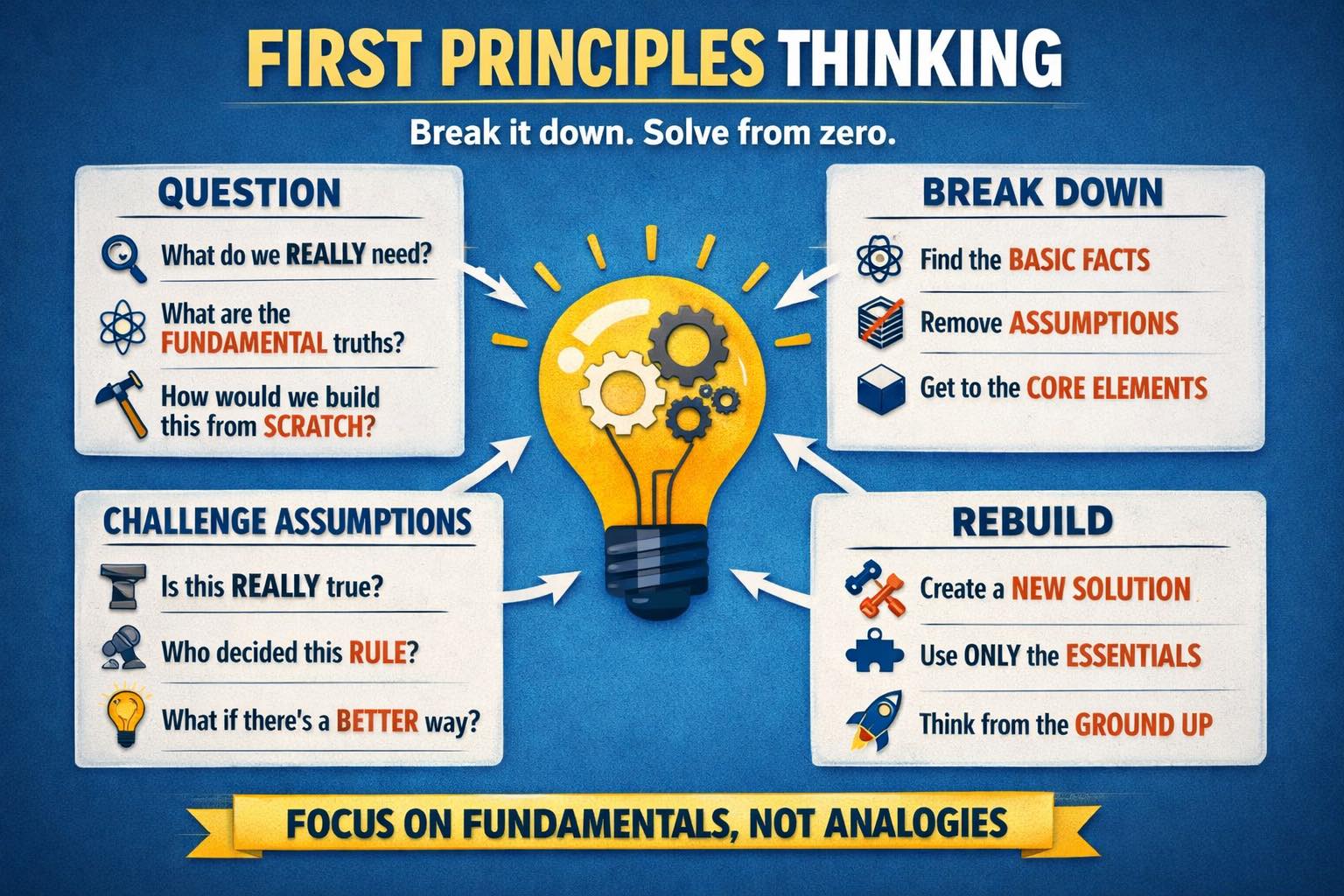
  • First Principles Thinking

    What is First Principles Thinking?
    First principles thinking means breaking any problem down to its most basic, undeniable truths, and then rebuilding a solution from scratch, instead of copying what others are doing.

    Most people think by analogy:

    “This is how it’s always been done.”
    “This is how others do it.”
    “This is the standard way.”

    First principles thinkers ask:

    “What is actually true here?”
    “What do we really need?”
    “If nothing existed, how would I build this from zero?”

    This method comes from ancient philosophy, especially Aristotle, but today it is used by the world’s most effective problem-solvers, scientists, and founders.


    Why Normal Thinking Fails

    Most systems around us are layers of assumptions:
    • Schools assume learning needs classrooms, exams, and degrees
    • Jobs assume you must be 22+ to earn
    • Businesses assume you need large capital
    • Poverty assumes it is permanent

    First principles thinking removes assumptions and keeps only facts.


    The First Principles Formula
    1. Identify the problem
    2. Break it down to facts that cannot be reduced further
    3. Remove all assumptions
    4. Rebuild a solution using only those facts


    Story 1: The Broken Chair

    A school has a broken chair.

    Normal thinking (by analogy):
    • Buy a new chair
    • Chairs cost $50
    • We don’t have budget
    • Problem stays unsolved

    First principles thinking:
    • What is a chair?
    • Something to sit on
    • Must support weight
    • Must be stable
    • Do we need a chair specifically?
    • Or do we need something to sit on?

    Solution:
    • Stack wooden boxes
    • Use a low table
    • Repair only the broken leg

    Insight:
    The problem was never “buy a chair.”
    The problem was “support a human body safely.”


    Story 2: The Poor Student Who Couldn’t Learn English

    A 12-year-old child in Karachi cannot speak English.

    Normal thinking:
    • English needs school
    • School needs fees
    • Fees need money
    • Child is poor
    • End of story

    First principles thinking:
    • What is English?
    • Sounds
    • Words
    • Repetition
    • Practice
    • How do humans learn language?
    • Listening
    • Copying
    • Daily exposure
    • Does learning require a school?
    • No
    • Does it require books?
    • No

    Solution:
    • Phone + YouTube
    • Cartoons + subtitles
    • Daily speaking practice with AI
    • Zero cost

    Insight:
    English is not a “subject.”
    English is a skill learned by exposure and repetition.


    Story 3: The Tea Seller vs the Restaurant Owner

    A man wants to start a food business.

    Normal thinking:
    • Restaurant needs rent
    • Furniture
    • Staff
    • Menu
    • Licenses
    • Capital required: very high
    • He gives up

    First principles thinking:
    • Why do people buy food?
    • Hunger
    • Taste
    • Convenience
    • Do they need a restaurant?
    • No
    • Do they need branding?
    • No
    • What’s the minimum?
    • One item
    • One pot
    • One location
    • One customer

    Solution:
    • One chai kettle
    • One bench
    • One corner
    • Start today

    Insight:
    Business is not “big systems.”
    Business is solving one real problem for one real human.


    Why First Principles Thinkers Change the World

    They don’t:
    • Wait for permission
    • Fear tradition
    • Respect broken systems

    They ask:
    • “Why does this exist?”
    • “Who decided this rule?”
    • “What if this assumption is false?”

    This is how:
    • New schools are created
    • New industries are born
    • Poor children become leaders
    • Old nations reinvent themselves


    Final Thought

    Progress does not come from improving old answers.
    Progress comes from questioning old questions.

    First principles thinking is not intelligence.
    It is courage — the courage to think from zero.

    If you teach children to think this way,
    you don’t give them jobs —
    you give them the ability to create worlds.
    First Principles Thinking What is First Principles Thinking? First principles thinking means breaking any problem down to its most basic, undeniable truths, and then rebuilding a solution from scratch, instead of copying what others are doing. Most people think by analogy: “This is how it’s always been done.” “This is how others do it.” “This is the standard way.” First principles thinkers ask: “What is actually true here?” “What do we really need?” “If nothing existed, how would I build this from zero?” This method comes from ancient philosophy, especially Aristotle, but today it is used by the world’s most effective problem-solvers, scientists, and founders. ⸻ Why Normal Thinking Fails Most systems around us are layers of assumptions: • Schools assume learning needs classrooms, exams, and degrees • Jobs assume you must be 22+ to earn • Businesses assume you need large capital • Poverty assumes it is permanent First principles thinking removes assumptions and keeps only facts. ⸻ The First Principles Formula 1. Identify the problem 2. Break it down to facts that cannot be reduced further 3. Remove all assumptions 4. Rebuild a solution using only those facts ⸻ Story 1: The Broken Chair A school has a broken chair. Normal thinking (by analogy): • Buy a new chair • Chairs cost $50 • We don’t have budget • Problem stays unsolved First principles thinking: • What is a chair? • Something to sit on • Must support weight • Must be stable • Do we need a chair specifically? • Or do we need something to sit on? Solution: • Stack wooden boxes • Use a low table • Repair only the broken leg 💡 Insight: The problem was never “buy a chair.” The problem was “support a human body safely.” ⸻ Story 2: The Poor Student Who Couldn’t Learn English A 12-year-old child in Karachi cannot speak English. Normal thinking: • English needs school • School needs fees • Fees need money • Child is poor • End of story First principles thinking: • What is English? • Sounds • Words • Repetition • Practice • How do humans learn language? • Listening • Copying • Daily exposure • Does learning require a school? • No • Does it require books? • No Solution: • Phone + YouTube • Cartoons + subtitles • Daily speaking practice with AI • Zero cost 💡 Insight: English is not a “subject.” English is a skill learned by exposure and repetition. ⸻ Story 3: The Tea Seller vs the Restaurant Owner A man wants to start a food business. Normal thinking: • Restaurant needs rent • Furniture • Staff • Menu • Licenses • Capital required: very high • He gives up First principles thinking: • Why do people buy food? • Hunger • Taste • Convenience • Do they need a restaurant? • No • Do they need branding? • No • What’s the minimum? • One item • One pot • One location • One customer Solution: • One chai kettle • One bench • One corner • Start today 💡 Insight: Business is not “big systems.” Business is solving one real problem for one real human. ⸻ Why First Principles Thinkers Change the World They don’t: • Wait for permission • Fear tradition • Respect broken systems They ask: • “Why does this exist?” • “Who decided this rule?” • “What if this assumption is false?” This is how: • New schools are created • New industries are born • Poor children become leaders • Old nations reinvent themselves ⸻ Final Thought Progress does not come from improving old answers. Progress comes from questioning old questions. First principles thinking is not intelligence. It is courage — the courage to think from zero. If you teach children to think this way, you don’t give them jobs — you give them the ability to create worlds.
    0 Comentários 0 Compartilhamentos 113 Visualizações
  • Today I added subtitles to my edited video so more people can read what Rehan Sir is saying!

    #Rehan #CapCut #CapCutEditing #VideoWithSubtitles #Subtitles #videoeditingpractice
    Today I added subtitles to my edited video so more people can read what Rehan Sir is saying! #Rehan #CapCut #CapCutEditing #VideoWithSubtitles #Subtitles #videoeditingpractice
    0 Comentários 0 Compartilhamentos 974 Visualizações 0
  • Day 4
    Today I added Urdu subtitles to my video. This will help more people understand and learn!

    Rehan #CapCut #CapCutEditing #UrduSubtitles #UrdUSubtitles #learnenglish
    Day 4 Today I added Urdu subtitles to my video. This will help more people understand and learn! Rehan #CapCut #CapCutEditing #UrduSubtitles #UrdUSubtitles #learnenglish
    0 Comentários 0 Compartilhamentos 725 Visualizações 0