• Canva post : 92
    Book A : Level 1
    RSISB Rollno 209
    Date 10:03:26


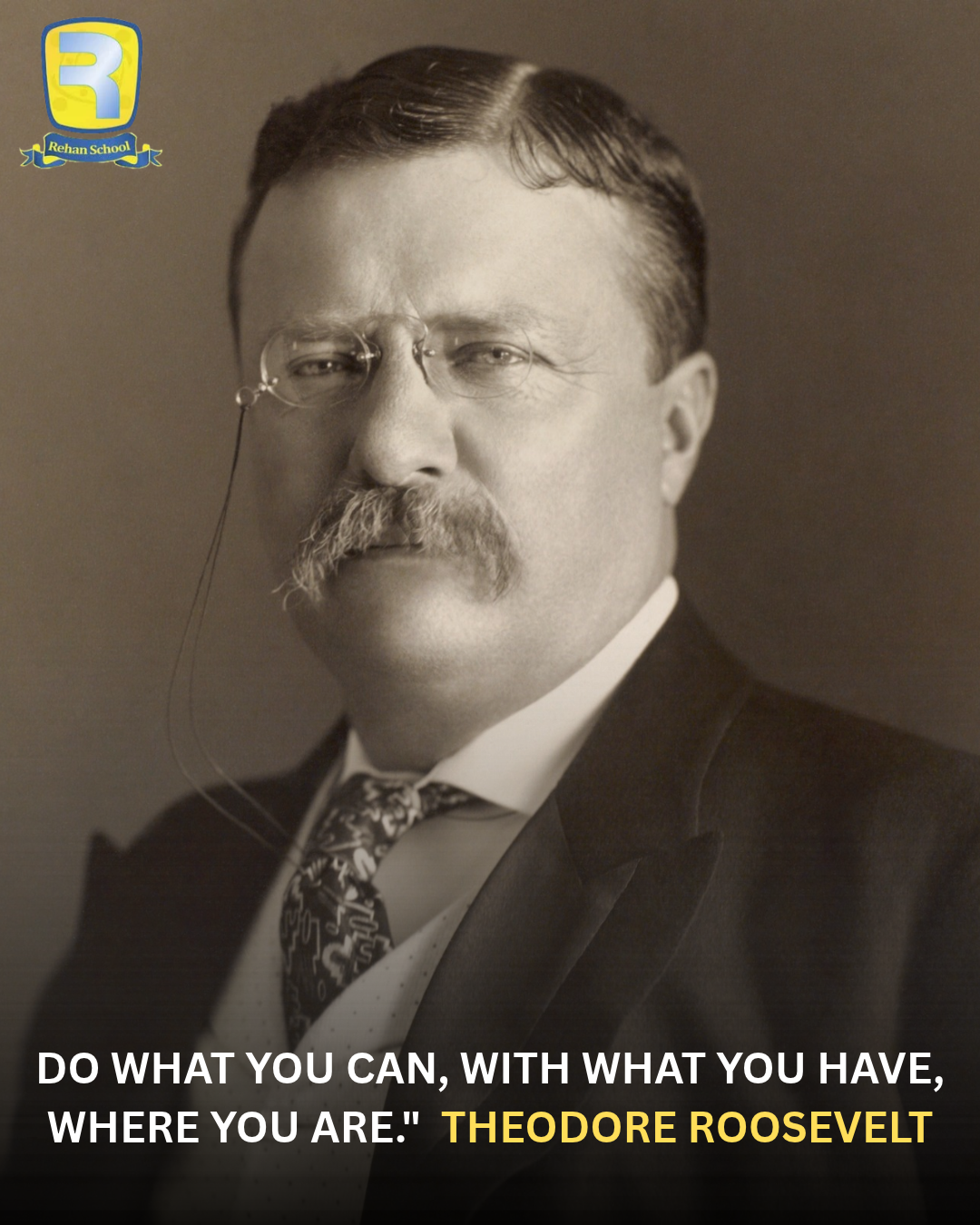
    “Do what you can, with what you have, where you are.” — Theodore Roosevelt

    You don’t need perfect circumstances to start making progress. Sometimes, the most important step is simply using the resources, skills, and opportunities you already have.

    Instead of waiting for the perfect moment, take action today. Learn from every experience, make the most of what is available, and keep moving forward one step at a time.

    Start where you are. Use what you have. Do what you can.

    Take action.
    Focus on what you can control.
    Keep learning.
    Grow one step at a time.
    Never wait for perfection.

    #TheodoreRoosevelt #InspirationalQuotes #Motivation #DoWhatYouCan #TakeAction #NeverGiveUp #SuccessMindset #PositiveThinking #LifeLessons #PersonalGrowth #KeepGoing #DreamBig #StayFocused #DailyMotivation #Inspiration #BelieveInYourself #GrowthMindset
    Canva post : 92 Book A : Level 1 RSISB Rollno 209 Date 10:03:26 🌟πŸ’ͺ “Do what you can, with what you have, where you are.” — Theodore Roosevelt 🌱✨ You don’t need perfect circumstances to start making progress. Sometimes, the most important step is simply using the resources, skills, and opportunities you already have. πŸš€πŸ’‘ Instead of waiting for the perfect moment, take action today. Learn from every experience, make the most of what is available, and keep moving forward one step at a time. πŸŽ―πŸ“š πŸ’« Start where you are. Use what you have. Do what you can. πŸ’ͺ Take action. 🎯 Focus on what you can control. πŸ“š Keep learning. 🌱 Grow one step at a time. πŸš€ Never wait for perfection. #TheodoreRoosevelt #InspirationalQuotes #Motivation #DoWhatYouCan #TakeAction #NeverGiveUp #SuccessMindset #PositiveThinking #LifeLessons #PersonalGrowth #KeepGoing #DreamBig #StayFocused #DailyMotivation #Inspiration #BelieveInYourself #GrowthMindset
    0 Reacties 0 aandelen 36 Views
  • #rsisb
    Roll n.247
    ChatGPT Image no.5
    Foundation level
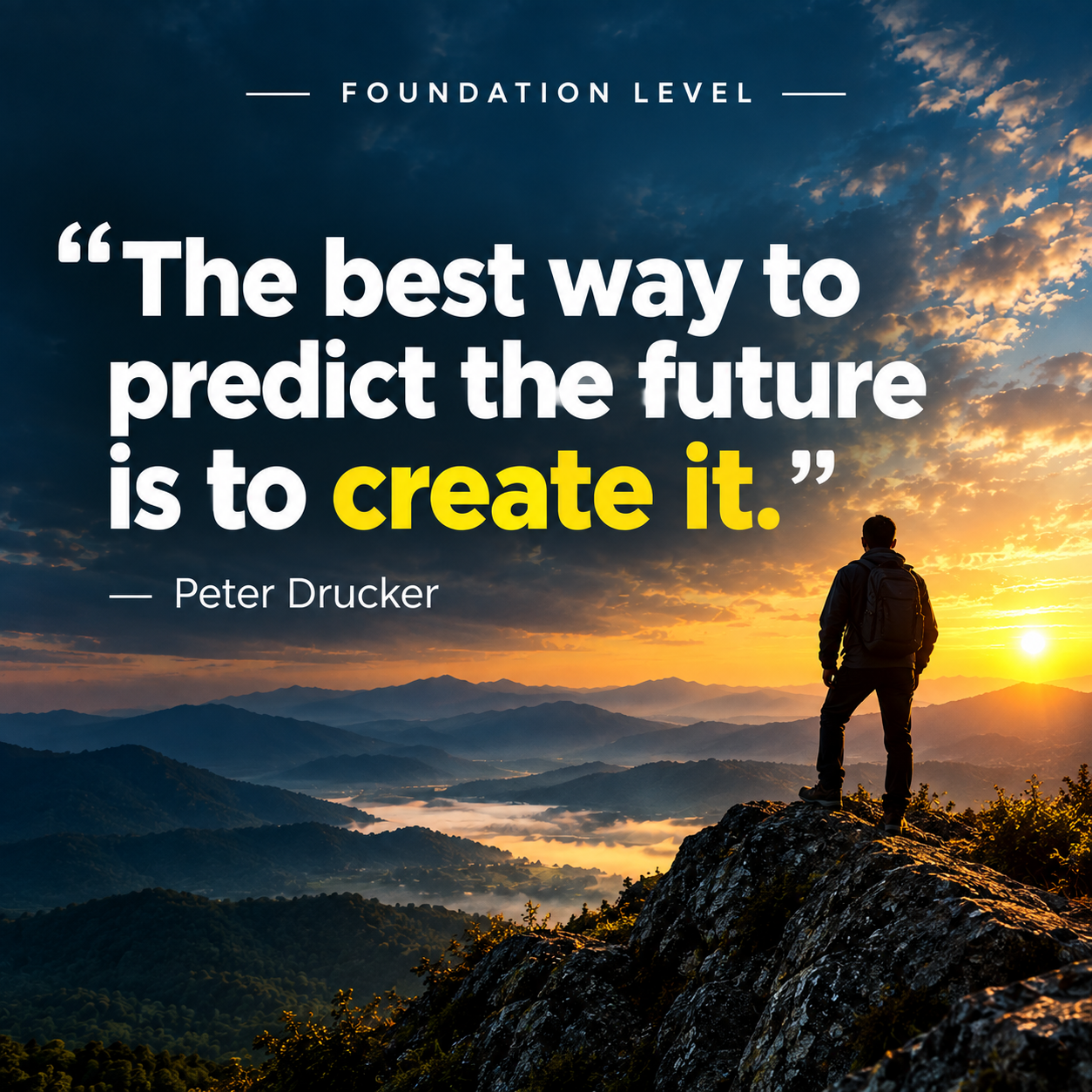
    **The Best Way to Predict the Future Is to Create It!**
    The future doesn’t simply happen—it is shaped by the choices, efforts, ideas, and actions we take today. Every dream begins with a thought, and every achievement begins with the courage to take the first step.
    Instead of waiting for tomorrow, start building the future you imagine. Learn something new, believe in your abilities, set meaningful goals, stay consistent, and keep moving forward even when progress feels slow.
    Remember, you may not be able to control everything that happens in the future, but you can control what you do today. Your effort today can become your success tomorrow.
    Dream boldly. Think creatively. Work patiently. Keep learning. And most importantly, **create the future you want to see.**
    Sharing this message on all platforms to inspire others to believe in their potential and take action toward their dreams!
    #TheFuture #CreateYourFuture #DreamBig #StayMotivated #KeepLearning #NeverGiveUp #BelieveInYourself #Success #Motivation #Inspiration #PositiveThinking #Goals #Dreams #GrowthMindset #HardWork #Consistency #Education #Learning #FutureGoals #SelfImprovement #StudentLife #InspirationDaily #MotivationalQuote #CreateDontWait #ThinkBig #AchieveYourGoals #KeepMovingForward
    #rsisb Roll n.247 ChatGPT Image no.5 Foundation level πŸš€βœ¨ **The Best Way to Predict the Future Is to Create It!** 🌟 The future doesn’t simply happen—it is shaped by the choices, efforts, ideas, and actions we take today. πŸ’­πŸŒ Every dream begins with a thought, and every achievement begins with the courage to take the first step. πŸ†πŸ”₯ Instead of waiting for tomorrow, start building the future you imagine. πŸ“šπŸ’‘ Learn something new, believe in your abilities, set meaningful goals, stay consistent, and keep moving forward even when progress feels slow. πŸ’ͺ🌱 Remember, you may not be able to control everything that happens in the future, but you can control what you do today. ⏳✨ Your effort today can become your success tomorrow. πŸŒˆπŸ… Dream boldly. Think creatively. Work patiently. Keep learning. And most importantly, **create the future you want to see.** πŸš€πŸŒŸ πŸ“² Sharing this message on all platforms to inspire others to believe in their potential and take action toward their dreams! β€οΈπŸ™Œ #TheFuture #CreateYourFuture #DreamBig #StayMotivated #KeepLearning #NeverGiveUp #BelieveInYourself #Success #Motivation #Inspiration #PositiveThinking #Goals #Dreams #GrowthMindset #HardWork #Consistency #Education #Learning #FutureGoals #SelfImprovement #StudentLife #InspirationDaily #MotivationalQuote #CreateDontWait #ThinkBig #AchieveYourGoals #KeepMovingForward
    0 Reacties 0 aandelen 39 Views
  • How to control your Mind? By Rehan Allahwala
    ???? ???? ?????? ??? ???? ?????

    #rehanallahwala #rehan #control #Mind #intention #mindpower #abundance
    How to control your Mind? By Rehan Allahwala ???? ???? ?????? ??? ???? ????? #rehanallahwala #rehan #control #Mind #intention #mindpower #abundance
    0 Reacties 0 aandelen 244 Views
  • Foundation Level | Roll No. 005 | Day 99 | Canva Post
    A motivational Canva post featuring the quote “The best way to predict the future is to create it.” — Peter Drucker, designed to encourage creativity, initiative, and taking control of the future.
    Foundation Level | Roll No. 005 | Day 99 | Canva Post A motivational Canva post featuring the quote “The best way to predict the future is to create it.” — Peter Drucker, designed to encourage creativity, initiative, and taking control of the future.
    0 Reacties 0 aandelen 176 Views
  • #rsisb
    Roll NO:232
    Foundation level student.
    Story post:22

    DescriptionDecoding Cyber: Origins in Norbert Wieners Cybernetics Discover the fascinating story behind the word “Cyber”! Explore how it is connected to Norbert Wiener’s cybernetics, a field focused on communication, control, feedback, and systems. From early ideas about machines and communication to today’s cybersecurity, cyberspace, and digital technology, the word “Cyber” has become a major part of our modern technological world. Join us on this exciting journey through science, technology, language, and innovation! Hashtags#Cyber #Cybernetics #NorbertWiener #CyberHistory #Technology #ComputerScience #ArtificialIntelligence #Cybersecurity #DigitalWorld #Innovation #ScienceAndTechnology #HistoryOfTechnology #TechFacts #ScienceFacts #Learning #Education #FutureTech #DigitalTechnology #Knowledge Emojis
    #rsisb Roll NO:232 Foundation level student. Story post:22 πŸ’» DescriptionDecoding Cyber: Origins in Norbert Wieners Cybernetics πŸ€–πŸ§ Discover the fascinating story behind the word “Cyber”! 🌐✨ Explore how it is connected to Norbert Wiener’s cybernetics, a field focused on communication, control, feedback, and systems. πŸ“‘πŸ”„From early ideas about machines and communication to today’s cybersecurity, cyberspace, and digital technology, the word “Cyber” has become a major part of our modern technological world. πŸ’»πŸ”πŸŒJoin us on this exciting journey through science, technology, language, and innovation! πŸš€πŸ“šπŸ·οΈ Hashtags#Cyber #Cybernetics #NorbertWiener #CyberHistory #Technology #ComputerScience #ArtificialIntelligence #Cybersecurity #DigitalWorld #Innovation #ScienceAndTechnology #HistoryOfTechnology #TechFacts #ScienceFacts #Learning #Education #FutureTech #DigitalTechnology #Knowledge πŸŒπŸ’»πŸ€–πŸ˜Š EmojisπŸ’» 🌐 πŸ€– 🧠 πŸ“‘ πŸ” βš™οΈ πŸ”„ πŸ§ͺ πŸš€ πŸ“š πŸ’‘ πŸ”Ž 🌍 ✨
    0 Reacties 0 aandelen 1097 Views
  • Untitled recording - 2026-10-01T211151.483RSIF 8

    Roll no 93

    Short documentary no 6

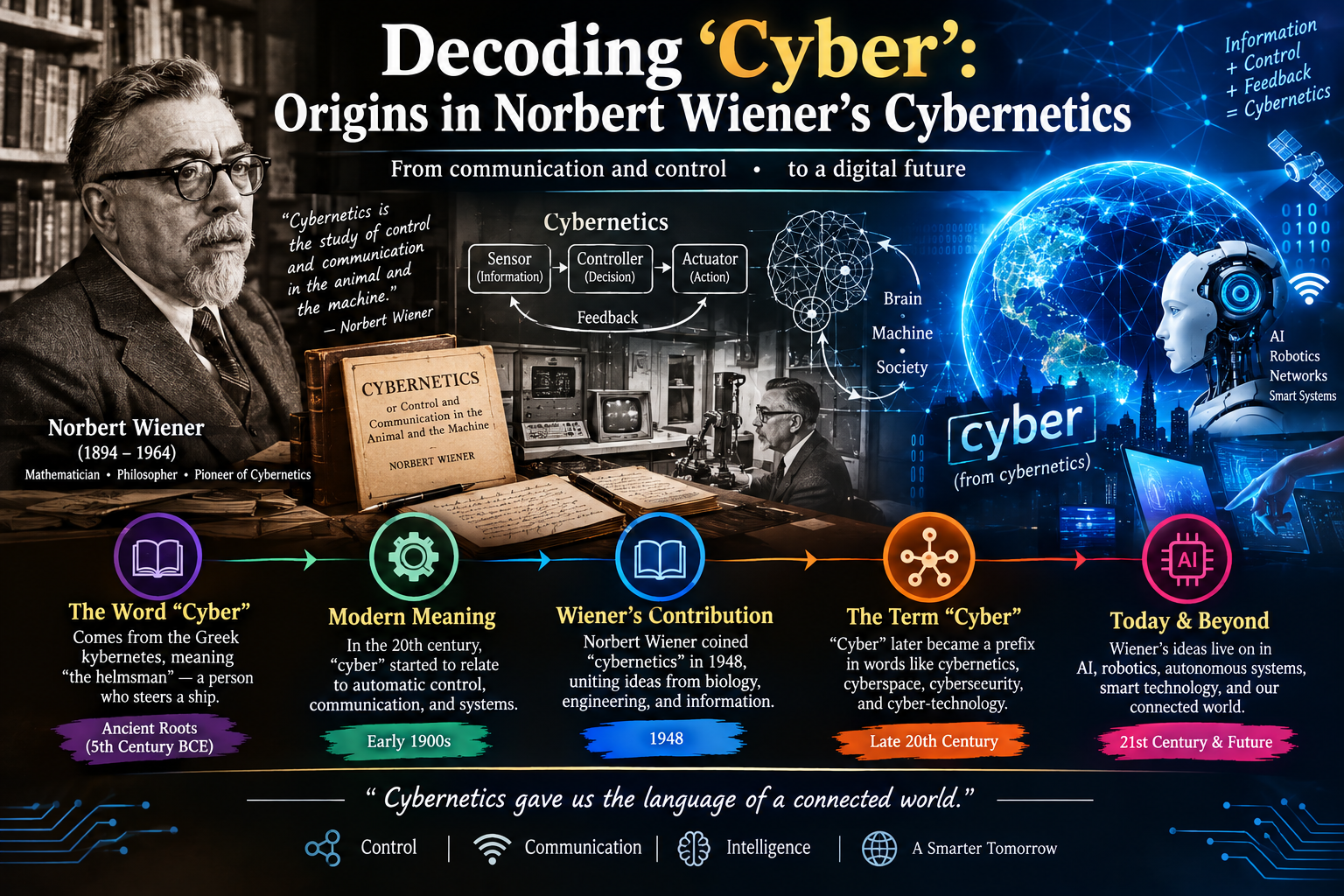
    Task topic:Decoding 'Cyber': Origins in Norbert Wiener's Cybernetics". **Decoding “Cyber”: Origins in Norbert Wiener’s Cybernetics**


    Have you ever wondered where the word **“Cyber”** actually comes from?


    Today, we hear words like **Cybersecurity, Cyberspace, Cybercrime, and Cyber Technology** everywhere. But the history behind the word goes much deeper than the modern internet.


    In this documentary, **“Decoding ‘Cyber’: Origins in Norbert Wiener’s Cybernetics,”** we explore the fascinating ideas of **Norbert Wiener**, the American mathematician and philosopher whose work helped establish the field of **Cybernetics**.


    We discover how Wiener explored the relationship between **communication, information, control, and feedback** in both animals and machines. His 1948 book, *Cybernetics: Or Control and Communication in the Animal and the Machine*, introduced ideas that influenced fields such as computer science, engineering, robotics, biology, and artificial intelligence.


    One of the most important concepts in cybernetics is **feedback** — the ability of a system to use information about its current condition to adjust its actions.


    From simple thermostats to modern intelligent machines, feedback plays an important role in how systems respond and adapt.


    This documentary takes us from the historical roots of the word **“Cyber”** to its connection with the digital world we know today.


    **In this documentary, we explore:**

    • The origins of the word “Cyber”

    • Who Norbert Wiener was

    • What Cybernetics means

    • The importance of communication and control

    • How feedback works

    • The connection between humans and machines

    • How cybernetics influenced modern technology

    • Why the concept remains relevant today


    Technology continues to evolve, but many of its fundamental ideas began with a simple question:


    **How can information help a system understand, respond, and adapt?**


    Watch the documentary and discover the fascinating origins of **Cybernetics** and its influence on the technological world.


    #Cyber #Cybernetics #NorbertWiener #Technology #ComputerScience #ArtificialIntel
    Untitled recording - 2026-10-01T211151.483RSIF 8 Roll no 93 Short documentary no 6 Task topic:Decoding 'Cyber': Origins in Norbert Wiener's Cybernetics".🧠 **Decoding “Cyber”: Origins in Norbert Wiener’s Cybernetics** πŸ’» Have you ever wondered where the word **“Cyber”** actually comes from? 🌐 Today, we hear words like **Cybersecurity, Cyberspace, Cybercrime, and Cyber Technology** everywhere. But the history behind the word goes much deeper than the modern internet. In this documentary, **“Decoding ‘Cyber’: Origins in Norbert Wiener’s Cybernetics,”** we explore the fascinating ideas of **Norbert Wiener**, the American mathematician and philosopher whose work helped establish the field of **Cybernetics**. We discover how Wiener explored the relationship between **communication, information, control, and feedback** in both animals and machines. His 1948 book, *Cybernetics: Or Control and Communication in the Animal and the Machine*, introduced ideas that influenced fields such as computer science, engineering, robotics, biology, and artificial intelligence. πŸ”„ One of the most important concepts in cybernetics is **feedback** — the ability of a system to use information about its current condition to adjust its actions. From simple thermostats to modern intelligent machines, feedback plays an important role in how systems respond and adapt. This documentary takes us from the historical roots of the word **“Cyber”** to its connection with the digital world we know today. πŸŒπŸ’» 🎯 **In this documentary, we explore:** • The origins of the word “Cyber” • Who Norbert Wiener was • What Cybernetics means • The importance of communication and control • How feedback works • The connection between humans and machines • How cybernetics influenced modern technology • Why the concept remains relevant today Technology continues to evolve, but many of its fundamental ideas began with a simple question: **How can information help a system understand, respond, and adapt?** Watch the documentary and discover the fascinating origins of **Cybernetics** and its influence on the technological world. πŸš€ #Cyber #Cybernetics #NorbertWiener #Technology #ComputerScience #ArtificialIntel
    0 Reacties 0 aandelen 990 Views
  • RSIF8
    RollNO:92
    Coding task No:22
    Topic:### WhatsApp Clone (Non-Functional, Web-Based, 1 Hour)

    This project is a professional, web-based WhatsApp Clone designed to demonstrate a modern messaging application interface. It includes a responsive chat layout with a contact list, search bar, user profiles, chat messages, timestamps, unread indicators, and message input controls. The application uses a clean WhatsApp-inspired design with modern colors, icons, smooth interactions, and responsive layouts for desktop and mobile screens. This is a non-functional prototype created for UI demonstration and does not include real-time messaging, authentication, databases, or backend integration.
    RSIF8 RollNO:92 Coding task No:22 Topic:### WhatsApp Clone (Non-Functional, Web-Based, 1 Hour) This project is a professional, web-based WhatsApp Clone designed to demonstrate a modern messaging application interface. It includes a responsive chat layout with a contact list, search bar, user profiles, chat messages, timestamps, unread indicators, and message input controls. The application uses a clean WhatsApp-inspired design with modern colors, icons, smooth interactions, and responsive layouts for desktop and mobile screens. This is a non-functional prototype created for UI demonstration and does not include real-time messaging, authentication, databases, or backend integration.
    0 Reacties 0 aandelen 406 Views
  • #rsisb
    Roll No 253
    Foundation Level
    Story Post 24

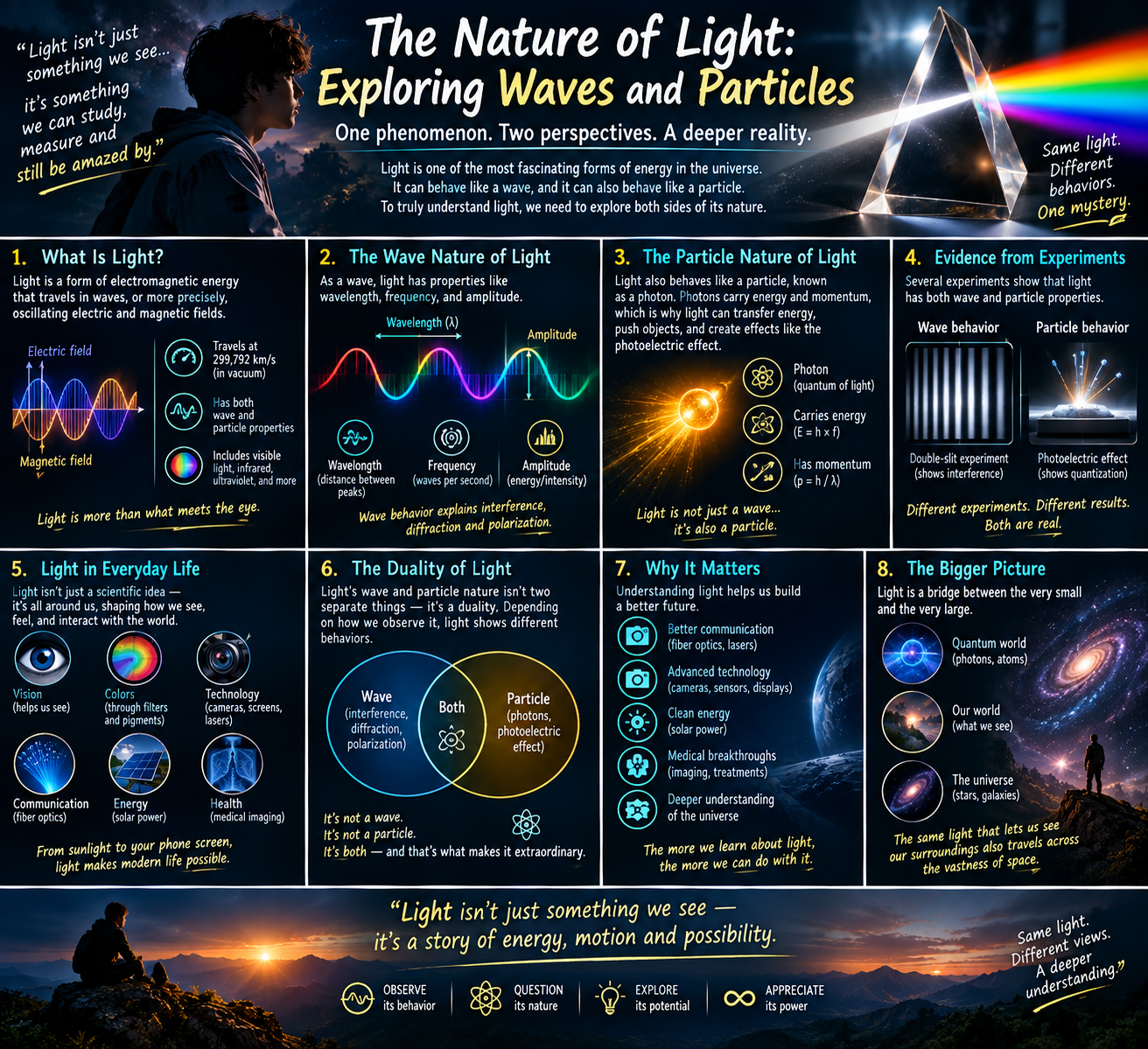
    # The Nature of Light: Exploring Waves and Particles

    Imagine standing beneath a night sky filled with stars.

    Every photon reaching your eyes has traveled across space carrying information from distant worlds. Light allows us to see, measure, communicate, explore, and understand the universe itself.

    But light is far stranger than it first appears.

    Sometimes it behaves like a **wave** .

    Sometimes it behaves like a **particle** .

    And understanding this strange dual nature changed our picture of reality forever.

    ---

    # 1. What Is Light?

    Light is a form of **electromagnetic radiation**—energy carried through oscillating electric and magnetic fields.

    In empty space, electromagnetic waves travel at approximately:

    ### **299,792 kilometers per second**

    That's the speed of light in vacuum.

    Visible light is only a small part of the electromagnetic spectrum.

    Beyond what our eyes can see are:

    Radio waves
    Microwaves
    Infrared
    Visible light
    Ultraviolet
    🩻 X-rays
    Gamma rays

    So light isn't simply what we see.

    ### **It's an enormous family of electromagnetic phenomena.**

    ---

    # 2. The Wave Nature of Light

    When light behaves as a wave, we can describe it using several important properties:

    **Wavelength** — the distance between successive wave peaks
    **Frequency** — how many oscillations occur each second
    **Amplitude** — related to the wave's intensity

    These properties help explain many familiar phenomena.

    **Interference** occurs when waves combine.
    **Diffraction** occurs when waves spread around openings or obstacles.
    **Polarization** describes the orientation of electromagnetic oscillations.

    The wave model explains behaviors that are difficult to understand if we imagine light only as tiny particles.

    ---

    # 3. The Particle Nature of Light

    But the story doesn't end there.

    Light can also behave as if it arrives in discrete packets of energy called **photons**.

    A photon is a quantum of electromagnetic radiation.

    Its energy is related to frequency:

    ### **E = h × f**

    And its momentum is related to its wavelength:

    ### **p = h / λ**

    This particle-like behavior helps explain phenomena such as the **photoelectric effect**, where light can transfer energy to electrons.

    So light isn't simply a smooth continuous wave.

    At the quantum level, energy can be exchanged in discrete amounts.

    ### **Light has another side—and it's quantum.**

    ---

    # 4. Evidence From Experiments

    The strange nature of light isn't merely philosophical.

    Experiments demonstrate it.

    ### Double-Slit Experiment

    When light passes through two narrow openings, an **interference pattern** can appear—strong evidence of wave-like behavior.

    ### Photoelectric Effect

    When light strikes certain materials, it can eject electrons. This behavior is explained using photons and quantized energy.

    Different experiments reveal different aspects of light.

    And that's one of the most fascinating things about physics:

    ### **The same phenomenon can reveal different behaviors depending on how we investigate it.**

    ---

    # 5. Light in Everyday Life

    Light isn't something that exists only inside physics laboratories.

    It's everywhere.

    **Vision** — allows us to see the world
    **Colors** — arise from how different wavelengths interact with matter
    **Cameras** — convert light into images
    **Screens** — produce controlled patterns of light
    **Fiber optics** — carry information using light
    **Solar panels** — convert light energy into electrical energy
    🩻 **Medical imaging** — uses electromagnetic radiation to see inside the body

    From sunrise to smartphone screens…

    ### **Modern civilization depends heavily on our ability to control light.**

    ---

    # 6. The Duality of Light

    Here lies the great mystery.

    Light can display **wave-like behavior**

    and

    **particle-like behavior** .

    This is known as **wave-particle duality**.

    It's important to understand that this doesn't mean light is literally switching between being a classical wave and a classical particle like two separate objects.

    Instead, quantum physics gives us a deeper framework in which classical wave and particle descriptions each capture different aspects of light's behavior.

    ### **Two perspectives. One quantum reality.**

    ---

    # 7. Why Understanding Light Matters

    Learning how light behaves has transformed technology.

    **Communication** — fiber-optic networks
    **Science** — spectroscopy and microscopy
    **Imaging** — cameras and sensors
    **Energy** — solar technology
    **Medicine** — lasers and diagnostic imaging
    **Astronomy** — studying distant stars and galaxies

    When astronomers observe light from a distant star, they aren't simply seeing brightness.

    They can analyze the light's wavelengths and learn about the star's:

    Temperature
    Chemical composition
    Motion
    Environment

    ### **Light carries information across space.**

    ---

    # 8. The Bigger Picture

    Light connects the microscopic and the cosmic.

    At the quantum scale, photons interact with atoms and electrons.

    At human scales, light allows us to see and communicate.

    Across astronomical distances, light travels from stars and galaxies to our telescopes.

    In many ways, light is our messenger from the universe.

    When we look at a distant galaxy, we are receiving photons that may have traveled for millions or billions of years before reaching Earth.

    ### **Looking at the universe means looking at ancient light.**

    ---

    # The Final Thought

    Light is more than something that illuminates a room.

    It is energy.
    It is information.
    It is electromagnetic radiation.
    It has quantum behavior.
    And it is one of the most important tools we have for exploring reality.

    From a photon interacting with an electron…

    to sunlight crossing space…

    to the glow of a distant galaxy…

    ### **Light connects the smallest scales of nature with the largest.**

    So the next time you see sunlight streaming through a window , a rainbow , or stars shining overhead , remember:

    **You aren't simply seeing light.**

    You're witnessing one of the universe's most fascinating mysteries—a phenomenon that behaves in ways far stranger and more beautiful than our everyday experience suggests.

    # **Light isn't just something we see—it's a story of energy, motion, information, and possibility.** ∞


    Asma Shaheen EducationWali
    Saima Empowerment Wali
    Mishaal TrainingWali

    #rsisb Roll No 253 Foundation Level Story Post 24 # 🌈⚑ The Nature of Light: Exploring Waves and Particles Imagine standing beneath a night sky filled with stars. 🌌✨ Every photon reaching your eyes has traveled across space carrying information from distant worlds. Light allows us to see, measure, communicate, explore, and understand the universe itself. πŸ”­πŸ‘οΈπŸ“‘ But light is far stranger than it first appears. Sometimes it behaves like a **wave** 🌊. Sometimes it behaves like a **particle** βš›οΈ. And understanding this strange dual nature changed our picture of reality forever. 🧠🌌 --- # πŸ’‘πŸŒŒ 1. What Is Light? Light is a form of **electromagnetic radiation**—energy carried through oscillating electric and magnetic fields. ⚑🧲 In empty space, electromagnetic waves travel at approximately: ### πŸš€ **299,792 kilometers per second** That's the speed of light in vacuum. Visible light πŸ‘οΈπŸŒˆ is only a small part of the electromagnetic spectrum. Beyond what our eyes can see are: πŸ“» Radio waves πŸ“‘ Microwaves πŸ”₯ Infrared 🌈 Visible light β˜€οΈ Ultraviolet 🩻 X-rays ☒️ Gamma rays So light isn't simply what we see. ### **It's an enormous family of electromagnetic phenomena.** 🌌⚑ --- # πŸŒŠπŸ”¬ 2. The Wave Nature of Light When light behaves as a wave, we can describe it using several important properties: 〰️ **Wavelength** — the distance between successive wave peaks ⚑ **Frequency** — how many oscillations occur each second πŸ“ˆ **Amplitude** — related to the wave's intensity These properties help explain many familiar phenomena. 🌈 **Interference** occurs when waves combine. πŸ” **Diffraction** occurs when waves spread around openings or obstacles. πŸ•ΆοΈ **Polarization** describes the orientation of electromagnetic oscillations. The wave model explains behaviors that are difficult to understand if we imagine light only as tiny particles. --- # βš›οΈβœ¨ 3. The Particle Nature of Light But the story doesn't end there. Light can also behave as if it arrives in discrete packets of energy called **photons**. βš›οΈπŸ’‘ A photon is a quantum of electromagnetic radiation. Its energy is related to frequency: ### **E = h × f** ⚑ And its momentum is related to its wavelength: ### **p = h / λ** πŸŒŠβš›οΈ This particle-like behavior helps explain phenomena such as the **photoelectric effect**, where light can transfer energy to electrons. So light isn't simply a smooth continuous wave. At the quantum level, energy can be exchanged in discrete amounts. ### **Light has another side—and it's quantum.** πŸŒŒβš›οΈ --- # πŸ§ͺπŸ” 4. Evidence From Experiments The strange nature of light isn't merely philosophical. Experiments demonstrate it. ### 🌊 Double-Slit Experiment When light passes through two narrow openings, an **interference pattern** can appear—strong evidence of wave-like behavior. πŸŒŠγ€°οΈ ### ⚑ Photoelectric Effect When light strikes certain materials, it can eject electrons. This behavior is explained using photons and quantized energy. βš›οΈπŸ”‹ Different experiments reveal different aspects of light. And that's one of the most fascinating things about physics: ### **The same phenomenon can reveal different behaviors depending on how we investigate it.** πŸ”¬βœ¨ --- # πŸ‘οΈπŸŒˆ 5. Light in Everyday Life Light isn't something that exists only inside physics laboratories. It's everywhere. πŸŒβ˜€οΈ πŸ‘οΈ **Vision** — allows us to see the world 🌈 **Colors** — arise from how different wavelengths interact with matter πŸ“· **Cameras** — convert light into images πŸ“± **Screens** — produce controlled patterns of light 🌐 **Fiber optics** — carry information using light β˜€οΈ **Solar panels** — convert light energy into electrical energy 🩻 **Medical imaging** — uses electromagnetic radiation to see inside the body From sunrise to smartphone screens… ### **Modern civilization depends heavily on our ability to control light.** πŸ’‘πŸŒ --- # πŸŒŠβš›οΈ 6. The Duality of Light Here lies the great mystery. Light can display **wave-like behavior** 🌊 and **particle-like behavior** βš›οΈ. This is known as **wave-particle duality**. It's important to understand that this doesn't mean light is literally switching between being a classical wave and a classical particle like two separate objects. Instead, quantum physics gives us a deeper framework in which classical wave and particle descriptions each capture different aspects of light's behavior. ### **Two perspectives. One quantum reality.** 🌌✨ --- # πŸš€πŸ”¬ 7. Why Understanding Light Matters Learning how light behaves has transformed technology. πŸ“‘ **Communication** — fiber-optic networks πŸ”¬ **Science** — spectroscopy and microscopy πŸ“· **Imaging** — cameras and sensors β˜€οΈ **Energy** — solar technology 🩺 **Medicine** — lasers and diagnostic imaging πŸš€ **Astronomy** — studying distant stars and galaxies When astronomers observe light from a distant star, they aren't simply seeing brightness. They can analyze the light's wavelengths and learn about the star's: 🌑️ Temperature πŸ§ͺ Chemical composition πŸ’¨ Motion 🌌 Environment ### **Light carries information across space.** --- # πŸŒŒπŸ”­ 8. The Bigger Picture Light connects the microscopic and the cosmic. At the quantum scale, photons interact with atoms and electrons. βš›οΈπŸ”¬ At human scales, light allows us to see and communicate. πŸ‘οΈπŸ“± Across astronomical distances, light travels from stars and galaxies to our telescopes. πŸŒŸπŸ”­ In many ways, light is our messenger from the universe. When we look at a distant galaxy, we are receiving photons that may have traveled for millions or billions of years before reaching Earth. 🌌⏳ ### **Looking at the universe means looking at ancient light.** ✨ --- # πŸŒ…πŸ’‘ The Final Thought Light is more than something that illuminates a room. It is energy. ⚑ It is information. πŸ“‘ It is electromagnetic radiation. 🌊 It has quantum behavior. βš›οΈ And it is one of the most important tools we have for exploring reality. πŸ”­ From a photon interacting with an electron… to sunlight crossing space… to the glow of a distant galaxy… ### **Light connects the smallest scales of nature with the largest.** πŸŒŒβš›οΈ So the next time you see sunlight streaming through a window β˜€οΈ, a rainbow 🌈, or stars shining overhead ⭐, remember: **You aren't simply seeing light.** You're witnessing one of the universe's most fascinating mysteries—a phenomenon that behaves in ways far stranger and more beautiful than our everyday experience suggests. πŸŒŠβš›οΈβœ¨ # 🌈🌌 **Light isn't just something we see—it's a story of energy, motion, information, and possibility.** βš‘πŸ”¬∞ Asma Shaheen EducationWali Saima Empowerment Wali Mishaal TrainingWali

    0 Reacties 0 aandelen 1354 Views
  • #rsisb
    Roll No 253
    Foundation Level
    Story Post 23

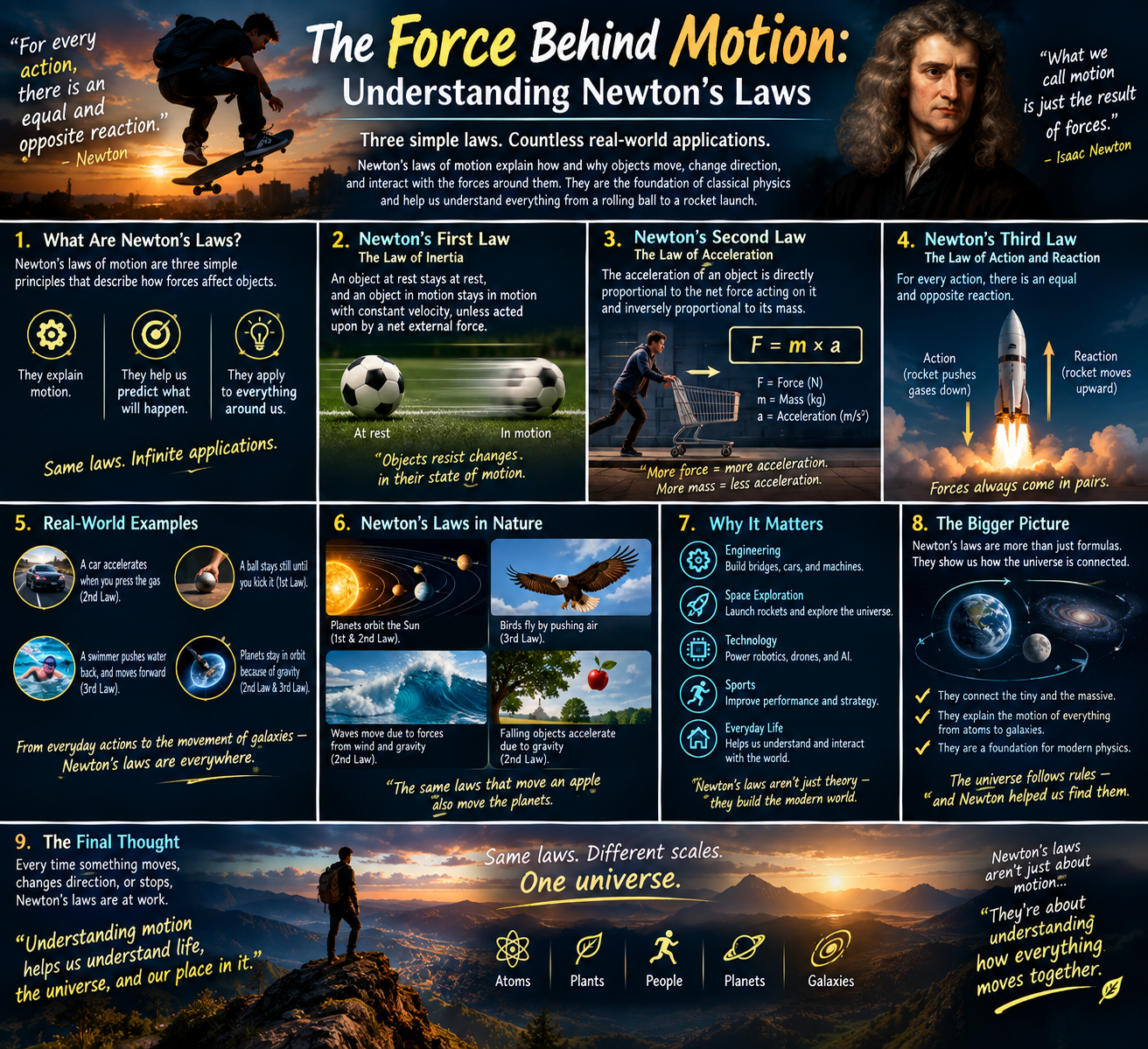
    # The Force Behind Motion: Understanding Newton’s Laws

    Imagine watching a football fly through the air , a car accelerate down a road , a rocket launch into space , or planets orbiting a star .

    These events may appear completely different—but beneath them is the same fundamental idea:

    ## **Forces control motion.**

    More than three centuries ago, **Isaac Newton** developed three laws that transformed our understanding of how objects move and interact. These laws became the foundation of classical mechanics and remain essential to physics, engineering, astronomy, and countless technologies today.

    ---

    # 1. What Are Newton's Laws?

    Newton's three laws describe the relationship between:

    **Force**
    **Mass**
    **Acceleration**
    **Motion**

    Together, they help us explain why objects remain still, why they accelerate, and how forces interact.

    From a rolling ball to a spacecraft , the same fundamental principles apply.

    ### **Three simple laws. Infinite applications.**

    ---

    # 2. Newton's First Law — The Law of Inertia

    Newton's First Law states that an object at rest remains at rest, while an object in motion continues moving at constant velocity unless acted upon by a net external force.

    This property is called **inertia**.

    Imagine a football sitting on the ground.

    It stays there until you kick it.

    Once moving, it won't naturally change its motion unless another force acts on it—such as friction, air resistance, or another object.

    A car requires braking to stop.
    A ball slows because of friction.
    Objects in space can continue moving with very little resistance.

    ### **Objects resist changes in their state of motion.**

    ---

    # 3. Newton's Second Law — The Law of Acceleration

    The second law explains how force changes motion.

    Its famous equation is:

    # **F = m × a**

    Where:

    **F** = Force
    **m** = Mass
    **a** = Acceleration

    This means that increasing the net force on an object generally increases its acceleration, while increasing the object's mass makes the same force produce less acceleration.

    Imagine pushing an empty shopping cart .

    It accelerates easily.

    Now fill it with heavy objects.

    The same push produces less acceleration.

    ### **More net force → more acceleration.**

    ### **More mass → less acceleration for the same force.**

    This simple relationship powers everything from vehicle design to rocket engineering .

    ---

    # 4. Newton's Third Law — Action and Reaction

    Newton's Third Law states:

    ### **For every action, there is an equal and opposite reaction.**

    Forces always occur through interactions between objects.

    Consider a rocket.

    The engine pushes hot gases downward and backward.

    The gases exert an equal and opposite force on the rocket, pushing it upward.

    The same principle appears everywhere:

    A swimmer pushes water backward → the water pushes the swimmer forward.
    A bird pushes air downward → the air helps push the bird upward.
    You push the ground backward → the ground pushes you forward.

    ### **Forces come in pairs.**

    ---

    # 5. Newton's Laws in Everyday Life

    You don't need a laboratory to see Newton's laws.

    They are happening around you constantly.

    **Cars:** Engine force changes speed and direction.
    **Sports:** Kicking a ball changes its motion.
    **Swimming:** Pushing water creates forward motion.
    **Cycling:** Pedaling produces forces that accelerate the bicycle.
    **Falling objects:** Gravity changes their motion.
    **Skateboards:** Pushing against the ground creates movement.

    Everyday motion is essentially a continuous interaction between forces.

    ---

    # 6. Newton's Laws in Nature

    Newton's laws don't stop at Earth.

    They also help describe motion throughout the universe.

    Planets orbit stars.
    Moons orbit planets.
    Comets travel through space.
    Waves respond to forces.
    Birds generate lift through interactions with air.
    Objects accelerate under gravity.

    The same physics that explains a falling apple can help describe the motion of enormous celestial bodies.

    ### **From apples to planets, the same laws operate across nature.**

    ---

    # 7. Why Newton's Laws Matter

    Newton's laws are more than equations in a textbook.

    They are essential tools for understanding and designing the physical world.

    **Engineering** — bridges, buildings, vehicles, and machines
    **Space exploration** — rockets, spacecraft, and orbital motion
    **Technology** — robots, drones, and automated systems
    **Sports science** — movement, speed, and performance
    **Transportation** — cars, aircraft, and trains

    Modern technology depends heavily on our ability to predict how forces produce motion.

    ---

    # 8. The Bigger Picture

    Newton's laws reveal something remarkable:

    The universe is not simply a collection of random movements.

    Objects interact through measurable forces.

    From microscopic particles to massive planets and galaxies , physics provides mathematical relationships that help us understand motion.

    The scale may change.

    The objects may change.

    But the underlying principles remain incredibly powerful.

    ### **Tiny or massive. Fast or slow. Earth or space. Motion follows physical laws.**

    ---

    # 9. The Final Thought

    Every time something moves…

    Every time something accelerates…

    Every time something changes direction…

    **Newton's laws are there.**

    A skateboard rolling down a street
    A bird taking flight
    A rocket leaving Earth
    A planet orbiting the Sun

    Different events.

    Different scales.

    One underlying framework.

    ## **Same laws. Different scales. One universe.**

    Understanding motion isn't just about solving equations.

    It's about understanding **how the physical world moves, interacts, and holds together.**

    ### **Once you understand the forces behind motion, the world around you begins to move in a whole new way.**


    Asma Shaheen EducationWali
    Saima Empowerment Wali
    Mishaal TrainingWali

    #rsisb Roll No 253 Foundation Level Story Post 23 # ⚑🌌 The Force Behind Motion: Understanding Newton’s Laws Imagine watching a football fly through the air ⚽, a car accelerate down a road πŸš—πŸ’¨, a rocket launch into space πŸš€, or planets orbiting a star πŸͺβœ¨. These events may appear completely different—but beneath them is the same fundamental idea: ## **Forces control motion.** ⚑🧲 More than three centuries ago, **Isaac Newton** developed three laws that transformed our understanding of how objects move and interact. These laws became the foundation of classical mechanics and remain essential to physics, engineering, astronomy, and countless technologies today. πŸ”¬βš™οΈπŸŒ --- # 🧠⚑ 1. What Are Newton's Laws? Newton's three laws describe the relationship between: ⚑ **Force** 🧱 **Mass** πŸ’¨ **Acceleration** πŸƒ **Motion** Together, they help us explain why objects remain still, why they accelerate, and how forces interact. From a rolling ball 🎾 to a spacecraft πŸš€, the same fundamental principles apply. ### **Three simple laws. Infinite applications.** 🌌 --- # πŸ›‘βž‘οΈ 2. Newton's First Law — The Law of Inertia Newton's First Law states that an object at rest remains at rest, while an object in motion continues moving at constant velocity unless acted upon by a net external force. This property is called **inertia**. 🧱⚑ Imagine a football sitting on the ground. ⚽ It stays there until you kick it. Once moving, it won't naturally change its motion unless another force acts on it—such as friction, air resistance, or another object. πŸš— A car requires braking to stop. ⚽ A ball slows because of friction. πŸ›°οΈ Objects in space can continue moving with very little resistance. ### **Objects resist changes in their state of motion.** --- # πŸ’¨βš™οΈ 3. Newton's Second Law — The Law of Acceleration The second law explains how force changes motion. Its famous equation is: # **F = m × a** ⚑ Where: **F** = Force 🧲 **m** = Mass βš–οΈ **a** = Acceleration πŸ’¨ This means that increasing the net force on an object generally increases its acceleration, while increasing the object's mass makes the same force produce less acceleration. Imagine pushing an empty shopping cart πŸ›’. It accelerates easily. Now fill it with heavy objects. The same push produces less acceleration. ### **More net force → more acceleration.** ### **More mass → less acceleration for the same force.** This simple relationship powers everything from vehicle design πŸš— to rocket engineering πŸš€. --- # πŸš€πŸ”₯ 4. Newton's Third Law — Action and Reaction Newton's Third Law states: ### **For every action, there is an equal and opposite reaction.** ⚑ Forces always occur through interactions between objects. Consider a rocket. πŸš€ The engine pushes hot gases downward and backward. The gases exert an equal and opposite force on the rocket, pushing it upward. ⬆️πŸ”₯ The same principle appears everywhere: 🏊 A swimmer pushes water backward → the water pushes the swimmer forward. πŸ¦… A bird pushes air downward → the air helps push the bird upward. 🚢 You push the ground backward → the ground pushes you forward. ### **Forces come in pairs.** πŸ”—βš‘ --- # 🌍⚽ 5. Newton's Laws in Everyday Life You don't need a laboratory to see Newton's laws. They are happening around you constantly. πŸš— **Cars:** Engine force changes speed and direction. ⚽ **Sports:** Kicking a ball changes its motion. 🏊 **Swimming:** Pushing water creates forward motion. 🚲 **Cycling:** Pedaling produces forces that accelerate the bicycle. 🍎 **Falling objects:** Gravity changes their motion. πŸ›Ή **Skateboards:** Pushing against the ground creates movement. Everyday motion is essentially a continuous interaction between forces. --- # 🌌πŸͺ 6. Newton's Laws in Nature Newton's laws don't stop at Earth. They also help describe motion throughout the universe. 🌌 πŸͺ Planets orbit stars. πŸŒ™ Moons orbit planets. β˜„οΈ Comets travel through space. 🌊 Waves respond to forces. πŸ¦… Birds generate lift through interactions with air. 🍎 Objects accelerate under gravity. The same physics that explains a falling apple can help describe the motion of enormous celestial bodies. ### **From apples to planets, the same laws operate across nature.** 🍎➑️πŸͺ --- # βš™οΈπŸš€ 7. Why Newton's Laws Matter Newton's laws are more than equations in a textbook. They are essential tools for understanding and designing the physical world. πŸ—οΈ **Engineering** — bridges, buildings, vehicles, and machines πŸš€ **Space exploration** — rockets, spacecraft, and orbital motion πŸ€– **Technology** — robots, drones, and automated systems πŸƒ **Sports science** — movement, speed, and performance πŸš— **Transportation** — cars, aircraft, and trains Modern technology depends heavily on our ability to predict how forces produce motion. --- # πŸŒŒπŸ”­ 8. The Bigger Picture Newton's laws reveal something remarkable: The universe is not simply a collection of random movements. Objects interact through measurable forces. βš›οΈπŸ§² From microscopic particles πŸ”¬ to massive planets πŸͺ and galaxies 🌌, physics provides mathematical relationships that help us understand motion. The scale may change. The objects may change. But the underlying principles remain incredibly powerful. ### **Tiny or massive. Fast or slow. Earth or space. Motion follows physical laws.** ⚑🌍🌌 --- # πŸŒ…βš‘ 9. The Final Thought Every time something moves… Every time something accelerates… Every time something changes direction… **Newton's laws are there.** 🧠⚑ A skateboard rolling down a street πŸ›Ή A bird taking flight πŸ¦… A rocket leaving Earth πŸš€ A planet orbiting the Sun β˜€οΈπŸͺ Different events. Different scales. One underlying framework. ## 🌌 **Same laws. Different scales. One universe.** Understanding motion isn't just about solving equations. It's about understanding **how the physical world moves, interacts, and holds together.** βš›οΈπŸŒβœ¨ ### **Once you understand the forces behind motion, the world around you begins to move in a whole new way.** βš‘πŸ”¬πŸŒŒ Asma Shaheen EducationWali Saima Empowerment Wali Mishaal TrainingWali

    0 Reacties 0 aandelen 1339 Views
  • #rsisb
    Roll no.239
    Story post no.24
    Foundation Level
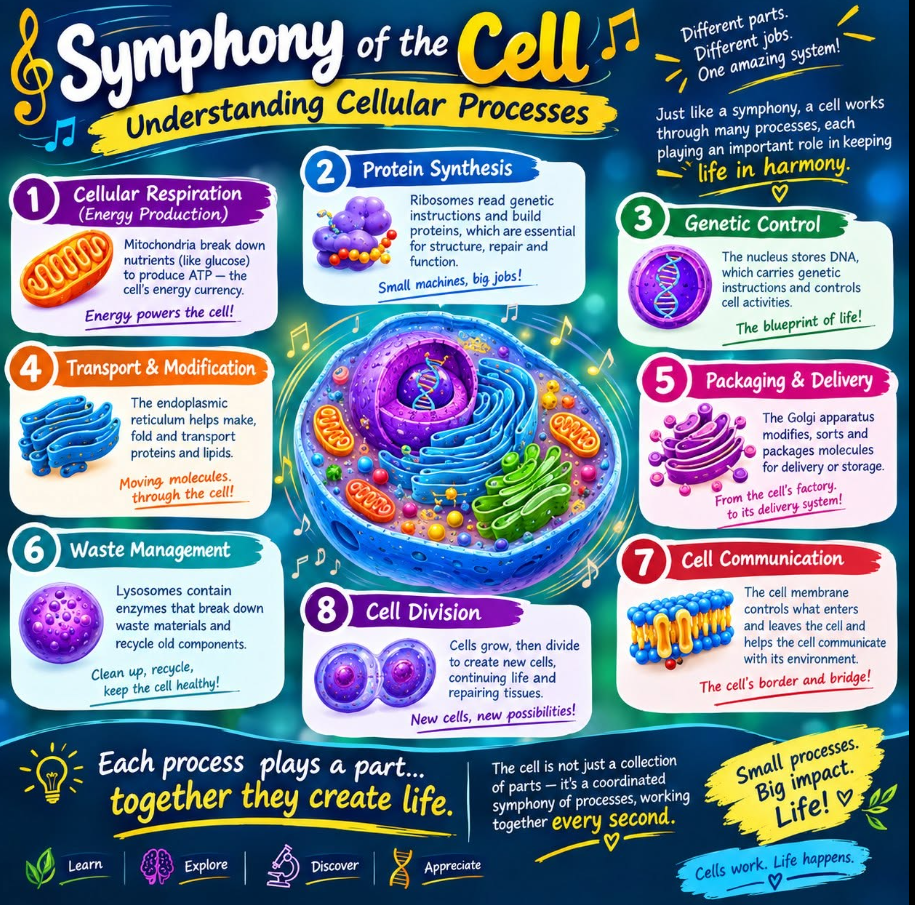
    Imagine a cell as a magnificent orchestra, where every organelle has its own instrument and every cellular process plays an important part. Together, they create the incredible **symphony of life**.
    Just as an orchestra depends on different musicians working together, a cell depends on many specialized structures and processes to stay organized and function properly.
    **Cellular Respiration — The Energy Makers**
    Mitochondria help produce ATP, the usable energy that powers many cellular activities.
    **Genetic Control — The Instructions**
    The nucleus stores DNA, which contains genetic information that helps guide cell activities.
    **Protein Synthesis — The Builders**
    Ribosomes use genetic instructions to build proteins needed for growth, repair, and everyday cellular functions.
    **Transport & Modification — The Delivery Network**
    The endoplasmic reticulum helps produce and transport proteins and lipids within the cell.
    **Packaging & Delivery — The Shipping Center**
    The Golgi apparatus modifies, sorts, and packages molecules so they can reach their proper destinations.
    **Waste Management — The Recycling Team**
    Lysosomes help break down unwanted materials and recycle components within the cell.
    **Cell Communication — The Gatekeeper**
    The cell membrane controls what enters and leaves the cell while helping the cell interact with its surroundings.
    **Cell Division — Creating New Cells**
    Cells can grow and divide, allowing organisms to develop, replace cells, and repair tissues.
    Every process has a role. Every organelle contributes to the performance. And together, they demonstrate one of biology’s most fascinating ideas:
    **A cell is not simply a collection of parts—it is a coordinated system where countless processes work together to support life.**
    **Learn. Explore. Discover. Appreciate the amazing symphony happening inside every living cell.**
    #SymphonyOfTheCell #CellBiology #Biology #CellularProcesses #Organelles #Science #ScienceEducation #BiologyFacts #CellStructure #Mitochondria #DNA #ProteinSynthesis #CellDivision #Microscopy #Learning #DidYouKnow #ScientificDiscovery
    #rsisb Roll no.239 Story post no.24 Foundation Level Imagine a cell as a magnificent orchestra, where every organelle has its own instrument and every cellular process plays an important part. Together, they create the incredible **symphony of life**. 🎼🌱 Just as an orchestra depends on different musicians working together, a cell depends on many specialized structures and processes to stay organized and function properly. ⚑ **Cellular Respiration — The Energy Makers** Mitochondria help produce ATP, the usable energy that powers many cellular activities. 🧬 **Genetic Control — The Instructions** The nucleus stores DNA, which contains genetic information that helps guide cell activities. 🏭 **Protein Synthesis — The Builders** Ribosomes use genetic instructions to build proteins needed for growth, repair, and everyday cellular functions. 🚚 **Transport & Modification — The Delivery Network** The endoplasmic reticulum helps produce and transport proteins and lipids within the cell. πŸ“¦ **Packaging & Delivery — The Shipping Center** The Golgi apparatus modifies, sorts, and packages molecules so they can reach their proper destinations. ♻️ **Waste Management — The Recycling Team** Lysosomes help break down unwanted materials and recycle components within the cell. πŸšͺ **Cell Communication — The Gatekeeper** The cell membrane controls what enters and leaves the cell while helping the cell interact with its surroundings. 🌱 **Cell Division — Creating New Cells** Cells can grow and divide, allowing organisms to develop, replace cells, and repair tissues. Every process has a role. Every organelle contributes to the performance. And together, they demonstrate one of biology’s most fascinating ideas: ✨ **A cell is not simply a collection of parts—it is a coordinated system where countless processes work together to support life.** πŸ”¬ **Learn. Explore. Discover. Appreciate the amazing symphony happening inside every living cell.** #SymphonyOfTheCell #CellBiology #Biology #CellularProcesses #Organelles #Science #ScienceEducation #BiologyFacts #CellStructure #Mitochondria #DNA #ProteinSynthesis #CellDivision #Microscopy #Learning #DidYouKnow #ScientificDiscovery
    0 Reacties 0 aandelen 1814 Views
Zoekresultaten