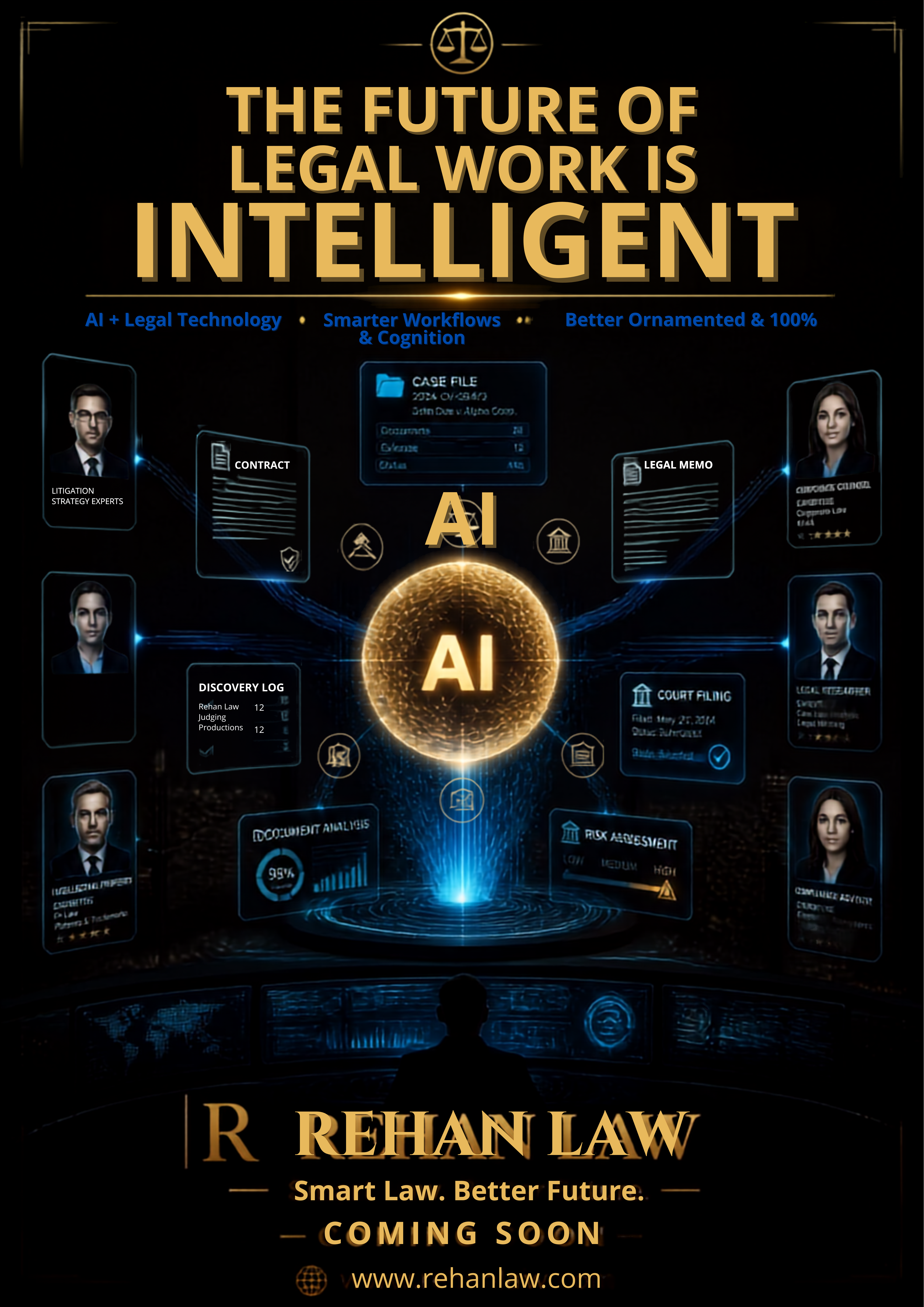
• What if legal information could work smarter?

    Documents. Contracts. Cases. Information.

    Rehan Law is being built around a simple vision: bring AI + Legal Technology together to create smarter legal workflows and better organization.

    Understand. Organize. Move Forward.

    REHAN LAW — Smart Law. Better Future.

    www.rehanlaw.com

    Rehan Law is an emerging legal-tech platform and does not replace qualified legal professionals.

    Hashtags

    #RehanLaw #LegalTech #LegalAI #AI #ArtificialIntelligence #FutureOfLaw #LawAndTechnology #LegalInnovation #SmartLaw #AIForLawyers #Lawyers #Advocates #LegalTechnology #AIStartup #PakistanStartup #PakistanTech #FutureTech #DigitalTransformation #LegalInnovation #CaseManagement #ContractReview #LegalDocuments #BusinessCompliance #LawTech #LegalIndustry #TechInnovation #StartupPakistan #ComingSoon #SmartTechnology #FutureOfLegalWork #MujeebFreelancingwala
    What if legal information could work smarter? ⚖️🤖 Documents. Contracts. Cases. Information. Rehan Law is being built around a simple vision: bring AI + Legal Technology together to create smarter legal workflows and better organization. Understand. Organize. Move Forward. 🚀 REHAN LAW — Smart Law. Better Future. 🌐 www.rehanlaw.com Rehan Law is an emerging legal-tech platform and does not replace qualified legal professionals. 🔥 Hashtags #RehanLaw #LegalTech #LegalAI #AI #ArtificialIntelligence #FutureOfLaw #LawAndTechnology #LegalInnovation #SmartLaw #AIForLawyers #Lawyers #Advocates #LegalTechnology #AIStartup #PakistanStartup #PakistanTech #FutureTech #DigitalTransformation #LegalInnovation #CaseManagement #ContractReview #LegalDocuments #BusinessCompliance #LawTech #LegalIndustry #TechInnovation #StartupPakistan #ComingSoon #SmartTechnology #FutureOfLegalWork #MujeebFreelancingwala
    0 Kommentare 0 Anteile 454 Ansichten 7
  • The future of legal work is becoming smarter.

    Legal work involves documents, contracts, case information, research, compliance, and countless details.

    What if technology could help organize that complexity?

    Rehan Law is being built around the idea of combining AI + Legal Technology to create smarter legal workflows, better organization, and clearer decision-making.

    From intelligent legal assistance to document workflows, case management, contract analysis, lawyer connections, and business compliance — the vision is to create ONE SMARTER LEGAL JOURNEY.

    Rehan Law — Smart Law. Better Future.

    Coming Soon
    www.rehanlaw.com

    Rehan Law is an emerging legal-tech platform and is not a replacement for qualified legal professionals.

    Connect With Muhammad Mujeeb Asif Freelancingwala

    My Services
    Custom Songs & Lyrics
    YouTube Thumbnails & Canva Posts
    Professional Video Editing
    Social Media Content Creation
    3. Hashtags

    #RehanLaw, #LegalTech, #AI, #ArtificialIntelligence, #AIandLaw, #FutureOfLaw, #LawTech, #LegalInnovation, #LegalTechnology, #Lawyers, #Advocates, #LegalAI, #AIForLawyers, #SmartLaw, #FutureOfLegalWork, #LegalWork, #CaseManagement, #ContractReview, #LegalDocuments, #BusinessCompliance, #LegalInnovation, #TechInnovation, #StartupPakistan, #PakistaniStartup, #PakistanTech, #AIStartup, #FutureTech, #DigitalTransformation, #Innovation, #Entrepreneurship, #LawAndTechnology, #LawyerTechnology, #LegalIndustry, #ComingSoon, #SmartTechnology, #MujeebFreelancingwala
    The future of legal work is becoming smarter. ⚖️🤖 Legal work involves documents, contracts, case information, research, compliance, and countless details. What if technology could help organize that complexity? Rehan Law is being built around the idea of combining AI + Legal Technology to create smarter legal workflows, better organization, and clearer decision-making. From intelligent legal assistance to document workflows, case management, contract analysis, lawyer connections, and business compliance — the vision is to create ONE SMARTER LEGAL JOURNEY. 🚀 Rehan Law — Smart Law. Better Future. Coming Soon 🌐 www.rehanlaw.com Rehan Law is an emerging legal-tech platform and is not a replacement for qualified legal professionals. 🔗 Connect With Muhammad Mujeeb Asif Freelancingwala 💼 My Services Custom Songs & Lyrics YouTube Thumbnails & Canva Posts Professional Video Editing Social Media Content Creation 3. 🔥 Hashtags #RehanLaw, #LegalTech, #AI, #ArtificialIntelligence, #AIandLaw, #FutureOfLaw, #LawTech, #LegalInnovation, #LegalTechnology, #Lawyers, #Advocates, #LegalAI, #AIForLawyers, #SmartLaw, #FutureOfLegalWork, #LegalWork, #CaseManagement, #ContractReview, #LegalDocuments, #BusinessCompliance, #LegalInnovation, #TechInnovation, #StartupPakistan, #PakistaniStartup, #PakistanTech, #AIStartup, #FutureTech, #DigitalTransformation, #Innovation, #Entrepreneurship, #LawAndTechnology, #LawyerTechnology, #LegalIndustry, #ComingSoon, #SmartTechnology, #MujeebFreelancingwala
    0 Kommentare 0 Anteile 681 Ansichten
  • Every reform needs examples more than advocates.
    Every reform needs examples more than advocates.
    0 Kommentare 0 Anteile 175 Ansichten
  • Big Brothers Big Sisters Lone Star Agency History
    For more than 88 years, Big Brothers Big Sisters has been helping change the lives of kids in Texas by giving them the opportunity to reach their fullest potential. And we have eight and a half decades of volunteers, donors, and advocates just like you to thank!

    Our Humble Beginnings
    It all started on February 24, 1927, when the growing number of boys passing through the Juvenile Court System in Dallas County inspired the humble beginnings of what is now the nations largest Big Brothers Big Sisters agency. Through the vision of few, hundreds of thousands of Texans lives were changed for the better, forever through the power of one-to-one youth mentoring.

    In 1926, Ms. Jessie A. White, a young probation officer of the Dallas Juvenile Court, was distraught at the futures that awaited the boys filing through the court system. "When a child is brought to us there are only two things to do with him," she said. "We can send him to the reform school or we can send him back to the same conditions from which he came."
    What these boys need is a friend that the boy can count on, who can give him the feeling that some one is especially interested in him. Upon this realization, Ms. White took a step which would forever change the futures of North Texas children.
    The Big Brother Club
    Ms. White visited civic organizations, churches and clubs to recruit mentors and generate support for the Big Brother movement which began in New York City 23 years earlier. Through the support Judge F.H. Alexander and the Dallas Rotary Club Boys Committee which began the process of recruiting businessmen to serve as mentors, the Dallas Big Brothers Club was ultimately born on February 24, 1927.

    Mr. J.J. Burnett was named the first president of the Dallas Big Brothers Club and by 1929, 75 Dallas businessmen had stepped forward as Big Brothers to boys throughout the city. Throughout the 1920s and 1930s, additional services to boys were offered through the Dallas Big Brothers Club. In 1932, the County Boys Parental Home and School was opened to provide a home to boys convicted through the Juvenile Courts but not meeting the requirements for reform school. In 1939, Camp Tammi Babi (Comanche words for Little Brother) opened in Cedar Hill to provide Little Brothers a structured summer environment away from the busy city. The Melba Theatre on Elm Street hosted Saturday morning Big Brother programs which featured visits by Popeye the Sailor and Baby Rose Marie, and motion pictures including Joe Palooka featuring Jimmy Durante and The Lone Cowboy featuring Jackie Cooper.
    Historic Places
    It wasnít until 1935 that the Dallas Big Brothers Club opened it first official headquarters at 1607 Main St. in what was then called the Praetorian Building (now called Stone Place Tower.) This neoclassical style building was dubbed the Wests first skyscraper at 15 stories tall.
    The Melrose Hotel in Dallas also claims relevance in the early history of the organization. The hotel hosted more than a decade of Big Brother/Little Brother annual holiday banquets and Dallas Big Brother Club annual meetings. At this banquet in 1945, Jimmy Smith was honored as being the first Little Brother to become a Big Brother in the program.
    World War II
    The program began to grow steadily until the numbers became difficult to track during WWII. Of the 302 boys reported served by the organization in early 1942, approximately 100 Big Brothers and 64 Little Brothers were reported as on active military duty by the end of that year.

    Many employers at the time allowed qualified Little Brothers to fill in for their Big Brothers active in the armed forces. Sadly, during these war years the absence of fathers, brothers and Big Brothers ultimately led to an increase in youth delinquency and an even greater demand for male mentors.
    Big Brothers Big Sisters Lone Star Agency History For more than 88 years, Big Brothers Big Sisters has been helping change the lives of kids in Texas by giving them the opportunity to reach their fullest potential. And we have eight and a half decades of volunteers, donors, and advocates just like you to thank! Our Humble Beginnings It all started on February 24, 1927, when the growing number of boys passing through the Juvenile Court System in Dallas County inspired the humble beginnings of what is now the nation's largest Big Brothers Big Sisters agency. Through the vision of few, hundreds of thousands of Texans lives were changed for the better, forever through the power of one-to-one youth mentoring. In 1926, Ms. Jessie A. White, a young probation officer of the Dallas Juvenile Court, was distraught at the futures that awaited the boys filing through the court system. "When a child is brought to us there are only two things to do with him," she said. "We can send him to the reform school or we can send him back to the same conditions from which he came." What these boys need is a friend that the boy can count on, who can give him the feeling that some one is especially interested in him. Upon this realization, Ms. White took a step which would forever change the futures of North Texas children. The Big Brother Club Ms. White visited civic organizations, churches and clubs to recruit mentors and generate support for the Big Brother movement which began in New York City 23 years earlier. Through the support Judge F.H. Alexander and the Dallas Rotary Club Boys Committee which began the process of recruiting businessmen to serve as mentors, the Dallas Big Brothers Club was ultimately born on February 24, 1927. Mr. J.J. Burnett was named the first president of the Dallas Big Brothers Club and by 1929, 75 Dallas businessmen had stepped forward as Big Brothers to boys throughout the city. Throughout the 1920s and 1930s, additional services to boys were offered through the Dallas Big Brothers Club. In 1932, the County Boys Parental Home and School was opened to provide a home to boys convicted through the Juvenile Courts but not meeting the requirements for reform school. In 1939, Camp Tammi Babi (Comanche words for Little Brother) opened in Cedar Hill to provide Little Brothers a structured summer environment away from the busy city. The Melba Theatre on Elm Street hosted Saturday morning Big Brother programs which featured visits by Popeye the Sailor and Baby Rose Marie, and motion pictures including Joe Palooka featuring Jimmy Durante and The Lone Cowboy featuring Jackie Cooper. Historic Places It wasnít until 1935 that the Dallas Big Brothers Club opened it first official headquarters at 1607 Main St. in what was then called the Praetorian Building (now called Stone Place Tower.) This neoclassical style building was dubbed the West's first skyscraper at 15 stories tall. The Melrose Hotel in Dallas also claims relevance in the early history of the organization. The hotel hosted more than a decade of Big Brother/Little Brother annual holiday banquets and Dallas Big Brother Club annual meetings. At this banquet in 1945, Jimmy Smith was honored as being the first Little Brother to become a Big Brother in the program. World War II The program began to grow steadily until the numbers became difficult to track during WWII. Of the 302 boys reported served by the organization in early 1942, approximately 100 Big Brothers and 64 Little Brothers were reported as on active military duty by the end of that year. Many employers at the time allowed qualified Little Brothers to fill in for their Big Brothers active in the armed forces. Sadly, during these war years the absence of fathers, brothers and Big Brothers ultimately led to an increase in youth delinquency and an even greater demand for male mentors.
    0 Kommentare 0 Anteile 1542 Ansichten
  • Some of the key pedagogical approaches and innovations throughout history. Many of these approaches continue to evolve and influence modern education practices.

    c. 700 BCE: Socratic Method - Ancient Greek philosopher Socrates develops a questioning technique to promote critical thinking and dialogue.

    15th-18th centuries: Humanism - Renaissance scholars emphasize the importance of classical education, focusing on literature, history, and moral philosophy.

    18th century: Rousseau and Natural Education - Jean-Jacques Rousseaus "Emile" promotes a child-centered approach, advocating for learning through experience and nature.

    Early 19th century: Pestalozzi Method - Johann Heinrich Pestalozzi, a Swiss educator, develops a teaching method that focuses on the development of the whole child, including head, heart, and hands.

    Mid-19th century: Kindergarten - Friedrich Froebel establishes the concept of kindergarten, emphasizing play, creativity, and social development in early education.

    Late 19th century: Montessori Method - Maria Montessori introduces a child-centered approach, focusing on self-directed learning, multi-age classrooms, and hands-on materials.

    Late 19th century: Dewey and Progressive Education - John Dewey advocates for experiential learning, democratic classrooms, and real-world problem-solving.

    Early 20th century: Steiner and Waldorf Education - Rudolf Steiner establishes Waldorf schools, emphasizing a holistic approach to education, artistic expression, and social responsibility.

    Mid-20th century: Behaviorism - B.F. Skinners theories of operant conditioning and reinforcement gain popularity, shaping educational approaches that focus on observable behaviors and learning outcomes.

    1960s: Constructivism - Jean Piaget and Lev Vygotskys theories emphasize the importance of active learning, social interaction, and the construction of knowledge through experience.

    1970s: Critical Pedagogy - Paulo Freires "Pedagogy of the Oppressed" introduces a transformative educational approach that empowers learners to challenge social injustices and inequalities.

    1980s: Multiple Intelligences - Howard Gardner proposes the theory of multiple intelligences, suggesting that individuals possess various types of intelligence, each requiring different teaching methods.

    Late 20th century: Inquiry-Based Learning - Educational approaches that encourage students to ask questions, explore, and discover knowledge through their curiosity and interests gain popularity.

    21st century: Flipped Classroom - Educators experiment with inverting the traditional teaching model, assigning lectures for homework and using class time for hands-on activities and discussions.

    21st century: Blended Learning - The integration of digital technology and online resources with traditional classroom instruction becomes more widespread, creating diverse learning opportunities.
    Some of the key pedagogical approaches and innovations throughout history. Many of these approaches continue to evolve and influence modern education practices. c. 700 BCE: Socratic Method - Ancient Greek philosopher Socrates develops a questioning technique to promote critical thinking and dialogue. 15th-18th centuries: Humanism - Renaissance scholars emphasize the importance of classical education, focusing on literature, history, and moral philosophy. 18th century: Rousseau and Natural Education - Jean-Jacques Rousseau's "Emile" promotes a child-centered approach, advocating for learning through experience and nature. Early 19th century: Pestalozzi Method - Johann Heinrich Pestalozzi, a Swiss educator, develops a teaching method that focuses on the development of the whole child, including head, heart, and hands. Mid-19th century: Kindergarten - Friedrich Froebel establishes the concept of kindergarten, emphasizing play, creativity, and social development in early education. Late 19th century: Montessori Method - Maria Montessori introduces a child-centered approach, focusing on self-directed learning, multi-age classrooms, and hands-on materials. Late 19th century: Dewey and Progressive Education - John Dewey advocates for experiential learning, democratic classrooms, and real-world problem-solving. Early 20th century: Steiner and Waldorf Education - Rudolf Steiner establishes Waldorf schools, emphasizing a holistic approach to education, artistic expression, and social responsibility. Mid-20th century: Behaviorism - B.F. Skinner's theories of operant conditioning and reinforcement gain popularity, shaping educational approaches that focus on observable behaviors and learning outcomes. 1960s: Constructivism - Jean Piaget and Lev Vygotsky's theories emphasize the importance of active learning, social interaction, and the construction of knowledge through experience. 1970s: Critical Pedagogy - Paulo Freire's "Pedagogy of the Oppressed" introduces a transformative educational approach that empowers learners to challenge social injustices and inequalities. 1980s: Multiple Intelligences - Howard Gardner proposes the theory of multiple intelligences, suggesting that individuals possess various types of intelligence, each requiring different teaching methods. Late 20th century: Inquiry-Based Learning - Educational approaches that encourage students to ask questions, explore, and discover knowledge through their curiosity and interests gain popularity. 21st century: Flipped Classroom - Educators experiment with inverting the traditional teaching model, assigning lectures for homework and using class time for hands-on activities and discussions. 21st century: Blended Learning - The integration of digital technology and online resources with traditional classroom instruction becomes more widespread, creating diverse learning opportunities.
    0 Kommentare 0 Anteile 1832 Ansichten
  • In this context, "خرد" (khird) in Persian and Urdu refers to intellect, wisdom, or reason. The phrase "خرد کو غلامی سے آزاد کر دے" emphasizes the liberation or freeing of the intellect or wisdom from the constraints or bondage of ignorance, blind following, or unreasoned belief. It advocates for enlightenment and the use of critical thinking and reason.
    In this context, "خرد" (khird) in Persian and Urdu refers to intellect, wisdom, or reason. The phrase "خرد کو غلامی سے آزاد کر دے" emphasizes the liberation or freeing of the intellect or wisdom from the constraints or bondage of ignorance, blind following, or unreasoned belief. It advocates for enlightenment and the use of critical thinking and reason.
    0 Kommentare 0 Anteile 434 Ansichten
  • The **Pugwash Conferences on Science and World Affairs**, commonly referred to as the **Pugwash Movement**, is an international organization that advocates for the responsible use of science and promotes peace by reducing the threat of armed conflict, particularly nuclear warfare. The movement was established in **1957** in the village of **Pugwash, Nova Scotia**, Canada, following a call by Bertrand Russell and Albert Einstein, in what is known as the **Russell-Einstein Manifesto** of 1955. The manifesto emphasized the dangers posed by nuclear weapons and urged scientists worldwide to work towards peace.

    ### Key Objectives:
    1. **Reduction of nuclear arms**: One of the primary goals of the Pugwash Movement is to advocate for the reduction and eventual elimination of nuclear weapons.
    2. **Promotion of disarmament**: In addition to nuclear disarmament, the movement also promotes disarmament in other areas and the responsible use of scientific discoveries.
    3. **Engaging scientists in peace**: Pugwash brings together scientists, scholars, and policymakers from around the world to discuss ways to mitigate the dangers of armed conflict.

    ### Nobel Peace Prize:
    In **1995**, on the occasion of the 50th anniversary of the Hiroshima and Nagasaki bombings, the **Pugwash Conferences** and its co-founder, **Joseph Rotblat**, were jointly awarded the **Nobel Peace Prize**. The Nobel Committee honored them for their efforts to diminish the role of nuclear weapons in international politics and for their long-standing efforts to reduce the threat of nuclear conflict.

    - **Joseph Rotblat** was a key figure in the movement, and one of the few scientists who worked on the Manhattan Project but later became a vocal advocate for nuclear disarmament. His personal decision to leave the Manhattan Project on moral grounds became symbolic of the responsibility scientists bear for the consequences of their work.

    ### Impact:
    The Pugwash Movements work has been crucial in fostering dialogue between conflicting nations, especially during the Cold War era. Their work helped build bridges between scientists from different political systems and provided a platform for informal but impactful negotiations that contributed to arms control agreements, including the **Nuclear Non-Proliferation Treaty (NPT)**.

    In summary, the **Pugwash Movement** and **Joseph Rotblat** were recognized by the Nobel Committee for their steadfast commitment to peace and the role of scientists in preventing nuclear disaster.
    The **Pugwash Conferences on Science and World Affairs**, commonly referred to as the **Pugwash Movement**, is an international organization that advocates for the responsible use of science and promotes peace by reducing the threat of armed conflict, particularly nuclear warfare. The movement was established in **1957** in the village of **Pugwash, Nova Scotia**, Canada, following a call by Bertrand Russell and Albert Einstein, in what is known as the **Russell-Einstein Manifesto** of 1955. The manifesto emphasized the dangers posed by nuclear weapons and urged scientists worldwide to work towards peace. ### Key Objectives: 1. **Reduction of nuclear arms**: One of the primary goals of the Pugwash Movement is to advocate for the reduction and eventual elimination of nuclear weapons. 2. **Promotion of disarmament**: In addition to nuclear disarmament, the movement also promotes disarmament in other areas and the responsible use of scientific discoveries. 3. **Engaging scientists in peace**: Pugwash brings together scientists, scholars, and policymakers from around the world to discuss ways to mitigate the dangers of armed conflict. ### Nobel Peace Prize: In **1995**, on the occasion of the 50th anniversary of the Hiroshima and Nagasaki bombings, the **Pugwash Conferences** and its co-founder, **Joseph Rotblat**, were jointly awarded the **Nobel Peace Prize**. The Nobel Committee honored them for their efforts to diminish the role of nuclear weapons in international politics and for their long-standing efforts to reduce the threat of nuclear conflict. - **Joseph Rotblat** was a key figure in the movement, and one of the few scientists who worked on the Manhattan Project but later became a vocal advocate for nuclear disarmament. His personal decision to leave the Manhattan Project on moral grounds became symbolic of the responsibility scientists bear for the consequences of their work. ### Impact: The Pugwash Movement's work has been crucial in fostering dialogue between conflicting nations, especially during the Cold War era. Their work helped build bridges between scientists from different political systems and provided a platform for informal but impactful negotiations that contributed to arms control agreements, including the **Nuclear Non-Proliferation Treaty (NPT)**. In summary, the **Pugwash Movement** and **Joseph Rotblat** were recognized by the Nobel Committee for their steadfast commitment to peace and the role of scientists in preventing nuclear disaster.
    0 Kommentare 0 Anteile 291 Ansichten
  • In Islam, the concept of non-possessiveness and detachment from excessive materialism is emphasized through various principles that encourage believers to focus on spiritual growth, simplicity, and inner peace. Here are key teachings in Islam that reflect the practice of non-attachment to material possessions:

    ### 1. **Zuhd (Asceticism / Detachment)**
    **Zuhd** refers to detachment from worldly possessions and pleasures. Islam encourages believers to live simply and avoid being overly attached to material wealth or luxuries. The Prophet Muhammad (PBUH) lived a life of modesty, demonstrating that true wealth lies in spiritual contentment and not in the accumulation of worldly goods.

    **Quranic reference**:
    > *"Know that the life of this world is only play and amusement, pomp and mutual boasting among you, and rivalry in respect of wealth and children..."* (Quran 57:20)

    This verse highlights the temporary and distracting nature of materialism, reminding believers to focus on their spiritual development.

    ### 2. **Tawakkul (Trust in God)**
    **Tawakkul** means placing complete trust in Allah and understanding that everything, including wealth and possessions, comes from Him. By relying on God rather than material things, Muslims can achieve inner peace and reduce their attachment to worldly possessions, knowing that their sustenance is divinely provided.

    **Quranic reference**:
    > *"And whosoever fears Allah… He will make a way for him to get out (from every difficulty). And He will provide him from (sources) he never could imagine..."* (Quran 65:2-3)

    This verse encourages believers to place their trust in God rather than depending on material wealth for security.

    ### 3. **Charity (Zakat and Sadaqah)**
    **Zakat** (obligatory charity) and **Sadaqah** (voluntary charity) are essential practices in Islam that teach believers to give part of their wealth to those in need. This act of giving reduces attachment to material possessions and fosters a sense of responsibility towards others.

    **Quranic reference**:
    > *"The example of those who spend their wealth in the way of Allah is like a seed of grain that sprouts seven ears, with a hundred grains in every ear."* (Quran 2:261)

    Charity is seen as a means to purify one’s wealth and soul, encouraging believers to avoid greed and materialism.

    ### 4. **Moderation (Wasatiyyah)**
    Islam advocates for **Wasatiyyah**, which means living a balanced life. This principle encourages Muslims to avoid extremes, whether in spending or in accumulating wealth, and to live moderately without excess.

    **Quranic reference**:
    > *"And those who, when they spend, are neither extravagant nor stingy, but hold a medium (way) between those (extremes)."* (Quran 25:67)

    The emphasis on moderation prevents wastefulness and unnecessary accumulation of possessions, aligning with the idea of living simply and focusing on what is essential.

    ### 5. **Gratitude (Shukr)**
    **Shukr** is the practice of gratitude, which teaches Muslims to appreciate what they have rather than constantly seeking more. Gratitude fosters contentment and reduces the desire for excessive material gain, helping believers remain focused on their spiritual journey.

    **Quranic reference**:
    > *"If you are grateful, I will surely increase you [in favor]; but if you deny, indeed, My punishment is severe."* (Quran 14:7)

    Through gratitude, Muslims learn to value what they have, avoiding greed and unnecessary attachment to material wealth.

    ---

    ### Conclusion:
    Islam promotes a life of **detachment from material possessions**, encouraging believers to trust in Allah, live moderately, practice charity, and focus on spiritual growth. These teachings help Muslims find inner peace by reducing the attachment to worldly goods and fostering a mindset of simplicity, gratitude, and contentment.

    In Islam, the concept of non-possessiveness and detachment from excessive materialism is emphasized through various principles that encourage believers to focus on spiritual growth, simplicity, and inner peace. Here are key teachings in Islam that reflect the practice of non-attachment to material possessions: ### 1. **Zuhd (Asceticism / Detachment)** **Zuhd** refers to detachment from worldly possessions and pleasures. Islam encourages believers to live simply and avoid being overly attached to material wealth or luxuries. The Prophet Muhammad (PBUH) lived a life of modesty, demonstrating that true wealth lies in spiritual contentment and not in the accumulation of worldly goods. **Quranic reference**: > *"Know that the life of this world is only play and amusement, pomp and mutual boasting among you, and rivalry in respect of wealth and children..."* (Qur'an 57:20) This verse highlights the temporary and distracting nature of materialism, reminding believers to focus on their spiritual development. ### 2. **Tawakkul (Trust in God)** **Tawakkul** means placing complete trust in Allah and understanding that everything, including wealth and possessions, comes from Him. By relying on God rather than material things, Muslims can achieve inner peace and reduce their attachment to worldly possessions, knowing that their sustenance is divinely provided. **Quranic reference**: > *"And whosoever fears Allah… He will make a way for him to get out (from every difficulty). And He will provide him from (sources) he never could imagine..."* (Qur'an 65:2-3) This verse encourages believers to place their trust in God rather than depending on material wealth for security. ### 3. **Charity (Zakat and Sadaqah)** **Zakat** (obligatory charity) and **Sadaqah** (voluntary charity) are essential practices in Islam that teach believers to give part of their wealth to those in need. This act of giving reduces attachment to material possessions and fosters a sense of responsibility towards others. **Quranic reference**: > *"The example of those who spend their wealth in the way of Allah is like a seed of grain that sprouts seven ears, with a hundred grains in every ear."* (Qur'an 2:261) Charity is seen as a means to purify one’s wealth and soul, encouraging believers to avoid greed and materialism. ### 4. **Moderation (Wasatiyyah)** Islam advocates for **Wasatiyyah**, which means living a balanced life. This principle encourages Muslims to avoid extremes, whether in spending or in accumulating wealth, and to live moderately without excess. **Quranic reference**: > *"And those who, when they spend, are neither extravagant nor stingy, but hold a medium (way) between those (extremes)."* (Qur'an 25:67) The emphasis on moderation prevents wastefulness and unnecessary accumulation of possessions, aligning with the idea of living simply and focusing on what is essential. ### 5. **Gratitude (Shukr)** **Shukr** is the practice of gratitude, which teaches Muslims to appreciate what they have rather than constantly seeking more. Gratitude fosters contentment and reduces the desire for excessive material gain, helping believers remain focused on their spiritual journey. **Quranic reference**: > *"If you are grateful, I will surely increase you [in favor]; but if you deny, indeed, My punishment is severe."* (Qur'an 14:7) Through gratitude, Muslims learn to value what they have, avoiding greed and unnecessary attachment to material wealth. --- ### Conclusion: Islam promotes a life of **detachment from material possessions**, encouraging believers to trust in Allah, live moderately, practice charity, and focus on spiritual growth. These teachings help Muslims find inner peace by reducing the attachment to worldly goods and fostering a mindset of simplicity, gratitude, and contentment.

    0 Kommentare 0 Anteile 1114 Ansichten
  • Student Exchange to Build Peace

    Student exchange programs have become a powerful tool for fostering peace and understanding across cultures. By allowing students to live and learn in other countries while staying with host families, these programs create unique opportunities for meaningful cultural exchange. They help break down barriers, promote empathy, and develop a global mindset among young people. Here’s how student exchange programs contribute to building peace and some of the notable opportunities available.

    Why Student Exchange Programs Foster Peace

    1. Cultural Understanding
    Living with host families exposes students to the daily life, traditions, and values of another culture. This firsthand experience builds a deeper appreciation for diversity, reducing stereotypes and prejudices.
    2. Language and Communication
    Immersing students in a foreign environment helps them learn new languages and improve communication skills. Speaking the same language fosters better connections and mutual understanding, which are vital for peaceful coexistence.
    3. Global Citizenship
    These programs teach students to think beyond national boundaries. By experiencing the challenges and joys of another culture, they develop empathy and learn to work collaboratively on global issues.
    4. Conflict Resolution
    By interacting with peers from different backgrounds, students learn how to resolve conflicts peacefully, gaining skills that they carry forward into their communities and beyond.

    Popular Student Exchange Programs Promoting Peace

    1. Youth Exchange and Study (YES) Program
    Sponsored by the U.S. Department of State, the YES Program aims to bridge gaps between the United States and other countries by offering students a chance to live abroad, fostering mutual respect and understanding.
    2. Rotary Youth Exchange
    Rotary International runs one of the largest and most impactful exchange programs. Students aged 15-19 live with host families and attend schools, fostering intercultural understanding and lifelong friendships.
    3. AFS Intercultural Programs
    With a focus on building bridges between nations, AFS encourages students to live abroad for 3-6 months or more. The organization emphasizes respect and peacebuilding through cultural immersion.
    4. Youth for Understanding (YFU)
    YFU programs are designed to create global citizens. Students engage deeply with their host communities and bring back lessons of peace and tolerance.
    5. Greenheart Exchange
    This program emphasizes environmental and cultural awareness alongside academic learning, promoting global harmony through a shared commitment to a better world.

    How These Programs Build Lasting Peace

    • Grassroots Connections: Living with host families creates personal bonds that transcend borders. These connections often last a lifetime, fostering a sense of unity.
    • Shared Knowledge: Students share their experiences when they return home, becoming ambassadors of peace and cultural understanding in their own communities.
    • Youth Leadership: Many programs include leadership training, helping young people become advocates for peace and global cooperation.

    Conclusion

    Student exchange programs are much more than academic opportunities; they are pathways to a more peaceful world. By encouraging cultural understanding, global citizenship, and empathy, these programs shape the next generation of leaders to prioritize harmony and cooperation. As more students embark on these life-changing journeys, they carry with them the seeds of peace, making the world a better place—one connection at a time.
    Student Exchange to Build Peace Student exchange programs have become a powerful tool for fostering peace and understanding across cultures. By allowing students to live and learn in other countries while staying with host families, these programs create unique opportunities for meaningful cultural exchange. They help break down barriers, promote empathy, and develop a global mindset among young people. Here’s how student exchange programs contribute to building peace and some of the notable opportunities available. Why Student Exchange Programs Foster Peace 1. Cultural Understanding Living with host families exposes students to the daily life, traditions, and values of another culture. This firsthand experience builds a deeper appreciation for diversity, reducing stereotypes and prejudices. 2. Language and Communication Immersing students in a foreign environment helps them learn new languages and improve communication skills. Speaking the same language fosters better connections and mutual understanding, which are vital for peaceful coexistence. 3. Global Citizenship These programs teach students to think beyond national boundaries. By experiencing the challenges and joys of another culture, they develop empathy and learn to work collaboratively on global issues. 4. Conflict Resolution By interacting with peers from different backgrounds, students learn how to resolve conflicts peacefully, gaining skills that they carry forward into their communities and beyond. Popular Student Exchange Programs Promoting Peace 1. Youth Exchange and Study (YES) Program Sponsored by the U.S. Department of State, the YES Program aims to bridge gaps between the United States and other countries by offering students a chance to live abroad, fostering mutual respect and understanding. 2. Rotary Youth Exchange Rotary International runs one of the largest and most impactful exchange programs. Students aged 15-19 live with host families and attend schools, fostering intercultural understanding and lifelong friendships. 3. AFS Intercultural Programs With a focus on building bridges between nations, AFS encourages students to live abroad for 3-6 months or more. The organization emphasizes respect and peacebuilding through cultural immersion. 4. Youth for Understanding (YFU) YFU programs are designed to create global citizens. Students engage deeply with their host communities and bring back lessons of peace and tolerance. 5. Greenheart Exchange This program emphasizes environmental and cultural awareness alongside academic learning, promoting global harmony through a shared commitment to a better world. How These Programs Build Lasting Peace • Grassroots Connections: Living with host families creates personal bonds that transcend borders. These connections often last a lifetime, fostering a sense of unity. • Shared Knowledge: Students share their experiences when they return home, becoming ambassadors of peace and cultural understanding in their own communities. • Youth Leadership: Many programs include leadership training, helping young people become advocates for peace and global cooperation. Conclusion Student exchange programs are much more than academic opportunities; they are pathways to a more peaceful world. By encouraging cultural understanding, global citizenship, and empathy, these programs shape the next generation of leaders to prioritize harmony and cooperation. As more students embark on these life-changing journeys, they carry with them the seeds of peace, making the world a better place—one connection at a time.
    0 Kommentare 0 Anteile 1196 Ansichten
  • Umair Sheikh is a seasoned entrepreneur, innovator and ecosystem builder with over 19 years of diverse business experience. Hes also an award-winning fintech founder and plays a pivotal role in fostering entrepreneurship. As a Director at the Founder Institute, a Chapter Chairperson at the International Trade Council, and a Coach at the National Incubation Center Faisalabad, hes deeply involved in global and local startup ecosystems. Umair passionately mentors aspiring entrepreneurs and advocates for regulatory reforms. His role as a member of the SECP FinTech Working Group underscores his commitment to shaping the FinTech sector in Pakistan.

    Please invite him to your podcasts and shows !

    He is lahore based !
    Umair Sheikh is a seasoned entrepreneur, innovator and ecosystem builder with over 19 years of diverse business experience. He's also an award-winning fintech founder and plays a pivotal role in fostering entrepreneurship. As a Director at the Founder Institute, a Chapter Chairperson at the International Trade Council, and a Coach at the National Incubation Center Faisalabad, he's deeply involved in global and local startup ecosystems. Umair passionately mentors aspiring entrepreneurs and advocates for regulatory reforms. His role as a member of the SECP FinTech Working Group underscores his commitment to shaping the FinTech sector in Pakistan. Please invite him to your podcasts and shows ! He is lahore based !
    0 Kommentare 0 Anteile 254 Ansichten
Suchergebnis