Mohsin RS F8
Story post NO:19
roll NO:13
Class: Foundation Level
Made by Me
The Nature of Light: Exploring Waves and Particles
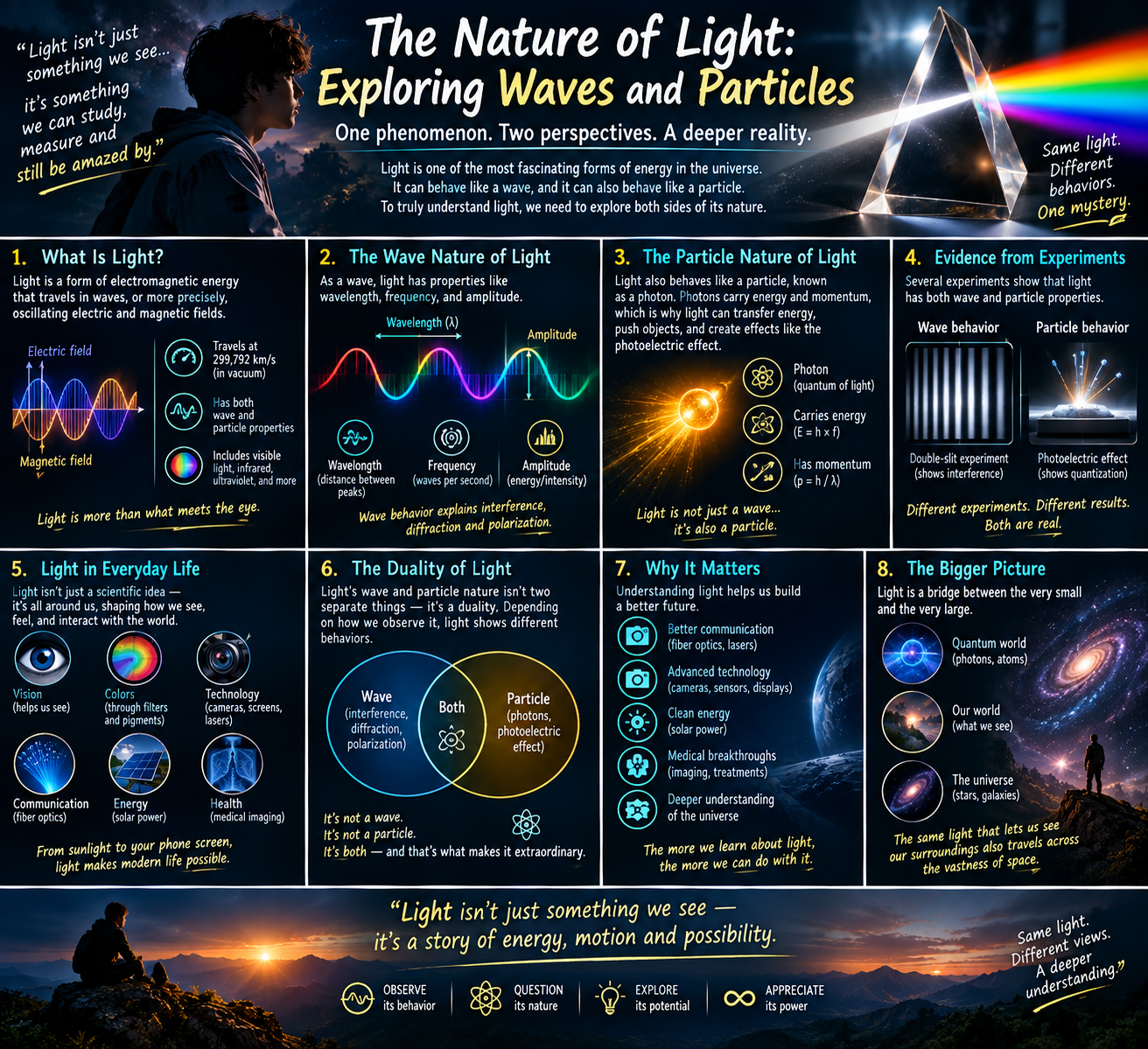
Light is one of the most fascinating phenomena in the universe. We see it every day, from the warm glow of the Sun to the colors of a rainbow, but understanding what light actually is has been one of the most interesting challenges in the history of science. The topic “The Nature of Light: Exploring Waves and Particles” takes us on an exciting journey into the world of physics and helps us understand why light can behave in two seemingly different ways.
For a long time, scientists debated whether light should be understood as a wave or as a collection of tiny particles. Experiments eventually showed that light has characteristics of both waves and particles. This remarkable property is known as wave-particle duality and is one of the foundations of modern physics.
Light as a Wave
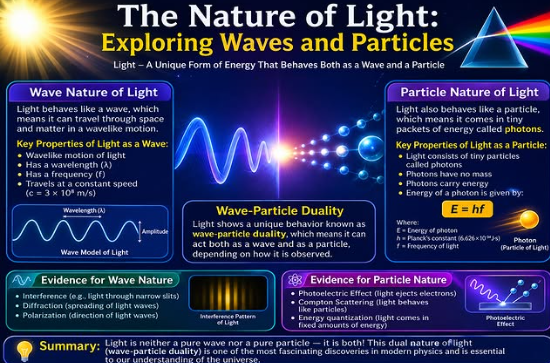
When we study light as a wave, we can describe it using properties such as wavelength, frequency, and amplitude. Light can demonstrate wave behaviors such as interference, diffraction, and polarization. The famous double-slit experiment provides a powerful example of how light can create an interference pattern, showing behavior associated with waves.
Different wavelengths of visible light correspond to different colors. When white light passes through a prism, it can separate into a beautiful spectrum of colors, reminding us that the light around us contains a fascinating range of electromagnetic radiation.
Light as a Particle
Light also displays particle-like behavior. In modern physics, these particles are called photons. A photon is a quantum of electromagnetic energy, and its energy is related to the frequency of light through the equation:
E = hf
Here, E represents the energy of a photon, h is Planck’s constant, and f is the frequency of the light.
The photoelectric effect provided important evidence for the particle nature of light. In this phenomenon, light can transfer energy to electrons in certain materials. This discovery played an important role in the development of quantum physics.
Story post NO:19
roll NO:13
Class: Foundation Level
Made by Me
The Nature of Light: Exploring Waves and Particles
Light is one of the most fascinating phenomena in the universe. We see it every day, from the warm glow of the Sun to the colors of a rainbow, but understanding what light actually is has been one of the most interesting challenges in the history of science. The topic “The Nature of Light: Exploring Waves and Particles” takes us on an exciting journey into the world of physics and helps us understand why light can behave in two seemingly different ways.
For a long time, scientists debated whether light should be understood as a wave or as a collection of tiny particles. Experiments eventually showed that light has characteristics of both waves and particles. This remarkable property is known as wave-particle duality and is one of the foundations of modern physics.
Light as a Wave
When we study light as a wave, we can describe it using properties such as wavelength, frequency, and amplitude. Light can demonstrate wave behaviors such as interference, diffraction, and polarization. The famous double-slit experiment provides a powerful example of how light can create an interference pattern, showing behavior associated with waves.
Different wavelengths of visible light correspond to different colors. When white light passes through a prism, it can separate into a beautiful spectrum of colors, reminding us that the light around us contains a fascinating range of electromagnetic radiation.
Light as a Particle
Light also displays particle-like behavior. In modern physics, these particles are called photons. A photon is a quantum of electromagnetic energy, and its energy is related to the frequency of light through the equation:
E = hf
Here, E represents the energy of a photon, h is Planck’s constant, and f is the frequency of the light.
The photoelectric effect provided important evidence for the particle nature of light. In this phenomenon, light can transfer energy to electrons in certain materials. This discovery played an important role in the development of quantum physics.
Mohsin RS F8 🎓✨
Story post NO:19
roll NO:13
Class: Foundation Level 📚
Made by Me 💻🚀
🌟 The Nature of Light: Exploring Waves and Particles 💡🌈
Light is one of the most fascinating phenomena in the universe. We see it every day, from the warm glow of the Sun to the colors of a rainbow, but understanding what light actually is has been one of the most interesting challenges in the history of science. The topic “The Nature of Light: Exploring Waves and Particles” takes us on an exciting journey into the world of physics and helps us understand why light can behave in two seemingly different ways.
For a long time, scientists debated whether light should be understood as a wave or as a collection of tiny particles. Experiments eventually showed that light has characteristics of both waves and particles. This remarkable property is known as wave-particle duality and is one of the foundations of modern physics.
🌊 Light as a Wave
When we study light as a wave, we can describe it using properties such as wavelength, frequency, and amplitude. Light can demonstrate wave behaviors such as interference, diffraction, and polarization. The famous double-slit experiment provides a powerful example of how light can create an interference pattern, showing behavior associated with waves.
Different wavelengths of visible light correspond to different colors. When white light passes through a prism, it can separate into a beautiful spectrum of colors, reminding us that the light around us contains a fascinating range of electromagnetic radiation.
✨ Light as a Particle
Light also displays particle-like behavior. In modern physics, these particles are called photons. A photon is a quantum of electromagnetic energy, and its energy is related to the frequency of light through the equation:
E = hf
Here, E represents the energy of a photon, h is Planck’s constant, and f is the frequency of the light.
The photoelectric effect provided important evidence for the particle nature of light. In this phenomenon, light can transfer energy to electrons in certain materials. This discovery played an important role in the development of quantum physics.
0 Yorumlar
0 hisse senetleri
71 Views