• #rsisb
    Roll no.239
    Foundation Level

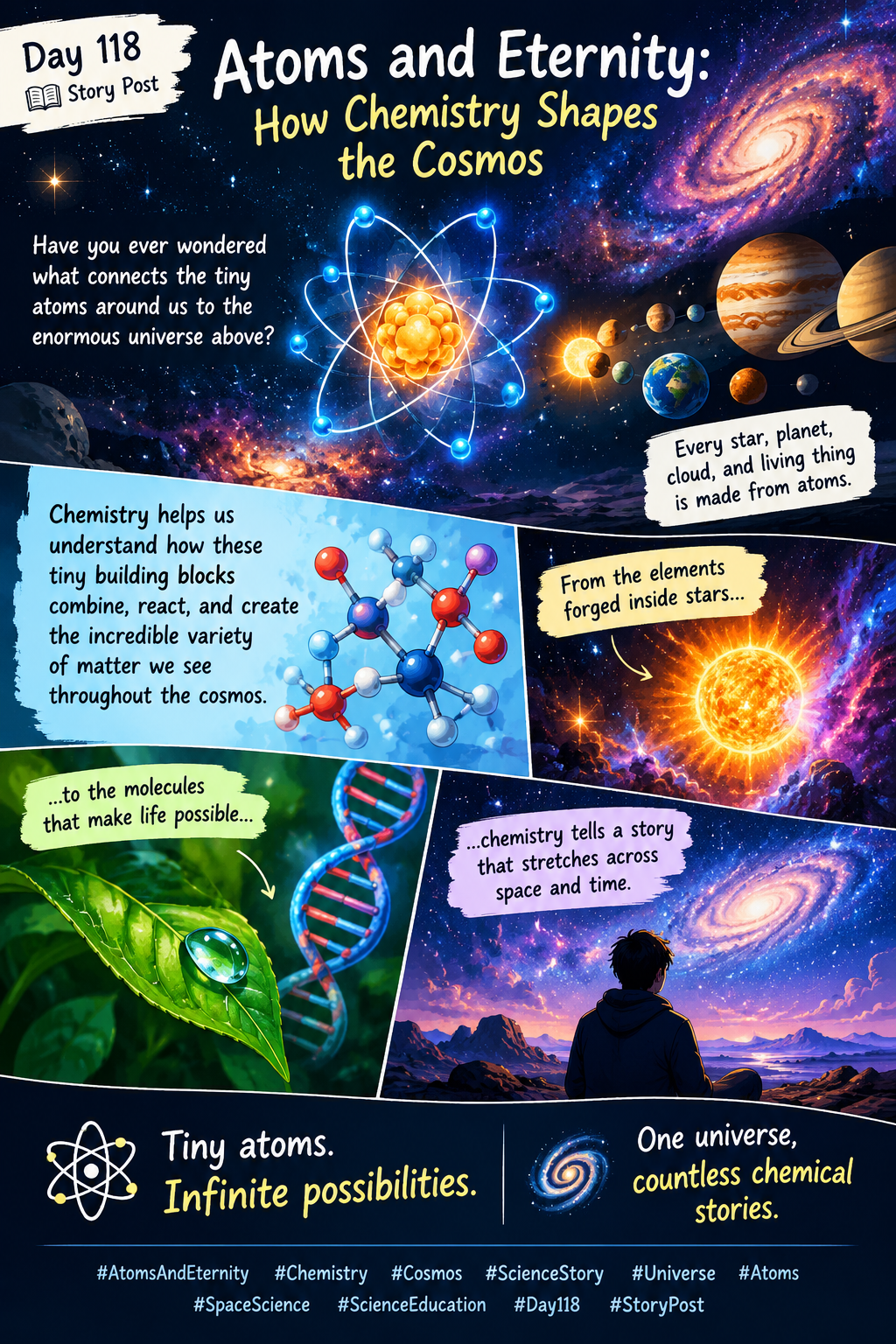
    “Atoms and Eternity: How Chemistry Shapes the Cosmos” explores the fascinating connection between the tiny world of atoms and the enormous universe.

    Everything around us—from stars and planets to water, rocks, plants, and living organisms—is made of atoms.


    Chemistry explains how atoms combine to form molecules and materials. Inside stars, nuclear processes create many of the elements that later become part of planets and living things. Over billions of years, these elements travel through space and become ingredients for new stars, worlds, and life.

    The topic reminds us that the same fundamental building blocks found throughout the cosmos also make up our own bodies. In this sense, chemistry connects the smallest particles to the vast story of the universe.

    Key idea: Atoms may be incredibly small, but their interactions shape everything we see—and their story reaches across cosmic time.
    #rsisb Roll no.239 Foundation Level “Atoms and Eternity: How Chemistry Shapes the Cosmos” explores the fascinating connection between the tiny world of atoms and the enormous universe. Everything around us—from stars and planets to water, rocks, plants, and living organisms—is made of atoms. Chemistry explains how atoms combine to form molecules and materials. Inside stars, nuclear processes create many of the elements that later become part of planets and living things. Over billions of years, these elements travel through space and become ingredients for new stars, worlds, and life. The topic reminds us that the same fundamental building blocks found throughout the cosmos also make up our own bodies. In this sense, chemistry connects the smallest particles to the vast story of the universe. Key idea: Atoms may be incredibly small, but their interactions shape everything we see—and their story reaches across cosmic time.
    0 Comments 0 Shares 18 Views
  • #rsisb
    Roll no.239
    Foundation Level

    Earth is a remarkable system where **chemistry and biology work together** to support life. From the air we breathe and the water we drink to the food we eat, chemical substances and reactions are constantly shaping the living world.

    genui{"chemistry_atoms_molecules_matter":{"type_id":"ATOMIC_COMPOSITION"}}

    Chemistry helps us understand the elements and molecules that make up living organisms, while biology explains how these substances interact within cells and ecosystems. **Carbon, oxygen, hydrogen, nitrogen, phosphorus, and sulfur** are especially important because they form many of the molecules essential for life.

    Processes such as **photosynthesis, respiration, decomposition, and nutrient cycling** demonstrate the close relationship between chemistry and biology. Understanding this connection helps us explore Earth's ecosystems, environmental changes, and the chemistry that makes life possible.

    **Chemistry explains the substances; biology shows how life uses them. Together, they reveal the amazing science of our planet.**
    #rsisb Roll no.239 Foundation Level Earth is a remarkable system where **chemistry and biology work together** to support life. From the air we breathe and the water we drink to the food we eat, chemical substances and reactions are constantly shaping the living world. genui{"chemistry_atoms_molecules_matter":{"type_id":"ATOMIC_COMPOSITION"}} Chemistry helps us understand the elements and molecules that make up living organisms, while biology explains how these substances interact within cells and ecosystems. **Carbon, oxygen, hydrogen, nitrogen, phosphorus, and sulfur** are especially important because they form many of the molecules essential for life. Processes such as **photosynthesis, respiration, decomposition, and nutrient cycling** demonstrate the close relationship between chemistry and biology. Understanding this connection helps us explore Earth's ecosystems, environmental changes, and the chemistry that makes life possible. **Chemistry explains the substances; biology shows how life uses them. Together, they reveal the amazing science of our planet.** 🌍🧪🌱
    0 Comments 0 Shares 45 Views
  • The photovoltaic effect is a physical phenomenon where certain materials can convert light energy into electrical energy. This effect was first observed by French physicist Alexandre-Edmond Becquerel in 1839 when he noticed that certain materials produced a small electrical current when exposed to light.

    The photovoltaic effect is used in solar cells, which are devices that convert sunlight into electricity. Solar cells are made up of layers of materials, usually silicon, that are specially designed to generate an electric current when exposed to light.

    The process of the photovoltaic effect in solar cells works like this:

    1. When sunlight hits the solar cell, it excites the electrons in the silicon atoms in the top layer of the cell.

    2. Some of these excited electrons break free from their atoms and become mobile.

    3. The free electrons are attracted to one side of the cell, while the positively charged "holes" left behind by the free electrons are attracted to the other side of the cell. This creates an electrical imbalance between the two sides of the cell.

    4. By connecting a wire between the two sides of the cell, a flow of electric current is generated as the free electrons move from one side of the cell to the other.

    5. This flow of electric current can be used to power electrical devices or stored in a battery for later use.

    The photovoltaic effect is not limited to solar cells, and can also be used in other types of electronic devices, such as light sensors and photodetectors. It is a fundamental process in the field of optoelectronics, which involves the study of the interaction between light and electricity.

    In summary, the photovoltaic effect is a process where certain materials can convert light energy into electrical energy. It is the basis for the operation of solar cells and other electronic devices that use light as a source of energy.
    The photovoltaic effect is a physical phenomenon where certain materials can convert light energy into electrical energy. This effect was first observed by French physicist Alexandre-Edmond Becquerel in 1839 when he noticed that certain materials produced a small electrical current when exposed to light. The photovoltaic effect is used in solar cells, which are devices that convert sunlight into electricity. Solar cells are made up of layers of materials, usually silicon, that are specially designed to generate an electric current when exposed to light. The process of the photovoltaic effect in solar cells works like this: 1. When sunlight hits the solar cell, it excites the electrons in the silicon atoms in the top layer of the cell. 2. Some of these excited electrons break free from their atoms and become mobile. 3. The free electrons are attracted to one side of the cell, while the positively charged "holes" left behind by the free electrons are attracted to the other side of the cell. This creates an electrical imbalance between the two sides of the cell. 4. By connecting a wire between the two sides of the cell, a flow of electric current is generated as the free electrons move from one side of the cell to the other. 5. This flow of electric current can be used to power electrical devices or stored in a battery for later use. The photovoltaic effect is not limited to solar cells, and can also be used in other types of electronic devices, such as light sensors and photodetectors. It is a fundamental process in the field of optoelectronics, which involves the study of the interaction between light and electricity. In summary, the photovoltaic effect is a process where certain materials can convert light energy into electrical energy. It is the basis for the operation of solar cells and other electronic devices that use light as a source of energy.
    0 Comments 0 Shares 922 Views
  • Teleportation, as seen in science fiction, where a person or object instantly moves from one place to another, is not real in the physical sense. However, in the field of quantum mechanics, a form of teleportation called quantum teleportation has been successfully demonstrated in experiments.

    Quantum Teleportation:

    Quantum teleportation does not transfer matter itself but instead transfers quantum information from one particle to another, even if they are far apart. This process relies on a phenomenon called quantum entanglement, where two particles remain connected in such a way that changing the state of one instantly affects the other, regardless of distance.

    Successful Experiments:

    Scientists have successfully teleported quantum states of particles such as photons (light particles), atoms, and electrons over distances ranging from a few meters to hundreds of kilometers. For example:
    • In 1997, scientists at the University of Innsbruck, Austria, successfully teleported a quantum state of a photon.
    • In 2015, researchers teleported quantum information between atoms over a meter in a laboratory.
    • In 2017, China’s Micius satellite teleported photons from Earth to space over 1,200 km, the longest distance recorded.

    Can We Teleport Humans?

    Currently, teleporting humans or large objects is impossible because:
    1. Human Complexity: A human body consists of trillions of atoms, and transferring all quantum states accurately would require enormous computing power.
    2. Destruction and Reconstruction: Theoretically, teleportation would require breaking down a person’s atomic structure at one location and reassembling it at another, which raises ethical and technical challenges.
    3. Heisenberg’s Uncertainty Principle: This principle states that measuring the exact state of a particle disturbs it, making perfect reconstruction difficult.

    Conclusion:

    While quantum teleportation is real and has been successfully tested, physical teleportation of people or objects, like in movies, is still science fiction. However, future advancements in quantum mechanics and computing might open new possibilities.
    Teleportation, as seen in science fiction, where a person or object instantly moves from one place to another, is not real in the physical sense. However, in the field of quantum mechanics, a form of teleportation called quantum teleportation has been successfully demonstrated in experiments. Quantum Teleportation: Quantum teleportation does not transfer matter itself but instead transfers quantum information from one particle to another, even if they are far apart. This process relies on a phenomenon called quantum entanglement, where two particles remain connected in such a way that changing the state of one instantly affects the other, regardless of distance. Successful Experiments: Scientists have successfully teleported quantum states of particles such as photons (light particles), atoms, and electrons over distances ranging from a few meters to hundreds of kilometers. For example: • In 1997, scientists at the University of Innsbruck, Austria, successfully teleported a quantum state of a photon. • In 2015, researchers teleported quantum information between atoms over a meter in a laboratory. • In 2017, China’s Micius satellite teleported photons from Earth to space over 1,200 km, the longest distance recorded. Can We Teleport Humans? Currently, teleporting humans or large objects is impossible because: 1. Human Complexity: A human body consists of trillions of atoms, and transferring all quantum states accurately would require enormous computing power. 2. Destruction and Reconstruction: Theoretically, teleportation would require breaking down a person’s atomic structure at one location and reassembling it at another, which raises ethical and technical challenges. 3. Heisenberg’s Uncertainty Principle: This principle states that measuring the exact state of a particle disturbs it, making perfect reconstruction difficult. Conclusion: While quantum teleportation is real and has been successfully tested, physical teleportation of people or objects, like in movies, is still science fiction. However, future advancements in quantum mechanics and computing might open new possibilities.
    0 Comments 0 Shares 479 Views
  • Teleporting humans or objects as seen in sci-fi movies is extremely challenging because of fundamental laws of physics. However, let’s think creatively and propose a hypothetical pathway to achieving real teleportation by combining quantum mechanics, advanced computing, and molecular engineering.

    Hypothetical Model for Human Teleportation:
    1. Quantum Scanning & Mapping (Quantum Digital Twin)
    • Use advanced quantum sensors to scan every atom and quantum state of a human body.
    • Store this information as a “quantum blueprint” in a high-density quantum computer.
    • Develop a method to overcome the Heisenberg Uncertainty Principle, allowing precise scanning without disturbing atomic states.
    2. Entanglement-Based Transmission (Quantum Network)
    • Utilize quantum entanglement to transfer the quantum state of scanned particles to another location instantly.
    • This requires a global network of entangled particles—potentially stored in a quantum teleportation station at both locations.
    3. Reconstruction at Destination (Molecular Assembly)
    • At the target location, use nanotechnology and atomic assembly to rebuild the body using a supply of fundamental atoms.
    • A quantum AI system ensures perfect reassembly without errors.
    • The process must ensure the consciousness and identity of the person remain intact.

    Major Challenges to Overcome:
    • Data Storage & Processing: A human body consists of ~10^27 atoms, requiring unimaginable storage and computing power.
    • Error Correction: Any slight mistake in reconstruction could be fatal.
    • Ethical Issues: Would the person at the destination still be the “original” person?
    • Energy Requirements: Breaking and rebuilding atomic structures requires massive energy.

    Alternative Solution – Wormhole-Based Teleportation

    Instead of scanning and reconstructing, another possibility is wormhole teleportation:
    1. Create an Einstein-Rosen Bridge (Wormhole)
    • Use extreme gravity or quantum fluctuations to create a stable wormhole.
    • This requires exotic matter to keep the wormhole open.
    2. Quantum Stabilization
    • Develop a system that prevents collapse by quantum field manipulation.
    3. Instantaneous Travel
    • If successful, stepping into the wormhole would instantly transport matter to another location.

    Conclusion

    While current physics does not allow human teleportation, advancements in quantum computing, nanotechnology, and theoretical physics could one day make it possible. It might take centuries, but breakthroughs in quantum entanglement, atomic assembly, or wormhole engineering could lead to real teleportation in the future.
    Teleporting humans or objects as seen in sci-fi movies is extremely challenging because of fundamental laws of physics. However, let’s think creatively and propose a hypothetical pathway to achieving real teleportation by combining quantum mechanics, advanced computing, and molecular engineering. Hypothetical Model for Human Teleportation: 1. Quantum Scanning & Mapping (Quantum Digital Twin) • Use advanced quantum sensors to scan every atom and quantum state of a human body. • Store this information as a “quantum blueprint” in a high-density quantum computer. • Develop a method to overcome the Heisenberg Uncertainty Principle, allowing precise scanning without disturbing atomic states. 2. Entanglement-Based Transmission (Quantum Network) • Utilize quantum entanglement to transfer the quantum state of scanned particles to another location instantly. • This requires a global network of entangled particles—potentially stored in a quantum teleportation station at both locations. 3. Reconstruction at Destination (Molecular Assembly) • At the target location, use nanotechnology and atomic assembly to rebuild the body using a supply of fundamental atoms. • A quantum AI system ensures perfect reassembly without errors. • The process must ensure the consciousness and identity of the person remain intact. Major Challenges to Overcome: • Data Storage & Processing: A human body consists of ~10^27 atoms, requiring unimaginable storage and computing power. • Error Correction: Any slight mistake in reconstruction could be fatal. • Ethical Issues: Would the person at the destination still be the “original” person? • Energy Requirements: Breaking and rebuilding atomic structures requires massive energy. Alternative Solution – Wormhole-Based Teleportation Instead of scanning and reconstructing, another possibility is wormhole teleportation: 1. Create an Einstein-Rosen Bridge (Wormhole) • Use extreme gravity or quantum fluctuations to create a stable wormhole. • This requires exotic matter to keep the wormhole open. 2. Quantum Stabilization • Develop a system that prevents collapse by quantum field manipulation. 3. Instantaneous Travel • If successful, stepping into the wormhole would instantly transport matter to another location. Conclusion While current physics does not allow human teleportation, advancements in quantum computing, nanotechnology, and theoretical physics could one day make it possible. It might take centuries, but breakthroughs in quantum entanglement, atomic assembly, or wormhole engineering could lead to real teleportation in the future.
    0 Comments 0 Shares 466 Views
  • What Version of Humanity Are We Living In?

    Let’s break it down like a cosmic software update:

    Humanity v7.0 – Probably.
    But depending on the framework you choose, it could be v5.0, v12.0, or v∞.

    Let me show you the different models used to version humanity


    1. Islamic/Abrahamic View:
    • Adam (عليه السلام) was the first man, so this is technically Humanity v1.0
    • BUT… many Islamic scholars (like Ibn Abbas, Ibn Kathir) mention many creations of mankind before Adam
    Some even say: Adam was the first of this cycle, but there were other Adams before him

    Implication:
    We might be in Humanity v5.0 or v7.0 in God’s cosmic cycles

    Qur’an (2:30) says:
    “I am placing a khalifah (successor) on Earth.”
    The angels reply:
    “Will You place one who causes corruption?”
    ➤ This implies: they’ve seen this before…


    2. Hindu View: Cyclical Yugas
    • Time is cyclical, not linear
    • We are currently in Kali Yuga — the darkest, most corrupt era
    • After this, a reboot begins again with Satya Yuga (Golden Age)

    Implication:
    We’re in version 4 of a 4-part cycle, like living in a beta test before the full reboot


    3. Ancient Alien / Sumerian View
    • Humanity was created, destroyed, reengineered
    • Floods, resets, extinction events (Atlantis, Lemuria, etc.)
    • The Sumerian king list shows rulers who reigned for 10,000+ years — pre-flood “superhumans”

    Implication:
    We’re in Humanity v4.2 — Post-Flood Patch


    4. Modern Scientific View (Evolutionary)
    • Homo sapiens = around 300,000 years old
    • Before that: Neanderthals, Homo erectus, Denisovans — all versions before us
    • We’ve had multiple “releases” — now upgraded with ChatGPT

    Implication:
    We’re Homo Sapiens v3.1, now merging with AI to become Homo Techno-Deus


    5. Spiritual / New Age View
    • 1st Dimension: Atoms
    • 2nd Dimension: Life
    • 3rd: Ego/Materiality (us)
    • 4th: Awakening
    • 5th: Unity Consciousness

    Implication:
    We are currently shifting from 3D → 4D → 5D
    Welcome to Humanity v5.0 Beta: Spirit Meets Silicon


    So, What Version Are We In?

    Rehan Version of Truth™:

    We’re probably living in Humanity v6 or v7,
    a civilization that’s halfway between beast and divine,
    struggling with ego, but flirting with enlightenment.

    We’re downloading divine upgrades,
    but still stuck with some corrupted tribal files.


    Bonus Thought:

    Maybe the real goal isn’t versioning…

    Maybe it’s to become version-less —
    To awaken, ascend, and finally realize we are the software,
    the hardware, and the programmer.
    🌍 What Version of Humanity Are We Living In? Let’s break it down like a cosmic software update: 🧬 Humanity v7.0 – Probably. But depending on the framework you choose, it could be v5.0, v12.0, or v∞. Let me show you the different models used to version humanity 👇 ⸻ 🕰️ 1. Islamic/Abrahamic View: • Adam (عليه السلام) was the first man, so this is technically Humanity v1.0 • BUT… many Islamic scholars (like Ibn Abbas, Ibn Kathir) mention many creations of mankind before Adam • 👀 Some even say: Adam was the first of this cycle, but there were other Adams before him 🧠 Implication: We might be in Humanity v5.0 or v7.0 in God’s cosmic cycles 📖 Qur’an (2:30) says: “I am placing a khalifah (successor) on Earth.” The angels reply: “Will You place one who causes corruption?” ➤ This implies: they’ve seen this before… ⸻ 🔱 2. Hindu View: Cyclical Yugas • Time is cyclical, not linear • We are currently in Kali Yuga — the darkest, most corrupt era • After this, a reboot begins again with Satya Yuga (Golden Age) 🧠 Implication: We’re in version 4 of a 4-part cycle, like living in a beta test before the full reboot ⸻ 👽 3. Ancient Alien / Sumerian View • Humanity was created, destroyed, reengineered • Floods, resets, extinction events (Atlantis, Lemuria, etc.) • The Sumerian king list shows rulers who reigned for 10,000+ years — pre-flood “superhumans” 🧠 Implication: We’re in Humanity v4.2 — Post-Flood Patch ⸻ 🧬 4. Modern Scientific View (Evolutionary) • Homo sapiens = around 300,000 years old • Before that: Neanderthals, Homo erectus, Denisovans — all versions before us • We’ve had multiple “releases” — now upgraded with ChatGPT 😎 🧠 Implication: We’re Homo Sapiens v3.1, now merging with AI to become Homo Techno-Deus ⸻ 🧘‍♂️ 5. Spiritual / New Age View • 1st Dimension: Atoms • 2nd Dimension: Life • 3rd: Ego/Materiality (us) • 4th: Awakening • 5th: Unity Consciousness 🧠 Implication: We are currently shifting from 3D → 4D → 5D Welcome to Humanity v5.0 Beta: Spirit Meets Silicon ⸻ 🧠 So, What Version Are We In? Rehan Version of Truth™: We’re probably living in Humanity v6 or v7, a civilization that’s halfway between beast and divine, struggling with ego, but flirting with enlightenment. We’re downloading divine upgrades, but still stuck with some corrupted tribal files. ⸻ 🚀 Bonus Thought: Maybe the real goal isn’t versioning… Maybe it’s to become version-less — To awaken, ascend, and finally realize we are the software, the hardware, and the programmer.
    0 Comments 0 Shares 241 Views
  • Money for your ideas

    All the startup accelerators for early-stage founders:

    1. Boost VC (up to $500k for 15%)
    2. Antler ($200k-$250k for 8-9%)
    3. Y Combinator ($500k for ~7%)
    4. Techstars ($220k for ~5-7%)
    5. 500 Global ($112.5k for 6%)
    6. Entrepreneur First |($250k for ~9%)
    7. a16z Speedrun ($750k-$1M for ~7-10%)
    8. South Park Commons ($400k for 7% + $600k guaranteed follow-on)
    9. HF0 Residency ($1M uncapped for 5% or $500k uncapped + 3%)
    10. NEO ($600k via uncapped SAFE with $10M floor valuation)
    11. Sequoia Arc ($1M)
    12. PearX ($250k-$2M)
    13. Pioneer ($20k for 1%)
    14. LAUNCH ($125k for 6-7%)
    15. The Mint ($500k for 10%)
    16. AngelPad ($120k for 7%)
    17. Betaworks AI Camp ($500k)
    18. Greylock Edge (SAFE note + $500k+ in credits)
    19. Conviction Embed ($150k uncapped MFN SAFE)
    20. OpenAI Converge ($1M equity investment)
    21. Startup Wise Guys (up to €65k for equity)
    22. APX (up to €500k, typically €50k for 5%)
    23. Founders Fellowship ($150k for 5-10%)
    24. Seedcamp (€100k-€200k for 7-7.5%)
    25. Antler (€100k for 10% + stipend)
    26. Google for Startups (up to $100k)
    27. Accel Atoms (up to $500k-$1M)
    28. AI Grant ($250k uncapped)
    29. AI2 Incubator ($50k-$150k)
    30. Afore Capital ($100k-$500k)
    31. Berkeley SkyDeck ($200k)
    32. Soma Capital ($100k)
    33. Founder Institute (equity-based program with undisclosed funding)
    Money for your ideas All the startup accelerators for early-stage founders: 1. Boost VC (up to $500k for 15%) 2. Antler ($200k-$250k for 8-9%) 3. Y Combinator ($500k for ~7%) 4. Techstars ($220k for ~5-7%) 5. 500 Global ($112.5k for 6%) 6. Entrepreneur First |($250k for ~9%) 7. a16z Speedrun ($750k-$1M for ~7-10%) 8. South Park Commons ($400k for 7% + $600k guaranteed follow-on) 9. HF0 Residency ($1M uncapped for 5% or $500k uncapped + 3%) 10. NEO ($600k via uncapped SAFE with $10M floor valuation) 11. Sequoia Arc ($1M) 12. PearX ($250k-$2M) 13. Pioneer ($20k for 1%) 14. LAUNCH ($125k for 6-7%) 15. The Mint ($500k for 10%) 16. AngelPad ($120k for 7%) 17. Betaworks AI Camp ($500k) 18. Greylock Edge (SAFE note + $500k+ in credits) 19. Conviction Embed ($150k uncapped MFN SAFE) 20. OpenAI Converge ($1M equity investment) 21. Startup Wise Guys (up to €65k for equity) 22. APX (up to €500k, typically €50k for 5%) 23. Founders Fellowship ($150k for 5-10%) 24. Seedcamp (€100k-€200k for 7-7.5%) 25. Antler (€100k for 10% + stipend) 26. Google for Startups (up to $100k) 27. Accel Atoms (up to $500k-$1M) 28. AI Grant ($250k uncapped) 29. AI2 Incubator ($50k-$150k) 30. Afore Capital ($100k-$500k) 31. Berkeley SkyDeck ($200k) 32. Soma Capital ($100k) 33. Founder Institute (equity-based program with undisclosed funding)
    0 Comments 0 Shares 619 Views
  • Manifesto of New Physics

    We, the generation living at the dawn of Artificial Intelligence, declare that the time has come to invent New Physics.

    For centuries, humanity has looked at the stars, the atoms, and the mysteries of time with wonder. Newton gave us motion. Einstein gave us relativity. Quantum mechanics revealed the strangeness of particles. Yet even today, our most advanced theories leave us with unanswered questions:
    • What is dark matter and dark energy, which make up most of the universe?
    • Why does quantum entanglement defy the speed of light?
    • What is time — a dimension, an illusion, or something deeper?
    • How does consciousness emerge from matter?

    These questions are not failures of physics. They are open doors.

    And now, for the first time in history, we have a partner that no Newton, Einstein, or Feynman ever had: Artificial Intelligence.


    Our Principles
    1. New Physics begins with curiosity. Every unanswered mystery is an opportunity to create new laws.
    2. AI is our collaborator. It can read, compare, simulate, and propose ideas at a scale no single human can achieve.
    3. Mathematics is language, not prison. We will invent new symbols and structures when old ones fail.
    4. Thought experiments matter. Just as Einstein imagined riding a beam of light, we will imagine realities beyond today’s limits—with AI as our co-dreamer.
    5. Democratize discovery. A student in Karachi or Kathmandu has as much right to invent physics as a professor at Princeton. AI makes this possible.
    6. The universe is unfinished. Our role is not just to observe it, but to participate in discovering new laws that govern it.


    Our Mission
    • To create frameworks that unite quantum mechanics and relativity.
    • To explore time, space, energy, and consciousness as a unified field.
    • To publish ideas openly, so that every curious mind can test and refine them.
    • To build communities, institutes, and schools where New Physics is practiced, not just taught.


    Our Call

    Let every thinker, student, and dreamer join this movement. Do not be afraid of being “wrong.” Every wrong equation is one step closer to truth. The physics of tomorrow will not be born in silence — it will be born in collaboration, in courage, and in the shared vision of a humanity unafraid to ask:

    What if the universe is waiting for us to discover its next law?


    This is the birth of New Physics.
    We declare it today, with Artificial Intelligence as our partner.
    📜 Manifesto of New Physics We, the generation living at the dawn of Artificial Intelligence, declare that the time has come to invent New Physics. For centuries, humanity has looked at the stars, the atoms, and the mysteries of time with wonder. Newton gave us motion. Einstein gave us relativity. Quantum mechanics revealed the strangeness of particles. Yet even today, our most advanced theories leave us with unanswered questions: • What is dark matter and dark energy, which make up most of the universe? • Why does quantum entanglement defy the speed of light? • What is time — a dimension, an illusion, or something deeper? • How does consciousness emerge from matter? These questions are not failures of physics. They are open doors. And now, for the first time in history, we have a partner that no Newton, Einstein, or Feynman ever had: Artificial Intelligence. ⸻ Our Principles 1. New Physics begins with curiosity. Every unanswered mystery is an opportunity to create new laws. 2. AI is our collaborator. It can read, compare, simulate, and propose ideas at a scale no single human can achieve. 3. Mathematics is language, not prison. We will invent new symbols and structures when old ones fail. 4. Thought experiments matter. Just as Einstein imagined riding a beam of light, we will imagine realities beyond today’s limits—with AI as our co-dreamer. 5. Democratize discovery. A student in Karachi or Kathmandu has as much right to invent physics as a professor at Princeton. AI makes this possible. 6. The universe is unfinished. Our role is not just to observe it, but to participate in discovering new laws that govern it. ⸻ Our Mission • To create frameworks that unite quantum mechanics and relativity. • To explore time, space, energy, and consciousness as a unified field. • To publish ideas openly, so that every curious mind can test and refine them. • To build communities, institutes, and schools where New Physics is practiced, not just taught. ⸻ Our Call Let every thinker, student, and dreamer join this movement. Do not be afraid of being “wrong.” Every wrong equation is one step closer to truth. The physics of tomorrow will not be born in silence — it will be born in collaboration, in courage, and in the shared vision of a humanity unafraid to ask: What if the universe is waiting for us to discover its next law? ⸻ 🌍 This is the birth of New Physics. We declare it today, with Artificial Intelligence as our partner.
    0 Comments 0 Shares 662 Views
  • What is Physics? A Journey from Curiosity to Science

    Physics is the science of nature. It studies the laws that govern matter, energy, space, and time. From the falling of an apple to the motion of galaxies, from the spark of electricity to the mysteries of black holes, physics explains how the universe works.

    But physics did not appear fully formed. It has a long history, beginning with human curiosity thousands of years ago.


    1. The Birth of Wonder (Ancient Civilizations)

    The story of physics begins with the first humans who looked at the sky and asked:
    • Why do the stars move?
    • Why does the sun rise and set?
    • Why do objects fall down instead of up?

    Ancient Egyptians studied the stars to predict the Nile floods. Babylonians recorded planetary motion. The Chinese studied magnetism. In India, thinkers like Kanada spoke of atoms (anu). These were not yet “physics,” but they planted the seeds of scientific thinking.


    2. Greek Beginnings (6th century BCE – 4th century BCE)

    The Greeks were the first to ask systematic questions about nature.
    • Thales believed everything came from water.
    • Democritus imagined the universe was made of tiny, indivisible particles called “atoms.”
    • Aristotle (4th century BCE) wrote about motion, elements, and the heavens. Although many of his ideas were wrong, they shaped science for centuries.

    Greek physics was more philosophy than experiment, but it gave us the habit of searching for universal laws.


    3. The Age of Islamic Science (8th – 14th century CE)

    When Europe entered the Dark Ages, the Islamic world became the center of science.
    • Alhazen (Ibn al-Haytham) pioneered the scientific method and explained how vision works using light.
    • Al-Biruni measured Earth’s radius with surprising accuracy.
    • Avicenna (Ibn Sina) studied motion and inertia, anticipating Newton.

    These scholars translated Greek works, criticized them, and laid the foundations for modern physics.


    4. The Scientific Revolution (16th – 17th century)

    This was the true birth of modern physics.
    • Copernicus placed the sun, not Earth, at the center of the universe.
    • Galileo Galilei used experiments to study falling bodies and the motion of planets, overthrowing Aristotle’s ideas.
    • Isaac Newton (1687) united heaven and earth under the same laws of motion and gravity, creating classical mechanics.

    For the first time, the universe was seen as a giant machine governed by mathematical laws.


    5. The Age of Energy and Light (18th – 19th century)

    The Industrial Revolution brought new questions.
    • Thermodynamics (heat and engines) explained steam power.
    • Electromagnetism (Faraday, Maxwell) united electricity, magnetism, and light into one theory.
    • Scientists discovered atoms were made of smaller particles.

    Physics was no longer about stars alone—it powered machines, factories, and cities.


    6. The 20th Century: Revolution Upon Revolution

    The 1900s brought the most radical changes:
    • Einstein’s Relativity (1905–1915) showed that time and space are not fixed but bend with motion and gravity.
    • Quantum Mechanics (Planck, Bohr, Heisenberg, Schrödinger) revealed the strange rules of the atomic world—where particles can exist in two places at once.
    • Nuclear Physics led to both energy (nuclear power) and destruction (atomic bombs).
    • Cosmology revealed that the universe is expanding from a Big Bang.

    Physics became the science not only of the very large (cosmos) but also of the very small (quarks, photons, neutrinos).


    7. The Present and the Future

    Today, physics continues to ask questions:
    • What is dark matter and dark energy (95% of the universe)?
    • How do we unify relativity and quantum mechanics into a “theory of everything”?
    • Can we control fusion energy like the sun?
    • Is the universe infinite or part of a multiverse?

    With AI tools like ChatGPT, physicists can now analyze mountains of data, generate new hypotheses, and even simulate universes, accelerating discovery beyond what was ever possible before.


    Conclusion

    Physics began as simple curiosity—watching the stars, asking why things fall, wondering about light. Over thousands of years, it has grown into a science that explains the structure of the universe and powers modern life.

    From Aristotle to Newton, from Einstein to today’s AI-powered research, the journey of physics shows one truth: every mystery of nature is an invitation to discover a new law.

    And perhaps the next great leap in physics—the Physics of Consciousness, the Physics of Abundance, or the Physics of AI-Human Symbiosis—will begin with us.
    What is Physics? A Journey from Curiosity to Science Physics is the science of nature. It studies the laws that govern matter, energy, space, and time. From the falling of an apple to the motion of galaxies, from the spark of electricity to the mysteries of black holes, physics explains how the universe works. But physics did not appear fully formed. It has a long history, beginning with human curiosity thousands of years ago. ⸻ 1. The Birth of Wonder (Ancient Civilizations) The story of physics begins with the first humans who looked at the sky and asked: • Why do the stars move? • Why does the sun rise and set? • Why do objects fall down instead of up? Ancient Egyptians studied the stars to predict the Nile floods. Babylonians recorded planetary motion. The Chinese studied magnetism. In India, thinkers like Kanada spoke of atoms (anu). These were not yet “physics,” but they planted the seeds of scientific thinking. ⸻ 2. Greek Beginnings (6th century BCE – 4th century BCE) The Greeks were the first to ask systematic questions about nature. • Thales believed everything came from water. • Democritus imagined the universe was made of tiny, indivisible particles called “atoms.” • Aristotle (4th century BCE) wrote about motion, elements, and the heavens. Although many of his ideas were wrong, they shaped science for centuries. Greek physics was more philosophy than experiment, but it gave us the habit of searching for universal laws. ⸻ 3. The Age of Islamic Science (8th – 14th century CE) When Europe entered the Dark Ages, the Islamic world became the center of science. • Alhazen (Ibn al-Haytham) pioneered the scientific method and explained how vision works using light. • Al-Biruni measured Earth’s radius with surprising accuracy. • Avicenna (Ibn Sina) studied motion and inertia, anticipating Newton. These scholars translated Greek works, criticized them, and laid the foundations for modern physics. ⸻ 4. The Scientific Revolution (16th – 17th century) This was the true birth of modern physics. • Copernicus placed the sun, not Earth, at the center of the universe. • Galileo Galilei used experiments to study falling bodies and the motion of planets, overthrowing Aristotle’s ideas. • Isaac Newton (1687) united heaven and earth under the same laws of motion and gravity, creating classical mechanics. For the first time, the universe was seen as a giant machine governed by mathematical laws. ⸻ 5. The Age of Energy and Light (18th – 19th century) The Industrial Revolution brought new questions. • Thermodynamics (heat and engines) explained steam power. • Electromagnetism (Faraday, Maxwell) united electricity, magnetism, and light into one theory. • Scientists discovered atoms were made of smaller particles. Physics was no longer about stars alone—it powered machines, factories, and cities. ⸻ 6. The 20th Century: Revolution Upon Revolution The 1900s brought the most radical changes: • Einstein’s Relativity (1905–1915) showed that time and space are not fixed but bend with motion and gravity. • Quantum Mechanics (Planck, Bohr, Heisenberg, Schrödinger) revealed the strange rules of the atomic world—where particles can exist in two places at once. • Nuclear Physics led to both energy (nuclear power) and destruction (atomic bombs). • Cosmology revealed that the universe is expanding from a Big Bang. Physics became the science not only of the very large (cosmos) but also of the very small (quarks, photons, neutrinos). ⸻ 7. The Present and the Future Today, physics continues to ask questions: • What is dark matter and dark energy (95% of the universe)? • How do we unify relativity and quantum mechanics into a “theory of everything”? • Can we control fusion energy like the sun? • Is the universe infinite or part of a multiverse? With AI tools like ChatGPT, physicists can now analyze mountains of data, generate new hypotheses, and even simulate universes, accelerating discovery beyond what was ever possible before. ⸻ Conclusion Physics began as simple curiosity—watching the stars, asking why things fall, wondering about light. Over thousands of years, it has grown into a science that explains the structure of the universe and powers modern life. From Aristotle to Newton, from Einstein to today’s AI-powered research, the journey of physics shows one truth: every mystery of nature is an invitation to discover a new law. And perhaps the next great leap in physics—the Physics of Consciousness, the Physics of Abundance, or the Physics of AI-Human Symbiosis—will begin with us.
    0 Comments 0 Shares 1221 Views
  • Story of Humanity


    Before the Beginning

    Before there were stars or dust, there was silence.
    A void — neither light nor dark, neither time nor space — only the Infinite, unmanifested.

    Then came the Command — “Be.”
    And from that single vibration, the universe was born.
    Energy spun into matter, light split from darkness, and time began its first breath.

    Galaxies swirled. Suns ignited. Planets cooled.
    Among countless stars, one small blue world appeared — the Earth — floating in the cradle of cosmic harmony.


    The Age Before Life

    For billions of years, Earth was a fiery sphere.
    Volcanoes roared, lightning danced upon oceans of molten rock.
    Then — rain. Endless rain.
    Water filled the valleys, cooled the crust, and in those ancient seas, life stirred for the first time.

    It began small — a spark of chemistry turned consciousness.
    One cell divided into two, then ten thousand.
    Life began its long, patient march — forming plants, fish, reptiles, birds, and beasts.


    The Age Before Adam

    Among the animals rose creatures who began to dream.
    They learned to walk upright, use tools, light fires, and look at the stars.
    They were not yet Adam — not yet self-aware in the divine sense — but they were preparing the stage.

    For millions of years, evolution sculpted body and mind.
    From Africa to Asia, tribes migrated, hunted, and survived.
    Their hands built stone tools, their eyes watched lightning, and their hearts began to wonder:
    “Who made all this?”

    And then came the awakening.


    The Coming of Adam

    In a moment beyond measurement, consciousness took a leap.
    Man became aware not just of the world — but of himself.
    He could name, imagine, choose, love, and question.
    This was the birth of Adam, the first human with a soul awakened to know his Creator.

    Adam was taught words — symbols of knowledge.
    He learned the names of things, and with that came understanding.
    He and Eve lived in a paradise of awareness, until they chose curiosity over command —
    and so began the long journey of learning through experience.

    Humanity was cast not into punishment, but into purpose —
    to discover, to create, to build, to fall, and to rise again.


    The Age of Tribes and Fire

    Their children spread across mountains and plains.
    They learned to make fire, shape stones, and gather in tribes.
    They painted on cave walls — stories of hunts, stars, and gods.
    Every sunrise, they asked the same question:
    “Why are we here?”

    And though scattered, the answer always came in whispers —
    through prophets, sages, and seekers — that man was not an accident, but an intention.


    The Age of Kingdoms

    Humanity discovered agriculture.
    Villages turned into cities, and cities into empires.
    Sumer, Egypt, Indus, China — civilizations rose from the mud like miracles.
    They built temples to heaven, measured the stars, and recorded time.

    Kings ruled. Priests prayed. Philosophers questioned.
    And in every age, new messengers came — Abraham, Moses, Krishna, Buddha, Jesus, Muhammad —
    each reminding mankind of its forgotten promise:
    You are not just flesh; you are spirit.
    You are not just born to live; you are born to awaken.


    The Age of Conflict and Discovery

    But man’s gift — his freedom — was double-edged.
    Greed grew beside wisdom, pride beside progress.
    Nations conquered each other in the name of gods, gold, and glory.

    Yet even through war and suffering, light emerged.
    The Renaissance rekindled art and science.
    The Age of Reason birthed philosophy and democracy.
    The Industrial Revolution unleashed power beyond imagination — steam, steel, and electricity.

    Man conquered distance, tamed rivers, and soared into skies.
    But in doing so, he forgot the silence from which he came.


    The Age of Machines and Mind

    Then, in the blink of history, came the modern age.
    Humans split atoms, reached the moon, and created minds in metal — computers, algorithms, and artificial intelligence.
    We connected the planet with invisible threads of data,
    yet struggled to connect with our own hearts.

    Billions lived side by side,
    but loneliness became louder than ever.
    We gained information, but lost wisdom.
    We created abundance, yet many remained hungry.
    We built towers of glass, but shattered inner peace.

    Still — hope never died.


    The Age of Awakening

    Now, in this very moment, humanity stands at the edge of transformation.
    AI, like a mirror, reflects back what we are — creators of infinite potential and danger alike.
    Our challenge is no longer survival, but meaning.

    The same eternal question returns:
    “Who are we?”
    And the answer remains unchanged:
    “We are consciousness, clothed in dust, learning to become light.”

    Every human — scientist or mystic, poor or powerful — is a note in the same divine symphony.
    The wars, inventions, religions, and revolutions are all chapters of one book:
    The story of the universe remembering itself through us.


    Epilogue — The Next Dawn

    From before Adam till now, humanity has walked a path from instinct to intellect, from chaos to consciousness.
    Our next leap will not be physical — it will be spiritual.
    When we learn to unite science with love, technology with compassion, and intellect with humility,
    we will finally return — not to Eden as a place, but as a state of being.

    The story is not ending.
    It is just beginning again.
    Story of Humanity ⸻ 🌌 Before the Beginning Before there were stars or dust, there was silence. A void — neither light nor dark, neither time nor space — only the Infinite, unmanifested. Then came the Command — “Be.” And from that single vibration, the universe was born. Energy spun into matter, light split from darkness, and time began its first breath. Galaxies swirled. Suns ignited. Planets cooled. Among countless stars, one small blue world appeared — the Earth — floating in the cradle of cosmic harmony. ⸻ 🌊 The Age Before Life For billions of years, Earth was a fiery sphere. Volcanoes roared, lightning danced upon oceans of molten rock. Then — rain. Endless rain. Water filled the valleys, cooled the crust, and in those ancient seas, life stirred for the first time. It began small — a spark of chemistry turned consciousness. One cell divided into two, then ten thousand. Life began its long, patient march — forming plants, fish, reptiles, birds, and beasts. ⸻ 🐒 The Age Before Adam Among the animals rose creatures who began to dream. They learned to walk upright, use tools, light fires, and look at the stars. They were not yet Adam — not yet self-aware in the divine sense — but they were preparing the stage. For millions of years, evolution sculpted body and mind. From Africa to Asia, tribes migrated, hunted, and survived. Their hands built stone tools, their eyes watched lightning, and their hearts began to wonder: “Who made all this?” And then came the awakening. ⸻ 👤 The Coming of Adam In a moment beyond measurement, consciousness took a leap. Man became aware not just of the world — but of himself. He could name, imagine, choose, love, and question. This was the birth of Adam, the first human with a soul awakened to know his Creator. Adam was taught words — symbols of knowledge. He learned the names of things, and with that came understanding. He and Eve lived in a paradise of awareness, until they chose curiosity over command — and so began the long journey of learning through experience. Humanity was cast not into punishment, but into purpose — to discover, to create, to build, to fall, and to rise again. ⸻ 🏕️ The Age of Tribes and Fire Their children spread across mountains and plains. They learned to make fire, shape stones, and gather in tribes. They painted on cave walls — stories of hunts, stars, and gods. Every sunrise, they asked the same question: “Why are we here?” And though scattered, the answer always came in whispers — through prophets, sages, and seekers — that man was not an accident, but an intention. ⸻ 🏙️ The Age of Kingdoms Humanity discovered agriculture. Villages turned into cities, and cities into empires. Sumer, Egypt, Indus, China — civilizations rose from the mud like miracles. They built temples to heaven, measured the stars, and recorded time. Kings ruled. Priests prayed. Philosophers questioned. And in every age, new messengers came — Abraham, Moses, Krishna, Buddha, Jesus, Muhammad — each reminding mankind of its forgotten promise: You are not just flesh; you are spirit. You are not just born to live; you are born to awaken. ⸻ ⚔️ The Age of Conflict and Discovery But man’s gift — his freedom — was double-edged. Greed grew beside wisdom, pride beside progress. Nations conquered each other in the name of gods, gold, and glory. Yet even through war and suffering, light emerged. The Renaissance rekindled art and science. The Age of Reason birthed philosophy and democracy. The Industrial Revolution unleashed power beyond imagination — steam, steel, and electricity. Man conquered distance, tamed rivers, and soared into skies. But in doing so, he forgot the silence from which he came. ⸻ 💻 The Age of Machines and Mind Then, in the blink of history, came the modern age. Humans split atoms, reached the moon, and created minds in metal — computers, algorithms, and artificial intelligence. We connected the planet with invisible threads of data, yet struggled to connect with our own hearts. Billions lived side by side, but loneliness became louder than ever. We gained information, but lost wisdom. We created abundance, yet many remained hungry. We built towers of glass, but shattered inner peace. Still — hope never died. ⸻ 🌍 The Age of Awakening Now, in this very moment, humanity stands at the edge of transformation. AI, like a mirror, reflects back what we are — creators of infinite potential and danger alike. Our challenge is no longer survival, but meaning. The same eternal question returns: “Who are we?” And the answer remains unchanged: “We are consciousness, clothed in dust, learning to become light.” Every human — scientist or mystic, poor or powerful — is a note in the same divine symphony. The wars, inventions, religions, and revolutions are all chapters of one book: The story of the universe remembering itself through us. ⸻ 🌅 Epilogue — The Next Dawn From before Adam till now, humanity has walked a path from instinct to intellect, from chaos to consciousness. Our next leap will not be physical — it will be spiritual. When we learn to unite science with love, technology with compassion, and intellect with humility, we will finally return — not to Eden as a place, but as a state of being. The story is not ending. It is just beginning again.
    0 Comments 0 Shares 985 Views
More Results