**Roll No: 2**
**Batch: 14**
**Book: ACCL**
**Task No: 162**
# Sound Waves: The Physics of Hearing and Communication
Have you ever wondered how we hear music, recognize someone's voice, or communicate with people from a distance? Every sound we hear is connected to the fascinating science of physics. From a gentle whisper to a powerful thunderstorm, sound travels through vibrations and waves, allowing us to experience and understand the world around us.
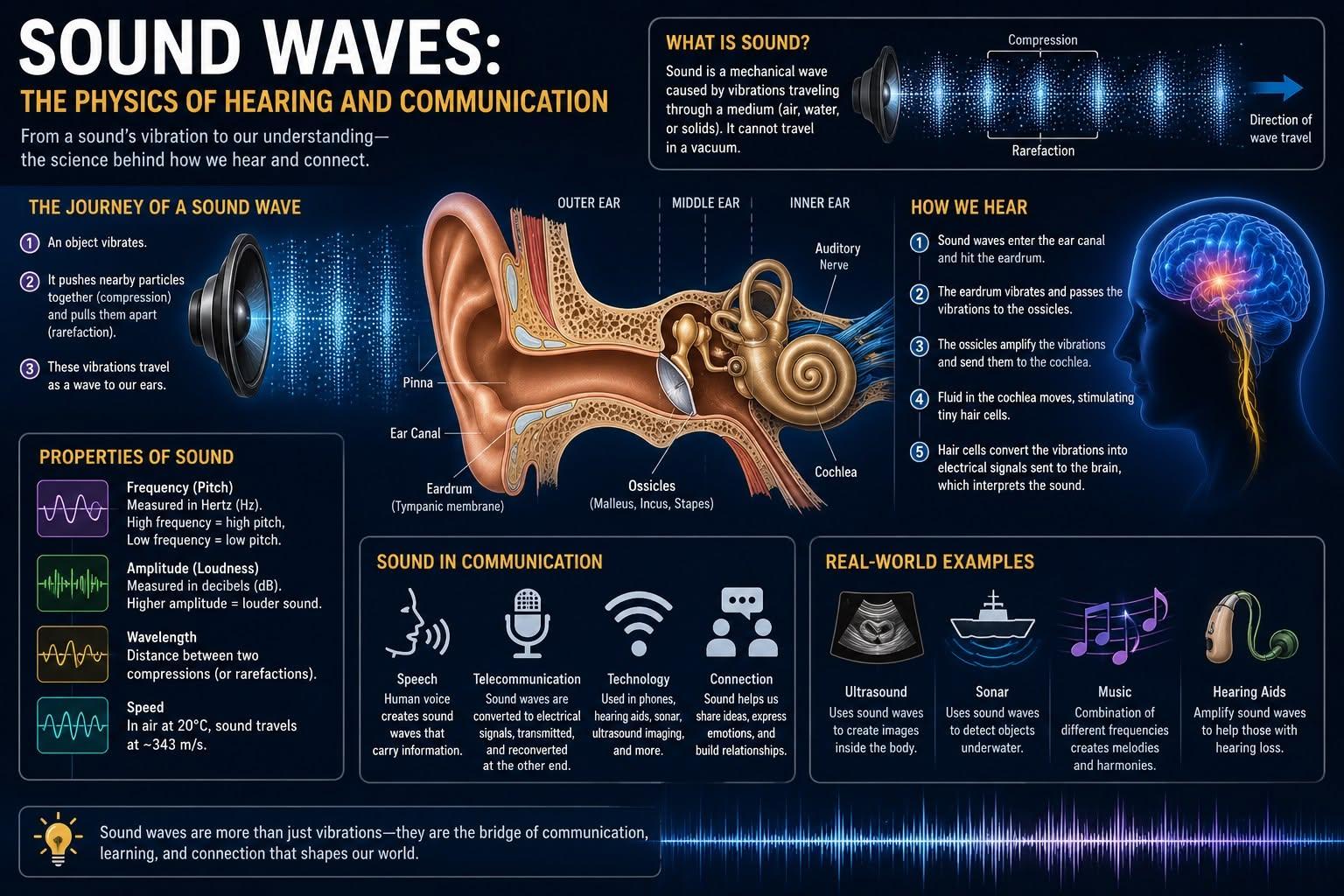
**Sound is a form of energy produced by vibrations.** When an object vibrates, it causes nearby particles in a medium, such as air, water, or a solid material, to vibrate as well. These vibrations travel from one place to another in the form of sound waves. Unlike light, sound cannot travel through a vacuum because it needs a material medium to carry its vibrations.
## How Sound Waves Travel
Sound generally travels through air as a longitudinal wave. This means that air particles vibrate back and forth in the same direction as the wave travels. These movements create areas of compression, where particles are closer together, and rarefaction, where particles are farther apart. Together, these patterns carry sound energy through the medium.
The speed of sound depends on the material through which it travels and the surrounding conditions. In air at room temperature, sound travels at approximately 343 metres per second. It generally travels faster through liquids and solids because of the properties of their particles. This explains why sound behaves differently in different environments.
## Important Properties of Sound
Sound waves have several important properties that help us understand what we hear.
- **Frequency:** The number of vibrations or cycles per second, measured in hertz (Hz). Frequency determines the pitch of a sound. Higher frequency usually means a higher-pitched sound, while lower frequency produces a deeper sound.
- **Amplitude:** The size of a wave's vibration. Greater amplitude generally corresponds to a louder sound.
- **Wavelength:** The distance between two corresponding points on a wave, such as two successive compressions.
- **Speed:** The rate at which sound travels through a particular medium.
These properties help explain why a bird's chirping sounds different from the deep rumble of thunder.
## The Amazing Science of Human Hearing
The human ear is a remarkable organ that allows us to detect and interpret sound. It has three main parts: the outer ear, middle ear, and inner ear. Each part performs an important function in the hearing process.
The outer ear collects sound waves and directs them into the ear canal. They reach the eardrum, causing it to vibrate. These vibrations pass through three tiny bones in the middle ear, known as the hammer, anvil, and stirrup. The vibrations then reach the cochlea in the inner ear, where specialized sensory cells convert them into electrical signals.
These signals travel through the auditory nerve to the brain, which processes them and allows us to recognize voices, music, and other sounds.
## Sound and Human Communication
Sound is one of the most important tools of human communication. Through speech, people share information, express emotions, tell stories, and build relationships. Different languages use different combinations of sounds to create words and meanings.
Communication is not limited to spoken words. Music, alarms, bells, and other signals also carry information. For example, a school bell tells students when a class begins or ends, while emergency sirens warn people about possible dangers. Sound helps societies exchange information quickly and effectively.
## Music: The Beauty of Sound
Music demonstrates the creative side of sound physics. Musical instruments produce vibrations in different ways. A guitar creates sound through vibrating strings, a flute produces sound through vibrating air, and a drum produces sound through a vibrating surface.
Different frequencies combine to create melodies and harmonies. The quality or tone of a sound, called timbre, helps us distinguish one instrument from another even when they play the same musical note. This connection between physics and music shows how scientific principles can create beautiful artistic experiences.
## Sound in Modern Technology
The science of sound has transformed communication and technology. Microphones convert sound waves into electrical signals, while speakers convert electrical signals back into sound. These devices make telephones, computers, televisions, and recording systems possible.
Ultrasound technology uses sound waves with frequencies higher than the human hearing range. It is widely used in medical imaging to help doctors observe structures inside the body. Sonar systems use sound waves to detect objects underwater and estimate their distance. These applications show that sound is important not only for communication but also for science, medicine, and exploration.
## Protecting Our Hearing
Although sound is useful, excessively loud noise can damage hearing. Continuous exposure to high sound levels may harm the sensitive structures inside the ears. Therefore, it is important to keep headphone volumes at safe levels, take listening breaks, and use suitable hearing protection in noisy environments.
Noise pollution is another environmental concern. Traffic, construction, factories, and loud machinery can disturb people and wildlife. Reducing unnecessary noise helps create healthier and more peaceful surroundings.
## Learning Through Observation
We can explore sound waves through simple and safe activities. For example, gently plucking a rubber band stretched around a box allows us to observe how vibrations produce sound. We can also compare the sounds of different musical instruments and notice how their pitch and tone vary.
These observations help students connect scientific theories with everyday experiences. By asking questions, testing ideas, and recording observations, we develop a deeper understanding of the physics behind hearing and communication.
Sound is much more than something we hear. It is a physical phenomenon that connects science, technology, music, nature, and human interaction. Every conversation, musical note, and natural sound demonstrates the remarkable journey of vibrations through the world around us.
**Sound waves are the invisible messengers of our world. By understanding how they travel, how our ears detect them, and how technology uses them, we discover the powerful connection between physics, hearing, and communication. **
#SoundWaves #PhysicsOfSound #Hearing #Communication #Acoustics #Science #HumanEar #SoundTechnology #ACCL #Batch14 #Task162
**Roll No: 2**
**Batch: 14**
**Book: ACCL**
**Task No: 162**
# 🔊🎵 Sound Waves: The Physics of Hearing and Communication 👂🌍
Have you ever wondered how we hear music, recognize someone's voice, or communicate with people from a distance? 🎶📢 Every sound we hear is connected to the fascinating science of physics. From a gentle whisper to a powerful thunderstorm, sound travels through vibrations and waves, allowing us to experience and understand the world around us. 🌎✨
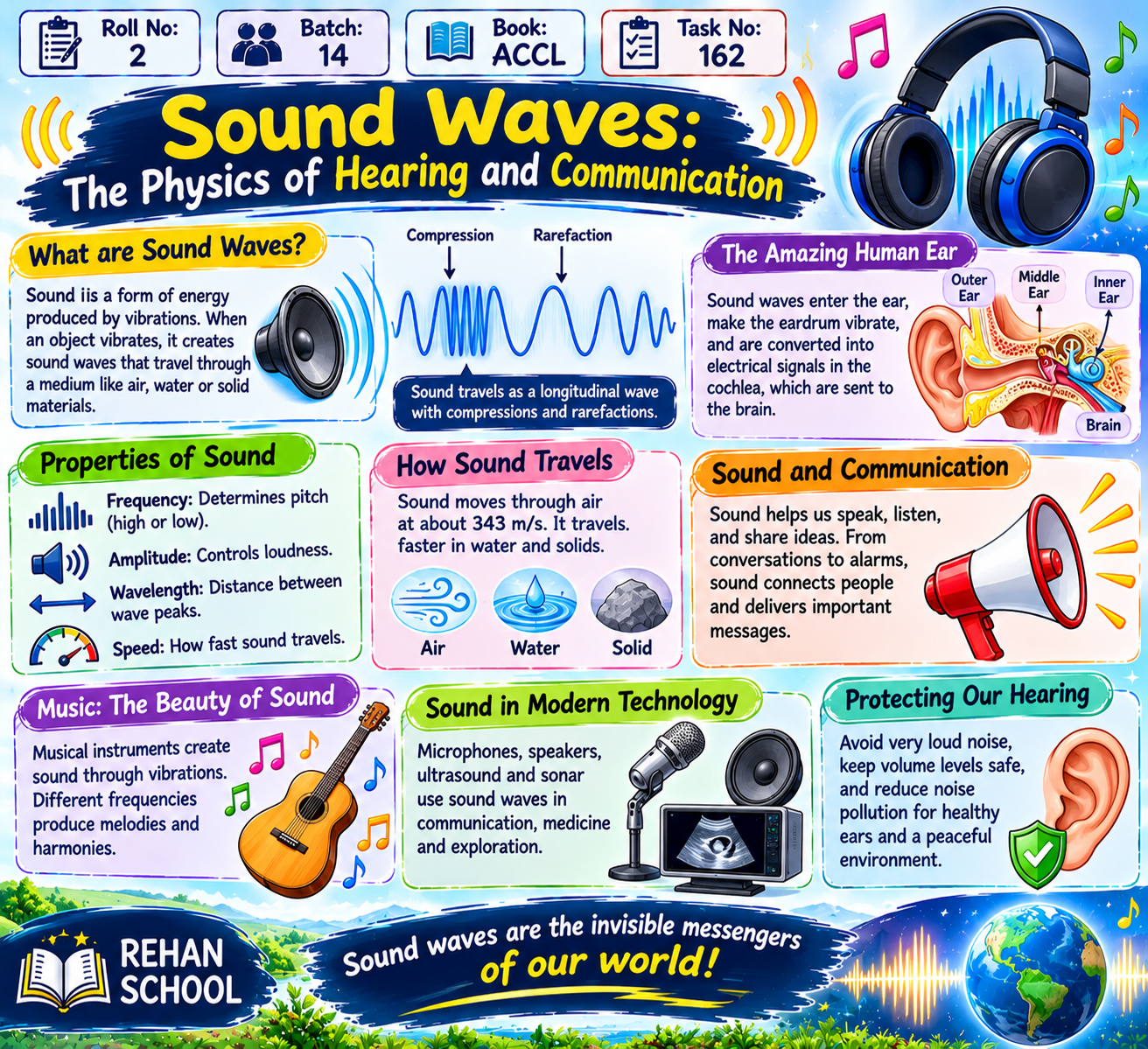
**Sound is a form of energy produced by vibrations.** 🔬 When an object vibrates, it causes nearby particles in a medium, such as air, water, or a solid material, to vibrate as well. These vibrations travel from one place to another in the form of sound waves. Unlike light, sound cannot travel through a vacuum because it needs a material medium to carry its vibrations.
## 🌊 How Sound Waves Travel
Sound generally travels through air as a longitudinal wave. This means that air particles vibrate back and forth in the same direction as the wave travels. These movements create areas of compression, where particles are closer together, and rarefaction, where particles are farther apart. Together, these patterns carry sound energy through the medium. 🌬️
The speed of sound depends on the material through which it travels and the surrounding conditions. In air at room temperature, sound travels at approximately 343 metres per second. It generally travels faster through liquids and solids because of the properties of their particles. This explains why sound behaves differently in different environments. 💧🪨
## 📏 Important Properties of Sound
Sound waves have several important properties that help us understand what we hear.
- **Frequency:** The number of vibrations or cycles per second, measured in hertz (Hz). Frequency determines the pitch of a sound. Higher frequency usually means a higher-pitched sound, while lower frequency produces a deeper sound.
- **Amplitude:** The size of a wave's vibration. Greater amplitude generally corresponds to a louder sound.
- **Wavelength:** The distance between two corresponding points on a wave, such as two successive compressions.
- **Speed:** The rate at which sound travels through a particular medium.
These properties help explain why a bird's chirping sounds different from the deep rumble of thunder. 🐦⛈️
## 👂 The Amazing Science of Human Hearing
The human ear is a remarkable organ that allows us to detect and interpret sound. It has three main parts: the outer ear, middle ear, and inner ear. Each part performs an important function in the hearing process. 🦻
The outer ear collects sound waves and directs them into the ear canal. They reach the eardrum, causing it to vibrate. These vibrations pass through three tiny bones in the middle ear, known as the hammer, anvil, and stirrup. The vibrations then reach the cochlea in the inner ear, where specialized sensory cells convert them into electrical signals.
These signals travel through the auditory nerve to the brain, which processes them and allows us to recognize voices, music, and other sounds. 🧠💡
## 🗣️ Sound and Human Communication
Sound is one of the most important tools of human communication. Through speech, people share information, express emotions, tell stories, and build relationships. Different languages use different combinations of sounds to create words and meanings. 🗨️🌍
Communication is not limited to spoken words. Music, alarms, bells, and other signals also carry information. For example, a school bell tells students when a class begins or ends, while emergency sirens warn people about possible dangers. Sound helps societies exchange information quickly and effectively. 🚨🔔
## 🎶 Music: The Beauty of Sound
Music demonstrates the creative side of sound physics. Musical instruments produce vibrations in different ways. A guitar creates sound through vibrating strings, a flute produces sound through vibrating air, and a drum produces sound through a vibrating surface. 🎸🥁
Different frequencies combine to create melodies and harmonies. The quality or tone of a sound, called timbre, helps us distinguish one instrument from another even when they play the same musical note. This connection between physics and music shows how scientific principles can create beautiful artistic experiences. 🎼✨
## 📡 Sound in Modern Technology
The science of sound has transformed communication and technology. Microphones convert sound waves into electrical signals, while speakers convert electrical signals back into sound. These devices make telephones, computers, televisions, and recording systems possible. 📱💻
Ultrasound technology uses sound waves with frequencies higher than the human hearing range. It is widely used in medical imaging to help doctors observe structures inside the body. Sonar systems use sound waves to detect objects underwater and estimate their distance. These applications show that sound is important not only for communication but also for science, medicine, and exploration. 🏥🚢
## 🌍 Protecting Our Hearing
Although sound is useful, excessively loud noise can damage hearing. Continuous exposure to high sound levels may harm the sensitive structures inside the ears. Therefore, it is important to keep headphone volumes at safe levels, take listening breaks, and use suitable hearing protection in noisy environments. 💚👂
Noise pollution is another environmental concern. Traffic, construction, factories, and loud machinery can disturb people and wildlife. Reducing unnecessary noise helps create healthier and more peaceful surroundings. 🌳🏡
## 🧪 Learning Through Observation
We can explore sound waves through simple and safe activities. For example, gently plucking a rubber band stretched around a box allows us to observe how vibrations produce sound. We can also compare the sounds of different musical instruments and notice how their pitch and tone vary.
These observations help students connect scientific theories with everyday experiences. By asking questions, testing ideas, and recording observations, we develop a deeper understanding of the physics behind hearing and communication. 🔍📚
Sound is much more than something we hear. It is a physical phenomenon that connects science, technology, music, nature, and human interaction. Every conversation, musical note, and natural sound demonstrates the remarkable journey of vibrations through the world around us. 🌎🔊
**Sound waves are the invisible messengers of our world. By understanding how they travel, how our ears detect them, and how technology uses them, we discover the powerful connection between physics, hearing, and communication. 🎵👂🔬💚**
#SoundWaves #PhysicsOfSound #Hearing #Communication #Acoustics #Science #HumanEar #SoundTechnology #ACCL #Batch14 #Task162 🔊🎶🌍
0 Комментарии
0 Поделились
6370 Просмотры