• #rsisb
    Roll no.239
    Foundation Level


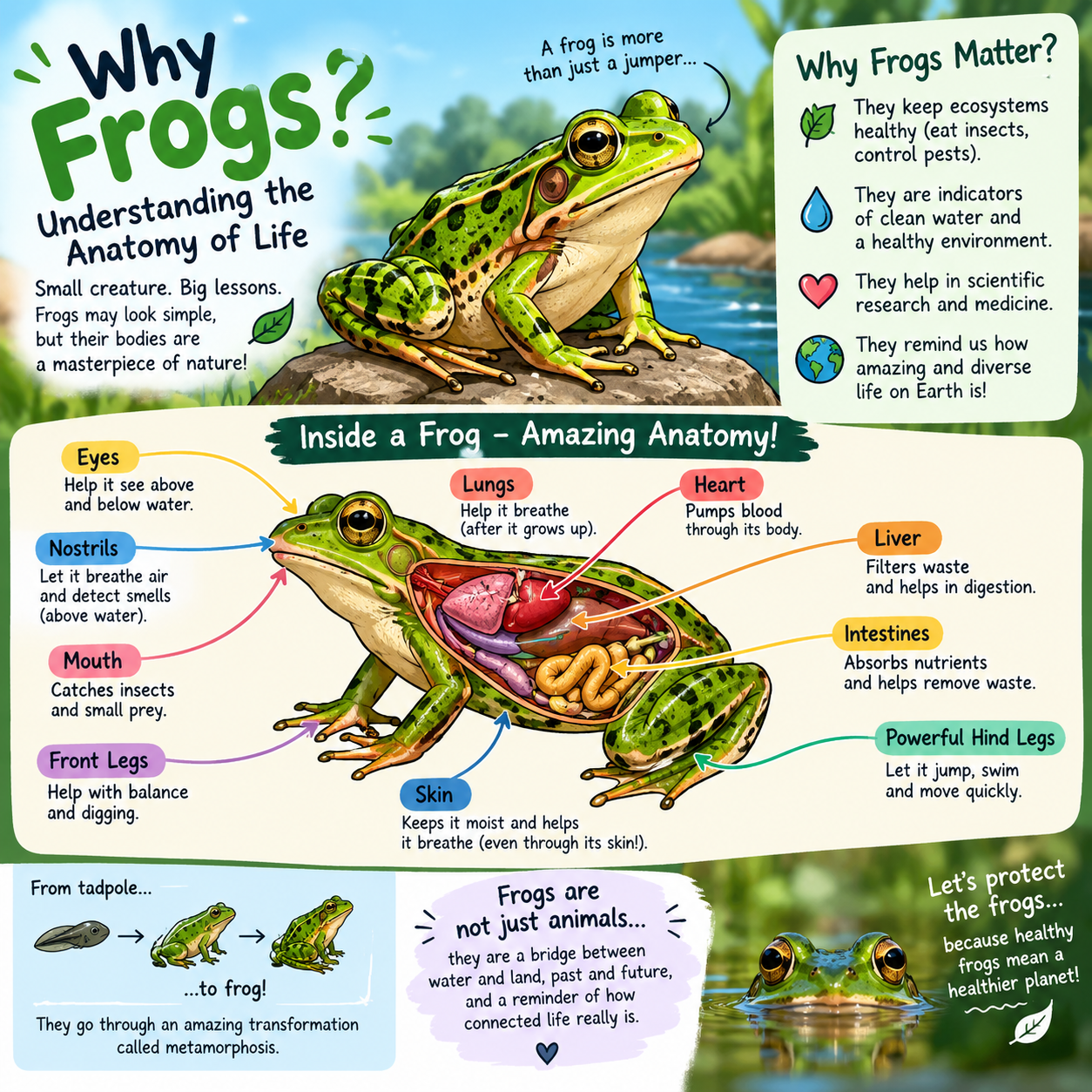
    Frogs are often studied in biology because their bodies provide a clear way to understand **basic animal anatomy and physiology**. Their organs and organ systems are relatively easy to observe, while still showing many of the same fundamental structures found in other vertebrates.

    ### What Can Frogs Teach Us?

    * **Heart:** A frog’s three-chambered heart demonstrates how blood circulates through the body.
    * **Lungs and skin:** Frogs breathe through both their lungs and moist skin, showing different methods of gas exchange.
    * **Digestive system:** Their digestive organs demonstrate how food is broken down and nutrients are absorbed.
    * **Muscles and skeleton:** Powerful hind-leg muscles and a specialized skeleton explain how frogs jump and move.
    * **Nervous system:** The brain, spinal cord, and nerves coordinate movement and responses.
    * **Kidneys:** These organs help remove waste and maintain the body's internal balance.

    ξˆ€genuiξˆ‚{"biology_anatomy_physiology":{"type_id":"BLOOD_CIRCULATION","locale_override":"en-US"}}

    ### **Why Are Frogs Important in Biology?**

    Frogs are useful study organisms because their anatomy helps students connect **structure with function**. By examining how different organs work together, we can better understand a central idea of biology: **life depends on coordinated systems working as one whole organism.**

    In short, studying a frog is not simply about studying one animal—it is a way to explore the **anatomy, physiology, adaptation, and organization of life itself**.
    #rsisb Roll no.239 Foundation Level Frogs are often studied in biology because their bodies provide a clear way to understand **basic animal anatomy and physiology**. Their organs and organ systems are relatively easy to observe, while still showing many of the same fundamental structures found in other vertebrates. ### 🐸 What Can Frogs Teach Us? * **Heart:** A frog’s three-chambered heart demonstrates how blood circulates through the body. * **Lungs and skin:** Frogs breathe through both their lungs and moist skin, showing different methods of gas exchange. * **Digestive system:** Their digestive organs demonstrate how food is broken down and nutrients are absorbed. * **Muscles and skeleton:** Powerful hind-leg muscles and a specialized skeleton explain how frogs jump and move. * **Nervous system:** The brain, spinal cord, and nerves coordinate movement and responses. * **Kidneys:** These organs help remove waste and maintain the body's internal balance. ξˆ€genuiξˆ‚{"biology_anatomy_physiology":{"type_id":"BLOOD_CIRCULATION","locale_override":"en-US"}} ### **Why Are Frogs Important in Biology?** Frogs are useful study organisms because their anatomy helps students connect **structure with function**. By examining how different organs work together, we can better understand a central idea of biology: **life depends on coordinated systems working as one whole organism.** In short, studying a frog is not simply about studying one animal—it is a way to explore the **anatomy, physiology, adaptation, and organization of life itself**.
    0 Comments 0 Shares 7 Views
  • #rsisb
    Roll No.240
    Story No.17
    Foundation level

    ### **The Ethics and Education of Animal Dissections**

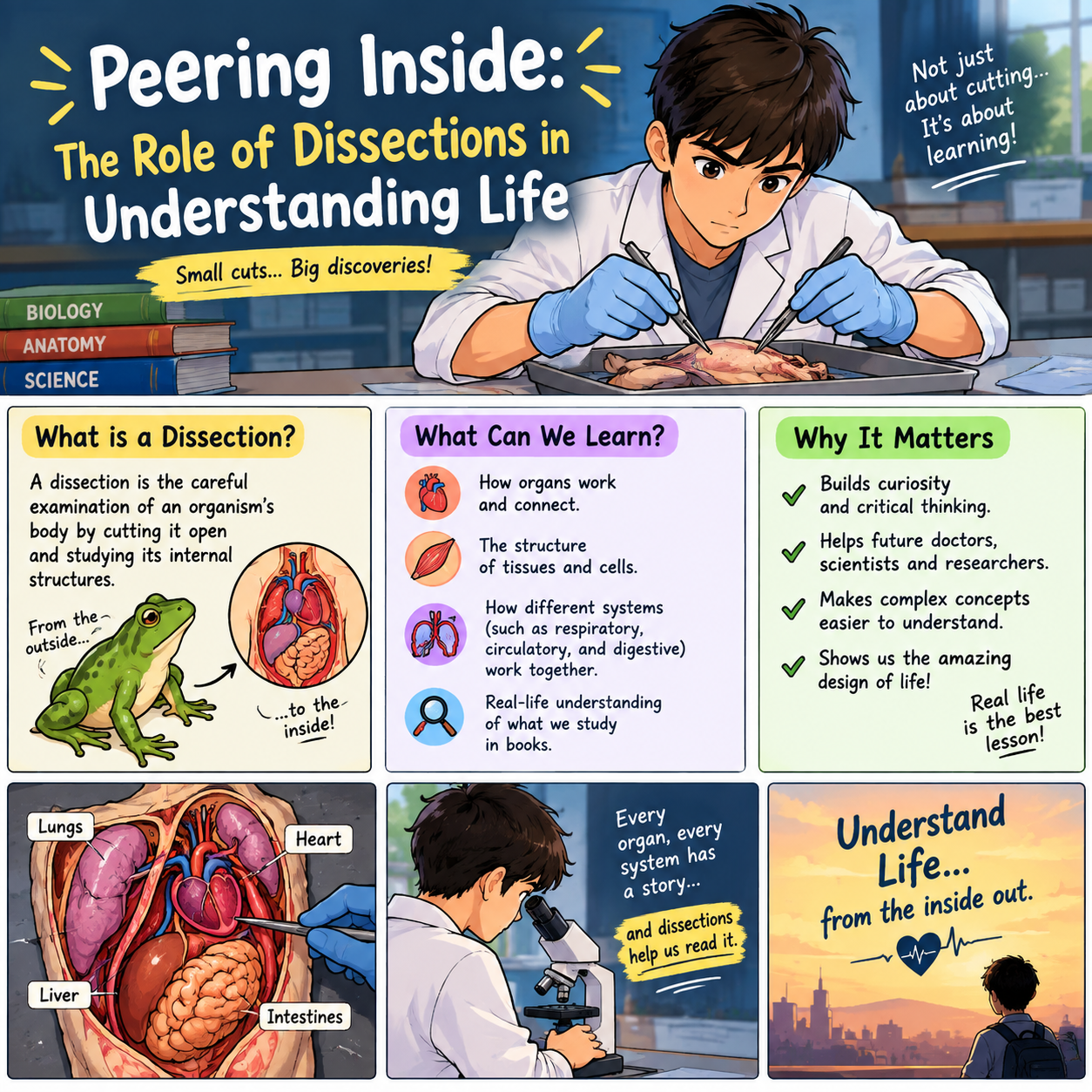
    Animal dissection has long been an important part of biology and medical education, helping students understand anatomy, physiology, and the complex structures of living organisms. By examining real biological specimens, learners gain hands-on experience that strengthens their observation, critical thinking, and scientific investigation skills. For many years, dissections have played a significant role in preparing future doctors, veterinarians, scientists, and researchers by providing practical knowledge that complements classroom learning.

    At the same time, animal dissections raise important ethical questions about animal welfare, responsible scientific practice, and the balance between educational benefits and respect for living creatures. Modern education encourages students to consider these ethical perspectives while learning about science. Many schools and universities now offer alternatives such as virtual dissections, 3D anatomical models, computer simulations, and interactive digital laboratories. These innovative tools provide effective learning experiences while reducing the need for animal specimens in many educational settings.

    Understanding the ethics of animal dissection helps students develop not only scientific knowledge but also compassion, responsibility, and respect for life. By combining ethical awareness with scientific inquiry, educators can inspire future generations to pursue discovery in ways that are both innovative and humane. This balanced approach promotes critical thinking, responsible decision-making, and a deeper appreciation for the relationship between science, education, and the living world.

    **#AnimalDissection #Biology #ScienceEducation #Ethics #STEM #BiologyLab #Anatomy #LifeSciences #ScientificLearning #AnimalWelfare #Education #MedicalScience #CriticalThinking #Research #Science **

    Rehan School Islamabad Campus
    Asma Shaheen EducationWali
    Irum Asim
    Saima Happinesswali
    #rsisb Roll No.240 Story No.17 Foundation level ### **The Ethics and Education of Animal Dissections** Animal dissection has long been an important part of biology and medical education, helping students understand anatomy, physiology, and the complex structures of living organisms. By examining real biological specimens, learners gain hands-on experience that strengthens their observation, critical thinking, and scientific investigation skills. For many years, dissections have played a significant role in preparing future doctors, veterinarians, scientists, and researchers by providing practical knowledge that complements classroom learning. At the same time, animal dissections raise important ethical questions about animal welfare, responsible scientific practice, and the balance between educational benefits and respect for living creatures. Modern education encourages students to consider these ethical perspectives while learning about science. Many schools and universities now offer alternatives such as virtual dissections, 3D anatomical models, computer simulations, and interactive digital laboratories. These innovative tools provide effective learning experiences while reducing the need for animal specimens in many educational settings. Understanding the ethics of animal dissection helps students develop not only scientific knowledge but also compassion, responsibility, and respect for life. By combining ethical awareness with scientific inquiry, educators can inspire future generations to pursue discovery in ways that are both innovative and humane. This balanced approach promotes critical thinking, responsible decision-making, and a deeper appreciation for the relationship between science, education, and the living world. **#AnimalDissection #Biology #ScienceEducation #Ethics #STEM #BiologyLab #Anatomy #LifeSciences #ScientificLearning #AnimalWelfare #Education #MedicalScience #CriticalThinking #Research #Science πŸŒΏπŸ”¬πŸ§¬πŸΈπŸ“š** Rehan School Islamabad Campus Asma Shaheen EducationWali Irum Asim Saima Happinesswali
    0 Comments 0 Shares 253 Views
  • #rsisb
    Roll No.240
    Story No.18
    Foundation Level

    ### **Exploring Life’s Mechanisms Through Experimentation**

    Scientific experimentation is one of the most powerful ways to understand the complex processes that sustain life. From the smallest microscopic cells to entire ecosystems, experiments allow scientists to observe, test, and explain how living organisms grow, reproduce, respond to their environment, and maintain balance. Through careful observation, data collection, and analysis, researchers uncover the biological mechanisms that drive life and contribute to advances in medicine, agriculture, biotechnology, and environmental conservation.

    Biological experiments help students and scientists explore essential topics such as genetics, cell biology, microbiology, physiology, ecology, and evolution. By forming hypotheses, conducting controlled experiments, and interpreting results, learners develop critical thinking, problem-solving, and analytical skills. Laboratory investigations also demonstrate the importance of accuracy, ethical responsibility, and evidence-based conclusions in scientific research.

    Modern technology has transformed biological experimentation through advanced microscopes, DNA sequencing, computer simulations, molecular biology techniques, and artificial intelligence. These innovations enable researchers to study diseases, develop life-saving medicines, improve crop production, protect endangered species, and better understand the incredible complexity of living organisms. Every experiment, whether simple or advanced, contributes valuable knowledge that helps improve human health and our understanding of the natural world.

    Exploring life's mechanisms through experimentation inspires curiosity, encourages innovation, and highlights the importance of scientific discovery. By combining observation, creativity, and rigorous testing, scientists continue to unlock the mysteries of life and create solutions to global challenges, paving the way for a healthier, more sustainable future.

    **#Biology #LifeScience #ScientificExperiment #Laboratory #STEM #ScienceEducation #Research #Biotechnology #CellBiology #Genetics #Microbiology #Innovation #ScientificDiscovery #Education #ExploreScience **

    Rehan School Islamabad Campus
    Asma Shaheen EducationWali
    Irum Asim
    Saima Happinesswali
    #rsisb Roll No.240 Story No.18 Foundation Level ### **Exploring Life’s Mechanisms Through Experimentation** Scientific experimentation is one of the most powerful ways to understand the complex processes that sustain life. From the smallest microscopic cells to entire ecosystems, experiments allow scientists to observe, test, and explain how living organisms grow, reproduce, respond to their environment, and maintain balance. Through careful observation, data collection, and analysis, researchers uncover the biological mechanisms that drive life and contribute to advances in medicine, agriculture, biotechnology, and environmental conservation. Biological experiments help students and scientists explore essential topics such as genetics, cell biology, microbiology, physiology, ecology, and evolution. By forming hypotheses, conducting controlled experiments, and interpreting results, learners develop critical thinking, problem-solving, and analytical skills. Laboratory investigations also demonstrate the importance of accuracy, ethical responsibility, and evidence-based conclusions in scientific research. Modern technology has transformed biological experimentation through advanced microscopes, DNA sequencing, computer simulations, molecular biology techniques, and artificial intelligence. These innovations enable researchers to study diseases, develop life-saving medicines, improve crop production, protect endangered species, and better understand the incredible complexity of living organisms. Every experiment, whether simple or advanced, contributes valuable knowledge that helps improve human health and our understanding of the natural world. Exploring life's mechanisms through experimentation inspires curiosity, encourages innovation, and highlights the importance of scientific discovery. By combining observation, creativity, and rigorous testing, scientists continue to unlock the mysteries of life and create solutions to global challenges, paving the way for a healthier, more sustainable future. **#Biology #LifeScience #ScientificExperiment #Laboratory #STEM #ScienceEducation #Research #Biotechnology #CellBiology #Genetics #Microbiology #Innovation #ScientificDiscovery #Education #ExploreScience πŸ”¬πŸ§¬πŸ§«πŸŒ±πŸ“š** Rehan School Islamabad Campus Asma Shaheen EducationWali Irum Asim Saima Happinesswali
    0 Comments 0 Shares 299 Views
  • #rsisb
    Roll No.240
    Story No.22
    Foundation Level

    ### **Peering Inside: The Role of Dissections in Understanding Life – Description**

    **Peering Inside: The Role of Dissections in Understanding Life** explores how dissections help scientists, doctors, and students uncover the hidden structures of living organisms. By carefully studying internal anatomy, researchers gain a deeper understanding of how organs, tissues, and body systems work together.

    Through dissection, we can discover the complexity of life, improve medical knowledge, and develop better treatments for diseases. It connects observation with scientific discovery and allows learners to explore the amazing design and organization of living things.

    This journey highlights the importance of anatomy, research, and ethical scientific practices in understanding the mysteries of life.

    Discover how looking inside helps us understand the incredible story of life from within.

    #Dissection #Anatomy #Biology #ScienceEducation #UnderstandingLife #HumanBody #MedicalScience #BiologyLearning #ScientificDiscovery

    Rehan School Islamabad Campus
    Asma Shaheen EducationWali
    Irum Asim
    Saima Happinesswali
    #rsisb Roll No.240 Story No.22 Foundation Level ### πŸ”¬ **Peering Inside: The Role of Dissections in Understanding Life – Description** ✨ 🧬 **Peering Inside: The Role of Dissections in Understanding Life** explores how dissections help scientists, doctors, and students uncover the hidden structures of living organisms. By carefully studying internal anatomy, researchers gain a deeper understanding of how organs, tissues, and body systems work together. πŸ” Through dissection, we can discover the complexity of life, improve medical knowledge, and develop better treatments for diseases. It connects observation with scientific discovery and allows learners to explore the amazing design and organization of living things. πŸ§ͺ This journey highlights the importance of anatomy, research, and ethical scientific practices in understanding the mysteries of life. 🌱 Discover how looking inside helps us understand the incredible story of life from within. #Dissection #Anatomy #Biology #ScienceEducation #UnderstandingLife #HumanBody #MedicalScience #BiologyLearning #ScientificDiscovery πŸ”¬πŸ§¬βœ¨ Rehan School Islamabad Campus Asma Shaheen EducationWali Irum Asim Saima Happinesswali
    0 Comments 0 Shares 143 Views
  • #rsisb
    Roll No.240
    Story No.22
    Foundation Level

    ### **Peering Inside: The Role of Dissections in Understanding Life – Description**

    **Peering Inside: The Role of Dissections in Understanding Life** explores how dissections help scientists, doctors, and students uncover the hidden structures of living organisms. By carefully studying internal anatomy, researchers gain a deeper understanding of how organs, tissues, and body systems work together.

    Through dissection, we can discover the complexity of life, improve medical knowledge, and develop better treatments for diseases. It connects observation with scientific discovery and allows learners to explore the amazing design and organization of living things.

    This journey highlights the importance of anatomy, research, and ethical scientific practices in understanding the mysteries of life.

    Discover how looking inside helps us understand the incredible story of life from within.

    #Dissection #Anatomy #Biology #ScienceEducation #UnderstandingLife #HumanBody #MedicalScience #BiologyLearning #ScientificDiscovery

    Rehan School Islamabad Campus
    Asma Shaheen EducationWali
    Irum Asim
    Saima Happinesswali
    #rsisb Roll No.240 Story No.22 Foundation Level ### πŸ”¬ **Peering Inside: The Role of Dissections in Understanding Life – Description** ✨ 🧬 **Peering Inside: The Role of Dissections in Understanding Life** explores how dissections help scientists, doctors, and students uncover the hidden structures of living organisms. By carefully studying internal anatomy, researchers gain a deeper understanding of how organs, tissues, and body systems work together. πŸ” Through dissection, we can discover the complexity of life, improve medical knowledge, and develop better treatments for diseases. It connects observation with scientific discovery and allows learners to explore the amazing design and organization of living things. πŸ§ͺ This journey highlights the importance of anatomy, research, and ethical scientific practices in understanding the mysteries of life. 🌱 Discover how looking inside helps us understand the incredible story of life from within. #Dissection #Anatomy #Biology #ScienceEducation #UnderstandingLife #HumanBody #MedicalScience #BiologyLearning #ScientificDiscovery πŸ”¬πŸ§¬βœ¨ Rehan School Islamabad Campus Asma Shaheen EducationWali Irum Asim Saima Happinesswali
    0 Comments 0 Shares 139 Views
  • #rsisb
    Roll No.240
    Story No.20
    Foundation Level

    # The Evolution Paradox: Bridging Theories of Life with Divine Design

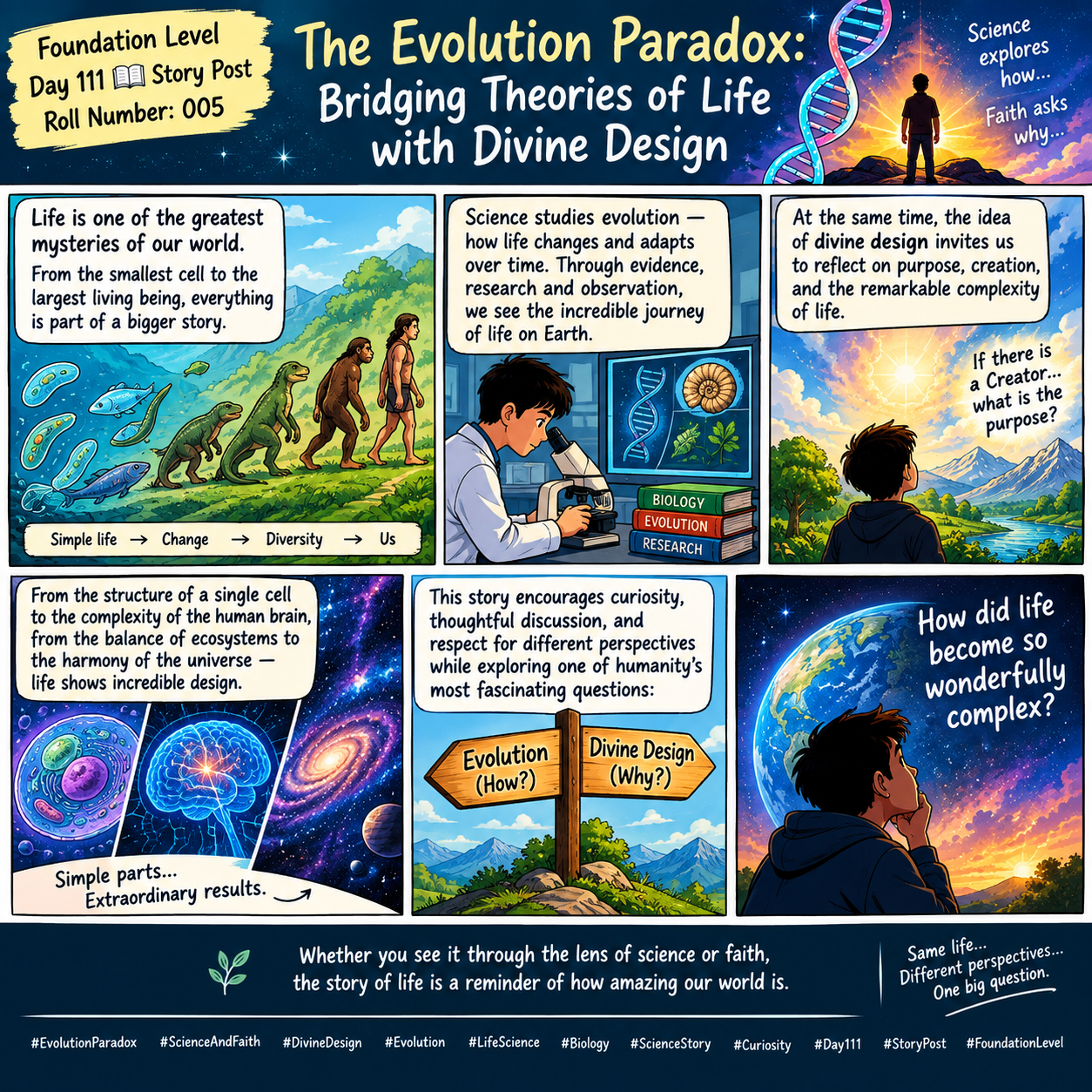
    The relationship between **evolution** and **divine design** has long been one of humanity's most fascinating and thought-provoking discussions. While evolutionary biology explains how living organisms have changed and diversified over billions of years through natural processes such as mutation, natural selection, and genetic variation, many religious traditions view life as the result of a purposeful and intelligent Creator. Rather than seeing these perspectives as necessarily incompatible, many scholars, scientists, and people of faith explore ways they can coexist.

    Evolution provides a scientific framework for understanding the development of life based on observable evidence from fossils, genetics, comparative anatomy, and ecology. It seeks to explain *how* biological diversity emerged and continues to change over time. Divine design, on the other hand, addresses questions of *purpose*, *meaning*, and *ultimate origin*—questions that science alone is not designed to answer.

    The "evolution paradox" arises because these perspectives often focus on different kinds of questions. Science investigates natural mechanisms through observation, experimentation, and evidence, while faith explores spiritual beliefs, morality, and humanity's relationship with the Creator. Many individuals embrace both scientific discoveries and religious faith, believing that natural laws themselves may reflect an intentional design behind the universe.

    Modern genetics has revealed remarkable complexity within DNA, strengthening our understanding of evolution while also inspiring philosophical and theological reflection about the origin of life and the fine-tuned nature of the universe. These discoveries encourage respectful dialogue between science and religion rather than unnecessary conflict.

    Ultimately, exploring the relationship between evolution and divine design reminds us that curiosity, critical thinking, and respectful discussion are essential in the pursuit of knowledge. Whether one approaches life's origins through scientific inquiry, religious belief, or a combination of both, the search for truth continues to inspire wonder, humility, and a deeper appreciation for the complexity and beauty of existence.

    **#Evolution #DivineDesign #Science #Faith #Biology #Genetics #OriginOfLife #CriticalThinking #Education #Philosophy #Theology #ScientificDiscovery #Knowledge #Learning #Wonder**

    Rehan School Islamabad Campus
    Asma Shaheen EducationWali
    Irum Asim
    Saima Happinesswali
    #rsisb Roll No.240 Story No.20 Foundation Level # 🌍🧬 The Evolution Paradox: Bridging Theories of Life with Divine Design The relationship between **evolution** and **divine design** has long been one of humanity's most fascinating and thought-provoking discussions. While evolutionary biology explains how living organisms have changed and diversified over billions of years through natural processes such as mutation, natural selection, and genetic variation, many religious traditions view life as the result of a purposeful and intelligent Creator. Rather than seeing these perspectives as necessarily incompatible, many scholars, scientists, and people of faith explore ways they can coexist. Evolution provides a scientific framework for understanding the development of life based on observable evidence from fossils, genetics, comparative anatomy, and ecology. It seeks to explain *how* biological diversity emerged and continues to change over time. Divine design, on the other hand, addresses questions of *purpose*, *meaning*, and *ultimate origin*—questions that science alone is not designed to answer. The "evolution paradox" arises because these perspectives often focus on different kinds of questions. Science investigates natural mechanisms through observation, experimentation, and evidence, while faith explores spiritual beliefs, morality, and humanity's relationship with the Creator. Many individuals embrace both scientific discoveries and religious faith, believing that natural laws themselves may reflect an intentional design behind the universe. Modern genetics has revealed remarkable complexity within DNA, strengthening our understanding of evolution while also inspiring philosophical and theological reflection about the origin of life and the fine-tuned nature of the universe. These discoveries encourage respectful dialogue between science and religion rather than unnecessary conflict. Ultimately, exploring the relationship between evolution and divine design reminds us that curiosity, critical thinking, and respectful discussion are essential in the pursuit of knowledge. Whether one approaches life's origins through scientific inquiry, religious belief, or a combination of both, the search for truth continues to inspire wonder, humility, and a deeper appreciation for the complexity and beauty of existence. **#Evolution #DivineDesign #Science #Faith #Biology #Genetics #OriginOfLife #CriticalThinking #Education #Philosophy #Theology #ScientificDiscovery #Knowledge #Learning #Wonder** πŸŒπŸ§¬πŸ“–βœ¨ Rehan School Islamabad Campus Asma Shaheen EducationWali Irum Asim Saima Happinesswali
    0 Comments 0 Shares 237 Views
  • #rsisb
    Roll No.240
    Story No.19
    Foundation Level

    # The Blueprint of Existence: Unraveling DNA and the Origins of Life

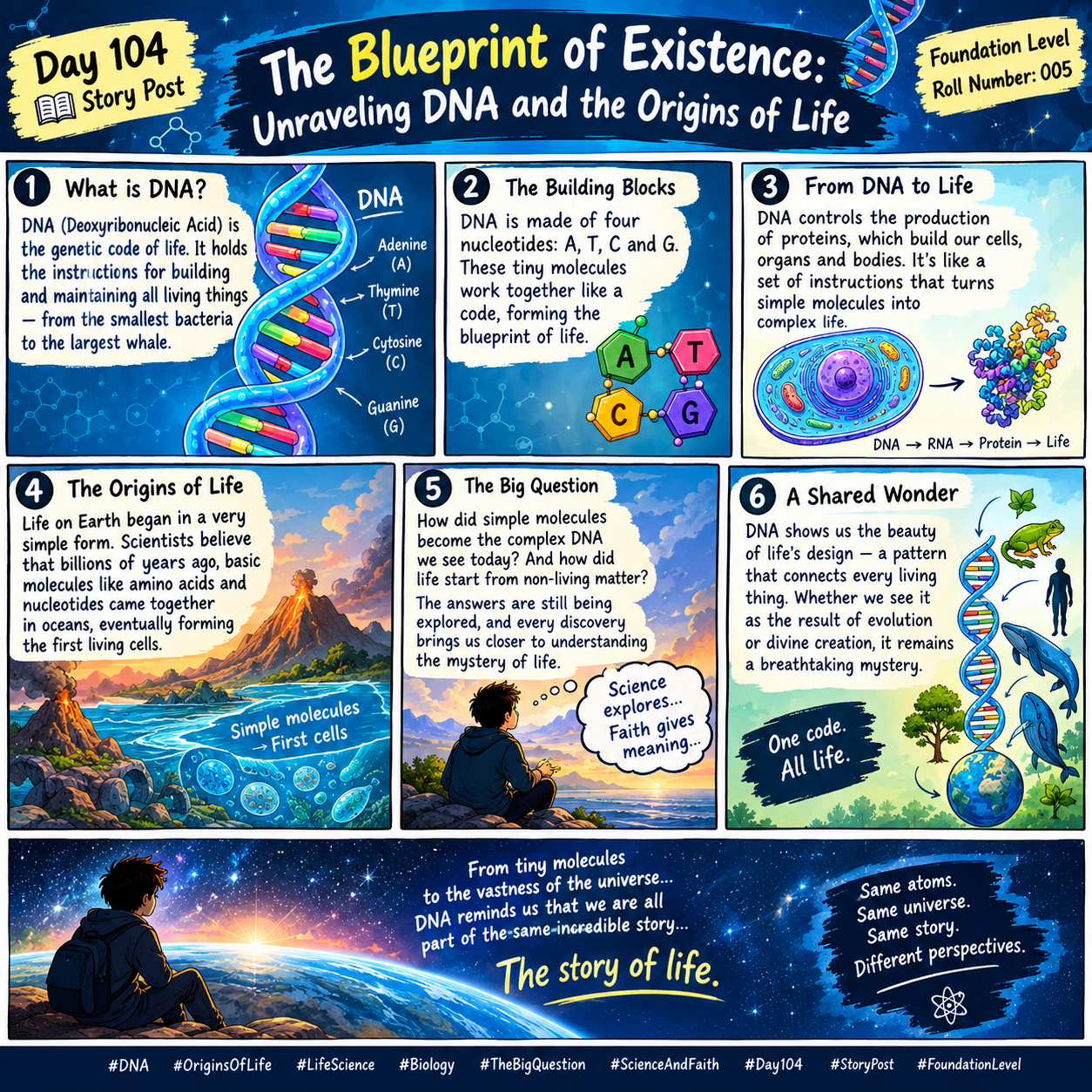
    DNA, or **Deoxyribonucleic Acid**, is often called the **blueprint of life** because it contains the genetic instructions that guide the growth, development, and functioning of every living organism. From the tiniest bacteria to the largest mammals, DNA carries the information that determines how living things are built, how they reproduce, and how traits are passed from one generation to the next. Understanding DNA has revolutionized biology, medicine, agriculture, and forensic science, helping scientists unlock the mysteries of life itself.

    The origins of life remain one of science's greatest questions. Researchers believe that billions of years ago, simple molecules on the early Earth gradually combined through natural chemical processes to form more complex compounds. Over immense periods of time, these molecules eventually developed the ability to replicate and evolve, leading to the first primitive forms of life. While many details are still being explored, scientific evidence suggests that DNA became the primary storage system for genetic information as life evolved.

    Every cell in the human body contains DNA organized into chromosomes, with thousands of genes carrying instructions for producing proteins. These proteins perform countless essential functions, from building tissues and organs to regulating metabolism and supporting the immune system. Even small changes in DNA can influence physical characteristics, health, and susceptibility to certain diseases, making genetics one of the most important fields in modern science.

    The study of DNA has transformed healthcare through genetic testing, personalized medicine, gene therapy, and disease prevention. It has also helped solve criminal investigations through DNA fingerprinting, improved crop production through genetic engineering, and deepened our understanding of evolution by revealing the shared ancestry of all living organisms.

    As scientists continue exploring genetics and the origins of life, new discoveries are reshaping our understanding of biology and opening exciting possibilities for the future. By unraveling the secrets hidden within DNA, humanity moves closer to understanding not only where life came from but also how we can improve health, protect biodiversity, and advance scientific knowledge for generations to come.

    **#DNA #Genetics #Biology #Science #OriginOfLife #MolecularBiology #Evolution #GeneticResearch #LifeSciences #STEM #Education #ScientificDiscovery #Innovation #Learning #FutureOfScience**

    Rehan School Islamabad Campus
    Asma Shaheen EducationWali
    Irum Asim
    Saima Happinesswali
    #rsisb Roll No.240 Story No.19 Foundation Level # 🧬 The Blueprint of Existence: Unraveling DNA and the Origins of Life DNA, or **Deoxyribonucleic Acid**, is often called the **blueprint of life** because it contains the genetic instructions that guide the growth, development, and functioning of every living organism. From the tiniest bacteria to the largest mammals, DNA carries the information that determines how living things are built, how they reproduce, and how traits are passed from one generation to the next. Understanding DNA has revolutionized biology, medicine, agriculture, and forensic science, helping scientists unlock the mysteries of life itself. The origins of life remain one of science's greatest questions. Researchers believe that billions of years ago, simple molecules on the early Earth gradually combined through natural chemical processes to form more complex compounds. Over immense periods of time, these molecules eventually developed the ability to replicate and evolve, leading to the first primitive forms of life. While many details are still being explored, scientific evidence suggests that DNA became the primary storage system for genetic information as life evolved. Every cell in the human body contains DNA organized into chromosomes, with thousands of genes carrying instructions for producing proteins. These proteins perform countless essential functions, from building tissues and organs to regulating metabolism and supporting the immune system. Even small changes in DNA can influence physical characteristics, health, and susceptibility to certain diseases, making genetics one of the most important fields in modern science. The study of DNA has transformed healthcare through genetic testing, personalized medicine, gene therapy, and disease prevention. It has also helped solve criminal investigations through DNA fingerprinting, improved crop production through genetic engineering, and deepened our understanding of evolution by revealing the shared ancestry of all living organisms. As scientists continue exploring genetics and the origins of life, new discoveries are reshaping our understanding of biology and opening exciting possibilities for the future. By unraveling the secrets hidden within DNA, humanity moves closer to understanding not only where life came from but also how we can improve health, protect biodiversity, and advance scientific knowledge for generations to come. **#DNA #Genetics #Biology #Science #OriginOfLife #MolecularBiology #Evolution #GeneticResearch #LifeSciences #STEM #Education #ScientificDiscovery #Innovation #Learning #FutureOfScience** πŸ§¬πŸ”¬πŸŒπŸ“šβœ¨ Rehan School Islamabad Campus Asma Shaheen EducationWali Irum Asim Saima Happinesswali
    0 Comments 0 Shares 393 Views
  • #rsisb
    Roll No.240
    Story No.13
    Foundation Level

    # The Earth's Chemistry: Connecting Biology and Chemistry

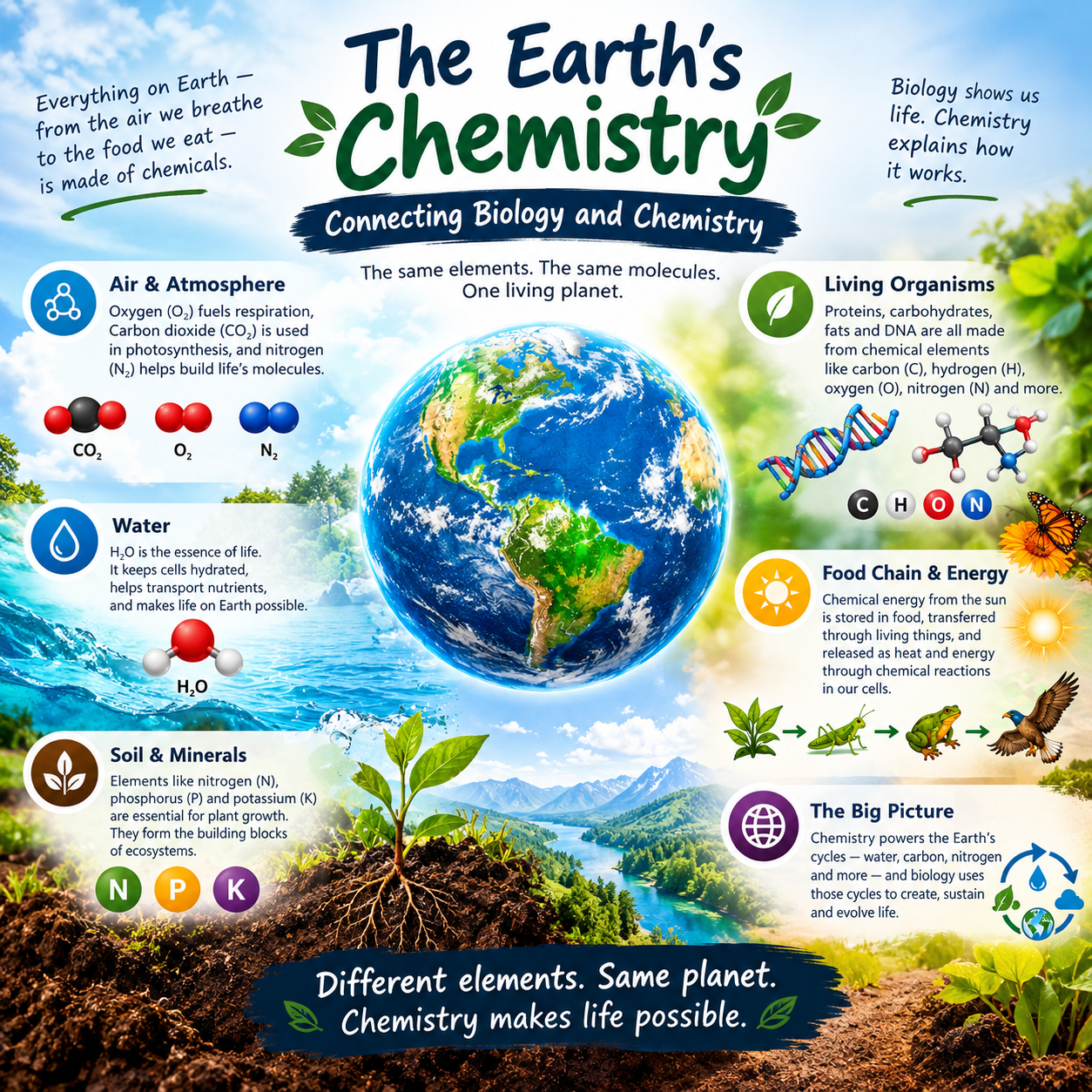
    The Earth is a remarkable system where biology and chemistry work together to sustain life. Every living organism depends on chemical elements and reactions to grow, reproduce, and survive. From the oxygen we breathe and the water we drink to the nutrients in the soil, Earth's natural cycles are driven by the close relationship between biological processes and chemical transformations. Photosynthesis, respiration, decomposition, and nutrient cycling all demonstrate how life and chemistry are deeply interconnected.

    Chemistry explains the composition of air, water, rocks, and living cells, while biology reveals how organisms use these substances to carry out life's essential functions. Carbon, hydrogen, oxygen, nitrogen, phosphorus, and sulfur are the building blocks of life, constantly moving through Earth's atmosphere, oceans, soil, and ecosystems. Understanding this connection helps us appreciate the delicate balance that supports biodiversity, regulates climate, and maintains healthy environments.

    Exploring Earth's chemistry allows us to understand environmental challenges such as pollution, climate change, soil degradation, and water quality. By combining the principles of biology and chemistry, scientists develop innovative solutions for conserving ecosystems, improving agriculture, protecting natural resources, and creating a more sustainable future. Discover how these two fascinating sciences unite to explain the incredible processes that make our planet a thriving home for life.

    Rehan School Islamabad Campus
    Asma Shaheen EducationWali
    Irum Asim
    Saima Happinesswali
    #rsisb Roll No.240 Story No.13 Foundation Level # The Earth's Chemistry: Connecting Biology and Chemistry The Earth is a remarkable system where biology and chemistry work together to sustain life. Every living organism depends on chemical elements and reactions to grow, reproduce, and survive. From the oxygen we breathe and the water we drink to the nutrients in the soil, Earth's natural cycles are driven by the close relationship between biological processes and chemical transformations. Photosynthesis, respiration, decomposition, and nutrient cycling all demonstrate how life and chemistry are deeply interconnected. Chemistry explains the composition of air, water, rocks, and living cells, while biology reveals how organisms use these substances to carry out life's essential functions. Carbon, hydrogen, oxygen, nitrogen, phosphorus, and sulfur are the building blocks of life, constantly moving through Earth's atmosphere, oceans, soil, and ecosystems. Understanding this connection helps us appreciate the delicate balance that supports biodiversity, regulates climate, and maintains healthy environments. Exploring Earth's chemistry allows us to understand environmental challenges such as pollution, climate change, soil degradation, and water quality. By combining the principles of biology and chemistry, scientists develop innovative solutions for conserving ecosystems, improving agriculture, protecting natural resources, and creating a more sustainable future. Discover how these two fascinating sciences unite to explain the incredible processes that make our planet a thriving home for life. Rehan School Islamabad Campus Asma Shaheen EducationWali Irum Asim Saima Happinesswali
    0 Comments 0 Shares 225 Views
  • #rsisb
    Roll no.239
    Foundation Level

    **DNA (deoxyribonucleic acid)** is often described as the blueprint of life because it stores the genetic instructions that guide how living organisms grow, function, and reproduce.

    ξˆ€genuiξˆ‚{"biology_genetics_evolution_ecology":{"type_id":"DNA_TRANSCRIPTION"}}

    The study of DNA helps scientists understand **heredity, genetic variation, evolution, and the remarkable complexity of living organisms**. But DNA itself raises a deeper question: **How did the first systems capable of storing and copying biological information arise?**

    Scientists study several hypotheses about the **origin of life**, including the possibility that simple organic molecules gradually formed more complex chemical systems on early Earth. One leading research area explores how molecules capable of storing information and supporting self-replication could have emerged.

    Together, the study of **DNA and the origins of life** connects chemistry, biology, genetics, and evolution—and helps us explore one of science's biggest questions: **How did life begin?**
    #rsisb Roll no.239 Foundation Level **DNA (deoxyribonucleic acid)** is often described as the blueprint of life because it stores the genetic instructions that guide how living organisms grow, function, and reproduce. ξˆ€genuiξˆ‚{"biology_genetics_evolution_ecology":{"type_id":"DNA_TRANSCRIPTION"}} The study of DNA helps scientists understand **heredity, genetic variation, evolution, and the remarkable complexity of living organisms**. But DNA itself raises a deeper question: **How did the first systems capable of storing and copying biological information arise?** Scientists study several hypotheses about the **origin of life**, including the possibility that simple organic molecules gradually formed more complex chemical systems on early Earth. One leading research area explores how molecules capable of storing information and supporting self-replication could have emerged. Together, the study of **DNA and the origins of life** connects chemistry, biology, genetics, and evolution—and helps us explore one of science's biggest questions: **How did life begin?** πŸŒπŸ”¬πŸ§¬
    0 Comments 0 Shares 171 Views
  • #rsisb
    Roll no.239
    Foundation Level

    Earth is a remarkable system where **chemistry and biology work together** to support life. From the air we breathe and the water we drink to the food we eat, chemical substances and reactions are constantly shaping the living world.

    ξˆ€genuiξˆ‚{"chemistry_atoms_molecules_matter":{"type_id":"ATOMIC_COMPOSITION"}}

    Chemistry helps us understand the elements and molecules that make up living organisms, while biology explains how these substances interact within cells and ecosystems. **Carbon, oxygen, hydrogen, nitrogen, phosphorus, and sulfur** are especially important because they form many of the molecules essential for life.

    Processes such as **photosynthesis, respiration, decomposition, and nutrient cycling** demonstrate the close relationship between chemistry and biology. Understanding this connection helps us explore Earth's ecosystems, environmental changes, and the chemistry that makes life possible.

    **Chemistry explains the substances; biology shows how life uses them. Together, they reveal the amazing science of our planet.**
    #rsisb Roll no.239 Foundation Level Earth is a remarkable system where **chemistry and biology work together** to support life. From the air we breathe and the water we drink to the food we eat, chemical substances and reactions are constantly shaping the living world. ξˆ€genuiξˆ‚{"chemistry_atoms_molecules_matter":{"type_id":"ATOMIC_COMPOSITION"}} Chemistry helps us understand the elements and molecules that make up living organisms, while biology explains how these substances interact within cells and ecosystems. **Carbon, oxygen, hydrogen, nitrogen, phosphorus, and sulfur** are especially important because they form many of the molecules essential for life. Processes such as **photosynthesis, respiration, decomposition, and nutrient cycling** demonstrate the close relationship between chemistry and biology. Understanding this connection helps us explore Earth's ecosystems, environmental changes, and the chemistry that makes life possible. **Chemistry explains the substances; biology shows how life uses them. Together, they reveal the amazing science of our planet.** 🌍πŸ§ͺ🌱
    0 Comments 0 Shares 157 Views
More Results