• #rsisb
    Roll no.214
    Foundation level
    Story post no.15

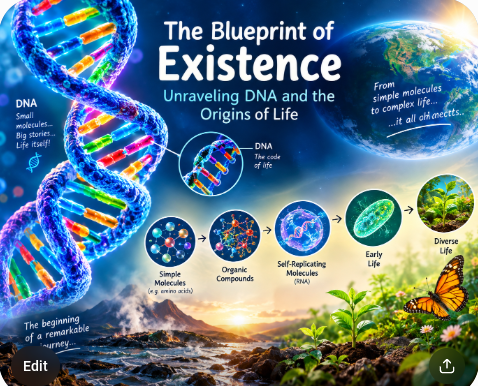
    Discover the amazing world of DNA, the molecule that carries the instructions for life. Explore how DNA stores genetic information, how it guides living organisms, and how scientists study the possible origins of life. This fascinating journey connects biology, chemistry, evolution, and the mysteries of our existence.

    #DNA #OriginsOfLife #Biology #Science #Genetics #Evolution #LifeScience #ScienceLearning #DiscoverScience #KnowledgeIsPower
    #rsisb Roll no.214 Foundation level Story post no.15 Discover the amazing world of DNA, the molecule that carries the instructions for life. 🧬📖 Explore how DNA stores genetic information, how it guides living organisms, and how scientists study the possible origins of life. 🌱🔬 This fascinating journey connects biology, chemistry, evolution, and the mysteries of our existence. 🌌✨ #DNA 🧬 #OriginsOfLife 🌱 #Biology 🔬 #Science 🌍 #Genetics 🧬 #Evolution 🧪 #LifeScience 📚 #ScienceLearning 💡 #DiscoverScience 🔎 #KnowledgeIsPower ✨
    0 Commentaires 0 Parts 128 Vue
  • #rsisb
    roll no 46
    song 9


    Chemical reactions are the amazing processes that transform one substance into another and make life possible. From digesting food to breathing oxygen , producing energy , and helping plants grow , chemical reactions are happening around us every moment.

    In our bodies, chemical reactions help cells produce energy, repair tissues, and maintain essential functions . Plants use photosynthesis to make food and release oxygen, while cellular respiration helps living organisms get energy from food .

    Chemical reactions are also important in cooking , medicine , industry , technology , and the environment . Studying them helps us understand how matter changes and how the natural world works.

    Chemistry is not just a subject—it is one of the engines that keeps life moving!

    #ChemicalReactions #EngineOfLife #Chemistry #Science #ScienceEducation #Biology #Photosynthesis #CellularRespiration #Energy #HumanBody #Cells #STEM #ScienceProject #ExploreScience #Learning #FutureScientists
    #rsisb roll no 46 song 9 Chemical reactions are the amazing processes that transform one substance into another and make life possible. From digesting food 🍎 to breathing oxygen 🌬️, producing energy ⚡, and helping plants grow 🌿, chemical reactions are happening around us every moment. In our bodies, chemical reactions help cells produce energy, repair tissues, and maintain essential functions ❤️🧬. Plants use photosynthesis ☀️🌱 to make food and release oxygen, while cellular respiration helps living organisms get energy from food 🔋. Chemical reactions are also important in cooking 🍳, medicine 💊, industry 🏭, technology 💻, and the environment 🌍. Studying them helps us understand how matter changes and how the natural world works. 🔬 Chemistry is not just a subject—it is one of the engines that keeps life moving! ⚡🧪🌎 #ChemicalReactions #EngineOfLife #Chemistry #Science #ScienceEducation #Biology #Photosynthesis #CellularRespiration #Energy #HumanBody #Cells #STEM #ScienceProject #ExploreScience #Learning #FutureScientists 🧪🔬🌱⚡🧬❤️🌍
    0 Commentaires 0 Parts 277 Vue 2
  • Class Foundation Level
    #rsisb
    Roll#209
    Story Post: 35


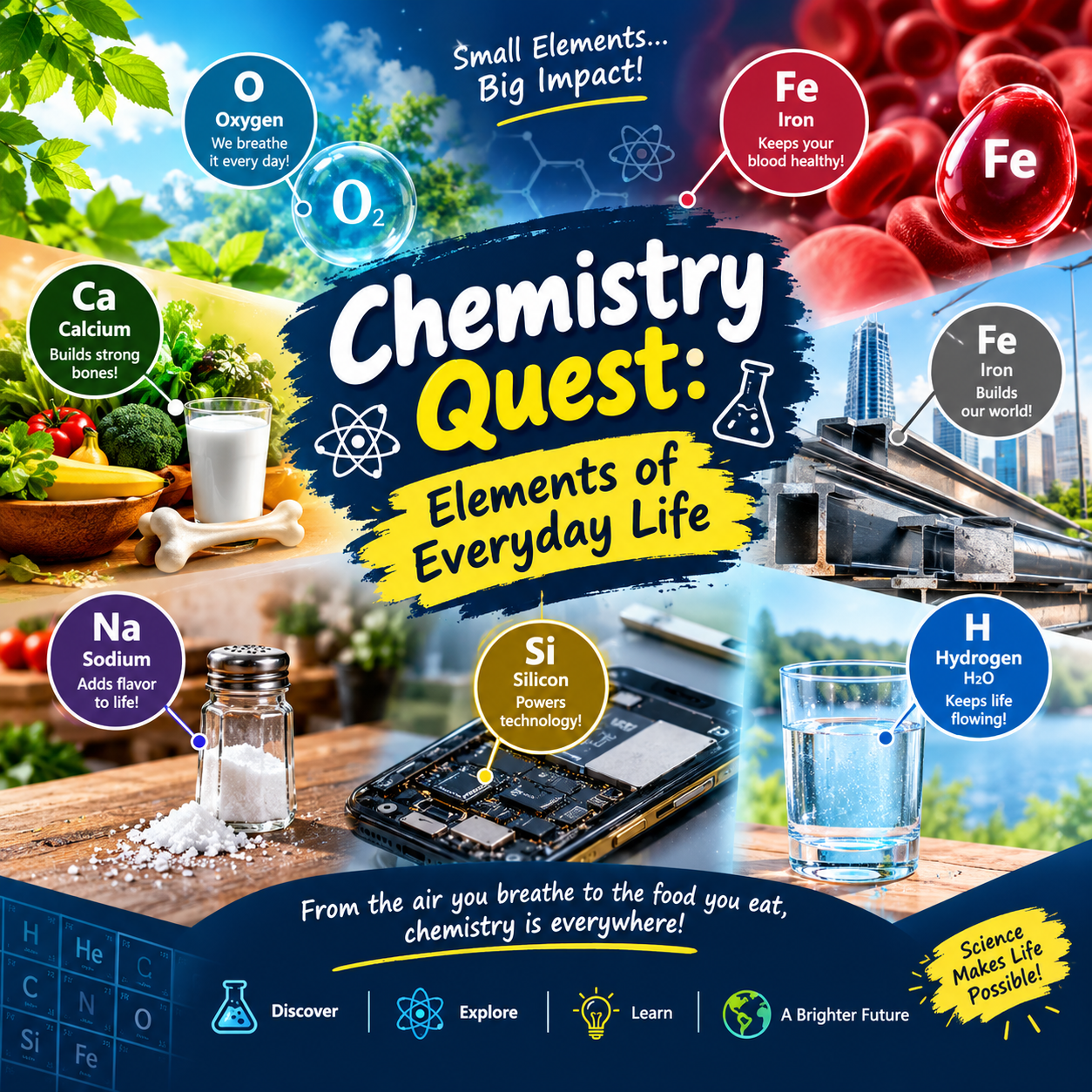
    **Chemistry Quest: Elements of Everyday Life**

    Step into the fascinating world of chemistry and discover how elements shape the world around us! From the air we breathe and the water we drink to the food we eat and the materials we use every day, chemistry is everywhere.

    Explore the amazing properties of elements, uncover their role in everyday life, and see how scientific discoveries help us understand and improve our world.

    **Explore the elements.**
    **Discover the science.**
    **Connect chemistry with everyday life.**
    **Turn curiosity into knowledge.**

    Because when you understand chemistry, **the ordinary world becomes extraordinary!**

    #ChemistryQuest #ElementsOfEverydayLife #Chemistry #Science #ScienceEducation #ChemistryLovers #ExploreScience #LearnChemistry #PeriodicTable #STEMEducation #ScienceForEveryone #EverydayScience #DiscoverScience #LearningIsFun #Curiosity #Education
    Class Foundation Level #rsisb Roll#209 Story Post: 35 🧪🔬 **Chemistry Quest: Elements of Everyday Life** ⚗️✨ Step into the fascinating world of chemistry and discover how elements shape the world around us! 🌍🧬 From the air we breathe and the water we drink to the food we eat and the materials we use every day, chemistry is everywhere. 🥤🍎💡 Explore the amazing properties of elements, uncover their role in everyday life, and see how scientific discoveries help us understand and improve our world. 🔍🌱🚀 🧪 **Explore the elements.** 🔬 **Discover the science.** 💡 **Connect chemistry with everyday life.** 🌍 **Turn curiosity into knowledge.** Because when you understand chemistry, **the ordinary world becomes extraordinary!** ✨⚗️🧪 #ChemistryQuest #ElementsOfEverydayLife #Chemistry #Science #ScienceEducation #ChemistryLovers #ExploreScience #LearnChemistry #PeriodicTable #STEMEducation #ScienceForEveryone #EverydayScience #DiscoverScience #LearningIsFun #Curiosity #Education 🧪🔬⚗️🌍✨
    0 Commentaires 0 Parts 1183 Vue
  • Day 97
    Task No:97
    Roll No:42
    RSLC
    Foundation Level, Batch#04

    Deep beneath the Earths surface and across its vast oceans, an incredible chemical journey has been shaping life for billions of years. Every drop of water, every mineral in the soil, and every breath of oxygen is part of a natural chemical cycle. These elements combine in perfect balance, creating the conditions that allow plants, animals, and humans to survive. Biology and chemistry work together as natures hidden partners, building the foundation of life on our planet.

    Plants demonstrate this remarkable connection every day by transforming sunlight, water, and carbon dioxide into food through photosynthesis. This amazing biological process depends entirely on chemical reactions that produce oxygen for living organisms. Animals and humans then use this oxygen to release energy from food, while returning carbon dioxide to the atmosphere, creating a continuous cycle that keeps Earths ecosystems healthy and alive.

    The relationship between biology and chemistry reminds us that every living thing is connected through natures invisible processes. From the smallest cell to the largest forest, chemical reactions make life possible and maintain the balance of our environment. By understanding this powerful partnership, we gain a deeper appreciation for our planet and the responsibility we all share to protect the natural world for future generations.

    #TheEarthsChemistry #Biology #Chemistry #Science #Nature #Earth #Photosynthesis #Ecosystem #EnvironmentalScience #STEM #Learning #Education #Knowledge #ScienceFacts #NatureLovers
    Day 97 Task No:97 Roll No:42 RSLC Foundation Level, Batch#04 Deep beneath the Earth's surface and across its vast oceans, an incredible chemical journey has been shaping life for billions of years. Every drop of water, every mineral in the soil, and every breath of oxygen is part of a natural chemical cycle. These elements combine in perfect balance, creating the conditions that allow plants, animals, and humans to survive. Biology and chemistry work together as nature's hidden partners, building the foundation of life on our planet. Plants demonstrate this remarkable connection every day by transforming sunlight, water, and carbon dioxide into food through photosynthesis. This amazing biological process depends entirely on chemical reactions that produce oxygen for living organisms. Animals and humans then use this oxygen to release energy from food, while returning carbon dioxide to the atmosphere, creating a continuous cycle that keeps Earth's ecosystems healthy and alive. The relationship between biology and chemistry reminds us that every living thing is connected through nature's invisible processes. From the smallest cell to the largest forest, chemical reactions make life possible and maintain the balance of our environment. By understanding this powerful partnership, we gain a deeper appreciation for our planet and the responsibility we all share to protect the natural world for future generations. #TheEarthsChemistry #Biology #Chemistry #Science #Nature #Earth #Photosynthesis #Ecosystem #EnvironmentalScience #STEM #Learning #Education #Knowledge #ScienceFacts #NatureLovers
    0 Commentaires 0 Parts 1271 Vue
  • Fondation Level Batch No 4
    Roll RSLC #42
    Task No #118
    Day #118

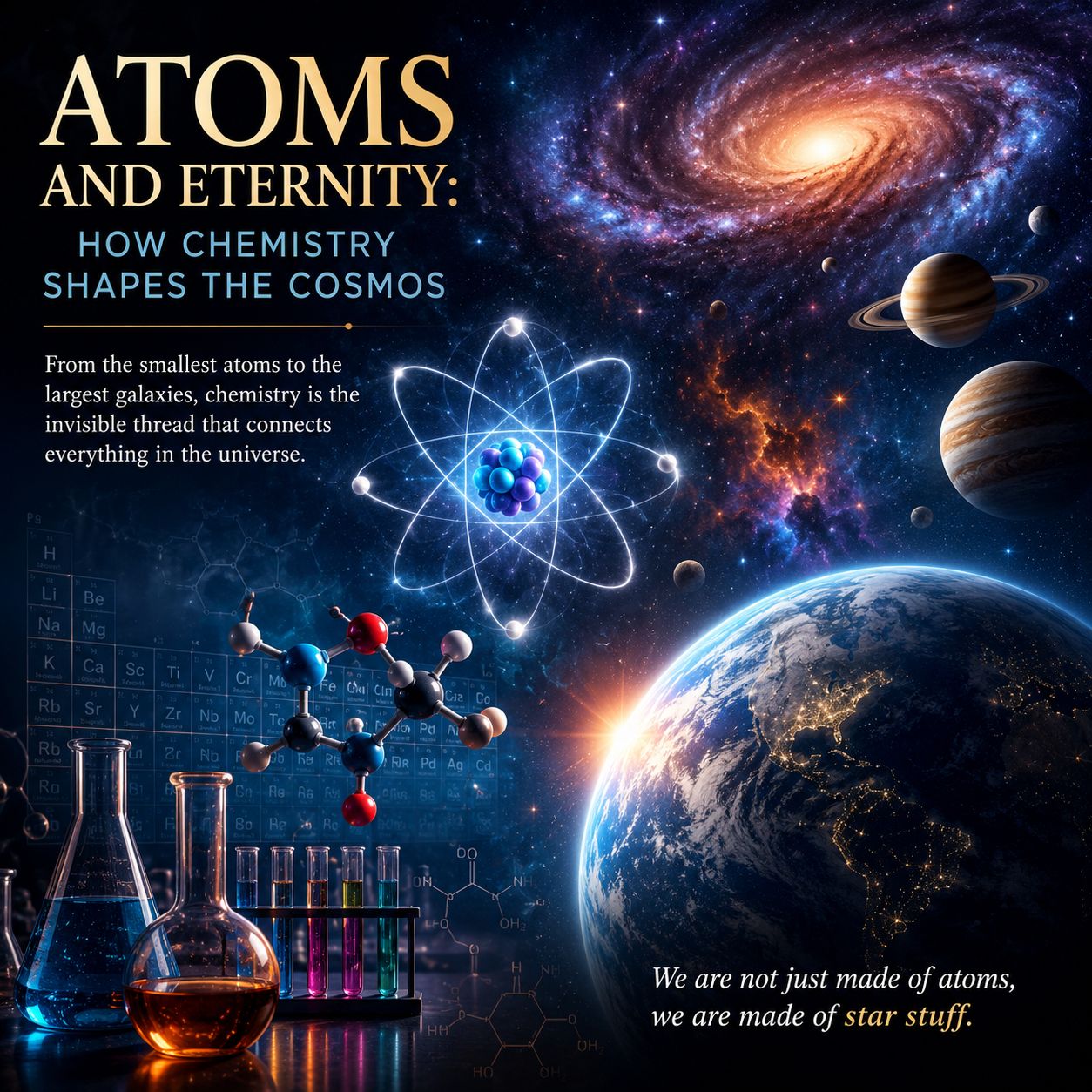
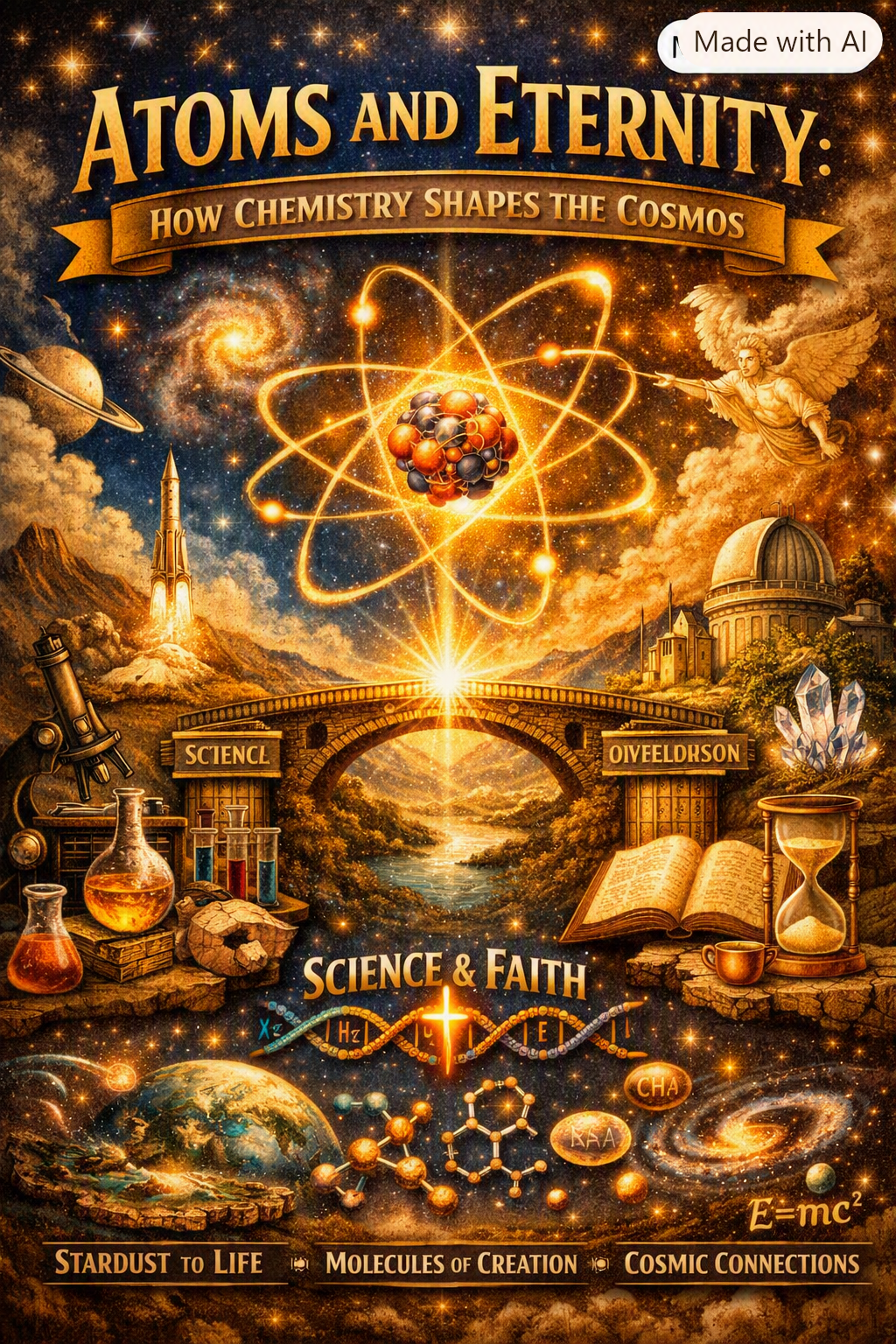
    Atoms and Eternity: How Chemistry Shapes the Cosmos

    One night, Ali looked up at the sky and wondered what all those countless stars were made of. His teacher explained that everything in the universe is made of atoms, and these tiny building blocks combine in different ways to create stars, planets, water, air, and even the ingredients of life. Ali was amazed that something so small could play such a huge role in shaping the universe.

    The next day, his teacher explained that powerful processes inside stars create new elements. Over enormous periods of time, these elements become part of planets and eventually contribute to the building blocks of life. Ali realized that every person, plant, and animal on Earth is connected to a much older cosmic story.

    Ali looked at the sky again and understood that nothing in the universe is truly insignificant. Even a tiny atom can be an important part of something much greater. He realized that, just as different atoms come together to create beautiful forms of matter, people can also work together to create a better world.

    Moral Lesson:
    Never consider something unimportant simply because it is small. Every part of the universe has a purpose, and our small efforts can also come together to create something truly meaningful.

    #AtomsAndEternity #Chemistry #Cosmos #Atoms #Science #Universe #SpaceScience #CosmicChemistry
    Fondation Level Batch No 4 Roll RSLC #42 Task No #118 Day #118 Atoms and Eternity: How Chemistry Shapes the Cosmos One night, Ali looked up at the sky and wondered what all those countless stars were made of. His teacher explained that everything in the universe is made of atoms, and these tiny building blocks combine in different ways to create stars, planets, water, air, and even the ingredients of life. Ali was amazed that something so small could play such a huge role in shaping the universe. The next day, his teacher explained that powerful processes inside stars create new elements. Over enormous periods of time, these elements become part of planets and eventually contribute to the building blocks of life. Ali realized that every person, plant, and animal on Earth is connected to a much older cosmic story. Ali looked at the sky again and understood that nothing in the universe is truly insignificant. Even a tiny atom can be an important part of something much greater. He realized that, just as different atoms come together to create beautiful forms of matter, people can also work together to create a better world. Moral Lesson: Never consider something unimportant simply because it is small. Every part of the universe has a purpose, and our small efforts can also come together to create something truly meaningful. #AtomsAndEternity #Chemistry #Cosmos #Atoms #Science #Universe #SpaceScience #CosmicChemistry
    0 Commentaires 0 Parts 783 Vue
  • #rsisb
    Roll No.240
    Image With Chatgpt No.6
    Foundation Level

    Oxygen is one of the most important elements for life on Earth, but its discovery was the result of careful experiments, curiosity, and scientific investigation.

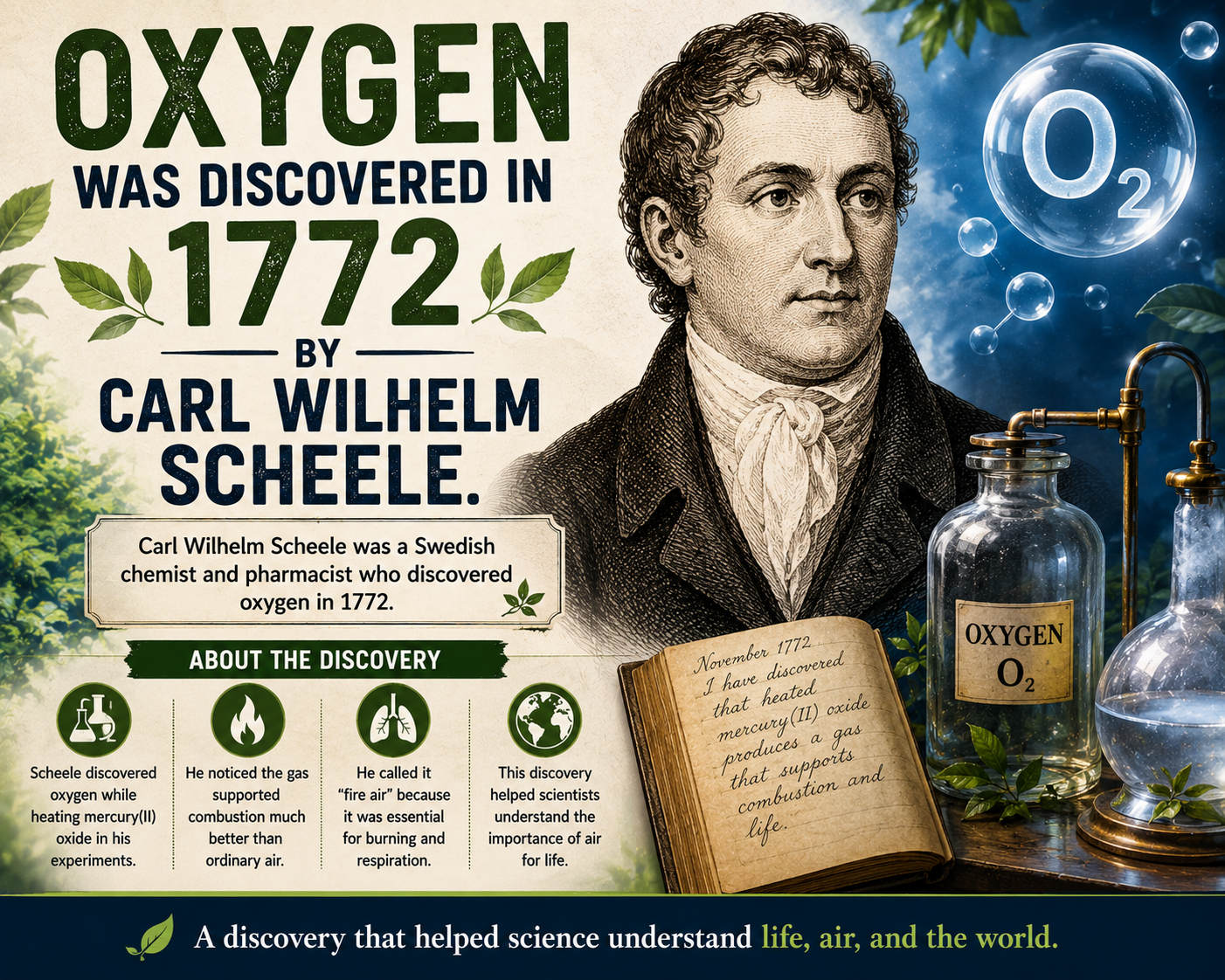
    In 1772, Swedish chemist and pharmacist Carl Wilhelm Scheele identified a gas that behaved differently from ordinary air. He found that this gas strongly supported combustion and played an important role in the processes we now understand as respiration and burning.

    Scheele referred to the gas as “fire air” because of its ability to support combustion. His experiments helped reveal that air was not simply one single substance, but a mixture containing different gases.

    The story of oxygen’s discovery is a fascinating example of how science develops through observation and experimentation. Scientists investigate materials, record their observations, test ideas, and gradually build a better understanding of the natural world.

    Although Scheele discovered oxygen independently, the recognition and naming of oxygen as an element also involved other scientists, including Joseph Priestley and Antoine Lavoisier. Their work helped establish oxygen’s role in combustion and contributed to the development of modern chemistry.

    Oxygen is represented by the chemical symbol O and has the atomic number 8. It is essential for aerobic respiration in humans and many other organisms. Without oxygen, most familiar forms of complex life could not survive.

    The discovery of oxygen changed the way scientists understood air, combustion, chemistry, and life. It became an important part of the scientific revolution in chemistry and helped researchers develop a much clearer understanding of chemical reactions.

    This story also reminds us that major scientific discoveries often happen through patience, careful observation, and a willingness to ask questions. Every experiment can reveal something new, and every discovery can open the door to further knowledge.

    From “fire air” to oxygen, the journey of discovery changed chemistry forever.

    Science teaches us that the world around us is full of mysteries waiting to be explored. Whether studying gases, atoms, cells, planets, or living organisms, curiosity is often the first step toward discovery.

    Question. Observe. Experiment. Discover. Learn.

    #Oxygen #DiscoveryOfOxygen #CarlWilhelmScheele #ScienceHistory #HistoryOfScience #Chemistry #ChemicalElements #OxygenDiscovery #1772 #ScientificDiscovery #ScienceEducation #ChemistryFacts #ScienceFacts #LearnScience #ScientificRevolution #Combustion #Air #Respiration #ChemistryHistory #STEM #Education #LearningJourney #ScienceExperiment #ScientificThinking #Research #Discovery #Knowledge #Innovation #Curiosity #ExploreScience #ScienceLovers #EducationalContent #Scientists #ChemicalScience #ModernChemistry #ScienceJourney #HistoryOfChemistry

    Rehan School Islamabad Campus
    Asma Shaheen EducationWali
    Irum Asim
    Saima Happinesswali

    #rsisb Roll No.240 Image With Chatgpt No.6 Foundation Level Oxygen is one of the most important elements for life on Earth, but its discovery was the result of careful experiments, curiosity, and scientific investigation. 🌱🫁🔥 In 1772, Swedish chemist and pharmacist Carl Wilhelm Scheele identified a gas that behaved differently from ordinary air. He found that this gas strongly supported combustion and played an important role in the processes we now understand as respiration and burning. 🔥🧪 Scheele referred to the gas as “fire air” because of its ability to support combustion. His experiments helped reveal that air was not simply one single substance, but a mixture containing different gases. 🌬️🔬 The story of oxygen’s discovery is a fascinating example of how science develops through observation and experimentation. Scientists investigate materials, record their observations, test ideas, and gradually build a better understanding of the natural world. 📚🔎💡 Although Scheele discovered oxygen independently, the recognition and naming of oxygen as an element also involved other scientists, including Joseph Priestley and Antoine Lavoisier. Their work helped establish oxygen’s role in combustion and contributed to the development of modern chemistry. ⚗️🧠🌍 Oxygen is represented by the chemical symbol O and has the atomic number 8. It is essential for aerobic respiration in humans and many other organisms. 🫁🌿🐾 Without oxygen, most familiar forms of complex life could not survive. The discovery of oxygen changed the way scientists understood air, combustion, chemistry, and life. 🌎🔥🔬 It became an important part of the scientific revolution in chemistry and helped researchers develop a much clearer understanding of chemical reactions. This story also reminds us that major scientific discoveries often happen through patience, careful observation, and a willingness to ask questions. 💭➡️🔬➡️💡 Every experiment can reveal something new, and every discovery can open the door to further knowledge. ✨ From “fire air” to oxygen, the journey of discovery changed chemistry forever. ✨ Science teaches us that the world around us is full of mysteries waiting to be explored. 🌍🔎 Whether studying gases, atoms, cells, planets, or living organisms, curiosity is often the first step toward discovery. 🚀📚 🌟 Question. Observe. Experiment. Discover. Learn. 🌟 #Oxygen #DiscoveryOfOxygen #CarlWilhelmScheele #ScienceHistory #HistoryOfScience #Chemistry #ChemicalElements #OxygenDiscovery #1772 #ScientificDiscovery #ScienceEducation #ChemistryFacts #ScienceFacts #LearnScience #ScientificRevolution #Combustion #Air #Respiration #ChemistryHistory #STEM #Education #LearningJourney #ScienceExperiment #ScientificThinking #Research #Discovery #Knowledge #Innovation #Curiosity #ExploreScience #ScienceLovers #EducationalContent #Scientists #ChemicalScience #ModernChemistry #ScienceJourney #HistoryOfChemistry 🔬🧪🌍🔥🫁📚💡✨🚀🌱 Rehan School Islamabad Campus Asma Shaheen EducationWali Irum Asim Saima Happinesswali
    0 Commentaires 0 Parts 3331 Vue
  • #rsisb
    Roll No.240
    Story Post No.24
    Foundation Level

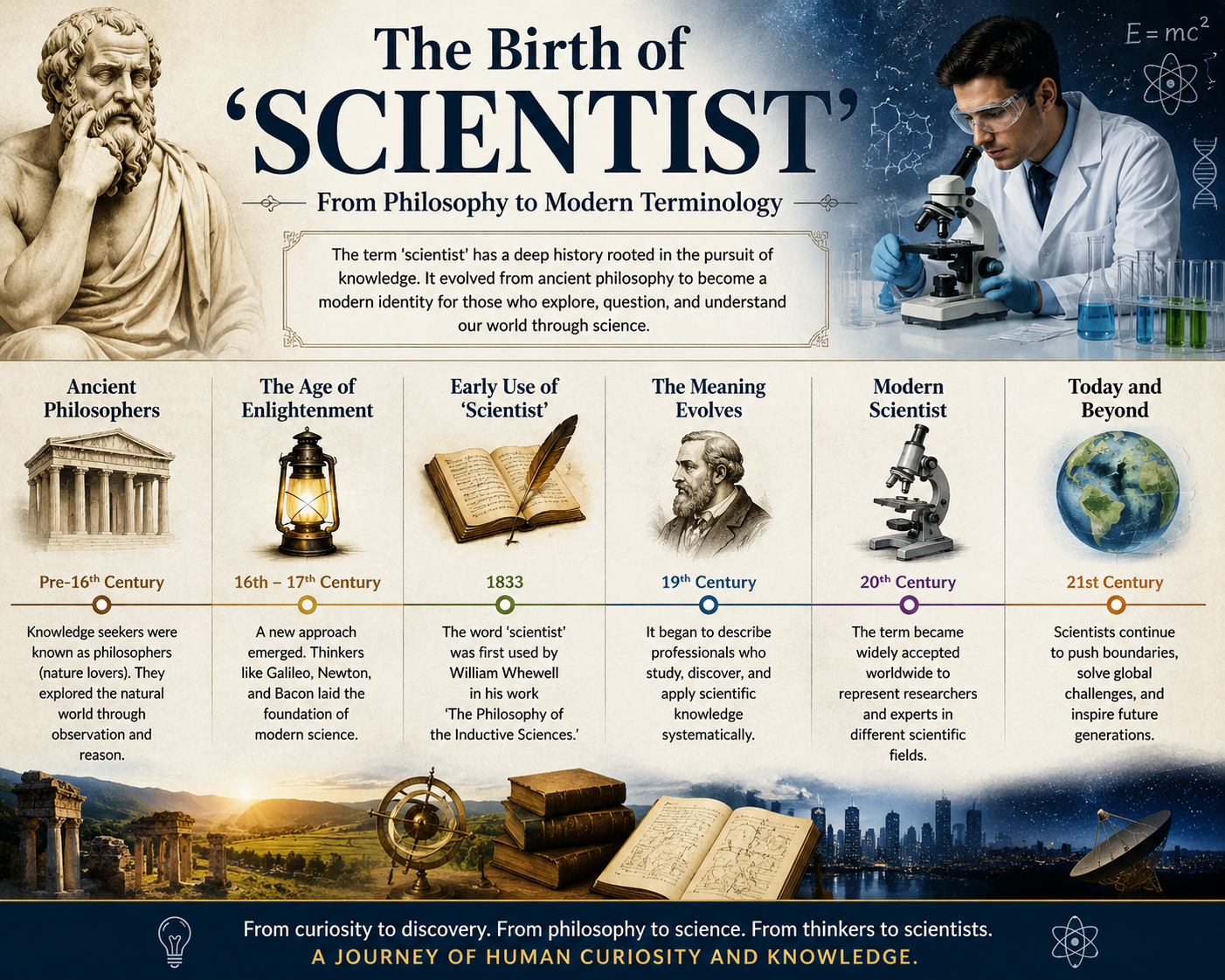
    The word “scientist” may sound like a modern term, but the journey behind it is connected to centuries of human curiosity, philosophy, observation, experimentation, and the search for knowledge.

    Long before the word “scientist” became common, people who studied the natural world were often known as philosophers, scholars, natural philosophers, mathematicians, and thinkers. They asked important questions about nature, the universe, life, matter, motion, and the world around them.

    From the thinkers of the ancient world to the scholars of the Renaissance and the Scientific Revolution, humans continued developing new ways to understand nature. Observation became more important, experiments became more systematic, and evidence gradually became a central part of scientific inquiry.

    During the 18th and 19th centuries, many different branches of knowledge began becoming more specialized. Physics, chemistry, biology, astronomy, geology, and other fields developed their own methods, discoveries, and communities of researchers.

    A major moment in terminology came in the 19th century, when the word “scientist” was introduced as a useful name for people engaged in scientific study. The term is widely associated with William Whewell, who used it in 1833. This helped provide a new, unified word for researchers working across different areas of science.

    The evolution of this word reflects something bigger than language. It represents the changing way humanity organized knowledge and recognized scientific work. The transition from “natural philosopher” to “scientist” shows how science gradually became a distinct and organized field of study.

    Today, scientists work in laboratories, universities, hospitals, observatories, research centers, engineering facilities, and many other places around the world. They investigate everything from tiny cells and molecules to distant galaxies and the origins of the universe.

    Modern science continues to grow through curiosity, evidence, teamwork, technology, and a willingness to ask difficult questions. Every discovery begins with someone wondering, “Why?”, “How?”, or “What if?”

    The story of the word “scientist” reminds us that human knowledge is always evolving. What began with simple curiosity and philosophical questioning gradually developed into the powerful and diverse scientific world we know today.

    From thinkers to researchers. From philosophy to science. From questions to discoveries.

    Science is not only about finding answers—it is also about continuing to ask better questions.

    A journey from curiosity to discovery, and from philosophy to modern science.

    #TheBirthOfScientist #Scientist #HistoryOfScience #ScienceHistory #ScientificRevolution #Philosophy #NaturalPhilosophy #WilliamWhewell #1833 #ModernScience #ScienceEducation #ScientificTerminology #Science #Scientists #Research #Discovery #Curiosity #Knowledge #Learning #Education #STEM #Physics #Chemistry #Biology #Astronomy #Geology #Innovation #Experimentation #ScientificThinking #CriticalThinking #HumanKnowledge #HistoryOfKnowledge #ScienceJourney #FromPhilosophyToScience #ScienceFacts #EducationalContent #LearningJourney #ExploreScience #DiscoverScience

    Rehan School Islamabad Campus
    Asma Shaheen EducationWali
    Irum Asim
    Saima Happinesswali

    #rsisb Roll No.240 Story Post No.24 Foundation Level The word “scientist” may sound like a modern term, but the journey behind it is connected to centuries of human curiosity, philosophy, observation, experimentation, and the search for knowledge. 🧠🔎 Long before the word “scientist” became common, people who studied the natural world were often known as philosophers, scholars, natural philosophers, mathematicians, and thinkers. 🏛️📜 They asked important questions about nature, the universe, life, matter, motion, and the world around them. From the thinkers of the ancient world to the scholars of the Renaissance and the Scientific Revolution, humans continued developing new ways to understand nature. 🌌🌍📖 Observation became more important, experiments became more systematic, and evidence gradually became a central part of scientific inquiry. 🔬🧪✨ During the 18th and 19th centuries, many different branches of knowledge began becoming more specialized. Physics, chemistry, biology, astronomy, geology, and other fields developed their own methods, discoveries, and communities of researchers. 🧬⚗️🌠 A major moment in terminology came in the 19th century, when the word “scientist” was introduced as a useful name for people engaged in scientific study. The term is widely associated with William Whewell, who used it in 1833. 📜🔬 This helped provide a new, unified word for researchers working across different areas of science. The evolution of this word reflects something bigger than language. It represents the changing way humanity organized knowledge and recognized scientific work. 🌟📚 The transition from “natural philosopher” to “scientist” shows how science gradually became a distinct and organized field of study. Today, scientists work in laboratories, universities, hospitals, observatories, research centers, engineering facilities, and many other places around the world. 🌍🧪🔭 They investigate everything from tiny cells and molecules to distant galaxies and the origins of the universe. 🧬🦠🌌 Modern science continues to grow through curiosity, evidence, teamwork, technology, and a willingness to ask difficult questions. 💡🤝🚀 Every discovery begins with someone wondering, “Why?”, “How?”, or “What if?” The story of the word “scientist” reminds us that human knowledge is always evolving. What began with simple curiosity and philosophical questioning gradually developed into the powerful and diverse scientific world we know today. 🌱➡️🔬➡️🌍 ✨ From thinkers to researchers. From philosophy to science. From questions to discoveries. ✨ Science is not only about finding answers—it is also about continuing to ask better questions. 🔎💡 🌟 A journey from curiosity to discovery, and from philosophy to modern science. 🌟 #TheBirthOfScientist #Scientist #HistoryOfScience #ScienceHistory #ScientificRevolution #Philosophy #NaturalPhilosophy #WilliamWhewell #1833 #ModernScience #ScienceEducation #ScientificTerminology #Science #Scientists #Research #Discovery #Curiosity #Knowledge #Learning #Education #STEM #Physics #Chemistry #Biology #Astronomy #Geology #Innovation #Experimentation #ScientificThinking #CriticalThinking #HumanKnowledge #HistoryOfKnowledge #ScienceJourney #FromPhilosophyToScience #ScienceFacts #EducationalContent #LearningJourney #ExploreScience #DiscoverScience 🔬📚🧠🌍✨🔭🧪🚀💡🌟 Rehan School Islamabad Campus Asma Shaheen EducationWali Irum Asim Saima Happinesswali

    0 Commentaires 0 Parts 3229 Vue
  • #rsisb
    Roll no.247
    song no.4
    Foundation level

    **Chemical Reactions: The Engine of Life**

    Chemical reactions are happening all around us—and even inside us—every moment of every day! From the food we eat to the oxygen we breathe, chemical reactions make life possible. They transform substances into new substances and provide the energy needed for living organisms to grow, move, repair themselves, and survive.

    In this fascinating journey through chemistry, we explore how atoms rearrange, how bonds are broken and formed, and how energy can be released or absorbed during a reaction. We’ll discover everyday examples such as digestion , photosynthesis , cellular respiration , rusting , cooking , and many other processes.

    Photosynthesis is a wonderful example of chemistry in action. Plants use light energy to help convert carbon dioxide and water into glucose and oxygen. Cellular respiration then helps living cells obtain usable energy from food. Together, these processes show how beautifully chemistry and biology are connected.

    Understanding chemical reactions helps us understand the world at a deeper level. It explains how medicines work , how fuels produce energy , how materials change , and how natural cycles keep our planet functioning .

    So, get ready to explore the amazing microscopic world of atoms and molecules! Learn how tiny changes at the molecular level can create enormous effects in the world around us.

    **Chemistry isn't just a subject—it is one of the engines that keeps life moving!**

    #ChemicalReactions #Chemistry #EngineOfLife #Science #Biology #Atoms #Molecules #Photosynthesis #CellularRespiration #ScienceEducation #LearnScience #STEM #ScienceForStudents #AmazingScience #ChemistryInAction #LifeScience #EducationalContent #ExploreScience #KnowledgeIsPower #LearningIsFun
    #rsisb Roll no.247 song no.4 Foundation level 🧪⚡ **Chemical Reactions: The Engine of Life** 🌱🔬 Chemical reactions are happening all around us—and even inside us—every moment of every day! 🌍✨ From the food we eat to the oxygen we breathe, chemical reactions make life possible. They transform substances into new substances and provide the energy needed for living organisms to grow, move, repair themselves, and survive. 🧬❤️ In this fascinating journey through chemistry, we explore how atoms rearrange, how bonds are broken and formed, and how energy can be released or absorbed during a reaction. ⚛️🔗🔥 We’ll discover everyday examples such as digestion 🍎, photosynthesis 🌿☀️, cellular respiration 🫁, rusting 🧲, cooking 🍳, and many other processes. Photosynthesis is a wonderful example of chemistry in action. 🌱☀️ Plants use light energy to help convert carbon dioxide and water into glucose and oxygen. Cellular respiration then helps living cells obtain usable energy from food. Together, these processes show how beautifully chemistry and biology are connected. 💚🔬 Understanding chemical reactions helps us understand the world at a deeper level. It explains how medicines work 💊, how fuels produce energy ⛽, how materials change 🧱, and how natural cycles keep our planet functioning 🌎. So, get ready to explore the amazing microscopic world of atoms and molecules! 🚀🧪 Learn how tiny changes at the molecular level can create enormous effects in the world around us. ✨ **Chemistry isn't just a subject—it is one of the engines that keeps life moving!** ⚡🌍🧬 #ChemicalReactions 🧪 #Chemistry 🔬 #EngineOfLife ⚡ #Science 🌍 #Biology 🧬 #Atoms ⚛️ #Molecules 🔗 #Photosynthesis 🌱 #CellularRespiration 🫁 #ScienceEducation 📚 #LearnScience 💡 #STEM 🚀 #ScienceForStudents 🎓 #AmazingScience ✨ #ChemistryInAction 🔥 #LifeScience 🌿 #EducationalContent 📖 #ExploreScience 🔎 #KnowledgeIsPower 💫 #LearningIsFun 😊
    0 Commentaires 0 Parts 1825 Vue 5
  • #rsisb Roll No.240 Song No.22 Foundation Level Energy, Matter, and Transformation: The Philosophy of Chemical Reactions takes us into the fascinating world of chemistry, where ordinary substances can change into something new. Chemical reactions are happening around us all the time — when food cooks, when a candle burns, when iron reacts with oxygen, and even inside living organisms. In a chemical reaction, atoms do not simply disappear. Instead, they rearrange and form new combinations. Old chemical bonds may break, while new bonds form. As these changes happen, energy can be released or absorbed. Energy is an important part of every chemical reaction. Some reactions release energy, often in the form of heat or light, while others need energy to take place. Understanding this movement of energy helps us understand why and how chemical changes happen. Matter is also central to chemistry. Everything around us is made of matter, from the air we breathe to the water we drink and the food we eat. During a chemical reaction, matter is transformed into new substances while the total amount of matter remains conserved. This topic also introduces the deeper idea of transformation. Chemistry shows us that change is a natural part of the world. A substance may look different after a reaction, but its atoms are still present in new arrangements. By studying chemical reactions, students can learn how to observe changes, identify reactants and products, understand energy changes, and appreciate the amazing processes taking place in the world around them. 🔬 Matter changes through chemical reactions. ⚡ Energy can be released or absorbed. 🧪 Atoms rearrange to form new substances. 🌍 Chemical reactions happen everywhere around us. 💡 Chemistry helps us understand how and why matter transforms. Energy, Matter, and Transformation encourages curiosity and scientific thinking. It reminds us that even simple changes can reveal fascinating ideas about matter, energy, and the way our world works. #ChemicalReactions #Energy #Matter #Transformation #Chemistry #Science #ChemicalChange #Atoms #Molecules #ScienceEducation #Learning #ChemistryEducation #ScientificDiscovery Rehan School Islamabad Campus Asma Shaheen EducationWali Irum Asim Saima Happinesswali https://www.facebook.com/share/v/1FVxBMuoWA/

    WWW.FACEBOOK.COM
    Facebook
    #rsisb Roll No.240 Song No.22 Foundation Level Energy, Matter, and Transformation: The Philosophy of Chemical Reactions takes us into the fascinating world of chemistry, where ordinary substances...
    0 Commentaires 0 Parts 1347 Vue
  • #rsisb
    Roll No.269
    Foundation Level
    Story Post No.17

    ## Atoms and Eternity: How Chemistry Shapes the Cosmos

    Have you ever wondered how tiny **atoms** can shape the enormous universe? In this video, we explore **“Atoms and Eternity: How Chemistry Shapes the Cosmos”** and discover the fascinating connection between chemistry, matter, stars, planets, and space.

    From the smallest particles to gigantic stars and galaxies, **atoms are the building blocks of ordinary matter**. We’ll explore how elements are formed, how chemical reactions occur, and how the elements found on Earth are connected to processes that happen throughout the cosmos.

    This journey combines **chemistry, physics, and astronomy** to show how the behavior of atoms helps us understand the universe around us.

    **Learn • Explore • Discover • Understand**

    ### Hashtags

    #Atoms #Chemistry #Cosmos #Astronomy #Universe #Science #Elements #Physics #SpaceScience #Stars #Matter #ChemistryAndAstronomy #STEM #ScienceLearning #ExploreTheUniverse
    #rsisb Roll No.269 Foundation Level Story Post No.17 ## 🌌⚛️ Atoms and Eternity: How Chemistry Shapes the Cosmos Have you ever wondered how tiny **atoms** can shape the enormous universe? 🤔🌠 In this video, we explore **“Atoms and Eternity: How Chemistry Shapes the Cosmos”** and discover the fascinating connection between chemistry, matter, stars, planets, and space. From the smallest particles to gigantic stars and galaxies, **atoms are the building blocks of ordinary matter**. ⚛️✨ We’ll explore how elements are formed, how chemical reactions occur, and how the elements found on Earth are connected to processes that happen throughout the cosmos. 🌍🔭 This journey combines **chemistry, physics, and astronomy** to show how the behavior of atoms helps us understand the universe around us. 🚀🧪🌌 🎓 **Learn • Explore • Discover • Understand** ### 🔖 Hashtags #Atoms ⚛️ #Chemistry 🧪 #Cosmos 🌌 #Astronomy 🔭 #Universe 🌠 #Science 🔬 #Elements #Physics 🚀 #SpaceScience 🌍 #Stars ⭐ #Matter #ChemistryAndAstronomy #STEM 🎓 #ScienceLearning #ExploreTheUniverse ✨
    0 Commentaires 0 Parts 1277 Vue
Plus de résultats