• RSIf8
    Roll Number: 49
    Story post no.30
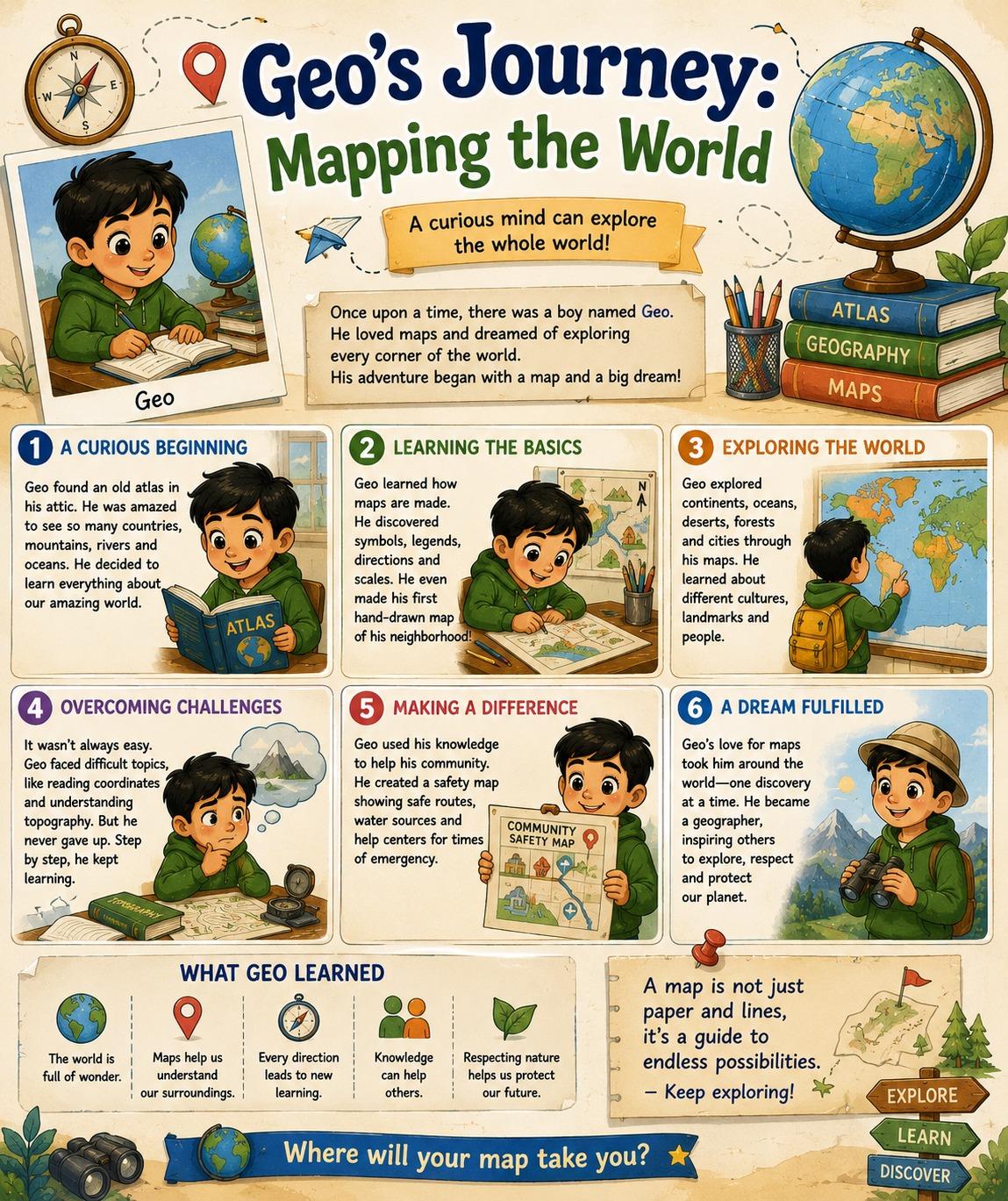
    Story post topic: **Geo's Journey: Mapping the World**

    Embark on an exciting journey around our amazing planet with **“Geo's Journey: Mapping the World.”** This educational adventure explores how maps help us understand continents, countries, oceans, mountains, cities, and the diverse places that make Earth unique.

    **In this journey, we explore:**
    Continents and countries
    Different types of maps
    Mountains, rivers, and oceans
    Locations and geographical features
    How geography helps us understand our world
    The importance of maps in everyday life

    Maps are more than drawings—they are powerful tools that help us explore, navigate, and understand the world around us.

    **Which place in the world would you love to explore?** Share your answer in the comments!

    Like | Comment | Share | Follow for more educational and interesting content.

    #GeosJourney #MappingTheWorld #Geography #Maps #WorldMap #ExploreTheWorld #GeographyEducation #Learning #Education #Earth #Continents #Countries #Oceans #Mountains #GeographyFacts #StudentLife #EducationalContent #Knowledge #Explore #AyeshAhmed
    RSIf8 Roll Number: 49 Story post no.30 Story post topic:🌍🗺️ **Geo's Journey: Mapping the World** Embark on an exciting journey around our amazing planet with **“Geo's Journey: Mapping the World.”** 🌎✨ This educational adventure explores how maps help us understand continents, countries, oceans, mountains, cities, and the diverse places that make Earth unique. 🧭 **In this journey, we explore:** 🌍 Continents and countries 🗺️ Different types of maps 🏔️ Mountains, rivers, and oceans 📍 Locations and geographical features 🌐 How geography helps us understand our world 🔎 The importance of maps in everyday life Maps are more than drawings—they are powerful tools that help us explore, navigate, and understand the world around us. 🌟 💬 **Which place in the world would you love to explore?** Share your answer in the comments! 👍 Like | 💭 Comment | 🔄 Share | 🔔 Follow for more educational and interesting content. #GeosJourney #MappingTheWorld #Geography #Maps #WorldMap #ExploreTheWorld #GeographyEducation #Learning #Education #Earth #Continents #Countries #Oceans #Mountains #GeographyFacts #StudentLife #EducationalContent #Knowledge #Explore #AyeshAhmed
    0 التعليقات 0 المشاركات 439 مشاهدة
  • Mohsin #RSF8
    #Storypostt6
    Class: Foundation level
    Made by Me
    rool no:13
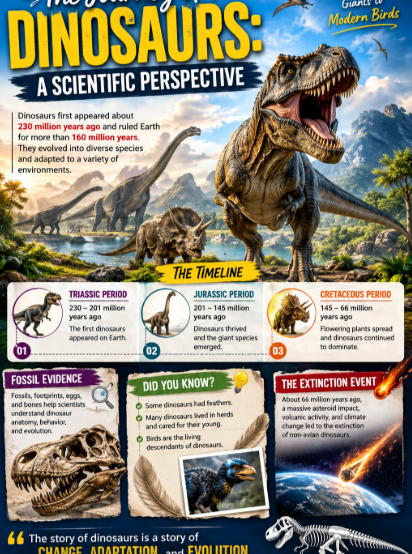
    The Journey of Dinosaurs: A Scientific Perspective

    Travel back hundreds of millions of years and discover the extraordinary story of dinosaurs—some of the most fascinating creatures to ever inhabit our planet. Their journey began during the Triassic Period, approximately 230 million years ago, when the Earth looked vastly different from the world we know today. Continents were joined together in a giant landmass called Pangaea, and early dinosaurs emerged as small, agile reptiles. Over time, these ancient creatures evolved into a diverse range of species, occupying nearly every ecological niche and becoming the dominant animals on Earth for more than 160 million years.

    During the Jurassic Period, dinosaurs flourished and diversified into countless forms. Massive herbivores such as Brachiosaurus and Diplodocus roamed lush forests, while formidable predators like Allosaurus hunted across vast landscapes. Their remarkable adaptations allowed them to thrive in changing environments, demonstrating the power of evolution and natural selection. As ecosystems became increasingly complex, dinosaurs developed specialized characteristics that enabled them to survive and dominate their habitats.

    The Cretaceous Period marked the peak of dinosaur diversity. Iconic species such as Tyrannosaurus rex, Triceratops, and Velociraptor appeared during this era. Scientists believe that many dinosaurs displayed advanced behaviors, including social interaction, parental care, and migration. Fossil evidence has even revealed that some dinosaurs possessed feathers, providing strong support for the evolutionary link between dinosaurs and modern birds. These discoveries have transformed our understanding of dinosaurs, showing that they were dynamic, intelligent, and highly adaptable creatures rather than the slow-moving reptiles once imagined.

    Our knowledge of dinosaurs comes primarily from the study of fossils. Paleontologists carefully examine fossilized bones, footprints, eggs, and even preserved skin impressions to reconstruct the lives of these prehistoric animals. Modern technologies.
    Mohsin #RSF8🎓✨ #Storypostt6 Class: Foundation level 📚 Made by Me 💻🚀 rool no:13 🦖 The Journey of Dinosaurs: A Scientific Perspective Travel back hundreds of millions of years and discover the extraordinary story of dinosaurs—some of the most fascinating creatures to ever inhabit our planet. Their journey began during the Triassic Period, approximately 230 million years ago, when the Earth looked vastly different from the world we know today. Continents were joined together in a giant landmass called Pangaea, and early dinosaurs emerged as small, agile reptiles. Over time, these ancient creatures evolved into a diverse range of species, occupying nearly every ecological niche and becoming the dominant animals on Earth for more than 160 million years. During the Jurassic Period, dinosaurs flourished and diversified into countless forms. Massive herbivores such as Brachiosaurus and Diplodocus roamed lush forests, while formidable predators like Allosaurus hunted across vast landscapes. Their remarkable adaptations allowed them to thrive in changing environments, demonstrating the power of evolution and natural selection. As ecosystems became increasingly complex, dinosaurs developed specialized characteristics that enabled them to survive and dominate their habitats. The Cretaceous Period marked the peak of dinosaur diversity. Iconic species such as Tyrannosaurus rex, Triceratops, and Velociraptor appeared during this era. Scientists believe that many dinosaurs displayed advanced behaviors, including social interaction, parental care, and migration. Fossil evidence has even revealed that some dinosaurs possessed feathers, providing strong support for the evolutionary link between dinosaurs and modern birds. These discoveries have transformed our understanding of dinosaurs, showing that they were dynamic, intelligent, and highly adaptable creatures rather than the slow-moving reptiles once imagined. Our knowledge of dinosaurs comes primarily from the study of fossils. Paleontologists carefully examine fossilized bones, footprints, eggs, and even preserved skin impressions to reconstruct the lives of these prehistoric animals. Modern technologies.
    0 التعليقات 0 المشاركات 792 مشاهدة
  • #rsisb
    Roll no.247
    call Annie .15
    Foundation level

    **“Earth” – The History of Our Home in a Word (25 min)**

    Welcome to an exciting journey through the incredible history of **Earth — our beautiful home in the universe!** From its formation billions of years ago to the amazing diversity of life we see today, Earth has experienced an extraordinary story filled with change, discovery, survival, and transformation.

    In this **25-minute exploration**, we will travel back through deep time and discover how our planet formed from the early material of the solar system. We’ll explore the development of oceans , mountains , continents , atmosphere , and the conditions that eventually made life possible.

    We’ll take a fascinating look at ancient Earth, when the planet was very different from the world we know today. We’ll discover how simple forms of life appeared and gradually evolved into increasingly complex organisms.

    The story of Earth also includes dramatic events such as massive volcanic activity, changing climates, shifting continents, ice ages, and the disappearance of many ancient species. These events helped shape the planet and created opportunities for new forms of life to develop.

    As we move closer to the present, we’ll explore the rise of humans and how our species became an important part of Earth’s story. From early communities and agriculture to modern cities, technology, science, and exploration, humanity has changed the planet in remarkable ways.

    But Earth’s history is not just a story about the past. It also encourages us to think about the future. What will happen to our planet in the years ahead? How can we protect nature, conserve resources, reduce pollution, and take better care of the world we call home?

    **Earth is more than just a planet — it is a living story.** Every mountain, ocean, fossil, forest, river, and living creature is part of that incredible story. By learning about Earth’s past, we can better understand the present and make wiser choices for the future.

    Join us for this fascinating **25-minute journey through Earth’s history** and discover how our planet became the remarkable world we know today!

    **Learn about the past. Understand the present. Protect the future.**

    #Earth #EarthHistory #OurPlanet #PlanetEarth #HistoryOfEarth #Science #Geology #Evolution #Dinosaurs #AncientEarth #Oceans #Nature #Environment #Climate #Space #Universe #HumanHistory #ScienceEducation #Learning #EducationalVideo #EarthScience #ExploreEarth #SaveOurPlanet #ProtectNature #FutureOfEarth #Knowledge #DiscoverScience #AmazingEarth #WorldHistory
    #rsisb Roll no.247 call Annie .15 Foundation level 🌍 **“Earth” – The History of Our Home in a Word (25 min)** 🌎✨ Welcome to an exciting journey through the incredible history of **Earth — our beautiful home in the universe!** 🌌🌍 From its formation billions of years ago to the amazing diversity of life we see today, Earth has experienced an extraordinary story filled with change, discovery, survival, and transformation. 🦕🌋🌊🌳 In this **25-minute exploration**, we will travel back through deep time and discover how our planet formed from the early material of the solar system. ☀️🪐 We’ll explore the development of oceans 🌊, mountains ⛰️, continents 🌎, atmosphere 🌤️, and the conditions that eventually made life possible. 🧬🌱 We’ll take a fascinating look at ancient Earth, when the planet was very different from the world we know today. 🌋🔥 We’ll discover how simple forms of life appeared and gradually evolved into increasingly complex organisms. 🦠➡️🐠➡️🦖➡️🦅➡️🐘 The story of Earth also includes dramatic events such as massive volcanic activity, changing climates, shifting continents, ice ages, and the disappearance of many ancient species. 🌋❄️🌍 These events helped shape the planet and created opportunities for new forms of life to develop. 🌱🦖🔬 As we move closer to the present, we’ll explore the rise of humans and how our species became an important part of Earth’s story. 👨‍👩‍👧‍👦🏕️🌾🏙️ From early communities and agriculture to modern cities, technology, science, and exploration, humanity has changed the planet in remarkable ways. 🚜🏗️💡🚀 But Earth’s history is not just a story about the past. It also encourages us to think about the future. 🌱💚 What will happen to our planet in the years ahead? How can we protect nature, conserve resources, reduce pollution, and take better care of the world we call home? 🌳💧♻️ 🌍 **Earth is more than just a planet — it is a living story.** Every mountain, ocean, fossil, forest, river, and living creature is part of that incredible story. By learning about Earth’s past, we can better understand the present and make wiser choices for the future. 🔬📚🌎 Join us for this fascinating **25-minute journey through Earth’s history** and discover how our planet became the remarkable world we know today! 🌍✨🚀 💚 **Learn about the past. Understand the present. Protect the future.** 🌱🌎 #Earth 🌍 #EarthHistory 📚 #OurPlanet 🌎 #PlanetEarth 🪐 #HistoryOfEarth ⏳ #Science 🔬 #Geology 🪨 #Evolution 🧬 #Dinosaurs 🦖 #AncientEarth 🌋 #Oceans 🌊 #Nature 🌳 #Environment 🌱 #Climate 🌤️ #Space 🌌 #Universe ✨ #HumanHistory 👨‍👩‍👧‍👦 #ScienceEducation 📖 #Learning 📚 #EducationalVideo 🎓 #EarthScience 🔬 #ExploreEarth 🌍 #SaveOurPlanet 💚 #ProtectNature 🌳 #FutureOfEarth 🌎 #Knowledge 💡 #DiscoverScience 🚀 #AmazingEarth ✨ #WorldHistory 🌍
    0 التعليقات 0 المشاركات 5680 مشاهدة 8
  • #rsisb Roll No.240 Call Annie No.24 Foundation Level **Earth – The History of Our Home in a Word (25 min)** 🌍 Explore the amazing history of **Earth**, from its formation billions of years ago to the world we live in today. In this educational 25-minute video, discover how Earth formed, how oceans and continents developed, how life began, and how plants, animals, dinosaurs, and humans appeared over time. Learn about Earth’s layers, atmosphere, oceans, mountains, volcanoes, earthquakes, fossils, evolution, climate, and the movement of tectonic plates. This video explains Earth’s long journey in an easy and interesting way, making it perfect for students, children, and anyone curious about our planet. 🌎 **Topics Covered:** Earth’s formation, continents, oceans, atmosphere, fossils, dinosaurs, evolution, human history, climate change, and the future of our planet. #Earth #HistoryOfEarth #PlanetEarth #EarthScience #Geology #Evolution #Dinosaurs #HumanEvolution #Science #EducationalVideo #Nature #OurPlanet #EarthHistory #Knowledge #Learning Rehan School Islamabad Campus Asma Shaheen EducationWali Irum Asim Saima Happinesswali https://www.facebook.com/share/v/1Ud8BgNn6i/
    WWW.FACEBOOK.COM
    Facebook
    #rsisb Roll No.240 Call Annie No.24 Foundation Level **Earth – The History of Our Home in a Word (25 min)** 🌍 Explore the amazing history of **Earth**, from its formation billions of years ago to...
    0 التعليقات 0 المشاركات 3356 مشاهدة
  • roll no 80 Join us on an incredible journey through the **largest road, rail, sea, and air transportation networks** on Earth! Discover how billions of people and trillions of dollars worth of goods move across continents every day. 🌎 In this documentary, you'll explore: 🚛 The world's largest highway networks 🚆 Massive railway systems connecting entire nations 🚢 The busiest shipping routes and mega ports ✈️ The biggest airports and global aviation hubs 📊 Mind-blowing facts and comparisons 🔮 Future transportation technologies that could change the world forever Whether you're passionate about logistics, engineering, infrastructure, or global trade, this documentary will give you a fascinating look at the transportation systems that keep our world connected. 👍 Don't forget to **Like**, **Comment**, **Share**, and **Subscribe** for more amazing transportation and logistics documentaries!https://www.linkedin.com/posts/arham-naeem-transport-wala-3b5bb1398_transportation-logistics-documentary-ugcPost-7479752240040431616-iKQy/?utm_source=social_share_send&utm_medium=member_desktop_web&rcm=ACoAAGG1h_kBVD23UUFCoR_Jg29EeGDorI4zAmw
    WWW.LINKEDIN.COM
    #transportation #logistics #documentary #roadtransport #railways #shipping #aviation #globaltrade #supplychain #infrastructure #megaprojects #engineering #futuretransport #smartlogistics… | Arham Naeem Transport wala
    roll no 80 🌍🚛 The World's Biggest Transportation Systems Explained! ✈️🚢🚆 Join us on an incredible journey through the largest road, rail, sea, and air transportation networks on Earth! Discover how billions of people and trillions of dollars worth of goods move across continents every day. 🌎 In this documentary, you'll explore: 🚛 The world's largest highway networks 🚆 Massive railway systems connecting entire nations 🚢 The busiest shipping routes and mega ports ✈️ The biggest airports and global aviation hubs 📊 Mind-blowing facts and comparisons 🔮 Future transportation technologies that could change the world forever Whether you're passionate about logistics, engineering, infrastructure, or global trade, this documentary will give you a fascinating look at the transportation systems that keep our world connected. 👍 Don't forget to Like, Comment, Share, and Subscribe for more amazing transportation and logistics documentaries! #Transportation #Logistics #Documentary #RoadTransport #Railways #Shipping #Aviation #GlobalTrade #SupplyChain #Infrastructure #MegaProjects #Engineering #FutureTransport #SmartLogistics #TransportWala
    0 التعليقات 0 المشاركات 1127 مشاهدة
  • The name America has its origins in the early 16th century and is derived from the Latinized version of the name of the Italian explorer Amerigo Vespucci (1454–1512). Vespucci was among the first to suggest that the lands discovered by Christopher Columbus were part of a “New World,” separate from Asia.

    Origin and History:
    1. Amerigo Vespucci:
    The name “America” is derived from the Latinized version of his first name, Americus (in Latin) or Amerigo (in Italian). Vespucci wrote letters describing the lands he explored in the Americas, and his accounts spread widely in Europe.
    2. Naming by Martin Waldseemüller (1507):
    A German cartographer, Martin Waldseemüller, is credited with naming the continent “America.” In 1507, he published a map titled “Universalis Cosmographia” that labeled the new continent “America” in honor of Vespucci. This was the first recorded instance of the name being used.
    3. Application to Both Continents:
    Initially, “America” referred only to South America, as Vespucci’s explorations focused on that region. Over time, the name expanded to include North America as well.

    Meaning:

    The name “America” itself does not have a specific linguistic meaning but is derived from Vespucci’s name as an acknowledgment of his contributions to the discovery and understanding of the New World.

    Fun Fact:

    While Vespucci’s name is immortalized in the continents’ name, there is historical debate about whether the naming was entirely justified, as Columbus had discovered the New World before Vespucci’s exploration and writings.
    The name America has its origins in the early 16th century and is derived from the Latinized version of the name of the Italian explorer Amerigo Vespucci (1454–1512). Vespucci was among the first to suggest that the lands discovered by Christopher Columbus were part of a “New World,” separate from Asia. Origin and History: 1. Amerigo Vespucci: The name “America” is derived from the Latinized version of his first name, Americus (in Latin) or Amerigo (in Italian). Vespucci wrote letters describing the lands he explored in the Americas, and his accounts spread widely in Europe. 2. Naming by Martin Waldseemüller (1507): A German cartographer, Martin Waldseemüller, is credited with naming the continent “America.” In 1507, he published a map titled “Universalis Cosmographia” that labeled the new continent “America” in honor of Vespucci. This was the first recorded instance of the name being used. 3. Application to Both Continents: Initially, “America” referred only to South America, as Vespucci’s explorations focused on that region. Over time, the name expanded to include North America as well. Meaning: The name “America” itself does not have a specific linguistic meaning but is derived from Vespucci’s name as an acknowledgment of his contributions to the discovery and understanding of the New World. Fun Fact: While Vespucci’s name is immortalized in the continents’ name, there is historical debate about whether the naming was entirely justified, as Columbus had discovered the New World before Vespucci’s exploration and writings.
    0 التعليقات 0 المشاركات 519 مشاهدة
  • The name Asia has ancient origins and its exact etymology is not entirely certain, but there are several theories about how the name came to be used:

    1. Origin of the Name “Asia”
    • The name “Asia” is believed to derive from the ancient Greek word Ἀσία (Asía), which originally referred to the region of Anatolia (modern-day Turkey) and the areas east of the Aegean Sea.
    • Hittite Connection: Some scholars suggest it may have originated from the Hittite word “Assuwa,” which referred to a confederation of states in western Anatolia.
    • Akkadian Influence: Another theory is that the name came from the Akkadian word “asu,” which means “to rise” or “sunrise,” reflecting the direction of the east (where the sun rises). This ties to the concept of Asia being the “Land of the Rising Sun.”

    2. Greco-Roman Usage
    • In ancient Greek geography, Asia referred initially to the eastern part of the known world, particularly Anatolia (modern-day Turkey). Over time, the term expanded to include the entire landmass stretching to India and beyond.
    • The Romans adopted the term from the Greeks, further solidifying its use as the name for this vast region.

    3. Cultural and Historical Meaning
    • For ancient Greeks and Romans, “Asia” represented the “East” as opposed to “Europe,” which was the “West.” These terms became foundational in dividing the known world into continents.
    • Asia became associated with a vast diversity of cultures, languages, and civilizations, from Mesopotamia to China and the Indian subcontinent.

    4. Modern Perspective
    • Today, “Asia” refers to the largest continent in terms of size and population. It spans a diverse array of regions, including the Middle East, South Asia, East Asia, Central Asia, and Southeast Asia.

    Summary

    The name “Asia” likely has roots in ancient languages and means “Land of the Sunrise” or “Eastern Land.” It reflects the perception of the East from the perspective of ancient civilizations in the Mediterranean and Near East.
    The name Asia has ancient origins and its exact etymology is not entirely certain, but there are several theories about how the name came to be used: 1. Origin of the Name “Asia” • The name “Asia” is believed to derive from the ancient Greek word Ἀσία (Asía), which originally referred to the region of Anatolia (modern-day Turkey) and the areas east of the Aegean Sea. • Hittite Connection: Some scholars suggest it may have originated from the Hittite word “Assuwa,” which referred to a confederation of states in western Anatolia. • Akkadian Influence: Another theory is that the name came from the Akkadian word “asu,” which means “to rise” or “sunrise,” reflecting the direction of the east (where the sun rises). This ties to the concept of Asia being the “Land of the Rising Sun.” 2. Greco-Roman Usage • In ancient Greek geography, Asia referred initially to the eastern part of the known world, particularly Anatolia (modern-day Turkey). Over time, the term expanded to include the entire landmass stretching to India and beyond. • The Romans adopted the term from the Greeks, further solidifying its use as the name for this vast region. 3. Cultural and Historical Meaning • For ancient Greeks and Romans, “Asia” represented the “East” as opposed to “Europe,” which was the “West.” These terms became foundational in dividing the known world into continents. • Asia became associated with a vast diversity of cultures, languages, and civilizations, from Mesopotamia to China and the Indian subcontinent. 4. Modern Perspective • Today, “Asia” refers to the largest continent in terms of size and population. It spans a diverse array of regions, including the Middle East, South Asia, East Asia, Central Asia, and Southeast Asia. Summary The name “Asia” likely has roots in ancient languages and means “Land of the Sunrise” or “Eastern Land.” It reflects the perception of the East from the perspective of ancient civilizations in the Mediterranean and Near East.
    0 التعليقات 0 المشاركات 697 مشاهدة
  • Over 2 Billion Muslims: A Global Force for Unity & Progress!

    Did you know? The world is home to over 2 billion Muslims, making up more than 25% of the global population! Among them, an estimated 236 million Muslims speak English—that’s more than the entire populations of Germany (83M), France (68M), the UK (67M), and Canada (40M) combined!

    From the bustling streets of Jakarta to the innovation hubs of Silicon Valley, Muslims are shaping the world with compassion, intellect, and resilience. Their voices echo across continents, fostering dialogue, inclusivity, and a shared vision for a better future.

    Let’s celebrate this incredible global community that stands for peace, unity, and advancement!

    #MuslimWorld #Diversity #Unity #GlobalImpact #Inspiration
    🌍 Over 2 Billion Muslims: A Global Force for Unity & Progress! 🌟 Did you know? The world is home to over 2 billion Muslims, making up more than 25% of the global population! 🌏✨ Among them, an estimated 236 million Muslims speak English—that’s more than the entire populations of Germany (83M), France (68M), the UK (67M), and Canada (40M) combined! 🇩🇪🇫🇷🇬🇧🇨🇦 From the bustling streets of Jakarta to the innovation hubs of Silicon Valley, Muslims are shaping the world with compassion, intellect, and resilience. 🏆💡 Their voices echo across continents, fostering dialogue, inclusivity, and a shared vision for a better future. Let’s celebrate this incredible global community that stands for peace, unity, and advancement! 🤝💙 #MuslimWorld #Diversity #Unity #GlobalImpact #Inspiration
    0 التعليقات 0 المشاركات 1286 مشاهدة
  • Two Paths, One Dream: The Story of IB and Rehan School

    In Geneva in the 1960s, the world was still healing from the scars of war. A small group of educators dreamed of an education system that would prepare children not just for exams, but for life in a rapidly changing and fragile world. Out of that dream was born the International Baccalaureate (IB) in 1968—a bold experiment in global learning. Its mission was clear: to develop inquiring, knowledgeable, and caring young people who would create a better and more peaceful world.

    At the heart of IB’s origin was the belief that education must unite cultures and nations. Marie-Thérèse Maurette and her colleagues designed a program that challenged students to think critically, serve their communities, and see themselves as citizens of the world. IB began with only a handful of schools, but its vision of “Education for a Better World” carried it across continents. Today, IB operates in more than 150 countries, shaping millions of young minds.

    Half a century later, in Pakistan, another bold dream was born—the Rehan School. Its roots lie not in post-war Europe, but in the digital revolution of the 21st century. Where IB sought to unite cultures through a shared curriculum, Rehan School seeks to empower the underserved through technology and artificial intelligence.

    Rehan School was founded with a different urgency: to create 1,000 leaders who will build $1 million startups, positively impact 1 million people, and raise Pakistan’s per capita income to $100,000. Unlike IB, which started with elite international schools, Rehan School is designed to be accessible to anyone with a mobile phone, internet connection, and the will to learn.

    Both movements share a deep commonality: they believe that education is not just about knowledge, but about transformation. IB emphasized critical thinking, global citizenship, and community service; Rehan School emphasizes entrepreneurship, leadership, and the use of AI to leapfrog traditional barriers. Both want to create not just students, but leaders of change.

    Yet, their contexts differ. IB emerged from a world longing for peace; Rehan School emerges from a world racing through digital disruption. IB spread through brick-and-mortar international schools; Rehan School spreads through smartphones and online platforms. IB focused on preparing children for global universities; Rehan School focuses on preparing adults and youth to build global startups.

    If IB was the education of the 20th century’s challenges, Rehan School is the education for the 21st century’s opportunities. One began in Geneva, the other in Karachi—but both share the same dream: to empower learners to change the world.


    Lesson for Rehan School:
    IB started with a clear, inspiring mission and expanded slowly but steadily into a global force. Rehan School, with its bold vision and AI-first model, can learn from IB’s discipline of mission clarity, global partnerships, and consistent values, while moving even faster thanks to technology.
    Two Paths, One Dream: The Story of IB and Rehan School In Geneva in the 1960s, the world was still healing from the scars of war. A small group of educators dreamed of an education system that would prepare children not just for exams, but for life in a rapidly changing and fragile world. Out of that dream was born the International Baccalaureate (IB) in 1968—a bold experiment in global learning. Its mission was clear: to develop inquiring, knowledgeable, and caring young people who would create a better and more peaceful world. At the heart of IB’s origin was the belief that education must unite cultures and nations. Marie-Thérèse Maurette and her colleagues designed a program that challenged students to think critically, serve their communities, and see themselves as citizens of the world. IB began with only a handful of schools, but its vision of “Education for a Better World” carried it across continents. Today, IB operates in more than 150 countries, shaping millions of young minds. Half a century later, in Pakistan, another bold dream was born—the Rehan School. Its roots lie not in post-war Europe, but in the digital revolution of the 21st century. Where IB sought to unite cultures through a shared curriculum, Rehan School seeks to empower the underserved through technology and artificial intelligence. Rehan School was founded with a different urgency: to create 1,000 leaders who will build $1 million startups, positively impact 1 million people, and raise Pakistan’s per capita income to $100,000. Unlike IB, which started with elite international schools, Rehan School is designed to be accessible to anyone with a mobile phone, internet connection, and the will to learn. Both movements share a deep commonality: they believe that education is not just about knowledge, but about transformation. IB emphasized critical thinking, global citizenship, and community service; Rehan School emphasizes entrepreneurship, leadership, and the use of AI to leapfrog traditional barriers. Both want to create not just students, but leaders of change. Yet, their contexts differ. IB emerged from a world longing for peace; Rehan School emerges from a world racing through digital disruption. IB spread through brick-and-mortar international schools; Rehan School spreads through smartphones and online platforms. IB focused on preparing children for global universities; Rehan School focuses on preparing adults and youth to build global startups. If IB was the education of the 20th century’s challenges, Rehan School is the education for the 21st century’s opportunities. One began in Geneva, the other in Karachi—but both share the same dream: to empower learners to change the world. ⸻ ✨ Lesson for Rehan School: IB started with a clear, inspiring mission and expanded slowly but steadily into a global force. Rehan School, with its bold vision and AI-first model, can learn from IB’s discipline of mission clarity, global partnerships, and consistent values, while moving even faster thanks to technology.
    0 التعليقات 0 المشاركات 982 مشاهدة
  • The Origin Story of Coffee — A Story Essay

    Long before coffee filled cafés, fueled office mornings, and became the world’s favorite stimulant, it was simply a mystery growing on the slopes of distant mountains.
    The legend begins not in Europe or Arabia, but in the green highlands of Ethiopia.


    Chapter 1 — The Goat Who Wouldn’t Sleep

    Hundreds of years ago, a young Ethiopian goat herder named Kaldi noticed something strange.

    Every afternoon, his goats wandered toward a certain shrub with bright red berries.
    They chewed the berries… and suddenly became wild with energy—jumping, running, dancing, refusing to sleep.

    Kaldi tasted the berries himself.

    A warm surge of alertness ran through him.
    Something powerful lived inside those tiny red cherries.

    He told the local monk, who boiled the berries into a drink.
    That night, the monk stayed awake through all his prayers without feeling tired.

    The news spread:

    “A magical berry has been found in the mountains.
    A berry that keeps the mind awake.”

    This was the first whisper of coffee.


    Chapter 2 — The Monks of Yemen Discover a Secret Weapon

    By the 1400s, coffee cherries traveled across the Red Sea into Yemen, specifically the port city of Mocha, which would later lend its name to mocha coffee.

    Yemeni Sufi monks discovered that the drink helped them stay awake during long nights of worship and meditation.

    They roasted the beans…
    ground them…
    and boiled them into a dark, heavenly liquid.

    This was the birth of true brewed coffee.

    From the monasteries of Yemen, coffee spread to the mosques, the marketplaces, and the streets.

    Mocha became the world’s first coffee capital.


    Chapter 3 — The World’s First Coffeehouses

    Coffeehouses—called qahwah khaneh—opened first in Mecca, Medina, and then across the Islamic world.
    They became places where:
    • Scholars debated
    • Poets recited verses
    • Merchants planned deals
    • Friends met
    • Ideas were exchanged freely

    Coffeehouses became known as “Schools of the Wise.”

    But not everyone liked this freedom…

    Some conservative jurists feared that coffeehouses spread unconventional ideas.
    Some rulers feared political discussions.
    So bans came and went.

    But even when coffee was condemned, smuggled, or forbidden, people refused to give it up.

    The drink was too powerful.
    Too inspiring.
    Too loved.


    Chapter 4 — Coffee Reaches Istanbul and Changes the Empire

    By the 1500s, coffee reached Constantinople (Istanbul), capital of the Ottoman Empire.

    There it became a phenomenon.

    The Ottomans perfected the art of making strong, finely ground Turkish coffee.
    Lavish coffeehouses appeared on every street—so influential that sultans feared them, sometimes even banning them.

    But nothing could stop coffee.
    It became woven into Turkish culture, marriage rituals, and daily life.

    The Ottomans helped spread coffee across three continents.


    Chapter 5 — Smugglers, Sailors, and the Coffee of Europe

    The Arabs tried to protect the coffee plant by banning the export of fertile seeds.

    But one day, a clever Indian pilgrim named Baba Budan smuggled seven seeds under his clothes and carried them to India.

    Those seven seeds broke the monopoly and transformed the world.

    Soon:
    • The Dutch planted coffee in Indonesia
    • The French grew it in the Caribbean
    • The Portuguese spread it to Brazil

    Brazil’s climate proved perfect, and it eventually became the largest coffee producer on Earth—a title it still holds today.

    Coffee had gone global.


    Chapter 6 — Europe Falls in Love

    Europe first heard of coffee as “the Arab wine.”

    It arrived in Venice, then London, Paris, Vienna, and beyond.
    At first, people feared it—priests called it the “bitter invention of Satan.”

    But soon, coffeehouses became the center of European business and culture.

    In London, they were called “penny universities” because for one penny, you could buy a cup of coffee and learn more from the conversations there than at an actual university.

    Ideas that shaped revolutions, trading companies, newspapers, literature, and science were born over cups of coffee.


    Chapter 7 — From a Wild Cherry to the World’s Most Beloved Drink

    Today, coffee is:
    • A $100+ billion global industry
    • The second-most traded commodity after oil
    • The morning ritual of billions
    • A symbol of connection, creativity, and comfort

    But behind every steaming cup lies a story that began with goats in Ethiopia, monks in Yemen, merchants in Istanbul, sailors in Europe, and farmers in Brazil.

    It is a story of discovery, resistance, love, trade, and transformation.


    One-Line Summary

    Coffee started as a mysterious berry in the mountains of Ethiopia…
    became a spiritual drink in Yemen…
    a social revolution in Istanbul…
    an intellectual engine in Europe…
    and finally the global heartbeat of modern life.

    ☕ The Origin Story of Coffee — A Story Essay Long before coffee filled cafés, fueled office mornings, and became the world’s favorite stimulant, it was simply a mystery growing on the slopes of distant mountains. The legend begins not in Europe or Arabia, but in the green highlands of Ethiopia. ⸻ 🌱 Chapter 1 — The Goat Who Wouldn’t Sleep Hundreds of years ago, a young Ethiopian goat herder named Kaldi noticed something strange. Every afternoon, his goats wandered toward a certain shrub with bright red berries. They chewed the berries… and suddenly became wild with energy—jumping, running, dancing, refusing to sleep. Kaldi tasted the berries himself. A warm surge of alertness ran through him. Something powerful lived inside those tiny red cherries. He told the local monk, who boiled the berries into a drink. That night, the monk stayed awake through all his prayers without feeling tired. The news spread: “A magical berry has been found in the mountains. A berry that keeps the mind awake.” This was the first whisper of coffee. ⸻ 🕌 Chapter 2 — The Monks of Yemen Discover a Secret Weapon By the 1400s, coffee cherries traveled across the Red Sea into Yemen, specifically the port city of Mocha, which would later lend its name to mocha coffee. Yemeni Sufi monks discovered that the drink helped them stay awake during long nights of worship and meditation. They roasted the beans… ground them… and boiled them into a dark, heavenly liquid. This was the birth of true brewed coffee. From the monasteries of Yemen, coffee spread to the mosques, the marketplaces, and the streets. Mocha became the world’s first coffee capital. ⸻ ☕ Chapter 3 — The World’s First Coffeehouses Coffeehouses—called qahwah khaneh—opened first in Mecca, Medina, and then across the Islamic world. They became places where: • Scholars debated • Poets recited verses • Merchants planned deals • Friends met • Ideas were exchanged freely Coffeehouses became known as “Schools of the Wise.” But not everyone liked this freedom… Some conservative jurists feared that coffeehouses spread unconventional ideas. Some rulers feared political discussions. So bans came and went. But even when coffee was condemned, smuggled, or forbidden, people refused to give it up. The drink was too powerful. Too inspiring. Too loved. ⸻ 🌍 Chapter 4 — Coffee Reaches Istanbul and Changes the Empire By the 1500s, coffee reached Constantinople (Istanbul), capital of the Ottoman Empire. There it became a phenomenon. The Ottomans perfected the art of making strong, finely ground Turkish coffee. Lavish coffeehouses appeared on every street—so influential that sultans feared them, sometimes even banning them. But nothing could stop coffee. It became woven into Turkish culture, marriage rituals, and daily life. The Ottomans helped spread coffee across three continents. ⸻ 🚢 Chapter 5 — Smugglers, Sailors, and the Coffee of Europe The Arabs tried to protect the coffee plant by banning the export of fertile seeds. But one day, a clever Indian pilgrim named Baba Budan smuggled seven seeds under his clothes and carried them to India. Those seven seeds broke the monopoly and transformed the world. Soon: • The Dutch planted coffee in Indonesia • The French grew it in the Caribbean • The Portuguese spread it to Brazil Brazil’s climate proved perfect, and it eventually became the largest coffee producer on Earth—a title it still holds today. Coffee had gone global. ⸻ ☕ Chapter 6 — Europe Falls in Love Europe first heard of coffee as “the Arab wine.” It arrived in Venice, then London, Paris, Vienna, and beyond. At first, people feared it—priests called it the “bitter invention of Satan.” But soon, coffeehouses became the center of European business and culture. In London, they were called “penny universities” because for one penny, you could buy a cup of coffee and learn more from the conversations there than at an actual university. Ideas that shaped revolutions, trading companies, newspapers, literature, and science were born over cups of coffee. ⸻ 🔥 Chapter 7 — From a Wild Cherry to the World’s Most Beloved Drink Today, coffee is: • A $100+ billion global industry • The second-most traded commodity after oil • The morning ritual of billions • A symbol of connection, creativity, and comfort But behind every steaming cup lies a story that began with goats in Ethiopia, monks in Yemen, merchants in Istanbul, sailors in Europe, and farmers in Brazil. It is a story of discovery, resistance, love, trade, and transformation. ⸻ ✨ One-Line Summary Coffee started as a mysterious berry in the mountains of Ethiopia… became a spiritual drink in Yemen… a social revolution in Istanbul… an intellectual engine in Europe… and finally the global heartbeat of modern life.

    0 التعليقات 0 المشاركات 1255 مشاهدة
الصفحات المعززة