• Day 99
    rollno:-006
    foundation level
    Canva Post

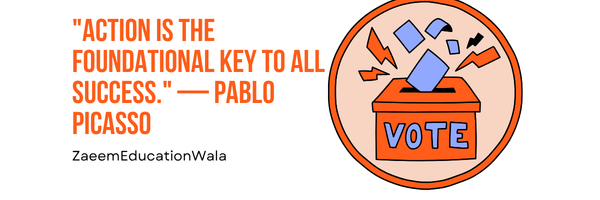
    This graphic combines a powerful quote about taking action with a voting-box illustration. It highlights the connection between personal responsibility, civic participation, and making your voice heard.

    A simple reminder that meaningful change can begin with taking thoughtful, informed action.

    #CivicEducation #Voting #CivicParticipation #TakeAction #InformedCitizen #Education #Awareness #Community #Democracy #LearnAndGrow #ZaeemEducationWala #SocialAwareness
    Day 99 rollno:-006 foundation level 🎨 Canva Post This graphic combines a powerful quote about taking action with a voting-box illustration. It highlights the connection between personal responsibility, civic participation, and making your voice heard. A simple reminder that meaningful change can begin with taking thoughtful, informed action. 💭✨ #CivicEducation #Voting #CivicParticipation #TakeAction #InformedCitizen #Education #Awareness #Community #Democracy #LearnAndGrow #ZaeemEducationWala #SocialAwareness
    0 تبصرے 0 شیئرز 1770 ویوز
  • Today I had an insightful conversation with **Sesame AI** on the topic **“Comparing Various Political Structures and Their Effectiveness.”**

    In this discussion, we explored different political systems such as democracy, monarchy, federal and unitary structures, and how each system works in governing a country. The conversation helped us understand how leadership, citizen participation, accountability, and decision-making influence the effectiveness of a political system.

    It was a great learning experience that deepened my understanding of global political structures and how they shape societies and governance around the world.

    MAYA:23
    ROLL:71
    @highlight
    Rubab EducationWali
    Today I had an insightful conversation with **Sesame AI** on the topic **“Comparing Various Political Structures and Their Effectiveness.”** 🏛️🌍 In this discussion, we explored different political systems such as democracy, monarchy, federal and unitary structures, and how each system works in governing a country. The conversation helped us understand how leadership, citizen participation, accountability, and decision-making influence the effectiveness of a political system. It was a great learning experience that deepened my understanding of global political structures and how they shape societies and governance around the world. 📚✨ MAYA:23 ROLL:71 @highlight Rubab EducationWali
    0 تبصرے 0 شیئرز 1177 ویوز 0
  • 2 People have approached me via Facebook so far who say they have no money to eat, and no job. I am so proud that finally the time of real democracy is here, where even the most common mas HAS THE VOICE to be able to TRY TO DO something for himself, Free Facebook, and whats app will change this country in a way that NO ONE will be able to see how we lived without these things.

    Empower the people around you with a smart phone, and knowledge to use facebook, and let the REAL NEW PAKISTAN Come, where EVERYONE is empowered to change their lives, if they really want to.

    Rehan Allahwala
    2 People have approached me via Facebook so far who say they have no money to eat, and no job. I am so proud that finally the time of real democracy is here, where even the most common mas HAS THE VOICE to be able to TRY TO DO something for himself, Free Facebook, and what's app will change this country in a way that NO ONE will be able to see how we lived without these things. Empower the people around you with a smart phone, and knowledge to use facebook, and let the REAL NEW PAKISTAN Come, where EVERYONE is empowered to change their lives, if they really want to. Rehan Allahwala
    0 تبصرے 0 شیئرز 337 ویوز
  • The millatry industrial complex :(

    WORLD NEWS
    Pakistani Leader Sharif Nears Pact With Military
    Army Presses Sharif to Relinquish Control of Security Affairs, Foreign Policy
    ISLAMABAD—The Pakistani military is close to an agreement with the government in which the prime minister would relinquish control of security affairs and strategic foreign policy, government officials said, amid antigovernment protests that have paralyzed the capital.
    A nearly two-week confrontation between the administration and demonstrators, which the government believes are backed by the military, has put Prime Minister Nawaz Sharif under pressure.
    Government aides said the military has seized on Mr. Sharifs weakened status during the political crisis to strike a deal in which he would leave strategic policy areas—including relations with the U.S., Afghanistan and India—to be controlled by the armed forces.
    The military is now seeking guarantees from the prime minister that he will follow through on the agreement, the aides said. Spokesmen for Mr. Sharif and several government ministries didnt return calls seeking comment. A Pakistani military spokesman didnt respond to requests to comment.
    Since winning an outright majority in Parliament 16 months ago, Mr. Sharif has angered the military establishment with efforts to assert civilian control of the armed forces and decide on policies that were traditionally the domain of the military. The deal with the military would sharply curtail Mr. Sharifs powers, and cast doubt on his ability to make peace with Pakistans rival, India, a top priority for the prime minister.
    "If Nawaz Sharif survives, for the rest of his term, he will be a ceremonial prime minister—the world will not take him seriously," said Ayesha Siddiqa, an analyst based in Islamabad. "A soft coup has already taken place. The question is whether it will harden."
    Thousands of protesters arrived on Aug. 15 in Islamabad, led by Imran Khan, a politician and former cricket star, and Muslim cleric Tahir ul Qadri, demanding the prime ministers resignation. The activists have slept on the streets of the capital since, protesters moving last week in front of the Parliament.

    The armed forces have run Pakistan for half its 67-year history, including a 1999 coup led by then-army chief Pervez Musharraf, which ended Mr. Sharifs last stint as prime minister. Even when not formally in power, the military has traditionally run foreign and internal security policies.
    Government aides said the military has extracted a promise of freedom for Mr. Musharraf, who is being prosecuted by Mr. Sharifs government for treason. That charge, related to Mr. Musharrafs military rule following the 1999 coup, is another major source of tension between the administration and the armed forces. Mr. Musharraf denies the treason charge.
    According to political and security officials, Mr. Sharifs government had secretly agreed to let Mr. Musharraf go abroad after a symbolic indictment over treason, which took place in March, but the government went back on the deal. That eroded trust between the military and Mr. Sharif.
    Government aides said the administration was also willing to let the prime ministers brother, Shahbaz Sharif, step down as chief minister of Punjab province, the countrys most heavily populated region.
    Democracy was restored in Pakistan in 2008, when a government led by Asif Zardari of the Pakistan Peoples Party was elected and ruled until last years elections. Mr. Zardaris government, a weak coalition, had also in its early days tried to push its own foreign and security policies, but it was soon beaten back.
    "Nawaz Sharif thought that he was no Asif Zardari," said Murtaza Solangi, an analyst who had served as head of Radio Pakistan, the state broadcaster, under the Zardari government. "But the military decided that theyll make him an Asif Zardari."
    Mr. Sharifs election victory had also raised hopes of a shift in policy toward Afghanistan and India. Mr. Sharif offered India a trade liberalization deal, and pledged to Kabul that he would end Pakistans interference in Afghanistan.
    But Mr. Sharifs stated aim of making peace with India and the pace at which he started to pursue this goal—seen in Washington as a historic opportunity— riled the military establishment. Mr. Sharifs policy of holding extended peace talks with Pakistani Taliban militants held up the armys plans for an operation against them, sowing further misgivings about the government.
    A government aide said that the personal political ambitions of the protest leaders had been encouraged by a military that wanted to "cut Nawaz Sharif down to size."
    "The script was never to topple the government but weaken it to the point where it was just left hanging, unable to move," said the aide.
    Mr. Khan has called for a government of "technocrats" to be brought in now, but denied that he is acting on behalf of the military.
    "Im doing this for Pakistan, not for myself," Mr. Khan told supporters in a speech Wednesday. "To save our democracy, Im not going from here without Nawaz Sharifs resignation."
    Washington last week put out a statement of support for the administration, saying: "We support the constitutional and electoral process in Pakistan, which produced the Prime Minister of Nawaz Sharif."

    The millatry industrial complex :( WORLD NEWS Pakistani Leader Sharif Nears Pact With Military Army Presses Sharif to Relinquish Control of Security Affairs, Foreign Policy ISLAMABAD—The Pakistani military is close to an agreement with the government in which the prime minister would relinquish control of security affairs and strategic foreign policy, government officials said, amid antigovernment protests that have paralyzed the capital. A nearly two-week confrontation between the administration and demonstrators, which the government believes are backed by the military, has put Prime Minister Nawaz Sharif under pressure. Government aides said the military has seized on Mr. Sharif's weakened status during the political crisis to strike a deal in which he would leave strategic policy areas—including relations with the U.S., Afghanistan and India—to be controlled by the armed forces. The military is now seeking guarantees from the prime minister that he will follow through on the agreement, the aides said. Spokesmen for Mr. Sharif and several government ministries didn't return calls seeking comment. A Pakistani military spokesman didn't respond to requests to comment. Since winning an outright majority in Parliament 16 months ago, Mr. Sharif has angered the military establishment with efforts to assert civilian control of the armed forces and decide on policies that were traditionally the domain of the military. The deal with the military would sharply curtail Mr. Sharif's powers, and cast doubt on his ability to make peace with Pakistan's rival, India, a top priority for the prime minister. "If Nawaz Sharif survives, for the rest of his term, he will be a ceremonial prime minister—the world will not take him seriously," said Ayesha Siddiqa, an analyst based in Islamabad. "A soft coup has already taken place. The question is whether it will harden." Thousands of protesters arrived on Aug. 15 in Islamabad, led by Imran Khan, a politician and former cricket star, and Muslim cleric Tahir ul Qadri, demanding the prime minister's resignation. The activists have slept on the streets of the capital since, protesters moving last week in front of the Parliament. The armed forces have run Pakistan for half its 67-year history, including a 1999 coup led by then-army chief Pervez Musharraf, which ended Mr. Sharif's last stint as prime minister. Even when not formally in power, the military has traditionally run foreign and internal security policies. Government aides said the military has extracted a promise of freedom for Mr. Musharraf, who is being prosecuted by Mr. Sharif's government for treason. That charge, related to Mr. Musharraf's military rule following the 1999 coup, is another major source of tension between the administration and the armed forces. Mr. Musharraf denies the treason charge. According to political and security officials, Mr. Sharif's government had secretly agreed to let Mr. Musharraf go abroad after a symbolic indictment over treason, which took place in March, but the government went back on the deal. That eroded trust between the military and Mr. Sharif. Government aides said the administration was also willing to let the prime minister's brother, Shahbaz Sharif, step down as chief minister of Punjab province, the country's most heavily populated region. Democracy was restored in Pakistan in 2008, when a government led by Asif Zardari of the Pakistan Peoples Party was elected and ruled until last year's elections. Mr. Zardari's government, a weak coalition, had also in its early days tried to push its own foreign and security policies, but it was soon beaten back. "Nawaz Sharif thought that he was no Asif Zardari," said Murtaza Solangi, an analyst who had served as head of Radio Pakistan, the state broadcaster, under the Zardari government. "But the military decided that they'll make him an Asif Zardari." Mr. Sharif's election victory had also raised hopes of a shift in policy toward Afghanistan and India. Mr. Sharif offered India a trade liberalization deal, and pledged to Kabul that he would end Pakistan's interference in Afghanistan. But Mr. Sharif's stated aim of making peace with India and the pace at which he started to pursue this goal—seen in Washington as a historic opportunity— riled the military establishment. Mr. Sharif's policy of holding extended peace talks with Pakistani Taliban militants held up the army's plans for an operation against them, sowing further misgivings about the government. A government aide said that the personal political ambitions of the protest leaders had been encouraged by a military that wanted to "cut Nawaz Sharif down to size." "The script was never to topple the government but weaken it to the point where it was just left hanging, unable to move," said the aide. Mr. Khan has called for a government of "technocrats" to be brought in now, but denied that he is acting on behalf of the military. "I'm doing this for Pakistan, not for myself," Mr. Khan told supporters in a speech Wednesday. "To save our democracy, I'm not going from here without Nawaz Sharif's resignation." Washington last week put out a statement of support for the administration, saying: "We support the constitutional and electoral process in Pakistan, which produced the Prime Minister of Nawaz Sharif."

    0 تبصرے 0 شیئرز 6437 ویوز
  • Beautiful Thoughts of Asun Agulló

    MY people is the people who believe in democracy, western values: equality before the law, equality between genders, State of Law, FREEDOM

    That is my people and that is my religion.

    What is YOUR religion ?

    Asun Agulló
    Beautiful Thoughts of Asun Agulló MY people is the people who believe in democracy, western values: equality before the law, equality between genders, State of Law, FREEDOM That is my people and that is my religion. What is YOUR religion ? Asun Agulló
    0 تبصرے 0 شیئرز 710 ویوز
  • The world needs UBER of Politics and Governance.

    The younger generation globally is rising above from being left wing, right wing, pro-democracy, or dictatorship, kingship etc neither supporting judicial system that protects elite and punishes the poor alone. Any New IDEA that disrupts this current system, produces pro-humanity based outcomes, automates procedures, will surely be revolutionizing how we live today massively.

    Via Inciting Insights with Mohsin M. Siddique
    The world needs UBER of Politics and Governance. The younger generation globally is rising above from being left wing, right wing, pro-democracy, or dictatorship, kingship etc neither supporting judicial system that protects elite and punishes the poor alone. Any New IDEA that disrupts this current system, produces pro-humanity based outcomes, automates procedures, will surely be revolutionizing how we live today massively. Via Inciting Insights with Mohsin M. Siddique
    0 تبصرے 0 شیئرز 495 ویوز
  • Christopher Mark Wingate writes the following, do you agree ?

    Pakistan has various deep state problems. First the Durand Line encircling and isolating the Pashtun people, then the Baloch takeover, then religious fundamentalists chasing political power in the name of God and demanding their way or else- and of course the endless cheap for sale politicians and militant proxies after any dollars in their pockets making them puppet sluts to hidden powers. And sitting on the fence of all that are the military and the ISI like eagles looking for movement, ready to pounce. Aside from all those issues, most of the people of Pakistan are wonderful yet sadly caught up in all that ****. Only one answer will solve it- no religion in politics- new employment laws to control political and judicial conduct overseen by a jury of qualified independent peers so that the people can hold those in power to account. Democracy has flaws in its design and the brightest corporate boys operate in hunting packs. Using the flaws they manipulate everything from public policy think tanks, favourable legislation, government contracts, intelligence targeting, military engagement, and financial advantage- same problem all over the world. We don’t have real democracy; what we have is a system of government where our politicians are either puppets for others or greedy fucks in it for themselves. Think of power as a pyramid with those at the very top wielding almost total global power, even in countries portrayed in the media as enemies. Money and power is people’s god.
    Christopher Mark Wingate writes the following, do you agree ? Pakistan has various 'deep state' problems. First the Durand Line encircling and isolating the Pashtun people, then the Baloch takeover, then religious fundamentalists chasing political power in the name of God and demanding their way or else- and of course the endless cheap for sale politicians and militant proxies after any dollars in their pockets making them puppet sluts to hidden powers. And sitting on the fence of all that are the military and the ISI like eagles looking for movement, ready to pounce. Aside from all those issues, most of the people of Pakistan are wonderful yet sadly caught up in all that shit. Only one answer will solve it- no religion in politics- new employment laws to control political and judicial conduct overseen by a jury of qualified independent peers so that the people can hold those in power to account. Democracy has flaws in its design and the brightest corporate boys operate in hunting packs. Using the flaws they manipulate everything from public policy think tanks, favourable legislation, government contracts, intelligence targeting, military engagement, and financial advantage- same problem all over the world. We don’t have real democracy; what we have is a system of government where our politicians are either puppets for others or greedy fucks in it for themselves. Think of power as a pyramid with those at the very top wielding almost total global power, even in countries portrayed in the media as enemies. Money and power is people’s god.
    0 تبصرے 0 شیئرز 751 ویوز
  • From Sapiens: A Brief History of Humankind by Yuval Noah Harari

    "Next, British, French and German scholars wedded the linguistic theory about the industrious Aryans to Darwin’s theory of natural selection and posited that the Aryans were not just a linguistic group but a biological entity – a race. And not just any race, but a master race of tall, light-haired, blue-eyed, hard-working, and super-rational humans who emerged from the mists of the north to lay the foundations of culture throughout the world. Regrettably, the Aryans who invaded India and Persia intermarried with the local natives they found in these lands, losing their light complexions and blond hair, and with them their rationality and diligence. The civilizations of India and Persia consequently declined. In Europe, on the other hand, the Aryans preserved their racial purity. This is why Europeans had managed to conquer the world, and why they were to rule it – provided they took precautions not to mix with inferior races.

    Such racist theories, prominent and respectable for many decades, have become anathema among scientists and politicians alike. People continue to conduct a heroic struggle against racism without noticing that the battlefront has shifted, and that the place of racism in imperial ideology has now been replaced by ‘culturism’. There is no such word, but it’s about time we coined it. Among today’s elites, assertions about the contrasting merits of diverse human groups are almost always couched in terms of historical differences between cultures rather than biological differences between races. We no longer say, ‘It’s in their blood.’ We say, ‘It’s in their culture.’ Thus European right-wing parties which oppose Muslim immigration usually take care to avoid racial terminology. Marine le Pen’s speechwriters would have been shown the door on the spot had they suggested that the leader of the Front National go on television to declare that, ‘We don’t want those inferior Semites to dilute our Aryan blood and spoil our Aryan civilization.’ Instead, the French Front National, the Dutch Party for Freedom, the Alliance for the Future of Austria and their like tend to argue that Western culture, as it has evolved in Europe, is characterized by democratic values, tolerance and gender equality, whereas Muslim culture, which evolved in the Middle East, is characterized by hierarchical politics, fanaticism and misogyny. Since the two cultures are so different, and since many Muslim immigrants are unwilling (and perhaps unable) to adopt Western values, they should not be allowed to enter, lest they foment internal conflicts and corrode European democracy and liberalism."
    From Sapiens: A Brief History of Humankind by Yuval Noah Harari "Next, British, French and German scholars wedded the linguistic theory about the industrious Aryans to Darwin’s theory of natural selection and posited that the Aryans were not just a linguistic group but a biological entity – a race. And not just any race, but a master race of tall, light-haired, blue-eyed, hard-working, and super-rational humans who emerged from the mists of the north to lay the foundations of culture throughout the world. Regrettably, the Aryans who invaded India and Persia intermarried with the local natives they found in these lands, losing their light complexions and blond hair, and with them their rationality and diligence. The civilizations of India and Persia consequently declined. In Europe, on the other hand, the Aryans preserved their racial purity. This is why Europeans had managed to conquer the world, and why they were to rule it – provided they took precautions not to mix with inferior races. Such racist theories, prominent and respectable for many decades, have become anathema among scientists and politicians alike. People continue to conduct a heroic struggle against racism without noticing that the battlefront has shifted, and that the place of racism in imperial ideology has now been replaced by ‘culturism’. There is no such word, but it’s about time we coined it. Among today’s elites, assertions about the contrasting merits of diverse human groups are almost always couched in terms of historical differences between cultures rather than biological differences between races. We no longer say, ‘It’s in their blood.’ We say, ‘It’s in their culture.’ Thus European right-wing parties which oppose Muslim immigration usually take care to avoid racial terminology. Marine le Pen’s speechwriters would have been shown the door on the spot had they suggested that the leader of the Front National go on television to declare that, ‘We don’t want those inferior Semites to dilute our Aryan blood and spoil our Aryan civilization.’ Instead, the French Front National, the Dutch Party for Freedom, the Alliance for the Future of Austria and their like tend to argue that Western culture, as it has evolved in Europe, is characterized by democratic values, tolerance and gender equality, whereas Muslim culture, which evolved in the Middle East, is characterized by hierarchical politics, fanaticism and misogyny. Since the two cultures are so different, and since many Muslim immigrants are unwilling (and perhaps unable) to adopt Western values, they should not be allowed to enter, lest they foment internal conflicts and corrode European democracy and liberalism."
    0 تبصرے 0 شیئرز 2107 ویوز
  • Democracy in Pakistan is coming ! You should also run for elections if you don’t like the people who govern you if you can do a better job !
    Democracy in Pakistan is coming ! You should also run for elections if you don’t like the people who govern you if you can do a better job !
    0 تبصرے 0 شیئرز 408 ویوز
  • *Press Release*
    *Pakistan India Peoples’ Forum for Peace and Democracy (India)*

    PIPFPD (India) Office: F-10/12, Malviya Nagar, New Delhi

    Email- pipfpd.india@gmail.com | Phone- 011-26680883

    Mobile- +91-9582452343/ +91-9868165471

    PIPFPD welcomes Imran Khan’s invitation to dialogu and urges Indian government to respond positively

    New Delhi, 2nd August 2018 – We, the members of Pakistan-India Peoples’ Forum for Peace and Democracy (India Chapter), welcome the statement of Pakistan’s newly elected Prime Minister to be, Mr. Imran Khan that his government would “want to improve our relations with India”. He rightly points out the pointlessness of the “blame game that whatever goes wrong in Pakistan’s Baluchistan is because of India and vice versa”, in his statement. Mr. Khan has added that this attitude has stood in the way of meaningful dialogue. He has made it clear that he would like the leaders of India and Pakistan to resolve all disputes, including the “core issue” of Kashmir, through talks, that the blame game between the two neighbours, detrimental to the subcontinent, should stop.

    This statement is significant particularly in the context that India and Pakistan relationship has reached its all-time low in recent years with no bilateral talks taking place. Violations of the ceasefire agreement of 2003 between the two countries in the Jammu and Kashmir region, has caused immense sufferings to the residents of the border region in both the countries.

    The failure of both countries to systematically assess the causes of cease fire violations has resulted in both governments adopting policies that have been unsuccessful in curtailing recurrent violations. Ceasefire violations have the potential to not only spark bilateral crises but also escalate any ongoing crisis, especially in the aftermath of terror incidents.

    We have also seen that the 2003 Ceasefire Agreement tends to hold when a dialogue process is under way between India and Pakistan on key disputes, and all local factors seeming to have little or no influence under such a positive environment. Indian Government must engage with the newly elected Government of Pakistan to assure return to normalcy and positive engagement.

    The importance of resumption of dialogue between India and Pakistan cannot be overemphasized. It is an absolute necessity for the normalization of relationship between India and Pakistan. We urge the Government of India to respond positively to Pakistan’s Prime Minister designate, Mr. Imran Khan’s invitation to dialogue for resolving all disputes.

    We believe a positive response will ease out the current negative visa and trade regime and will also save the miserable lives of hundreds of fishworkers and other prisoners, in each other’s prisons. An unconditional and open dialogue, is the way forward.

    Tapan. K Bose & Syeda Hameed
    Co-Chairpersons, PIPFPD (India Chapter) Vijayan M J
    General Secretary Bhargavi Dilipkumar Executive Secretary
    *Press Release* *Pakistan India Peoples’ Forum for Peace and Democracy (India)* PIPFPD (India) Office: F-10/12, Malviya Nagar, New Delhi Email- pipfpd.india@gmail.com | Phone- 011-26680883 Mobile- +91-9582452343/ +91-9868165471 PIPFPD welcomes Imran Khan’s invitation to dialogu and urges Indian government to respond positively New Delhi, 2nd August 2018 – We, the members of Pakistan-India Peoples’ Forum for Peace and Democracy (India Chapter), welcome the statement of Pakistan’s newly elected Prime Minister to be, Mr. Imran Khan that his government would “want to improve our relations with India”. He rightly points out the pointlessness of the “blame game that whatever goes wrong in Pakistan’s Baluchistan is because of India and vice versa”, in his statement. Mr. Khan has added that this attitude has stood in the way of meaningful dialogue. He has made it clear that he would like the leaders of India and Pakistan to resolve all disputes, including the “core issue” of Kashmir, through talks, that the blame game between the two neighbours, detrimental to the subcontinent, should stop. This statement is significant particularly in the context that India and Pakistan relationship has reached its all-time low in recent years with no bilateral talks taking place. Violations of the ceasefire agreement of 2003 between the two countries in the Jammu and Kashmir region, has caused immense sufferings to the residents of the border region in both the countries. The failure of both countries to systematically assess the causes of cease fire violations has resulted in both governments adopting policies that have been unsuccessful in curtailing recurrent violations. Ceasefire violations have the potential to not only spark bilateral crises but also escalate any ongoing crisis, especially in the aftermath of terror incidents. We have also seen that the 2003 Ceasefire Agreement tends to hold when a dialogue process is under way between India and Pakistan on key disputes, and all local factors seeming to have little or no influence under such a positive environment. Indian Government must engage with the newly elected Government of Pakistan to assure return to normalcy and positive engagement. The importance of resumption of dialogue between India and Pakistan cannot be overemphasized. It is an absolute necessity for the normalization of relationship between India and Pakistan. We urge the Government of India to respond positively to Pakistan’s Prime Minister designate, Mr. Imran Khan’s invitation to dialogue for resolving all disputes. We believe a positive response will ease out the current negative visa and trade regime and will also save the miserable lives of hundreds of fishworkers and other prisoners, in each other’s prisons. An unconditional and open dialogue, is the way forward. Tapan. K Bose & Syeda Hameed Co-Chairpersons, PIPFPD (India Chapter) Vijayan M J General Secretary Bhargavi Dilipkumar Executive Secretary
    0 تبصرے 0 شیئرز 1093 ویوز
More Results