



#rsisb
Roll no.279
story post no.9
Foundation Level
**Periodic Table: The Language of Science**
Long ago, scientists discovered many different elements, but there was a problem. They needed a way to organize these elements so they could understand their properties and relationships.
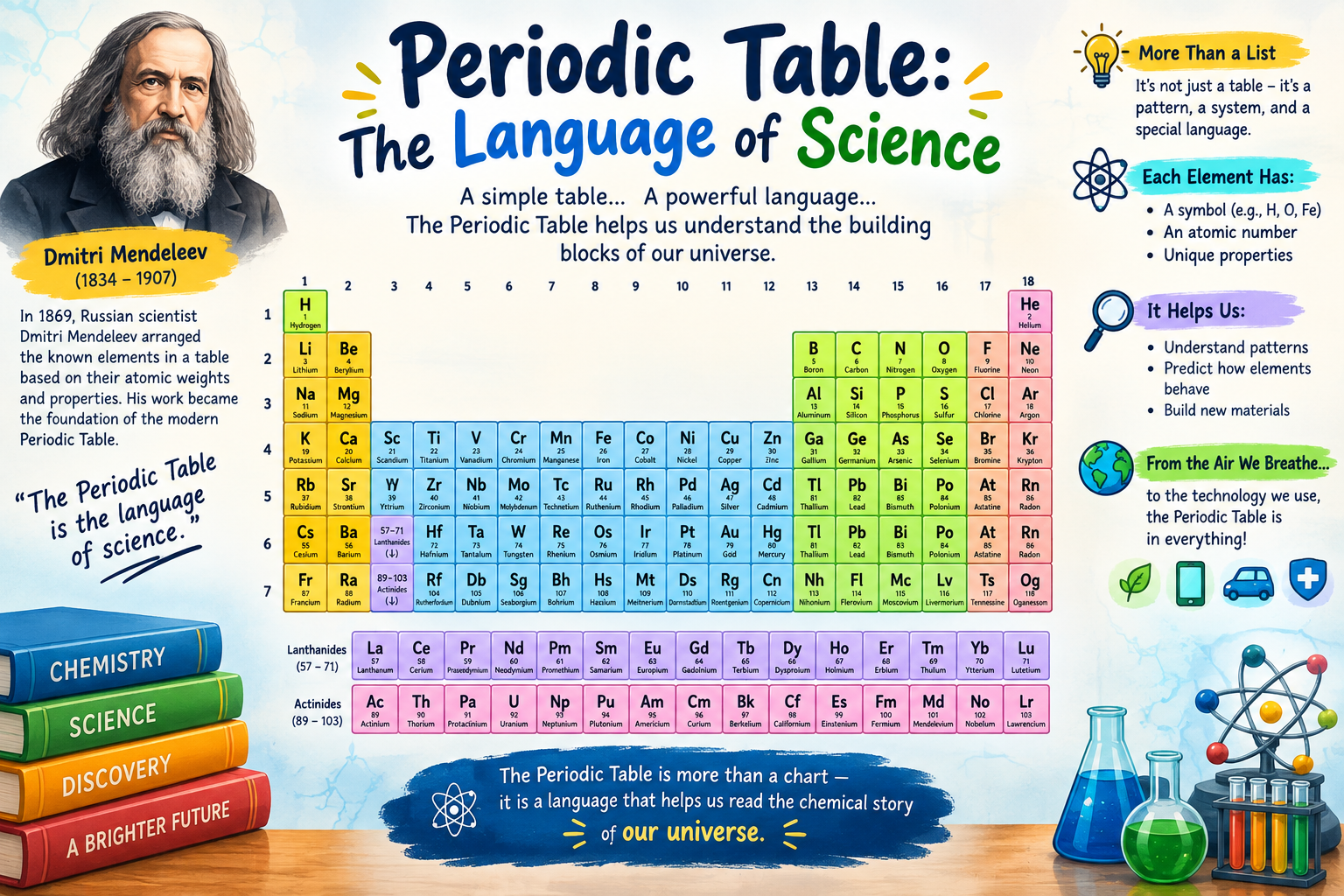
Then came a brilliant idea! In 1869, Russian scientist **Dmitri Mendeleev** arranged the known elements in a table based mainly on their atomic weights and properties. His work became the foundation of the modern **Periodic Table**.
The table was not just a list of elements—it was like a special language. Each element had its own symbol, atomic number, and unique characteristics. For example, **H** represents hydrogen, **O** represents oxygen, and **Fe** represents iron.
As scientists discovered more elements, the Periodic Table continued to grow. Today, it helps us understand patterns in elements and predict how they may behave in chemical reactions.
Imagine the Periodic Table as a giant map of the building blocks of our universe. Every box tells a story about an element, and together they help explain everything from the air we breathe to the materials used in technology .
From the classroom to laboratories around the world, the Periodic Table remains one of chemistry’s most important tools. It reminds us that science is about discovering patterns, asking questions, and understanding the world around us.
**The Periodic Table is more than a chart—it is a language that helps us read the chemical story of our universe.**
#PeriodicTable #Chemistry #Science #Elements #DmitriMendeleev #ScienceEducation #ChemistryLearning #STEM #Knowledge #LearningIsFun
Asma Shaheen EducationWali
Saima Happinesswali
Irum Asim
Roll no.279
story post no.9
Foundation Level
**Periodic Table: The Language of Science**
Long ago, scientists discovered many different elements, but there was a problem. They needed a way to organize these elements so they could understand their properties and relationships.
Then came a brilliant idea! In 1869, Russian scientist **Dmitri Mendeleev** arranged the known elements in a table based mainly on their atomic weights and properties. His work became the foundation of the modern **Periodic Table**.
The table was not just a list of elements—it was like a special language. Each element had its own symbol, atomic number, and unique characteristics. For example, **H** represents hydrogen, **O** represents oxygen, and **Fe** represents iron.
As scientists discovered more elements, the Periodic Table continued to grow. Today, it helps us understand patterns in elements and predict how they may behave in chemical reactions.
Imagine the Periodic Table as a giant map of the building blocks of our universe. Every box tells a story about an element, and together they help explain everything from the air we breathe to the materials used in technology .
From the classroom to laboratories around the world, the Periodic Table remains one of chemistry’s most important tools. It reminds us that science is about discovering patterns, asking questions, and understanding the world around us.
**The Periodic Table is more than a chart—it is a language that helps us read the chemical story of our universe.**
#PeriodicTable #Chemistry #Science #Elements #DmitriMendeleev #ScienceEducation #ChemistryLearning #STEM #Knowledge #LearningIsFun
Asma Shaheen EducationWali
Saima Happinesswali
Irum Asim
#rsisb
Roll no.279
story post no.9
Foundation Level
🧪 **Periodic Table: The Language of Science** 🌍✨
Long ago, scientists discovered many different elements, but there was a problem. 🤔 They needed a way to organize these elements so they could understand their properties and relationships.
Then came a brilliant idea! 💡 In 1869, Russian scientist **Dmitri Mendeleev** arranged the known elements in a table based mainly on their atomic weights and properties. 🧑🔬📚 His work became the foundation of the modern **Periodic Table**.
The table was not just a list of elements—it was like a special language. 🔤🧪 Each element had its own symbol, atomic number, and unique characteristics. For example, **H** represents hydrogen, **O** represents oxygen, and **Fe** represents iron. ⚛️✨
As scientists discovered more elements, the Periodic Table continued to grow. 🔬🌟 Today, it helps us understand patterns in elements and predict how they may behave in chemical reactions.
Imagine the Periodic Table as a giant map of the building blocks of our universe. 🗺️🌌 Every box tells a story about an element, and together they help explain everything from the air we breathe 🌬️ to the materials used in technology 📱💻.
From the classroom to laboratories around the world, the Periodic Table remains one of chemistry’s most important tools. 🧪🏆 It reminds us that science is about discovering patterns, asking questions, and understanding the world around us. 🌍🔍✨
**The Periodic Table is more than a chart—it is a language that helps us read the chemical story of our universe.** ⚛️📖🌟
#PeriodicTable #Chemistry #Science #Elements #DmitriMendeleev #ScienceEducation #ChemistryLearning #STEM #Knowledge #LearningIsFun 🧪🔬⚛️🌍📚
Asma Shaheen EducationWali
Saima Happinesswali
Irum Asim
0 Comments
0 Shares
544 Views