


• #rsisb
    Roll No 253
    Foundation Level
    Story Post 23

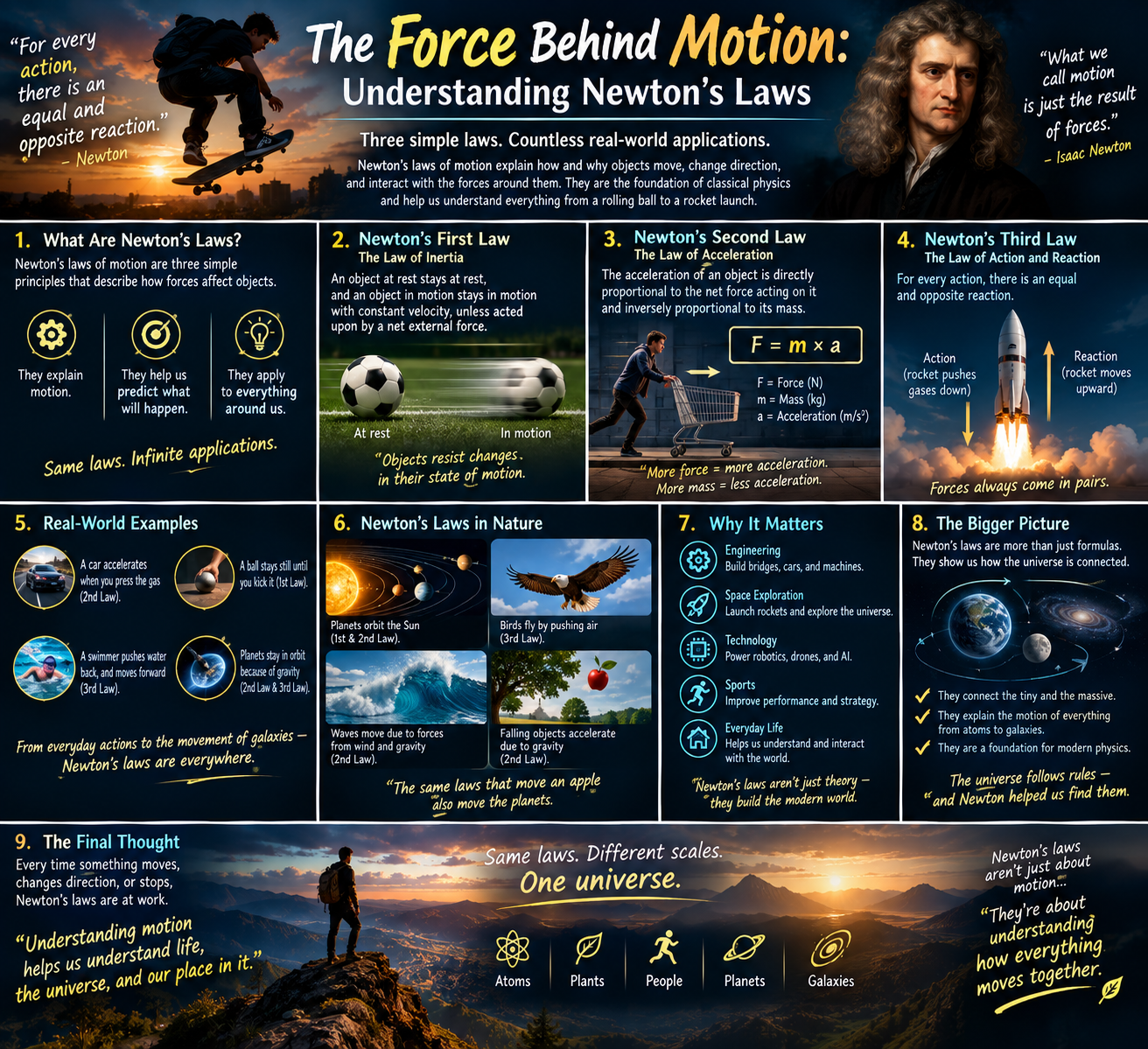
    # The Force Behind Motion: Understanding Newton’s Laws

    Imagine watching a football fly through the air , a car accelerate down a road , a rocket launch into space , or planets orbiting a star .

    These events may appear completely different—but beneath them is the same fundamental idea:

    ## **Forces control motion.**

    More than three centuries ago, **Isaac Newton** developed three laws that transformed our understanding of how objects move and interact. These laws became the foundation of classical mechanics and remain essential to physics, engineering, astronomy, and countless technologies today.

    ---

    # 1. What Are Newton's Laws?

    Newton's three laws describe the relationship between:

    **Force**
    **Mass**
    **Acceleration**
    **Motion**

    Together, they help us explain why objects remain still, why they accelerate, and how forces interact.

    From a rolling ball to a spacecraft , the same fundamental principles apply.

    ### **Three simple laws. Infinite applications.**

    ---

    # 2. Newton's First Law — The Law of Inertia

    Newton's First Law states that an object at rest remains at rest, while an object in motion continues moving at constant velocity unless acted upon by a net external force.

    This property is called **inertia**.

    Imagine a football sitting on the ground.

    It stays there until you kick it.

    Once moving, it won't naturally change its motion unless another force acts on it—such as friction, air resistance, or another object.

    A car requires braking to stop.
    A ball slows because of friction.
    Objects in space can continue moving with very little resistance.

    ### **Objects resist changes in their state of motion.**

    ---

    # 3. Newton's Second Law — The Law of Acceleration

    The second law explains how force changes motion.

    Its famous equation is:

    # **F = m × a**

    Where:

    **F** = Force
    **m** = Mass
    **a** = Acceleration

    This means that increasing the net force on an object generally increases its acceleration, while increasing the object's mass makes the same force produce less acceleration.

    Imagine pushing an empty shopping cart .

    It accelerates easily.

    Now fill it with heavy objects.

    The same push produces less acceleration.

    ### **More net force → more acceleration.**

    ### **More mass → less acceleration for the same force.**

    This simple relationship powers everything from vehicle design to rocket engineering .

    ---

    # 4. Newton's Third Law — Action and Reaction

    Newton's Third Law states:

    ### **For every action, there is an equal and opposite reaction.**

    Forces always occur through interactions between objects.

    Consider a rocket.

    The engine pushes hot gases downward and backward.

    The gases exert an equal and opposite force on the rocket, pushing it upward.

    The same principle appears everywhere:

    A swimmer pushes water backward → the water pushes the swimmer forward.
    A bird pushes air downward → the air helps push the bird upward.
    You push the ground backward → the ground pushes you forward.

    ### **Forces come in pairs.**

    ---

    # 5. Newton's Laws in Everyday Life

    You don't need a laboratory to see Newton's laws.

    They are happening around you constantly.

    **Cars:** Engine force changes speed and direction.
    **Sports:** Kicking a ball changes its motion.
    **Swimming:** Pushing water creates forward motion.
    **Cycling:** Pedaling produces forces that accelerate the bicycle.
    **Falling objects:** Gravity changes their motion.
    **Skateboards:** Pushing against the ground creates movement.

    Everyday motion is essentially a continuous interaction between forces.

    ---

    # 6. Newton's Laws in Nature

    Newton's laws don't stop at Earth.

    They also help describe motion throughout the universe.

    Planets orbit stars.
    Moons orbit planets.
    Comets travel through space.
    Waves respond to forces.
    Birds generate lift through interactions with air.
    Objects accelerate under gravity.

    The same physics that explains a falling apple can help describe the motion of enormous celestial bodies.

    ### **From apples to planets, the same laws operate across nature.**

    ---

    # 7. Why Newton's Laws Matter

    Newton's laws are more than equations in a textbook.

    They are essential tools for understanding and designing the physical world.

    **Engineering** — bridges, buildings, vehicles, and machines
    **Space exploration** — rockets, spacecraft, and orbital motion
    **Technology** — robots, drones, and automated systems
    **Sports science** — movement, speed, and performance
    **Transportation** — cars, aircraft, and trains

    Modern technology depends heavily on our ability to predict how forces produce motion.

    ---

    # 8. The Bigger Picture

    Newton's laws reveal something remarkable:

    The universe is not simply a collection of random movements.

    Objects interact through measurable forces.

    From microscopic particles to massive planets and galaxies , physics provides mathematical relationships that help us understand motion.

    The scale may change.

    The objects may change.

    But the underlying principles remain incredibly powerful.

    ### **Tiny or massive. Fast or slow. Earth or space. Motion follows physical laws.**

    ---

    # 9. The Final Thought

    Every time something moves…

    Every time something accelerates…

    Every time something changes direction…

    **Newton's laws are there.**

    A skateboard rolling down a street
    A bird taking flight
    A rocket leaving Earth
    A planet orbiting the Sun

    Different events.

    Different scales.

    One underlying framework.

    ## **Same laws. Different scales. One universe.**

    Understanding motion isn't just about solving equations.

    It's about understanding **how the physical world moves, interacts, and holds together.**

    ### **Once you understand the forces behind motion, the world around you begins to move in a whole new way.**


    Asma Shaheen EducationWali
    Saima Empowerment Wali
    Mishaal TrainingWali
    #rsisb Roll No 253 Foundation Level Story Post 23 # ⚡🌌 The Force Behind Motion: Understanding Newton’s Laws Imagine watching a football fly through the air ⚽, a car accelerate down a road 🚗💨, a rocket launch into space 🚀, or planets orbiting a star 🪐✨. These events may appear completely different—but beneath them is the same fundamental idea: ## **Forces control motion.** ⚡🧲 More than three centuries ago, **Isaac Newton** developed three laws that transformed our understanding of how objects move and interact. These laws became the foundation of classical mechanics and remain essential to physics, engineering, astronomy, and countless technologies today. 🔬⚙️🌍 --- # 🧠⚡ 1. What Are Newton's Laws? Newton's three laws describe the relationship between: ⚡ **Force** 🧱 **Mass** 💨 **Acceleration** 🏃 **Motion** Together, they help us explain why objects remain still, why they accelerate, and how forces interact. From a rolling ball 🎾 to a spacecraft 🚀, the same fundamental principles apply. ### **Three simple laws. Infinite applications.** 🌌 --- # 🛑➡️ 2. Newton's First Law — The Law of Inertia Newton's First Law states that an object at rest remains at rest, while an object in motion continues moving at constant velocity unless acted upon by a net external force. This property is called **inertia**. 🧱⚡ Imagine a football sitting on the ground. ⚽ It stays there until you kick it. Once moving, it won't naturally change its motion unless another force acts on it—such as friction, air resistance, or another object. 🚗 A car requires braking to stop. ⚽ A ball slows because of friction. 🛰️ Objects in space can continue moving with very little resistance. ### **Objects resist changes in their state of motion.** --- # 💨⚙️ 3. Newton's Second Law — The Law of Acceleration The second law explains how force changes motion. Its famous equation is: # **F = m × a** ⚡ Where: **F** = Force 🧲 **m** = Mass ⚖️ **a** = Acceleration 💨 This means that increasing the net force on an object generally increases its acceleration, while increasing the object's mass makes the same force produce less acceleration. Imagine pushing an empty shopping cart 🛒. It accelerates easily. Now fill it with heavy objects. The same push produces less acceleration. ### **More net force → more acceleration.** ### **More mass → less acceleration for the same force.** This simple relationship powers everything from vehicle design 🚗 to rocket engineering 🚀. --- # 🚀🔥 4. Newton's Third Law — Action and Reaction Newton's Third Law states: ### **For every action, there is an equal and opposite reaction.** ⚡ Forces always occur through interactions between objects. Consider a rocket. 🚀 The engine pushes hot gases downward and backward. The gases exert an equal and opposite force on the rocket, pushing it upward. ⬆️🔥 The same principle appears everywhere: 🏊 A swimmer pushes water backward → the water pushes the swimmer forward. 🦅 A bird pushes air downward → the air helps push the bird upward. 🚶 You push the ground backward → the ground pushes you forward. ### **Forces come in pairs.** 🔗⚡ --- # 🌍⚽ 5. Newton's Laws in Everyday Life You don't need a laboratory to see Newton's laws. They are happening around you constantly. 🚗 **Cars:** Engine force changes speed and direction. ⚽ **Sports:** Kicking a ball changes its motion. 🏊 **Swimming:** Pushing water creates forward motion. 🚲 **Cycling:** Pedaling produces forces that accelerate the bicycle. 🍎 **Falling objects:** Gravity changes their motion. 🛹 **Skateboards:** Pushing against the ground creates movement. Everyday motion is essentially a continuous interaction between forces. --- # 🌌🪐 6. Newton's Laws in Nature Newton's laws don't stop at Earth. They also help describe motion throughout the universe. 🌌 🪐 Planets orbit stars. 🌙 Moons orbit planets. ☄️ Comets travel through space. 🌊 Waves respond to forces. 🦅 Birds generate lift through interactions with air. 🍎 Objects accelerate under gravity. The same physics that explains a falling apple can help describe the motion of enormous celestial bodies. ### **From apples to planets, the same laws operate across nature.** 🍎➡️🪐 --- # ⚙️🚀 7. Why Newton's Laws Matter Newton's laws are more than equations in a textbook. They are essential tools for understanding and designing the physical world. 🏗️ **Engineering** — bridges, buildings, vehicles, and machines 🚀 **Space exploration** — rockets, spacecraft, and orbital motion 🤖 **Technology** — robots, drones, and automated systems 🏃 **Sports science** — movement, speed, and performance 🚗 **Transportation** — cars, aircraft, and trains Modern technology depends heavily on our ability to predict how forces produce motion. --- # 🌌🔭 8. The Bigger Picture Newton's laws reveal something remarkable: The universe is not simply a collection of random movements. Objects interact through measurable forces. ⚛️🧲 From microscopic particles 🔬 to massive planets 🪐 and galaxies 🌌, physics provides mathematical relationships that help us understand motion. The scale may change. The objects may change. But the underlying principles remain incredibly powerful. ### **Tiny or massive. Fast or slow. Earth or space. Motion follows physical laws.** ⚡🌍🌌 --- # 🌅⚡ 9. The Final Thought Every time something moves… Every time something accelerates… Every time something changes direction… **Newton's laws are there.** 🧠⚡ A skateboard rolling down a street 🛹 A bird taking flight 🦅 A rocket leaving Earth 🚀 A planet orbiting the Sun ☀️🪐 Different events. Different scales. One underlying framework. ## 🌌 **Same laws. Different scales. One universe.** Understanding motion isn't just about solving equations. It's about understanding **how the physical world moves, interacts, and holds together.** ⚛️🌍✨ ### **Once you understand the forces behind motion, the world around you begins to move in a whole new way.** ⚡🔬🌌 Asma Shaheen EducationWali Saima Empowerment Wali Mishaal TrainingWali
    0 Comentários 0 Compartilhamentos 5403 Visualizações
  • This is a group for Hobbyists and Electronics students who wish to make their own toy drones, and for who owns there own photography drones.

    Know anyone who is interested ? Join it

    https://www.facebook.com/groups/DroneClubPakistan/members/
    This is a group for Hobbyists and Electronics students who wish to make their own toy drones, and for who owns there own photography drones. Know anyone who is interested ? Join it https://www.facebook.com/groups/DroneClubPakistan/members/
    0 Comentários 0 Compartilhamentos 1252 Visualizações
  • Soon you will be able to broadcast to facebook via standard cameras, laptops , drones and will be able to watch global tv channels via facebook live
    Soon you will be able to broadcast to facebook via standard cameras, laptops , drones and will be able to watch global tv channels via facebook live
    0 Comentários 0 Compartilhamentos 206 Visualizações
  • I hope Pakistan drones same soon
    I hope Pakistan drones same soon
    0 Comentários 0 Compartilhamentos 178 Visualizações
  • Interested in Drones ? Join the club

    https://web.facebook.com/groups/160497330985709/
    Interested in Drones ? Join the club https://web.facebook.com/groups/160497330985709/
    0 Comentários 0 Compartilhamentos 187 Visualizações
  • No matter how many trees we plant, we have to use technology to plant trees, I strongly urge students to study tree planting drones and start working on them as your projects !
    No matter how many trees we plant, we have to use technology to plant trees, I strongly urge students to study tree planting drones and start working on them as your projects !
    0 Comentários 0 Compartilhamentos 551 Visualizações
  • The world is built upon 3 things:
    1. The things we know - these make up our values, our believes, our strengths, our weaknesses and our insecurities.

    2. The thing we know we dont know - these make up the things we worry about, the things that make us work, plan, investigate, build and innovate.

    3. The things we dont know that we dont know - these are our fears, our bias, our inability to accept other opinion other than our own. This is the place where people say: "there are smarter people handling this, Ill let them decide for me". This is where governments become radical, where charismatic preachers turn people into mindless drones.

    The objective of the 3 is to allow people to ascend issues from number 3 to number 1. People need to learn, read, explore, travel, experience and most importantly - keep asking questions.

    When ask questions you can start talking instead of fighting.
    The world is built upon 3 things: 1. The things we know - these make up our values, our believes, our strengths, our weaknesses and our insecurities. 2. The thing we know we don't know - these make up the things we worry about, the things that make us work, plan, investigate, build and innovate. 3. The things we don't know that we don't know - these are our fears, our bias, our inability to accept other opinion other than our own. This is the place where people say: "there are smarter people handling this, I'll let them decide for me". This is where governments become radical, where charismatic preachers turn people into mindless drones. The objective of the 3 is to allow people to ascend issues from number 3 to number 1. People need to learn, read, explore, travel, experience and most importantly - keep asking questions. When ask questions you can start talking instead of fighting.
    0 Comentários 0 Compartilhamentos 366 Visualizações
  • If you’re alive in 30 years, the world will look dramatically different due to profound technological and social changes. Here’s a breakdown of what you’re likely to witness:
    Technological Changes
    1 AI and Automation Everywhere�Artificial intelligence (AI) will evolve far beyond today’s capabilities. You’ll see AI handling complex tasks like diagnosing diseases, creating art, or even advising on legal matters. Automation will take over routine jobs in industries like manufacturing, retail, and transportation, making human work more about creativity, strategy, and emotional intelligence.
    2 Quantum Computing Revolution�Quantum computers could become mainstream, solving problems we can’t tackle today. Think faster drug discovery through molecular simulations, unbreakable cryptography, or real-time optimization of global supply chains. This will reshape fields like medicine, security, and climate science.
    3 Transportation Transformed�Autonomous vehicles—cars, drones, and maybe even flying taxis—will dominate. Hyperloops or other high-speed systems could shrink travel times, while electric vehicles become standard. You might not own a car anymore, instead relying on on-demand, efficient transport networks.
    4 Healthcare Breakthroughs�Expect longer, healthier lives thanks to gene editing (like CRISPR), personalized medicine tailored to your DNA, and regenerative therapies that repair organs or slow aging. You could see people staying active into their 100s, with treatments that predict and prevent diseases before they start.
    5 Digital Worlds Come Alive�Virtual reality (VR) and augmented reality (AR) will create immersive environments for work, socializing, or entertainment. You might spend time in a “metaverse,” attending virtual concerts or meetings as if they were real, blurring the line between physical and digital life.
    6 Sustainable Living Tech�Climate change will drive innovations like fusion energy, advanced solar power, and carbon capture systems. Food production might shift to lab-grown meat or vertical farms, reducing environmental strain and making sustainability a daily reality.

    Social Changes
    1 Work and Education Redefined�With automation displacing many jobs, society will rethink employment. You might see universal basic income (UBI) debated or implemented to support people. Education will focus less on memorization and more on adaptability, critical thinking, and lifelong learning to prepare for a fast-changing job market.
    2 Privacy Under Pressure�As technology collects more data—think smart homes, wearables, and AI assistants—privacy will be a hot topic. You’ll likely see stronger laws or new tools (like blockchain) to protect your information, alongside debates about who controls your digital footprint.
    3 A Connected Yet Divided World�Technology will make the globe feel smaller, fostering global communities online. But you might also see fragmentation—digital “tribes” forming around shared interests, or even a “splinternet” where regions enforce their own online rules, reflecting geopolitical tensions.
    4 Climate-Driven Shifts�Rising temperatures and sea levels could force migrations from vulnerable areas, reshaping where and how people live. Cities might get smarter, with green buildings and renewable energy grids, while some experiment with radical ideas like floating neighborhoods.
    5 Evolving Identities and Communities�Social norms around gender, relationships, and identity will keep shifting. You might connect with AI companions or virtual influencers, and communities could form more in digital spaces than physical ones, based on interests rather than location.
    6 New Ways to Govern�Trust in traditional institutions might wane, leading to decentralized governance—think blockchain-based voting or citizen-led organizations. But surveillance tech could also empower stricter control in some places, creating a divide between open and closed societies.

    The Big Picture
    In 30 years, you’ll live in a world of incredible possibilities—AI assistants managing your life, health tech keeping you youthful, or digital realities as vivid as the physical world. But it won’t be all rosy. You’ll face challenges like job displacement, ethical debates over AI, and the impacts of climate change. To thrive, you’ll need to stay adaptable, keep learning, and lean on uniquely human skills like empathy and creativity. The future will be a wild mix of wonder and complexity—get ready for the ride!
    If you’re alive in 30 years, the world will look dramatically different due to profound technological and social changes. Here’s a breakdown of what you’re likely to witness: Technological Changes 1 AI and Automation Everywhere�Artificial intelligence (AI) will evolve far beyond today’s capabilities. You’ll see AI handling complex tasks like diagnosing diseases, creating art, or even advising on legal matters. Automation will take over routine jobs in industries like manufacturing, retail, and transportation, making human work more about creativity, strategy, and emotional intelligence. 2 Quantum Computing Revolution�Quantum computers could become mainstream, solving problems we can’t tackle today. Think faster drug discovery through molecular simulations, unbreakable cryptography, or real-time optimization of global supply chains. This will reshape fields like medicine, security, and climate science. 3 Transportation Transformed�Autonomous vehicles—cars, drones, and maybe even flying taxis—will dominate. Hyperloops or other high-speed systems could shrink travel times, while electric vehicles become standard. You might not own a car anymore, instead relying on on-demand, efficient transport networks. 4 Healthcare Breakthroughs�Expect longer, healthier lives thanks to gene editing (like CRISPR), personalized medicine tailored to your DNA, and regenerative therapies that repair organs or slow aging. You could see people staying active into their 100s, with treatments that predict and prevent diseases before they start. 5 Digital Worlds Come Alive�Virtual reality (VR) and augmented reality (AR) will create immersive environments for work, socializing, or entertainment. You might spend time in a “metaverse,” attending virtual concerts or meetings as if they were real, blurring the line between physical and digital life. 6 Sustainable Living Tech�Climate change will drive innovations like fusion energy, advanced solar power, and carbon capture systems. Food production might shift to lab-grown meat or vertical farms, reducing environmental strain and making sustainability a daily reality. Social Changes 1 Work and Education Redefined�With automation displacing many jobs, society will rethink employment. You might see universal basic income (UBI) debated or implemented to support people. Education will focus less on memorization and more on adaptability, critical thinking, and lifelong learning to prepare for a fast-changing job market. 2 Privacy Under Pressure�As technology collects more data—think smart homes, wearables, and AI assistants—privacy will be a hot topic. You’ll likely see stronger laws or new tools (like blockchain) to protect your information, alongside debates about who controls your digital footprint. 3 A Connected Yet Divided World�Technology will make the globe feel smaller, fostering global communities online. But you might also see fragmentation—digital “tribes” forming around shared interests, or even a “splinternet” where regions enforce their own online rules, reflecting geopolitical tensions. 4 Climate-Driven Shifts�Rising temperatures and sea levels could force migrations from vulnerable areas, reshaping where and how people live. Cities might get smarter, with green buildings and renewable energy grids, while some experiment with radical ideas like floating neighborhoods. 5 Evolving Identities and Communities�Social norms around gender, relationships, and identity will keep shifting. You might connect with AI companions or virtual influencers, and communities could form more in digital spaces than physical ones, based on interests rather than location. 6 New Ways to Govern�Trust in traditional institutions might wane, leading to decentralized governance—think blockchain-based voting or citizen-led organizations. But surveillance tech could also empower stricter control in some places, creating a divide between open and closed societies. The Big Picture In 30 years, you’ll live in a world of incredible possibilities—AI assistants managing your life, health tech keeping you youthful, or digital realities as vivid as the physical world. But it won’t be all rosy. You’ll face challenges like job displacement, ethical debates over AI, and the impacts of climate change. To thrive, you’ll need to stay adaptable, keep learning, and lean on uniquely human skills like empathy and creativity. The future will be a wild mix of wonder and complexity—get ready for the ride!
    0 Comentários 0 Compartilhamentos 2877 Visualizações
  • How Bees Make a Queen to Take Care of Them: A Royal Tale of Survival and Strategy

    In the bustling world of honeybees, there’s no royal bloodline or inherited crown. A queen is not born royal — she is made. When a hive needs a new leader, whether due to the aging of the old queen or a sudden loss, the colony springs into coordinated action. The process is not random nor magical — it’s a scientifically astonishing, deeply cooperative strategy that ensures the survival of the entire hive.

    Let’s dive into this regal transformation.

    ⸻

    Step 1: Recognizing the Need for a Queen

    Bees know when their queen is failing. Her pheromones — chemical signals that maintain harmony in the hive — begin to weaken. It’s like her WiFi signal drops, and suddenly, everyone’s confused. The workers quickly assess the situation and make a collective decision: It’s time to raise a new queen.

    ⸻

    Step 2: Choosing the Chosen Ones

    Worker bees, who are all sterile females, scan the hive for the youngest, healthiest female larvae — usually less than 3 days old. These larvae are not yet committed to being workers or queens. With the right diet, their destiny can be rewritten.

    Several are selected. It’s a bee version of The Bachelor, only much stickier.

    ⸻

    Step 3: Feeding Royal Jelly: The Magic Elixir

    The secret to turning a normal larva into a queen lies in royal jelly — a creamy, protein-rich substance secreted by nurse bees. All bee larvae get a little royal jelly at first, but future queens are drenched in it their entire development.

    This superfood activates queen-specific genes. It enlarges her body, supercharges her ovaries, and gives her the ability to lay up to 2,000 eggs a day — the biological engine of the hive.

    ⸻

    Step 4: Transformation Through Epigenetics

    Royal jelly doesn’t just feed; it reprograms. Scientists have discovered that the diet turns on and off specific genes, a process called epigenetics. Without royal jelly, a female larva becomes a worker. With it, she becomes a queen. It’s like one fork leads to office work, and the other to ruling a nation.

    ⸻

    Step 5: Queen vs. Queen – The Final Duel

    Multiple queen larvae are usually raised at once. But the hive only needs one ruler. The first queen to emerge starts hunting her rivals. She’ll seek out other queen cells and sting them to death before they hatch. If two queens emerge at the same time — it’s a literal battle to the death.

    It’s a Game of Thrones… with wings.

    ⸻

    Step 6: The Queen Takes the Throne

    Once the competition ends, the winner embarks on a mating flight, where she mates with 10–20 drones mid-air, collecting enough sperm to last her whole life. She then returns to the hive to begin her reign — laying eggs, maintaining order, and being constantly pampered by her attendants.

    The colony now has a strong queen to care for them — one they collectively selected, fed, and supported into royalty.

    ⸻

    What We Can Learn from Bees

    Bees don’t choose a queen because she’s special — they make her special by feeding her, caring for her, and guiding her growth. It’s a powerful metaphor for leadership and community: true leaders are created through nurture, support, and collective vision.

    In a world buzzing with stress and disunity, perhaps we can learn from the bees — choose someone with potential, feed them well (literally and emotionally), and let them rise to greatness for the good of all.
    🐝 How Bees Make a Queen to Take Care of Them: A Royal Tale of Survival and Strategy In the bustling world of honeybees, there’s no royal bloodline or inherited crown. A queen is not born royal — she is made. When a hive needs a new leader, whether due to the aging of the old queen or a sudden loss, the colony springs into coordinated action. The process is not random nor magical — it’s a scientifically astonishing, deeply cooperative strategy that ensures the survival of the entire hive. Let’s dive into this regal transformation. ⸻ 👑 Step 1: Recognizing the Need for a Queen Bees know when their queen is failing. Her pheromones — chemical signals that maintain harmony in the hive — begin to weaken. It’s like her WiFi signal drops, and suddenly, everyone’s confused. The workers quickly assess the situation and make a collective decision: It’s time to raise a new queen. ⸻ 🍳 Step 2: Choosing the Chosen Ones Worker bees, who are all sterile females, scan the hive for the youngest, healthiest female larvae — usually less than 3 days old. These larvae are not yet committed to being workers or queens. With the right diet, their destiny can be rewritten. Several are selected. It’s a bee version of The Bachelor, only much stickier. ⸻ 🍯 Step 3: Feeding Royal Jelly: The Magic Elixir The secret to turning a normal larva into a queen lies in royal jelly — a creamy, protein-rich substance secreted by nurse bees. All bee larvae get a little royal jelly at first, but future queens are drenched in it their entire development. This superfood activates queen-specific genes. It enlarges her body, supercharges her ovaries, and gives her the ability to lay up to 2,000 eggs a day — the biological engine of the hive. ⸻ 🔬 Step 4: Transformation Through Epigenetics Royal jelly doesn’t just feed; it reprograms. Scientists have discovered that the diet turns on and off specific genes, a process called epigenetics. Without royal jelly, a female larva becomes a worker. With it, she becomes a queen. It’s like one fork leads to office work, and the other to ruling a nation. ⸻ 🐝 Step 5: Queen vs. Queen – The Final Duel Multiple queen larvae are usually raised at once. But the hive only needs one ruler. The first queen to emerge starts hunting her rivals. She’ll seek out other queen cells and sting them to death before they hatch. If two queens emerge at the same time — it’s a literal battle to the death. It’s a Game of Thrones… with wings. ⸻ ❤️ Step 6: The Queen Takes the Throne Once the competition ends, the winner embarks on a mating flight, where she mates with 10–20 drones mid-air, collecting enough sperm to last her whole life. She then returns to the hive to begin her reign — laying eggs, maintaining order, and being constantly pampered by her attendants. The colony now has a strong queen to care for them — one they collectively selected, fed, and supported into royalty. ⸻ 🧠 What We Can Learn from Bees Bees don’t choose a queen because she’s special — they make her special by feeding her, caring for her, and guiding her growth. It’s a powerful metaphor for leadership and community: true leaders are created through nurture, support, and collective vision. In a world buzzing with stress and disunity, perhaps we can learn from the bees — choose someone with potential, feed them well (literally and emotionally), and let them rise to greatness for the good of all.
    0 Comentários 0 Compartilhamentos 902 Visualizações
  • Part 1: The 1525 Squad vs. the Job Market of 2025

    Three villagers from 1525—Hugo the Blacksmith, Agnes the Herb Witch, and Sir Cedric the Scroll Keeper—mysteriously fall into a wormhole while chasing a confused goat. They land smack in the middle of 2025.

    Hugo: “What in the name of Saint Ironbeard is influencing? This boy dances on something called TikTok and gets gold for it?”

    Agnes: “That one’s filming herself talking to a mirror box… says she’s a life coach. Back in my day, you got one beating from a nun and boom, your life was on track.”

    Cedric (scrolling a smartphone like it’s possessed): “Behold, they call this a UI/UX Designer! They rearrange boxes on a glowing square and charge more than a duke’s ransom!”

    Observations:
    • They call plumbers “engineers.”
    • They call laziness “remote work.”
    • One man yells at the screen while playing a game—and people donate him money.
    • Hugo faints after learning that “blacksmithing” is now called “3D printing.”

    Final judgment from Team 1525:

    “Everyone’s either selling pixels, watching pixels, or yelling at pixels. No one tills soil anymore. Madness.”

    ⸻

    Part 2: 2025 Squad vs. the Futurists of 2125

    Fast forward. Now it’s Ayesha, a 2025 AI trainer, Mo, a podcast producer, and Ali, a blockchain consultant who visit the future—2125. And oh boy…

    Ayesha: “Wait, this lady’s job is to emotionally support robots going through existential crises?”

    Mo: “This guy is a Memory Curator… he edits your memories for Instagram aesthetics. I’m both impressed and deeply terrified.”

    Ali: “You’re telling me this woman is a DNA Influencer? She biohacks her genes live and gets paid in ‘Genecoins’? I need to sit down.”

    Weirdest Jobs of 2125:
    • Drone Stylist: Styles delivery drones for brand appeal.
    • Synthetic Pet Therapist: Calms down AI cats who refuse to obey.
    • Time-Zone Emotional Guide: Helps people emotionally adjust when they travel to Mars and experience 38-hour days.
    • Virtual Cemetery Manager: Maintains and moderates avatars of dead relatives.

    Final judgment from Team 2025:

    “Okay, we had some odd jobs, but at least we didn’t have to emotionally coach holograms through breakups.”

    ⸻

    Part 3: 2125 Squad Looks Back at 2025… and 1525

    Three cool humans from 2125—Zara the AI Whisperer, Jin the Mars Colony Chef, and Robo-Dan (50% human, 50% confused)—look at past job listings for fun:

    Zara: “They needed human people to fix bugs in software? That’s like using fire to dry your tears.”

    Jin: “Someone had to manually flip burgers? What is this… medieval torture?”

    Robo-Dan: “They didn’t even have neural upload insurance. Poor souls. One broken leg and boom, bankruptcy.”

    Perspective:
    • 2025: Still used fingers to type.
    • 1525: Used scrolls and goats for communication.
    • 2125: Just blink at a hologram and it updates your résumé telepathically.

    ⸻

    Moral of the Story:

    Every generation thinks the next one is weird and the previous one is barbaric. But secretly, they’re all just trying to:

    Make money
    Be happy
    Not die from confusion

    And the weirdest job?

    Judging other people’s jobs.
    Part 1: The 1525 Squad vs. the Job Market of 2025 Three villagers from 1525—Hugo the Blacksmith, Agnes the Herb Witch, and Sir Cedric the Scroll Keeper—mysteriously fall into a wormhole while chasing a confused goat. They land smack in the middle of 2025. 👀 Hugo: “What in the name of Saint Ironbeard is influencing? This boy dances on something called TikTok and gets gold for it?” 💃 Agnes: “That one’s filming herself talking to a mirror box… says she’s a life coach. Back in my day, you got one beating from a nun and boom, your life was on track.” 📱 Cedric (scrolling a smartphone like it’s possessed): “Behold, they call this a UI/UX Designer! They rearrange boxes on a glowing square and charge more than a duke’s ransom!” 🤣 Observations: • They call plumbers “engineers.” • They call laziness “remote work.” • One man yells at the screen while playing a game—and people donate him money. • Hugo faints after learning that “blacksmithing” is now called “3D printing.” Final judgment from Team 1525: “Everyone’s either selling pixels, watching pixels, or yelling at pixels. No one tills soil anymore. Madness.” ⸻ Part 2: 2025 Squad vs. the Futurists of 2125 Fast forward. Now it’s Ayesha, a 2025 AI trainer, Mo, a podcast producer, and Ali, a blockchain consultant who visit the future—2125. And oh boy… 👾 Ayesha: “Wait, this lady’s job is to emotionally support robots going through existential crises?” 🤖 Mo: “This guy is a Memory Curator… he edits your memories for Instagram aesthetics. I’m both impressed and deeply terrified.” 🧬 Ali: “You’re telling me this woman is a DNA Influencer? She biohacks her genes live and gets paid in ‘Genecoins’? I need to sit down.” 🤣 Weirdest Jobs of 2125: • Drone Stylist: Styles delivery drones for brand appeal. • Synthetic Pet Therapist: Calms down AI cats who refuse to obey. • Time-Zone Emotional Guide: Helps people emotionally adjust when they travel to Mars and experience 38-hour days. • Virtual Cemetery Manager: Maintains and moderates avatars of dead relatives. Final judgment from Team 2025: “Okay, we had some odd jobs, but at least we didn’t have to emotionally coach holograms through breakups.” ⸻ Part 3: 2125 Squad Looks Back at 2025… and 1525 Three cool humans from 2125—Zara the AI Whisperer, Jin the Mars Colony Chef, and Robo-Dan (50% human, 50% confused)—look at past job listings for fun: 💻 Zara: “They needed human people to fix bugs in software? That’s like using fire to dry your tears.” 🍔 Jin: “Someone had to manually flip burgers? What is this… medieval torture?” 🔋 Robo-Dan: “They didn’t even have neural upload insurance. Poor souls. One broken leg and boom, bankruptcy.” 😂 Perspective: • 2025: Still used fingers to type. • 1525: Used scrolls and goats for communication. • 2125: Just blink at a hologram and it updates your résumé telepathically. ⸻ Moral of the Story: Every generation thinks the next one is weird and the previous one is barbaric. But secretly, they’re all just trying to: ✅ Make money ✅ Be happy ✅ Not die from confusion And the weirdest job? Judging other people’s jobs.
    0 Comentários 0 Compartilhamentos 2157 Visualizações
Páginas Impulsionadas