• #rsisb
    Roll no . 214
    Foundation level
    Story post no. 12

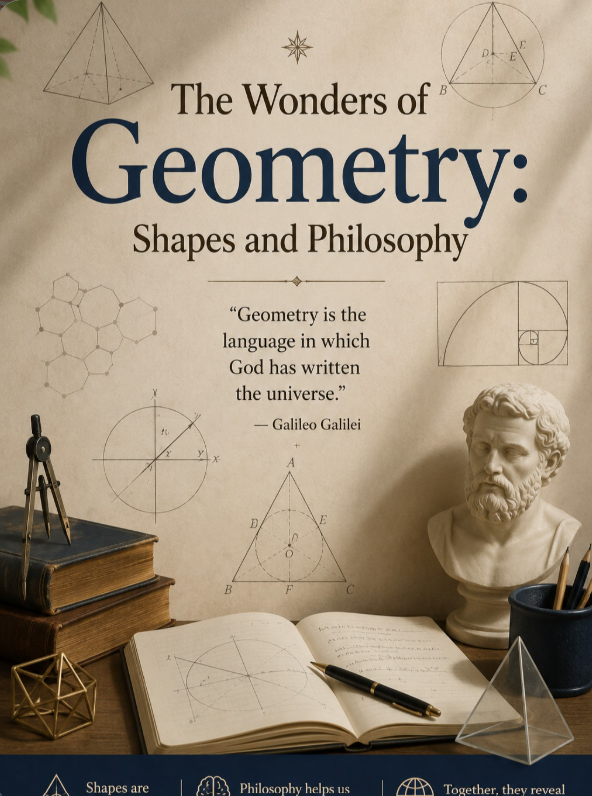
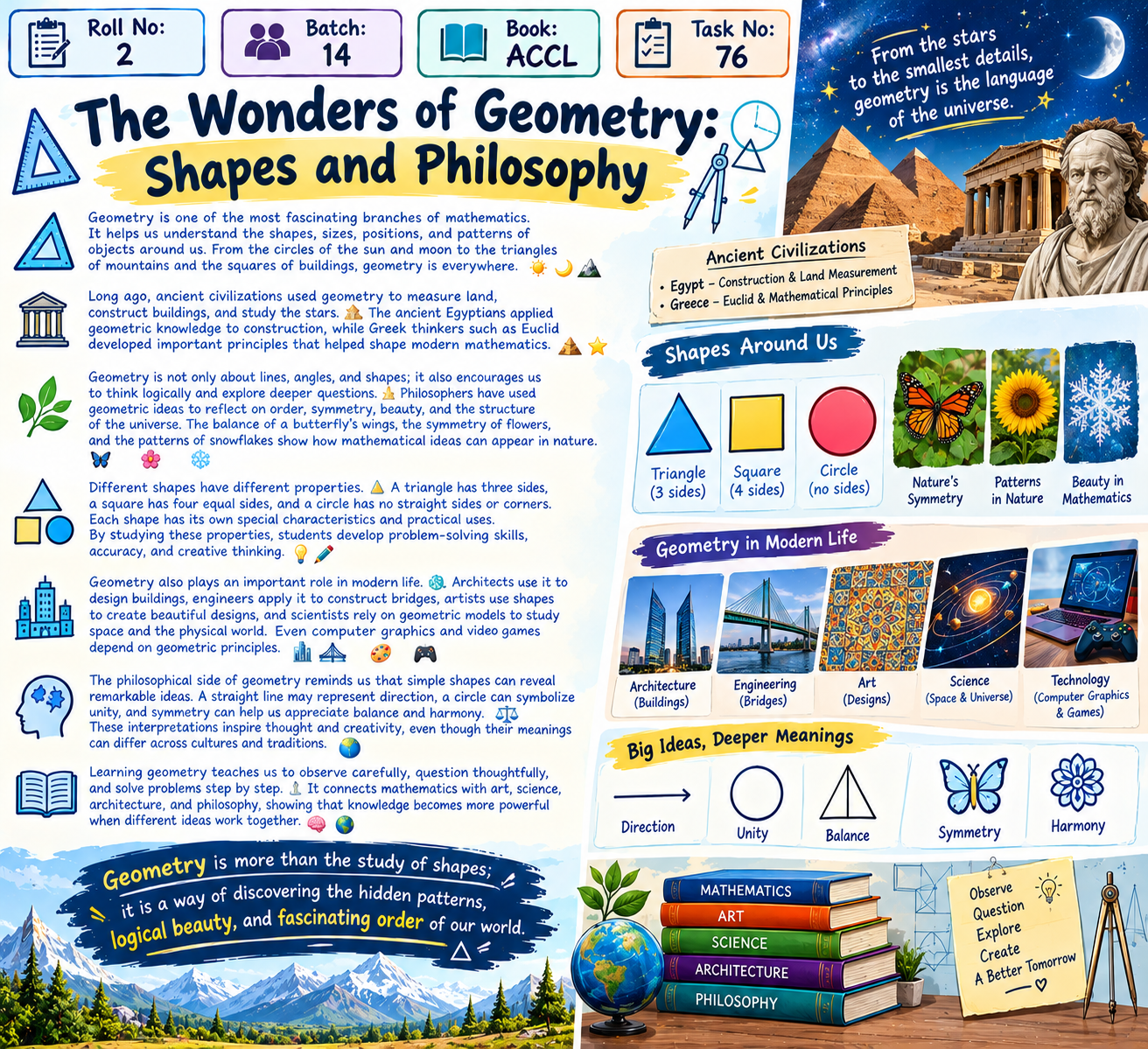
    Geometry is more than just lines, angles, and shapes—it is the hidden language of the universe. From the perfect symmetry of nature to the incredible designs of architecture , geometry reveals the beauty and order that surround us. It also inspires philosophical thinking by teaching us about balance, harmony, logic, and the connection between mathematics and life. Explore how simple shapes can unlock profound ideas and help us see the world from a new perspective.

    Every shape tells a story.
    Every angle holds a lesson.
    Every pattern reflects the beauty of creation.

    #Geometry #Mathematics #Shapes #Philosophy #Learning #Education #STEM #MathIsBeautiful #Knowledge #CriticalThinking #Science #Patterns #CreativeLearning #Inspiration #Explore #Mindset #EducationMatters
    #rsisb Roll no . 214 Foundation level Story post no. 12 Geometry is more than just lines, angles, and shapes—it is the hidden language of the universe. 🌍 From the perfect symmetry of nature 🌸 to the incredible designs of architecture 🏛️, geometry reveals the beauty and order that surround us. It also inspires philosophical thinking by teaching us about balance, harmony, logic, and the connection between mathematics and life. Explore how simple shapes can unlock profound ideas and help us see the world from a new perspective. 📚✨ 🔷 Every shape tells a story. 📏 Every angle holds a lesson. 🌟 Every pattern reflects the beauty of creation. #Geometry #Mathematics #Shapes #Philosophy #Learning #Education #STEM #MathIsBeautiful #Knowledge #CriticalThinking #Science #Patterns #CreativeLearning #Inspiration #Explore #Mindset #EducationMatters 📐📘✨🌍🧠
    0 Commenti 0 condivisioni 3038 Views
  • "Give me a place to stand, and a lever long enough, and I will move the world." - Archimedes

    Archimedes of Syracuse was a Greek mathematician, physicist, engineer, inventor, and astronomer. He is considered one of the greatest mathematicians of antiquity and one of the greatest of all time. Here are some key points about him:

    Mathematics: Archimedes made significant contributions to geometry, including the area of circles, the surface area and volume of spheres, and the area under parabolas.

    Physics: He is known for his principle of buoyancy, known as Archimedes Principle, which states that a body immersed in a fluid experiences an upward force equal to the weight of the fluid displaced by the body.

    Engineering: Archimedes designed innovative machines, including war machines to defend his city of Syracuse during its siege by the Romans. He is also credited with inventing the Archimedean screw, a device for raising water.

    Eureka Moment: The famous story of Archimedes running through the streets of Syracuse naked, shouting "Eureka!" ("I have found it!") occurred when he discovered how to determine the purity of a gold object by measuring its displacement of water.

    Legacy: Archimedes work laid the foundations for future scientists and mathematicians. His methods anticipated modern calculus and analysis, and his inventions influenced engineering for centuries.

    Archimedes combination of theoretical and practical expertise made him a legendary figure in the history of science and mathematics.
    "Give me a place to stand, and a lever long enough, and I will move the world." - Archimedes Archimedes of Syracuse was a Greek mathematician, physicist, engineer, inventor, and astronomer. He is considered one of the greatest mathematicians of antiquity and one of the greatest of all time. Here are some key points about him: Mathematics: Archimedes made significant contributions to geometry, including the area of circles, the surface area and volume of spheres, and the area under parabolas. Physics: He is known for his principle of buoyancy, known as Archimedes' Principle, which states that a body immersed in a fluid experiences an upward force equal to the weight of the fluid displaced by the body. Engineering: Archimedes designed innovative machines, including war machines to defend his city of Syracuse during its siege by the Romans. He is also credited with inventing the Archimedean screw, a device for raising water. Eureka Moment: The famous story of Archimedes running through the streets of Syracuse naked, shouting "Eureka!" ("I have found it!") occurred when he discovered how to determine the purity of a gold object by measuring its displacement of water. Legacy: Archimedes' work laid the foundations for future scientists and mathematicians. His methods anticipated modern calculus and analysis, and his inventions influenced engineering for centuries. Archimedes' combination of theoretical and practical expertise made him a legendary figure in the history of science and mathematics.
    0 Commenti 0 condivisioni 507 Views
  • The “369 Tesla Code” is inspired by Nikola Tesla, a famous inventor and physicist, who believed that the numbers 3, 6, and 9 hold special significance in the universe. Tesla is often quoted as saying, “If you only knew the magnificence of the 3, 6, and 9, you would have the key to the universe.” While this quote and concept have gained attention in spiritual and metaphysical circles, there is no direct scientific evidence linking these numbers to universal secrets.

    Interpretations of the 369 Tesla Code
    1. Numerical Patterns and Vibrations:
    • In mathematics, these numbers often appear in patterns. For example, multiples of 3 always reduce to 3, 6, or 9 when digits are added (e.g., 12 → 1+2=3, 18 → 1+8=9).
    • Some interpret this as a sign of universal harmony or energy flow.
    2. Sacred Geometry:
    • Tesla and others saw connections between these numbers and geometric shapes like circles (360 degrees, which reduces to 9), suggesting they symbolize cosmic order.
    3. Manifestation Techniques:
    • The “369 Method” is a popular modern manifestation practice:
    • Write down your desire 3 times in the morning.
    • Write it down 6 times in the afternoon.
    • Write it down 9 times at night.
    • This is believed to help focus energy and intention, aligning thoughts with universal vibrations.
    4. Spiritual Significance:
    • In spiritual numerology, 3 is linked to creativity and expression, 6 to harmony and love, and 9 to completion and enlightenment.

    Tesla’s Fascination

    Tesla was deeply interested in patterns, numbers, and the idea of energy in the universe. While his work was scientific, his mystical inclinations led him to explore ideas that went beyond the physical sciences.

    The “369 Tesla Code” is a blend of Tesla’s ideas, numerology, and modern spiritual practices, often used as a metaphor for unlocking higher understanding or universal alignment.
    The “369 Tesla Code” is inspired by Nikola Tesla, a famous inventor and physicist, who believed that the numbers 3, 6, and 9 hold special significance in the universe. Tesla is often quoted as saying, “If you only knew the magnificence of the 3, 6, and 9, you would have the key to the universe.” While this quote and concept have gained attention in spiritual and metaphysical circles, there is no direct scientific evidence linking these numbers to universal secrets. Interpretations of the 369 Tesla Code 1. Numerical Patterns and Vibrations: • In mathematics, these numbers often appear in patterns. For example, multiples of 3 always reduce to 3, 6, or 9 when digits are added (e.g., 12 → 1+2=3, 18 → 1+8=9). • Some interpret this as a sign of universal harmony or energy flow. 2. Sacred Geometry: • Tesla and others saw connections between these numbers and geometric shapes like circles (360 degrees, which reduces to 9), suggesting they symbolize cosmic order. 3. Manifestation Techniques: • The “369 Method” is a popular modern manifestation practice: • Write down your desire 3 times in the morning. • Write it down 6 times in the afternoon. • Write it down 9 times at night. • This is believed to help focus energy and intention, aligning thoughts with universal vibrations. 4. Spiritual Significance: • In spiritual numerology, 3 is linked to creativity and expression, 6 to harmony and love, and 9 to completion and enlightenment. Tesla’s Fascination Tesla was deeply interested in patterns, numbers, and the idea of energy in the universe. While his work was scientific, his mystical inclinations led him to explore ideas that went beyond the physical sciences. The “369 Tesla Code” is a blend of Tesla’s ideas, numerology, and modern spiritual practices, often used as a metaphor for unlocking higher understanding or universal alignment.
    0 Commenti 0 condivisioni 451 Views
  • Inventing New Physics with AI

    Physics has always been the foundation of human progress. It explains the motion of planets, the behavior of particles, the nature of light, and the birth of the universe. Yet, the history of physics also shows that what we call “truth” is never final. Newton’s mechanics gave way to Einstein’s relativity. Relativity opened the door to quantum mechanics. And today, even quantum physics struggles to unify with gravity. This means one thing: new physics is waiting to be born.

    For the first time in history, we have a partner that past geniuses never had—Artificial Intelligence. By working with systems like ChatGPT, we can accelerate the creation of entirely new branches of physics.


    1. Begin with the Unexplainable

    New physics begins where old physics fails.
    • Why does consciousness arise from matter?
    • What is “dark energy” and “dark matter,” which make up 95% of the universe but remain invisible?
    • Why does quantum entanglement allow instant correlations faster than light?
    • What exactly is “time”?

    With ChatGPT, researchers can generate hundreds of possible hypotheses and frameworks in hours instead of decades, each pointing toward unexplored laws of nature.


    2. Map the Existing Landscape

    Physics is vast, scattered across thousands of papers and theories. One human cannot read them all. But an AI can scan, summarize, and compare ideas at scale. ChatGPT can highlight contradictions, find unexplored connections, and expose the “white spaces” where new physics might emerge.

    Example: Unifying general relativity (gravity) with quantum field theory (particles) has remained unsolved for a century. An AI can review every attempt, classify their assumptions, and suggest new combinations never tried before.


    3. Generate New Models and Mathematics

    At the heart of physics lies mathematics. New symbols and equations give us new ways to describe reality. AI can:
    • Suggest new mathematical operators that describe phenomena like entanglement.
    • Simulate universes with different physical constants.
    • Test whether a new equation produces consistent predictions with observed data.

    This turns ChatGPT into a co-inventor of mathematical languages for new physics.


    4. Design Thought Experiments

    Einstein invented relativity not in a lab, but by imagining himself riding a beam of light. Today, ChatGPT can help invent thousands of such thought experiments:
    • What happens inside a black hole if information is never lost?
    • What if time is not a line but a loop?
    • What if gravity is not a force but an emergent property of information flow?

    Each thought experiment becomes a seed for real experiments.


    5. Simulate and Test

    With integration into physics engines and quantum simulators, AI can model the consequences of new laws. For example:
    • If a new theory of time predicts particles aging differently, we can simulate particle decays.
    • If a new geometry explains dark matter, AI can test its predictions against galaxy rotation curves.

    In hours, we can discard weak theories and refine promising ones.


    6. Build a New Physics Community

    New sciences require believers. By writing manifestos, publishing papers, and building institutes, we can attract students and researchers to test these new frameworks. A “Physics of Consciousness” or “Physics of Abundance” could start at Rehan School and spread globally.


    7. Democratizing Physics

    For centuries, physics was locked in elite universities. With AI, every curious student—whether in Karachi, Kathmandu, or Kansas—can run experiments, test equations, and publish ideas. This democratization could unleash the next Newton or Einstein from anywhere in the world.


    Conclusion

    Inventing new physics is no longer the privilege of a lone genius with a chalkboard. It is a collective act powered by AI. By combining human imagination with AI’s capacity for infinite connections, we can explore questions that have haunted humanity for centuries.

    With ChatGPT, we are not just studying the universe—we are invited to reinvent the laws that define it.

    The physics of tomorrow will not only explain the cosmos. It will explain us.
    Inventing New Physics with AI Physics has always been the foundation of human progress. It explains the motion of planets, the behavior of particles, the nature of light, and the birth of the universe. Yet, the history of physics also shows that what we call “truth” is never final. Newton’s mechanics gave way to Einstein’s relativity. Relativity opened the door to quantum mechanics. And today, even quantum physics struggles to unify with gravity. This means one thing: new physics is waiting to be born. For the first time in history, we have a partner that past geniuses never had—Artificial Intelligence. By working with systems like ChatGPT, we can accelerate the creation of entirely new branches of physics. ⸻ 1. Begin with the Unexplainable New physics begins where old physics fails. • Why does consciousness arise from matter? • What is “dark energy” and “dark matter,” which make up 95% of the universe but remain invisible? • Why does quantum entanglement allow instant correlations faster than light? • What exactly is “time”? With ChatGPT, researchers can generate hundreds of possible hypotheses and frameworks in hours instead of decades, each pointing toward unexplored laws of nature. ⸻ 2. Map the Existing Landscape Physics is vast, scattered across thousands of papers and theories. One human cannot read them all. But an AI can scan, summarize, and compare ideas at scale. ChatGPT can highlight contradictions, find unexplored connections, and expose the “white spaces” where new physics might emerge. Example: Unifying general relativity (gravity) with quantum field theory (particles) has remained unsolved for a century. An AI can review every attempt, classify their assumptions, and suggest new combinations never tried before. ⸻ 3. Generate New Models and Mathematics At the heart of physics lies mathematics. New symbols and equations give us new ways to describe reality. AI can: • Suggest new mathematical operators that describe phenomena like entanglement. • Simulate universes with different physical constants. • Test whether a new equation produces consistent predictions with observed data. This turns ChatGPT into a co-inventor of mathematical languages for new physics. ⸻ 4. Design Thought Experiments Einstein invented relativity not in a lab, but by imagining himself riding a beam of light. Today, ChatGPT can help invent thousands of such thought experiments: • What happens inside a black hole if information is never lost? • What if time is not a line but a loop? • What if gravity is not a force but an emergent property of information flow? Each thought experiment becomes a seed for real experiments. ⸻ 5. Simulate and Test With integration into physics engines and quantum simulators, AI can model the consequences of new laws. For example: • If a new theory of time predicts particles aging differently, we can simulate particle decays. • If a new geometry explains dark matter, AI can test its predictions against galaxy rotation curves. In hours, we can discard weak theories and refine promising ones. ⸻ 6. Build a New Physics Community New sciences require believers. By writing manifestos, publishing papers, and building institutes, we can attract students and researchers to test these new frameworks. A “Physics of Consciousness” or “Physics of Abundance” could start at Rehan School and spread globally. ⸻ 7. Democratizing Physics For centuries, physics was locked in elite universities. With AI, every curious student—whether in Karachi, Kathmandu, or Kansas—can run experiments, test equations, and publish ideas. This democratization could unleash the next Newton or Einstein from anywhere in the world. ⸻ Conclusion Inventing new physics is no longer the privilege of a lone genius with a chalkboard. It is a collective act powered by AI. By combining human imagination with AI’s capacity for infinite connections, we can explore questions that have haunted humanity for centuries. With ChatGPT, we are not just studying the universe—we are invited to reinvent the laws that define it. The physics of tomorrow will not only explain the cosmos. It will explain us.
    0 Commenti 0 condivisioni 750 Views
  • The Story of Knowledge: How Humanity Learned to Remember, Share, and Think Together

    Before books, before writing, before cities, knowledge lived in the most fragile place possible: the human mind.

    A hunter taught his son where animals migrate.
    A mother taught her daughter which plants heal and which kill.
    A tribe survived because someone remembered.

    This was the oral age of knowledge.

    Human beings invented memory systems long before writing:
    • Stories wrapped in emotion
    • Songs tied to rhythm
    • Poetry that could not be forgotten

    Knowledge survived not because it was written, but because it was memorable.

    But memory dies with the body.

    And one day, humanity decided that knowledge should live longer than a human life.


    When Knowledge Left the Brain: Clay Tablets

    Around 5,000 years ago, humans pressed symbols into wet clay.

    With clay tablets, knowledge stepped outside the human body for the first time.

    Laws, trade, stories, and calculations were frozen in time.
    A thought could now survive its thinker.

    But this knowledge was:
    • Heavy
    • Slow to copy
    • Controlled by a few scribes

    Knowledge existed — but it did not yet flow.


    The Alphabet: Compressing Human Thought

    Then came a silent revolution.

    Instead of thousands of symbols, humans invented alphabets — a small set of letters that could build infinite meaning.

    This was one of the greatest inventions in human history.

    For the first time:
    • Ordinary people could learn to read
    • Knowledge could spread beyond priests
    • Thought could be compressed efficiently

    The alphabet did to language what ZIP files do to data.


    Numbers, Zero, and Mathematics: Knowledge Becomes Universal

    Words describe.
    Numbers prove.

    When civilizations developed mathematics — especially zero, algebra, and geometry — knowledge became:
    • Precise
    • Universal
    • Predictable

    A law of physics written in numbers could be understood anywhere on Earth.

    Without mathematics:
    • There is no science
    • No engineering
    • No computers

    Math became the language of reality itself.


    Papyrus, Paper, and the Freedom to Travel

    Egypt gave us papyrus.
    China gave us paper.

    This changed everything.

    Knowledge became:
    • Light
    • Cheap
    • Portable

    Now ideas could travel faster than armies.

    Paper quietly enabled:
    • Education systems
    • Exams
    • Bureaucracy
    • Books for the masses

    The printing press would later get the credit — but paper made it possible.


    Libraries & Universities: Knowledge Gets a Home

    As knowledge grew, humanity faced a new problem:

    “Where do we keep it all?”

    Libraries emerged.
    So did universities.

    Places like:
    • Taxila (in today’s Pakistan)
    • Nalanda
    • Al-Qarawiyyin
    • Al-Azhar

    Knowledge stopped being individual and became institutional.

    Universities created:
    • Disciplines
    • Teachers
    • Students
    • Curricula

    Humanity built factories of thinking.


    The Translation Movements: Knowledge Is Saved

    Knowledge nearly died many times.

    When empires fell, books burned.

    But during the Islamic Golden Age, scholars translated Greek, Persian, and Indian knowledge into Arabic — preserving it, expanding it, and improving it.

    Europe later received this knowledge back.

    The Renaissance was not a miracle.
    It was a return shipment.


    The Printing Press: Knowledge Explodes

    In the 1400s, Gutenberg introduced the printing press.

    For the first time:
    • Knowledge multiplied faster than humans
    • Identical copies spread everywhere
    • Education broke elite control

    This single invention reshaped the world:
    • Science accelerated
    • Religion was questioned
    • Literacy exploded

    Knowledge stopped whispering.
    It began to roar.


    The Scientific Method: Truth Changes Its Rules

    Before this moment:

    Truth came from authority.

    After this moment:

    Truth came from evidence.

    The scientific method taught humanity how to test knowledge.

    If it couldn’t be proven, it couldn’t rule.

    This changed everything:
    • Medicine
    • Technology
    • Industry
    • Modern life


    Electricity & Computers: Knowledge Gains Speed

    Electricity gave knowledge:
    • Speed
    • Distance elimination
    • Automation

    Computers turned knowledge into data.
    Storage became cheap.
    Copying became instant.

    But data alone is useless without finding it.


    Search Engines: Knowledge Becomes Findable

    The internet created chaos.
    Search engines created order.

    For the first time:
    • Humanity could ask questions and get answers instantly
    • Knowledge became navigable

    Google did not create knowledge.
    It made it usable.


    Social Media: Knowledge Becomes Emotional

    Then knowledge entered the social age.

    Truth now competed with:
    • Virality
    • Emotion
    • Attention

    Ideas spread not because they were correct —
    but because they were shareable.

    This changed how humans think, argue, and believe.


    Artificial Intelligence: Knowledge Comes Alive

    Now we stand at the greatest turning point since writing itself.

    AI does not just store knowledge.
    It understands, recombines, explains, and teaches it.

    For the first time:
    • Knowledge talks back
    • Adapts to the learner
    • Learns how you learn

    This is not a library.
    This is living knowledge.


    The Real Ending (Which Is Also a Beginning)

    From memory to clay.
    From letters to numbers.
    From books to machines.
    From storage to intelligence.

    The story of humanity is not about tools.
    It is about how we protect, spread, and use knowledge.

    Today, knowledge is no longer scarce.

    Wisdom is.

    And the next civilization will not be ruled by those who have knowledge —
    but by those who understand how to use it responsibly.
    The Story of Knowledge: How Humanity Learned to Remember, Share, and Think Together Before books, before writing, before cities, knowledge lived in the most fragile place possible: the human mind. A hunter taught his son where animals migrate. A mother taught her daughter which plants heal and which kill. A tribe survived because someone remembered. This was the oral age of knowledge. Human beings invented memory systems long before writing: • Stories wrapped in emotion • Songs tied to rhythm • Poetry that could not be forgotten Knowledge survived not because it was written, but because it was memorable. But memory dies with the body. And one day, humanity decided that knowledge should live longer than a human life. ⸻ When Knowledge Left the Brain: Clay Tablets Around 5,000 years ago, humans pressed symbols into wet clay. With clay tablets, knowledge stepped outside the human body for the first time. Laws, trade, stories, and calculations were frozen in time. A thought could now survive its thinker. But this knowledge was: • Heavy • Slow to copy • Controlled by a few scribes Knowledge existed — but it did not yet flow. ⸻ The Alphabet: Compressing Human Thought Then came a silent revolution. Instead of thousands of symbols, humans invented alphabets — a small set of letters that could build infinite meaning. This was one of the greatest inventions in human history. For the first time: • Ordinary people could learn to read • Knowledge could spread beyond priests • Thought could be compressed efficiently The alphabet did to language what ZIP files do to data. ⸻ Numbers, Zero, and Mathematics: Knowledge Becomes Universal Words describe. Numbers prove. When civilizations developed mathematics — especially zero, algebra, and geometry — knowledge became: • Precise • Universal • Predictable A law of physics written in numbers could be understood anywhere on Earth. Without mathematics: • There is no science • No engineering • No computers Math became the language of reality itself. ⸻ Papyrus, Paper, and the Freedom to Travel Egypt gave us papyrus. China gave us paper. This changed everything. Knowledge became: • Light • Cheap • Portable Now ideas could travel faster than armies. Paper quietly enabled: • Education systems • Exams • Bureaucracy • Books for the masses The printing press would later get the credit — but paper made it possible. ⸻ Libraries & Universities: Knowledge Gets a Home As knowledge grew, humanity faced a new problem: “Where do we keep it all?” Libraries emerged. So did universities. Places like: • Taxila (in today’s Pakistan) • Nalanda • Al-Qarawiyyin • Al-Azhar Knowledge stopped being individual and became institutional. Universities created: • Disciplines • Teachers • Students • Curricula Humanity built factories of thinking. ⸻ The Translation Movements: Knowledge Is Saved Knowledge nearly died many times. When empires fell, books burned. But during the Islamic Golden Age, scholars translated Greek, Persian, and Indian knowledge into Arabic — preserving it, expanding it, and improving it. Europe later received this knowledge back. The Renaissance was not a miracle. It was a return shipment. ⸻ The Printing Press: Knowledge Explodes In the 1400s, Gutenberg introduced the printing press. For the first time: • Knowledge multiplied faster than humans • Identical copies spread everywhere • Education broke elite control This single invention reshaped the world: • Science accelerated • Religion was questioned • Literacy exploded Knowledge stopped whispering. It began to roar. ⸻ The Scientific Method: Truth Changes Its Rules Before this moment: Truth came from authority. After this moment: Truth came from evidence. The scientific method taught humanity how to test knowledge. If it couldn’t be proven, it couldn’t rule. This changed everything: • Medicine • Technology • Industry • Modern life ⸻ Electricity & Computers: Knowledge Gains Speed Electricity gave knowledge: • Speed • Distance elimination • Automation Computers turned knowledge into data. Storage became cheap. Copying became instant. But data alone is useless without finding it. ⸻ Search Engines: Knowledge Becomes Findable The internet created chaos. Search engines created order. For the first time: • Humanity could ask questions and get answers instantly • Knowledge became navigable Google did not create knowledge. It made it usable. ⸻ Social Media: Knowledge Becomes Emotional Then knowledge entered the social age. Truth now competed with: • Virality • Emotion • Attention Ideas spread not because they were correct — but because they were shareable. This changed how humans think, argue, and believe. ⸻ Artificial Intelligence: Knowledge Comes Alive Now we stand at the greatest turning point since writing itself. AI does not just store knowledge. It understands, recombines, explains, and teaches it. For the first time: • Knowledge talks back • Adapts to the learner • Learns how you learn This is not a library. This is living knowledge. ⸻ The Real Ending (Which Is Also a Beginning) From memory to clay. From letters to numbers. From books to machines. From storage to intelligence. The story of humanity is not about tools. It is about how we protect, spread, and use knowledge. Today, knowledge is no longer scarce. Wisdom is. And the next civilization will not be ruled by those who have knowledge — but by those who understand how to use it responsibly.
    0 Commenti 0 condivisioni 677 Views
  • Ultra-Strict Professional Enhancement Prompt
    Forensic-grade image enhancement pipeline
    Upgrade the input image to maximum achievable photorealistic quality while enforcing absolute identity preservation.
    Hard constraints (non-negotiable):
    – facial anatomy and bone structure must remain unchanged
    – expression dynamics and muscle tension must match the source
    – head angle, gaze direction, and body alignment must remain identical
    – body proportions and spatial orientation must not shift
    – original clothing, fabric behavior, folds, and tension must be preserved
    – accessories, background, camera angle, framing, and perspective must remain intact
    Enhancement scope:
    Quality restoration and clarity improvement only.
    No redesign, no optimization, no aesthetic correction, no reinterpretation.
    Micro-detail recovery (physically accurate):
    – true skin texture with natural pore distribution
    – realistic subsurface skin response (no plastic or waxy effect)
    – authentic hair strand separation without volume inflation
    – sharp, undistorted eyes with preserved sclera and iris scale
    – clean edge refinement without geometry alteration
    Lighting & tone:
    Preserve original lighting direction, intensity, and color temperature.
    No cinematic stylization, no artificial contrast, no dramatic grading.
    Output requirements:
    Ultra-high fidelity, source-faithful result.
    Photorealistic textures only.
    No stylistic drift.
    Validation rule:
    If identity, pose, expression, or spatial alignment deviates in any way from the source image, the result is invalid.
    Negative Prompt
    identity change, facial refinement, beautification, symmetry correction, pose adjustment, head tilt correction, eye enlargement, artistic interpretation, cinematic lighting, CGI look, AI retouching, plastic skin, fake sharpness, anatomy alteration
    🔒 Ultra-Strict Professional Enhancement Prompt Forensic-grade image enhancement pipeline Upgrade the input image to maximum achievable photorealistic quality while enforcing absolute identity preservation. Hard constraints (non-negotiable): – facial anatomy and bone structure must remain unchanged – expression dynamics and muscle tension must match the source – head angle, gaze direction, and body alignment must remain identical – body proportions and spatial orientation must not shift – original clothing, fabric behavior, folds, and tension must be preserved – accessories, background, camera angle, framing, and perspective must remain intact Enhancement scope: Quality restoration and clarity improvement only. No redesign, no optimization, no aesthetic correction, no reinterpretation. Micro-detail recovery (physically accurate): – true skin texture with natural pore distribution – realistic subsurface skin response (no plastic or waxy effect) – authentic hair strand separation without volume inflation – sharp, undistorted eyes with preserved sclera and iris scale – clean edge refinement without geometry alteration Lighting & tone: Preserve original lighting direction, intensity, and color temperature. No cinematic stylization, no artificial contrast, no dramatic grading. Output requirements: Ultra-high fidelity, source-faithful result. Photorealistic textures only. No stylistic drift. Validation rule: If identity, pose, expression, or spatial alignment deviates in any way from the source image, the result is invalid. ❌ Negative Prompt identity change, facial refinement, beautification, symmetry correction, pose adjustment, head tilt correction, eye enlargement, artistic interpretation, cinematic lighting, CGI look, AI retouching, plastic skin, fake sharpness, anatomy alteration
    0 Commenti 0 condivisioni 317 Views
  • ACCL Day 83 – The Wonders of Geometry: Shapes and Philosophy

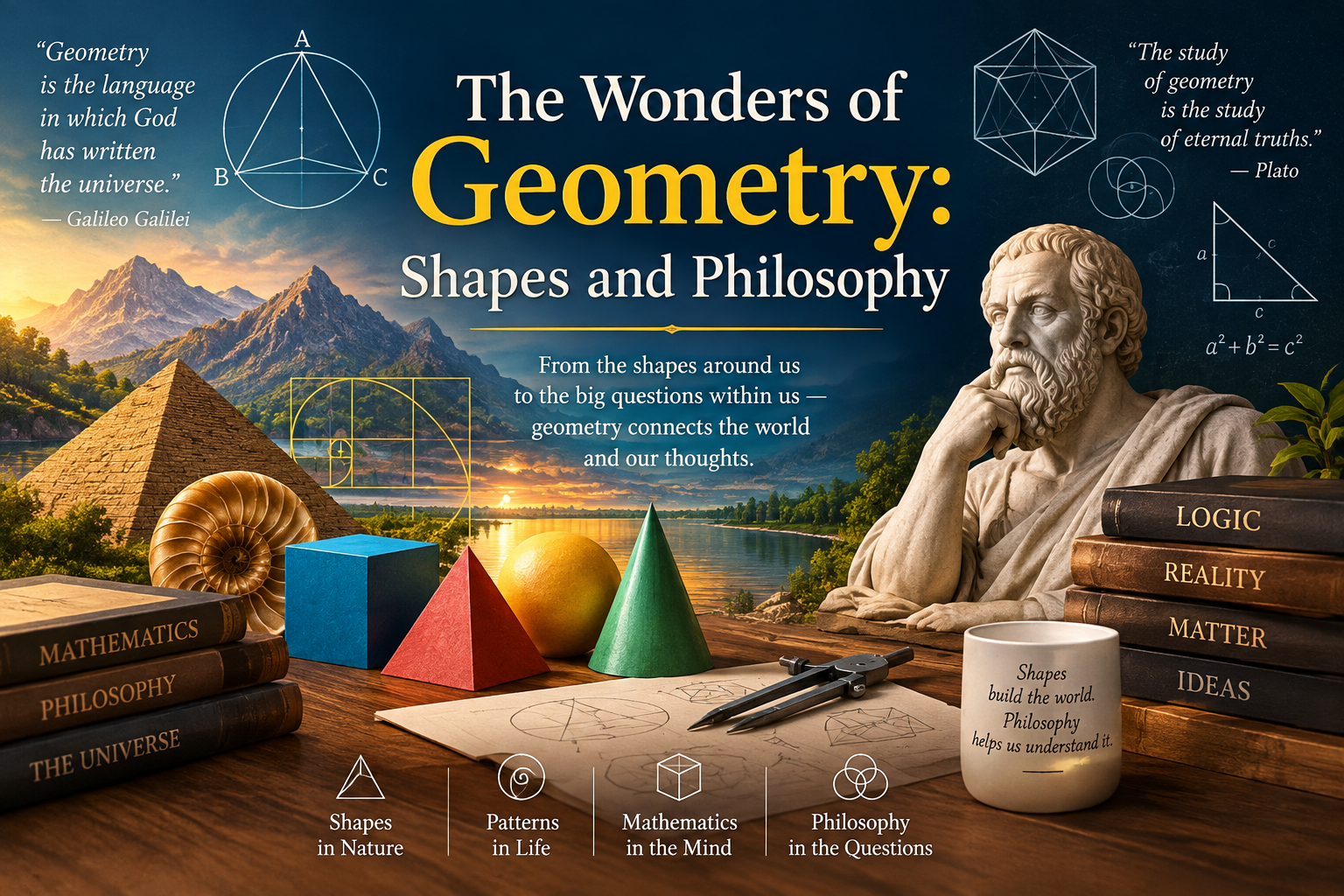
    Once upon a time, in a world full of mysteries, a curious student looked at the world and noticed patterns everywhere — the circle of the sun, the triangles in mountains, and the squares in city streets. She realized that geometry was more than just shapes; it was a way to understand life and the universe.

    Each shape told a story: the circle spoke of eternity and unity, the triangle of balance and strength, and the square of stability and order. Philosophers and mathematicians throughout history used these shapes to explore truth, logic, and beauty, connecting the physical world to deep ideas.

    On ACCL Day 83, she shared her discovery: that geometry is not just about numbers, lines, or angles — it is about seeing the hidden wisdom in the world around us.

    #ACCL #Day83 #GeometryAndPhilosophy #ShapesOfWisdom #LearningJourney
    📖 ACCL Day 83 – The Wonders of Geometry: Shapes and Philosophy 🟦🔺 Once upon a time, in a world full of mysteries, a curious student looked at the world and noticed patterns everywhere — the circle of the sun, the triangles in mountains, and the squares in city streets. She realized that geometry was more than just shapes; it was a way to understand life and the universe. Each shape told a story: the circle spoke of eternity and unity, the triangle of balance and strength, and the square of stability and order. Philosophers and mathematicians throughout history used these shapes to explore truth, logic, and beauty, connecting the physical world to deep ideas. On ACCL Day 83, she shared her discovery: that geometry is not just about numbers, lines, or angles — it is about seeing the hidden wisdom in the world around us. 🌍✨ #ACCL #Day83 #GeometryAndPhilosophy #ShapesOfWisdom #LearningJourney
    0 Commenti 0 condivisioni 964 Views
  • Roll on 80
    canva post on 445
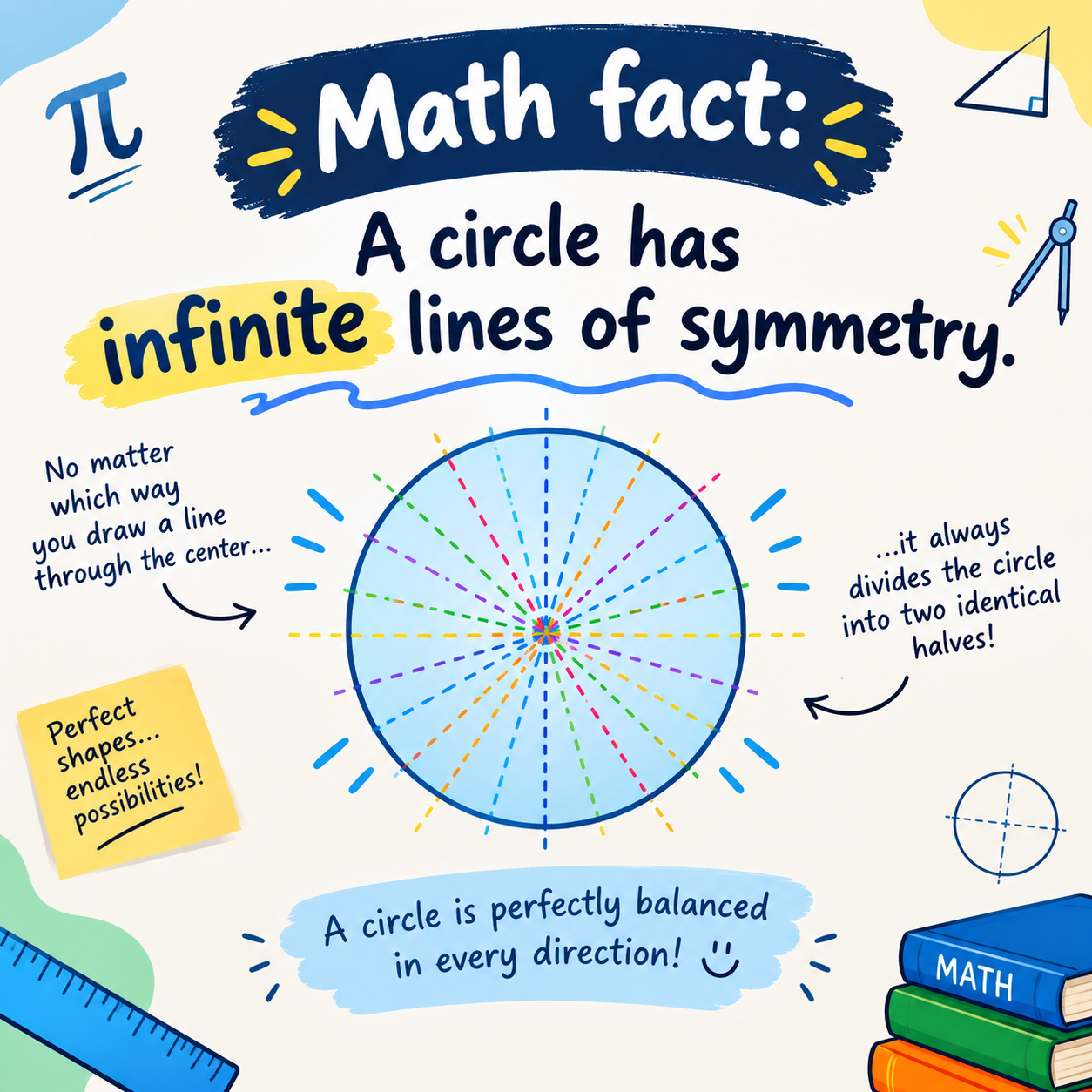
    Math is full of amazing patterns!
    Did you know a circle has infinite lines of symmetry? Any line passing through its center divides it into two equal halves.
    #MathFacts #Geometry #LearningIsFun #MathMagic #Circle #Education #DidYouKnow #STEM #StudentLife #MathLovers #InfiniteSymmetry @@asmashaheeneducationwali
    Roll on 80 canva post on 445 ✨ Math is full of amazing patterns! Did you know a circle has infinite lines of symmetry? Any line passing through its center divides it into two equal halves. 🧠📐 #MathFacts #Geometry #LearningIsFun #MathMagic #Circle #Education #DidYouKnow #STEM #StudentLife #MathLovers #InfiniteSymmetry 📘@@asmashaheeneducationwali
    1
    0 Commenti 0 condivisioni 4721 Views