• #rsisb Roll No.240 Call Annie No.34 Level one Welcome to our live discussion about Global Economics! 🎥🌎 In this session, we will explore how the world's economies work, how countries trade with one another, and how economic decisions affect our daily lives. From international trade and inflation to employment, poverty, technology, and business development, we will discuss important topics that shape the future of our world. 📈🌐 Global economics helps us understand how countries depend on one another for goods, services, resources, technology, and investment. During this discussion, we will talk about why some countries have stronger economies, how developing nations can create more opportunities, and how international cooperation can help improve people's living standards. 🤝💰 We will also explore the role of education, entrepreneurship, digital technology, and small businesses in economic growth. In addition, we will discuss the challenges of rising prices, unemployment, poverty, and economic inequality, along with practical ideas for creating a better future for individuals, families, and communities. 📚💡 This live session is an opportunity to learn new things, exchange ideas, improve our communication skills, and understand the connection between global economic events and our everyday lives. Every country has its own challenges and opportunities, and learning about global economics helps us become more informed citizens of the world. 🌍🧠 Let's learn, discuss, and grow together! 🙌 Share your thoughts in the comments, participate in the conversation, and tell us what you think is the biggest challenge facing the global economy today. Thank you for watching and supporting our educational journey! ❤️ Don't forget to like, comment, and share this discussion with others who are interested in economics, business, education, and global development. #GlobalEconomics #WorldEconomy #InternationalTrade #EconomicGrowth #GlobalBusiness #FinancialEducation #Inflation #Entrepreneurship #EconomicDevelopment #Globalization #BusinessEducation #SocialMediaLive #LiveDiscussion #KnowledgeSharing #LearningTogether 🌍📊💼 Rehan School Islamabad Campus Asma Shaheen EducationWali Irum Asim Leadershipwali Saima Empowerment Wali https://www.facebook.com/share/v/1EdCxvEA78/
    WWW.FACEBOOK.COM
    Made with Restream Studio. Livestream on 30+ platforms at once with Restream #rsisb Roll No.240 Call Annie No.34 Level one Welcome to our live discussion about Global Economics! 🎥🌎 In this session, we will explore how the world's economies work, how countries trade with one another, and how economic decisions affect our daily lives. From international trade and inflation to employment, poverty, technology, and business development, we will discuss important topics that shape the future of our world. 📈🌐 Global economics helps us understand how countries depend on one another for goods, services, resources, technology, and investment. During this discussion, we will talk about why some countries have stronger economies, how developing nations can create more opportunities, and how international cooperation can help improve people's living standards. 🤝💰 We will also explore the role of education, entrepreneurship, digital technology, and small businesses in economic growth. In addition, we will discuss the challenges of rising prices, unemployment, poverty, and economic inequality, along with practical ideas for creating a better future for individuals, families, and communities. 📚💡 This live session is an opportunity to learn new things, exchange ideas, improve our communication skills, and understand the connection between global economic events and our everyday lives. Every country has its own challenges and opportunities, and learning about global economics helps us become more informed citizens of the world. 🌍🧠 Let's learn, discuss, and grow together! 🙌 Share your thoughts in the comments, participate in the conversation, and tell us what you think is the biggest challenge facing the global economy today. Thank you for watching and supporting our educational journey! ❤️ Don't forget to like, comment, and share this discussion with others who are interested in economics, business, education, and global development. #GlobalEconomics #WorldEconomy #InternationalTrade #EconomicGrowth #GlobalBusiness #FinancialEducation #Inflation #Entrepreneurship #EconomicDevelopment #Globalization #BusinessEducation #SocialMediaLive #LiveDiscussion #KnowledgeSharing #LearningTogether 🌍📊💼 Rehan School Islamabad Campus Asma Shaheen EducationWali Irum Asim Leadershipwali Saima Empowerment Wali | Ahmad Ali Constriction Wala
    Made with Restream Studio. Livestream on 30+ platforms at once with Restream #rsisb Roll No.240 Call Annie No.34 Level one Welcome to our live discussion about Global Economics! 🎥🌎 In this session,...
    0 Kommentare 0 Anteile 5104 Ansichten
  • RSIF8
    ROll no:82
    Story post: 1
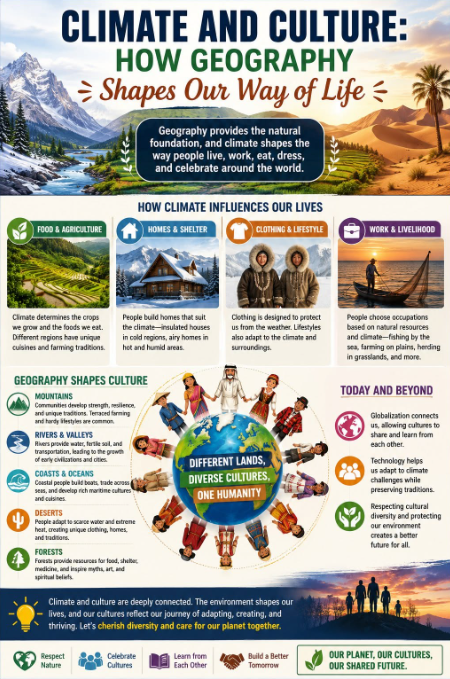
    Story post topic:Climate and Culture: How Geography Shapes Our Way of Life

    The world is a beautiful tapestry of cultures, traditions, and lifestyles, and one of the greatest influences behind this diversity is geography. Mountains, deserts, forests, rivers, oceans, and climate all play a significant role in shaping how people live, work, eat, dress, and celebrate. From the frozen landscapes of the Arctic to the warm tropical islands, every environment has inspired unique ways of life that reflect the challenges and opportunities of nature.

    Climate affects the food we grow, the homes we build, and the clothes we wear. People living in colder regions often construct well-insulated houses and wear warm clothing to protect themselves from harsh winters, while communities in hotter climates design homes with natural ventilation and wear lightweight fabrics to stay cool. Agriculture also depends on climate, influencing the crops that become part of local cuisines and cultural traditions.

    Geography has shaped trade routes, languages, occupations, and even the customs passed down through generations. Coastal communities often develop strong maritime traditions through fishing, shipping, and trade, while mountain communities rely on farming, livestock, and local craftsmanship. Rivers have given rise to some of the world's earliest civilizations, providing fresh water, fertile land, and transportation that supported the growth of cities and cultures.

    Despite these differences, every culture reflects humanity's creativity, resilience, and ability to adapt to its surroundings. Today, technology and globalization connect people across continents, allowing cultures to share ideas while preserving their unique identities. Understanding how geography influences culture helps us appreciate the diversity of our world and encourages respect for the traditions and lifestyles of others.

    Climate and culture are deeply connected, reminding us that the environment not only shapes the landscapes we see but also the stories, values, and traditions that define who we are. By protecting our planet and respecting cultural diversity, we preserve the rich heritage that makes our world vibrant and extraordinary.

    "Geography shapes the land beneath our feet, while culture shapes the lives we lead—together they tell the story of humanity." See less

    RSIF8 ROll no:82 Story post: 1 Story post topic:Climate and Culture: How Geography Shapes Our Way of Life The world is a beautiful tapestry of cultures, traditions, and lifestyles, and one of the greatest influences behind this diversity is geography. Mountains, deserts, forests, rivers, oceans, and climate all play a significant role in shaping how people live, work, eat, dress, and celebrate. From the frozen landscapes of the Arctic to the warm tropical islands, every environment has inspired unique ways of life that reflect the challenges and opportunities of nature. Climate affects the food we grow, the homes we build, and the clothes we wear. People living in colder regions often construct well-insulated houses and wear warm clothing to protect themselves from harsh winters, while communities in hotter climates design homes with natural ventilation and wear lightweight fabrics to stay cool. Agriculture also depends on climate, influencing the crops that become part of local cuisines and cultural traditions. Geography has shaped trade routes, languages, occupations, and even the customs passed down through generations. Coastal communities often develop strong maritime traditions through fishing, shipping, and trade, while mountain communities rely on farming, livestock, and local craftsmanship. Rivers have given rise to some of the world's earliest civilizations, providing fresh water, fertile land, and transportation that supported the growth of cities and cultures. Despite these differences, every culture reflects humanity's creativity, resilience, and ability to adapt to its surroundings. Today, technology and globalization connect people across continents, allowing cultures to share ideas while preserving their unique identities. Understanding how geography influences culture helps us appreciate the diversity of our world and encourages respect for the traditions and lifestyles of others. Climate and culture are deeply connected, reminding us that the environment not only shapes the landscapes we see but also the stories, values, and traditions that define who we are. By protecting our planet and respecting cultural diversity, we preserve the rich heritage that makes our world vibrant and extraordinary. "Geography shapes the land beneath our feet, while culture shapes the lives we lead—together they tell the story of humanity." See less

    0 Kommentare 0 Anteile 3181 Ansichten
  • https://www.facebook.com/share/v/1Bvo8AMxrk/ talk with ai 61 topic The Impact of Globalization week 6 day 12 level 1 @followers [rehan]
    WWW.FACEBOOK.COM
    Facebook
    talk with ai 61 topic The Impact of Globalization week 6 day 12 level 1 @followers
    0 Kommentare 0 Anteile 729 Ansichten
  • Is this you? :-)

    COMMENTARY by Thomas L. Friedman: I think I’ll plan to go from Kiev to Hanoi more often. It’s only when you go to two seemingly disconnected places that you see the big trends, and one of the big ones I’ve noticed is the emergence of “The Square People.” In 2004, the Harvard political scientist Samuel Huntington wrote about an emerging global “superclass” of “Davos Men” — alluding to attendees of the Davos World Economic Forum — a transnational, cosmopolitan elite drawn from high-tech, finance, multinationals, academics and NGOs. The Davos Men had “little need for national loyalty” and more in common with each other than their fellow citizens, Huntington argued. They also had the skills to disproportionately benefit from the new globalization of markets and information technologies.
    Is this you? :-) COMMENTARY by Thomas L. Friedman: I think I’ll plan to go from Kiev to Hanoi more often. It’s only when you go to two seemingly disconnected places that you see the big trends, and one of the big ones I’ve noticed is the emergence of “The Square People.” In 2004, the Harvard political scientist Samuel Huntington wrote about an emerging global “superclass” of “Davos Men” — alluding to attendees of the Davos World Economic Forum — a transnational, cosmopolitan elite drawn from high-tech, finance, multinationals, academics and NGOs. The Davos Men had “little need for national loyalty” and more in common with each other than their fellow citizens, Huntington argued. They also had the skills to disproportionately benefit from the new globalization of markets and information technologies.
    0 Kommentare 0 Anteile 5233 Ansichten
  • What is globalization ?
    What is globalization ?
    0 Kommentare 0 Anteile 805 Ansichten
  • I am speaking in Jamia Rasheed in Karachi on Globalization to the Muftis over there, What should I talk about ?
    I am speaking in Jamia Rasheed in Karachi on Globalization to the Mufti's over there, What should I talk about ?
    0 Kommentare 0 Anteile 875 Ansichten
  • "Chinese farmers all have a phone in their hands even before they really know what a computer is."

    CCTV talked to Jack Ma, Chinas legendary E-commerce pioneer.

    "We have been working on Taobao for more than a decade and now have some 300 million users. However, the majority of Chinese are living in rural areas and that is a great opportunity. With no Internet, you can hardly dig its potential. Chinese farmers all have a phone in their hands even before they really know what a computer is. And the point is now most mobiles can function as computers. So I think if we can reform the economy and the means of production in rural areas with E-commerce technology, we will make a great contribution to our country," Ma said.

    Not bound by the domestic market, Ma and Alibaba have already begun to eye the global internet market.

    "One of our main ideas is that Alibaba will do what local companies cant do in their countries. We will not steal local companies livelihood, but to help them become better. If our Chinese companies can benefit local customers, then we are doing the real globalization, otherwise it will become a sort of Sinolization," Ma said.

    In addition, Ma said he hopes more Chinese companies will arise in the near future. He hopes the companies can represent Chinas values and culture, as well as its youths enterprising spirit and ability to innovate.

    #WIC #WIC2015
    "Chinese farmers all have a phone in their hands even before they really know what a computer is." CCTV talked to Jack Ma, China's legendary E-commerce pioneer. "We have been working on Taobao for more than a decade and now have some 300 million users. However, the majority of Chinese are living in rural areas and that is a great opportunity. With no Internet, you can hardly dig its potential. Chinese farmers all have a phone in their hands even before they really know what a computer is. And the point is now most mobiles can function as computers. So I think if we can reform the economy and the means of production in rural areas with E-commerce technology, we will make a great contribution to our country," Ma said. Not bound by the domestic market, Ma and Alibaba have already begun to eye the global internet market. "One of our main ideas is that Alibaba will do what local companies can't do in their countries. We will not steal local companies' livelihood, but to help them become better. If our Chinese companies can benefit local customers, then we are doing the real globalization, otherwise it will become a sort of 'Sinolization,'" Ma said. In addition, Ma said he hopes more Chinese companies will arise in the near future. He hopes the companies can represent China's values and culture, as well as its youth's enterprising spirit and ability to innovate. #WIC #WIC2015
    0 Kommentare 0 Anteile 2726 Ansichten
  • Neocolonialism, or neo-imperialism is the practice of using capitalism, globalization and cultural imperialism to influence a developing country in lieu of direct military control (imperialism) or indirect political control (hegemony). It was coined by Kwame Nkrumah in the context of African countries undergoing decolonization in the 1960s. Neo-colonialism is also discussed in the works of Western thinkers such as Jean-Paul Sartre (Colonialism and Neo-colonialism, 1964)[1] and Noam Chomsky (The Washington Connection and Third World Fascism, 1979).[2] Some neocolonial ideas, like charter cities, are popular among economists.
    Neocolonialism, or neo-imperialism is the practice of using capitalism, globalization and cultural imperialism to influence a developing country in lieu of direct military control (imperialism) or indirect political control (hegemony). It was coined by Kwame Nkrumah in the context of African countries undergoing decolonization in the 1960s. Neo-colonialism is also discussed in the works of Western thinkers such as Jean-Paul Sartre (Colonialism and Neo-colonialism, 1964)[1] and Noam Chomsky (The Washington Connection and Third World Fascism, 1979).[2] Some neocolonial ideas, like charter cities, are popular among economists.
    0 Kommentare 0 Anteile 876 Ansichten
  • Once all humans think themselves as one family & end tribalism, that would be true globalization !

    Sir Arthur C. Clarke
    Once all humans think themselves as one family & end tribalism, that would be true globalization ! Sir Arthur C. Clarke
    0 Kommentare 0 Anteile 905 Ansichten
  • words that sound similar in both Urdu and English, many of which have been borrowed or adapted into Urdu:

    1. **Bank** - "بینک" (bank): A financial institution.
    2. **Doctor** - "ڈاکٹر" (doctor): A medical professional.
    3. **Engine** - "انجن" (engine): A machine or motor.
    4. **Hotel** - "ہوٹل" (hotel): A place of accommodation.
    5. **Taxi** - "ٹیکسی" (taxi): A vehicle for hire.
    6. **Bus** - "بس" (bus): A large vehicle for transporting people.
    7. **Tea** - "چائے" (chai): A beverage.
    8. **Glass** - "گلاس" (glass): A drinking container.
    9. **Radio** - "ریڈیو" (radio): An electronic device for broadcasting.
    10. **Telephone** - "ٹیلی فون" (telephone): A communication device.
    11. **Camera** - "کیمرہ" (camera): A device for capturing images.
    12. **Cycle** - "سائیکل" (cycle): A bicycle.
    13. **Computer** - "کمپیوٹر" (computer): An electronic computing device.
    14. **Chair** - "چیئر" (chair): A piece of furniture.
    15. **Cinema** - "سینما" (cinema): A place to watch films.
    16. **Hospital** - "ہسپتال" (hospital): A place for medical treatment.
    17. **Office** - "آفس" (office): A place of administrative work.
    18. **Pencil** - "پنسل" (pencil): A writing instrument.
    19. **Petrol** - "پٹرول" (petrol): Fuel for vehicles.
    20. **Restaurant** - "ریستوران" (restaurant): A place to eat.
    21. **School** - "اسکول" (school): An institution for education.
    22. **Station** - "اسٹیشن" (station): A place for vehicles to stop, like a bus station.
    23. **Shop** - "شاپ" (shop): A place to buy goods.
    24. **Toilet** - "ٹوائلٹ" (toilet): Restroom or bathroom.
    25. **Train** - "ٹرین" (train): A mode of rail transport.
    26. **University** - "یونیورسٹی" (university): A higher education institution.
    27. **Watch** - "واچ" (watch): A time-telling device.
    28. **Zoo** - "چڑیا گھر" (chidiya ghar): While the exact word isnt the same, many Urdu speakers will understand the English word "zoo."
    29. **Fan** - "فین" (fan): A device for cooling.
    30. **Gas** - "گیس" (gas): Refers to fuels or natural gas.
    31. **Jacket** - "جیکٹ" (jacket): A piece of clothing.
    32. **Lunch** - "لنچ" (lunch): A mid-day meal.
    33. **Match** - "میچ" (match): Refers to a game or contest.
    34. **Note** - "نوٹ" (note): A piece of paper with information or a currency bill.
    35. **Print** - "پرنٹ" (print): To make a copy using a printer.
    36. **Road** - "روڈ" (road): A path for vehicles.
    37. **Spoon** - "سپون" (spoon): A utensil.
    38. **Table** - "ٹیبل" (table): A piece of furniture.
    39. **Ticket** - "ٹکٹ" (ticket): A pass or admission paper.
    40. **Vitamin** - "وٹامن" (vitamin): A nutritional compound.
    41. **Wash** - "واش" (wash): To clean.
    42. **Cup** - "کپ" (cup): A small container for drinking.
    43. **Club** - "کلب" (club): An organization or a place of gathering.
    44. **Milk** - "ملک" (milk): A dairy product.
    45. **Team** - "ٹیم" (team): A group working together.
    46. **Park** - "پارک" (park): A public recreational area.
    47. **Basket** - "باسکٹ" (basket): A container.
    48. **Gate** - "گیٹ" (gate): An entrance.
    49. **Pen** - "پن" (pen): A writing instrument.
    50. **Guitar** - "گٹار" (guitar): A musical instrument.

    Many of these words are directly borrowed or adapted from English due to globalization and technological advancements.
    words that sound similar in both Urdu and English, many of which have been borrowed or adapted into Urdu: 1. **Bank** - "بینک" (bank): A financial institution. 2. **Doctor** - "ڈاکٹر" (doctor): A medical professional. 3. **Engine** - "انجن" (engine): A machine or motor. 4. **Hotel** - "ہوٹل" (hotel): A place of accommodation. 5. **Taxi** - "ٹیکسی" (taxi): A vehicle for hire. 6. **Bus** - "بس" (bus): A large vehicle for transporting people. 7. **Tea** - "چائے" (chai): A beverage. 8. **Glass** - "گلاس" (glass): A drinking container. 9. **Radio** - "ریڈیو" (radio): An electronic device for broadcasting. 10. **Telephone** - "ٹیلی فون" (telephone): A communication device. 11. **Camera** - "کیمرہ" (camera): A device for capturing images. 12. **Cycle** - "سائیکل" (cycle): A bicycle. 13. **Computer** - "کمپیوٹر" (computer): An electronic computing device. 14. **Chair** - "چیئر" (chair): A piece of furniture. 15. **Cinema** - "سینما" (cinema): A place to watch films. 16. **Hospital** - "ہسپتال" (hospital): A place for medical treatment. 17. **Office** - "آفس" (office): A place of administrative work. 18. **Pencil** - "پنسل" (pencil): A writing instrument. 19. **Petrol** - "پٹرول" (petrol): Fuel for vehicles. 20. **Restaurant** - "ریستوران" (restaurant): A place to eat. 21. **School** - "اسکول" (school): An institution for education. 22. **Station** - "اسٹیشن" (station): A place for vehicles to stop, like a bus station. 23. **Shop** - "شاپ" (shop): A place to buy goods. 24. **Toilet** - "ٹوائلٹ" (toilet): Restroom or bathroom. 25. **Train** - "ٹرین" (train): A mode of rail transport. 26. **University** - "یونیورسٹی" (university): A higher education institution. 27. **Watch** - "واچ" (watch): A time-telling device. 28. **Zoo** - "چڑیا گھر" (chidiya ghar): While the exact word isn't the same, many Urdu speakers will understand the English word "zoo." 29. **Fan** - "فین" (fan): A device for cooling. 30. **Gas** - "گیس" (gas): Refers to fuels or natural gas. 31. **Jacket** - "جیکٹ" (jacket): A piece of clothing. 32. **Lunch** - "لنچ" (lunch): A mid-day meal. 33. **Match** - "میچ" (match): Refers to a game or contest. 34. **Note** - "نوٹ" (note): A piece of paper with information or a currency bill. 35. **Print** - "پرنٹ" (print): To make a copy using a printer. 36. **Road** - "روڈ" (road): A path for vehicles. 37. **Spoon** - "سپون" (spoon): A utensil. 38. **Table** - "ٹیبل" (table): A piece of furniture. 39. **Ticket** - "ٹکٹ" (ticket): A pass or admission paper. 40. **Vitamin** - "وٹامن" (vitamin): A nutritional compound. 41. **Wash** - "واش" (wash): To clean. 42. **Cup** - "کپ" (cup): A small container for drinking. 43. **Club** - "کلب" (club): An organization or a place of gathering. 44. **Milk** - "ملک" (milk): A dairy product. 45. **Team** - "ٹیم" (team): A group working together. 46. **Park** - "پارک" (park): A public recreational area. 47. **Basket** - "باسکٹ" (basket): A container. 48. **Gate** - "گیٹ" (gate): An entrance. 49. **Pen** - "پن" (pen): A writing instrument. 50. **Guitar** - "گٹار" (guitar): A musical instrument. Many of these words are directly borrowed or adapted from English due to globalization and technological advancements.
    0 Kommentare 0 Anteile 2152 Ansichten
Suchergebnis