• **Roll No: 2**
    **Batch: 14**
    **Book: ACCL**
    **Task No: 153**

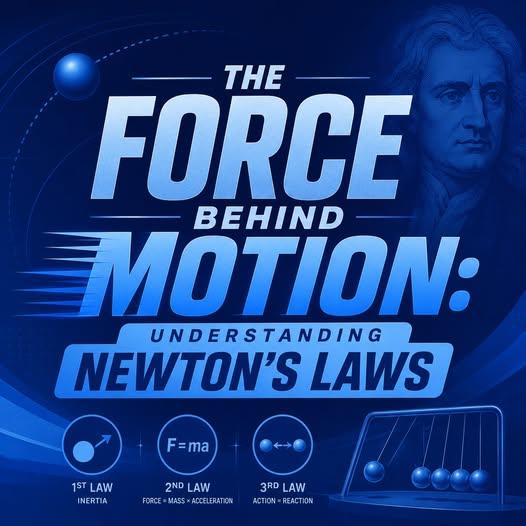
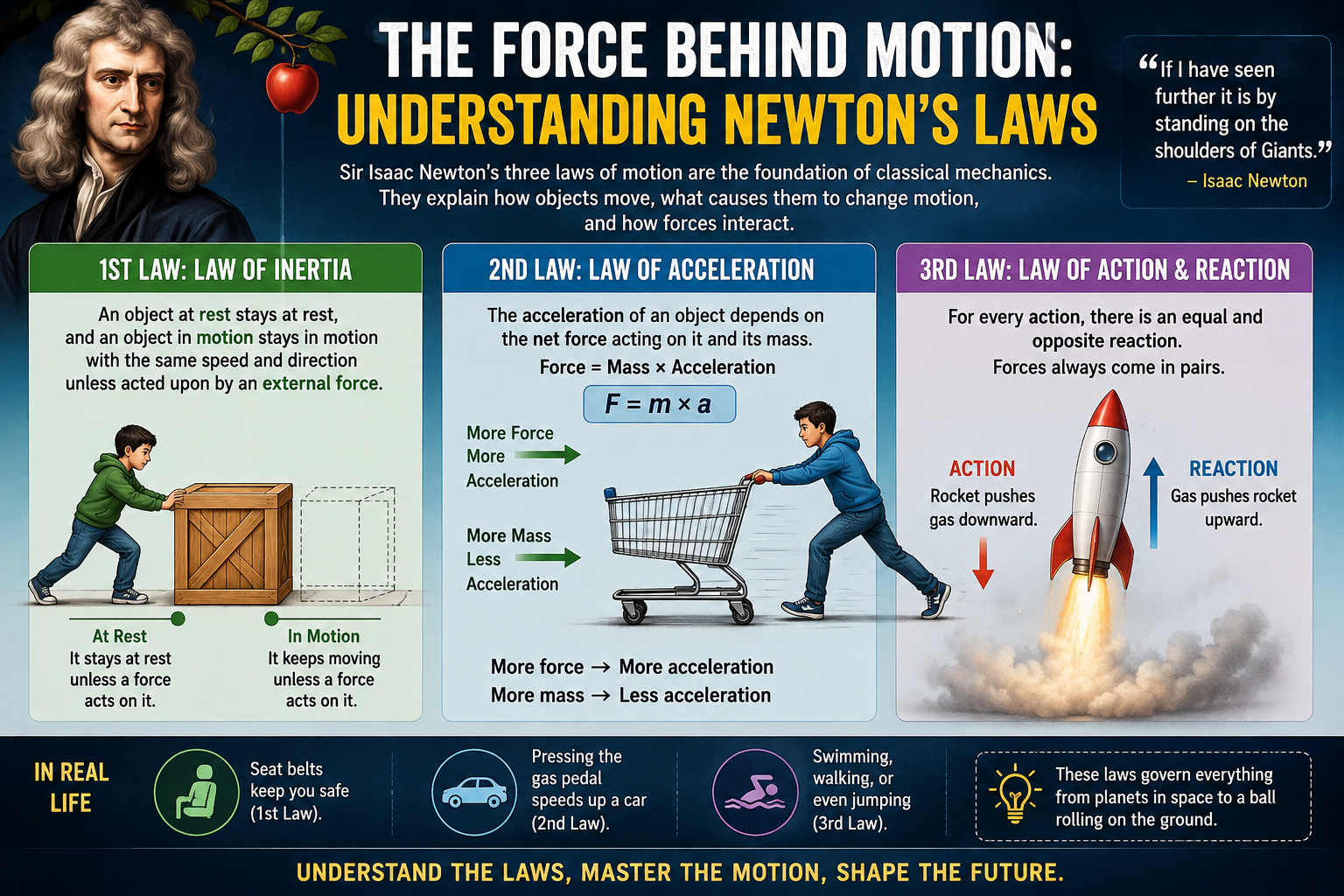
    # The Force Behind Motion: Understanding Newton’s Laws

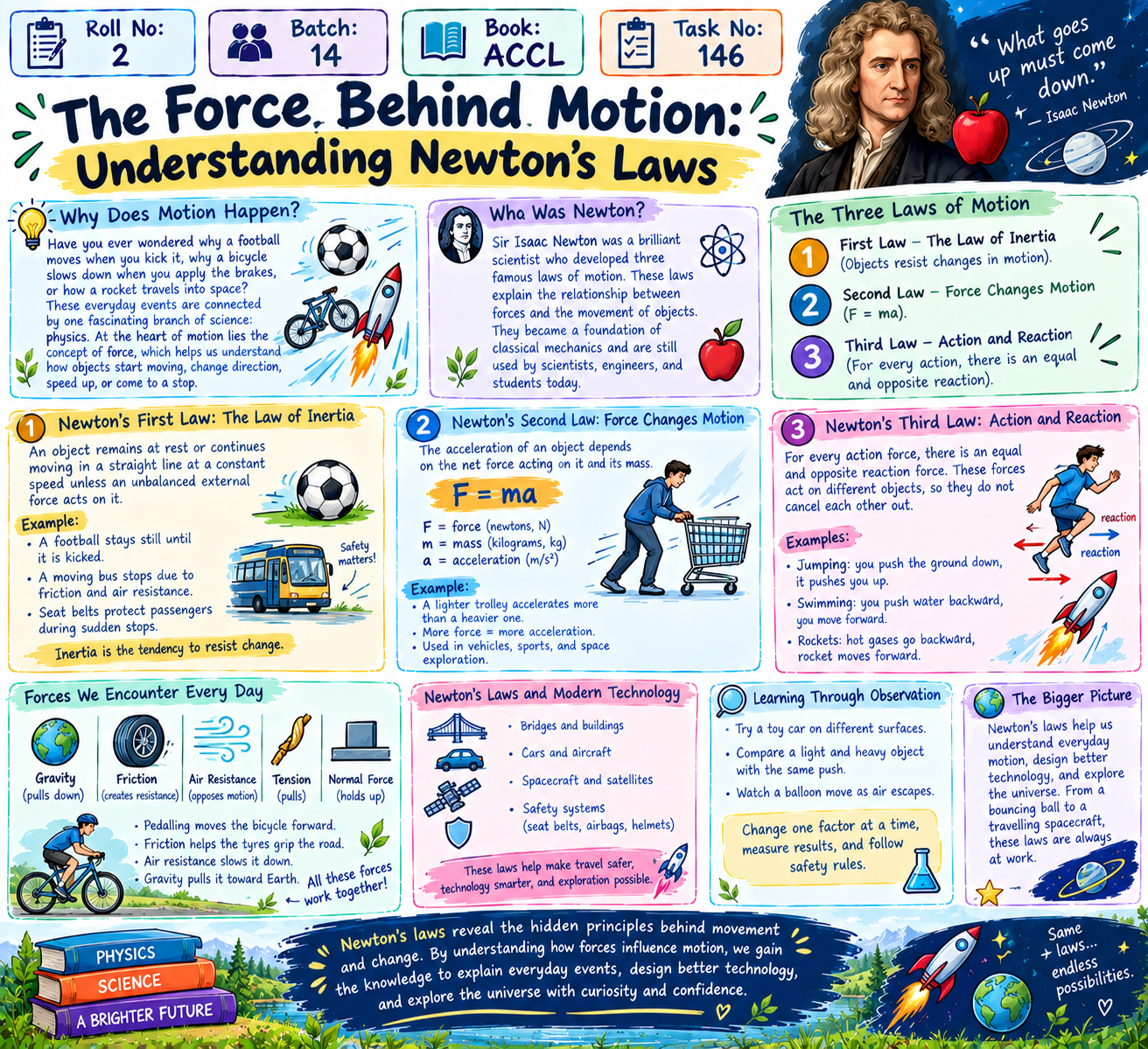
    Have you ever wondered why a football moves when you kick it, why a bicycle slows down when you apply the brakes, or how a rocket travels into space? These everyday events are connected by one fascinating branch of science: physics. At the heart of motion lies the concept of **force**, which helps us understand how objects start moving, change direction, speed up, or come to a stop.

    One of the most important scientists in the history of physics was **Sir Isaac Newton**. Through his work, Newton developed three famous laws of motion that explain the relationship between forces and the movement of objects. These laws became a foundation of classical mechanics and continue to help scientists, engineers, and students understand the physical world around them.

    ## Newton’s First Law: The Law of Inertia

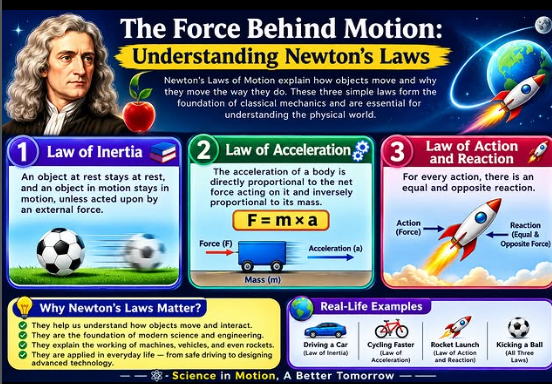
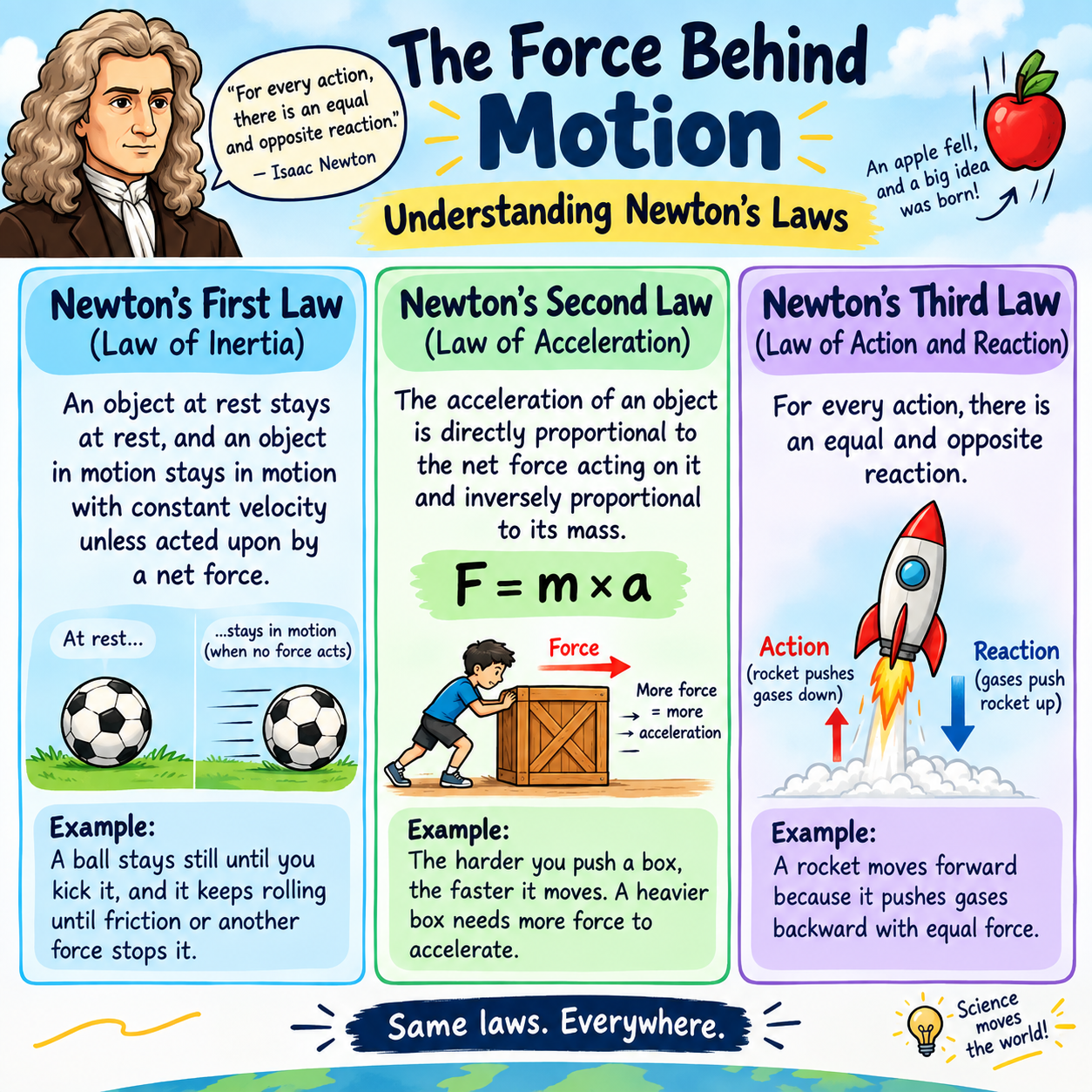
    Newton’s first law states that an object remains at rest or continues moving in a straight line at a constant speed unless an unbalanced external force acts on it. This tendency to resist changes in motion is called **inertia**.

    Imagine a football resting on the ground. It will remain still until someone kicks it or another force acts upon it. Once the ball begins moving, friction between the ball and the ground, along with air resistance, gradually slows it down. Without these opposing forces, the ball would continue moving at a constant velocity.

    You can also notice inertia when a moving bus suddenly brakes. Passengers may feel their bodies move forward because their bodies tend to maintain their previous motion. Seat belts help protect passengers by providing a force that restrains their movement. This shows how Newton’s first law explains both everyday experiences and important safety features.

    ## Newton’s Second Law: Force Changes Motion

    Newton’s second law explains how an unbalanced force changes an object’s motion. The acceleration of an object depends on the net force acting on it and its mass. For an object with constant mass, the relationship is written as:

    [
    \boxed{F = ma}
    ]

    Here, (F) represents the net force, (m) represents mass, and (a) represents acceleration. Force is measured in newtons (N), mass in kilograms (kg), and acceleration in metres per second squared ((\text{m/s}^2)).

    Consider pushing an empty shopping trolley and then pushing a heavily loaded one. The empty trolley usually accelerates more easily because it has less mass. If the same net force acts on two objects, the object with less mass experiences greater acceleration. Similarly, increasing the net force on an object of constant mass increases its acceleration.

    This law is essential in engineering, transport, sports, and space exploration. Engineers use it to calculate how much force is needed to accelerate vehicles, while athletes use the principles of force and acceleration when running, jumping, and throwing objects. ‍

    ## Newton’s Third Law: Action and Reaction

    Newton’s third law states that **for every action force, there is an equal and opposite reaction force**. These two forces act on different objects, so they do not cancel each other out.

    Think about what happens when you jump. Your feet push down against the ground, and the ground pushes upward on you. This upward force helps you rise into the air. The same principle explains how swimmers move forward by pushing water backward.

    Rockets provide another remarkable example. A rocket expels hot gases backward at high speed, and the gases exert an opposite force on the rocket, pushing it forward. This principle works even in the vacuum of space because the rocket does not need air to push against. Its motion results from the interaction between the rocket and the expelled gases.

    ## Forces We Encounter Every Day

    Forces are all around us, even when we do not notice them. Gravity pulls objects toward Earth, friction acts between surfaces in contact, and air resistance opposes an object moving through the atmosphere. Tension in a rope can pull an object, while a normal force from a supporting surface helps hold an object up.

    These forces often work together. For example, when a cyclist travels along a road, pedalling produces forward motion, friction helps the tyres grip the road, air resistance opposes movement, and gravity pulls the cyclist toward Earth. ‍ Understanding how these forces interact helps explain why the bicycle speeds up, slows down, or turns.

    ## Newton’s Laws and Modern Technology

    Newton’s laws are important far beyond the classroom. Engineers apply them when designing bridges, cars, aircraft, and machines. Scientists use them to predict the motion of many objects, while space agencies apply mechanics to plan spacecraft trajectories and study the movement of satellites.

    These laws also help improve safety. Seat belts, airbags, helmets, and vehicle safety systems are designed with an understanding of motion, forces, and changes in momentum. Although modern physics includes ideas beyond Newton’s laws, his work remains extremely useful for understanding everyday motion and many engineering problems.

    ## Learning Through Observation

    You do not need a complicated laboratory to begin exploring Newton’s laws. You can observe a toy car rolling across different surfaces, compare how a light and a heavier object respond to the same gentle push, or watch a balloon move as air escapes from it. Such simple observations can help connect scientific ideas with real experiences.

    When conducting experiments, it is important to change one factor at a time where possible, measure results carefully, and follow appropriate safety precautions. By observing patterns and asking questions, students can develop critical thinking skills and discover how physics explains the world around them.

    Newton’s laws teach us that motion is not random. The movement of a bouncing ball, a speeding bicycle, a swimming person, and a travelling spacecraft can all be understood by investigating forces and their effects.

    **Newton’s laws reveal the hidden principles behind movement and change. By understanding how forces influence motion, we gain the knowledge to explain everyday events, design better technology, and explore the universe with curiosity and confidence. **

    \#NewtonsLaws #ForceAndMotion #Physics #Science #Inertia #Acceleration #SpaceExploration #ACCL #Batch14 #Task146
    **Roll No: 2** **Batch: 14** **Book: ACCL** **Task No: 153** # ๐Ÿš€โš™๏ธ The Force Behind Motion: Understanding Newton’s Laws ๐ŸŽ๐ŸŒ Have you ever wondered why a football moves when you kick it, why a bicycle slows down when you apply the brakes, or how a rocket travels into space? ๐Ÿšฒโšฝ๐Ÿš€ These everyday events are connected by one fascinating branch of science: physics. At the heart of motion lies the concept of **force**, which helps us understand how objects start moving, change direction, speed up, or come to a stop. One of the most important scientists in the history of physics was **Sir Isaac Newton**. ๐ŸŽ๐Ÿ”ญ Through his work, Newton developed three famous laws of motion that explain the relationship between forces and the movement of objects. These laws became a foundation of classical mechanics and continue to help scientists, engineers, and students understand the physical world around them. ## โš–๏ธ Newton’s First Law: The Law of Inertia Newton’s first law states that an object remains at rest or continues moving in a straight line at a constant speed unless an unbalanced external force acts on it. This tendency to resist changes in motion is called **inertia**. ๐Ÿงฑโœจ Imagine a football resting on the ground. โšฝ It will remain still until someone kicks it or another force acts upon it. Once the ball begins moving, friction between the ball and the ground, along with air resistance, gradually slows it down. Without these opposing forces, the ball would continue moving at a constant velocity. You can also notice inertia when a moving bus suddenly brakes. ๐ŸšŒ Passengers may feel their bodies move forward because their bodies tend to maintain their previous motion. Seat belts help protect passengers by providing a force that restrains their movement. This shows how Newton’s first law explains both everyday experiences and important safety features. ## ๐Ÿ’ช Newton’s Second Law: Force Changes Motion Newton’s second law explains how an unbalanced force changes an object’s motion. The acceleration of an object depends on the net force acting on it and its mass. For an object with constant mass, the relationship is written as: [ \boxed{F = ma} ] Here, (F) represents the net force, (m) represents mass, and (a) represents acceleration. Force is measured in newtons (N), mass in kilograms (kg), and acceleration in metres per second squared ((\text{m/s}^2)). ๐Ÿ”ฌ๐Ÿ“ Consider pushing an empty shopping trolley and then pushing a heavily loaded one. ๐Ÿ›’ The empty trolley usually accelerates more easily because it has less mass. If the same net force acts on two objects, the object with less mass experiences greater acceleration. Similarly, increasing the net force on an object of constant mass increases its acceleration. This law is essential in engineering, transport, sports, and space exploration. Engineers use it to calculate how much force is needed to accelerate vehicles, while athletes use the principles of force and acceleration when running, jumping, and throwing objects. ๐Ÿƒ‍โ™‚๏ธ๐Ÿ€ ## ๐Ÿ”„ Newton’s Third Law: Action and Reaction Newton’s third law states that **for every action force, there is an equal and opposite reaction force**. These two forces act on different objects, so they do not cancel each other out. ๐ŸŒโšก Think about what happens when you jump. Your feet push down against the ground, and the ground pushes upward on you. This upward force helps you rise into the air. ๐Ÿฆ˜ The same principle explains how swimmers move forward by pushing water backward. Rockets provide another remarkable example. ๐Ÿš€ A rocket expels hot gases backward at high speed, and the gases exert an opposite force on the rocket, pushing it forward. This principle works even in the vacuum of space because the rocket does not need air to push against. Its motion results from the interaction between the rocket and the expelled gases. ## ๐ŸŒŽ Forces We Encounter Every Day Forces are all around us, even when we do not notice them. Gravity pulls objects toward Earth, friction acts between surfaces in contact, and air resistance opposes an object moving through the atmosphere. ๐Ÿช‚๐ŸŒฌ๏ธ Tension in a rope can pull an object, while a normal force from a supporting surface helps hold an object up. These forces often work together. For example, when a cyclist travels along a road, pedalling produces forward motion, friction helps the tyres grip the road, air resistance opposes movement, and gravity pulls the cyclist toward Earth. ๐Ÿšด‍โ™‚๏ธ Understanding how these forces interact helps explain why the bicycle speeds up, slows down, or turns. ## ๐Ÿ›ฐ๏ธ Newton’s Laws and Modern Technology Newton’s laws are important far beyond the classroom. Engineers apply them when designing bridges, cars, aircraft, and machines. ๐Ÿ—๏ธ๐Ÿš— Scientists use them to predict the motion of many objects, while space agencies apply mechanics to plan spacecraft trajectories and study the movement of satellites. These laws also help improve safety. Seat belts, airbags, helmets, and vehicle safety systems are designed with an understanding of motion, forces, and changes in momentum. Although modern physics includes ideas beyond Newton’s laws, his work remains extremely useful for understanding everyday motion and many engineering problems. ## ๐Ÿง  Learning Through Observation You do not need a complicated laboratory to begin exploring Newton’s laws. You can observe a toy car rolling across different surfaces, compare how a light and a heavier object respond to the same gentle push, or watch a balloon move as air escapes from it. ๐ŸŽˆ๐Ÿงช Such simple observations can help connect scientific ideas with real experiences. When conducting experiments, it is important to change one factor at a time where possible, measure results carefully, and follow appropriate safety precautions. By observing patterns and asking questions, students can develop critical thinking skills and discover how physics explains the world around them. Newton’s laws teach us that motion is not random. The movement of a bouncing ball, a speeding bicycle, a swimming person, and a travelling spacecraft can all be understood by investigating forces and their effects. ๐ŸŒŒโš™๏ธ **Newton’s laws reveal the hidden principles behind movement and change. By understanding how forces influence motion, we gain the knowledge to explain everyday events, design better technology, and explore the universe with curiosity and confidence. ๐Ÿš€๐ŸŒ๐Ÿ’ก** \#NewtonsLaws #ForceAndMotion #Physics #Science #Inertia #Acceleration #SpaceExploration #ACCL #Batch14 #Task146 โš™๏ธ๐Ÿš€๐Ÿ“š
    0 Comments 0 Shares 94 Views
  • RSIF8
    Roll no:14
    story no:24
    story topic:The Force Behind Motion: Understanding Newton’s Laws

    **The Force Behind Motion: Understanding Newton’s Laws**

    Welcome to the fascinating world of physics, where forces, motion, and energy work together to explain how our universe operates! In this educational journey, we explore **Newton’s Three Laws of Motion**, some of the most important principles in science that help us understand why objects move, how they change speed, and how forces affect everything around us. From a simple falling apple to a speeding car and a powerful rocket launching into space, Newton’s laws are everywhere in our daily lives!

    **1. Newton’s First Law — The Law of Inertia**

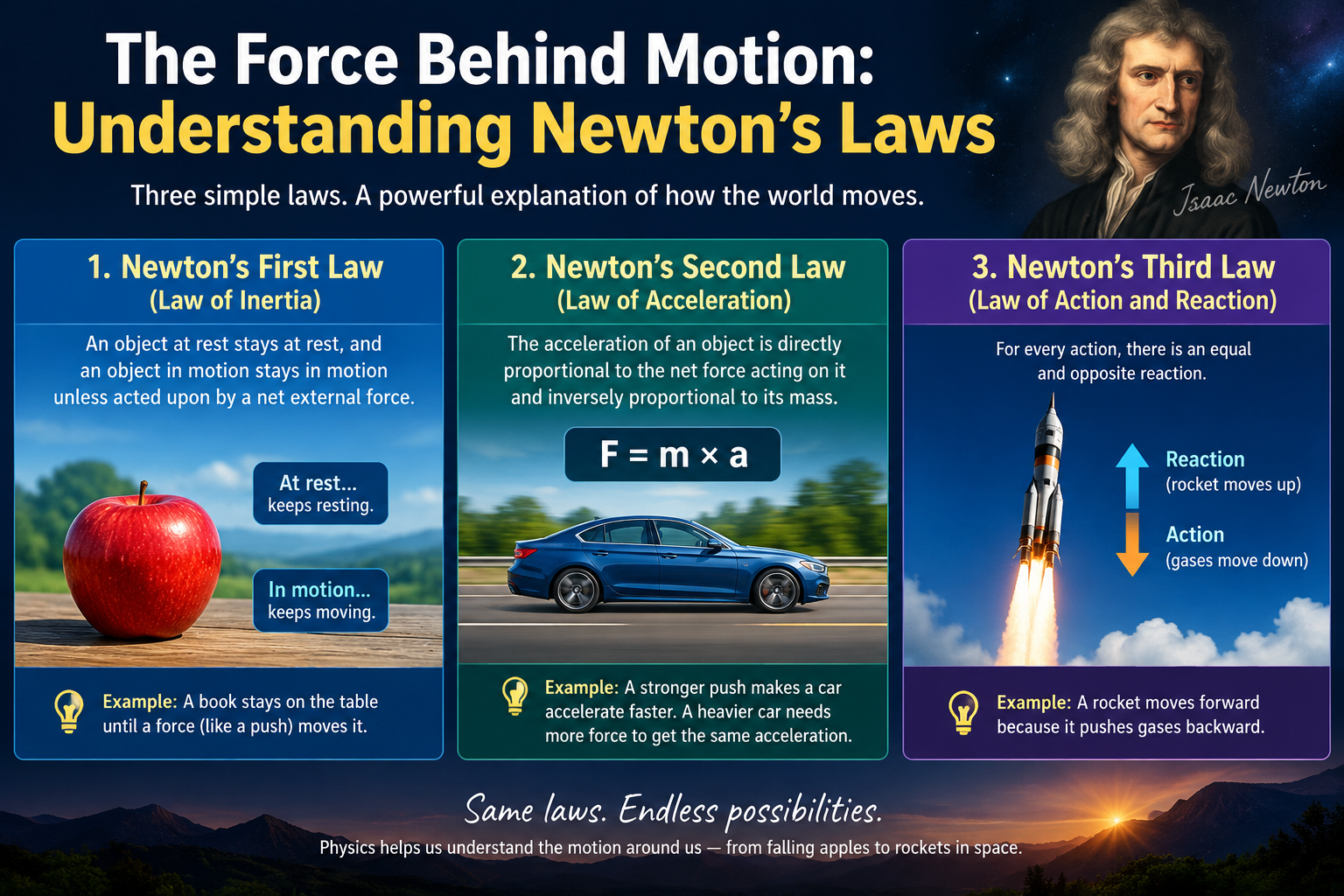
    Newton’s First Law states that an object at rest remains at rest, and an object in motion continues moving at a constant speed in a straight line unless acted upon by an unbalanced external force. This principle explains why a book stays on a table until someone moves it and why passengers tend to move forward when a moving car suddenly stops. Inertia is the natural tendency of objects to resist changes in their state of motion.

    **2. Newton’s Second Law — The Law of Acceleration**

    Newton’s Second Law explains how force, mass, and acceleration are connected. The greater the net force applied to an object, the greater its acceleration. However, a heavier object requires more force than a lighter object to achieve the same acceleration. This relationship is expressed through the famous formula **F = m × a**, where F represents force, m represents mass, and a represents acceleration. This law helps engineers design vehicles, machines, and countless other technologies.

    **3. Newton’s Third Law — The Law of Action and Reaction**

    Newton’s Third Law states that for every action, there is an equal and opposite reaction. Whenever one object exerts a force on another, the second object exerts an equal force in the opposite direction. This principle explains how rockets move forward by pushing exhaust gases backward, how swimmers move through water, and how we walk by pushing against the ground. It reveals the incredible relationship between forces acting on interacting objects.

    **Why Are Newton’s Laws Important?**

    Newton’s laws are essential for understanding the physical world. They help scientists explain motion, engineers develop safer vehicles, athletes improve their performance, and space agencies calculate the movements of spacecraft. These principles are used in transportation, construction, robotics, aviation, sports science, and space exploration. By understanding these laws, students can develop stronger scientific thinking and see how classroom physics connects to real-life experiences.

    **Explore the Science Behind Everyday Motion!**

    Physics is more than formulas and equations; it is a way to understand the world around us. Every moving bicycle, bouncing ball, accelerating car, and launching rocket demonstrates the fascinating principles of force and motion. Learning Newton’s laws opens the door to deeper discoveries in science, technology, engineering, and mathematics.

    Join us on this exciting journey to discover how simple scientific principles explain some of the most extraordinary movements in our universe. Keep asking questions, stay curious, and never stop exploring the wonders of science!

    **Learn the Laws. Understand the Forces. Discover the Science of Motion!**

    Like, share, and follow for more educational content, fascinating science topics, and easy-to-understand explanations that make learning enjoyable!

    #NewtonsLaws #ForceAndMotion #Physics #ScienceEducation #IsaacNewton #LawOfInertia #Acceleration #ActionAndReaction #PhysicsExplained #ScienceFacts #STEMEducation #EducationalVideos #LearnScience #ScientificDiscoveries #SpaceExploration #KnowledgeIsPower
    RSIF8 Roll no:14 story no:24 story topic:The Force Behind Motion: Understanding Newton’s Laws ๐Ÿš€ **The Force Behind Motion: Understanding Newton’s Laws** ๐ŸŒ๐Ÿ”ฌ Welcome to the fascinating world of physics, where forces, motion, and energy work together to explain how our universe operates! ๐ŸŒŒ In this educational journey, we explore **Newton’s Three Laws of Motion**, some of the most important principles in science that help us understand why objects move, how they change speed, and how forces affect everything around us. From a simple falling apple to a speeding car and a powerful rocket launching into space, Newton’s laws are everywhere in our daily lives! ๐ŸŽ๐Ÿš—๐Ÿš€ ๐Ÿ“˜ **1. Newton’s First Law — The Law of Inertia** Newton’s First Law states that an object at rest remains at rest, and an object in motion continues moving at a constant speed in a straight line unless acted upon by an unbalanced external force. This principle explains why a book stays on a table until someone moves it and why passengers tend to move forward when a moving car suddenly stops. Inertia is the natural tendency of objects to resist changes in their state of motion. โšก **2. Newton’s Second Law — The Law of Acceleration** Newton’s Second Law explains how force, mass, and acceleration are connected. The greater the net force applied to an object, the greater its acceleration. However, a heavier object requires more force than a lighter object to achieve the same acceleration. This relationship is expressed through the famous formula **F = m × a**, where F represents force, m represents mass, and a represents acceleration. This law helps engineers design vehicles, machines, and countless other technologies. ๐ŸŒŸ **3. Newton’s Third Law — The Law of Action and Reaction** Newton’s Third Law states that for every action, there is an equal and opposite reaction. Whenever one object exerts a force on another, the second object exerts an equal force in the opposite direction. This principle explains how rockets move forward by pushing exhaust gases backward, how swimmers move through water, and how we walk by pushing against the ground. It reveals the incredible relationship between forces acting on interacting objects. ๐Ÿ” **Why Are Newton’s Laws Important?** Newton’s laws are essential for understanding the physical world. They help scientists explain motion, engineers develop safer vehicles, athletes improve their performance, and space agencies calculate the movements of spacecraft. These principles are used in transportation, construction, robotics, aviation, sports science, and space exploration. By understanding these laws, students can develop stronger scientific thinking and see how classroom physics connects to real-life experiences. ๐Ÿ’ก **Explore the Science Behind Everyday Motion!** Physics is more than formulas and equations; it is a way to understand the world around us. Every moving bicycle, bouncing ball, accelerating car, and launching rocket demonstrates the fascinating principles of force and motion. Learning Newton’s laws opens the door to deeper discoveries in science, technology, engineering, and mathematics. Join us on this exciting journey to discover how simple scientific principles explain some of the most extraordinary movements in our universe. Keep asking questions, stay curious, and never stop exploring the wonders of science! ๐ŸŒโœจ ๐ŸŽฏ **Learn the Laws. Understand the Forces. Discover the Science of Motion!** ๐Ÿ‘ Like, share, and follow for more educational content, fascinating science topics, and easy-to-understand explanations that make learning enjoyable! #NewtonsLaws #ForceAndMotion #Physics #ScienceEducation #IsaacNewton #LawOfInertia #Acceleration #ActionAndReaction #PhysicsExplained #ScienceFacts #STEMEducation #EducationalVideos #LearnScience #ScientificDiscoveries #SpaceExploration #KnowledgeIsPower ๐Ÿš€๐Ÿ“š
    0 Comments 0 Shares 4574 Views
  • RSIF8
    Roll no 94
    Story post no 22
    Story post topic
    The Force Behind Motion: Understanding Newton’s Laws
    Motion is all around us—from a moving car to a soaring rocket ! Newton’s Laws of Motion help us understand how forces affect the way objects move. Learning these laws makes physics fun, practical, and easier to understand.
    Discover:
    Law of Inertia
    Law of Acceleration
    Law of Action & Reaction
    Keep exploring, keep learning, and let science inspire your curiosity!
    #NewtonsLaws #Physics #ScienceEducation #STEM #LearningIsFun #ForceAndMotion #ScienceFacts #EducationalPost #PhysicsStudents #Knowledge #StudentLife #ExploreScience
    RSIF8 Roll no 94 Story post no 22 Story post topic ๐Ÿš€๐Ÿ“š The Force Behind Motion: Understanding Newton’s Laws โš–๏ธโœจ Motion is all around us—from a moving car ๐Ÿš— to a soaring rocket ๐Ÿš€! Newton’s Laws of Motion help us understand how forces affect the way objects move. Learning these laws makes physics fun, practical, and easier to understand. ๐ŸŒŸ๐Ÿ”ฌ ๐Ÿ’ก Discover: ๐Ÿ”น Law of Inertia ๐Ÿ”น Law of Acceleration ๐Ÿ”น Law of Action & Reaction Keep exploring, keep learning, and let science inspire your curiosity! ๐ŸŒ๐Ÿ“–โœจ #NewtonsLaws #Physics #ScienceEducation #STEM #LearningIsFun #ForceAndMotion #ScienceFacts #EducationalPost #PhysicsStudents #Knowledge #StudentLife #ExploreScience ๐Ÿš€๐Ÿ“š๐Ÿ”ฌโœจ๐ŸŒŸ
    0 Comments 0 Shares 2203 Views
  • Mohsin RS F8
    Story post NO:18
    roll NO:13
    Class: Foundation Level
    Made by Me

    The Force Behind Motion: Understanding Newton’s Laws

    Motion is one of the most important ideas in physics. Everything around us is constantly affected by forces, whether we notice them or not. A ball rolling across the ground, a car accelerating on a road, a bicycle slowing down, a person jumping, and a rocket launching into space are all examples of motion caused or changed by forces. To understand these everyday movements, scientists use fundamental principles known as Newton’s Laws of Motion.

    Sir Isaac Newton developed his three laws of motion in the 17th century, and they became a foundation of classical physics. These laws help explain the relationship between force, mass, and motion. They allow us to understand not only simple movements around us but also complicated systems involving machines, vehicles, sports, engineering, and space exploration.

    The First Law of Motion, often called the Law of Inertia, explains that an object at rest tends to remain at rest, while an object in motion tends to continue moving in the same direction and at the same speed unless an external force acts upon it. In everyday life, we can see this when a football remains still until someone kicks it. Similarly, when a moving car suddenly stops, passengers tend to move forward because their bodies were already in motion. This law teaches us that objects do not naturally change their motion without a force acting on them.

    The Second Law of Motion explains how force affects the acceleration of an object. It is commonly represented by the equation F = m × a, meaning that force is equal to mass multiplied by acceleration. This law shows that applying a greater force can produce greater acceleration, while an object with greater mass requires more force to achieve the same acceleration. For example, pushing an empty shopping cart is usually easier than pushing a heavily loaded one. This principle is extremely important in the design of vehicles, machines, sports equipment, and many engineering systems.

    The Third Law of Motion states that for every action, there is an equal and opposite
    Mohsin RS F8 ๐ŸŽ“โœจ Story post NO:18 roll NO:13 Class: Foundation Level ๐Ÿ“š Made by Me ๐Ÿ’ป๐Ÿš€ The Force Behind Motion: Understanding Newton’s Laws โšก๐Ÿ”ฌ๐Ÿš€ Motion is one of the most important ideas in physics. Everything around us is constantly affected by forces, whether we notice them or not. A ball rolling across the ground, a car accelerating on a road, a bicycle slowing down, a person jumping, and a rocket launching into space are all examples of motion caused or changed by forces. To understand these everyday movements, scientists use fundamental principles known as Newton’s Laws of Motion. Sir Isaac Newton developed his three laws of motion in the 17th century, and they became a foundation of classical physics. These laws help explain the relationship between force, mass, and motion. They allow us to understand not only simple movements around us but also complicated systems involving machines, vehicles, sports, engineering, and space exploration. The First Law of Motion, often called the Law of Inertia, explains that an object at rest tends to remain at rest, while an object in motion tends to continue moving in the same direction and at the same speed unless an external force acts upon it. In everyday life, we can see this when a football remains still until someone kicks it. Similarly, when a moving car suddenly stops, passengers tend to move forward because their bodies were already in motion. This law teaches us that objects do not naturally change their motion without a force acting on them. The Second Law of Motion explains how force affects the acceleration of an object. It is commonly represented by the equation F = m × a, meaning that force is equal to mass multiplied by acceleration. This law shows that applying a greater force can produce greater acceleration, while an object with greater mass requires more force to achieve the same acceleration. For example, pushing an empty shopping cart is usually easier than pushing a heavily loaded one. This principle is extremely important in the design of vehicles, machines, sports equipment, and many engineering systems. The Third Law of Motion states that for every action, there is an equal and opposite
    0 Comments 0 Shares 1335 Views
  • ACCL Day 153 — Story: The Force Behind Motion: Understanding Newton’s Laws

    The sun was barely up when the science lab doors slid open, and young Ayan stepped inside. Today wasn’t just any day — it was the day he finally understood why things move the way they do.

    As he placed a small toy car on the table, Sir Imran walked in with his usual smile.
    “Ready to learn how the universe pushes you around?” he joked.

    Ayan nodded.

    “Good,” Sir Imran said. “Let’s talk Newton.”

    First Law — The Law of Inertia

    Ayan flicked the toy car lightly. It moved… then stopped.
    “Why did it stop?” Sir Imran asked.
    “Because I stopped pushing it,” Ayan replied.
    “No,” Sir Imran grinned. “It stopped because friction pushed back. Without any forces, things keep going forever.”

    Ayan imagined a car flying endlessly through space — no brakes, no slowing down.
    So that’s inertia, he thought.
    Objects don’t stop unless something forces them to.

    Second Law — F = ma

    Sir Imran handed him two identical cars: one empty, one full of metal weights.
    “Push them both,” he ordered.

    Ayan pushed.
    The light car zoomed. The heavy one crawled.

    “The heavier something is, the more force you need,” Sir Imran explained. “Force equals mass times acceleration. Simple math — powerful truth.”

    Ayan felt like he had just unlocked a secret code of the universe.

    Third Law — Action & Reaction

    Finally, Sir Imran placed a balloon car on the table.
    “Let go.”

    WOOSH! The balloon shot air backwards — the car zoomed forward.

    “For every action,” Sir Imran said, “there’s an equal and opposite reaction. The universe always responds.”

    Ayan watched the car bounce off the wall and laughed.
    It wasn’t just science… it felt like magic.

    The Lesson of the Day

    As Ayan packed up, he whispered to himself:
    “Everything moves for a reason. Forces shape every step we take.”

    Walking out of the lab, he felt the world differently — every motion, every push, every reaction suddenly made sense.

    Newton wasn’t just writing laws.
    He was explaining the story written into every moment of our lives.
    ACCL Day 153 — Story: The Force Behind Motion: Understanding Newton’s Laws The sun was barely up when the science lab doors slid open, and young Ayan stepped inside. Today wasn’t just any day — it was the day he finally understood why things move the way they do. As he placed a small toy car on the table, Sir Imran walked in with his usual smile. “Ready to learn how the universe pushes you around?” he joked. Ayan nodded. “Good,” Sir Imran said. “Let’s talk Newton.” First Law — The Law of Inertia Ayan flicked the toy car lightly. It moved… then stopped. “Why did it stop?” Sir Imran asked. “Because I stopped pushing it,” Ayan replied. “No,” Sir Imran grinned. “It stopped because friction pushed back. Without any forces, things keep going forever.” Ayan imagined a car flying endlessly through space — no brakes, no slowing down. So that’s inertia, he thought. Objects don’t stop unless something forces them to. Second Law — F = ma Sir Imran handed him two identical cars: one empty, one full of metal weights. “Push them both,” he ordered. Ayan pushed. The light car zoomed. The heavy one crawled. “The heavier something is, the more force you need,” Sir Imran explained. “Force equals mass times acceleration. Simple math — powerful truth.” Ayan felt like he had just unlocked a secret code of the universe. Third Law — Action & Reaction Finally, Sir Imran placed a balloon car on the table. “Let go.” WOOSH! The balloon shot air backwards — the car zoomed forward. “For every action,” Sir Imran said, “there’s an equal and opposite reaction. The universe always responds.” Ayan watched the car bounce off the wall and laughed. It wasn’t just science… it felt like magic. The Lesson of the Day As Ayan packed up, he whispered to himself: “Everything moves for a reason. Forces shape every step we take.” Walking out of the lab, he felt the world differently — every motion, every push, every reaction suddenly made sense. Newton wasn’t just writing laws. He was explaining the story written into every moment of our lives.
    0 Comments 0 Shares 1064 Views
  • Mohsin RS F8
    Story post NO:18
    roll NO:13
    Class: Foundation Level
    Made by Me

    The Force Behind Motion: Understanding Newton’s Laws

    Motion is one of the most important ideas in physics. Everything around us is constantly affected by forces, whether we notice them or not. A ball rolling across the ground, a car accelerating on a road, a bicycle slowing down, a person jumping, and a rocket launching into space are all examples of motion caused or changed by forces. To understand these everyday movements, scientists use fundamental principles known as Newton’s Laws of Motion.

    Sir Isaac Newton developed his three laws of motion in the 17th century, and they became a foundation of classical physics. These laws help explain the relationship between force, mass, and motion. They allow us to understand not only simple movements around us but also complicated systems involving machines, vehicles, sports, engineering, and space exploration.

    The First Law of Motion, often called the Law of Inertia, explains that an object at rest tends to remain at rest, while an object in motion tends to continue moving in the same direction and at the same speed unless an external force acts upon it. In everyday life, we can see this when a football remains still until someone kicks it. Similarly, when a moving car suddenly stops, passengers tend to move forward because their bodies were already in motion. This law teaches us that objects do not naturally change their motion without a force acting on them.

    The Second Law of Motion explains how force affects the acceleration of an object. It is commonly represented by the equation F = m × a, meaning that force is equal to mass multiplied by acceleration. This law shows that applying a greater force can produce greater acceleration, while an object with greater mass requires more force to achieve the same acceleration. For example, pushing an empty shopping cart is usually easier than pushing a heavily loaded one. This principle is extremely important in the design of vehicles, machines, sports equipment, and many engineering systems.

    The Third Law of Motion states that for every action, there is an equal and opposite
    Mohsin RS F8 ๐ŸŽ“โœจ Story post NO:18 roll NO:13 Class: Foundation Level ๐Ÿ“š Made by Me ๐Ÿ’ป๐Ÿš€ The Force Behind Motion: Understanding Newton’s Laws โšก๐Ÿ”ฌ๐Ÿš€ Motion is one of the most important ideas in physics. Everything around us is constantly affected by forces, whether we notice them or not. A ball rolling across the ground, a car accelerating on a road, a bicycle slowing down, a person jumping, and a rocket launching into space are all examples of motion caused or changed by forces. To understand these everyday movements, scientists use fundamental principles known as Newton’s Laws of Motion. Sir Isaac Newton developed his three laws of motion in the 17th century, and they became a foundation of classical physics. These laws help explain the relationship between force, mass, and motion. They allow us to understand not only simple movements around us but also complicated systems involving machines, vehicles, sports, engineering, and space exploration. The First Law of Motion, often called the Law of Inertia, explains that an object at rest tends to remain at rest, while an object in motion tends to continue moving in the same direction and at the same speed unless an external force acts upon it. In everyday life, we can see this when a football remains still until someone kicks it. Similarly, when a moving car suddenly stops, passengers tend to move forward because their bodies were already in motion. This law teaches us that objects do not naturally change their motion without a force acting on them. The Second Law of Motion explains how force affects the acceleration of an object. It is commonly represented by the equation F = m × a, meaning that force is equal to mass multiplied by acceleration. This law shows that applying a greater force can produce greater acceleration, while an object with greater mass requires more force to achieve the same acceleration. For example, pushing an empty shopping cart is usually easier than pushing a heavily loaded one. This principle is extremely important in the design of vehicles, machines, sports equipment, and many engineering systems. The Third Law of Motion states that for every action, there is an equal and opposite
    0 Comments 0 Shares 1323 Views
  • RSIF8
    Roll no: 99
    Story post no: 23
    Story topic: The Force Behind Motion: Understanding Newton's Laws
    Newton’s laws of motion form the foundation of classical mechanics and help us understand how forces affect the movement of objects. From a moving car to a falling object, these laws explain motion in everyday life and across the universe.
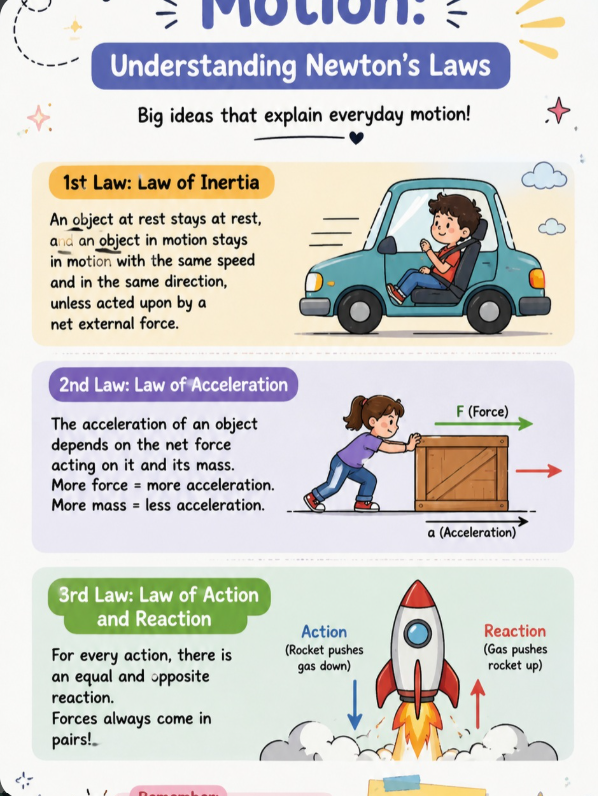
    The First Law introduces inertia, explaining that an object remains at rest or in motion unless acted upon by an external force. The Second Law connects force, mass, and acceleration through the equation F = ma. The Third Law states that every action has an equal and opposite reaction.
    Together, Newton’s laws provide a powerful framework for understanding motion and show how simple principles can explain complex physical phenomena.
    #NewtonLaws #Physics #Newton #Motion #Force #ClassicalMechanics #ScienceEducation #PhysicsEducation #STEM #LearnPhysics #Education
    RSIF8 Roll no: 99 Story post no: 23 Story topic: The Force Behind Motion: Understanding Newton's Laws Newton’s laws of motion form the foundation of classical mechanics and help us understand how forces affect the movement of objects. From a moving car to a falling object, these laws explain motion in everyday life and across the universe. The First Law introduces inertia, explaining that an object remains at rest or in motion unless acted upon by an external force. The Second Law connects force, mass, and acceleration through the equation F = ma. The Third Law states that every action has an equal and opposite reaction. Together, Newton’s laws provide a powerful framework for understanding motion and show how simple principles can explain complex physical phenomena. #NewtonLaws #Physics #Newton #Motion #Force #ClassicalMechanics #ScienceEducation #PhysicsEducation #STEM #LearnPhysics #Education
    0 Comments 0 Shares 2367 Views
  • #rsisb
    Roll No 253
    Foundation Level
    Story Post 23

    # The Force Behind Motion: Understanding Newton’s Laws

    Imagine watching a football fly through the air , a car accelerate down a road , a rocket launch into space , or planets orbiting a star .

    These events may appear completely different—but beneath them is the same fundamental idea:

    ## **Forces control motion.**

    More than three centuries ago, **Isaac Newton** developed three laws that transformed our understanding of how objects move and interact. These laws became the foundation of classical mechanics and remain essential to physics, engineering, astronomy, and countless technologies today.

    ---

    # 1. What Are Newton's Laws?

    Newton's three laws describe the relationship between:

    **Force**
    **Mass**
    **Acceleration**
    **Motion**

    Together, they help us explain why objects remain still, why they accelerate, and how forces interact.

    From a rolling ball to a spacecraft , the same fundamental principles apply.

    ### **Three simple laws. Infinite applications.**

    ---

    # 2. Newton's First Law — The Law of Inertia

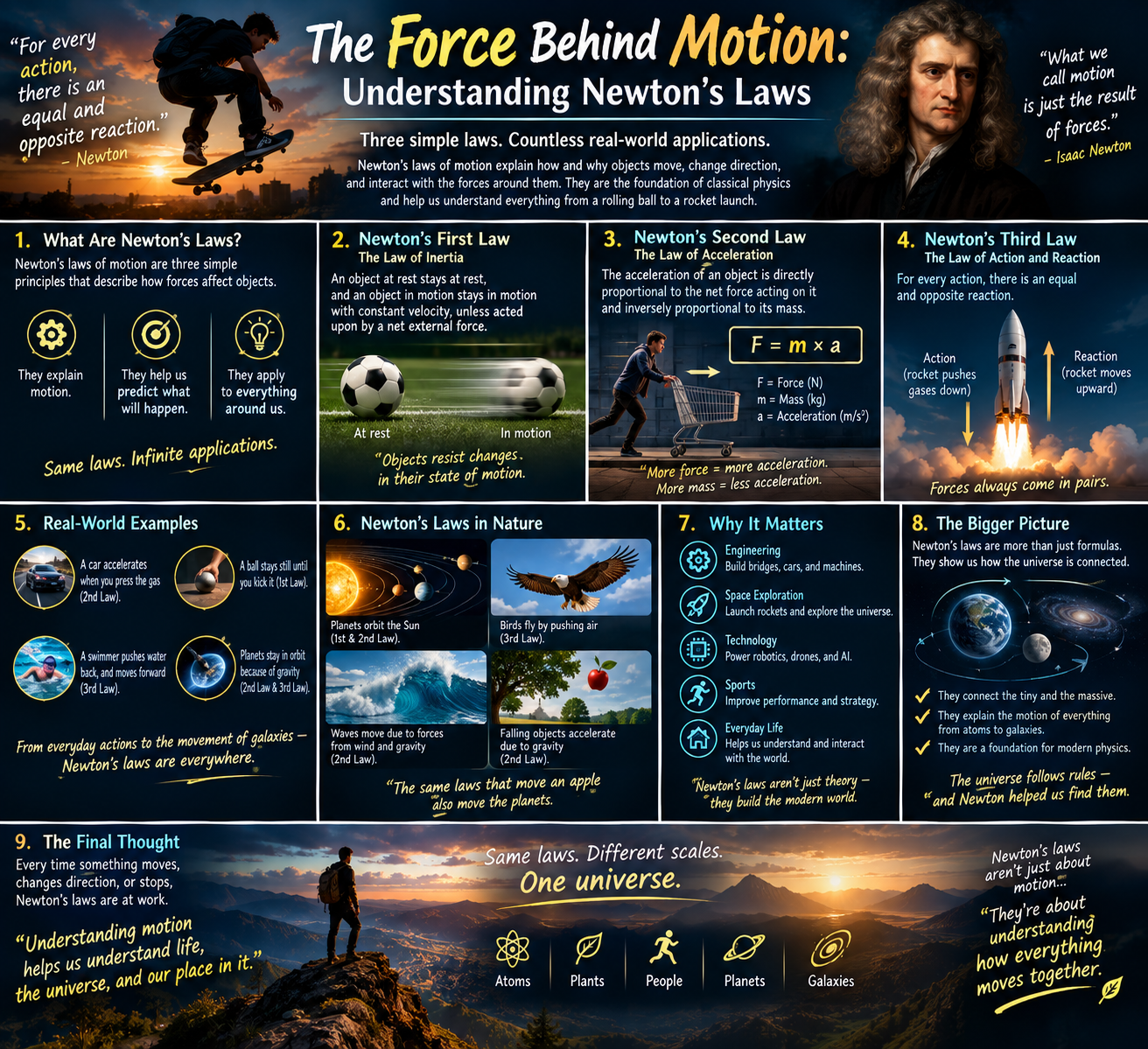
    Newton's First Law states that an object at rest remains at rest, while an object in motion continues moving at constant velocity unless acted upon by a net external force.

    This property is called **inertia**.

    Imagine a football sitting on the ground.

    It stays there until you kick it.

    Once moving, it won't naturally change its motion unless another force acts on it—such as friction, air resistance, or another object.

    A car requires braking to stop.
    A ball slows because of friction.
    Objects in space can continue moving with very little resistance.

    ### **Objects resist changes in their state of motion.**

    ---

    # 3. Newton's Second Law — The Law of Acceleration

    The second law explains how force changes motion.

    Its famous equation is:

    # **F = m × a**

    Where:

    **F** = Force
    **m** = Mass
    **a** = Acceleration

    This means that increasing the net force on an object generally increases its acceleration, while increasing the object's mass makes the same force produce less acceleration.

    Imagine pushing an empty shopping cart .

    It accelerates easily.

    Now fill it with heavy objects.

    The same push produces less acceleration.

    ### **More net force → more acceleration.**

    ### **More mass → less acceleration for the same force.**

    This simple relationship powers everything from vehicle design to rocket engineering .

    ---

    # 4. Newton's Third Law — Action and Reaction

    Newton's Third Law states:

    ### **For every action, there is an equal and opposite reaction.**

    Forces always occur through interactions between objects.

    Consider a rocket.

    The engine pushes hot gases downward and backward.

    The gases exert an equal and opposite force on the rocket, pushing it upward.

    The same principle appears everywhere:

    A swimmer pushes water backward → the water pushes the swimmer forward.
    A bird pushes air downward → the air helps push the bird upward.
    You push the ground backward → the ground pushes you forward.

    ### **Forces come in pairs.**

    ---

    # 5. Newton's Laws in Everyday Life

    You don't need a laboratory to see Newton's laws.

    They are happening around you constantly.

    **Cars:** Engine force changes speed and direction.
    **Sports:** Kicking a ball changes its motion.
    **Swimming:** Pushing water creates forward motion.
    **Cycling:** Pedaling produces forces that accelerate the bicycle.
    **Falling objects:** Gravity changes their motion.
    **Skateboards:** Pushing against the ground creates movement.

    Everyday motion is essentially a continuous interaction between forces.

    ---

    # 6. Newton's Laws in Nature

    Newton's laws don't stop at Earth.

    They also help describe motion throughout the universe.

    Planets orbit stars.
    Moons orbit planets.
    Comets travel through space.
    Waves respond to forces.
    Birds generate lift through interactions with air.
    Objects accelerate under gravity.

    The same physics that explains a falling apple can help describe the motion of enormous celestial bodies.

    ### **From apples to planets, the same laws operate across nature.**

    ---

    # 7. Why Newton's Laws Matter

    Newton's laws are more than equations in a textbook.

    They are essential tools for understanding and designing the physical world.

    **Engineering** — bridges, buildings, vehicles, and machines
    **Space exploration** — rockets, spacecraft, and orbital motion
    **Technology** — robots, drones, and automated systems
    **Sports science** — movement, speed, and performance
    **Transportation** — cars, aircraft, and trains

    Modern technology depends heavily on our ability to predict how forces produce motion.

    ---

    # 8. The Bigger Picture

    Newton's laws reveal something remarkable:

    The universe is not simply a collection of random movements.

    Objects interact through measurable forces.

    From microscopic particles to massive planets and galaxies , physics provides mathematical relationships that help us understand motion.

    The scale may change.

    The objects may change.

    But the underlying principles remain incredibly powerful.

    ### **Tiny or massive. Fast or slow. Earth or space. Motion follows physical laws.**

    ---

    # 9. The Final Thought

    Every time something moves…

    Every time something accelerates…

    Every time something changes direction…

    **Newton's laws are there.**

    A skateboard rolling down a street
    A bird taking flight
    A rocket leaving Earth
    A planet orbiting the Sun

    Different events.

    Different scales.

    One underlying framework.

    ## **Same laws. Different scales. One universe.**

    Understanding motion isn't just about solving equations.

    It's about understanding **how the physical world moves, interacts, and holds together.**

    ### **Once you understand the forces behind motion, the world around you begins to move in a whole new way.**


    Asma Shaheen EducationWali
    Saima Empowerment Wali
    Mishaal TrainingWali
    #rsisb Roll No 253 Foundation Level Story Post 23 # โšก๐ŸŒŒ The Force Behind Motion: Understanding Newton’s Laws Imagine watching a football fly through the air โšฝ, a car accelerate down a road ๐Ÿš—๐Ÿ’จ, a rocket launch into space ๐Ÿš€, or planets orbiting a star ๐Ÿชโœจ. These events may appear completely different—but beneath them is the same fundamental idea: ## **Forces control motion.** โšก๐Ÿงฒ More than three centuries ago, **Isaac Newton** developed three laws that transformed our understanding of how objects move and interact. These laws became the foundation of classical mechanics and remain essential to physics, engineering, astronomy, and countless technologies today. ๐Ÿ”ฌโš™๏ธ๐ŸŒ --- # ๐Ÿง โšก 1. What Are Newton's Laws? Newton's three laws describe the relationship between: โšก **Force** ๐Ÿงฑ **Mass** ๐Ÿ’จ **Acceleration** ๐Ÿƒ **Motion** Together, they help us explain why objects remain still, why they accelerate, and how forces interact. From a rolling ball ๐ŸŽพ to a spacecraft ๐Ÿš€, the same fundamental principles apply. ### **Three simple laws. Infinite applications.** ๐ŸŒŒ --- # ๐Ÿ›‘โžก๏ธ 2. Newton's First Law — The Law of Inertia Newton's First Law states that an object at rest remains at rest, while an object in motion continues moving at constant velocity unless acted upon by a net external force. This property is called **inertia**. ๐Ÿงฑโšก Imagine a football sitting on the ground. โšฝ It stays there until you kick it. Once moving, it won't naturally change its motion unless another force acts on it—such as friction, air resistance, or another object. ๐Ÿš— A car requires braking to stop. โšฝ A ball slows because of friction. ๐Ÿ›ฐ๏ธ Objects in space can continue moving with very little resistance. ### **Objects resist changes in their state of motion.** --- # ๐Ÿ’จโš™๏ธ 3. Newton's Second Law — The Law of Acceleration The second law explains how force changes motion. Its famous equation is: # **F = m × a** โšก Where: **F** = Force ๐Ÿงฒ **m** = Mass โš–๏ธ **a** = Acceleration ๐Ÿ’จ This means that increasing the net force on an object generally increases its acceleration, while increasing the object's mass makes the same force produce less acceleration. Imagine pushing an empty shopping cart ๐Ÿ›’. It accelerates easily. Now fill it with heavy objects. The same push produces less acceleration. ### **More net force → more acceleration.** ### **More mass → less acceleration for the same force.** This simple relationship powers everything from vehicle design ๐Ÿš— to rocket engineering ๐Ÿš€. --- # ๐Ÿš€๐Ÿ”ฅ 4. Newton's Third Law — Action and Reaction Newton's Third Law states: ### **For every action, there is an equal and opposite reaction.** โšก Forces always occur through interactions between objects. Consider a rocket. ๐Ÿš€ The engine pushes hot gases downward and backward. The gases exert an equal and opposite force on the rocket, pushing it upward. โฌ†๏ธ๐Ÿ”ฅ The same principle appears everywhere: ๐ŸŠ A swimmer pushes water backward → the water pushes the swimmer forward. ๐Ÿฆ… A bird pushes air downward → the air helps push the bird upward. ๐Ÿšถ You push the ground backward → the ground pushes you forward. ### **Forces come in pairs.** ๐Ÿ”—โšก --- # ๐ŸŒโšฝ 5. Newton's Laws in Everyday Life You don't need a laboratory to see Newton's laws. They are happening around you constantly. ๐Ÿš— **Cars:** Engine force changes speed and direction. โšฝ **Sports:** Kicking a ball changes its motion. ๐ŸŠ **Swimming:** Pushing water creates forward motion. ๐Ÿšฒ **Cycling:** Pedaling produces forces that accelerate the bicycle. ๐ŸŽ **Falling objects:** Gravity changes their motion. ๐Ÿ›น **Skateboards:** Pushing against the ground creates movement. Everyday motion is essentially a continuous interaction between forces. --- # ๐ŸŒŒ๐Ÿช 6. Newton's Laws in Nature Newton's laws don't stop at Earth. They also help describe motion throughout the universe. ๐ŸŒŒ ๐Ÿช Planets orbit stars. ๐ŸŒ™ Moons orbit planets. โ˜„๏ธ Comets travel through space. ๐ŸŒŠ Waves respond to forces. ๐Ÿฆ… Birds generate lift through interactions with air. ๐ŸŽ Objects accelerate under gravity. The same physics that explains a falling apple can help describe the motion of enormous celestial bodies. ### **From apples to planets, the same laws operate across nature.** ๐ŸŽโžก๏ธ๐Ÿช --- # โš™๏ธ๐Ÿš€ 7. Why Newton's Laws Matter Newton's laws are more than equations in a textbook. They are essential tools for understanding and designing the physical world. ๐Ÿ—๏ธ **Engineering** — bridges, buildings, vehicles, and machines ๐Ÿš€ **Space exploration** — rockets, spacecraft, and orbital motion ๐Ÿค– **Technology** — robots, drones, and automated systems ๐Ÿƒ **Sports science** — movement, speed, and performance ๐Ÿš— **Transportation** — cars, aircraft, and trains Modern technology depends heavily on our ability to predict how forces produce motion. --- # ๐ŸŒŒ๐Ÿ”ญ 8. The Bigger Picture Newton's laws reveal something remarkable: The universe is not simply a collection of random movements. Objects interact through measurable forces. โš›๏ธ๐Ÿงฒ From microscopic particles ๐Ÿ”ฌ to massive planets ๐Ÿช and galaxies ๐ŸŒŒ, physics provides mathematical relationships that help us understand motion. The scale may change. The objects may change. But the underlying principles remain incredibly powerful. ### **Tiny or massive. Fast or slow. Earth or space. Motion follows physical laws.** โšก๐ŸŒ๐ŸŒŒ --- # ๐ŸŒ…โšก 9. The Final Thought Every time something moves… Every time something accelerates… Every time something changes direction… **Newton's laws are there.** ๐Ÿง โšก A skateboard rolling down a street ๐Ÿ›น A bird taking flight ๐Ÿฆ… A rocket leaving Earth ๐Ÿš€ A planet orbiting the Sun โ˜€๏ธ๐Ÿช Different events. Different scales. One underlying framework. ## ๐ŸŒŒ **Same laws. Different scales. One universe.** Understanding motion isn't just about solving equations. It's about understanding **how the physical world moves, interacts, and holds together.** โš›๏ธ๐ŸŒโœจ ### **Once you understand the forces behind motion, the world around you begins to move in a whole new way.** โšก๐Ÿ”ฌ๐ŸŒŒ Asma Shaheen EducationWali Saima Empowerment Wali Mishaal TrainingWali
    0 Comments 0 Shares 4241 Views
  • **Foundation Level** **Day 153** **story post** **Roll Number: 005**

    The Force Behind Motion: Understanding Newton’s Laws

    Ever wondered why objects move, stop, or change direction? Isaac Newton’s three laws of motion help us understand the forces behind movement.

    First Law – Inertia: Objects keep their state of motion unless a force changes it.
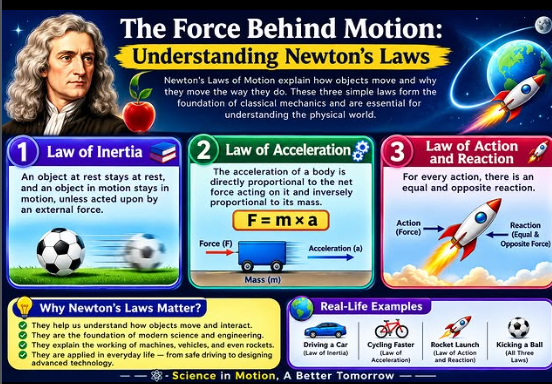
    Second Law – Acceleration: Force, mass, and acceleration are connected by F = m × a.
    Third Law – Action & Reaction: Every action has an equal and opposite reaction.

    From a rolling ball to a launching rocket , Newton’s laws are working all around us!

    #NewtonLaws #Physics #Science #Motion #Force #Education #ScienceExplained #PhysicsForStudents #LearningScience #InstagramEducation
    **Foundation Level** **Day 153** **story post** **Roll Number: 005** ๐Ÿš€ The Force Behind Motion: Understanding Newton’s Laws โšก Ever wondered why objects move, stop, or change direction? ๐ŸŒ Isaac Newton’s three laws of motion help us understand the forces behind movement. ๐Ÿ”น First Law – Inertia: Objects keep their state of motion unless a force changes it. ๐Ÿ”น Second Law – Acceleration: Force, mass, and acceleration are connected by F = m × a. ๐Ÿ”น Third Law – Action & Reaction: Every action has an equal and opposite reaction. From a rolling ball โšฝ to a launching rocket ๐Ÿš€, Newton’s laws are working all around us! #NewtonLaws #Physics #Science #Motion #Force #Education #ScienceExplained #PhysicsForStudents #LearningScience #InstagramEducation
    0 Comments 0 Shares 2529 Views
  • #rsisb
    Roll no.247
    Foundation level **The Force Behind Motion: Understanding Newton’s Laws**

    Have you ever wondered why objects move, stop, speed up, slow down, or change direction? The answer lies in one of the most important ideas in physics: **Newton’s Laws of Motion!**

    In this fascinating journey, we explore the three laws developed by **Sir Isaac Newton**, which help us understand how forces affect the motion of objects. ‍ From a ball rolling across the ground to a rocket launching into space , Newton’s laws are everywhere around us!

    **Newton’s First Law – The Law of Inertia:**
    An object tends to remain at rest or keep moving in a straight line unless an external force acts upon it. This explains why objects don’t simply change their motion on their own.

    **Newton’s Second Law – Force and Acceleration:**
    This law shows how force, mass, and acceleration are connected. The famous equation **F = ma** helps us understand why applying more force can produce greater acceleration.

    **Newton’s Third Law – Action and Reaction:**
    For every action, there is an equal and opposite reaction. This principle helps explain how we walk, swim, jump, and even how rockets move upward! ‍‍

    Newton’s laws are not just formulas written in a textbook—they are principles that describe motion in our everyday lives. Whether you are riding a bicycle , playing sports , pushing a door , or watching a car accelerate , physics is working all around you!

    In this topic, we’ll discover how **force, mass, acceleration, inertia, and action-reaction pairs** work together to explain the motion we see every day. It’s a perfect opportunity for students, science lovers, and curious minds to explore the amazing world of physics.

    **Key Topics:**
    Newton’s Three Laws of Motion
    Understanding Force and Motion
    Inertia and Mass
    Force, Mass & Acceleration
    Action and Reaction
    Real-Life Examples of Newton’s Laws
    The Role of Physics in Everyday Life
    Applications in Transportation, Sports, Space, and Engineering

    **Physics is everywhere!** Once you understand Newton’s laws, ordinary movements can become extraordinary scientific discoveries. So get ready to explore the forces that shape motion and uncover the science behind the world around us!

    Like, share, and follow for more exciting educational content!

    #NewtonLaws #NewtonLawsOfMotion #Physics #ForceAndMotion #Science #PhysicsEducation #ScienceForStudents #Newton #IsaacNewton #LawOfInertia #Acceleration #Force #Mass #Motion #ActionAndReaction #FEqualsMA #STEM #ScienceLearning #PhysicsExplained #LearnPhysics #EducationalVideo #ScienceEducation #AmazingScience #EverydayPhysics #SpaceScience
    #rsisb Roll no.247 Foundation level ๐Ÿš€โš™๏ธ **The Force Behind Motion: Understanding Newton’s Laws** โš™๏ธ๐Ÿš€ Have you ever wondered why objects move, stop, speed up, slow down, or change direction? ๐ŸŒโœจ The answer lies in one of the most important ideas in physics: **Newton’s Laws of Motion!** ๐Ÿง ๐Ÿ”ฌ In this fascinating journey, we explore the three laws developed by **Sir Isaac Newton**, which help us understand how forces affect the motion of objects. ๐Ÿƒ‍โ™‚๏ธโšฝ๐Ÿš— From a ball rolling across the ground to a rocket launching into space ๐Ÿš€๐ŸŒŒ, Newton’s laws are everywhere around us! ๐Ÿ“š **Newton’s First Law – The Law of Inertia:** An object tends to remain at rest or keep moving in a straight line unless an external force acts upon it. ๐Ÿ›‘โžก๏ธ This explains why objects don’t simply change their motion on their own. โšก **Newton’s Second Law – Force and Acceleration:** This law shows how force, mass, and acceleration are connected. The famous equation **F = ma** helps us understand why applying more force can produce greater acceleration. ๐Ÿ’ช๐Ÿ“ ๐Ÿ”ฅ **Newton’s Third Law – Action and Reaction:** For every action, there is an equal and opposite reaction. ๐ŸŒŸ This principle helps explain how we walk, swim, jump, and even how rockets move upward! ๐Ÿšถ‍โ™‚๏ธ๐ŸŠ‍โ™‚๏ธ๐Ÿš€ ๐ŸŒŽ Newton’s laws are not just formulas written in a textbook—they are principles that describe motion in our everyday lives. Whether you are riding a bicycle ๐Ÿšฒ, playing sports ๐Ÿ€, pushing a door ๐Ÿšช, or watching a car accelerate ๐Ÿš—๐Ÿ’จ, physics is working all around you! ๐Ÿ” In this topic, we’ll discover how **force, mass, acceleration, inertia, and action-reaction pairs** work together to explain the motion we see every day. It’s a perfect opportunity for students, science lovers, and curious minds to explore the amazing world of physics. ๐Ÿงช๐Ÿ“–โœจ ๐ŸŽฏ **Key Topics:** ๐Ÿ”น Newton’s Three Laws of Motion ๐Ÿ”น Understanding Force and Motion ๐Ÿ”น Inertia and Mass ๐Ÿ”น Force, Mass & Acceleration ๐Ÿ”น Action and Reaction ๐Ÿ”น Real-Life Examples of Newton’s Laws ๐Ÿ”น The Role of Physics in Everyday Life ๐Ÿ”น Applications in Transportation, Sports, Space, and Engineering ๐Ÿš—๐Ÿ€๐Ÿš€ ๐ŸŒŸ **Physics is everywhere!** Once you understand Newton’s laws, ordinary movements can become extraordinary scientific discoveries. So get ready to explore the forces that shape motion and uncover the science behind the world around us! ๐ŸŒ๐Ÿ”ฌ๐Ÿ’ซ ๐Ÿ‘ Like, share, and follow for more exciting educational content! ๐Ÿ“šโœจ #NewtonLaws #NewtonLawsOfMotion #Physics #ForceAndMotion #Science #PhysicsEducation #ScienceForStudents #Newton #IsaacNewton #LawOfInertia #Acceleration #Force #Mass #Motion #ActionAndReaction #FEqualsMA #STEM #ScienceLearning #PhysicsExplained #LearnPhysics #EducationalVideo #ScienceEducation #AmazingScience #EverydayPhysics #SpaceScience ๐Ÿš€๐Ÿ”ฌ๐ŸŒ
    0 Comments 0 Shares 9147 Views
More Results