• #rsisb
    Roll no.247
    ChatGPT Image no. 10
    Foundation level

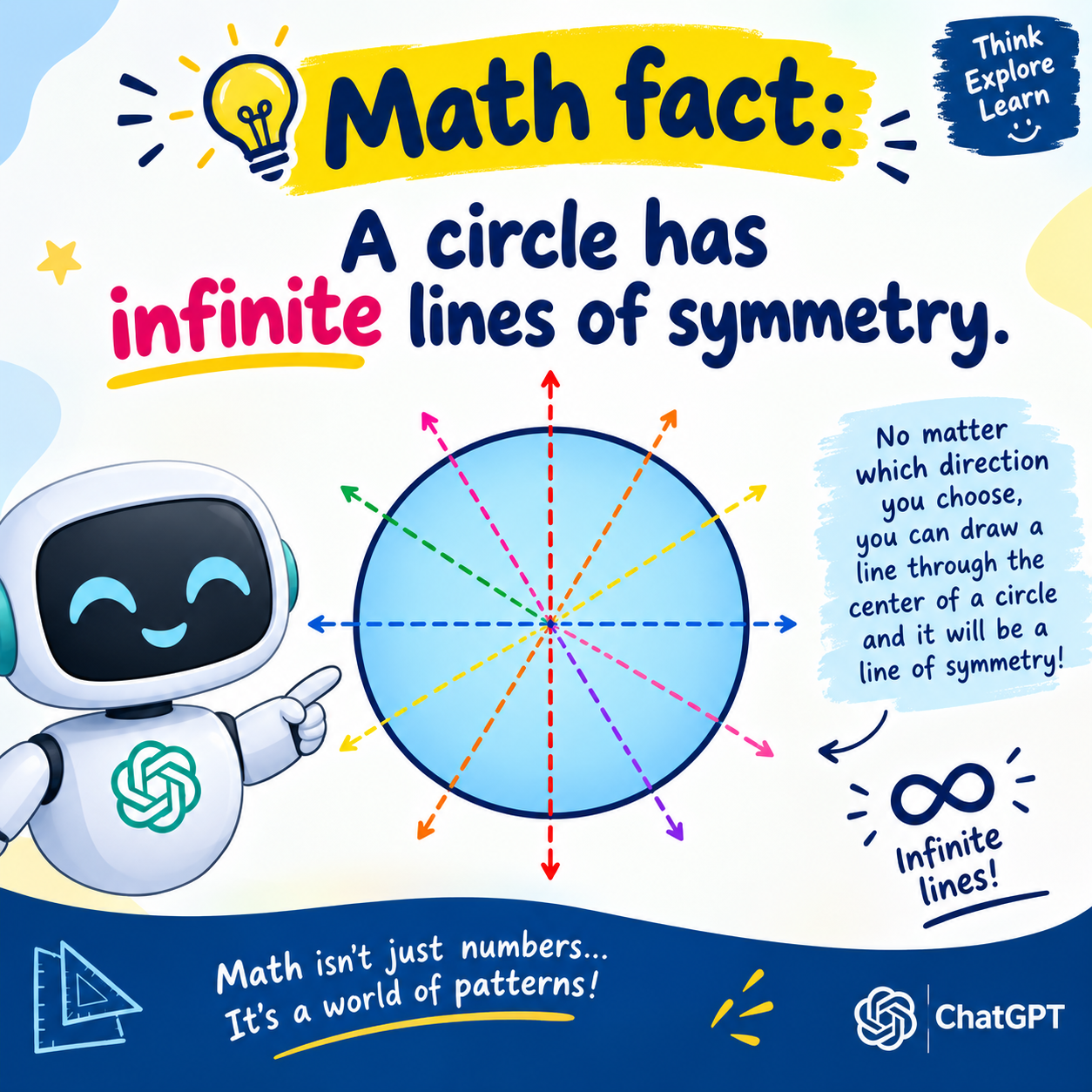
    **MATH FACT: A CIRCLE HAS INFINITE LINES OF SYMMETRY!**

    **Discover the Amazing World of Mathematics!**

    Did you know that a circle has **infinite lines of symmetry**? Yes, it's true! Mathematics is full of amazing facts, and this is one of the most interesting examples!

    **What is a line of symmetry?**

    A line of symmetry is a line that divides a shape into two equal, matching halves. If you fold the shape along that line, both halves fit perfectly on top of each other!

    **Why does a circle have infinite lines of symmetry?**

    Imagine drawing a circle on a piece of paper. Now draw a straight line through its center, dividing it into two equal halves. You can draw this line vertically, horizontally, diagonally, or at almost any angle through the center!

    Every straight line passing through the center of a circle creates two matching halves. Since you can rotate this line through infinitely many different angles, a circle has infinitely many lines of symmetry!

    **Let's explore some fun math facts!**

    A circle has infinite lines of symmetry.

    An equilateral triangle has 3 lines of symmetry.

    A square has 4 lines of symmetry.

    ▭ A rectangle has 2 lines of symmetry.

    Some shapes have no lines of symmetry at all!

    **Why is learning mathematics important?**

    Mathematics helps us develop logical thinking, solve problems, recognize patterns, and understand the world around us. From architecture and engineering to art, science, and technology, math is everywhere!

    **Challenge for you!**

    Can you draw a circle and find five different lines of symmetry? Try it yourself, and then see if you can discover even more! Remember, there is no limit to the number of lines of symmetry a perfect circle has.

    Keep asking questions, keep exploring, and keep learning something new every day! Every little discovery brings you one step closer to becoming a better thinker.

    **Share this amazing math fact with your friends, classmates, teachers, and family!** Let's make learning fun and inspire everyone to discover the beauty of mathematics!

    **Comment below:** What is your favorite mathematical shape, and how many lines of symmetry does it have?

    Keep learning. Keep exploring. Keep discovering!

    #MathFact #Mathematics #Circle #LinesOfSymmetry #Geometry #MathIsFun #DidYouKnow #AmazingFacts #FunWithMath #LearnSomethingNew #Education #STEMEducation #ScienceAndMath #MathLovers #CreativeLearning #KnowledgeIsPower #DailyLearning #EducationalPost #LearningEveryDay #Infinity #CircleSymmetry #SchoolLearning #ExploreMathematics #BrainPower #PostOnAllPlatforms
    #rsisb Roll no.247 ChatGPT Image no. 10 Foundation level ⭕📐 **MATH FACT: A CIRCLE HAS INFINITE LINES OF SYMMETRY!** 🧠✨ 🌟🔢 **Discover the Amazing World of Mathematics!** 🔢🌟 Did you know that a circle has **infinite lines of symmetry**? 🤯⭕ Yes, it's true! Mathematics is full of amazing facts, and this is one of the most interesting examples! 🎉📚 🔍 **What is a line of symmetry?** A line of symmetry is a line that divides a shape into two equal, matching halves. If you fold the shape along that line, both halves fit perfectly on top of each other! ✂️📏 ⭕ **Why does a circle have infinite lines of symmetry?** Imagine drawing a circle on a piece of paper. 📝 Now draw a straight line through its center, dividing it into two equal halves. You can draw this line vertically, horizontally, diagonally, or at almost any angle through the center! 🎯 Every straight line passing through the center of a circle creates two matching halves. Since you can rotate this line through infinitely many different angles, a circle has infinitely many lines of symmetry! ♾️💡 🌈 **Let's explore some fun math facts!** 🔵 A circle has infinite lines of symmetry. 🔺 An equilateral triangle has 3 lines of symmetry. 🟦 A square has 4 lines of symmetry. ▭ A rectangle has 2 lines of symmetry. ⭐ Some shapes have no lines of symmetry at all! 🚀 **Why is learning mathematics important?** Mathematics helps us develop logical thinking, solve problems, recognize patterns, and understand the world around us. From architecture and engineering to art, science, and technology, math is everywhere! 🌍🏗️🔬 💭 **Challenge for you!** Can you draw a circle and find five different lines of symmetry? ⭕✏️ Try it yourself, and then see if you can discover even more! Remember, there is no limit to the number of lines of symmetry a perfect circle has. ♾️ 🎓 Keep asking questions, keep exploring, and keep learning something new every day! Every little discovery brings you one step closer to becoming a better thinker. 🌟📖 ❤️ **Share this amazing math fact with your friends, classmates, teachers, and family!** Let's make learning fun and inspire everyone to discover the beauty of mathematics! 🧠🎉 👇 **Comment below:** What is your favorite mathematical shape, and how many lines of symmetry does it have? ⭕ Keep learning. 📚 Keep exploring. 🚀 Keep discovering! #MathFact #Mathematics #Circle #LinesOfSymmetry #Geometry #MathIsFun #DidYouKnow #AmazingFacts #FunWithMath #LearnSomethingNew #Education #STEMEducation #ScienceAndMath #MathLovers #CreativeLearning #KnowledgeIsPower #DailyLearning #EducationalPost #LearningEveryDay #Infinity #CircleSymmetry #SchoolLearning #ExploreMathematics #BrainPower #PostOnAllPlatforms 🌟📐⭕♾️🎓✨
    0 Commentarii 0 Distribuiri 92 Views
  • Mohsin #RSF8
    #Storypost10
    Class: Foundation level
    Made by Me
    rool no:13

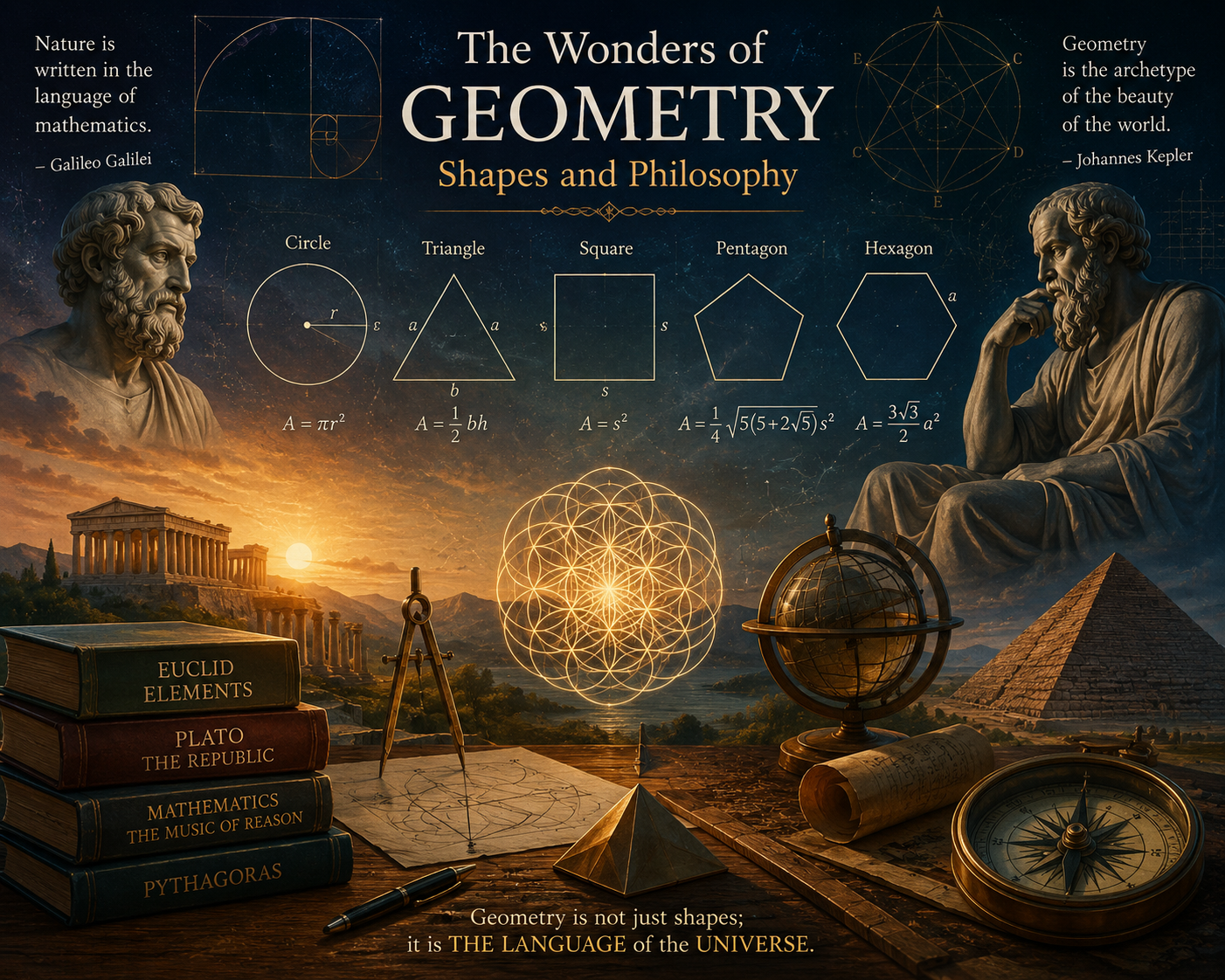
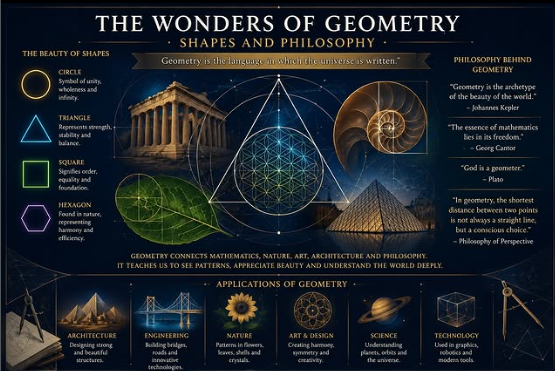
    The Wonders of Geometry: Shapes and Philosophy

    Geometry is one of the oldest and most fascinating areas of mathematics. It is not simply the study of lines, angles, and shapes; it is a way of understanding the structure, patterns, balance, and beauty of the world around us. From the smallest natural patterns to huge buildings and bridges, geometry plays an important role in our everyday lives.

    The topic “The Wonders of Geometry: Shapes and Philosophy” explores the beautiful relationship between mathematics and the ideas that humans have developed about order, harmony, proportion, symmetry, and perfection.

    The Beauty of Circles

    The circle is one of the most recognizable geometric shapes. It has no corners and every point on its boundary is the same distance from its center. Because of its continuous form, the circle is often associated with ideas such as unity, completeness, continuity, and infinity. We can see circles in wheels, clocks, planets, coins, lenses, and many designs around us.

    The Strength of Triangles

    Triangles are simple but incredibly important shapes. Their strong structure makes them useful in architecture and engineering. Bridges, roofs, towers, and other structures often use triangular designs because triangles provide stability. In geometry, triangles also help us understand angles, lengths, proportions, and many important mathematical relationships.

    The Balance of Squares

    The square represents equality, balance, order, and structure. All four of its sides are equal, and all four angles are right angles. Squares are commonly found in buildings, floor designs, windows, screens, tiles, artwork, and patterns. They demonstrate how mathematical rules can produce simple yet powerful designs.

    ⬡ The Harmony of Hexagons

    Hexagons are another fascinating shape. They can be seen naturally in honeycombs and in various patterns found in science and nature. Hexagonal structures can efficiently cover a surface without leaving gaps, which makes them especially interesting from both mathematical and natural per
    Mohsin #RSF8🎓✨ #Storypost10 Class: Foundation level 📚 Made by Me 💻🚀 rool no:13 📐✨ The Wonders of Geometry: Shapes and Philosophy ✨📐 Geometry is one of the oldest and most fascinating areas of mathematics. It is not simply the study of lines, angles, and shapes; it is a way of understanding the structure, patterns, balance, and beauty of the world around us. From the smallest natural patterns to huge buildings and bridges, geometry plays an important role in our everyday lives. The topic “The Wonders of Geometry: Shapes and Philosophy” explores the beautiful relationship between mathematics and the ideas that humans have developed about order, harmony, proportion, symmetry, and perfection. 🔵 The Beauty of Circles The circle is one of the most recognizable geometric shapes. It has no corners and every point on its boundary is the same distance from its center. Because of its continuous form, the circle is often associated with ideas such as unity, completeness, continuity, and infinity. We can see circles in wheels, clocks, planets, coins, lenses, and many designs around us. 🔺 The Strength of Triangles Triangles are simple but incredibly important shapes. Their strong structure makes them useful in architecture and engineering. Bridges, roofs, towers, and other structures often use triangular designs because triangles provide stability. In geometry, triangles also help us understand angles, lengths, proportions, and many important mathematical relationships. ⬜ The Balance of Squares The square represents equality, balance, order, and structure. All four of its sides are equal, and all four angles are right angles. Squares are commonly found in buildings, floor designs, windows, screens, tiles, artwork, and patterns. They demonstrate how mathematical rules can produce simple yet powerful designs. ⬡ The Harmony of Hexagons Hexagons are another fascinating shape. They can be seen naturally in honeycombs and in various patterns found in science and nature. Hexagonal structures can efficiently cover a surface without leaving gaps, which makes them especially interesting from both mathematical and natural per
    0 Commentarii 0 Distribuiri 1866 Views
  • #rsisb
    Roll no.247
    Foundation level

    **The Wonders of Geometry: Shapes and Philosophy**

    Geometry is much more than lines, angles, circles, and formulas—it is a fascinating way of understanding the patterns, structures, and beauty that surround us every day. From the perfect symmetry of a flower to the curves of a planet , from the architecture of magnificent buildings to the shapes found in art and nature , geometry helps us see the world from a completely new perspective.

    **Shapes tell stories.** Triangles can represent strength and stability, circles can symbolize unity and infinity, while squares and rectangles appear in countless structures around us. Every shape has its own properties, relationships, and mathematical beauty.

    **But geometry also connects with philosophy.** Throughout history, thinkers have wondered why mathematical patterns appear so naturally in the universe. Why do certain shapes create balance? Why does symmetry feel beautiful? How can simple mathematical ideas describe complex structures in nature? These questions show that geometry is not only about calculating measurements—it can also inspire curiosity, imagination, and deeper thinking.

    In this fascinating journey, we explore how geometry connects **mathematics, science, art, architecture, nature, and philosophy**. We discover how ancient civilizations used geometric ideas, how mathematicians studied shapes and space, and how geometric patterns continue to influence modern technology and design.

    Geometry encourages us to look beyond what is immediately visible. A simple line can become an angle, angles can form shapes, shapes can create patterns, and patterns can reveal remarkable relationships. The more we explore, the more we realize that mathematics can be both logical and beautiful.

    **The Wonders of Geometry** is an invitation to ask questions, observe carefully, think creatively, and appreciate the hidden mathematical order of our world. Whether you are a student, teacher, science enthusiast, artist, or simply someone curious about the universe, geometry offers endless discoveries.

    **Explore the shapes. Discover the patterns. Question the ideas. And experience the philosophy hidden within geometry!**

    #TheWondersOfGeometry #Geometry #Shapes #Mathematics #Philosophy #MathIsBeautiful #GeometryLovers #MathematicsEducation #Learning #ScienceAndMath #CreativeLearning #GeometricShapes #Symmetry #Patterns #Angles #Circles #Triangles #Architecture #NatureAndGeometry #MathInNature #ArtAndGeometry #STEM #Education #Knowledge #Curiosity #ExploreAndLearn #MathematicalBeauty #AmazingMath #LearningIsFun #Science #Inspiration
    #rsisb Roll no.247 Foundation level 🌟📐 **The Wonders of Geometry: Shapes and Philosophy** 📐🌟 Geometry is much more than lines, angles, circles, and formulas—it is a fascinating way of understanding the patterns, structures, and beauty that surround us every day. 🌍✨ From the perfect symmetry of a flower 🌸 to the curves of a planet 🌎, from the architecture of magnificent buildings 🏛️ to the shapes found in art and nature 🎨, geometry helps us see the world from a completely new perspective. 🔺 **Shapes tell stories.** Triangles can represent strength and stability, circles can symbolize unity and infinity, while squares and rectangles appear in countless structures around us. Every shape has its own properties, relationships, and mathematical beauty. 📏🔵🟦 🤔 **But geometry also connects with philosophy.** Throughout history, thinkers have wondered why mathematical patterns appear so naturally in the universe. Why do certain shapes create balance? Why does symmetry feel beautiful? How can simple mathematical ideas describe complex structures in nature? These questions show that geometry is not only about calculating measurements—it can also inspire curiosity, imagination, and deeper thinking. 🧠✨ 📚 In this fascinating journey, we explore how geometry connects **mathematics, science, art, architecture, nature, and philosophy**. We discover how ancient civilizations used geometric ideas, how mathematicians studied shapes and space, and how geometric patterns continue to influence modern technology and design. 🚀📐 🌌 Geometry encourages us to look beyond what is immediately visible. A simple line can become an angle, angles can form shapes, shapes can create patterns, and patterns can reveal remarkable relationships. The more we explore, the more we realize that mathematics can be both logical and beautiful. 💫 🎯 **The Wonders of Geometry** is an invitation to ask questions, observe carefully, think creatively, and appreciate the hidden mathematical order of our world. Whether you are a student, teacher, science enthusiast, artist, or simply someone curious about the universe, geometry offers endless discoveries. 🔍📖🌟 ✨ **Explore the shapes. Discover the patterns. Question the ideas. And experience the philosophy hidden within geometry!** 📐🧠🌍 #TheWondersOfGeometry #Geometry #Shapes #Mathematics #Philosophy #MathIsBeautiful #GeometryLovers #MathematicsEducation #Learning #ScienceAndMath #CreativeLearning #GeometricShapes #Symmetry #Patterns #Angles #Circles #Triangles #Architecture #NatureAndGeometry #MathInNature #ArtAndGeometry #STEM #Education #Knowledge #Curiosity #ExploreAndLearn #MathematicalBeauty #AmazingMath #LearningIsFun #Science #Inspiration 📐🔺🔵✨🌍🧠📚🎨🚀
    0 Commentarii 0 Distribuiri 6940 Views
  • #rsisb
    Roll No.240
    Story No.11
    Foundation Level

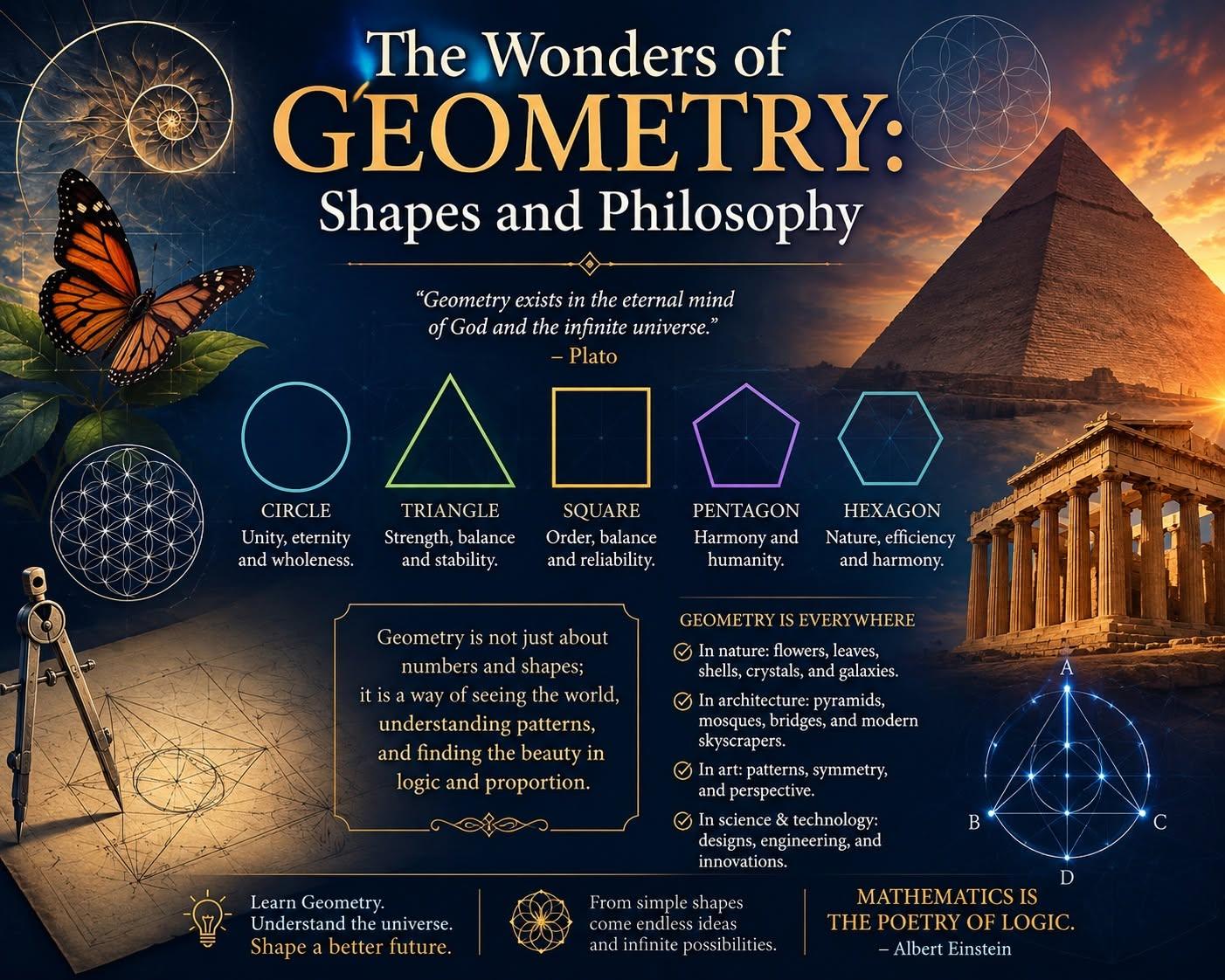
    # The Wonders of Geometry: Shapes and Philosophy

    Geometry is far more than a branch of mathematics—it is a language that describes the beauty, balance, and structure of the world around us. From the symmetry of a butterfly's wings to the towering pyramids of Egypt, geometric shapes are found everywhere in nature, architecture, art, and technology. Circles represent unity and infinity, triangles symbolize strength and stability, while squares and rectangles reflect order, balance, and reliability. These timeless shapes help us understand space, design, and the hidden patterns that shape our universe.

    Beyond calculations and formulas, geometry also carries a deep philosophical meaning. Ancient philosophers believed that geometric forms reflected the harmony and perfection of creation. Studying shapes encourages logical thinking, creativity, and problem-solving while inspiring us to see the connections between mathematics, nature, and human life. Whether you're exploring basic polygons or the mysteries of symmetry, geometry reminds us that beauty and knowledge often share the same foundation. Discover the fascinating world of shapes and uncover the philosophy that has inspired scientists, artists, architects, and thinkers for centuries.

    Rehan School Islamabad Campus
    Asma Shaheen EducationWali
    Irum Asim
    Saima Happinesswali
    #rsisb Roll No.240 Story No.11 Foundation Level # The Wonders of Geometry: Shapes and Philosophy Geometry is far more than a branch of mathematics—it is a language that describes the beauty, balance, and structure of the world around us. From the symmetry of a butterfly's wings to the towering pyramids of Egypt, geometric shapes are found everywhere in nature, architecture, art, and technology. Circles represent unity and infinity, triangles symbolize strength and stability, while squares and rectangles reflect order, balance, and reliability. These timeless shapes help us understand space, design, and the hidden patterns that shape our universe. Beyond calculations and formulas, geometry also carries a deep philosophical meaning. Ancient philosophers believed that geometric forms reflected the harmony and perfection of creation. Studying shapes encourages logical thinking, creativity, and problem-solving while inspiring us to see the connections between mathematics, nature, and human life. Whether you're exploring basic polygons or the mysteries of symmetry, geometry reminds us that beauty and knowledge often share the same foundation. Discover the fascinating world of shapes and uncover the philosophy that has inspired scientists, artists, architects, and thinkers for centuries. Rehan School Islamabad Campus Asma Shaheen EducationWali Irum Asim Saima Happinesswali
    0 Commentarii 0 Distribuiri 4920 Views
  • Final Chapter: Earth 2030 – One Team, One Planet

    By 2030, the world looked unrecognizable compared to just five years earlier. Wars were history. Borders were doors. Poverty was shrinking, schools were glowing, and the planet breathed easier with clean energy humming across every continent.

    And for the first time in history, humanity wasn’t a collection of rivals. It was one team.

    ⸻

    Looking Back

    In classrooms across the Planet Union, students laughed at old news clips of angry presidents shouting at each other, tanks rolling across borders, and endless trade wars.

    “Why did they waste so much time fighting?” children asked. Teachers only smiled and said: “Because they didn’t know what you know now — that cooperation is cheaper, faster, and a lot more fun.”

    ⸻

    The Humanity Flag

    Every city square now flew the blue Humanity Flag with its white infinity symbol. It didn’t replace cultures, religions, or traditions — it simply reminded everyone that above all, we are humans first.

    On January 1st, 2030, when the Planet Union was declared, billions of people cried, hugged strangers, and danced in the streets. That day became the new global holiday: Interdependence Day.

    ⸻

    New Missions

    With the Earth united, humans finally asked a new question: “What’s next?”
    • Space Exploration: Instead of competing, nations pooled resources. A joint Moon base was built by 2031, followed by the first Mars mission — carrying astronauts from 20 countries under one flag.
    • AI for Humanity: Advanced AI wasn’t locked in corporate labs; it was embedded in schools, hospitals, and farms, teaching and healing billions.
    • Climate Restoration: Massive reforestation, ocean cleanup, and solar shading projects began. The planet started healing at a speed scientists once thought impossible.

    ⸻

    The Spirit of 2030

    For the first time, children growing up in Africa, Asia, Europe, and the Americas dreamed the same dream: not of leaving their country for a “better one,” but of improving their planet for everyone.

    Poets called it the Second Renaissance. Musicians called it the Great Harmony. Historians simply wrote:
    “In 2030, Earth became Earth’s first superpower.”

    ⸻

    Legacy

    The Planet Union wasn’t perfect. Disagreements still happened. Cultures still clashed. But instead of wars, they had debates. Instead of armies, they had engineers. Instead of treaties that broke, they had trains that connected.

    Humanity had finally remembered the obvious:
    We were always one species. We just needed a reminder.

    ⸻

    And so the story of Planet Union closes with one line carved into the heart of 2030:

    “One planet. One people. One future.”
    Final Chapter: Earth 2030 – One Team, One Planet By 2030, the world looked unrecognizable compared to just five years earlier. Wars were history. Borders were doors. Poverty was shrinking, schools were glowing, and the planet breathed easier with clean energy humming across every continent. And for the first time in history, humanity wasn’t a collection of rivals. It was one team. ⸻ Looking Back In classrooms across the Planet Union, students laughed at old news clips of angry presidents shouting at each other, tanks rolling across borders, and endless trade wars. “Why did they waste so much time fighting?” children asked. Teachers only smiled and said: “Because they didn’t know what you know now — that cooperation is cheaper, faster, and a lot more fun.” ⸻ The Humanity Flag Every city square now flew the blue Humanity Flag with its white infinity symbol. It didn’t replace cultures, religions, or traditions — it simply reminded everyone that above all, we are humans first. On January 1st, 2030, when the Planet Union was declared, billions of people cried, hugged strangers, and danced in the streets. That day became the new global holiday: Interdependence Day. ⸻ New Missions With the Earth united, humans finally asked a new question: “What’s next?” • Space Exploration: Instead of competing, nations pooled resources. A joint Moon base was built by 2031, followed by the first Mars mission — carrying astronauts from 20 countries under one flag. • AI for Humanity: Advanced AI wasn’t locked in corporate labs; it was embedded in schools, hospitals, and farms, teaching and healing billions. • Climate Restoration: Massive reforestation, ocean cleanup, and solar shading projects began. The planet started healing at a speed scientists once thought impossible. ⸻ The Spirit of 2030 For the first time, children growing up in Africa, Asia, Europe, and the Americas dreamed the same dream: not of leaving their country for a “better one,” but of improving their planet for everyone. Poets called it the Second Renaissance. Musicians called it the Great Harmony. Historians simply wrote: “In 2030, Earth became Earth’s first superpower.” ⸻ Legacy The Planet Union wasn’t perfect. Disagreements still happened. Cultures still clashed. But instead of wars, they had debates. Instead of armies, they had engineers. Instead of treaties that broke, they had trains that connected. Humanity had finally remembered the obvious: We were always one species. We just needed a reminder. ⸻ 👉 And so the story of Planet Union closes with one line carved into the heart of 2030: “One planet. One people. One future.”
    0 Commentarii 0 Distribuiri 467 Views
  • 8 is infinity !
    8 is infinity !
    0 Commentarii 0 Distribuiri 78 Views
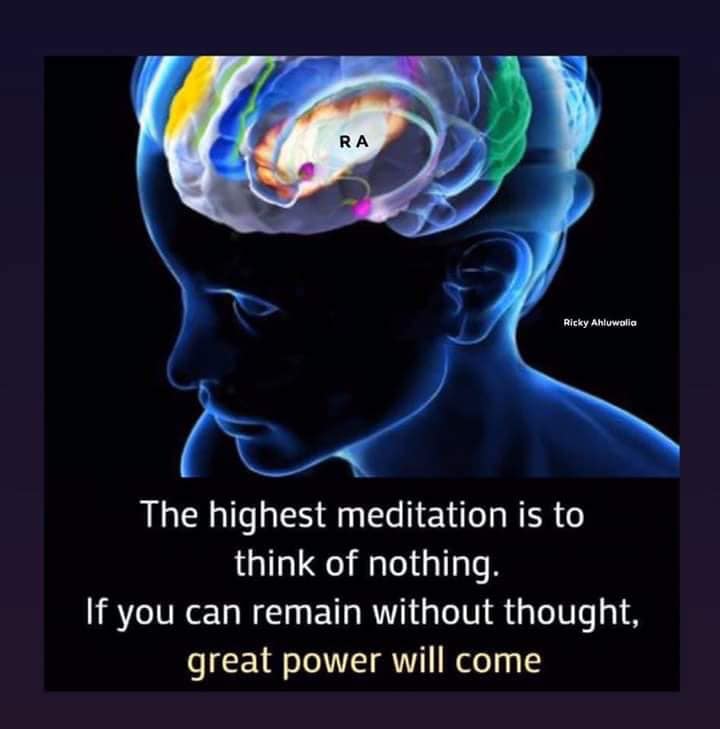
  • Mind and brain are not the same. The brain is an organ that is in your skull. You have 2 nervous systems. One you control, the other called the Limbic system, controls the inner organs so you dont have to think, lungs breathe, heart beat now etc. Your Mind doesnt live in your skull. Mind is not an internal organ. If you cannot control your mind, you need practice and self discipline. When the Sensei asks for quiet, there is a higher purpose for your silence. Infinity goes in every direction, even in your body. Search within yourself by allowing different vibrational frequencies to explore.
    Mind and brain are not the same. The brain is an organ that is in your skull. You have 2 nervous systems. One you control, the other called the Limbic system, controls the inner organs so you don't have to think, lungs breathe, heart beat now etc. Your Mind doesn't live in your skull. Mind is not an internal organ. If you cannot control your mind, you need practice and self discipline. When the Sensei asks for quiet, there is a higher purpose for your silence. Infinity goes in every direction, even in your body. Search within yourself by allowing different vibrational frequencies to explore.
    0 Commentarii 0 Distribuiri 77 Views
  • The Million-Book Revolution

    How One Book Taught a Nation to Dream Again
    By Rehan Allahwala

    ⸻

    It was December 2026.
    Winter sunlight spread across Pakistan like a quiet blessing.
    From Karachi’s crowded classrooms to the shadowed courtyards of Thar,
    a million young voices hummed the same word — “AI.”

    It had begun not with a government plan,
    not with billions in funding,
    but with a book — soft in color, small in price, vast in purpose.

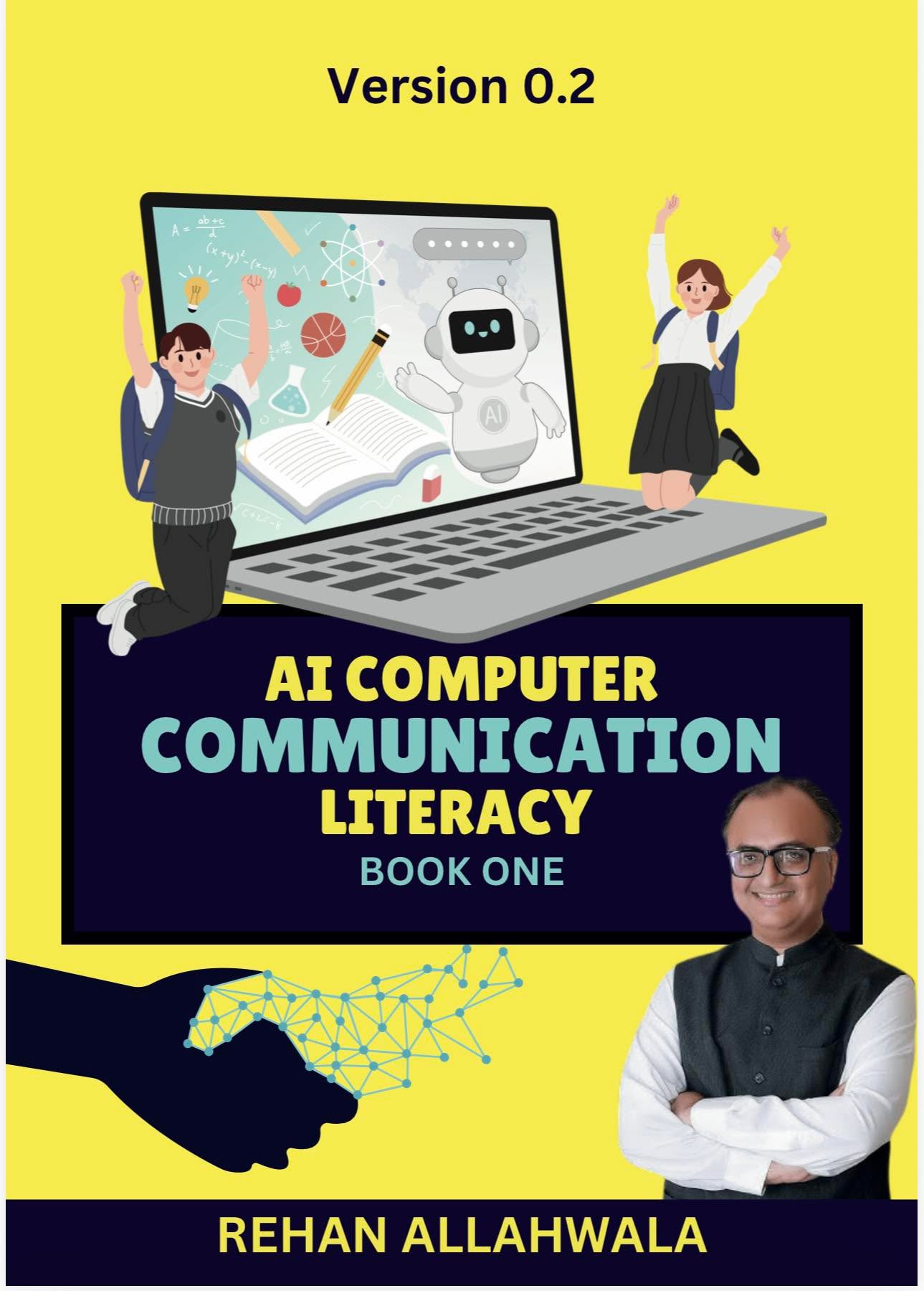
    Its name: ACCL — AI Computer Communication Literacy.
    Its creator: Rehan Allahwala.
    Its power: to awaken the sleeping intelligence of a nation.

    ⸻

    The World Before

    Only a few years earlier, the computer classes of Pakistan were frozen in time.
    Children memorized what a “floppy disk” was,
    as if history were more sacred than possibility.

    Screens blinked, but minds did not.
    The mouse was their master; the world, their stranger.

    The curriculum — a relic of a vanished century —
    taught hands to click, not hearts to think.
    It produced typists, not dreamers.
    Followers, not leaders.

    And somewhere in the noise of repetition,
    the light of curiosity dimmed.

    ⸻

    The Spark

    Then came a whisper that became a wind.
    A man asked, gently but firmly:

    “Why are our children learning to use a mouse,
    when the world has learned to talk to machines?”

    And that question became a revolution.

    In his humble office in Karachi, surrounded by laptops and laughter,
    Rehan Allahwala wrote a book.
    Not a manual — a manifesto.
    Not a syllabus — a seed.

    A book that replaced the old question “What is a computer?”
    with the eternal one —
    “What can you become?”

    ⸻

    The 180 Steps to Awakening

    The ACCL Book was not meant to be read.
    It was meant to be lived.

    One hundred and eighty small daily tasks —
    simple, human, profound.

    Ask an AI to write your first poem.
    Record your voice telling a story.
    Make a poster about kindness.
    Search the internet not for entertainment, but for understanding.

    In each task, a child discovered a mirror.
    And in that reflection, found a teacher more powerful than any textbook —
    themselves.

    ⸻

    The Unfolding Miracle

    By the end of the first year,
    thousands of schools had quietly replaced their old “MS Word and Excel” lessons
    with this strange new book that spoke of the future in the language of the present.

    Students no longer feared English — they played with it.
    They no longer repeated; they created.
    They no longer waited; they led.

    Videos of ten-year-olds conversing with AI went viral.
    Parents who had once silenced their children
    now listened —
    for the first time —
    in awe.

    And thus began The Million-Book Revolution.

    ⸻

    A School Without Walls

    By 2026, the book had reached one million students.
    And through them, another ten million out-of-school children.

    For Pakistan has 26 million children who never sit in classrooms —
    but they had something more powerful than a desk:
    a smartphone.

    The ACCL students became their teachers.
    In villages, they gathered children under trees and said,
    “Let’s learn together. Listen. Speak. Ask.”

    AI tools became storytellers,
    reading lessons aloud in soft, human voices.
    Children who could not write began to think.
    Those who could not read began to dream.

    Education had escaped the classroom —
    it had become an atmosphere.

    ⸻

    The Transformation

    In a town near Multan, a rickshaw driver’s daughter built a YouTube channel
    where she taught AI in Urdu.
    In Gwadar, fishermen’s sons began learning English through voice chat with AI.
    In Gilgit, children mapped their valleys on Google Earth and called them “our digital Himalayas.”

    They were no longer waiting for opportunity —
    they were creating it.

    And the most beautiful part?
    They didn’t even realize they were making history.

    ⸻

    The National Awakening

    By December 2026, Pakistan had changed.
    The Ministry of Education could not ignore the storm.
    Colleges began teaching “AI Communication Literacy.”
    Governors quoted ten-year-olds in their speeches.
    Even television anchors started asking,
    “Have you read the ACCL book?”

    The nation had found something it had lost long ago —
    its confidence.

    ⸻

    Rehan’s Reflection

    When journalists asked Rehan Allahwala how it all happened,
    he smiled — that calm, patient smile of a man who had already seen the future.

    “It was never about a book,” he said softly.
    “It was about giving our children permission to think.
    We taught them that intelligence is not memorized — it is awakened.”

    And in that awakening,
    a nation began to heal.

    ⸻

    Epilogue: The Dawn of Pakistan 2.0

    As 2026 ended, the headlines read:

    “One Million Students Now Learning AI Literacy.”

    But the truth was far larger.
    These were not just students.
    They were storytellers of a new civilization.

    A generation that spoke in code and compassion.
    That used technology not to escape the world —
    but to improve it.

    And at the center of it all, a single book —
    thin as a whisper, vast as a horizon.

    ⸻

    Final Words

    No war was fought.
    No law was passed.
    And yet, a nation changed.

    Because one man dared to believe
    that if you give a child a question and a tool,
    they will give you a universe.

    And that belief — printed on 180 pages —
    became Pakistan’s first true revolution of the mind.

    ⸻

    “The ACCL Book — a bridge between ignorance and infinity.”
    A million books. A million voices. One new Pakistan.

    ⸻
    🌍 The Million-Book Revolution How One Book Taught a Nation to Dream Again By Rehan Allahwala ⸻ It was December 2026. Winter sunlight spread across Pakistan like a quiet blessing. From Karachi’s crowded classrooms to the shadowed courtyards of Thar, a million young voices hummed the same word — “AI.” It had begun not with a government plan, not with billions in funding, but with a book — soft in color, small in price, vast in purpose. Its name: ACCL — AI Computer Communication Literacy. Its creator: Rehan Allahwala. Its power: to awaken the sleeping intelligence of a nation. ⸻ 🕊️ The World Before Only a few years earlier, the computer classes of Pakistan were frozen in time. Children memorized what a “floppy disk” was, as if history were more sacred than possibility. Screens blinked, but minds did not. The mouse was their master; the world, their stranger. The curriculum — a relic of a vanished century — taught hands to click, not hearts to think. It produced typists, not dreamers. Followers, not leaders. And somewhere in the noise of repetition, the light of curiosity dimmed. ⸻ 🌱 The Spark Then came a whisper that became a wind. A man asked, gently but firmly: “Why are our children learning to use a mouse, when the world has learned to talk to machines?” And that question became a revolution. In his humble office in Karachi, surrounded by laptops and laughter, Rehan Allahwala wrote a book. Not a manual — a manifesto. Not a syllabus — a seed. A book that replaced the old question “What is a computer?” with the eternal one — “What can you become?” ⸻ 💡 The 180 Steps to Awakening The ACCL Book was not meant to be read. It was meant to be lived. One hundred and eighty small daily tasks — simple, human, profound. Ask an AI to write your first poem. Record your voice telling a story. Make a poster about kindness. Search the internet not for entertainment, but for understanding. In each task, a child discovered a mirror. And in that reflection, found a teacher more powerful than any textbook — themselves. ⸻ 🌾 The Unfolding Miracle By the end of the first year, thousands of schools had quietly replaced their old “MS Word and Excel” lessons with this strange new book that spoke of the future in the language of the present. Students no longer feared English — they played with it. They no longer repeated; they created. They no longer waited; they led. Videos of ten-year-olds conversing with AI went viral. Parents who had once silenced their children now listened — for the first time — in awe. And thus began The Million-Book Revolution. ⸻ 🌐 A School Without Walls By 2026, the book had reached one million students. And through them, another ten million out-of-school children. For Pakistan has 26 million children who never sit in classrooms — but they had something more powerful than a desk: a smartphone. The ACCL students became their teachers. In villages, they gathered children under trees and said, “Let’s learn together. Listen. Speak. Ask.” AI tools became storytellers, reading lessons aloud in soft, human voices. Children who could not write began to think. Those who could not read began to dream. Education had escaped the classroom — it had become an atmosphere. ⸻ 🔥 The Transformation In a town near Multan, a rickshaw driver’s daughter built a YouTube channel where she taught AI in Urdu. In Gwadar, fishermen’s sons began learning English through voice chat with AI. In Gilgit, children mapped their valleys on Google Earth and called them “our digital Himalayas.” They were no longer waiting for opportunity — they were creating it. And the most beautiful part? They didn’t even realize they were making history. ⸻ 🧭 The National Awakening By December 2026, Pakistan had changed. The Ministry of Education could not ignore the storm. Colleges began teaching “AI Communication Literacy.” Governors quoted ten-year-olds in their speeches. Even television anchors started asking, “Have you read the ACCL book?” The nation had found something it had lost long ago — its confidence. ⸻ 🕊️ Rehan’s Reflection When journalists asked Rehan Allahwala how it all happened, he smiled — that calm, patient smile of a man who had already seen the future. “It was never about a book,” he said softly. “It was about giving our children permission to think. We taught them that intelligence is not memorized — it is awakened.” And in that awakening, a nation began to heal. ⸻ 🌟 Epilogue: The Dawn of Pakistan 2.0 As 2026 ended, the headlines read: “One Million Students Now Learning AI Literacy.” But the truth was far larger. These were not just students. They were storytellers of a new civilization. A generation that spoke in code and compassion. That used technology not to escape the world — but to improve it. And at the center of it all, a single book — thin as a whisper, vast as a horizon. ⸻ ✨ Final Words No war was fought. No law was passed. And yet, a nation changed. Because one man dared to believe that if you give a child a question and a tool, they will give you a universe. And that belief — printed on 180 pages — became Pakistan’s first true revolution of the mind. ⸻ “The ACCL Book — a bridge between ignorance and infinity.” A million books. A million voices. One new Pakistan. ⸻
    0 Commentarii 0 Distribuiri 317 Views