• RSIF8
    Roll no: 86
    Story Post no: 49
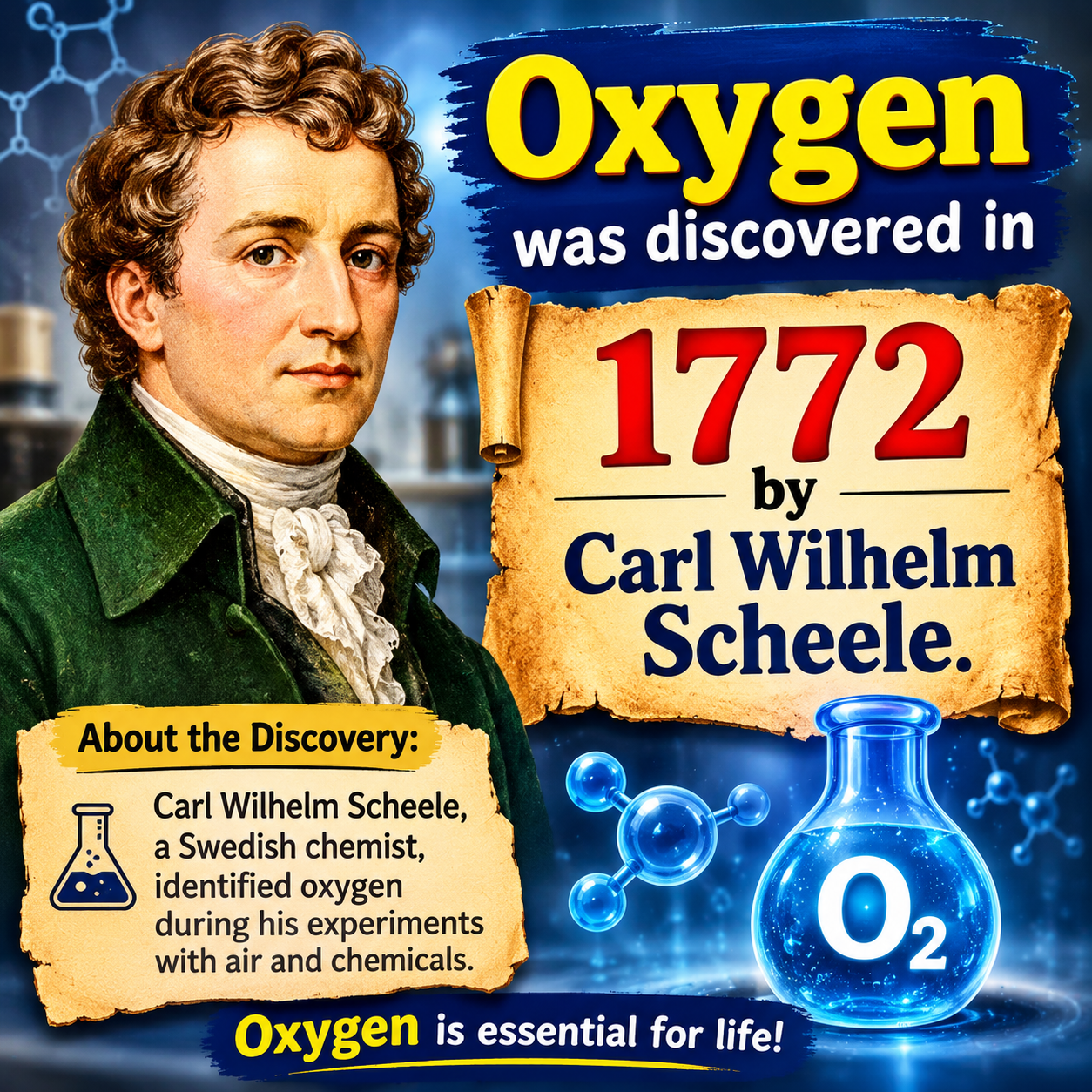
    Story Post Topic:Image with ChatGPT: Oxygen Was Discovered in 1772 by Carl Wilhelm Scheele

    Did you know that oxygen, one of the most important elements for life on Earth, was discovered in 1772 by Swedish chemist Carl Wilhelm Scheele? Oxygen plays a very important role in our daily lives and is essential for the survival of humans, animals, and many other living organisms.

    Carl Wilhelm Scheele was a talented scientist who performed many experiments to understand different chemical substances. During his experiments, he discovered a gas that supported burning and was later recognized as oxygen. He called it "Fire Air" because of its connection with combustion.

    Oxygen is represented by the chemical symbol O and has the atomic number 8. It is a colorless and odorless gas that makes up about 21% of Earth's atmosphere. We breathe oxygen to help our bodies release energy from food. It also supports combustion and plays an important role in many natural processes.

    Why Is Oxygen Important?

    It is essential for breathing in humans and many animals.

    It helps cells release energy through cellular respiration.

    It supports the process of combustion.

    It is important for many chemical and biological processes.

    Plants release oxygen during photosynthesis.

    An Interesting Fact: Although Carl Wilhelm Scheele discovered oxygen around 1772, Joseph Priestley independently discovered it in 1774. Antoine Lavoisier later helped explain its role in combustion and gave it the name oxygen.

    This educational activity helped me learn more about the history of chemistry, scientific discoveries, and the importance of oxygen in our world.

    Science teaches us that even the smallest discoveries can make a huge difference in our understanding of life and nature.

    Sharing this educational image on Facebook, YouTube, LinkedIn, Instagram, and TikTok to spread scientific knowledge and encourage everyone to keep learning!

    #RSIF8 #Oxygen #CarlWilhelmScheele #ScienceFacts #Chemistry #ScientificDiscoveries #LearnWithScience #Education
    RSIF8 Roll no: 86 Story Post no: 49 Story Post Topic:Image with ChatGPT: Oxygen Was Discovered in 1772 by Carl Wilhelm Scheele 🔬 Did you know that oxygen, one of the most important elements for life on Earth, was discovered in 1772 by Swedish chemist Carl Wilhelm Scheele? 🌍✨ Oxygen plays a very important role in our daily lives and is essential for the survival of humans, animals, and many other living organisms. Carl Wilhelm Scheele was a talented scientist who performed many experiments to understand different chemical substances. During his experiments, he discovered a gas that supported burning and was later recognized as oxygen. He called it "Fire Air" because of its connection with combustion. Oxygen is represented by the chemical symbol O and has the atomic number 8. It is a colorless and odorless gas that makes up about 21% of Earth's atmosphere. We breathe oxygen to help our bodies release energy from food. It also supports combustion and plays an important role in many natural processes. 🌱 Why Is Oxygen Important? It is essential for breathing in humans and many animals. It helps cells release energy through cellular respiration. It supports the process of combustion. It is important for many chemical and biological processes. Plants release oxygen during photosynthesis. 🔍 An Interesting Fact: Although Carl Wilhelm Scheele discovered oxygen around 1772, Joseph Priestley independently discovered it in 1774. Antoine Lavoisier later helped explain its role in combustion and gave it the name oxygen. 📚 This educational activity helped me learn more about the history of chemistry, scientific discoveries, and the importance of oxygen in our world. 🌟 Science teaches us that even the smallest discoveries can make a huge difference in our understanding of life and nature. 📢 Sharing this educational image on Facebook, YouTube, LinkedIn, Instagram, and TikTok to spread scientific knowledge and encourage everyone to keep learning! #RSIF8 🎓 #Oxygen 🧪 #CarlWilhelmScheele 🔬 #ScienceFacts 🌍 #Chemistry 📚 #ScientificDiscoveries 💡 #LearnWithScience 🚀 #Education ✨
    0 Σχόλια 0 Μοιράστηκε 219 Views
  • #rsisb
    roll no.
    foundation level
    **How to Download and Use Sesame?**
    Want to improve your English, ask questions, and enjoy interesting conversations? Sesame is an AI-powered conversational tool that helps you communicate, practice English, and explore new ideas.
    In this guide, learn how to download Sesame from the App Store or Google Play, sign up or log in, start asking questions, practice English, enjoy voice chats, and use its amazing tools.
    You can also save or share your progress and continue learning every day!
    **Start your AI learning journey with Sesame today!**
    #Sesame #AI #ArtificialIntelligence #EnglishPractice #LearnEnglish #VoiceChat #AITools #DigitalSkills #Technology #Education #RehanSchool
    #rsisb roll no. foundation level 🤖✨ **How to Download and Use Sesame?** 📱💬 Want to improve your English, ask questions, and enjoy interesting conversations? 🌟 Sesame is an AI-powered conversational tool that helps you communicate, practice English, and explore new ideas. In this guide, learn how to download Sesame from the App Store or Google Play, sign up or log in, start asking questions, practice English, enjoy voice chats, and use its amazing tools. 🎤📚 You can also save or share your progress and continue learning every day! 🚀🌍 **Start your AI learning journey with Sesame today!** 💡❤️ #Sesame #AI #ArtificialIntelligence #EnglishPractice #LearnEnglish #VoiceChat #AITools #DigitalSkills #Technology #Education #RehanSchool 🎓
    0 Σχόλια 0 Μοιράστηκε 183 Views
  • #rsisb
    Roll No.177
    Japanese Session No.15
    Level One

    **Learncc Japanese Language | 50 Easy Japanese Questions for Beginners**

    Welcome to our Japanese language learning journey! In this learning session, we are practicing 50 easy and useful questions in Japanese. These questions will help beginners learn Japanese words, improve speaking skills, and build confidence in everyday conversations.
    From introducing yourself to talking about your family ‍‍‍, hobbies , favorite foods , school , daily routine , and future dreams , these simple questions make learning Japanese fun and interesting!
    Each question includes Japanese writing , Roman Japanese , and English meaning , making it easier for students to understand, read, memorize, and practice speaking.
    Learning a new language opens the door to a new culture, new friendships, and exciting opportunities around the world! Let's practice every day, improve our communication skills, and enjoy learning Japanese together.
    頑張りましょう!
    **Ganbarimashou! — Let's do our best!**
    Thank you for watching and learning with us! Keep learning, keep practicing, and keep growing!

    **HASHTAGS**

    \#LearnJapanese
    \#JapaneseLanguage
    \#JapaneseQuestions
    \#LearnJapaneseForBeginners
    \#JapaneseSpeaking
    \#JapanesePractice
    \#JapaneseVocabulary
    \#EasyJapanese
    \#LanguageLearning
    \#StudyJapanese
    \#JapaneseCulture
    \#SpeakJapanese
    \#EnglishAndJapanese 🇬🇵
    \#EducationForEveryone
    \#AIEducation
    \#RehanSchool
    \#RehanSchoolIslamabad
    \#LearningJourney
    \#NeverStopLearning
    #KnowledgeIsPower
    #rsisb Roll No.177 Japanese Session No.15 Level One 🇯🇵✨ **Learncc Japanese Language | 50 Easy Japanese Questions for Beginners** 📚🗣️🌸 Welcome to our Japanese language learning journey! 🇯🇵🎌 In this learning session, we are practicing 50 easy and useful questions in Japanese. 📝✨ These questions will help beginners learn Japanese words, improve speaking skills, and build confidence in everyday conversations. 🗣️💬😊 From introducing yourself 👋 to talking about your family 👨‍👩‍👧‍👦, hobbies 🎨⚽, favorite foods 🍜🍣, school 📚🏫, daily routine ⏰🌅, and future dreams 🌟🚀, these simple questions make learning Japanese fun and interesting! 🎉💖 Each question includes Japanese writing 🇯🇵, Roman Japanese 🔤, and English meaning 🇬🇧, making it easier for students to understand, read, memorize, and practice speaking. 🧠📖💡 Learning a new language opens the door to a new culture, new friendships, and exciting opportunities around the world! 🌍🤝🌈 Let's practice every day, improve our communication skills, and enjoy learning Japanese together. 💪🎯🎓 頑張りましょう! 🇯🇵✨ **Ganbarimashou! — Let's do our best!** 💯🔥🙌 Thank you for watching and learning with us! ❤️😊 Keep learning, keep practicing, and keep growing! 🚀🌟📚 **HASHTAGS** 🔥👇 \#LearnJapanese 🇯🇵 \#JapaneseLanguage 🗣️ \#JapaneseQuestions 📝 \#LearnJapaneseForBeginners 📚 \#JapaneseSpeaking 💬 \#JapanesePractice ✍️ \#JapaneseVocabulary 📖 \#EasyJapanese 🌸 \#LanguageLearning 🌍 \#StudyJapanese 🎓 \#JapaneseCulture 🎌 \#SpeakJapanese 🗣️ \#EnglishAndJapanese 🇬🇧🇯🇵 \#EducationForEveryone 🎓 \#AIEducation 🤖 \#RehanSchool 🏫 \#RehanSchoolIslamabad 📍 \#LearningJourney 🚀 \#NeverStopLearning 💡 #KnowledgeIsPower 🧠✨
    0 Σχόλια 0 Μοιράστηκε 242 Views 6
  • An Interesting Conversation with ChatGPT | The Story of “PLEASE”

    Assalamualaikum Everyone!

    Aaj ki meri special conversation mein maine ChatGPT ke saath ek bohat interesting topic discuss kiya: “PLEASE – The Story Behind a Polite Word.”

    Is conversation mein humne jaana:

    Please word ki history kya hai?
    Different countries mein Please kaise bola jata hai?
    Telephone ne communication mein kya role play kiya?
    Artificial Intelligence (AI) kis tarah languages ko samajhne aur translate karne mein madad karti hai?

    Mera maqsad sirf sawal poochna nahi, balki naye ideas seekhna aur apni knowledge ko duniya ke saath share karna hai.

    Keep Learning, Keep Exploring, Keep Growing!

    Thank you, ChatGPT, for this wonderful conversation!

    Presented by: Rahim AI Wala

    #RahimAIWala #ChatGPT #Please #ArtificialIntel
    ligence #AI #Learning #EnglishWords #WordHistory #Education #Knowledge #Technology #Interview
    🎙️ An Interesting Conversation with ChatGPT | The Story of “PLEASE” 🌍🤖 Assalamualaikum Everyone! Aaj ki meri special conversation mein maine ChatGPT ke saath ek bohat interesting topic discuss kiya: “PLEASE – The Story Behind a Polite Word.” Is conversation mein humne jaana: ✨ Please word ki history kya hai? 🌍 Different countries mein Please kaise bola jata hai? 📞 Telephone ne communication mein kya role play kiya? 🤖 Artificial Intelligence (AI) kis tarah languages ko samajhne aur translate karne mein madad karti hai? Mera maqsad sirf sawal poochna nahi, balki naye ideas seekhna aur apni knowledge ko duniya ke saath share karna hai. Keep Learning, Keep Exploring, Keep Growing! 🚀 Thank you, ChatGPT, for this wonderful conversation! Presented by: Rahim AI Wala #RahimAIWala #ChatGPT #Please #ArtificialIntel ligence #AI #Learning #EnglishWords #WordHistory #Education #Knowledge #Technology #Interview
    0 Σχόλια 0 Μοιράστηκε 168 Views 15
  • Foundation level Task
    Day : 62
    Task : story post
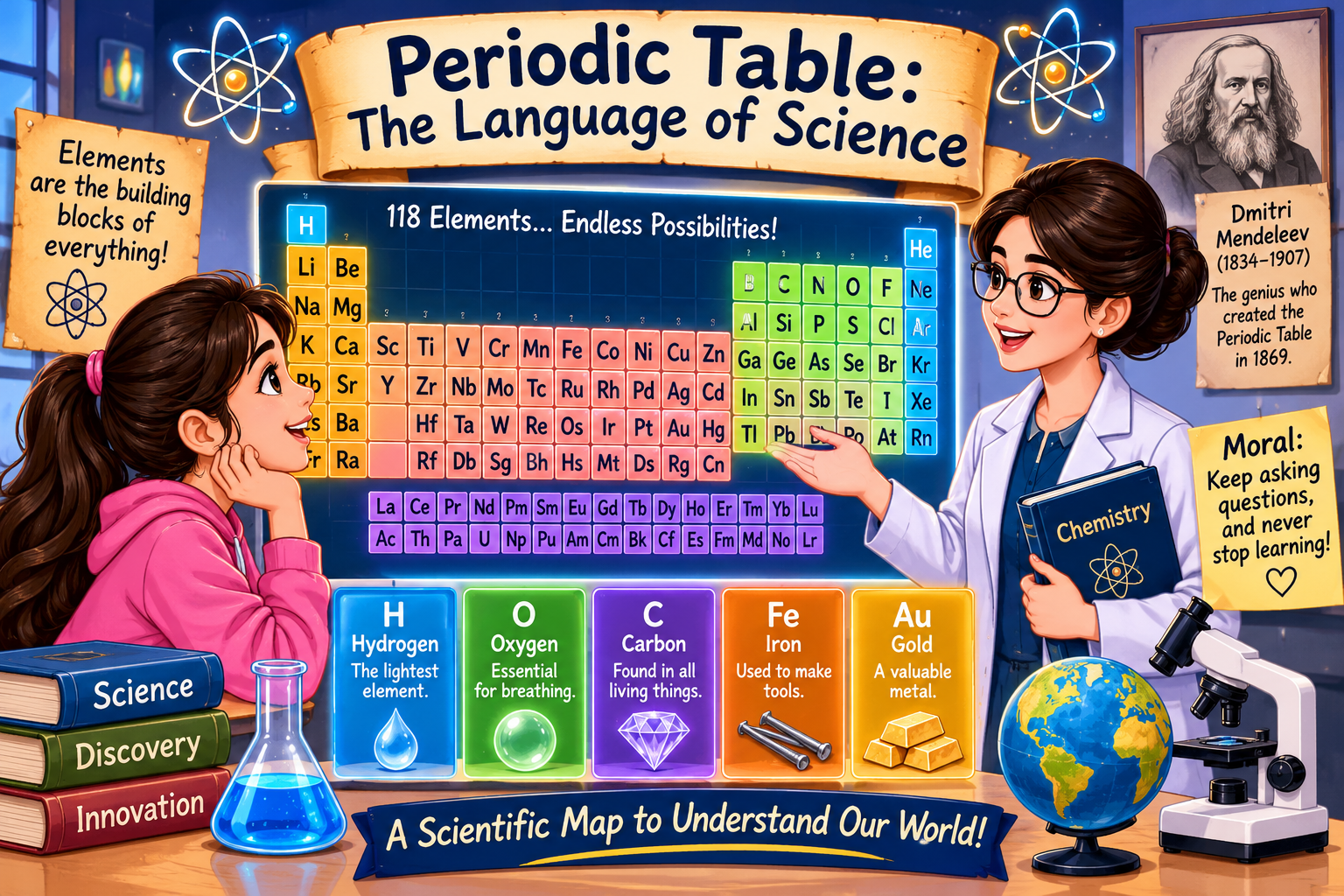
    # ** Periodic Table: The Language of Science**
    *An Interesting Educational Story*
    Once upon a time, in the amazing world of science, there was a magical chart called the **Periodic Table**. It was not an ordinary chart; it was a special language that helped scientists understand the building blocks of everything around us.
    One day, a curious student named Ali asked his science teacher, "What is everything in the world made of?"
    The teacher smiled and replied, "Everything around you, from the air you breathe to the water you drink, is made of tiny building blocks called elements."
    Ali became curious and asked, "How can we understand all these elements?"
    The teacher pointed towards the Periodic Table and said, "This is where the magic begins!"
    The Periodic Table contains 118 known elements. Each element has its own name, symbol, and atomic number.
    For example:
    - **H – Hydrogen:** The lightest element.
    - **O – Oxygen:** Essential for breathing.
    - **C – Carbon:** Found in all living things.
    - **Fe – Iron:** Used to make many tools and structures.
    - **Au – Gold:** A valuable metal.
    Ali discovered that the elements were arranged according to their atomic numbers and properties. Elements in the same group often share similar characteristics.
    He also learned about Dmitri Mendeleev, the scientist who developed an early version of the Periodic Table in 1869. He even left spaces for elements that had not yet been discovered!
    Ali was amazed. He realized that the Periodic Table was like a scientific map that helped us understand nature, technology, medicine, and the world around us.
    From that day forward, Ali never saw the Periodic Table as just a collection of symbols. He saw it as the **language of science**, connecting every element to the incredible story of our universe.

    **Moral of the Story:**

    Science is all around us. Every element has a story, and every discovery begins with curiosity. Keep asking questions, keep exploring, and never stop learning!
    **The Periodic Table is not just a chart; it is the language that helps us understand our world!**

    **Periodic Table: The Language of Science**

    The Periodic Table is one of the most important tools in science. It organizes 118 known elements and helps us understand the building blocks of everything around us.
    In this educational story, we explore different elements such as Hydrogen, Oxygen, Carbon, Iron, and Gold. We also discover how Dmitri Mendeleev developed the Periodic Table and changed the world of chemistry.
    **My Learning:** Every element has its own properties and importance. Science helps us understand the world around us!
    Keep exploring, keep asking questions, and never stop learning!
    #PeriodicTable #LanguageOfScience #Chemistry #ScienceLearning #Elements #Education #DmitriMendeleev #KeepLearning #ScienceExploration


    Foundation level Task Day : 62 Task : story post # **🌍 Periodic Table: The Language of Science** *An Interesting Educational Story* Once upon a time, in the amazing world of science, there was a magical chart called the **Periodic Table**. It was not an ordinary chart; it was a special language that helped scientists understand the building blocks of everything around us. One day, a curious student named Ali asked his science teacher, "What is everything in the world made of?" The teacher smiled and replied, "Everything around you, from the air you breathe to the water you drink, is made of tiny building blocks called elements." Ali became curious and asked, "How can we understand all these elements?" The teacher pointed towards the Periodic Table and said, "This is where the magic begins!" The Periodic Table contains 118 known elements. Each element has its own name, symbol, and atomic number. For example: - **H – Hydrogen:** The lightest element. - **O – Oxygen:** Essential for breathing. - **C – Carbon:** Found in all living things. - **Fe – Iron:** Used to make many tools and structures. - **Au – Gold:** A valuable metal. Ali discovered that the elements were arranged according to their atomic numbers and properties. Elements in the same group often share similar characteristics. He also learned about Dmitri Mendeleev, the scientist who developed an early version of the Periodic Table in 1869. He even left spaces for elements that had not yet been discovered! Ali was amazed. He realized that the Periodic Table was like a scientific map that helped us understand nature, technology, medicine, and the world around us. From that day forward, Ali never saw the Periodic Table as just a collection of symbols. He saw it as the **language of science**, connecting every element to the incredible story of our universe. ✨ **Moral of the Story:** Science is all around us. Every element has a story, and every discovery begins with curiosity. Keep asking questions, keep exploring, and never stop learning! **The Periodic Table is not just a chart; it is the language that helps us understand our world!** 🌍🔬 🌍 **Periodic Table: The Language of Science** 🔬🧪 The Periodic Table is one of the most important tools in science. It organizes 118 known elements and helps us understand the building blocks of everything around us. ✨ In this educational story, we explore different elements such as Hydrogen, Oxygen, Carbon, Iron, and Gold. We also discover how Dmitri Mendeleev developed the Periodic Table and changed the world of chemistry. 💡 **My Learning:** Every element has its own properties and importance. Science helps us understand the world around us! 🚀 Keep exploring, keep asking questions, and never stop learning! #PeriodicTable #LanguageOfScience #Chemistry #ScienceLearning #Elements #Education #DmitriMendeleev #KeepLearning #ScienceExploration
    1
    0 Σχόλια 0 Μοιράστηκε 321 Views
  • #rsisb
    Roll no 248
    Foundtion level
    Image with ChatGPT no 13
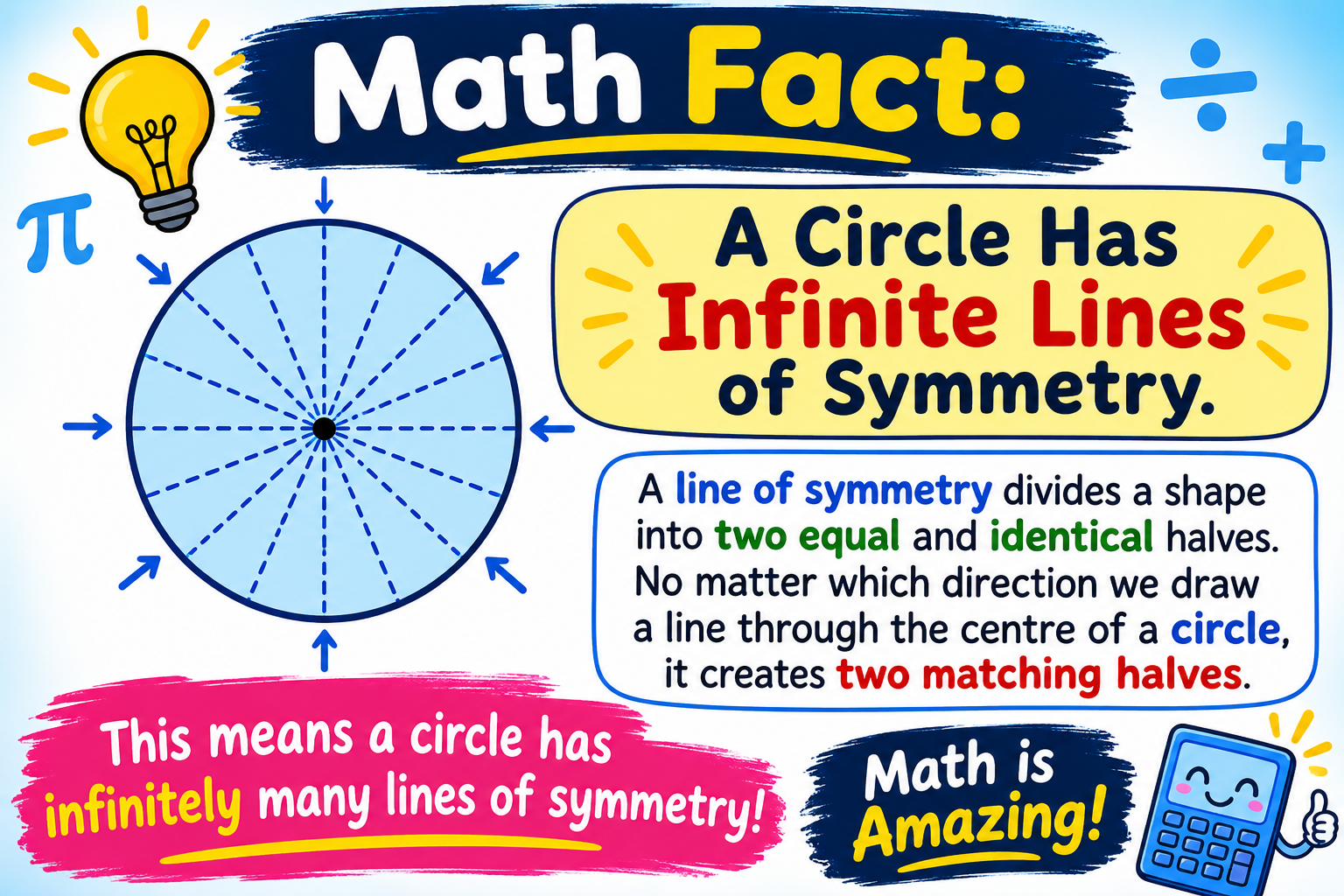
    **Math Fact: A Circle Has Infinite Lines of Symmetry!**

    Did you know? Mathematics is full of amazing facts! Today, I learned something interesting about circles: **A circle has infinite lines of symmetry.**

    A line of symmetry divides a shape into two equal and identical halves. No matter which direction we draw a line through the centre of a circle, it creates two matching halves. This means a circle has infinitely many lines of symmetry!

    Math is not just about numbers and calculations; it is also about discovering beautiful patterns, exploring shapes, and understanding the world around us.

    As a student of **Rehan School Islamabad, Pakistan**, I am always excited to learn new things with the help of ChatGPT and AI.

    Let's keep learning, exploring, and discovering something new every day!

    **What is your favourite mathematical fact? Share it in the comments!**

    #MathFacts #Mathematics #Circle #LinesOfSymmetry #AmazingMath #LearnWithChatGPT #AIinEducation #RehanSchool #RehanSchoolIslamabad #LearningEveryday #Education #KnowledgeIsPower #CreativeLearning #StudentLife #KeepLearning
    #rsisb Roll no 248 Foundtion level Image with ChatGPT no 13 🔵 **Math Fact: A Circle Has Infinite Lines of Symmetry!** 📐✨ Did you know? 🤔 Mathematics is full of amazing facts! Today, I learned something interesting about circles: **A circle has infinite lines of symmetry.** 🔵 A line of symmetry divides a shape into two equal and identical halves. No matter which direction we draw a line through the centre of a circle, it creates two matching halves. This means a circle has infinitely many lines of symmetry! 🌟 Math is not just about numbers and calculations; it is also about discovering beautiful patterns, exploring shapes, and understanding the world around us. 🌍📚 As a student of **Rehan School Islamabad, Pakistan**, I am always excited to learn new things with the help of ChatGPT and AI. 🤖🚀 Let's keep learning, exploring, and discovering something new every day! 💡 **What is your favourite mathematical fact? Share it in the comments!** 💬 #MathFacts #Mathematics #Circle #LinesOfSymmetry #AmazingMath #LearnWithChatGPT #AIinEducation #RehanSchool #RehanSchoolIslamabad #LearningEveryday #Education #KnowledgeIsPower #CreativeLearning #StudentLife #KeepLearning 📚🔵✨
    1
    0 Σχόλια 0 Μοιράστηκε 399 Views
  • ACCL BOOK
    DAY 24
    Talk With AI
    Zainab Siddiqui AI Wali
    Foundation Level
    Roll No: 002
    Student at Rehan School Urdu Bazar Campus
    @Saba Ibrahim Educationwali

    Topic: Bye-Bye – Where Did Our Goodbye Come From?

    Have you ever wondered where the word “Goodbye” came from? This interesting conversation explores the history and origin of one of the most common words we use every day. From its early beginnings to the way people say goodbye around the world, we discover how a simple farewell became an important part of our daily communication. Through this Talk with AI activity, we learn new things, improve our English speaking skills, and understand the beauty of everyday language.

    Every goodbye is a new beginning!

    \#TalkWithAI #ByeBye #Goodbye #EnglishSpeaking #LearnEnglish #LanguageLearning #EnglishPractice #CommunicationSkills #DailyEnglish #AIConversation
    ACCL BOOK DAY 24 Talk With AI Zainab Siddiqui AI Wali Foundation Level Roll No: 002 Student at Rehan School Urdu Bazar Campus @Saba Ibrahim Educationwali 📞✨ Topic: Bye-Bye – Where Did Our Goodbye Come From? 👋💬 Have you ever wondered where the word “Goodbye” came from? 🤔 This interesting conversation explores the history and origin of one of the most common words we use every day. 🌍 From its early beginnings to the way people say goodbye around the world, we discover how a simple farewell became an important part of our daily communication. 💕 Through this Talk with AI activity, we learn new things, improve our English speaking skills, and understand the beauty of everyday language. 🗣️📚 Every goodbye is a new beginning! 🌸👋✨ \#TalkWithAI #ByeBye #Goodbye #EnglishSpeaking #LearnEnglish #LanguageLearning #EnglishPractice #CommunicationSkills #DailyEnglish #AIConversation 📞💻🌟
    2
    0 Σχόλια 0 Μοιράστηκε 469 Views 5
  • Foundation level Task
    Day : 69
    Task : story post
    # Acids and Bases: The Balance of Nature
    An Educational Science Story
    Title: The Secret of Acids and Bases
    Once upon a time, in a beautiful world called Nature, two special characters lived: Acid and Base.
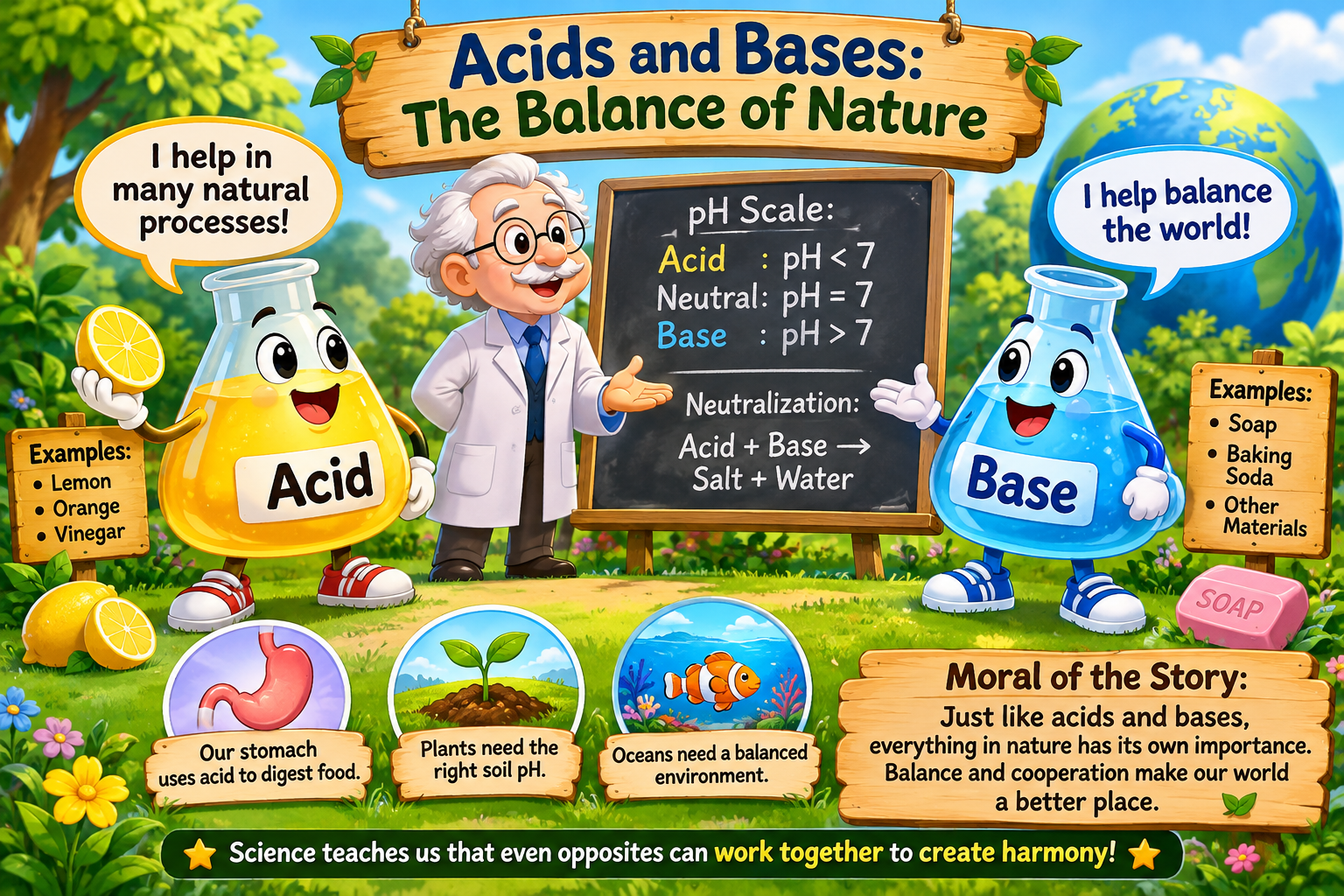
    Acid was famous for its sour taste. Lemons, oranges, and vinegar were some of its examples. Base was different. It was found in soap, baking soda, and other everyday materials.
    One day, Acid and Base started arguing.
    Acid said, "I am more important because I help in many natural processes!"
    Base replied, "No! I am equally important because I help balance the world!"
    They went to the wise scientist, Professor Nature, to solve their disagreement.
    Professor Nature smiled and said, "Both of you are important! Acids and bases work together to maintain balance in nature."
    He explained that acids have a pH below 7, bases have a pH above 7, and neutral substances have a pH of 7.
    Then he showed them a special process called Neutralization. When an acid and a base react together, they can produce salt and water.
    Acid and Base finally understood that they were not enemies. They were partners!
    They also learned that our stomach uses acid to help digest food, plants need the right soil pH to grow, and oceans need a balanced environment for marine life.
    From that day forward, Acid and Base worked together to protect the balance of nature.
    Moral of the Story:
    Just like acids and bases, everything in nature has its own importance. Balance and cooperation make our world a better place.
    Science teaches us that even opposites can work together to create harmony!

    **Acids and Bases: The Balance of Nature**

    Discover the fascinating world of acids and bases through an interesting educational story! From sour lemons and oranges to soap and baking soda, acids and bases play an important role in our daily lives.
    Learn about the pH scale, neutralization, and how acids and bases help maintain balance in nature. Explore how our stomach, plants, and oceans depend on the right chemical balance.
    **Moral of the Story:** Everything in nature has its own importance. Balance and cooperation make our world a better place!

    Science is everywhere around us. Let's learn something new every day!
    #AcidsAndBases #ScienceStory #Chemistry #PHScale #Neutralization #BalanceOfNature #ScienceEducation #LearnWithFun #educationalstorytellers

    Foundation level Task Day : 69 Task : story post # 🌿 Acids and Bases: The Balance of Nature An Educational Science Story Title: The Secret of Acids and Bases Once upon a time, in a beautiful world called Nature, two special characters lived: Acid and Base. Acid was famous for its sour taste. Lemons, oranges, and vinegar were some of its examples. Base was different. It was found in soap, baking soda, and other everyday materials. One day, Acid and Base started arguing. Acid said, "I am more important because I help in many natural processes!" Base replied, "No! I am equally important because I help balance the world!" They went to the wise scientist, Professor Nature, to solve their disagreement. Professor Nature smiled and said, "Both of you are important! Acids and bases work together to maintain balance in nature." He explained that acids have a pH below 7, bases have a pH above 7, and neutral substances have a pH of 7. Then he showed them a special process called Neutralization. When an acid and a base react together, they can produce salt and water. Acid and Base finally understood that they were not enemies. They were partners! They also learned that our stomach uses acid to help digest food, plants need the right soil pH to grow, and oceans need a balanced environment for marine life. From that day forward, Acid and Base worked together to protect the balance of nature. Moral of the Story: Just like acids and bases, everything in nature has its own importance. Balance and cooperation make our world a better place. 🌍 Science teaches us that even opposites can work together to create harmony! 🌿 **Acids and Bases: The Balance of Nature** 🧪 Discover the fascinating world of acids and bases through an interesting educational story! From sour lemons and oranges to soap and baking soda, acids and bases play an important role in our daily lives. Learn about the pH scale, neutralization, and how acids and bases help maintain balance in nature. Explore how our stomach, plants, and oceans depend on the right chemical balance. ✨ **Moral of the Story:** Everything in nature has its own importance. Balance and cooperation make our world a better place! 🌍 Science is everywhere around us. Let's learn something new every day! #AcidsAndBases #ScienceStory #Chemistry #PHScale #Neutralization #BalanceOfNature #ScienceEducation #LearnWithFun #educationalstorytellers
    1
    0 Σχόλια 0 Μοιράστηκε 731 Views
  • Mohsin #RSF8
    Call Annine NO:9
    Class: foundation level
    roll no:13
    Made by Me

    "Sorry" – Tracing the Roots of Apology

    The word "Sorry" is one of the most important and meaningful words in our daily lives. It is a small word, but it has a powerful message of kindness, respect, honesty, and forgiveness. We use this word when we make a mistake, hurt someone's feelings, misunderstand someone, or cause trouble for another person. In this activity, "Sorry" – Tracing the Roots of Apology, I will explore the history, meaning, importance, and evolution of the word "Sorry."

    During this 10-minute activity, I will discuss 20 interesting questions about apologies and learn why people say sorry, where the word originally came from, and how the tradition of apologizing developed throughout history. I will also explore how people in different countries and cultures express apologies and how this simple word became an important part of human communication.

    Saying sorry is not just about speaking a word. It is about accepting our mistakes, understanding other people's feelings, and taking responsibility for our actions. A sincere apology shows that we respect others and care about their emotions. Sometimes, a small apology can solve a big misunderstanding, rebuild trust, and make a friendship stronger.

    I will also discuss the difference between a simple apology and a sincere apology. Some people say sorry just to end an argument, but a meaningful apology comes from the heart. A true apology should include understanding the mistake, accepting responsibility, and trying not to repeat it. Our actions are just as important as our words.

    Another important point I will explore is why some people find it difficult to apologize. Sometimes pride, fear, or embarrassment stops people from accepting their mistakes. However, I believe that saying sorry is not a sign of weakness. It is a sign of courage, maturity, confidence, and good character. A person who can accept mistakes is always ready to learn and improve.

    Through this topic, I will understand how apologies help us in our families, schools, friendships, and everyday conversations.
    Mohsin #RSF8 Call Annine NO:9 Class: foundation level roll no:13 Made by Me "Sorry" – Tracing the Roots of Apology The word "Sorry" is one of the most important and meaningful words in our daily lives. It is a small word, but it has a powerful message of kindness, respect, honesty, and forgiveness. We use this word when we make a mistake, hurt someone's feelings, misunderstand someone, or cause trouble for another person. In this activity, "Sorry" – Tracing the Roots of Apology, I will explore the history, meaning, importance, and evolution of the word "Sorry." During this 10-minute activity, I will discuss 20 interesting questions about apologies and learn why people say sorry, where the word originally came from, and how the tradition of apologizing developed throughout history. I will also explore how people in different countries and cultures express apologies and how this simple word became an important part of human communication. Saying sorry is not just about speaking a word. It is about accepting our mistakes, understanding other people's feelings, and taking responsibility for our actions. A sincere apology shows that we respect others and care about their emotions. Sometimes, a small apology can solve a big misunderstanding, rebuild trust, and make a friendship stronger. I will also discuss the difference between a simple apology and a sincere apology. Some people say sorry just to end an argument, but a meaningful apology comes from the heart. A true apology should include understanding the mistake, accepting responsibility, and trying not to repeat it. Our actions are just as important as our words. Another important point I will explore is why some people find it difficult to apologize. Sometimes pride, fear, or embarrassment stops people from accepting their mistakes. However, I believe that saying sorry is not a sign of weakness. It is a sign of courage, maturity, confidence, and good character. A person who can accept mistakes is always ready to learn and improve. Through this topic, I will understand how apologies help us in our families, schools, friendships, and everyday conversations.
    1
    0 Σχόλια 0 Μοιράστηκε 982 Views 16
  • #rsisb
    Roll no 159
    Story Post No.1
    Level One Student


    Topic: Mulla Nasruddin – The Magical Mirror


    Today, I learned an interesting story about Mulla Nasruddin and how he cleverly solved a problem using a magical mirror given to him by the Sultan. This story teaches us the importance of intelligence, creativity, and problem-solving.
    #MullaNasruddin #MagicalMirror #Storytelling #ProblemSolving #RehanSchool
    #rsisb Roll no 159 Story Post No.1 Level One Student Topic: Mulla Nasruddin – The Magical Mirror Today, I learned an interesting story about Mulla Nasruddin and how he cleverly solved a problem using a magical mirror given to him by the Sultan. This story teaches us the importance of intelligence, creativity, and problem-solving. #MullaNasruddin #MagicalMirror #Storytelling #ProblemSolving #RehanSchool
    1
    0 Σχόλια 0 Μοιράστηκε 356 Views
Αναζήτηση αποτελεσμάτων