



#rsisb
Roll no.239
Story post no.8
Foundation Level
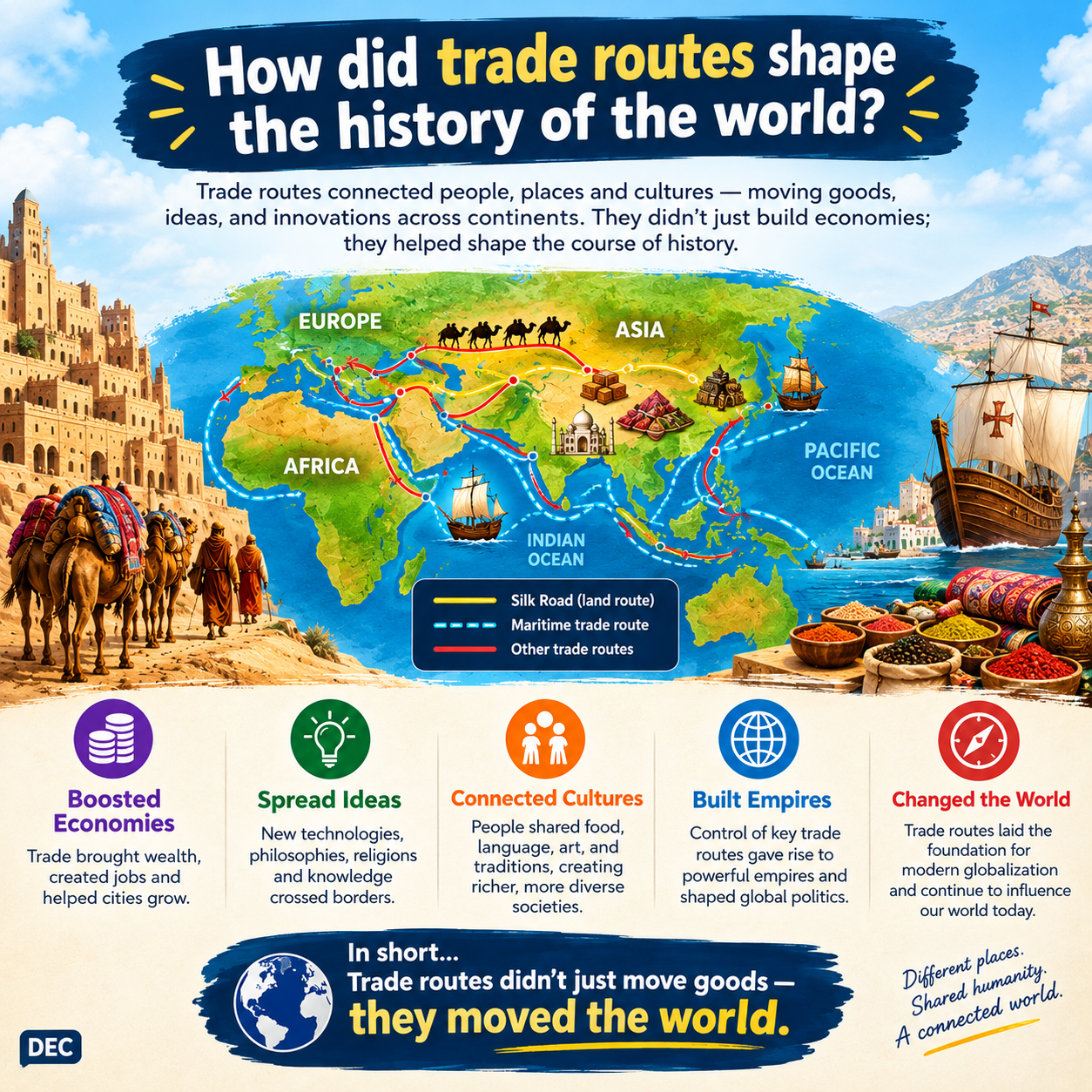
Long before modern airplanes, highways, and the internet connected the world, **trade routes brought distant communities together**. From ancient caravan paths across Asia and Africa to maritime routes across the Indian Ocean and Mediterranean Sea, these networks helped transform human history.
**Trade routes moved much more than goods.**
Silk, spices, gold, precious stones, textiles, metals, food, and other valuable products traveled across continents. But along with these goods came something equally important: **ideas, technologies, languages, beliefs, traditions, and knowledge**.
**They helped economies grow.**
Cities located along important routes often became busy centers of trade. Merchants, craftsmen, sailors, and travelers created new economic opportunities, while ports and marketplaces connected producers and consumers across great distances.
**They spread knowledge and innovation.**
Technologies, scientific ideas, navigation techniques, agricultural practices, and inventions could travel from one region to another. Trade networks therefore helped knowledge move across cultural and geographic boundaries.
**They connected different cultures.**
People from different societies met in markets, ports, and trading cities. These encounters encouraged cultural exchange and influenced food, clothing, art, architecture, languages, and traditions.
**They influenced the rise of cities and empires.**
Controlling important trade routes could provide wealth and strategic advantages. As a result, powerful states and empires competed to control important roads, ports, and commercial centers.
**Maritime trade changed global connections.**
Sea routes across the Indian Ocean and other waterways allowed merchants to transport large quantities of goods between distant regions. Over time, expanding maritime networks helped create increasingly interconnected economies.
**The legacy continues today.**
Modern global trade, international shipping, major ports, and interconnected economies are part of a much longer history of people exchanging goods and ideas across borders.
**In short:** Trade routes did not simply move products from one place to another. They helped **move people, ideas, technology, cultures, and knowledge**, creating connections that shaped the history of the world.
**History reminds us that the world has been connected for thousands of years.**
#TradeRoutes #WorldHistory #HistoryFacts #SilkRoad #AncientHistory #GlobalHistory #Geography #CulturalExchange #HistoryEducation #LearnHistory #DidYouKnow #WorldCivilizations #MaritimeTrade #Education #STEM #SocialStudies #HistoryLovers #KnowledgeIsPower #ChatGPT
Roll no.239
Story post no.8
Foundation Level
Long before modern airplanes, highways, and the internet connected the world, **trade routes brought distant communities together**. From ancient caravan paths across Asia and Africa to maritime routes across the Indian Ocean and Mediterranean Sea, these networks helped transform human history.
**Trade routes moved much more than goods.**
Silk, spices, gold, precious stones, textiles, metals, food, and other valuable products traveled across continents. But along with these goods came something equally important: **ideas, technologies, languages, beliefs, traditions, and knowledge**.
**They helped economies grow.**
Cities located along important routes often became busy centers of trade. Merchants, craftsmen, sailors, and travelers created new economic opportunities, while ports and marketplaces connected producers and consumers across great distances.
**They spread knowledge and innovation.**
Technologies, scientific ideas, navigation techniques, agricultural practices, and inventions could travel from one region to another. Trade networks therefore helped knowledge move across cultural and geographic boundaries.
**They connected different cultures.**
People from different societies met in markets, ports, and trading cities. These encounters encouraged cultural exchange and influenced food, clothing, art, architecture, languages, and traditions.
**They influenced the rise of cities and empires.**
Controlling important trade routes could provide wealth and strategic advantages. As a result, powerful states and empires competed to control important roads, ports, and commercial centers.
**Maritime trade changed global connections.**
Sea routes across the Indian Ocean and other waterways allowed merchants to transport large quantities of goods between distant regions. Over time, expanding maritime networks helped create increasingly interconnected economies.
**The legacy continues today.**
Modern global trade, international shipping, major ports, and interconnected economies are part of a much longer history of people exchanging goods and ideas across borders.
**In short:** Trade routes did not simply move products from one place to another. They helped **move people, ideas, technology, cultures, and knowledge**, creating connections that shaped the history of the world.
**History reminds us that the world has been connected for thousands of years.**
#TradeRoutes #WorldHistory #HistoryFacts #SilkRoad #AncientHistory #GlobalHistory #Geography #CulturalExchange #HistoryEducation #LearnHistory #DidYouKnow #WorldCivilizations #MaritimeTrade #Education #STEM #SocialStudies #HistoryLovers #KnowledgeIsPower #ChatGPT
#rsisb
Roll no.239
Story post no.8
Foundation Level
Long before modern airplanes, highways, and the internet connected the world, **trade routes brought distant communities together**. From ancient caravan paths across Asia and Africa to maritime routes across the Indian Ocean and Mediterranean Sea, these networks helped transform human history.
🧭 **Trade routes moved much more than goods.**
Silk, spices, gold, precious stones, textiles, metals, food, and other valuable products traveled across continents. But along with these goods came something equally important: **ideas, technologies, languages, beliefs, traditions, and knowledge**.
💰 **They helped economies grow.**
Cities located along important routes often became busy centers of trade. Merchants, craftsmen, sailors, and travelers created new economic opportunities, while ports and marketplaces connected producers and consumers across great distances.
💡 **They spread knowledge and innovation.**
Technologies, scientific ideas, navigation techniques, agricultural practices, and inventions could travel from one region to another. Trade networks therefore helped knowledge move across cultural and geographic boundaries.
🤝 **They connected different cultures.**
People from different societies met in markets, ports, and trading cities. These encounters encouraged cultural exchange and influenced food, clothing, art, architecture, languages, and traditions.
🏛️ **They influenced the rise of cities and empires.**
Controlling important trade routes could provide wealth and strategic advantages. As a result, powerful states and empires competed to control important roads, ports, and commercial centers.
🌊 **Maritime trade changed global connections.**
Sea routes across the Indian Ocean and other waterways allowed merchants to transport large quantities of goods between distant regions. Over time, expanding maritime networks helped create increasingly interconnected economies.
🌎 **The legacy continues today.**
Modern global trade, international shipping, major ports, and interconnected economies are part of a much longer history of people exchanging goods and ideas across borders.
✨ **In short:** Trade routes did not simply move products from one place to another. They helped **move people, ideas, technology, cultures, and knowledge**, creating connections that shaped the history of the world.
📚 **History reminds us that the world has been connected for thousands of years.**
#TradeRoutes #WorldHistory #HistoryFacts #SilkRoad #AncientHistory #GlobalHistory #Geography #CulturalExchange #HistoryEducation #LearnHistory #DidYouKnow #WorldCivilizations #MaritimeTrade #Education #STEM #SocialStudies #HistoryLovers #KnowledgeIsPower #ChatGPT
0 Commentarii
0 Distribuiri
1232 Views