• #rsisb
    Roll No.221
    Song No.17
    Foundation Level


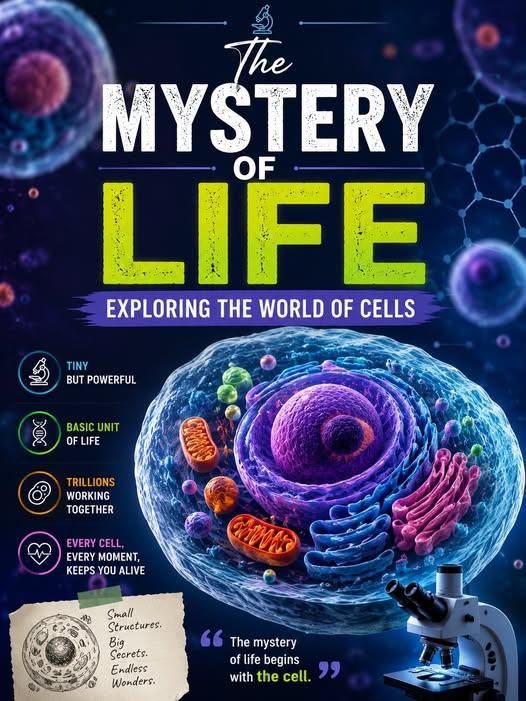
    **Cellular Symphony: The Intricate Dance of Life’s Building Blocks**

    Discover the incredible world of **cells**, the fundamental building blocks of all living organisms, through this inspiring educational song! From the nucleus and DNA to mitochondria, ribosomes, and the cell membrane, this song takes you on a fascinating journey into the microscopic world where life begins. Learn how cells work together to create tissues, organs, and entire living beings while celebrating the beauty, complexity, and harmony of biology.

    Perfect for **students, teachers, biology enthusiasts, and lifelong learners**, this song makes science engaging, memorable, and fun. Whether you're studying cell biology, preparing for exams, or simply curious about the wonders of life, let this musical journey inspire your love for science and discovery.

    **Learn • Explore • Discover • Be Inspired**

    #CellularSymphony #CellBiology #BiologySong #ScienceEducation #STEM #LifeSciences #DNA #Cells #EducationalMusic #LearningThroughMusic #ScienceForStudents #BiologyEducation #MicroscopicWorld #Nature #Knowledge #Inspiration #ScienceLovers
    Asma Shaheen EducationWali
    Saima Happinesswali
    Irum Asim

    #rsisb Roll No.221 Song No.17 Foundation Level 🧬🎶 **Cellular Symphony: The Intricate Dance of Life’s Building Blocks** 🌍✨ Discover the incredible world of **cells**, the fundamental building blocks of all living organisms, through this inspiring educational song! 🔬💚 From the nucleus and DNA to mitochondria, ribosomes, and the cell membrane, this song takes you on a fascinating journey into the microscopic world where life begins. Learn how cells work together to create tissues, organs, and entire living beings while celebrating the beauty, complexity, and harmony of biology. Perfect for **students, teachers, biology enthusiasts, and lifelong learners**, this song makes science engaging, memorable, and fun. Whether you're studying cell biology, preparing for exams, or simply curious about the wonders of life, let this musical journey inspire your love for science and discovery. 🌱🧪 ✨ **Learn • Explore • Discover • Be Inspired** #CellularSymphony #CellBiology #BiologySong #ScienceEducation #STEM #LifeSciences #DNA #Cells #EducationalMusic #LearningThroughMusic #ScienceForStudents #BiologyEducation #MicroscopicWorld #Nature #Knowledge #Inspiration #ScienceLovers 🧬🎵🌍 Asma Shaheen EducationWali Saima Happinesswali Irum Asim
    0 Комментарии 0 Поделились 4421 Просмотры 7
  • #rsisb
    RollNo.244
    Task No.41
    Foundation Level
    Here's a social-media-friendly description with emojis:
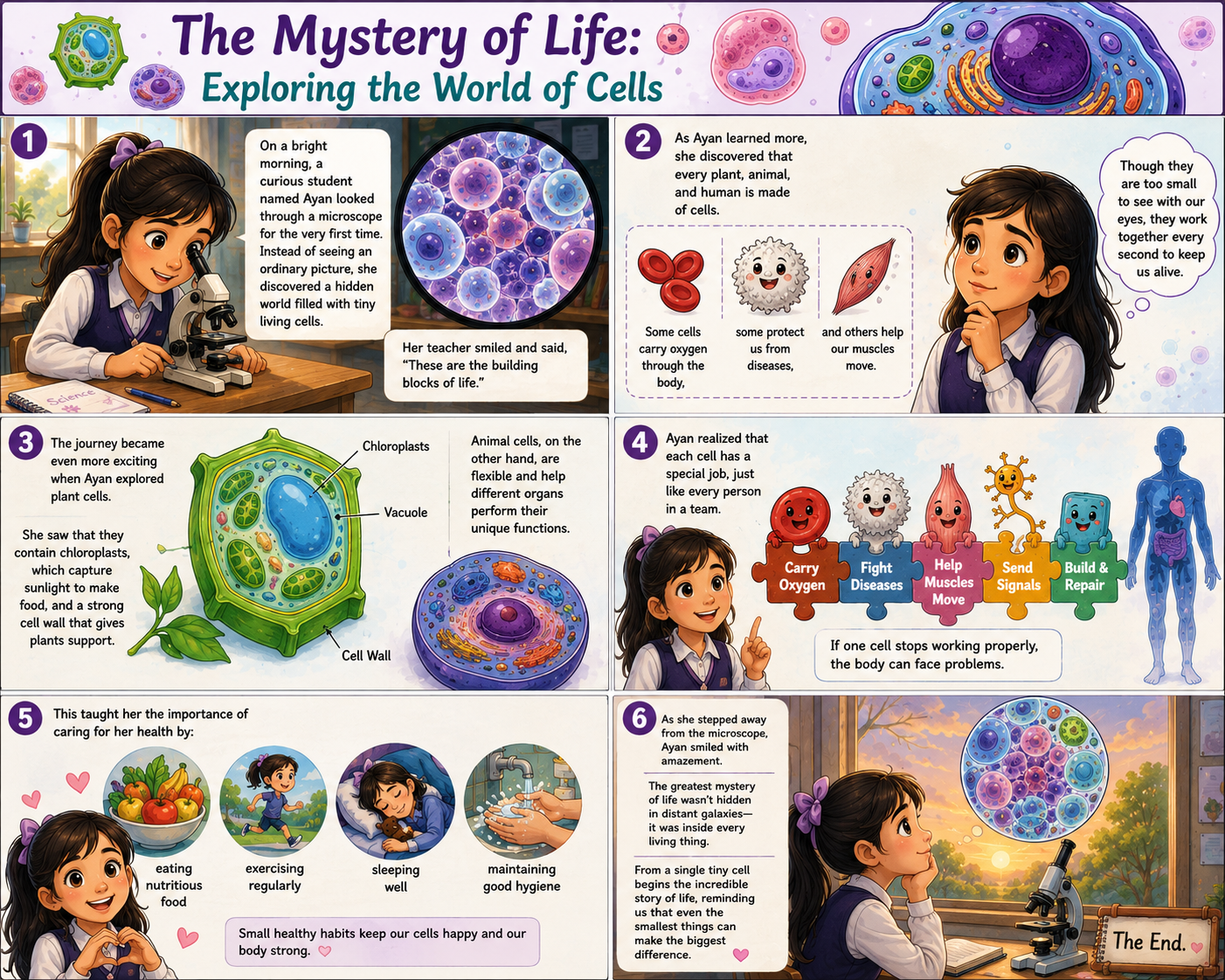
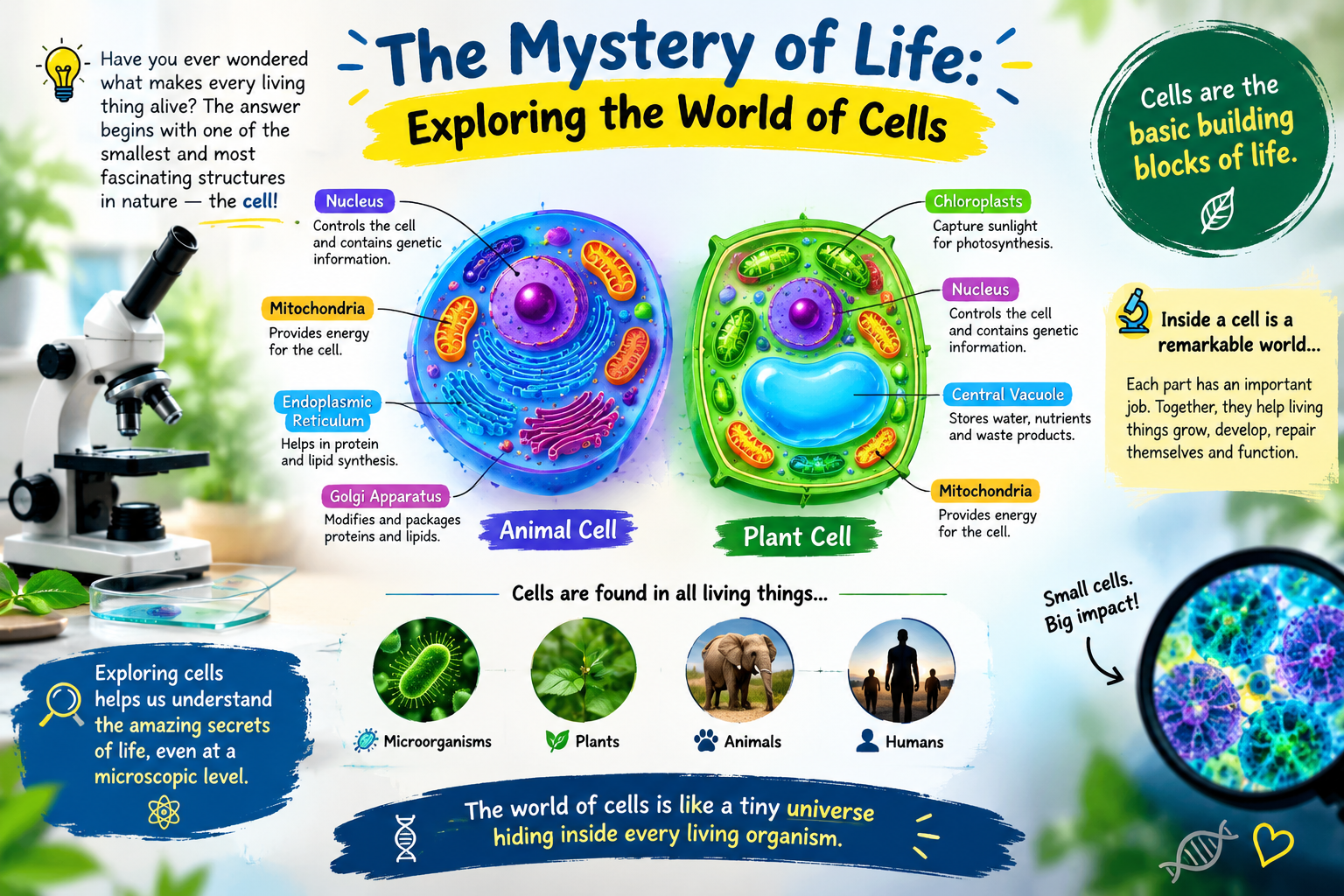
    **The Mystery of Life: Exploring the World of Cells**
    Every living thing, from the tiniest ant to the tallest tree and every human being , is made up of tiny building blocks called **cells**. Although they are too small to see with the naked eye , cells perform incredible jobs every second to keep us alive.
    Think of cells as tiny factories working nonstop! They produce energy , repair damaged tissues , fight harmful germs , and help our bodies grow stronger every day. Each cell has a special role, and together they create the amazing masterpiece that is life.
    Scientists use powerful microscopes to unlock the secrets hidden inside cells. From discovering new medicines to understanding diseases and improving healthcare, the study of cells has transformed our world in remarkable ways.
    The more we explore the microscopic world, the more we realize how extraordinary life truly is. Every cell tells a story of growth , teamwork , and survival . So, the next time you look at yourself in the mirror , remember that trillions of tiny cells are working together to make you who you are!
    Keep exploring, keep asking questions, and never stop being curious—because every great discovery begins with curiosity!
    #rsisb RollNo.244 Task No.41 Foundation Level Here's a social-media-friendly description with emojis: 🧬🔬 **The Mystery of Life: Exploring the World of Cells** 🌍✨ Every living thing, from the tiniest ant 🐜 to the tallest tree 🌳 and every human being 👨‍👩‍👧‍👦, is made up of tiny building blocks called **cells**. 🧫 Although they are too small to see with the naked eye 👀, cells perform incredible jobs every second to keep us alive. ❤️⚡ Think of cells as tiny factories 🏭 working nonstop! They produce energy ⚡, repair damaged tissues 🩹, fight harmful germs 🦠, and help our bodies grow stronger every day. 💪🌱 Each cell has a special role, and together they create the amazing masterpiece that is life. 🌟 Scientists use powerful microscopes 🔬 to unlock the secrets hidden inside cells. From discovering new medicines 💊 to understanding diseases 🩺 and improving healthcare, the study of cells has transformed our world in remarkable ways. 🌍✨ The more we explore the microscopic world, the more we realize how extraordinary life truly is. 💚 Every cell tells a story of growth 🌱, teamwork 🤝, and survival 🌟. So, the next time you look at yourself in the mirror 🪞, remember that trillions of tiny cells are working together to make you who you are! 🧬💖 🌟 Keep exploring, keep asking questions, and never stop being curious—because every great discovery begins with curiosity!
    0 Комментарии 0 Поделились 2008 Просмотры
  • Two brain cells having a chat:

    Neurons have specialized projections called dendrites and axons.
    Dendrites bring information to the cell body and axons take information away from the cell body.

    Dendrites receive synaptic inputs from axons, with the sum total of dendritic inputs determining whether the neuron will fire an action potential.

    Credit: microscopicture
    #neuroscience #biology #medicine
    Two brain cells having a chat: Neurons have specialized projections called dendrites and axons. Dendrites bring information to the cell body and axons take information away from the cell body. Dendrites receive synaptic inputs from axons, with the sum total of dendritic inputs determining whether the neuron will fire an action potential. Credit: microscopicture #neuroscience #biology #medicine
    0 Комментарии 0 Поделились 428 Просмотры 0
  • What I and many who understand that education in school is mostly waste of time were saying for years no one listened, and now finally a microscopic virus is doing it for us !

    Pakistani schools closed for another 2.5 months !

    It will finally make us technology savvy, literate and it will make us stronger as humanity !

    Thank you coronoa virus ! You are a blessing in disguise for humanity, so we can finally think and evolve !

    For those who really want their children to learn something, get them online on Khan Academy , EDX and Youtube !

    Get them to meditate, exercise, cook, communicate with you every day, that will make them amazing citizens of the world !

    Here is a 4 year old video of mine still valid about education https://youtu.be/QH_6OY830J0

    Rehan Allahwala
    What I and many who understand that education in school is mostly waste of time were saying for years no one listened, and now finally a microscopic virus 🦠 is doing it for us ! Pakistani schools closed for another 2.5 months ! It will finally make us technology savvy, literate and it will make us stronger as humanity ! Thank you coronoa virus ! You are a blessing in disguise for humanity, so we can finally think and evolve ! For those who really want their children to learn something, get them online on Khan Academy , EDX and Youtube ! Get them to meditate, exercise, cook, communicate with you every day, that will make them amazing citizens of the world ! Here is a 4 year old video of mine still valid about education https://youtu.be/QH_6OY830J0 Rehan Allahwala
    0 Комментарии 0 Поделились 334 Просмотры
  • Colors in nature come mainly from three sources: pigments, structural colors, and bioluminescence. Such is the case of blue and green colors, compared to reds and the rest because they can be structural colors.

    Colors in nature come mainly from three sources: pigments, structural colors, and bioluminescence. Such is the case of blue and green colors, compared to reds and the rest because they can be structural colors.

    Structural coloring is the result of microscopically fine structured surfaces that interfere with visible light, sometimes in combination with pigments. For example, peacock tail feathers are brown pigmented, but because of their microscopic structure, they also reflect blue, turquoise and green light. And they are often iridescent. Thus, structural coloring is a classic optical effect of interference and diffraction, rather than a quantum property of photon absorption and emission, which is responsible for color in pigments (as plants, which efficiently absorb red light and the green is reflected) and bioluminescence.

    Learn more about the biophysics of the natural world in the free Unified Science Course in the Resonance Academy at ResonanceScience.org

    Photo by Kelvin Hudson
    Colors in nature come mainly from three sources: pigments, structural colors, and bioluminescence. Such is the case of blue and green colors, compared to reds and the rest because they can be structural colors. Colors in nature come mainly from three sources: pigments, structural colors, and bioluminescence. Such is the case of blue and green colors, compared to reds and the rest because they can be structural colors. Structural coloring is the result of microscopically fine structured surfaces that interfere with visible light, sometimes in combination with pigments. For example, peacock tail feathers are brown pigmented, but because of their microscopic structure, they also reflect blue, turquoise and green light. And they are often iridescent. Thus, structural coloring is a classic optical effect of interference and diffraction, rather than a quantum property of photon absorption and emission, which is responsible for color in pigments (as plants, which efficiently absorb red light and the green is reflected) and bioluminescence. Learn more about the biophysics of the natural world in the free Unified Science Course in the Resonance Academy at ResonanceScience.org Photo by Kelvin Hudson
    0 Комментарии 0 Поделились 318 Просмотры
  • Dr. Gary Greenberg, a visionary microscopist, is defying the conventional notion that compares something to a grain of sand as tiny or meaningless.

    Through his remarkable use of a microlens, Dr. Greenberg’s captivating images challenge this stereotype and showcase the astonishing beauty and complexity found within the microscopic world.

    Dr. Greenberg’s photographs unveil the hidden wonders within grains of sand, magnifying them up to 300 times their size. These incredible images reveal a kaleidoscope of colors and intricate patterns, transforming the perception of sand under a microscope from insignificance to a realm of awe-inspiring intricacy.

    By highlighting the beauty of these tiny rocks at such a magnified scale, Dr. Greenberg aims to challenge the notion that size determines significance. His work encourages us to recognize the incredible diversity and complexity that exists even within the tiniest particles of our world.

    #Sand #Singlegrain #Microscopic #Zoomedin #Picture
    Dr. Gary Greenberg, a visionary microscopist, is defying the conventional notion that compares something to a grain of sand as tiny or meaningless. Through his remarkable use of a microlens, Dr. Greenberg’s captivating images challenge this stereotype and showcase the astonishing beauty and complexity found within the microscopic world. Dr. Greenberg’s photographs unveil the hidden wonders within grains of sand, magnifying them up to 300 times their size. These incredible images reveal a kaleidoscope of colors and intricate patterns, transforming the perception of sand under a microscope from insignificance to a realm of awe-inspiring intricacy. By highlighting the beauty of these tiny rocks at such a magnified scale, Dr. Greenberg aims to challenge the notion that size determines significance. His work encourages us to recognize the incredible diversity and complexity that exists even within the tiniest particles of our world. #Sand #Singlegrain #Microscopic #Zoomedin #Picture
    0 Комментарии 0 Поделились 935 Просмотры
  • NASA has classified Sansevieria, now called Dracaena, as an air purifier due to its ability to remove toxic compounds such as benzene, formaldehyde, trichloroethylene, xylene and toluene.
    This plant uses the acid metabolism of the Crassulaceae to exchange oxygen and carbon dioxide, enabling it to resist drought.
    The microscopic pores on its leaves, called stomata, open only at night to limit water loss through transpiration in the heat of the sun. Unlike other plants, Sansevieria produces oxygen and absorbs carbon dioxide at night, making it an excellent indoor air purifier while we sleep.
    NASA has classified Sansevieria, now called Dracaena, as an air purifier due to its ability to remove toxic compounds such as benzene, formaldehyde, trichloroethylene, xylene and toluene. This plant uses the acid metabolism of the Crassulaceae to exchange oxygen and carbon dioxide, enabling it to resist drought. The microscopic pores on its leaves, called stomata, open only at night to limit water loss through transpiration in the heat of the sun. Unlike other plants, Sansevieria produces oxygen and absorbs carbon dioxide at night, making it an excellent indoor air purifier while we sleep.
    0 Комментарии 0 Поделились 274 Просмотры
  • Did you know?

    A handful of soil contains an astonishing number of microbes! In just one gram of soil, there can be over a billion bacteria, fungi, protozoa, nematodes, and other microorganisms. These tiny creatures play crucial roles in nutrient cycling, soil structure maintenance, and the decomposition of organic matter, making soil a vital and dynamic ecosystem.

    Next time you eat a fruit or see a tree, remember that billions and trillions of bacteria helped make this happen.

    Imagine holding tens of billions of these microscopic life forms in your hand, each contributing to the health of our planet.

    Check out this colorful visualization of a handful of soil teeming with life!

    #SoilHealth #Microbes #Nature #Ecosystem
    🌱 Did you know? 🌱 A handful of soil contains an astonishing number of microbes! In just one gram of soil, there can be over a billion bacteria, fungi, protozoa, nematodes, and other microorganisms. These tiny creatures play crucial roles in nutrient cycling, soil structure maintenance, and the decomposition of organic matter, making soil a vital and dynamic ecosystem. Next time you eat a fruit or see a tree, remember that billions and trillions of bacteria helped make this happen. 🌳🍎 Imagine holding tens of billions of these microscopic life forms in your hand, each contributing to the health of our planet. 🌍 Check out this colorful visualization of a handful of soil teeming with life! #SoilHealth #Microbes #Nature #Ecosystem
    0 Комментарии 0 Поделились 768 Просмотры
  • InnerVoice Band

    The Future Device That Turns Silent Thoughts Into Text

    For thousands of years, humans have used:

    * speaking,
    * writing,
    * keyboards,
    * touchscreens,
    to communicate with machines and each other.

    But a new era is beginning.

    A future is coming where humans may no longer need to:

    * type,
    * press buttons,
    * or even speak aloud.

    Instead, computers may understand:

    intention itself.

    One possible step toward that future is a device called:

    InnerVoice Band

    A wearable AI-powered communication device that converts silent inner speech into text on a phone, computer, or TV screen.


    What Is the InnerVoice Band?

    The InnerVoice Band is a wearable device placed around:

    * the jaw,
    * ear,
    * neck,
    * or glasses frame.

    The user silently “speaks” in their mind.

    For example:

    “Message Abdullah I am coming.”

    The device detects tiny muscle and nerve signals generated during internal speech and converts them into:

    * text,
    * commands,
    * notes,
    * AI prompts,
    displayed instantly on a phone or screen.

    The person never speaks aloud.

    To an outside observer, it appears almost magical.


    The Science Behind It

    The device does not truly “read minds.”

    Instead, it reads:

    subvocal signals.

    When humans silently talk in their head, the brain still sends microscopic electrical signals to:

    * jaw muscles,
    * throat muscles,
    * tongue muscles.

    These signals are extremely weak but real.

    The technology used to detect them is called:

    Electromyography (EMG)

    EMG sensors measure tiny electrical activity in muscles.

    Even when a person does not visibly move their mouth, the body often prepares speech internally.

    The InnerVoice Band captures these hidden signals.


    How the Device Works

    Step 1 — Internal Speech

    The user silently thinks:

    “Open WhatsApp.”


    Step 2 — Signal Detection

    EMG sensors detect:

    * jaw micro-movements,
    * throat activation,
    * muscle electrical patterns.

    Optional EEG sensors may also detect general neural activity.


    Step 3 — AI Interpretation

    An AI model analyzes the signals.

    The AI predicts:

    * words,
    * commands,
    * sentences,
    using:
    * machine learning,
    * language prediction,
    * personal training data.

    This is similar to how ChatGPT predicts sentences from incomplete information.


    Step 4 — Output

    The text appears on:

    * phone,
    * computer,
    * AR glasses,
    * TV screen.

    Example:

    “Open WhatsApp.”

    Or:

    “I have an idea for a solar startup.”


    Hardware Needed

    1. EMG Sensors

    These detect electrical muscle activity.

    Possible components:

    * MyoWare EMG sensor,
    * ADS1299 bio-signal chips,
    * custom dry electrodes.

    Cost:
    ~$5–20 per sensor.


    2. Microcontroller / AI Processor

    Possible options:

    * ESP32,
    * Raspberry Pi Zero,
    * Qualcomm AI chip,
    * NVIDIA Jetson Nano.

    This handles:

    * signal collection,
    * Bluetooth,
    * preprocessing.


    3. Bluetooth Module

    Sends data to:

    * smartphone,
    * computer,
    * cloud AI.

    Most modern chips already include Bluetooth.


    4. AI Software

    The AI system performs:

    * signal interpretation,
    * noise filtering,
    * word prediction,
    * personalization.

    Possible software stack:

    * Python,
    * TensorFlow,
    * PyTorch,
    * OpenAI APIs,
    * Whisper-like speech models.


    5. Battery

    Small lithium battery:

    * 8–12 hour runtime.

    Rechargeable through USB-C.


    6. Bone Conduction Speaker (Optional)

    The AI can respond privately through skull vibrations.

    Only the wearer hears the response.

    Like:

    * a silent AI whisper assistant.


    Why AI Changed Everything

    Ten years ago, this device would have been nearly impossible.

    The signals from the body are:

    * noisy,
    * weak,
    * inconsistent.

    But modern AI can now:

    * predict missing information,
    * infer intent,
    * autocomplete human language.

    This changes the problem completely.

    Even imperfect muscle signals can become useful when combined with:

    large language models.


    Training the Device

    Every human has different muscle patterns.

    So the device must learn:

    * your speech style,
    * your jaw signals,
    * your vocabulary.

    The user trains it by:

    1. silently speaking phrases,
    2. confirming correct outputs,
    3. allowing AI personalization.

    Over time:
    accuracy improves dramatically.

    Similar to:

    * Face ID learning your face,
    * keyboard autocorrect learning your typing style.


    Realistic Version 1 Features

    Possible Today

    Silent note taking
    Silent texting
    AI assistant control
    Smart home commands
    Translation
    Accessibility communication
    Cursor control
    AR glasses interaction


    Not Yet Realistic

    Reading random thoughts
    Reading dreams
    Detecting secrets automatically
    Perfect emotion reading
    Full telepathy


    Best Initial Markets

    1. Disabled Communication

    People unable to speak could communicate silently.

    Massive humanitarian impact.


    2. Professionals

    Silent note taking during meetings.


    3. Military & Security

    Silent communication without radios.


    4. AR/VR Industry

    Future glasses need post-keyboard interfaces.


    5. AI Power Users

    Fast interaction with AI assistants.


    Challenges

    Noise

    Human bodies generate many overlapping signals.


    Accuracy

    Different users speak differently internally.


    Privacy

    People may fear “mind reading.”

    Marketing must emphasize:

    “Intentional silent speech only.”


    Comfort

    The wearable must become:

    * lightweight,
    * fashionable,
    * all-day wearable.


    Future Possibilities

    In the future, devices like InnerVoice Band may merge with:

    * smart glasses,
    * AI assistants,
    * neural wristbands,
    * earbuds.

    Humans may eventually interact with computers using:

    intention instead of typing.

    The keyboard may become:

    * outdated,
    * slow,
    * unnecessary.

    Just as smartphones replaced many older technologies, silent AI interfaces may replace:

    * keyboards,
    * mice,
    * touchscreens,
    over the next few decades.


    Final Thought

    Human history is the story of improving communication:

    * cave drawings,
    * language,
    * writing,
    * printing,
    * telephones,
    * internet,
    * smartphones,
    * AI.

    The next step may be:

    thought-to-computer communication.

    Not magic.
    Not telepathy.
    But a powerful combination of:

    * biology,
    * sensors,
    * AI,
    * and human intention.

    And the first generation of that future is already beginning.
    InnerVoice Band The Future Device That Turns Silent Thoughts Into Text For thousands of years, humans have used: * speaking, * writing, * keyboards, * touchscreens, to communicate with machines and each other. But a new era is beginning. A future is coming where humans may no longer need to: * type, * press buttons, * or even speak aloud. Instead, computers may understand: intention itself. One possible step toward that future is a device called: InnerVoice Band A wearable AI-powered communication device that converts silent inner speech into text on a phone, computer, or TV screen. ⸻ What Is the InnerVoice Band? The InnerVoice Band is a wearable device placed around: * the jaw, * ear, * neck, * or glasses frame. The user silently “speaks” in their mind. For example: “Message Abdullah I am coming.” The device detects tiny muscle and nerve signals generated during internal speech and converts them into: * text, * commands, * notes, * AI prompts, displayed instantly on a phone or screen. The person never speaks aloud. To an outside observer, it appears almost magical. ⸻ The Science Behind It The device does not truly “read minds.” Instead, it reads: subvocal signals. When humans silently talk in their head, the brain still sends microscopic electrical signals to: * jaw muscles, * throat muscles, * tongue muscles. These signals are extremely weak but real. The technology used to detect them is called: Electromyography (EMG) EMG sensors measure tiny electrical activity in muscles. Even when a person does not visibly move their mouth, the body often prepares speech internally. The InnerVoice Band captures these hidden signals. ⸻ How the Device Works Step 1 — Internal Speech The user silently thinks: “Open WhatsApp.” ⸻ Step 2 — Signal Detection EMG sensors detect: * jaw micro-movements, * throat activation, * muscle electrical patterns. Optional EEG sensors may also detect general neural activity. ⸻ Step 3 — AI Interpretation An AI model analyzes the signals. The AI predicts: * words, * commands, * sentences, using: * machine learning, * language prediction, * personal training data. This is similar to how ChatGPT predicts sentences from incomplete information. ⸻ Step 4 — Output The text appears on: * phone, * computer, * AR glasses, * TV screen. Example: “Open WhatsApp.” Or: “I have an idea for a solar startup.” ⸻ Hardware Needed 1. EMG Sensors These detect electrical muscle activity. Possible components: * MyoWare EMG sensor, * ADS1299 bio-signal chips, * custom dry electrodes. Cost: ~$5–20 per sensor. ⸻ 2. Microcontroller / AI Processor Possible options: * ESP32, * Raspberry Pi Zero, * Qualcomm AI chip, * NVIDIA Jetson Nano. This handles: * signal collection, * Bluetooth, * preprocessing. ⸻ 3. Bluetooth Module Sends data to: * smartphone, * computer, * cloud AI. Most modern chips already include Bluetooth. ⸻ 4. AI Software The AI system performs: * signal interpretation, * noise filtering, * word prediction, * personalization. Possible software stack: * Python, * TensorFlow, * PyTorch, * OpenAI APIs, * Whisper-like speech models. ⸻ 5. Battery Small lithium battery: * 8–12 hour runtime. Rechargeable through USB-C. ⸻ 6. Bone Conduction Speaker (Optional) The AI can respond privately through skull vibrations. Only the wearer hears the response. Like: * a silent AI whisper assistant. ⸻ Why AI Changed Everything Ten years ago, this device would have been nearly impossible. The signals from the body are: * noisy, * weak, * inconsistent. But modern AI can now: * predict missing information, * infer intent, * autocomplete human language. This changes the problem completely. Even imperfect muscle signals can become useful when combined with: large language models. ⸻ Training the Device Every human has different muscle patterns. So the device must learn: * your speech style, * your jaw signals, * your vocabulary. The user trains it by: 1. silently speaking phrases, 2. confirming correct outputs, 3. allowing AI personalization. Over time: accuracy improves dramatically. Similar to: * Face ID learning your face, * keyboard autocorrect learning your typing style. ⸻ Realistic Version 1 Features Possible Today ✅ Silent note taking ✅ Silent texting ✅ AI assistant control ✅ Smart home commands ✅ Translation ✅ Accessibility communication ✅ Cursor control ✅ AR glasses interaction ⸻ Not Yet Realistic ❌ Reading random thoughts ❌ Reading dreams ❌ Detecting secrets automatically ❌ Perfect emotion reading ❌ Full telepathy ⸻ Best Initial Markets 1. Disabled Communication People unable to speak could communicate silently. Massive humanitarian impact. ⸻ 2. Professionals Silent note taking during meetings. ⸻ 3. Military & Security Silent communication without radios. ⸻ 4. AR/VR Industry Future glasses need post-keyboard interfaces. ⸻ 5. AI Power Users Fast interaction with AI assistants. ⸻ Challenges Noise Human bodies generate many overlapping signals. ⸻ Accuracy Different users speak differently internally. ⸻ Privacy People may fear “mind reading.” Marketing must emphasize: “Intentional silent speech only.” ⸻ Comfort The wearable must become: * lightweight, * fashionable, * all-day wearable. ⸻ Future Possibilities In the future, devices like InnerVoice Band may merge with: * smart glasses, * AI assistants, * neural wristbands, * earbuds. Humans may eventually interact with computers using: intention instead of typing. The keyboard may become: * outdated, * slow, * unnecessary. Just as smartphones replaced many older technologies, silent AI interfaces may replace: * keyboards, * mice, * touchscreens, over the next few decades. ⸻ Final Thought Human history is the story of improving communication: * cave drawings, * language, * writing, * printing, * telephones, * internet, * smartphones, * AI. The next step may be: thought-to-computer communication. Not magic. Not telepathy. But a powerful combination of: * biology, * sensors, * AI, * and human intention. And the first generation of that future is already beginning.
    0 Комментарии 0 Поделились 216 Просмотры
  • Two brain cells having a chat:

    Neurons have specialized projections called dendrites and axons.
    Dendrites bring information to the cell body and axons take information away from the cell body.

    Dendrites receive synaptic inputs from axons, with the sum total of dendritic inputs determining whether the neuron will fire an action potential.

    Credit: microscopicture
    #neuroscience #biology #medicine
    Two brain cells having a chat: Neurons have specialized projections called dendrites and axons. Dendrites bring information to the cell body and axons take information away from the cell body. Dendrites receive synaptic inputs from axons, with the sum total of dendritic inputs determining whether the neuron will fire an action potential. Credit: microscopicture #neuroscience #biology #medicine
    0 Комментарии 0 Поделились 254 Просмотры 0
Расширенные страницы