• #rsisb
    Roll NO:232
    Foundation level student.
    Story post:29


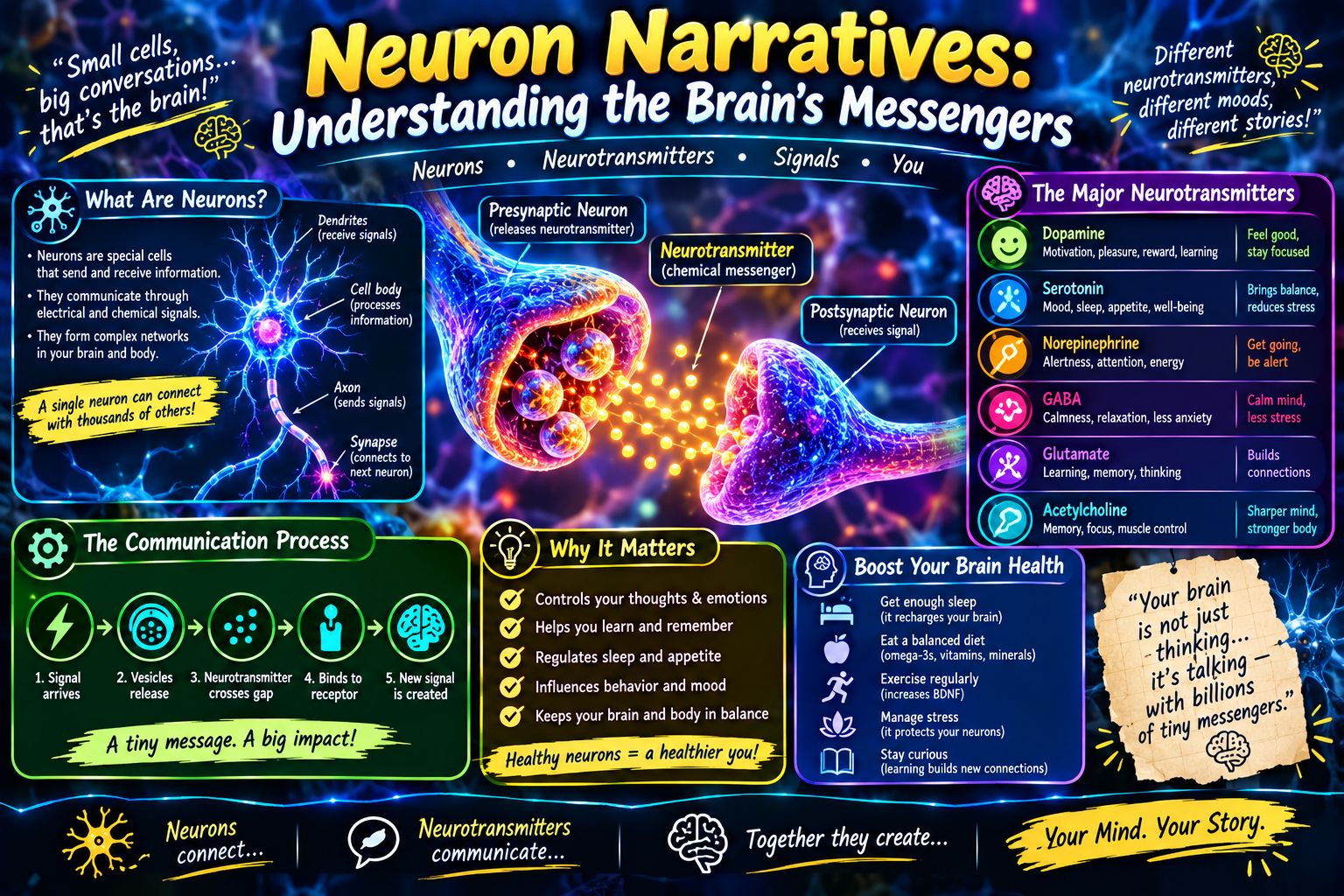
    ### Neuron Narratives: Understanding the Brain's Messengers

    **Description:**
    Step into the fascinating world of **neurons**, the tiny messengers that help our brain and nervous system communicate! Discover how neurons send electrical and chemical signals, allowing us to **think, learn, feel, remember, and respond** to the world around us.

    Explore the amazing structure of neurons, including the **dendrites, cell body, and axon**, and learn how these specialized cells work together to keep messages moving throughout the nervous system.

    **Hashtags:**
    #NeuronNarratives #Neurons #Brain #Neuroscience #NervousSystem #BrainScience #Biology #Science #NeuralSignals #HumanBody #ScienceEducation #LearnBiology #EducationalVideo #NeuroscienceForStudents #ScienceLovers

    **Emojis:**

    #rsisb Roll NO:232 Foundation level student. Story post:29 ### 🧠 Neuron Narratives: Understanding the Brain's Messengers ⚡🔬 **Description:** Step into the fascinating world of **neurons**, the tiny messengers that help our brain and nervous system communicate! 🧠⚡ Discover how neurons send electrical and chemical signals, allowing us to **think, learn, feel, remember, and respond** to the world around us. 🔬✨ Explore the amazing structure of neurons, including the **dendrites, cell body, and axon**, and learn how these specialized cells work together to keep messages moving throughout the nervous system. 🧬📚 **Hashtags:** #NeuronNarratives #Neurons #Brain #Neuroscience #NervousSystem #BrainScience #Biology #Science #NeuralSignals #HumanBody #ScienceEducation #LearnBiology #EducationalVideo #NeuroscienceForStudents #ScienceLovers 🧠🔬 **Emojis:** 🧠 ⚡ 🔬 🧬 🧪 💡 📚 🧠✨ ⚙️ 🌟 👀 💭 🚀
    0 Commenti 0 condivisioni 485 Views
  • Why Do We Feel Up or Down After Meeting People?

    Understanding the Science of Human Vibes

    Have you ever walked away from a conversation feeling like you just drank three cups of espresso without touching a drop—or like someone unplugged your soul and drained your battery? You’re not alone. The energy we feel when meeting others isn’t just “in our head” or emotional poetry—it’s deeply rooted in biology, chemistry, and even subtle electromagnetic signals in our bodies. Let’s explore why meeting some people lifts us up, while others leave us feeling down.

    ⸝

    Chemical & Hormonal Reactions in the Body

    When you interact with someone, your body doesn’t wait for your opinion—it automatically reacts by releasing different chemicals and hormones based on how it perceives the person.
    • Oxytocin is often released when we feel connected or safe. It’s nicknamed the “love hormone” and is key to feelings of trust and bonding. A kind smile or warm voice can trigger a burst of oxytocin, making us feel uplifted.
    • Dopamine kicks in when something feels rewarding. If someone is interesting, funny, or aligns with your values, dopamine brings a feeling of pleasure and motivation.
    • On the flip side, cortisol, the stress hormone, spikes when we feel uncomfortable, judged, or unsafe. This can instantly make your mood drop, heart race, and stomach turn.
    • Adrenaline may also be triggered—if the person feels intense or confrontational, your body gears up to deal with them, even if it’s just emotionally.
    • And when things don’t go well socially, serotonin—the mood stabilizer—can dip, leaving you with a vague sense of deflation or sadness.

    So yes, meeting people is a bit like a hormone cocktail shaker. The mix depends on the person—and how your nervous system interprets them.

    ⸝

    Your Brain is Always Scanning for Safety

    This process is called neuroception—your nervous system scans every person you meet to assess: “Am I safe? Can I relax? Can I trust this person?” And it does this without asking you first.

    If someone feels authentic, open, or kind, your nervous system gives a green light. Energy flows. You feel expansive. But if someone’s body language is tense, fake, or threatening, your system hits the brakes—emotionally and physically.

    It’s a primal survival mechanism. Your ancestors didn’t have time to analyze intentions—they had to sense danger instantly. You still do.

    ⸝

    The Mirror Effect

    We humans are natural mimics. Known as mirror neurons, our brain reflects the emotions and body language of others. If someone’s excited, your energy may rise to match theirs. If they’re anxious, sad, or negative—you might suddenly feel drained without knowing why.

    It’s emotional Wi-Fi. And you’re always connected.

    ⸝

    The Frequency of People

    There’s another layer too: personal resonance. Some people just “vibe” with you. Their beliefs, values, humor, or goals match yours. The interaction flows effortlessly—and both parties leave the conversation feeling lighter, brighter, and more alive.

    Other people may be completely fine—but not “tuned” to your frequency. That mismatch can feel flat, awkward, or draining, even if nothing negative is said.

    ⸝

    The Science of Real Energy

    Beyond chemistry, your body actually emits electromagnetic fields—especially the heart and brain. Research has shown that:
    • Our heart rate variability (HRV) changes when we feel emotionally connected.
    • Our brainwaves can synchronize with others during deep conversations.

    While this isn’t the kind of energy you measure with a plug or battery, it is a form of energetic exchange. Human-to-human Bluetooth, if you will.

    ⸝

    How to Notice the Shift

    Pay attention after interactions. Ask:
    • Do I feel more alive or more tired?
    • Did I feel seen, heard, respected?
    • Did I feel tense, guarded, or free?

    Your body knows. Listen.

    ⸝

    In Summary

    We feel up or down after meeting people because:
    • Our hormones and chemicals respond instantly to perceived emotions and safety.
    • Our nervous system scans people for trust and threat.
    • We mirror others’ energy—consciously or not.
    • We resonate (or don’t) based on values, beliefs, and emotional tone.
    • And, possibly, our hearts and minds physically sync when real connection occurs.

    So next time you meet someone and feel like you just caught a second wind—or like your battery hit 1%—remember: It’s not magic. It’s science.
    Your vibes don’t lie. Your body is simply trying to tell you the truth.
    Why Do We Feel Up or Down After Meeting People? Understanding the Science of Human Vibes Have you ever walked away from a conversation feeling like you just drank three cups of espresso without touching a drop—or like someone unplugged your soul and drained your battery? You’re not alone. The energy we feel when meeting others isn’t just “in our head” or emotional poetry—it’s deeply rooted in biology, chemistry, and even subtle electromagnetic signals in our bodies. Let’s explore why meeting some people lifts us up, while others leave us feeling down. ⸻ ⚗️ Chemical & Hormonal Reactions in the Body When you interact with someone, your body doesn’t wait for your opinion—it automatically reacts by releasing different chemicals and hormones based on how it perceives the person. • Oxytocin is often released when we feel connected or safe. It’s nicknamed the “love hormone” and is key to feelings of trust and bonding. A kind smile or warm voice can trigger a burst of oxytocin, making us feel uplifted. • Dopamine kicks in when something feels rewarding. If someone is interesting, funny, or aligns with your values, dopamine brings a feeling of pleasure and motivation. • On the flip side, cortisol, the stress hormone, spikes when we feel uncomfortable, judged, or unsafe. This can instantly make your mood drop, heart race, and stomach turn. • Adrenaline may also be triggered—if the person feels intense or confrontational, your body gears up to deal with them, even if it’s just emotionally. • And when things don’t go well socially, serotonin—the mood stabilizer—can dip, leaving you with a vague sense of deflation or sadness. So yes, meeting people is a bit like a hormone cocktail shaker. The mix depends on the person—and how your nervous system interprets them. ⸻ 🧠 Your Brain is Always Scanning for Safety This process is called neuroception—your nervous system scans every person you meet to assess: “Am I safe? Can I relax? Can I trust this person?” And it does this without asking you first. If someone feels authentic, open, or kind, your nervous system gives a green light. Energy flows. You feel expansive. But if someone’s body language is tense, fake, or threatening, your system hits the brakes—emotionally and physically. It’s a primal survival mechanism. Your ancestors didn’t have time to analyze intentions—they had to sense danger instantly. You still do. ⸻ 🪞 The Mirror Effect We humans are natural mimics. Known as mirror neurons, our brain reflects the emotions and body language of others. If someone’s excited, your energy may rise to match theirs. If they’re anxious, sad, or negative—you might suddenly feel drained without knowing why. It’s emotional Wi-Fi. And you’re always connected. ⸻ 🧲 The Frequency of People There’s another layer too: personal resonance. Some people just “vibe” with you. Their beliefs, values, humor, or goals match yours. The interaction flows effortlessly—and both parties leave the conversation feeling lighter, brighter, and more alive. Other people may be completely fine—but not “tuned” to your frequency. That mismatch can feel flat, awkward, or draining, even if nothing negative is said. ⸻ 💓 The Science of Real Energy Beyond chemistry, your body actually emits electromagnetic fields—especially the heart and brain. Research has shown that: • Our heart rate variability (HRV) changes when we feel emotionally connected. • Our brainwaves can synchronize with others during deep conversations. While this isn’t the kind of energy you measure with a plug or battery, it is a form of energetic exchange. Human-to-human Bluetooth, if you will. ⸻ 🚦 How to Notice the Shift Pay attention after interactions. Ask: • Do I feel more alive or more tired? • Did I feel seen, heard, respected? • Did I feel tense, guarded, or free? Your body knows. Listen. ⸻ ✅ In Summary We feel up or down after meeting people because: • Our hormones and chemicals respond instantly to perceived emotions and safety. • Our nervous system scans people for trust and threat. • We mirror others’ energy—consciously or not. • We resonate (or don’t) based on values, beliefs, and emotional tone. • And, possibly, our hearts and minds physically sync when real connection occurs. So next time you meet someone and feel like you just caught a second wind—or like your battery hit 1%—remember: It’s not magic. It’s science. Your vibes don’t lie. Your body is simply trying to tell you the truth.
    0 Commenti 0 condivisioni 1372 Views
  • Why Do We Feel Up or Down After Meeting People?

    Understanding the Science of Human Vibes

    Have you ever walked away from a conversation feeling like you just drank three cups of espresso without touching a drop—or like someone unplugged your soul and drained your battery? You’re not alone. The energy we feel when meeting others isn’t just “in our head” or emotional poetry—it’s deeply rooted in biology, chemistry, and even subtle electromagnetic signals in our bodies. Let’s explore why meeting some people lifts us up, while others leave us feeling down.

    ⸝

    Chemical & Hormonal Reactions in the Body

    When you interact with someone, your body doesn’t wait for your opinion—it automatically reacts by releasing different chemicals and hormones based on how it perceives the person.
    • Oxytocin is often released when we feel connected or safe. It’s nicknamed the “love hormone” and is key to feelings of trust and bonding. A kind smile or warm voice can trigger a burst of oxytocin, making us feel uplifted.
    • Dopamine kicks in when something feels rewarding. If someone is interesting, funny, or aligns with your values, dopamine brings a feeling of pleasure and motivation.
    • On the flip side, cortisol, the stress hormone, spikes when we feel uncomfortable, judged, or unsafe. This can instantly make your mood drop, heart race, and stomach turn.
    • Adrenaline may also be triggered—if the person feels intense or confrontational, your body gears up to deal with them, even if it’s just emotionally.
    • And when things don’t go well socially, serotonin—the mood stabilizer—can dip, leaving you with a vague sense of deflation or sadness.

    So yes, meeting people is a bit like a hormone cocktail shaker. The mix depends on the person—and how your nervous system interprets them.

    ⸝

    Your Brain is Always Scanning for Safety

    This process is called neuroception—your nervous system scans every person you meet to assess: “Am I safe? Can I relax? Can I trust this person?” And it does this without asking you first.

    If someone feels authentic, open, or kind, your nervous system gives a green light. Energy flows. You feel expansive. But if someone’s body language is tense, fake, or threatening, your system hits the brakes—emotionally and physically.

    It’s a primal survival mechanism. Your ancestors didn’t have time to analyze intentions—they had to sense danger instantly. You still do.

    ⸝

    The Mirror Effect

    We humans are natural mimics. Known as mirror neurons, our brain reflects the emotions and body language of others. If someone’s excited, your energy may rise to match theirs. If they’re anxious, sad, or negative—you might suddenly feel drained without knowing why.

    It’s emotional Wi-Fi. And you’re always connected.

    ⸝

    The Frequency of People

    There’s another layer too: personal resonance. Some people just “vibe” with you. Their beliefs, values, humor, or goals match yours. The interaction flows effortlessly—and both parties leave the conversation feeling lighter, brighter, and more alive.

    Other people may be completely fine—but not “tuned” to your frequency. That mismatch can feel flat, awkward, or draining, even if nothing negative is said.

    ⸝

    The Science of Real Energy

    Beyond chemistry, your body actually emits electromagnetic fields—especially the heart and brain. Research has shown that:
    • Our heart rate variability (HRV) changes when we feel emotionally connected.
    • Our brainwaves can synchronize with others during deep conversations.

    While this isn’t the kind of energy you measure with a plug or battery, it is a form of energetic exchange. Human-to-human Bluetooth, if you will.

    ⸝

    How to Notice the Shift

    Pay attention after interactions. Ask:
    • Do I feel more alive or more tired?
    • Did I feel seen, heard, respected?
    • Did I feel tense, guarded, or free?

    Your body knows. Listen.

    ⸝

    In Summary

    We feel up or down after meeting people because:
    • Our hormones and chemicals respond instantly to perceived emotions and safety.
    • Our nervous system scans people for trust and threat.
    • We mirror others’ energy—consciously or not.
    • We resonate (or don’t) based on values, beliefs, and emotional tone.
    • And, possibly, our hearts and minds physically sync when real connection occurs.

    So next time you meet someone and feel like you just caught a second wind—or like your battery hit 1%—remember: It’s not magic. It’s science.
    Your vibes don’t lie. Your body is simply trying to tell you the truth.
    Why Do We Feel Up or Down After Meeting People? Understanding the Science of Human Vibes Have you ever walked away from a conversation feeling like you just drank three cups of espresso without touching a drop—or like someone unplugged your soul and drained your battery? You’re not alone. The energy we feel when meeting others isn’t just “in our head” or emotional poetry—it’s deeply rooted in biology, chemistry, and even subtle electromagnetic signals in our bodies. Let’s explore why meeting some people lifts us up, while others leave us feeling down. ⸻ ⚗️ Chemical & Hormonal Reactions in the Body When you interact with someone, your body doesn’t wait for your opinion—it automatically reacts by releasing different chemicals and hormones based on how it perceives the person. • Oxytocin is often released when we feel connected or safe. It’s nicknamed the “love hormone” and is key to feelings of trust and bonding. A kind smile or warm voice can trigger a burst of oxytocin, making us feel uplifted. • Dopamine kicks in when something feels rewarding. If someone is interesting, funny, or aligns with your values, dopamine brings a feeling of pleasure and motivation. • On the flip side, cortisol, the stress hormone, spikes when we feel uncomfortable, judged, or unsafe. This can instantly make your mood drop, heart race, and stomach turn. • Adrenaline may also be triggered—if the person feels intense or confrontational, your body gears up to deal with them, even if it’s just emotionally. • And when things don’t go well socially, serotonin—the mood stabilizer—can dip, leaving you with a vague sense of deflation or sadness. So yes, meeting people is a bit like a hormone cocktail shaker. The mix depends on the person—and how your nervous system interprets them. ⸻ 🧠 Your Brain is Always Scanning for Safety This process is called neuroception—your nervous system scans every person you meet to assess: “Am I safe? Can I relax? Can I trust this person?” And it does this without asking you first. If someone feels authentic, open, or kind, your nervous system gives a green light. Energy flows. You feel expansive. But if someone’s body language is tense, fake, or threatening, your system hits the brakes—emotionally and physically. It’s a primal survival mechanism. Your ancestors didn’t have time to analyze intentions—they had to sense danger instantly. You still do. ⸻ 🪞 The Mirror Effect We humans are natural mimics. Known as mirror neurons, our brain reflects the emotions and body language of others. If someone’s excited, your energy may rise to match theirs. If they’re anxious, sad, or negative—you might suddenly feel drained without knowing why. It’s emotional Wi-Fi. And you’re always connected. ⸻ 🧲 The Frequency of People There’s another layer too: personal resonance. Some people just “vibe” with you. Their beliefs, values, humor, or goals match yours. The interaction flows effortlessly—and both parties leave the conversation feeling lighter, brighter, and more alive. Other people may be completely fine—but not “tuned” to your frequency. That mismatch can feel flat, awkward, or draining, even if nothing negative is said. ⸻ 💓 The Science of Real Energy Beyond chemistry, your body actually emits electromagnetic fields—especially the heart and brain. Research has shown that: • Our heart rate variability (HRV) changes when we feel emotionally connected. • Our brainwaves can synchronize with others during deep conversations. While this isn’t the kind of energy you measure with a plug or battery, it is a form of energetic exchange. Human-to-human Bluetooth, if you will. ⸻ 🚦 How to Notice the Shift Pay attention after interactions. Ask: • Do I feel more alive or more tired? • Did I feel seen, heard, respected? • Did I feel tense, guarded, or free? Your body knows. Listen. ⸻ ✅ In Summary We feel up or down after meeting people because: • Our hormones and chemicals respond instantly to perceived emotions and safety. • Our nervous system scans people for trust and threat. • We mirror others’ energy—consciously or not. • We resonate (or don’t) based on values, beliefs, and emotional tone. • And, possibly, our hearts and minds physically sync when real connection occurs. So next time you meet someone and feel like you just caught a second wind—or like your battery hit 1%—remember: It’s not magic. It’s science. Your vibes don’t lie. Your body is simply trying to tell you the truth.
    0 Commenti 0 condivisioni 1371 Views
  • Why Humans Can Only Learn a Little More Than They Already Know

    The Science and Logic Behind Slow Understanding of Completely New Ideas

    Human learning feels frustratingly slow when we face something truly new. A child cannot understand calculus in one sitting. A person who has never seen the internet cannot instantly grasp artificial intelligence. This is not a failure of intelligence or effort—it is how the human brain is designed to work. Science, psychology, and neuroscience all agree on one core truth:

    The brain can only understand new knowledge by attaching it to existing knowledge.
    When nothing familiar exists to attach to, understanding takes a very long time.

    Below is a clear, science-based explanation of why this happens.

    ⸝

    1. The Brain Learns by Building on Existing Mental Structures

    The brain does not store information randomly. It organizes knowledge into mental models or schemas.

    A schema is like a folder in your brain:
    • A child has a “dog” schema (four legs, barks).
    • When they see a wolf, the brain says: similar to dog → new variation added.

    But when something has no existing folder, the brain struggles.

    For example:
    • Explaining “cloud computing” to someone who has never used a computer
    • Explaining “quantum probability” to someone who doesn’t understand basic probability

    The brain asks:
    “Where do I put this?”

    If there is no place, learning slows dramatically.

    ⸝

    2. Assimilation vs. Accommodation (Jean Piaget’s Core Insight)

    Cognitive science explains learning through two processes:

    1. Assimilation (Easy Learning)

    New information fits into what you already know.

    Example:
    • You know bicycles
    • You see a motorcycle
    • Brain says: bigger, faster bicycle → learning is quick

    2. Accommodation (Hard Learning)

    The brain must rebuild its structure.

    Example:
    • You believe the Earth is flat
    • You learn it is round
    • This destroys an old belief and replaces it

    Accommodation is:
    • Emotionally uncomfortable
    • Mentally slow
    • Often resisted

    That is why radically new ideas take years, not minutes.

    ⸝

    3. Cognitive Load: The Brain Has a Hard Limit

    Your working memory is extremely limited.

    Research shows:
    • Humans can hold about 4–7 pieces of new information at once
    • Anything beyond that causes confusion, stress, or rejection

    When a concept is entirely new:
    • Every word is unfamiliar
    • Every assumption is missing
    • Cognitive load explodes

    The brain responds by:
    • Shutting down
    • Oversimplifying
    • Rejecting the idea entirely

    This is why people say:

    “This is too much for me”
    when in reality, it is too new, not too complex.

    ⸝

    4. Understanding Requires Repeated Exposure Over Time

    Neurons that fire together must fire repeatedly to wire together.

    For a brand-new concept:
    • First exposure → confusion
    • Second exposure → vague recognition
    • Third exposure → partial clarity
    • Dozens of exposures → true understanding

    This biological process is called synaptic strengthening.

    No repetition = no understanding
    No time = no deep learning

    This is why:
    • Reading once does nothing
    • Teaching others creates mastery
    • Daily exposure beats long lectures

    ⸝

    5. Language Limits Understanding

    You cannot understand what you cannot name.

    If a language lacks words for a concept:
    • The brain struggles to even notice it
    • Understanding stays shallow

    This is why:
    • Children struggle with abstract ideas
    • New scientific fields invent new vocabulary
    • Translating new ideas into familiar language speeds learning

    Understanding expands with language.

    ⸝

    6. Emotion and Identity Block New Ideas

    Entirely new concepts often threaten identity.

    Examples:
    • New technology threatening a job
    • New beliefs challenging religion or culture
    • New science questioning long-held “truths”

    The brain is not just a thinking machine—it is a protection machine.

    When identity is threatened:
    • The emotional brain overrides logic
    • The person cannot understand, even if intelligent

    This is why:

    “You can’t explain this to him”
    is sometimes biologically true.

    ⸝

    7. Learning Is Like Climbing, Not Jumping

    You cannot jump to the top of a mountain.

    You must:
    • Step from one rock to the next
    • Build strength gradually
    • See the path from where you stand

    The brain works the same way.

    Each new idea must be:
    • Slightly above current understanding
    • Connected to something familiar
    • Revisited multiple times

    Anything too far ahead feels invisible.

    ⸝

    8. Why Breakthroughs Feel Sudden (But Aren’t)

    People often say:

    “Suddenly, it all clicked!”

    This is an illusion.

    What really happened:
    • Months or years of silent buildup
    • Gradual neural rewiring
    • A final connection that became conscious

    Understanding feels sudden
    But learning is always slow

    ⸝

    Final Truth

    Humans cannot fully understand something completely new because:
    1. The brain needs existing structures to attach knowledge
    2. Working memory has strict limits
    3. Neural connections require time and repetition
    4. Language, emotion, and identity slow acceptance
    5. Radical ideas require rebuilding the mind itself

    This is not weakness.
    It is how intelligence survives.

    Progress happens not by forcing big jumps—but by designing small, consistent steps forward.

    That is how children grow.
    That is how civilizations advance.
    That is how real learning happens.
    Why Humans Can Only Learn a Little More Than They Already Know The Science and Logic Behind Slow Understanding of Completely New Ideas Human learning feels frustratingly slow when we face something truly new. A child cannot understand calculus in one sitting. A person who has never seen the internet cannot instantly grasp artificial intelligence. This is not a failure of intelligence or effort—it is how the human brain is designed to work. Science, psychology, and neuroscience all agree on one core truth: The brain can only understand new knowledge by attaching it to existing knowledge. When nothing familiar exists to attach to, understanding takes a very long time. Below is a clear, science-based explanation of why this happens. ⸻ 1. The Brain Learns by Building on Existing Mental Structures The brain does not store information randomly. It organizes knowledge into mental models or schemas. A schema is like a folder in your brain: • A child has a “dog” schema (four legs, barks). • When they see a wolf, the brain says: similar to dog → new variation added. But when something has no existing folder, the brain struggles. For example: • Explaining “cloud computing” to someone who has never used a computer • Explaining “quantum probability” to someone who doesn’t understand basic probability The brain asks: “Where do I put this?” If there is no place, learning slows dramatically. ⸻ 2. Assimilation vs. Accommodation (Jean Piaget’s Core Insight) Cognitive science explains learning through two processes: 1. Assimilation (Easy Learning) New information fits into what you already know. Example: • You know bicycles • You see a motorcycle • Brain says: bigger, faster bicycle → learning is quick 2. Accommodation (Hard Learning) The brain must rebuild its structure. Example: • You believe the Earth is flat • You learn it is round • This destroys an old belief and replaces it Accommodation is: • Emotionally uncomfortable • Mentally slow • Often resisted That is why radically new ideas take years, not minutes. ⸻ 3. Cognitive Load: The Brain Has a Hard Limit Your working memory is extremely limited. Research shows: • Humans can hold about 4–7 pieces of new information at once • Anything beyond that causes confusion, stress, or rejection When a concept is entirely new: • Every word is unfamiliar • Every assumption is missing • Cognitive load explodes The brain responds by: • Shutting down • Oversimplifying • Rejecting the idea entirely This is why people say: “This is too much for me” when in reality, it is too new, not too complex. ⸻ 4. Understanding Requires Repeated Exposure Over Time Neurons that fire together must fire repeatedly to wire together. For a brand-new concept: • First exposure → confusion • Second exposure → vague recognition • Third exposure → partial clarity • Dozens of exposures → true understanding This biological process is called synaptic strengthening. No repetition = no understanding No time = no deep learning This is why: • Reading once does nothing • Teaching others creates mastery • Daily exposure beats long lectures ⸻ 5. Language Limits Understanding You cannot understand what you cannot name. If a language lacks words for a concept: • The brain struggles to even notice it • Understanding stays shallow This is why: • Children struggle with abstract ideas • New scientific fields invent new vocabulary • Translating new ideas into familiar language speeds learning Understanding expands with language. ⸻ 6. Emotion and Identity Block New Ideas Entirely new concepts often threaten identity. Examples: • New technology threatening a job • New beliefs challenging religion or culture • New science questioning long-held “truths” The brain is not just a thinking machine—it is a protection machine. When identity is threatened: • The emotional brain overrides logic • The person cannot understand, even if intelligent This is why: “You can’t explain this to him” is sometimes biologically true. ⸻ 7. Learning Is Like Climbing, Not Jumping You cannot jump to the top of a mountain. You must: • Step from one rock to the next • Build strength gradually • See the path from where you stand The brain works the same way. Each new idea must be: • Slightly above current understanding • Connected to something familiar • Revisited multiple times Anything too far ahead feels invisible. ⸻ 8. Why Breakthroughs Feel Sudden (But Aren’t) People often say: “Suddenly, it all clicked!” This is an illusion. What really happened: • Months or years of silent buildup • Gradual neural rewiring • A final connection that became conscious Understanding feels sudden But learning is always slow ⸻ Final Truth Humans cannot fully understand something completely new because: 1. The brain needs existing structures to attach knowledge 2. Working memory has strict limits 3. Neural connections require time and repetition 4. Language, emotion, and identity slow acceptance 5. Radical ideas require rebuilding the mind itself This is not weakness. It is how intelligence survives. Progress happens not by forcing big jumps—but by designing small, consistent steps forward. That is how children grow. That is how civilizations advance. That is how real learning happens.
    0 Commenti 0 condivisioni 1191 Views
  • Two brain cells having a chat:

    Neurons have specialized projections called dendrites and axons.
    Dendrites bring information to the cell body and axons take information away from the cell body.

    Dendrites receive synaptic inputs from axons, with the sum total of dendritic inputs determining whether the neuron will fire an action potential.

    Credit: microscopicture
    #neuroscience #biology #medicine
    Two brain cells having a chat: Neurons have specialized projections called dendrites and axons. Dendrites bring information to the cell body and axons take information away from the cell body. Dendrites receive synaptic inputs from axons, with the sum total of dendritic inputs determining whether the neuron will fire an action potential. Credit: microscopicture #neuroscience #biology #medicine
    0 Commenti 0 condivisioni 854 Views 0
  • Here are the images representing the journey of neural connections in the human brain:

    1. **Neurons and Synapses:** A vivid representation of neurons with dendrites reaching out and the highlighted synapses where theyre close to connecting.
    2. **Neurotransmitters in Action:** A depiction of neurotransmitters traveling across synapses.
    3. **Formation of Neural Connections:** An illustration showcasing the strengthening of connections and the concept of neural plasticity.
    4. **Adaptive Plasticity:** A visualization of how neural connections adapt over time based on learning and experience.
    Here are the images representing the journey of neural connections in the human brain: 1. **Neurons and Synapses:** A vivid representation of neurons with dendrites reaching out and the highlighted synapses where they're close to connecting. 2. **Neurotransmitters in Action:** A depiction of neurotransmitters traveling across synapses. 3. **Formation of Neural Connections:** An illustration showcasing the strengthening of connections and the concept of neural plasticity. 4. **Adaptive Plasticity:** A visualization of how neural connections adapt over time based on learning and experience.
    0 Commenti 0 condivisioni 1164 Views 0
  • 100 billion stars in the universe.
    100 billion neurons in human brain.

    What if the Universe is one big brain with stars as neurons and we humans just like an invisible virus?

    Sudhir Pai
    100 billion stars in the universe. 100 billion neurons in human brain. What if the Universe is one big brain with stars as neurons and we humans just like an invisible virus? Sudhir Pai
    0 Commenti 0 condivisioni 77 Views
  • ‘The Social Dilemma’ is a documentary on Netflix that has been recently released. It is about the evils of social media and is causing a lot of distress. A school principal was dismayed that now parents are going to say, ‘We told you so! Take away the internet from children, immediately’. Hopefully, nothing of the sort will happen.

    This documentary is worth watching, but with an open and discerning mind. First, note that it is produced by disgruntled ex-employees of Facebook, Twitter and Google. Then, note that the views of the other side, people from these, and similar, companies, are missing. And, of course, children’s opinions are absent, but that is usual.

    The main contention of the documentary is that our minds are being psychologically manipulated by AI, created by evil designers. This used to be called ‘advertising’, I think. Note that any algorithm that uses a lot of data to make accurate projections of short-term future is called AI. In my time, we used to call these ‘moving averages’, ‘standard deviation’ and extrapolation. Nobody thought these were evil.

    Missing entirely in the documentary is the main new idea of our times, that when lots of things are connected together (phones, computers, people) into a network, we get self-Organizing Systems. Self organizing systems can show Spontaneous Order and Emergent Behavior. Ilya Prigogine got a Nobel prize in the 1980s for discovering this.

    Self Organizing Systems are unpredictable, so they cannot be ‘programmed’ for evil. Organisations like the ones above can only facilitate their formation, not what they will do. Like a gardener who can plant flowering plants, but cannot say where a beehive might form. You cannot make Self Organising Systems do anything, you can only let them do what they will.

    Jaron Lanier, the inventor of Virtual Reality, is prominently present in the documentary. He even compares us, humans, with neurons in our brains, being ‘forced’ to mindlessly perform as part of a network! Well, imagine if all the neurons in your brain became independent, free agents, while you sat around – brainless and smiling vacuously.

    Algorithms in social media have small, very specific goals, usually to focus your attention on something. Just as neurons have a small and specific goal, to connect with other neurons. If the internet makes all of humanity into one giant brain, that would probably represent an evolutionary step. Evolution is not evil, it has no goal – it just happens.

    Similar documentaries and comments have been made about books, newspapers, television and radio when they were invented and started networking people. Even the postal system was not spared criticism. It all created some noise and died down. As will this one.

    Lastly, someone in the documentary suggests that children below the age of 16 should not be allowed to google! That is a bit like saying that the reading habit in children should not be encouraged until they are grown up because they might read comic books.

    So, do watch the documentary, and enjoy the paranoia.

    Via Sugata Mitra
    Professor of Educational Technologies
    New castle University
    ‘The Social Dilemma’ is a documentary on Netflix that has been recently released. It is about the evils of social media and is causing a lot of distress. A school principal was dismayed that now parents are going to say, ‘We told you so! Take away the internet from children, immediately’. Hopefully, nothing of the sort will happen. This documentary is worth watching, but with an open and discerning mind. First, note that it is produced by disgruntled ex-employees of Facebook, Twitter and Google. Then, note that the views of the other side, people from these, and similar, companies, are missing. And, of course, children’s opinions are absent, but that is usual. The main contention of the documentary is that our minds are being psychologically manipulated by AI, created by evil designers. This used to be called ‘advertising’, I think. Note that any algorithm that uses a lot of data to make accurate projections of short-term future is called AI. In my time, we used to call these ‘moving averages’, ‘standard deviation’ and extrapolation. Nobody thought these were evil. Missing entirely in the documentary is the main new idea of our times, that when lots of things are connected together (phones, computers, people) into a network, we get self-Organizing Systems. Self organizing systems can show Spontaneous Order and Emergent Behavior. Ilya Prigogine got a Nobel prize in the 1980's for discovering this. Self Organizing Systems are unpredictable, so they cannot be ‘programmed’ for evil. Organisations like the ones above can only facilitate their formation, not what they will do. Like a gardener who can plant flowering plants, but cannot say where a beehive might form. You cannot make Self Organising Systems do anything, you can only let them do what they will. Jaron Lanier, the inventor of Virtual Reality, is prominently present in the documentary. He even compares us, humans, with neurons in our brains, being ‘forced’ to mindlessly perform as part of a network! Well, imagine if all the neurons in your brain became independent, free agents, while you sat around – brainless and smiling vacuously. Algorithms in social media have small, very specific goals, usually to focus your attention on something. Just as neurons have a small and specific goal, to connect with other neurons. If the internet makes all of humanity into one giant brain, that would probably represent an evolutionary step. Evolution is not evil, it has no goal – it just happens. Similar documentaries and comments have been made about books, newspapers, television and radio when they were invented and started networking people. Even the postal system was not spared criticism. It all created some noise and died down. As will this one. Lastly, someone in the documentary suggests that children below the age of 16 should not be allowed to google! That is a bit like saying that the reading habit in children should not be encouraged until they are grown up because they might read comic books. So, do watch the documentary, and enjoy the paranoia. Via Sugata Mitra Professor of Educational Technologies New castle University
    0 Commenti 0 condivisioni 216 Views
  • Your body consists of 37 trillion cells divided into 200 different types.

    100 billion cells make up the skin, which is the largest organ in your body. 100 billion neurons in the brain allow you to process as many as 60,000 thought per day.

    You also have 127 million retinal cells that allow you to see the world in as many as 10 million different colors.

    You have 30 trillion red blood cells, 42 billion blood vessels, and 6 liters (1.6 gallons) of blood in your body. Your blood makes approximately 10% of your body weight. Your nose has 1,000 olfactory receptors that allow you to distinguish 50,000 different smells.

    Your lungs allow you to breathe 23,040 breaths per day, while your heart beats around 115,200 heartbeats per day or 42 million heartbeats per year.

    You have 640 muscles, 360 joints, 206 bones and 100,000 hair follicles. You produce around 23,000 liters (6,075 gallons) of saliva in your lifetime, which is enough to fill two swimming pools
    Your body consists of 37 trillion cells divided into 200 different types. 100 billion cells make up the skin, which is the largest organ in your body. 100 billion neurons in the brain allow you to process as many as 60,000 thought per day. You also have 127 million retinal cells that allow you to see the world in as many as 10 million different colors. You have 30 trillion red blood cells, 42 billion blood vessels, and 6 liters (1.6 gallons) of blood in your body. Your blood makes approximately 10% of your body weight. Your nose has 1,000 olfactory receptors that allow you to distinguish 50,000 different smells. Your lungs allow you to breathe 23,040 breaths per day, while your heart beats around 115,200 heartbeats per day or 42 million heartbeats per year. You have 640 muscles, 360 joints, 206 bones and 100,000 hair follicles. You produce around 23,000 liters (6,075 gallons) of saliva in your lifetime, which is enough to fill two swimming pools
    0 Commenti 0 condivisioni 239 Views
  • The Soil That Refuses to Bow — A Story of Pakistan’s Hidden Brilliance

    Every few years, a generation begins to whisper the same dangerous sentence: “Nothing great comes from us.”
    It is a quiet poison — slow, invisible, fatal.
    And today, millions of young Pakistanis carry that poison in their pockets, in their conversations, in their sighs.

    Yet, this belief has no roots in reality.
    History — real, measurable, globally verified history — tells a different story.
    It tells a story of a people who were born in storms, who built in uncertainty, who invented in darkness, and who rose not because the world supported them, but because the world underestimated them.

    This essay is a reminder — an antidote — a declaration that Pakistani brilliance is not an exception. It is a pattern.

    ⸝

    The World Has Already Been Changed by Pakistanis — Quietly, Consistently, Powerfully

    Below are not opinions.
    Not emotions.
    Not nostalgia.

    These are facts — names, inventions, companies, and breakthroughs created by people who came from your soil, your streets, your schools.

    If they could,
    you can.
    If they did with far less,
    you can do with far more.

    ⸝

    1. Dr. Abdus Salam — The Man Who Bent the Universe

    Pakistan produced the first Muslim Nobel Prize in Physics: Dr. Abdus Salam.

    His work on the electroweak theory changed modern physics forever.
    Every device you use — including the phone in your hand — depends on the science he unlocked.

    He grew up in Jhang.
    A small town.
    No fancy labs.
    No elite schooling.

    But genius does not ask permission from geography — it simply burns.

    ⸝

    2. Dr. Nergis Mavalvala — The Woman Who Heard the Whisper of the Universe

    Born in Karachi, she became a MacArthur Genius, an MIT Dean, and part of the team that detected gravitational waves.

    Einstein predicted those waves.
    She proved them.

    From Saddar Karachi to the edge of time and space.

    ⸝

    3. Engro — A Pakistani Company Feeding the World

    Engro began in Pakistan in the 1960s.
    Today, it is connected to global fertilizer, petrochemical, and energy supply chains.

    Its subsidiary, Engro Fertilizers, helps feed over 30 million people annually.

    One company.
    Born in Pakistan.
    Impacting continents.

    ⸝

    4. Careem — A Pakistani Co-Founder Who Built a Billion-Dollar Company

    Few know this:
    Careem, now a $3.1 billion acquisition by Uber, had a Pakistani co-founder — Mudassir Sheikha.

    Careem didn’t just build an app.
    It created income for over 1 million drivers across the Muslim world.

    A Pakistani helped create that economic revolution.

    ⸝

    5. PakWheels — Pakistan’s Digital Auto Empire

    Born in Pakistan.
    Made in Pakistan.
    Scaling globally.

    PakWheels, founded by Pakistanis, became one of the largest automotive portals in Asia —
    bigger than many Indian and Middle Eastern competitors.

    Over 30 million annual users,
    and growing.

    ⸝

    6. Zameen.com — A Pakistani Unicorn Before Pakistan Believed in Unicorns

    Two Pakistani brothers built a real-estate tech company that operates across the Middle East, Europe, and South Asia.

    Zameen Group is now valued at over $1 billion, and includes Bayut in the UAE, Mubawab in North Africa, and Lamudi in Asia.

    From Lahore → Dubai → Global dominance.

    ⸝

    7. Systems Limited — Pakistan’s First Tech Company to Cross $1 Billion Market Cap

    Founded in 1977 in Lahore.
    Today it works in 16+ countries,
    serves global Fortune 500 clients,
    and recently crossed $1 billion in valuation.

    A Pakistani IT company — older than many Silicon Valley giants — quietly competing worldwide.

    ⸝

    8. NetSol Technologies — Pakistani Software Running the World’s Largest Car Leasing Companies

    NetSol, born in Lahore, now powers leasing software for brands like:
    • BMW
    • Mercedes-Benz
    • Toyota
    • Volkswagen
    • Honda

    Their system runs in over 30 countries.

    The world’s cars move on Pakistani code.

    ⸝

    9. Markhor — Pakistani Shoes on Silicon Valley Racks

    Markhor, started by a young Pakistani couple from Okara and Lahore, was the first Pakistani company accepted into Y-Combinator.

    They went from local leather workshops to global luxury stores.

    ⸝

    10. Bykea — Pakistan’s Own Tech Innovation for Emerging Markets

    While Silicon Valley was thinking cars and drones, a Pakistani team built a region-specific mobility, delivery, and payments system serving millions of users.

    Innovation does not always come from the West.
    It comes from need, struggle, and creativity.

    ⸝

    11. Airlift — Pakistan’s Biggest Startup Fundraise

    Before it shut down due to global economic collapse, Airlift raised $85 million — the largest single round in Pakistan’s history.

    Founded by young Pakistanis.

    Competing with global giants.

    Showing the world what courage looks like.

    ⸝

    12. Pakistani Scientists Behind Global Breakthroughs
    • Dr. Ata-ur-Rahman — world’s leading chemist, over 1,200 publications, fellow of the Royal Society.
    • Dr. Samar Mubarakmand — led Pakistan’s nuclear test team.
    • Dr. Mahboob Mahmood — former Harvard professor, founder of Knowledge Platform.
    • Dr. Naweed Syed — first scientist to connect brain cells to a silicon chip.

    Pakistanis are literally wiring silicon with neurons.

    ⸝

    13. Pakistani-Origin Leaders in Global Tech
    • Arif Naqvi (Abraaj Group) — one of the largest investment firms in emerging markets.
    • Imran Khan (Not the politician! Ex-Google) — led global payments and internet products.
    • Shahid Khan — from Lahore; owns Jacksonville Jaguars (NFL), Fulham FC, and Flex-N-Gate (over $8 billion revenue).
    • Tariq Farid — created Edible Arrangements, now a global chain across 50+ countries.
    • Jahangir Siddiqui (JS Group) — global investments and financial empire.

    These are not accidents.
    They are indicators of hidden power.

    ⸝

    14. Pakistani Inventions You Use Every Day Without Realizing

    You have been taught that Pakistan invented nothing.
    But here is reality:

    ● The First Virus-Proof Computer Architecture (Dr. Umar Saif’s work)

    MIT-backed, internationally recognized.

    ● SARMAYA Payment Switch

    Pakistan built its own financial switch long before many countries.

    ● OGDCL, PIA Engineering, Sui Gas Pipeline Network

    Some of the largest and most complex engineering infrastructures in the region.

    ● Pakistan’s NIC Program

    One of the largest government-backed incubator networks in Asia.

    ⸝

    15. Pakistan’s Secret Superpower — Its People

    Despite:
    • unstable governments
    • limited funding
    • broken systems
    • unreliable infrastructure
    • brain drain
    • global media bias

    Pakistanis continue to win:
    • global hackathons
    • international Olympiads
    • startup accelerators
    • research fellowships
    • space competitions
    • robotics championships
    • AI competitions
    • math contests

    Every year, quietly, without noise, without applause, without recognition.

    ⸝

    16. So Why Does the Youth Feel “Nothing Will Happen”?

    Because the noise of negativity is louder than the whispers of success.

    Because our heroes are not shown.
    Our inventors are not taught.
    Our entrepreneurs are not celebrated.
    Our scientists are not introduced in textbooks.
    Our youth are raised on political drama, not scientific miracles.

    This is why you believe nothing comes from Pakistan.

    Not because nothing comes from Pakistan.

    But because nothing is shown to you.

    ⸝

    17. The Truth: Pakistan Is Not Empty. Pakistan Is Untranslated.

    You are part of a nation that:
    • built nuclear capability under sanctions
    • created billion-dollar companies with no ecosystem
    • produced world-class scientists with no world-class labs
    • developed global players in finance, sports, entertainment, and tech
    • sent millions abroad who lead global businesses, research labs, and universities

    Pakistan is not behind.
    Pakistan is unawakened.

    ⸝

    18. A Final Message to Every Young Pakistani

    You come from a people who crossed deserts with no water.
    Who built cities with no tools.
    Who learned English in adulthood and taught it to the world.
    Who survived wars, floods, earthquakes, dictatorships — and still built companies, wrote books, coded apps, and discovered scientific truths.

    Your story did not begin with failure.
    It began with impossible victories.

    If you feel discouraged, remember:

    The world has already been changed by people like you.
    The world is waiting for you to take your turn.

    Do not say, “Nothing great comes from Pakistan.”

    Say:

    “Nothing great leaves Pakistan without being born first inside someone like me.”

    This is your soil.
    This is your inheritance.
    This is your turn.

    The Soil That Refuses to Bow — A Story of Pakistan’s Hidden Brilliance Every few years, a generation begins to whisper the same dangerous sentence: “Nothing great comes from us.” It is a quiet poison — slow, invisible, fatal. And today, millions of young Pakistanis carry that poison in their pockets, in their conversations, in their sighs. Yet, this belief has no roots in reality. History — real, measurable, globally verified history — tells a different story. It tells a story of a people who were born in storms, who built in uncertainty, who invented in darkness, and who rose not because the world supported them, but because the world underestimated them. This essay is a reminder — an antidote — a declaration that Pakistani brilliance is not an exception. It is a pattern. ⸻ The World Has Already Been Changed by Pakistanis — Quietly, Consistently, Powerfully Below are not opinions. Not emotions. Not nostalgia. These are facts — names, inventions, companies, and breakthroughs created by people who came from your soil, your streets, your schools. If they could, you can. If they did with far less, you can do with far more. ⸻ 1. Dr. Abdus Salam — The Man Who Bent the Universe Pakistan produced the first Muslim Nobel Prize in Physics: Dr. Abdus Salam. His work on the electroweak theory changed modern physics forever. Every device you use — including the phone in your hand — depends on the science he unlocked. He grew up in Jhang. A small town. No fancy labs. No elite schooling. But genius does not ask permission from geography — it simply burns. ⸻ 2. Dr. Nergis Mavalvala — The Woman Who Heard the Whisper of the Universe Born in Karachi, she became a MacArthur Genius, an MIT Dean, and part of the team that detected gravitational waves. Einstein predicted those waves. She proved them. From Saddar Karachi to the edge of time and space. ⸻ 3. Engro — A Pakistani Company Feeding the World Engro began in Pakistan in the 1960s. Today, it is connected to global fertilizer, petrochemical, and energy supply chains. Its subsidiary, Engro Fertilizers, helps feed over 30 million people annually. One company. Born in Pakistan. Impacting continents. ⸻ 4. Careem — A Pakistani Co-Founder Who Built a Billion-Dollar Company Few know this: Careem, now a $3.1 billion acquisition by Uber, had a Pakistani co-founder — Mudassir Sheikha. Careem didn’t just build an app. It created income for over 1 million drivers across the Muslim world. A Pakistani helped create that economic revolution. ⸻ 5. PakWheels — Pakistan’s Digital Auto Empire Born in Pakistan. Made in Pakistan. Scaling globally. PakWheels, founded by Pakistanis, became one of the largest automotive portals in Asia — bigger than many Indian and Middle Eastern competitors. Over 30 million annual users, and growing. ⸻ 6. Zameen.com — A Pakistani Unicorn Before Pakistan Believed in Unicorns Two Pakistani brothers built a real-estate tech company that operates across the Middle East, Europe, and South Asia. Zameen Group is now valued at over $1 billion, and includes Bayut in the UAE, Mubawab in North Africa, and Lamudi in Asia. From Lahore → Dubai → Global dominance. ⸻ 7. Systems Limited — Pakistan’s First Tech Company to Cross $1 Billion Market Cap Founded in 1977 in Lahore. Today it works in 16+ countries, serves global Fortune 500 clients, and recently crossed $1 billion in valuation. A Pakistani IT company — older than many Silicon Valley giants — quietly competing worldwide. ⸻ 8. NetSol Technologies — Pakistani Software Running the World’s Largest Car Leasing Companies NetSol, born in Lahore, now powers leasing software for brands like: • BMW • Mercedes-Benz • Toyota • Volkswagen • Honda Their system runs in over 30 countries. The world’s cars move on Pakistani code. ⸻ 9. Markhor — Pakistani Shoes on Silicon Valley Racks Markhor, started by a young Pakistani couple from Okara and Lahore, was the first Pakistani company accepted into Y-Combinator. They went from local leather workshops to global luxury stores. ⸻ 10. Bykea — Pakistan’s Own Tech Innovation for Emerging Markets While Silicon Valley was thinking cars and drones, a Pakistani team built a region-specific mobility, delivery, and payments system serving millions of users. Innovation does not always come from the West. It comes from need, struggle, and creativity. ⸻ 11. Airlift — Pakistan’s Biggest Startup Fundraise Before it shut down due to global economic collapse, Airlift raised $85 million — the largest single round in Pakistan’s history. Founded by young Pakistanis. Competing with global giants. Showing the world what courage looks like. ⸻ 12. Pakistani Scientists Behind Global Breakthroughs • Dr. Ata-ur-Rahman — world’s leading chemist, over 1,200 publications, fellow of the Royal Society. • Dr. Samar Mubarakmand — led Pakistan’s nuclear test team. • Dr. Mahboob Mahmood — former Harvard professor, founder of Knowledge Platform. • Dr. Naweed Syed — first scientist to connect brain cells to a silicon chip. Pakistanis are literally wiring silicon with neurons. ⸻ 13. Pakistani-Origin Leaders in Global Tech • Arif Naqvi (Abraaj Group) — one of the largest investment firms in emerging markets. • Imran Khan (Not the politician! Ex-Google) — led global payments and internet products. • Shahid Khan — from Lahore; owns Jacksonville Jaguars (NFL), Fulham FC, and Flex-N-Gate (over $8 billion revenue). • Tariq Farid — created Edible Arrangements, now a global chain across 50+ countries. • Jahangir Siddiqui (JS Group) — global investments and financial empire. These are not accidents. They are indicators of hidden power. ⸻ 14. Pakistani Inventions You Use Every Day Without Realizing You have been taught that Pakistan invented nothing. But here is reality: ● The First Virus-Proof Computer Architecture (Dr. Umar Saif’s work) MIT-backed, internationally recognized. ● SARMAYA Payment Switch Pakistan built its own financial switch long before many countries. ● OGDCL, PIA Engineering, Sui Gas Pipeline Network Some of the largest and most complex engineering infrastructures in the region. ● Pakistan’s NIC Program One of the largest government-backed incubator networks in Asia. ⸻ 15. Pakistan’s Secret Superpower — Its People Despite: • unstable governments • limited funding • broken systems • unreliable infrastructure • brain drain • global media bias Pakistanis continue to win: • global hackathons • international Olympiads • startup accelerators • research fellowships • space competitions • robotics championships • AI competitions • math contests Every year, quietly, without noise, without applause, without recognition. ⸻ 16. So Why Does the Youth Feel “Nothing Will Happen”? Because the noise of negativity is louder than the whispers of success. Because our heroes are not shown. Our inventors are not taught. Our entrepreneurs are not celebrated. Our scientists are not introduced in textbooks. Our youth are raised on political drama, not scientific miracles. This is why you believe nothing comes from Pakistan. Not because nothing comes from Pakistan. But because nothing is shown to you. ⸻ 17. The Truth: Pakistan Is Not Empty. Pakistan Is Untranslated. You are part of a nation that: • built nuclear capability under sanctions • created billion-dollar companies with no ecosystem • produced world-class scientists with no world-class labs • developed global players in finance, sports, entertainment, and tech • sent millions abroad who lead global businesses, research labs, and universities Pakistan is not behind. Pakistan is unawakened. ⸻ 18. A Final Message to Every Young Pakistani You come from a people who crossed deserts with no water. Who built cities with no tools. Who learned English in adulthood and taught it to the world. Who survived wars, floods, earthquakes, dictatorships — and still built companies, wrote books, coded apps, and discovered scientific truths. Your story did not begin with failure. It began with impossible victories. If you feel discouraged, remember: The world has already been changed by people like you. The world is waiting for you to take your turn. Do not say, “Nothing great comes from Pakistan.” Say: “Nothing great leaves Pakistan without being born first inside someone like me.” This is your soil. This is your inheritance. This is your turn.

    0 Commenti 0 condivisioni 1081 Views
Pagine in Evidenza