• #rsisb
    Roll no.247
    Story post .9
    Foundation level


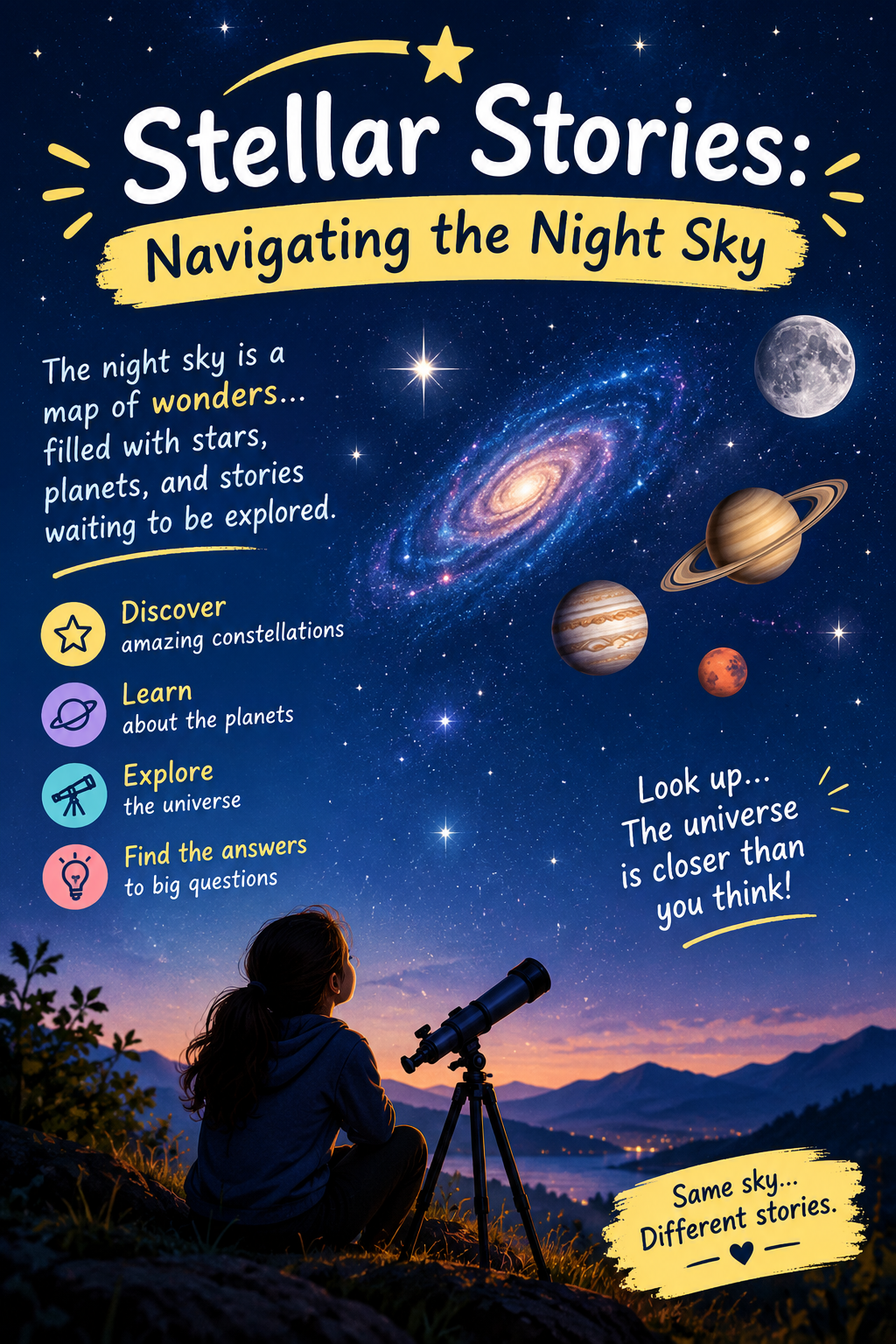
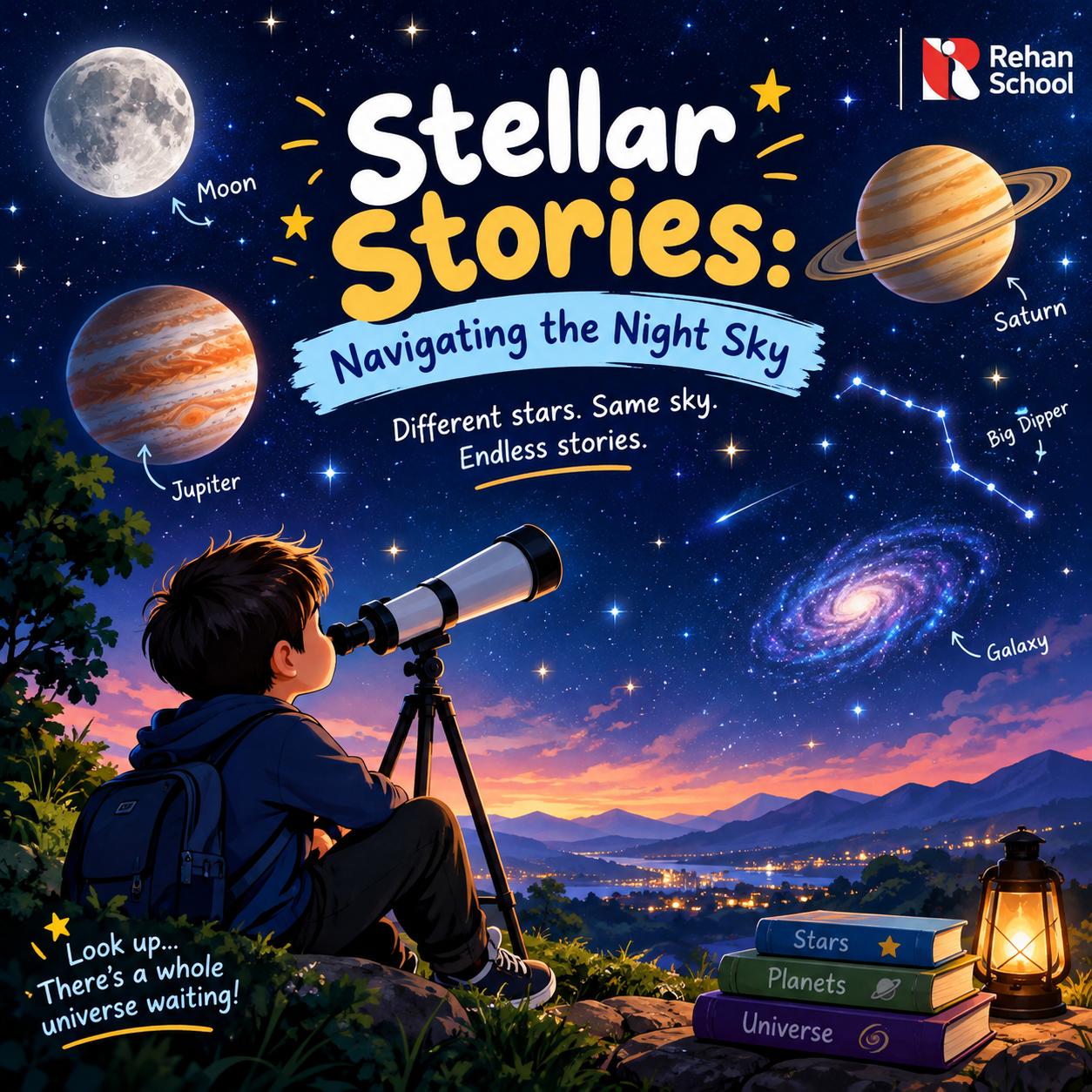
    **Stellar Stories: Navigating the Night Sky**

    **Welcome to Stellar Stories, where the magic of the universe comes alive!** Have you ever looked up at the night sky and wondered how many stars are shining above you? Have you ever imagined traveling through space, discovering distant planets, exploring beautiful galaxies, and learning the secrets hidden among the stars? If yes, then get ready for an amazing journey through the wonders of the cosmos!

    The night sky is like a giant storybook filled with countless stars, fascinating constellations, mysterious planets, and breathtaking galaxies. Every tiny point of light tells us something about our incredible universe. From the bright North Star to the beautiful patterns of Orion's Belt , the sky has inspired explorers, scientists, dreamers, and storytellers for thousands of years.

    **Discover the Wonders of the Night Sky!**

    **Stars:** Learn about the glowing balls of hot gas that light up the universe. Some stars are much larger than our Sun, while others are smaller and cooler. Every star has its own fascinating story!

    **Planets:** Explore the amazing worlds of our solar system, from Mercury's scorching surface to Neptune's distant, deep-blue atmosphere. Discover how planets move around the Sun and why Earth is such a special place for life.

    **Galaxies:** Imagine billions of stars gathered together in enormous cosmic cities! Our home galaxy, the Milky Way, contains stars, planets, gas, and dust, all connected by gravity. Just think about how enormous the universe really is!

    **Constellations:** Discover how people connect stars into recognizable patterns in the sky. These patterns have helped people tell stories, recognize seasons, and navigate throughout history.

    **The Moon:** Observe our closest celestial neighbor and discover why it changes appearance throughout the month. Learn about its phases, its craters, and its important role in Earth's natural systems.

    **Meteors and Comets:** Discover the spectacular streaks of light called meteors and learn about icy comets that travel through space, sometimes developing beautiful glowing tails near the Sun.

    ‍ **Become a Young Space Explorer!**

    You don't need a giant telescope or a spaceship to begin exploring the universe! You can start by looking at the night sky, learning the names of bright stars, identifying visible constellations, and observing the Moon. A simple sky map or astronomy app can help you understand what you're seeing.

    **Why Is Astronomy Important?**

    Astronomy teaches us to ask questions, observe carefully, think scientifically, and search for answers. It helps us understand Earth's place in the universe and reminds us that learning never has to stop. Every discovery begins with curiosity!

    Imagine standing beneath a sky filled with sparkling stars, wondering what exists beyond the worlds we already know. Somewhere out there, new mysteries are waiting to be explored, new discoveries are waiting to be made, and new questions are waiting for curious minds like yours!

    **Remember:** The universe is vast, beautiful, and full of wonders. Keep looking up, keep asking questions, and never stop exploring! Your next great discovery might begin with one simple question: *What's out there?*

    Let's make learning about space exciting, inspiring, and fun! Share this post with your friends and family, encourage young explorers to discover astronomy, and spread the wonder of the night sky across the world.

    **Tell us in the comments!**
    Which would you love to explore first: the Moon, Mars, Saturn's rings, or a distant galaxy?

    Like | Comment | Share | Follow for more amazing stories, educational adventures, science facts, and discoveries!

    **Stellar Stories: Every Star Has a Story, and Every Explorer Has a Question!**

    ━━━━━━━━━━━━━━━━━━━━

    **HASHTAGS**

    #StellarStories #NavigatingTheNightSky #NightSky #Astronomy #SpaceExploration #ExploreTheUniverse #Stars #Planets #Galaxies #MilkyWay #Constellations #Moon #SolarSystem #SpaceScience #ScienceForKids #YoungScientists #YoungExplorers #SpaceLovers #AstronomyForBeginners #LearnAboutSpace #EducationalContent #ScienceEducation #DiscoverTheUniverse #CosmicWonders #Universe #SpaceFacts #Stargazing #Telescope #Astrophysics #ScienceIsFun #Curiosity #KeepLearning #DreamBig #ExploreAndDiscover #KnowledgeIsPower #InspiringMinds #StoryPost #EducationalPost #CreativeLearning #SpaceAdventure #FutureAstronomers #WonderOfTheUniverse #KeepLookingUp
    #rsisb Roll no.247 Story post .9 Foundation level 🌌✨ **Stellar Stories: Navigating the Night Sky** 🌟🔭 🌠🌌 **Welcome to Stellar Stories, where the magic of the universe comes alive!** 🚀✨ Have you ever looked up at the night sky and wondered how many stars are shining above you? 🌟 Have you ever imagined traveling through space, discovering distant planets, exploring beautiful galaxies, and learning the secrets hidden among the stars? 🌍🪐🌌 If yes, then get ready for an amazing journey through the wonders of the cosmos! 🚀💫 🌙✨ The night sky is like a giant storybook filled with countless stars, fascinating constellations, mysterious planets, and breathtaking galaxies. Every tiny point of light tells us something about our incredible universe. 🌟📖 From the bright North Star ⭐ to the beautiful patterns of Orion's Belt 🌠, the sky has inspired explorers, scientists, dreamers, and storytellers for thousands of years. 🔭🌌 **Discover the Wonders of the Night Sky!** 🌟 **Stars:** Learn about the glowing balls of hot gas that light up the universe. Some stars are much larger than our Sun, while others are smaller and cooler. Every star has its own fascinating story! ☀️✨ 🪐 **Planets:** Explore the amazing worlds of our solar system, from Mercury's scorching surface to Neptune's distant, deep-blue atmosphere. Discover how planets move around the Sun and why Earth is such a special place for life. 🌍🚀 🌌 **Galaxies:** Imagine billions of stars gathered together in enormous cosmic cities! Our home galaxy, the Milky Way, contains stars, planets, gas, and dust, all connected by gravity. Just think about how enormous the universe really is! 🌠💫 ⭐ **Constellations:** Discover how people connect stars into recognizable patterns in the sky. These patterns have helped people tell stories, recognize seasons, and navigate throughout history. 🧭🌟 🌙 **The Moon:** Observe our closest celestial neighbor and discover why it changes appearance throughout the month. Learn about its phases, its craters, and its important role in Earth's natural systems. 🌕🔭 ☄️ **Meteors and Comets:** Discover the spectacular streaks of light called meteors and learn about icy comets that travel through space, sometimes developing beautiful glowing tails near the Sun. ☄️✨ 🧑‍🚀🚀 **Become a Young Space Explorer!** You don't need a giant telescope or a spaceship to begin exploring the universe! 🌌🔭 You can start by looking at the night sky, learning the names of bright stars, identifying visible constellations, and observing the Moon. A simple sky map or astronomy app can help you understand what you're seeing. 📱⭐ 🌍💡 **Why Is Astronomy Important?** Astronomy teaches us to ask questions, observe carefully, think scientifically, and search for answers. It helps us understand Earth's place in the universe and reminds us that learning never has to stop. Every discovery begins with curiosity! 🧠🔬✨ 🌠 Imagine standing beneath a sky filled with sparkling stars, wondering what exists beyond the worlds we already know. Somewhere out there, new mysteries are waiting to be explored, new discoveries are waiting to be made, and new questions are waiting for curious minds like yours! 🚀🌌 💫 **Remember:** The universe is vast, beautiful, and full of wonders. Keep looking up, keep asking questions, and never stop exploring! Your next great discovery might begin with one simple question: *What's out there?* 🌟🔭🌍 ❤️🌌 Let's make learning about space exciting, inspiring, and fun! Share this post with your friends and family, encourage young explorers to discover astronomy, and spread the wonder of the night sky across the world. 🌎🚀✨ 👇 **Tell us in the comments!** 💬 🌟 Which would you love to explore first: the Moon, Mars, Saturn's rings, or a distant galaxy? 🪐🌙🔴🌌 👍 Like | 💬 Comment | 🔄 Share | ⭐ Follow for more amazing stories, educational adventures, science facts, and discoveries! 🌌✨ **Stellar Stories: Every Star Has a Story, and Every Explorer Has a Question!** 🚀🌟 ━━━━━━━━━━━━━━━━━━━━ 🏷️ **HASHTAGS** 🌠 #StellarStories #NavigatingTheNightSky #NightSky #Astronomy #SpaceExploration #ExploreTheUniverse #Stars #Planets #Galaxies #MilkyWay #Constellations #Moon #SolarSystem #SpaceScience #ScienceForKids #YoungScientists #YoungExplorers #SpaceLovers #AstronomyForBeginners #LearnAboutSpace #EducationalContent #ScienceEducation #DiscoverTheUniverse #CosmicWonders #Universe #SpaceFacts #Stargazing #Telescope #Astrophysics #ScienceIsFun #Curiosity #KeepLearning #DreamBig #ExploreAndDiscover #KnowledgeIsPower #InspiringMinds #StoryPost #EducationalPost #CreativeLearning #SpaceAdventure #FutureAstronomers #WonderOfTheUniverse #KeepLookingUp 🌌🔭🚀✨🌟🪐🌙💫
    0 Commentarios 0 Acciones 406 Views
  • MohsinRSF8
    song title no:11
    Rool no:13

    The Story of Elements: From Carbon to Gold

    The universe is full of incredible stories, and one of the most fascinating stories is the story of the elements. Everything around us—from the air we breathe and the water we drink to the rocks beneath our feet, the plants around us, and even our own bodies—is connected to chemical elements. This journey helps us understand how the building blocks of matter became part of the amazing world we see today.

    The story begins with the early universe, when the simplest elements such as hydrogen and helium appeared. As the universe expanded and changed, huge clouds of matter came together under gravity and eventually formed stars. These stars became enormous natural laboratories where nuclear reactions could create heavier elements.

    Inside stars, incredible temperatures and pressures allow atoms to take part in processes that produce new elements. One important element created through stellar processes is carbon. Carbon is especially fascinating because it can form a huge variety of compounds and plays a fundamental role in life. It can be found in living organisms, plants, fuels, minerals, and different forms of materials.

    But carbon is only one part of the story. Other elements such as oxygen and nitrogen are also essential to the natural world. Elements move through cycles in nature, becoming part of the atmosphere, oceans, soil, rocks, plants, animals, and countless other systems. This shows us that the elements are constantly participating in the processes that shape our planet.

    As massive stars evolve, they can create heavier elements through different nuclear processes. Eventually, some stars reach dramatic final stages and release material into space. That material can become part of future stars, planets, and other objects. In this way, the universe continuously recycles matter and gives elements new places to exist.

    The journey becomes even more fascinating when we reach elements heavier than iron. Powerful cosmic events can create many of these heavy elements. Gold is one of the most remarkable examples.
    MohsinRSF8 song title no:11 Rool no:13 🌌 The Story of Elements: From Carbon to Gold 🔬🥇 The universe is full of incredible stories, and one of the most fascinating stories is the story of the elements. Everything around us—from the air we breathe and the water we drink to the rocks beneath our feet, the plants around us, and even our own bodies—is connected to chemical elements. This journey helps us understand how the building blocks of matter became part of the amazing world we see today. The story begins with the early universe, when the simplest elements such as hydrogen and helium appeared. As the universe expanded and changed, huge clouds of matter came together under gravity and eventually formed stars. These stars became enormous natural laboratories where nuclear reactions could create heavier elements. Inside stars, incredible temperatures and pressures allow atoms to take part in processes that produce new elements. One important element created through stellar processes is carbon. Carbon is especially fascinating because it can form a huge variety of compounds and plays a fundamental role in life. It can be found in living organisms, plants, fuels, minerals, and different forms of materials. But carbon is only one part of the story. Other elements such as oxygen and nitrogen are also essential to the natural world. Elements move through cycles in nature, becoming part of the atmosphere, oceans, soil, rocks, plants, animals, and countless other systems. This shows us that the elements are constantly participating in the processes that shape our planet. As massive stars evolve, they can create heavier elements through different nuclear processes. Eventually, some stars reach dramatic final stages and release material into space. That material can become part of future stars, planets, and other objects. In this way, the universe continuously recycles matter and gives elements new places to exist. The journey becomes even more fascinating when we reach elements heavier than iron. Powerful cosmic events can create many of these heavy elements. Gold is one of the most remarkable examples.
    0 Commentarios 0 Acciones 526 Views 26


  • Mohsin RS F8
    Story post NO:14
    roll NO:13
    Class: Foundation Level
    Made by Me

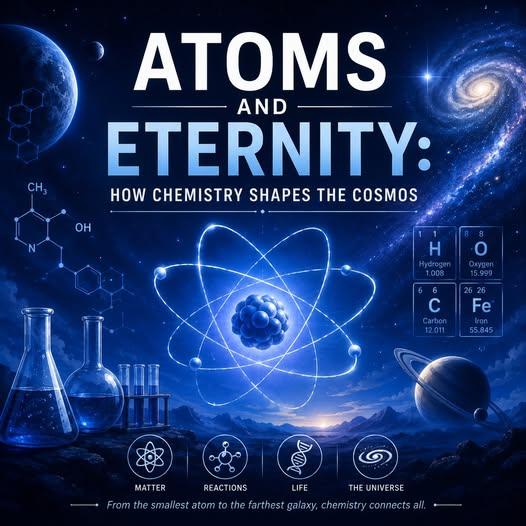
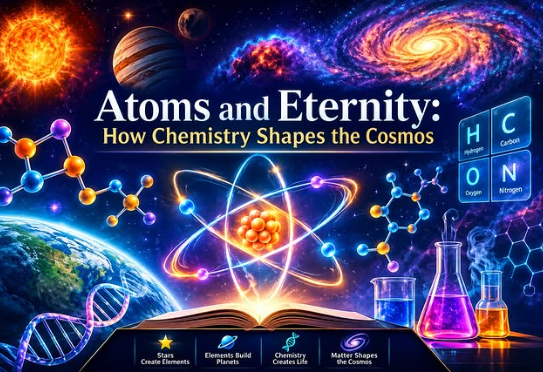
    Description: Atoms and Eternity: How Chemistry Shapes the Cosmos

    Atoms and Eternity: How Chemistry Shapes the Cosmos is a fascinating journey into the connection between the smallest building blocks of matter and the enormous universe around us. Everything we see—from stars and planets to oceans, rocks, plants, animals, and even our own bodies—is made from atoms. Although atoms are incredibly tiny, their interactions create the incredible diversity and complexity we observe throughout nature.

    The story of atoms is also connected to the story of the cosmos. The universe began with simple elements, while stars became powerful cosmic environments where many heavier elements were produced. Over immense periods of time, these elements became part of clouds of gas and dust that could eventually form new stars, planets, and other celestial objects. This gives us a remarkable way to understand how matter travels and transforms across the universe.

    Chemistry helps explain what happens when atoms combine. Different combinations of elements create molecules with completely different properties. Water, for example, is formed from hydrogen and oxygen, while carbon can form an enormous variety of molecules that are important in living systems. These chemical relationships show how simple components can create increasingly complex structures.

    The connection between chemistry and astronomy is especially exciting because scientists can study the composition of objects that are unimaginably far away. By analyzing the light from stars and other cosmic objects, scientists can identify elements and learn about the conditions in distant regions of space. In this way, chemistry becomes a powerful tool for exploring the universe.

    This topic also encourages us to think about the relationship between stars, elements, planets, and life. The elements found on Earth are part of a much larger cosmic story. The atoms that make up minerals, water, atmosphere, and living organisms have participated in countless transformations throughout the history of the universe.

    Ultimately, Atoms and Eternity
    Mohsin RS F8 🎓✨ Story post NO:14 roll NO:13 Class: Foundation Level 📚 Made by Me 💻🚀 Description: Atoms and Eternity: How Chemistry Shapes the Cosmos 🌌⚛️ Atoms and Eternity: How Chemistry Shapes the Cosmos is a fascinating journey into the connection between the smallest building blocks of matter and the enormous universe around us. Everything we see—from stars and planets to oceans, rocks, plants, animals, and even our own bodies—is made from atoms. Although atoms are incredibly tiny, their interactions create the incredible diversity and complexity we observe throughout nature. The story of atoms is also connected to the story of the cosmos. The universe began with simple elements, while stars became powerful cosmic environments where many heavier elements were produced. Over immense periods of time, these elements became part of clouds of gas and dust that could eventually form new stars, planets, and other celestial objects. This gives us a remarkable way to understand how matter travels and transforms across the universe. Chemistry helps explain what happens when atoms combine. Different combinations of elements create molecules with completely different properties. Water, for example, is formed from hydrogen and oxygen, while carbon can form an enormous variety of molecules that are important in living systems. These chemical relationships show how simple components can create increasingly complex structures. The connection between chemistry and astronomy is especially exciting because scientists can study the composition of objects that are unimaginably far away. By analyzing the light from stars and other cosmic objects, scientists can identify elements and learn about the conditions in distant regions of space. In this way, chemistry becomes a powerful tool for exploring the universe. This topic also encourages us to think about the relationship between stars, elements, planets, and life. The elements found on Earth are part of a much larger cosmic story. The atoms that make up minerals, water, atmosphere, and living organisms have participated in countless transformations throughout the history of the universe. Ultimately, Atoms and Eternity
    0 Commentarios 0 Acciones 343 Views
  • Mohsin #RSF8
    #Storypost9
    Class: Foundation level
    Made by Me
    rool no:13

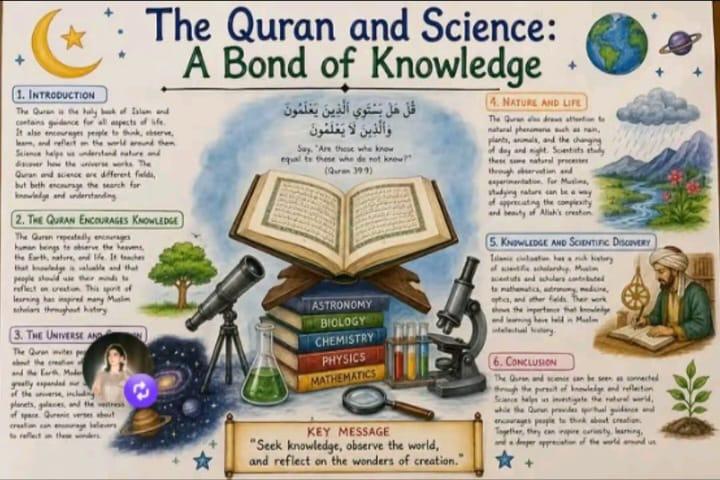
    The Quran and Science: A Bond of Knowledge

    Introduction

    The Quran is the holy book of Islam and contains guidance for all aspects of life. It also encourages people to think, observe, learn, and reflect on the world around them. Science helps us understand nature and discover how the universe works. The Quran and science are different fields, but both encourage the search for knowledge and understanding.

    The Quran Encourages Knowledge

    The Quran repeatedly encourages human beings to observe the heavens, the Earth, nature, and life. It teaches that knowledge is valuable and that people should use their minds to reflect on creation. This spirit of learning has inspired many Muslim scholars throughout history.

    The Universe and Creation

    The Quran invites people to think about the creation of the heavens and the Earth. Modern science has greatly expanded our understanding of the universe, including stars, planets, galaxies, and the vastness of space. Quranic verses about creation can encourage believers to reflect on these wonders.

    Nature and Life

    The Quran also draws attention to natural phenomena such as rain, plants, animals, and the changing of day and night. Scientists study these same natural processes through observation and experimentation. For Muslims, studying nature can be a way of appreciating the complexity and beauty of Allah’s creation.

    Knowledge and Scientific Discovery

    Islamic civilization has a rich history of scientific scholarship. Muslim scientists and scholars contributed to mathematics, astronomy, medicine, optics, and other fields. Their work shows the importance that knowledge and learning have held in Muslim intellectual history.

    Conclusion

    The Quran and science can be seen as connected through the pursuit of knowledge and reflection. Science helps us investigate the natural world, while the Quran provides spiritual guidance and encourages people to think about creation. Together, they can inspire curiosity, learning, and a deeper appreciation of the world around us.
    Mohsin #RSF8🎓✨ #Storypost9 Class: Foundation level 📚 Made by Me 💻🚀 rool no:13 The Quran and Science: A Bond of Knowledge Introduction The Quran is the holy book of Islam and contains guidance for all aspects of life. It also encourages people to think, observe, learn, and reflect on the world around them. Science helps us understand nature and discover how the universe works. The Quran and science are different fields, but both encourage the search for knowledge and understanding. The Quran Encourages Knowledge The Quran repeatedly encourages human beings to observe the heavens, the Earth, nature, and life. It teaches that knowledge is valuable and that people should use their minds to reflect on creation. This spirit of learning has inspired many Muslim scholars throughout history. The Universe and Creation The Quran invites people to think about the creation of the heavens and the Earth. Modern science has greatly expanded our understanding of the universe, including stars, planets, galaxies, and the vastness of space. Quranic verses about creation can encourage believers to reflect on these wonders. Nature and Life The Quran also draws attention to natural phenomena such as rain, plants, animals, and the changing of day and night. Scientists study these same natural processes through observation and experimentation. For Muslims, studying nature can be a way of appreciating the complexity and beauty of Allah’s creation. Knowledge and Scientific Discovery Islamic civilization has a rich history of scientific scholarship. Muslim scientists and scholars contributed to mathematics, astronomy, medicine, optics, and other fields. Their work shows the importance that knowledge and learning have held in Muslim intellectual history. Conclusion The Quran and science can be seen as connected through the pursuit of knowledge and reflection. Science helps us investigate the natural world, while the Quran provides spiritual guidance and encourages people to think about creation. Together, they can inspire curiosity, learning, and a deeper appreciation of the world around us.
    0 Commentarios 0 Acciones 1104 Views
  • #RSTA
    #Task : Story Post
    #Class: Foundation Level Book 2
    #Day No: 9
    #Made By Me

    Total Post:3


    Today, I completed a story post titled **“Stellar Stories: Navigating the Night Sky.”** I explored the beauty of stars, planets, constellations, and the amazing universe.

    I also generated a creative image for the story and shared the post on **Facebook, YouTube, LinkedIn, Instagram, and TikTok**. This activity helped me learn more about space while improving my creativity and digital skills.

    RSTA StellarStories NightSky Space Stars Universe Astronomy StoryPost Learning Creativity MadeByMe Facebook YouTube LinkedIn Instagram TikTok
    #RSTA #Task : Story Post #Class: Foundation Level Book 2 #Day No: 9 #Made By Me Total Post:3 Today, I completed a story post titled **“Stellar Stories: Navigating the Night Sky.”** I explored the beauty of stars, planets, constellations, and the amazing universe. 🔭✨ I also generated a creative image for the story and shared the post on **Facebook, YouTube, LinkedIn, Instagram, and TikTok**. This activity helped me learn more about space while improving my creativity and digital skills. 🚀📚 RSTA StellarStories NightSky Space Stars Universe Astronomy StoryPost Learning Creativity MadeByMe Facebook YouTube LinkedIn Instagram TikTok
    0 Commentarios 0 Acciones 788 Views
  • MohsinRSF8
    song title no:9
    Rool no:13
    Class: Foundation level

    Calculus: The Journey of Numbers and Sacred Spaces

    Calculus is one of the most remarkable branches of mathematics because it gives us a way to understand change, movement, growth, space, patterns, and continuous processes. At first, calculus may appear to be a collection of complicated formulas, symbols, graphs, limits, derivatives, and integrals. However, when we look deeper, we discover that calculus is actually a beautiful language used to describe the world around us.

    The story of calculus begins with one of the most important questions in mathematics and science: How does something change? Everything around us is constantly changing. The position of a moving object changes with time. The speed of a vehicle changes as it accelerates or slows down. Plants grow, populations increase or decrease, rivers flow, temperatures rise and fall, and planets move through space. Calculus provides mathematical tools that allow us to study these changes carefully and accurately.

    One of the most important concepts in calculus is the derivative. A derivative helps us understand the rate at which something is changing at a particular moment. It allows us to move beyond simply knowing the beginning and ending values of something and instead understand what is happening between those points. This idea is extremely useful in physics, engineering, astronomy, economics, biology, computer science, and many other fields.

    For example, imagine a car traveling along a road. We may know how far the car has traveled after a certain amount of time, but calculus allows us to determine its speed at a specific instant. By studying the change in position over time, we can understand motion in a much more detailed way. This simple idea becomes the foundation for understanding acceleration, forces, planetary motion, and many other physical processes.

    The second major idea of calculus is integration. While differentiation focuses on rates of change, integration focuses on accumulation. An integral can help us calculate areas, volumes, distances, and quantities that build up over time. If many small pieces are combined together,
    MohsinRSF8 song title no:9 Rool no:13 Class: Foundation level Calculus: The Journey of Numbers and Sacred Spaces Calculus is one of the most remarkable branches of mathematics because it gives us a way to understand change, movement, growth, space, patterns, and continuous processes. At first, calculus may appear to be a collection of complicated formulas, symbols, graphs, limits, derivatives, and integrals. However, when we look deeper, we discover that calculus is actually a beautiful language used to describe the world around us. The story of calculus begins with one of the most important questions in mathematics and science: How does something change? Everything around us is constantly changing. The position of a moving object changes with time. The speed of a vehicle changes as it accelerates or slows down. Plants grow, populations increase or decrease, rivers flow, temperatures rise and fall, and planets move through space. Calculus provides mathematical tools that allow us to study these changes carefully and accurately. One of the most important concepts in calculus is the derivative. A derivative helps us understand the rate at which something is changing at a particular moment. It allows us to move beyond simply knowing the beginning and ending values of something and instead understand what is happening between those points. This idea is extremely useful in physics, engineering, astronomy, economics, biology, computer science, and many other fields. For example, imagine a car traveling along a road. We may know how far the car has traveled after a certain amount of time, but calculus allows us to determine its speed at a specific instant. By studying the change in position over time, we can understand motion in a much more detailed way. This simple idea becomes the foundation for understanding acceleration, forces, planetary motion, and many other physical processes. The second major idea of calculus is integration. While differentiation focuses on rates of change, integration focuses on accumulation. An integral can help us calculate areas, volumes, distances, and quantities that build up over time. If many small pieces are combined together,
    0 Commentarios 0 Acciones 1144 Views 125
  • Mohsin #RSF8
    #Storypost10
    Class: Foundation level
    Made by Me
    rool no:13

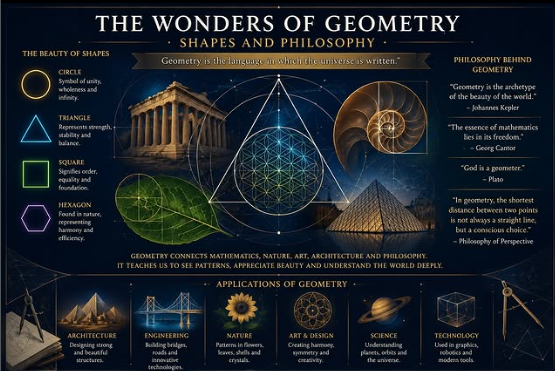
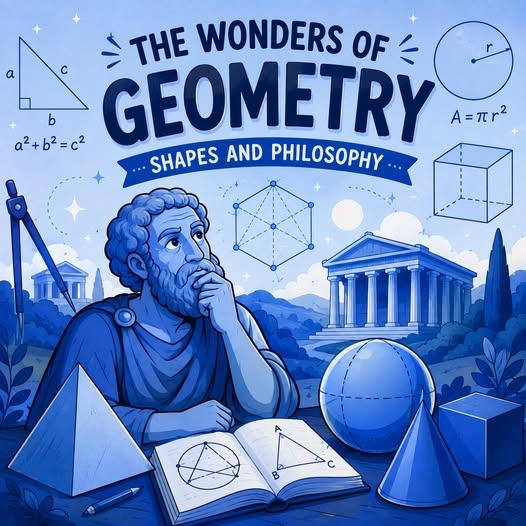
    The Wonders of Geometry: Shapes and Philosophy

    Geometry is one of the oldest and most fascinating areas of mathematics. It is not simply the study of lines, angles, and shapes; it is a way of understanding the structure, patterns, balance, and beauty of the world around us. From the smallest natural patterns to huge buildings and bridges, geometry plays an important role in our everyday lives.

    The topic “The Wonders of Geometry: Shapes and Philosophy” explores the beautiful relationship between mathematics and the ideas that humans have developed about order, harmony, proportion, symmetry, and perfection.

    The Beauty of Circles

    The circle is one of the most recognizable geometric shapes. It has no corners and every point on its boundary is the same distance from its center. Because of its continuous form, the circle is often associated with ideas such as unity, completeness, continuity, and infinity. We can see circles in wheels, clocks, planets, coins, lenses, and many designs around us.

    The Strength of Triangles

    Triangles are simple but incredibly important shapes. Their strong structure makes them useful in architecture and engineering. Bridges, roofs, towers, and other structures often use triangular designs because triangles provide stability. In geometry, triangles also help us understand angles, lengths, proportions, and many important mathematical relationships.

    The Balance of Squares

    The square represents equality, balance, order, and structure. All four of its sides are equal, and all four angles are right angles. Squares are commonly found in buildings, floor designs, windows, screens, tiles, artwork, and patterns. They demonstrate how mathematical rules can produce simple yet powerful designs.

    ⬡ The Harmony of Hexagons

    Hexagons are another fascinating shape. They can be seen naturally in honeycombs and in various patterns found in science and nature. Hexagonal structures can efficiently cover a surface without leaving gaps, which makes them especially interesting from both mathematical and natural per
    Mohsin #RSF8🎓✨ #Storypost10 Class: Foundation level 📚 Made by Me 💻🚀 rool no:13 📐✨ The Wonders of Geometry: Shapes and Philosophy ✨📐 Geometry is one of the oldest and most fascinating areas of mathematics. It is not simply the study of lines, angles, and shapes; it is a way of understanding the structure, patterns, balance, and beauty of the world around us. From the smallest natural patterns to huge buildings and bridges, geometry plays an important role in our everyday lives. The topic “The Wonders of Geometry: Shapes and Philosophy” explores the beautiful relationship between mathematics and the ideas that humans have developed about order, harmony, proportion, symmetry, and perfection. 🔵 The Beauty of Circles The circle is one of the most recognizable geometric shapes. It has no corners and every point on its boundary is the same distance from its center. Because of its continuous form, the circle is often associated with ideas such as unity, completeness, continuity, and infinity. We can see circles in wheels, clocks, planets, coins, lenses, and many designs around us. 🔺 The Strength of Triangles Triangles are simple but incredibly important shapes. Their strong structure makes them useful in architecture and engineering. Bridges, roofs, towers, and other structures often use triangular designs because triangles provide stability. In geometry, triangles also help us understand angles, lengths, proportions, and many important mathematical relationships. ⬜ The Balance of Squares The square represents equality, balance, order, and structure. All four of its sides are equal, and all four angles are right angles. Squares are commonly found in buildings, floor designs, windows, screens, tiles, artwork, and patterns. They demonstrate how mathematical rules can produce simple yet powerful designs. ⬡ The Harmony of Hexagons Hexagons are another fascinating shape. They can be seen naturally in honeycombs and in various patterns found in science and nature. Hexagonal structures can efficiently cover a surface without leaving gaps, which makes them especially interesting from both mathematical and natural per
    0 Commentarios 0 Acciones 1907 Views
  • RSIF8
    Roll no: 99
    Story post no: 18
    Story topic: Atoms and Eternity: How Chemistry Shapes the Cosmos
    Everything around us, from the smallest atom to the largest galaxy, is connected through chemistry. Atoms combine to form molecules, molecules take part in reactions, and these processes create the matter and structures that make up our world and the universe.
    Chemistry is not limited to laboratories—it plays a role in stars, planets, living organisms, and the space between them. By understanding atoms and their interactions, we gain a deeper appreciation of how the universe is built and how its incredible complexity comes together.
    #Atoms #Chemistry #Cosmos #Science #Universe #Molecules #Astronomy #ScienceEducation #STEM #LearnScience
    RSIF8 Roll no: 99 Story post no: 18 Story topic: Atoms and Eternity: How Chemistry Shapes the Cosmos Everything around us, from the smallest atom to the largest galaxy, is connected through chemistry. Atoms combine to form molecules, molecules take part in reactions, and these processes create the matter and structures that make up our world and the universe. Chemistry is not limited to laboratories—it plays a role in stars, planets, living organisms, and the space between them. By understanding atoms and their interactions, we gain a deeper appreciation of how the universe is built and how its incredible complexity comes together. #Atoms #Chemistry #Cosmos #Science #Universe #Molecules #Astronomy #ScienceEducation #STEM #LearnScience
    0 Commentarios 0 Acciones 745 Views
  • RSIF8
    Roll no: 99
    Story post no: 13
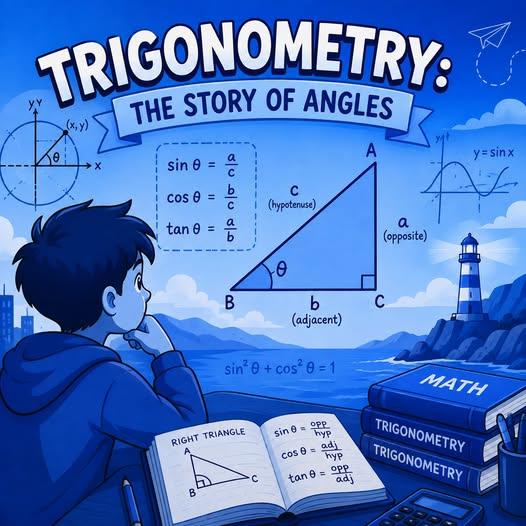
    Story topic: Trigonometry: The Story of Angles
    Trigonometry is the study of angles, triangles, and the relationships between their sides. What may seem like simple shapes and measurements becomes a powerful tool for understanding the world around us.
    From measuring the height of a building to studying waves, sound, light, and the movement of planets, trigonometry helps us calculate distances and uncover hidden patterns. Every angle has a story to tell, and trigonometry gives us the language to understand it.
    #Trigonometry #Mathematics #Angles #Triangles #MathEducation #STEM #LearnMath #MathematicsLovers #ScienceAndMath #Education
    RSIF8 Roll no: 99 Story post no: 13 Story topic: Trigonometry: The Story of Angles Trigonometry is the study of angles, triangles, and the relationships between their sides. What may seem like simple shapes and measurements becomes a powerful tool for understanding the world around us. From measuring the height of a building to studying waves, sound, light, and the movement of planets, trigonometry helps us calculate distances and uncover hidden patterns. Every angle has a story to tell, and trigonometry gives us the language to understand it. #Trigonometry #Mathematics #Angles #Triangles #MathEducation #STEM #LearnMath #MathematicsLovers #ScienceAndMath #Education
    0 Commentarios 0 Acciones 1114 Views
  • RSIF8
    Roll no: 99
    Story post no: 12
    Story topic: The Wonders of Geometry: Shapes and Philosophy
    Geometry is more than just shapes, lines, and angles—it is a way of understanding the patterns and structures around us. From the symmetry of nature to the design of buildings and the movement of planets, geometry helps us see how mathematics connects with the world.
    For centuries, philosophers and mathematicians have explored geometry to understand beauty, balance, and order. Every circle, triangle, and polygon tells a story about how mathematics shapes the way we see and understand our universe.
    #Geometry #Mathematics #Shapes #Philosophy #MathEducation #STEM #LearnMath #MathematicsLovers #ScienceAndMath #Education
    RSIF8 Roll no: 99 Story post no: 12 Story topic: The Wonders of Geometry: Shapes and Philosophy Geometry is more than just shapes, lines, and angles—it is a way of understanding the patterns and structures around us. From the symmetry of nature to the design of buildings and the movement of planets, geometry helps us see how mathematics connects with the world. For centuries, philosophers and mathematicians have explored geometry to understand beauty, balance, and order. Every circle, triangle, and polygon tells a story about how mathematics shapes the way we see and understand our universe. #Geometry #Mathematics #Shapes #Philosophy #MathEducation #STEM #LearnMath #MathematicsLovers #ScienceAndMath #Education
    0 Commentarios 0 Acciones 1050 Views
Resultados de la búsqueda