• rehan school urdu bazar
    roll no 11
    foundation level
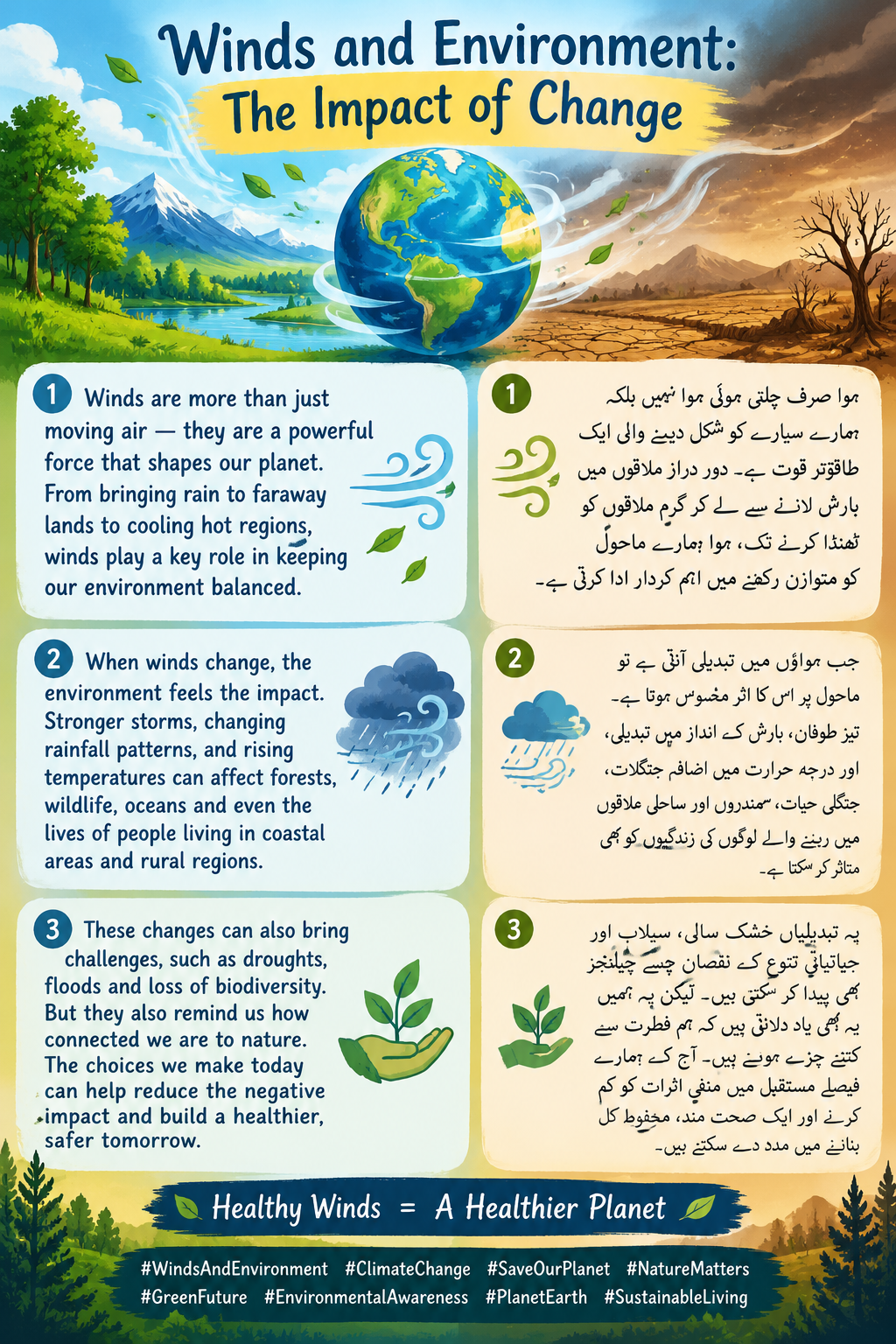
    ### Paragraph 1: The Power of Wind
    Wind is an important part of our environment. It moves air from one place to another and helps keep our planet balanced. Wind brings rain, cools hot places, and helps plants spread their seeds. It also plays an important role in changing weather.
    ### Paragraph 2: How Winds Affect Nature
    When winds become stronger or change direction, they can affect the weather. Strong winds may bring storms, heavy rain, or dust. These changes can affect forests, animals, oceans, and people. Coastal areas and rural communities can be especially affected by severe weather.
    ### Paragraph 3: The Challenges of Change
    Changes in weather can cause problems such as droughts, floods, and damage to plants and wildlife. Strong storms can destroy homes and trees. These challenges remind us that nature is delicate and that we must take care of our environment.
    ### Paragraph 4: Protecting Our Planet
    We can help protect our planet by planting trees, reducing pollution, saving energy, and using clean energy such as wind power. Every small action matters. If we work together, we can build a greener and healthier future for everyone.
    **Healthy Winds, Healthy Planet!**### پیراگراف 1: ہوا کی طاقت
    ہوا ہمارے ماحول کا ایک اہم حصہ ہے۔ یہ ایک جگہ سے دوسری جگہ حرکت کرتی ہے اور ہماری زمین کے قدرتی توازن کو برقرار رکھنے میں مدد دیتی ہے۔ ہوا بارش لانے، گرم علاقوں کو ٹھنڈا کرنے اور پودوں کے بیج پھیلانے میں اہم کردار ادا کرتی ہے۔
    ### پیراگراف 2: ہواؤں کے قدرت پر اثرات
    جب ہواؤں کی رفتار بڑھ جاتی ہے یا ان کا رخ بدل جاتا ہے تو موسم بھی متاثر ہو سکتا ہے۔ تیز ہوائیں طوفان، شدید بارش یا گردوغبار کا سبب بن سکتی ہیں۔ ان تبدیلیوں سے جنگلات، جانوروں، سمندروں اور انسانوں کی زندگی متاثر ہوتی ہے۔
    ### پیراگراف 3: تبدیلی کے چیلنجز
    موسمی تبدیلیوں کی وجہ سے خشک سالی، سیلاب اور پودوں و جنگلی حیات کو نقصان پہنچ سکتا ہے۔ شدید طوفان گھروں اور درختوں کو تباہ کر سکتے ہیں۔ یہ مسائل ہمیں یاد دلاتے ہیں کہ قدرت بہت قیمتی ہے اور ہمیں اپنے ماحول کی حفاظت کرنی چاہیے۔
    ### پیراگراف 4: اپنے سیارے کی حفاظت
    ہم درخت لگا کر، آلودگی کم کرکے، توانائی بچا کر اور ہوا سے بجلی پیدا کرکے اپنے سیارے کی حفاظت میں مدد دے سکتے ہیں۔ ہماری ہر چھوٹی کوشش اہم ہے۔ اگر ہم سب مل کر کام کریں تو ہم آنے والی نسلوں کے لیے ایک صاف ستھرا اور صحت مند ماحول بنا سکتے ہیں۔
    **صحت مند ہوائیں، صحت مند زمین!** See less
    rehan school urdu bazar roll no 11 foundation level ### Paragraph 1: The Power of Wind Wind is an important part of our environment. It moves air from one place to another and helps keep our planet balanced. Wind brings rain, cools hot places, and helps plants spread their seeds. It also plays an important role in changing weather. ### Paragraph 2: How Winds Affect Nature When winds become stronger or change direction, they can affect the weather. Strong winds may bring storms, heavy rain, or dust. These changes can affect forests, animals, oceans, and people. Coastal areas and rural communities can be especially affected by severe weather. ### Paragraph 3: The Challenges of Change Changes in weather can cause problems such as droughts, floods, and damage to plants and wildlife. Strong storms can destroy homes and trees. These challenges remind us that nature is delicate and that we must take care of our environment. ### Paragraph 4: Protecting Our Planet We can help protect our planet by planting trees, reducing pollution, saving energy, and using clean energy such as wind power. Every small action matters. If we work together, we can build a greener and healthier future for everyone. **Healthy Winds, Healthy Planet!**### پیراگراف 1: ہوا کی طاقت ہوا ہمارے ماحول کا ایک اہم حصہ ہے۔ یہ ایک جگہ سے دوسری جگہ حرکت کرتی ہے اور ہماری زمین کے قدرتی توازن کو برقرار رکھنے میں مدد دیتی ہے۔ ہوا بارش لانے، گرم علاقوں کو ٹھنڈا کرنے اور پودوں کے بیج پھیلانے میں اہم کردار ادا کرتی ہے۔ ### پیراگراف 2: ہواؤں کے قدرت پر اثرات جب ہواؤں کی رفتار بڑھ جاتی ہے یا ان کا رخ بدل جاتا ہے تو موسم بھی متاثر ہو سکتا ہے۔ تیز ہوائیں طوفان، شدید بارش یا گردوغبار کا سبب بن سکتی ہیں۔ ان تبدیلیوں سے جنگلات، جانوروں، سمندروں اور انسانوں کی زندگی متاثر ہوتی ہے۔ ### پیراگراف 3: تبدیلی کے چیلنجز موسمی تبدیلیوں کی وجہ سے خشک سالی، سیلاب اور پودوں و جنگلی حیات کو نقصان پہنچ سکتا ہے۔ شدید طوفان گھروں اور درختوں کو تباہ کر سکتے ہیں۔ یہ مسائل ہمیں یاد دلاتے ہیں کہ قدرت بہت قیمتی ہے اور ہمیں اپنے ماحول کی حفاظت کرنی چاہیے۔ ### پیراگراف 4: اپنے سیارے کی حفاظت ہم درخت لگا کر، آلودگی کم کرکے، توانائی بچا کر اور ہوا سے بجلی پیدا کرکے اپنے سیارے کی حفاظت میں مدد دے سکتے ہیں۔ ہماری ہر چھوٹی کوشش اہم ہے۔ اگر ہم سب مل کر کام کریں تو ہم آنے والی نسلوں کے لیے ایک صاف ستھرا اور صحت مند ماحول بنا سکتے ہیں۔ **صحت مند ہوائیں، صحت مند زمین!** See less
    0 التعليقات 0 المشاركات 900 مشاهدة
  • #rsisb
    Roll no. 247
    Story post 14
    Foundation level

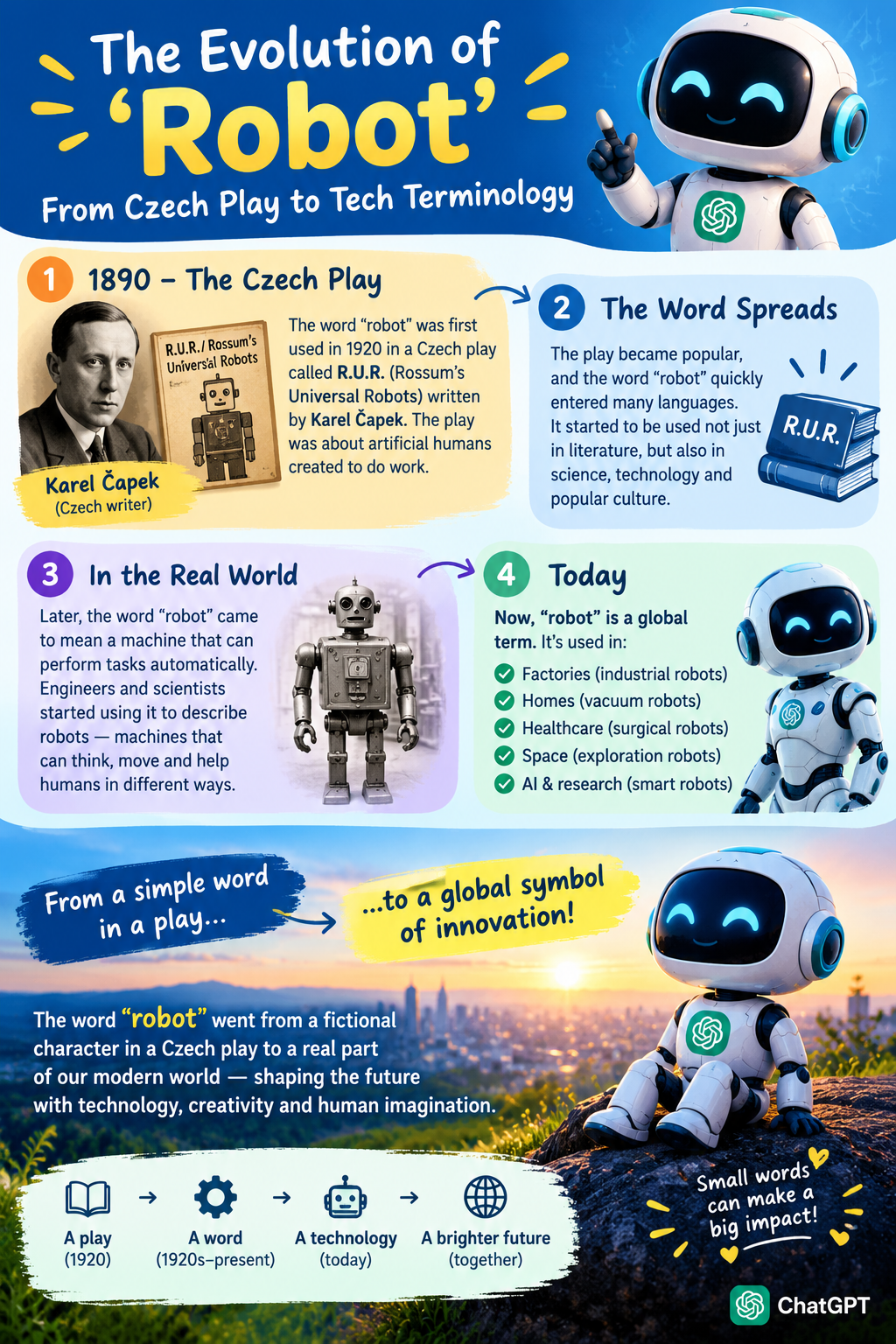
    **The Evolution of “Robot”: From Czech Play to Tech Terminology **

    Have you ever wondered where the word **“robot”** came from? Today, we use this word when talking about smart machines, artificial intelligence, factories, space exploration, and modern technology. But did you know that the word “robot” became popular through a Czech play written more than a century ago? Let's explore the fascinating journey of this little word that became a big part of our technological world!

    **1. The Beginning: A Czech Play **

    The story of the word “robot” begins with Czech writer and playwright **Karel Čapek** and his science-fiction play *R.U.R. (Rossum’s Universal Robots)*, first performed in 1921 and published in 1920. The play imagined artificial workers created to perform tasks for humans. It introduced audiences to ideas about artificial beings, technology, work, and the relationship between humans and machines.

    The word “robot” comes from the Czech word *robota*, associated with forced labor or compulsory work. Interestingly, Karel Čapek credited his brother, **Josef Čapek**, with suggesting the word for the play.

    **2. How the Word Spread Around the World **

    As the play gained attention, the word “robot” spread beyond literature and entered everyday language. People began using it to discuss machines that could perform tasks automatically. Over time, robots became a popular subject in science-fiction stories, films, books, and discussions about the future.

    Writers and scientists explored exciting questions: Could machines help humans? Could robots perform difficult tasks? How might technology change our lives? These questions helped inspire generations of inventors and researchers.

    **3. From Fiction to Real Machines **

    Robots eventually became an important part of real-world engineering and science. Modern robots can perform repetitive tasks, assist with manufacturing, explore places that are difficult for humans to reach, and help researchers carry out complex work.

    Today, we can find robots in many areas:

    **Factories:** Industrial robots help assemble products and perform precise tasks.

    **Homes:** Robotic vacuum cleaners help people with household cleaning.

    **Healthcare:** Specialised robotic systems assist medical professionals with certain procedures.

    **Space Exploration:** Robotic rovers and spacecraft help scientists explore distant worlds.

    **Agriculture:** Some robots help monitor crops and perform farming tasks.

    **Research:** Scientists use robots to test ideas, collect information, and explore new possibilities.

    **4. Robots and Artificial Intelligence **

    Modern technology has introduced new possibilities through artificial intelligence (AI). Some robots use AI to interpret information from sensors, recognise objects, plan actions, or respond to changing conditions. However, not every robot uses AI, and not every AI system is a robot.

    This difference is important! A robot is generally a physical machine that can carry out tasks, while AI refers to computer systems designed to perform tasks that may require abilities such as recognising patterns or understanding language. Together, robotics and AI are helping researchers develop new tools and technologies.

    **5. What Can We Learn from the Evolution of “Robot”?**

    The journey of the word “robot” teaches us that ideas can travel from books and plays into real life. A word introduced through a fictional story became an important term in science, engineering, and technology.

    It also reminds us that technology is created by people using imagination, creativity, teamwork, and scientific knowledge. As we learn more about robots, we should think about how to use technology responsibly and how it can benefit people and communities.

    **Conclusion: From a Czech Play to a Technological Future**

    The evolution of “robot” is a remarkable example of how language, literature, and science connect. What began as a word associated with artificial workers in a Czech play is now used around the world to describe machines that help us in factories, homes, hospitals, laboratories, and space exploration.

    The future of robotics will continue to bring new discoveries, challenges, and opportunities. By learning about the past, understanding the present, and thinking creatively about the future, we can become more informed and responsible users of technology.

    **Let's keep learning, exploring, and innovating!** Every great invention begins with an idea, and every curious mind has the potential to discover something new.

    **Question for everyone:** If you could invent a helpful robot, what would you want it to do? Share your ideas in the comments!

    Like, share, and spread the excitement of science and technology!

    ━━━━━━━━━━━━━━━━━━

    **HASHTAGS**

    #EvolutionOfRobots #RobotHistory #TheWordRobot #KarelCapek #JosefCapek #RUR #CzechLiterature #HistoryOfTechnology #Robotics #ArtificialIntelligence #AI #ScienceAndTechnology #EducationalPost #StoryPost #TechnologyEducation #FutureTechnology #Innovation #Engineering #STEMEducation #ScienceForEveryone #LearningIsFun #DigitalLearning #TechHistory #SmartMachines #SpaceExploration #IndustrialRobots #CreativeThinking #KnowledgeIsPower #ChatGPT #PostOnAllPlatforms
    #rsisb Roll no. 247 Story post 14 Foundation level 🤖🌍 **The Evolution of “Robot”: From Czech Play to Tech Terminology 📚✨** 🚀🤖 Have you ever wondered where the word **“robot”** came from? Today, we use this word when talking about smart machines, artificial intelligence, factories, space exploration, and modern technology. But did you know that the word “robot” became popular through a Czech play written more than a century ago? 📖🌟 Let's explore the fascinating journey of this little word that became a big part of our technological world! 💡🌐 📚 **1. The Beginning: A Czech Play 🇨🇿** The story of the word “robot” begins with Czech writer and playwright **Karel Čapek** and his science-fiction play *R.U.R. (Rossum’s Universal Robots)*, first performed in 1921 and published in 1920. 🎭🤖 The play imagined artificial workers created to perform tasks for humans. It introduced audiences to ideas about artificial beings, technology, work, and the relationship between humans and machines. The word “robot” comes from the Czech word *robota*, associated with forced labor or compulsory work. Interestingly, Karel Čapek credited his brother, **Josef Čapek**, with suggesting the word for the play. ✍️💭 🌎 **2. How the Word Spread Around the World 🌐** As the play gained attention, the word “robot” spread beyond literature and entered everyday language. People began using it to discuss machines that could perform tasks automatically. 📖⚙️ Over time, robots became a popular subject in science-fiction stories, films, books, and discussions about the future. Writers and scientists explored exciting questions: Could machines help humans? Could robots perform difficult tasks? How might technology change our lives? These questions helped inspire generations of inventors and researchers. 🚀🧠 ⚙️ **3. From Fiction to Real Machines 🏭** Robots eventually became an important part of real-world engineering and science. Modern robots can perform repetitive tasks, assist with manufacturing, explore places that are difficult for humans to reach, and help researchers carry out complex work. 🔧🤖 Today, we can find robots in many areas: 🏭 **Factories:** Industrial robots help assemble products and perform precise tasks. 🏠 **Homes:** Robotic vacuum cleaners help people with household cleaning. 🏥 **Healthcare:** Specialised robotic systems assist medical professionals with certain procedures. 🚀 **Space Exploration:** Robotic rovers and spacecraft help scientists explore distant worlds. 🌾 **Agriculture:** Some robots help monitor crops and perform farming tasks. 🧪 **Research:** Scientists use robots to test ideas, collect information, and explore new possibilities. 💻 **4. Robots and Artificial Intelligence 🧠** Modern technology has introduced new possibilities through artificial intelligence (AI). Some robots use AI to interpret information from sensors, recognise objects, plan actions, or respond to changing conditions. 🤖💡 However, not every robot uses AI, and not every AI system is a robot. This difference is important! A robot is generally a physical machine that can carry out tasks, while AI refers to computer systems designed to perform tasks that may require abilities such as recognising patterns or understanding language. Together, robotics and AI are helping researchers develop new tools and technologies. 🌐✨ 🌟 **5. What Can We Learn from the Evolution of “Robot”?** The journey of the word “robot” teaches us that ideas can travel from books and plays into real life. A word introduced through a fictional story became an important term in science, engineering, and technology. 📚➡️⚙️ It also reminds us that technology is created by people using imagination, creativity, teamwork, and scientific knowledge. As we learn more about robots, we should think about how to use technology responsibly and how it can benefit people and communities. ❤️🌍 🎯 **Conclusion: From a Czech Play to a Technological Future** The evolution of “robot” is a remarkable example of how language, literature, and science connect. What began as a word associated with artificial workers in a Czech play is now used around the world to describe machines that help us in factories, homes, hospitals, laboratories, and space exploration. 🤖🚀 The future of robotics will continue to bring new discoveries, challenges, and opportunities. By learning about the past, understanding the present, and thinking creatively about the future, we can become more informed and responsible users of technology. 🌟💚 📢 **Let's keep learning, exploring, and innovating!** Every great invention begins with an idea, and every curious mind has the potential to discover something new. 💡📚 💬 **Question for everyone:** If you could invent a helpful robot, what would you want it to do? Share your ideas in the comments! 👇🤖 ❤️ Like, share, and spread the excitement of science and technology! ━━━━━━━━━━━━━━━━━━ 🏷️ **HASHTAGS** #EvolutionOfRobots #RobotHistory #TheWordRobot #KarelCapek #JosefCapek #RUR #CzechLiterature #HistoryOfTechnology #Robotics #ArtificialIntelligence #AI #ScienceAndTechnology #EducationalPost #StoryPost #TechnologyEducation #FutureTechnology #Innovation #Engineering #STEMEducation #ScienceForEveryone #LearningIsFun #DigitalLearning #TechHistory #SmartMachines #SpaceExploration #IndustrialRobots #CreativeThinking #KnowledgeIsPower #ChatGPT #PostOnAllPlatforms 🤖🌍📚🚀✨
    0 التعليقات 0 المشاركات 7378 مشاهدة
  • #rsisb
    Roll no.247
    Documentary no.1
    Foundation level

    **The Evolution of “Robot”: From Czech Play to Tech Terminology **

    **Discover the Amazing Journey of Robots!**

    Have you ever wondered where the word **“Robot”** came from? Today, robots are everywhere—from factories and hospitals to schools, homes, and even outer space! But the story of this incredible word began long before modern artificial intelligence and advanced technology became part of our daily lives.

    **The Beginning of the Word “Robot” **

    The word “robot” became famous through a Czech science-fiction play called *R.U.R. (Rossum’s Universal Robots)*, written by Czech writer Karel Čapek. The play premiered in 1921 and introduced audiences to artificial workers created to serve humans. The word is connected to the Czech word *robota*, which refers to forced labor or hard work.

    **From Fiction to Reality!**

    When the word “robot” first appeared, the robots people imagined were very different from the machines we know today. Early robots were mainly ideas from stories, plays, and science fiction. Over time, scientists, engineers, and inventors began building real machines that could perform tasks automatically.

    **The Rise of Modern Robotics**

    As technology developed, robots became more advanced. Industrial robots began helping workers manufacture cars, assemble products, and complete repetitive tasks. Later, robots were developed for medical assistance, scientific research, space exploration, agriculture, and education. ‍

    **Robots and Artificial Intelligence**

    Today, robotics and Artificial Intelligence (AI) are transforming the world! Some robots can recognize objects, follow instructions, navigate their surroundings, and assist people with different tasks. AI can help certain robots process information and make decisions within their designed capabilities.

    However, not every robot uses AI, and robots do not all think or behave like humans. Understanding this difference helps us learn how technology really works!

    **Why Is the Word “Robot” Important?**

    The evolution of the word “robot” shows how imagination can influence science and innovation. A term popularized through a Czech play became an important part of modern science and technology. It reminds us that ideas from books and stories can inspire people to explore new possibilities and create amazing inventions.

    **What Can We Learn From This Story?**

    Words have fascinating histories.
    Stories can inspire scientific discoveries.
    Technology changes and develops over time.
    Robotics can help solve real-world problems.
    Learning about the past helps us understand the future.

    **Think About It!**

    If robots continue to develop, how might they help students, teachers, doctors, scientists, and communities in the future? Could you design a robot that solves a problem in your school or neighborhood?

    Remember, every great invention begins with curiosity, creativity, and the courage to explore new ideas!

    **Watch, Learn, Explore, and Innovate!** Share this documentary with your friends and family, discover the fascinating history of robotics, and keep asking questions about the technology shaping our world.

    **Comment below:** What kind of robot would you like to invent, and what problem would it solve?

    Like | Comment | Share | Follow for more educational documentaries, science stories, technology facts, and exciting learning adventures!

    #Robot #Robotics #EvolutionOfRobots #HistoryOfRobots #KarelCapek #RUR #CzechHistory #ArtificialIntelligence #AI #ScienceAndTechnology #Technology #Innovation #FutureOfTechnology #STEMEducation #ScienceDocumentary #EducationalContent #LearningIsFun #TechHistory #ModernRobotics #RoboticsForKids #DiscoverScience #KnowledgeIsPower #CreativeThinking #FutureInnovators #DigitalLearning #ExploreAndLearn #EducationalJourney #Documentary #ScienceFacts #InspiringInnovation
    #rsisb Roll no.247 Documentary no.1 Foundation level 🤖📚 **The Evolution of “Robot”: From Czech Play to Tech Terminology 🌍🚀** ✨ **Discover the Amazing Journey of Robots!** ✨ Have you ever wondered where the word **“Robot”** came from? 🤔🤖 Today, robots are everywhere—from factories and hospitals to schools, homes, and even outer space! 🚗🏭🏥🚀 But the story of this incredible word began long before modern artificial intelligence and advanced technology became part of our daily lives. 📖 **The Beginning of the Word “Robot” 🇨🇿** The word “robot” became famous through a Czech science-fiction play called *R.U.R. (Rossum’s Universal Robots)*, written by Czech writer Karel Čapek. The play premiered in 1921 and introduced audiences to artificial workers created to serve humans. 🤖🎭 The word is connected to the Czech word *robota*, which refers to forced labor or hard work. 💡 **From Fiction to Reality!** When the word “robot” first appeared, the robots people imagined were very different from the machines we know today. Early robots were mainly ideas from stories, plays, and science fiction. 📚✨ Over time, scientists, engineers, and inventors began building real machines that could perform tasks automatically. ⚙️ **The Rise of Modern Robotics** As technology developed, robots became more advanced. Industrial robots began helping workers manufacture cars, assemble products, and complete repetitive tasks. 🏭🚘 Later, robots were developed for medical assistance, scientific research, space exploration, agriculture, and education. 🌱🧑‍⚕️🔬🪐 🧠 **Robots and Artificial Intelligence** Today, robotics and Artificial Intelligence (AI) are transforming the world! 🌐💻 Some robots can recognize objects, follow instructions, navigate their surroundings, and assist people with different tasks. AI can help certain robots process information and make decisions within their designed capabilities. However, not every robot uses AI, and robots do not all think or behave like humans. Understanding this difference helps us learn how technology really works! 💡📖 🌟 **Why Is the Word “Robot” Important?** The evolution of the word “robot” shows how imagination can influence science and innovation. A term popularized through a Czech play became an important part of modern science and technology. 🚀✨ It reminds us that ideas from books and stories can inspire people to explore new possibilities and create amazing inventions. 🎯 **What Can We Learn From This Story?** ✅ Words have fascinating histories. 📚 ✅ Stories can inspire scientific discoveries. 💭 ✅ Technology changes and develops over time. ⚙️ ✅ Robotics can help solve real-world problems. 🌍 ✅ Learning about the past helps us understand the future. 🚀 🤔 **Think About It!** If robots continue to develop, how might they help students, teachers, doctors, scientists, and communities in the future? Could you design a robot that solves a problem in your school or neighborhood? 🏫🤖💡 Remember, every great invention begins with curiosity, creativity, and the courage to explore new ideas! 🌈🌟 📢 **Watch, Learn, Explore, and Innovate!** Share this documentary with your friends and family, discover the fascinating history of robotics, and keep asking questions about the technology shaping our world. 🤖🌍❤️ 💬 **Comment below:** What kind of robot would you like to invent, and what problem would it solve? 👍 Like | 💬 Comment | 🔄 Share | ⭐ Follow for more educational documentaries, science stories, technology facts, and exciting learning adventures! #Robot #Robotics #EvolutionOfRobots #HistoryOfRobots #KarelCapek #RUR #CzechHistory #ArtificialIntelligence #AI #ScienceAndTechnology #Technology #Innovation #FutureOfTechnology #STEMEducation #ScienceDocumentary #EducationalContent #LearningIsFun #TechHistory #ModernRobotics #RoboticsForKids #DiscoverScience #KnowledgeIsPower #CreativeThinking #FutureInnovators #DigitalLearning #ExploreAndLearn #EducationalJourney #Documentary #ScienceFacts #InspiringInnovation 🤖🚀📚🌍💡✨
    0 التعليقات 0 المشاركات 7507 مشاهدة 8
  • 💻 **Day 124 | Coding Task** 📝 **Basic Text Editor** Today, I created a **Basic Text Editor** using **HTML, CSS, and JavaScript**. 🚀 file:///E:/Abdul%20Raffay/text-editor.html This project includes text formatting, font options, alignment, word & character count, save/open features, dark mode, undo/redo, and auto-save. ✨ Through this task, I practiced **JavaScript functionality, DOM manipulation, user interaction, and building a useful web application**. 🧠💻 🎓 **Rehan School | Foundation Level** 🔢 **Roll No: 01** ✅ **Day 124 — Task Completed!** \#RehanSchool #Day124 #CodingTask #TextEditor #HTML #CSS #JavaScript #WebDevelopment #CodingJourney #AIJourney #FutureAICreator http://youtube.com/post/UgkxL1UyUnLOPZK1Np7XS7JopcObPd79hGZ7?si=Q7LUnrURegJn-hfr
    YOUTUBE.COM
    💻 **Day 124 | Coding Task** 📝 **Basic Text Editor** Today, I created a **Basic Text Editor** using **HTML, CSS, and JavaScript**. 🚀 file:///E:/Abdul%20Raffay...
    💻 **Day 124 | Coding Task** 📝 **Basic Text Editor** Today, I created a **Basic Text Editor** using **HTML, CSS, and JavaScript**. 🚀 file:///E:/Abdul%20Raffay...
    0 التعليقات 0 المشاركات 1847 مشاهدة
  • #rsisb
    Roll No 253
    Foundation level
    Song No 01

    **THE HEARTBEAT OF PUNJAB | A Musical Journey Through the Soul of Punjab**

    Step into the heart of Punjab — a land where every field tells a story, every river carries a memory, and every beat of the dhol echoes with generations of tradition.

    **“The Heartbeat of Punjab”** is more than just a song; it is a celebration of Punjab’s **culture, heritage, people, traditions, love, and unstoppable spirit.** ‍

    From the golden wheat fields dancing beneath the sunlight to the lively streets filled with the rhythm of the **dhol** , this song takes you on a cinematic journey through the colors and emotions of Punjab.

    **The song captures:**

    * The beauty of Punjab’s golden fields and countryside
    * The powerful rhythm of the dhol and traditional music
    * The energy of Punjabi celebrations and festivals
    * The warmth, love, and hospitality of its people
    * The timeless legacy of Punjabi poetry and storytelling
    * The spiritual influence of Sufi traditions
    * The rivers and landscapes that have shaped Punjabi life
    * The simplicity and beauty of village life
    * The courage, pride, and resilience of the Punjabi spirit

    Inspired by the timeless traditions of **Heer-Ranjha, Waris Shah, Sufi poetry, folk music, and rural Punjab**, the song connects the past with the present while celebrating a culture that continues to live through generations.

    As the music rises, every beat becomes a heartbeat — **the heartbeat of Punjab.**

    Whether you were born in Punjab, grew up surrounded by its traditions, or simply admire its rich culture, this song is a reminder that **our roots are not just where we come from — they are a part of who we are.**

    **A song. A story. A culture. A feeling.**

    **This is Punjab.**
    **This is its rhythm.**
    **This is its heartbeat.**

    #TheHeartbeatOfPunjab #Punjab #PunjabiCulture #PunjabiMusic #PunjabDiShaan #PunjabiHeritage #Dhol #PunjabiFolk #WarisShah #HeerRanjha #SufiCulture #PunjabLove #CulturalHeritage #DesiCulture #PakistaniMusic


    Asma Shaheen EducationWali
    Saima Empowerment Wali
    Mishaal TrainingWali
    @followers
    #rsisb Roll No 253 Foundation level Song No 01 🎵 **THE HEARTBEAT OF PUNJAB | A Musical Journey Through the Soul of Punjab** 🌾❤️ Step into the heart of Punjab — a land where every field tells a story, every river carries a memory, and every beat of the dhol echoes with generations of tradition. 🥁🌅 **“The Heartbeat of Punjab”** is more than just a song; it is a celebration of Punjab’s **culture, heritage, people, traditions, love, and unstoppable spirit.** ❤️‍🔥🌾 From the golden wheat fields dancing beneath the sunlight 🌾☀️ to the lively streets filled with the rhythm of the **dhol** 🥁, this song takes you on a cinematic journey through the colors and emotions of Punjab. 🎶 **The song captures:** * 🌾 The beauty of Punjab’s golden fields and countryside * 🥁 The powerful rhythm of the dhol and traditional music * 💃 The energy of Punjabi celebrations and festivals * ❤️ The warmth, love, and hospitality of its people * 📜 The timeless legacy of Punjabi poetry and storytelling * 🕊️ The spiritual influence of Sufi traditions * 🌊 The rivers and landscapes that have shaped Punjabi life * 🏡 The simplicity and beauty of village life * 🔥 The courage, pride, and resilience of the Punjabi spirit Inspired by the timeless traditions of **Heer-Ranjha, Waris Shah, Sufi poetry, folk music, and rural Punjab**, the song connects the past with the present while celebrating a culture that continues to live through generations. 🎼📜✨ As the music rises, every beat becomes a heartbeat — **the heartbeat of Punjab.** ❤️🥁 Whether you were born in Punjab, grew up surrounded by its traditions, or simply admire its rich culture, this song is a reminder that **our roots are not just where we come from — they are a part of who we are.** 🌍❤️ 🎬 **A song. A story. A culture. A feeling.** 🌾 **This is Punjab.** 🥁 **This is its rhythm.** ❤️ **This is its heartbeat.** #TheHeartbeatOfPunjab #Punjab #PunjabiCulture #PunjabiMusic #PunjabDiShaan #PunjabiHeritage #Dhol #PunjabiFolk #WarisShah #HeerRanjha #SufiCulture #PunjabLove #CulturalHeritage #DesiCulture #PakistaniMusic 🎵🇵🇰❤️ Asma Shaheen EducationWali Saima Empowerment Wali Mishaal TrainingWali @followers
    0 التعليقات 0 المشاركات 5129 مشاهدة 7
  • Rural Pakistan
    #pakistan
    Rural Pakistan #pakistan
    0 التعليقات 0 المشاركات 408 مشاهدة
  • RSIF8
    ROLL NO 66
    DOCUMENTARY NO 02
    DOCUMENTARY TOPIC: The Evolution of “Robot”: From Czech Play to Tech Terminology

    Have you ever wondered where the word “robot” came from?

    This short documentary explores the fascinating journey of the word robot, from its origins in the 1920 Czech play R.U.R. (Rossum’s Universal Robots) by Czech writer Karel Čapek to its modern meaning in science and technology.

    The word comes from the Czech term “robota,” associated with forced labor or hard work. What began as a fictional concept of artificial workers eventually became one of the most recognizable words in the world of technology.

    Today, robots are used in factories, scientific research, space exploration, healthcare, automation, and many other fields. With advances in artificial intelligence, robotics continues to evolve and change the way we think about machines and the future.

    Watch the documentary to discover how a word from a Czech stage play became a symbol of modern technology!

    From fiction to reality—this is the incredible evolution of the “robot.”

    #Robot #Robotics #Technology #ArtificialIntelligence #AI #HistoryOfTechnology #KarelCapek #RUR #Science #Innovation #TechHistory #FutureTechnology #EducationalDocumentary #Learning #Engineering #Automation #Robots #TechEducation
    RSIF8 ROLL NO 66 DOCUMENTARY NO 02 DOCUMENTARY TOPIC: 🤖 The Evolution of “Robot”: From Czech Play to Tech Terminology Have you ever wondered where the word “robot” came from? 🤔⚙️ This short documentary explores the fascinating journey of the word robot, from its origins in the 1920 Czech play R.U.R. (Rossum’s Universal Robots) by Czech writer Karel Čapek to its modern meaning in science and technology. The word comes from the Czech term “robota,” associated with forced labor or hard work. What began as a fictional concept of artificial workers eventually became one of the most recognizable words in the world of technology. Today, robots are used in factories, scientific research, space exploration, healthcare, automation, and many other fields. With advances in artificial intelligence, robotics continues to evolve and change the way we think about machines and the future. 🎬 Watch the documentary to discover how a word from a Czech stage play became a symbol of modern technology! ✨ From fiction to reality—this is the incredible evolution of the “robot.” #Robot #Robotics #Technology #ArtificialIntelligence #AI #HistoryOfTechnology #KarelCapek #RUR #Science #Innovation #TechHistory #FutureTechnology #EducationalDocumentary #Learning #Engineering #Automation #Robots #TechEducation
    0 التعليقات 0 المشاركات 3163 مشاهدة 0
  • RSIF8
    Roll no 11
    TEDX 3
    TEDX topic “Living in Denial – Climate Change” – Iqra Khilji (Review video in English & Urdu).Post both videos on social media.

    Aaj maine “Living in Denial – Climate Change” by Iqra Khilji ki bohat sochne par majboor kar dene wali TEDx Talk dekhi.

    Climate change ab sirf mustaqbil ka masla nahi raha, balkay yeh aaj hamari rozmarra zindagi ko mutasir kar raha hai. Barhti hui garmi, pighalte hue glaciers, selaab , khushk saali aur mausam ki tabdeel hoti surat-e-haal is baat ka saboot hain ke hamein ab action lene ki zarurat hai.

    Is zabardast TEDx Talk mein Iqra Khilji batati hain ke climate change ko nazarandaz karna kitna nuqsan deh ho sakta hai aur kyun awareness, taleem aur mushtarka koshishen bohat zaroori hain. Yeh talk hamein yaad dilati hai ke har shakhs apna kirdar ada kar sakta hai. Chahe kachra kam karna ho , pani bachana ho , darakht lagana ho ya environment-friendly aadatein apnani hon , har chhota qadam aham hai.

    Hamari dharti hamara ek hi ghar hai, aur iski hifazat ham sab ki zimmedari hai. Aao mil kar ek hara bhara, sehatmand aur mehfooz mustaqbil banayein.

    Aap climate change ke khilaf kya qadam utha rahe hain? Apni rai comments mein zaroor share karein!

    #ClimateChange #ClimateAction #TEDxTalk #SaveThePlanet #GoGreen #Environment #GlobalWarming #Sustainability #EcoFriendly #ProtectEarth #GreenFuture #ActNow #Awareness #NatureLovers #FutureGenerations ‍‍‍
    RSIF8 Roll no 11 TEDX 3 TEDX topic “Living in Denial – Climate Change” – Iqra Khilji (Review video in English & Urdu).Post both videos on social media. 🎤🌎 Aaj maine “Living in Denial – Climate Change” by Iqra Khilji ki bohat sochne par majboor kar dene wali TEDx Talk dekhi. 💭🌱 Climate change ab sirf mustaqbil ka masla nahi raha, balkay yeh aaj hamari rozmarra zindagi ko mutasir kar raha hai. 🌡️🏔️ Barhti hui garmi, pighalte hue glaciers, selaab 🌊, khushk saali ☀️ aur mausam ki tabdeel hoti surat-e-haal is baat ka saboot hain ke hamein ab action lene ki zarurat hai. Is zabardast TEDx Talk mein Iqra Khilji batati hain ke climate change ko nazarandaz karna kitna nuqsan deh ho sakta hai aur kyun awareness, taleem aur mushtarka koshishen bohat zaroori hain. 🌍✨ Yeh talk hamein yaad dilati hai ke har shakhs apna kirdar ada kar sakta hai. Chahe kachra kam karna ho ♻️, pani bachana ho 💧, darakht lagana ho 🌳 ya environment-friendly aadatein apnani hon 🌿, har chhota qadam aham hai. Hamari dharti hamara ek hi ghar hai, aur iski hifazat ham sab ki zimmedari hai. 💚🌎 Aao mil kar ek hara bhara, sehatmand aur mehfooz mustaqbil banayein. 💭 Aap climate change ke khilaf kya qadam utha rahe hain? Apni rai comments mein zaroor share karein! 👇 #ClimateChange 🌍 #ClimateAction 🌱 #TEDxTalk 🎤 #SaveThePlanet 🌎 #GoGreen 💚 #Environment 🌿 #GlobalWarming 🔥 #Sustainability ♻️ #EcoFriendly 🌳 #ProtectEarth 🌍 #GreenFuture ✨ #ActNow 🚀 #Awareness 📚 #NatureLovers 🍃 #FutureGenerations 👨‍👩‍👧‍👦
    1
    0 التعليقات 0 المشاركات 3754 مشاهدة 10
  • #rsisb
    Roll no.239
    Story post no.17
    Foundation Level

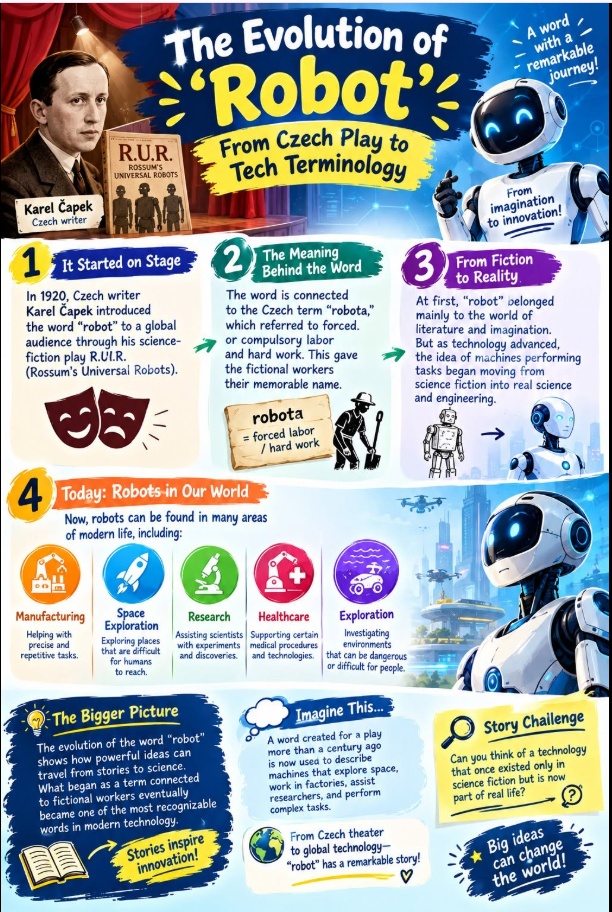
    The word **“robot”** may sound like it belongs to the world of modern technology, artificial intelligence, and futuristic machines—but its fascinating journey actually began on the **stage of a Czech play!**
    In **1920**, Czech writer **Karel Čapek** introduced the word “robot” to a global audience through his science-fiction play ***R.U.R. (Rossum’s Universal Robots)***. The story imagined artificial workers created to perform labor for humans.
    The word is connected to the Czech term **“robota,”** which referred to forced or compulsory labor and hard work. This connection helped give the fictional workers their memorable name.
    At first, “robot” belonged mainly to the world of literature and imagination. But as technology advanced, the idea of machines performing tasks began moving from **science fiction into real science and engineering**.
    Today, robots can be found in many areas of modern life, including:
    **Manufacturing** — helping with precise and repetitive tasks
    **Space exploration** — exploring places that are difficult for humans to reach
    **Research** — assisting scientists with experiments and discoveries
    **Healthcare** — supporting certain medical procedures and technologies
    **Exploration** — investigating environments that can be dangerous or difficult for people
    The evolution of the word **“robot”** shows how powerful ideas can travel from **stories to science**. What began as a term connected to fictional workers eventually became one of the most recognizable words in modern technology.
    **Imagine this:** A word created for a play more than a century ago is now used to describe machines that explore space, work in factories, assist researchers, and perform complex tasks.
    **From Czech theater to global technology—“robot” has a remarkable story!**
    **Story Challenge:** Can you think of a technology that once existed only in science fiction but is now part of real life?
    #Robot #Robots #Robotics #RobotHistory #HistoryOfTechnology #KarelCapek #RUR #CzechHistory #Technology #Science #Engineering #STEM #TechHistory #Innovation #FutureTechnology #ArtificialIntelligence #ScienceFiction #TechFacts #DidYouKnow #ScienceEducation #LearningIsFun #TechnologyFacts #RoboticsEducation
    #rsisb Roll no.239 Story post no.17 Foundation Level The word **“robot”** may sound like it belongs to the world of modern technology, artificial intelligence, and futuristic machines—but its fascinating journey actually began on the **stage of a Czech play!** 🎭✨ In **1920**, Czech writer **Karel Čapek** introduced the word “robot” to a global audience through his science-fiction play ***R.U.R. (Rossum’s Universal Robots)***. The story imagined artificial workers created to perform labor for humans. 🤖🏭 The word is connected to the Czech term **“robota,”** which referred to forced or compulsory labor and hard work. This connection helped give the fictional workers their memorable name. 💡📚 At first, “robot” belonged mainly to the world of literature and imagination. But as technology advanced, the idea of machines performing tasks began moving from **science fiction into real science and engineering**. 🔬⚙️ Today, robots can be found in many areas of modern life, including: 🏭 **Manufacturing** — helping with precise and repetitive tasks 🚀 **Space exploration** — exploring places that are difficult for humans to reach 🔬 **Research** — assisting scientists with experiments and discoveries 🏥 **Healthcare** — supporting certain medical procedures and technologies 🌊 **Exploration** — investigating environments that can be dangerous or difficult for people The evolution of the word **“robot”** shows how powerful ideas can travel from **stories to science**. What began as a term connected to fictional workers eventually became one of the most recognizable words in modern technology. 🌟🤖 💭 **Imagine this:** A word created for a play more than a century ago is now used to describe machines that explore space, work in factories, assist researchers, and perform complex tasks. ✨ **From Czech theater to global technology—“robot” has a remarkable story!** 🔎 **Story Challenge:** Can you think of a technology that once existed only in science fiction but is now part of real life? #Robot #Robots #Robotics #RobotHistory #HistoryOfTechnology #KarelCapek #RUR #CzechHistory #Technology #Science #Engineering #STEM #TechHistory #Innovation #FutureTechnology #ArtificialIntelligence #ScienceFiction #TechFacts #DidYouKnow #ScienceEducation #LearningIsFun #TechnologyFacts #RoboticsEducation 🤖⚙️🔬📚🎭🚀✨
    0 التعليقات 0 المشاركات 4932 مشاهدة
  • RSIF8
    Roll no 77
    short documentry no 2
    short documentry topic The Evolution of 'Robot': From Czech

    **The Evolution of “Robot”: From Czech **

    Have you ever wondered where the word **“Robot”** came from?

    The word “Robot” has a fascinating history! It comes from the Czech word **“robota,”** meaning hard work, forced labor, or compulsory service. The word became famous through Karel Čapek’s 1920 play **“R.U.R. – Rossum’s Universal Robots.”**

    From a word describing hard labor to machines that can work, explore dangerous places, assist doctors, and even travel into space —the journey of the word “robot” shows how language, imagination, and technology can shape our future.

    Technology keeps evolving, and so does our understanding of what robots can do. The story of the robot reminds us that today’s imagination can become tomorrow’s innovation!

    #Robot #Robotics #AI #ArtificialIntelligence #Technology #Innovation #FutureTech #CzechHistory #KarelCapek #RUR #Science #Engineering #Learning #Education #TechHistory #Future #Creativity
    RSIF8 Roll no 77 short documentry no 2 short documentry topic The Evolution of 'Robot': From Czech 🤖 **The Evolution of “Robot”: From Czech 🇨🇿** Have you ever wondered where the word **“Robot”** came from? 🤔 The word “Robot” has a fascinating history! It comes from the Czech word **“robota,”** meaning hard work, forced labor, or compulsory service. The word became famous through Karel Čapek’s 1920 play **“R.U.R. – Rossum’s Universal Robots.”** 📖🤖 From a word describing hard labor to machines that can work, explore dangerous places, assist doctors, and even travel into space 🚀—the journey of the word “robot” shows how language, imagination, and technology can shape our future. 🌍💡 Technology keeps evolving, and so does our understanding of what robots can do. The story of the robot reminds us that today’s imagination can become tomorrow’s innovation! ✨🧠 #Robot #Robotics #AI #ArtificialIntelligence #Technology #Innovation #FutureTech #CzechHistory #KarelCapek #RUR #Science #Engineering #Learning #Education #TechHistory #Future #Creativity 🤖🚀📚✨
    0 التعليقات 0 المشاركات 1709 مشاهدة 42
الصفحات المعززة