• #rsisb
    Roll No 253
    Foundation Level
    Story Post 22
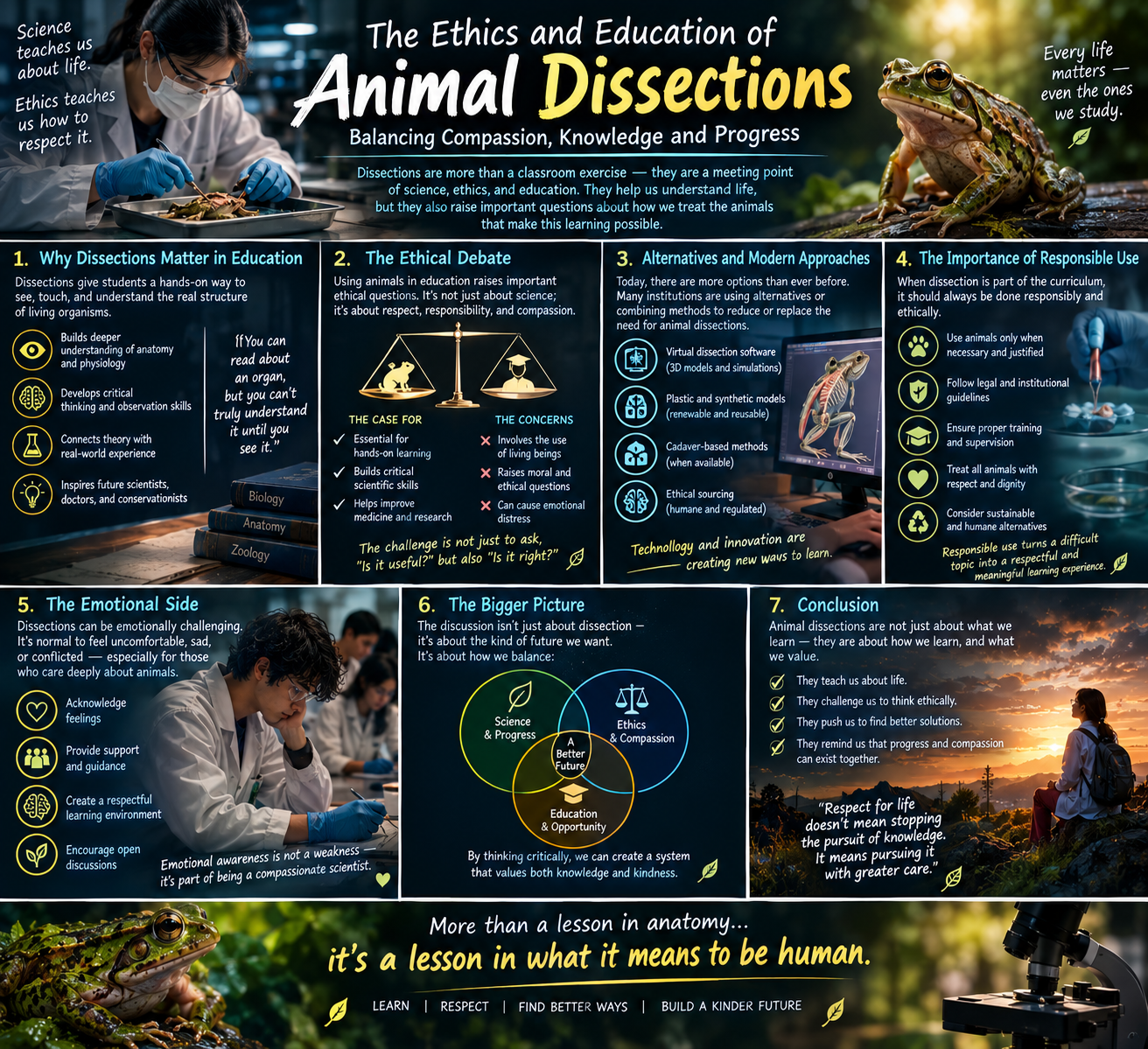
    # The Ethics and Education of Animal Dissections

    ## Balancing Knowledge, Compassion, and Scientific Progress

    Animal dissections have long been used to help students understand anatomy, physiology, and the remarkable complexity of living organisms.

    But dissection is more than a scientific technique.

    It also raises an important question:

    ### **How can we learn about life while treating life with respect?**

    Understanding both the educational value and the ethical considerations surrounding dissections allows us to approach biology with greater knowledge, responsibility, and compassion.

    ---

    ## 1. Why Dissections Matter in Education

    Dissections can provide students with a direct way to explore biological structures that are difficult to fully understand through diagrams or textbooks alone.

    They can help learners:

    Observe real anatomy
    Develop critical thinking
    Understand organ relationships
    Connect theory with physical structures
    Build curiosity about living systems

    Instead of simply memorizing the location of an organ, students can investigate how structures are positioned and connected.

    ### **It turns biological concepts into something tangible.**

    ---

    ## 2. The Ethical Debate

    Using animals for education creates a genuine ethical discussion.

    On one side, supporters may point to the educational benefits of direct anatomical study.

    On the other, concerns include:

    The use of living organisms
    Animal welfare
    Moral responsibility
    Whether alternatives can provide similar educational value

    The central question isn't simply:

    **“Is it useful?”**

    It is also:

    ### **“Is it justified, and can the same learning goals be achieved another way?”**

    Considering both questions encourages students to think scientifically **and ethically**.

    ---

    ## 3. Alternatives and Modern Approaches

    Technology has created new ways to study anatomy without always relying on traditional dissection.

    Modern educational approaches can include:

    Virtual dissection software
    3D anatomical models
    Synthetic or plastic models
    Interactive simulations
    Microscopic analysis
    High-quality anatomical imagery

    These tools can allow students to explore structures repeatedly, change viewpoints, and investigate complex systems in ways that may be difficult with a physical specimen.

    ### **Technology is creating new possibilities for learning.**

    ---

    ## 4. The Importance of Responsible Use

    When animal specimens are used for education or research, responsibility is essential.

    Important principles include:

    Following relevant laws and institutional guidelines
    Providing proper training and supervision
    Using animals only when scientifically or educationally justified
    Treating specimens respectfully
    Considering sustainable and humane alternatives

    Responsible scientific education isn't simply about obtaining knowledge.

    It is about **how that knowledge is obtained.**

    ---

    ## 5. The Emotional Side

    Dissection can affect students differently.

    Some may feel fascinated by anatomy.
    Others may feel uncomfortable.
    Some may experience sadness or conflict because they care deeply about animals.

    These reactions shouldn't automatically be dismissed.

    A respectful educational environment can encourage students to:

    Acknowledge their emotions
    Discuss concerns openly
    Support one another
    Maintain scientific curiosity
    Develop compassion

    ### **Emotional awareness can be part of becoming a responsible scientist.**

    ---

    # 6. The Bigger Picture

    The debate surrounding animal dissection isn't simply about choosing **science or compassion**.

    It is about finding ways for:

    **Scientific progress**
    **Ethical responsibility**
    **Education**
    **Compassion**

    to coexist.

    The goal is to create learning environments where students can develop strong scientific knowledge while also thinking carefully about the consequences of scientific practices.

    ### **Knowledge and compassion don't have to be opposites.**

    ---

    ## 7. What Dissections Can Teach Us

    When conducted appropriately, anatomical study can teach lessons that extend beyond individual organs.

    It can teach us about:

    The complexity of life
    Biological organization
    Interconnected systems
    Evolution and adaptation
    Scientific observation
    Ethical decision-making

    A specimen can become more than an anatomy lesson.

    It can become an opportunity to ask **how we learn, why we learn, and what responsibilities come with knowledge.**

    ---

    # 8. The Real Question

    Perhaps the deepest question isn't simply:

    **“Should animals be dissected?”**

    It is:

    How can we improve biological education?
    How can we reduce unnecessary harm?
    Which alternatives can provide meaningful learning?
    How should scientists balance discovery with responsibility?
    How can future generations learn with greater compassion?

    These questions don't have to end scientific exploration.

    They can make scientific exploration **more thoughtful.**

    ---

    # The Bigger Lesson

    Animal dissections can teach us about anatomy—but the discussion surrounding them can teach us something even larger.

    ### **Science teaches us how life works.**

    ### **Ethics asks us how we should treat it.**

    ### **Education gives us the opportunity to understand both.**

    The future of science isn't only about discovering more.

    It's also about learning to discover **responsibly.**

    So when we look inside an organism to understand its anatomy, we should also look beyond the specimen and consider the larger picture:

    **Respect life.**
    **Pursue knowledge.**
    **Think critically.**
    **Explore better alternatives.**
    **Build a more compassionate future.**

    ## **More than a lesson in anatomy—it's a lesson in what it means to learn responsibly.**


    Asma Shaheen EducationWali
    Saima Empowerment Wali
    Mishaal TrainingWali
    #rsisb Roll No 253 Foundation Level Story Post 22 # 🐸🔬 The Ethics and Education of Animal Dissections ## 🌿⚖️ Balancing Knowledge, Compassion, and Scientific Progress Animal dissections have long been used to help students understand anatomy, physiology, and the remarkable complexity of living organisms. 🧬🫀🔬 But dissection is more than a scientific technique. It also raises an important question: ### **How can we learn about life while treating life with respect?** 🐾❤️ Understanding both the educational value and the ethical considerations surrounding dissections allows us to approach biology with greater knowledge, responsibility, and compassion. --- ## 🎓🔬 1. Why Dissections Matter in Education Dissections can provide students with a direct way to explore biological structures that are difficult to fully understand through diagrams or textbooks alone. 📚➡️🔬 They can help learners: 👁️ Observe real anatomy 🧠 Develop critical thinking 🫀 Understand organ relationships 🔬 Connect theory with physical structures 🌱 Build curiosity about living systems Instead of simply memorizing the location of an organ, students can investigate how structures are positioned and connected. ### **It turns biological concepts into something tangible.** ✨ --- ## ⚖️🐾 2. The Ethical Debate Using animals for education creates a genuine ethical discussion. On one side, supporters may point to the educational benefits of direct anatomical study. 🎓🔬 On the other, concerns include: 🐾 The use of living organisms ❤️ Animal welfare 🧠 Moral responsibility 🌱 Whether alternatives can provide similar educational value The central question isn't simply: **“Is it useful?”** It is also: ### **“Is it justified, and can the same learning goals be achieved another way?”** ⚖️ Considering both questions encourages students to think scientifically **and ethically**. --- ## 💻🧬 3. Alternatives and Modern Approaches Technology has created new ways to study anatomy without always relying on traditional dissection. 🚀🔬 Modern educational approaches can include: 💻 Virtual dissection software 🧊 3D anatomical models 🧫 Synthetic or plastic models 🖥️ Interactive simulations 🔬 Microscopic analysis 📚 High-quality anatomical imagery These tools can allow students to explore structures repeatedly, change viewpoints, and investigate complex systems in ways that may be difficult with a physical specimen. ### **Technology is creating new possibilities for learning.** 💡🌍 --- ## 🧤🐸 4. The Importance of Responsible Use When animal specimens are used for education or research, responsibility is essential. ⚖️🔬 Important principles include: 📜 Following relevant laws and institutional guidelines 🎓 Providing proper training and supervision 🐾 Using animals only when scientifically or educationally justified ❤️ Treating specimens respectfully ♻️ Considering sustainable and humane alternatives Responsible scientific education isn't simply about obtaining knowledge. It is about **how that knowledge is obtained.** --- ## 💭❤️ 5. The Emotional Side Dissection can affect students differently. Some may feel fascinated by anatomy. 🔬 Others may feel uncomfortable. 😟 Some may experience sadness or conflict because they care deeply about animals. 🐾❤️ These reactions shouldn't automatically be dismissed. A respectful educational environment can encourage students to: 🧠 Acknowledge their emotions 💬 Discuss concerns openly 🤝 Support one another 🔬 Maintain scientific curiosity ❤️ Develop compassion ### **Emotional awareness can be part of becoming a responsible scientist.** --- # 🌍⚖️ 6. The Bigger Picture The debate surrounding animal dissection isn't simply about choosing **science or compassion**. It is about finding ways for: 🔬 **Scientific progress** ⚖️ **Ethical responsibility** 🎓 **Education** ❤️ **Compassion** to coexist. The goal is to create learning environments where students can develop strong scientific knowledge while also thinking carefully about the consequences of scientific practices. ### **Knowledge and compassion don't have to be opposites.** 🌱✨ --- ## 🧬📚 7. What Dissections Can Teach Us When conducted appropriately, anatomical study can teach lessons that extend beyond individual organs. It can teach us about: 🫀 The complexity of life 🧬 Biological organization 🔗 Interconnected systems 🌱 Evolution and adaptation 🔬 Scientific observation ⚖️ Ethical decision-making A specimen can become more than an anatomy lesson. It can become an opportunity to ask **how we learn, why we learn, and what responsibilities come with knowledge.** 🧠✨ --- # 🌅🌎 8. The Real Question Perhaps the deepest question isn't simply: **“Should animals be dissected?”** It is: ❓ How can we improve biological education? ❓ How can we reduce unnecessary harm? ❓ Which alternatives can provide meaningful learning? ❓ How should scientists balance discovery with responsibility? ❓ How can future generations learn with greater compassion? These questions don't have to end scientific exploration. They can make scientific exploration **more thoughtful.** 🔬❤️ --- # 🐸💚 The Bigger Lesson Animal dissections can teach us about anatomy—but the discussion surrounding them can teach us something even larger. ### **Science teaches us how life works.** 🔬 ### **Ethics asks us how we should treat it.** ⚖️ ### **Education gives us the opportunity to understand both.** 🎓 The future of science isn't only about discovering more. It's also about learning to discover **responsibly.** 🌍🧬 So when we look inside an organism to understand its anatomy, we should also look beyond the specimen and consider the larger picture: 🐾 **Respect life.** 🔬 **Pursue knowledge.** 🧠 **Think critically.** 💡 **Explore better alternatives.** 🌱 **Build a more compassionate future.** ## ✨ **More than a lesson in anatomy—it's a lesson in what it means to learn responsibly.** 🐸🔬❤️ Asma Shaheen EducationWali Saima Empowerment Wali Mishaal TrainingWali
    0 Commentarii 0 Distribuiri 888 Views
  • #rsisb
    Roll NO:232
    Foundation level student.
    Story post:9

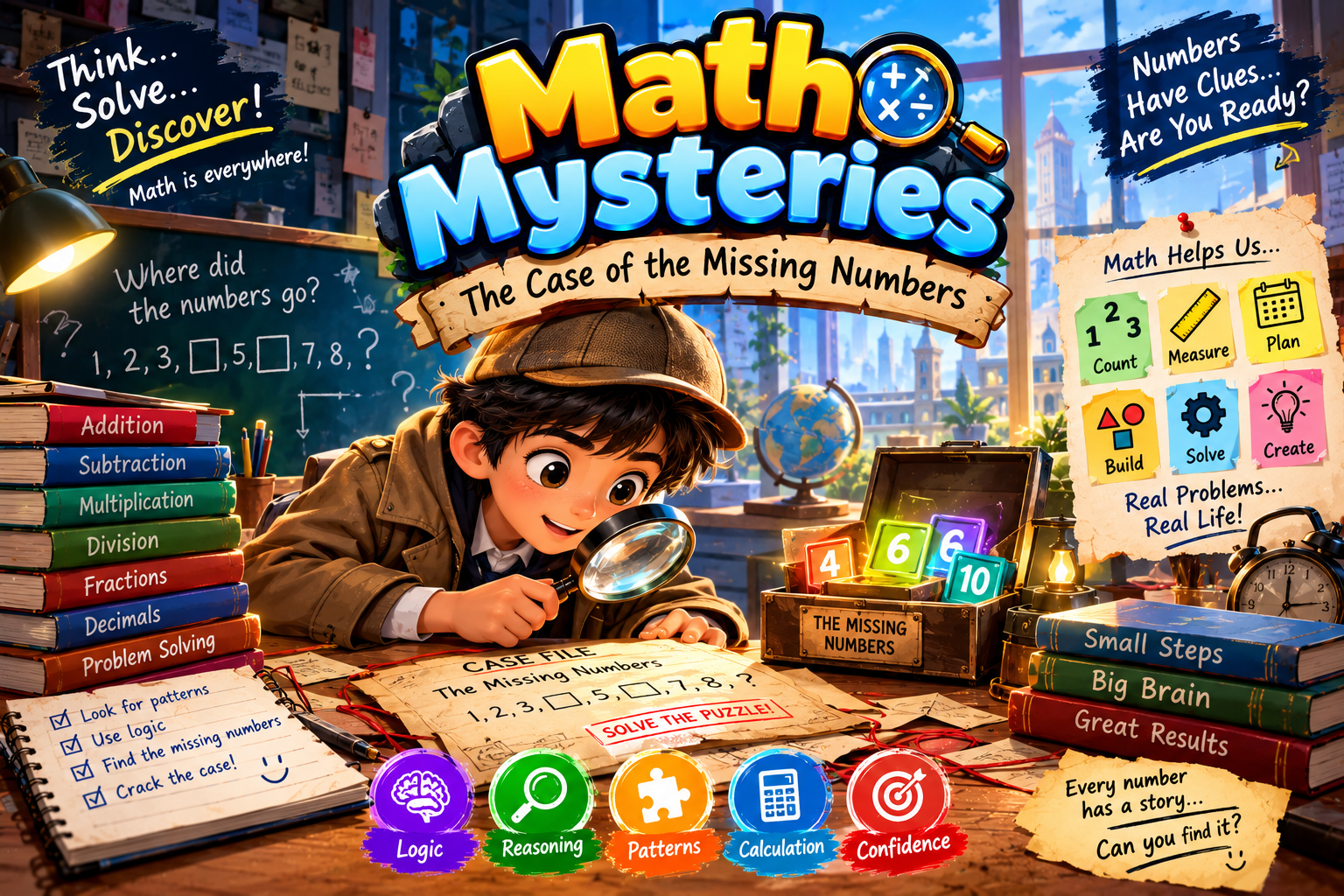
    **Math Mysteries: The Case of the Missing Numbers**

    Get ready for an exciting mathematical adventure! In **“Math Mysteries: The Case of the Missing Numbers,”** we become number detectives and set out to solve a fascinating mystery — where did the missing numbers go?

    Along the way, we’ll explore **patterns, sequences, addition, subtraction, multiplication, division, logic, and problem-solving**. Each clue brings us closer to solving the mystery and discovering the hidden answer!

    Math is more than just numbers on a page — it is a powerful way of thinking, finding patterns, solving problems, and understanding the world around us. Through this fun adventure, learners can build their **logical thinking, observation skills, creativity, and confidence in mathematics**.

    Can you follow the clues, spot the patterns, and help solve the case? ‍

    **Think Smart • Find the Pattern • Solve the Mystery • Discover the Magic of Math!**

    Join us for this exciting journey and turn every number into a new clue!

    #MathMysteries #MissingNumbers #Math #Mathematics #NumberMystery #MathForKids #MathAdventure #Learning #Education #FunLearning #ProblemSolving #LogicalThinking #MathSkills #NumberPatterns #Sequences #STEM #EducationalVideo #KidsLearning #LearnMath #MathChallenge #DiscoverMath
    #rsisb Roll NO:232 Foundation level student. Story post:9 🧮🔍 **Math Mysteries: The Case of the Missing Numbers** 🔢🕵️✨ Get ready for an exciting mathematical adventure! 🚀📚 In **“Math Mysteries: The Case of the Missing Numbers,”** we become number detectives and set out to solve a fascinating mystery — where did the missing numbers go? 🔢❓🕵️ Along the way, we’ll explore **patterns, sequences, addition, subtraction, multiplication, division, logic, and problem-solving**. 🧠➕➖✖️➗ Each clue brings us closer to solving the mystery and discovering the hidden answer! Math is more than just numbers on a page — it is a powerful way of thinking, finding patterns, solving problems, and understanding the world around us. 🌍💡 Through this fun adventure, learners can build their **logical thinking, observation skills, creativity, and confidence in mathematics**. 🎯🧠✨ Can you follow the clues, spot the patterns, and help solve the case? 🔎🔢🕵️‍♂️ 🌟 **Think Smart • Find the Pattern • Solve the Mystery • Discover the Magic of Math!** 🧮🚀 Join us for this exciting journey and turn every number into a new clue! 📚🔢✨ #MathMysteries #MissingNumbers #Math #Mathematics #NumberMystery #MathForKids #MathAdventure #Learning #Education #FunLearning #ProblemSolving #LogicalThinking #MathSkills #NumberPatterns #Sequences #STEM #EducationalVideo #KidsLearning #LearnMath #MathChallenge #DiscoverMath 🧮🔢🔍🕵️🧠➕➖✖️➗📚🎯✨🚀💡🌟
    0 Commentarii 0 Distribuiri 494 Views
  • Untitled recording - 2026-09-28T223656.537RSIF 8

    Roll no 93

    Movie review no 2

    Movie review topic:— Watch "Gandhi".Bilkul — yeh **ready-to-post description** hai. The film is the 1982 Richard Attenborough film starring Ben Kingsley, and BFI describes its focus on Gandhi’s life, South Africa, India’s independence movement, and the 1919 Amritsar massacre.


    **Movie Review — Gandhi (1982)**


    I watched the movie **Gandhi** and recorded my review in both **English and Urdu**. The film was directed by **Richard Attenborough** and stars **Ben Kingsley** as Gandhi. It presents important periods of Gandhi’s life, including his experiences in South Africa and his involvement in India’s independence movement.


    In my review, I discuss the movie’s themes of **nonviolent resistance, civil disobedience, courage, leadership, social conflict, and historical change**. The film also presents major historical events, including the **1919 Amritsar massacre** and the tensions surrounding the end of British rule in India.


    One important thing I learned from this movie is that history is not only about dates and names. It also involves people, decisions, conflicts, sacrifices, and their consequences. At the same time, a historical movie is a dramatization, so it is useful to learn about the events from historical sources as well.


    **English & Urdu Review Video**

    Learning history through cinema

    Understanding historical events and different perspectives


    #Gandhi #GandhiMovie #MovieReview #History #FilmReview #IndianHistory #SouthAsianHistory #Learning #Education #RichardAttenborough #BenKingsley #HistoricalFilm #RehanSchool #RehanCodingWithAI


    BFI also records that the film won nine Academy Awards, including Best Picture, Best Director, and Best Actor.


    If you want, I can also make this **longer with more emojis and hashtags** for Facebook, Instagram, YouTube, TikTok, and LinkedIn
    Untitled recording - 2026-09-28T223656.537RSIF 8 Roll no 93 Movie review no 2 Movie review topic:— Watch "Gandhi".Bilkul — yeh **ready-to-post description** hai. The film is the 1982 Richard Attenborough film starring Ben Kingsley, and BFI describes its focus on Gandhi’s life, South Africa, India’s independence movement, and the 1919 Amritsar massacre. 🎬 **Movie Review — Gandhi (1982)** I watched the movie **Gandhi** and recorded my review in both **English and Urdu**. The film was directed by **Richard Attenborough** and stars **Ben Kingsley** as Gandhi. It presents important periods of Gandhi’s life, including his experiences in South Africa and his involvement in India’s independence movement. In my review, I discuss the movie’s themes of **nonviolent resistance, civil disobedience, courage, leadership, social conflict, and historical change**. The film also presents major historical events, including the **1919 Amritsar massacre** and the tensions surrounding the end of British rule in India. One important thing I learned from this movie is that history is not only about dates and names. It also involves people, decisions, conflicts, sacrifices, and their consequences. At the same time, a historical movie is a dramatization, so it is useful to learn about the events from historical sources as well. 🎥 **English & Urdu Review Video** 📚 Learning history through cinema 🌍 Understanding historical events and different perspectives #Gandhi #GandhiMovie #MovieReview #History #FilmReview #IndianHistory #SouthAsianHistory #Learning #Education #RichardAttenborough #BenKingsley #HistoricalFilm #RehanSchool #RehanCodingWithAI BFI also records that the film won nine Academy Awards, including Best Picture, Best Director, and Best Actor. If you want, I can also make this **longer with more emojis and hashtags** for Facebook, Instagram, YouTube, TikTok, and LinkedIn
    0 Commentarii 0 Distribuiri 1249 Views
  • #rsisb
    Roll no.239
    Story post no.12
    Foundation Level

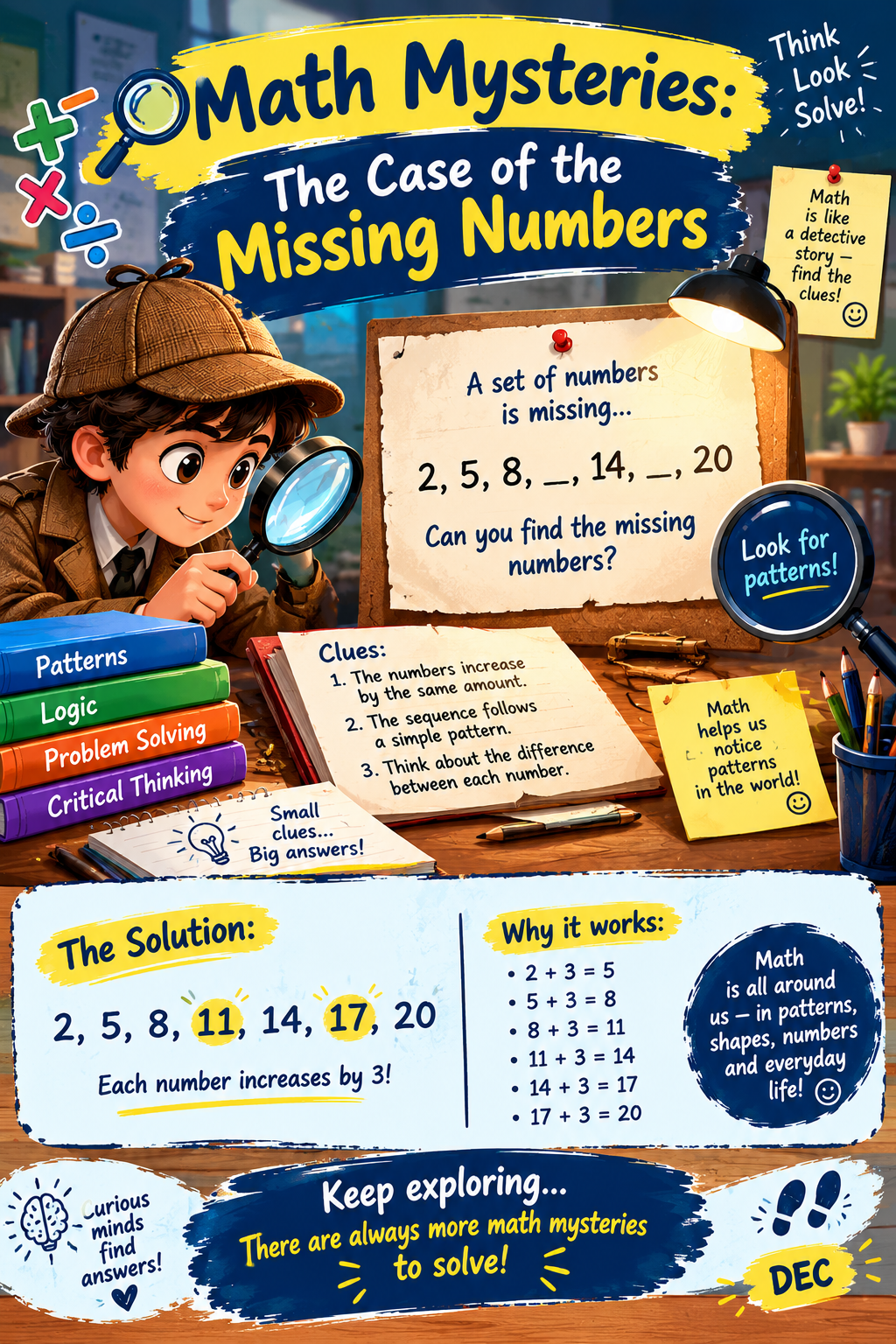
    Welcome to a world where **numbers become clues, patterns become evidence, and every problem is a mystery waiting to be solved!**

    Imagine you are a math detective. A sequence of numbers appears, but some numbers are missing. Your mission is to study the clues, discover the pattern, and find the numbers that belong in the empty spaces.

    **Here’s a mystery to solve:**

    **2, 5, 8, __, 14, __, 20**

    Can you find the missing numbers?

    Look carefully at the sequence. What happens as you move from one number to the next?

    **The clue:** Each number increases by **3**.

    So the completed sequence is:

    **2, 5, 8, 11, 14, 17, 20**

    The missing numbers are **11 and 17**!

    But this is just the beginning. Math is full of mysteries involving **patterns, sequences, logic, shapes, equations, and problem-solving**.

    **Think like a detective:**
    Look carefully for clues.
    Search for patterns.
    Test your ideas.
    Check your answer.
    Learn from every problem you solve.

    Math isn't only about getting an answer—it’s also about **thinking carefully, asking questions, recognizing patterns, and finding logical solutions**.

    **Small clues can lead to big discoveries!**

    So grab your pencil, sharpen your thinking, and get ready for your next mathematical mystery. There are always more numbers to investigate and more puzzles to solve!

    **Can you create your own number mystery for others to solve?**

    #MathMysteries #MathPuzzle #MissingNumbers #MathChallenge #NumberPatterns #Mathematics #FunMath #MathFacts #ProblemSolving #CriticalThinking #LogicalThinking #MathEducation #LearnMath #STEM #Education #BrainTeaser #NumberSequence #MathDetective #KidsLearning #DEC
    #rsisb Roll no.239 Story post no.12 Foundation Level Welcome to a world where **numbers become clues, patterns become evidence, and every problem is a mystery waiting to be solved!** 🔢🔍 Imagine you are a math detective. A sequence of numbers appears, but some numbers are missing. Your mission is to study the clues, discover the pattern, and find the numbers that belong in the empty spaces. 🧠💡 🔢 **Here’s a mystery to solve:** **2, 5, 8, __, 14, __, 20** Can you find the missing numbers? 🤔 Look carefully at the sequence. What happens as you move from one number to the next? ✨ **The clue:** Each number increases by **3**. So the completed sequence is: **2, 5, 8, 11, 14, 17, 20** 🎯 The missing numbers are **11 and 17**! But this is just the beginning. Math is full of mysteries involving **patterns, sequences, logic, shapes, equations, and problem-solving**. 🧩📚 🕵️ **Think like a detective:** 🔍 Look carefully for clues. 🧠 Search for patterns. ✏️ Test your ideas. 🎯 Check your answer. 💡 Learn from every problem you solve. Math isn't only about getting an answer—it’s also about **thinking carefully, asking questions, recognizing patterns, and finding logical solutions**. 🌟 **Small clues can lead to big discoveries!** So grab your pencil, sharpen your thinking, and get ready for your next mathematical mystery. There are always more numbers to investigate and more puzzles to solve! 🔎➕➖✖️➗ 💬 **Can you create your own number mystery for others to solve?** #MathMysteries #MathPuzzle #MissingNumbers #MathChallenge #NumberPatterns #Mathematics #FunMath #MathFacts #ProblemSolving #CriticalThinking #LogicalThinking #MathEducation #LearnMath #STEM #Education #BrainTeaser #NumberSequence #MathDetective #KidsLearning #DEC
    0 Commentarii 0 Distribuiri 1110 Views
  • accl task
    day 69
    week 3
    task: story post 69
    topic:Acids and Bases: The Balance of Nature
    Title: Acids and Bases: The Balance of Nature

    One afternoon, a curious student named Ayan entered the chemistry laboratory.

    On the table were several ordinary substances: lemon juice, vinegar, baking soda, soap, and pure water.

    Ayan looked at them and asked his teacher,

    “How can such different substances all be part of the same scientific system?”

    His teacher smiled.

    “Because many of them can be understood through the chemistry of acids, bases, and balance.”

    Ayan became curious.

    The World of Acids

    The teacher first placed a small amount of lemon juice on the table.

    “Lemon juice contains citric acid,” she explained.

    Acids are substances that, in water, increase the concentration of hydrogen ions (H⁺). Many acids have a sour taste, although scientists never identify an unknown chemical by tasting it.

    Ayan had seen acids in everyday life without realizing it.

    Vinegar contains acetic acid.

    The stomach naturally contains hydrochloric acid, which helps with digestion.

    Even some fruits contain naturally occurring acids.

    Ayan began to understand that the word “acid” did not always mean something dangerous.

    Discovering Bases

    Next, the teacher showed him a solution of baking soda.

    “This behaves as a base in water,” she said.

    Bases generally increase the concentration of hydroxide ions or accept hydrogen ions, depending on the chemical definition being used.

    Many basic substances are found around us.

    Some cleaning products are basic.

    Soap solutions are often basic.

    Certain minerals and compounds in nature can also behave as bases.

    Ayan realized that acids and bases were not simply opposites in a textbook.

    They were part of everyday chemistry.

    The pH Scale

    The teacher then drew a colorful scale on the board.

    It was the pH scale.

    “pH helps us describe how acidic or basic an aqueous solution is,” she explained.

    At about pH 7, a solution is considered neutral under standard conditions, such as pure water at around room temperature.

    Values below 7 are generally acidic.

    Values above 7 are generally basic.

    Ayan looked at the scale with fascination.

    The numbers seemed simple, but they represented important chemical differences.

    The teacher added:

    “The pH scale is logarithmic. A change of one pH unit represents a tenfold change in hydrogen-ion concentration.”

    Ayan suddenly realized that even a small numerical change could represent a significant chemical difference.

    When Acids and Bases Meet

    Then the teacher performed an experiment.

    She carefully combined an acid with a base.

    The two substances reacted.

    In many common acid-base reactions, the products include water and a salt. This type of reaction is often called neutralization.

    Ayan watched as the chemistry changed before his eyes.

    “So acids and bases can balance each other?” he asked.

    “In the right conditions, yes,” his teacher replied.

    “But neutralization does not always mean the final mixture has exactly pH 7. The result depends on the substances and their amounts.”

    Ayan nodded.

    Chemistry was more precise than he had imagined.

    Balance in Nature

    The teacher then showed Ayan pictures of lakes, soil, oceans, and living organisms.

    “Acid-base balance is important in nature too.”

    Soil chemistry can influence how nutrients are available to plants.

    The pH of freshwater can affect aquatic organisms.

    Ocean chemistry is also changing as the ocean absorbs carbon dioxide from the atmosphere, which leads to ocean acidification.

    This does not mean the ocean suddenly becomes a strong acid.

    Instead, its seawater chemistry shifts toward greater acidity, with important consequences for organisms that build shells or skeletons from calcium carbonate.

    Ayan began to see that chemistry was connected to the entire environment.

    Balance Inside the Human Body

    The teacher then explained that acid-base balance is also essential inside the human body.

    Blood normally stays within a narrow pH range.

    The body uses several systems—including the lungs and kidneys—to help regulate this balance.

    The lungs influence carbon dioxide levels, while the kidneys help regulate acids and bases over longer periods.

    Ayan was amazed.

    “Even our bodies have their own chemical balancing systems?”

    “Exactly,” said his teacher.

    The Power of Buffers

    There was one final concept.

    The teacher added:

    “Some solutions contain buffers.”

    Buffers help resist large changes in pH when relatively small amounts of acid or base are added.

    Ayan learned that buffer systems are important in chemistry, biology, medicine, and many natural environments.

    They help keep chemical conditions within useful ranges.

    The Lesson of Balance

    As the lesson ended, Ayan looked again at the bottles on the laboratory table.

    Lemon juice.

    Vinegar.

    Baking soda.

    Water.

    They seemed ordinary.

    But behind each substance was a world of chemical reactions, ions, and equilibrium.

    Ayan finally understood the lesson.

    Acids and bases are not simply about “strong” and “weak” chemicals.

    They are part of a larger story about chemical balance.

    From a laboratory experiment to soil, oceans, and living organisms, acid-base chemistry helps explain how many systems behave.

    Final Thought

    Nature depends on balance.

    Too much of one chemical condition can change an entire system, while the right balance can help maintain stability.

    Acids and bases teach us an important scientific lesson:9 sometimes, understanding two different forces interact is the key to understanding the system as a when
    accl task day 69 week 3 task: story post 69 topic:Acids and Bases: The Balance of Nature Title: 🧪 Acids and Bases: The Balance of Nature One afternoon, a curious student named Ayan entered the chemistry laboratory. On the table were several ordinary substances: lemon juice, vinegar, baking soda, soap, and pure water. Ayan looked at them and asked his teacher, “How can such different substances all be part of the same scientific system?” His teacher smiled. “Because many of them can be understood through the chemistry of acids, bases, and balance.” Ayan became curious. 🍋 The World of Acids The teacher first placed a small amount of lemon juice on the table. “Lemon juice contains citric acid,” she explained. Acids are substances that, in water, increase the concentration of hydrogen ions (H⁺). Many acids have a sour taste, although scientists never identify an unknown chemical by tasting it. Ayan had seen acids in everyday life without realizing it. Vinegar contains acetic acid. The stomach naturally contains hydrochloric acid, which helps with digestion. Even some fruits contain naturally occurring acids. Ayan began to understand that the word “acid” did not always mean something dangerous. 🧼 Discovering Bases Next, the teacher showed him a solution of baking soda. “This behaves as a base in water,” she said. Bases generally increase the concentration of hydroxide ions or accept hydrogen ions, depending on the chemical definition being used. Many basic substances are found around us. Some cleaning products are basic. Soap solutions are often basic. Certain minerals and compounds in nature can also behave as bases. Ayan realized that acids and bases were not simply opposites in a textbook. They were part of everyday chemistry. 🌈 The pH Scale The teacher then drew a colorful scale on the board. It was the pH scale. “pH helps us describe how acidic or basic an aqueous solution is,” she explained. At about pH 7, a solution is considered neutral under standard conditions, such as pure water at around room temperature. Values below 7 are generally acidic. Values above 7 are generally basic. Ayan looked at the scale with fascination. The numbers seemed simple, but they represented important chemical differences. The teacher added: “The pH scale is logarithmic. A change of one pH unit represents a tenfold change in hydrogen-ion concentration.” Ayan suddenly realized that even a small numerical change could represent a significant chemical difference. ⚖️ When Acids and Bases Meet Then the teacher performed an experiment. She carefully combined an acid with a base. The two substances reacted. In many common acid-base reactions, the products include water and a salt. This type of reaction is often called neutralization. Ayan watched as the chemistry changed before his eyes. “So acids and bases can balance each other?” he asked. “In the right conditions, yes,” his teacher replied. “But neutralization does not always mean the final mixture has exactly pH 7. The result depends on the substances and their amounts.” Ayan nodded. Chemistry was more precise than he had imagined. 🌱 Balance in Nature The teacher then showed Ayan pictures of lakes, soil, oceans, and living organisms. “Acid-base balance is important in nature too.” Soil chemistry can influence how nutrients are available to plants. The pH of freshwater can affect aquatic organisms. Ocean chemistry is also changing as the ocean absorbs carbon dioxide from the atmosphere, which leads to ocean acidification. This does not mean the ocean suddenly becomes a strong acid. Instead, its seawater chemistry shifts toward greater acidity, with important consequences for organisms that build shells or skeletons from calcium carbonate. Ayan began to see that chemistry was connected to the entire environment. 🧬 Balance Inside the Human Body The teacher then explained that acid-base balance is also essential inside the human body. Blood normally stays within a narrow pH range. The body uses several systems—including the lungs and kidneys—to help regulate this balance. The lungs influence carbon dioxide levels, while the kidneys help regulate acids and bases over longer periods. Ayan was amazed. “Even our bodies have their own chemical balancing systems?” “Exactly,” said his teacher. 🔬 The Power of Buffers There was one final concept. The teacher added: “Some solutions contain buffers.” Buffers help resist large changes in pH when relatively small amounts of acid or base are added. Ayan learned that buffer systems are important in chemistry, biology, medicine, and many natural environments. They help keep chemical conditions within useful ranges. 🌍 The Lesson of Balance As the lesson ended, Ayan looked again at the bottles on the laboratory table. Lemon juice. Vinegar. Baking soda. Water. They seemed ordinary. But behind each substance was a world of chemical reactions, ions, and equilibrium. Ayan finally understood the lesson. Acids and bases are not simply about “strong” and “weak” chemicals. They are part of a larger story about chemical balance. From a laboratory experiment to soil, oceans, and living organisms, acid-base chemistry helps explain how many systems behave. ⚗️ Final Thought Nature depends on balance. Too much of one chemical condition can change an entire system, while the right balance can help maintain stability. Acids and bases teach us an important scientific lesson:9 sometimes, understanding two different forces interact is the key to understanding the system as a when
    0 Commentarii 0 Distribuiri 2582 Views
  • #rsisb
    Roll No.177
    Call Annie No.128
    Foundation Level

    **TELLING THE TRUTH – LIVE ON SOCIAL MEDIA**

    Today, we are going live on social media with an important and meaningful topic: **“Telling the Truth.”** Honesty is one of the most valuable qualities a person can have. It means speaking honestly, accepting our mistakes, and being truthful with ourselves and with others.

    Telling the truth helps us build **trust, respect, confidence, and strong relationships**. When we are honest, people know they can depend on our words. ‍‍‍ Whether we are talking to our parents, teachers, friends, classmates, or colleagues, honesty helps create better relationships.

    In this live session, we will talk about why telling the truth is important in our daily lives. We will discuss how honesty can help us solve problems, learn from our mistakes, and become responsible people.

    Sometimes, telling the truth can be difficult because we may feel afraid of making someone unhappy or worried about the consequences. But accepting our mistakes and speaking honestly can help us learn and grow. Every mistake can teach us something valuable when we are willing to admit it.

    We will also discuss honesty in friendships. A good friendship is built on **trust, respect, understanding, and truthfulness**. When friends communicate honestly and respectfully, they can understand each other better and solve problems together.

    Honesty is also important for students. Students should be truthful with their teachers, parents, and classmates. Being honest in studies, homework, tests, and daily activities helps develop good character and responsibility.

    A society where people value truth and honesty can become more trustworthy and peaceful. Small acts of honesty in our everyday lives can make a big difference.

    During this live session, we will share ideas, ask questions, and learn together about the power of truth. Your thoughts and experiences can also make this discussion more interesting and meaningful!

    **Always remember:** Telling the truth is not only about speaking honestly to others; it is also about being honest with yourself. True honesty helps us become better, stronger, and more responsible human beings.

    Thank you for joining this live session! Keep learning, keep growing, stay positive, and always try to choose honesty and truth in your daily life.

    **Topic: Telling the Truth**
    **Live on Social Media**
    **Speak the Truth • Build Trust • Spread Honesty**

    #TellingTheTruth #Honesty #Truth #BeHonest #HonestyIsTheBestPolicy #TruthMatters #LiveOnSocialMedia #SocialMediaLive #PositiveThinking #GoodCharacter #Trust #Respect #LifeLessons #StudentLife #Education #LearningTogether #SelfImprovement #PersonalGrowth #Motivation #Inspiration #PositiveLife #SpeakTheTruth #StayHonest #BetterLife #GoodValues #ResponsibleLife #NeverGiveUp #KeepLearning #KeepGrowing #SpreadPositivity #RehanSchool #IslamabadCampus #Pakistan #LiveSession
    #rsisb Roll No.177 Call Annie No.128 Foundation Level 🎥🔴 **TELLING THE TRUTH – LIVE ON SOCIAL MEDIA** 🔴🎥 🌟🗣️ Today, we are going live on social media with an important and meaningful topic: **“Telling the Truth.”** 🤝❤️ Honesty is one of the most valuable qualities a person can have. It means speaking honestly, accepting our mistakes, and being truthful with ourselves and with others. 🧠💯 ✨ Telling the truth helps us build **trust, respect, confidence, and strong relationships**. 🤝💙 When we are honest, people know they can depend on our words. 👨‍👩‍👧‍👦❤️ Whether we are talking to our parents, teachers, friends, classmates, or colleagues, honesty helps create better relationships. 🌍🌈 📚🎓 In this live session, we will talk about why telling the truth is important in our daily lives. We will discuss how honesty can help us solve problems, learn from our mistakes, and become responsible people. 💪🧠🌟 😊 Sometimes, telling the truth can be difficult because we may feel afraid of making someone unhappy or worried about the consequences. 😟 But accepting our mistakes and speaking honestly can help us learn and grow. 🌱📖 Every mistake can teach us something valuable when we are willing to admit it. 💡✨ 👫💬 We will also discuss honesty in friendships. A good friendship is built on **trust, respect, understanding, and truthfulness**. 🤝💙 When friends communicate honestly and respectfully, they can understand each other better and solve problems together. 🗣️❤️ 🏫📚 Honesty is also important for students. Students should be truthful with their teachers, parents, and classmates. 🎓✨ Being honest in studies, homework, tests, and daily activities helps develop good character and responsibility. 🌟📖 🌍💫 A society where people value truth and honesty can become more trustworthy and peaceful. 🕊️🤝 Small acts of honesty in our everyday lives can make a big difference. ❤️✨ 🎤🔴 During this live session, we will share ideas, ask questions, and learn together about the power of truth. 💬🧠📚 Your thoughts and experiences can also make this discussion more interesting and meaningful! 🙌😊 ❤️ **Always remember:** Telling the truth is not only about speaking honestly to others; it is also about being honest with yourself. 🌟🪞 True honesty helps us become better, stronger, and more responsible human beings. 💪❤️ 🙏✨ Thank you for joining this live session! Keep learning, keep growing, stay positive, and always try to choose honesty and truth in your daily life. 🌱📚💯 🔴🎥 **Topic: Telling the Truth** 🗣️💬 **Live on Social Media** ❤️🤝 **Speak the Truth • Build Trust • Spread Honesty** 🌍✨ #TellingTheTruth 🗣️ #Honesty ❤️ #Truth 💯 #BeHonest 🤝 #HonestyIsTheBestPolicy 🌟 #TruthMatters 💬 #LiveOnSocialMedia 🔴 #SocialMediaLive 📱 #PositiveThinking 😊 #GoodCharacter 🌱 #Trust 🤝 #Respect ❤️ #LifeLessons 📚 #StudentLife 🎓 #Education 📖 #LearningTogether 🧠 #SelfImprovement 💪 #PersonalGrowth 🌱 #Motivation ✨ #Inspiration 🌟 #PositiveLife 🌈 #SpeakTheTruth 🗣️ #StayHonest 💯 #BetterLife ❤️ #GoodValues 🌟 #ResponsibleLife 🤝 #NeverGiveUp 💪 #KeepLearning 📚 #KeepGrowing 🌱 #SpreadPositivity 😊 #RehanSchool 🏫 #IslamabadCampus 🇵🇰 #Pakistan 🇵🇰 #LiveSession 🎥🔴
    0 Commentarii 1 Distribuiri 4882 Views 13
  • RSIF8
    Roll No: 112
    TED x Talk Post No: 5
    TED x Talk Post Topic: Power of a Single Decision – Zara Noor Abbas
    **Power of a Single Decision – Zara Noor Abbas**
    I watched the TEDx Talk **“Power of a Single Decision” by Zara Noor Abbas**, and I found it very interesting, inspiring, and meaningful. The talk focuses on the importance of our decisions, how they can affect our lives, and why we should understand ourselves before making important choices.
    Every day, we make many decisions, but sometimes **one single decision can change the direction of our life.** This talk reminded me that important choices should not always be made in a hurry or simply because of other people's expectations. We should think carefully, understand our goals, and consider the possible consequences of our choices.
    One of the important lessons I learned from this TEDx Talk is that making a wrong decision does not mean that everything is over. Mistakes can become valuable learning experiences. We can learn from them, make better choices, and continue moving forward with confidence.
    I also learned that we should take responsibility for our decisions and have the courage to choose a path that is right for us. Listening to advice from others can be helpful, but we should also understand our own dreams, goals, and values.
    This talk encouraged me to think more carefully about the choices I make. It reminded me that our future is influenced by the decisions we make today. Every choice can teach us something and help us grow as a person.
    **Think carefully. Believe in yourself. Learn from your choices. Make your decision and move forward!**
    #PowerOfASingleDecision #ZaraNoorAbbas #TEDx #TEDxTalk #Motivation #Inspiration #LifeLessons #DecisionMaking #SelfGrowth #PersonalGrowth #BelieveInYourself #PositiveThinking #Success #DreamBig #Learning #Confidence #FutureGoals #MotivationalTalk #NeverGiveUp
    RSIF8 Roll No: 112 TED x Talk Post No: 5 TED x Talk Post Topic: Power of a Single Decision – Zara Noor Abbas 🌟 **Power of a Single Decision – Zara Noor Abbas** 🎤✨ I watched the TEDx Talk **“Power of a Single Decision” by Zara Noor Abbas**, and I found it very interesting, inspiring, and meaningful. 💭🌟 The talk focuses on the importance of our decisions, how they can affect our lives, and why we should understand ourselves before making important choices. 🎯✨ Every day, we make many decisions, but sometimes **one single decision can change the direction of our life.** 🔄🌱 This talk reminded me that important choices should not always be made in a hurry or simply because of other people's expectations. We should think carefully, understand our goals, and consider the possible consequences of our choices. 💡❤️ One of the important lessons I learned from this TEDx Talk is that making a wrong decision does not mean that everything is over. 🙌 Mistakes can become valuable learning experiences. 📚🌱 We can learn from them, make better choices, and continue moving forward with confidence. 💪🚀 I also learned that we should take responsibility for our decisions and have the courage to choose a path that is right for us. 🌟🎯 Listening to advice from others can be helpful, but we should also understand our own dreams, goals, and values. This talk encouraged me to think more carefully about the choices I make. ✨ It reminded me that our future is influenced by the decisions we make today. Every choice can teach us something and help us grow as a person. 🌈💫 💭 **Think carefully. Believe in yourself. Learn from your choices. Make your decision and move forward!** 💪🎯🚀 #PowerOfASingleDecision #ZaraNoorAbbas #TEDx #TEDxTalk #Motivation #Inspiration #LifeLessons #DecisionMaking #SelfGrowth #PersonalGrowth #BelieveInYourself #PositiveThinking #Success #DreamBig #Learning #Confidence #FutureGoals #MotivationalTalk #NeverGiveUp 🎤🌟💭✨🎯💪🚀🌱❤️📚🌈🙌😊🔥🏆
    0 Commentarii 0 Distribuiri 1544 Views 3
  • Class Foundation Level
    #rsisb
    Roll#209
    Story Post: 39

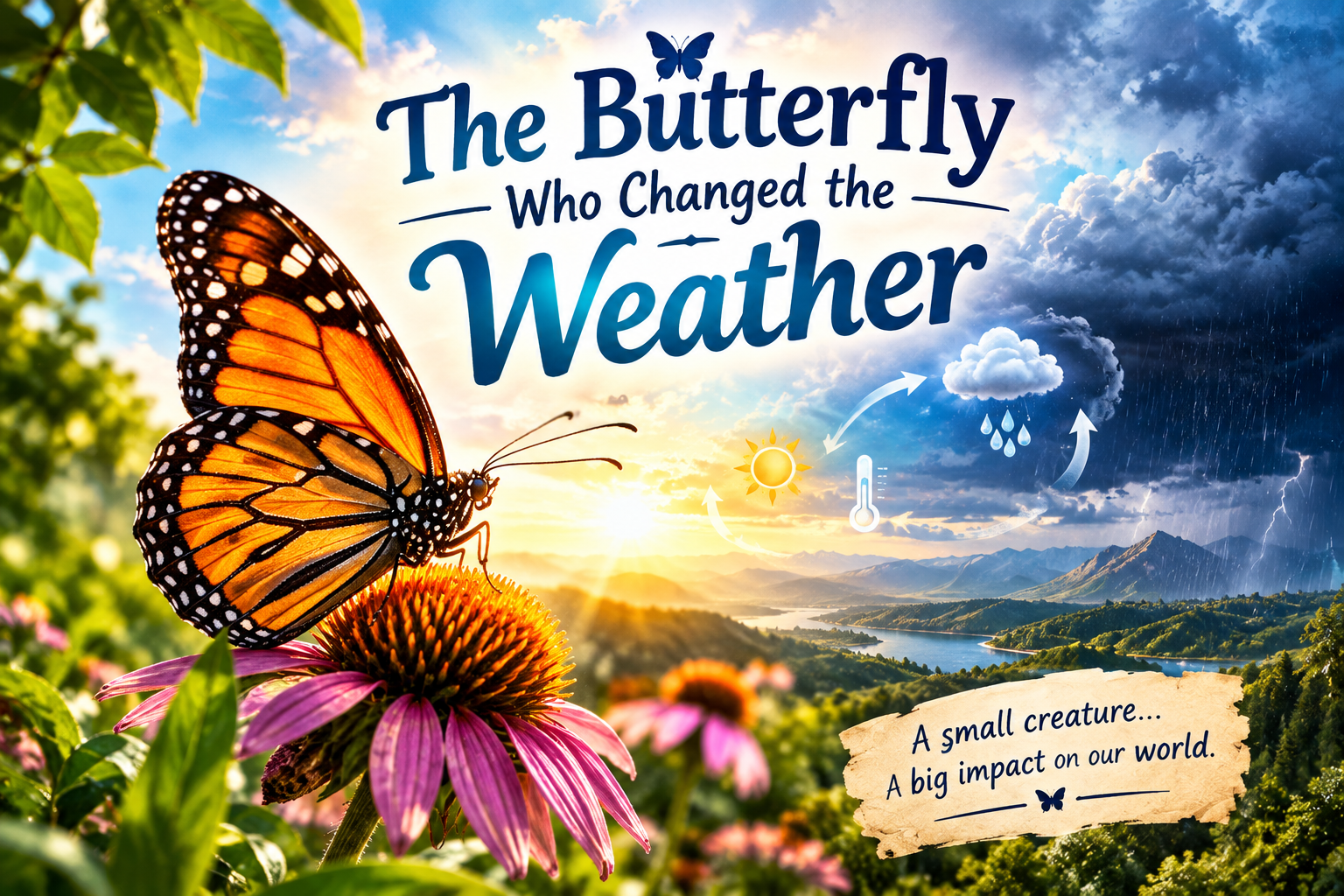
    “The Butterfly Who Changed the Weather”

    Can something as small as a butterfly influence something as powerful as the weather? Explore the fascinating Butterfly Effect and discover how tiny changes in one part of a complex system can create surprisingly large effects elsewhere.

    From the delicate movement of a butterfly’s wings to the vast patterns of our atmosphere, this concept reminds us that small actions can lead to big consequences.

    Think beyond the obvious.
    Explore the power of small changes.
    Discover the science of interconnected systems.
    See how tiny moments can create extraordinary outcomes.

    #TheButterflyEffect #ButterflyWhoChangedTheWeather #Science #Weather #ClimateScience #Curiosity #ScienceEducation #ExploreScience #AmazingScience #NatureAndScience #Learning #STEM #ThinkBig #SmallChangesBigImpact #DiscoverTheWorld
    Class Foundation Level #rsisb Roll#209 Story Post: 39 🦋🌦️ “The Butterfly Who Changed the Weather” 🌍✨ Can something as small as a butterfly influence something as powerful as the weather? 🌪️🔍 Explore the fascinating Butterfly Effect and discover how tiny changes in one part of a complex system can create surprisingly large effects elsewhere. 🌱🌎 From the delicate movement of a butterfly’s wings to the vast patterns of our atmosphere, this concept reminds us that small actions can lead to big consequences. 💫 🦋 Think beyond the obvious. 🌍 Explore the power of small changes. 🔬 Discover the science of interconnected systems. ✨ See how tiny moments can create extraordinary outcomes. #TheButterflyEffect #ButterflyWhoChangedTheWeather #Science #Weather #ClimateScience #Curiosity #ScienceEducation #ExploreScience #AmazingScience #NatureAndScience #Learning #STEM #ThinkBig #SmallChangesBigImpact #DiscoverTheWorld 🦋🌍🌦️🔬✨
    0 Commentarii 0 Distribuiri 3050 Views
  • #rsisb
    Roll No.221
    Tedx Talks No.14
    Foundation Level


    # Inside a School for Suicide Bombers – Sharmeen Obaid-Chinoy | TED Talk

    **Assalam-o-Alaikum everyone!**
    Welcome back to our channel! I hope you all are doing great, happy, and staying positive.

    Today, we are going to explore a powerful and thought-provoking TED Talk titled **“Inside a School for Suicide Bombers,”** presented by the award-winning Pakistani journalist and filmmaker **Sharmeen Obaid-Chinoy**.

    In this important talk, Sharmeen Obaid-Chinoy takes us into a difficult and disturbing reality, showing how vulnerable young people can be exposed to extremist ideas and manipulated by those who seek to influence them. She highlights the serious consequences of radicalization and the ways in which children can be affected by their surroundings, circumstances, and the messages they receive.

    The talk also makes us think about the importance of **education, awareness, critical thinking, and compassion** in protecting young people from harmful influences. It reminds us that children need opportunities, guidance, knowledge, and a safe environment where they can build a better future.

    This TED Talk is not just about one particular situation; it encourages us to look deeper into the challenges faced by young people and to understand how education and awareness can help create positive change in society.

    Watch this meaningful TED Talk and take a moment to reflect on its powerful message.

    **Like** | **Comment** | **Share** | **Subscribe**

    #TEDTalks #SharmeenObaidChinoy #Education #Awareness #Children #Peace #CriticalThinking #Radicalization #Pakistan #Humanity #Inspiration #IdeasWorthSpreading

    https://www.youtube.com/watch?v=aoGJP02CtPA&utm_source=chatgpt.com
    @followers
    Asma Shaheen EducationWali
    Saima Happinesswali
    Irum Asim
    #rsisb Roll No.221 Tedx Talks No.14 Foundation Level # 🎙️ Inside a School for Suicide Bombers – Sharmeen Obaid-Chinoy | TED Talk 🌸 **Assalam-o-Alaikum everyone!** Welcome back to our channel! ❤️ I hope you all are doing great, happy, and staying positive. 😊 Today, we are going to explore a powerful and thought-provoking TED Talk titled **“Inside a School for Suicide Bombers,”** presented by the award-winning Pakistani journalist and filmmaker **Sharmeen Obaid-Chinoy**. In this important talk, Sharmeen Obaid-Chinoy takes us into a difficult and disturbing reality, showing how vulnerable young people can be exposed to extremist ideas and manipulated by those who seek to influence them. She highlights the serious consequences of radicalization and the ways in which children can be affected by their surroundings, circumstances, and the messages they receive. The talk also makes us think about the importance of **education, awareness, critical thinking, and compassion** in protecting young people from harmful influences. 📚🧠❤️ It reminds us that children need opportunities, guidance, knowledge, and a safe environment where they can build a better future. This TED Talk is not just about one particular situation; it encourages us to look deeper into the challenges faced by young people and to understand how education and awareness can help create positive change in society. 🌍🕊️ ✨ Watch this meaningful TED Talk and take a moment to reflect on its powerful message. 👍 **Like** | 💬 **Comment** | 🔄 **Share** | 🔔 **Subscribe** #TEDTalks #SharmeenObaidChinoy #Education #Awareness #Children #Peace #CriticalThinking #Radicalization #Pakistan #Humanity #Inspiration #IdeasWorthSpreading https://www.youtube.com/watch?v=aoGJP02CtPA&utm_source=chatgpt.com @followers Asma Shaheen EducationWali Saima Happinesswali Irum Asim
    0 Commentarii 0 Distribuiri 3365 Views 3
  • In the TEDx talk “Ethical Consumerism and Its Impact,” Colin Beavan examines how our daily choices as consumers shape the world around us.
    He explains that every purchase we make carries social, environmental, and economic consequences.
    Beavan emphasizes that ethical consumerism is not just a personal responsibility but a collective opportunity to drive change.
    Through practical examples, he demonstrates how small, conscious decisions—like reducing waste or choosing sustainable products—can create a ripple effect.
    The talk highlights the interconnectedness of individual actions and global outcomes.
    Beavan’s insights inspire reflection on our habits and encourage a shift toward mindful consumption.
    He also addresses common challenges and misconceptions about living ethically, offering realistic solutions.
    This talk motivates viewers to recognize their power as conscious consumers and make informed choices.
    Ultimately, it is a call to action for creating a more sustainable, fair, and compassionate world.

    TedX Eng:45
    Roll:71
    @highlight
    Rubab EducationWali
    In the TEDx talk “Ethical Consumerism and Its Impact,” Colin Beavan examines how our daily choices as consumers shape the world around us. 🌱 He explains that every purchase we make carries social, environmental, and economic consequences. Beavan emphasizes that ethical consumerism is not just a personal responsibility but a collective opportunity to drive change. Through practical examples, he demonstrates how small, conscious decisions—like reducing waste or choosing sustainable products—can create a ripple effect. The talk highlights the interconnectedness of individual actions and global outcomes. Beavan’s insights inspire reflection on our habits and encourage a shift toward mindful consumption. He also addresses common challenges and misconceptions about living ethically, offering realistic solutions. This talk motivates viewers to recognize their power as conscious consumers and make informed choices. Ultimately, it is a call to action for creating a more sustainable, fair, and compassionate world. 🌍✨ TedX Eng:45 Roll:71 @highlight Rubab EducationWali
    0 Commentarii 0 Distribuiri 993 Views 0
Sponsorizeaza Paginile