• RSIf8
    Roll Number: 49
    Story post no.33
    Story post topic:Chemistry Quest — Elements of Everyday Life

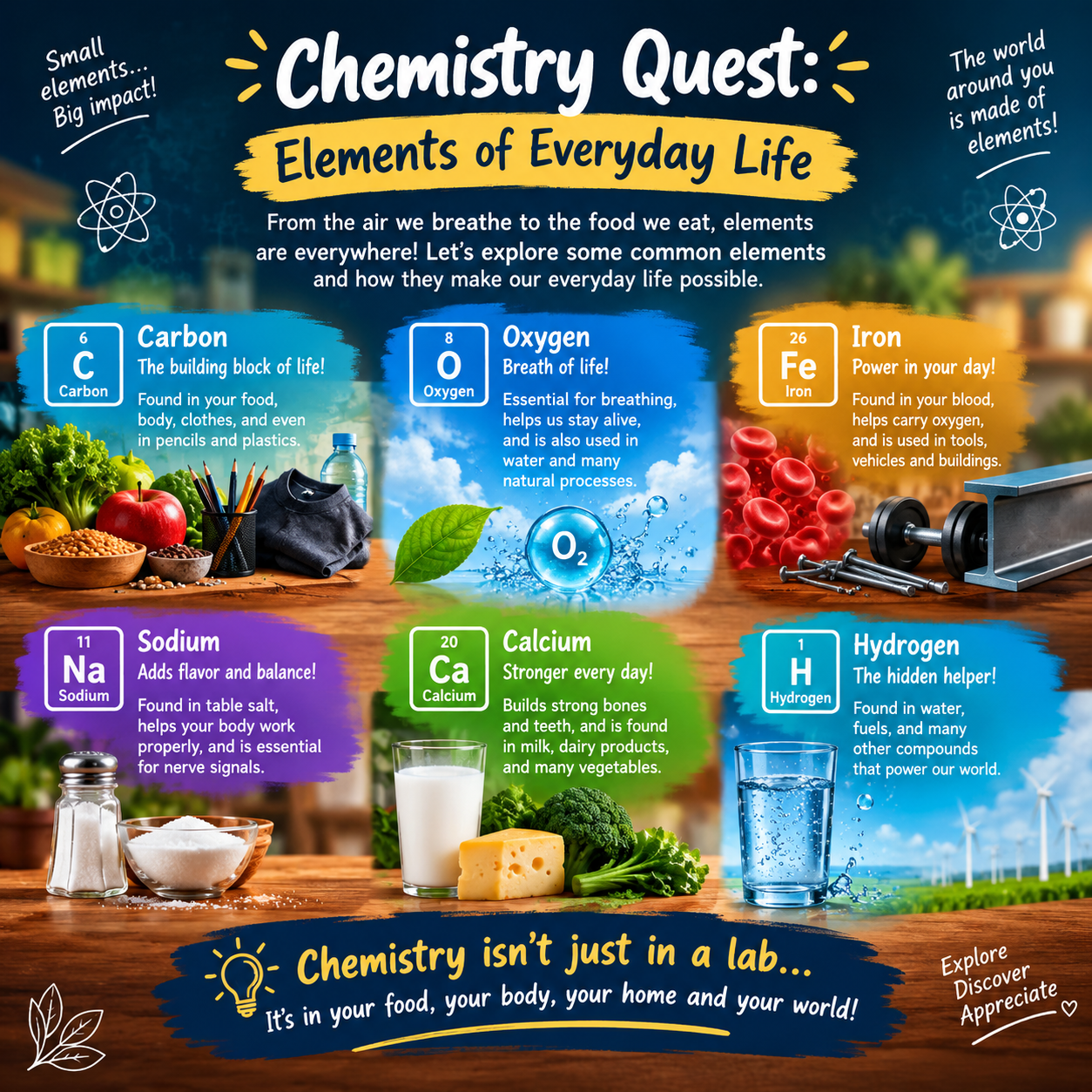
    Have you ever wondered how chemistry makes our everyday lives possible? From the air we breathe to the food we eat, chemical elements are all around us! This exciting story post explores the fascinating role of elements such as Carbon, Oxygen, Iron, Sodium, Calcium, and Hydrogen in our daily lives.

    Through this creative learning journey, I discovered how carbon is found in living things, oxygen is essential for breathing, iron helps our bodies carry oxygen, sodium supports important body functions, calcium strengthens our bones and teeth, and hydrogen is a key component of water.

    This activity helped me understand that chemistry is not limited to laboratories; it is an important part of our bodies, homes, nature, and the world around us. Learning about these elements makes science more interesting and helps us appreciate the wonders of everyday life!

    Small elements, big impact! Let's explore, discover, and appreciate the chemistry all around us.

    #ChemistryQuest #ElementsOfEverydayLife #Chemistry #ScienceEducation #ChemicalElements #Carbon #Oxygen #Iron #Sodium #Calcium #Hydrogen #CreativeLearning #ClassFoundation #RSf8
    RSIf8 Roll Number: 49 Story post no.33 Story post topic:Chemistry Quest — Elements of Everyday Life ⚗️✨ Have you ever wondered how chemistry makes our everyday lives possible? From the air we breathe to the food we eat, chemical elements are all around us! 🌿💧 This exciting story post explores the fascinating role of elements such as Carbon, Oxygen, Iron, Sodium, Calcium, and Hydrogen in our daily lives. Through this creative learning journey, I discovered how carbon is found in living things, oxygen is essential for breathing, iron helps our bodies carry oxygen, sodium supports important body functions, calcium strengthens our bones and teeth, and hydrogen is a key component of water. 🔬🧬 This activity helped me understand that chemistry is not limited to laboratories; it is an important part of our bodies, homes, nature, and the world around us. Learning about these elements makes science more interesting and helps us appreciate the wonders of everyday life! 💡📚 Small elements, big impact! Let's explore, discover, and appreciate the chemistry all around us. 🚀🌱 #ChemistryQuest #ElementsOfEverydayLife #Chemistry #ScienceEducation #ChemicalElements #Carbon #Oxygen #Iron #Sodium #Calcium #Hydrogen #CreativeLearning #ClassFoundation #RSf8
    0 Kommentare 0 Anteile 152 Ansichten
  • MohsinRSF8
    song title no:8
    Rool no:13
    Class: Foundation level

    Sure! Here is a **long English description** for your social media post:

    **Chemical Bonding: The Relationship of Molecules**

    Chemistry is one of the most fascinating branches of science because it helps us understand the materials, substances, and processes that surround us every day. From the water we drink and the air we breathe to the food we eat and the objects we use, everything is connected to atoms and molecules. But how do these tiny particles come together to form the world around us? The answer lies in **chemical bonding**.

    My song, **“Chemical Bonding: The Relationship of Molecules,”** presents this important chemistry concept in a creative, simple, and enjoyable way. Through this song, I have tried to explain how atoms interact with each other, how electrons are involved in bonding, and how different atoms combine to form molecules and compounds.

    Atoms are extremely small, but the relationships between them have a huge impact on the properties of matter. Atoms can form different types of chemical bonds depending on how their electrons interact. These bonds help determine the structure, stability, and many properties of the substances around us.

    One important type is **covalent bonding**, where atoms share electrons with each other. This type of bonding plays an important role in the formation of many molecules. Water is a familiar example in which hydrogen and oxygen atoms are connected through covalent bonds. Many other substances that are essential to life also depend on this type of bonding.

    Another important type is **ionic bonding**. In this type of bonding, one atom transfers electrons to another atom. This creates positively and negatively charged ions that attract each other. Sodium and chlorine provide a common example, forming sodium chloride, which is the salt we use in everyday life.

    We can also learn about **metallic bonding**, which helps explain the special properties of metals. The way electrons are arranged and shared among metal atoms contributes to characteristics such as electrical conductivity, strength, and metallic appearance.
    MohsinRSF8 song title no:8 Rool no:13 Class: Foundation level Sure! ❤️ Here is a **long English description** for your social media post: 🧪🎵 **Chemical Bonding: The Relationship of Molecules** 🎵🧪 Chemistry is one of the most fascinating branches of science because it helps us understand the materials, substances, and processes that surround us every day. From the water we drink and the air we breathe to the food we eat and the objects we use, everything is connected to atoms and molecules. But how do these tiny particles come together to form the world around us? The answer lies in **chemical bonding**. My song, **“Chemical Bonding: The Relationship of Molecules,”** presents this important chemistry concept in a creative, simple, and enjoyable way. Through this song, I have tried to explain how atoms interact with each other, how electrons are involved in bonding, and how different atoms combine to form molecules and compounds. 🎶🔬 Atoms are extremely small, but the relationships between them have a huge impact on the properties of matter. Atoms can form different types of chemical bonds depending on how their electrons interact. These bonds help determine the structure, stability, and many properties of the substances around us. One important type is **covalent bonding**, where atoms share electrons with each other. This type of bonding plays an important role in the formation of many molecules. Water is a familiar example in which hydrogen and oxygen atoms are connected through covalent bonds. Many other substances that are essential to life also depend on this type of bonding. 💧 Another important type is **ionic bonding**. In this type of bonding, one atom transfers electrons to another atom. This creates positively and negatively charged ions that attract each other. Sodium and chlorine provide a common example, forming sodium chloride, which is the salt we use in everyday life. 🧂 We can also learn about **metallic bonding**, which helps explain the special properties of metals. The way electrons are arranged and shared among metal atoms contributes to characteristics such as electrical conductivity, strength, and metallic appearance. ⚙️✨
    0 Kommentare 0 Anteile 1405 Ansichten 86
  • RSIF 8

    Roll no 93

    Story post no 30

    Story post topic:"Chemistry Quest: Elements of Everyday Life". Yeh raha **ready-to-post description** for all platforms:


    **Story Post — Chemistry Quest: Elements of Everyday Life**


    Welcome to an exciting **Chemistry Quest** where we discover how the elements around us are connected to our everyday lives!


    Chemistry is not only about laboratories and textbooks. It is all around us—in the **food we eat, the water we drink, the air we breathe, our homes, clothes, phones, technology, and even our bodies.**


    On this journey, we explore important elements such as:


    **Oxygen** — essential for breathing

    **Hydrogen** — found in water and many fuels

    **Carbon** — an important part of living things and many everyday materials

    **Iron** — important for our bodies and used in buildings and machines

    **Sodium** — helps our bodies function properly

    **Calcium** — helps build strong bones and teeth

    **Silicon** — used in computer chips and modern technology

    **Gold** — used in electronics, jewellery, and technology


    **The lesson:** Small elements can have a huge impact on our world. Learning chemistry helps us understand how the things around us work.


    **Explore. Learn. Discover.**

    **Chemistry connects the elements to everyday life!**


    #ChemistryQuest #Chemistry #Elements #Science #EverydayChemistry #ScienceEducation #Learning #Education #STEM #ScienceProject #ChemistryForKids #Innovation #Technology #Nature #ExploreLearnDiscover #RehanSchool #RehanCodingWithAI
    RSIF 8 Roll no 93 Story post no 30 Story post topic:"Chemistry Quest: Elements of Everyday Life". Yeh raha **ready-to-post description** for all platforms: 🧪🌍 **Story Post — Chemistry Quest: Elements of Everyday Life** 🔬✨ Welcome to an exciting **Chemistry Quest** where we discover how the elements around us are connected to our everyday lives! 🚀📚 Chemistry is not only about laboratories and textbooks. It is all around us—in the **food we eat, the water we drink, the air we breathe, our homes, clothes, phones, technology, and even our bodies.** 🌱💧📱 On this journey, we explore important elements such as: 🫁 **Oxygen** — essential for breathing 💧 **Hydrogen** — found in water and many fuels 🌳 **Carbon** — an important part of living things and many everyday materials 🩸 **Iron** — important for our bodies and used in buildings and machines 🧂 **Sodium** — helps our bodies function properly 🦴 **Calcium** — helps build strong bones and teeth 💻 **Silicon** — used in computer chips and modern technology 💎 **Gold** — used in electronics, jewellery, and technology 💡 **The lesson:** Small elements can have a huge impact on our world. Learning chemistry helps us understand how the things around us work. 🔬 **Explore. Learn. Discover.** 🌍 **Chemistry connects the elements to everyday life!** #ChemistryQuest #Chemistry #Elements #Science #EverydayChemistry #ScienceEducation #Learning #Education #STEM #ScienceProject #ChemistryForKids #Innovation #Technology #Nature #ExploreLearnDiscover #RehanSchool #RehanCodingWithAI
    0 Kommentare 0 Anteile 2236 Ansichten
  • RSIF8
    roll no 72
    story post no 5
    stoty post topic : Chemistry Quest: Elements of Everyday Life!

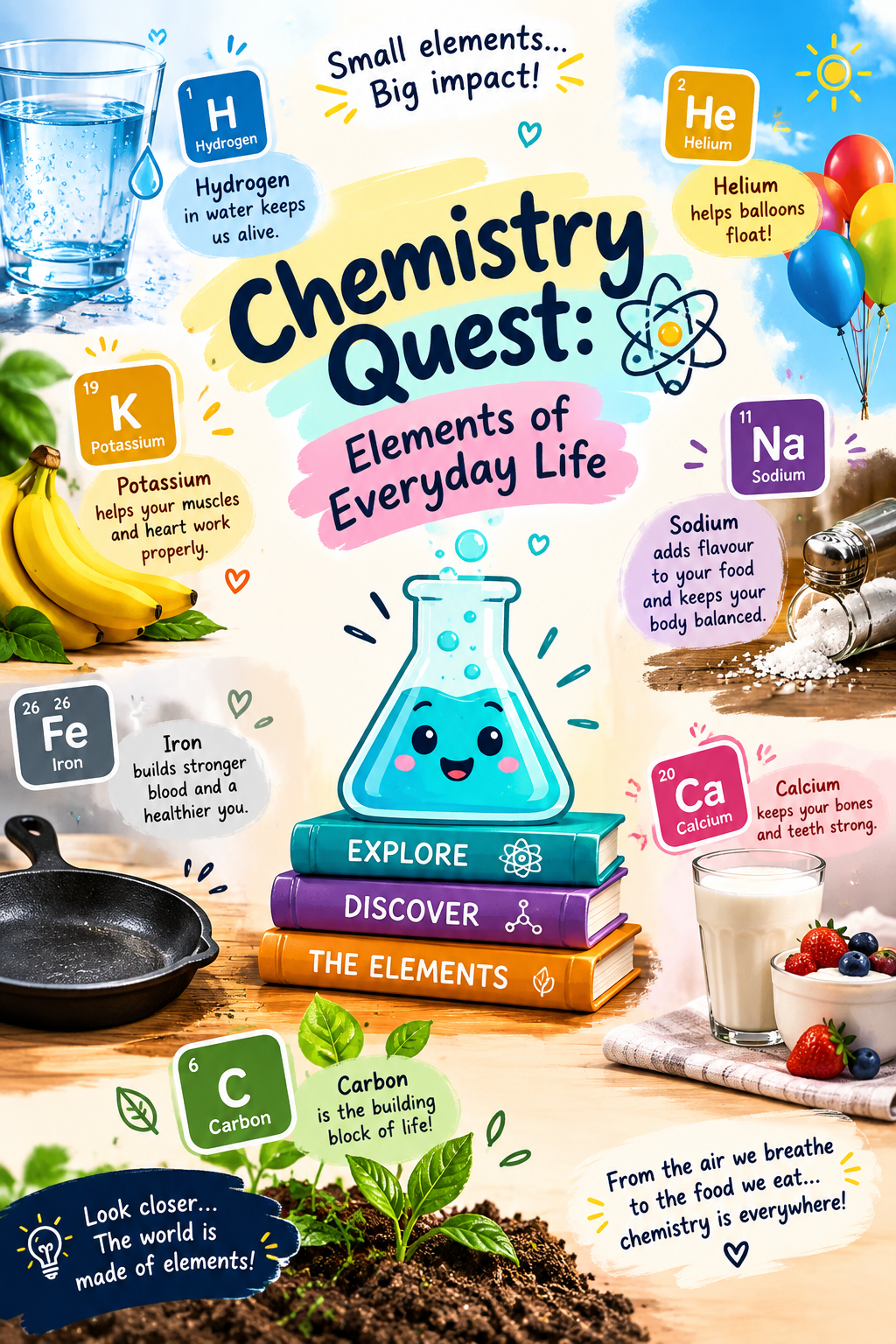
    From the water we drink to the food we eat, the air we breathe, and the objects around us, chemistry is everywhere! Explore how elements like hydrogen, helium, carbon, sodium, potassium, iron, and calcium make everyday life possible.

    #ChemistryQuest #EverydayChemistry #Elements #ScienceExploration #LearnScience #Chemistry #ScienceForKids #FunLearning #STEM #DiscoverAndLearn
    RSIF8 roll no 72 story post no 5 stoty post topic : Chemistry Quest: Elements of Everyday Life! From the water we drink to the food we eat, the air we breathe, and the objects around us, chemistry is everywhere! 🌍🔬 Explore how elements like hydrogen, helium, carbon, sodium, potassium, iron, and calcium make everyday life possible. 💧🍌🥛🌱 #ChemistryQuest #EverydayChemistry #Elements #ScienceExploration #LearnScience #Chemistry #ScienceForKids #FunLearning #STEM #DiscoverAndLearn
    0 Kommentare 0 Anteile 1401 Ansichten
  • #rsisb Roll No.240 Song No.13 Foundation Level Chemical bonding is one of the most important concepts in chemistry. It explains how atoms join together and form molecules and different substances around us. Everything we see, touch, eat, and use is made from atoms, and chemical bonds help these atoms stay connected. Atoms join together mainly to become more stable. To do this, they may **share, gain, or lose electrons**. When atoms share electrons, they form a **covalent bond**. When one atom gives electrons to another atom, an **ionic bond** can form. There are also **metallic bonds**, which help hold metal atoms together. A simple example is **water (H₂O)**. Water is made when hydrogen atoms bond with an oxygen atom. Another example is **table salt (NaCl)**, which is formed from sodium and chlorine through ionic bonding. Chemical bonds are like invisible connections between atoms. These connections determine how substances are formed and many of their properties. Strong or weak bonding can affect how a substance behaves, reacts, melts, or dissolves. Understanding chemical bonding helps us understand the world at a deeper level. From the water we drink to the food we eat, medicines, materials, and even the cells in our bodies, chemical bonds are involved everywhere. In simple words, **chemical bonding is the relationship that connects atoms and allows them to create molecules and substances.** It is a fascinating part of chemistry that shows us how tiny atoms work together to build the amazing world around us. 🌍🔬✨ #ChemicalBonding #Chemistry #Molecules #Atoms #CovalentBond #IonicBond #Science #ChemistryForStudents #Education #ScienceLearning #MolecularScience Rehan School Islamabad Campus Asma Shaheen EducationWali Irum Asim Saima Happinesswali https://www.facebook.com/share/v/19UVUAejBw/
    WWW.FACEBOOK.COM
    Facebook
    #rsisb Roll No.240 Song No.13 Foundation Level Chemical bonding is one of the most important concepts in chemistry. It explains how atoms join together and form molecules and different substances...
    0 Kommentare 0 Anteile 4753 Ansichten
  • Islamic teachings on water consumption are filled with wisdom, many of which align with modern scientific understanding. Below is a breakdown of these teachings, along with the corresponding scientific reasoning.

    ### 1. **Drinking Water in Sips**
    - **Islamic Teaching**: The Prophet Muhammad (PBUH) advised against drinking water in one gulp and recommended drinking it in two or three sips instead.
    > "Do not drink water in one gulp (or one breath) like a camel, but drink it in two or three sips." (Sunan Ibn Majah)

    - **Scientific Reasoning**: Drinking water slowly in sips allows the body to absorb the water more effectively. When you gulp down large quantities at once, it can overwhelm the kidneys, causing the body to excrete the excess water quickly without fully absorbing it. Taking small sips gives your body time to hydrate properly, preventing discomfort and bloating.

    ### 2. **Sitting While Drinking**
    - **Islamic Teaching**: The Prophet Muhammad (PBUH) recommended drinking water while sitting.
    > "Let none of you drink while standing; and if anyone forgets, then he should vomit." (Sahih Muslim)

    - **Scientific Reasoning**: When you sit down, your body is more relaxed, allowing the water to be absorbed properly. Standing and drinking causes the water to pass through the body quickly, potentially affecting the digestion process and leading to issues such as indigestion or inadequate hydration. Sitting helps in slowing down the intake, facilitating better digestion, and allowing the kidneys to filter water more effectively.

    ### 3. **Saying “Bismillah” Before Drinking and “Alhamdulillah” After**
    - **Islamic Teaching**: The Prophet Muhammad (PBUH) instructed to say **Bismillah** (In the name of Allah) before drinking and **Alhamdulillah** (All praise is due to Allah) after drinking.

    - **Scientific Reasoning**: While saying “Bismillah” is a spiritual act, it also encourages mindfulness. When you approach drinking water with awareness, it leads to more conscious, slower consumption, reducing the likelihood of gulping down large amounts too quickly. Mindful drinking has been shown to improve digestion and hydration by encouraging people to drink more slowly and pay attention to their body’s signals of thirst and fullness. Gratitude ("Alhamdulillah") afterward reinforces mindfulness, which can lead to overall healthier habits.

    ### 4. **Moderation in Drinking**
    - **Islamic Teaching**: Islam emphasizes moderation in all things, including eating and drinking:
    > "And eat and drink, but be not excessive. Indeed, He likes not those who commit excess." (Quran 7:31)

    - **Scientific Reasoning**: Overhydration, or drinking excessive amounts of water too quickly, can lead to a condition called **hyponatremia**, where the sodium levels in the blood drop to dangerously low levels. This can cause cells to swell, leading to nausea, headache, confusion, and in severe cases, death. Drinking water in moderation prevents this risk and ensures that the body remains balanced in its water and electrolyte levels. Science also supports the idea that both dehydration and overhydration can disrupt bodily functions, so moderation is key to maintaining optimal health.

    ### 5. **Avoiding Wastefulness with Water**
    - **Islamic Teaching**: The Quran teaches not to waste resources, including water.
    > "Indeed, the wasteful are brothers of the devils, and ever has Satan been to his Lord ungrateful." (Quran 17:27)

    - **Scientific Reasoning**: Water is a finite and precious resource, critical for all forms of life. Modern environmental science warns about the risks of water scarcity due to overuse, pollution, and climate change. Avoiding the wastage of water is not only a religious principle but also essential for maintaining sustainable ecosystems and ensuring access to clean water for future generations. Being mindful of water consumption promotes environmental sustainability, especially in regions where water is scarce.

    ### 6. **Drinking Water First Thing in the Morning**
    - **Islamic Practice**: While there is no specific hadith directly commanding this, many Islamic scholars encourage drinking water upon waking as part of maintaining good health.

    - **Scientific Reasoning**: After several hours of sleep, the body is naturally dehydrated. Drinking water first thing in the morning helps to rehydrate the body, kick-starts metabolism, and aids in the elimination of toxins that have built up overnight. Starting your day with water supports healthy bodily functions, including digestion and circulation.

    ### 7. **Water as a Blessing and Source of Life**
    - **Islamic Teaching**: The Quran frequently refers to water as a gift and a source of all life:
    > "And We made from water every living thing. Then will they not believe?" (Quran 21:30)

    - **Scientific Reasoning**: Modern science confirms that water is indeed essential for life. The human body is about 60% water, and water is critical for various bodily functions, including digestion, temperature regulation, and nutrient transportation. Without water, no living organism can survive. By emphasizing the importance of water, Islamic teachings encourage a deep respect for this vital resource, which aligns with both environmental awareness and health science.

    ### Conclusion:
    The teachings of Islam regarding water are rich with wisdom that aligns with modern scientific understanding. Whether its drinking in moderation, sitting while drinking, avoiding waste, or approaching water consumption mindfully, the advice given over 1,400 years ago promotes good health, efficient hydration, and environmental stewardship.

    Islamic teachings on water consumption are filled with wisdom, many of which align with modern scientific understanding. Below is a breakdown of these teachings, along with the corresponding scientific reasoning. ### 1. **Drinking Water in Sips** - **Islamic Teaching**: The Prophet Muhammad (PBUH) advised against drinking water in one gulp and recommended drinking it in two or three sips instead. > "Do not drink water in one gulp (or one breath) like a camel, but drink it in two or three sips." (Sunan Ibn Majah) - **Scientific Reasoning**: Drinking water slowly in sips allows the body to absorb the water more effectively. When you gulp down large quantities at once, it can overwhelm the kidneys, causing the body to excrete the excess water quickly without fully absorbing it. Taking small sips gives your body time to hydrate properly, preventing discomfort and bloating. ### 2. **Sitting While Drinking** - **Islamic Teaching**: The Prophet Muhammad (PBUH) recommended drinking water while sitting. > "Let none of you drink while standing; and if anyone forgets, then he should vomit." (Sahih Muslim) - **Scientific Reasoning**: When you sit down, your body is more relaxed, allowing the water to be absorbed properly. Standing and drinking causes the water to pass through the body quickly, potentially affecting the digestion process and leading to issues such as indigestion or inadequate hydration. Sitting helps in slowing down the intake, facilitating better digestion, and allowing the kidneys to filter water more effectively. ### 3. **Saying “Bismillah” Before Drinking and “Alhamdulillah” After** - **Islamic Teaching**: The Prophet Muhammad (PBUH) instructed to say **Bismillah** (In the name of Allah) before drinking and **Alhamdulillah** (All praise is due to Allah) after drinking. - **Scientific Reasoning**: While saying “Bismillah” is a spiritual act, it also encourages mindfulness. When you approach drinking water with awareness, it leads to more conscious, slower consumption, reducing the likelihood of gulping down large amounts too quickly. Mindful drinking has been shown to improve digestion and hydration by encouraging people to drink more slowly and pay attention to their body’s signals of thirst and fullness. Gratitude ("Alhamdulillah") afterward reinforces mindfulness, which can lead to overall healthier habits. ### 4. **Moderation in Drinking** - **Islamic Teaching**: Islam emphasizes moderation in all things, including eating and drinking: > "And eat and drink, but be not excessive. Indeed, He likes not those who commit excess." (Qur'an 7:31) - **Scientific Reasoning**: Overhydration, or drinking excessive amounts of water too quickly, can lead to a condition called **hyponatremia**, where the sodium levels in the blood drop to dangerously low levels. This can cause cells to swell, leading to nausea, headache, confusion, and in severe cases, death. Drinking water in moderation prevents this risk and ensures that the body remains balanced in its water and electrolyte levels. Science also supports the idea that both dehydration and overhydration can disrupt bodily functions, so moderation is key to maintaining optimal health. ### 5. **Avoiding Wastefulness with Water** - **Islamic Teaching**: The Qur'an teaches not to waste resources, including water. > "Indeed, the wasteful are brothers of the devils, and ever has Satan been to his Lord ungrateful." (Qur'an 17:27) - **Scientific Reasoning**: Water is a finite and precious resource, critical for all forms of life. Modern environmental science warns about the risks of water scarcity due to overuse, pollution, and climate change. Avoiding the wastage of water is not only a religious principle but also essential for maintaining sustainable ecosystems and ensuring access to clean water for future generations. Being mindful of water consumption promotes environmental sustainability, especially in regions where water is scarce. ### 6. **Drinking Water First Thing in the Morning** - **Islamic Practice**: While there is no specific hadith directly commanding this, many Islamic scholars encourage drinking water upon waking as part of maintaining good health. - **Scientific Reasoning**: After several hours of sleep, the body is naturally dehydrated. Drinking water first thing in the morning helps to rehydrate the body, kick-starts metabolism, and aids in the elimination of toxins that have built up overnight. Starting your day with water supports healthy bodily functions, including digestion and circulation. ### 7. **Water as a Blessing and Source of Life** - **Islamic Teaching**: The Qur'an frequently refers to water as a gift and a source of all life: > "And We made from water every living thing. Then will they not believe?" (Qur'an 21:30) - **Scientific Reasoning**: Modern science confirms that water is indeed essential for life. The human body is about 60% water, and water is critical for various bodily functions, including digestion, temperature regulation, and nutrient transportation. Without water, no living organism can survive. By emphasizing the importance of water, Islamic teachings encourage a deep respect for this vital resource, which aligns with both environmental awareness and health science. ### Conclusion: The teachings of Islam regarding water are rich with wisdom that aligns with modern scientific understanding. Whether it's drinking in moderation, sitting while drinking, avoiding waste, or approaching water consumption mindfully, the advice given over 1,400 years ago promotes good health, efficient hydration, and environmental stewardship.

    0 Kommentare 0 Anteile 1806 Ansichten
  • Baking Soda – The Ninja Powder Hiding in Your Kitchen

    You’ve probably seen it sitting quietly in your kitchen cabinet or at the back of your fridge. A humble little box, costing less than a cup of chai.
    But here’s the truth: baking soda is one of the most powerful, multi-talented substances you’ll ever own.

    This white powder is like a martial arts master in civilian clothes — peaceful, silent… until it’s time to strike. Then?
    It cleans, it cooks, it heals, it deodorizes, it even saves lives.

    ⸻

    What Is Baking Soda, Really?

    Chemically, it’s sodium bicarbonate — a mild alkaline salt that changes pH, reacts with acids, and scrubs without scratching. It’s so safe you can eat it, and so tough it can tackle burnt pans or even put out small fires.

    ⸻

    The Science of Its Superpowers
    1. pH Control – Changes acidity levels, making meat soft and odors disappear.
    2. Chemical Reaction – With acid, it releases carbon dioxide gas (that magical fizz), which lifts grime or makes your cake rise.
    3. Micro-Abrasive Action – Tiny crystals act like gentle scrubbing beads for teeth, skin, or cookware.

    ⸻

    20 Ways to Use the Ninja Powder

    In the Kitchen
    • Tenderize beef until it’s melt-in-your-mouth soft.
    • Make cakes and bread rise like a pro.
    • Crisp up fried food.
    • Soften beans in record time.
    • Keep veggies bright green.

    In Cleaning
    • Deodorize your fridge.
    • Scrub burnt pots.
    • Freshen up the microwave.
    • Polish silver.
    • Remove cutting board smells.

    For Personal Care
    • Whiten teeth.
    • Make a DIY mouthwash.
    • Gently exfoliate skin.
    • Soften bath water.
    • Clean razors.

    In Emergencies
    • Extinguish small grease/electrical fires.
    • Soothe insect bites.
    • Deodorize shoes.
    • Unclog drains.
    • Remove pet odors from carpets.

    ⸻

    Why Everyone Should Keep It
    • Safe – No harsh chemicals.
    • Cheap – Usually under $1 a box.
    • Effective – Works in 20+ ways.
    • Universal – Used in cooking, cleaning, first aid, and beauty.

    ⸻

    Final Thought: In a world full of expensive specialty products, baking soda is proof that sometimes the simplest solutions are the most powerful. Treat it like the kitchen ninja it is — always ready, always effective, and always on your side.
    Baking Soda – The Ninja Powder Hiding in Your Kitchen 🥷✨ You’ve probably seen it sitting quietly in your kitchen cabinet or at the back of your fridge. A humble little box, costing less than a cup of chai. But here’s the truth: baking soda is one of the most powerful, multi-talented substances you’ll ever own. This white powder is like a martial arts master in civilian clothes — peaceful, silent… until it’s time to strike. Then? It cleans, it cooks, it heals, it deodorizes, it even saves lives. ⸻ What Is Baking Soda, Really? Chemically, it’s sodium bicarbonate — a mild alkaline salt that changes pH, reacts with acids, and scrubs without scratching. It’s so safe you can eat it, and so tough it can tackle burnt pans or even put out small fires. ⸻ The Science of Its Superpowers 1. pH Control – Changes acidity levels, making meat soft and odors disappear. 2. Chemical Reaction – With acid, it releases carbon dioxide gas (that magical fizz), which lifts grime or makes your cake rise. 3. Micro-Abrasive Action – Tiny crystals act like gentle scrubbing beads for teeth, skin, or cookware. ⸻ 20 Ways to Use the Ninja Powder 🍳 In the Kitchen • Tenderize beef until it’s melt-in-your-mouth soft. • Make cakes and bread rise like a pro. • Crisp up fried food. • Soften beans in record time. • Keep veggies bright green. 🧼 In Cleaning • Deodorize your fridge. • Scrub burnt pots. • Freshen up the microwave. • Polish silver. • Remove cutting board smells. 💆 For Personal Care • Whiten teeth. • Make a DIY mouthwash. • Gently exfoliate skin. • Soften bath water. • Clean razors. 🚨 In Emergencies • Extinguish small grease/electrical fires. • Soothe insect bites. • Deodorize shoes. • Unclog drains. • Remove pet odors from carpets. ⸻ Why Everyone Should Keep It • Safe – No harsh chemicals. • Cheap – Usually under $1 a box. • Effective – Works in 20+ ways. • Universal – Used in cooking, cleaning, first aid, and beauty. ⸻ 💡 Final Thought: In a world full of expensive specialty products, baking soda is proof that sometimes the simplest solutions are the most powerful. Treat it like the kitchen ninja it is — always ready, always effective, and always on your side.
    0 Kommentare 0 Anteile 262 Ansichten
  • The Magical White Powder That Changed the World — The Story of Baking Soda

    If you looked at baking soda for the first time — a soft, white, innocent-looking powder — you would never imagine that it is one of the most powerful and versatile substances ever discovered by humans.

    But its real name already hints at its strength:

    Sodium Bicarbonate.

    A big scientific word for a tiny crystal that behaves like a magician.

    ⸻

    A Long Time Ago… the Powder Was Born in the Earth

    Millions of years before humans existed, deep underground, a mineral called nahcolite formed slowly inside rocks. This mineral is basically baking soda in solid, natural form.

    It waited there quietly — like a genie trapped inside a stone — until human beings finally learned how to extract it.

    But ancient civilizations had already seen something special.
    • Egyptians used a similar natural powder (called natron) for cleaning and preserving mummies.
    • Greek and Roman healers used alkaline powders to treat stomach acidity.

    But they didn’t know the secret formula.

    That came much later.

    ⸻

    When Science Finally Met the Genie

    In the late 1700s, a French chemist examined these mysterious alkaline minerals and discovered something shocking:

    “When mixed with acid, they produce gas — bubbles!”

    That bubbling gas was carbon dioxide, the same gas that makes soda fizzy.

    A few decades later, two clever bakers — John Dwight and Austin Church in the United States — used this discovery to create the world’s first commercial baking soda in 1846.

    Suddenly, bread could rise without yeast. Cakes could become fluffy. Biscuits could become soft. Kitchen magic was born.

    ⸻

    What Makes Baking Soda So Magical?

    It seems like a simple white dust.

    But inside the dust are tiny particles that behave like soldiers with a mission:
    Neutralize acids. Clean messes. Deodorize smells. Lift dough. Fight fire. Freshen everything.

    It is:
    • A base (alkaline) — so it fights acidity.
    • A deodorizer — so it captures bad smells and destroys them.
    • A gentle abrasive — so it scrubs but does not scratch.
    • A gas-releaser — so it makes bread rise.
    • A neutralizer — so it softens water and reduces corrosion.
    • A home remedy — for cleaning teeth, calming acid reflux (carefully!), treating insect bites, washing, cleaning carpets, shoes, and even cat litter.

    Few substances on Earth have so many uses.

    Even NASA uses it for cleaning spacecraft materials.

    Firefighters use it to stop small grease fires.

    Hospitals use it for medical treatments.

    And yes — your cat litter box also needs it like oxygen.

    ⸻

    The Science Behind the Magic

    If you look extremely close — under a microscope — baking soda is made of tiny cubes.

    Each tiny cube follows one rule:

    When it meets something acidic, it releases carbon dioxide gas.

    This is the “puff!” that makes cupcakes grow.

    This is the “bubble!” that cleans stains.

    This is the “lift!” that loosens dirt and removes smells.

    You can test it right now:

    Pour a spoon of baking soda.
    Add a few drops of lemon juice or vinegar.
    Watch the reaction explode like tiny fireworks.

    That’s the genie waking up.

    ⸻

    The Powder That Lives in Every Home

    Every kitchen in the world has a big box of it.

    Why?

    Because nothing else is so cheap… yet so powerful.

    A few rupees or euros, and you have:
    • A cleaning agent
    • A smell killer
    • A cooking helper
    • A science experiment
    • A fire extinguisher
    • A mild medicine
    • A deodorizer
    • A carpet cleaner
    • A fridge freshener
    • A cat litter smell neutralizer

    All in one.

    No wonder people call it the magical powder of the 19th century… and the 20th… and the 21st.

    ⸻

    In Simple Words

    Baking soda = sodium bicarbonate = NaHCO₃
    A natural mineral that reacts with acids, makes bubbles, cleans everything, kills smells, and has hundreds of uses.

    A miracle that costs almost nothing.

    A magic trick hidden in every kitchen.

    A powder that looks ordinary but behaves extraordinary.
    The Magical White Powder That Changed the World — The Story of Baking Soda If you looked at baking soda for the first time — a soft, white, innocent-looking powder — you would never imagine that it is one of the most powerful and versatile substances ever discovered by humans. But its real name already hints at its strength: Sodium Bicarbonate. A big scientific word for a tiny crystal that behaves like a magician. ⸻ A Long Time Ago… the Powder Was Born in the Earth Millions of years before humans existed, deep underground, a mineral called nahcolite formed slowly inside rocks. This mineral is basically baking soda in solid, natural form. It waited there quietly — like a genie trapped inside a stone — until human beings finally learned how to extract it. But ancient civilizations had already seen something special. • Egyptians used a similar natural powder (called natron) for cleaning and preserving mummies. • Greek and Roman healers used alkaline powders to treat stomach acidity. But they didn’t know the secret formula. That came much later. ⸻ When Science Finally Met the Genie In the late 1700s, a French chemist examined these mysterious alkaline minerals and discovered something shocking: “When mixed with acid, they produce gas — bubbles!” That bubbling gas was carbon dioxide, the same gas that makes soda fizzy. A few decades later, two clever bakers — John Dwight and Austin Church in the United States — used this discovery to create the world’s first commercial baking soda in 1846. Suddenly, bread could rise without yeast. Cakes could become fluffy. Biscuits could become soft. Kitchen magic was born. ⸻ What Makes Baking Soda So Magical? It seems like a simple white dust. But inside the dust are tiny particles that behave like soldiers with a mission: Neutralize acids. Clean messes. Deodorize smells. Lift dough. Fight fire. Freshen everything. It is: • A base (alkaline) — so it fights acidity. • A deodorizer — so it captures bad smells and destroys them. • A gentle abrasive — so it scrubs but does not scratch. • A gas-releaser — so it makes bread rise. • A neutralizer — so it softens water and reduces corrosion. • A home remedy — for cleaning teeth, calming acid reflux (carefully!), treating insect bites, washing, cleaning carpets, shoes, and even cat litter. Few substances on Earth have so many uses. Even NASA uses it for cleaning spacecraft materials. Firefighters use it to stop small grease fires. Hospitals use it for medical treatments. And yes — your cat litter box also needs it like oxygen. ⸻ The Science Behind the Magic If you look extremely close — under a microscope — baking soda is made of tiny cubes. Each tiny cube follows one rule: When it meets something acidic, it releases carbon dioxide gas. This is the “puff!” that makes cupcakes grow. This is the “bubble!” that cleans stains. This is the “lift!” that loosens dirt and removes smells. You can test it right now: Pour a spoon of baking soda. Add a few drops of lemon juice or vinegar. Watch the reaction explode like tiny fireworks. That’s the genie waking up. ⸻ The Powder That Lives in Every Home Every kitchen in the world has a big box of it. Why? Because nothing else is so cheap… yet so powerful. A few rupees or euros, and you have: • A cleaning agent • A smell killer • A cooking helper • A science experiment • A fire extinguisher • A mild medicine • A deodorizer • A carpet cleaner • A fridge freshener • A cat litter smell neutralizer All in one. No wonder people call it the magical powder of the 19th century… and the 20th… and the 21st. ⸻ In Simple Words Baking soda = sodium bicarbonate = NaHCO₃ A natural mineral that reacts with acids, makes bubbles, cleans everything, kills smells, and has hundreds of uses. A miracle that costs almost nothing. A magic trick hidden in every kitchen. A powder that looks ordinary but behaves extraordinary.
    0 Kommentare 0 Anteile 2201 Ansichten
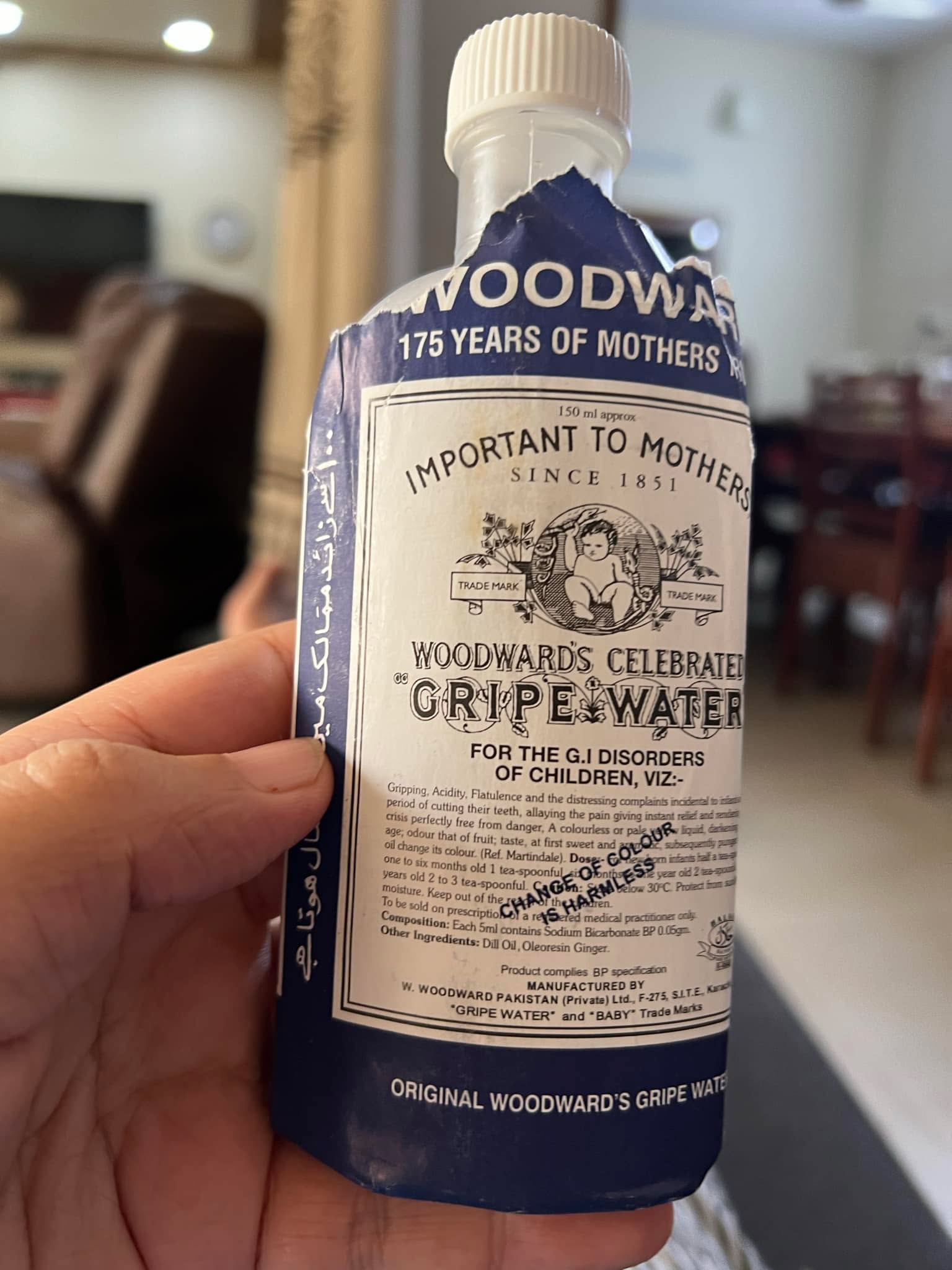
  • Woodwards Gripe Water is a proprietary formulation often used for the relief of discomfort caused by minor stomach upsets in babies. The key ingredients commonly found in commercial versions include sodium bicarbonate and dill oil. Heres a basic homemade gripe water recipe that uses similar natural ingredients:

    ### Homemade Gripe Water

    **Ingredients:**
    1. 2 cups of water
    2. 1 teaspoon of fennel seeds
    3. 1 teaspoon of dill seeds or dill weed
    4. 1 teaspoon of sugar or agave nectar (optional, for sweetness)
    5. 1/2 teaspoon of crushed ginger (optional, for additional relief)

    **Instructions:**
    1. In a pot, bring the 2 cups of water to a boil.
    2. Add the fennel seeds, dill seeds (or dill weed), and crushed ginger to the boiling water.
    3. Let the mixture simmer for about 20 minutes.
    4. Remove from heat and let it cool to room temperature.
    5. Once cooled, strain the liquid to remove all solids.
    6. If desired, add sugar or agave nectar for sweetness and mix until dissolved.
    7. Store the gripe water in a clean, airtight bottle or container in the refrigerator.
    8. Before giving it to your baby, make sure its at a suitable temperature and not too cold.

    **Note:** Its essential to consult with a pediatrician before giving any homemade remedies to your baby to ensure safety and appropriateness for your childs specific needs.
    Woodward's Gripe Water is a proprietary formulation often used for the relief of discomfort caused by minor stomach upsets in babies. The key ingredients commonly found in commercial versions include sodium bicarbonate and dill oil. Here's a basic homemade gripe water recipe that uses similar natural ingredients: ### Homemade Gripe Water **Ingredients:** 1. 2 cups of water 2. 1 teaspoon of fennel seeds 3. 1 teaspoon of dill seeds or dill weed 4. 1 teaspoon of sugar or agave nectar (optional, for sweetness) 5. 1/2 teaspoon of crushed ginger (optional, for additional relief) **Instructions:** 1. In a pot, bring the 2 cups of water to a boil. 2. Add the fennel seeds, dill seeds (or dill weed), and crushed ginger to the boiling water. 3. Let the mixture simmer for about 20 minutes. 4. Remove from heat and let it cool to room temperature. 5. Once cooled, strain the liquid to remove all solids. 6. If desired, add sugar or agave nectar for sweetness and mix until dissolved. 7. Store the gripe water in a clean, airtight bottle or container in the refrigerator. 8. Before giving it to your baby, make sure it's at a suitable temperature and not too cold. **Note:** It's essential to consult with a pediatrician before giving any homemade remedies to your baby to ensure safety and appropriateness for your child's specific needs.
    0 Kommentare 0 Anteile 32 Ansichten
  • Soda ash (sodium carbonate) can be produced from natural salt through a process called the Solvay process. Heres a simplified explanation of the steps involved:

    1. **Ammonia Absorption:** The process starts with the introduction of ammonia into a concentrated solution of brine (saltwater). Ammonia is absorbed into the solution, creating ammoniated brine.

    2. **Carbonation:** Carbon dioxide is then bubbled through the ammoniated brine. This carbon dioxide can be obtained from limestone (calcium carbonate) that is heated in a kiln to produce lime (calcium oxide) and carbon dioxide. The carbon dioxide reacts with the ammonia and water in the brine to form sodium bicarbonate (baking soda) and ammonium chloride.

    3. **Precipitation and Filtration:** The sodium bicarbonate precipitates out of this solution as it is slightly less soluble than the other components. It is then filtered out from the mixture.

    4. **Calcination:** The sodium bicarbonate is heated (calcined) in a kiln, which decomposes it into sodium carbonate (soda ash), water, and carbon dioxide. The carbon dioxide can be recycled back into the process.

    5. **Recovery of Ammonia:** The remaining solution, which contains ammonium chloride, is treated to recover the ammonia. This is usually done by reacting it with the lime produced in the kiln. The ammonia is then reused in the process.

    6. **Production of Soda Ash:** The final product, soda ash, is then collected, processed as needed (for example, into different grades), and packaged for use.

    This method is widely used because of its efficiency and the fact that the major raw materials (salt, limestone, and ammonia) are readily available. Additionally, the process is relatively environmentally friendly since it recycles most of its major chemicals.

    #saltland #khewra
    Soda ash (sodium carbonate) can be produced from natural salt through a process called the Solvay process. Here's a simplified explanation of the steps involved: 1. **Ammonia Absorption:** The process starts with the introduction of ammonia into a concentrated solution of brine (saltwater). Ammonia is absorbed into the solution, creating ammoniated brine. 2. **Carbonation:** Carbon dioxide is then bubbled through the ammoniated brine. This carbon dioxide can be obtained from limestone (calcium carbonate) that is heated in a kiln to produce lime (calcium oxide) and carbon dioxide. The carbon dioxide reacts with the ammonia and water in the brine to form sodium bicarbonate (baking soda) and ammonium chloride. 3. **Precipitation and Filtration:** The sodium bicarbonate precipitates out of this solution as it is slightly less soluble than the other components. It is then filtered out from the mixture. 4. **Calcination:** The sodium bicarbonate is heated (calcined) in a kiln, which decomposes it into sodium carbonate (soda ash), water, and carbon dioxide. The carbon dioxide can be recycled back into the process. 5. **Recovery of Ammonia:** The remaining solution, which contains ammonium chloride, is treated to recover the ammonia. This is usually done by reacting it with the lime produced in the kiln. The ammonia is then reused in the process. 6. **Production of Soda Ash:** The final product, soda ash, is then collected, processed as needed (for example, into different grades), and packaged for use. This method is widely used because of its efficiency and the fact that the major raw materials (salt, limestone, and ammonia) are readily available. Additionally, the process is relatively environmentally friendly since it recycles most of its major chemicals. #saltland #khewra
    0 Kommentare 0 Anteile 1227 Ansichten
Suchergebnis