



Mohsin #RSF8
#Storypostt6
Class: Foundation level
Made by Me
rool no:13
The Journey of Dinosaurs: A Scientific Perspective
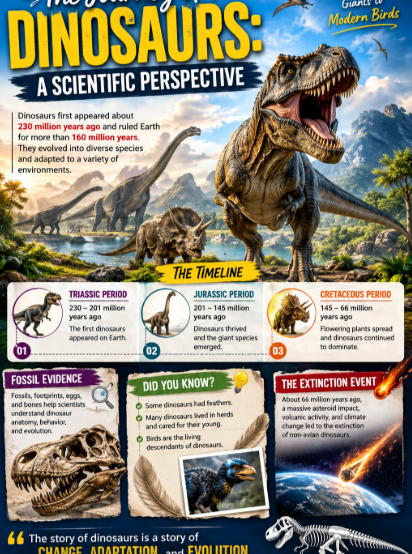
Travel back hundreds of millions of years and discover the extraordinary story of dinosaurs—some of the most fascinating creatures to ever inhabit our planet. Their journey began during the Triassic Period, approximately 230 million years ago, when the Earth looked vastly different from the world we know today. Continents were joined together in a giant landmass called Pangaea, and early dinosaurs emerged as small, agile reptiles. Over time, these ancient creatures evolved into a diverse range of species, occupying nearly every ecological niche and becoming the dominant animals on Earth for more than 160 million years.
During the Jurassic Period, dinosaurs flourished and diversified into countless forms. Massive herbivores such as Brachiosaurus and Diplodocus roamed lush forests, while formidable predators like Allosaurus hunted across vast landscapes. Their remarkable adaptations allowed them to thrive in changing environments, demonstrating the power of evolution and natural selection. As ecosystems became increasingly complex, dinosaurs developed specialized characteristics that enabled them to survive and dominate their habitats.
The Cretaceous Period marked the peak of dinosaur diversity. Iconic species such as Tyrannosaurus rex, Triceratops, and Velociraptor appeared during this era. Scientists believe that many dinosaurs displayed advanced behaviors, including social interaction, parental care, and migration. Fossil evidence has even revealed that some dinosaurs possessed feathers, providing strong support for the evolutionary link between dinosaurs and modern birds. These discoveries have transformed our understanding of dinosaurs, showing that they were dynamic, intelligent, and highly adaptable creatures rather than the slow-moving reptiles once imagined.
Our knowledge of dinosaurs comes primarily from the study of fossils. Paleontologists carefully examine fossilized bones, footprints, eggs, and even preserved skin impressions to reconstruct the lives of these prehistoric animals. Modern technologies.
#Storypostt6
Class: Foundation level
Made by Me
rool no:13
The Journey of Dinosaurs: A Scientific Perspective
Travel back hundreds of millions of years and discover the extraordinary story of dinosaurs—some of the most fascinating creatures to ever inhabit our planet. Their journey began during the Triassic Period, approximately 230 million years ago, when the Earth looked vastly different from the world we know today. Continents were joined together in a giant landmass called Pangaea, and early dinosaurs emerged as small, agile reptiles. Over time, these ancient creatures evolved into a diverse range of species, occupying nearly every ecological niche and becoming the dominant animals on Earth for more than 160 million years.
During the Jurassic Period, dinosaurs flourished and diversified into countless forms. Massive herbivores such as Brachiosaurus and Diplodocus roamed lush forests, while formidable predators like Allosaurus hunted across vast landscapes. Their remarkable adaptations allowed them to thrive in changing environments, demonstrating the power of evolution and natural selection. As ecosystems became increasingly complex, dinosaurs developed specialized characteristics that enabled them to survive and dominate their habitats.
The Cretaceous Period marked the peak of dinosaur diversity. Iconic species such as Tyrannosaurus rex, Triceratops, and Velociraptor appeared during this era. Scientists believe that many dinosaurs displayed advanced behaviors, including social interaction, parental care, and migration. Fossil evidence has even revealed that some dinosaurs possessed feathers, providing strong support for the evolutionary link between dinosaurs and modern birds. These discoveries have transformed our understanding of dinosaurs, showing that they were dynamic, intelligent, and highly adaptable creatures rather than the slow-moving reptiles once imagined.
Our knowledge of dinosaurs comes primarily from the study of fossils. Paleontologists carefully examine fossilized bones, footprints, eggs, and even preserved skin impressions to reconstruct the lives of these prehistoric animals. Modern technologies.
Mohsin #RSF8🎓✨
#Storypostt6
Class: Foundation level 📚
Made by Me 💻🚀
rool no:13
🦖 The Journey of Dinosaurs: A Scientific Perspective
Travel back hundreds of millions of years and discover the extraordinary story of dinosaurs—some of the most fascinating creatures to ever inhabit our planet. Their journey began during the Triassic Period, approximately 230 million years ago, when the Earth looked vastly different from the world we know today. Continents were joined together in a giant landmass called Pangaea, and early dinosaurs emerged as small, agile reptiles. Over time, these ancient creatures evolved into a diverse range of species, occupying nearly every ecological niche and becoming the dominant animals on Earth for more than 160 million years.
During the Jurassic Period, dinosaurs flourished and diversified into countless forms. Massive herbivores such as Brachiosaurus and Diplodocus roamed lush forests, while formidable predators like Allosaurus hunted across vast landscapes. Their remarkable adaptations allowed them to thrive in changing environments, demonstrating the power of evolution and natural selection. As ecosystems became increasingly complex, dinosaurs developed specialized characteristics that enabled them to survive and dominate their habitats.
The Cretaceous Period marked the peak of dinosaur diversity. Iconic species such as Tyrannosaurus rex, Triceratops, and Velociraptor appeared during this era. Scientists believe that many dinosaurs displayed advanced behaviors, including social interaction, parental care, and migration. Fossil evidence has even revealed that some dinosaurs possessed feathers, providing strong support for the evolutionary link between dinosaurs and modern birds. These discoveries have transformed our understanding of dinosaurs, showing that they were dynamic, intelligent, and highly adaptable creatures rather than the slow-moving reptiles once imagined.
Our knowledge of dinosaurs comes primarily from the study of fossils. Paleontologists carefully examine fossilized bones, footprints, eggs, and even preserved skin impressions to reconstruct the lives of these prehistoric animals. Modern technologies.
0 Comments
0 Shares
711 Views