



#rsisb
Roll no. 247
Story post 14
Foundation level
**The Evolution of “Robot”: From Czech Play to Tech Terminology **
Have you ever wondered where the word **“robot”** came from? Today, we use this word when talking about smart machines, artificial intelligence, factories, space exploration, and modern technology. But did you know that the word “robot” became popular through a Czech play written more than a century ago? Let's explore the fascinating journey of this little word that became a big part of our technological world!
**1. The Beginning: A Czech Play **
The story of the word “robot” begins with Czech writer and playwright **Karel Čapek** and his science-fiction play *R.U.R. (Rossum’s Universal Robots)*, first performed in 1921 and published in 1920. The play imagined artificial workers created to perform tasks for humans. It introduced audiences to ideas about artificial beings, technology, work, and the relationship between humans and machines.
The word “robot” comes from the Czech word *robota*, associated with forced labor or compulsory work. Interestingly, Karel Čapek credited his brother, **Josef Čapek**, with suggesting the word for the play.
**2. How the Word Spread Around the World **
As the play gained attention, the word “robot” spread beyond literature and entered everyday language. People began using it to discuss machines that could perform tasks automatically. Over time, robots became a popular subject in science-fiction stories, films, books, and discussions about the future.
Writers and scientists explored exciting questions: Could machines help humans? Could robots perform difficult tasks? How might technology change our lives? These questions helped inspire generations of inventors and researchers.
**3. From Fiction to Real Machines **
Robots eventually became an important part of real-world engineering and science. Modern robots can perform repetitive tasks, assist with manufacturing, explore places that are difficult for humans to reach, and help researchers carry out complex work.
Today, we can find robots in many areas:
**Factories:** Industrial robots help assemble products and perform precise tasks.
**Homes:** Robotic vacuum cleaners help people with household cleaning.
**Healthcare:** Specialised robotic systems assist medical professionals with certain procedures.
**Space Exploration:** Robotic rovers and spacecraft help scientists explore distant worlds.
**Agriculture:** Some robots help monitor crops and perform farming tasks.
**Research:** Scientists use robots to test ideas, collect information, and explore new possibilities.
**4. Robots and Artificial Intelligence **
Modern technology has introduced new possibilities through artificial intelligence (AI). Some robots use AI to interpret information from sensors, recognise objects, plan actions, or respond to changing conditions. However, not every robot uses AI, and not every AI system is a robot.
This difference is important! A robot is generally a physical machine that can carry out tasks, while AI refers to computer systems designed to perform tasks that may require abilities such as recognising patterns or understanding language. Together, robotics and AI are helping researchers develop new tools and technologies.
**5. What Can We Learn from the Evolution of “Robot”?**
The journey of the word “robot” teaches us that ideas can travel from books and plays into real life. A word introduced through a fictional story became an important term in science, engineering, and technology.
It also reminds us that technology is created by people using imagination, creativity, teamwork, and scientific knowledge. As we learn more about robots, we should think about how to use technology responsibly and how it can benefit people and communities.
**Conclusion: From a Czech Play to a Technological Future**
The evolution of “robot” is a remarkable example of how language, literature, and science connect. What began as a word associated with artificial workers in a Czech play is now used around the world to describe machines that help us in factories, homes, hospitals, laboratories, and space exploration.
The future of robotics will continue to bring new discoveries, challenges, and opportunities. By learning about the past, understanding the present, and thinking creatively about the future, we can become more informed and responsible users of technology.
**Let's keep learning, exploring, and innovating!** Every great invention begins with an idea, and every curious mind has the potential to discover something new.
**Question for everyone:** If you could invent a helpful robot, what would you want it to do? Share your ideas in the comments!
Like, share, and spread the excitement of science and technology!
━━━━━━━━━━━━━━━━━━
**HASHTAGS**
#EvolutionOfRobots #RobotHistory #TheWordRobot #KarelCapek #JosefCapek #RUR #CzechLiterature #HistoryOfTechnology #Robotics #ArtificialIntelligence #AI #ScienceAndTechnology #EducationalPost #StoryPost #TechnologyEducation #FutureTechnology #Innovation #Engineering #STEMEducation #ScienceForEveryone #LearningIsFun #DigitalLearning #TechHistory #SmartMachines #SpaceExploration #IndustrialRobots #CreativeThinking #KnowledgeIsPower #ChatGPT #PostOnAllPlatforms
Roll no. 247
Story post 14
Foundation level
**The Evolution of “Robot”: From Czech Play to Tech Terminology **
Have you ever wondered where the word **“robot”** came from? Today, we use this word when talking about smart machines, artificial intelligence, factories, space exploration, and modern technology. But did you know that the word “robot” became popular through a Czech play written more than a century ago? Let's explore the fascinating journey of this little word that became a big part of our technological world!
**1. The Beginning: A Czech Play **
The story of the word “robot” begins with Czech writer and playwright **Karel Čapek** and his science-fiction play *R.U.R. (Rossum’s Universal Robots)*, first performed in 1921 and published in 1920. The play imagined artificial workers created to perform tasks for humans. It introduced audiences to ideas about artificial beings, technology, work, and the relationship between humans and machines.
The word “robot” comes from the Czech word *robota*, associated with forced labor or compulsory work. Interestingly, Karel Čapek credited his brother, **Josef Čapek**, with suggesting the word for the play.
**2. How the Word Spread Around the World **
As the play gained attention, the word “robot” spread beyond literature and entered everyday language. People began using it to discuss machines that could perform tasks automatically. Over time, robots became a popular subject in science-fiction stories, films, books, and discussions about the future.
Writers and scientists explored exciting questions: Could machines help humans? Could robots perform difficult tasks? How might technology change our lives? These questions helped inspire generations of inventors and researchers.
**3. From Fiction to Real Machines **
Robots eventually became an important part of real-world engineering and science. Modern robots can perform repetitive tasks, assist with manufacturing, explore places that are difficult for humans to reach, and help researchers carry out complex work.
Today, we can find robots in many areas:
**Factories:** Industrial robots help assemble products and perform precise tasks.
**Homes:** Robotic vacuum cleaners help people with household cleaning.
**Healthcare:** Specialised robotic systems assist medical professionals with certain procedures.
**Space Exploration:** Robotic rovers and spacecraft help scientists explore distant worlds.
**Agriculture:** Some robots help monitor crops and perform farming tasks.
**Research:** Scientists use robots to test ideas, collect information, and explore new possibilities.
**4. Robots and Artificial Intelligence **
Modern technology has introduced new possibilities through artificial intelligence (AI). Some robots use AI to interpret information from sensors, recognise objects, plan actions, or respond to changing conditions. However, not every robot uses AI, and not every AI system is a robot.
This difference is important! A robot is generally a physical machine that can carry out tasks, while AI refers to computer systems designed to perform tasks that may require abilities such as recognising patterns or understanding language. Together, robotics and AI are helping researchers develop new tools and technologies.
**5. What Can We Learn from the Evolution of “Robot”?**
The journey of the word “robot” teaches us that ideas can travel from books and plays into real life. A word introduced through a fictional story became an important term in science, engineering, and technology.
It also reminds us that technology is created by people using imagination, creativity, teamwork, and scientific knowledge. As we learn more about robots, we should think about how to use technology responsibly and how it can benefit people and communities.
**Conclusion: From a Czech Play to a Technological Future**
The evolution of “robot” is a remarkable example of how language, literature, and science connect. What began as a word associated with artificial workers in a Czech play is now used around the world to describe machines that help us in factories, homes, hospitals, laboratories, and space exploration.
The future of robotics will continue to bring new discoveries, challenges, and opportunities. By learning about the past, understanding the present, and thinking creatively about the future, we can become more informed and responsible users of technology.
**Let's keep learning, exploring, and innovating!** Every great invention begins with an idea, and every curious mind has the potential to discover something new.
**Question for everyone:** If you could invent a helpful robot, what would you want it to do? Share your ideas in the comments!
Like, share, and spread the excitement of science and technology!
━━━━━━━━━━━━━━━━━━
**HASHTAGS**
#EvolutionOfRobots #RobotHistory #TheWordRobot #KarelCapek #JosefCapek #RUR #CzechLiterature #HistoryOfTechnology #Robotics #ArtificialIntelligence #AI #ScienceAndTechnology #EducationalPost #StoryPost #TechnologyEducation #FutureTechnology #Innovation #Engineering #STEMEducation #ScienceForEveryone #LearningIsFun #DigitalLearning #TechHistory #SmartMachines #SpaceExploration #IndustrialRobots #CreativeThinking #KnowledgeIsPower #ChatGPT #PostOnAllPlatforms
#rsisb
Roll no. 247
Story post 14
Foundation level
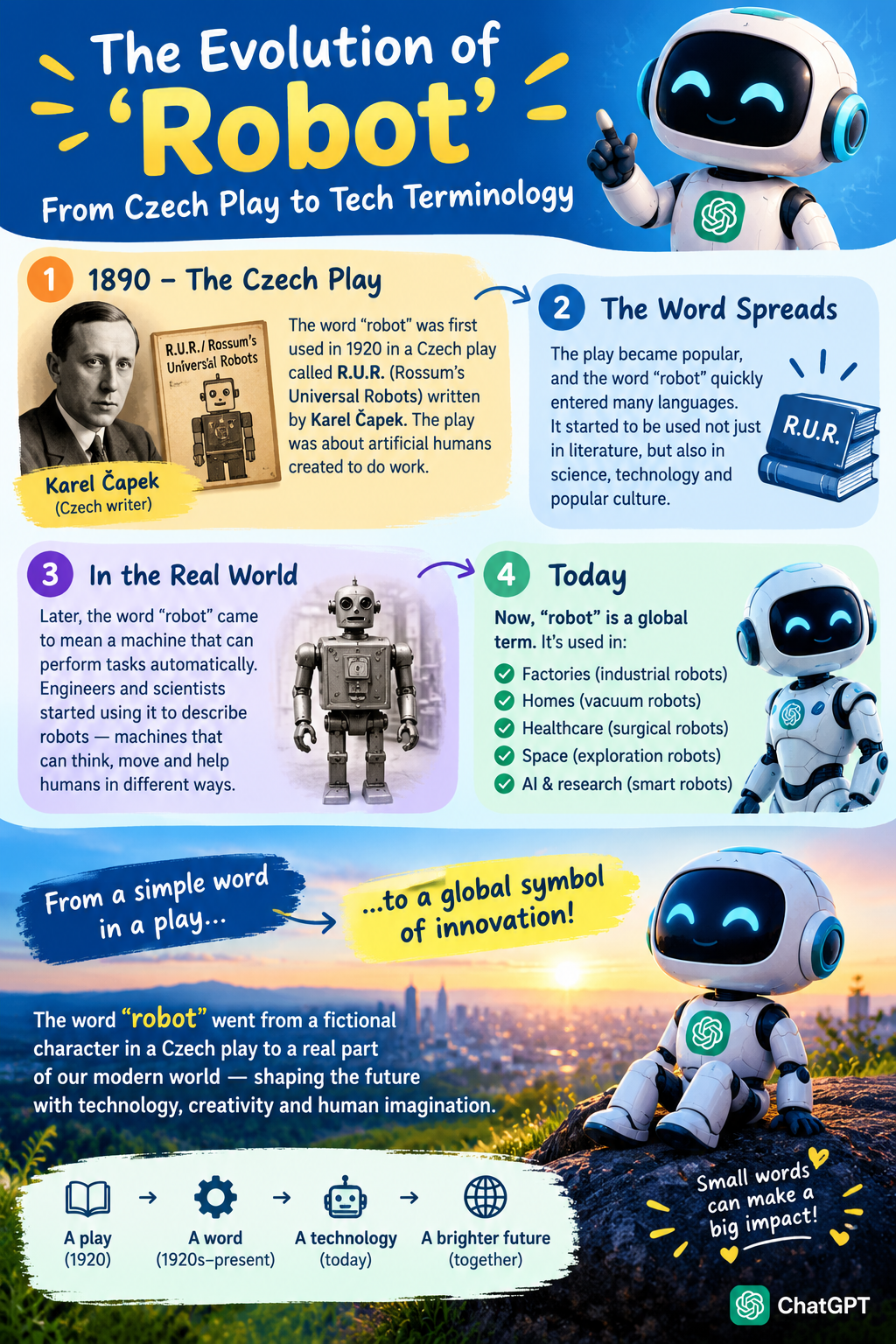
🤖🌍 **The Evolution of “Robot”: From Czech Play to Tech Terminology 📚✨**
🚀🤖 Have you ever wondered where the word **“robot”** came from? Today, we use this word when talking about smart machines, artificial intelligence, factories, space exploration, and modern technology. But did you know that the word “robot” became popular through a Czech play written more than a century ago? 📖🌟 Let's explore the fascinating journey of this little word that became a big part of our technological world! 💡🌐
📚 **1. The Beginning: A Czech Play 🇨🇿**
The story of the word “robot” begins with Czech writer and playwright **Karel Čapek** and his science-fiction play *R.U.R. (Rossum’s Universal Robots)*, first performed in 1921 and published in 1920. 🎭🤖 The play imagined artificial workers created to perform tasks for humans. It introduced audiences to ideas about artificial beings, technology, work, and the relationship between humans and machines.
The word “robot” comes from the Czech word *robota*, associated with forced labor or compulsory work. Interestingly, Karel Čapek credited his brother, **Josef Čapek**, with suggesting the word for the play. ✍️💭
🌎 **2. How the Word Spread Around the World 🌐**
As the play gained attention, the word “robot” spread beyond literature and entered everyday language. People began using it to discuss machines that could perform tasks automatically. 📖⚙️ Over time, robots became a popular subject in science-fiction stories, films, books, and discussions about the future.
Writers and scientists explored exciting questions: Could machines help humans? Could robots perform difficult tasks? How might technology change our lives? These questions helped inspire generations of inventors and researchers. 🚀🧠
⚙️ **3. From Fiction to Real Machines 🏭**
Robots eventually became an important part of real-world engineering and science. Modern robots can perform repetitive tasks, assist with manufacturing, explore places that are difficult for humans to reach, and help researchers carry out complex work. 🔧🤖
Today, we can find robots in many areas:
🏭 **Factories:** Industrial robots help assemble products and perform precise tasks.
🏠 **Homes:** Robotic vacuum cleaners help people with household cleaning.
🏥 **Healthcare:** Specialised robotic systems assist medical professionals with certain procedures.
🚀 **Space Exploration:** Robotic rovers and spacecraft help scientists explore distant worlds.
🌾 **Agriculture:** Some robots help monitor crops and perform farming tasks.
🧪 **Research:** Scientists use robots to test ideas, collect information, and explore new possibilities.
💻 **4. Robots and Artificial Intelligence 🧠**
Modern technology has introduced new possibilities through artificial intelligence (AI). Some robots use AI to interpret information from sensors, recognise objects, plan actions, or respond to changing conditions. 🤖💡 However, not every robot uses AI, and not every AI system is a robot.
This difference is important! A robot is generally a physical machine that can carry out tasks, while AI refers to computer systems designed to perform tasks that may require abilities such as recognising patterns or understanding language. Together, robotics and AI are helping researchers develop new tools and technologies. 🌐✨
🌟 **5. What Can We Learn from the Evolution of “Robot”?**
The journey of the word “robot” teaches us that ideas can travel from books and plays into real life. A word introduced through a fictional story became an important term in science, engineering, and technology. 📚➡️⚙️
It also reminds us that technology is created by people using imagination, creativity, teamwork, and scientific knowledge. As we learn more about robots, we should think about how to use technology responsibly and how it can benefit people and communities. ❤️🌍
🎯 **Conclusion: From a Czech Play to a Technological Future**
The evolution of “robot” is a remarkable example of how language, literature, and science connect. What began as a word associated with artificial workers in a Czech play is now used around the world to describe machines that help us in factories, homes, hospitals, laboratories, and space exploration. 🤖🚀
The future of robotics will continue to bring new discoveries, challenges, and opportunities. By learning about the past, understanding the present, and thinking creatively about the future, we can become more informed and responsible users of technology. 🌟💚
📢 **Let's keep learning, exploring, and innovating!** Every great invention begins with an idea, and every curious mind has the potential to discover something new. 💡📚
💬 **Question for everyone:** If you could invent a helpful robot, what would you want it to do? Share your ideas in the comments! 👇🤖
❤️ Like, share, and spread the excitement of science and technology!
━━━━━━━━━━━━━━━━━━
🏷️ **HASHTAGS**
#EvolutionOfRobots #RobotHistory #TheWordRobot #KarelCapek #JosefCapek #RUR #CzechLiterature #HistoryOfTechnology #Robotics #ArtificialIntelligence #AI #ScienceAndTechnology #EducationalPost #StoryPost #TechnologyEducation #FutureTechnology #Innovation #Engineering #STEMEducation #ScienceForEveryone #LearningIsFun #DigitalLearning #TechHistory #SmartMachines #SpaceExploration #IndustrialRobots #CreativeThinking #KnowledgeIsPower #ChatGPT #PostOnAllPlatforms 🤖🌍📚🚀✨
0 Комментарии
0 Поделились
329 Просмотры