• “Hurry Up!” – The Story Behind a Common English Phrase!

    Have you ever wondered why we say “Hurry Up” in our daily lives? In this talk, I explored the meaning, importance, and popularity of this common phrase, and how technology, telephone, social media, and AI help us use and understand English in our everyday lives.

    Every word has a story, and every phrase has a purpose!

    Presented by Raheem AI Wala
    Learning Today, Becoming an AI Expert Tomorrow!

    #HurryUp #EnglishSpeaking #FiveMinuteTalk #PublicSpeaking #LearnEnglish #ArtificialIntelligence #RaheemAIWala
    ⏰ “Hurry Up!” – The Story Behind a Common English Phrase! 🎤✨ Have you ever wondered why we say “Hurry Up” in our daily lives? 🤔 In this talk, I explored the meaning, importance, and popularity of this common phrase, and how technology, telephone, social media, and AI help us use and understand English in our everyday lives. 🌍💡 Every word has a story, and every phrase has a purpose! ❤️ 🎙️ Presented by Raheem AI Wala 🚀 Learning Today, Becoming an AI Expert Tomorrow! #HurryUp #EnglishSpeaking #FiveMinuteTalk #PublicSpeaking #LearnEnglish #ArtificialIntelligence #RaheemAIWala
    0 Commentaires 0 Parts 356 Vue 8
  • RSIF8
    ROLL NO 60
    TASK 21
    CALL ANNIE NO 1
    # "Hello" – Origins of a Simple Greeting (5 Minutes)
    Have you ever wondered where the word **"Hello"** came from and how it became one of the most popular greetings in the world?
    In this interesting 5-minute video, we explore the fascinating history of the word "Hello," from its early use to its popularity in everyday conversations. Discover how the invention of the telephone helped make "Hello" a common way to begin a conversation and learn about Alexander Graham Bell's role in telephone history.
    Join us on this exciting journey to discover how one simple word became a universal way to greet people, make connections, and start conversations around the world.
    **Watch until the end to discover the amazing story behind the word "Hello"!**
    Like, share, and subscribe for more interesting facts, educational videos, and fascinating stories.
    RSIF8 ROLL NO 60 TASK 21 CALL ANNIE NO 1 # "Hello" – Origins of a Simple Greeting (5 Minutes) Have you ever wondered where the word **"Hello"** came from and how it became one of the most popular greetings in the world? 🌍 In this interesting 5-minute video, we explore the fascinating history of the word "Hello," from its early use to its popularity in everyday conversations. Discover how the invention of the telephone helped make "Hello" a common way to begin a conversation and learn about Alexander Graham Bell's role in telephone history. Join us on this exciting journey to discover how one simple word became a universal way to greet people, make connections, and start conversations around the world. ✨ **Watch until the end to discover the amazing story behind the word "Hello"!** 👍 Like, share, and subscribe for more interesting facts, educational videos, and fascinating stories.
    0 Commentaires 0 Parts 861 Vue 4
  • RSIF8
    Roll No:86
    Task No:21
    Task topic:"Hello" - Origins of a Simple Greeting
    “Hello” — a simple word that carries the power to connect hearts across the world. Though it may seem ordinary today, the origin of “hello” has a fascinating history that dates back centuries. The word evolved from older expressions like “hallo” and “hullo,” which were once used to grab attention or express surprise. Over time, it transformed into the warm and friendly greeting we use every single day.
    The popularity of “hello” grew rapidly during the invention of the telephone in the late 1800s. When people first started speaking over phones, they needed a clear and polite way to begin conversations. Inventor Thomas Edison strongly supported the use of “hello” as the standard telephone greeting, and soon it became a global habit. From letters and conversations to modern video calls, this tiny word became a symbol of communication and human connection.
    What makes “hello” truly special is its simplicity. It breaks barriers between strangers, starts friendships, and creates comfort in everyday life. Whether spoken with excitement, kindness, or curiosity, “hello” has the magical ability to make someone feel noticed and welcomed. In every culture and language, greetings hold deep meaning, and “hello” remains one of the most recognized words on Earth.
    In a fast-moving world filled with technology and constant change, the word “hello” still reminds us of the importance of human interaction. One small greeting can brighten someone’s day, begin a new journey, or create unforgettable memories. Sometimes, the simplest words carry the deepest impact — and “hello” is a perfect example of that timeless truth.
    #Hello #Greeting #OriginsOfHello #Communication #History #Language #HumanConnection #PositiveVibes #DidYouKnow #WordsMatter #GlobalConnection #SimpleGreeting #EnglishLanguage #Inspiration #Kindness
    RSIF8 Roll No:86 Task No:21 Task topic:"Hello" - Origins of a Simple Greeting 🌍✨ “Hello” — a simple word that carries the power to connect hearts across the world. Though it may seem ordinary today, the origin of “hello” has a fascinating history that dates back centuries. The word evolved from older expressions like “hallo” and “hullo,” which were once used to grab attention or express surprise. Over time, it transformed into the warm and friendly greeting we use every single day. 💬📖 ☎️📜 The popularity of “hello” grew rapidly during the invention of the telephone in the late 1800s. When people first started speaking over phones, they needed a clear and polite way to begin conversations. Inventor Thomas Edison strongly supported the use of “hello” as the standard telephone greeting, and soon it became a global habit. From letters and conversations to modern video calls, this tiny word became a symbol of communication and human connection. 🌐🤝 😊💡 What makes “hello” truly special is its simplicity. It breaks barriers between strangers, starts friendships, and creates comfort in everyday life. Whether spoken with excitement, kindness, or curiosity, “hello” has the magical ability to make someone feel noticed and welcomed. In every culture and language, greetings hold deep meaning, and “hello” remains one of the most recognized words on Earth. 🌎❤️ ✨📚 In a fast-moving world filled with technology and constant change, the word “hello” still reminds us of the importance of human interaction. One small greeting can brighten someone’s day, begin a new journey, or create unforgettable memories. Sometimes, the simplest words carry the deepest impact — and “hello” is a perfect example of that timeless truth. 💫👋 #Hello #Greeting #OriginsOfHello #Communication #History #Language #HumanConnection #PositiveVibes #DidYouKnow #WordsMatter #GlobalConnection #SimpleGreeting #EnglishLanguage #Inspiration #Kindness
    0 Commentaires 0 Parts 2528 Vue 12
  • RSIF8
    ROLL NO 108
    TASK 21
    ANNIE TAIK 01
    Here is a ready-to-use description for your **5-minute topic**:
    **Hello – Origins of a Simple Greeting**
    “Hello” is one of the most common and friendly words we use every day. But have you ever wondered where this simple greeting came from? In this 5-minute presentation, we explore the origins and history of the word “Hello,” how its use became popular, and why it remains an important part of everyday communication. From early forms of greeting to its use in modern conversations and telephone calls, discover the interesting story behind this familiar word.
    RSIF8 ROLL NO 108 TASK 21 ANNIE TAIK 01 Here is a ready-to-use description for your **5-minute topic**: **Hello – Origins of a Simple Greeting** “Hello” is one of the most common and friendly words we use every day. But have you ever wondered where this simple greeting came from? In this 5-minute presentation, we explore the origins and history of the word “Hello,” how its use became popular, and why it remains an important part of everyday communication. From early forms of greeting to its use in modern conversations and telephone calls, discover the interesting story behind this familiar word.
    0 Commentaires 0 Parts 526 Vue 26
  • Call Annine NO:3
    Class: foundation level
    Made by Me
    rool no:13
    Okay – The Story Behind the World’s Favorite Word

    Have you ever stopped to think about how often you say the word “okay”? It is one of the most common words used in daily conversations, yet very few people know the fascinating story behind it. In this 5-minute discussion with Annie, we explore the origins, history, and global impact of a simple word that has become a universal part of human communication.

    The word “okay,” often written as OK, is recognized and understood in almost every corner of the world. Whether you are speaking English, Urdu, Arabic, Chinese, Spanish, or any other language, there is a good chance that people will understand what you mean when you say “okay.” It is used to express agreement, approval, understanding, acceptance, or confirmation. From casual conversations with friends to important business meetings, the word has found its place in every aspect of modern life.

    The history of “okay” dates back to the United States in the 1830s. One popular explanation suggests that it began as a humorous abbreviation of the intentionally misspelled phrase “Oll Korrect,” meaning “All Correct.” During that period, playful abbreviations were fashionable, and “OK” became one of the few that survived the test of time. Its popularity grew rapidly during political campaigns and through newspapers, eventually becoming a standard part of the English language.

    What makes “okay” truly remarkable is its versatility. It can be used in many different ways depending on the situation and tone of voice. For example, it can mean “yes,” “I understand,” “I agree,” “everything is fine,” or simply acknowledge that a message has been received. Few words in any language can perform so many functions while remaining easy to understand.

    As communication technology evolved, “okay” became even more important. It appeared in telegrams, radio communications, telephone conversations, emails, text messages, and social media posts. Today, it is used billions of times every day around the world. The word's simplicity and flexibility have helped it cross cultural and linguistic boundaries, making it one of

    Call Annine NO:3 Class: foundation level 📚 Made by Me 💻🚀 rool no:13 Okay – The Story Behind the World’s Favorite Word Have you ever stopped to think about how often you say the word “okay”? It is one of the most common words used in daily conversations, yet very few people know the fascinating story behind it. In this 5-minute discussion with Annie, we explore the origins, history, and global impact of a simple word that has become a universal part of human communication. The word “okay,” often written as OK, is recognized and understood in almost every corner of the world. Whether you are speaking English, Urdu, Arabic, Chinese, Spanish, or any other language, there is a good chance that people will understand what you mean when you say “okay.” It is used to express agreement, approval, understanding, acceptance, or confirmation. From casual conversations with friends to important business meetings, the word has found its place in every aspect of modern life. The history of “okay” dates back to the United States in the 1830s. One popular explanation suggests that it began as a humorous abbreviation of the intentionally misspelled phrase “Oll Korrect,” meaning “All Correct.” During that period, playful abbreviations were fashionable, and “OK” became one of the few that survived the test of time. Its popularity grew rapidly during political campaigns and through newspapers, eventually becoming a standard part of the English language. What makes “okay” truly remarkable is its versatility. It can be used in many different ways depending on the situation and tone of voice. For example, it can mean “yes,” “I understand,” “I agree,” “everything is fine,” or simply acknowledge that a message has been received. Few words in any language can perform so many functions while remaining easy to understand. As communication technology evolved, “okay” became even more important. It appeared in telegrams, radio communications, telephone conversations, emails, text messages, and social media posts. Today, it is used billions of times every day around the world. The word's simplicity and flexibility have helped it cross cultural and linguistic boundaries, making it one of

    0 Commentaires 0 Parts 1625 Vue 155
  • RSIF8
    ROll no:82
    Story post: 1
    Story post topic:Sound Waves: The Physics of Hearing and Communication

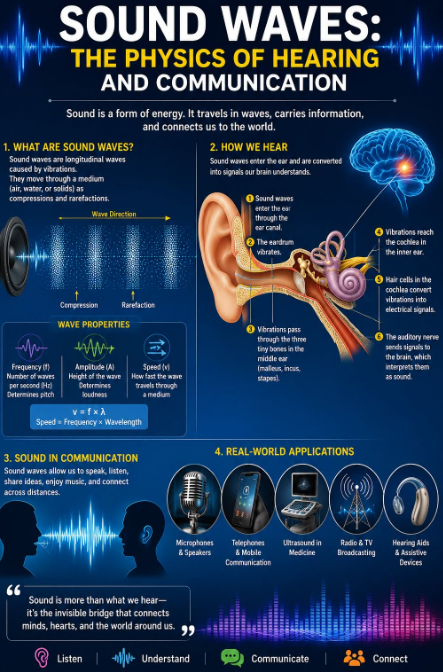
    Sound is an invisible form of energy that plays a vital role in our everyday lives. It travels as waves created by vibrating objects and moves through air, water, or solid materials until it reaches our ears. These waves allow us to hear voices, enjoy music, recognize warning signals, and communicate with people around the world.

    The process of hearing is a remarkable example of nature and science working together. Sound waves enter the ear canal, causing the eardrum to vibrate. These vibrations travel through tiny bones in the middle ear and reach the cochlea, where specialized hair cells convert them into electrical signals. The brain then interprets these signals, allowing us to recognize speech, music, and countless other sounds.

    The physics of sound is also the foundation of modern communication. Technologies such as microphones, speakers, telephones, hearing aids, ultrasound devices, and broadcasting systems all rely on the transmission and interpretation of sound waves. From education and healthcare to entertainment and global communication, sound connects people and makes the exchange of ideas possible.

    Understanding sound waves helps us appreciate both the complexity of the human body and the power of scientific discovery. Every conversation, every melody, and every echo reminds us that invisible waves carry information, emotions, and knowledge across the world.

    "Sound is more than something we hear—it is the invisible force that connects people, powers communication, and brings the world to life."
    RSIF8 ROll no:82 Story post: 1 Story post topic:Sound Waves: The Physics of Hearing and Communication Sound is an invisible form of energy that plays a vital role in our everyday lives. It travels as waves created by vibrating objects and moves through air, water, or solid materials until it reaches our ears. These waves allow us to hear voices, enjoy music, recognize warning signals, and communicate with people around the world. The process of hearing is a remarkable example of nature and science working together. Sound waves enter the ear canal, causing the eardrum to vibrate. These vibrations travel through tiny bones in the middle ear and reach the cochlea, where specialized hair cells convert them into electrical signals. The brain then interprets these signals, allowing us to recognize speech, music, and countless other sounds. The physics of sound is also the foundation of modern communication. Technologies such as microphones, speakers, telephones, hearing aids, ultrasound devices, and broadcasting systems all rely on the transmission and interpretation of sound waves. From education and healthcare to entertainment and global communication, sound connects people and makes the exchange of ideas possible. Understanding sound waves helps us appreciate both the complexity of the human body and the power of scientific discovery. Every conversation, every melody, and every echo reminds us that invisible waves carry information, emotions, and knowledge across the world. "Sound is more than something we hear—it is the invisible force that connects people, powers communication, and brings the world to life."
    0 Commentaires 0 Parts 2470 Vue
  • Day:-174
    rollno:-006
    foundation level
    Story Post
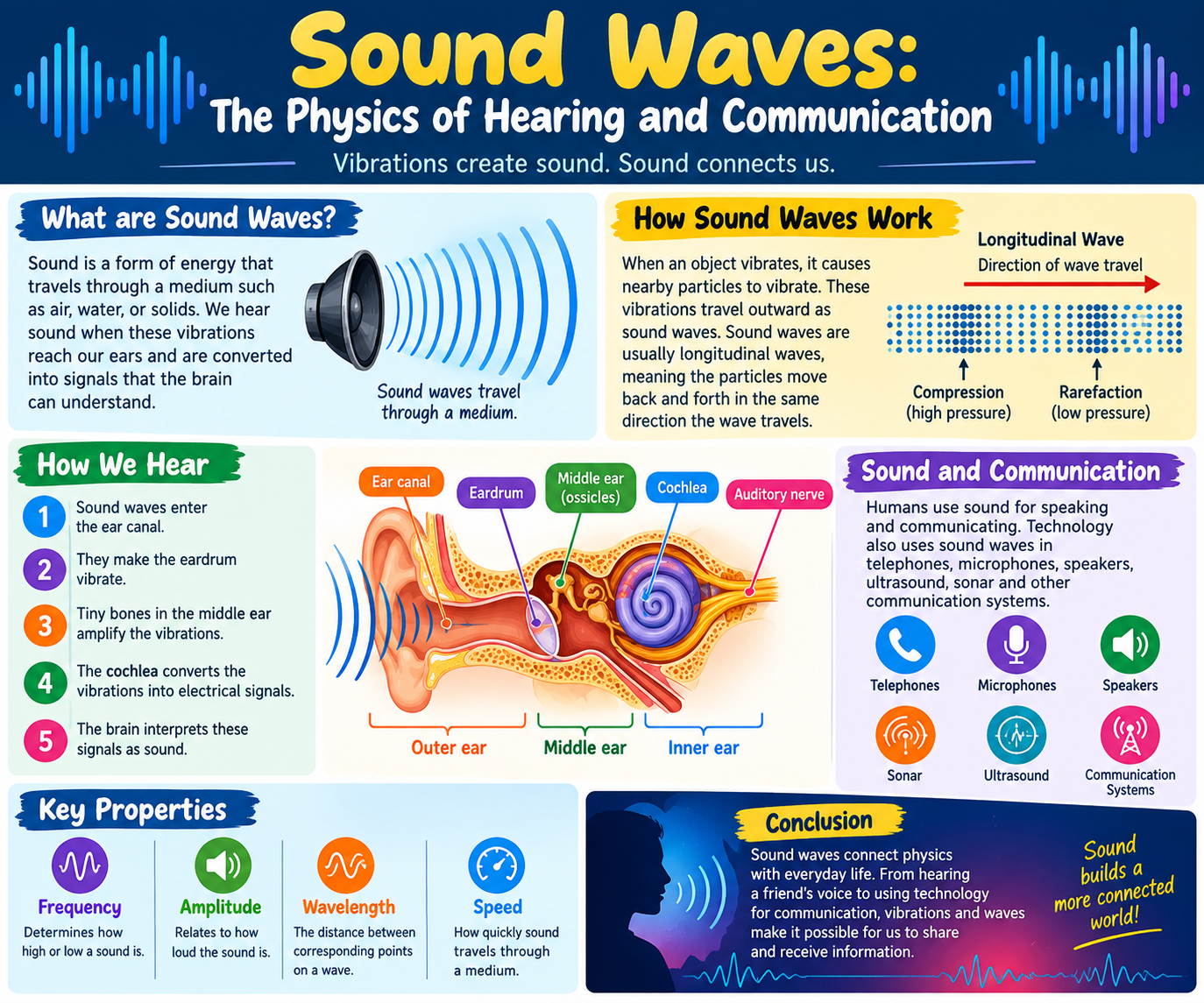
    Sound Waves: The Physics of Hearing and Communication

    Sound is a form of energy that travels through a medium such as air, water, or solids. We hear sound when these vibrations reach our ears and are converted into signals that the brain can understand.

    How Sound Waves Work

    When an object vibrates, it causes nearby particles to vibrate. These vibrations travel outward as sound waves. Sound waves are usually longitudinal waves, meaning the particles move back and forth in the same direction the wave travels.

    How We Hear
    Sound waves enter the ear canal.
    They make the eardrum vibrate.
    Tiny bones in the middle ear amplify the vibrations.
    The cochlea converts the vibrations into electrical signals.
    The brain interprets these signals as sound.
    Sound and Communication

    Humans use sound for speaking and communicating. Technology also uses sound waves in telephones, microphones, speakers, ultrasound, sonar, and other communication systems.

    Key Properties
    Frequency → determines how high or low a sound is.
    Amplitude → relates to how loud the sound is.
    Wavelength → the distance between corresponding points on a wave.
    Speed → how quickly sound travels through a medium.

    Conclusion: Sound waves connect physics with everyday life. From hearing a friend's voice to using technology for communication, vibrations and waves make it possible for us to share and receive information.
    Day:-174 rollno:-006 foundation level 📖 Story Post 🔊 Sound Waves: The Physics of Hearing and Communication Sound is a form of energy that travels through a medium such as air, water, or solids. We hear sound when these vibrations reach our ears and are converted into signals that the brain can understand. 🌊 How Sound Waves Work When an object vibrates, it causes nearby particles to vibrate. These vibrations travel outward as sound waves. Sound waves are usually longitudinal waves, meaning the particles move back and forth in the same direction the wave travels. 👂 How We Hear Sound waves enter the ear canal. They make the eardrum vibrate. Tiny bones in the middle ear amplify the vibrations. The cochlea converts the vibrations into electrical signals. The brain interprets these signals as sound. 📡 Sound and Communication Humans use sound for speaking and communicating. Technology also uses sound waves in telephones, microphones, speakers, ultrasound, sonar, and other communication systems. 🔑 Key Properties Frequency → determines how high or low a sound is. Amplitude → relates to how loud the sound is. Wavelength → the distance between corresponding points on a wave. Speed → how quickly sound travels through a medium. Conclusion: Sound waves connect physics with everyday life. From hearing a friend's voice to using technology for communication, vibrations and waves make it possible for us to share and receive information.
    0 Commentaires 0 Parts 1925 Vue
  • RSIF8
    chat gpt no 1
    chat gpt topic "Hello" - Origins of a Simple Greeting
    Going LIVE: "Hello" – The Origins of a Simple Greeting

    Join me and Annie as we dive into the fascinating story behind one of the most powerful and universal words — “Hello.”

    Did you know this simple greeting became popular because of the invention of the telephone?
    How did it spread across cultures?
    Why does one small word carry so much warmth and connection?

    In this 5-minute live session, we’ll explore the history, meaning, and impact of this everyday word that connects the world.

    Don’t miss it — let’s say “Hello” to knowledge together!

    #Hello #LiveSession #DidYouKnow #WordOrigins #Communication #SocialMediaLive #EnglishLearning #ContentCreator #GoLive #ImagineLabs
    RSIF8 chat gpt no 1 chat gpt topic "Hello" - Origins of a Simple Greeting ✨ Going LIVE: "Hello" – The Origins of a Simple Greeting 👋🌍 Join me and Annie as we dive into the fascinating story behind one of the most powerful and universal words — “Hello.” 💬 Did you know this simple greeting became popular because of the invention of the telephone? 📞 How did it spread across cultures? 🌎 Why does one small word carry so much warmth and connection? 🤝❤️ In this 5-minute live session, we’ll explore the history, meaning, and impact of this everyday word that connects the world. 🌟 Don’t miss it — let’s say “Hello” to knowledge together! 👋✨ #Hello #LiveSession #DidYouKnow #WordOrigins #Communication #SocialMediaLive #EnglishLearning #ContentCreator #GoLive #ImagineLabs 🎥🔥
    0 Commentaires 0 Parts 2720 Vue 6
  • Foundation Level
    Day 21
    Call Maya No:1
    Roll NO : 007
    Talk with Maya – "Hello" | Origins of a Simple Greeting
    How did the word "Hello" become one of the most recognized greetings in the world? In this engaging 5-minute conversation with Maya, we explore the fascinating origins of this simple yet powerful word. Learn how "Hello" evolved over time, gained popularity during the telephone era, and became a universal greeting that connects people across different cultures and languages.
    Join Maya as she uncovers the history, meaning, and interesting facts behind one of the world's most commonly spoken words.
    Foundation Level Day 21 Call Maya No:1 Roll NO : 007 Talk with Maya – "Hello" | Origins of a Simple Greeting How did the word "Hello" become one of the most recognized greetings in the world? In this engaging 5-minute conversation with Maya, we explore the fascinating origins of this simple yet powerful word. Learn how "Hello" evolved over time, gained popularity during the telephone era, and became a universal greeting that connects people across different cultures and languages. Join Maya as she uncovers the history, meaning, and interesting facts behind one of the world's most commonly spoken words.
    0 Commentaires 0 Parts 884 Vue 24
  • Foundation level :-
    Day 22 Roll:-005
    Talk with AI

    **The Story Behind the World’s Favorite Word: OK**

    Have you ever wondered where the word **“OK”** came from?

    The story goes back to **1839 in Boston, USA**. At that time, people had a funny habit of shortening phrases and deliberately misspelling them. One popular joke was **“oll korrect”**, a misspelled version of **“all correct.”**

    They shortened **“oll korrect”** to **“O.K.”** — and the little abbreviation became famous.

    Later, the expression became even more popular during the **1840 U.S. presidential election**, when supporters of Martin Van Buren used **“OK”** as a campaign slogan connected with his nickname, **“Old Kinderhook.”**

    From newspapers to telegraphs, telephones, movies, and the internet, **OK traveled across the world**.

    Today, just two letters can mean **yes, fine, agreed, understood, or everything is alright.**

    **Two letters. One tiny word. A worldwide story.**

    **OK — perhaps the world’s most universally recognized word.**
    Foundation level :- Day 22 Roll:-005 📞 Talk with AI 🌍 **The Story Behind the World’s Favorite Word: OK** Have you ever wondered where the word **“OK”** came from? 🤔 The story goes back to **1839 in Boston, USA**. At that time, people had a funny habit of shortening phrases and deliberately misspelling them. One popular joke was **“oll korrect”**, a misspelled version of **“all correct.”** They shortened **“oll korrect”** to **“O.K.”** — and the little abbreviation became famous. Later, the expression became even more popular during the **1840 U.S. presidential election**, when supporters of Martin Van Buren used **“OK”** as a campaign slogan connected with his nickname, **“Old Kinderhook.”** From newspapers to telegraphs, telephones, movies, and the internet, **OK traveled across the world**. Today, just two letters can mean **yes, fine, agreed, understood, or everything is alright.** ✨ **Two letters. One tiny word. A worldwide story.** **OK — perhaps the world’s most universally recognized word.** 🌎
    0 Commentaires 0 Parts 2080 Vue 13
Plus de résultats