• **REHAN SCHOOL — URDU BAZAAR CAMPUS**
    **Day 174 | Story Post**
    **Foundation Level**
    **Roll No: 01**

    **Sound Waves: The Physics of Hearing and Communication**

    Kya aap ne kabhi socha hai ke hum kisi ki awaaz kaise sunte hain aur door baithe kisi insaan ki baat hum tak kaise pohanchti hai? Iska jawab sound waves yani awaaz ki lehron mein chhupa hai!

    Aaj ke Story Post mein maine sound waves aur unke hamari daily life mein important role ke baare mein seekha. Jab koi cheez vibrate karti hai, to woh apne aas paas ke medium, jaise hawa, mein sound waves paida kar sakti hai. Ye waves travel karti hain aur jab hamare kaan tak pohanchti hain, to hamara hearing system unhein signals mein convert karta hai, jinhein brain samajhta hai.

    Sound waves sirf sunne ke liye hi nahi, balki communication ke liye bhi bohot zaroori hain. Hum baat karne, music sunne, alarms, announcements aur different sounds ke zariye information share karte hain. Science aur technology mein bhi sound ka use hota hai, jaise ultrasound medical imaging mein madad karta hai.

    Is task se mujhe ye samajh aaya ke ek simple si awaaz ke peeche bhi physics ka interesting process hota hai. Sound waves ko samajh kar hum apni duniya ko aur behtar tareeqe se explore kar sakte hain.

    **Vibration → Sound Waves → Ears → Brain → Understanding**

    **“Every sound carries a wave, and every wave helps us understand the world around us.”**

    **Day 174 — Task Completed!**

    #RehanSchool #UrduBazaarCampus #Day174 #StoryPost #SoundWaves #Physics #Science #Hearing #Communication #SoundEnergy #Ultrasound #LearningJourney #Education #FoundationLevel #AI #ExploreScience
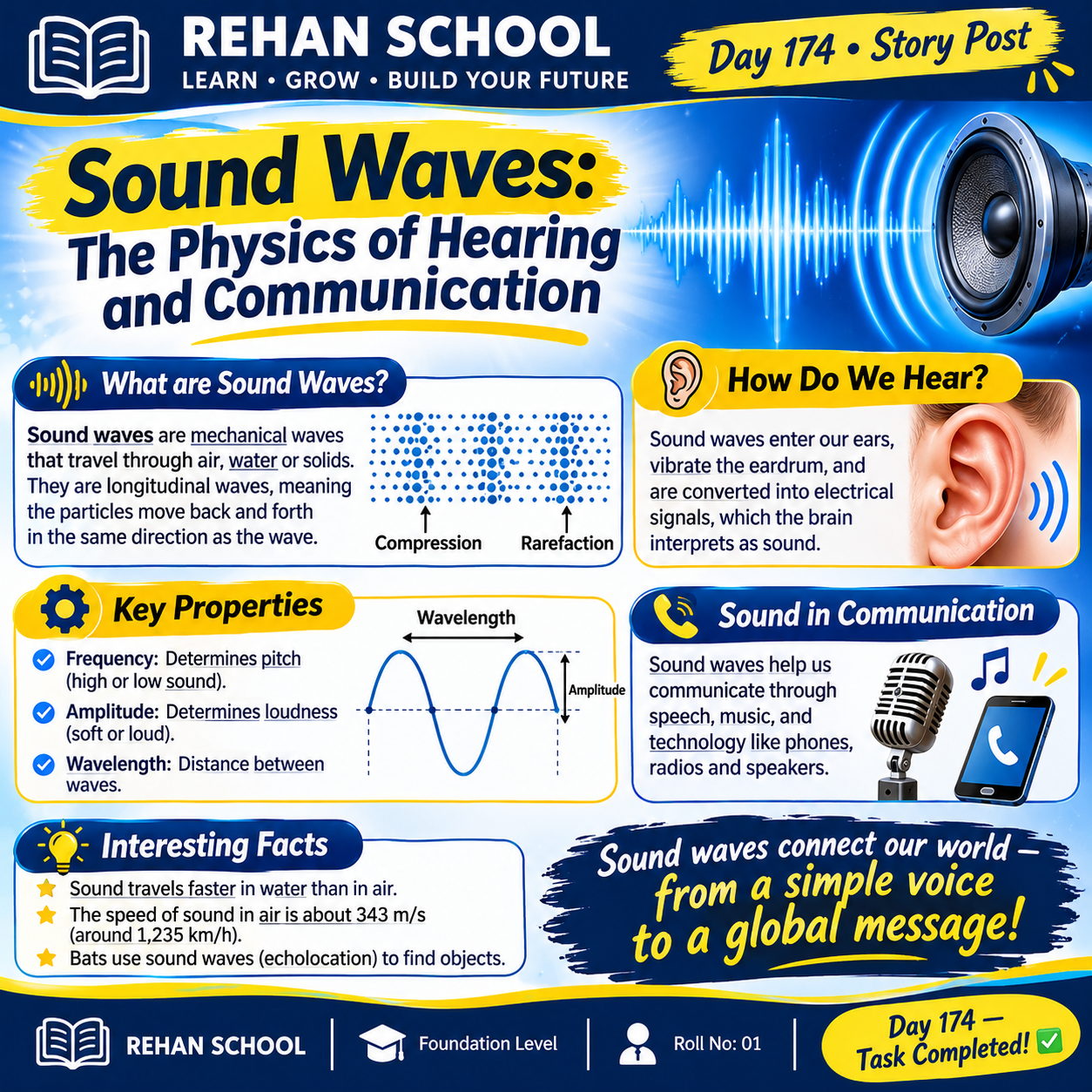
    🏫 **REHAN SCHOOL — URDU BAZAAR CAMPUS** πŸ“– **Day 174 | Story Post** πŸ“š **Foundation Level** πŸ”’ **Roll No: 01** πŸ”Š **Sound Waves: The Physics of Hearing and Communication** Kya aap ne kabhi socha hai ke hum kisi ki awaaz kaise sunte hain aur door baithe kisi insaan ki baat hum tak kaise pohanchti hai? πŸ€”πŸŽ§ Iska jawab sound waves yani awaaz ki lehron mein chhupa hai! Aaj ke Story Post mein maine sound waves aur unke hamari daily life mein important role ke baare mein seekha. πŸ’‘ Jab koi cheez vibrate karti hai, to woh apne aas paas ke medium, jaise hawa, mein sound waves paida kar sakti hai. Ye waves travel karti hain aur jab hamare kaan tak pohanchti hain, to hamara hearing system unhein signals mein convert karta hai, jinhein brain samajhta hai. πŸ§ πŸ‘‚ Sound waves sirf sunne ke liye hi nahi, balki communication ke liye bhi bohot zaroori hain. Hum baat karne, music sunne, alarms, announcements aur different sounds ke zariye information share karte hain. πŸ“’πŸŽΆ Science aur technology mein bhi sound ka use hota hai, jaise ultrasound medical imaging mein madad karta hai. Is task se mujhe ye samajh aaya ke ek simple si awaaz ke peeche bhi physics ka interesting process hota hai. Sound waves ko samajh kar hum apni duniya ko aur behtar tareeqe se explore kar sakte hain. πŸ”¬πŸŒ 🎯 **Vibration → Sound Waves → Ears → Brain → Understanding** ✨ **“Every sound carries a wave, and every wave helps us understand the world around us.”** βœ… **Day 174 — Task Completed!** #RehanSchool #UrduBazaarCampus #Day174 #StoryPost #SoundWaves #Physics #Science #Hearing #Communication #SoundEnergy #Ultrasound #LearningJourney #Education #FoundationLevel #AI #ExploreScience
    0 Commenti 0 condivisioni 74 Views

  • RSIF8
    Roll no:14
    canva post no:67
    canva post topic:"Doubt kills more dreams than failure ever will." — Suzy Kassem

    **Sound Waves: The Physics of Hearing and Communication**

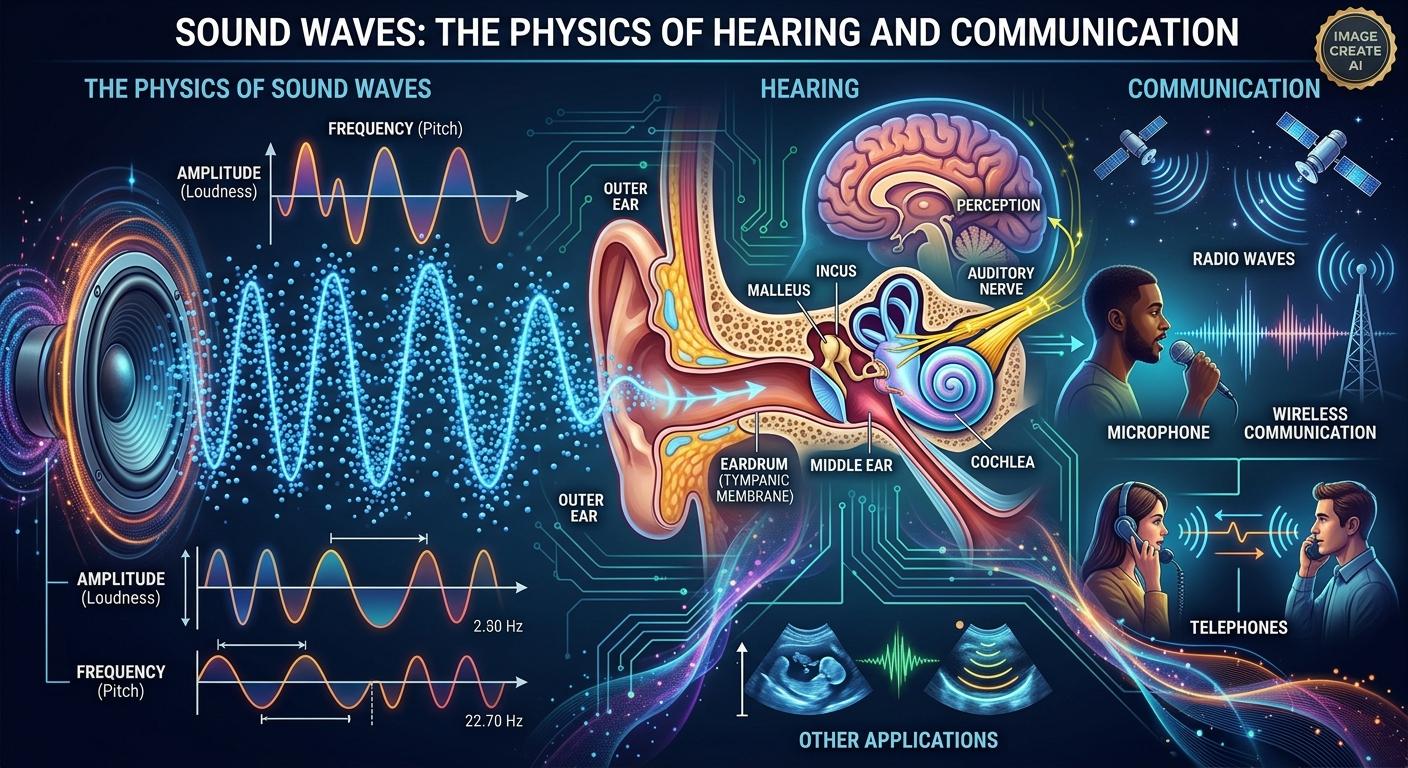
    Welcome to the fascinating world of sound waves, where physics explains how we hear, speak, listen to music, and communicate with one another! Sound is more than just noise; it is a form of energy that travels through a medium such as air, water, or solids in the form of mechanical waves.

    **What Are Sound Waves?**

    Sound waves are produced when an object vibrates, causing nearby particles to vibrate and transfer energy from one place to another. These waves travel through compressions and rarefactions, allowing sound to reach our ears. Unlike light waves, sound waves need a medium to travel and cannot move through a vacuum.

    **How Do We Hear Sound?**

    Our hearing system is an amazing example of science in action! When sound waves enter the outer ear, they travel through the ear canal and make the eardrum vibrate. Tiny bones in the middle ear transmit these vibrations to the cochlea in the inner ear, where they are converted into electrical signals. The auditory nerve carries these signals to the brain, which interprets them as sounds.

    **Key Properties of Sound Waves:**

    **Frequency:** Determines the pitch of a sound, whether it is high or low. It is measured in hertz (Hz).

    **Amplitude:** Determines the loudness of a sound.

    **Wavelength:** Represents the distance between two consecutive points in a wave, such as compressions.

    **Speed:** Sound travels through air at approximately 343 meters per second at 20°C.

    **Sound Waves in Communication**

    Sound waves play an essential role in our everyday lives. Human speech allows us to share ideas and emotions, music brings creativity and expression, and technologies such as telephones, radios, sonar, and voice communication systems help connect people across the world.

    **Why Is Understanding Sound Important?**

    Learning about sound waves helps us understand the science behind hearing, musical instruments, noise reduction, medical ultrasound, and modern communication technologies. It also shows how physics connects scientific principles with the experiences we encounter every day.

    **Discover the invisible waves that bring voices to our ears and connect people, ideas, and the world!**

    Like, Share, and Follow for more interesting science topics, educational content, and fascinating discoveries!

    #SoundWaves #Physics #ScienceEducation #Hearing #Communication #Acoustics #WaveMotion #SoundPhysics #EducationalContent #ScienceFacts #LearningIsFun #Technology #ExploreScience
    RSIF8 Roll no:14 canva post no:67 canva post topic:"Doubt kills more dreams than failure ever will." — Suzy Kassem πŸ”Š **Sound Waves: The Physics of Hearing and Communication** 🌊🎧 Welcome to the fascinating world of sound waves, where physics explains how we hear, speak, listen to music, and communicate with one another! 🌍✨ Sound is more than just noise; it is a form of energy that travels through a medium such as air, water, or solids in the form of mechanical waves. πŸ”¬ **What Are Sound Waves?** Sound waves are produced when an object vibrates, causing nearby particles to vibrate and transfer energy from one place to another. These waves travel through compressions and rarefactions, allowing sound to reach our ears. Unlike light waves, sound waves need a medium to travel and cannot move through a vacuum. πŸ‘‚ **How Do We Hear Sound?** Our hearing system is an amazing example of science in action! When sound waves enter the outer ear, they travel through the ear canal and make the eardrum vibrate. Tiny bones in the middle ear transmit these vibrations to the cochlea in the inner ear, where they are converted into electrical signals. The auditory nerve carries these signals to the brain, which interprets them as sounds. πŸ“š **Key Properties of Sound Waves:** πŸ”Ή **Frequency:** Determines the pitch of a sound, whether it is high or low. It is measured in hertz (Hz). πŸ”Ή **Amplitude:** Determines the loudness of a sound. πŸ”Ή **Wavelength:** Represents the distance between two consecutive points in a wave, such as compressions. πŸ”Ή **Speed:** Sound travels through air at approximately 343 meters per second at 20°C. πŸ“‘ **Sound Waves in Communication** Sound waves play an essential role in our everyday lives. Human speech allows us to share ideas and emotions, music brings creativity and expression, and technologies such as telephones, radios, sonar, and voice communication systems help connect people across the world. πŸ’‘ **Why Is Understanding Sound Important?** Learning about sound waves helps us understand the science behind hearing, musical instruments, noise reduction, medical ultrasound, and modern communication technologies. It also shows how physics connects scientific principles with the experiences we encounter every day. 🌟 **Discover the invisible waves that bring voices to our ears and connect people, ideas, and the world!** πŸ‘ Like, Share, and Follow for more interesting science topics, educational content, and fascinating discoveries! #SoundWaves #Physics #ScienceEducation #Hearing #Communication #Acoustics #WaveMotion #SoundPhysics #EducationalContent #ScienceFacts #LearningIsFun #Technology #ExploreScience πŸ”¬πŸŽ§
    0 Commenti 0 condivisioni 2068 Views
  • RSIF8
    ROll no:82
    Story post: 1
    Story post topic:Sound Waves: The Physics of Hearing and Communication

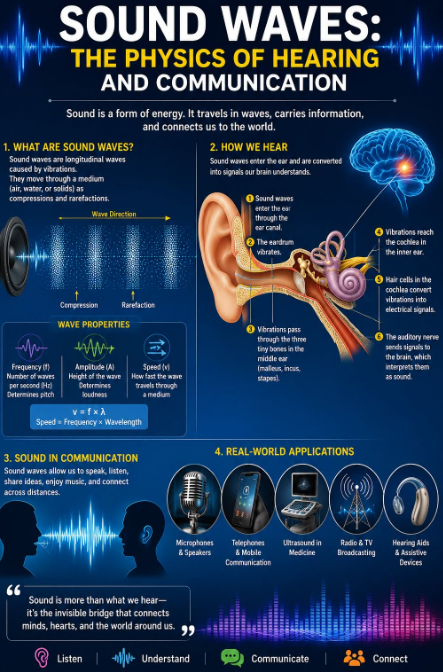
    Sound is an invisible form of energy that plays a vital role in our everyday lives. It travels as waves created by vibrating objects and moves through air, water, or solid materials until it reaches our ears. These waves allow us to hear voices, enjoy music, recognize warning signals, and communicate with people around the world.

    The process of hearing is a remarkable example of nature and science working together. Sound waves enter the ear canal, causing the eardrum to vibrate. These vibrations travel through tiny bones in the middle ear and reach the cochlea, where specialized hair cells convert them into electrical signals. The brain then interprets these signals, allowing us to recognize speech, music, and countless other sounds.

    The physics of sound is also the foundation of modern communication. Technologies such as microphones, speakers, telephones, hearing aids, ultrasound devices, and broadcasting systems all rely on the transmission and interpretation of sound waves. From education and healthcare to entertainment and global communication, sound connects people and makes the exchange of ideas possible.

    Understanding sound waves helps us appreciate both the complexity of the human body and the power of scientific discovery. Every conversation, every melody, and every echo reminds us that invisible waves carry information, emotions, and knowledge across the world.

    "Sound is more than something we hear—it is the invisible force that connects people, powers communication, and brings the world to life."
    RSIF8 ROll no:82 Story post: 1 Story post topic:Sound Waves: The Physics of Hearing and Communication Sound is an invisible form of energy that plays a vital role in our everyday lives. It travels as waves created by vibrating objects and moves through air, water, or solid materials until it reaches our ears. These waves allow us to hear voices, enjoy music, recognize warning signals, and communicate with people around the world. The process of hearing is a remarkable example of nature and science working together. Sound waves enter the ear canal, causing the eardrum to vibrate. These vibrations travel through tiny bones in the middle ear and reach the cochlea, where specialized hair cells convert them into electrical signals. The brain then interprets these signals, allowing us to recognize speech, music, and countless other sounds. The physics of sound is also the foundation of modern communication. Technologies such as microphones, speakers, telephones, hearing aids, ultrasound devices, and broadcasting systems all rely on the transmission and interpretation of sound waves. From education and healthcare to entertainment and global communication, sound connects people and makes the exchange of ideas possible. Understanding sound waves helps us appreciate both the complexity of the human body and the power of scientific discovery. Every conversation, every melody, and every echo reminds us that invisible waves carry information, emotions, and knowledge across the world. "Sound is more than something we hear—it is the invisible force that connects people, powers communication, and brings the world to life."
    0 Commenti 0 condivisioni 2654 Views
  • Day:-174
    rollno:-006
    foundation level
    Story Post
    Sound Waves: The Physics of Hearing and Communication

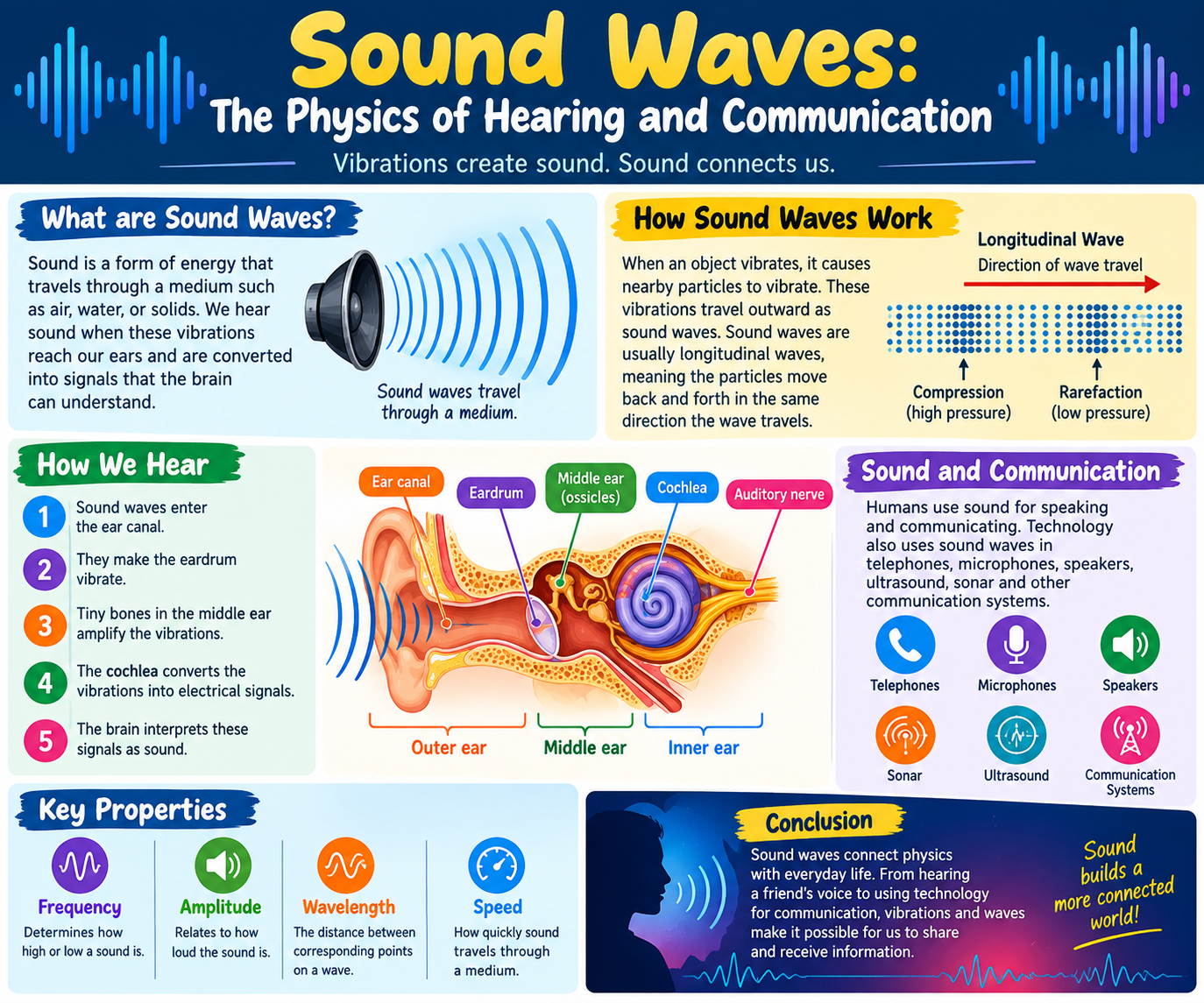
    Sound is a form of energy that travels through a medium such as air, water, or solids. We hear sound when these vibrations reach our ears and are converted into signals that the brain can understand.

    How Sound Waves Work

    When an object vibrates, it causes nearby particles to vibrate. These vibrations travel outward as sound waves. Sound waves are usually longitudinal waves, meaning the particles move back and forth in the same direction the wave travels.

    How We Hear
    Sound waves enter the ear canal.
    They make the eardrum vibrate.
    Tiny bones in the middle ear amplify the vibrations.
    The cochlea converts the vibrations into electrical signals.
    The brain interprets these signals as sound.
    Sound and Communication

    Humans use sound for speaking and communicating. Technology also uses sound waves in telephones, microphones, speakers, ultrasound, sonar, and other communication systems.

    Key Properties
    Frequency → determines how high or low a sound is.
    Amplitude → relates to how loud the sound is.
    Wavelength → the distance between corresponding points on a wave.
    Speed → how quickly sound travels through a medium.

    Conclusion: Sound waves connect physics with everyday life. From hearing a friend's voice to using technology for communication, vibrations and waves make it possible for us to share and receive information.
    Day:-174 rollno:-006 foundation level πŸ“– Story Post πŸ”Š Sound Waves: The Physics of Hearing and Communication Sound is a form of energy that travels through a medium such as air, water, or solids. We hear sound when these vibrations reach our ears and are converted into signals that the brain can understand. 🌊 How Sound Waves Work When an object vibrates, it causes nearby particles to vibrate. These vibrations travel outward as sound waves. Sound waves are usually longitudinal waves, meaning the particles move back and forth in the same direction the wave travels. πŸ‘‚ How We Hear Sound waves enter the ear canal. They make the eardrum vibrate. Tiny bones in the middle ear amplify the vibrations. The cochlea converts the vibrations into electrical signals. The brain interprets these signals as sound. πŸ“‘ Sound and Communication Humans use sound for speaking and communicating. Technology also uses sound waves in telephones, microphones, speakers, ultrasound, sonar, and other communication systems. πŸ”‘ Key Properties Frequency → determines how high or low a sound is. Amplitude → relates to how loud the sound is. Wavelength → the distance between corresponding points on a wave. Speed → how quickly sound travels through a medium. Conclusion: Sound waves connect physics with everyday life. From hearing a friend's voice to using technology for communication, vibrations and waves make it possible for us to share and receive information.
    0 Commenti 0 condivisioni 2073 Views
  • #rsisb
    Roll no.239
    Canva Post no.49
    Foundation Level


    Sound is an essential part of our everyday lives. We hear people speaking, music playing, birds singing, and many other sounds around us. But have you ever wondered how sound travels from one place to another? The answer lies in **sound waves**—vibrations that carry energy through a medium such as air, water, or solids.

    Sound is produced when an object **vibrates**. These vibrations cause nearby particles to move back and forth, creating a series of compressions and rarefactions. This movement travels outward as a wave. Unlike light, sound cannot travel through a vacuum because it needs particles to carry the vibrations.

    The characteristics of sound include **frequency, amplitude, wavelength, and speed**. Frequency determines the **pitch** of a sound: higher frequencies produce higher-pitched sounds, while lower frequencies produce deeper sounds. Amplitude is related to the **loudness** of a sound. Larger vibrations generally create louder sounds.

    Our ears are remarkable organs designed to detect these waves. Sound waves enter the ear and cause the **eardrum** to vibrate. These vibrations are transmitted through tiny bones in the middle ear and eventually reach the inner ear, where specialized cells convert them into electrical signals. The brain then interprets these signals as meaningful sounds.

    Sound waves also play a vital role in **human communication**. When we speak, our vocal cords vibrate and produce sound waves. These waves travel through the air to another person's ears, allowing them to hear and understand our words. Modern technology uses the same principles in telephones, microphones, radios, and other communication devices.

    The study of sound helps us understand not only hearing and communication but also music, medicine, engineering, and technology. From the simple vibration of a guitar string to advanced ultrasound technology, sound waves demonstrate the fascinating connection between **physics and everyday life**.

    **Sound is more than something we hear—it is energy in motion, carrying information and connecting us with the world around us.**

    #SoundWaves #Physics #Science #Hearing #Communication #Education #Learning #Waves #Technology
    #rsisb Roll no.239 Canva Post no.49 Foundation Level Sound is an essential part of our everyday lives. We hear people speaking, music playing, birds singing, and many other sounds around us. But have you ever wondered how sound travels from one place to another? The answer lies in **sound waves**—vibrations that carry energy through a medium such as air, water, or solids. Sound is produced when an object **vibrates**. These vibrations cause nearby particles to move back and forth, creating a series of compressions and rarefactions. This movement travels outward as a wave. Unlike light, sound cannot travel through a vacuum because it needs particles to carry the vibrations. The characteristics of sound include **frequency, amplitude, wavelength, and speed**. Frequency determines the **pitch** of a sound: higher frequencies produce higher-pitched sounds, while lower frequencies produce deeper sounds. Amplitude is related to the **loudness** of a sound. Larger vibrations generally create louder sounds. Our ears are remarkable organs designed to detect these waves. Sound waves enter the ear and cause the **eardrum** to vibrate. These vibrations are transmitted through tiny bones in the middle ear and eventually reach the inner ear, where specialized cells convert them into electrical signals. The brain then interprets these signals as meaningful sounds. Sound waves also play a vital role in **human communication**. When we speak, our vocal cords vibrate and produce sound waves. These waves travel through the air to another person's ears, allowing them to hear and understand our words. Modern technology uses the same principles in telephones, microphones, radios, and other communication devices. The study of sound helps us understand not only hearing and communication but also music, medicine, engineering, and technology. From the simple vibration of a guitar string to advanced ultrasound technology, sound waves demonstrate the fascinating connection between **physics and everyday life**. 🌟 **Sound is more than something we hear—it is energy in motion, carrying information and connecting us with the world around us.** #SoundWaves #Physics #Science #Hearing #Communication #Education #Learning #Waves #Technology πŸ”ŠπŸŒπŸŽ΅
    0 Commenti 0 condivisioni 5389 Views
  • #rsisb
    Roll No.240
    Story No.14
    Foundation Level

    **Sound Waves: The Physics of Hearing and Communication**

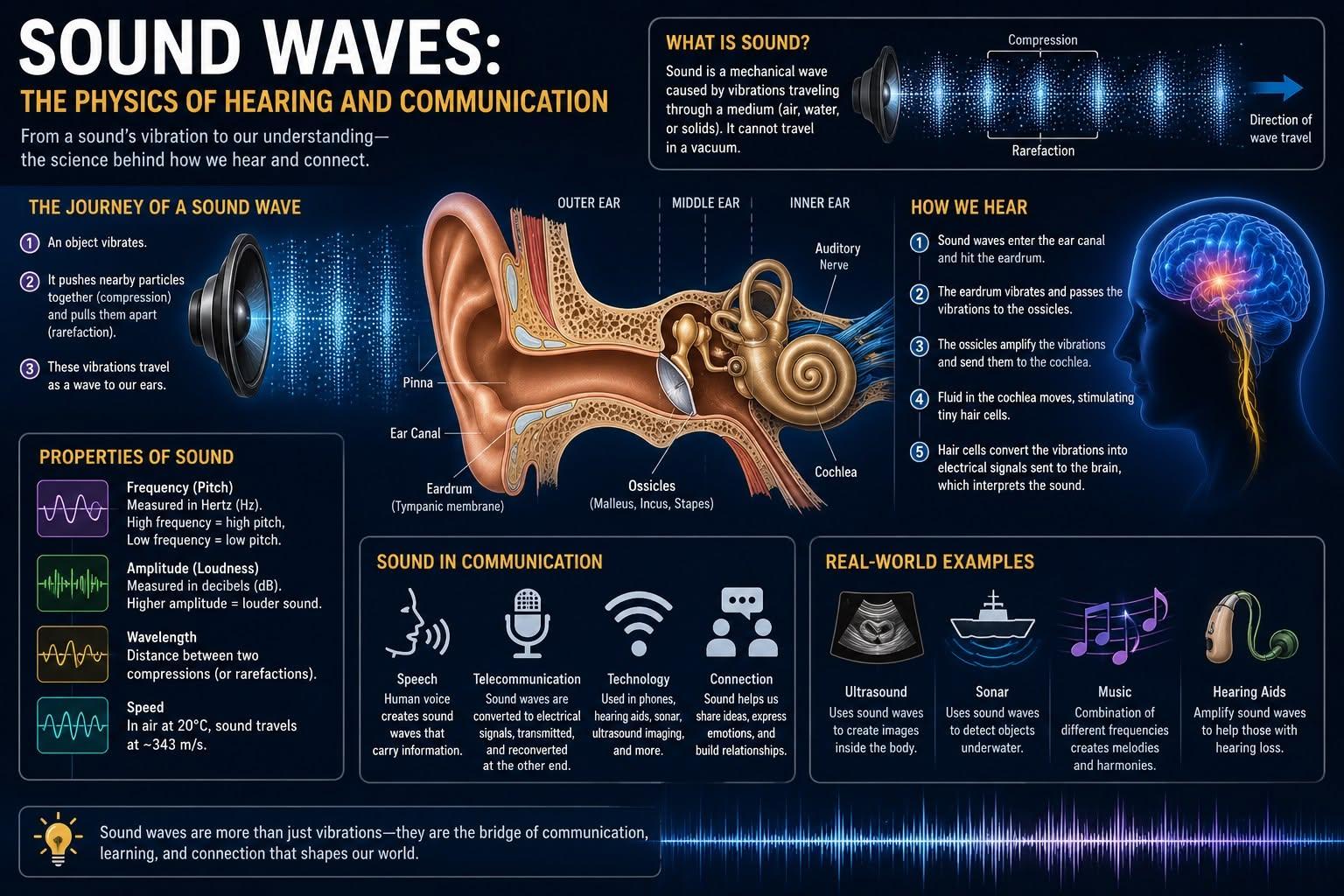
    Sound waves are invisible vibrations that travel through air, water, and solids, allowing us to hear and communicate with the world around us. Every sound begins when an object vibrates, creating waves that move through a medium until they reach our ears. These waves carry energy, not matter, and their frequency determines the pitch while their amplitude controls the loudness of the sound.

    Inside the human ear, sound waves follow an incredible journey. They enter through the outer ear, vibrate the eardrum, and pass through three tiny bones called the ossicles. These vibrations then reach the cochlea, where thousands of tiny hair cells convert them into electrical signals. The auditory nerve carries these signals to the brain, which interprets them as speech, music, or other familiar sounds.

    Sound plays a vital role in communication, education, entertainment, medicine, and technology. From conversations and musical performances to ultrasound imaging, sonar systems, and hearing aids, the science of sound has transformed countless aspects of modern life. Understanding how sound waves travel and interact with different materials helps scientists and engineers develop better communication systems and innovative technologies.

    The study of sound waves demonstrates the fascinating connection between physics and everyday life. By exploring concepts such as vibration, frequency, wavelength, amplitude, and wave speed, we gain a deeper appreciation of how hearing works and how sound enables people to connect, learn, and share ideas across the world.

    Rehan School Islamabad Campus
    Asma Shaheen EducationWali
    Irum Asim
    Saima Happinesswali
    #rsisb Roll No.240 Story No.14 Foundation Level **Sound Waves: The Physics of Hearing and Communication** Sound waves are invisible vibrations that travel through air, water, and solids, allowing us to hear and communicate with the world around us. Every sound begins when an object vibrates, creating waves that move through a medium until they reach our ears. These waves carry energy, not matter, and their frequency determines the pitch while their amplitude controls the loudness of the sound. Inside the human ear, sound waves follow an incredible journey. They enter through the outer ear, vibrate the eardrum, and pass through three tiny bones called the ossicles. These vibrations then reach the cochlea, where thousands of tiny hair cells convert them into electrical signals. The auditory nerve carries these signals to the brain, which interprets them as speech, music, or other familiar sounds. Sound plays a vital role in communication, education, entertainment, medicine, and technology. From conversations and musical performances to ultrasound imaging, sonar systems, and hearing aids, the science of sound has transformed countless aspects of modern life. Understanding how sound waves travel and interact with different materials helps scientists and engineers develop better communication systems and innovative technologies. The study of sound waves demonstrates the fascinating connection between physics and everyday life. By exploring concepts such as vibration, frequency, wavelength, amplitude, and wave speed, we gain a deeper appreciation of how hearing works and how sound enables people to connect, learn, and share ideas across the world. Rehan School Islamabad Campus Asma Shaheen EducationWali Irum Asim Saima Happinesswali
    0 Commenti 0 condivisioni 6226 Views
  • Forwarded as received !

    Are you a female doctor who is completing her house job and looking for a space to start your clinic? Are you motivated to work within your own communities (Model Colony, Bin Qasim, Korangi and Lyari- Karachi)? Sehat Kahani is here to offer you an amazing opportunity to run your clinic by providing you with an equipped space, medical personnel, mobilization resources and diagnostic facilities (lab referrals and ultrasound). Deadline to apply is 25th March. The first five eligible candidates will be selected on rolling basis. Apply fast! For further information please contact 03350336506 or 03433437227.
    makkiyajawed@sehatkahani.comzohaib.sehatkahani@gmail.com
    Forwarded as received ! Are you a female doctor who is completing her house job and looking for a space to start your clinic? Are you motivated to work within your own communities (Model Colony, Bin Qasim, Korangi and Lyari- Karachi)? Sehat Kahani is here to offer you an amazing opportunity to run your clinic by providing you with an equipped space, medical personnel, mobilization resources and diagnostic facilities (lab referrals and ultrasound). Deadline to apply is 25th March. The first five eligible candidates will be selected on rolling basis. Apply fast! For further information please contact 03350336506 or 03433437227. makkiyajawed@sehatkahani.comzohaib.sehatkahani@gmail.com
    0 Commenti 0 condivisioni 747 Views