#rsisb
Roll No 253
Foundation Level
Story Post 24
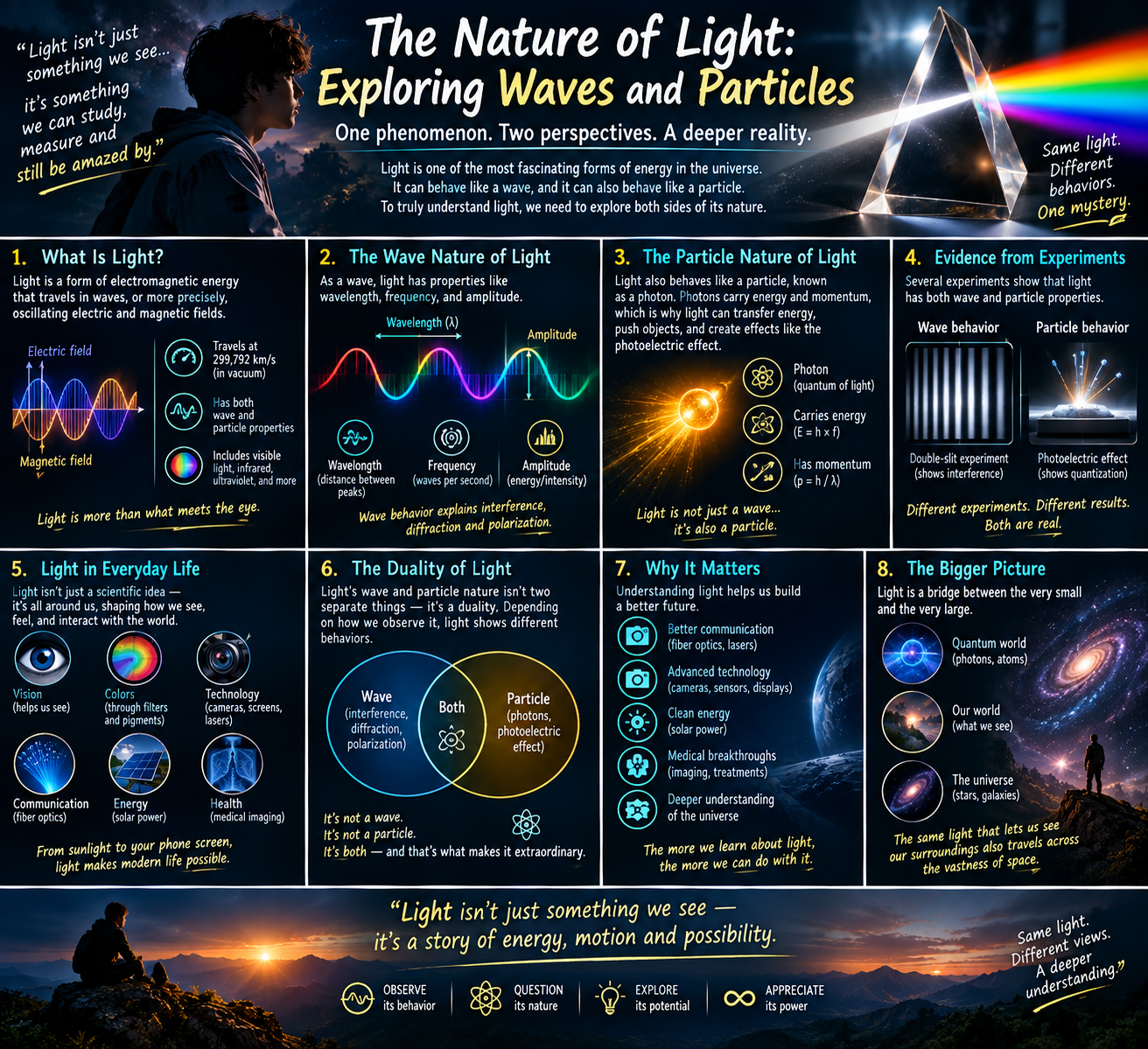
# The Nature of Light: Exploring Waves and Particles
Imagine standing beneath a night sky filled with stars.
Every photon reaching your eyes has traveled across space carrying information from distant worlds. Light allows us to see, measure, communicate, explore, and understand the universe itself.
But light is far stranger than it first appears.
Sometimes it behaves like a **wave** .
Sometimes it behaves like a **particle** .
And understanding this strange dual nature changed our picture of reality forever.
---
# 1. What Is Light?
Light is a form of **electromagnetic radiation**—energy carried through oscillating electric and magnetic fields.
In empty space, electromagnetic waves travel at approximately:
### **299,792 kilometers per second**
That's the speed of light in vacuum.
Visible light is only a small part of the electromagnetic spectrum.
Beyond what our eyes can see are:
Radio waves
Microwaves
Infrared
Visible light
Ultraviolet
🩻 X-rays
Gamma rays
So light isn't simply what we see.
### **It's an enormous family of electromagnetic phenomena.**
---
# 2. The Wave Nature of Light
When light behaves as a wave, we can describe it using several important properties:
**Wavelength** — the distance between successive wave peaks
**Frequency** — how many oscillations occur each second
**Amplitude** — related to the wave's intensity
These properties help explain many familiar phenomena.
**Interference** occurs when waves combine.
**Diffraction** occurs when waves spread around openings or obstacles.
**Polarization** describes the orientation of electromagnetic oscillations.
The wave model explains behaviors that are difficult to understand if we imagine light only as tiny particles.
---
# 3. The Particle Nature of Light
But the story doesn't end there.
Light can also behave as if it arrives in discrete packets of energy called **photons**.
A photon is a quantum of electromagnetic radiation.
Its energy is related to frequency:
### **E = h × f**
And its momentum is related to its wavelength:
### **p = h / λ**
This particle-like behavior helps explain phenomena such as the **photoelectric effect**, where light can transfer energy to electrons.
So light isn't simply a smooth continuous wave.
At the quantum level, energy can be exchanged in discrete amounts.
### **Light has another side—and it's quantum.**
---
# 4. Evidence From Experiments
The strange nature of light isn't merely philosophical.
Experiments demonstrate it.
### Double-Slit Experiment
When light passes through two narrow openings, an **interference pattern** can appear—strong evidence of wave-like behavior.
### Photoelectric Effect
When light strikes certain materials, it can eject electrons. This behavior is explained using photons and quantized energy.
Different experiments reveal different aspects of light.
And that's one of the most fascinating things about physics:
### **The same phenomenon can reveal different behaviors depending on how we investigate it.**
---
# 5. Light in Everyday Life
Light isn't something that exists only inside physics laboratories.
It's everywhere.
**Vision** — allows us to see the world
**Colors** — arise from how different wavelengths interact with matter
**Cameras** — convert light into images
**Screens** — produce controlled patterns of light
**Fiber optics** — carry information using light
**Solar panels** — convert light energy into electrical energy
🩻 **Medical imaging** — uses electromagnetic radiation to see inside the body
From sunrise to smartphone screens…
### **Modern civilization depends heavily on our ability to control light.**
---
# 6. The Duality of Light
Here lies the great mystery.
Light can display **wave-like behavior**
and
**particle-like behavior** .
This is known as **wave-particle duality**.
It's important to understand that this doesn't mean light is literally switching between being a classical wave and a classical particle like two separate objects.
Instead, quantum physics gives us a deeper framework in which classical wave and particle descriptions each capture different aspects of light's behavior.
### **Two perspectives. One quantum reality.**
---
# 7. Why Understanding Light Matters
Learning how light behaves has transformed technology.
**Communication** — fiber-optic networks
**Science** — spectroscopy and microscopy
**Imaging** — cameras and sensors
**Energy** — solar technology
**Medicine** — lasers and diagnostic imaging
**Astronomy** — studying distant stars and galaxies
When astronomers observe light from a distant star, they aren't simply seeing brightness.
They can analyze the light's wavelengths and learn about the star's:
Temperature
Chemical composition
Motion
Environment
### **Light carries information across space.**
---
# 8. The Bigger Picture
Light connects the microscopic and the cosmic.
At the quantum scale, photons interact with atoms and electrons.
At human scales, light allows us to see and communicate.
Across astronomical distances, light travels from stars and galaxies to our telescopes.
In many ways, light is our messenger from the universe.
When we look at a distant galaxy, we are receiving photons that may have traveled for millions or billions of years before reaching Earth.
### **Looking at the universe means looking at ancient light.**
---
# The Final Thought
Light is more than something that illuminates a room.
It is energy.
It is information.
It is electromagnetic radiation.
It has quantum behavior.
And it is one of the most important tools we have for exploring reality.
From a photon interacting with an electron…
to sunlight crossing space…
to the glow of a distant galaxy…
### **Light connects the smallest scales of nature with the largest.**
So the next time you see sunlight streaming through a window , a rainbow , or stars shining overhead , remember:
**You aren't simply seeing light.**
You're witnessing one of the universe's most fascinating mysteries—a phenomenon that behaves in ways far stranger and more beautiful than our everyday experience suggests.
# **Light isn't just something we see—it's a story of energy, motion, information, and possibility.** ∞
Asma Shaheen EducationWali
Saima Empowerment Wali
Mishaal TrainingWali
Roll No 253
Foundation Level
Story Post 24
# The Nature of Light: Exploring Waves and Particles
Imagine standing beneath a night sky filled with stars.
Every photon reaching your eyes has traveled across space carrying information from distant worlds. Light allows us to see, measure, communicate, explore, and understand the universe itself.
But light is far stranger than it first appears.
Sometimes it behaves like a **wave** .
Sometimes it behaves like a **particle** .
And understanding this strange dual nature changed our picture of reality forever.
---
# 1. What Is Light?
Light is a form of **electromagnetic radiation**—energy carried through oscillating electric and magnetic fields.
In empty space, electromagnetic waves travel at approximately:
### **299,792 kilometers per second**
That's the speed of light in vacuum.
Visible light is only a small part of the electromagnetic spectrum.
Beyond what our eyes can see are:
Radio waves
Microwaves
Infrared
Visible light
Ultraviolet
🩻 X-rays
Gamma rays
So light isn't simply what we see.
### **It's an enormous family of electromagnetic phenomena.**
---
# 2. The Wave Nature of Light
When light behaves as a wave, we can describe it using several important properties:
**Wavelength** — the distance between successive wave peaks
**Frequency** — how many oscillations occur each second
**Amplitude** — related to the wave's intensity
These properties help explain many familiar phenomena.
**Interference** occurs when waves combine.
**Diffraction** occurs when waves spread around openings or obstacles.
**Polarization** describes the orientation of electromagnetic oscillations.
The wave model explains behaviors that are difficult to understand if we imagine light only as tiny particles.
---
# 3. The Particle Nature of Light
But the story doesn't end there.
Light can also behave as if it arrives in discrete packets of energy called **photons**.
A photon is a quantum of electromagnetic radiation.
Its energy is related to frequency:
### **E = h × f**
And its momentum is related to its wavelength:
### **p = h / λ**
This particle-like behavior helps explain phenomena such as the **photoelectric effect**, where light can transfer energy to electrons.
So light isn't simply a smooth continuous wave.
At the quantum level, energy can be exchanged in discrete amounts.
### **Light has another side—and it's quantum.**
---
# 4. Evidence From Experiments
The strange nature of light isn't merely philosophical.
Experiments demonstrate it.
### Double-Slit Experiment
When light passes through two narrow openings, an **interference pattern** can appear—strong evidence of wave-like behavior.
### Photoelectric Effect
When light strikes certain materials, it can eject electrons. This behavior is explained using photons and quantized energy.
Different experiments reveal different aspects of light.
And that's one of the most fascinating things about physics:
### **The same phenomenon can reveal different behaviors depending on how we investigate it.**
---
# 5. Light in Everyday Life
Light isn't something that exists only inside physics laboratories.
It's everywhere.
**Vision** — allows us to see the world
**Colors** — arise from how different wavelengths interact with matter
**Cameras** — convert light into images
**Screens** — produce controlled patterns of light
**Fiber optics** — carry information using light
**Solar panels** — convert light energy into electrical energy
🩻 **Medical imaging** — uses electromagnetic radiation to see inside the body
From sunrise to smartphone screens…
### **Modern civilization depends heavily on our ability to control light.**
---
# 6. The Duality of Light
Here lies the great mystery.
Light can display **wave-like behavior**
and
**particle-like behavior** .
This is known as **wave-particle duality**.
It's important to understand that this doesn't mean light is literally switching between being a classical wave and a classical particle like two separate objects.
Instead, quantum physics gives us a deeper framework in which classical wave and particle descriptions each capture different aspects of light's behavior.
### **Two perspectives. One quantum reality.**
---
# 7. Why Understanding Light Matters
Learning how light behaves has transformed technology.
**Communication** — fiber-optic networks
**Science** — spectroscopy and microscopy
**Imaging** — cameras and sensors
**Energy** — solar technology
**Medicine** — lasers and diagnostic imaging
**Astronomy** — studying distant stars and galaxies
When astronomers observe light from a distant star, they aren't simply seeing brightness.
They can analyze the light's wavelengths and learn about the star's:
Temperature
Chemical composition
Motion
Environment
### **Light carries information across space.**
---
# 8. The Bigger Picture
Light connects the microscopic and the cosmic.
At the quantum scale, photons interact with atoms and electrons.
At human scales, light allows us to see and communicate.
Across astronomical distances, light travels from stars and galaxies to our telescopes.
In many ways, light is our messenger from the universe.
When we look at a distant galaxy, we are receiving photons that may have traveled for millions or billions of years before reaching Earth.
### **Looking at the universe means looking at ancient light.**
---
# The Final Thought
Light is more than something that illuminates a room.
It is energy.
It is information.
It is electromagnetic radiation.
It has quantum behavior.
And it is one of the most important tools we have for exploring reality.
From a photon interacting with an electron…
to sunlight crossing space…
to the glow of a distant galaxy…
### **Light connects the smallest scales of nature with the largest.**
So the next time you see sunlight streaming through a window , a rainbow , or stars shining overhead , remember:
**You aren't simply seeing light.**
You're witnessing one of the universe's most fascinating mysteries—a phenomenon that behaves in ways far stranger and more beautiful than our everyday experience suggests.
# **Light isn't just something we see—it's a story of energy, motion, information, and possibility.** ∞
Asma Shaheen EducationWali
Saima Empowerment Wali
Mishaal TrainingWali
#rsisb
Roll No 253
Foundation Level
Story Post 24
# 🌈⚡ The Nature of Light: Exploring Waves and Particles
Imagine standing beneath a night sky filled with stars. 🌌✨
Every photon reaching your eyes has traveled across space carrying information from distant worlds. Light allows us to see, measure, communicate, explore, and understand the universe itself. 🔭👁️📡
But light is far stranger than it first appears.
Sometimes it behaves like a **wave** 🌊.
Sometimes it behaves like a **particle** ⚛️.
And understanding this strange dual nature changed our picture of reality forever. 🧠🌌
---
# 💡🌌 1. What Is Light?
Light is a form of **electromagnetic radiation**—energy carried through oscillating electric and magnetic fields. ⚡🧲
In empty space, electromagnetic waves travel at approximately:
### 🚀 **299,792 kilometers per second**
That's the speed of light in vacuum.
Visible light 👁️🌈 is only a small part of the electromagnetic spectrum.
Beyond what our eyes can see are:
📻 Radio waves
📡 Microwaves
🔥 Infrared
🌈 Visible light
☀️ Ultraviolet
🩻 X-rays
☢️ Gamma rays
So light isn't simply what we see.
### **It's an enormous family of electromagnetic phenomena.** 🌌⚡
---
# 🌊🔬 2. The Wave Nature of Light
When light behaves as a wave, we can describe it using several important properties:
〰️ **Wavelength** — the distance between successive wave peaks
⚡ **Frequency** — how many oscillations occur each second
📈 **Amplitude** — related to the wave's intensity
These properties help explain many familiar phenomena.
🌈 **Interference** occurs when waves combine.
🔍 **Diffraction** occurs when waves spread around openings or obstacles.
🕶️ **Polarization** describes the orientation of electromagnetic oscillations.
The wave model explains behaviors that are difficult to understand if we imagine light only as tiny particles.
---
# ⚛️✨ 3. The Particle Nature of Light
But the story doesn't end there.
Light can also behave as if it arrives in discrete packets of energy called **photons**. ⚛️💡
A photon is a quantum of electromagnetic radiation.
Its energy is related to frequency:
### **E = h × f** ⚡
And its momentum is related to its wavelength:
### **p = h / λ** 🌊⚛️
This particle-like behavior helps explain phenomena such as the **photoelectric effect**, where light can transfer energy to electrons.
So light isn't simply a smooth continuous wave.
At the quantum level, energy can be exchanged in discrete amounts.
### **Light has another side—and it's quantum.** 🌌⚛️
---
# 🧪🔍 4. Evidence From Experiments
The strange nature of light isn't merely philosophical.
Experiments demonstrate it.
### 🌊 Double-Slit Experiment
When light passes through two narrow openings, an **interference pattern** can appear—strong evidence of wave-like behavior. 🌊〰️
### ⚡ Photoelectric Effect
When light strikes certain materials, it can eject electrons. This behavior is explained using photons and quantized energy. ⚛️🔋
Different experiments reveal different aspects of light.
And that's one of the most fascinating things about physics:
### **The same phenomenon can reveal different behaviors depending on how we investigate it.** 🔬✨
---
# 👁️🌈 5. Light in Everyday Life
Light isn't something that exists only inside physics laboratories.
It's everywhere. 🌍☀️
👁️ **Vision** — allows us to see the world
🌈 **Colors** — arise from how different wavelengths interact with matter
📷 **Cameras** — convert light into images
📱 **Screens** — produce controlled patterns of light
🌐 **Fiber optics** — carry information using light
☀️ **Solar panels** — convert light energy into electrical energy
🩻 **Medical imaging** — uses electromagnetic radiation to see inside the body
From sunrise to smartphone screens…
### **Modern civilization depends heavily on our ability to control light.** 💡🌍
---
# 🌊⚛️ 6. The Duality of Light
Here lies the great mystery.
Light can display **wave-like behavior** 🌊
and
**particle-like behavior** ⚛️.
This is known as **wave-particle duality**.
It's important to understand that this doesn't mean light is literally switching between being a classical wave and a classical particle like two separate objects.
Instead, quantum physics gives us a deeper framework in which classical wave and particle descriptions each capture different aspects of light's behavior.
### **Two perspectives. One quantum reality.** 🌌✨
---
# 🚀🔬 7. Why Understanding Light Matters
Learning how light behaves has transformed technology.
📡 **Communication** — fiber-optic networks
🔬 **Science** — spectroscopy and microscopy
📷 **Imaging** — cameras and sensors
☀️ **Energy** — solar technology
🩺 **Medicine** — lasers and diagnostic imaging
🚀 **Astronomy** — studying distant stars and galaxies
When astronomers observe light from a distant star, they aren't simply seeing brightness.
They can analyze the light's wavelengths and learn about the star's:
🌡️ Temperature
🧪 Chemical composition
💨 Motion
🌌 Environment
### **Light carries information across space.**
---
# 🌌🔭 8. The Bigger Picture
Light connects the microscopic and the cosmic.
At the quantum scale, photons interact with atoms and electrons. ⚛️🔬
At human scales, light allows us to see and communicate. 👁️📱
Across astronomical distances, light travels from stars and galaxies to our telescopes. 🌟🔭
In many ways, light is our messenger from the universe.
When we look at a distant galaxy, we are receiving photons that may have traveled for millions or billions of years before reaching Earth. 🌌⏳
### **Looking at the universe means looking at ancient light.** ✨
---
# 🌅💡 The Final Thought
Light is more than something that illuminates a room.
It is energy. ⚡
It is information. 📡
It is electromagnetic radiation. 🌊
It has quantum behavior. ⚛️
And it is one of the most important tools we have for exploring reality. 🔭
From a photon interacting with an electron…
to sunlight crossing space…
to the glow of a distant galaxy…
### **Light connects the smallest scales of nature with the largest.** 🌌⚛️
So the next time you see sunlight streaming through a window ☀️, a rainbow 🌈, or stars shining overhead ⭐, remember:
**You aren't simply seeing light.**
You're witnessing one of the universe's most fascinating mysteries—a phenomenon that behaves in ways far stranger and more beautiful than our everyday experience suggests. 🌊⚛️✨
# 🌈🌌 **Light isn't just something we see—it's a story of energy, motion, information, and possibility.** ⚡🔬∞
Asma Shaheen EducationWali
Saima Empowerment Wali
Mishaal TrainingWali
0 Comentários
0 Compartilhamentos
4004 Visualizações