• Accl portal
    Day 12
    Week 2
    Book 1
    Story post
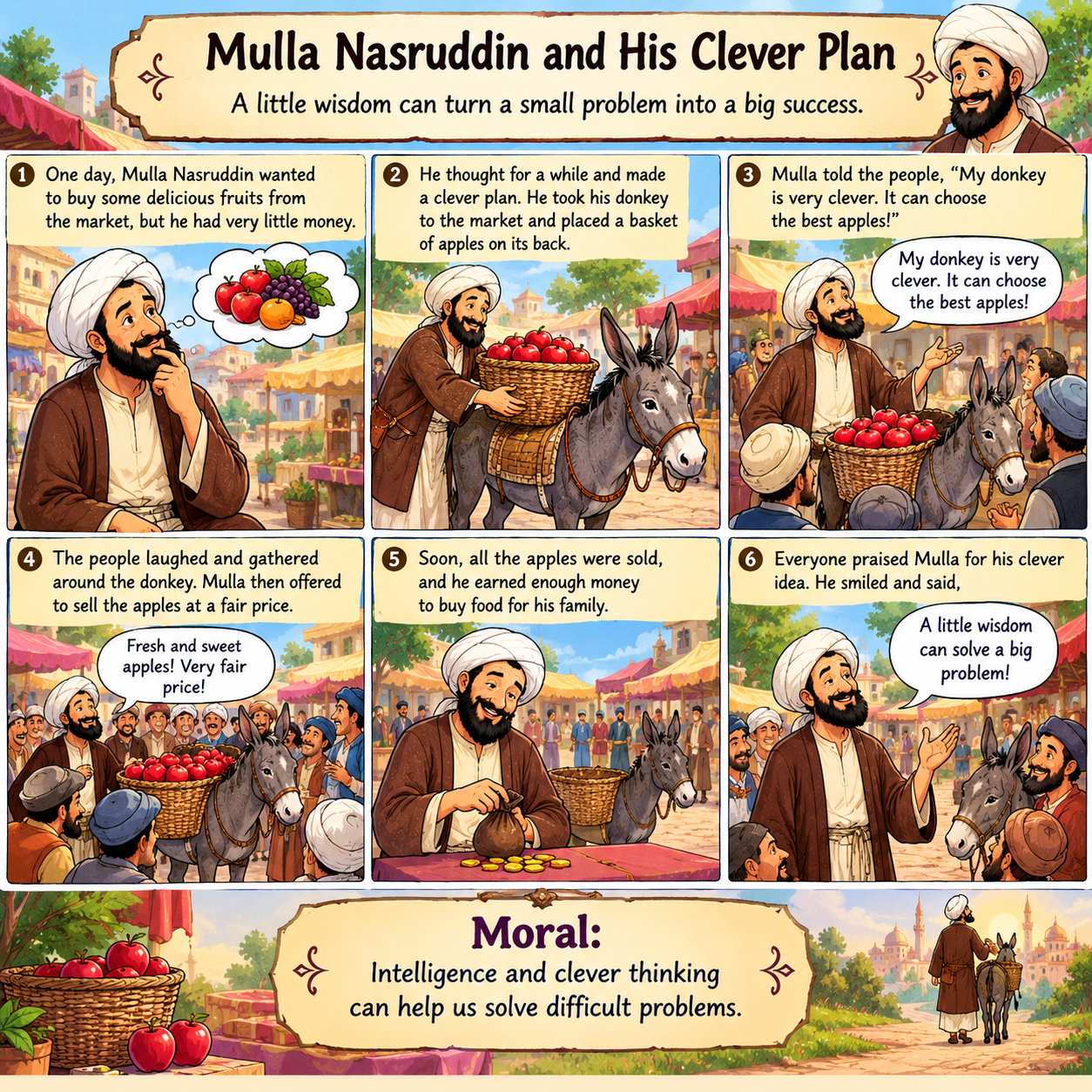
    # Mulla Nasruddin and His Clever Plan
    One day, Mulla Nasruddin wanted to buy some delicious fruits from the market, but he had very little money.
    He thought for a while and made a clever plan. He took his donkey to the market and placed a basket of apples on its back.
    Mulla told the people, “My donkey is very clever. It can choose the best apples!”
    The people laughed and gathered around the donkey. Mulla then offered to sell the apples at a fair price. Soon, all the apples were sold, and he earned enough money to buy food for his family.
    Everyone praised Mulla for his clever idea. He smiled and said, “A little wisdom can solve a big problem!”
    Moral: Intelligence and clever thinking can help us solve difficult problems.
    Accl portal Day 12 Week 2 Book 1 Story post # Mulla Nasruddin and His Clever Plan One day, Mulla Nasruddin wanted to buy some delicious fruits from the market, but he had very little money. He thought for a while and made a clever plan. He took his donkey to the market and placed a basket of apples on its back. Mulla told the people, “My donkey is very clever. It can choose the best apples!” The people laughed and gathered around the donkey. Mulla then offered to sell the apples at a fair price. Soon, all the apples were sold, and he earned enough money to buy food for his family. Everyone praised Mulla for his clever idea. He smiled and said, “A little wisdom can solve a big problem!” Moral: Intelligence and clever thinking can help us solve difficult problems.
    0 Commentarii 0 Distribuiri 653 Views
  • #rsisb
    Roll no.239
    Miss zoya no. 20
    Foundation Level

    Hello, everyone! Welcome to my new video. My name is Subhan, and I am a Foundation Level student at Rehan School Islamabad Bahria Campus. Today, I am very excited to share an interesting topic with you: **Red and Green**. In this video, I will explore these two beautiful colors, their meanings, their importance in our daily lives, and the different ways we see them in the world around us.
    Colors are an important part of our lives. Every day, we see different colors in nature, schools, homes, clothes, books, toys, flowers, fruits, and many other things. Colors make our world look beautiful, interesting, and full of life. They also help us recognize objects, understand signs, express creativity, and communicate different messages.
    ## The Meaning and Importance of Red
    Red is a bright, powerful, and eye-catching color. It is often associated with love, energy, courage, excitement, and strong emotions. We can see red in roses, apples, strawberries, tomatoes, flags, decorations, and many other things.
    Red is also important for safety. In traffic lights, red tells drivers and pedestrians to stop. Red warning signs can alert people to danger and remind them to be careful. This shows that colors are not only beautiful but can also help protect our lives.
    In art and drawing, red can make a picture look bold and attractive. Artists use red to highlight important objects, create contrast, and express different feelings. Red is also used in celebrations and decorations in many cultures around the world.
    ## The Meaning and Importance of Green
    Green is a refreshing and beautiful color that we often associate with nature, plants, trees, grass, and growth. When we look at green forests, gardens, and fields, we can see the beauty of the natural world.
    Green plants are very important for life on Earth. Plants help produce oxygen, provide food, support wildlife, and contribute to healthy ecosystems. Trees also provide shade and shelter for many living things. By planting trees, protecting forests, and keeping our surroundings clean, we can help care for our planet.
    Green is also used in traffic lights. A green signal generally means that traffic may proceed when it is safe to do so. Green symbols are often used to represent nature, environmental awareness, and environmentally friendly activities.
    In drawings and paintings, green helps artists show leaves, grass, gardens, mountains, and beautiful landscapes. It can make artwork look fresh, peaceful, and natural.
    ## Red and Green in Our Daily Lives
    \#RedAndGreen #JapaneseLearning #Aka #Midori #LearnJapanese #Colors #Education #StudentLife #Confidence #NewVideo #KeepLearning
    #rsisb Roll no.239 Miss zoya no. 20 Foundation Level Hello, everyone! Welcome to my new video. My name is Subhan, and I am a Foundation Level student at Rehan School Islamabad Bahria Campus. Today, I am very excited to share an interesting topic with you: **Red and Green**. In this video, I will explore these two beautiful colors, their meanings, their importance in our daily lives, and the different ways we see them in the world around us. Colors are an important part of our lives. Every day, we see different colors in nature, schools, homes, clothes, books, toys, flowers, fruits, and many other things. Colors make our world look beautiful, interesting, and full of life. They also help us recognize objects, understand signs, express creativity, and communicate different messages. ## 🔴 The Meaning and Importance of Red Red is a bright, powerful, and eye-catching color. It is often associated with love, energy, courage, excitement, and strong emotions. We can see red in roses, apples, strawberries, tomatoes, flags, decorations, and many other things. Red is also important for safety. In traffic lights, red tells drivers and pedestrians to stop. Red warning signs can alert people to danger and remind them to be careful. This shows that colors are not only beautiful but can also help protect our lives. In art and drawing, red can make a picture look bold and attractive. Artists use red to highlight important objects, create contrast, and express different feelings. Red is also used in celebrations and decorations in many cultures around the world. ## 🟢 The Meaning and Importance of Green Green is a refreshing and beautiful color that we often associate with nature, plants, trees, grass, and growth. When we look at green forests, gardens, and fields, we can see the beauty of the natural world. Green plants are very important for life on Earth. Plants help produce oxygen, provide food, support wildlife, and contribute to healthy ecosystems. Trees also provide shade and shelter for many living things. By planting trees, protecting forests, and keeping our surroundings clean, we can help care for our planet. Green is also used in traffic lights. A green signal generally means that traffic may proceed when it is safe to do so. Green symbols are often used to represent nature, environmental awareness, and environmentally friendly activities. In drawings and paintings, green helps artists show leaves, grass, gardens, mountains, and beautiful landscapes. It can make artwork look fresh, peaceful, and natural. ## 🌍 Red and Green in Our Daily Lives \#RedAndGreen #JapaneseLearning #Aka #Midori #LearnJapanese #Colors #Education #StudentLife #Confidence #NewVideo #KeepLearning
    0 Commentarii 0 Distribuiri 3633 Views 3
  • ACCL BOOK
    DAY 12
    Story Post
    Zainab Siddiqui AIWali
    Foundation Level
    Roll No: 002

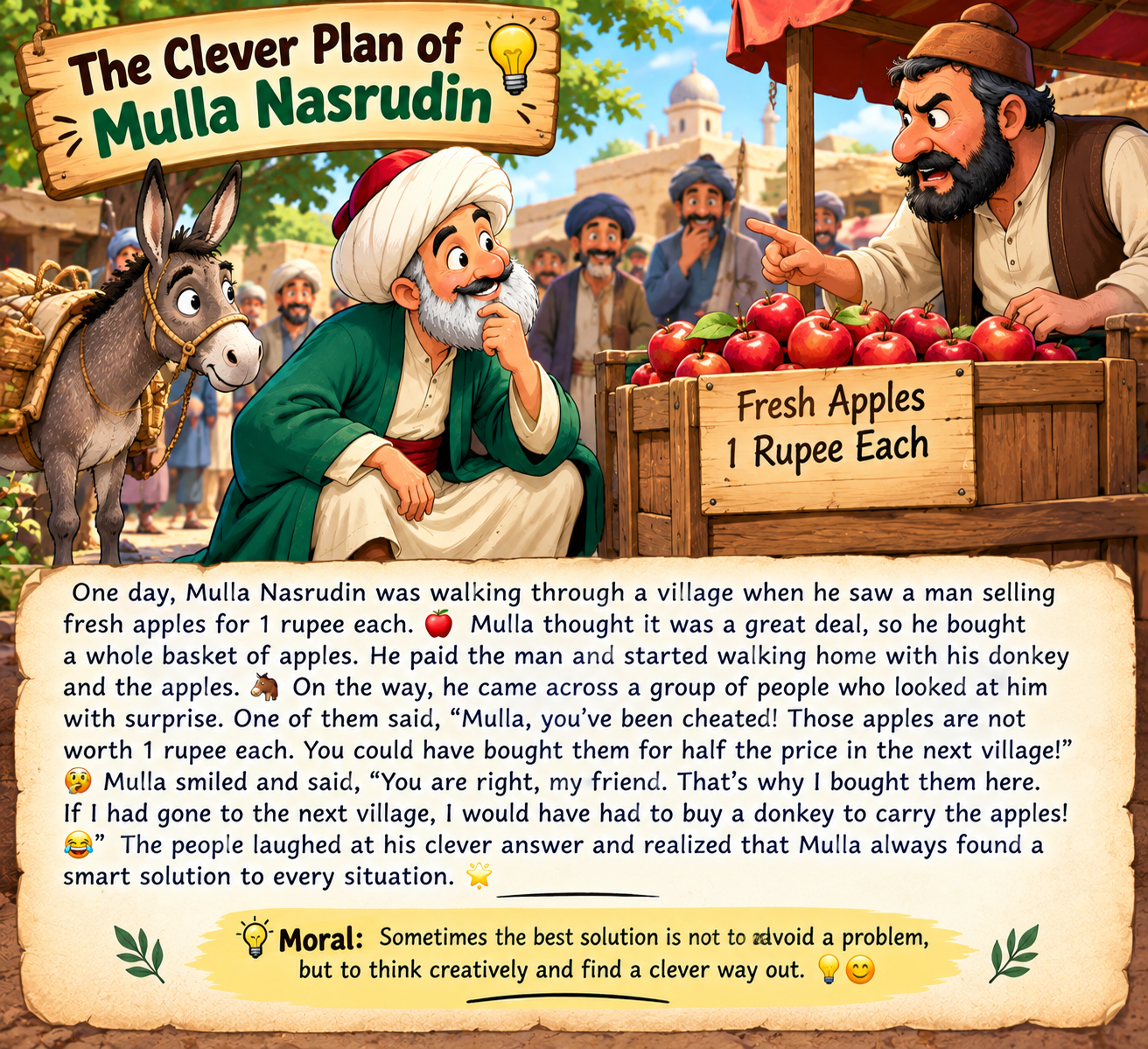
    The Clever Plan of Mulla Nasrudin

    One day, Mulla Nasrudin was walking through a busy village market with his donkey 🫏 when he saw a man selling fresh apples for just one rupee each. Mulla thought it was a wonderful deal, so he bought a basket full of apples and happily started his journey home with his donkey. On the way, he met some people who looked at his basket and began talking about the price of the apples. One man said, **“Mulla, you have paid too much! These apples are cheaper in the next village.”** Mulla smiled calmly and replied, **“You may be right, my friend, but if I had gone to the next village to buy cheaper apples, I would have needed another donkey to carry them home!”** 🫏 Everyone around started laughing at Mulla’s clever answer. Mulla had once again shown that instead of worrying about a small problem, it is sometimes better to look at the situation from a different point of view and find a smart solution. His clever thinking made everyone smile, and the villagers realized that Mulla could turn even an ordinary situation into a funny and meaningful lesson.
    **Moral: Sometimes, creative thinking can help us find a simple and clever solution to a problem.**
    ACCL BOOK DAY 12 Story Post Zainab Siddiqui AIWali Foundation Level Roll No: 002 🍎 The Clever Plan of Mulla Nasrudin 💡 One day, Mulla Nasrudin was walking through a busy village market with his donkey 🫏 when he saw a man selling fresh apples for just one rupee each. 🍎💰 Mulla thought it was a wonderful deal, so he bought a basket full of apples and happily started his journey home with his donkey. 😄 On the way, he met some people who looked at his basket and began talking about the price of the apples. One man said, **“Mulla, you have paid too much! These apples are cheaper in the next village.”** 😲 Mulla smiled calmly and replied, **“You may be right, my friend, but if I had gone to the next village to buy cheaper apples, I would have needed another donkey to carry them home!”** 😂🫏 Everyone around started laughing at Mulla’s clever answer. 😄 Mulla had once again shown that instead of worrying about a small problem, it is sometimes better to look at the situation from a different point of view and find a smart solution. 💡✨ His clever thinking made everyone smile, and the villagers realized that Mulla could turn even an ordinary situation into a funny and meaningful lesson. 🌟 📚 **Moral: Sometimes, creative thinking can help us find a simple and clever solution to a problem.** 🧠💡😊
    1
    0 Commentarii 0 Distribuiri 1556 Views
  • #rsisb
    Roll No 253
    Foundation Level
    Story Post 23

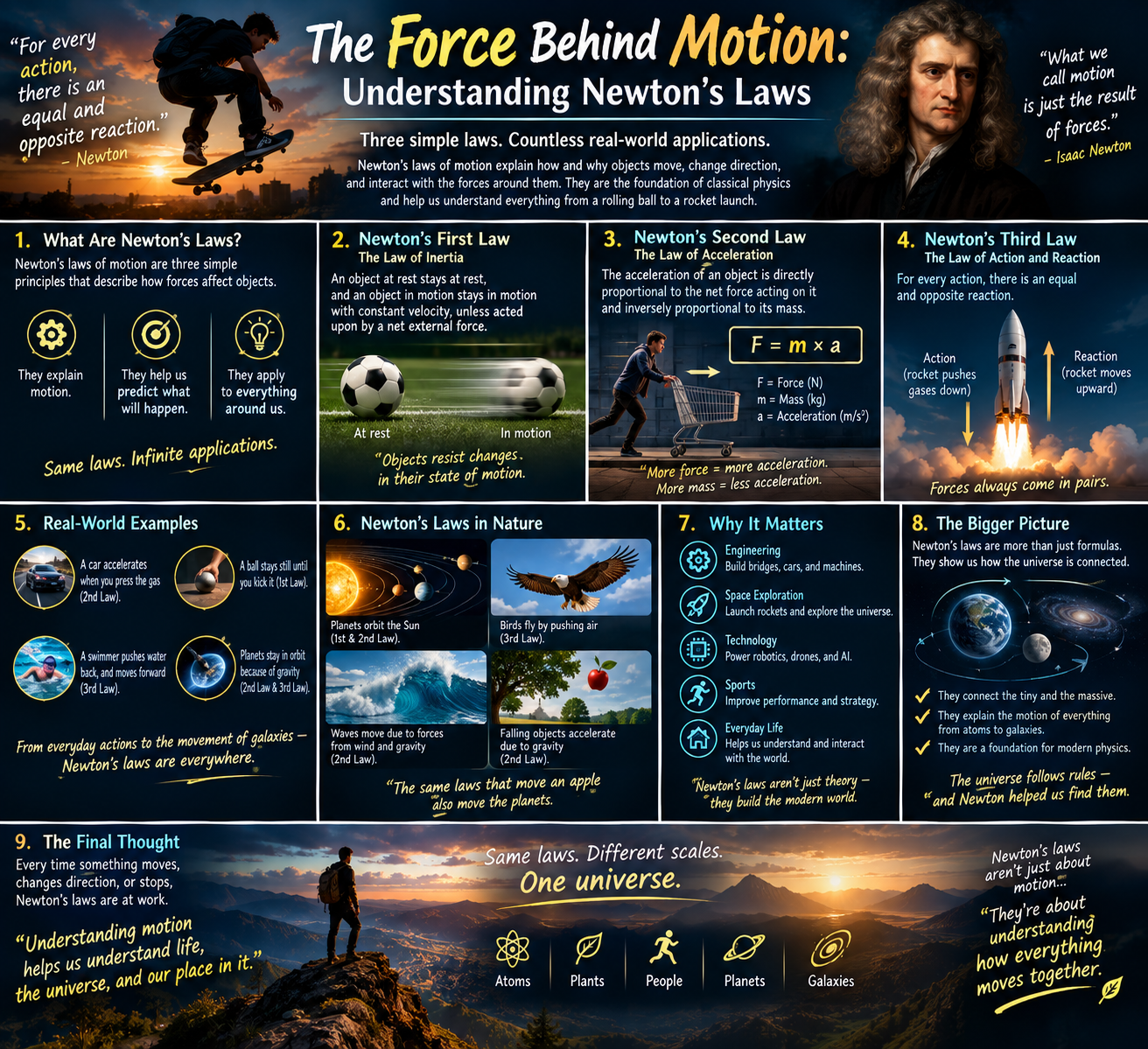
    # The Force Behind Motion: Understanding Newton’s Laws

    Imagine watching a football fly through the air , a car accelerate down a road , a rocket launch into space , or planets orbiting a star .

    These events may appear completely different—but beneath them is the same fundamental idea:

    ## **Forces control motion.**

    More than three centuries ago, **Isaac Newton** developed three laws that transformed our understanding of how objects move and interact. These laws became the foundation of classical mechanics and remain essential to physics, engineering, astronomy, and countless technologies today.

    ---

    # 1. What Are Newton's Laws?

    Newton's three laws describe the relationship between:

    **Force**
    **Mass**
    **Acceleration**
    **Motion**

    Together, they help us explain why objects remain still, why they accelerate, and how forces interact.

    From a rolling ball to a spacecraft , the same fundamental principles apply.

    ### **Three simple laws. Infinite applications.**

    ---

    # 2. Newton's First Law — The Law of Inertia

    Newton's First Law states that an object at rest remains at rest, while an object in motion continues moving at constant velocity unless acted upon by a net external force.

    This property is called **inertia**.

    Imagine a football sitting on the ground.

    It stays there until you kick it.

    Once moving, it won't naturally change its motion unless another force acts on it—such as friction, air resistance, or another object.

    A car requires braking to stop.
    A ball slows because of friction.
    Objects in space can continue moving with very little resistance.

    ### **Objects resist changes in their state of motion.**

    ---

    # 3. Newton's Second Law — The Law of Acceleration

    The second law explains how force changes motion.

    Its famous equation is:

    # **F = m × a**

    Where:

    **F** = Force
    **m** = Mass
    **a** = Acceleration

    This means that increasing the net force on an object generally increases its acceleration, while increasing the object's mass makes the same force produce less acceleration.

    Imagine pushing an empty shopping cart .

    It accelerates easily.

    Now fill it with heavy objects.

    The same push produces less acceleration.

    ### **More net force → more acceleration.**

    ### **More mass → less acceleration for the same force.**

    This simple relationship powers everything from vehicle design to rocket engineering .

    ---

    # 4. Newton's Third Law — Action and Reaction

    Newton's Third Law states:

    ### **For every action, there is an equal and opposite reaction.**

    Forces always occur through interactions between objects.

    Consider a rocket.

    The engine pushes hot gases downward and backward.

    The gases exert an equal and opposite force on the rocket, pushing it upward.

    The same principle appears everywhere:

    A swimmer pushes water backward → the water pushes the swimmer forward.
    A bird pushes air downward → the air helps push the bird upward.
    You push the ground backward → the ground pushes you forward.

    ### **Forces come in pairs.**

    ---

    # 5. Newton's Laws in Everyday Life

    You don't need a laboratory to see Newton's laws.

    They are happening around you constantly.

    **Cars:** Engine force changes speed and direction.
    **Sports:** Kicking a ball changes its motion.
    **Swimming:** Pushing water creates forward motion.
    **Cycling:** Pedaling produces forces that accelerate the bicycle.
    **Falling objects:** Gravity changes their motion.
    **Skateboards:** Pushing against the ground creates movement.

    Everyday motion is essentially a continuous interaction between forces.

    ---

    # 6. Newton's Laws in Nature

    Newton's laws don't stop at Earth.

    They also help describe motion throughout the universe.

    Planets orbit stars.
    Moons orbit planets.
    Comets travel through space.
    Waves respond to forces.
    Birds generate lift through interactions with air.
    Objects accelerate under gravity.

    The same physics that explains a falling apple can help describe the motion of enormous celestial bodies.

    ### **From apples to planets, the same laws operate across nature.**

    ---

    # 7. Why Newton's Laws Matter

    Newton's laws are more than equations in a textbook.

    They are essential tools for understanding and designing the physical world.

    **Engineering** — bridges, buildings, vehicles, and machines
    **Space exploration** — rockets, spacecraft, and orbital motion
    **Technology** — robots, drones, and automated systems
    **Sports science** — movement, speed, and performance
    **Transportation** — cars, aircraft, and trains

    Modern technology depends heavily on our ability to predict how forces produce motion.

    ---

    # 8. The Bigger Picture

    Newton's laws reveal something remarkable:

    The universe is not simply a collection of random movements.

    Objects interact through measurable forces.

    From microscopic particles to massive planets and galaxies , physics provides mathematical relationships that help us understand motion.

    The scale may change.

    The objects may change.

    But the underlying principles remain incredibly powerful.

    ### **Tiny or massive. Fast or slow. Earth or space. Motion follows physical laws.**

    ---

    # 9. The Final Thought

    Every time something moves…

    Every time something accelerates…

    Every time something changes direction…

    **Newton's laws are there.**

    A skateboard rolling down a street
    A bird taking flight
    A rocket leaving Earth
    A planet orbiting the Sun

    Different events.

    Different scales.

    One underlying framework.

    ## **Same laws. Different scales. One universe.**

    Understanding motion isn't just about solving equations.

    It's about understanding **how the physical world moves, interacts, and holds together.**

    ### **Once you understand the forces behind motion, the world around you begins to move in a whole new way.**


    Asma Shaheen EducationWali
    Saima Empowerment Wali
    Mishaal TrainingWali
    #rsisb Roll No 253 Foundation Level Story Post 23 # ⚡🌌 The Force Behind Motion: Understanding Newton’s Laws Imagine watching a football fly through the air ⚽, a car accelerate down a road 🚗💨, a rocket launch into space 🚀, or planets orbiting a star 🪐✨. These events may appear completely different—but beneath them is the same fundamental idea: ## **Forces control motion.** ⚡🧲 More than three centuries ago, **Isaac Newton** developed three laws that transformed our understanding of how objects move and interact. These laws became the foundation of classical mechanics and remain essential to physics, engineering, astronomy, and countless technologies today. 🔬⚙️🌍 --- # 🧠⚡ 1. What Are Newton's Laws? Newton's three laws describe the relationship between: ⚡ **Force** 🧱 **Mass** 💨 **Acceleration** 🏃 **Motion** Together, they help us explain why objects remain still, why they accelerate, and how forces interact. From a rolling ball 🎾 to a spacecraft 🚀, the same fundamental principles apply. ### **Three simple laws. Infinite applications.** 🌌 --- # 🛑➡️ 2. Newton's First Law — The Law of Inertia Newton's First Law states that an object at rest remains at rest, while an object in motion continues moving at constant velocity unless acted upon by a net external force. This property is called **inertia**. 🧱⚡ Imagine a football sitting on the ground. ⚽ It stays there until you kick it. Once moving, it won't naturally change its motion unless another force acts on it—such as friction, air resistance, or another object. 🚗 A car requires braking to stop. ⚽ A ball slows because of friction. 🛰️ Objects in space can continue moving with very little resistance. ### **Objects resist changes in their state of motion.** --- # 💨⚙️ 3. Newton's Second Law — The Law of Acceleration The second law explains how force changes motion. Its famous equation is: # **F = m × a** ⚡ Where: **F** = Force 🧲 **m** = Mass ⚖️ **a** = Acceleration 💨 This means that increasing the net force on an object generally increases its acceleration, while increasing the object's mass makes the same force produce less acceleration. Imagine pushing an empty shopping cart 🛒. It accelerates easily. Now fill it with heavy objects. The same push produces less acceleration. ### **More net force → more acceleration.** ### **More mass → less acceleration for the same force.** This simple relationship powers everything from vehicle design 🚗 to rocket engineering 🚀. --- # 🚀🔥 4. Newton's Third Law — Action and Reaction Newton's Third Law states: ### **For every action, there is an equal and opposite reaction.** ⚡ Forces always occur through interactions between objects. Consider a rocket. 🚀 The engine pushes hot gases downward and backward. The gases exert an equal and opposite force on the rocket, pushing it upward. ⬆️🔥 The same principle appears everywhere: 🏊 A swimmer pushes water backward → the water pushes the swimmer forward. 🦅 A bird pushes air downward → the air helps push the bird upward. 🚶 You push the ground backward → the ground pushes you forward. ### **Forces come in pairs.** 🔗⚡ --- # 🌍⚽ 5. Newton's Laws in Everyday Life You don't need a laboratory to see Newton's laws. They are happening around you constantly. 🚗 **Cars:** Engine force changes speed and direction. ⚽ **Sports:** Kicking a ball changes its motion. 🏊 **Swimming:** Pushing water creates forward motion. 🚲 **Cycling:** Pedaling produces forces that accelerate the bicycle. 🍎 **Falling objects:** Gravity changes their motion. 🛹 **Skateboards:** Pushing against the ground creates movement. Everyday motion is essentially a continuous interaction between forces. --- # 🌌🪐 6. Newton's Laws in Nature Newton's laws don't stop at Earth. They also help describe motion throughout the universe. 🌌 🪐 Planets orbit stars. 🌙 Moons orbit planets. ☄️ Comets travel through space. 🌊 Waves respond to forces. 🦅 Birds generate lift through interactions with air. 🍎 Objects accelerate under gravity. The same physics that explains a falling apple can help describe the motion of enormous celestial bodies. ### **From apples to planets, the same laws operate across nature.** 🍎➡️🪐 --- # ⚙️🚀 7. Why Newton's Laws Matter Newton's laws are more than equations in a textbook. They are essential tools for understanding and designing the physical world. 🏗️ **Engineering** — bridges, buildings, vehicles, and machines 🚀 **Space exploration** — rockets, spacecraft, and orbital motion 🤖 **Technology** — robots, drones, and automated systems 🏃 **Sports science** — movement, speed, and performance 🚗 **Transportation** — cars, aircraft, and trains Modern technology depends heavily on our ability to predict how forces produce motion. --- # 🌌🔭 8. The Bigger Picture Newton's laws reveal something remarkable: The universe is not simply a collection of random movements. Objects interact through measurable forces. ⚛️🧲 From microscopic particles 🔬 to massive planets 🪐 and galaxies 🌌, physics provides mathematical relationships that help us understand motion. The scale may change. The objects may change. But the underlying principles remain incredibly powerful. ### **Tiny or massive. Fast or slow. Earth or space. Motion follows physical laws.** ⚡🌍🌌 --- # 🌅⚡ 9. The Final Thought Every time something moves… Every time something accelerates… Every time something changes direction… **Newton's laws are there.** 🧠⚡ A skateboard rolling down a street 🛹 A bird taking flight 🦅 A rocket leaving Earth 🚀 A planet orbiting the Sun ☀️🪐 Different events. Different scales. One underlying framework. ## 🌌 **Same laws. Different scales. One universe.** Understanding motion isn't just about solving equations. It's about understanding **how the physical world moves, interacts, and holds together.** ⚛️🌍✨ ### **Once you understand the forces behind motion, the world around you begins to move in a whole new way.** ⚡🔬🌌 Asma Shaheen EducationWali Saima Empowerment Wali Mishaal TrainingWali

    0 Commentarii 0 Distribuiri 4883 Views
  • Pakistan needs Steve Jobs to create apples, our youth lacks the role Models among us to follow, because we are told self branding is a bad thing, self branding is not a bad thing, self branding via bad ways and for bad reasons may be a bad thing.

    Tell the world what you do, let them be proud to know you, be among you, with desire to be like you.

    Rehan Allahwala
    Pakistan needs Steve Jobs to create apples, our youth lacks the role Models among us to follow, because we are told self branding is a bad thing, self branding is not a bad thing, self branding via bad ways and for bad reasons may be a bad thing. Tell the world what you do, let them be proud to know you, be among you, with desire to be like you. Rehan Allahwala
    0 Commentarii 0 Distribuiri 547 Views
  • One can count the number of seeds in an apple, we can not calculate how many apples can grow from one seed.

    FUTURE is unseen, keep planting your seeds of thoughts and Ideas, who knows which of your seeds will bring a lot of fruits.

    Rehan Allahwala
    One can count the number of seeds in an apple, we can not calculate how many apples can grow from one seed. FUTURE is unseen, keep planting your seeds of thoughts and Ideas, who knows which of your seeds will bring a lot of fruits. Rehan Allahwala
    0 Commentarii 0 Distribuiri 567 Views
  • If you have an apple and I have an apple and we exchange these apples then you and I will still each have one apple. But if u have an idea, and i have mine , and we exchange these ideas, then each of us will have two ideas...so try to share ur ideas with others in order to strength ur own thoughts and counter argumentations..
    If you have an apple and I have an apple and we exchange these apples then you and I will still each have one apple. But if u have an idea, and i have mine , and we exchange these ideas, then each of us will have two ideas...so try to share ur ideas with others in order to strength ur own thoughts and counter argumentations..
    0 Commentarii 0 Distribuiri 348 Views
  • Once upon a time, in the early days of the United States, there lived a man named John Chapman, better known as Johnny Appleseed. Johnny had a deep passion for nature and a desire to share its bounties with others.

    He wandered across the countryside, planting apple seeds wherever he went. With each seed he carefully placed in the fertile soil, he nurtured hope and possibility. Johnny understood that lifes true joy lay not in the fruits of his labor but in the act of planting itself.

    He believed that by sowing the seeds of goodness and selflessness, one could transform the world around them. Just as he tended to his apple trees, Johnny cared for the well-being of those he encountered. His actions spoke volumes, showing that true fulfillment comes from embracing ones duties with sincerity and dedication.

    With unwavering commitment, Johnny Appleseed spread not only apple orchards but also kindness, compassion, and the spirit of giving. People were touched by his humble presence and the generosity he embodied. He inspired them to cultivate their own gardens of benevolence, making the world a better place.

    Johnnys story teaches us that when we focus on selflessly fulfilling our responsibilities, without getting caught up in the outcomes, we can sow seeds of positive change. Just as an apple tree blossoms and bears fruit, our actions can bear results beyond our imagination.

    So let us, like Johnny Appleseed, strive to plant the seeds of goodness in our daily lives, nurturing them with love and care. By doing so, we can create a more compassionate and harmonious world for ourselves and future generations, guided by the wisdom that true fulfillment lies in the act of giving rather than solely pursuing the fruits of our labor.
    Once upon a time, in the early days of the United States, there lived a man named John Chapman, better known as Johnny Appleseed. Johnny had a deep passion for nature and a desire to share its bounties with others. He wandered across the countryside, planting apple seeds wherever he went. With each seed he carefully placed in the fertile soil, he nurtured hope and possibility. Johnny understood that life's true joy lay not in the fruits of his labor but in the act of planting itself. He believed that by sowing the seeds of goodness and selflessness, one could transform the world around them. Just as he tended to his apple trees, Johnny cared for the well-being of those he encountered. His actions spoke volumes, showing that true fulfillment comes from embracing one's duties with sincerity and dedication. With unwavering commitment, Johnny Appleseed spread not only apple orchards but also kindness, compassion, and the spirit of giving. People were touched by his humble presence and the generosity he embodied. He inspired them to cultivate their own gardens of benevolence, making the world a better place. Johnny's story teaches us that when we focus on selflessly fulfilling our responsibilities, without getting caught up in the outcomes, we can sow seeds of positive change. Just as an apple tree blossoms and bears fruit, our actions can bear results beyond our imagination. So let us, like Johnny Appleseed, strive to plant the seeds of goodness in our daily lives, nurturing them with love and care. By doing so, we can create a more compassionate and harmonious world for ourselves and future generations, guided by the wisdom that true fulfillment lies in the act of giving rather than solely pursuing the fruits of our labor.
    0 Commentarii 0 Distribuiri 1135 Views
  • What is a Mucus-Free or Mucus-Less Diet?

    The mucus-free or mucus-less diet, as popularized by Dr. Arnold Ehret, is a plant-based dietary approach that emphasizes eating foods that do not produce mucus in the body. The system is based on the belief that mucus-forming foods contribute to disease, whereas mucus-free foods cleanse the body and promote health. The diet primarily consists of fresh fruits, leafy greens, and other non-starchy vegetables, while avoiding foods that are said to produce mucus, such as dairy, meat, processed foods, and refined grains.

    Core Components of the Mucus-Free Diet
    1. Allowed Foods (Mucus-Free):
    • Fresh fruits (e.g., apples, oranges, berries, melons).
    • Non-starchy vegetables (e.g., leafy greens, celery, cucumbers, zucchini).
    • Some nuts and seeds in moderation.
    2. Avoided Foods (Mucus-Forming):
    • Dairy products (milk, cheese, yogurt).
    • Animal products (meat, eggs, fish).
    • Refined carbohydrates (white bread, pasta, sugar).
    • Starchy foods (potatoes, rice, legumes).
    • Processed and artificial foods.
    3. Additional Practices:
    • Fasting to accelerate detoxification.
    • Eating simple meals for easier digestion.
    • Prioritizing hydration through distilled water and herbal teas.

    The Science (or Lack Thereof) Behind the Diet

    Ehret’s Theory on Mucus

    Dr. Arnold Ehret believed that all disease is caused by a buildup of “mucus” in the body. In his view:
    • Mucus is a byproduct of eating unnatural, processed, or mucus-forming foods.
    • This mucus accumulates in the digestive system and other organs, clogging the body and impairing its natural functions.
    • Cleansing the body of mucus leads to healing, vitality, and disease prevention.

    Scientific Perspective on Mucus
    1. What is Mucus?
    • Mucus is a slippery secretion produced by mucous membranes in the body. It serves several essential functions:
    • Protects and lubricates tissues.
    • Traps pathogens, dust, and irritants to prevent infection.
    • Aids in digestion by coating the stomach and intestines.
    2. Mucus Production and Diet:
    • Certain foods (e.g., dairy) can temporarily stimulate mucus production, especially in individuals with sensitivities, but this is not harmful for most people.
    • The body naturally regulates mucus production, and excess mucus is expelled (e.g., through coughing, sneezing, or digestion).
    3. Mucus and Disease:
    • There is no scientific evidence that mucus itself causes chronic disease.
    • However, some people may have conditions where mucus overproduction is a symptom (e.g., asthma, chronic sinusitis). In these cases, avoiding trigger foods might help.
    4. Cleansing and Detox Claims:
    • Ehret’s claims about “cleansing mucus” lack scientific backing. The body has its own detoxification systems (e.g., liver, kidneys, and lymphatic system) that do not rely on specific diets.

    Why Does Ehret Say Mucus is Bad?

    Ehret believed:
    1. Mucus clogs the body, disrupting normal functions.
    2. Mucus-forming foods are “unnatural” and cause digestive inefficiency, leading to toxin buildup.
    3. A mucus-free state allows the body to heal itself and perform at its best.

    From Ehret’s perspective, the absence of mucus is a sign of optimal health. He equated the elimination of mucus with the removal of toxins and the restoration of vitality.

    Modern Scientific Interpretation
    1. Some Valid Points:
    • A diet high in fruits and vegetables is undeniably beneficial for health due to their fiber, vitamins, and antioxidants.
    • Avoiding processed foods, refined sugars, and excessive animal products can reduce inflammation and promote better digestion.
    • Fasting has some scientific support for benefits like cellular repair (autophagy) and improved metabolic health.
    2. Questionable Claims:
    • The idea that mucus-forming foods directly cause disease is not scientifically supported.
    • The body produces and expels mucus naturally as part of its protective systems, and this is not inherently harmful.

    Why Do Some People Feel Better on a Mucus-Free Diet?
    1. Elimination of Processed Foods:
    • Cutting out processed foods, sugar, and refined carbs reduces inflammation and improves gut health.
    2. Increased Nutrient Intake:
    • A diet rich in fruits and vegetables provides antioxidants, fiber, and hydration, which can improve digestion and overall well-being.
    3. Improved Gut Health:
    • Reducing heavy, hard-to-digest foods (e.g., meat, dairy) may alleviate bloating, gas, and sluggish digestion.
    4. Weight Loss:
    • Transitioning to lighter, whole foods often results in natural weight loss, which can enhance energy and mobility.

    Summary

    The mucus-free diet focuses on eating clean, plant-based foods to cleanse the body and reduce toxin buildup. While some principles of the diet align with modern nutritional science (e.g., avoiding processed foods, eating more fruits and vegetables), the concept that mucus directly causes disease is not supported by current evidence. Mucus is a natural and protective part of the body’s functions, and its production is not inherently harmful. However, the diet’s emphasis on whole, natural foods can lead to significant health improvements for many individuals.
    What is a Mucus-Free or Mucus-Less Diet? The mucus-free or mucus-less diet, as popularized by Dr. Arnold Ehret, is a plant-based dietary approach that emphasizes eating foods that do not produce mucus in the body. The system is based on the belief that mucus-forming foods contribute to disease, whereas mucus-free foods cleanse the body and promote health. The diet primarily consists of fresh fruits, leafy greens, and other non-starchy vegetables, while avoiding foods that are said to produce mucus, such as dairy, meat, processed foods, and refined grains. Core Components of the Mucus-Free Diet 1. Allowed Foods (Mucus-Free): • Fresh fruits (e.g., apples, oranges, berries, melons). • Non-starchy vegetables (e.g., leafy greens, celery, cucumbers, zucchini). • Some nuts and seeds in moderation. 2. Avoided Foods (Mucus-Forming): • Dairy products (milk, cheese, yogurt). • Animal products (meat, eggs, fish). • Refined carbohydrates (white bread, pasta, sugar). • Starchy foods (potatoes, rice, legumes). • Processed and artificial foods. 3. Additional Practices: • Fasting to accelerate detoxification. • Eating simple meals for easier digestion. • Prioritizing hydration through distilled water and herbal teas. The Science (or Lack Thereof) Behind the Diet Ehret’s Theory on Mucus Dr. Arnold Ehret believed that all disease is caused by a buildup of “mucus” in the body. In his view: • Mucus is a byproduct of eating unnatural, processed, or mucus-forming foods. • This mucus accumulates in the digestive system and other organs, clogging the body and impairing its natural functions. • Cleansing the body of mucus leads to healing, vitality, and disease prevention. Scientific Perspective on Mucus 1. What is Mucus? • Mucus is a slippery secretion produced by mucous membranes in the body. It serves several essential functions: • Protects and lubricates tissues. • Traps pathogens, dust, and irritants to prevent infection. • Aids in digestion by coating the stomach and intestines. 2. Mucus Production and Diet: • Certain foods (e.g., dairy) can temporarily stimulate mucus production, especially in individuals with sensitivities, but this is not harmful for most people. • The body naturally regulates mucus production, and excess mucus is expelled (e.g., through coughing, sneezing, or digestion). 3. Mucus and Disease: • There is no scientific evidence that mucus itself causes chronic disease. • However, some people may have conditions where mucus overproduction is a symptom (e.g., asthma, chronic sinusitis). In these cases, avoiding trigger foods might help. 4. Cleansing and Detox Claims: • Ehret’s claims about “cleansing mucus” lack scientific backing. The body has its own detoxification systems (e.g., liver, kidneys, and lymphatic system) that do not rely on specific diets. Why Does Ehret Say Mucus is Bad? Ehret believed: 1. Mucus clogs the body, disrupting normal functions. 2. Mucus-forming foods are “unnatural” and cause digestive inefficiency, leading to toxin buildup. 3. A mucus-free state allows the body to heal itself and perform at its best. From Ehret’s perspective, the absence of mucus is a sign of optimal health. He equated the elimination of mucus with the removal of toxins and the restoration of vitality. Modern Scientific Interpretation 1. Some Valid Points: • A diet high in fruits and vegetables is undeniably beneficial for health due to their fiber, vitamins, and antioxidants. • Avoiding processed foods, refined sugars, and excessive animal products can reduce inflammation and promote better digestion. • Fasting has some scientific support for benefits like cellular repair (autophagy) and improved metabolic health. 2. Questionable Claims: • The idea that mucus-forming foods directly cause disease is not scientifically supported. • The body produces and expels mucus naturally as part of its protective systems, and this is not inherently harmful. Why Do Some People Feel Better on a Mucus-Free Diet? 1. Elimination of Processed Foods: • Cutting out processed foods, sugar, and refined carbs reduces inflammation and improves gut health. 2. Increased Nutrient Intake: • A diet rich in fruits and vegetables provides antioxidants, fiber, and hydration, which can improve digestion and overall well-being. 3. Improved Gut Health: • Reducing heavy, hard-to-digest foods (e.g., meat, dairy) may alleviate bloating, gas, and sluggish digestion. 4. Weight Loss: • Transitioning to lighter, whole foods often results in natural weight loss, which can enhance energy and mobility. Summary The mucus-free diet focuses on eating clean, plant-based foods to cleanse the body and reduce toxin buildup. While some principles of the diet align with modern nutritional science (e.g., avoiding processed foods, eating more fruits and vegetables), the concept that mucus directly causes disease is not supported by current evidence. Mucus is a natural and protective part of the body’s functions, and its production is not inherently harmful. However, the diet’s emphasis on whole, natural foods can lead to significant health improvements for many individuals.
    0 Commentarii 0 Distribuiri 2187 Views
  • The Origin Story of Ketchup — A Story Essay

    Long before the world dipped French fries in ketchup…
    long before burgers dripped with red sauce…

    There was no tomato in ketchup at all.

    The true story begins 2,500 years ago, deep in Asia.

    ⸻

    Chapter 1 — The Sauce of the Sea (China, 300 BCE)

    Along the coastline of ancient China, fishermen fermented:
    • Fish
    • Salt
    • Water
    • Sometimes seaweed

    They called this dark, salty liquid:

    “鮭汁” (Ke-tsiap)

    Pronounced kay-chap.
    It meant “fish brine” or “fish sauce.”

    It was powerful, sharp, and full of umami — the perfect seasoning.
    Sailors loved it, traders carried it, and soon it spread along the shipping routes of Asia.

    ⸻

    Chapter 2 — The Journey to Southeast Asia

    Ke-tsiap traveled to:
    • Malaysia
    • Indonesia
    • Singapore
    • The Philippines

    Local people copied it.

    In Malay it became:

    “Kecap” or “Kicap”

    This word still exists today — the origin of our modern “ketchup.”

    But still — no tomato yet.

    ⸻

    Chapter 3 — The British Discover the Magic (1600s)

    British sailors visiting Asia tasted kecap and loved it.

    They brought the idea back to England.

    But Britain had no Asian fish sauce, so they improvised and created their own versions:
    • Mushroom ketchup
    • Walnut ketchup
    • Oyster ketchup
    • Anchovy ketchup

    Ketchup at this time looked brown, not red.
    It was used in soups, gravies, and meat pies — more like soy sauce than today’s ketchup.

    For over 150 years, ketchup was a brown, savory British sauce.

    ⸻

    Chapter 4 — The Tomato Arrives (1800s, America)

    Tomatoes reached America from Europe.
    People were still unsure — were tomatoes poisonous or safe?

    Then American cooks did something bold:

    They made tomato ketchup.

    The earliest printed recipe appears around 1812 by scientist James Mease.
    He called tomatoes “love apples” and mixed them with:
    • Vinegar
    • Salt
    • Spices

    This new red ketchup was bright, sweet, and tangy.
    Americans loved it instantly.

    Tomato ketchup pushed aside every other version.

    ⸻

    Chapter 5 — Heinz and the Birth of Modern Ketchup (1876)

    This is the real turning point.

    Henry J. Heinz created the ketchup we know today:
    • Thick
    • Smooth
    • Bright red
    • Sweet
    • Shelf-stable

    He added distilled vinegar and removed all artificial preservatives.
    His glass bottle with the number 57 became iconic.

    From that moment, ketchup transformed from a homemade sauce to a global kitchen essential.

    ⸻

    Chapter 6 — Ketchup Conquers the World

    By the 1900s:
    • Hamburgers
    • Hot dogs
    • Fries
    • Fried chicken
    • Eggs
    • Shawarma
    • Samosas
    • Pakoras
    • Parathas

    All got baptized in ketchup.

    India made spicy ketchup.
    Pakistan made chili-garlic ketchup.
    Japan made omurice ketchup.
    The world made a thousand versions — but all of them trace back to:

    A Chinese fermented fish sauce.

    ⸻

    The Journey in One Line

    A salty Chinese fish sauce became a British mushroom sauce…
    which became an American tomato sauce…
    which became ketchup, the world’s favorite icon.
    🍅 The Origin Story of Ketchup — A Story Essay Long before the world dipped French fries in ketchup… long before burgers dripped with red sauce… There was no tomato in ketchup at all. The true story begins 2,500 years ago, deep in Asia. ⸻ 🌊 Chapter 1 — The Sauce of the Sea (China, 300 BCE) Along the coastline of ancient China, fishermen fermented: • Fish • Salt • Water • Sometimes seaweed They called this dark, salty liquid: “鮭汁” (Ke-tsiap) Pronounced kay-chap. It meant “fish brine” or “fish sauce.” It was powerful, sharp, and full of umami — the perfect seasoning. Sailors loved it, traders carried it, and soon it spread along the shipping routes of Asia. ⸻ 🛶 Chapter 2 — The Journey to Southeast Asia Ke-tsiap traveled to: • Malaysia • Indonesia • Singapore • The Philippines Local people copied it. In Malay it became: “Kecap” or “Kicap” This word still exists today — the origin of our modern “ketchup.” But still — no tomato yet. ⸻ 🚢 Chapter 3 — The British Discover the Magic (1600s) British sailors visiting Asia tasted kecap and loved it. They brought the idea back to England. But Britain had no Asian fish sauce, so they improvised and created their own versions: • Mushroom ketchup • Walnut ketchup • Oyster ketchup • Anchovy ketchup Ketchup at this time looked brown, not red. It was used in soups, gravies, and meat pies — more like soy sauce than today’s ketchup. For over 150 years, ketchup was a brown, savory British sauce. ⸻ 🍅 Chapter 4 — The Tomato Arrives (1800s, America) Tomatoes reached America from Europe. People were still unsure — were tomatoes poisonous or safe? Then American cooks did something bold: They made tomato ketchup. The earliest printed recipe appears around 1812 by scientist James Mease. He called tomatoes “love apples” and mixed them with: • Vinegar • Salt • Spices This new red ketchup was bright, sweet, and tangy. Americans loved it instantly. Tomato ketchup pushed aside every other version. ⸻ 🏭 Chapter 5 — Heinz and the Birth of Modern Ketchup (1876) This is the real turning point. Henry J. Heinz created the ketchup we know today: • Thick • Smooth • Bright red • Sweet • Shelf-stable He added distilled vinegar and removed all artificial preservatives. His glass bottle with the number 57 became iconic. From that moment, ketchup transformed from a homemade sauce to a global kitchen essential. ⸻ 🌍 Chapter 6 — Ketchup Conquers the World By the 1900s: • Hamburgers • Hot dogs • Fries • Fried chicken • Eggs • Shawarma • Samosas • Pakoras • Parathas All got baptized in ketchup. India made spicy ketchup. Pakistan made chili-garlic ketchup. Japan made omurice ketchup. The world made a thousand versions — but all of them trace back to: A Chinese fermented fish sauce. ⸻ 🍅 The Journey in One Line A salty Chinese fish sauce became a British mushroom sauce… which became an American tomato sauce… which became ketchup, the world’s favorite icon.
    0 Commentarii 0 Distribuiri 2889 Views
Sponsorizeaza Paginile