• RSIF8
    Roll no:14
    story no:24
    story topic:The Force Behind Motion: Understanding Newton’s Laws

    **The Force Behind Motion: Understanding Newton’s Laws**

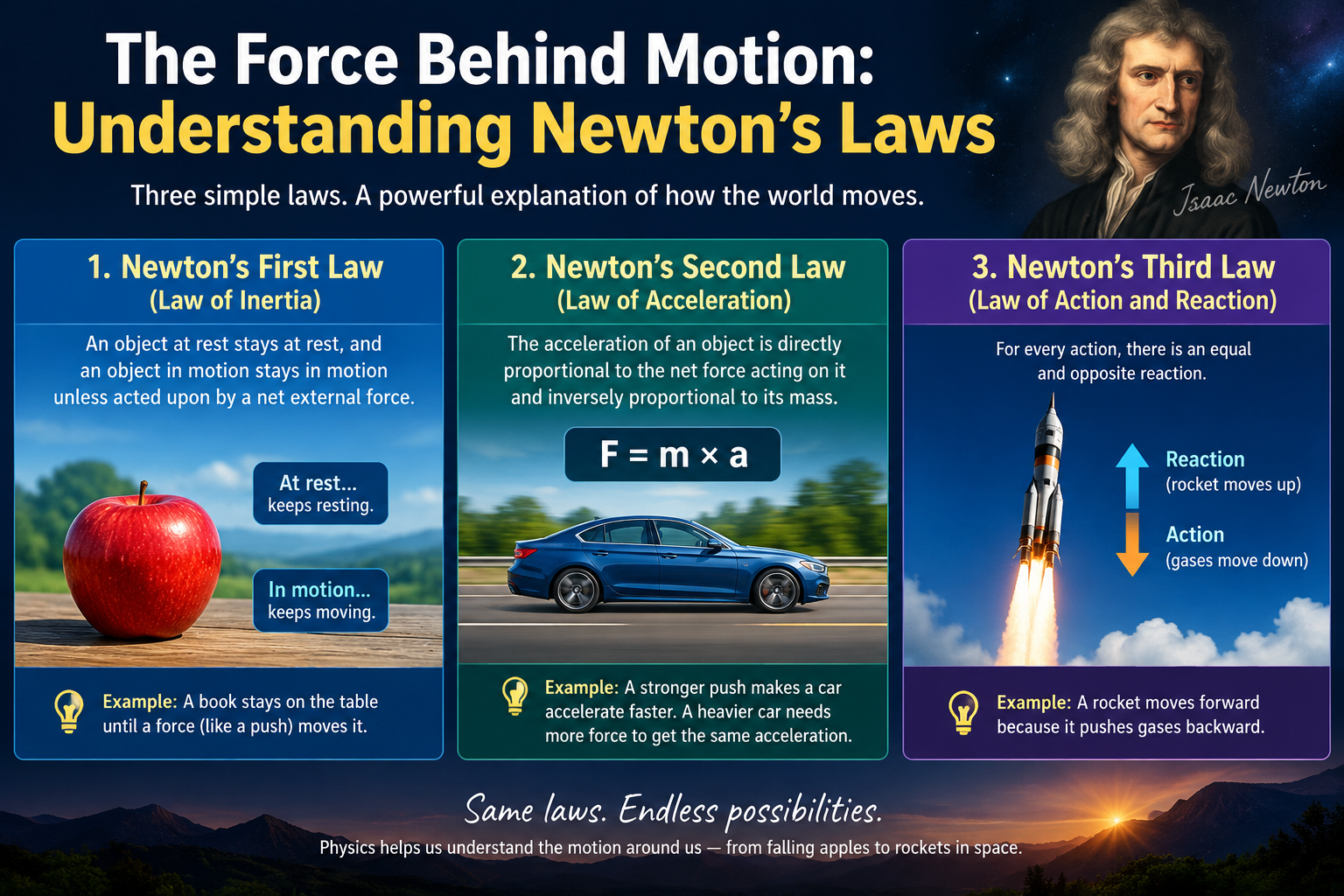
    Welcome to the fascinating world of physics, where forces, motion, and energy work together to explain how our universe operates! In this educational journey, we explore **Newton’s Three Laws of Motion**, some of the most important principles in science that help us understand why objects move, how they change speed, and how forces affect everything around us. From a simple falling apple to a speeding car and a powerful rocket launching into space, Newton’s laws are everywhere in our daily lives!

    **1. Newton’s First Law — The Law of Inertia**

    Newton’s First Law states that an object at rest remains at rest, and an object in motion continues moving at a constant speed in a straight line unless acted upon by an unbalanced external force. This principle explains why a book stays on a table until someone moves it and why passengers tend to move forward when a moving car suddenly stops. Inertia is the natural tendency of objects to resist changes in their state of motion.

    **2. Newton’s Second Law — The Law of Acceleration**

    Newton’s Second Law explains how force, mass, and acceleration are connected. The greater the net force applied to an object, the greater its acceleration. However, a heavier object requires more force than a lighter object to achieve the same acceleration. This relationship is expressed through the famous formula **F = m × a**, where F represents force, m represents mass, and a represents acceleration. This law helps engineers design vehicles, machines, and countless other technologies.

    **3. Newton’s Third Law — The Law of Action and Reaction**

    Newton’s Third Law states that for every action, there is an equal and opposite reaction. Whenever one object exerts a force on another, the second object exerts an equal force in the opposite direction. This principle explains how rockets move forward by pushing exhaust gases backward, how swimmers move through water, and how we walk by pushing against the ground. It reveals the incredible relationship between forces acting on interacting objects.

    **Why Are Newton’s Laws Important?**

    Newton’s laws are essential for understanding the physical world. They help scientists explain motion, engineers develop safer vehicles, athletes improve their performance, and space agencies calculate the movements of spacecraft. These principles are used in transportation, construction, robotics, aviation, sports science, and space exploration. By understanding these laws, students can develop stronger scientific thinking and see how classroom physics connects to real-life experiences.

    **Explore the Science Behind Everyday Motion!**

    Physics is more than formulas and equations; it is a way to understand the world around us. Every moving bicycle, bouncing ball, accelerating car, and launching rocket demonstrates the fascinating principles of force and motion. Learning Newton’s laws opens the door to deeper discoveries in science, technology, engineering, and mathematics.

    Join us on this exciting journey to discover how simple scientific principles explain some of the most extraordinary movements in our universe. Keep asking questions, stay curious, and never stop exploring the wonders of science!

    **Learn the Laws. Understand the Forces. Discover the Science of Motion!**

    Like, share, and follow for more educational content, fascinating science topics, and easy-to-understand explanations that make learning enjoyable!

    #NewtonsLaws #ForceAndMotion #Physics #ScienceEducation #IsaacNewton #LawOfInertia #Acceleration #ActionAndReaction #PhysicsExplained #ScienceFacts #STEMEducation #EducationalVideos #LearnScience #ScientificDiscoveries #SpaceExploration #KnowledgeIsPower
    RSIF8 Roll no:14 story no:24 story topic:The Force Behind Motion: Understanding Newton’s Laws ๐Ÿš€ **The Force Behind Motion: Understanding Newton’s Laws** ๐ŸŒ๐Ÿ”ฌ Welcome to the fascinating world of physics, where forces, motion, and energy work together to explain how our universe operates! ๐ŸŒŒ In this educational journey, we explore **Newton’s Three Laws of Motion**, some of the most important principles in science that help us understand why objects move, how they change speed, and how forces affect everything around us. From a simple falling apple to a speeding car and a powerful rocket launching into space, Newton’s laws are everywhere in our daily lives! ๐ŸŽ๐Ÿš—๐Ÿš€ ๐Ÿ“˜ **1. Newton’s First Law — The Law of Inertia** Newton’s First Law states that an object at rest remains at rest, and an object in motion continues moving at a constant speed in a straight line unless acted upon by an unbalanced external force. This principle explains why a book stays on a table until someone moves it and why passengers tend to move forward when a moving car suddenly stops. Inertia is the natural tendency of objects to resist changes in their state of motion. โšก **2. Newton’s Second Law — The Law of Acceleration** Newton’s Second Law explains how force, mass, and acceleration are connected. The greater the net force applied to an object, the greater its acceleration. However, a heavier object requires more force than a lighter object to achieve the same acceleration. This relationship is expressed through the famous formula **F = m × a**, where F represents force, m represents mass, and a represents acceleration. This law helps engineers design vehicles, machines, and countless other technologies. ๐ŸŒŸ **3. Newton’s Third Law — The Law of Action and Reaction** Newton’s Third Law states that for every action, there is an equal and opposite reaction. Whenever one object exerts a force on another, the second object exerts an equal force in the opposite direction. This principle explains how rockets move forward by pushing exhaust gases backward, how swimmers move through water, and how we walk by pushing against the ground. It reveals the incredible relationship between forces acting on interacting objects. ๐Ÿ” **Why Are Newton’s Laws Important?** Newton’s laws are essential for understanding the physical world. They help scientists explain motion, engineers develop safer vehicles, athletes improve their performance, and space agencies calculate the movements of spacecraft. These principles are used in transportation, construction, robotics, aviation, sports science, and space exploration. By understanding these laws, students can develop stronger scientific thinking and see how classroom physics connects to real-life experiences. ๐Ÿ’ก **Explore the Science Behind Everyday Motion!** Physics is more than formulas and equations; it is a way to understand the world around us. Every moving bicycle, bouncing ball, accelerating car, and launching rocket demonstrates the fascinating principles of force and motion. Learning Newton’s laws opens the door to deeper discoveries in science, technology, engineering, and mathematics. Join us on this exciting journey to discover how simple scientific principles explain some of the most extraordinary movements in our universe. Keep asking questions, stay curious, and never stop exploring the wonders of science! ๐ŸŒโœจ ๐ŸŽฏ **Learn the Laws. Understand the Forces. Discover the Science of Motion!** ๐Ÿ‘ Like, share, and follow for more educational content, fascinating science topics, and easy-to-understand explanations that make learning enjoyable! #NewtonsLaws #ForceAndMotion #Physics #ScienceEducation #IsaacNewton #LawOfInertia #Acceleration #ActionAndReaction #PhysicsExplained #ScienceFacts #STEMEducation #EducationalVideos #LearnScience #ScientificDiscoveries #SpaceExploration #KnowledgeIsPower ๐Ÿš€๐Ÿ“š
    0 Reacties 0 aandelen 5150 Views
  • **Roll No: 2**
    **Batch: 14**
    **Book: ACCL**
    **Task No: 84**

    # The Wonders of Geometry: Shapes and Philosophy

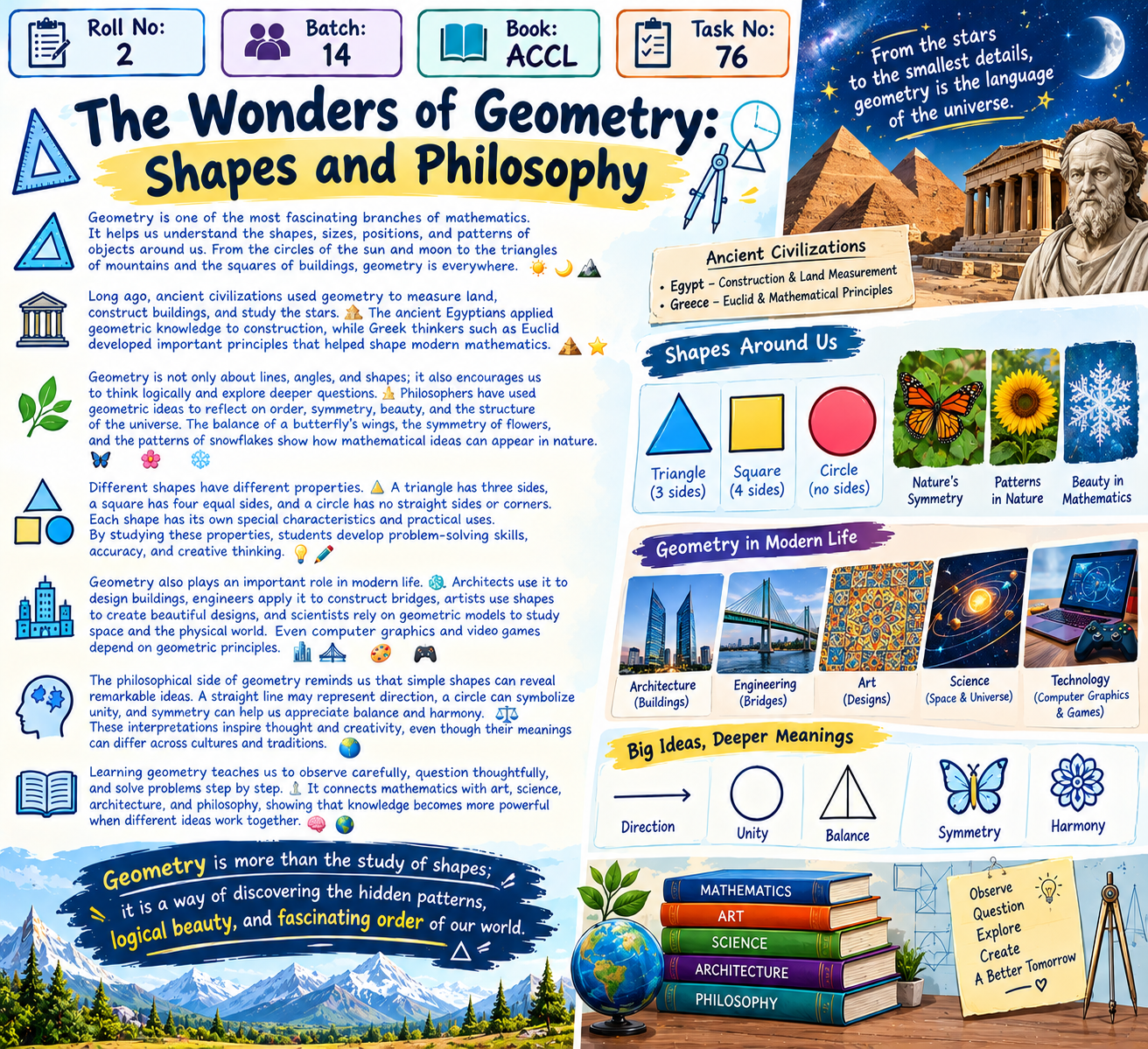
    Geometry is one of the most fascinating branches of mathematics. It helps us understand the shapes, sizes, positions, and patterns of objects around us. From the circles of the sun and moon to the triangles of mountains and the squares of buildings, geometry is everywhere.

    Long ago, ancient civilizations used geometry to measure land, construct buildings, and study the stars. The ancient Egyptians applied geometric knowledge to construction, while Greek thinkers such as **Euclid** developed important principles that helped shape modern mathematics.

    Geometry is not only about lines, angles, and shapes; it also encourages us to think logically and explore deeper questions. Philosophers have used geometric ideas to reflect on order, symmetry, beauty, and the structure of the universe. The balance of a butterfly's wings , the symmetry of flowers , and the patterns of snowflakes show how mathematical ideas can appear in nature.

    Different shapes have different properties. A triangle has three sides, a square has four equal sides, and a circle has no straight sides or corners. Each shape has its own special characteristics and practical uses. By studying these properties, students develop problem-solving skills, accuracy, and creative thinking.

    Geometry also plays an important role in modern life. Architects use it to design buildings, engineers apply it to construct bridges, artists use shapes to create beautiful designs, and scientists rely on geometric models to study space and the physical world. Even computer graphics and video games depend on geometric principles.

    The philosophical side of geometry reminds us that simple shapes can reveal remarkable ideas. A straight line may represent direction, a circle can symbolize unity, and symmetry can help us appreciate balance and harmony. These interpretations inspire thought and creativity, even though their meanings can differ across cultures and traditions.

    Learning geometry teaches us to observe carefully, question thoughtfully, and solve problems step by step. It connects mathematics with art, science, architecture, and philosophy, showing that knowledge becomes more powerful when different ideas work together.

    **Geometry is more than the study of shapes; it is a way of discovering the hidden patterns, logical beauty, and fascinating order of our world. **
    **Roll No: 2** **Batch: 14** **Book: ACCL** **Task No: 84** # ๐Ÿ“ The Wonders of Geometry: Shapes and Philosophy ๐Ÿ”บ๐ŸŒ Geometry is one of the most fascinating branches of mathematics. ๐Ÿ“โœจ It helps us understand the shapes, sizes, positions, and patterns of objects around us. From the circles of the sun and moon to the triangles of mountains and the squares of buildings, geometry is everywhere. โ˜€๏ธ๐ŸŒ™๐Ÿ”๏ธ Long ago, ancient civilizations used geometry to measure land, construct buildings, and study the stars. ๐Ÿ›๏ธ๐ŸŒŒ The ancient Egyptians applied geometric knowledge to construction, while Greek thinkers such as **Euclid** developed important principles that helped shape modern mathematics. ๐Ÿ“š๐Ÿง  Geometry is not only about lines, angles, and shapes; it also encourages us to think logically and explore deeper questions. ๐Ÿ”๐Ÿ’ก Philosophers have used geometric ideas to reflect on order, symmetry, beauty, and the structure of the universe. The balance of a butterfly's wings ๐Ÿฆ‹, the symmetry of flowers ๐ŸŒธ, and the patterns of snowflakes โ„๏ธ show how mathematical ideas can appear in nature. Different shapes have different properties. ๐Ÿ”บ A triangle has three sides, a square has four equal sides, and a circle has no straight sides or corners. Each shape has its own special characteristics and practical uses. ๐Ÿ“๐Ÿ“Š By studying these properties, students develop problem-solving skills, accuracy, and creative thinking. ๐ŸŽ“โœจ Geometry also plays an important role in modern life. ๐Ÿ—๏ธ Architects use it to design buildings, engineers apply it to construct bridges, artists use shapes to create beautiful designs, and scientists rely on geometric models to study space and the physical world. ๐Ÿš€๐ŸŽจ Even computer graphics and video games depend on geometric principles. ๐Ÿ’ป๐ŸŽฎ The philosophical side of geometry reminds us that simple shapes can reveal remarkable ideas. A straight line may represent direction, a circle can symbolize unity, and symmetry can help us appreciate balance and harmony. โš–๏ธ๐Ÿ”ต These interpretations inspire thought and creativity, even though their meanings can differ across cultures and traditions. Learning geometry teaches us to observe carefully, question thoughtfully, and solve problems step by step. ๐Ÿง ๐Ÿ“– It connects mathematics with art, science, architecture, and philosophy, showing that knowledge becomes more powerful when different ideas work together. ๐ŸŒ๐Ÿ”ฌ **Geometry is more than the study of shapes; it is a way of discovering the hidden patterns, logical beauty, and fascinating order of our world. ๐Ÿ“๐ŸŒŸ๐Ÿ”บ**
    0 Reacties 0 aandelen 3130 Views
  • Mohsin #RSF8
    #Storypost11
    Class: Foundation level
    Made by Me
    rool no:13

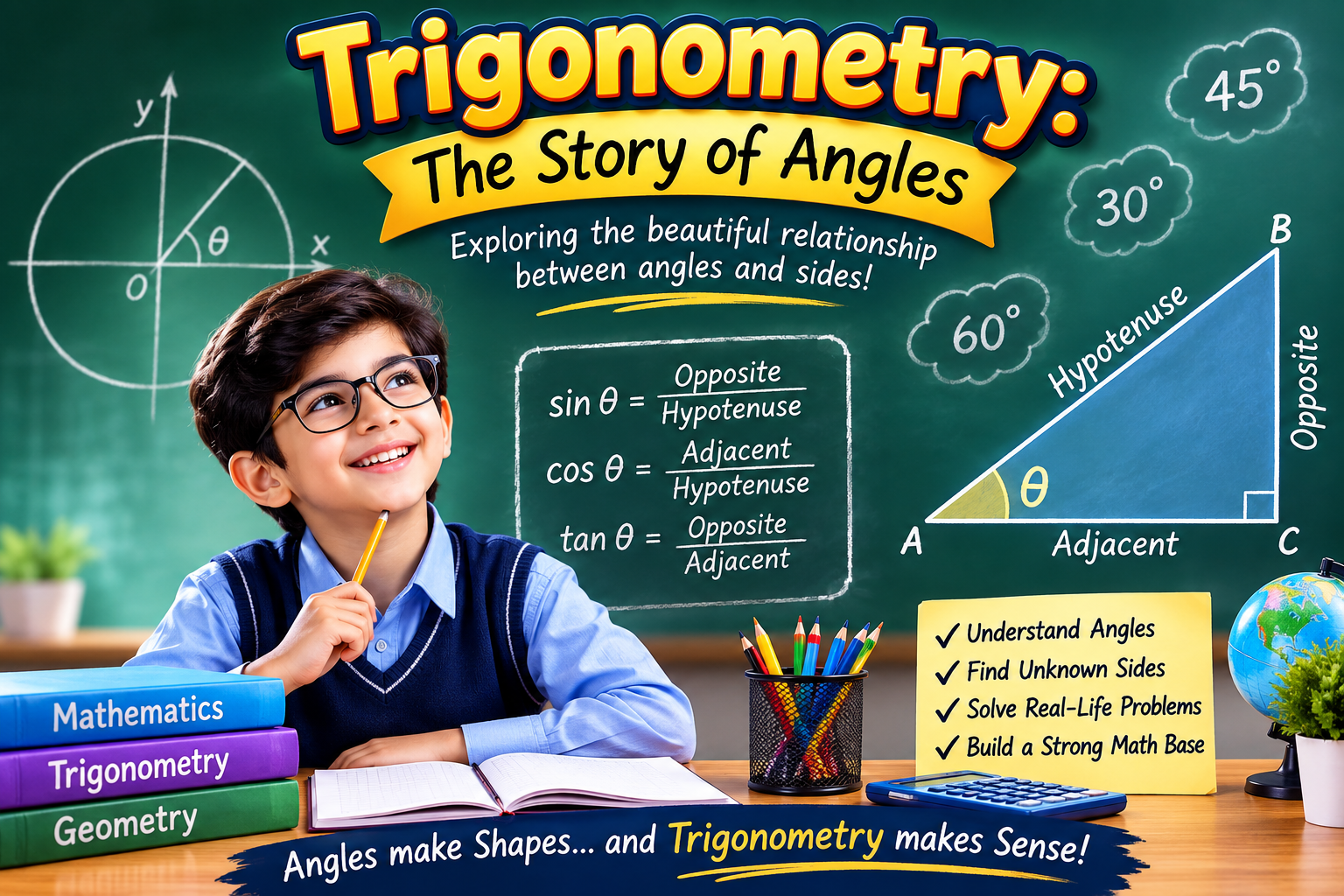
    Trigonometry: The Story of Angles

    Trigonometry is much more than just formulas and triangles—it is the mathematics of angles, distances, heights, and relationships.

    From the height of a tall building to the distance between two places, trigonometry helps us solve problems that cannot always be measured directly. It connects angles with the sides of triangles and gives us powerful tools such as sine, cosine, and tangent.

    Trigonometry is used in many areas of our everyday world, including architecture, engineering, astronomy, navigation, construction, physics, computer graphics, and technology.

    Every angle gives us information, and every triangle can reveal something new. By understanding how angles and sides are connected, we can discover distances, calculate heights, and understand shapes in a completely different way.

    Angles tell the story.
    Triangles provide the clues.
    Trigonometry helps us find the answer.

    So, the next time you see a triangle or measure an angle, remember—you are looking at one of the most useful ideas in mathematics!

    #Trigonometry #Mathematics #Angles Triangles MathStory LearnMath MathEducation STEM MathematicsLearning
    Mohsin #RSF8๐ŸŽ“โœจ #Storypost11 Class: Foundation level ๐Ÿ“š Made by Me ๐Ÿ’ป๐Ÿš€ rool no:13 ๐Ÿ“ Trigonometry: The Story of Angles Trigonometry is much more than just formulas and triangles—it is the mathematics of angles, distances, heights, and relationships. ๐Ÿ”บ๐Ÿ“Š From the height of a tall building to the distance between two places, trigonometry helps us solve problems that cannot always be measured directly. It connects angles with the sides of triangles and gives us powerful tools such as sine, cosine, and tangent. ๐ŸŒ Trigonometry is used in many areas of our everyday world, including architecture, engineering, astronomy, navigation, construction, physics, computer graphics, and technology. Every angle gives us information, and every triangle can reveal something new. By understanding how angles and sides are connected, we can discover distances, calculate heights, and understand shapes in a completely different way. โœจ Angles tell the story. Triangles provide the clues. Trigonometry helps us find the answer. So, the next time you see a triangle or measure an angle, remember—you are looking at one of the most useful ideas in mathematics! ๐Ÿง ๐Ÿ“ #Trigonometry #Mathematics #Angles Triangles MathStory LearnMath MathEducation STEM MathematicsLearning
    0 Reacties 0 aandelen 2906 Views
  • Suggestion for construction industry for standard design homes

    #industry #construction #homes
    Suggestion for construction industry for standard design homes #industry #construction #homes
    0 Reacties 0 aandelen 1043 Views
  • #rsisb
    Roll No.240
    Canva No.87
    Level One

    Allama Muhammad Iqbal (1877–1938) was a great poet, philosopher, and visionary whose powerful ideas inspired Muslims to believe in self-respect, knowledge, courage, and self-discovery.

    His poetry continues to inspire millions of people around the world. His famous works include Bang-e-Dra, Bal-e-Jibril, and The Reconstruction of Religious Thought in Islam.

    Iqbal’s message reminds us to dream big, strengthen our character, seek knowledge, and work toward a better future.

    “Raise yourself to such heights that even destiny asks you what you desire.”

    A timeless thinker. A legendary poet. An eternal inspiration.

    #AllamaIqbal #MuhammadIqbal #Iqbal #PoetOfTheEast #IqbalQuotes #Pakistan #UrduPoetry #IslamicHistory #History #Philosophy #Inspiration #Motivation #PoetryLovers #PakistaniHistory #GreatPoet

    Rehan School Islamabad Campus
    Asma Shaheen EducationWali
    Irum Asim Leadershipwali
    Saima Empowerment Wali

    #rsisb Roll No.240 Canva No.87 Level One Allama Muhammad Iqbal (1877–1938) was a great poet, philosopher, and visionary whose powerful ideas inspired Muslims to believe in self-respect, knowledge, courage, and self-discovery. ๐Ÿ“šโœจ His poetry continues to inspire millions of people around the world. His famous works include Bang-e-Dra, Bal-e-Jibril, and The Reconstruction of Religious Thought in Islam. ๐Ÿ–‹๏ธ๐Ÿ“– Iqbal’s message reminds us to dream big, strengthen our character, seek knowledge, and work toward a better future. ๐ŸŒ™โญ ๐Ÿฆ… “Raise yourself to such heights that even destiny asks you what you desire.” ๐Ÿ‡ต๐Ÿ‡ฐ A timeless thinker. A legendary poet. An eternal inspiration. โค๏ธ #AllamaIqbal #MuhammadIqbal #Iqbal #PoetOfTheEast #IqbalQuotes #Pakistan #UrduPoetry #IslamicHistory #History #Philosophy #Inspiration #Motivation #PoetryLovers #PakistaniHistory #GreatPoet ๐Ÿ“š๐Ÿ–‹๏ธ๐Ÿ‡ต๐Ÿ‡ฐโœจ๐Ÿฆ… Rehan School Islamabad Campus Asma Shaheen EducationWali Irum Asim Leadershipwali Saima Empowerment Wali
    0 Reacties 0 aandelen 4286 Views
  • Day:-90
    rollno:-006
    foundation level
    Story Post
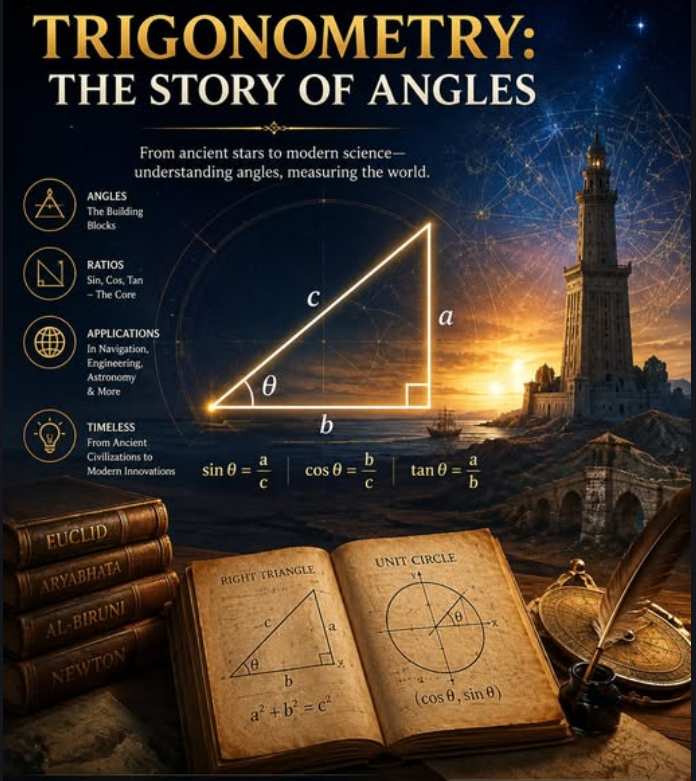
    Trigonometry: The Story of Angles

    Description:
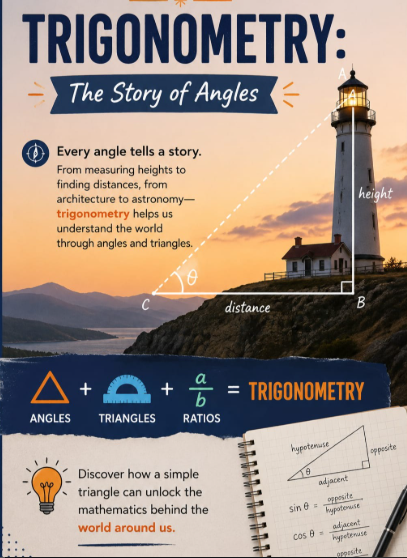
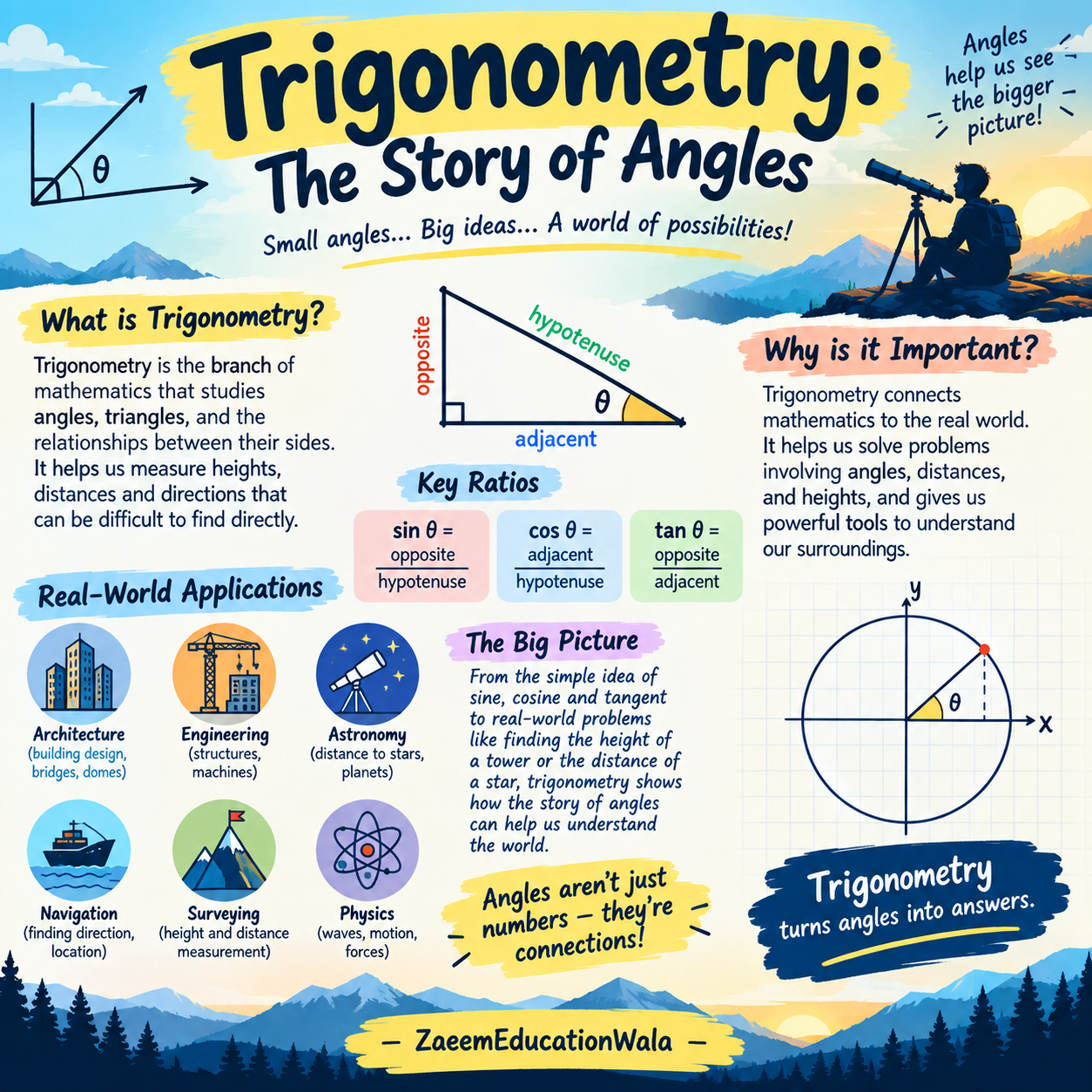
    Trigonometry is a fascinating branch of mathematics that explores the relationship between angles and the sides of triangles. It helps us measure heights, distances, and directions that can be difficult to find directly.

    Using concepts such as sine, cosine, and tangent, trigonometry connects mathematics to the real world. It is used in architecture, engineering, astronomy, navigation, construction, and physics. Learning trigonometry helps us understand how angles shape the world around us.

    #Trigonometry #TheStoryOfAngles #Mathematics #Geometry #Sine #Cosine #Tangent #MathLearning #ScienceAndMath #ZaeemEducationWala

    Day:-90 rollno:-006 foundation level ๐Ÿ“– Story Post ๐Ÿ“ Trigonometry: The Story of Angles Description: Trigonometry is a fascinating branch of mathematics that explores the relationship between angles and the sides of triangles. It helps us measure heights, distances, and directions that can be difficult to find directly. Using concepts such as sine, cosine, and tangent, trigonometry connects mathematics to the real world. It is used in architecture, engineering, astronomy, navigation, construction, and physics. Learning trigonometry helps us understand how angles shape the world around us. #Trigonometry #TheStoryOfAngles #Mathematics #Geometry #Sine #Cosine #Tangent #MathLearning #ScienceAndMath #ZaeemEducationWala
    0 Reacties 0 aandelen 3649 Views
  • #rsisb
    Roll no.247
    Call annie.18
    Foundation level

    **“Wood” – The Backbone of Early Civilization | 25-Minute Learning Journey**

    Wood is one of the oldest and most important natural materials used by humanity. Long before modern technology, steel, concrete, and plastic transformed our world, people depended on trees and wood for survival, creativity, shelter, transportation, tools, and everyday life.

    In this fascinating **25-minute exploration**, we travel back through history to discover how wood helped early civilizations grow, adapt, and build their communities. From simple wooden tools and shelters to boats, bridges, furniture, weapons, wheels, and farming equipment, wood played a remarkable role in human development.

    **Why was wood so important?**
    Wood was relatively easy to find, shape, cut, carve, and transport. Early humans learned to use different types of trees for different purposes, turning a natural resource into useful objects that made life easier and helped communities become more organized.

    Wood also provided an important source of fuel. Fire helped people cook food, stay warm, protect themselves, and eventually develop new technologies such as pottery and metalworking. The relationship between humans, trees, fire, and technology became an important part of civilization.

    **Wood and Transportation**
    One of the most exciting developments was the use of wood to create boats and other forms of transportation. Wooden boats allowed people to travel across rivers, lakes, and seas, encouraging exploration, trade, communication, and cultural exchange.

    **Wood and Shelter**
    Wood became an essential building material for homes, villages, storage structures, roofs, doors, and other buildings. As communities developed, woodworking skills became increasingly valuable, allowing people to construct stronger and more useful structures.

    **Wood and Human Creativity**
    Wood was not simply a material for survival—it became a medium for creativity. People carved decorations, created musical instruments, made furniture, constructed tools, and produced objects that reflected their cultures and traditions.

    **Wood and the Growth of Civilization**
    The story of wood is also the story of human innovation. By learning how to select, shape, join, preserve, and use wood, people developed practical skills that contributed to agriculture, construction, transportation, craftsmanship, and trade.

    This 25-minute lesson encourages us to look at an ordinary piece of wood in a completely different way. A wooden table, chair, pencil, door, or boat may seem simple today, but behind these objects lies thousands of years of human knowledge, experimentation, craftsmanship, and discovery.

    **A Lesson for Today**
    Understanding the historical importance of wood also reminds us of our responsibility toward forests and the environment. Trees provide habitats, help support ecosystems, and play an important role in our planet’s natural systems. Learning about wood means learning not only about the past, but also about how we can use natural resources responsibly in the future.

    Join us on this educational journey through history and discover how **wood became one of the foundations of human civilization**. From ancient tools to magnificent wooden structures, from forests to communities, the story of wood reveals how humans transformed the resources around them into the foundations of everyday life.

    **Watch, learn, explore, and discover the incredible story behind one of humanity’s oldest materials!**

    #Wood #HistoryOfWood #EarlyCivilization #HumanHistory #AncientCivilizations #History #Education #Learning #Science #Nature #Trees #Forests #Woodworking #AncientHistory #HumanInnovation #Technology #Archaeology #Culture #Craftsmanship #NaturalResources #EnvironmentalAwareness #LearningJourney #EducationalVideo #HistoryLesson #Civilization #Innovation #Knowledge #ExploreHistory #WoodenTools
    #rsisb Roll no.247 Call annie.18 Foundation level ๐ŸŒณ **“Wood” – The Backbone of Early Civilization | 25-Minute Learning Journey** ๐Ÿชต๐Ÿบ Wood is one of the oldest and most important natural materials used by humanity. Long before modern technology, steel, concrete, and plastic transformed our world, people depended on trees and wood for survival, creativity, shelter, transportation, tools, and everyday life. ๐ŸŒ๐ŸŒณ In this fascinating **25-minute exploration**, we travel back through history to discover how wood helped early civilizations grow, adapt, and build their communities. ๐Ÿ•๏ธ๐Ÿ  From simple wooden tools and shelters to boats, bridges, furniture, weapons, wheels, and farming equipment, wood played a remarkable role in human development. ๐Ÿ›ถ๐Ÿ› ๏ธ ๐ŸŒฒ **Why was wood so important?** Wood was relatively easy to find, shape, cut, carve, and transport. Early humans learned to use different types of trees for different purposes, turning a natural resource into useful objects that made life easier and helped communities become more organized. ๐Ÿ”ฅ Wood also provided an important source of fuel. Fire helped people cook food, stay warm, protect themselves, and eventually develop new technologies such as pottery and metalworking. The relationship between humans, trees, fire, and technology became an important part of civilization. ๐Ÿ”ฅ๐Ÿฒ ๐Ÿ›ถ **Wood and Transportation** One of the most exciting developments was the use of wood to create boats and other forms of transportation. Wooden boats allowed people to travel across rivers, lakes, and seas, encouraging exploration, trade, communication, and cultural exchange. ๐ŸŒŠโ›ต ๐Ÿ  **Wood and Shelter** Wood became an essential building material for homes, villages, storage structures, roofs, doors, and other buildings. As communities developed, woodworking skills became increasingly valuable, allowing people to construct stronger and more useful structures. ๐Ÿก๐Ÿ”จ ๐Ÿ› ๏ธ **Wood and Human Creativity** Wood was not simply a material for survival—it became a medium for creativity. People carved decorations, created musical instruments, made furniture, constructed tools, and produced objects that reflected their cultures and traditions. ๐ŸŽต๐ŸŽจ๐Ÿช‘ ๐ŸŒ **Wood and the Growth of Civilization** The story of wood is also the story of human innovation. By learning how to select, shape, join, preserve, and use wood, people developed practical skills that contributed to agriculture, construction, transportation, craftsmanship, and trade. This 25-minute lesson encourages us to look at an ordinary piece of wood in a completely different way. A wooden table, chair, pencil, door, or boat may seem simple today, but behind these objects lies thousands of years of human knowledge, experimentation, craftsmanship, and discovery. ๐Ÿ”๐Ÿง โœจ ๐ŸŒฑ **A Lesson for Today** Understanding the historical importance of wood also reminds us of our responsibility toward forests and the environment. Trees provide habitats, help support ecosystems, and play an important role in our planet’s natural systems. Learning about wood means learning not only about the past, but also about how we can use natural resources responsibly in the future. ๐ŸŒณ๐ŸŒŽ๐Ÿ’š ๐Ÿ“š Join us on this educational journey through history and discover how **wood became one of the foundations of human civilization**. From ancient tools to magnificent wooden structures, from forests to communities, the story of wood reveals how humans transformed the resources around them into the foundations of everyday life. ๐ŸŒณ๐Ÿชต๐Ÿบโœจ ๐Ÿ’ก **Watch, learn, explore, and discover the incredible story behind one of humanity’s oldest materials!** #Wood #HistoryOfWood #EarlyCivilization #HumanHistory #AncientCivilizations #History #Education #Learning #Science #Nature #Trees #Forests #Woodworking #AncientHistory #HumanInnovation #Technology #Archaeology #Culture #Craftsmanship #NaturalResources #EnvironmentalAwareness #LearningJourney #EducationalVideo #HistoryLesson #Civilization #Innovation #Knowledge #ExploreHistory #WoodenTools ๐ŸŒณ๐Ÿชต๐Ÿ“š๐ŸŒโœจ
    0 Reacties 0 aandelen 9195 Views 11
  • #rsisb
    Roll no. 247
    Foundation level

    **Trigonometry: The Story of Angles**

    Have you ever wondered how we measure the height of a building, the distance between two places, or the direction of a moving object? The answer often begins with **trigonometry**—the fascinating branch of mathematics that tells the story of **angles, triangles, and relationships**.

    Trigonometry helps us understand how angles and sides are connected. From the simple right triangle to the powerful sine, cosine, and tangent functions, it gives us mathematical tools to solve real-world problems.

    At the heart of trigonometry are three important ratios: **sine (sin), cosine (cos), and tangent (tan)**. These ratios allow us to discover unknown lengths and angles when some information is already known.

    But trigonometry is much more than formulas! It is used in **engineering, architecture, astronomy, physics, navigation, computer graphics, construction, robotics, and many other fields**.

    The story of angles also connects mathematics to the world around us. The angle of a ramp, the height of a mountain, the movement of waves, and even the position of planets can all be explored using trigonometric ideas.

    Learning trigonometry teaches us to look at problems from different perspectives, think logically, and discover hidden relationships. It shows us that mathematics is not just about numbers—it is a language for describing the shapes, movements, and patterns of our world.

    So, whether you're just beginning your mathematical journey or exploring advanced concepts, remember: **every angle tells a story, and trigonometry helps us understand it!**

    **Explore the angles.**
    **Understand the relationships.**
    **Discover mathematics in the real world.**
    **Keep learning and keep calculating!**

    #Trigonometry #StoryOfAngles #Mathematics #Maths #Angles #Triangles #Sine #Cosine #Tangent #Geometry #MathEducation #LearnMath #MathematicsLovers #STEM #ScienceAndMath #Education #MathJourney #MathSkills #ProblemSolving #LearningIsFun #StudyMotivation #MathStudents #ExploreMath #AmazingMathematics
    #rsisb Roll no. 247 Foundation level ๐ŸŒŸ๐Ÿ“ **Trigonometry: The Story of Angles** ๐Ÿ“๐ŸŒŸ Have you ever wondered how we measure the height of a building, the distance between two places, or the direction of a moving object? ๐Ÿค”๐Ÿ—๏ธ๐ŸŒ The answer often begins with **trigonometry**—the fascinating branch of mathematics that tells the story of **angles, triangles, and relationships**. ๐Ÿ”บ๐Ÿ“Šโœจ Trigonometry helps us understand how angles and sides are connected. From the simple right triangle to the powerful sine, cosine, and tangent functions, it gives us mathematical tools to solve real-world problems. ๐Ÿ“๐Ÿงฎ At the heart of trigonometry are three important ratios: **sine (sin), cosine (cos), and tangent (tan)**. These ratios allow us to discover unknown lengths and angles when some information is already known. ๐Ÿ”ข๐Ÿ“šโœจ But trigonometry is much more than formulas! ๐ŸŒŸ It is used in **engineering, architecture, astronomy, physics, navigation, computer graphics, construction, robotics, and many other fields**. ๐Ÿš€๐Ÿ—๏ธ๐Ÿค–๐ŸŒŒ The story of angles also connects mathematics to the world around us. The angle of a ramp, the height of a mountain, the movement of waves, and even the position of planets can all be explored using trigonometric ideas. ๐ŸŒŠโ›ฐ๏ธ๐ŸŒ™ Learning trigonometry teaches us to look at problems from different perspectives, think logically, and discover hidden relationships. ๐Ÿ’ก๐Ÿง  It shows us that mathematics is not just about numbers—it is a language for describing the shapes, movements, and patterns of our world. ๐ŸŒโค๏ธ So, whether you're just beginning your mathematical journey or exploring advanced concepts, remember: **every angle tells a story, and trigonometry helps us understand it!** ๐Ÿ“๐Ÿ“–โœจ ๐Ÿ”บ **Explore the angles.** ๐Ÿงฎ **Understand the relationships.** ๐ŸŒ **Discover mathematics in the real world.** ๐Ÿš€ **Keep learning and keep calculating!** #Trigonometry #StoryOfAngles #Mathematics #Maths #Angles #Triangles #Sine #Cosine #Tangent #Geometry #MathEducation #LearnMath #MathematicsLovers #STEM #ScienceAndMath #Education #MathJourney #MathSkills #ProblemSolving #LearningIsFun #StudyMotivation #MathStudents #ExploreMath #AmazingMathematics ๐Ÿ“๐Ÿ”บ๐Ÿงฎ๐ŸŒŸ๐Ÿš€๐Ÿ“š๐Ÿ’ก
    0 Reacties 0 aandelen 10492 Views
  • #rsisb
    Roll no.239
    Foundation Level

    **Trigonometry** is the fascinating branch of mathematics that explores the relationships between **angles and the sides of triangles**. The word itself comes from Greek roots meaning “triangle” and “measurement.”

    At the heart of trigonometry are three important ratios: **sine, cosine, and tangent**. These help us understand angles and calculate unknown lengths and measurements.

    ๎ˆ€genui๎ˆ‚{"trigonometry_vectors":{"type_id":"UNIT_CIRCLE"}}๎ˆ

    Trigonometry is used far beyond the classroom. It plays an important role in **engineering, architecture, astronomy, physics, navigation, computer graphics, and construction**.

    The story of angles shows us how a simple mathematical idea can become a powerful tool for understanding the world around us.
    #rsisb Roll no.239 Foundation Level **Trigonometry** is the fascinating branch of mathematics that explores the relationships between **angles and the sides of triangles**. The word itself comes from Greek roots meaning “triangle” and “measurement.” At the heart of trigonometry are three important ratios: **sine, cosine, and tangent**. These help us understand angles and calculate unknown lengths and measurements. ๎ˆ€genui๎ˆ‚{"trigonometry_vectors":{"type_id":"UNIT_CIRCLE"}}๎ˆ Trigonometry is used far beyond the classroom. It plays an important role in **engineering, architecture, astronomy, physics, navigation, computer graphics, and construction**. The story of angles shows us how a simple mathematical idea can become a powerful tool for understanding the world around us.
    0 Reacties 0 aandelen 3906 Views
  • Coding Task: 138
    Prompt :
    " Simulate historical reconstructions or future predictions."
    Click Here for Try :
    http://rsk152.rehanschool.us/Time-Travel%20Data%20Simulator%20Agent/
    Coding Task: 138 Prompt : " Simulate historical reconstructions or future predictions." Click Here for Try : http://rsk152.rehanschool.us/Time-Travel%20Data%20Simulator%20Agent/
    0 Reacties 0 aandelen 823 Views
Zoekresultaten