• RSIF8
    ROLL NO 108
    TASK 90
    SOTRY POST14
    Trigonometry: The Story of Angles – Description
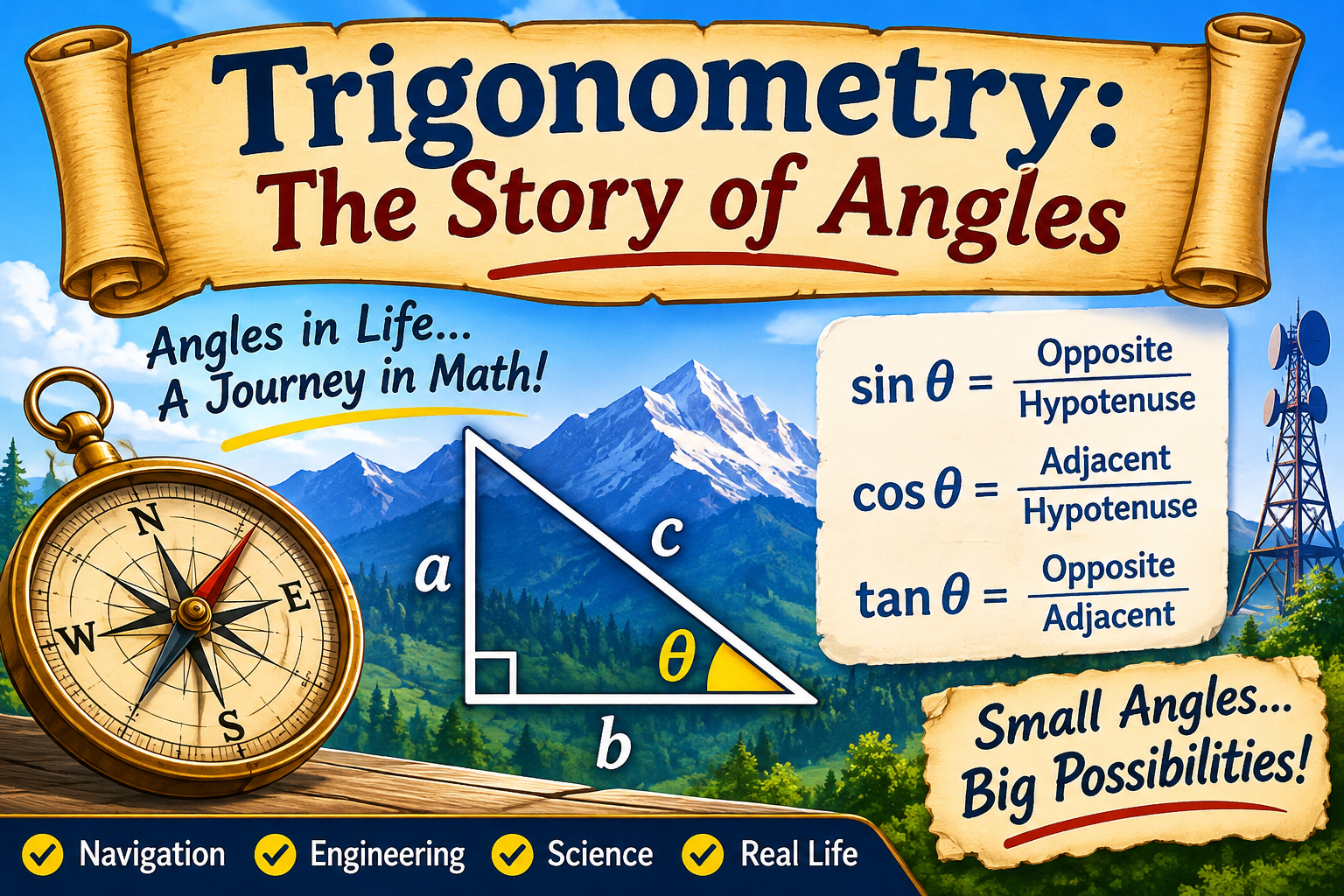
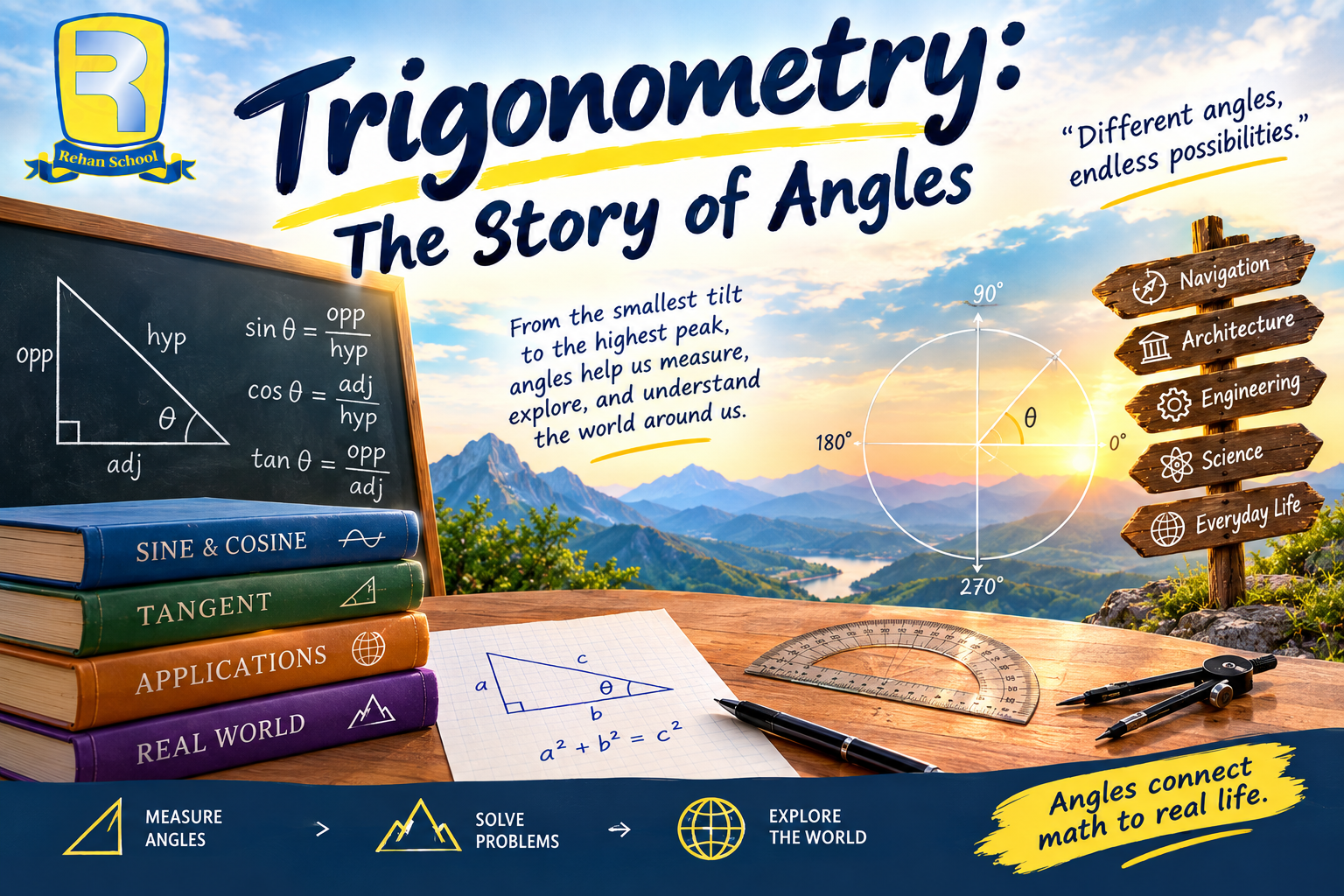
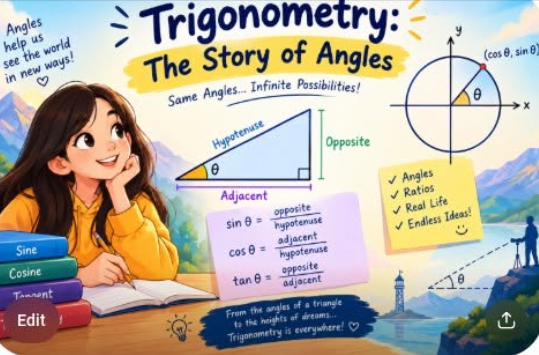
    Trigonometry is an important branch of mathematics that explores the relationship between angles and sides of triangles. It helps us understand how shapes, heights, distances, and measurements work in the real world. In this journey, we discover the three main trigonometric functions: sine, cosine, and tangent. We also learn how trigonometry is used in engineering, architecture, astronomy, navigation, and everyday life. From measuring tall buildings to exploring the stars, trigonometry shows us the fascinating power of angles and mathematics.
    RSIF8 ROLL NO 108 TASK 90 SOTRY POST14 Trigonometry: The Story of Angles – Description Trigonometry is an important branch of mathematics that explores the relationship between angles and sides of triangles. It helps us understand how shapes, heights, distances, and measurements work in the real world. In this journey, we discover the three main trigonometric functions: sine, cosine, and tangent. We also learn how trigonometry is used in engineering, architecture, astronomy, navigation, and everyday life. From measuring tall buildings to exploring the stars, trigonometry shows us the fascinating power of angles and mathematics.
    0 Commentarios 0 Acciones 385 Views
  • RSIF8
    ROLL NO 108
    TASK 84
    SONG 11
    Calculus: The Journey of Numbers and Sacred Spaces – Description
    Discover the fascinating world of calculus, where numbers, patterns, and mathematical ideas come together to explain the universe. This topic explores the amazing concepts of limits, derivatives, integrals, and infinite possibilities. Learn how calculus helps us understand motion, speed, growth, curves, shapes, and the spaces around us. Explore its connections with science, engineering, architecture, nature, and the hidden mathematical patterns of life. Join us on an exciting journey to discover how calculus transforms complex problems into meaningful solutions and reveals the beauty of mathematics!
    RSIF8 ROLL NO 108 TASK 84 SONG 11 Calculus: The Journey of Numbers and Sacred Spaces – Description Discover the fascinating world of calculus, where numbers, patterns, and mathematical ideas come together to explain the universe. This topic explores the amazing concepts of limits, derivatives, integrals, and infinite possibilities. Learn how calculus helps us understand motion, speed, growth, curves, shapes, and the spaces around us. Explore its connections with science, engineering, architecture, nature, and the hidden mathematical patterns of life. Join us on an exciting journey to discover how calculus transforms complex problems into meaningful solutions and reveals the beauty of mathematics!
    0 Commentarios 0 Acciones 447 Views 4
  • **STORY POST — TRIGONOMETRY: THE STORY OF ANGLES**

    ‍ **Created by: Abdul Hadi**

    **Topic:** *Trigonometry: The Story of Angles*

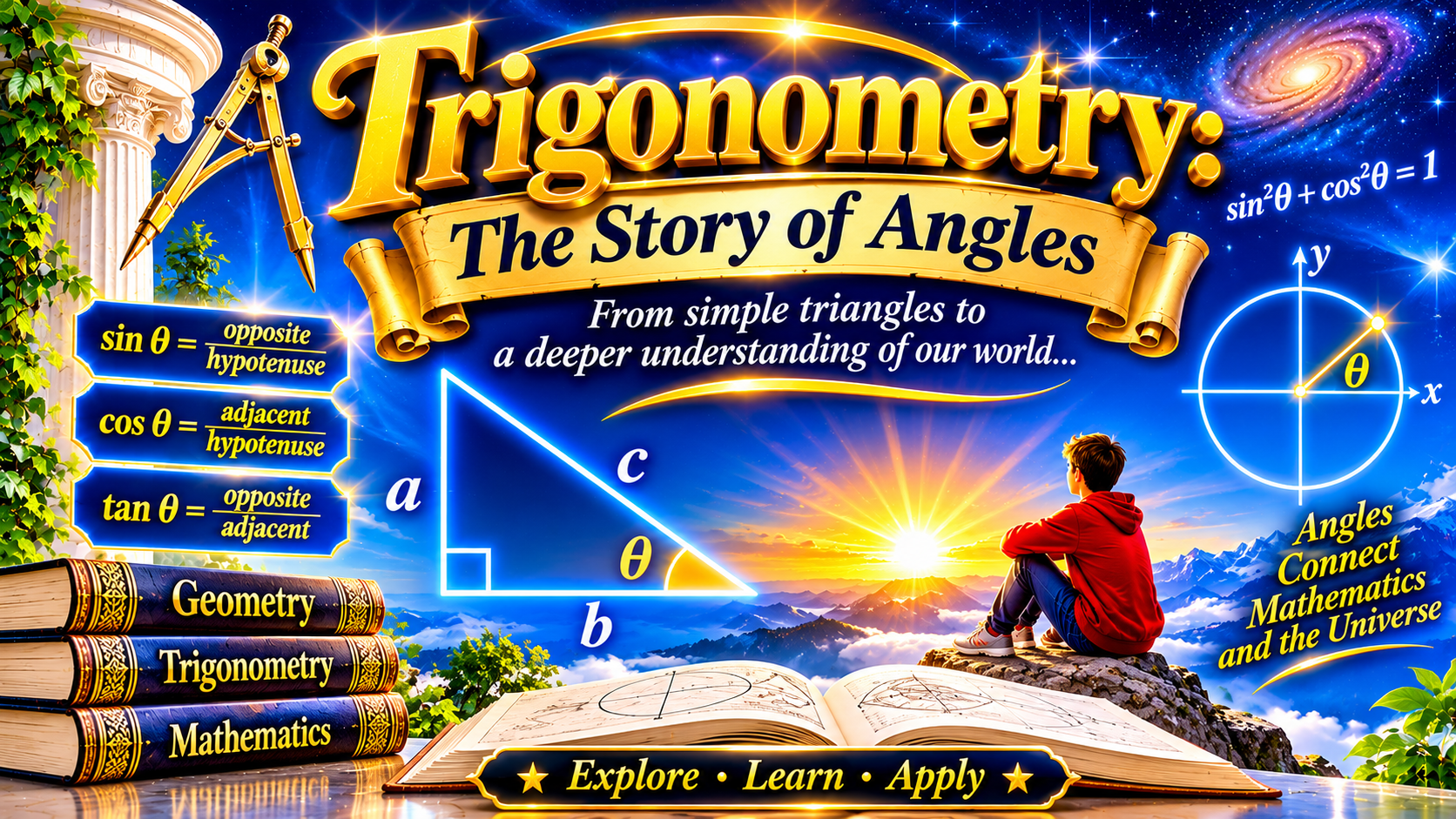
    Trigonometry is the fascinating story of **angles, triangles, and the mathematics that helps us understand our world**. From measuring heights and distances to exploring science, engineering, architecture, and space, trigonometry connects simple geometric ideas to amazing real-life applications.

    In this story post, I explored **angles, right triangles, sine, cosine, tangent, and the unit circle**, discovering how mathematical relationships can help us solve problems and understand the world around us.

    **Angles connect mathematics, science, technology, and the universe!**

    **Explore • Learn • Apply**

    #Trigonometry #StoryPost #Mathematics #Angles #Geometry #Learning #Education #Science #Maths #AbdulHadi #ExploreLearnApply
    ✨📐 **STORY POST — TRIGONOMETRY: THE STORY OF ANGLES** 📐✨ 👨‍🎓 **Created by: Abdul Hadi** 📚 **Topic:** *Trigonometry: The Story of Angles* 🌟 Trigonometry is the fascinating story of **angles, triangles, and the mathematics that helps us understand our world**. From measuring heights and distances to exploring science, engineering, architecture, and space, trigonometry connects simple geometric ideas to amazing real-life applications. 🌍🔭 📐 In this story post, I explored **angles, right triangles, sine, cosine, tangent, and the unit circle**, discovering how mathematical relationships can help us solve problems and understand the world around us. 🧮✨ 💡 **Angles connect mathematics, science, technology, and the universe!** 🚀 **Explore • Learn • Apply** 🚀 #Trigonometry #StoryPost #Mathematics #Angles #Geometry #Learning #Education #Science #Maths #AbdulHadi #ExploreLearnApply 📐✨📚
    0 Commentarios 0 Acciones 1750 Views
  • Foundation level Task
    Day : 90
    Task : story post
    # **Trigonometry: The Story of Angles**
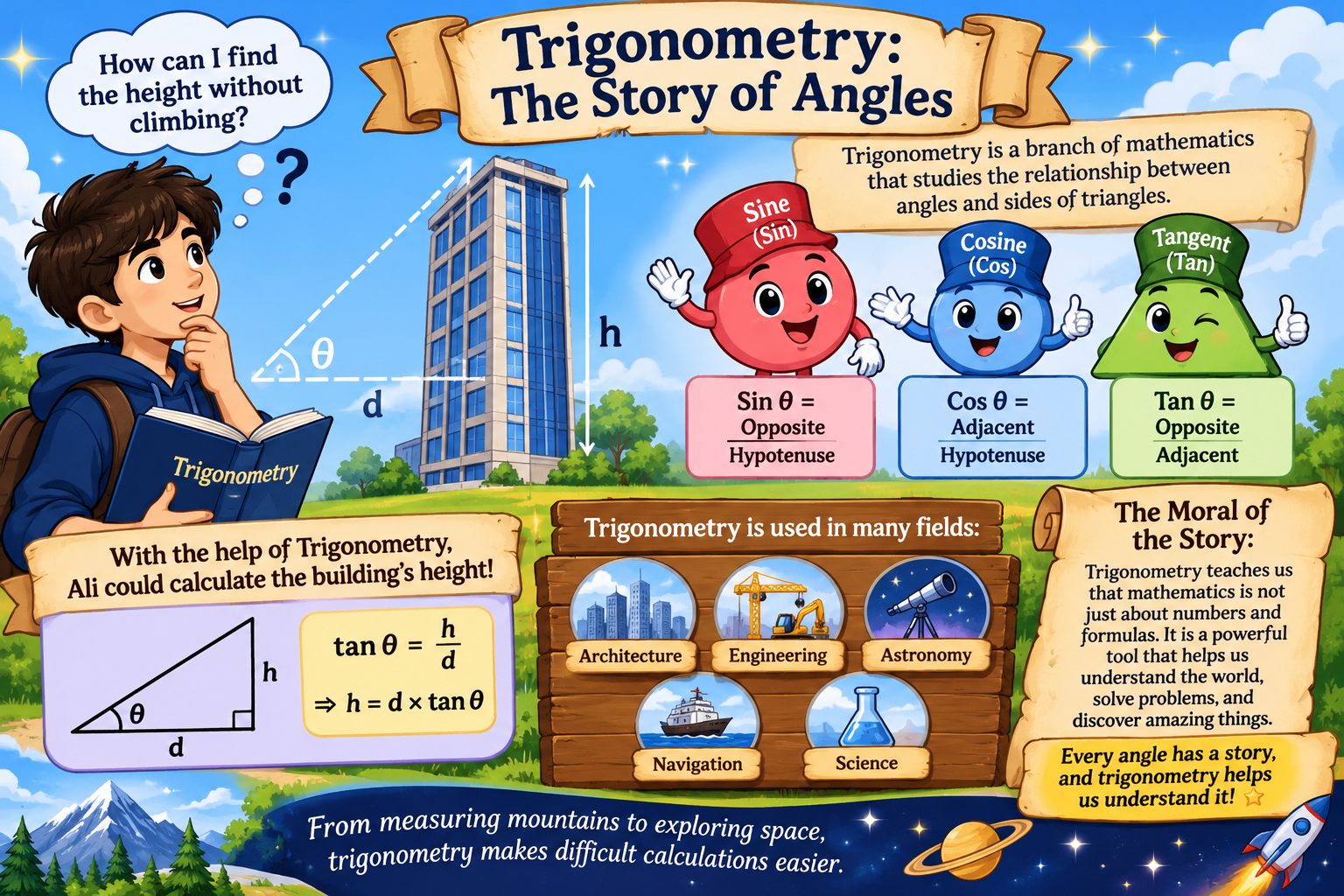
    Once upon a time, in the magical world of mathematics, there lived three friends: **Sine, Cosine, and Tangent.** They had a special power to understand angles, triangles, and distances.
    One day, a young student named Ali wanted to measure the height of a tall building, but he had no ladder or measuring tape long enough to reach the top. He wondered, "How can I find the height without climbing?"
    Then he discovered a fascinating subject called **Trigonometry**.
    Trigonometry is a branch of mathematics that studies the relationship between the angles and sides of triangles. It helps us solve real-life problems and understand the world around us.
    Ali learned about three important trigonometric functions:
    - **Sine (Sin):** The relationship between the opposite side and the hypotenuse.
    - **Cosine (Cos):** The relationship between the adjacent side and the hypotenuse.
    - **Tangent (Tan):** The relationship between the opposite side and the adjacent side.
    \\(\tan(\theta)=\frac{\text{opposite}}{\text{adjacent}}\\)
    Drag the pointsθ36.9°53.1°Adjacent 4Opposite 3Hypotenuse 5
    Give feedback
    With the help of these functions, Ali could calculate the building's height using its distance and angle.
    He also discovered that trigonometry is used in many fields, such as architecture, engineering, astronomy, navigation, and science.
    From measuring mountains to designing bridges and exploring space, trigonometry makes difficult calculations easier.
    **The Moral of the Story:**
    Trigonometry teaches us that mathematics is not just about numbers and formulas. It is a powerful tool that helps us understand the world, solve problems, and discover amazing things.
    **Every angle has a story, and trigonometry helps us understand it!**
    **Trigonometry: The Story of Angles**
    Discover the amazing world of Trigonometry! This story explains how angles, triangles, Sine, Cosine, and Tangent help us solve real-life problems. From measuring tall buildings to exploring space, mathematics makes incredible discoveries possible.
    **Every angle has a story!**
    \#Trigonometry #StoryOfAngles #Mathematics #LearningIsFun #Sine #Cosine #Tangent #Education #MathStories #KnowledgeIsPower
    Foundation level Task Day : 90 Task : story post # **Trigonometry: The Story of Angles** Once upon a time, in the magical world of mathematics, there lived three friends: **Sine, Cosine, and Tangent.** They had a special power to understand angles, triangles, and distances. One day, a young student named Ali wanted to measure the height of a tall building, but he had no ladder or measuring tape long enough to reach the top. He wondered, "How can I find the height without climbing?" Then he discovered a fascinating subject called **Trigonometry**. Trigonometry is a branch of mathematics that studies the relationship between the angles and sides of triangles. It helps us solve real-life problems and understand the world around us. Ali learned about three important trigonometric functions: - **Sine (Sin):** The relationship between the opposite side and the hypotenuse. - **Cosine (Cos):** The relationship between the adjacent side and the hypotenuse. - **Tangent (Tan):** The relationship between the opposite side and the adjacent side. \\(\tan(\theta)=\frac{\text{opposite}}{\text{adjacent}}\\) Drag the pointsθ36.9°53.1°Adjacent 4Opposite 3Hypotenuse 5 Give feedback With the help of these functions, Ali could calculate the building's height using its distance and angle. He also discovered that trigonometry is used in many fields, such as architecture, engineering, astronomy, navigation, and science. From measuring mountains to designing bridges and exploring space, trigonometry makes difficult calculations easier. **The Moral of the Story:** Trigonometry teaches us that mathematics is not just about numbers and formulas. It is a powerful tool that helps us understand the world, solve problems, and discover amazing things. ✨ **Every angle has a story, and trigonometry helps us understand it!** 📐✨ **Trigonometry: The Story of Angles** Discover the amazing world of Trigonometry! This story explains how angles, triangles, Sine, Cosine, and Tangent help us solve real-life problems. From measuring tall buildings to exploring space, mathematics makes incredible discoveries possible. 🚀📚 **Every angle has a story!** 🌟 \#Trigonometry #StoryOfAngles #Mathematics #LearningIsFun #Sine #Cosine #Tangent #Education #MathStories #KnowledgeIsPower
    1
    0 Commentarios 0 Acciones 2234 Views
  • ACCL
    FOUNDATION LEVEL
    STORY POST DAY: 90
    Saba Ibrahim Educationwali
    Rehan School Urdu Bazar

    Trigonometry: The Story of Angles
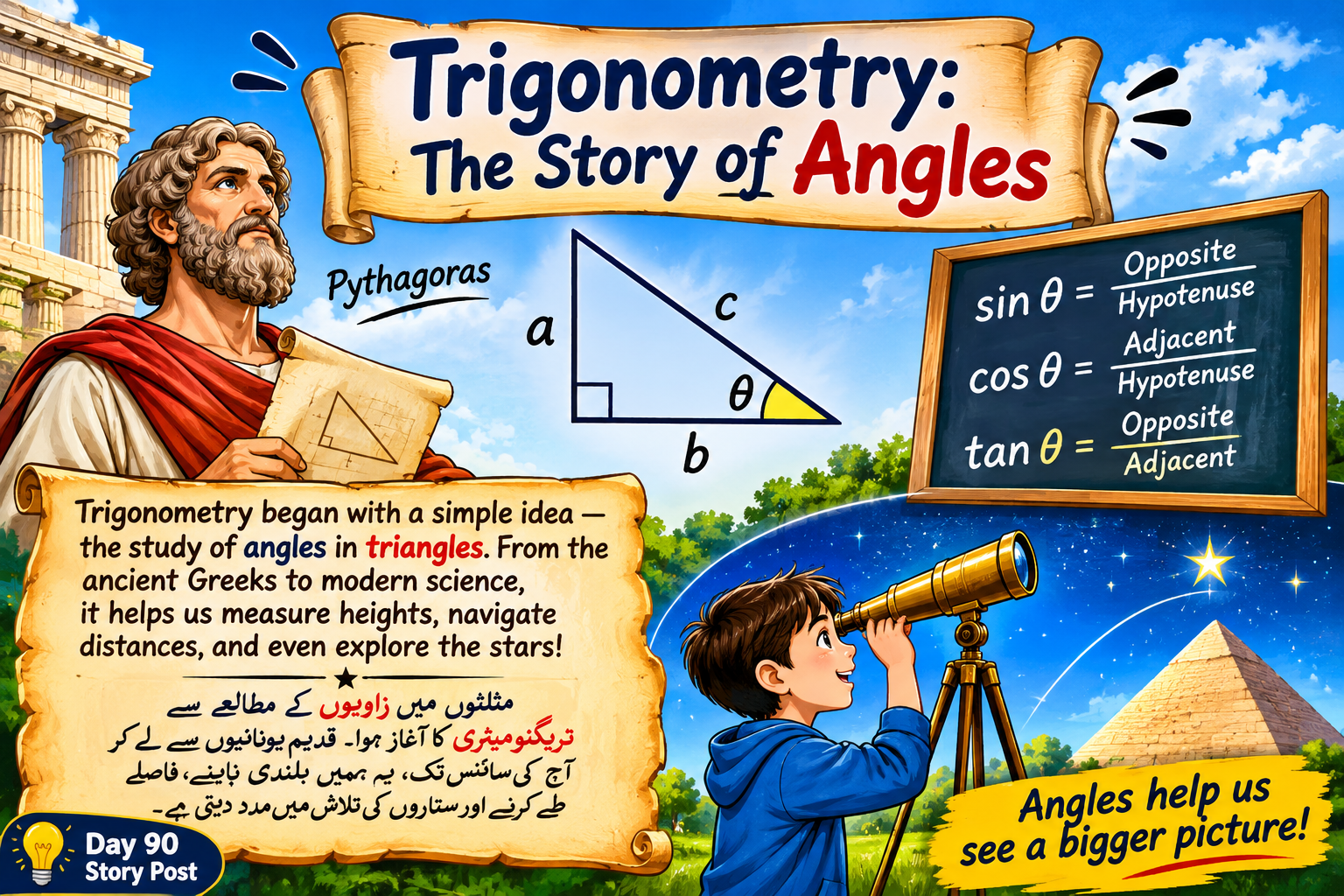
    Long ago, people wanted to measure the heights of mountains, the distances between places, and the positions of stars. They discovered that angles and triangles could help them solve these problems. This led to the development of a branch of mathematics called Trigonometry.

    Trigonometry is the study of the relationship between the angles and sides of triangles. Ancient Greek mathematicians, including Hipparchus and others, helped develop its foundations.

    There are three important trigonometric ratios: Sine (Sin), Cosine (Cos), and Tangent (Tan). These help us calculate unknown sides and angles in right-angled triangles.

    Today, trigonometry is used in architecture, engineering, astronomy, navigation, and construction. It helps scientists measure distances, build strong structures, and explore space.

    اس کہانی سے ہمیں معلوم ہوتا ہے کہ تکونیت (Trigonometry) ریاضی کی ایک اہم شاخ ہے۔ یہ ہمیں زاویوں اور مثلثوں کے ذریعے مشکل مسائل حل کرنا سکھاتی ہے۔ آج بھی سائنس، انجینئرنگ اور تعمیرات میں اس کا بہت استعمال ہوتا ہے۔

    The lesson: Angles are not just shapes in mathematics; they help us understand and explore the world around us!
    ACCL FOUNDATION LEVEL STORY POST DAY: 90 Saba Ibrahim Educationwali Rehan School Urdu Bazar 📖 Trigonometry: The Story of Angles Long ago, people wanted to measure the heights of mountains, the distances between places, and the positions of stars. They discovered that angles and triangles could help them solve these problems. This led to the development of a branch of mathematics called Trigonometry. Trigonometry is the study of the relationship between the angles and sides of triangles. Ancient Greek mathematicians, including Hipparchus and others, helped develop its foundations. There are three important trigonometric ratios: Sine (Sin), Cosine (Cos), and Tangent (Tan). These help us calculate unknown sides and angles in right-angled triangles. Today, trigonometry is used in architecture, engineering, astronomy, navigation, and construction. It helps scientists measure distances, build strong structures, and explore space. اس کہانی سے ہمیں معلوم ہوتا ہے کہ تکونیت (Trigonometry) ریاضی کی ایک اہم شاخ ہے۔ یہ ہمیں زاویوں اور مثلثوں کے ذریعے مشکل مسائل حل کرنا سکھاتی ہے۔ آج بھی سائنس، انجینئرنگ اور تعمیرات میں اس کا بہت استعمال ہوتا ہے۔ The lesson: Angles are not just shapes in mathematics; they help us understand and explore the world around us! 🌍📐
    1
    0 Commentarios 0 Acciones 2000 Views
  • #rsisb Roll no 279 song post 11 Foundation level ## ✨ The Magic of Algebra: Solving Problems ➗📐 Algebra is one of the most interesting and powerful branches of mathematics. It helps us understand numbers, patterns, relationships, and mathematical problems using letters, symbols, and equations. Unlike basic arithmetic, algebra allows us to work with unknown values and discover their answers through logical thinking and step-by-step solutions. 🔢🧠 The magic of algebra is that it turns complicated problems into simple and understandable steps. By using variables such as X and Y, we can represent unknown numbers, create equations, and find solutions. Whether we are solving simple equations, understanding mathematical patterns, or working with complex expressions, algebra teaches us how to think critically and solve challenges with confidence. ✏️📚 Algebra is also connected to our everyday lives. It is used in science, technology, engineering, business, computer programming, and many other fields. From calculating distances and managing money to designing buildings and developing modern technology, algebra plays an important role in shaping our world. 🌍💻 Learning algebra improves our problem-solving abilities, strengthens logical thinking, develops patience, and encourages creativity. Every equation is like a puzzle, and every correct answer brings a new sense of achievement. With regular practice, even difficult mathematical problems can become easier and more enjoyable. 💡🏆 Remember, mathematics is not just about numbers; it is about discovering solutions, exploring possibilities, and developing a smarter way of thinking. Let's explore the magic of algebra and make learning mathematics an exciting journey! 🚀🌟 \#Algebra #Mathematics #MathMagic #ProblemSolving #Learning #Education #LogicalThinking #MathSkills #Equations #ScienceAndTechnology #CreativeThinking ➕➖✖️➗📐🔢🎓 https://www.facebook.com/share/v/1FYj49JfZn/
    WWW.FACEBOOK.COM
    Facebook
    #rsisb Roll no 279 song post 11 Foundation level ## ✨ The Magic of Algebra: Solving Problems ➗📐 Algebra is one of the most interesting and powerful branches of mathematics. It helps us understand...
    1
    0 Commentarios 0 Acciones 2915 Views
  • ACCL TASK:90
    Day:90
    foundation level
    **Description:**
    Trigonometry helps us understand the fascinating world of angles, triangles, and measurements. From architecture and engineering to navigation and science, trigonometry connects mathematics with the real world and helps us explore how things work.
    #Trigonometry #Mathematics #Angles #Learning #RehanSchool
    ACCL TASK:90 Day:90 foundation level **Description:** Trigonometry helps us understand the fascinating world of angles, triangles, and measurements. From architecture and engineering to navigation and science, trigonometry connects mathematics with the real world and helps us explore how things work. 📐🌍✨ #Trigonometry #Mathematics #Angles #Learning #RehanSchool
    1
    0 Commentarios 0 Acciones 1548 Views
  • #rsisb Roll NO:232 Foundation level student. Movie review :19 🎬 **Movie Review — 3 Idiots (2009)** 🎓😂 Today, I watched the amazing and inspiring Bollywood movie *3 Idiots*. This movie tells the story of three engineering students: Rancho, Farhan, and Raju. They study together at a college and experience many challenges related to education, friendship, family pressure, and career choices. The movie highlights how the education system sometimes focuses more on marks and grades than on actual learning and creativity. Rancho believes in understanding concepts instead of simply memorizing information. His positive thinking and passion for learning inspire his friends to follow their dreams. This movie taught me that education is not just about getting good grades; it is about gaining knowledge, developing skills, thinking creatively, and becoming a better person. 🌟 **My Key Learnings:** - Follow your passion and dreams. - Focus on learning, not just marks. - Believe in yourself and your abilities. - Choose knowledge over memorization. - True friendship is very important. - Never be afraid of making mistakes. - Success comes through passion and hard work. - Keep learning and improving yourself. 💡 **My Final Thoughts:** *3 Idiots* is a fantastic movie full of comedy, emotions, friendship, and valuable life lessons. It teaches us to enjoy learning, think differently, and follow our dreams instead of blindly following society. ✨ **Keep Learning, Follow Your Passion, and Believe in Yourself!** ❤️🚀 #3Idiots #MovieReview #Education #StudentLife #Friendship #FollowYourDreams #Learning #Creativity #Motivation #Inspiration #LifeLessons #NeverGiveUp #Success #Bollywood #PositiveThinking 🎬🎓😂❤️🌟🚀📚 Irum Asim Leadershipwali Asma Shaheen EducationWali Rehan School Islamabad Campus https://www.facebook.com/share/v/1DxKoqL2NP/
    WWW.FACEBOOK.COM
    Facebook
    #rsisb Roll NO:232 Foundation level student. Movie review :19 🎬 **Movie Review — 3 Idiots (2009)** 🎓😂 Today, I watched the amazing and inspiring Bollywood movie *3 Idiots*. This movie tells the...
    0 Commentarios 0 Acciones 2720 Views
  • #rsisb
    Roll no.214
    Foundation level
    Story post no. 14
    Explore the fascinating world of **angles, triangles, and measurements!** Trigonometry helps us understand the relationship between the sides and angles of triangles and is used in mathematics, science, engineering, architecture, and everyday life. From calculating heights and distances to understanding waves and motion, trigonometry turns angles into powerful mathematical ideas!
    **Learn • Explore • Calculate • Discover!**
    #Trigonometry #StoryOfAngles #Mathematics #Angles #Triangles #MathLearning #LearnMath #Education #STEM #MathIsFun
    #rsisb Roll no.214 Foundation level Story post no. 14 Explore the fascinating world of **angles, triangles, and measurements!** 🔺📊 Trigonometry helps us understand the relationship between the sides and angles of triangles and is used in mathematics, science, engineering, architecture, and everyday life. 🌍🧮 From calculating heights and distances to understanding waves and motion, trigonometry turns angles into powerful mathematical ideas! 🚀📚 🔢📐 **Learn • Explore • Calculate • Discover!** 🌟 #Trigonometry #StoryOfAngles #Mathematics #Angles #Triangles #MathLearning #LearnMath #Education #STEM #MathIsFun 📐🔺🧮✨
    0 Commentarios 0 Acciones 1865 Views
  • **Roll No: 2**
    **Batch: 14**
    **Book: ACCL**
    **Task No: 153**

    # The Force Behind Motion: Understanding Newton’s Laws

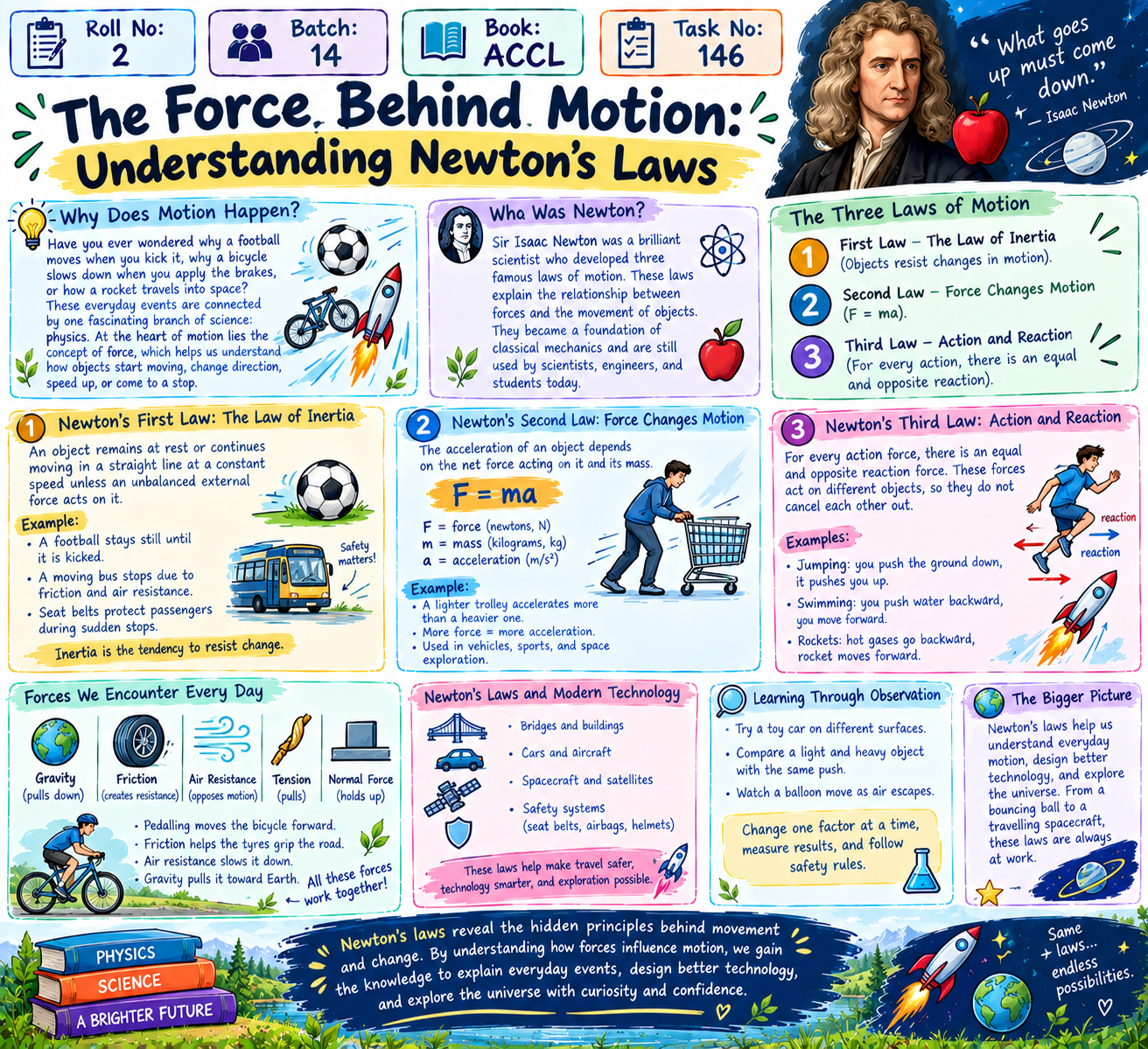
    Have you ever wondered why a football moves when you kick it, why a bicycle slows down when you apply the brakes, or how a rocket travels into space? These everyday events are connected by one fascinating branch of science: physics. At the heart of motion lies the concept of **force**, which helps us understand how objects start moving, change direction, speed up, or come to a stop.

    One of the most important scientists in the history of physics was **Sir Isaac Newton**. Through his work, Newton developed three famous laws of motion that explain the relationship between forces and the movement of objects. These laws became a foundation of classical mechanics and continue to help scientists, engineers, and students understand the physical world around them.

    ## Newton’s First Law: The Law of Inertia

    Newton’s first law states that an object remains at rest or continues moving in a straight line at a constant speed unless an unbalanced external force acts on it. This tendency to resist changes in motion is called **inertia**.

    Imagine a football resting on the ground. It will remain still until someone kicks it or another force acts upon it. Once the ball begins moving, friction between the ball and the ground, along with air resistance, gradually slows it down. Without these opposing forces, the ball would continue moving at a constant velocity.

    You can also notice inertia when a moving bus suddenly brakes. Passengers may feel their bodies move forward because their bodies tend to maintain their previous motion. Seat belts help protect passengers by providing a force that restrains their movement. This shows how Newton’s first law explains both everyday experiences and important safety features.

    ## Newton’s Second Law: Force Changes Motion

    Newton’s second law explains how an unbalanced force changes an object’s motion. The acceleration of an object depends on the net force acting on it and its mass. For an object with constant mass, the relationship is written as:

    [
    \boxed{F = ma}
    ]

    Here, (F) represents the net force, (m) represents mass, and (a) represents acceleration. Force is measured in newtons (N), mass in kilograms (kg), and acceleration in metres per second squared ((\text{m/s}^2)).

    Consider pushing an empty shopping trolley and then pushing a heavily loaded one. The empty trolley usually accelerates more easily because it has less mass. If the same net force acts on two objects, the object with less mass experiences greater acceleration. Similarly, increasing the net force on an object of constant mass increases its acceleration.

    This law is essential in engineering, transport, sports, and space exploration. Engineers use it to calculate how much force is needed to accelerate vehicles, while athletes use the principles of force and acceleration when running, jumping, and throwing objects. ‍

    ## Newton’s Third Law: Action and Reaction

    Newton’s third law states that **for every action force, there is an equal and opposite reaction force**. These two forces act on different objects, so they do not cancel each other out.

    Think about what happens when you jump. Your feet push down against the ground, and the ground pushes upward on you. This upward force helps you rise into the air. The same principle explains how swimmers move forward by pushing water backward.

    Rockets provide another remarkable example. A rocket expels hot gases backward at high speed, and the gases exert an opposite force on the rocket, pushing it forward. This principle works even in the vacuum of space because the rocket does not need air to push against. Its motion results from the interaction between the rocket and the expelled gases.

    ## Forces We Encounter Every Day

    Forces are all around us, even when we do not notice them. Gravity pulls objects toward Earth, friction acts between surfaces in contact, and air resistance opposes an object moving through the atmosphere. Tension in a rope can pull an object, while a normal force from a supporting surface helps hold an object up.

    These forces often work together. For example, when a cyclist travels along a road, pedalling produces forward motion, friction helps the tyres grip the road, air resistance opposes movement, and gravity pulls the cyclist toward Earth. ‍ Understanding how these forces interact helps explain why the bicycle speeds up, slows down, or turns.

    ## Newton’s Laws and Modern Technology

    Newton’s laws are important far beyond the classroom. Engineers apply them when designing bridges, cars, aircraft, and machines. Scientists use them to predict the motion of many objects, while space agencies apply mechanics to plan spacecraft trajectories and study the movement of satellites.

    These laws also help improve safety. Seat belts, airbags, helmets, and vehicle safety systems are designed with an understanding of motion, forces, and changes in momentum. Although modern physics includes ideas beyond Newton’s laws, his work remains extremely useful for understanding everyday motion and many engineering problems.

    ## Learning Through Observation

    You do not need a complicated laboratory to begin exploring Newton’s laws. You can observe a toy car rolling across different surfaces, compare how a light and a heavier object respond to the same gentle push, or watch a balloon move as air escapes from it. Such simple observations can help connect scientific ideas with real experiences.

    When conducting experiments, it is important to change one factor at a time where possible, measure results carefully, and follow appropriate safety precautions. By observing patterns and asking questions, students can develop critical thinking skills and discover how physics explains the world around them.

    Newton’s laws teach us that motion is not random. The movement of a bouncing ball, a speeding bicycle, a swimming person, and a travelling spacecraft can all be understood by investigating forces and their effects.

    **Newton’s laws reveal the hidden principles behind movement and change. By understanding how forces influence motion, we gain the knowledge to explain everyday events, design better technology, and explore the universe with curiosity and confidence. **

    \#NewtonsLaws #ForceAndMotion #Physics #Science #Inertia #Acceleration #SpaceExploration #ACCL #Batch14 #Task146
    **Roll No: 2** **Batch: 14** **Book: ACCL** **Task No: 153** # 🚀⚙️ The Force Behind Motion: Understanding Newton’s Laws 🍎🌍 Have you ever wondered why a football moves when you kick it, why a bicycle slows down when you apply the brakes, or how a rocket travels into space? 🚲⚽🚀 These everyday events are connected by one fascinating branch of science: physics. At the heart of motion lies the concept of **force**, which helps us understand how objects start moving, change direction, speed up, or come to a stop. One of the most important scientists in the history of physics was **Sir Isaac Newton**. 🍎🔭 Through his work, Newton developed three famous laws of motion that explain the relationship between forces and the movement of objects. These laws became a foundation of classical mechanics and continue to help scientists, engineers, and students understand the physical world around them. ## ⚖️ Newton’s First Law: The Law of Inertia Newton’s first law states that an object remains at rest or continues moving in a straight line at a constant speed unless an unbalanced external force acts on it. This tendency to resist changes in motion is called **inertia**. 🧱✨ Imagine a football resting on the ground. ⚽ It will remain still until someone kicks it or another force acts upon it. Once the ball begins moving, friction between the ball and the ground, along with air resistance, gradually slows it down. Without these opposing forces, the ball would continue moving at a constant velocity. You can also notice inertia when a moving bus suddenly brakes. 🚌 Passengers may feel their bodies move forward because their bodies tend to maintain their previous motion. Seat belts help protect passengers by providing a force that restrains their movement. This shows how Newton’s first law explains both everyday experiences and important safety features. ## 💪 Newton’s Second Law: Force Changes Motion Newton’s second law explains how an unbalanced force changes an object’s motion. The acceleration of an object depends on the net force acting on it and its mass. For an object with constant mass, the relationship is written as: [ \boxed{F = ma} ] Here, (F) represents the net force, (m) represents mass, and (a) represents acceleration. Force is measured in newtons (N), mass in kilograms (kg), and acceleration in metres per second squared ((\text{m/s}^2)). 🔬📐 Consider pushing an empty shopping trolley and then pushing a heavily loaded one. 🛒 The empty trolley usually accelerates more easily because it has less mass. If the same net force acts on two objects, the object with less mass experiences greater acceleration. Similarly, increasing the net force on an object of constant mass increases its acceleration. This law is essential in engineering, transport, sports, and space exploration. Engineers use it to calculate how much force is needed to accelerate vehicles, while athletes use the principles of force and acceleration when running, jumping, and throwing objects. 🏃‍♂️🏀 ## 🔄 Newton’s Third Law: Action and Reaction Newton’s third law states that **for every action force, there is an equal and opposite reaction force**. These two forces act on different objects, so they do not cancel each other out. 🌍⚡ Think about what happens when you jump. Your feet push down against the ground, and the ground pushes upward on you. This upward force helps you rise into the air. 🦘 The same principle explains how swimmers move forward by pushing water backward. Rockets provide another remarkable example. 🚀 A rocket expels hot gases backward at high speed, and the gases exert an opposite force on the rocket, pushing it forward. This principle works even in the vacuum of space because the rocket does not need air to push against. Its motion results from the interaction between the rocket and the expelled gases. ## 🌎 Forces We Encounter Every Day Forces are all around us, even when we do not notice them. Gravity pulls objects toward Earth, friction acts between surfaces in contact, and air resistance opposes an object moving through the atmosphere. 🪂🌬️ Tension in a rope can pull an object, while a normal force from a supporting surface helps hold an object up. These forces often work together. For example, when a cyclist travels along a road, pedalling produces forward motion, friction helps the tyres grip the road, air resistance opposes movement, and gravity pulls the cyclist toward Earth. 🚴‍♂️ Understanding how these forces interact helps explain why the bicycle speeds up, slows down, or turns. ## 🛰️ Newton’s Laws and Modern Technology Newton’s laws are important far beyond the classroom. Engineers apply them when designing bridges, cars, aircraft, and machines. 🏗️🚗 Scientists use them to predict the motion of many objects, while space agencies apply mechanics to plan spacecraft trajectories and study the movement of satellites. These laws also help improve safety. Seat belts, airbags, helmets, and vehicle safety systems are designed with an understanding of motion, forces, and changes in momentum. Although modern physics includes ideas beyond Newton’s laws, his work remains extremely useful for understanding everyday motion and many engineering problems. ## 🧠 Learning Through Observation You do not need a complicated laboratory to begin exploring Newton’s laws. You can observe a toy car rolling across different surfaces, compare how a light and a heavier object respond to the same gentle push, or watch a balloon move as air escapes from it. 🎈🧪 Such simple observations can help connect scientific ideas with real experiences. When conducting experiments, it is important to change one factor at a time where possible, measure results carefully, and follow appropriate safety precautions. By observing patterns and asking questions, students can develop critical thinking skills and discover how physics explains the world around them. Newton’s laws teach us that motion is not random. The movement of a bouncing ball, a speeding bicycle, a swimming person, and a travelling spacecraft can all be understood by investigating forces and their effects. 🌌⚙️ **Newton’s laws reveal the hidden principles behind movement and change. By understanding how forces influence motion, we gain the knowledge to explain everyday events, design better technology, and explore the universe with curiosity and confidence. 🚀🌍💡** \#NewtonsLaws #ForceAndMotion #Physics #Science #Inertia #Acceleration #SpaceExploration #ACCL #Batch14 #Task146 ⚙️🚀📚

    0 Commentarios 0 Acciones 5534 Views
Resultados de la búsqueda