• **Roll No: 2**
    **Batch: 14**
    **Book: ACCL**
    **Task No: 153**

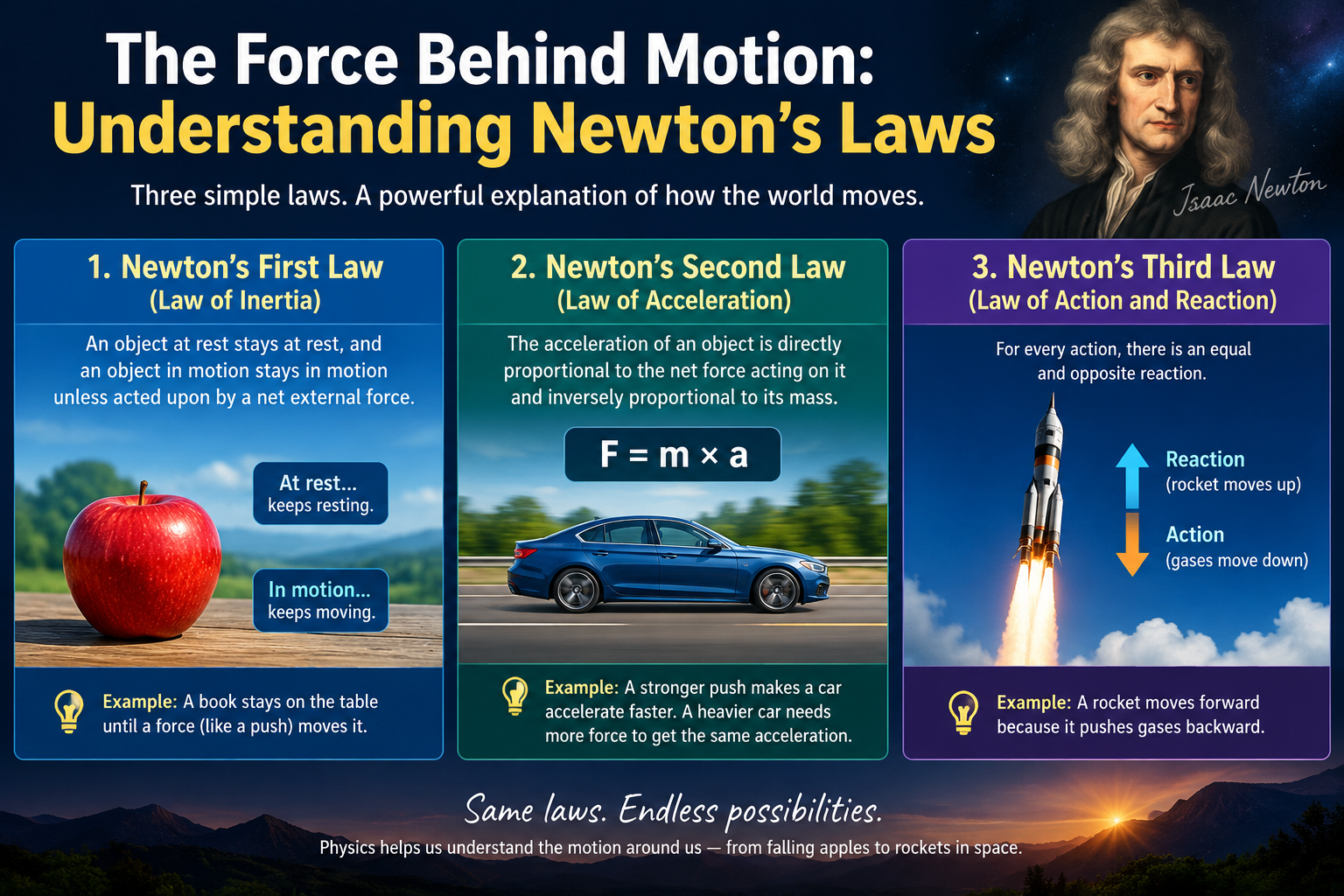
    # The Force Behind Motion: Understanding Newton’s Laws

    Have you ever wondered why a football moves when you kick it, why a bicycle slows down when you apply the brakes, or how a rocket travels into space? These everyday events are connected by one fascinating branch of science: physics. At the heart of motion lies the concept of **force**, which helps us understand how objects start moving, change direction, speed up, or come to a stop.

    One of the most important scientists in the history of physics was **Sir Isaac Newton**. Through his work, Newton developed three famous laws of motion that explain the relationship between forces and the movement of objects. These laws became a foundation of classical mechanics and continue to help scientists, engineers, and students understand the physical world around them.

    ## Newton’s First Law: The Law of Inertia

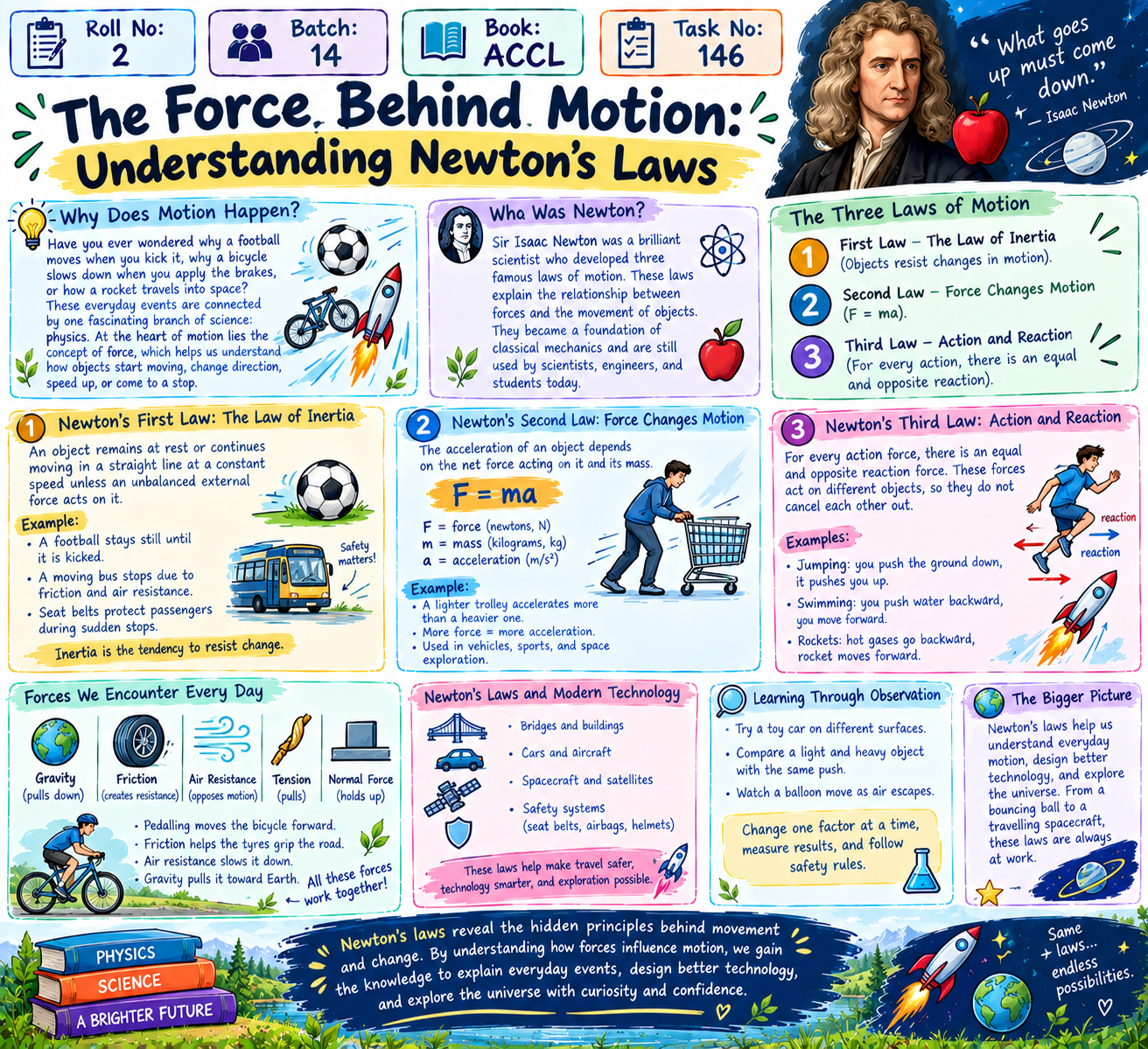
    Newton’s first law states that an object remains at rest or continues moving in a straight line at a constant speed unless an unbalanced external force acts on it. This tendency to resist changes in motion is called **inertia**.

    Imagine a football resting on the ground. It will remain still until someone kicks it or another force acts upon it. Once the ball begins moving, friction between the ball and the ground, along with air resistance, gradually slows it down. Without these opposing forces, the ball would continue moving at a constant velocity.

    You can also notice inertia when a moving bus suddenly brakes. Passengers may feel their bodies move forward because their bodies tend to maintain their previous motion. Seat belts help protect passengers by providing a force that restrains their movement. This shows how Newton’s first law explains both everyday experiences and important safety features.

    ## Newton’s Second Law: Force Changes Motion

    Newton’s second law explains how an unbalanced force changes an object’s motion. The acceleration of an object depends on the net force acting on it and its mass. For an object with constant mass, the relationship is written as:

    [
    \boxed{F = ma}
    ]

    Here, (F) represents the net force, (m) represents mass, and (a) represents acceleration. Force is measured in newtons (N), mass in kilograms (kg), and acceleration in metres per second squared ((\text{m/s}^2)).

    Consider pushing an empty shopping trolley and then pushing a heavily loaded one. The empty trolley usually accelerates more easily because it has less mass. If the same net force acts on two objects, the object with less mass experiences greater acceleration. Similarly, increasing the net force on an object of constant mass increases its acceleration.

    This law is essential in engineering, transport, sports, and space exploration. Engineers use it to calculate how much force is needed to accelerate vehicles, while athletes use the principles of force and acceleration when running, jumping, and throwing objects. ‍

    ## Newton’s Third Law: Action and Reaction

    Newton’s third law states that **for every action force, there is an equal and opposite reaction force**. These two forces act on different objects, so they do not cancel each other out.

    Think about what happens when you jump. Your feet push down against the ground, and the ground pushes upward on you. This upward force helps you rise into the air. The same principle explains how swimmers move forward by pushing water backward.

    Rockets provide another remarkable example. A rocket expels hot gases backward at high speed, and the gases exert an opposite force on the rocket, pushing it forward. This principle works even in the vacuum of space because the rocket does not need air to push against. Its motion results from the interaction between the rocket and the expelled gases.

    ## Forces We Encounter Every Day

    Forces are all around us, even when we do not notice them. Gravity pulls objects toward Earth, friction acts between surfaces in contact, and air resistance opposes an object moving through the atmosphere. Tension in a rope can pull an object, while a normal force from a supporting surface helps hold an object up.

    These forces often work together. For example, when a cyclist travels along a road, pedalling produces forward motion, friction helps the tyres grip the road, air resistance opposes movement, and gravity pulls the cyclist toward Earth. ‍ Understanding how these forces interact helps explain why the bicycle speeds up, slows down, or turns.

    ## Newton’s Laws and Modern Technology

    Newton’s laws are important far beyond the classroom. Engineers apply them when designing bridges, cars, aircraft, and machines. Scientists use them to predict the motion of many objects, while space agencies apply mechanics to plan spacecraft trajectories and study the movement of satellites.

    These laws also help improve safety. Seat belts, airbags, helmets, and vehicle safety systems are designed with an understanding of motion, forces, and changes in momentum. Although modern physics includes ideas beyond Newton’s laws, his work remains extremely useful for understanding everyday motion and many engineering problems.

    ## Learning Through Observation

    You do not need a complicated laboratory to begin exploring Newton’s laws. You can observe a toy car rolling across different surfaces, compare how a light and a heavier object respond to the same gentle push, or watch a balloon move as air escapes from it. Such simple observations can help connect scientific ideas with real experiences.

    When conducting experiments, it is important to change one factor at a time where possible, measure results carefully, and follow appropriate safety precautions. By observing patterns and asking questions, students can develop critical thinking skills and discover how physics explains the world around them.

    Newton’s laws teach us that motion is not random. The movement of a bouncing ball, a speeding bicycle, a swimming person, and a travelling spacecraft can all be understood by investigating forces and their effects.

    **Newton’s laws reveal the hidden principles behind movement and change. By understanding how forces influence motion, we gain the knowledge to explain everyday events, design better technology, and explore the universe with curiosity and confidence. **

    \#NewtonsLaws #ForceAndMotion #Physics #Science #Inertia #Acceleration #SpaceExploration #ACCL #Batch14 #Task146
    **Roll No: 2** **Batch: 14** **Book: ACCL** **Task No: 153** # 🚀⚙️ The Force Behind Motion: Understanding Newton’s Laws 🍎🌍 Have you ever wondered why a football moves when you kick it, why a bicycle slows down when you apply the brakes, or how a rocket travels into space? 🚲⚽🚀 These everyday events are connected by one fascinating branch of science: physics. At the heart of motion lies the concept of **force**, which helps us understand how objects start moving, change direction, speed up, or come to a stop. One of the most important scientists in the history of physics was **Sir Isaac Newton**. 🍎🔭 Through his work, Newton developed three famous laws of motion that explain the relationship between forces and the movement of objects. These laws became a foundation of classical mechanics and continue to help scientists, engineers, and students understand the physical world around them. ## ⚖️ Newton’s First Law: The Law of Inertia Newton’s first law states that an object remains at rest or continues moving in a straight line at a constant speed unless an unbalanced external force acts on it. This tendency to resist changes in motion is called **inertia**. 🧱✨ Imagine a football resting on the ground. ⚽ It will remain still until someone kicks it or another force acts upon it. Once the ball begins moving, friction between the ball and the ground, along with air resistance, gradually slows it down. Without these opposing forces, the ball would continue moving at a constant velocity. You can also notice inertia when a moving bus suddenly brakes. 🚌 Passengers may feel their bodies move forward because their bodies tend to maintain their previous motion. Seat belts help protect passengers by providing a force that restrains their movement. This shows how Newton’s first law explains both everyday experiences and important safety features. ## 💪 Newton’s Second Law: Force Changes Motion Newton’s second law explains how an unbalanced force changes an object’s motion. The acceleration of an object depends on the net force acting on it and its mass. For an object with constant mass, the relationship is written as: [ \boxed{F = ma} ] Here, (F) represents the net force, (m) represents mass, and (a) represents acceleration. Force is measured in newtons (N), mass in kilograms (kg), and acceleration in metres per second squared ((\text{m/s}^2)). 🔬📐 Consider pushing an empty shopping trolley and then pushing a heavily loaded one. 🛒 The empty trolley usually accelerates more easily because it has less mass. If the same net force acts on two objects, the object with less mass experiences greater acceleration. Similarly, increasing the net force on an object of constant mass increases its acceleration. This law is essential in engineering, transport, sports, and space exploration. Engineers use it to calculate how much force is needed to accelerate vehicles, while athletes use the principles of force and acceleration when running, jumping, and throwing objects. 🏃‍♂️🏀 ## 🔄 Newton’s Third Law: Action and Reaction Newton’s third law states that **for every action force, there is an equal and opposite reaction force**. These two forces act on different objects, so they do not cancel each other out. 🌍⚡ Think about what happens when you jump. Your feet push down against the ground, and the ground pushes upward on you. This upward force helps you rise into the air. 🦘 The same principle explains how swimmers move forward by pushing water backward. Rockets provide another remarkable example. 🚀 A rocket expels hot gases backward at high speed, and the gases exert an opposite force on the rocket, pushing it forward. This principle works even in the vacuum of space because the rocket does not need air to push against. Its motion results from the interaction between the rocket and the expelled gases. ## 🌎 Forces We Encounter Every Day Forces are all around us, even when we do not notice them. Gravity pulls objects toward Earth, friction acts between surfaces in contact, and air resistance opposes an object moving through the atmosphere. 🪂🌬️ Tension in a rope can pull an object, while a normal force from a supporting surface helps hold an object up. These forces often work together. For example, when a cyclist travels along a road, pedalling produces forward motion, friction helps the tyres grip the road, air resistance opposes movement, and gravity pulls the cyclist toward Earth. 🚴‍♂️ Understanding how these forces interact helps explain why the bicycle speeds up, slows down, or turns. ## 🛰️ Newton’s Laws and Modern Technology Newton’s laws are important far beyond the classroom. Engineers apply them when designing bridges, cars, aircraft, and machines. 🏗️🚗 Scientists use them to predict the motion of many objects, while space agencies apply mechanics to plan spacecraft trajectories and study the movement of satellites. These laws also help improve safety. Seat belts, airbags, helmets, and vehicle safety systems are designed with an understanding of motion, forces, and changes in momentum. Although modern physics includes ideas beyond Newton’s laws, his work remains extremely useful for understanding everyday motion and many engineering problems. ## 🧠 Learning Through Observation You do not need a complicated laboratory to begin exploring Newton’s laws. You can observe a toy car rolling across different surfaces, compare how a light and a heavier object respond to the same gentle push, or watch a balloon move as air escapes from it. 🎈🧪 Such simple observations can help connect scientific ideas with real experiences. When conducting experiments, it is important to change one factor at a time where possible, measure results carefully, and follow appropriate safety precautions. By observing patterns and asking questions, students can develop critical thinking skills and discover how physics explains the world around them. Newton’s laws teach us that motion is not random. The movement of a bouncing ball, a speeding bicycle, a swimming person, and a travelling spacecraft can all be understood by investigating forces and their effects. 🌌⚙️ **Newton’s laws reveal the hidden principles behind movement and change. By understanding how forces influence motion, we gain the knowledge to explain everyday events, design better technology, and explore the universe with curiosity and confidence. 🚀🌍💡** \#NewtonsLaws #ForceAndMotion #Physics #Science #Inertia #Acceleration #SpaceExploration #ACCL #Batch14 #Task146 ⚙️🚀📚
    0 تبصرے 0 شیئرز 5503 ویوز
  • #rsisb Roll No:232 Foundation level student. Documentary No:20 ## 🎬 Documentary: Remarkable Inventions That Changed Everyday Life 💡🌍 ### 📖 Description 💡 **Discover the incredible inventions that transformed our world and changed the way we live!** 🚀 Welcome to *Remarkable Inventions That Changed Everyday Life*, an exciting educational documentary exploring the brilliant ideas and discoveries that have shaped human history. From the invention of the wheel to smartphones and artificial intelligence, every invention has played an important role in making our lives easier, faster, and more connected. 🌍✨ In this documentary, we will explore how electricity transformed homes and industries, how the telephone revolutionized communication, and how computers and the internet changed the way we learn, work, and share information. ⚡☎️💻 We will also discover the impact of the printing press, the light bulb, automobiles, airplanes, and modern medical technologies. Each invention tells a fascinating story of human creativity, curiosity, and problem-solving. 📚🚗✈️ But innovation never stops! Today, scientists, engineers, and inventors continue to develop new technologies that could shape our future. From robotics to artificial intelligence and renewable energy, the possibilities are endless. 🤖🔬🌱 This documentary will inspire you to think creatively, appreciate the inventions we use every day, and understand how one simple idea can make a lasting difference in the world. 🌟 **Remember: Every great invention begins with curiosity, imagination, and the courage to try something new!** Join us on this amazing journey through the history of inventions that changed everyday life. 🚀💡 ### 🏷️ Hashtags #RemarkableInventions #HistoryOfInventions #AmazingDiscoveries #Technology #Innovation #ScienceAndTechnology #HumanCreativity #GreatInventors #EverydayLife #History #ArtificialIntelligence #Internet #Electricity #LightBulb #Telephone #ComputerTechnology #FutureInnovation #EducationalDocumentary #LearningJourney #KnowledgeIsPower ### 🌟 Emojis 💡 ⚙️ 🔬 💻 📱 ⚡ ☎️ 🚗 ✈️ 🤖 🧠 🌍 🚀 📚 🌟 ✨ Irum Asim Leadershipwali Asma Shaheen EducationWali Rehan School Islamabad Campus https://www.facebook.com/share/v/19WGP9BW2d/
    WWW.FACEBOOK.COM
    Facebook
    #rsisb Roll No:232 Foundation level student. Documentary No:20 ## 🎬 Documentary: Remarkable Inventions That Changed Everyday Life 💡🌍 ### 📖 Description 💡 **Discover the incredible inventions...
    0 تبصرے 0 شیئرز 4052 ویوز
  • RSIF8
    Roll no:14
    story no:24
    story topic:The Force Behind Motion: Understanding Newton’s Laws

    **The Force Behind Motion: Understanding Newton’s Laws**

    Welcome to the fascinating world of physics, where forces, motion, and energy work together to explain how our universe operates! In this educational journey, we explore **Newton’s Three Laws of Motion**, some of the most important principles in science that help us understand why objects move, how they change speed, and how forces affect everything around us. From a simple falling apple to a speeding car and a powerful rocket launching into space, Newton’s laws are everywhere in our daily lives!

    **1. Newton’s First Law — The Law of Inertia**

    Newton’s First Law states that an object at rest remains at rest, and an object in motion continues moving at a constant speed in a straight line unless acted upon by an unbalanced external force. This principle explains why a book stays on a table until someone moves it and why passengers tend to move forward when a moving car suddenly stops. Inertia is the natural tendency of objects to resist changes in their state of motion.

    **2. Newton’s Second Law — The Law of Acceleration**

    Newton’s Second Law explains how force, mass, and acceleration are connected. The greater the net force applied to an object, the greater its acceleration. However, a heavier object requires more force than a lighter object to achieve the same acceleration. This relationship is expressed through the famous formula **F = m × a**, where F represents force, m represents mass, and a represents acceleration. This law helps engineers design vehicles, machines, and countless other technologies.

    **3. Newton’s Third Law — The Law of Action and Reaction**

    Newton’s Third Law states that for every action, there is an equal and opposite reaction. Whenever one object exerts a force on another, the second object exerts an equal force in the opposite direction. This principle explains how rockets move forward by pushing exhaust gases backward, how swimmers move through water, and how we walk by pushing against the ground. It reveals the incredible relationship between forces acting on interacting objects.

    **Why Are Newton’s Laws Important?**

    Newton’s laws are essential for understanding the physical world. They help scientists explain motion, engineers develop safer vehicles, athletes improve their performance, and space agencies calculate the movements of spacecraft. These principles are used in transportation, construction, robotics, aviation, sports science, and space exploration. By understanding these laws, students can develop stronger scientific thinking and see how classroom physics connects to real-life experiences.

    **Explore the Science Behind Everyday Motion!**

    Physics is more than formulas and equations; it is a way to understand the world around us. Every moving bicycle, bouncing ball, accelerating car, and launching rocket demonstrates the fascinating principles of force and motion. Learning Newton’s laws opens the door to deeper discoveries in science, technology, engineering, and mathematics.

    Join us on this exciting journey to discover how simple scientific principles explain some of the most extraordinary movements in our universe. Keep asking questions, stay curious, and never stop exploring the wonders of science!

    **Learn the Laws. Understand the Forces. Discover the Science of Motion!**

    Like, share, and follow for more educational content, fascinating science topics, and easy-to-understand explanations that make learning enjoyable!

    #NewtonsLaws #ForceAndMotion #Physics #ScienceEducation #IsaacNewton #LawOfInertia #Acceleration #ActionAndReaction #PhysicsExplained #ScienceFacts #STEMEducation #EducationalVideos #LearnScience #ScientificDiscoveries #SpaceExploration #KnowledgeIsPower
    RSIF8 Roll no:14 story no:24 story topic:The Force Behind Motion: Understanding Newton’s Laws 🚀 **The Force Behind Motion: Understanding Newton’s Laws** 🌍🔬 Welcome to the fascinating world of physics, where forces, motion, and energy work together to explain how our universe operates! 🌌 In this educational journey, we explore **Newton’s Three Laws of Motion**, some of the most important principles in science that help us understand why objects move, how they change speed, and how forces affect everything around us. From a simple falling apple to a speeding car and a powerful rocket launching into space, Newton’s laws are everywhere in our daily lives! 🍎🚗🚀 📘 **1. Newton’s First Law — The Law of Inertia** Newton’s First Law states that an object at rest remains at rest, and an object in motion continues moving at a constant speed in a straight line unless acted upon by an unbalanced external force. This principle explains why a book stays on a table until someone moves it and why passengers tend to move forward when a moving car suddenly stops. Inertia is the natural tendency of objects to resist changes in their state of motion. ⚡ **2. Newton’s Second Law — The Law of Acceleration** Newton’s Second Law explains how force, mass, and acceleration are connected. The greater the net force applied to an object, the greater its acceleration. However, a heavier object requires more force than a lighter object to achieve the same acceleration. This relationship is expressed through the famous formula **F = m × a**, where F represents force, m represents mass, and a represents acceleration. This law helps engineers design vehicles, machines, and countless other technologies. 🌟 **3. Newton’s Third Law — The Law of Action and Reaction** Newton’s Third Law states that for every action, there is an equal and opposite reaction. Whenever one object exerts a force on another, the second object exerts an equal force in the opposite direction. This principle explains how rockets move forward by pushing exhaust gases backward, how swimmers move through water, and how we walk by pushing against the ground. It reveals the incredible relationship between forces acting on interacting objects. 🔍 **Why Are Newton’s Laws Important?** Newton’s laws are essential for understanding the physical world. They help scientists explain motion, engineers develop safer vehicles, athletes improve their performance, and space agencies calculate the movements of spacecraft. These principles are used in transportation, construction, robotics, aviation, sports science, and space exploration. By understanding these laws, students can develop stronger scientific thinking and see how classroom physics connects to real-life experiences. 💡 **Explore the Science Behind Everyday Motion!** Physics is more than formulas and equations; it is a way to understand the world around us. Every moving bicycle, bouncing ball, accelerating car, and launching rocket demonstrates the fascinating principles of force and motion. Learning Newton’s laws opens the door to deeper discoveries in science, technology, engineering, and mathematics. Join us on this exciting journey to discover how simple scientific principles explain some of the most extraordinary movements in our universe. Keep asking questions, stay curious, and never stop exploring the wonders of science! 🌍✨ 🎯 **Learn the Laws. Understand the Forces. Discover the Science of Motion!** 👍 Like, share, and follow for more educational content, fascinating science topics, and easy-to-understand explanations that make learning enjoyable! #NewtonsLaws #ForceAndMotion #Physics #ScienceEducation #IsaacNewton #LawOfInertia #Acceleration #ActionAndReaction #PhysicsExplained #ScienceFacts #STEMEducation #EducationalVideos #LearnScience #ScientificDiscoveries #SpaceExploration #KnowledgeIsPower 🚀📚
    0 تبصرے 0 شیئرز 9020 ویوز
  • **How to Build Ethical Robots | Alan Winfield | TEDx Talk **

    What does it mean to build robots that are not only intelligent but also ethical and responsible? In his inspiring TEDx talk, *“How to Build Ethical Robots,”* Alan Winfield explores the importance of ethics in robotics and explains why we must consider the moral responsibilities that come with developing intelligent machines. As robots become increasingly involved in our daily lives, we need to think carefully about how they make decisions, interact with humans, and affect society.

    This topic highlights the importance of designing robots that prioritize human safety, respect human values, and behave responsibly. Technology should not only focus on making machines smarter but also on ensuring that they are developed and used for the benefit of humanity.

    From artificial intelligence to autonomous machines, the future of robotics brings exciting opportunities as well as important challenges. Ethical thinking can help researchers, engineers, and developers create technology that people can trust. By combining innovation with responsibility, we can work toward a future where robots support humans, solve problems, and contribute positively to society.

    **Key message:** Building the robots of tomorrow requires more than advanced technology. It requires human wisdom, ethical thinking, accountability, and a commitment to making the world safer and better for everyone.

    Watch, learn, and explore how ethics can shape the future of robotics!

    #AlanWinfield #TEDx #TEDxTalk #EthicalRobotics #ArtificialIntelligence #AI #Robotics #RobotEthics
    🤖🌍 **How to Build Ethical Robots | Alan Winfield | TEDx Talk 🎤✨** What does it mean to build robots that are not only intelligent but also ethical and responsible? 🤔🤖 In his inspiring TEDx talk, *“How to Build Ethical Robots,”* Alan Winfield explores the importance of ethics in robotics and explains why we must consider the moral responsibilities that come with developing intelligent machines. As robots become increasingly involved in our daily lives, we need to think carefully about how they make decisions, interact with humans, and affect society. 🧠⚙️ 💡 This topic highlights the importance of designing robots that prioritize human safety, respect human values, and behave responsibly. Technology should not only focus on making machines smarter but also on ensuring that they are developed and used for the benefit of humanity. ❤️🌐 🚀 From artificial intelligence to autonomous machines, the future of robotics brings exciting opportunities as well as important challenges. Ethical thinking can help researchers, engineers, and developers create technology that people can trust. By combining innovation with responsibility, we can work toward a future where robots support humans, solve problems, and contribute positively to society. 🤝🌱 🎯 **Key message:** Building the robots of tomorrow requires more than advanced technology. It requires human wisdom, ethical thinking, accountability, and a commitment to making the world safer and better for everyone. 🎥 Watch, learn, and explore how ethics can shape the future of robotics! 🤖✨ #AlanWinfield #TEDx #TEDxTalk #EthicalRobotics #ArtificialIntelligence #AI #Robotics #RobotEthics
    0 تبصرے 0 شیئرز 3147 ویوز 3
  • **How to Build Ethical Robots | Alan Winfield | TEDx Talk **

    What does it mean to build robots that are not only intelligent but also ethical and responsible? In his inspiring TEDx talk, *“How to Build Ethical Robots,”* Alan Winfield explores the importance of ethics in robotics and explains why we must consider the moral responsibilities that come with developing intelligent machines. As robots become increasingly involved in our daily lives, we need to think carefully about how they make decisions, interact with humans, and affect society.

    This topic highlights the importance of designing robots that prioritize human safety, respect human values, and behave responsibly. Technology should not only focus on making machines smarter but also on ensuring that they are developed and used for the benefit of humanity.

    From artificial intelligence to autonomous machines, the future of robotics brings exciting opportunities as well as important challenges. Ethical thinking can help researchers, engineers, and developers create technology that people can trust. By combining innovation with responsibility, we can work toward a future where robots support humans, solve problems, and contribute positively to society.

    **Key message:** Building the robots of tomorrow requires more than advanced technology. It requires human wisdom, ethical thinking, accountability, and a commitment to making the world safer and better for everyone.

    Watch, learn, and explore how ethics can shape the future of robotics!

    #AlanWinfield #TEDx #TEDxTalk #EthicalRobotics #ArtificialIntelligence #AI #Robotics #RobotEthics #FutureOfTechnology #ResponsibleAI #MachineLearning #Innovation #Technology #HumanValues #AI Ethics #FutureOfRobots #ScienceAndTechnology #DigitalFuture #TechForGood #LearnAndGrow
    🤖🌍 **How to Build Ethical Robots | Alan Winfield | TEDx Talk 🎤✨** What does it mean to build robots that are not only intelligent but also ethical and responsible? 🤔🤖 In his inspiring TEDx talk, *“How to Build Ethical Robots,”* Alan Winfield explores the importance of ethics in robotics and explains why we must consider the moral responsibilities that come with developing intelligent machines. As robots become increasingly involved in our daily lives, we need to think carefully about how they make decisions, interact with humans, and affect society. 🧠⚙️ 💡 This topic highlights the importance of designing robots that prioritize human safety, respect human values, and behave responsibly. Technology should not only focus on making machines smarter but also on ensuring that they are developed and used for the benefit of humanity. ❤️🌐 🚀 From artificial intelligence to autonomous machines, the future of robotics brings exciting opportunities as well as important challenges. Ethical thinking can help researchers, engineers, and developers create technology that people can trust. By combining innovation with responsibility, we can work toward a future where robots support humans, solve problems, and contribute positively to society. 🤝🌱 🎯 **Key message:** Building the robots of tomorrow requires more than advanced technology. It requires human wisdom, ethical thinking, accountability, and a commitment to making the world safer and better for everyone. 🎥 Watch, learn, and explore how ethics can shape the future of robotics! 🤖✨ #AlanWinfield #TEDx #TEDxTalk #EthicalRobotics #ArtificialIntelligence #AI #Robotics #RobotEthics #FutureOfTechnology #ResponsibleAI #MachineLearning #Innovation #Technology #HumanValues #AI Ethics #FutureOfRobots #ScienceAndTechnology #DigitalFuture #TechForGood #LearnAndGrow 🌍🤖💡🚀
    0 تبصرے 0 شیئرز 5428 ویوز 0
  • **How to Build Ethical Robots | Alan Winfield | TEDx Talk **

    What does it mean to build robots that are not only intelligent but also ethical and responsible? In his inspiring TEDx talk, *“How to Build Ethical Robots,”* Alan Winfield explores the importance of ethics in robotics and explains why we must consider the moral responsibilities that come with developing intelligent machines. As robots become increasingly involved in our daily lives, we need to think carefully about how they make decisions, interact with humans, and affect society.

    This topic highlights the importance of designing robots that prioritize human safety, respect human values, and behave responsibly. Technology should not only focus on making machines smarter but also on ensuring that they are developed and used for the benefit of humanity.

    From artificial intelligence to autonomous machines, the future of robotics brings exciting opportunities as well as important challenges. Ethical thinking can help researchers, engineers, and developers create technology that people can trust. By combining innovation with responsibility, we can work toward a future where robots support humans, solve problems, and contribute positively to society.

    **Key message:** Building the robots of tomorrow requires more than advanced technology. It requires human wisdom, ethical thinking, accountability, and a commitment to making the world safer and better for everyone.

    Watch, learn, and explore how ethics can shape the future of robotics!

    #AlanWinfield #TEDx #TEDxTalk #EthicalRobotics #ArtificialIntelligence #AI #Robotics #RobotEthics #FutureOfTechnology #ResponsibleAI #MachineLearning #Innovation #Technology #HumanValues #AI Ethics #FutureOfRobots #ScienceAndTechnology #DigitalFuture #TechForGood #LearnAndGrow
    🤖🌍 **How to Build Ethical Robots | Alan Winfield | TEDx Talk 🎤✨** What does it mean to build robots that are not only intelligent but also ethical and responsible? 🤔🤖 In his inspiring TEDx talk, *“How to Build Ethical Robots,”* Alan Winfield explores the importance of ethics in robotics and explains why we must consider the moral responsibilities that come with developing intelligent machines. As robots become increasingly involved in our daily lives, we need to think carefully about how they make decisions, interact with humans, and affect society. 🧠⚙️ 💡 This topic highlights the importance of designing robots that prioritize human safety, respect human values, and behave responsibly. Technology should not only focus on making machines smarter but also on ensuring that they are developed and used for the benefit of humanity. ❤️🌐 🚀 From artificial intelligence to autonomous machines, the future of robotics brings exciting opportunities as well as important challenges. Ethical thinking can help researchers, engineers, and developers create technology that people can trust. By combining innovation with responsibility, we can work toward a future where robots support humans, solve problems, and contribute positively to society. 🤝🌱 🎯 **Key message:** Building the robots of tomorrow requires more than advanced technology. It requires human wisdom, ethical thinking, accountability, and a commitment to making the world safer and better for everyone. 🎥 Watch, learn, and explore how ethics can shape the future of robotics! 🤖✨ #AlanWinfield #TEDx #TEDxTalk #EthicalRobotics #ArtificialIntelligence #AI #Robotics #RobotEthics #FutureOfTechnology #ResponsibleAI #MachineLearning #Innovation #Technology #HumanValues #AI Ethics #FutureOfRobots #ScienceAndTechnology #DigitalFuture #TechForGood #LearnAndGrow 🌍🤖💡🚀
    0 تبصرے 0 شیئرز 4999 ویوز 0
  • RSIF8
    Rool no :14
    story no:15
    story topic:Trigonometry: The Story of Angles

    # Trigonometry: The Story of Angles

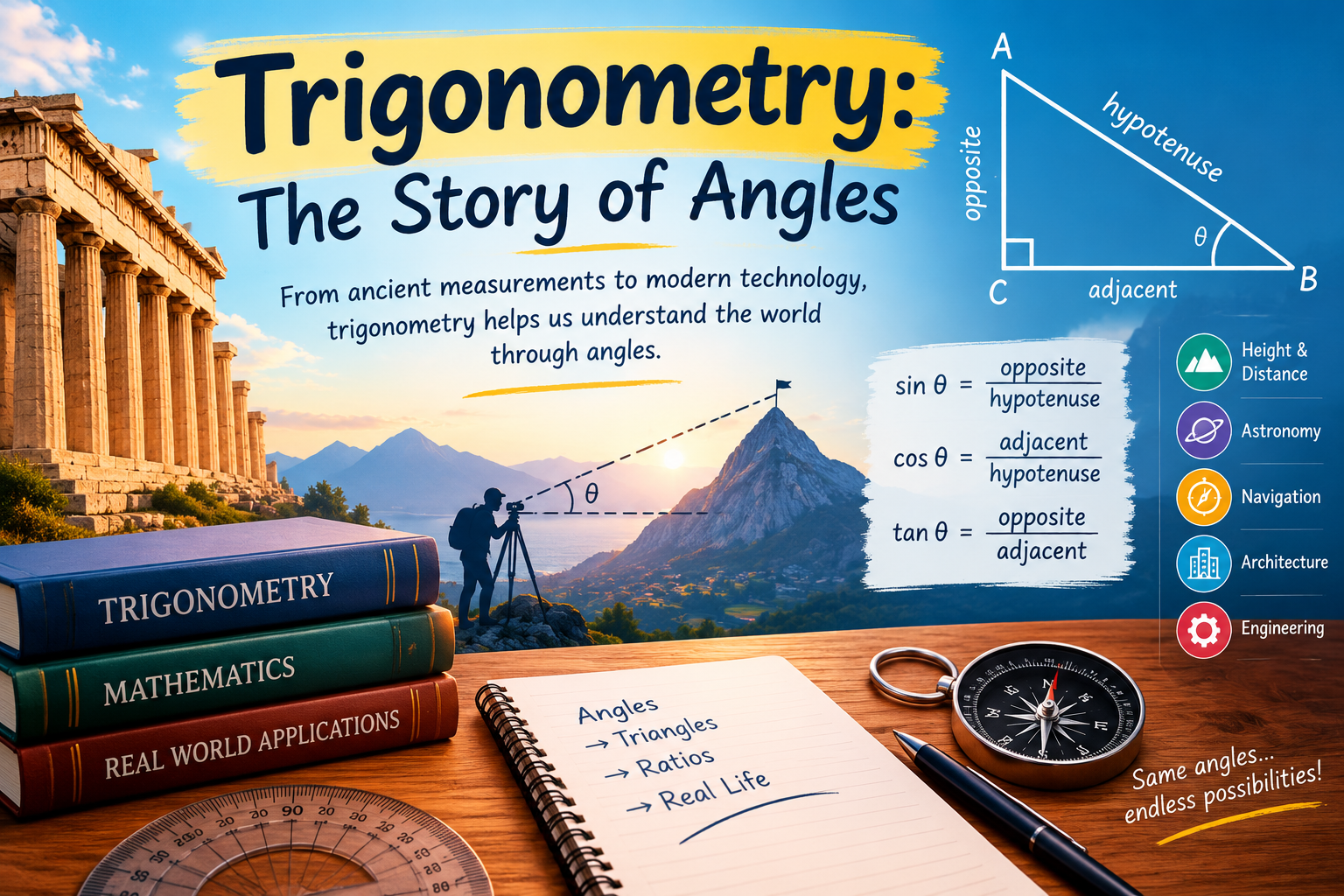
    Trigonometry is a fascinating branch of mathematics that helps us understand the relationship between angles and sides of triangles. From ancient civilizations to modern technology, trigonometry has played an important role in exploring the world, solving complex problems, and making scientific discoveries.

    In this educational project, **“Trigonometry: The Story of Angles,”** we explore the basic concepts of angles, triangles, and trigonometric ratios, including sine (sin), cosine (cos), and tangent (tan). These mathematical principles help us calculate heights, distances, and unknown measurements with accuracy and confidence.

    We also discover how trigonometry is used in our everyday lives and in various professional fields. Architects use it to design buildings, engineers apply it to construct safe structures, astronomers use it to study celestial objects, and navigators rely on it to determine directions and positions. Even measuring the height of a mountain without climbing it can be possible with the help of trigonometry!

    This project demonstrates that mathematics is not just about formulas and calculations; it is a powerful tool for understanding the world around us. By learning trigonometry, students can improve their logical thinking, problem-solving abilities, and understanding of real-world measurements.

    **Key Message:** Every angle tells a story, and every triangle opens the door to new discoveries. Trigonometry connects mathematical theory with practical applications, showing us how simple relationships can help solve extraordinary problems.

    **Remember:** Learn the angles, understand the ratios, and discover the endless possibilities of mathematics!

    #Trigonometry #TheStoryOfAngles #Mathematics #SineCosineTangent #EducationalProject #Geometry #MathsLearning #ScienceAndTechnology #RealWorldApplications #StudentLearning #LearnMathematics #STEMEducation
    RSIF8 Rool no :14 story no:15 story topic:Trigonometry: The Story of Angles # 📐 Trigonometry: The Story of Angles 🔺✨ Trigonometry is a fascinating branch of mathematics that helps us understand the relationship between angles and sides of triangles. From ancient civilizations to modern technology, trigonometry has played an important role in exploring the world, solving complex problems, and making scientific discoveries. 🌍📚 In this educational project, **“Trigonometry: The Story of Angles,”** we explore the basic concepts of angles, triangles, and trigonometric ratios, including sine (sin), cosine (cos), and tangent (tan). These mathematical principles help us calculate heights, distances, and unknown measurements with accuracy and confidence. 📏🧮 We also discover how trigonometry is used in our everyday lives and in various professional fields. Architects use it to design buildings, engineers apply it to construct safe structures, astronomers use it to study celestial objects, and navigators rely on it to determine directions and positions. Even measuring the height of a mountain without climbing it can be possible with the help of trigonometry! 🏔️🏗️🚀 This project demonstrates that mathematics is not just about formulas and calculations; it is a powerful tool for understanding the world around us. By learning trigonometry, students can improve their logical thinking, problem-solving abilities, and understanding of real-world measurements. 💡🎯 ✨ **Key Message:** Every angle tells a story, and every triangle opens the door to new discoveries. Trigonometry connects mathematical theory with practical applications, showing us how simple relationships can help solve extraordinary problems. 🌟 **Remember:** Learn the angles, understand the ratios, and discover the endless possibilities of mathematics! #Trigonometry #TheStoryOfAngles #Mathematics #SineCosineTangent #EducationalProject #Geometry #MathsLearning #ScienceAndTechnology #RealWorldApplications #StudentLearning #LearnMathematics #STEMEducation
    0 تبصرے 0 شیئرز 5252 ویوز
  • RSIF8
    Roll no 77
    Story post 42
    Story topic : The Evolution of 'Robot': From Czech Play to Tech Terminology.

    Did you know the word "Robot" wasn't born in a laboratory? It actually began on a theater stage!

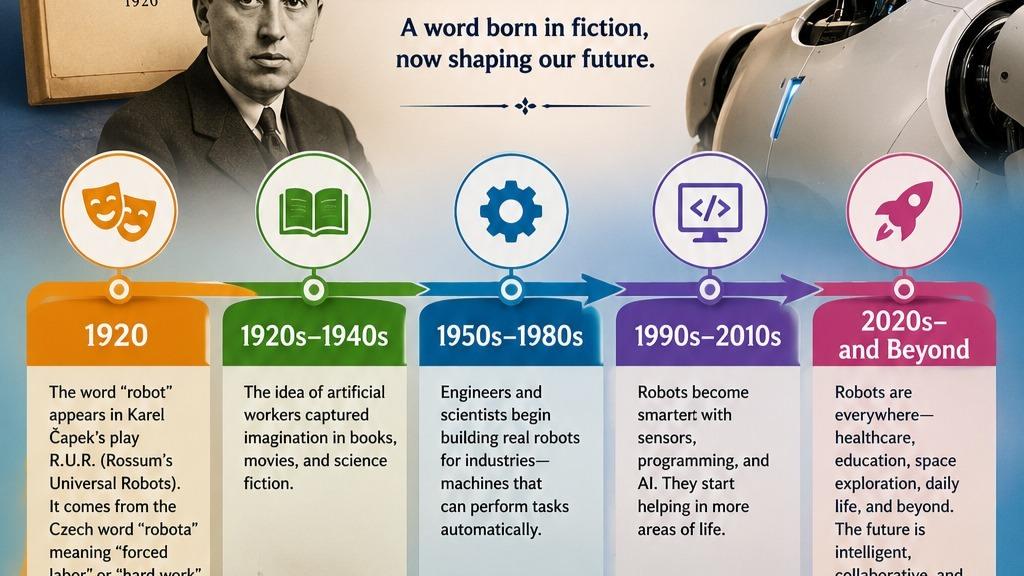
    In 1920, Czech writer Karel Čapek introduced the word "robot" in his famous play R.U.R. (Rossum's Universal Robots). The term comes from the Czech word "robota," meaning forced labor or hard work.

    In the play, robots were artificial workers created to serve humans. Over time, this fascinating idea inspired scientists, engineers, and inventors around the world.

    Today, robots are transforming our lives. They help build cars , perform delicate surgeries , explore distant planets , clean our homes , and even assist in classrooms . What started as a fictional concept has become one of the most important technologies of the modern era.

    The journey of the word "robot" reminds us that imagination can shape the future. Yesterday's fiction has become today's innovation—and tomorrow's possibilities are endless!

    #Robot #Technology #Innovation #ArtificialIntelligence #AI #HistoryOfWords #Science #TechFacts #FutureTech #Engineering #STEM #Education #Learning #DidYouKnow #Robotics #InnovationJourney #WordOrigins #TechHistory #Knowledge #Future
    RSIF8 Roll no 77 Story post 42 Story topic : The Evolution of 'Robot': From Czech Play to Tech Terminology. 🤔 Did you know the word "Robot" wasn't born in a laboratory? It actually began on a theater stage! 🎭 In 1920, Czech writer Karel Čapek introduced the word "robot" in his famous play R.U.R. (Rossum's Universal Robots). The term comes from the Czech word "robota," meaning forced labor or hard work. 💡 In the play, robots were artificial workers created to serve humans. Over time, this fascinating idea inspired scientists, engineers, and inventors around the world. 🌍⚙️ Today, robots are transforming our lives. 🤖 They help build cars 🚗, perform delicate surgeries 🏥, explore distant planets 🚀, clean our homes 🏠, and even assist in classrooms 📚. What started as a fictional concept has become one of the most important technologies of the modern era. The journey of the word "robot" reminds us that imagination can shape the future. ✨ Yesterday's fiction has become today's innovation—and tomorrow's possibilities are endless! 🌟 #Robot #Technology #Innovation #ArtificialIntelligence #AI #HistoryOfWords #Science #TechFacts #FutureTech #Engineering #STEM #Education #Learning #DidYouKnow #Robotics #InnovationJourney #WordOrigins #TechHistory #Knowledge #Future
    0 تبصرے 0 شیئرز 4004 ویوز
  • **Roll No: 2**
    **Batch: 14**
    **Book: ACCL**
    **Task No: 84**

    # The Wonders of Geometry: Shapes and Philosophy

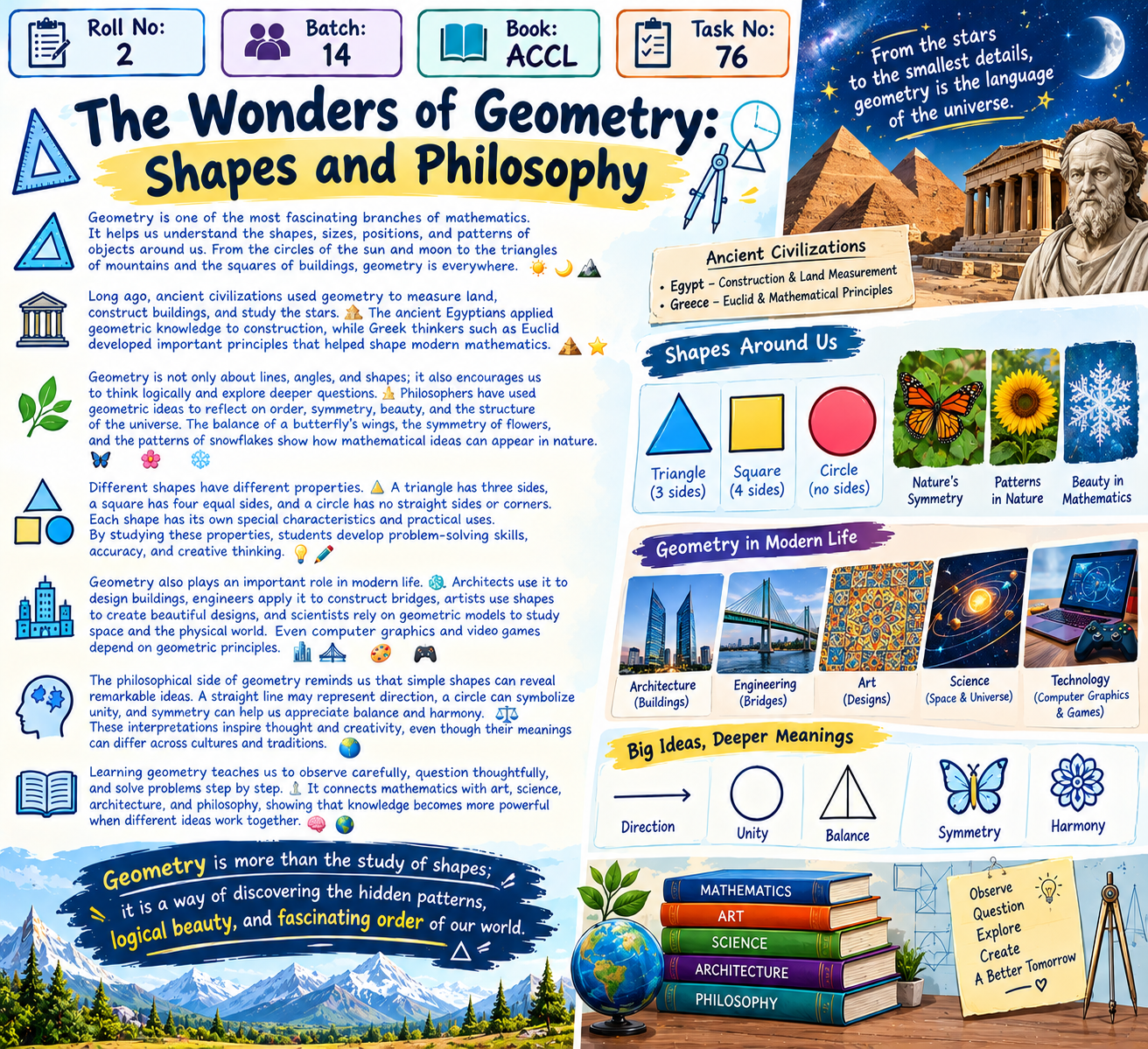
    Geometry is one of the most fascinating branches of mathematics. It helps us understand the shapes, sizes, positions, and patterns of objects around us. From the circles of the sun and moon to the triangles of mountains and the squares of buildings, geometry is everywhere.

    Long ago, ancient civilizations used geometry to measure land, construct buildings, and study the stars. The ancient Egyptians applied geometric knowledge to construction, while Greek thinkers such as **Euclid** developed important principles that helped shape modern mathematics.

    Geometry is not only about lines, angles, and shapes; it also encourages us to think logically and explore deeper questions. Philosophers have used geometric ideas to reflect on order, symmetry, beauty, and the structure of the universe. The balance of a butterfly's wings , the symmetry of flowers , and the patterns of snowflakes show how mathematical ideas can appear in nature.

    Different shapes have different properties. A triangle has three sides, a square has four equal sides, and a circle has no straight sides or corners. Each shape has its own special characteristics and practical uses. By studying these properties, students develop problem-solving skills, accuracy, and creative thinking.

    Geometry also plays an important role in modern life. Architects use it to design buildings, engineers apply it to construct bridges, artists use shapes to create beautiful designs, and scientists rely on geometric models to study space and the physical world. Even computer graphics and video games depend on geometric principles.

    The philosophical side of geometry reminds us that simple shapes can reveal remarkable ideas. A straight line may represent direction, a circle can symbolize unity, and symmetry can help us appreciate balance and harmony. These interpretations inspire thought and creativity, even though their meanings can differ across cultures and traditions.

    Learning geometry teaches us to observe carefully, question thoughtfully, and solve problems step by step. It connects mathematics with art, science, architecture, and philosophy, showing that knowledge becomes more powerful when different ideas work together.

    **Geometry is more than the study of shapes; it is a way of discovering the hidden patterns, logical beauty, and fascinating order of our world. **
    **Roll No: 2** **Batch: 14** **Book: ACCL** **Task No: 84** # 📐 The Wonders of Geometry: Shapes and Philosophy 🔺🌍 Geometry is one of the most fascinating branches of mathematics. 📏✨ It helps us understand the shapes, sizes, positions, and patterns of objects around us. From the circles of the sun and moon to the triangles of mountains and the squares of buildings, geometry is everywhere. ☀️🌙🏔️ Long ago, ancient civilizations used geometry to measure land, construct buildings, and study the stars. 🏛️🌌 The ancient Egyptians applied geometric knowledge to construction, while Greek thinkers such as **Euclid** developed important principles that helped shape modern mathematics. 📚🧠 Geometry is not only about lines, angles, and shapes; it also encourages us to think logically and explore deeper questions. 🔍💡 Philosophers have used geometric ideas to reflect on order, symmetry, beauty, and the structure of the universe. The balance of a butterfly's wings 🦋, the symmetry of flowers 🌸, and the patterns of snowflakes ❄️ show how mathematical ideas can appear in nature. Different shapes have different properties. 🔺 A triangle has three sides, a square has four equal sides, and a circle has no straight sides or corners. Each shape has its own special characteristics and practical uses. 📐📊 By studying these properties, students develop problem-solving skills, accuracy, and creative thinking. 🎓✨ Geometry also plays an important role in modern life. 🏗️ Architects use it to design buildings, engineers apply it to construct bridges, artists use shapes to create beautiful designs, and scientists rely on geometric models to study space and the physical world. 🚀🎨 Even computer graphics and video games depend on geometric principles. 💻🎮 The philosophical side of geometry reminds us that simple shapes can reveal remarkable ideas. A straight line may represent direction, a circle can symbolize unity, and symmetry can help us appreciate balance and harmony. ⚖️🔵 These interpretations inspire thought and creativity, even though their meanings can differ across cultures and traditions. Learning geometry teaches us to observe carefully, question thoughtfully, and solve problems step by step. 🧠📖 It connects mathematics with art, science, architecture, and philosophy, showing that knowledge becomes more powerful when different ideas work together. 🌍🔬 **Geometry is more than the study of shapes; it is a way of discovering the hidden patterns, logical beauty, and fascinating order of our world. 📐🌟🔺**
    0 تبصرے 0 شیئرز 3963 ویوز
  • #rsisb
    Roll no.247
    Documentary no.1
    Foundation level

    **The Evolution of “Robot”: From Czech Play to Tech Terminology **

    **Discover the Amazing Journey of Robots!**

    Have you ever wondered where the word **“Robot”** came from? Today, robots are everywhere—from factories and hospitals to schools, homes, and even outer space! But the story of this incredible word began long before modern artificial intelligence and advanced technology became part of our daily lives.

    **The Beginning of the Word “Robot” **

    The word “robot” became famous through a Czech science-fiction play called *R.U.R. (Rossum’s Universal Robots)*, written by Czech writer Karel Čapek. The play premiered in 1921 and introduced audiences to artificial workers created to serve humans. The word is connected to the Czech word *robota*, which refers to forced labor or hard work.

    **From Fiction to Reality!**

    When the word “robot” first appeared, the robots people imagined were very different from the machines we know today. Early robots were mainly ideas from stories, plays, and science fiction. Over time, scientists, engineers, and inventors began building real machines that could perform tasks automatically.

    **The Rise of Modern Robotics**

    As technology developed, robots became more advanced. Industrial robots began helping workers manufacture cars, assemble products, and complete repetitive tasks. Later, robots were developed for medical assistance, scientific research, space exploration, agriculture, and education. ‍

    **Robots and Artificial Intelligence**

    Today, robotics and Artificial Intelligence (AI) are transforming the world! Some robots can recognize objects, follow instructions, navigate their surroundings, and assist people with different tasks. AI can help certain robots process information and make decisions within their designed capabilities.

    However, not every robot uses AI, and robots do not all think or behave like humans. Understanding this difference helps us learn how technology really works!

    **Why Is the Word “Robot” Important?**

    The evolution of the word “robot” shows how imagination can influence science and innovation. A term popularized through a Czech play became an important part of modern science and technology. It reminds us that ideas from books and stories can inspire people to explore new possibilities and create amazing inventions.

    **What Can We Learn From This Story?**

    Words have fascinating histories.
    Stories can inspire scientific discoveries.
    Technology changes and develops over time.
    Robotics can help solve real-world problems.
    Learning about the past helps us understand the future.

    **Think About It!**

    If robots continue to develop, how might they help students, teachers, doctors, scientists, and communities in the future? Could you design a robot that solves a problem in your school or neighborhood?

    Remember, every great invention begins with curiosity, creativity, and the courage to explore new ideas!

    **Watch, Learn, Explore, and Innovate!** Share this documentary with your friends and family, discover the fascinating history of robotics, and keep asking questions about the technology shaping our world.

    **Comment below:** What kind of robot would you like to invent, and what problem would it solve?

    Like | Comment | Share | Follow for more educational documentaries, science stories, technology facts, and exciting learning adventures!

    #Robot #Robotics #EvolutionOfRobots #HistoryOfRobots #KarelCapek #RUR #CzechHistory #ArtificialIntelligence #AI #ScienceAndTechnology #Technology #Innovation #FutureOfTechnology #STEMEducation #ScienceDocumentary #EducationalContent #LearningIsFun #TechHistory #ModernRobotics #RoboticsForKids #DiscoverScience #KnowledgeIsPower #CreativeThinking #FutureInnovators #DigitalLearning #ExploreAndLearn #EducationalJourney #Documentary #ScienceFacts #InspiringInnovation
    #rsisb Roll no.247 Documentary no.1 Foundation level 🤖📚 **The Evolution of “Robot”: From Czech Play to Tech Terminology 🌍🚀** ✨ **Discover the Amazing Journey of Robots!** ✨ Have you ever wondered where the word **“Robot”** came from? 🤔🤖 Today, robots are everywhere—from factories and hospitals to schools, homes, and even outer space! 🚗🏭🏥🚀 But the story of this incredible word began long before modern artificial intelligence and advanced technology became part of our daily lives. 📖 **The Beginning of the Word “Robot” 🇨🇿** The word “robot” became famous through a Czech science-fiction play called *R.U.R. (Rossum’s Universal Robots)*, written by Czech writer Karel Čapek. The play premiered in 1921 and introduced audiences to artificial workers created to serve humans. 🤖🎭 The word is connected to the Czech word *robota*, which refers to forced labor or hard work. 💡 **From Fiction to Reality!** When the word “robot” first appeared, the robots people imagined were very different from the machines we know today. Early robots were mainly ideas from stories, plays, and science fiction. 📚✨ Over time, scientists, engineers, and inventors began building real machines that could perform tasks automatically. ⚙️ **The Rise of Modern Robotics** As technology developed, robots became more advanced. Industrial robots began helping workers manufacture cars, assemble products, and complete repetitive tasks. 🏭🚘 Later, robots were developed for medical assistance, scientific research, space exploration, agriculture, and education. 🌱🧑‍⚕️🔬🪐 🧠 **Robots and Artificial Intelligence** Today, robotics and Artificial Intelligence (AI) are transforming the world! 🌐💻 Some robots can recognize objects, follow instructions, navigate their surroundings, and assist people with different tasks. AI can help certain robots process information and make decisions within their designed capabilities. However, not every robot uses AI, and robots do not all think or behave like humans. Understanding this difference helps us learn how technology really works! 💡📖 🌟 **Why Is the Word “Robot” Important?** The evolution of the word “robot” shows how imagination can influence science and innovation. A term popularized through a Czech play became an important part of modern science and technology. 🚀✨ It reminds us that ideas from books and stories can inspire people to explore new possibilities and create amazing inventions. 🎯 **What Can We Learn From This Story?** ✅ Words have fascinating histories. 📚 ✅ Stories can inspire scientific discoveries. 💭 ✅ Technology changes and develops over time. ⚙️ ✅ Robotics can help solve real-world problems. 🌍 ✅ Learning about the past helps us understand the future. 🚀 🤔 **Think About It!** If robots continue to develop, how might they help students, teachers, doctors, scientists, and communities in the future? Could you design a robot that solves a problem in your school or neighborhood? 🏫🤖💡 Remember, every great invention begins with curiosity, creativity, and the courage to explore new ideas! 🌈🌟 📢 **Watch, Learn, Explore, and Innovate!** Share this documentary with your friends and family, discover the fascinating history of robotics, and keep asking questions about the technology shaping our world. 🤖🌍❤️ 💬 **Comment below:** What kind of robot would you like to invent, and what problem would it solve? 👍 Like | 💬 Comment | 🔄 Share | ⭐ Follow for more educational documentaries, science stories, technology facts, and exciting learning adventures! #Robot #Robotics #EvolutionOfRobots #HistoryOfRobots #KarelCapek #RUR #CzechHistory #ArtificialIntelligence #AI #ScienceAndTechnology #Technology #Innovation #FutureOfTechnology #STEMEducation #ScienceDocumentary #EducationalContent #LearningIsFun #TechHistory #ModernRobotics #RoboticsForKids #DiscoverScience #KnowledgeIsPower #CreativeThinking #FutureInnovators #DigitalLearning #ExploreAndLearn #EducationalJourney #Documentary #ScienceFacts #InspiringInnovation 🤖🚀📚🌍💡✨
    0 تبصرے 0 شیئرز 9048 ویوز 8
More Results