• **CODING TASK – DAY 180**

    **Topic: Prime Number Checker**

    **Date: November 17, 2026**
    ‍ **Name: Abdul Hadi**
    **Task No: Day 180**

    Today’s coding task was **Prime Number Checker**. In this task, I created a program that checks whether a given number is a **prime number** or not. A prime number is a number greater than 1 that has only two factors: **1 and itself**.

    This task helped me improve my understanding of **loops, conditions, logic, and problem-solving skills** in programming.

    **Keep Coding, Keep Learning, Keep Growing!**

    #Day180 #CodingTask #PrimeNumberChecker #Programming #Coding #LearnToCode #ProblemSolving #AbdulHadi #TechSkills #CodingJourney
    ๐Ÿ’ปโœจ **CODING TASK – DAY 180** โœจ๐Ÿ’ป ๐Ÿ”ข **Topic: Prime Number Checker** ๐Ÿ“… **Date: November 17, 2026** ๐Ÿ‘จ‍๐Ÿ’ป **Name: Abdul Hadi** ๐ŸŽฏ **Task No: Day 180** Today’s coding task was **Prime Number Checker**. In this task, I created a program that checks whether a given number is a **prime number** or not. A prime number is a number greater than 1 that has only two factors: **1 and itself**. This task helped me improve my understanding of **loops, conditions, logic, and problem-solving skills** in programming. ๐Ÿš€๐Ÿ’ก ๐ŸŒŸ **Keep Coding, Keep Learning, Keep Growing!** ๐ŸŒŸ #Day180 #CodingTask #PrimeNumberChecker #Programming #Coding #LearnToCode #ProblemSolving #AbdulHadi #TechSkills #CodingJourney ๐Ÿ’ป๐Ÿš€
    0 Reacties 0 aandelen 611 Views
  • #rsisb
    Roll no 279
    song post 6
    Foundation level
    **Health and DNA: The Struggle of Life**
    Health and DNA are two important parts of human life. DNA carries the genetic information that makes each person unique and helps our bodies grow, develop, and function. Every cell contains important instructions that play a role in how our bodies work.
    Our health is influenced by many factors, including genetics, nutrition, physical activity, sleep, and our environment. Understanding DNA helps scientists learn more about inherited traits, diseases, and new ways to improve healthcare.
    Life is an incredible journey, and science helps us understand the mysteries hidden inside our bodies. Let's explore the fascinating connection between health, genetics, and the struggle of life!
    #HealthAndDNA #Genetics #Science #HumanLife #DNA #Biology #Healthcare #HealthyLiving #MedicalScience #LearningAndGrowing
    #rsisb Roll no 279 song post 6 Foundation level ๐Ÿงฌ **Health and DNA: The Struggle of Life** โค๏ธ๐Ÿ”ฌ Health and DNA are two important parts of human life. DNA carries the genetic information that makes each person unique and helps our bodies grow, develop, and function. ๐Ÿงฌ Every cell contains important instructions that play a role in how our bodies work. Our health is influenced by many factors, including genetics, nutrition, physical activity, sleep, and our environment. ๐ŸŒฑ๐Ÿ’ช Understanding DNA helps scientists learn more about inherited traits, diseases, and new ways to improve healthcare. ๐Ÿฅ Life is an incredible journey, and science helps us understand the mysteries hidden inside our bodies. Let's explore the fascinating connection between health, genetics, and the struggle of life! ๐ŸŒโœจ #HealthAndDNA #Genetics #Science #HumanLife #DNA #Biology #Healthcare #HealthyLiving #MedicalScience #LearningAndGrowing ๐Ÿงฌ๐Ÿ”ฌโค๏ธ
    0 Reacties 0 aandelen 1981 Views 4
  • RSIF8
    ROLL NO:13
    TedxTalk NO:3

    URDU

    Living in Denial – Climate Change – Iqra Khilji

    Climate change is one of the most important and serious challenges facing our world today. It is a global issue that affects every country, every community, and every living thing on our planet. The topic "Living in Denial – Climate Change" by Iqra Khilji gives us an important opportunity to understand the reality of climate change, its causes, its consequences, and our responsibility toward protecting the environment. It encourages us to stop ignoring environmental problems and start thinking seriously about the future of our planet.

    Our Earth is a beautiful home filled with mountains, forests, rivers, oceans, animals, plants, and millions of different forms of life. Nature provides us with everything we need to survive, including clean air, fresh water, food, and natural resources. However, human activities and irresponsible decisions are putting increasing pressure on our environment. Pollution, deforestation, excessive use of natural resources, and the burning of fossil fuels are some of the major factors contributing to environmental problems and climate change.

    One of the most important messages of this topic is that many people know about climate change but still choose to ignore it. They hear about rising temperatures, melting glaciers, floods, droughts, heatwaves, and unusual weather conditions, but they do not always understand how serious these problems are. Some people believe that climate change is a problem for the future, while others think that one person's actions cannot make any difference. This way of thinking is what makes the topic of living in denial so important. Ignoring a problem does not mean that the problem will disappear. We must accept reality, understand the situation, and take meaningful steps to improve it.

    Climate change affects the natural balance of our planet in many different ways. Rising global temperatures can affect weather patterns, agriculture, water supplies, and natural ecosystems. Extreme weather conditions can create difficulties for communities and damage homes, crops, and infrastructure.
    RSIF8 ROLL NO:13 TedxTalk NO:3 URDU Living in Denial – Climate Change – Iqra Khilji ๐ŸŒ๐ŸŒฑ Climate change is one of the most important and serious challenges facing our world today. It is a global issue that affects every country, every community, and every living thing on our planet. The topic "Living in Denial – Climate Change" by Iqra Khilji gives us an important opportunity to understand the reality of climate change, its causes, its consequences, and our responsibility toward protecting the environment. It encourages us to stop ignoring environmental problems and start thinking seriously about the future of our planet. Our Earth is a beautiful home filled with mountains, forests, rivers, oceans, animals, plants, and millions of different forms of life. Nature provides us with everything we need to survive, including clean air, fresh water, food, and natural resources. However, human activities and irresponsible decisions are putting increasing pressure on our environment. Pollution, deforestation, excessive use of natural resources, and the burning of fossil fuels are some of the major factors contributing to environmental problems and climate change. One of the most important messages of this topic is that many people know about climate change but still choose to ignore it. They hear about rising temperatures, melting glaciers, floods, droughts, heatwaves, and unusual weather conditions, but they do not always understand how serious these problems are. Some people believe that climate change is a problem for the future, while others think that one person's actions cannot make any difference. This way of thinking is what makes the topic of living in denial so important. Ignoring a problem does not mean that the problem will disappear. We must accept reality, understand the situation, and take meaningful steps to improve it. Climate change affects the natural balance of our planet in many different ways. Rising global temperatures can affect weather patterns, agriculture, water supplies, and natural ecosystems. Extreme weather conditions can create difficulties for communities and damage homes, crops, and infrastructure.
    0 Reacties 0 aandelen 2434 Views 20
  • **Roll No: 2**
    **Batch: 14**
    **Book: ACCL**
    **Task No: 161**

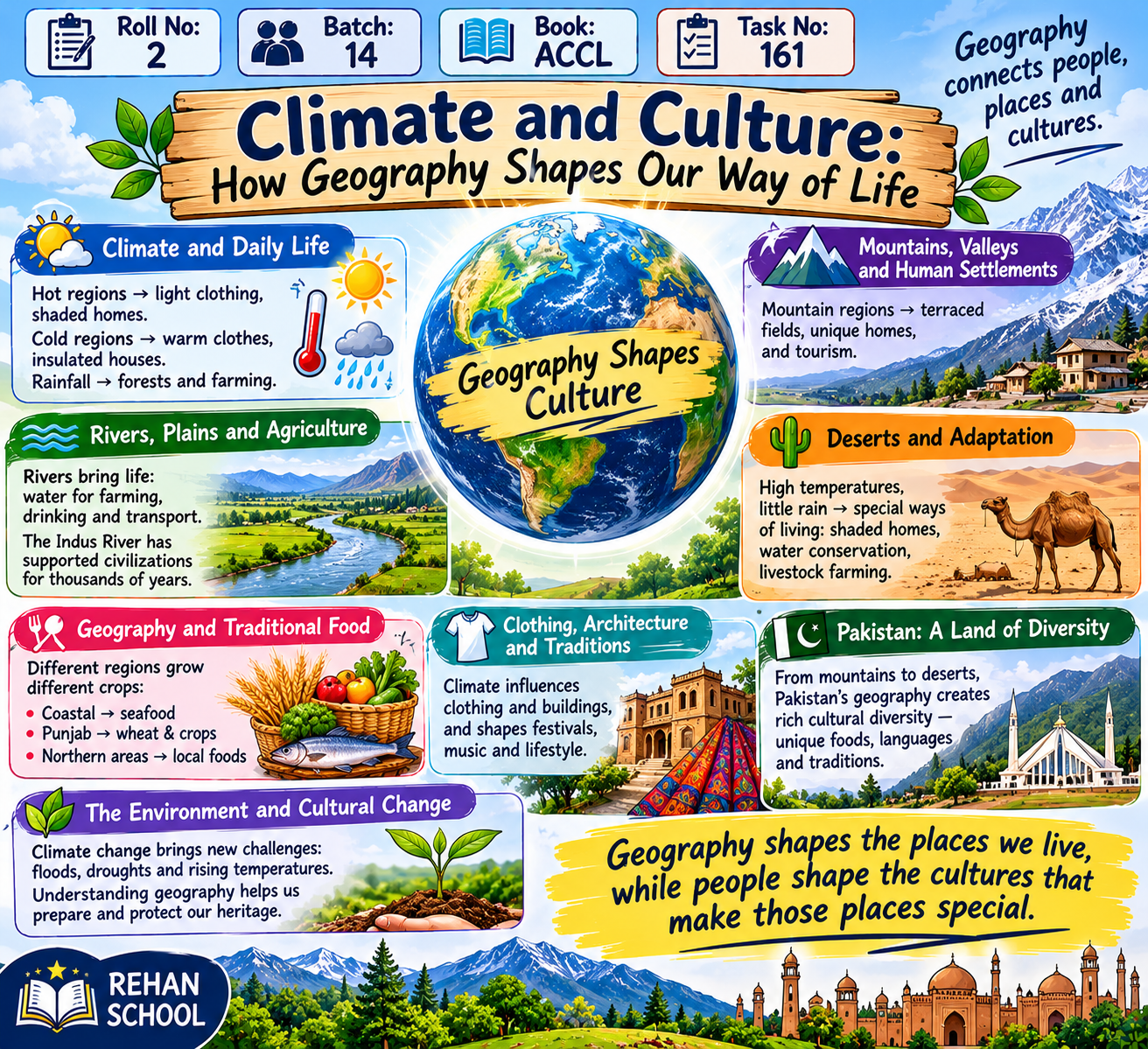
    # Climate and Culture: How Geography Shapes Our Way of Life

    Have you ever wondered why people in different parts of the world wear different clothes, eat different foods, build different houses, and celebrate different traditions? One important reason is geography. The physical features of a region, including its mountains, rivers, deserts, forests, and climate, influence how people live and develop their cultures. Geography is not just about maps and locations; it is also about understanding the relationship between people and their environment.

    **Climate refers to the long-term patterns of weather in a particular region, while geography describes the physical features and location of places.** These two factors influence many aspects of human life, including agriculture, housing, transportation, clothing, occupations, and cultural traditions. Over generations, communities develop ways of living that respond to the conditions around them.

    ## Climate and Daily Life

    Climate plays an important role in determining people's daily activities. In hot regions, people often prefer lightweight clothing and buildings designed to provide shade and ventilation. In colder areas, warm clothing, insulated houses, and heating systems help people remain comfortable.

    Rainfall also affects daily life. Regions receiving plenty of rain may support forests, rivers, and farming, while areas with limited rainfall often require careful water management. These environmental conditions influence where communities settle and how they use natural resources.

    ## Mountains, Valleys, and Human Settlements

    Mountains and valleys create unique living environments. People living in mountainous regions may build houses on slopes or in valleys and develop transportation systems suited to difficult terrain. Farming practices may include terraced fields, where steps are created on hillsides to make agricultural land more usable.

    Mountain communities often develop strong connections with their natural surroundings. Tourism, livestock farming, handicrafts, and forestry can become important sources of livelihood. In Pakistan, regions such as Gilgit-Baltistan and parts of Khyber Pakhtunkhwa demonstrate how mountain geography influences local lifestyles and traditions.

    ## Rivers, Plains, and Agriculture

    Rivers and fertile plains have played a major role in the development of human civilizations. Rivers provide water for drinking, farming, transportation, and other activities. Their surrounding land can contain fertile soil that supports the growth of crops.

    The Indus River is an important example. It has supported communities and agriculture in Pakistan for thousands of years. The Indus Valley Civilization developed around this river system, demonstrating how access to water and suitable land can contribute to the growth of cities, trade, and organized societies.

    ## Deserts and Adaptation

    Desert regions have high temperatures, limited rainfall, and scarce water resources. People living in these areas develop ways to adapt to challenging environmental conditions. They may use traditional methods of water conservation, construct buildings that provide shade, and organize their activities around cooler parts of the day.

    In some desert communities, livestock farming, trade, and traditional crafts are important occupations. Their clothing, food, architecture, and customs reflect generations of experience in living with a dry climate.

    ## Geography and Traditional Food

    Food is another interesting example of how geography shapes culture. Different regions grow different crops depending on their climate, soil, and water availability. Coastal communities often include fish and seafood in their diets, while agricultural regions may depend more on wheat, rice, vegetables, and fruits.

    In Pakistan, regional food traditions reflect local environments and cultural history. Punjab is famous for its agricultural products and traditional dishes, while coastal Sindh and Balochistan have strong connections with seafood. Northern areas are known for regional foods influenced by their mountain environment and local ingredients.

    ## Clothing, Architecture, and Traditions

    Geography influences the materials people use for clothing and construction. In cold climates, wool and other insulating materials are useful, while lighter fabrics are often preferred in hot environments.

    Traditional architecture also reflects local conditions. Houses in warm regions may have courtyards and shaded spaces, while buildings in colder areas may use materials and designs that help retain heat. Local traditions, festivals, music, and celebrations can also develop through people's relationship with their environment, history, and community life.

    ## The Environment and Cultural Change

    Although geography influences culture, human communities are not limited by their surroundings. People use creativity, technology, and knowledge to adapt to changing conditions. Modern transportation, irrigation systems, renewable energy, and improved construction methods have changed the way many communities live.

    Climate change is creating new challenges around the world. Rising temperatures, changing rainfall patterns, floods, droughts, and extreme weather events can affect agriculture, water supplies, homes, and traditional livelihoods. Understanding the connection between geography and culture can help communities prepare for these challenges and protect their natural and cultural heritage.

    ## Pakistan: A Land of Geographical and Cultural Diversity

    Pakistan is an excellent example of how geography creates cultural diversity. From the high mountains of the north to the deserts of the south, from fertile plains to coastal areas, every region has its own environmental characteristics and traditions.

    The people of different regions speak various languages, prepare different foods, wear traditional clothing, and celebrate unique cultural events. These differences make Pakistan a country rich in heritage and identity. At the same time, shared history and national values connect its communities.

    Geography teaches us that every place has its own story. The mountains, rivers, deserts, forests, and climates around us influence how societies grow, adapt, and preserve their traditions. By understanding these connections, we can appreciate cultural diversity and recognize the importance of protecting our environment.

    **Geography shapes the places we live, while people shape the cultures that make those places special. When we understand the relationship between climate, land, and human life, we gain a deeper appreciation of our world's diversity and the remarkable ways people adapt to their surroundings. **

    #ClimateAndCulture #Geography #CulturalDiversity #Environment #Pakistan #HumanGeography #ClimateChange #ACCL #Batch14 #Task161
    **Roll No: 2** **Batch: 14** **Book: ACCL** **Task No: 161** # ๐ŸŒ๐Ÿ”๏ธ Climate and Culture: How Geography Shapes Our Way of Life ๐ŸŒฆ๏ธ๐Ÿก Have you ever wondered why people in different parts of the world wear different clothes, eat different foods, build different houses, and celebrate different traditions? ๐ŸŒŽโœจ One important reason is geography. The physical features of a region, including its mountains, rivers, deserts, forests, and climate, influence how people live and develop their cultures. Geography is not just about maps and locations; it is also about understanding the relationship between people and their environment. **Climate refers to the long-term patterns of weather in a particular region, while geography describes the physical features and location of places.** ๐ŸŒค๏ธ These two factors influence many aspects of human life, including agriculture, housing, transportation, clothing, occupations, and cultural traditions. Over generations, communities develop ways of living that respond to the conditions around them. ## ๐ŸŒž Climate and Daily Life Climate plays an important role in determining people's daily activities. In hot regions, people often prefer lightweight clothing and buildings designed to provide shade and ventilation. In colder areas, warm clothing, insulated houses, and heating systems help people remain comfortable. โ„๏ธโ˜€๏ธ Rainfall also affects daily life. Regions receiving plenty of rain may support forests, rivers, and farming, while areas with limited rainfall often require careful water management. These environmental conditions influence where communities settle and how they use natural resources. ## ๐Ÿ”๏ธ Mountains, Valleys, and Human Settlements Mountains and valleys create unique living environments. ๐Ÿ”๏ธ People living in mountainous regions may build houses on slopes or in valleys and develop transportation systems suited to difficult terrain. Farming practices may include terraced fields, where steps are created on hillsides to make agricultural land more usable. Mountain communities often develop strong connections with their natural surroundings. Tourism, livestock farming, handicrafts, and forestry can become important sources of livelihood. In Pakistan, regions such as Gilgit-Baltistan and parts of Khyber Pakhtunkhwa demonstrate how mountain geography influences local lifestyles and traditions. ๐Ÿ‡ต๐Ÿ‡ฐ ## ๐ŸŒพ Rivers, Plains, and Agriculture Rivers and fertile plains have played a major role in the development of human civilizations. ๐ŸŒŠ Rivers provide water for drinking, farming, transportation, and other activities. Their surrounding land can contain fertile soil that supports the growth of crops. The Indus River is an important example. It has supported communities and agriculture in Pakistan for thousands of years. The Indus Valley Civilization developed around this river system, demonstrating how access to water and suitable land can contribute to the growth of cities, trade, and organized societies. ๐ŸŒพ๐Ÿ›๏ธ ## ๐Ÿœ๏ธ Deserts and Adaptation Desert regions have high temperatures, limited rainfall, and scarce water resources. ๐Ÿช People living in these areas develop ways to adapt to challenging environmental conditions. They may use traditional methods of water conservation, construct buildings that provide shade, and organize their activities around cooler parts of the day. In some desert communities, livestock farming, trade, and traditional crafts are important occupations. Their clothing, food, architecture, and customs reflect generations of experience in living with a dry climate. ## ๐Ÿฒ Geography and Traditional Food Food is another interesting example of how geography shapes culture. ๐Ÿš Different regions grow different crops depending on their climate, soil, and water availability. Coastal communities often include fish and seafood in their diets, while agricultural regions may depend more on wheat, rice, vegetables, and fruits. In Pakistan, regional food traditions reflect local environments and cultural history. Punjab is famous for its agricultural products and traditional dishes, while coastal Sindh and Balochistan have strong connections with seafood. Northern areas are known for regional foods influenced by their mountain environment and local ingredients. ๐Ÿ›๐Ÿ‡ต๐Ÿ‡ฐ ## ๐Ÿ‘• Clothing, Architecture, and Traditions Geography influences the materials people use for clothing and construction. In cold climates, wool and other insulating materials are useful, while lighter fabrics are often preferred in hot environments. ๐Ÿงฅ Traditional architecture also reflects local conditions. Houses in warm regions may have courtyards and shaded spaces, while buildings in colder areas may use materials and designs that help retain heat. Local traditions, festivals, music, and celebrations can also develop through people's relationship with their environment, history, and community life. ๐ŸŽถ๐Ÿก ## ๐ŸŒฑ The Environment and Cultural Change Although geography influences culture, human communities are not limited by their surroundings. People use creativity, technology, and knowledge to adapt to changing conditions. Modern transportation, irrigation systems, renewable energy, and improved construction methods have changed the way many communities live. Climate change is creating new challenges around the world. Rising temperatures, changing rainfall patterns, floods, droughts, and extreme weather events can affect agriculture, water supplies, homes, and traditional livelihoods. ๐ŸŒ Understanding the connection between geography and culture can help communities prepare for these challenges and protect their natural and cultural heritage. ## ๐Ÿ‡ต๐Ÿ‡ฐ Pakistan: A Land of Geographical and Cultural Diversity Pakistan is an excellent example of how geography creates cultural diversity. From the high mountains of the north to the deserts of the south, from fertile plains to coastal areas, every region has its own environmental characteristics and traditions. ๐Ÿ”๏ธ๐ŸŒŠ The people of different regions speak various languages, prepare different foods, wear traditional clothing, and celebrate unique cultural events. These differences make Pakistan a country rich in heritage and identity. At the same time, shared history and national values connect its communities. Geography teaches us that every place has its own story. The mountains, rivers, deserts, forests, and climates around us influence how societies grow, adapt, and preserve their traditions. By understanding these connections, we can appreciate cultural diversity and recognize the importance of protecting our environment. ๐ŸŒณ๐Ÿค **Geography shapes the places we live, while people shape the cultures that make those places special. When we understand the relationship between climate, land, and human life, we gain a deeper appreciation of our world's diversity and the remarkable ways people adapt to their surroundings. ๐ŸŒ๐Ÿ’šโœจ** #ClimateAndCulture #Geography #CulturalDiversity #Environment #Pakistan #HumanGeography #ClimateChange #ACCL #Batch14 #Task161 ๐ŸŒ๐Ÿ”๏ธ๐ŸŒฆ๏ธ
    0 Reacties 0 aandelen 6500 Views
  • RSIF8
    Roll no:14
    coding task no:26
    coding topic:Prime Number Checker

    **Prime Number Checker — Explore the World of Mathematics!**

    Welcome to the **Prime Number Checker**, a simple and useful mathematical tool designed to help users identify whether a number is prime or composite. This project combines the power of mathematics and programming to make number checking faster, easier, and more interactive.

    **What Is a Prime Number?**

    A prime number is a natural number greater than 1 that has exactly two distinct positive factors: 1 and itself. Examples include 2, 3, 5, 7, 11, 13, and 17. Numbers such as 4, 6, 8, and 9 are composite because they have more than two positive factors. Remember, the number 1 is neither prime nor composite.

    **How Does the Prime Number Checker Work?**

    The user enters a number, and the program checks whether it is divisible by any whole number other than 1 and itself. If no such divisor exists, the number is identified as prime. Otherwise, it is classified as composite. The program can also handle special cases, such as 1, 0, and negative numbers, by displaying appropriate results.

    **Key Features:**

    - Quickly checks whether a number is prime.
    - Uses mathematical logic to test divisibility.
    - Provides a simple and user-friendly interface.
    - Delivers results quickly and efficiently.
    - Helps students understand prime numbers and factors.
    - Supports learning basic programming concepts and conditional statements.

    **Why Is This Project Useful?**

    A Prime Number Checker is an excellent beginner-friendly programming project for students and mathematics enthusiasts. It helps develop logical thinking, problem-solving abilities, and an understanding of algorithms. Prime numbers are also important in advanced mathematics, computer science, and cryptography.

    Whether you are learning programming for the first time or exploring number theory, this project offers a practical way to connect mathematical concepts with real-world computing.

    **Think logically, explore numbers, and discover the fascinating patterns hidden in mathematics!**

    Like, Share, and Follow for more educational projects, programming ideas, and interesting mathematical concepts!

    #PrimeNumberChecker #PrimeNumbers #Mathematics #Programming #Coding #ComputerScience #PythonProgramming #NumberTheory #LearnToCode #EducationalProjects #ProblemSolving #STEMEducation
    RSIF8 Roll no:14 coding task no:26 coding topic:Prime Number Checker ๐Ÿ”ข **Prime Number Checker — Explore the World of Mathematics!** ๐Ÿงฎโœจ Welcome to the **Prime Number Checker**, a simple and useful mathematical tool designed to help users identify whether a number is prime or composite. This project combines the power of mathematics and programming to make number checking faster, easier, and more interactive. ๐Ÿ“š **What Is a Prime Number?** A prime number is a natural number greater than 1 that has exactly two distinct positive factors: 1 and itself. Examples include 2, 3, 5, 7, 11, 13, and 17. Numbers such as 4, 6, 8, and 9 are composite because they have more than two positive factors. Remember, the number 1 is neither prime nor composite. โš™๏ธ **How Does the Prime Number Checker Work?** The user enters a number, and the program checks whether it is divisible by any whole number other than 1 and itself. If no such divisor exists, the number is identified as prime. Otherwise, it is classified as composite. The program can also handle special cases, such as 1, 0, and negative numbers, by displaying appropriate results. ๐ŸŒŸ **Key Features:** - ๐Ÿ” Quickly checks whether a number is prime. - ๐Ÿงฎ Uses mathematical logic to test divisibility. - ๐Ÿ’ป Provides a simple and user-friendly interface. - โšก Delivers results quickly and efficiently. - ๐Ÿ“– Helps students understand prime numbers and factors. - ๐ŸŽฏ Supports learning basic programming concepts and conditional statements. ๐Ÿš€ **Why Is This Project Useful?** A Prime Number Checker is an excellent beginner-friendly programming project for students and mathematics enthusiasts. It helps develop logical thinking, problem-solving abilities, and an understanding of algorithms. Prime numbers are also important in advanced mathematics, computer science, and cryptography. ๐Ÿ’ก Whether you are learning programming for the first time or exploring number theory, this project offers a practical way to connect mathematical concepts with real-world computing. โœจ **Think logically, explore numbers, and discover the fascinating patterns hidden in mathematics!** ๐Ÿ‘ Like, Share, and Follow for more educational projects, programming ideas, and interesting mathematical concepts! #PrimeNumberChecker #PrimeNumbers #Mathematics #Programming #Coding #ComputerScience #PythonProgramming #NumberTheory #LearnToCode #EducationalProjects #ProblemSolving #STEMEducation ๐Ÿ”ข๐Ÿ’ป
    0 Reacties 0 aandelen 3823 Views
  • RSIF8
    ROLL NO 77
    TEDX TALK NO 48 TEDX TOPIC "The puzzle of motivation"

    **The Puzzle of Motivation**

    What truly motivates us to do our best? Is it money and rewards, or is there something more powerful?

    In this inspiring topic, we explore three key factors that can boost motivation: **Autonomy, Mastery, and Purpose.**

    **Autonomy:** The freedom to make choices.
    **Mastery:** The desire to learn and improve.
    **Purpose:** Understanding why our work matters.

    Remember, true motivation is not always about rewards. Sometimes, the greatest motivation comes from learning new skills, following our passion, and making a positive difference in the world.

    Discover your purpose, keep improving, and take one step closer to your dreams every day!

    #ThePuzzleOfMotivation #DanielPink #Motivation
    RSIF8 ROLL NO 77 TEDX TALK NO 48 TEDX TOPIC "The puzzle of motivation" ๐ŸŽฏโœจ **The Puzzle of Motivation** ๐Ÿš€ What truly motivates us to do our best? ๐Ÿค” Is it money and rewards, or is there something more powerful? In this inspiring topic, we explore three key factors that can boost motivation: **Autonomy, Mastery, and Purpose.** ๐ŸŒŸ ๐Ÿ•Š๏ธ **Autonomy:** The freedom to make choices. ๐Ÿ“š **Mastery:** The desire to learn and improve. ๐ŸŒ **Purpose:** Understanding why our work matters. Remember, true motivation is not always about rewards. Sometimes, the greatest motivation comes from learning new skills, following our passion, and making a positive difference in the world. ๐Ÿ’ก๐ŸŒฑ ๐Ÿ”ฅ Discover your purpose, keep improving, and take one step closer to your dreams every day! #ThePuzzleOfMotivation #DanielPink #Motivation
    0 Reacties 0 aandelen 2151 Views 10
  • RSIF8
    Roll no:14
    story no:22
    story post topic:Exploring Life’s Mechanisms Through Experimentation
    # Exploring Life’s Mechanisms Through Experimentation

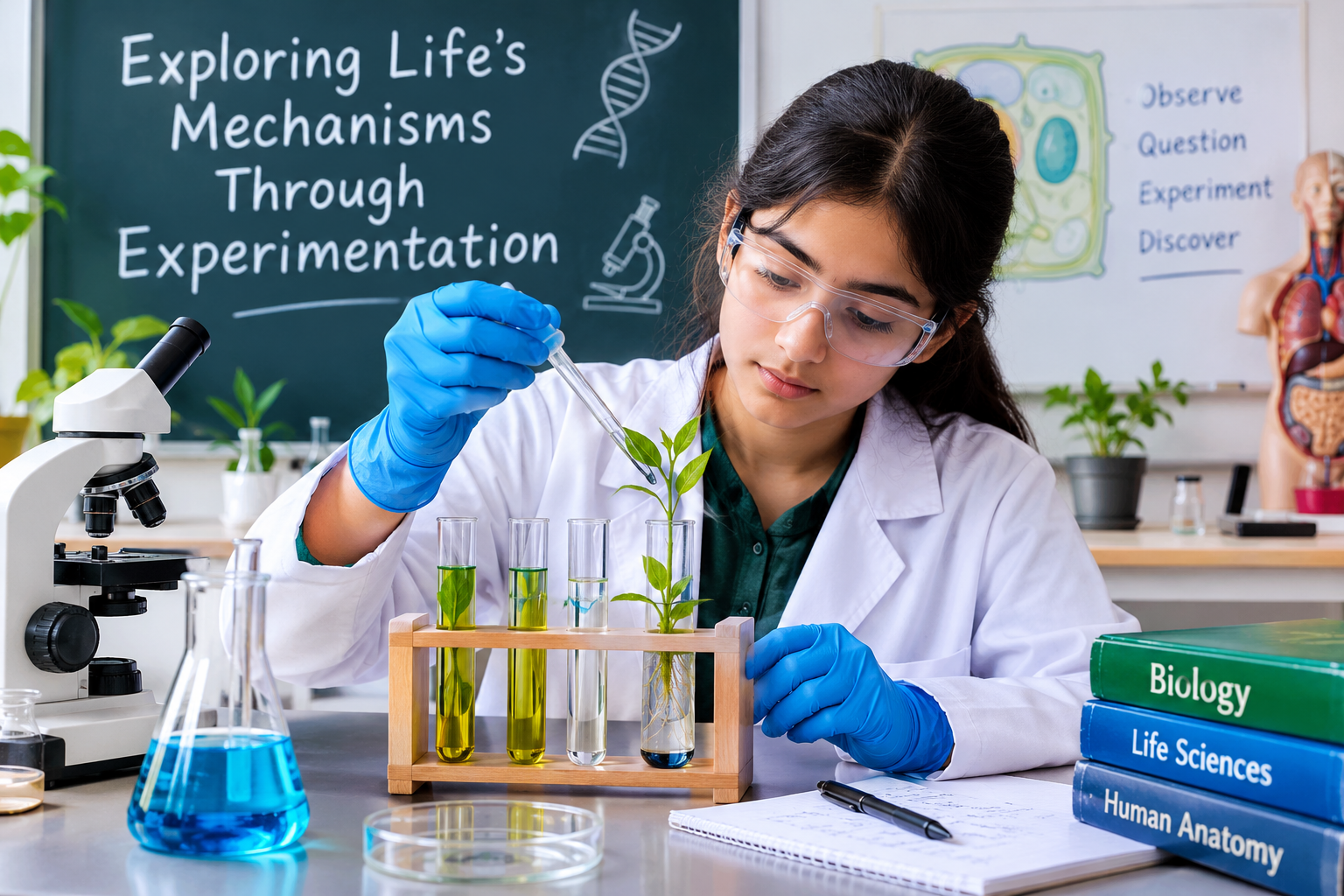
    Welcome to the fascinating world of scientific discovery, where curiosity meets experimentation and every observation brings us closer to understanding the mysteries of life! **“Exploring Life’s Mechanisms Through Experimentation”** highlights the importance of practical experiments in understanding how living organisms function, grow, and interact with their environments.

    Through hands-on activities, laboratory experiments, microscopes, and scientific observations, students can explore the amazing processes that take place inside living things. From examining plant growth and studying cells to understanding biological systems, experimentation helps transform scientific theories into meaningful discoveries.

    **Key Topics Covered:**
    - Understanding the structure and functions of living organisms
    - Exploring cells, DNA, and biological processes
    - Investigating plant growth and environmental factors
    - Learning through experiments and scientific observations
    - Developing critical thinking and problem-solving skills
    - Discovering how living organisms interact with their surroundings

    **Why Is Experimentation Important?**

    Scientific experimentation allows learners to ask questions, test ideas, analyze results, and develop evidence-based conclusions. It encourages creativity, patience, and curiosity while helping students understand the principles of biology and life sciences.

    Whether you are a student, science enthusiast, or aspiring researcher, exploring life's mechanisms through experimentation opens the door to new knowledge and exciting discoveries. Every experiment is an opportunity to learn something new about the incredible world around us!

    **Observe, experiment, discover, and explore the science of life—because every great discovery begins with a question!**

    #Biology #ScienceExperiments #LifeSciences #ScientificDiscovery #BiologyLab #LearningThroughExperimentation #STEMEducation #ScienceLearning #CellBiology #NatureAndScience #EducationalContent #ExploreScience
    RSIF8 Roll no:14 story no:22 story post topic:Exploring Life’s Mechanisms Through Experimentation # ๐Ÿ”ฌ Exploring Life’s Mechanisms Through Experimentation ๐Ÿงฌ Welcome to the fascinating world of scientific discovery, where curiosity meets experimentation and every observation brings us closer to understanding the mysteries of life! ๐ŸŒฑ๐Ÿ” **“Exploring Life’s Mechanisms Through Experimentation”** highlights the importance of practical experiments in understanding how living organisms function, grow, and interact with their environments. Through hands-on activities, laboratory experiments, microscopes, and scientific observations, students can explore the amazing processes that take place inside living things. From examining plant growth and studying cells to understanding biological systems, experimentation helps transform scientific theories into meaningful discoveries. ๐Ÿงช๐ŸŒฟ ๐Ÿ’ก **Key Topics Covered:** - ๐Ÿ”ฌ Understanding the structure and functions of living organisms - ๐Ÿงฌ Exploring cells, DNA, and biological processes - ๐ŸŒฑ Investigating plant growth and environmental factors - ๐Ÿงช Learning through experiments and scientific observations - ๐Ÿ“š Developing critical thinking and problem-solving skills - ๐ŸŒ Discovering how living organisms interact with their surroundings ๐ŸŽฏ **Why Is Experimentation Important?** Scientific experimentation allows learners to ask questions, test ideas, analyze results, and develop evidence-based conclusions. It encourages creativity, patience, and curiosity while helping students understand the principles of biology and life sciences. ๐ŸŒŸ Whether you are a student, science enthusiast, or aspiring researcher, exploring life's mechanisms through experimentation opens the door to new knowledge and exciting discoveries. Every experiment is an opportunity to learn something new about the incredible world around us! โœจ **Observe, experiment, discover, and explore the science of life—because every great discovery begins with a question!** #Biology #ScienceExperiments #LifeSciences #ScientificDiscovery #BiologyLab #LearningThroughExperimentation #STEMEducation #ScienceLearning #CellBiology #NatureAndScience #EducationalContent #ExploreScience
    0 Reacties 0 aandelen 5091 Views
  • **Roll No: 2**
    **Batch: 14**
    **Book: ACCL**
    **Task No: 138**

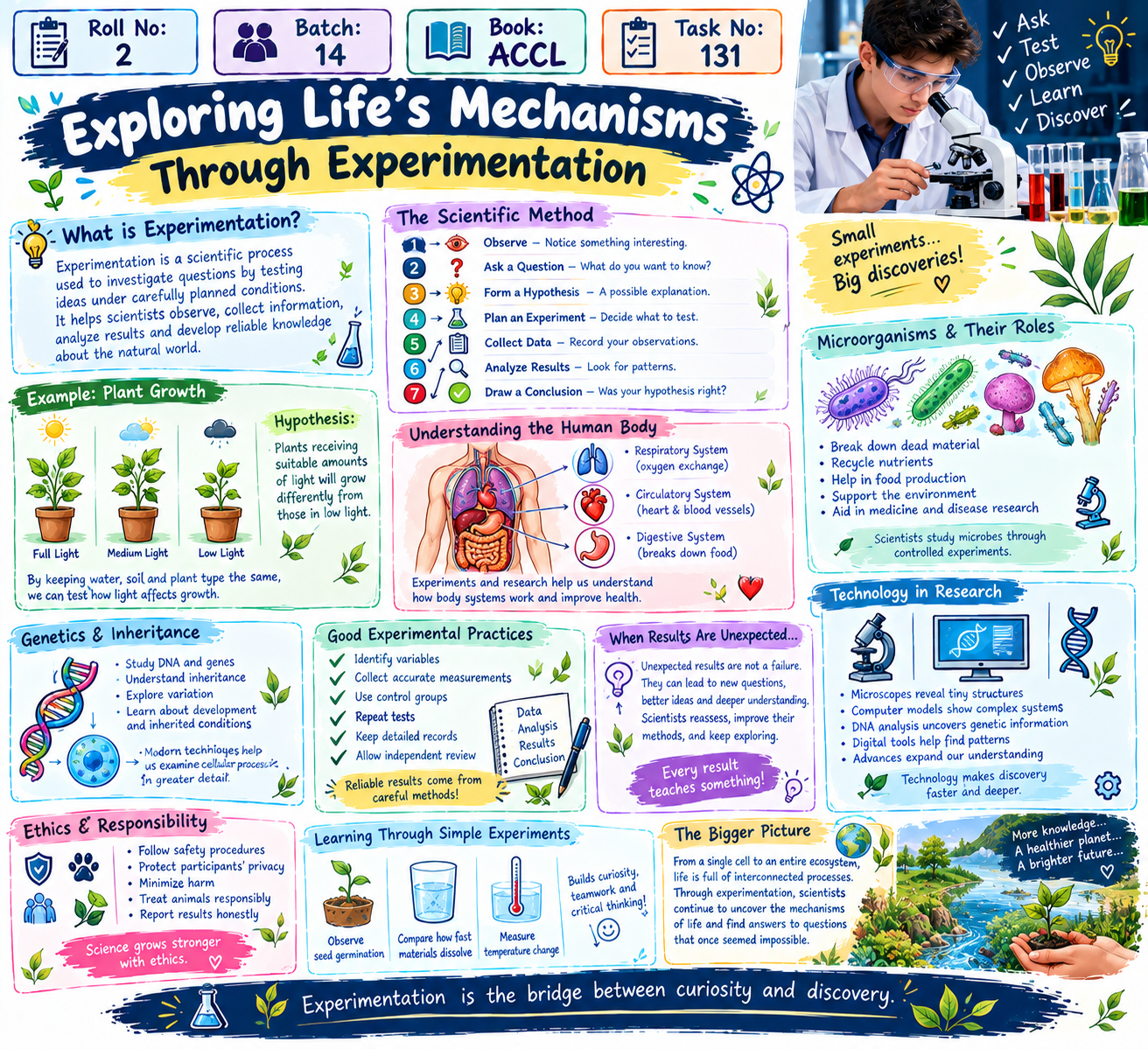
    # Exploring Life’s Mechanisms Through Experimentation

    Have you ever wondered how scientists discover the secrets of life? From understanding how plants grow to investigating how the human heart works, science helps us explore the processes that make living organisms function. Behind many important discoveries lies a powerful method called **experimentation**, which allows scientists to test ideas, observe results, and develop a deeper understanding of the natural world.

    **Experimentation is a scientific process used to investigate questions by testing ideas under carefully planned conditions.** Scientists begin by observing something interesting, asking a question, and developing a hypothesis—a possible explanation that can be tested. They then design an experiment, collect information, and analyze the results to determine whether the evidence supports their original idea. This process helps turn curiosity into reliable scientific knowledge.

    One fascinating example is the study of plant growth. Imagine a student who wants to discover whether the amount of light affects how quickly a plant grows. The student forms a hypothesis that plants receiving suitable amounts of light will grow differently from plants kept in low-light conditions. By keeping factors such as water, soil, and plant type consistent, the student can compare the results and investigate the role of light in plant development.

    Experimentation is also essential for understanding the human body. Scientists investigate how the heart circulates blood, how the lungs exchange gases, and how the digestive system processes food. Through carefully designed studies, medical imaging, laboratory tests, and other research methods, scientists learn how body systems work together to maintain health. Their findings can contribute to improved medical treatments and a better understanding of human biology.

    Another important field is microbiology, the study of microscopic organisms. Many bacteria and fungi play beneficial roles in nature, including breaking down dead material and recycling nutrients. Scientists use controlled experiments to investigate how these organisms respond to different environmental conditions. Such research can help improve food production, develop medicines, understand infectious diseases, and protect ecosystems.

    Experiments also help researchers understand genetics and the mechanisms of inheritance. By studying DNA, genes, and the characteristics of organisms across generations, scientists investigate how biological information is passed on and how variations arise. Modern techniques allow researchers to explore cellular processes in greater detail, helping them understand development, inherited conditions, and the relationships among different forms of life.

    A successful experiment requires more than simply observing what happens. Scientists must identify the variables they are studying, collect accurate measurements, and repeat tests when appropriate. They often use control groups for comparison and record their observations carefully. Repeating experiments helps determine whether a result is consistent, while independent review allows other researchers to examine the methods and evaluate the conclusions. These practices make scientific findings more trustworthy.

    Sometimes experiments produce unexpected results. Instead of treating an unexpected outcome as a failure, scientists use it as an opportunity to ask new questions. They may reconsider their hypothesis, improve their experimental design, or investigate another possible explanation. Scientific progress often happens through this cycle of questioning, testing, learning, and refining ideas. Every result can contribute something valuable when it is interpreted carefully.

    Technology has made biological experimentation more advanced than ever before. Microscopes reveal structures too small to see with the naked eye, computer models help researchers understand complicated systems, and DNA analysis allows scientists to investigate genetic information. Digital tools can also help organize large amounts of data and identify patterns that might otherwise be difficult to notice. These innovations continue to expand our understanding of living organisms.

    However, scientific experimentation must always be guided by responsibility and ethics. Researchers should follow safety procedures, protect participants' privacy, minimize harm, and treat animals responsibly. Experiments involving people or animals require appropriate ethical review and safeguards. Scientists must also report results honestly, even when the findings do not match their expectations. Reliable science depends on both accurate evidence and responsible behavior.

    Experimentation connects classroom learning with real-world discoveries. Students can explore scientific ideas through safe activities, such as observing seed germination, comparing how quickly different materials dissolve in water, or measuring changes in temperature. These activities encourage curiosity, careful observation, teamwork, and critical thinking. They also show that science is not just a collection of facts to memorize; it is an ongoing process of discovery.

    As we explore life's mechanisms, we begin to understand how countless processes work together to support living organisms. From the activity inside a single cell to the interactions among species in an ecosystem, each discovery reveals another part of nature's complexity. Through experimentation, scientists continue to investigate these connections and search for answers to questions that once seemed impossible to solve.

    **Experimentation is the bridge between curiosity and discovery. By asking thoughtful questions, testing ideas fairly, and learning from evidence, we can uncover the mechanisms of life and use scientific knowledge to improve human health, protect the environment, and build a brighter future. **

    \#Experimentation #Biology #ScientificMethod #LifeSciences #ScientificDiscovery #Research #ACCL #Batch14 #Task131
    **Roll No: 2** **Batch: 14** **Book: ACCL** **Task No: 138** # ๐Ÿ”ฌ๐Ÿงช Exploring Life’s Mechanisms Through Experimentation ๐ŸŒฑ๐Ÿงฌ Have you ever wondered how scientists discover the secrets of life? ๐ŸŒ From understanding how plants grow to investigating how the human heart works, science helps us explore the processes that make living organisms function. Behind many important discoveries lies a powerful method called **experimentation**, which allows scientists to test ideas, observe results, and develop a deeper understanding of the natural world. ๐Ÿ”โœจ **Experimentation is a scientific process used to investigate questions by testing ideas under carefully planned conditions.** ๐Ÿงช Scientists begin by observing something interesting, asking a question, and developing a hypothesis—a possible explanation that can be tested. They then design an experiment, collect information, and analyze the results to determine whether the evidence supports their original idea. This process helps turn curiosity into reliable scientific knowledge. ๐Ÿ“š๐Ÿ’ก One fascinating example is the study of plant growth. ๐ŸŒฑ Imagine a student who wants to discover whether the amount of light affects how quickly a plant grows. The student forms a hypothesis that plants receiving suitable amounts of light will grow differently from plants kept in low-light conditions. By keeping factors such as water, soil, and plant type consistent, the student can compare the results and investigate the role of light in plant development. โ˜€๏ธ๐ŸŒฟ Experimentation is also essential for understanding the human body. โค๏ธ Scientists investigate how the heart circulates blood, how the lungs exchange gases, and how the digestive system processes food. Through carefully designed studies, medical imaging, laboratory tests, and other research methods, scientists learn how body systems work together to maintain health. Their findings can contribute to improved medical treatments and a better understanding of human biology. ๐Ÿซ๐Ÿง  Another important field is microbiology, the study of microscopic organisms. ๐Ÿฆ  Many bacteria and fungi play beneficial roles in nature, including breaking down dead material and recycling nutrients. Scientists use controlled experiments to investigate how these organisms respond to different environmental conditions. Such research can help improve food production, develop medicines, understand infectious diseases, and protect ecosystems. ๐Ÿ”ฌ๐ŸŒ Experiments also help researchers understand genetics and the mechanisms of inheritance. ๐Ÿงฌ By studying DNA, genes, and the characteristics of organisms across generations, scientists investigate how biological information is passed on and how variations arise. Modern techniques allow researchers to explore cellular processes in greater detail, helping them understand development, inherited conditions, and the relationships among different forms of life. ๐ŸŒฑ๐Ÿ” A successful experiment requires more than simply observing what happens. Scientists must identify the variables they are studying, collect accurate measurements, and repeat tests when appropriate. ๐Ÿ“ They often use control groups for comparison and record their observations carefully. Repeating experiments helps determine whether a result is consistent, while independent review allows other researchers to examine the methods and evaluate the conclusions. These practices make scientific findings more trustworthy. ๐Ÿ“Š๐Ÿ“ Sometimes experiments produce unexpected results. ๐Ÿค” Instead of treating an unexpected outcome as a failure, scientists use it as an opportunity to ask new questions. They may reconsider their hypothesis, improve their experimental design, or investigate another possible explanation. Scientific progress often happens through this cycle of questioning, testing, learning, and refining ideas. Every result can contribute something valuable when it is interpreted carefully. ๐Ÿ’ก๐Ÿ”„ Technology has made biological experimentation more advanced than ever before. ๐Ÿค–๐Ÿ”ฌ Microscopes reveal structures too small to see with the naked eye, computer models help researchers understand complicated systems, and DNA analysis allows scientists to investigate genetic information. Digital tools can also help organize large amounts of data and identify patterns that might otherwise be difficult to notice. These innovations continue to expand our understanding of living organisms. ๐Ÿ’ป๐Ÿงฌ However, scientific experimentation must always be guided by responsibility and ethics. ๐Ÿ’š Researchers should follow safety procedures, protect participants' privacy, minimize harm, and treat animals responsibly. Experiments involving people or animals require appropriate ethical review and safeguards. Scientists must also report results honestly, even when the findings do not match their expectations. Reliable science depends on both accurate evidence and responsible behavior. โš–๏ธ๐ŸŒฟ Experimentation connects classroom learning with real-world discoveries. ๐Ÿซ Students can explore scientific ideas through safe activities, such as observing seed germination, comparing how quickly different materials dissolve in water, or measuring changes in temperature. These activities encourage curiosity, careful observation, teamwork, and critical thinking. They also show that science is not just a collection of facts to memorize; it is an ongoing process of discovery. ๐ŸŒˆ๐Ÿงช As we explore life's mechanisms, we begin to understand how countless processes work together to support living organisms. From the activity inside a single cell to the interactions among species in an ecosystem, each discovery reveals another part of nature's complexity. Through experimentation, scientists continue to investigate these connections and search for answers to questions that once seemed impossible to solve. ๐ŸŒŽ๐Ÿฆ‹๐Ÿ”ฌ **Experimentation is the bridge between curiosity and discovery. By asking thoughtful questions, testing ideas fairly, and learning from evidence, we can uncover the mechanisms of life and use scientific knowledge to improve human health, protect the environment, and build a brighter future. ๐Ÿ”ฌ๐Ÿงฌ๐ŸŒ๐Ÿ’š** \#Experimentation #Biology #ScientificMethod #LifeSciences #ScientificDiscovery #Research #ACCL #Batch14 #Task131 ๐Ÿงช๐Ÿ”ฌ๐ŸŒฑ
    0 Reacties 0 aandelen 7541 Views
  • RSi F8
    Roll NO:13
    Task NO:180
    Class: Foundation Level
    Made by Me

    Prime Number Checker — Description

    Prime Number Checker is a simple and useful programming project designed to help users quickly determine whether a given number is a prime number or not. Prime numbers are natural numbers greater than 1 that have exactly two positive factors: 1 and the number itself. Some common examples of prime numbers are 2, 3, 5, 7, 11, 13, 17, 19, and 23.

    This project provides an easy-to-use interface where the user can enter any number into an input field and click the “Check” button. The program then analyzes the entered number and displays a clear result, telling the user whether the number is prime or not. This makes the project useful for students who are learning about mathematics, logical thinking, algorithms, and programming fundamentals.

    Behind the simple interface, the program uses a logical process to check whether the number can be divided evenly by any number other than 1 and itself. If no such divisor exists, the number is identified as a prime number. If the number has another divisor, it is considered a composite number. The project can also handle special cases such as numbers less than or equal to 1, which are not considered prime numbers.

    The Prime Number Checker is a great beginner-friendly project because it combines HTML, CSS, and JavaScript to create an interactive web application. HTML can be used to structure the page, CSS can make the interface attractive and responsive, and JavaScript can perform the actual prime-number calculation.

    Creating this project also helps learners understand important programming concepts such as variables, functions, conditional statements, loops, user input, mathematical operations, and displaying dynamic results. It demonstrates how a mathematical idea can be converted into a working computer program.

    Overall, the Prime Number Checker is a small but meaningful coding project that makes learning programming more interesting and practical. It shows how simple algorithms can solve everyday computational problems while giving beginners valuable hands-on experience in building interactive application
    RSi F8 ๐ŸŽ“โœจ Roll NO:13 Task NO:180 Class: Foundation Level ๐Ÿ“š Made by Me ๐Ÿ’ป๐Ÿš€ Prime Number Checker — Description Prime Number Checker is a simple and useful programming project designed to help users quickly determine whether a given number is a prime number or not. Prime numbers are natural numbers greater than 1 that have exactly two positive factors: 1 and the number itself. Some common examples of prime numbers are 2, 3, 5, 7, 11, 13, 17, 19, and 23. This project provides an easy-to-use interface where the user can enter any number into an input field and click the “Check” button. The program then analyzes the entered number and displays a clear result, telling the user whether the number is prime or not. This makes the project useful for students who are learning about mathematics, logical thinking, algorithms, and programming fundamentals. Behind the simple interface, the program uses a logical process to check whether the number can be divided evenly by any number other than 1 and itself. If no such divisor exists, the number is identified as a prime number. If the number has another divisor, it is considered a composite number. The project can also handle special cases such as numbers less than or equal to 1, which are not considered prime numbers. The Prime Number Checker is a great beginner-friendly project because it combines HTML, CSS, and JavaScript to create an interactive web application. HTML can be used to structure the page, CSS can make the interface attractive and responsive, and JavaScript can perform the actual prime-number calculation. Creating this project also helps learners understand important programming concepts such as variables, functions, conditional statements, loops, user input, mathematical operations, and displaying dynamic results. It demonstrates how a mathematical idea can be converted into a working computer program. Overall, the Prime Number Checker is a small but meaningful coding project that makes learning programming more interesting and practical. It shows how simple algorithms can solve everyday computational problems while giving beginners valuable hands-on experience in building interactive application
    0 Reacties 0 aandelen 1682 Views
  • Mohsin RS F8
    Story post NO:16
    roll NO:13
    Class: Foundation Level
    Made by Me

    Exploring Life’s Mechanisms Through Experimentation

    Life is a remarkable system filled with countless processes that work together every moment. From the activity of tiny cells to the growth of plants and the functioning of complex organisms, nature is constantly performing fascinating biological processes. But how can we understand these hidden mechanisms? The answer lies in scientific investigation and experimentation.

    Experimentation gives us a way to explore the living world through observation, questions, testing, and evidence. Instead of simply believing an explanation, scientists investigate it carefully. They ask questions such as: How do plants grow? How do cells obtain energy? How do organisms respond to their environment? What factors affect biological processes? These questions can lead to experiments that help us discover how life works.

    A scientific experiment usually begins with curiosity. A researcher observes something interesting and develops a question about it. The researcher may then create a hypothesis, which is a possible explanation that can be tested. After designing an appropriate investigation, observations and measurements are collected. The results are then analyzed to determine whether they support the original idea.

    For example, scientists can investigate how different environmental conditions affect plant growth. By carefully controlling relevant factors and observing changes over time, researchers can learn more about the relationship between living organisms and their surroundings. Experiments like these help turn simple observations into scientific knowledge.

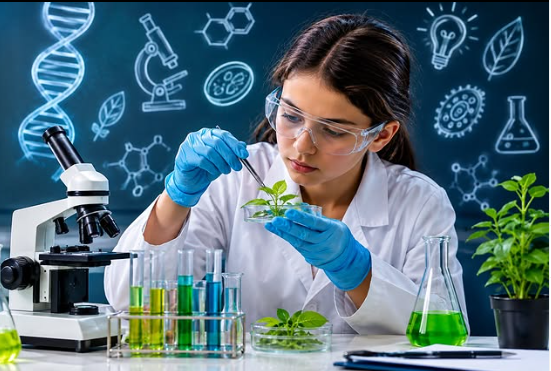
    Laboratory tools also play an important role in exploring life's mechanisms. Microscopes allow researchers to observe structures that are too small to see with the naked eye. Test tubes, petri dishes, measuring equipment, and other laboratory tools allow scientists to conduct controlled investigations. Modern technologies have expanded these possibilities even further, allowing researchers to study DNA, proteins, cells, and many other biological systems.
    Mohsin RS F8 ๐ŸŽ“โœจ Story post NO:16 roll NO:13 Class: Foundation Level ๐Ÿ“š Made by Me ๐Ÿ’ป๐Ÿš€ ๐Ÿ”ฌ Exploring Life’s Mechanisms Through Experimentation Life is a remarkable system filled with countless processes that work together every moment. From the activity of tiny cells to the growth of plants and the functioning of complex organisms, nature is constantly performing fascinating biological processes. But how can we understand these hidden mechanisms? The answer lies in scientific investigation and experimentation. Experimentation gives us a way to explore the living world through observation, questions, testing, and evidence. Instead of simply believing an explanation, scientists investigate it carefully. They ask questions such as: How do plants grow? How do cells obtain energy? How do organisms respond to their environment? What factors affect biological processes? These questions can lead to experiments that help us discover how life works. A scientific experiment usually begins with curiosity. A researcher observes something interesting and develops a question about it. The researcher may then create a hypothesis, which is a possible explanation that can be tested. After designing an appropriate investigation, observations and measurements are collected. The results are then analyzed to determine whether they support the original idea. For example, scientists can investigate how different environmental conditions affect plant growth. By carefully controlling relevant factors and observing changes over time, researchers can learn more about the relationship between living organisms and their surroundings. Experiments like these help turn simple observations into scientific knowledge. Laboratory tools also play an important role in exploring life's mechanisms. Microscopes allow researchers to observe structures that are too small to see with the naked eye. Test tubes, petri dishes, measuring equipment, and other laboratory tools allow scientists to conduct controlled investigations. Modern technologies have expanded these possibilities even further, allowing researchers to study DNA, proteins, cells, and many other biological systems.
    0 Reacties 0 aandelen 2221 Views
Zoekresultaten