• RSIF8
    Roll no:85
    Task no:48
    Task topic: The Journey of Dinosaurs: A Scientific Perspective
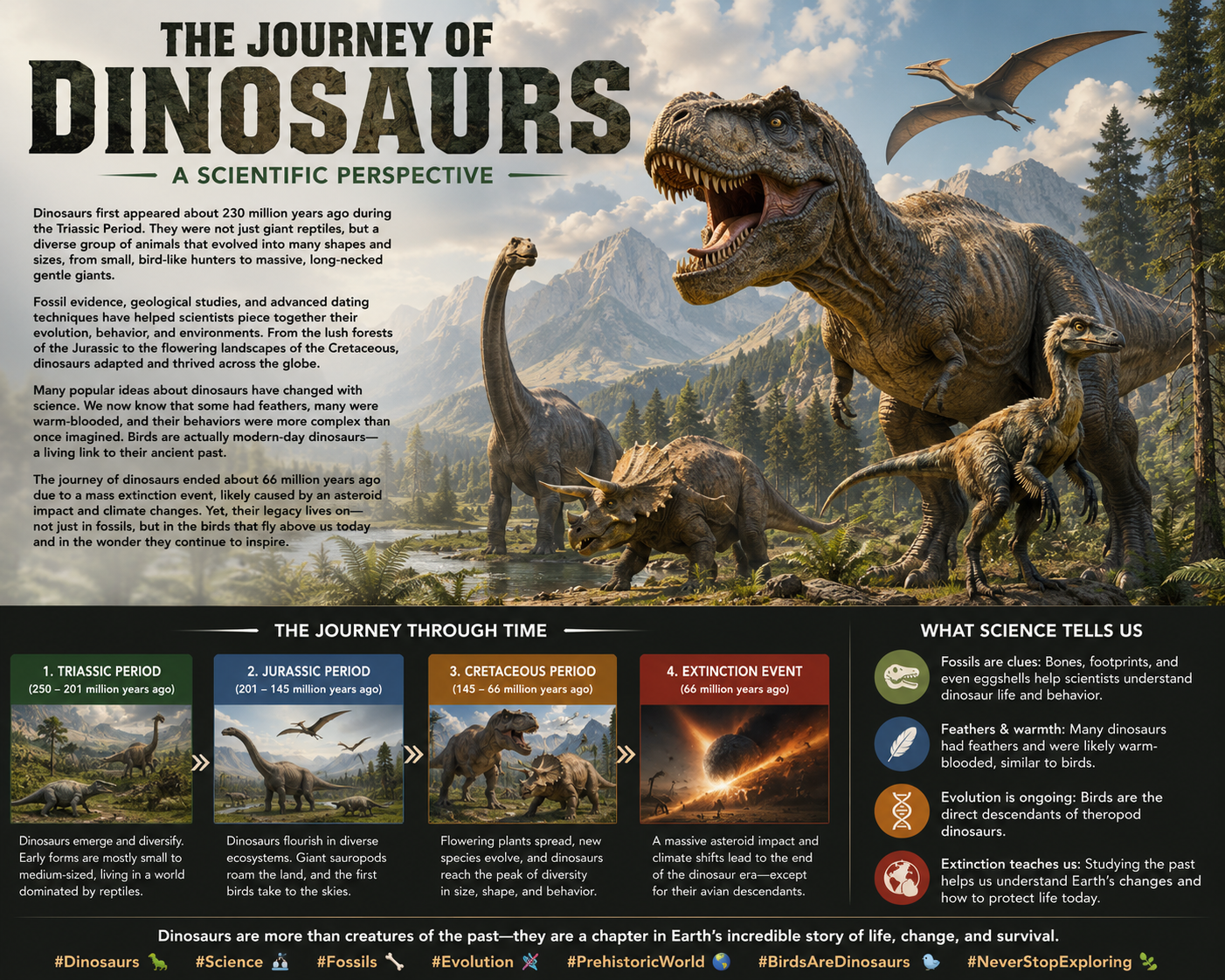
    Dinosaurs ruled our planet for more than 160 million years, evolving into countless species that ranged from tiny feathered hunters to gigantic plant-eating giants. Their incredible journey began during the Triassic Period and continued through the Jurassic and Cretaceous periods, shaping Earth's ecosystems in remarkable ways.

    Scientific discoveries through fossils have revealed fascinating details about dinosaur behavior, diets, and even their connection to modern birds. These ancient creatures adapted to changing environments and became one of the most successful groups of animals in Earth's history.

    Their story came to a dramatic end about 66 million years ago when a massive asteroid impact caused a global extinction event. However, the legacy of dinosaurs still lives on through birds, reminding us that evolution is a continuous and amazing process.

    Studying dinosaurs helps scientists understand Earth's past, climate changes, and the evolution of life itself. The journey of dinosaurs is not just a story of extinction—it's a powerful lesson about adaptation, survival, and the ever-changing nature of our planet.
    RSIF8 Roll no:85 Task no:48 Task topic: The Journey of Dinosaurs: A Scientific Perspective Dinosaurs ruled our planet for more than 160 million years, evolving into countless species that ranged from tiny feathered hunters to gigantic plant-eating giants. Their incredible journey began during the Triassic Period and continued through the Jurassic and Cretaceous periods, shaping Earth's ecosystems in remarkable ways. Scientific discoveries through fossils have revealed fascinating details about dinosaur behavior, diets, and even their connection to modern birds. These ancient creatures adapted to changing environments and became one of the most successful groups of animals in Earth's history. Their story came to a dramatic end about 66 million years ago when a massive asteroid impact caused a global extinction event. However, the legacy of dinosaurs still lives on through birds, reminding us that evolution is a continuous and amazing process. Studying dinosaurs helps scientists understand Earth's past, climate changes, and the evolution of life itself. The journey of dinosaurs is not just a story of extinction—it's a powerful lesson about adaptation, survival, and the ever-changing nature of our planet. 🌍
    0 Comentários 0 Compartilhamentos 83 Visualizações
  • **Roll No: 2**
    **Batch: 14**
    **Book: ACCL**
    **Task No: 61**

    # Periodic Table: The Language of Science

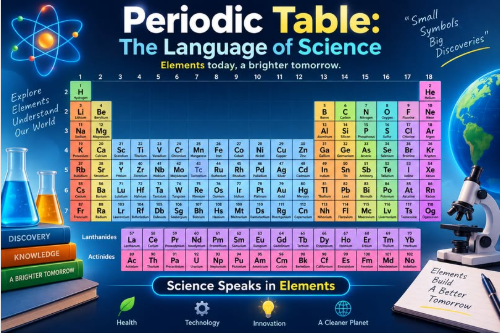
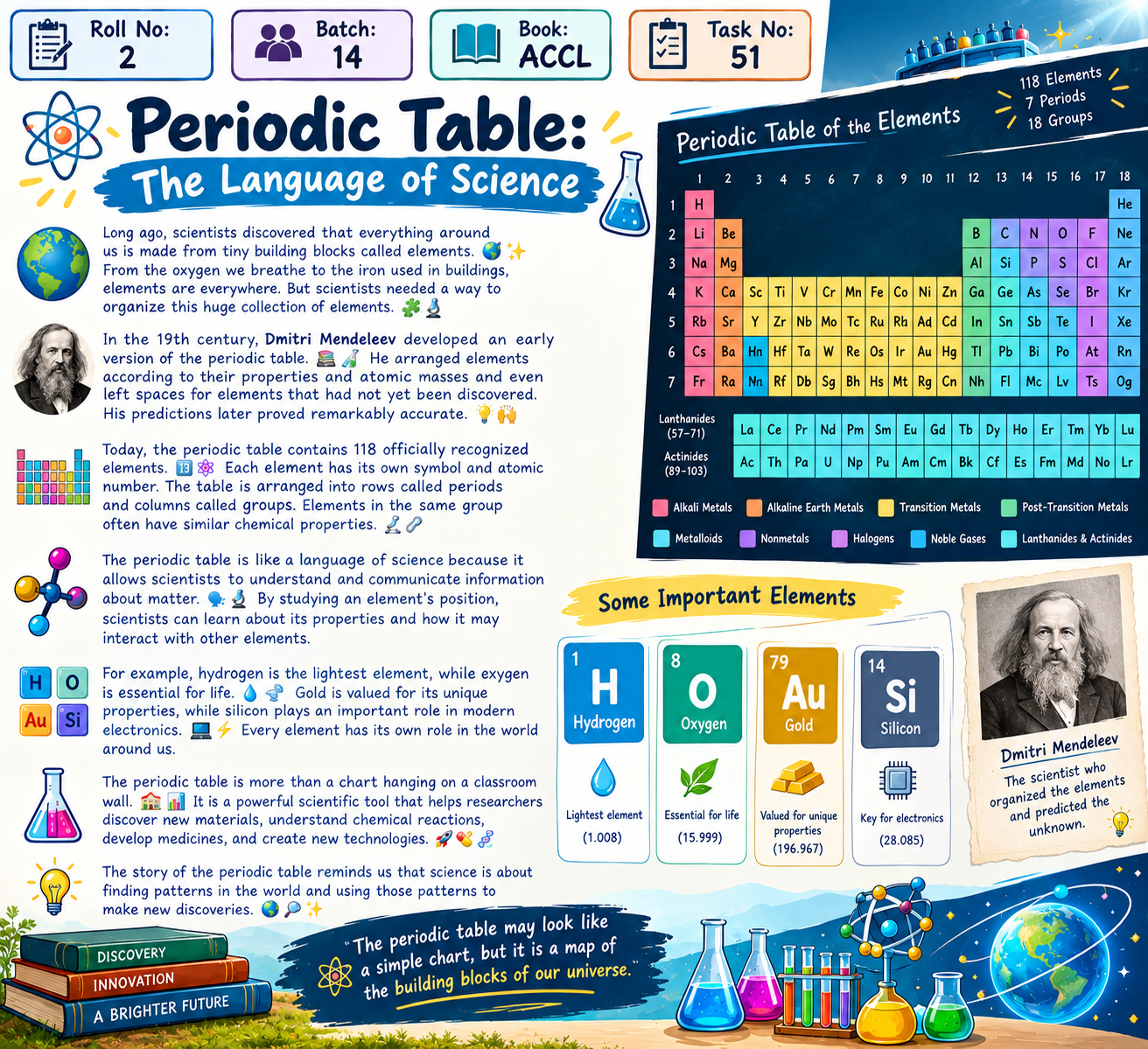
    Long ago, scientists discovered that everything around us is made from tiny building blocks called **elements**. From the oxygen we breathe to the iron used in buildings, elements are everywhere. But scientists needed a way to organize this huge collection of elements.

    In the 19th century, **Dmitri Mendeleev** developed an early version of the periodic table. He arranged elements according to their properties and atomic masses and even left spaces for elements that had not yet been discovered. His predictions later proved remarkably accurate.

    Today, the periodic table contains **118 officially recognized elements**. Each element has its own symbol and atomic number. The table is arranged into rows called **periods** and columns called **groups**. Elements in the same group often have similar chemical properties.

    The periodic table is like a **language of science** because it allows scientists to understand and communicate information about matter. By studying an element's position, scientists can learn about its properties and how it may interact with other elements.

    For example, hydrogen is the lightest element, while oxygen is essential for life. Gold is valued for its unique properties, while silicon plays an important role in modern electronics. Every element has its own role in the world around us.

    The periodic table is more than a chart hanging on a classroom wall. It is a powerful scientific tool that helps researchers discover new materials, understand chemical reactions, develop medicines, and create new technologies.

    The story of the periodic table reminds us that science is about finding patterns in the world and using those patterns to make new discoveries.

    **The periodic table may look like a simple chart, but it is a map of the building blocks of our universe. **
    **Roll No: 2** **Batch: 14** **Book: ACCL** **Task No: 61** # 🧪 Periodic Table: The Language of Science 🌍🔬 Long ago, scientists discovered that everything around us is made from tiny building blocks called **elements**. 🌎✨ From the oxygen we breathe to the iron used in buildings, elements are everywhere. But scientists needed a way to organize this huge collection of elements. 🧩🔬 In the 19th century, **Dmitri Mendeleev** developed an early version of the periodic table. 📚🧪 He arranged elements according to their properties and atomic masses and even left spaces for elements that had not yet been discovered. His predictions later proved remarkably accurate. 💡👏 Today, the periodic table contains **118 officially recognized elements**. 🔢⚛️ Each element has its own symbol and atomic number. The table is arranged into rows called **periods** and columns called **groups**. Elements in the same group often have similar chemical properties. 🧪🔗 The periodic table is like a **language of science** because it allows scientists to understand and communicate information about matter. 🗣️🔬 By studying an element's position, scientists can learn about its properties and how it may interact with other elements. For example, hydrogen is the lightest element, while oxygen is essential for life. 💧🌬️ Gold is valued for its unique properties, while silicon plays an important role in modern electronics. 💻⚡ Every element has its own role in the world around us. The periodic table is more than a chart hanging on a classroom wall. 🏫📊 It is a powerful scientific tool that helps researchers discover new materials, understand chemical reactions, develop medicines, and create new technologies. 🚀💊🧬 The story of the periodic table reminds us that science is about finding patterns in the world and using those patterns to make new discoveries. 🌍🔎✨ **The periodic table may look like a simple chart, but it is a map of the building blocks of our universe. 🧪⚛️🌌**
    0 Comentários 0 Compartilhamentos 823 Visualizações
  • RSIF8
    Roll No 13
    Story post No 10
    Story post Topic **Periodic Table: The Language of Science**

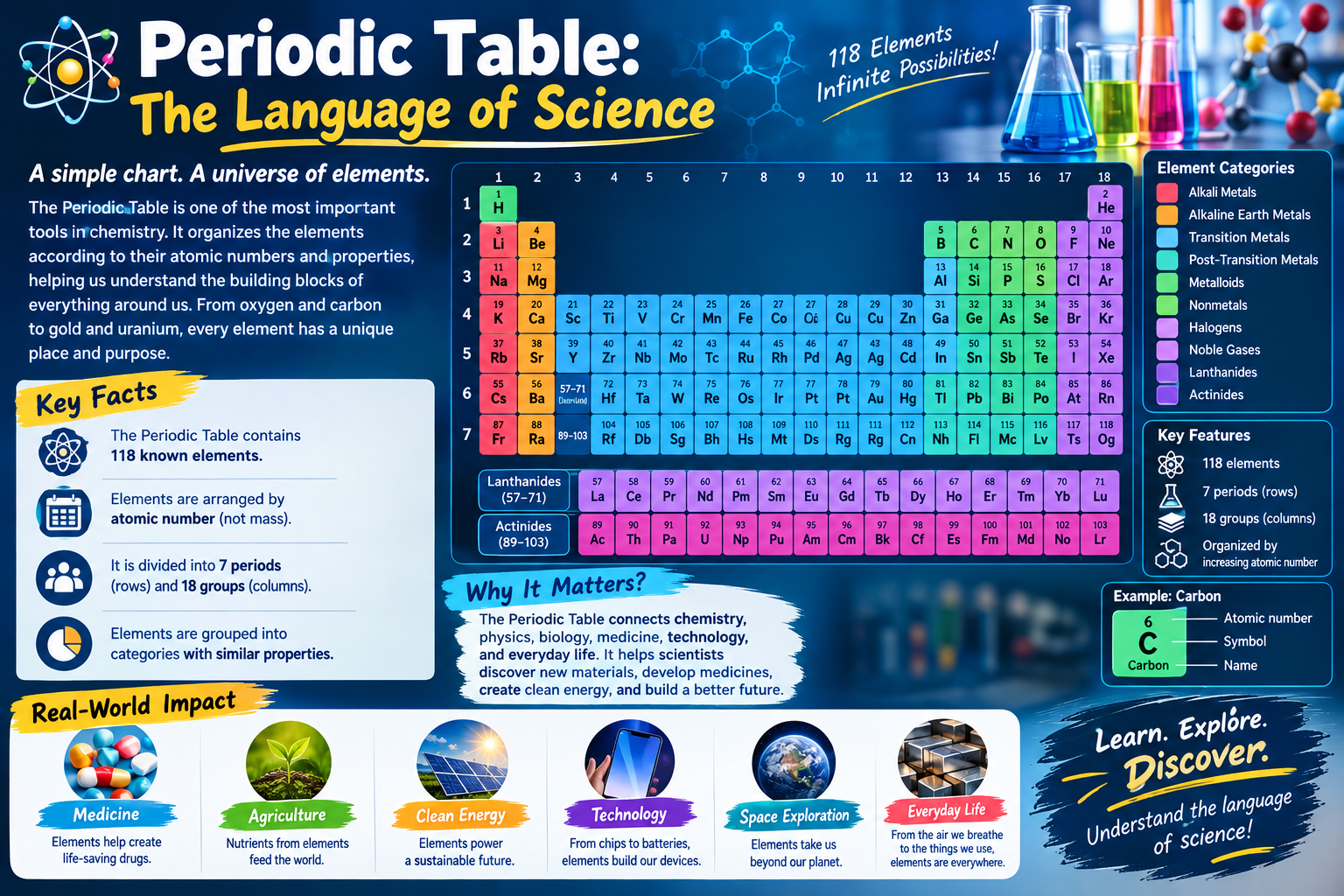
    The Periodic Table is one of the most important tools in chemistry. It organizes the elements according to their atomic numbers and properties, helping us understand the building blocks of everything around us. From oxygen and carbon to gold and uranium, every element has a unique place and purpose.

    In this educational journey, explore the **118 known elements**, their symbols, atomic numbers, groups, periods, and major categories. Discover how the Periodic Table connects chemistry, physics, biology, medicine, technology, and everyday life.

    Learn how elements combine to form molecules, materials, medicines, and countless technologies that shape our modern world.

    **Learn. Explore. Discover. Understand the language of science!**

    #PeriodicTable #Chemistry #Science #Elements #ChemicalElements #ScienceEducation #ChemistryLovers #STEM #Education #Learning #ScienceFacts #AtomicStructure #PeriodicTableOfElements
    RSIF8 Roll No 13 Story post No 10 Story post Topic 🧪 **Periodic Table: The Language of Science** 🌍🔬 The Periodic Table is one of the most important tools in chemistry. It organizes the elements according to their atomic numbers and properties, helping us understand the building blocks of everything around us. From oxygen and carbon to gold and uranium, every element has a unique place and purpose. In this educational journey, explore the **118 known elements**, their symbols, atomic numbers, groups, periods, and major categories. Discover how the Periodic Table connects chemistry, physics, biology, medicine, technology, and everyday life. ✨ Learn how elements combine to form molecules, materials, medicines, and countless technologies that shape our modern world. 📚 **Learn. Explore. Discover. Understand the language of science!** #PeriodicTable #Chemistry #Science #Elements #ChemicalElements #ScienceEducation #ChemistryLovers #STEM #Education #Learning #ScienceFacts #AtomicStructure #PeriodicTableOfElements
    0 Comentários 0 Compartilhamentos 1466 Visualizações
  • RSLC ROLL NO 80#
    FONDATION LEVEL Batch 06#
    task: 48
    DAY: 48

    The Journey of Dinosaurs: A Scientific Perspective

    Dinosaurs were a remarkable group of reptiles that lived on Earth for more than **165 million years**. They first appeared during the **Triassic Period**, about **230 million years ago**, and became one of the most successful groups of land animals in Earth’s history.

    Scientists learn about dinosaurs by studying **fossils**, including bones, teeth, footprints, eggs, and fossilized skin impressions. These discoveries help scientists understand how dinosaurs looked, moved, ate, and lived. Some dinosaurs were enormous plant-eaters, while others were powerful meat-eaters. Scientists have also discovered evidence that many dinosaurs had feathers, showing their close relationship with modern birds.

    About **66 million years ago**, a massive asteroid struck Earth near what is now Mexico. The impact caused major environmental changes, including darkness, cooling, and the collapse of many food chains. **Non-avian dinosaurs became extinct**, while some feathered dinosaurs survived and eventually evolved into the birds we see today.

    Today, dinosaurs continue to fascinate scientists. New fossils and research constantly improve our understanding of these ancient animals. Their story teaches us that **Earth is always changing and life must adapt to survive**. By studying the past, we can better understand our planet and the history of life.

    ### Moral

    **The story of dinosaurs teaches us that change is a natural part of life. By learning from the past and adapting to change, we can better understand and prepare for the future.**

    ### #Tags

    #Dinosaurs #Science #Fossils #Evolution #Paleontology
    RSLC ROLL NO 80# FONDATION LEVEL Batch 06# task: 48 DAY: 48 🦖 The Journey of Dinosaurs: A Scientific Perspective Dinosaurs were a remarkable group of reptiles that lived on Earth for more than **165 million years**. They first appeared during the **Triassic Period**, about **230 million years ago**, and became one of the most successful groups of land animals in Earth’s history. Scientists learn about dinosaurs by studying **fossils**, including bones, teeth, footprints, eggs, and fossilized skin impressions. These discoveries help scientists understand how dinosaurs looked, moved, ate, and lived. Some dinosaurs were enormous plant-eaters, while others were powerful meat-eaters. Scientists have also discovered evidence that many dinosaurs had feathers, showing their close relationship with modern birds. About **66 million years ago**, a massive asteroid struck Earth near what is now Mexico. The impact caused major environmental changes, including darkness, cooling, and the collapse of many food chains. **Non-avian dinosaurs became extinct**, while some feathered dinosaurs survived and eventually evolved into the birds we see today. Today, dinosaurs continue to fascinate scientists. New fossils and research constantly improve our understanding of these ancient animals. Their story teaches us that **Earth is always changing and life must adapt to survive**. By studying the past, we can better understand our planet and the history of life. ### 🌍 Moral **The story of dinosaurs teaches us that change is a natural part of life. By learning from the past and adapting to change, we can better understand and prepare for the future.** 🦖🌍 ### 🏷️ #Tags #Dinosaurs #Science #Fossils #Evolution #Paleontology
    0 Comentários 0 Compartilhamentos 1004 Visualizações
  • Episode #300 – Rehan Foundation Interview Series

    In this episode, we are joined by Kimberly Wiefling, an inspiring leadership facilitator, author, entrepreneur, physicist, coach, and innovation expert whose work focuses on helping people and organizations turn “impossible” into INEVITABLE.

    Kimberly Wiefling’s superpower is facilitating breakthroughs — helping managers become leaders, groups become true teams, and organizations achieve things they once believed were impossible.

    She is the author of the globally popular book “Scrappy Project Management,” founder of Wiefling Consulting, and cofounder of Silicon Valley Alliances. For more than 20 years, she has worked with global Japanese companies and organizations across Asia, Australia, Europe, and North America, facilitating cross-cultural workshops and learning experiences designed to improve leadership, teamwork, innovation, and organizational performance.

    Her journey combines science, engineering, business, leadership, and entrepreneurship. A physicist by education, Kimberly spent 10 years at HP in seven different engineering and project management roles, including leading an R&D team developing a new mass spectrometer. She later spent three years in Silicon Valley startups, leading product development teams working across hardware, software, and complex systems.

    Over the years, Kimberly has also helped start, run, and grow multiple small businesses, including a company that reached millions of dollars in revenue with only seed funding from its founders.

    Today, Kimberly focuses on creating powerful learning environments where leaders and teams can discover what is truly possible when they work together effectively. She is also increasingly focused on using her experience, leadership skills, and the rapidly developing power of AI to create positive change and contribute toward a more sustainable future for our planet.

    In this inspiring conversation, we explore:

    • What makes a great leader truly effective

    • The difference between managing people and leading people

    • How to build highly effective teams

    • Creating a strong and healthy organizational culture

    • How leaders can use AI as a “coach in your pocket”

    • Using AI to become a more effective leader and manager

    • The role of innovation in modern organizations

    • Why predictable causes of failure continue to affect organizations

    • How to identify and prevent failure before it happens

    • Turning “IMPOSSIBLE” into “INEVITABLE”

    • How organizations can achieve extraordinary results together

    • Lessons from working with global Japanese companies

    • Cross-cultural leadership and collaboration

    • What entrepreneurship can teach us about leadership and innovation

    • How to create teams capable of achieving the seemingly impossible

    • The importance of experimentation, learning, and adaptability

    • Using AI responsibly to create meaningful positive impact

    • Leadership lessons from Silicon Valley, engineering, and entrepreneurship

    • How leaders can create a more sustainable future

    This episode is a powerful conversation about leadership, teamwork, innovation, organizational culture, AI, entrepreneurship, resilience, and the mindset required to turn ambitious ideas into reality.

    Kimberly reminds us that the biggest breakthroughs often begin when someone is willing to challenge the assumption that something is impossible.

    Because with the right leadership, the right team, the right mindset, and the right tools — IMPOSSIBLE can become INEVITABLE.

    Part of the Rehan Foundation Interview Series

    Episode #300

    Foreigner Episode #28

    Rehan Allahwala
    Shahrukh Ali
    🎬 Episode #300 – Rehan Foundation Interview Series In this episode, we are joined by Kimberly Wiefling, an inspiring leadership facilitator, author, entrepreneur, physicist, coach, and innovation expert whose work focuses on helping people and organizations turn “impossible” into INEVITABLE. Kimberly Wiefling’s superpower is facilitating breakthroughs — helping managers become leaders, groups become true teams, and organizations achieve things they once believed were impossible. She is the author of the globally popular book “Scrappy Project Management,” founder of Wiefling Consulting, and cofounder of Silicon Valley Alliances. For more than 20 years, she has worked with global Japanese companies and organizations across Asia, Australia, Europe, and North America, facilitating cross-cultural workshops and learning experiences designed to improve leadership, teamwork, innovation, and organizational performance. Her journey combines science, engineering, business, leadership, and entrepreneurship. A physicist by education, Kimberly spent 10 years at HP in seven different engineering and project management roles, including leading an R&D team developing a new mass spectrometer. She later spent three years in Silicon Valley startups, leading product development teams working across hardware, software, and complex systems. Over the years, Kimberly has also helped start, run, and grow multiple small businesses, including a company that reached millions of dollars in revenue with only seed funding from its founders. Today, Kimberly focuses on creating powerful learning environments where leaders and teams can discover what is truly possible when they work together effectively. She is also increasingly focused on using her experience, leadership skills, and the rapidly developing power of AI to create positive change and contribute toward a more sustainable future for our planet. In this inspiring conversation, we explore: • What makes a great leader truly effective • The difference between managing people and leading people • How to build highly effective teams • Creating a strong and healthy organizational culture • How leaders can use AI as a “coach in your pocket” • Using AI to become a more effective leader and manager • The role of innovation in modern organizations • Why predictable causes of failure continue to affect organizations • How to identify and prevent failure before it happens • Turning “IMPOSSIBLE” into “INEVITABLE” • How organizations can achieve extraordinary results together • Lessons from working with global Japanese companies • Cross-cultural leadership and collaboration • What entrepreneurship can teach us about leadership and innovation • How to create teams capable of achieving the seemingly impossible • The importance of experimentation, learning, and adaptability • Using AI responsibly to create meaningful positive impact • Leadership lessons from Silicon Valley, engineering, and entrepreneurship • How leaders can create a more sustainable future This episode is a powerful conversation about leadership, teamwork, innovation, organizational culture, AI, entrepreneurship, resilience, and the mindset required to turn ambitious ideas into reality. Kimberly reminds us that the biggest breakthroughs often begin when someone is willing to challenge the assumption that something is impossible. Because with the right leadership, the right team, the right mindset, and the right tools — IMPOSSIBLE can become INEVITABLE. 📌 Part of the Rehan Foundation Interview Series 🎥 Episode #300 🌍 Foreigner Episode #28 Rehan Allahwala Shahrukh Ali
    0 Comentários 0 Compartilhamentos 2036 Visualizações
  • RSIF8
    Roll no:14
    story post:9
    story topic:Periodic Table: The Language of Science
    # Periodic Table: The Language of Science
    I successfully completed my **Foundation Level task** on the topic **“Periodic Table: The Language of Science.”**
    The Periodic Table is one of the most important tools in the world of **chemistry and science**. It organizes all known chemical elements in a clear and systematic way according to their **atomic numbers, properties, and electron arrangements**.
    During this task, I explored different **groups and periods** of the Periodic Table and learned about various types of elements, including **metals, non-metals, metalloids, noble gases, alkali metals, and halogens**. I also learned about important elements such as **Hydrogen, Oxygen, Carbon, Iron, Gold, Silver, and many others**.
    This activity helped me understand how scientists use the Periodic Table to **identify elements, compare their properties, predict their behavior, and understand chemical reactions**. It also showed me how elements are connected to our everyday lives, from the air we breathe and the water we drink to technology , medicine , energy , and many other areas.
    **What I Learned:**
    How the Periodic Table is organized
    The meaning of atomic numbers and element symbols
    Difference between groups and periods
    Types and properties of different elements
    Importance of elements in daily life
    How the Periodic Table helps scientists understand chemistry
    This task increased my interest in **science and chemistry** and helped me understand that the Periodic Table is more than just a chart—it is truly a **language that scientists use to understand the building blocks of our world.**
    I am happy to have completed this task successfully and gained valuable knowledge that will help me in my future learning and scientific studies.
    ### Science Speaks in Elements!
    ### Learn • Explore • Discover • Create
    #PeriodicTable #LanguageOfScience #Chemistry #Science #ChemicalElements #FoundationLevel #Learning #Education #ScienceEducation #ChemistryLearning #AtomicNumber #Elements #STEM #ScienceProject #StudentLearning #ExploreScience #LearnChemistry #ScientificDiscovery #FutureScientist #EducationMatters #KnowledgeIsPower #LearnAndGrow #ScienceIsFun #FoundationTask See less
    RSIF8 Roll no:14 story post:9 story topic:Periodic Table: The Language of Science # 🧪🔬 Periodic Table: The Language of Science 🌍⚛️ I successfully completed my **Foundation Level task** on the topic **“Periodic Table: The Language of Science.”** 🎓✨ The Periodic Table is one of the most important tools in the world of **chemistry and science**. 🧪🔬 It organizes all known chemical elements in a clear and systematic way according to their **atomic numbers, properties, and electron arrangements**. ⚛️📚 During this task, I explored different **groups and periods** of the Periodic Table and learned about various types of elements, including **metals, non-metals, metalloids, noble gases, alkali metals, and halogens**. 🔍🧬 I also learned about important elements such as **Hydrogen, Oxygen, Carbon, Iron, Gold, Silver, and many others**. 🌟 This activity helped me understand how scientists use the Periodic Table to **identify elements, compare their properties, predict their behavior, and understand chemical reactions**. 🧠⚗️ It also showed me how elements are connected to our everyday lives, from the air we breathe 🌬️ and the water we drink 💧 to technology 📱, medicine 💊, energy ⚡, and many other areas. 🌟 **What I Learned:** ✅ How the Periodic Table is organized 📊 ✅ The meaning of atomic numbers and element symbols ⚛️ ✅ Difference between groups and periods 🔢 ✅ Types and properties of different elements 🧪 ✅ Importance of elements in daily life 🌍 ✅ How the Periodic Table helps scientists understand chemistry 🔬 💡 This task increased my interest in **science and chemistry** and helped me understand that the Periodic Table is more than just a chart—it is truly a **language that scientists use to understand the building blocks of our world.** 🌎⚛️ I am happy to have completed this task successfully and gained valuable knowledge that will help me in my future learning and scientific studies. 🎓🚀✨ ### 🌟 Science Speaks in Elements! 🧪⚛️ ### 🔬 Learn • Explore • Discover • Create 🌍💡 #PeriodicTable #LanguageOfScience #Chemistry #Science #ChemicalElements #FoundationLevel #Learning #Education #ScienceEducation #ChemistryLearning #AtomicNumber #Elements #STEM #ScienceProject #StudentLearning #ExploreScience #LearnChemistry #ScientificDiscovery #FutureScientist #EducationMatters #KnowledgeIsPower #LearnAndGrow #ScienceIsFun #FoundationTask 🧪🔬⚛️🌍📚✨ See less
    0 Comentários 0 Compartilhamentos 2013 Visualizações
  • #rsisb
    Roll No:232
    Create Tic-Tac-Toe Game.
    Foundation level student.
    codding task
    **Tic-Tac-Toe Game**
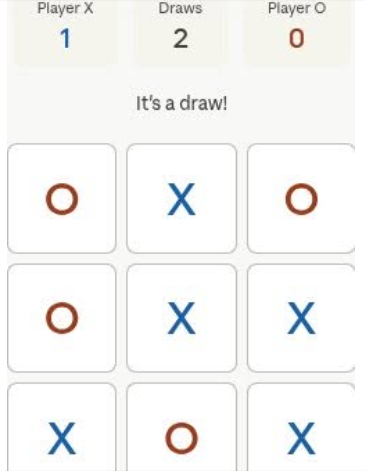
    Welcome to the exciting world of **Tic-Tac-Toe**, one of the most popular and timeless strategy games ever created! This simple yet engaging game has entertained players for generations and continues to be a favorite among children, students, and adults alike. The objective is straightforward: place your symbol (X or O) on a 3×3 grid and be the first to create a line of three matching symbols horizontally, vertically, or diagonally.
    Although Tic-Tac-Toe may seem easy at first glance, it requires careful planning, strategic thinking, and smart decision-making. Every move can change the outcome of the game, making each match both challenging and exciting. Players must think ahead, predict their opponent's actions, and develop winning strategies while preventing their opponent from completing a line.
    This game is not only fun but also educational. It helps improve logical reasoning, concentration, problem-solving skills, and critical thinking. Whether you are playing with friends, family members, classmates, or challenging an AI opponent, Tic-Tac-Toe offers endless opportunities for learning and entertainment.
    **Why Play Tic-Tac-Toe?**
    ✔ Easy to learn and play
    ✔ Suitable for all age groups
    ✔ Improves strategic thinking and planning
    ✔ Enhances focus and decision-making skills
    ✔ Provides quick and enjoyable entertainment
    ✔ Perfect for practicing logical reasoning
    ✔ Great for friendly competitions and challenges
    Whether you're a beginner discovering the game for the first time or an experienced player looking to sharpen your skills, Tic-Tac-Toe is a fantastic way to have fun while exercising your brain. Every match is a new challenge, and every move brings you one step closer to victory. So place your mark, plan your strategy, and see if you can outsmart your opponent!
    Ready to become the Tic-Tac-Toe champion? Start playing today and enjoy the thrill of this classic game!
    #TicTacToe #TicTacToeGame #ClassicGame #StrategyGame #BoardGame #Gaming #GameDevelopment #CodingProject #InteractiveGame #PuzzleGame #LogicGame #BrainTraining #CriticalThinking #ProblemSolving #EducationalGames #FunLearning #Programming #GameDesign #Entertainment #ChallengeYourMind

    Irum Asim
    Saima Happiness wali
    Rehan School Islamabad Campus
    Rehan Allahwala
    #rsisb Roll No:232 Create Tic-Tac-Toe Game. Foundation level student. codding task 🎮 **Tic-Tac-Toe Game** ❌⭕ Welcome to the exciting world of **Tic-Tac-Toe**, one of the most popular and timeless strategy games ever created! This simple yet engaging game has entertained players for generations and continues to be a favorite among children, students, and adults alike. The objective is straightforward: place your symbol (X or O) on a 3×3 grid and be the first to create a line of three matching symbols horizontally, vertically, or diagonally. Although Tic-Tac-Toe may seem easy at first glance, it requires careful planning, strategic thinking, and smart decision-making. Every move can change the outcome of the game, making each match both challenging and exciting. Players must think ahead, predict their opponent's actions, and develop winning strategies while preventing their opponent from completing a line. This game is not only fun but also educational. It helps improve logical reasoning, concentration, problem-solving skills, and critical thinking. Whether you are playing with friends, family members, classmates, or challenging an AI opponent, Tic-Tac-Toe offers endless opportunities for learning and entertainment. ✨ **Why Play Tic-Tac-Toe?** ✔ Easy to learn and play ✔ Suitable for all age groups ✔ Improves strategic thinking and planning ✔ Enhances focus and decision-making skills ✔ Provides quick and enjoyable entertainment ✔ Perfect for practicing logical reasoning ✔ Great for friendly competitions and challenges Whether you're a beginner discovering the game for the first time or an experienced player looking to sharpen your skills, Tic-Tac-Toe is a fantastic way to have fun while exercising your brain. Every match is a new challenge, and every move brings you one step closer to victory. So place your mark, plan your strategy, and see if you can outsmart your opponent! 🏆 Ready to become the Tic-Tac-Toe champion? Start playing today and enjoy the thrill of this classic game! #TicTacToe #TicTacToeGame #ClassicGame #StrategyGame #BoardGame #Gaming #GameDevelopment #CodingProject #InteractiveGame #PuzzleGame #LogicGame #BrainTraining #CriticalThinking #ProblemSolving #EducationalGames #FunLearning #Programming #GameDesign #Entertainment #ChallengeYourMind 🎮 ❌ ⭕ 🏆 🧠 🎯 🚀 ✨ 🎲 💡 🌟 😃 📱 🎉 Irum Asim Saima Happiness wali Rehan School Islamabad Campus Rehan Allahwala
    0 Comentários 0 Compartilhamentos 2378 Visualizações
  • **Periodic Table of the Elements**

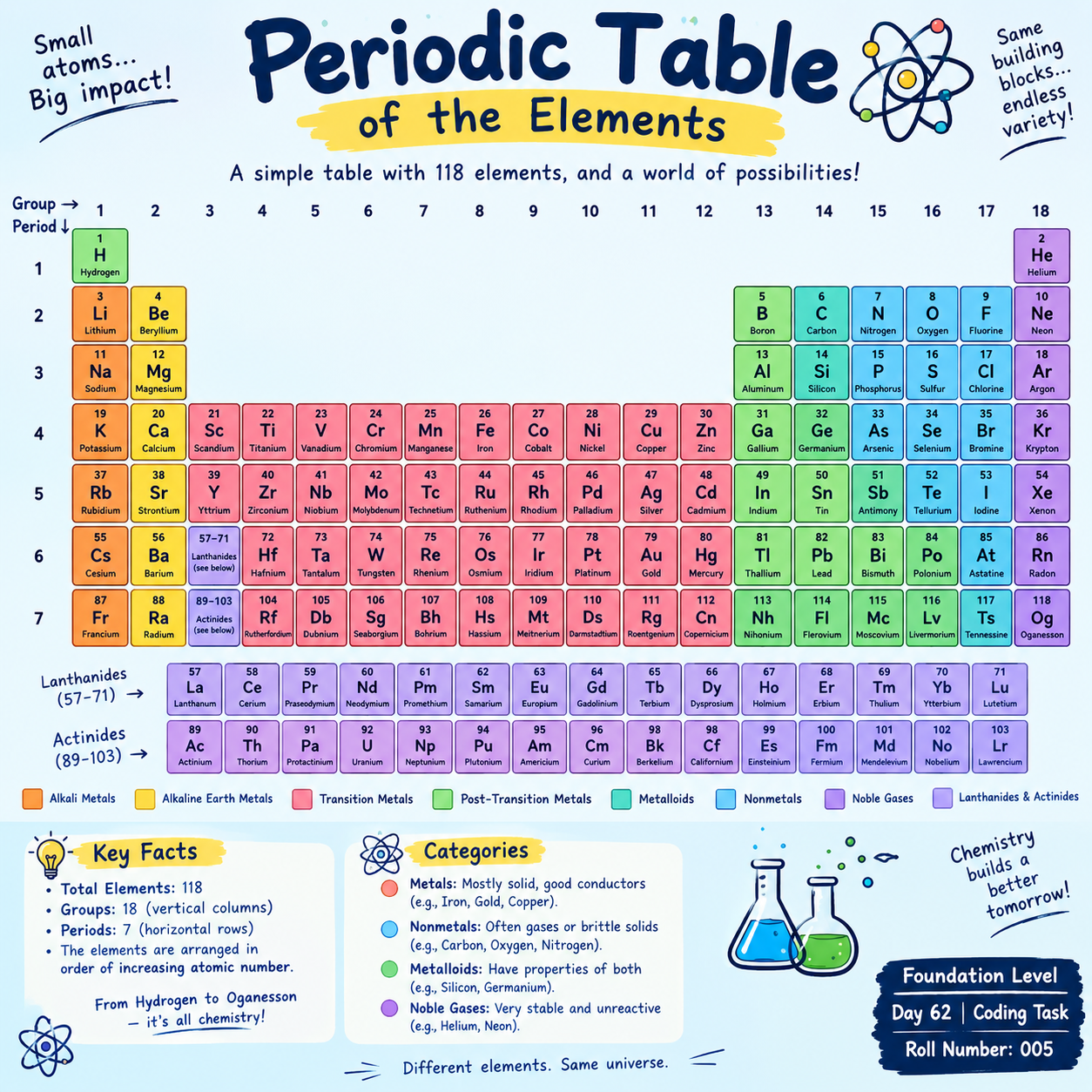
    A colorful and educational Instagram post exploring the **118 chemical elements**, their symbols, atomic numbers, groups, periods, and major categories. This visual makes chemistry easier and more interesting by showing how elements are organized and how they form the building blocks of our world.

    **Foundation Level**
    **Day 62 Story Post**
    **Roll Number: 005**
    🧪 **Periodic Table of the Elements** A colorful and educational Instagram post exploring the **118 chemical elements**, their symbols, atomic numbers, groups, periods, and major categories. This visual makes chemistry easier and more interesting by showing how elements are organized and how they form the building blocks of our world. **Foundation Level** **Day 62 📚 Story Post** **Roll Number: 005**
    0 Comentários 0 Compartilhamentos 459 Visualizações
  • RSIF8
    Roll no. 83
    Task no.2
    Task Topic: How to make a facebook
    How to Make a Facebook Account and Set It Up
    Creating a Facebook account is simple and only takes a few minutes. Follow these steps:
    Step 1: Visit Facebook
    Go to Facebook
    Step 2: Create a New Account
    Click "Create New Account" and enter:
    First and Last Name
    Mobile Number or Email Address
    Password
    Date of Birth
    Gender
    Step 3: Verify Your Account
    Facebook will send a verification code to your email or phone. Enter the code to confirm your account.
    Step 4: Add a Profile Picture
    Upload a clear photo of yourself so friends can recognize you.
    Step 5: Complete Your Profile
    Add:
    City or Hometown
    Education
    Workplace
    Interests and Hobbies
    Step 6: Find Friends
    Use the search bar to find friends and family and send friend requests.
    Step 7: Adjust Privacy Settings
    Go to Settings & Privacy to control:
    Who can see your posts
    Who can send friend requests
    Who can view your profile
    Step 8: Start Using Facebook
    Now you can:
    Like posts
    Comment on posts
    Share photos and videos
    Create your own posts
    Watch videos and join groups
    Your Facebook Account Is Ready!
    Stay connected, share moments, and interact with friends around the world.
    #Facebook
    #SocialMedia
    #FacebookAccount
    #CreateAccount
    #OnlineCommunity
    #DigitalLife
    #ConnectWithFriends
    #FacebookTips
    #TechGuide
    #StayConnected See less
    14w
    RSIF8 Roll no. 83 Task no.2 Task Topic: How to make a facebook 📘✨ How to Make a Facebook Account and Set It Up ✨📘 Creating a Facebook account is simple and only takes a few minutes. Follow these steps: 📝 Step 1: Visit Facebook Go to 🌐 Facebook 👤 Step 2: Create a New Account Click "Create New Account" and enter: ✅ First and Last Name ✅ Mobile Number or Email Address ✅ Password 🔒 ✅ Date of Birth 🎂 ✅ Gender 📩 Step 3: Verify Your Account Facebook will send a verification code to your email or phone. Enter the code to confirm your account. 🖼️ Step 4: Add a Profile Picture Upload a clear photo of yourself so friends can recognize you. 📄 Step 5: Complete Your Profile Add: 🏠 City or Hometown 🎓 Education 💼 Workplace ❤️ Interests and Hobbies 👥 Step 6: Find Friends Use the search bar to find friends and family and send friend requests. ⚙️ Step 7: Adjust Privacy Settings Go to Settings & Privacy to control: 🔒 Who can see your posts 👥 Who can send friend requests 📸 Who can view your profile 📱 Step 8: Start Using Facebook Now you can: 👍 Like posts 💬 Comment on posts 📸 Share photos and videos 📢 Create your own posts 🎥 Watch videos and join groups 🎉 Your Facebook Account Is Ready! Stay connected, share moments, and interact with friends around the world. 🌍💙 #Facebook 📘 #SocialMedia 📱 #FacebookAccount 👤 #CreateAccount ✨ #OnlineCommunity 🌍 #DigitalLife 💻 #ConnectWithFriends 👥 #FacebookTips 💡 #TechGuide 🚀 #StayConnected 💙 See less 14w
    0 Comentários 0 Compartilhamentos 2698 Visualizações
  • RSIF8
    Roll no 68
    Task no 94
    Task topic; **Inside a School for Suicide Bombers – Sharmeen Obaid-Chinoy**

    Sharmeen Obaid-Chinoy’s powerful TED talk explores how vulnerable children can be exposed to extremist ideas and manipulated by harmful groups. The talk highlights the importance of education, critical thinking, child protection, and creating positive opportunities for young people.

    The message reminds us that education and awareness can help build a safer, more peaceful future.
    RSIF8 Roll no 68 Task no 94 Task topic; **Inside a School for Suicide Bombers – Sharmeen Obaid-Chinoy** Sharmeen Obaid-Chinoy’s powerful TED talk explores how vulnerable children can be exposed to extremist ideas and manipulated by harmful groups. The talk highlights the importance of education, critical thinking, child protection, and creating positive opportunities for young people. 🌍 The message reminds us that education and awareness can help build a safer, more peaceful future.
    0 Comentários 0 Compartilhamentos 528 Visualizações 5
Páginas impulsionada