• #rsisb
    Roll No 242
    Story Post 18
    Foundation level

    **The Force Behind Motion: Understanding Newton’s Laws**

    Every movement around us—from a speeding car to a soaring rocket —is guided by **Newton’s Laws of Motion**. These three fundamental laws explain how forces influence objects, why things stay at rest or move, and how every action has an equal and opposite reaction.
    Understanding Newton’s Laws helps us unlock the secrets of physics and inspires innovations in engineering, space exploration, sports, and everyday life. Knowledge of these principles empowers us to see the science behind every motion around us!
    *"Science is not just about formulas—it’s about understanding the world in motion."*
    #NewtonsLaws #Physics #ScienceEducation #STEM #LearningNeverStops #Motion #Force #Education #Innovation #Engineering #ScienceForEveryone #FutureScientists #Curiosity #KnowledgeIsPower

    @Asma Shaheen EducationWali
    @Irum Asim
    @Saima Happinesswal
    #rsisb Roll No 242 Story Post 18 Foundation level 🚀 **The Force Behind Motion: Understanding Newton’s Laws** ⚖️🍎 Every movement around us—from a speeding car 🚗 to a soaring rocket 🚀—is guided by **Newton’s Laws of Motion**. These three fundamental laws explain how forces influence objects, why things stay at rest or move, and how every action has an equal and opposite reaction. 🌍✨ Understanding Newton’s Laws helps us unlock the secrets of physics and inspires innovations in engineering, space exploration, sports, and everyday life. Knowledge of these principles empowers us to see the science behind every motion around us! 📚🔬 💡 *"Science is not just about formulas—it’s about understanding the world in motion."* #NewtonsLaws ⚖️ #Physics 🔬 #ScienceEducation 📚 #STEM 🚀 #LearningNeverStops 🌟 #Motion #Force #Education #Innovation #Engineering #ScienceForEveryone #FutureScientists #Curiosity #KnowledgeIsPower 💙 @Asma Shaheen EducationWali @Irum Asim @Saima Happinesswal
    0 Σχόλια 0 Μοιράστηκε 3703 Views
  • ?? Project Completed: Seasonal Greeting Image Agent ?
    Im excited to share another AI-powered project ? Seasonal Greeting Image Agent!
    This smart AI agent generates high-quality, personalized greeting images for festivals, holidays, and special occasions. Users can create custom designs with unique messages for events like Eid, New Year, Christmas, Independence Day, birthdays, and many more?all within seconds using AI.
    Every new project enhances my skills in Artificial Intelligence, automation, and real-world application development. More exciting AI innovations are coming soon! ?
    Turning ideas into intelligent solutions. ?
    #AI #SeasonalGreetingAgent #ImageGeneration #GenerativeAI #ArtificialIntelligence #Automation #Python #WebDevelopment #SoftwareDevelopment #DeveloperLife #BuildInPublic #Innovation #RehanSchool #SadeemFreelancingwala
    ?? Project Completed: Seasonal Greeting Image Agent ? I'm excited to share another AI-powered project ? Seasonal Greeting Image Agent! This smart AI agent generates high-quality, personalized greeting images for festivals, holidays, and special occasions. Users can create custom designs with unique messages for events like Eid, New Year, Christmas, Independence Day, birthdays, and many more?all within seconds using AI. Every new project enhances my skills in Artificial Intelligence, automation, and real-world application development. More exciting AI innovations are coming soon! ? Turning ideas into intelligent solutions. ? #AI #SeasonalGreetingAgent #ImageGeneration #GenerativeAI #ArtificialIntelligence #Automation #Python #WebDevelopment #SoftwareDevelopment #DeveloperLife #BuildInPublic #Innovation #RehanSchool #SadeemFreelancingwala
    0 Σχόλια 0 Μοιράστηκε 3719 Views
  • Invite from Osama Manzar

    Please accept my warmest greetings and also from Digital Empowerment Foundation! The reason of writing this mail to you is to apprise you that at DEF, the journey that we had started five years back under the knowledge platform called the mBillionth Award, has reached to an aggregate of more than 1200 mobile innovations which are not only a reflection of how mobile is changing the fate of India but also all its neighboring South Asian countries. I strongly believe that each one of you is its real stakeholder and you have directly or indirectly played your role in this. We also collectively have the onus to play wider change agents in this information revolution, where mobile is a tool that is in the hands of the masses, and if we do not use this opportunity then the larger population living in remote areas and at the edge of information, may never be able to come up to the level playing threshold. Thus, this email is to let you know, that on July 18th, at India Habitat Center in Delhi, more than 100 mobile and telecom players, including app developers, congregating to share their innovations that has been changing the society and would change even more if we all encourage them, support them, and collaborate with them. Please do find time to attend, participate, energize the valuable gathering and innovative practices. You may register here: http://mbillionth.in/register-now/ OR, you may just write back to me if you can manage to grace the occasion, and I will have the invite sent to you. Please treat this as my personal invite:
    1. Details of whats happening is available at: http://mbillionth.in
    2. IT Secretaries of 4 Countries and several other state level IT Secretaries are participating.
    3. Officials of other ministries and department participation including agriculture,
    women and child development etc.
    4. About 50 CEOs and Founders of various Mobile enterprises
    5. 100 Mobile Companies. Startups, Projects, Apps, Products showcasing
    6. 10 Countries, 20 States participating.
    7. Launch of mBillionth Angel Fund & Incubation Center
    Look forward to seeing you,
    Warmest regards
    OsamaDate: 18 July 2014
    Time : 08:30AM- 09:30PM
    Venue: India Habitat Centre, Lodi Road, Near Sai mandir, New Delhi
    Join us on FacebookFollow us on Twitter
    For further information, please contact us at mBillionth@defindia.net
    This is an auto-mailer. Please do not reply to this
    Invite from Osama Manzar Please accept my warmest greetings and also from Digital Empowerment Foundation! The reason of writing this mail to you is to apprise you that at DEF, the journey that we had started five years back under the knowledge platform called the mBillionth Award, has reached to an aggregate of more than 1200 mobile innovations which are not only a reflection of how mobile is changing the fate of India but also all its neighboring South Asian countries. I strongly believe that each one of you is its real stakeholder and you have directly or indirectly played your role in this. We also collectively have the onus to play wider change agents in this information revolution, where mobile is a tool that is in the hands of the masses, and if we do not use this opportunity then the larger population living in remote areas and at the edge of information, may never be able to come up to the level playing threshold. Thus, this email is to let you know, that on July 18th, at India Habitat Center in Delhi, more than 100 mobile and telecom players, including app developers, congregating to share their innovations that has been changing the society and would change even more if we all encourage them, support them, and collaborate with them. Please do find time to attend, participate, energize the valuable gathering and innovative practices. You may register here: http://mbillionth.in/register-now/ OR, you may just write back to me if you can manage to grace the occasion, and I will have the invite sent to you. Please treat this as my personal invite: 1. Details of what's happening is available at: http://mbillionth.in 2. IT Secretaries of 4 Countries and several other state level IT Secretaries are participating. 3. Officials of other ministries and department participation including agriculture, women and child development etc. 4. About 50 CEOs and Founders of various Mobile enterprises 5. 100 Mobile Companies. Startups, Projects, Apps, Products showcasing 6. 10 Countries, 20 States participating. 7. Launch of mBillionth Angel Fund & Incubation Center Look forward to seeing you, Warmest regards OsamaDate: 18 July 2014 Time : 08:30AM- 09:30PM Venue: India Habitat Centre, Lodi Road, Near Sai mandir, New Delhi Join us on FacebookFollow us on Twitter For further information, please contact us at mBillionth@defindia.net This is an auto-mailer. Please do not reply to this
    0 Σχόλια 0 Μοιράστηκε 2104 Views
  • Rehan, Ive just launched a Next College group on peer learning innovations that can scale. The aim is to help come up with solutions in places with failed or failing institutions. Hope youll join & share insights –

    Mark Frazier

    https://www.facebook.com/groups/168633346879653/
    Rehan, I've just launched a 'Next College' group on peer learning innovations that can scale. The aim is to help come up with solutions in places with failed or failing institutions. Hope you'll join & share insights – Mark Frazier https://www.facebook.com/groups/168633346879653/
    0 Σχόλια 0 Μοιράστηκε 280 Views
  • Anyone interested in working as a Fellow / Intern with Shakeel Ahmad from all over Pakistan to learn Technology Innovations ? And then start their own department ?

    Comment here !
    Anyone interested in working as a Fellow / Intern with Shakeel Ahmad from all over Pakistan 🇵🇰 to learn Technology Innovations ? And then start their own department ? Comment here !
    0 Σχόλια 0 Μοιράστηκε 296 Views
  • #rsisb
    RollNo.244
    Story Post
    Foundation Level
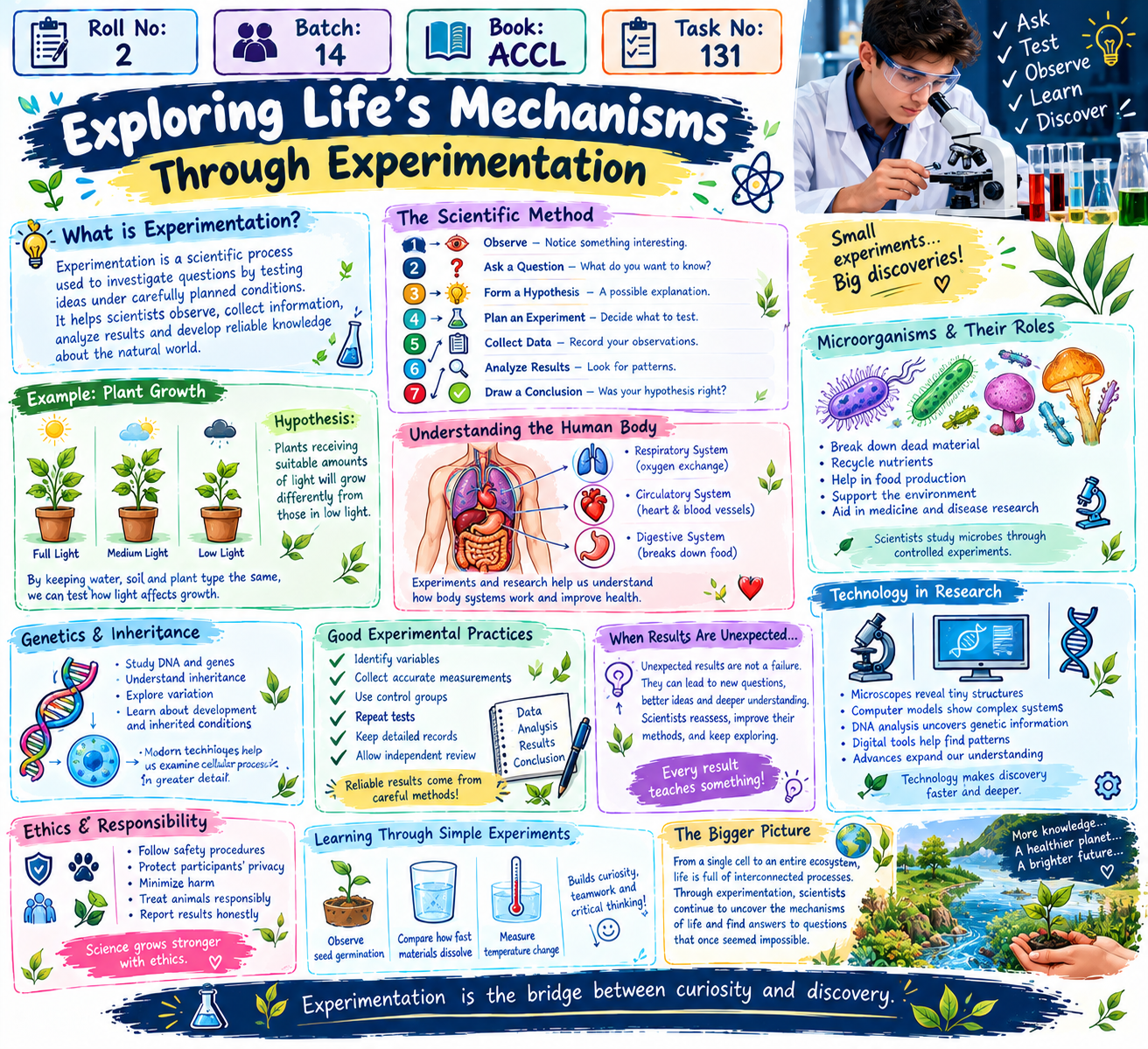
    ## Exploring Life’s Mechanisms Through Experimentation

    Every great scientific discovery begins with a question. Through careful experimentation, scientists uncover how living organisms grow, adapt, reproduce, and interact with their environment.

    From observing cells under a microscope to studying DNA and testing medicines , experiments help us understand the incredible mechanisms that keep life functioning. Biology experiments encourage curiosity, critical thinking, and problem-solving while teaching us the importance of evidence-based conclusions.

    Experimentation has transformed healthcare , agriculture , environmental conservation , and biotechnology , leading to innovations that improve lives around the world. Every observation and every experiment brings us one step closer to solving the mysteries of life.

    So, stay curious, ask questions, test ideas, and never stop exploring—because today's experiment could become tomorrow's breakthrough!

    #Biology #Science #Experimentation #LifeMechanisms #STEM #Learning #Education #ScientificDiscovery #Innovation #Research #Curiosity #FutureScientists
    #rsisb RollNo.244 Story Post Foundation Level ## 🔬 Exploring Life’s Mechanisms Through Experimentation 🧪🌱 Every great scientific discovery begins with a question. 🤔 Through careful experimentation, scientists uncover how living organisms grow, adapt, reproduce, and interact with their environment. 🌍🔬 From observing cells under a microscope 🦠 to studying DNA 🧬 and testing medicines 💊, experiments help us understand the incredible mechanisms that keep life functioning. Biology experiments encourage curiosity, critical thinking, and problem-solving while teaching us the importance of evidence-based conclusions. 📚✨ Experimentation has transformed healthcare 🏥, agriculture 🌾, environmental conservation 🌿, and biotechnology ⚙️, leading to innovations that improve lives around the world. Every observation and every experiment brings us one step closer to solving the mysteries of life. 🌟 So, stay curious, ask questions, test ideas, and never stop exploring—because today's experiment could become tomorrow's breakthrough! 🚀🔍 #Biology #Science #Experimentation #LifeMechanisms #STEM #Learning #Education #ScientificDiscovery #Innovation #Research #Curiosity #FutureScientists 🧬🌱
    0 Σχόλια 0 Μοιράστηκε 2756 Views
  • Some of the key pedagogical approaches and innovations throughout history. Many of these approaches continue to evolve and influence modern education practices.

    c. 700 BCE: Socratic Method - Ancient Greek philosopher Socrates develops a questioning technique to promote critical thinking and dialogue.

    15th-18th centuries: Humanism - Renaissance scholars emphasize the importance of classical education, focusing on literature, history, and moral philosophy.

    18th century: Rousseau and Natural Education - Jean-Jacques Rousseaus "Emile" promotes a child-centered approach, advocating for learning through experience and nature.

    Early 19th century: Pestalozzi Method - Johann Heinrich Pestalozzi, a Swiss educator, develops a teaching method that focuses on the development of the whole child, including head, heart, and hands.

    Mid-19th century: Kindergarten - Friedrich Froebel establishes the concept of kindergarten, emphasizing play, creativity, and social development in early education.

    Late 19th century: Montessori Method - Maria Montessori introduces a child-centered approach, focusing on self-directed learning, multi-age classrooms, and hands-on materials.

    Late 19th century: Dewey and Progressive Education - John Dewey advocates for experiential learning, democratic classrooms, and real-world problem-solving.

    Early 20th century: Steiner and Waldorf Education - Rudolf Steiner establishes Waldorf schools, emphasizing a holistic approach to education, artistic expression, and social responsibility.

    Mid-20th century: Behaviorism - B.F. Skinners theories of operant conditioning and reinforcement gain popularity, shaping educational approaches that focus on observable behaviors and learning outcomes.

    1960s: Constructivism - Jean Piaget and Lev Vygotskys theories emphasize the importance of active learning, social interaction, and the construction of knowledge through experience.

    1970s: Critical Pedagogy - Paulo Freires "Pedagogy of the Oppressed" introduces a transformative educational approach that empowers learners to challenge social injustices and inequalities.

    1980s: Multiple Intelligences - Howard Gardner proposes the theory of multiple intelligences, suggesting that individuals possess various types of intelligence, each requiring different teaching methods.

    Late 20th century: Inquiry-Based Learning - Educational approaches that encourage students to ask questions, explore, and discover knowledge through their curiosity and interests gain popularity.

    21st century: Flipped Classroom - Educators experiment with inverting the traditional teaching model, assigning lectures for homework and using class time for hands-on activities and discussions.

    21st century: Blended Learning - The integration of digital technology and online resources with traditional classroom instruction becomes more widespread, creating diverse learning opportunities.
    Some of the key pedagogical approaches and innovations throughout history. Many of these approaches continue to evolve and influence modern education practices. c. 700 BCE: Socratic Method - Ancient Greek philosopher Socrates develops a questioning technique to promote critical thinking and dialogue. 15th-18th centuries: Humanism - Renaissance scholars emphasize the importance of classical education, focusing on literature, history, and moral philosophy. 18th century: Rousseau and Natural Education - Jean-Jacques Rousseau's "Emile" promotes a child-centered approach, advocating for learning through experience and nature. Early 19th century: Pestalozzi Method - Johann Heinrich Pestalozzi, a Swiss educator, develops a teaching method that focuses on the development of the whole child, including head, heart, and hands. Mid-19th century: Kindergarten - Friedrich Froebel establishes the concept of kindergarten, emphasizing play, creativity, and social development in early education. Late 19th century: Montessori Method - Maria Montessori introduces a child-centered approach, focusing on self-directed learning, multi-age classrooms, and hands-on materials. Late 19th century: Dewey and Progressive Education - John Dewey advocates for experiential learning, democratic classrooms, and real-world problem-solving. Early 20th century: Steiner and Waldorf Education - Rudolf Steiner establishes Waldorf schools, emphasizing a holistic approach to education, artistic expression, and social responsibility. Mid-20th century: Behaviorism - B.F. Skinner's theories of operant conditioning and reinforcement gain popularity, shaping educational approaches that focus on observable behaviors and learning outcomes. 1960s: Constructivism - Jean Piaget and Lev Vygotsky's theories emphasize the importance of active learning, social interaction, and the construction of knowledge through experience. 1970s: Critical Pedagogy - Paulo Freire's "Pedagogy of the Oppressed" introduces a transformative educational approach that empowers learners to challenge social injustices and inequalities. 1980s: Multiple Intelligences - Howard Gardner proposes the theory of multiple intelligences, suggesting that individuals possess various types of intelligence, each requiring different teaching methods. Late 20th century: Inquiry-Based Learning - Educational approaches that encourage students to ask questions, explore, and discover knowledge through their curiosity and interests gain popularity. 21st century: Flipped Classroom - Educators experiment with inverting the traditional teaching model, assigning lectures for homework and using class time for hands-on activities and discussions. 21st century: Blended Learning - The integration of digital technology and online resources with traditional classroom instruction becomes more widespread, creating diverse learning opportunities.
    0 Σχόλια 0 Μοιράστηκε 1018 Views
  • Monsanto, now part of Bayer, has a long and complex history that spans over a century. Heres a concise overview of how Monsanto became Monsanto:

    ### Early History and Formation
    - **1901:** Monsanto was founded in St. Louis, Missouri, by John Francis Queeny, a 30-year veteran of the pharmaceutical industry. The company was named after his wife, Olga Méndez Monsanto.
    - **First Product:** Monsantos initial product was saccharin, an artificial sweetener.

    ### Growth and Diversification
    - **1920s-1940s:** Monsanto expanded its product line to include industrial chemicals, such as sulfuric acid and PCBs (polychlorinated biphenyls).
    - **1940s:** During World War II, Monsanto produced synthetic rubber and became involved in the emerging plastics industry.

    ### Agricultural Focus
    - **1960s-1970s:** Monsanto began to focus more on agriculture, producing herbicides such as Agent Orange (used during the Vietnam War) and Roundup (glyphosate).
    - **1980s:** The company invested heavily in biotechnology, becoming a pioneer in genetically modified organisms (GMOs). They developed and marketed genetically engineered seeds that were resistant to their own herbicides, such as Roundup Ready crops.

    ### Legal and Environmental Issues
    - Throughout its history, Monsanto faced numerous legal and environmental controversies, including lawsuits over the health effects of PCBs, dioxins, and glyphosate.

    ### Mergers and Acquisitions
    - **2000:** Monsanto merged with Pharmacia & Upjohn, and the agricultural operations were later spun off into a new Monsanto Company.
    - **2016:** Bayer, a German pharmaceutical and life sciences company, announced its intention to acquire Monsanto.
    - **2018:** The acquisition was completed, and Monsanto ceased to exist as an independent entity, with its products and technologies integrated into Bayers Crop Science division.

    ### Innovations and Legacy
    - Monsanto was instrumental in the development and commercialization of GMOs, which have had a significant impact on modern agriculture. The companys innovations in biotechnology and agricultural chemicals have been both praised for their contributions to increasing agricultural productivity and criticized for their environmental and health impacts.

    Throughout its existence, Monsantos influence on agriculture and its controversial legacy have made it a significant and often polarizing player in the agricultural industry.
    Monsanto, now part of Bayer, has a long and complex history that spans over a century. Here's a concise overview of how Monsanto became Monsanto: ### Early History and Formation - **1901:** Monsanto was founded in St. Louis, Missouri, by John Francis Queeny, a 30-year veteran of the pharmaceutical industry. The company was named after his wife, Olga Méndez Monsanto. - **First Product:** Monsanto's initial product was saccharin, an artificial sweetener. ### Growth and Diversification - **1920s-1940s:** Monsanto expanded its product line to include industrial chemicals, such as sulfuric acid and PCBs (polychlorinated biphenyls). - **1940s:** During World War II, Monsanto produced synthetic rubber and became involved in the emerging plastics industry. ### Agricultural Focus - **1960s-1970s:** Monsanto began to focus more on agriculture, producing herbicides such as Agent Orange (used during the Vietnam War) and Roundup (glyphosate). - **1980s:** The company invested heavily in biotechnology, becoming a pioneer in genetically modified organisms (GMOs). They developed and marketed genetically engineered seeds that were resistant to their own herbicides, such as Roundup Ready crops. ### Legal and Environmental Issues - Throughout its history, Monsanto faced numerous legal and environmental controversies, including lawsuits over the health effects of PCBs, dioxins, and glyphosate. ### Mergers and Acquisitions - **2000:** Monsanto merged with Pharmacia & Upjohn, and the agricultural operations were later spun off into a new Monsanto Company. - **2016:** Bayer, a German pharmaceutical and life sciences company, announced its intention to acquire Monsanto. - **2018:** The acquisition was completed, and Monsanto ceased to exist as an independent entity, with its products and technologies integrated into Bayer's Crop Science division. ### Innovations and Legacy - Monsanto was instrumental in the development and commercialization of GMOs, which have had a significant impact on modern agriculture. The company's innovations in biotechnology and agricultural chemicals have been both praised for their contributions to increasing agricultural productivity and criticized for their environmental and health impacts. Throughout its existence, Monsanto's influence on agriculture and its controversial legacy have made it a significant and often polarizing player in the agricultural industry.
    0 Σχόλια 0 Μοιράστηκε 477 Views
  • **WeChat**, known as **Weixin** in China, is one of the most influential apps in the world, especially in China, where it dominates not just social media, but a wide range of digital services. Here’s the story of WeChat and its rise to becoming a "super app":

    ### Founding of WeChat:
    WeChat was developed by **Tencent**, one of Chinas largest tech companies, led by its co-founder and CEO **Pony Ma (Ma Huateng)**. Tencent initially rose to fame with its **QQ** instant messaging service, which was popular during the late 1990s and early 2000s in China. However, as the world shifted to mobile devices, Tencent needed a mobile-first solution.

    - **WeChat** was the brainchild of **Zhang Xiaolong**, also known as **Allen Zhang**, a Tencent engineer. Zhang and his team started working on the app in late **2010**. Tencent was aware of the rapid growth of mobile messaging platforms like WhatsApp and realized the need to develop a mobile-first messaging service.
    - **WeChat** (or Weixin, its Chinese name) was launched in **January 2011** as a simple messaging app similar to WhatsApp, allowing users to send text, voice, and picture messages via mobile phones.

    ### Key Features and Evolution:
    - While WeChat started as a basic messaging app, it quickly began to differentiate itself with new features. A major turning point came when WeChat added **"Moments" (Pengyouquan)** in **April 2012**, a feature similar to Facebooks News Feed, allowing users to share pictures, updates, and links with their contacts.
    - **Voice messaging** and **video calling** were also added early on, appealing to users in China who found these features more convenient than typing in Chinese characters.

    ### Transformation into a Super App:
    - Tencent’s vision for WeChat went beyond a messaging service. Starting in **2013**, WeChat began integrating services that allowed users to do much more than chat. Some of the key innovations that turned WeChat into a "super app" included:

    1. **WeChat Pay**: In **2013**, WeChat introduced a payment platform, WeChat Pay, allowing users to link their bank accounts and make payments directly through the app. This feature revolutionized the way people in China handled transactions, from online shopping to paying bills or splitting a restaurant bill with friends. WeChat Pay quickly became ubiquitous, enabling users to pay for anything from taxis to groceries.

    2. **Official Accounts**: In **2012**, WeChat introduced **Official Accounts**, allowing businesses, celebrities, and influencers to create accounts for marketing and communication. These accounts act like mini-websites or apps within WeChat, offering services such as customer service, news updates, and even e-commerce.

    3. **Mini Programs**: In **2017**, WeChat introduced **Mini Programs**, which allowed third-party developers to build apps within WeChat. These lightweight apps cover a wide range of functions, from e-commerce to gaming, and dont require a separate download, allowing users to perform various tasks without leaving WeChat.

    4. **Integration with Everyday Life**: WeChat continued to add features that integrated with people’s daily lives, such as booking taxis, ordering food, making doctor’s appointments, and even paying utility bills. The app became a one-stop-shop for almost all digital needs, earning it the title of a "super app."

    ### Growth and Adoption:
    - WeChats adoption in China was rapid, thanks in part to Tencents ability to leverage its existing QQ user base. By **2013**, WeChat had over **100 million users**, and within a few years, it became the dominant messaging platform in China.
    - As of **2021**, WeChat had more than **1.2 billion monthly active users**, making it one of the largest social media platforms globally.

    ### WeChat’s Role in Society:
    - **WeChat’s ecosystem**: It became essential in daily life in China. WeChat Pay, along with **Alipay** (from Alibaba), transformed China into a largely cashless society. From street vendors to high-end retail stores, nearly everyone accepts WeChat Pay.
    - **Communication and media**: WeChat has also become the primary platform for news, information sharing, and social networking. Moments, Official Accounts, and Mini Programs created a closed ecosystem, reducing the need for other apps or platforms.
    - **Business tool**: WeChat became an essential tool for businesses, from small shops to large enterprises. Companies use WeChat Official Accounts and Mini Programs for marketing, customer engagement, and even direct sales.

    ### International Reach:
    - While WeChat’s dominance is unquestionable in China, it has struggled to achieve the same level of success internationally. Tencent has made efforts to expand WeChat in global markets, especially in Southeast Asia and among Chinese expatriates, but it has faced stiff competition from apps like WhatsApp, Facebook Messenger, and Line in other countries.
    - In **2013**, WeChat was rebranded internationally under its English name, but it could not gain the same level of user penetration outside China, partly due to different user preferences and established competitors.

    ### Privacy and Censorship Concerns:
    - As WeChat grew, so did concerns over **privacy** and **censorship**. Being a Chinese company, WeChat is subject to **Chinese government regulations**, including compliance with censorship laws. This has led to the censorship of certain political content and restrictions on free speech within the app. Critics have raised concerns over user data privacy and surveillance, particularly in light of China’s strict internet control policies.

    ### Recent Developments:
    - **AI Integration**: WeChat has continued to evolve, incorporating more **artificial intelligence (AI)** features, such as smart assistants and AI-powered services within its Mini Programs.
    - **Expansion of WeChat Pay**: WeChat Pay has expanded beyond China, allowing users to make payments in several countries, particularly where Chinese tourists frequently travel.
    - **Political Issues**: In 2020, WeChat came under scrutiny in the United States, with the Trump administration attempting to ban the app over concerns related to national security and data privacy. However, the ban was halted by courts, and under the Biden administration, the issue has been revisited.

    ### Legacy and Impact:
    - WeChat has fundamentally changed the way people in China communicate, shop, and conduct business. It has become the backbone of daily life for millions of Chinese citizens.
    - **Allen Zhang** is considered the architect of WeChat’s success, and his vision of a seamless app that integrates messaging with payment, social interaction, and services has been crucial to its growth. Tencent, led by **Pony Ma**, has played a pivotal role in pushing the boundaries of what an app can do.

    In summary, **WeChat’s story** is one of incredible innovation, transforming from a simple messaging app into a "super app" that integrates nearly every aspect of digital life in China. Its ability to adapt, expand, and meet the diverse needs of users has made it indispensable in China and a unique case study of app development worldwide.
    **WeChat**, known as **Weixin** in China, is one of the most influential apps in the world, especially in China, where it dominates not just social media, but a wide range of digital services. Here’s the story of WeChat and its rise to becoming a "super app": ### Founding of WeChat: WeChat was developed by **Tencent**, one of China's largest tech companies, led by its co-founder and CEO **Pony Ma (Ma Huateng)**. Tencent initially rose to fame with its **QQ** instant messaging service, which was popular during the late 1990s and early 2000s in China. However, as the world shifted to mobile devices, Tencent needed a mobile-first solution. - **WeChat** was the brainchild of **Zhang Xiaolong**, also known as **Allen Zhang**, a Tencent engineer. Zhang and his team started working on the app in late **2010**. Tencent was aware of the rapid growth of mobile messaging platforms like WhatsApp and realized the need to develop a mobile-first messaging service. - **WeChat** (or Weixin, its Chinese name) was launched in **January 2011** as a simple messaging app similar to WhatsApp, allowing users to send text, voice, and picture messages via mobile phones. ### Key Features and Evolution: - While WeChat started as a basic messaging app, it quickly began to differentiate itself with new features. A major turning point came when WeChat added **"Moments" (Pengyouquan)** in **April 2012**, a feature similar to Facebook's News Feed, allowing users to share pictures, updates, and links with their contacts. - **Voice messaging** and **video calling** were also added early on, appealing to users in China who found these features more convenient than typing in Chinese characters. ### Transformation into a Super App: - Tencent’s vision for WeChat went beyond a messaging service. Starting in **2013**, WeChat began integrating services that allowed users to do much more than chat. Some of the key innovations that turned WeChat into a "super app" included: 1. **WeChat Pay**: In **2013**, WeChat introduced a payment platform, WeChat Pay, allowing users to link their bank accounts and make payments directly through the app. This feature revolutionized the way people in China handled transactions, from online shopping to paying bills or splitting a restaurant bill with friends. WeChat Pay quickly became ubiquitous, enabling users to pay for anything from taxis to groceries. 2. **Official Accounts**: In **2012**, WeChat introduced **Official Accounts**, allowing businesses, celebrities, and influencers to create accounts for marketing and communication. These accounts act like mini-websites or apps within WeChat, offering services such as customer service, news updates, and even e-commerce. 3. **Mini Programs**: In **2017**, WeChat introduced **Mini Programs**, which allowed third-party developers to build apps within WeChat. These lightweight apps cover a wide range of functions, from e-commerce to gaming, and don't require a separate download, allowing users to perform various tasks without leaving WeChat. 4. **Integration with Everyday Life**: WeChat continued to add features that integrated with people’s daily lives, such as booking taxis, ordering food, making doctor’s appointments, and even paying utility bills. The app became a one-stop-shop for almost all digital needs, earning it the title of a "super app." ### Growth and Adoption: - WeChat's adoption in China was rapid, thanks in part to Tencent's ability to leverage its existing QQ user base. By **2013**, WeChat had over **100 million users**, and within a few years, it became the dominant messaging platform in China. - As of **2021**, WeChat had more than **1.2 billion monthly active users**, making it one of the largest social media platforms globally. ### WeChat’s Role in Society: - **WeChat’s ecosystem**: It became essential in daily life in China. WeChat Pay, along with **Alipay** (from Alibaba), transformed China into a largely cashless society. From street vendors to high-end retail stores, nearly everyone accepts WeChat Pay. - **Communication and media**: WeChat has also become the primary platform for news, information sharing, and social networking. Moments, Official Accounts, and Mini Programs created a closed ecosystem, reducing the need for other apps or platforms. - **Business tool**: WeChat became an essential tool for businesses, from small shops to large enterprises. Companies use WeChat Official Accounts and Mini Programs for marketing, customer engagement, and even direct sales. ### International Reach: - While WeChat’s dominance is unquestionable in China, it has struggled to achieve the same level of success internationally. Tencent has made efforts to expand WeChat in global markets, especially in Southeast Asia and among Chinese expatriates, but it has faced stiff competition from apps like WhatsApp, Facebook Messenger, and Line in other countries. - In **2013**, WeChat was rebranded internationally under its English name, but it could not gain the same level of user penetration outside China, partly due to different user preferences and established competitors. ### Privacy and Censorship Concerns: - As WeChat grew, so did concerns over **privacy** and **censorship**. Being a Chinese company, WeChat is subject to **Chinese government regulations**, including compliance with censorship laws. This has led to the censorship of certain political content and restrictions on free speech within the app. Critics have raised concerns over user data privacy and surveillance, particularly in light of China’s strict internet control policies. ### Recent Developments: - **AI Integration**: WeChat has continued to evolve, incorporating more **artificial intelligence (AI)** features, such as smart assistants and AI-powered services within its Mini Programs. - **Expansion of WeChat Pay**: WeChat Pay has expanded beyond China, allowing users to make payments in several countries, particularly where Chinese tourists frequently travel. - **Political Issues**: In 2020, WeChat came under scrutiny in the United States, with the Trump administration attempting to ban the app over concerns related to national security and data privacy. However, the ban was halted by courts, and under the Biden administration, the issue has been revisited. ### Legacy and Impact: - WeChat has fundamentally changed the way people in China communicate, shop, and conduct business. It has become the backbone of daily life for millions of Chinese citizens. - **Allen Zhang** is considered the architect of WeChat’s success, and his vision of a seamless app that integrates messaging with payment, social interaction, and services has been crucial to its growth. Tencent, led by **Pony Ma**, has played a pivotal role in pushing the boundaries of what an app can do. In summary, **WeChat’s story** is one of incredible innovation, transforming from a simple messaging app into a "super app" that integrates nearly every aspect of digital life in China. Its ability to adapt, expand, and meet the diverse needs of users has made it indispensable in China and a unique case study of app development worldwide.
    0 Σχόλια 0 Μοιράστηκε 548 Views
  • The story of **Kodak** is one of dramatic innovation and success, followed by decline, as it struggled to adapt to the digital revolution it helped pioneer. Kodak’s history is often seen as a cautionary tale about how even the most successful companies can falter if they fail to embrace technological change. Here’s the detailed story of Kodak:

    ### Founding of Kodak:
    - **Kodak** was founded by **George Eastman** in **1888** in Rochester, New York. Eastman was a visionary entrepreneur who revolutionized photography by making it accessible to the general public.
    - Before Kodak, photography was a complex, cumbersome process that involved large, heavy equipment and required significant expertise. Eastman’s key innovation was to simplify this process with the invention of **roll film**, which replaced the bulky glass plates used in cameras at the time.

    ### Early Innovations:
    - In 1888, Eastman introduced the **Kodak camera**, which was preloaded with film that could take **100 pictures**. After shooting, users would send the camera back to Kodak, where the film would be developed, and the camera reloaded. This invention made photography much more accessible to the average person, leading to Kodaks famous slogan: **“You press the button, we do the rest.”**

    - In 1900, Kodak introduced the **Brownie camera**, which sold for **$1** and further popularized photography by making it affordable for the masses. The Brownie helped establish Kodak as the dominant player in the photography market for much of the 20th century.

    ### The Rise of Kodak:
    - Throughout the 20th century, Kodak became synonymous with photography. The company continued to innovate, developing better cameras, film, and photo development technologies. Kodak’s film products, especially **Kodachrome**, became legendary in both consumer and professional photography.
    - By the mid-1900s, Kodak controlled **90% of the film market** and **85% of the camera market** in the United States. The company had an extraordinary presence globally, providing consumers with easy-to-use cameras and film, while dominating the photo printing industry.

    - Kodak was also deeply involved in motion picture technology, providing film stock used in Hollywood and for television broadcasts. Its dominance in both personal and professional photography made Kodak a global leader.

    ### The Invention of the Digital Camera:
    - Ironically, Kodak’s downfall began with its own invention. In **1975**, a Kodak engineer named **Steven Sasson** invented the **digital camera**. This early digital camera was a prototype and could only capture a low-resolution black-and-white image. Though it was a groundbreaking achievement, Kodak, fearing it would cannibalize its highly profitable film business, did not aggressively pursue the technology.

    - Kodak made early investments in digital technology, but its leadership was hesitant to fully commit to it, concerned about undermining its core business. Kodak executives continued to focus on traditional film, which was still generating the majority of the company’s revenue.

    ### The Rise of Digital Photography and Kodaks Struggles:
    - Throughout the **1990s and 2000s**, digital photography rapidly advanced. Companies like **Canon, Nikon, Sony**, and later **Apple** embraced digital imaging, introducing digital cameras and smartphones that allowed users to take, store, and share photos without the need for film or prints.

    - Kodak, despite having early access to the digital camera market, lagged behind competitors because it was slow to move away from its traditional business model. By the early **2000s**, the film business was shrinking rapidly as more consumers adopted digital cameras and smartphones.

    - Kodak did launch its own line of digital cameras, but by the time it fully entered the market, it was already too late. Competitors had gained significant ground, and Kodak was unable to capture enough market share to make up for the loss in film sales.

    ### Bankruptcy and Decline:
    - As digital photography became the norm, Kodak’s revenues from film and printing plummeted. The company attempted various strategies to reinvent itself, including focusing on printers and digital services, but none proved to be successful enough to offset the decline in its core business.

    - In **2012**, Kodak filed for **Chapter 11 bankruptcy**, marking the end of an era for the company that had once dominated the photography world. During the bankruptcy process, Kodak sold off many of its patents and assets to survive.

    ### Reinvention:
    - After emerging from bankruptcy in **2013**, Kodak attempted to reinvent itself as a technology company focused on imaging solutions for businesses, including printing and packaging, as well as licensing its brand for various consumer products.

    - While Kodak no longer holds the dominant position it once had, it remains in business, albeit in a much smaller capacity. It has since diversified into areas such as commercial printing, packaging, and software, and also focused on innovations in imaging technology for industrial and healthcare applications.

    ### Kodak’s Legacy:
    - Despite its dramatic decline, Kodak’s legacy in photography remains significant. The company helped make photography a mainstream hobby and profession. Its film, cameras, and innovations shaped much of the 20th century’s photographic history, and its products were used by some of the most famous photographers and filmmakers of the time.

    - **Kodachrome**, Kodak’s iconic film, was particularly beloved by photographers and was known for its vibrant color reproduction. When Kodak discontinued Kodachrome in **2009**, it marked the end of an era, though the film still holds a special place in the hearts of many photography enthusiasts.

    ### Lessons from Kodak’s Story:
    - Kodak’s failure to fully embrace digital technology has been widely cited as one of the greatest examples of **corporate complacency** and **innovators dilemma**. Despite being a pioneer in digital imaging, Kodak’s reluctance to cannibalize its highly profitable film business led to its downfall.

    - Kodak’s story is often used as a cautionary tale in business schools and the tech industry about the dangers of ignoring disruptive technologies and failing to adapt to changing markets.

    ### Conclusion:
    The story of Kodak is one of incredible innovation and ultimate caution. George Eastman and Kodak revolutionized photography, turning it from a specialized profession into a hobby for millions of people. However, Kodak’s failure to adapt to the digital age, despite being one of its early innovators, led to the companys sharp decline. Today, Kodak remains a much smaller company, having shifted its focus away from consumer photography toward business imaging solutions.
    The story of **Kodak** is one of dramatic innovation and success, followed by decline, as it struggled to adapt to the digital revolution it helped pioneer. Kodak’s history is often seen as a cautionary tale about how even the most successful companies can falter if they fail to embrace technological change. Here’s the detailed story of Kodak: ### Founding of Kodak: - **Kodak** was founded by **George Eastman** in **1888** in Rochester, New York. Eastman was a visionary entrepreneur who revolutionized photography by making it accessible to the general public. - Before Kodak, photography was a complex, cumbersome process that involved large, heavy equipment and required significant expertise. Eastman’s key innovation was to simplify this process with the invention of **roll film**, which replaced the bulky glass plates used in cameras at the time. ### Early Innovations: - In 1888, Eastman introduced the **Kodak camera**, which was preloaded with film that could take **100 pictures**. After shooting, users would send the camera back to Kodak, where the film would be developed, and the camera reloaded. This invention made photography much more accessible to the average person, leading to Kodak's famous slogan: **“You press the button, we do the rest.”** - In 1900, Kodak introduced the **Brownie camera**, which sold for **$1** and further popularized photography by making it affordable for the masses. The Brownie helped establish Kodak as the dominant player in the photography market for much of the 20th century. ### The Rise of Kodak: - Throughout the 20th century, Kodak became synonymous with photography. The company continued to innovate, developing better cameras, film, and photo development technologies. Kodak’s film products, especially **Kodachrome**, became legendary in both consumer and professional photography. - By the mid-1900s, Kodak controlled **90% of the film market** and **85% of the camera market** in the United States. The company had an extraordinary presence globally, providing consumers with easy-to-use cameras and film, while dominating the photo printing industry. - Kodak was also deeply involved in motion picture technology, providing film stock used in Hollywood and for television broadcasts. Its dominance in both personal and professional photography made Kodak a global leader. ### The Invention of the Digital Camera: - Ironically, Kodak’s downfall began with its own invention. In **1975**, a Kodak engineer named **Steven Sasson** invented the **digital camera**. This early digital camera was a prototype and could only capture a low-resolution black-and-white image. Though it was a groundbreaking achievement, Kodak, fearing it would cannibalize its highly profitable film business, did not aggressively pursue the technology. - Kodak made early investments in digital technology, but its leadership was hesitant to fully commit to it, concerned about undermining its core business. Kodak executives continued to focus on traditional film, which was still generating the majority of the company’s revenue. ### The Rise of Digital Photography and Kodak's Struggles: - Throughout the **1990s and 2000s**, digital photography rapidly advanced. Companies like **Canon, Nikon, Sony**, and later **Apple** embraced digital imaging, introducing digital cameras and smartphones that allowed users to take, store, and share photos without the need for film or prints. - Kodak, despite having early access to the digital camera market, lagged behind competitors because it was slow to move away from its traditional business model. By the early **2000s**, the film business was shrinking rapidly as more consumers adopted digital cameras and smartphones. - Kodak did launch its own line of digital cameras, but by the time it fully entered the market, it was already too late. Competitors had gained significant ground, and Kodak was unable to capture enough market share to make up for the loss in film sales. ### Bankruptcy and Decline: - As digital photography became the norm, Kodak’s revenues from film and printing plummeted. The company attempted various strategies to reinvent itself, including focusing on printers and digital services, but none proved to be successful enough to offset the decline in its core business. - In **2012**, Kodak filed for **Chapter 11 bankruptcy**, marking the end of an era for the company that had once dominated the photography world. During the bankruptcy process, Kodak sold off many of its patents and assets to survive. ### Reinvention: - After emerging from bankruptcy in **2013**, Kodak attempted to reinvent itself as a technology company focused on imaging solutions for businesses, including printing and packaging, as well as licensing its brand for various consumer products. - While Kodak no longer holds the dominant position it once had, it remains in business, albeit in a much smaller capacity. It has since diversified into areas such as commercial printing, packaging, and software, and also focused on innovations in imaging technology for industrial and healthcare applications. ### Kodak’s Legacy: - Despite its dramatic decline, Kodak’s legacy in photography remains significant. The company helped make photography a mainstream hobby and profession. Its film, cameras, and innovations shaped much of the 20th century’s photographic history, and its products were used by some of the most famous photographers and filmmakers of the time. - **Kodachrome**, Kodak’s iconic film, was particularly beloved by photographers and was known for its vibrant color reproduction. When Kodak discontinued Kodachrome in **2009**, it marked the end of an era, though the film still holds a special place in the hearts of many photography enthusiasts. ### Lessons from Kodak’s Story: - Kodak’s failure to fully embrace digital technology has been widely cited as one of the greatest examples of **corporate complacency** and **innovator's dilemma**. Despite being a pioneer in digital imaging, Kodak’s reluctance to cannibalize its highly profitable film business led to its downfall. - Kodak’s story is often used as a cautionary tale in business schools and the tech industry about the dangers of ignoring disruptive technologies and failing to adapt to changing markets. ### Conclusion: The story of Kodak is one of incredible innovation and ultimate caution. George Eastman and Kodak revolutionized photography, turning it from a specialized profession into a hobby for millions of people. However, Kodak’s failure to adapt to the digital age, despite being one of its early innovators, led to the company's sharp decline. Today, Kodak remains a much smaller company, having shifted its focus away from consumer photography toward business imaging solutions.
    0 Σχόλια 0 Μοιράστηκε 553 Views
Αναζήτηση αποτελεσμάτων