• Big Offer! Don't miss it!

    New Muse AI Account | 1 Billion Tokens FREE from us!
    Free Plan | Monthly Limited Usage

    Your personal AI assistant — for jobs, dashboards, websites, writing and research.

    Price: Only Rs 699
    Limited Offer | only a few accounts left!

    3 Requirements:

    Fresh email
    Confirm the Meta code
    Account released after payment
    WhatsApp now! Order today:
    0333 0717198

    #MuseAI #AI #Pakistan #Students #Freelancing
    Big Offer! Don't miss it! New Muse AI Account | 1 Billion Tokens FREE from us! Free Plan | Monthly Limited Usage Your personal AI assistant — for jobs, dashboards, websites, writing and research. 💰 Price: Only Rs 699 ⏰ Limited Offer | only a few accounts left! 3 Requirements: Fresh email Confirm the Meta code Account released after payment 👉 WhatsApp now! Order today: 0333 0717198 #MuseAI #AI #Pakistan #Students #Freelancing
    0 Kommentare 0 Anteile 1034 Ansichten
  • RSIF8
    Roll no 94
    Song no 11
    Song topic
    Chemical Bonding: The Relationship of Molecules

    Atoms may be tiny, but the bonds they form create the world around us! Chemical bonding is the force that connects atoms together, forming molecules that make up everything from water and food to plants and even our own bodies ‍.

    Through ionic, covalent, and metallic bonds, atoms interact and achieve stability, creating countless substances with unique properties. Understanding chemical bonding helps us learn how matter is formed, why chemical reactions happen, and how science improves our daily lives.

    This song celebrates the amazing relationships between molecules and the invisible connections that make life possible. From the smallest atom to the largest living organism, chemistry is everywhere!

    Let's explore the wonders of science and discover how molecules work together to build the universe around us.

    #ChemicalBonding #RelationshipOfMolecules #Chemistry #Science #Molecules #Atoms #ChemicalReactions #STEM #ScienceEducation #LearningIsFun #FutureScientists #ScienceProject #EducationalContent #ExploreScience #ChemistryLovers #Innovation #Knowledge #StudentLife #ScienceFacts #LearningJourney
    RSIF8 Roll no 94 Song no 11 Song topic 🔬🎶 Chemical Bonding: The Relationship of Molecules 🎶🔬 Atoms may be tiny, but the bonds they form create the world around us! ⚛️🌍 Chemical bonding is the force that connects atoms together, forming molecules that make up everything from water 💧 and food 🍎 to plants 🌱 and even our own bodies 🧑‍🔬. Through ionic, covalent, and metallic bonds, atoms interact and achieve stability, creating countless substances with unique properties. 🧪✨ Understanding chemical bonding helps us learn how matter is formed, why chemical reactions happen, and how science improves our daily lives. 💡📚 This song celebrates the amazing relationships between molecules and the invisible connections that make life possible. From the smallest atom to the largest living organism, chemistry is everywhere! 🌟🔬 Let's explore the wonders of science and discover how molecules work together to build the universe around us. 🚀⚛️🌎 #ChemicalBonding #RelationshipOfMolecules #Chemistry #Science #Molecules #Atoms #ChemicalReactions #STEM #ScienceEducation #LearningIsFun #FutureScientists #ScienceProject #EducationalContent #ExploreScience #ChemistryLovers #Innovation #Knowledge #StudentLife #ScienceFacts #LearningJourney 🔬🧪⚛️📚✨🌍🚀
    0 Kommentare 0 Anteile 1451 Ansichten 21
  • **Roll No: 2**
    **Batch: 14**
    **Book: ACCL**
    **Task No: 120**

    # Why Frogs? Understanding the Anatomy of Life

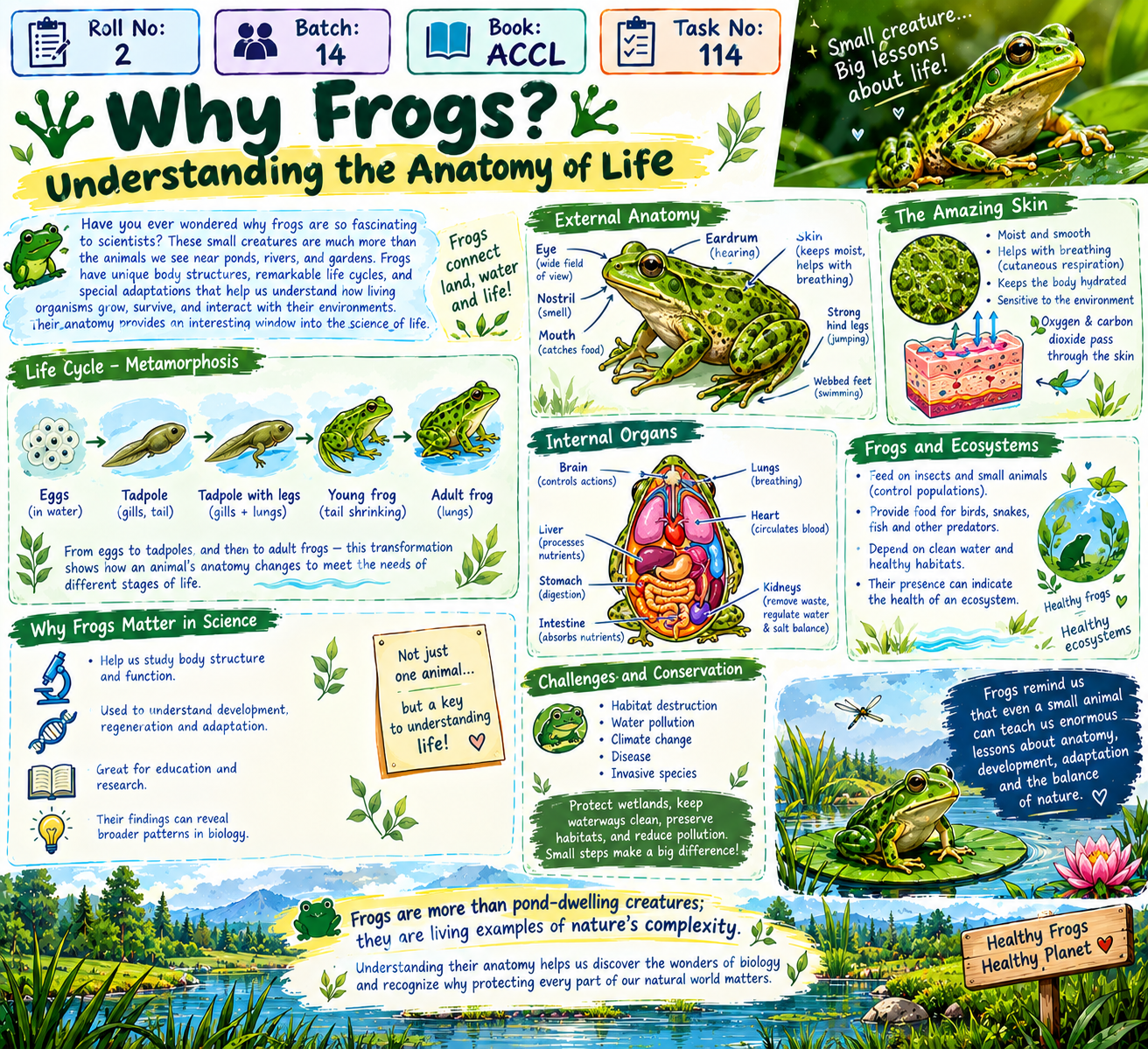
    Have you ever wondered why frogs are so fascinating to scientists? These small creatures are much more than the animals we see near ponds, rivers, and gardens. Frogs have unique body structures, remarkable life cycles, and special adaptations that help us understand how living organisms grow, survive, and interact with their environments. Their anatomy provides an interesting window into the science of life.

    A frog's body is designed for life both in water and on land. Its body generally has a broad head, a short trunk, strong hind legs, and webbed feet in many species. These features help frogs jump, swim, and move through their habitats. Their eyes are positioned to provide a wide field of view, while their sensitive hearing helps them detect sounds, including the calls of other frogs.

    One of the most interesting features of frogs is their skin. Unlike the dry, scaly skin of many reptiles, frog skin is usually moist and plays an important role in their survival. Many frogs can exchange gases through their skin as well as through their lungs. This process, called **cutaneous respiration**, allows oxygen and carbon dioxide to pass across the skin under suitable conditions. Their skin also helps maintain moisture, making a healthy habitat especially important for them.

    Frogs have a fascinating life cycle called **metamorphosis**. Many begin life as eggs in water. The eggs hatch into tadpoles, which usually have tails and breathe mainly through gills. As they develop, they grow legs, their lungs develop, and their bodies gradually change into those of adult frogs. The tail is usually absorbed during development. This transformation demonstrates how an animal's anatomy changes to meet the needs of different stages of life.

    The internal organs of a frog also reveal important biological principles. Its heart circulates blood through the body, carrying oxygen and nutrients to tissues. The digestive system breaks down food, while the kidneys help remove waste and regulate water and salt balance. The brain and nervous system coordinate movement, senses, and responses to the environment. Each organ works with other systems to keep the animal alive.

    Frogs are also valuable to ecosystems. Many feed on insects and other small animals, helping influence populations of these organisms. Frogs themselves provide food for birds, snakes, fish, and other predators. Because many frogs depend on suitable water and land habitats, changes in their populations can provide clues about environmental conditions. Scientists therefore study frogs to learn more about biodiversity, habitat quality, and ecosystem health.

    Another reason frogs are important is their role in scientific research and education. Their anatomy helps students explore the structure and function of organs, compare different vertebrates, and understand biological systems. Researchers also study frog development, regeneration in certain species, communication, and adaptation. Such research can reveal broader patterns in biology, although findings from frogs do not always apply directly to humans.

    Unfortunately, many frog species face challenges such as habitat destruction, water pollution, climate change, disease, and invasive species. Protecting wetlands, keeping waterways clean, preserving natural habitats, and reducing pollution can help support frog populations and the many other organisms that share their ecosystems. Caring for frogs is one way of caring for the wider web of life.

    Frogs remind us that even a small animal can teach us enormous lessons about anatomy, development, adaptation, and the balance of nature. By observing their bodies and studying their life cycles, we gain a deeper appreciation of how living systems work together.

    **Frogs are more than pond-dwelling creatures; they are living examples of nature's complexity. Understanding their anatomy helps us discover the wonders of biology and recognize why protecting every part of our natural world matters. **

    \#Frogs #AnatomyOfLife #Biology #LifeCycle #AnimalScience #Biodiversity #ACCL #Batch14 #Task114
    **Roll No: 2** **Batch: 14** **Book: ACCL** **Task No: 120** # 🐸🔬 Why Frogs? Understanding the Anatomy of Life 🌿💚 Have you ever wondered why frogs are so fascinating to scientists? 🐸🌎 These small creatures are much more than the animals we see near ponds, rivers, and gardens. Frogs have unique body structures, remarkable life cycles, and special adaptations that help us understand how living organisms grow, survive, and interact with their environments. Their anatomy provides an interesting window into the science of life. 🔬✨ A frog's body is designed for life both in water and on land. 💧🌱 Its body generally has a broad head, a short trunk, strong hind legs, and webbed feet in many species. These features help frogs jump, swim, and move through their habitats. Their eyes are positioned to provide a wide field of view, while their sensitive hearing helps them detect sounds, including the calls of other frogs. 🦵👀 One of the most interesting features of frogs is their skin. Unlike the dry, scaly skin of many reptiles, frog skin is usually moist and plays an important role in their survival. 🐸💦 Many frogs can exchange gases through their skin as well as through their lungs. This process, called **cutaneous respiration**, allows oxygen and carbon dioxide to pass across the skin under suitable conditions. Their skin also helps maintain moisture, making a healthy habitat especially important for them. Frogs have a fascinating life cycle called **metamorphosis**. 🥚➡️🐟➡️🐸 Many begin life as eggs in water. The eggs hatch into tadpoles, which usually have tails and breathe mainly through gills. As they develop, they grow legs, their lungs develop, and their bodies gradually change into those of adult frogs. The tail is usually absorbed during development. This transformation demonstrates how an animal's anatomy changes to meet the needs of different stages of life. 🌱🔄 The internal organs of a frog also reveal important biological principles. ❤️ Its heart circulates blood through the body, carrying oxygen and nutrients to tissues. The digestive system breaks down food, while the kidneys help remove waste and regulate water and salt balance. The brain and nervous system coordinate movement, senses, and responses to the environment. Each organ works with other systems to keep the animal alive. 🧠🫀 Frogs are also valuable to ecosystems. 🦟🌿 Many feed on insects and other small animals, helping influence populations of these organisms. Frogs themselves provide food for birds, snakes, fish, and other predators. Because many frogs depend on suitable water and land habitats, changes in their populations can provide clues about environmental conditions. Scientists therefore study frogs to learn more about biodiversity, habitat quality, and ecosystem health. 🌍🔎 Another reason frogs are important is their role in scientific research and education. 📚🔬 Their anatomy helps students explore the structure and function of organs, compare different vertebrates, and understand biological systems. Researchers also study frog development, regeneration in certain species, communication, and adaptation. Such research can reveal broader patterns in biology, although findings from frogs do not always apply directly to humans. Unfortunately, many frog species face challenges such as habitat destruction, water pollution, climate change, disease, and invasive species. 🌧️🏞️ Protecting wetlands, keeping waterways clean, preserving natural habitats, and reducing pollution can help support frog populations and the many other organisms that share their ecosystems. Caring for frogs is one way of caring for the wider web of life. 💚♻️ Frogs remind us that even a small animal can teach us enormous lessons about anatomy, development, adaptation, and the balance of nature. By observing their bodies and studying their life cycles, we gain a deeper appreciation of how living systems work together. 🐸🌎🔬 **Frogs are more than pond-dwelling creatures; they are living examples of nature's complexity. Understanding their anatomy helps us discover the wonders of biology and recognize why protecting every part of our natural world matters. 🐸🧬🌿✨** \#Frogs #AnatomyOfLife #Biology #LifeCycle #AnimalScience #Biodiversity #ACCL #Batch14 #Task114 🐸🔬🌍

    0 Kommentare 0 Anteile 3690 Ansichten
  • #rsisb
    Roll no. 247
    Earning no.
    Foundation level

    **Finalize the Teaching Plan – Turning Learning Goals into Reality! **

    Assalam-o-Alaikum Everyone!

    Today, I am going to share my learning journey about **“Finalize the Teaching Plan.”** Finalizing a teaching plan is an important step in creating an organized, effective, and meaningful learning experience for students. It helps teachers prepare lessons, set clear learning objectives, choose suitable teaching methods, and make sure students understand what they are learning.

    A good teaching plan is more than just a timetable. It is a roadmap that guides both teachers and students toward success. Before finalizing a teaching plan, we should carefully review the learning objectives, lesson activities, teaching resources, time management, and assessment methods. We should also consider students' interests, abilities, questions, and individual learning needs. ‍‍

    **Important Steps to Finalize a Teaching Plan:**

    **1. Set Clear Learning Objectives:** Decide what students should know or be able to do by the end of the lesson.

    **2. Organize the Lesson Content:** Arrange the topics in a simple, logical, and easy-to-understand sequence.

    **3. Select Teaching Methods:** Use discussions, demonstrations, activities, storytelling, group work, and practical examples to make learning interesting.

    **4. Manage Time Effectively:** Give appropriate time to introductions, explanations, activities, questions, and revision.

    **5. Prepare Learning Resources:** Arrange books, worksheets, presentations, videos, and other materials needed for the lesson.

    **6. Encourage Student Participation:** Give students opportunities to ask questions, share ideas, solve problems, and learn from one another.

    **7. Plan Assessments:** Use quizzes, discussions, assignments, and activities to check students' understanding.

    **8. Review and Improve:** Make the final changes needed to ensure the teaching plan is clear, practical, and achievable.

    **Why Is Finalizing a Teaching Plan Important?**

    A finalized teaching plan helps teachers stay focused, use classroom time wisely, and create a positive learning environment. It also helps students understand their goals and participate confidently. When a plan is organized but flexible, teachers can make adjustments according to students' needs and make learning more enjoyable.

    **My Key Learning:**

    I have learned that successful teaching requires preparation, organization, creativity, patience, and continuous improvement. A well-prepared teaching plan can make lessons more effective and help students move toward their learning goals step by step.

    Let's remember that **great teaching begins with thoughtful planning, and meaningful learning grows through practice, curiosity, and teamwork!**

    Thank you for reading my learning journey! Keep learning, keep improving, and keep sharing knowledge with others!

    #rsisb Roll no. 247 Earning no. Foundation level 📚✨ **Finalize the Teaching Plan – Turning Learning Goals into Reality! 🎯📝** Assalam-o-Alaikum Everyone! 🌟😊 Today, I am going to share my learning journey about **“Finalize the Teaching Plan.”** 📖🎓 Finalizing a teaching plan is an important step in creating an organized, effective, and meaningful learning experience for students. It helps teachers prepare lessons, set clear learning objectives, choose suitable teaching methods, and make sure students understand what they are learning. 🧠💡 A good teaching plan is more than just a timetable. It is a roadmap that guides both teachers and students toward success. 🗺️🏆 Before finalizing a teaching plan, we should carefully review the learning objectives, lesson activities, teaching resources, time management, and assessment methods. We should also consider students' interests, abilities, questions, and individual learning needs. 👩‍🏫👨‍🎓💖 ✅ **Important Steps to Finalize a Teaching Plan:** 🎯 **1. Set Clear Learning Objectives:** Decide what students should know or be able to do by the end of the lesson. 📚 **2. Organize the Lesson Content:** Arrange the topics in a simple, logical, and easy-to-understand sequence. 🎨 **3. Select Teaching Methods:** Use discussions, demonstrations, activities, storytelling, group work, and practical examples to make learning interesting. ⏰ **4. Manage Time Effectively:** Give appropriate time to introductions, explanations, activities, questions, and revision. 🧰 **5. Prepare Learning Resources:** Arrange books, worksheets, presentations, videos, and other materials needed for the lesson. 🤝 **6. Encourage Student Participation:** Give students opportunities to ask questions, share ideas, solve problems, and learn from one another. 📝 **7. Plan Assessments:** Use quizzes, discussions, assignments, and activities to check students' understanding. 🔄 **8. Review and Improve:** Make the final changes needed to ensure the teaching plan is clear, practical, and achievable. 🌈 **Why Is Finalizing a Teaching Plan Important?** A finalized teaching plan helps teachers stay focused, use classroom time wisely, and create a positive learning environment. It also helps students understand their goals and participate confidently. When a plan is organized but flexible, teachers can make adjustments according to students' needs and make learning more enjoyable. 🌟📖 💭 **My Key Learning:** I have learned that successful teaching requires preparation, organization, creativity, patience, and continuous improvement. A well-prepared teaching plan can make lessons more effective and help students move toward their learning goals step by step. 🚀🏅 Let's remember that **great teaching begins with thoughtful planning, and meaningful learning grows through practice, curiosity, and teamwork!** 🌱💫 Thank you for reading my learning journey! ❤️🙏 Keep learning, keep improving, and keep sharing knowledge with others! 📚🌍✨
    0 Kommentare 0 Anteile 1573 Ansichten
  • ACCL Day 153 — Story: The Force Behind Motion: Understanding Newton’s Laws

    The sun was barely up when the science lab doors slid open, and young Ayan stepped inside. Today wasn’t just any day — it was the day he finally understood why things move the way they do.

    As he placed a small toy car on the table, Sir Imran walked in with his usual smile.
    “Ready to learn how the universe pushes you around?” he joked.

    Ayan nodded.

    “Good,” Sir Imran said. “Let’s talk Newton.”

    First Law — The Law of Inertia

    Ayan flicked the toy car lightly. It moved… then stopped.
    “Why did it stop?” Sir Imran asked.
    “Because I stopped pushing it,” Ayan replied.
    “No,” Sir Imran grinned. “It stopped because friction pushed back. Without any forces, things keep going forever.”

    Ayan imagined a car flying endlessly through space — no brakes, no slowing down.
    So that’s inertia, he thought.
    Objects don’t stop unless something forces them to.

    Second Law — F = ma

    Sir Imran handed him two identical cars: one empty, one full of metal weights.
    “Push them both,” he ordered.

    Ayan pushed.
    The light car zoomed. The heavy one crawled.

    “The heavier something is, the more force you need,” Sir Imran explained. “Force equals mass times acceleration. Simple math — powerful truth.”

    Ayan felt like he had just unlocked a secret code of the universe.

    Third Law — Action & Reaction

    Finally, Sir Imran placed a balloon car on the table.
    “Let go.”

    WOOSH! The balloon shot air backwards — the car zoomed forward.

    “For every action,” Sir Imran said, “there’s an equal and opposite reaction. The universe always responds.”

    Ayan watched the car bounce off the wall and laughed.
    It wasn’t just science… it felt like magic.

    The Lesson of the Day

    As Ayan packed up, he whispered to himself:
    “Everything moves for a reason. Forces shape every step we take.”

    Walking out of the lab, he felt the world differently — every motion, every push, every reaction suddenly made sense.

    Newton wasn’t just writing laws.
    He was explaining the story written into every moment of our lives.
    ACCL Day 153 — Story: The Force Behind Motion: Understanding Newton’s Laws The sun was barely up when the science lab doors slid open, and young Ayan stepped inside. Today wasn’t just any day — it was the day he finally understood why things move the way they do. As he placed a small toy car on the table, Sir Imran walked in with his usual smile. “Ready to learn how the universe pushes you around?” he joked. Ayan nodded. “Good,” Sir Imran said. “Let’s talk Newton.” First Law — The Law of Inertia Ayan flicked the toy car lightly. It moved… then stopped. “Why did it stop?” Sir Imran asked. “Because I stopped pushing it,” Ayan replied. “No,” Sir Imran grinned. “It stopped because friction pushed back. Without any forces, things keep going forever.” Ayan imagined a car flying endlessly through space — no brakes, no slowing down. So that’s inertia, he thought. Objects don’t stop unless something forces them to. Second Law — F = ma Sir Imran handed him two identical cars: one empty, one full of metal weights. “Push them both,” he ordered. Ayan pushed. The light car zoomed. The heavy one crawled. “The heavier something is, the more force you need,” Sir Imran explained. “Force equals mass times acceleration. Simple math — powerful truth.” Ayan felt like he had just unlocked a secret code of the universe. Third Law — Action & Reaction Finally, Sir Imran placed a balloon car on the table. “Let go.” WOOSH! The balloon shot air backwards — the car zoomed forward. “For every action,” Sir Imran said, “there’s an equal and opposite reaction. The universe always responds.” Ayan watched the car bounce off the wall and laughed. It wasn’t just science… it felt like magic. The Lesson of the Day As Ayan packed up, he whispered to himself: “Everything moves for a reason. Forces shape every step we take.” Walking out of the lab, he felt the world differently — every motion, every push, every reaction suddenly made sense. Newton wasn’t just writing laws. He was explaining the story written into every moment of our lives.
    0 Kommentare 0 Anteile 1011 Ansichten
  • #rsisb
    Roll No 253
    Foundation Level
    Song 08

    **CHEMICAL REACTIONS: THE ENGINE OF LIFE | THE SCIENCE BEHIND EVERY BREATH**

    What if every heartbeat, every breath, every movement, and every thought depends on an invisible world of chemical reactions?

    **“Chemical Reactions: The Engine of Life”** takes you on a fascinating musical journey into the chemistry that keeps living organisms alive. From the smallest cell to the most complex human body, life depends on countless chemical reactions happening every second.

    Inside every cell, molecules are constantly being **broken down, built up, transformed, and exchanged**. These reactions release energy, create essential molecules, repair cellular structures, and maintain the delicate balance required for life.

    **The song explores:**

    How chemical reactions transform matter
    Energy release and energy storage in cells
    Photosynthesis and how plants capture sunlight
    Cellular respiration and the production of usable energy
    Enzymes that accelerate essential biological reactions
    The importance of water and molecular interactions
    How metabolism connects thousands of reactions together
    How chemistry supports the function of organs and cells
    How chemical processes drive growth, repair, and reproduction

    At the heart of the story is **metabolism** — the vast network of chemical reactions that allows organisms to obtain energy and build the molecules they need to survive.

    When you eat food, chemistry transforms its molecules into usable energy. When you breathe, oxygen participates in reactions that help cells produce energy. When a plant grows toward sunlight, chemistry is turning light energy into stored chemical energy.

    Even the smallest changes in molecules can create enormous consequences.

    A reaction can release energy.
    A reaction can store energy.
    A reaction can build something new.
    A reaction can break something down.

    Together, these processes form an extraordinary molecular engine that powers life itself.

    **From atoms to cells, from sunlight to energy, from food to movement — chemistry is everywhere.**

    **Plants use it to grow.**
    **Cells use it to survive.**
    **Brains use it to function.**
    **Muscles use it to move.**
    **Life uses it to continue.**

    **“Chemical Reactions: The Engine of Life”** is more than a song about chemistry. It is a reminder that beneath everything we see, an invisible molecular world is constantly working — transforming matter and energy into the processes we call **life**.

    **Every reaction tells a story.**
    **Every molecule has a purpose.**
    **And together, they create the chemistry of life.**

    #ChemicalReactions #EngineOfLife #Chemistry #Biochemistry #ScienceSong #ChemistryEducation #Biology #CellularRespiration #Photosynthesis #Enzymes #Metabolism #MolecularScience #ScienceEducation #LifeScience #EducationalMusic

    Asma Shaheen EducationWali
    Saima Empowerment Wali
    Mishaal TrainingWali
    #rsisb Roll No 253 Foundation Level Song 08 🧪 **CHEMICAL REACTIONS: THE ENGINE OF LIFE | THE SCIENCE BEHIND EVERY BREATH** 🧬⚡ What if every heartbeat, every breath, every movement, and every thought depends on an invisible world of chemical reactions? 🌌🔬 **“Chemical Reactions: The Engine of Life”** takes you on a fascinating musical journey into the chemistry that keeps living organisms alive. From the smallest cell to the most complex human body, life depends on countless chemical reactions happening every second. 🧪✨ Inside every cell, molecules are constantly being **broken down, built up, transformed, and exchanged**. These reactions release energy, create essential molecules, repair cellular structures, and maintain the delicate balance required for life. ⚡🧬 🎵 **The song explores:** 🧪 How chemical reactions transform matter ⚡ Energy release and energy storage in cells 🍃 Photosynthesis and how plants capture sunlight 🫁 Cellular respiration and the production of usable energy 🧬 Enzymes that accelerate essential biological reactions 💧 The importance of water and molecular interactions 🔬 How metabolism connects thousands of reactions together ❤️ How chemistry supports the function of organs and cells 🌱 How chemical processes drive growth, repair, and reproduction At the heart of the story is **metabolism** — the vast network of chemical reactions that allows organisms to obtain energy and build the molecules they need to survive. 🔥🔬 When you eat food, chemistry transforms its molecules into usable energy. When you breathe, oxygen participates in reactions that help cells produce energy. When a plant grows toward sunlight, chemistry is turning light energy into stored chemical energy. ☀️🌿 Even the smallest changes in molecules can create enormous consequences. A reaction can release energy. A reaction can store energy. A reaction can build something new. A reaction can break something down. Together, these processes form an extraordinary molecular engine that powers life itself. 🧬⚙️✨ 🎬 **From atoms to cells, from sunlight to energy, from food to movement — chemistry is everywhere.** 🌱 **Plants use it to grow.** 🫀 **Cells use it to survive.** 🧠 **Brains use it to function.** 🏃 **Muscles use it to move.** 🌍 **Life uses it to continue.** **“Chemical Reactions: The Engine of Life”** is more than a song about chemistry. It is a reminder that beneath everything we see, an invisible molecular world is constantly working — transforming matter and energy into the processes we call **life**. ❤️🧪 ✨ **Every reaction tells a story.** ⚡ **Every molecule has a purpose.** 🧬 **And together, they create the chemistry of life.** #ChemicalReactions #EngineOfLife #Chemistry #Biochemistry #ScienceSong #ChemistryEducation #Biology #CellularRespiration #Photosynthesis #Enzymes #Metabolism #MolecularScience #ScienceEducation #LifeScience #EducationalMusic 🧪🧬⚡🌱🔬 Asma Shaheen EducationWali Saima Empowerment Wali Mishaal TrainingWali
    0 Kommentare 0 Anteile 3385 Ansichten 5
  • Rsif8
    Roll No 30
    Post No 214
    ## Description — “Chemistry Quest: Elements of Everyday Life”

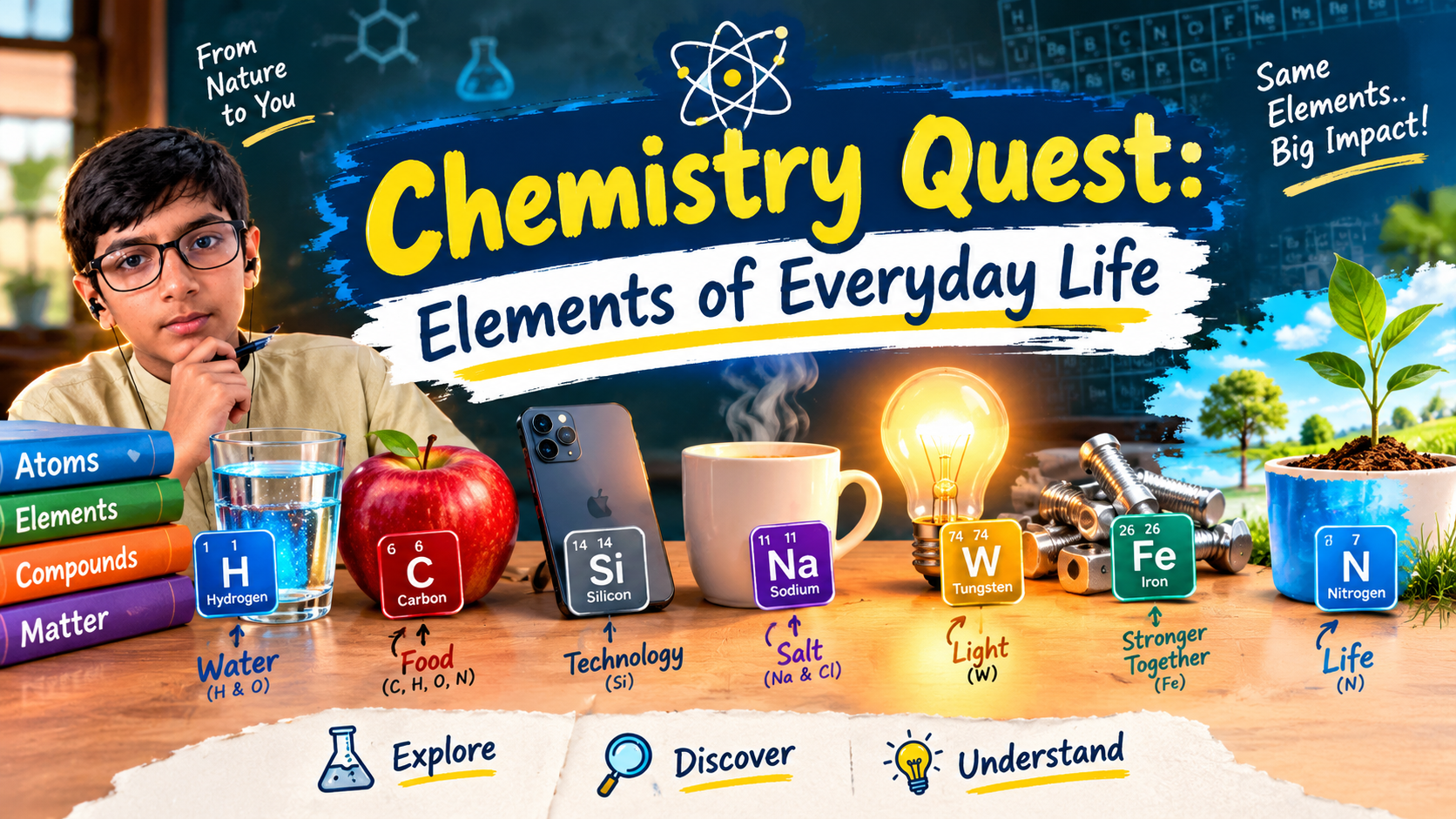
    In this project, I explored **“Chemistry Quest: Elements of Everyday Life”** and discovered how chemistry is connected to the things we use every day.

    From **water and food to smartphones, lights, metals, plants, and many other objects**, different chemical elements play an important role in our daily lives. For example, hydrogen and oxygen are found in water, carbon is important in living things, silicon is used in technology, and iron is used in many everyday objects.

    This project helped me understand that **chemistry is not only something we study in books—it is all around us!**

    I hope you enjoy this chemistry journey and learn something new.

    #ChemistryQuest #Chemistry #Elements #EverydayChemistry #Science #Learning #Education #PeriodicTable #RehanSchool
    Rsif8 Roll No 30 Post No 214 ## 🧪 Description — “Chemistry Quest: Elements of Everyday Life” In this project, I explored **“Chemistry Quest: Elements of Everyday Life”** and discovered how chemistry is connected to the things we use every day. From **water and food to smartphones, lights, metals, plants, and many other objects**, different chemical elements play an important role in our daily lives. For example, hydrogen and oxygen are found in water, carbon is important in living things, silicon is used in technology, and iron is used in many everyday objects. This project helped me understand that **chemistry is not only something we study in books—it is all around us!** 🔬🌍 I hope you enjoy this chemistry journey and learn something new. #ChemistryQuest #Chemistry #Elements #EverydayChemistry #Science #Learning #Education #PeriodicTable #RehanSchool
    0 Kommentare 0 Anteile 1482 Ansichten
  • MohsinRSF8
    song title no:8
    Rool no:13
    Class: Foundation level

    Sure! Here is a **long English description** for your social media post:

    **Chemical Bonding: The Relationship of Molecules**

    Chemistry is one of the most fascinating branches of science because it helps us understand the materials, substances, and processes that surround us every day. From the water we drink and the air we breathe to the food we eat and the objects we use, everything is connected to atoms and molecules. But how do these tiny particles come together to form the world around us? The answer lies in **chemical bonding**.

    My song, **“Chemical Bonding: The Relationship of Molecules,”** presents this important chemistry concept in a creative, simple, and enjoyable way. Through this song, I have tried to explain how atoms interact with each other, how electrons are involved in bonding, and how different atoms combine to form molecules and compounds.

    Atoms are extremely small, but the relationships between them have a huge impact on the properties of matter. Atoms can form different types of chemical bonds depending on how their electrons interact. These bonds help determine the structure, stability, and many properties of the substances around us.

    One important type is **covalent bonding**, where atoms share electrons with each other. This type of bonding plays an important role in the formation of many molecules. Water is a familiar example in which hydrogen and oxygen atoms are connected through covalent bonds. Many other substances that are essential to life also depend on this type of bonding.

    Another important type is **ionic bonding**. In this type of bonding, one atom transfers electrons to another atom. This creates positively and negatively charged ions that attract each other. Sodium and chlorine provide a common example, forming sodium chloride, which is the salt we use in everyday life.

    We can also learn about **metallic bonding**, which helps explain the special properties of metals. The way electrons are arranged and shared among metal atoms contributes to characteristics such as electrical conductivity, strength, and metallic appearance.
    MohsinRSF8 song title no:8 Rool no:13 Class: Foundation level Sure! ❤️ Here is a **long English description** for your social media post: 🧪🎵 **Chemical Bonding: The Relationship of Molecules** 🎵🧪 Chemistry is one of the most fascinating branches of science because it helps us understand the materials, substances, and processes that surround us every day. From the water we drink and the air we breathe to the food we eat and the objects we use, everything is connected to atoms and molecules. But how do these tiny particles come together to form the world around us? The answer lies in **chemical bonding**. My song, **“Chemical Bonding: The Relationship of Molecules,”** presents this important chemistry concept in a creative, simple, and enjoyable way. Through this song, I have tried to explain how atoms interact with each other, how electrons are involved in bonding, and how different atoms combine to form molecules and compounds. 🎶🔬 Atoms are extremely small, but the relationships between them have a huge impact on the properties of matter. Atoms can form different types of chemical bonds depending on how their electrons interact. These bonds help determine the structure, stability, and many properties of the substances around us. One important type is **covalent bonding**, where atoms share electrons with each other. This type of bonding plays an important role in the formation of many molecules. Water is a familiar example in which hydrogen and oxygen atoms are connected through covalent bonds. Many other substances that are essential to life also depend on this type of bonding. 💧 Another important type is **ionic bonding**. In this type of bonding, one atom transfers electrons to another atom. This creates positively and negatively charged ions that attract each other. Sodium and chlorine provide a common example, forming sodium chloride, which is the salt we use in everyday life. 🧂 We can also learn about **metallic bonding**, which helps explain the special properties of metals. The way electrons are arranged and shared among metal atoms contributes to characteristics such as electrical conductivity, strength, and metallic appearance. ⚙️✨
    0 Kommentare 0 Anteile 1806 Ansichten 86
  • #rsisb
    Roll NO:232
    Foundation level student.
    Story post:8

    **Chemistry Quest: Elements of Everyday Life**

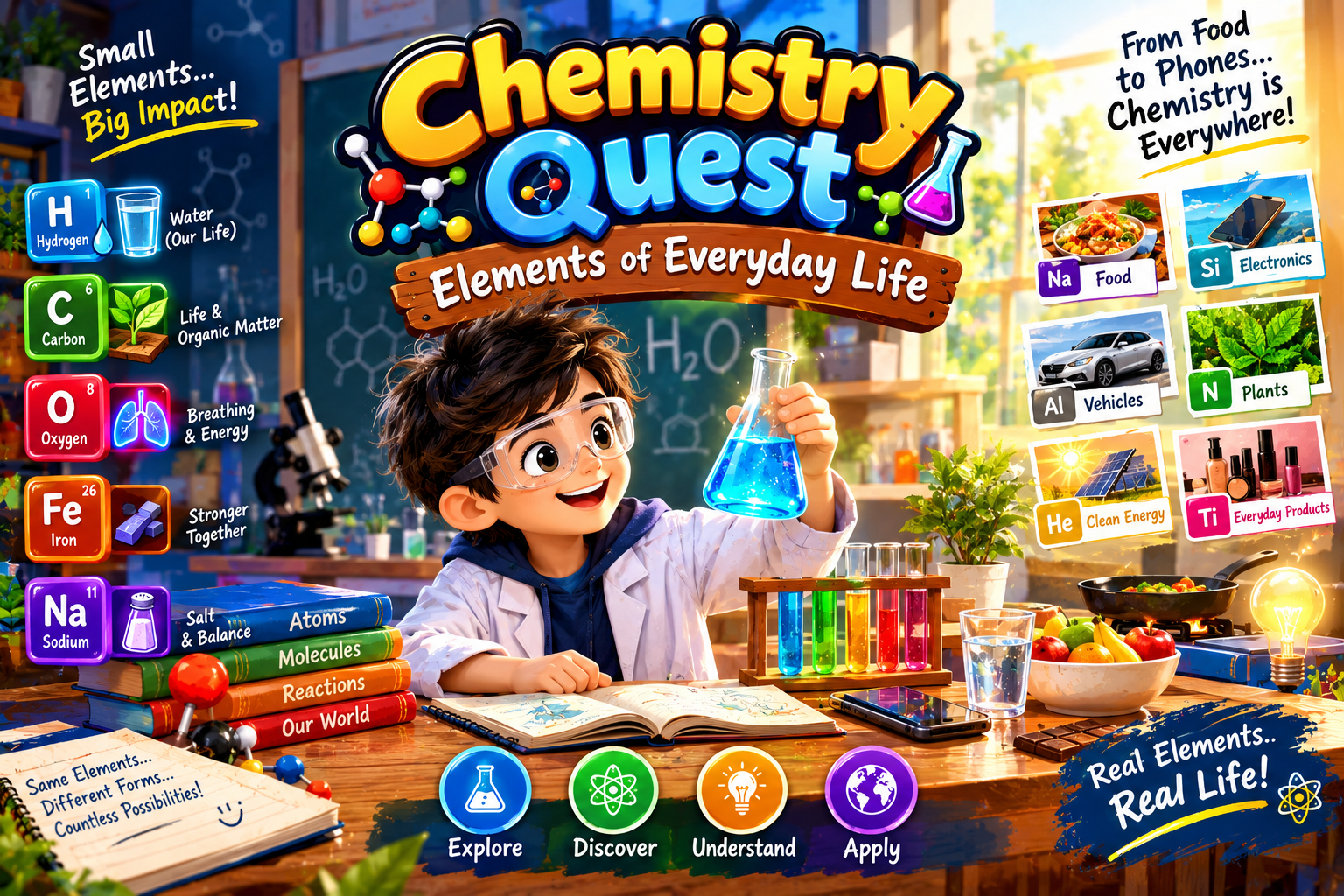
    Get ready for an exciting journey into the amazing world of **chemistry!** Join our Chemistry Quest as we discover how the elements around us are connected to the things we use and experience every day.

    From the oxygen we breathe and the water we drink to the metals in our everyday objects , the nutrients in our food , and the materials used in technology — chemistry is everywhere!

    In this educational adventure, we’ll explore **chemical elements, atoms, molecules, compounds, and chemical reactions** in a simple and interesting way. We’ll discover how different elements combine and how their properties make them useful in our daily lives.

    Chemistry isn't just something we study in a classroom — it is a science that helps us understand the world around us. From cooking to medicine , technology , energy , and nature , chemistry plays an important role in everyday life.

    **Explore Elements • Discover Chemistry • Understand Everyday Science • Keep Learning!**

    Join the quest and discover the fascinating science hidden in the world around you!

    #ChemistryQuest #Chemistry #Elements #EverydayChemistry #PeriodicTable #Atoms #Molecules #ChemicalReactions #Science #ScienceEducation #ChemistryForKids #STEM #Learning #Education #EducationalVideo #FunLearning #ScienceExploration #EverydayScience #DiscoverScience #YoungScientists #Knowledge
    #rsisb Roll NO:232 Foundation level student. Story post:8 🧪⚗️ **Chemistry Quest: Elements of Everyday Life** 🔬🌍✨ Get ready for an exciting journey into the amazing world of **chemistry!** 🚀🧪 Join our Chemistry Quest as we discover how the elements around us are connected to the things we use and experience every day. 🌎🔍 From the oxygen we breathe 🫁💨 and the water we drink 💧 to the metals in our everyday objects 🔩, the nutrients in our food 🍎, and the materials used in technology 📱💻 — chemistry is everywhere! In this educational adventure, we’ll explore **chemical elements, atoms, molecules, compounds, and chemical reactions** in a simple and interesting way. ⚛️🔬📚 We’ll discover how different elements combine and how their properties make them useful in our daily lives. 💡✨ Chemistry isn't just something we study in a classroom — it is a science that helps us understand the world around us. 🌍🧠 From cooking 🍳 to medicine 💊, technology 📱, energy ⚡, and nature 🌱, chemistry plays an important role in everyday life. 🌟 **Explore Elements • Discover Chemistry • Understand Everyday Science • Keep Learning!** 🧪🚀 Join the quest and discover the fascinating science hidden in the world around you! 🔬🌍💫 #ChemistryQuest #Chemistry #Elements #EverydayChemistry #PeriodicTable #Atoms #Molecules #ChemicalReactions #Science #ScienceEducation #ChemistryForKids #STEM #Learning #Education #EducationalVideo #FunLearning #ScienceExploration #EverydayScience #DiscoverScience #YoungScientists #Knowledge 🧪⚗️🔬⚛️🌍💧🌱🍎📱💡⚡📚🚀✨💫
    0 Kommentare 0 Anteile 2824 Ansichten
  • #rsisb
    Roll NO:232
    Foundation level student.
    Story post:7

    **Chemistry Quest: Elements of Everyday Life**

    Get ready for an exciting journey into the amazing world of **chemistry!** Join our Chemistry Quest as we discover how the elements around us are connected to the things we use and experience every day.

    From the oxygen we breathe and the water we drink to the metals in our everyday objects , the nutrients in our food , and the materials used in technology — chemistry is everywhere!

    In this educational adventure, we’ll explore **chemical elements, atoms, molecules, compounds, and chemical reactions** in a simple and interesting way. We’ll discover how different elements combine and how their properties make them useful in our daily lives.

    Chemistry isn't just something we study in a classroom — it is a science that helps us understand the world around us. From cooking to medicine , technology , energy , and nature , chemistry plays an important role in everyday life.

    **Explore Elements • Discover Chemistry • Understand Everyday Science • Keep Learning!**

    Join the quest and discover the fascinating science hidden in the world around you!

    #ChemistryQuest #Chemistry #Elements #EverydayChemistry #PeriodicTable #Atoms #Molecules #ChemicalReactions #Science #ScienceEducation #ChemistryForKids #STEM #Learning #Education #EducationalVideo #FunLearning #ScienceExploration #EverydayScience #DiscoverScience #YoungScientists #Knowledge
    #rsisb Roll NO:232 Foundation level student. Story post:7 🧪⚗️ **Chemistry Quest: Elements of Everyday Life** 🔬🌍✨ Get ready for an exciting journey into the amazing world of **chemistry!** 🚀🧪 Join our Chemistry Quest as we discover how the elements around us are connected to the things we use and experience every day. 🌎🔍 From the oxygen we breathe 🫁💨 and the water we drink 💧 to the metals in our everyday objects 🔩, the nutrients in our food 🍎, and the materials used in technology 📱💻 — chemistry is everywhere! In this educational adventure, we’ll explore **chemical elements, atoms, molecules, compounds, and chemical reactions** in a simple and interesting way. ⚛️🔬📚 We’ll discover how different elements combine and how their properties make them useful in our daily lives. 💡✨ Chemistry isn't just something we study in a classroom — it is a science that helps us understand the world around us. 🌍🧠 From cooking 🍳 to medicine 💊, technology 📱, energy ⚡, and nature 🌱, chemistry plays an important role in everyday life. 🌟 **Explore Elements • Discover Chemistry • Understand Everyday Science • Keep Learning!** 🧪🚀 Join the quest and discover the fascinating science hidden in the world around you! 🔬🌍💫 #ChemistryQuest #Chemistry #Elements #EverydayChemistry #PeriodicTable #Atoms #Molecules #ChemicalReactions #Science #ScienceEducation #ChemistryForKids #STEM #Learning #Education #EducationalVideo #FunLearning #ScienceExploration #EverydayScience #DiscoverScience #YoungScientists #Knowledge 🧪⚗️🔬⚛️🌍💧🌱🍎📱💡⚡📚🚀✨💫
    0 Kommentare 0 Anteile 2625 Ansichten
Suchergebnis