


• #rsisb
    Roll no.239
    Miss zoya 26
    Foundation Level
    Bismillahir-Rahmanir-Raheem. Assalamu Alaikum wa Rahmatullahi wa Barakatuh!
    Welcome to my educational video about Asma ul Husna, the Beautiful Names of Allah. In this video, I will share 100 interesting questions about the names and attributes of Allah, their meanings, and the important lessons Muslims can learn from them.
    The Beautiful Names of Allah help us learn about His mercy, forgiveness, knowledge, wisdom, power, generosity, protection, and guidance. Names such as Ar-Rahman, Ar-Raheem, Al-Malik, Al-Khaliq, Al-Ghaffar, Ar-Razzaq, Al-Alim, and Al-Hakim remind us of Allah's greatness and the many blessings He has given us.
    These questions are designed for students, children, teachers, and anyone who wants to improve their Islamic knowledge. They are written in Roman Arabic with English meanings to make learning and pronunciation easier.
    Through this video, we can reflect on the importance of remembering Allah, making dua, thanking Him for His blessings, asking for forgiveness, trusting Him, and following the path of goodness. We can also learn to show kindness, patience, honesty, humility, and mercy toward other people.
    Learning the Beautiful Names of Allah is not only about memorizing words. It is also about understanding their meanings and reflecting on how they guide our faith and daily lives.
    I hope this video helps you learn something new and inspires you to continue studying Islamic knowledge. Practice the questions with your classmates, friends, and family, and ask your teacher for help whenever you need clarification.
    May Allah increase our knowledge, strengthen our faith, forgive our mistakes, guide us to the straight path, and fill our lives with mercy and blessings.
    Thank you for watching! Please like, share, and subscribe for more Arabic questions, Islamic educational videos, Quran learning, and student projects.
    Jazakum Allahu Khairan. Assalamu Alaikum wa Rahmatullahi wa Barakatuh!
    Hashtags:
    #AsmaUlHusna #NamesOfAllah #Allah #IslamicKnowledge #ArabicQuestions #LearnArabic #IslamicEducation #BeautifulNamesOfAllah #Islam #Quran #MuslimStudents #IslamicReminder #EducationalVideo #LearningWithConfidence
    #rsisb Roll no.239 Miss zoya 26 Foundation Level Bismillahir-Rahmanir-Raheem. Assalamu Alaikum wa Rahmatullahi wa Barakatuh! Welcome to my educational video about Asma ul Husna, the Beautiful Names of Allah. In this video, I will share 100 interesting questions about the names and attributes of Allah, their meanings, and the important lessons Muslims can learn from them. The Beautiful Names of Allah help us learn about His mercy, forgiveness, knowledge, wisdom, power, generosity, protection, and guidance. Names such as Ar-Rahman, Ar-Raheem, Al-Malik, Al-Khaliq, Al-Ghaffar, Ar-Razzaq, Al-Alim, and Al-Hakim remind us of Allah's greatness and the many blessings He has given us. These questions are designed for students, children, teachers, and anyone who wants to improve their Islamic knowledge. They are written in Roman Arabic with English meanings to make learning and pronunciation easier. Through this video, we can reflect on the importance of remembering Allah, making dua, thanking Him for His blessings, asking for forgiveness, trusting Him, and following the path of goodness. We can also learn to show kindness, patience, honesty, humility, and mercy toward other people. Learning the Beautiful Names of Allah is not only about memorizing words. It is also about understanding their meanings and reflecting on how they guide our faith and daily lives. I hope this video helps you learn something new and inspires you to continue studying Islamic knowledge. Practice the questions with your classmates, friends, and family, and ask your teacher for help whenever you need clarification. May Allah increase our knowledge, strengthen our faith, forgive our mistakes, guide us to the straight path, and fill our lives with mercy and blessings. Thank you for watching! Please like, share, and subscribe for more Arabic questions, Islamic educational videos, Quran learning, and student projects. Jazakum Allahu Khairan. Assalamu Alaikum wa Rahmatullahi wa Barakatuh! Hashtags: #AsmaUlHusna #NamesOfAllah #Allah #IslamicKnowledge #ArabicQuestions #LearnArabic #IslamicEducation #BeautifulNamesOfAllah #Islam #Quran #MuslimStudents #IslamicReminder #EducationalVideo #LearningWithConfidence
    0 Commentarios 0 Acciones 2956 Views 3
  • #rsisb
    Roll no.239
    Miss zoya 24
    Foundation Level

    Bismillahir-Rahmanir-Raheem. Assalamu Alaikum, everyone!

    Welcome to my educational video! In this video, I will share 100 interesting Japanese questions about Muslims and non-Muslims, Islam, different religions, cultures, friendship, respect, education, and world peace.

    These questions are written in Roman Japanese, using English letters, with English meanings to help students and beginners practice Japanese speaking and pronunciation.

    The purpose of this video is to learn about different people, understand different cultures, and encourage respectful conversations. We will explore questions about Islam, the Holy Quran, Ramadan, Eid, Salah, Zakat, Hajj, halal food, mosques, Muslim traditions, and the daily lives of Muslims.

    We will also discuss how Muslims and non-Muslims can become friends, learn from one another, respect different beliefs, help people in need, and work together to make the world a more peaceful place.

    Learning about different religions does not mean that everyone must have the same beliefs. It means listening carefully, asking respectful questions, understanding differences, and treating every person with kindness and dignity.

    As students, we can help build a better future by learning new languages, exploring different cultures, sharing knowledge, and standing against discrimination. Japanese is a wonderful language for practicing communication and connecting with people from different backgrounds.

    I hope these 100 questions help you improve your Japanese, increase your knowledge, and develop confidence in speaking with others.

    Remember: **Different beliefs, different cultures, one world — we can choose kindness, respect, and peace.**

    Thank you for watching! Please like, share, and subscribe for more educational videos, Japanese questions, language-learning activities, and cultural topics.

    Arigatou gozaimasu! Sayonara!

    **Hashtags:**

    \#JapaneseQuestions #LearnJapanese #Romaji #MuslimsAndNonMuslims #Islam #Quran #JapaneseLanguage #ReligiousRespect #CulturalUnderstanding #WorldPeace #Friendship #Education #StudentLearning #RespectForAll #LearnTogether


    #rsisb Roll no.239 Miss zoya 24 Foundation Level Bismillahir-Rahmanir-Raheem. Assalamu Alaikum, everyone! Welcome to my educational video! In this video, I will share 100 interesting Japanese questions about Muslims and non-Muslims, Islam, different religions, cultures, friendship, respect, education, and world peace. These questions are written in Roman Japanese, using English letters, with English meanings to help students and beginners practice Japanese speaking and pronunciation. The purpose of this video is to learn about different people, understand different cultures, and encourage respectful conversations. We will explore questions about Islam, the Holy Quran, Ramadan, Eid, Salah, Zakat, Hajj, halal food, mosques, Muslim traditions, and the daily lives of Muslims. We will also discuss how Muslims and non-Muslims can become friends, learn from one another, respect different beliefs, help people in need, and work together to make the world a more peaceful place. Learning about different religions does not mean that everyone must have the same beliefs. It means listening carefully, asking respectful questions, understanding differences, and treating every person with kindness and dignity. As students, we can help build a better future by learning new languages, exploring different cultures, sharing knowledge, and standing against discrimination. Japanese is a wonderful language for practicing communication and connecting with people from different backgrounds. I hope these 100 questions help you improve your Japanese, increase your knowledge, and develop confidence in speaking with others. Remember: **Different beliefs, different cultures, one world — we can choose kindness, respect, and peace.** Thank you for watching! Please like, share, and subscribe for more educational videos, Japanese questions, language-learning activities, and cultural topics. Arigatou gozaimasu! Sayonara! 🇯🇵🌍🤝 **Hashtags:** \#JapaneseQuestions #LearnJapanese #Romaji #MuslimsAndNonMuslims #Islam #Quran #JapaneseLanguage #ReligiousRespect #CulturalUnderstanding #WorldPeace #Friendship #Education #StudentLearning #RespectForAll #LearnTogether
    0 Commentarios 0 Acciones 2000 Views 6
  • #rsisb Roll No:232 Foundation level student. Movie review No:1 # 🎬 Movie Review — Jinnah 🇵🇰 ## 📝 Description Today, I watched the historical movie **"Jinnah"**, which tells the inspiring story of Quaid-e-Azam Muhammad Ali Jinnah, the founder of Pakistan. 🇵🇰✨ This movie highlights his struggles, leadership, determination, and dedication to creating a separate homeland for Muslims of the Indian subcontinent. It shows how he faced many challenges but remained committed to his mission. The biggest lesson I learned from this movie is that **strong determination, courage, honesty, and leadership can help us achieve great goals.** Quaid-e-Azam's life teaches us to believe in our dreams, work hard, and never give up when facing difficulties. This movie also helped me understand the importance of Pakistan's history and the sacrifices made for our country. I feel proud to learn about the life and achievements of Quaid-e-Azam Muhammad Ali Jinnah. ❤️🇵🇰 **My key takeaway:** We should follow Quaid-e-Azam's principles of Unity, Faith, and Discipline in our daily lives. 💚 ## 🏷️ Hashtags #Jinnah #MovieReview #QuaidEAzam #MuhammadAliJinnah #Pakistan #PakistanHistory #FounderOfPakistan #UnityFaithDiscipline #HistoricalMovie #Leadership #Inspiration #Motivation #NeverGiveUp #LearningThroughMovies #EducationalContent #StudentLife #ProudPakistani 🇵🇰 ## 😊 Emojis 🎬 🎥 📚 🇵🇰 💚 ❤️ ✨ 🌟 💪 🎯 🤝 🫡 Irum Asim Leadershipwali Asma Shaheen EducationWali Rehan School Islamabad Campus https://www.facebook.com/share/v/1EzTR5k6Kd/
    WWW.FACEBOOK.COM
    Facebook
    #rsisb Roll No:232 Foundation level student. Movie review No:1 # 🎬 Movie Review — Jinnah 🇵🇰 ## 📝 Description Today, I watched the historical movie **"Jinnah"**, which tells the inspiring story...
    0 Commentarios 0 Acciones 1513 Views
  • #rsisb
    Roll no.239
    Miss zoya 22
    Foundation Level
    Assalamu Alaikum wa Rahmatullahi wa Barakatuh!

    Welcome to our educational video. Today, we will learn 100 questions about Jahannam (Hell) in Islam. These questions are written in Roman Arabic, using English letters, with English translations to help students and beginners read, understand, and practice them easily.

    In this video, we will explore what the Quran teaches about Jahannam, its descriptions, the Day of Judgment, accountability, good deeds, repentance, Allah's mercy, and the importance of preparing for the Hereafter.

    The purpose of learning about Jahannam is not simply to feel fear. It is to reflect on our actions, improve our character, avoid wrongdoing, treat others with kindness, perform our prayers, respect our parents, help those in need, and seek forgiveness from Allah.

    Islam teaches us to balance fear of Allah's punishment with hope in His mercy. We should never lose hope in Allah's forgiveness, and we should always try to become better people through sincere repentance and righteous deeds.

    These 100 questions are useful for Islamic studies, school assignments, classroom discussions, interview practice, Islamic educational videos, and personal learning.

    Read each question aloud, understand its English meaning, and discuss the answers with your teacher or family. For accurate explanations, refer to the Holy Quran, authentic hadith, and knowledgeable Islamic teachers.

    May Allah guide us to the straight path, forgive our mistakes, accept our good deeds, grant us Jannatul Firdaus, and protect us from the punishment of the Fire. Ameen.

    Thank you for watching! Please like, share, and subscribe for more Islamic questions, Arabic learning, Quran topics, and educational videos.

    #Jahannam #HellInIslam #IslamicQuestions #ArabicQuestions #RomanArabic #IslamicEducation #Quran #Islam #DayOfJudgment #Akhirah #AllahsMercy #Tawbah #Jannah #LearnArabic #IslamicKnowledge #MuslimStudents
    #rsisb Roll no.239 Miss zoya 22 Foundation Level Assalamu Alaikum wa Rahmatullahi wa Barakatuh! Welcome to our educational video. Today, we will learn 100 questions about Jahannam (Hell) in Islam. These questions are written in Roman Arabic, using English letters, with English translations to help students and beginners read, understand, and practice them easily. In this video, we will explore what the Quran teaches about Jahannam, its descriptions, the Day of Judgment, accountability, good deeds, repentance, Allah's mercy, and the importance of preparing for the Hereafter. The purpose of learning about Jahannam is not simply to feel fear. It is to reflect on our actions, improve our character, avoid wrongdoing, treat others with kindness, perform our prayers, respect our parents, help those in need, and seek forgiveness from Allah. Islam teaches us to balance fear of Allah's punishment with hope in His mercy. We should never lose hope in Allah's forgiveness, and we should always try to become better people through sincere repentance and righteous deeds. These 100 questions are useful for Islamic studies, school assignments, classroom discussions, interview practice, Islamic educational videos, and personal learning. Read each question aloud, understand its English meaning, and discuss the answers with your teacher or family. For accurate explanations, refer to the Holy Quran, authentic hadith, and knowledgeable Islamic teachers. May Allah guide us to the straight path, forgive our mistakes, accept our good deeds, grant us Jannatul Firdaus, and protect us from the punishment of the Fire. Ameen. 🤲 Thank you for watching! Please like, share, and subscribe for more Islamic questions, Arabic learning, Quran topics, and educational videos. #Jahannam #HellInIslam #IslamicQuestions #ArabicQuestions #RomanArabic #IslamicEducation #Quran #Islam #DayOfJudgment #Akhirah #AllahsMercy #Tawbah #Jannah #LearnArabic #IslamicKnowledge #MuslimStudents 🌙📖🤲
    0 Commentarios 0 Acciones 4520 Views 0
  • #rsisb
    Roll no.239
    Miss zoya 21
    Foundation Level

    Bismillahir Rahmanir Raheem. Assalamu Alaikum wa Rahmatullahi wa Barakatuh!
    Welcome, everyone, to my new educational video. My name is Subhanah, and I am a student at International Islamabad, Bahria Campus. Today, I am going to discuss a very important and meaningful topic in Islamic history: Masjid Al-Aqsa.
    Masjid Al-Aqsa holds a special place in the hearts of Muslims around the world. It is located in the Old City of Jerusalem, a city with deep religious, historical, and cultural significance. Al-Aqsa is associated with the history of many prophets and is an important part of the Islamic tradition.
    One of the most significant events associated with Masjid Al-Aqsa is Al-Isra wal-Mi'raj, the miraculous night journey and ascension of Prophet Muhammad (peace be upon him). According to Islamic tradition, the Prophet Muhammad (peace be upon him) travelled by night from Al-Masjid Al-Haram in Makkah to Al-Masjid Al-Aqsa, before his ascension.
    Masjid Al-Aqsa is also known as the first Qibla of Muslims, the direction Muslims faced in prayer before the Qibla was changed to the Kaaba in Makkah. Its religious significance makes learning about it an important part of understanding Islamic history and heritage.
    In this video, I will present 100 questions about Masjid Al-Aqsa. These questions cover its location, history, religious importance, connection with the prophets, Islamic traditions, architecture, and place in the lives of Muslims. The questions are designed to help students improve their knowledge, practise Arabic, and develop confidence in speaking and presenting educational topics.
    Learning about important religious places encourages us to explore history, understand different cultures, and appreciate the importance of faith, peace, respect, and knowledge. We should approach historical and religious topics thoughtfully and treat people of all backgrounds with dignity.
    I hope these 100 questions will help students, teachers, and viewers learn something valuable about Masjid Al-Aqsa. Let us continue learning, asking meaningful questions, and sharing knowledge with others.
    Thank you for watching my video. Please like, share, and subscribe for more educational questions, Arabic learning, Islamic history, and informative videos.
    May Allah grant us beneficial knowledge, guide us towards goodness, and bless all people with peace and justice.
    Jazakum Allahu Khairan. Assalamu Alaikum wa Rahmatullahi wa Barakatuh!
    #MasjidAlAqsa #AlAqsa #IslamicHistory #ArabicQuestions #LearnArabic #IslamicEducation #Jerusalem #100Questions #EducationalVideo
    #rsisb Roll no.239 Miss zoya 21 Foundation Level Bismillahir Rahmanir Raheem. Assalamu Alaikum wa Rahmatullahi wa Barakatuh! Welcome, everyone, to my new educational video. My name is Subhanah, and I am a student at International Islamabad, Bahria Campus. Today, I am going to discuss a very important and meaningful topic in Islamic history: Masjid Al-Aqsa. Masjid Al-Aqsa holds a special place in the hearts of Muslims around the world. It is located in the Old City of Jerusalem, a city with deep religious, historical, and cultural significance. Al-Aqsa is associated with the history of many prophets and is an important part of the Islamic tradition. One of the most significant events associated with Masjid Al-Aqsa is Al-Isra wal-Mi'raj, the miraculous night journey and ascension of Prophet Muhammad (peace be upon him). According to Islamic tradition, the Prophet Muhammad (peace be upon him) travelled by night from Al-Masjid Al-Haram in Makkah to Al-Masjid Al-Aqsa, before his ascension. Masjid Al-Aqsa is also known as the first Qibla of Muslims, the direction Muslims faced in prayer before the Qibla was changed to the Kaaba in Makkah. Its religious significance makes learning about it an important part of understanding Islamic history and heritage. In this video, I will present 100 questions about Masjid Al-Aqsa. These questions cover its location, history, religious importance, connection with the prophets, Islamic traditions, architecture, and place in the lives of Muslims. The questions are designed to help students improve their knowledge, practise Arabic, and develop confidence in speaking and presenting educational topics. Learning about important religious places encourages us to explore history, understand different cultures, and appreciate the importance of faith, peace, respect, and knowledge. We should approach historical and religious topics thoughtfully and treat people of all backgrounds with dignity. I hope these 100 questions will help students, teachers, and viewers learn something valuable about Masjid Al-Aqsa. Let us continue learning, asking meaningful questions, and sharing knowledge with others. Thank you for watching my video. Please like, share, and subscribe for more educational questions, Arabic learning, Islamic history, and informative videos. May Allah grant us beneficial knowledge, guide us towards goodness, and bless all people with peace and justice. Jazakum Allahu Khairan. Assalamu Alaikum wa Rahmatullahi wa Barakatuh! #MasjidAlAqsa #AlAqsa #IslamicHistory #ArabicQuestions #LearnArabic #IslamicEducation #Jerusalem #100Questions #EducationalVideo
    0 Commentarios 0 Acciones 3545 Views 6
  • #rsisb
    Roll no.239
    Miss zoya
    Foundation Level
    Bismillahir Rahmanir Raheem. Assalamu Alaikum wa Rahmatullahi wa Barakatuh!
    Welcome, everyone, to my new educational video. My name is Subhanah, and I am a student at International Islamabad, Bahria Campus. Today, I am going to discuss a very important and meaningful topic in Islamic history: Masjid Al-Aqsa.
    Masjid Al-Aqsa holds a special place in the hearts of Muslims around the world. It is located in the Old City of Jerusalem, a city with deep religious, historical, and cultural significance. Al-Aqsa is associated with the history of many prophets and is an important part of the Islamic tradition.
    One of the most significant events associated with Masjid Al-Aqsa is Al-Isra wal-Mi'raj, the miraculous night journey and ascension of Prophet Muhammad (peace be upon him). According to Islamic tradition, the Prophet Muhammad (peace be upon him) travelled by night from Al-Masjid Al-Haram in Makkah to Al-Masjid Al-Aqsa, before his ascension.
    Masjid Al-Aqsa is also known as the first Qibla of Muslims, the direction Muslims faced in prayer before the Qibla was changed to the Kaaba in Makkah. Its religious significance makes learning about it an important part of understanding Islamic history and heritage.
    In this video, I will present 100 questions about Masjid Al-Aqsa. These questions cover its location, history, religious importance, connection with the prophets, Islamic traditions, architecture, and place in the lives of Muslims. The questions are designed to help students improve their knowledge, practise Arabic, and develop confidence in speaking and presenting educational topics.
    Learning about important religious places encourages us to explore history, understand different cultures, and appreciate the importance of faith, peace, respect, and knowledge. We should approach historical and religious topics thoughtfully and treat people of all backgrounds with dignity.
    I hope these 100 questions will help students, teachers, and viewers learn something valuable about Masjid Al-Aqsa. Let us continue learning, asking meaningful questions, and sharing knowledge with others.
    Thank you for watching my video. Please like, share, and subscribe for more educational questions, Arabic learning, Islamic history, and informative videos.
    May Allah grant us beneficial knowledge, guide us towards goodness, and bless all people with peace and justice.
    Jazakum Allahu Khairan. Assalamu Alaikum wa Rahmatullahi wa Barakatuh!
    #MasjidAlAqsa #AlAqsa #IslamicHistory #ArabicQuestions #LearnArabic #IslamicEducation #Jerusalem #100Questions #EducationalVideo
    #rsisb Roll no.239 Miss zoya Foundation Level Bismillahir Rahmanir Raheem. Assalamu Alaikum wa Rahmatullahi wa Barakatuh! Welcome, everyone, to my new educational video. My name is Subhanah, and I am a student at International Islamabad, Bahria Campus. Today, I am going to discuss a very important and meaningful topic in Islamic history: Masjid Al-Aqsa. Masjid Al-Aqsa holds a special place in the hearts of Muslims around the world. It is located in the Old City of Jerusalem, a city with deep religious, historical, and cultural significance. Al-Aqsa is associated with the history of many prophets and is an important part of the Islamic tradition. One of the most significant events associated with Masjid Al-Aqsa is Al-Isra wal-Mi'raj, the miraculous night journey and ascension of Prophet Muhammad (peace be upon him). According to Islamic tradition, the Prophet Muhammad (peace be upon him) travelled by night from Al-Masjid Al-Haram in Makkah to Al-Masjid Al-Aqsa, before his ascension. Masjid Al-Aqsa is also known as the first Qibla of Muslims, the direction Muslims faced in prayer before the Qibla was changed to the Kaaba in Makkah. Its religious significance makes learning about it an important part of understanding Islamic history and heritage. In this video, I will present 100 questions about Masjid Al-Aqsa. These questions cover its location, history, religious importance, connection with the prophets, Islamic traditions, architecture, and place in the lives of Muslims. The questions are designed to help students improve their knowledge, practise Arabic, and develop confidence in speaking and presenting educational topics. Learning about important religious places encourages us to explore history, understand different cultures, and appreciate the importance of faith, peace, respect, and knowledge. We should approach historical and religious topics thoughtfully and treat people of all backgrounds with dignity. I hope these 100 questions will help students, teachers, and viewers learn something valuable about Masjid Al-Aqsa. Let us continue learning, asking meaningful questions, and sharing knowledge with others. Thank you for watching my video. Please like, share, and subscribe for more educational questions, Arabic learning, Islamic history, and informative videos. May Allah grant us beneficial knowledge, guide us towards goodness, and bless all people with peace and justice. Jazakum Allahu Khairan. Assalamu Alaikum wa Rahmatullahi wa Barakatuh! #MasjidAlAqsa #AlAqsa #IslamicHistory #ArabicQuestions #LearnArabic #IslamicEducation #Jerusalem #100Questions #EducationalVideo
    0 Commentarios 0 Acciones 3367 Views 9

  • #rsisb
    Roll no.239
    Miss zoya no. 17
    Foundation Level
    # Hazrat Jibraeel (A.S.) — The Angel of Revelation
    Hazrat Jibraeel (A.S.) is one of the most honoured angels in Islam. He is known as the angel who conveyed Allah’s revelations to His prophets by Allah’s command. He played a very important role in delivering Allah’s message to Prophet Muhammad (S.A.W.).
    The Holy Quran was revealed to Prophet Muhammad (S.A.W.) through Hazrat Jibraeel (A.S.). He is also known as **Ruh al-Ameen**, meaning the Trustworthy Spirit. His role teaches Muslims about faith, obedience, honesty, and the importance of following Allah’s guidance.
    One well-known event is the Hadith of Jibraeel, in which he came to Prophet Muhammad (S.A.W.) in the form of a man and asked questions about Islam, Iman (faith), and Ihsan (excellence in worship). These questions helped the companions understand important teachings of Islam.
    Muslims believe in Hazrat Jibraeel (A.S.) as one of Allah’s angels. His role reminds us of the importance of the Holy Quran, learning about Islam, and living according to Allah’s guidance.
    **Conclusion:** Hazrat Jibraeel (A.S.) holds a special place in Islam because he conveyed Allah’s revelation to His prophets. His story helps us understand the importance of faith, truth, and obedience to Allah.
    \#HazratJibraeel #Islam #HolyQuran #IslamicKnowledge #AngelsInIslam
    #rsisb Roll no.239 Miss zoya no. 17 Foundation Level # Hazrat Jibraeel (A.S.) — The Angel of Revelation Hazrat Jibraeel (A.S.) is one of the most honoured angels in Islam. He is known as the angel who conveyed Allah’s revelations to His prophets by Allah’s command. He played a very important role in delivering Allah’s message to Prophet Muhammad (S.A.W.). The Holy Quran was revealed to Prophet Muhammad (S.A.W.) through Hazrat Jibraeel (A.S.). He is also known as **Ruh al-Ameen**, meaning the Trustworthy Spirit. His role teaches Muslims about faith, obedience, honesty, and the importance of following Allah’s guidance. One well-known event is the Hadith of Jibraeel, in which he came to Prophet Muhammad (S.A.W.) in the form of a man and asked questions about Islam, Iman (faith), and Ihsan (excellence in worship). These questions helped the companions understand important teachings of Islam. Muslims believe in Hazrat Jibraeel (A.S.) as one of Allah’s angels. His role reminds us of the importance of the Holy Quran, learning about Islam, and living according to Allah’s guidance. **Conclusion:** Hazrat Jibraeel (A.S.) holds a special place in Islam because he conveyed Allah’s revelation to His prophets. His story helps us understand the importance of faith, truth, and obedience to Allah. \#HazratJibraeel #Islam #HolyQuran #IslamicKnowledge #AngelsInIslam 🤲📖
    0 Commentarios 0 Acciones 1974 Views 1
  • #rsisb
    Roll no.239
    Miss zoya no. 15
    Foundation Level

    Prophet Musa (peace be upon him) is one of the greatest prophets of Allah. His remarkable story teaches us powerful lessons about faith, courage, patience, justice, and trust in Allah. His life is described in several chapters of the Holy Quran, and his story continues to inspire Muslims around the world.
    Prophet Musa (AS) was sent by Allah to guide Pharaoh and the Children of Israel. Pharaoh was a cruel and arrogant ruler who oppressed the Children of Israel and refused to believe in Allah. Allah chose Musa (AS) to deliver His message and lead his people away from oppression.
    When Musa (AS) was a baby, his mother placed him in a basket in the river to protect him from Pharaoh's persecution. By Allah's plan, he was found by Pharaoh's household and grew up in the palace. Allah later reunited him with his mother, showing that His wisdom and protection are greater than any human plan.
    As Musa (AS) grew older, Allah chose him as a prophet and gave him important miracles. One of the most remarkable miracles was when his staff turned into a serpent by Allah's permission. Allah also gave him other signs to show Pharaoh the truth. However, Pharaoh remained proud and refused to accept Allah's message.
    Allah commanded Musa (AS) to lead the Children of Israel out of Egypt. When Pharaoh and his army pursued them, the people faced what seemed to be an impossible situation at the sea. Musa (AS) trusted Allah, and Allah commanded him to strike the sea with his staff. The sea parted by Allah's permission, allowing Musa (AS) and his people to cross safely. Pharaoh and his army were overwhelmed by the sea.
    Prophet Musa (AS) also received the Torah from Allah. His story reminds us that Allah guides His messengers and supports those who remain faithful to Him. Musa (AS) worked alongside his brother Harun (AS), teaching us the importance of family support, cooperation, and helping one another in the service of good.
    There are many valuable lessons in the life of Prophet Musa (AS). We learn to remain patient during difficult times, stand up against injustice, speak the truth with courage, and never lose hope in Allah's mercy. His story teaches us that even when a situation appears impossible, Allah can open a way forward.
    As Muslims, we should learn about the prophets, understand the lessons in their stories, and apply those lessons in our daily lives. We should be truthful, kind, brave, patient, and grateful to Allah for His blessings.
    **Conclusion:** The story of Prophet Musa (AS) is a timeless reminder that truth is greater than falsehood, faith is stronger than fear, and Allah's help can come when we least expect it. May Allah guide us to follow the teachings of His prophets, strengthen our faith, and help us live with patience, courage, and kindness. Ameen.
    \#ProphetMusa #MusaAS #IslamicStories #HolyQuran #Faith #Patience #TrustInAllah #IslamicEducation #Courage #LessonsFromTheQuran
    #rsisb Roll no.239 Miss zoya no. 15 Foundation Level Prophet Musa (peace be upon him) is one of the greatest prophets of Allah. His remarkable story teaches us powerful lessons about faith, courage, patience, justice, and trust in Allah. His life is described in several chapters of the Holy Quran, and his story continues to inspire Muslims around the world. Prophet Musa (AS) was sent by Allah to guide Pharaoh and the Children of Israel. Pharaoh was a cruel and arrogant ruler who oppressed the Children of Israel and refused to believe in Allah. Allah chose Musa (AS) to deliver His message and lead his people away from oppression. When Musa (AS) was a baby, his mother placed him in a basket in the river to protect him from Pharaoh's persecution. By Allah's plan, he was found by Pharaoh's household and grew up in the palace. Allah later reunited him with his mother, showing that His wisdom and protection are greater than any human plan. As Musa (AS) grew older, Allah chose him as a prophet and gave him important miracles. One of the most remarkable miracles was when his staff turned into a serpent by Allah's permission. Allah also gave him other signs to show Pharaoh the truth. However, Pharaoh remained proud and refused to accept Allah's message. Allah commanded Musa (AS) to lead the Children of Israel out of Egypt. When Pharaoh and his army pursued them, the people faced what seemed to be an impossible situation at the sea. Musa (AS) trusted Allah, and Allah commanded him to strike the sea with his staff. The sea parted by Allah's permission, allowing Musa (AS) and his people to cross safely. Pharaoh and his army were overwhelmed by the sea. Prophet Musa (AS) also received the Torah from Allah. His story reminds us that Allah guides His messengers and supports those who remain faithful to Him. Musa (AS) worked alongside his brother Harun (AS), teaching us the importance of family support, cooperation, and helping one another in the service of good. There are many valuable lessons in the life of Prophet Musa (AS). We learn to remain patient during difficult times, stand up against injustice, speak the truth with courage, and never lose hope in Allah's mercy. His story teaches us that even when a situation appears impossible, Allah can open a way forward. As Muslims, we should learn about the prophets, understand the lessons in their stories, and apply those lessons in our daily lives. We should be truthful, kind, brave, patient, and grateful to Allah for His blessings. **Conclusion:** The story of Prophet Musa (AS) is a timeless reminder that truth is greater than falsehood, faith is stronger than fear, and Allah's help can come when we least expect it. May Allah guide us to follow the teachings of His prophets, strengthen our faith, and help us live with patience, courage, and kindness. Ameen. 🤲 \#ProphetMusa #MusaAS #IslamicStories #HolyQuran #Faith #Patience #TrustInAllah #IslamicEducation #Courage #LessonsFromTheQuran
    0 Commentarios 0 Acciones 4006 Views 4
  • Mohsin #RSF8
    #Storypost9
    Class: Foundation level
    Made by Me
    rool no:13

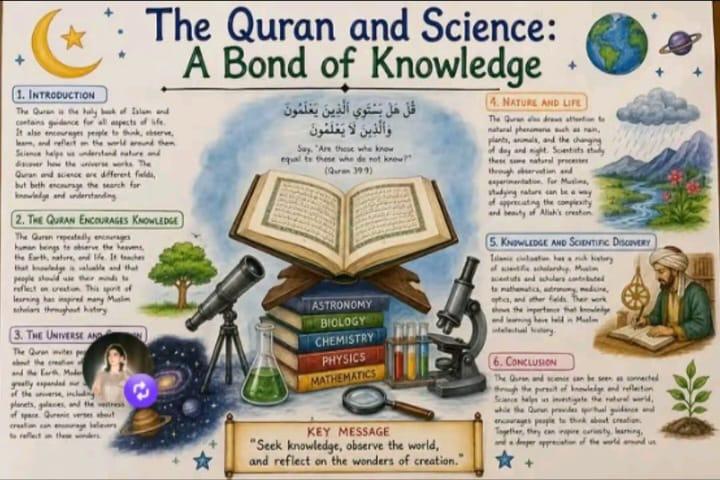
    The Quran and Science: A Bond of Knowledge

    Introduction

    The Quran is the holy book of Islam and contains guidance for all aspects of life. It also encourages people to think, observe, learn, and reflect on the world around them. Science helps us understand nature and discover how the universe works. The Quran and science are different fields, but both encourage the search for knowledge and understanding.

    The Quran Encourages Knowledge

    The Quran repeatedly encourages human beings to observe the heavens, the Earth, nature, and life. It teaches that knowledge is valuable and that people should use their minds to reflect on creation. This spirit of learning has inspired many Muslim scholars throughout history.

    The Universe and Creation

    The Quran invites people to think about the creation of the heavens and the Earth. Modern science has greatly expanded our understanding of the universe, including stars, planets, galaxies, and the vastness of space. Quranic verses about creation can encourage believers to reflect on these wonders.

    Nature and Life

    The Quran also draws attention to natural phenomena such as rain, plants, animals, and the changing of day and night. Scientists study these same natural processes through observation and experimentation. For Muslims, studying nature can be a way of appreciating the complexity and beauty of Allah’s creation.

    Knowledge and Scientific Discovery

    Islamic civilization has a rich history of scientific scholarship. Muslim scientists and scholars contributed to mathematics, astronomy, medicine, optics, and other fields. Their work shows the importance that knowledge and learning have held in Muslim intellectual history.

    Conclusion

    The Quran and science can be seen as connected through the pursuit of knowledge and reflection. Science helps us investigate the natural world, while the Quran provides spiritual guidance and encourages people to think about creation. Together, they can inspire curiosity, learning, and a deeper appreciation of the world around us.
    Mohsin #RSF8🎓✨ #Storypost9 Class: Foundation level 📚 Made by Me 💻🚀 rool no:13 The Quran and Science: A Bond of Knowledge Introduction The Quran is the holy book of Islam and contains guidance for all aspects of life. It also encourages people to think, observe, learn, and reflect on the world around them. Science helps us understand nature and discover how the universe works. The Quran and science are different fields, but both encourage the search for knowledge and understanding. The Quran Encourages Knowledge The Quran repeatedly encourages human beings to observe the heavens, the Earth, nature, and life. It teaches that knowledge is valuable and that people should use their minds to reflect on creation. This spirit of learning has inspired many Muslim scholars throughout history. The Universe and Creation The Quran invites people to think about the creation of the heavens and the Earth. Modern science has greatly expanded our understanding of the universe, including stars, planets, galaxies, and the vastness of space. Quranic verses about creation can encourage believers to reflect on these wonders. Nature and Life The Quran also draws attention to natural phenomena such as rain, plants, animals, and the changing of day and night. Scientists study these same natural processes through observation and experimentation. For Muslims, studying nature can be a way of appreciating the complexity and beauty of Allah’s creation. Knowledge and Scientific Discovery Islamic civilization has a rich history of scientific scholarship. Muslim scientists and scholars contributed to mathematics, astronomy, medicine, optics, and other fields. Their work shows the importance that knowledge and learning have held in Muslim intellectual history. Conclusion The Quran and science can be seen as connected through the pursuit of knowledge and reflection. Science helps us investigate the natural world, while the Quran provides spiritual guidance and encourages people to think about creation. Together, they can inspire curiosity, learning, and a deeper appreciation of the world around us.
    0 Commentarios 0 Acciones 2669 Views
  • #rsisb
    Roll no.239
    Miss Zoya no.4
    Foundation Level

    The **Kaaba** is the most sacred place in Islam and is located in the center of **Masjid al-Haram in Makkah, Saudi Arabia**. Muslims around the world face the Kaaba during their daily prayers, making it the **Qiblah** of Islam. The Kaaba is also the central focus of **Hajj and Umrah**, where Muslims perform Tawaf by walking around it seven times.

    According to Islamic tradition, **Prophet Ibrahim (Abraham) and his son Prophet Ismail (Ishmael)** rebuilt the Kaaba as a house dedicated to the worship of Allah. The Kaaba is covered with a special black cloth called the **Kiswah** and contains the **Black Stone (Hajar al-Aswad)** in one of its corners.

    For Muslims, the Kaaba represents **unity, faith, worship, and devotion to Allah**. Every year, millions of Muslims from different countries and cultures come to Makkah to perform Hajj and Umrah and visit this sacred house.
    #rsisb Roll no.239 Miss Zoya no.4 Foundation Level The **Kaaba** is the most sacred place in Islam and is located in the center of **Masjid al-Haram in Makkah, Saudi Arabia**. Muslims around the world face the Kaaba during their daily prayers, making it the **Qiblah** of Islam. The Kaaba is also the central focus of **Hajj and Umrah**, where Muslims perform Tawaf by walking around it seven times. According to Islamic tradition, **Prophet Ibrahim (Abraham) and his son Prophet Ismail (Ishmael)** rebuilt the Kaaba as a house dedicated to the worship of Allah. The Kaaba is covered with a special black cloth called the **Kiswah** and contains the **Black Stone (Hajar al-Aswad)** in one of its corners. For Muslims, the Kaaba represents **unity, faith, worship, and devotion to Allah**. Every year, millions of Muslims from different countries and cultures come to Makkah to perform Hajj and Umrah and visit this sacred house.
    0 Commentarios 0 Acciones 690 Views 2
Resultados de la búsqueda