• #rsisb
    Roll No.240
    Story No.25
    Foundation Level

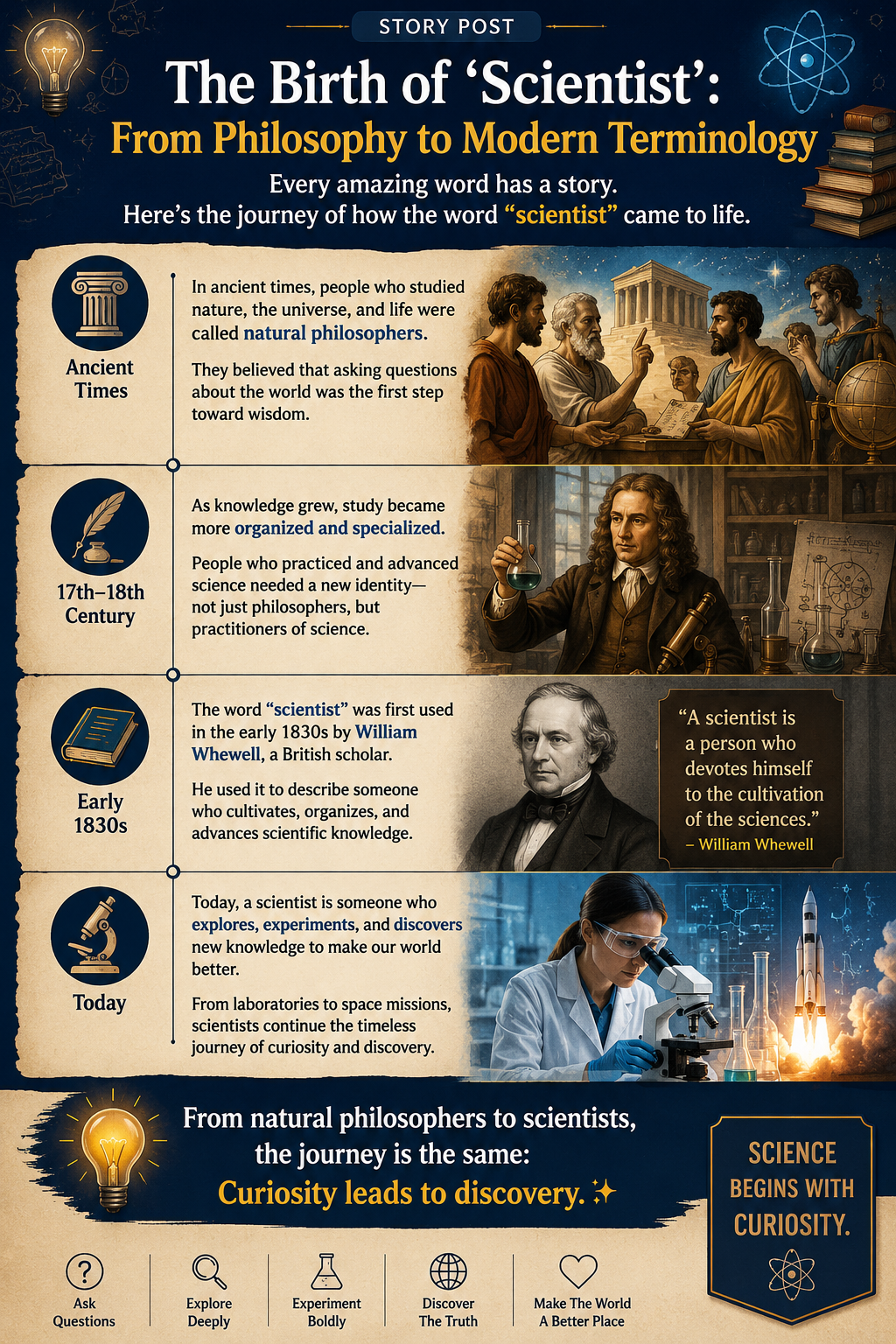
    “Scientist” is a word that represents curiosity, discovery, and the human desire to understand the world.

    Long before the modern term existed, people who studied nature were often called natural philosophers. Over time, scientific thinking became more specialized, and a new word was needed to describe those who practiced science professionally.

    This story explores how the word “scientist” was born, how its meaning evolved, and how it became a familiar part of modern language.

    From asking questions to discovering answers — the journey of science begins with curiosity.

    #Scientist #ScienceHistory #WordOrigins #HistoryOfScience #Philosophy #LanguageEvolution #Curiosity #Discovery #Knowledge #Learning #StoryPost

    Rehan School Islamabad Campus
    Asma Shaheen Eduction Wali
    Irum Asim
    Saima Happines Wali

    #rsisb Roll No.240 Story No.25 Foundation Level 🔬 “Scientist” is a word that represents curiosity, discovery, and the human desire to understand the world. 🌍✨ Long before the modern term existed, people who studied nature were often called natural philosophers. Over time, scientific thinking became more specialized, and a new word was needed to describe those who practiced science professionally. 📖 This story explores how the word “scientist” was born, how its meaning evolved, and how it became a familiar part of modern language. 💡 From asking questions to discovering answers — the journey of science begins with curiosity. #Scientist #ScienceHistory #WordOrigins #HistoryOfScience #Philosophy #LanguageEvolution #Curiosity #Discovery #Knowledge #Learning #StoryPost 🔬🌍📚✨ Rehan School Islamabad Campus Asma Shaheen Eduction Wali Irum Asim Saima Happines Wali
    0 التعليقات 0 المشاركات 1062 مشاهدة
  • #rsisb
    Roll No.240
    Story Post No.24
    Foundation Level

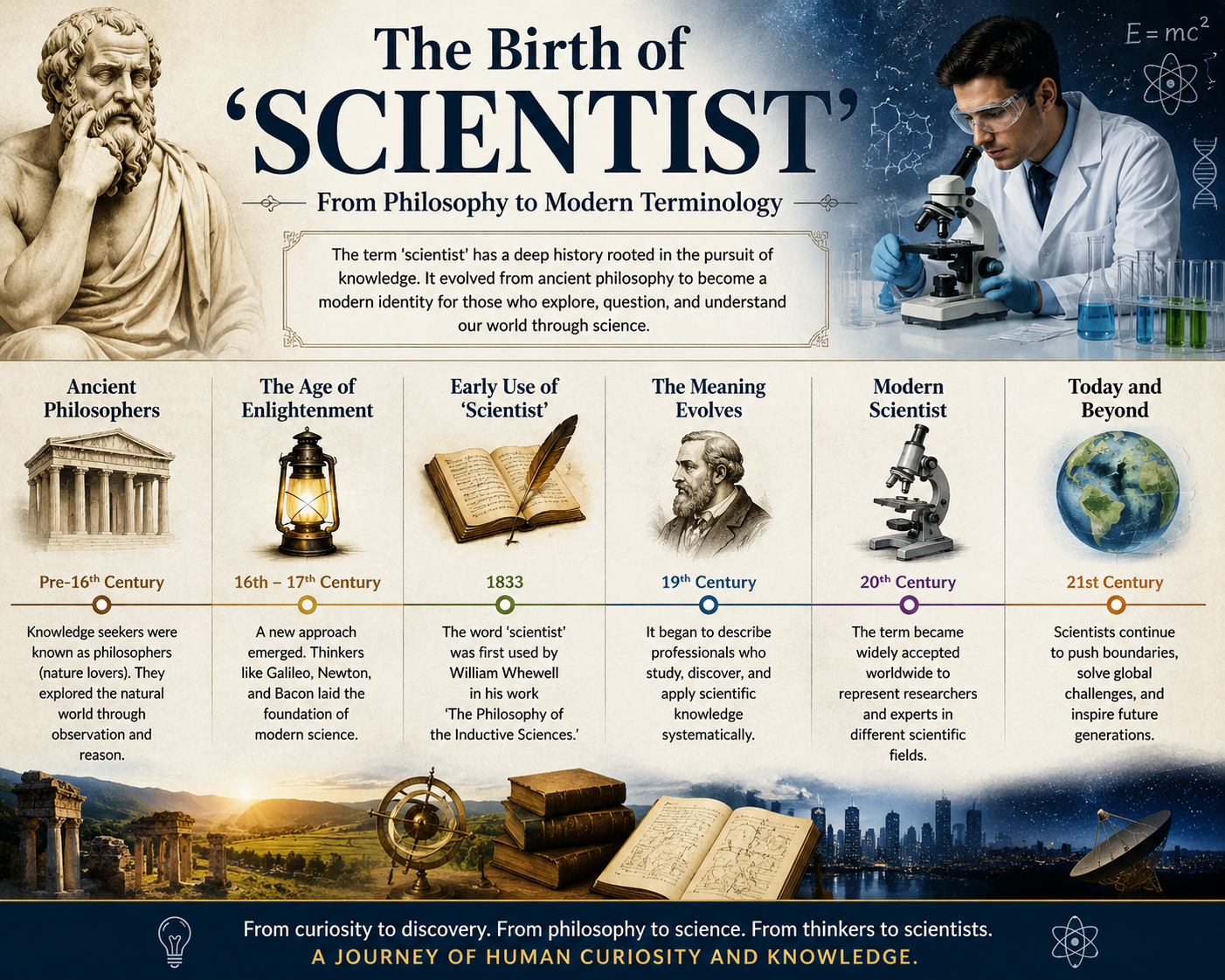
    The word “scientist” may sound like a modern term, but the journey behind it is connected to centuries of human curiosity, philosophy, observation, experimentation, and the search for knowledge.

    Long before the word “scientist” became common, people who studied the natural world were often known as philosophers, scholars, natural philosophers, mathematicians, and thinkers. They asked important questions about nature, the universe, life, matter, motion, and the world around them.

    From the thinkers of the ancient world to the scholars of the Renaissance and the Scientific Revolution, humans continued developing new ways to understand nature. Observation became more important, experiments became more systematic, and evidence gradually became a central part of scientific inquiry.

    During the 18th and 19th centuries, many different branches of knowledge began becoming more specialized. Physics, chemistry, biology, astronomy, geology, and other fields developed their own methods, discoveries, and communities of researchers.

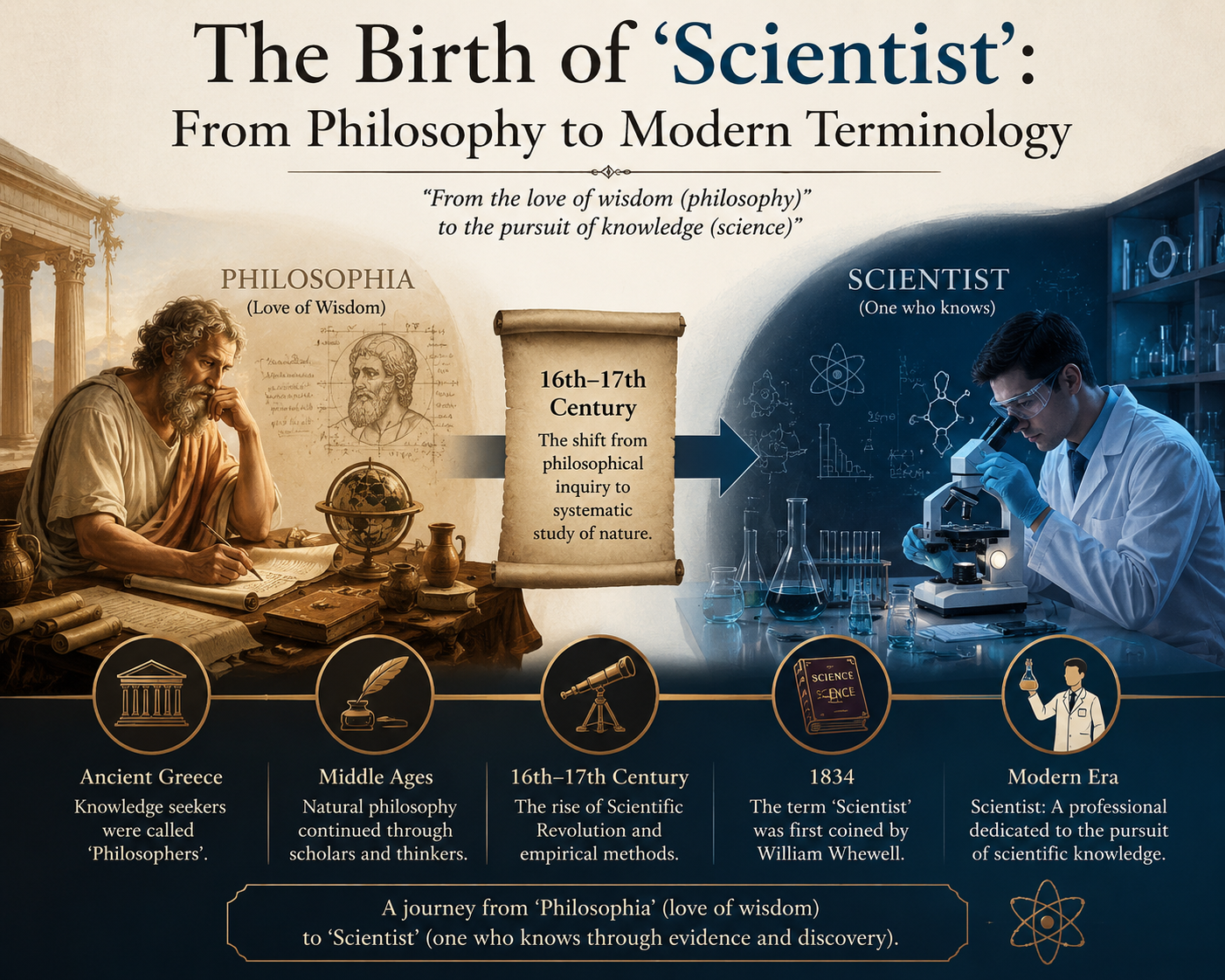
    A major moment in terminology came in the 19th century, when the word “scientist” was introduced as a useful name for people engaged in scientific study. The term is widely associated with William Whewell, who used it in 1833. This helped provide a new, unified word for researchers working across different areas of science.

    The evolution of this word reflects something bigger than language. It represents the changing way humanity organized knowledge and recognized scientific work. The transition from “natural philosopher” to “scientist” shows how science gradually became a distinct and organized field of study.

    Today, scientists work in laboratories, universities, hospitals, observatories, research centers, engineering facilities, and many other places around the world. They investigate everything from tiny cells and molecules to distant galaxies and the origins of the universe.

    Modern science continues to grow through curiosity, evidence, teamwork, technology, and a willingness to ask difficult questions. Every discovery begins with someone wondering, “Why?”, “How?”, or “What if?”

    The story of the word “scientist” reminds us that human knowledge is always evolving. What began with simple curiosity and philosophical questioning gradually developed into the powerful and diverse scientific world we know today.

    From thinkers to researchers. From philosophy to science. From questions to discoveries.

    Science is not only about finding answers—it is also about continuing to ask better questions.

    A journey from curiosity to discovery, and from philosophy to modern science.

    #TheBirthOfScientist #Scientist #HistoryOfScience #ScienceHistory #ScientificRevolution #Philosophy #NaturalPhilosophy #WilliamWhewell #1833 #ModernScience #ScienceEducation #ScientificTerminology #Science #Scientists #Research #Discovery #Curiosity #Knowledge #Learning #Education #STEM #Physics #Chemistry #Biology #Astronomy #Geology #Innovation #Experimentation #ScientificThinking #CriticalThinking #HumanKnowledge #HistoryOfKnowledge #ScienceJourney #FromPhilosophyToScience #ScienceFacts #EducationalContent #LearningJourney #ExploreScience #DiscoverScience

    Rehan School Islamabad Campus
    Asma Shaheen EducationWali
    Irum Asim
    Saima Happinesswali

    #rsisb Roll No.240 Story Post No.24 Foundation Level The word “scientist” may sound like a modern term, but the journey behind it is connected to centuries of human curiosity, philosophy, observation, experimentation, and the search for knowledge. 🧠🔎 Long before the word “scientist” became common, people who studied the natural world were often known as philosophers, scholars, natural philosophers, mathematicians, and thinkers. 🏛️📜 They asked important questions about nature, the universe, life, matter, motion, and the world around them. From the thinkers of the ancient world to the scholars of the Renaissance and the Scientific Revolution, humans continued developing new ways to understand nature. 🌌🌍📖 Observation became more important, experiments became more systematic, and evidence gradually became a central part of scientific inquiry. 🔬🧪✨ During the 18th and 19th centuries, many different branches of knowledge began becoming more specialized. Physics, chemistry, biology, astronomy, geology, and other fields developed their own methods, discoveries, and communities of researchers. 🧬⚗️🌠 A major moment in terminology came in the 19th century, when the word “scientist” was introduced as a useful name for people engaged in scientific study. The term is widely associated with William Whewell, who used it in 1833. 📜🔬 This helped provide a new, unified word for researchers working across different areas of science. The evolution of this word reflects something bigger than language. It represents the changing way humanity organized knowledge and recognized scientific work. 🌟📚 The transition from “natural philosopher” to “scientist” shows how science gradually became a distinct and organized field of study. Today, scientists work in laboratories, universities, hospitals, observatories, research centers, engineering facilities, and many other places around the world. 🌍🧪🔭 They investigate everything from tiny cells and molecules to distant galaxies and the origins of the universe. 🧬🦠🌌 Modern science continues to grow through curiosity, evidence, teamwork, technology, and a willingness to ask difficult questions. 💡🤝🚀 Every discovery begins with someone wondering, “Why?”, “How?”, or “What if?” The story of the word “scientist” reminds us that human knowledge is always evolving. What began with simple curiosity and philosophical questioning gradually developed into the powerful and diverse scientific world we know today. 🌱➡️🔬➡️🌍 ✨ From thinkers to researchers. From philosophy to science. From questions to discoveries. ✨ Science is not only about finding answers—it is also about continuing to ask better questions. 🔎💡 🌟 A journey from curiosity to discovery, and from philosophy to modern science. 🌟 #TheBirthOfScientist #Scientist #HistoryOfScience #ScienceHistory #ScientificRevolution #Philosophy #NaturalPhilosophy #WilliamWhewell #1833 #ModernScience #ScienceEducation #ScientificTerminology #Science #Scientists #Research #Discovery #Curiosity #Knowledge #Learning #Education #STEM #Physics #Chemistry #Biology #Astronomy #Geology #Innovation #Experimentation #ScientificThinking #CriticalThinking #HumanKnowledge #HistoryOfKnowledge #ScienceJourney #FromPhilosophyToScience #ScienceFacts #EducationalContent #LearningJourney #ExploreScience #DiscoverScience 🔬📚🧠🌍✨🔭🧪🚀💡🌟 Rehan School Islamabad Campus Asma Shaheen EducationWali Irum Asim Saima Happinesswali
    0 التعليقات 0 المشاركات 2567 مشاهدة
  • RSISB
    Roll No: 209
    Story Post No. 27

    The Birth of “Scientist”: From Philosophy to Modern Terminology

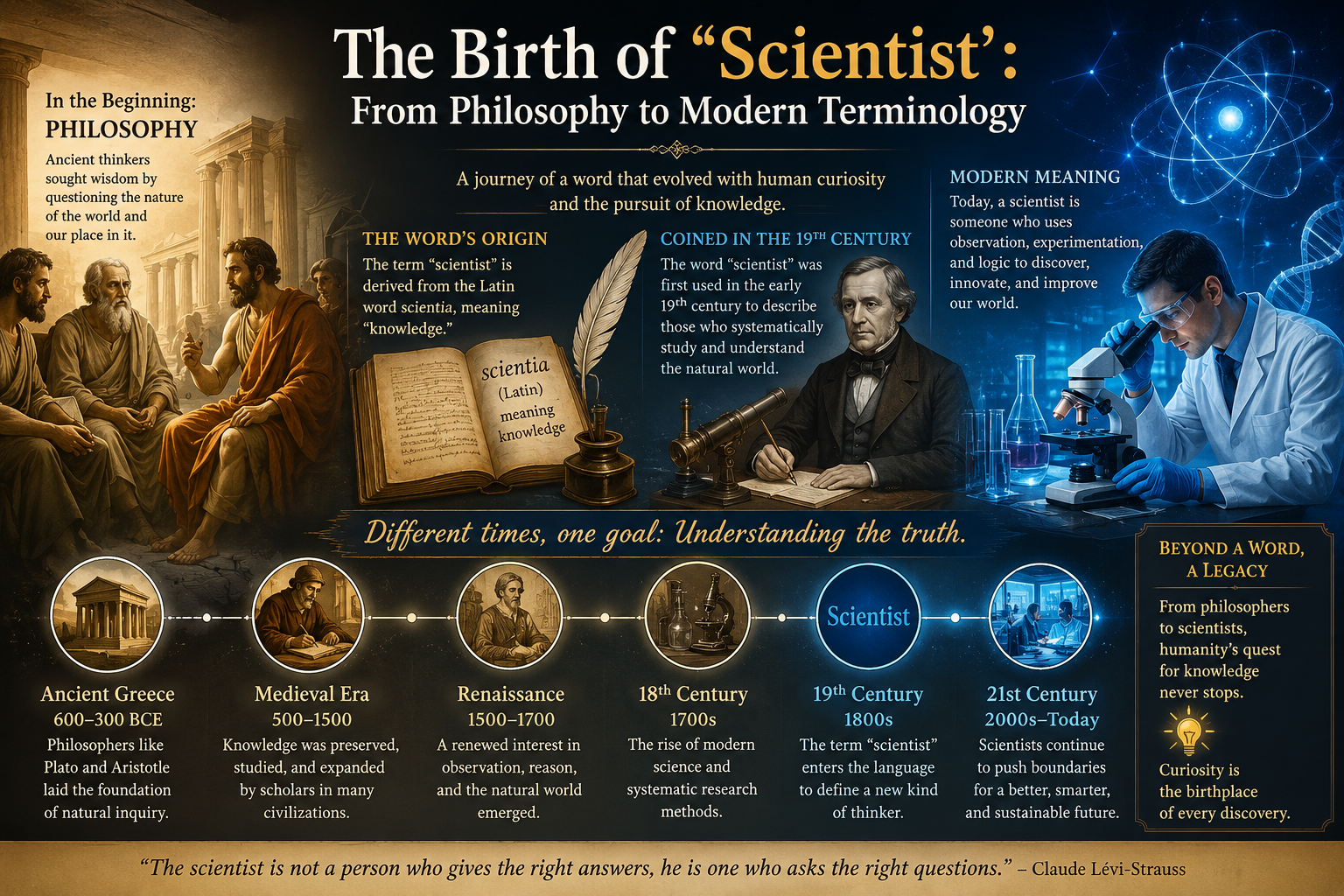
    Have you ever wondered where the word “Scientist” came from? This fascinating journey takes us from the ancient world of philosophy and natural inquiry to the modern age of laboratories, experiments, and scientific discovery.

    For centuries, thinkers explored the mysteries of nature through observation, reasoning, and philosophy. As knowledge and research evolved, a new term was needed to describe people who systematically studied the natural world—and the word “scientist” emerged in the 19th century.

    Today, scientists continue this timeless journey by asking questions, testing ideas, discovering new knowledge, and helping us understand our universe.

    From philosophers seeking wisdom to scientists seeking evidence, the quest for knowledge has never stopped!

    #Scientist #HistoryOfScience #ScienceHistory #Philosophy #ScientificDiscovery #Knowledge #ScienceAndTechnology #NaturalScience #Learning #Education #Curiosity #Innovation #Research #ModernScience #ScienceJourney
    RSISB Roll No: 209 Story Post No. 27 🔬📚 The Birth of “Scientist”: From Philosophy to Modern Terminology 🌍✨ Have you ever wondered where the word “Scientist” came from? 🤔🔎 This fascinating journey takes us from the ancient world of philosophy and natural inquiry to the modern age of laboratories, experiments, and scientific discovery. 🏛️➡️🧪 For centuries, thinkers explored the mysteries of nature through observation, reasoning, and philosophy. As knowledge and research evolved, a new term was needed to describe people who systematically studied the natural world—and the word “scientist” emerged in the 19th century. 💡📖 Today, scientists continue this timeless journey by asking questions, testing ideas, discovering new knowledge, and helping us understand our universe. 🌌🧬🚀 ✨ From philosophers seeking wisdom to scientists seeking evidence, the quest for knowledge has never stopped! 🔬🌟 #Scientist #HistoryOfScience #ScienceHistory #Philosophy #ScientificDiscovery #Knowledge #ScienceAndTechnology #NaturalScience #Learning #Education #Curiosity #Innovation #Research #ModernScience #ScienceJourney 🔬📚🌍✨
    0 التعليقات 0 المشاركات 1774 مشاهدة
  • #rsisb
    roll no.247
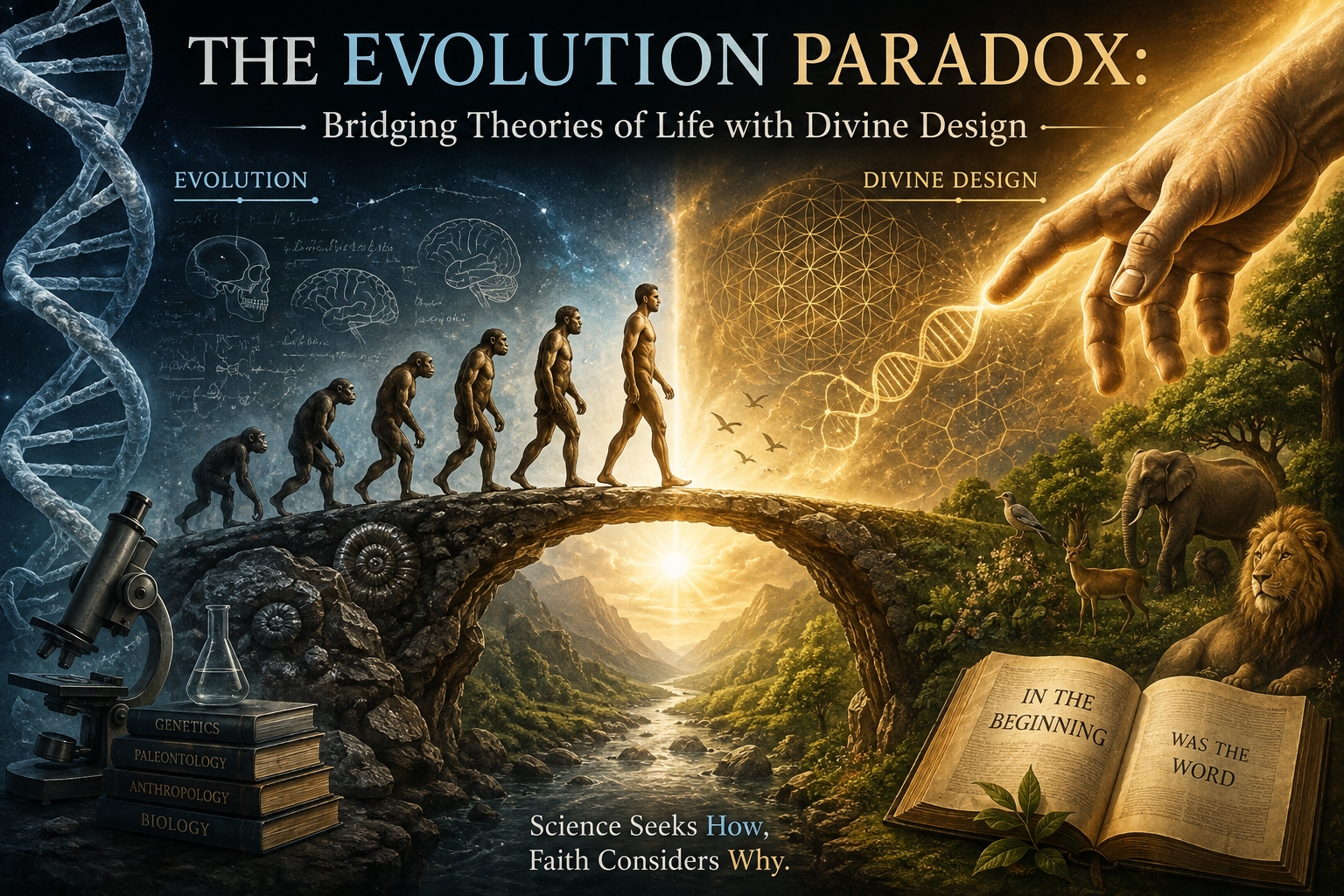
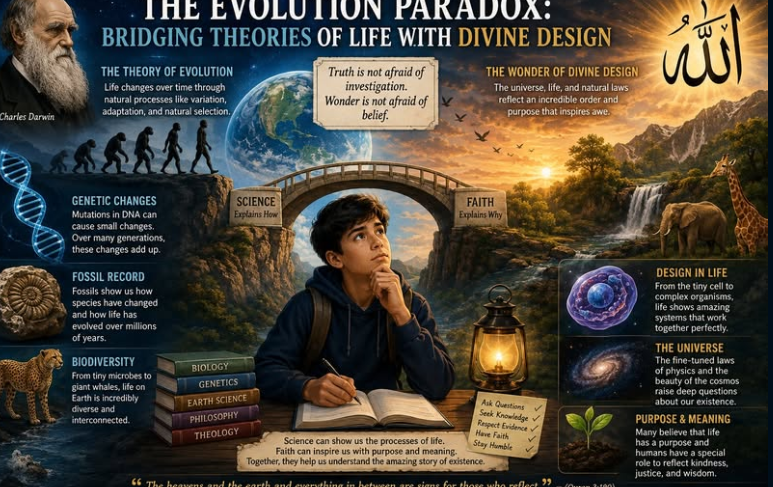
    Foundation level # The Evolution Paradox: Bridging Theories of Life with Divine Design

    The story of life is one of the greatest mysteries ever explored by humanity. From the smallest living cell to the incredible diversity of plants, animals, and human beings, nature presents a fascinating journey filled with questions about **origins, adaptation, complexity, and purpose**.

    **“The Evolution Paradox: Bridging Theories of Life with Divine Design”** explores the thought-provoking relationship between scientific ideas about evolution and philosophical or religious perspectives about creation and divine purpose. Rather than treating these subjects as simple opposites, this topic invites us to think deeply about how different ways of understanding the universe can raise meaningful questions about the same extraordinary reality.

    Evolutionary theory provides a scientific framework for explaining how populations of living organisms change across generations and how biodiversity develops over vast periods of time. Fossils, genetics, comparative anatomy, and observations of living organisms all contribute to our understanding of life's history.

    At the same time, many people look beyond scientific mechanisms and ask questions about **meaning, purpose, consciousness, and why the universe exists at all**. These questions belong not only to laboratories but also to philosophy, theology, and human reflection.

    The fascinating “paradox” arises when we consider how a natural process can be studied scientifically while questions about ultimate purpose remain philosophical or theological. For some people, evolutionary processes and belief in divine creation can coexist: evolution may describe **how biological change occurs**, while faith addresses questions of **meaning and ultimate purpose**.

    This discussion encourages curiosity rather than conflict. It reminds us that science seeks evidence-based explanations for the natural world, while philosophy and religion often explore broader questions about existence and meaning.

    Whether you approach the subject as a scientist, student, philosopher, or person of faith, the study of life encourages one powerful habit: **keep asking questions.** The more we discover about DNA, cells, ecosystems, fossils, and the history of life, the more fascinating the natural world becomes.

    **Life is not only a subject to study—it is a mystery that inspires us to learn, question, discover, and reflect.**

    Let this journey encourage thoughtful conversations between **science, philosophy, and faith**, while respecting the different perspectives people hold.

    #EvolutionParadox #Evolution #DivineDesign #OriginsOfLife #ScienceAndFaith #Biology #Genetics #DNA #LifeScience #NaturalWorld #Science #Philosophy #Theology #Creation #Biodiversity #HumanOrigins #Fossils #Nature #Discovery #Curiosity #Knowledge #Education #CriticalThinking #ExploreScience #MysteriesOfLife #Universe #LifeOnEarth #ScienceEducation #FaithAndScience #DeepQuestions
    #rsisb roll no.247 Foundation level # 🌍🧬 The Evolution Paradox: Bridging Theories of Life with Divine Design ✨🙏 The story of life is one of the greatest mysteries ever explored by humanity. 🌱🔬 From the smallest living cell to the incredible diversity of plants, animals, and human beings, nature presents a fascinating journey filled with questions about **origins, adaptation, complexity, and purpose**. 🧬🌎 **“The Evolution Paradox: Bridging Theories of Life with Divine Design”** explores the thought-provoking relationship between scientific ideas about evolution and philosophical or religious perspectives about creation and divine purpose. 🔬📖✨ Rather than treating these subjects as simple opposites, this topic invites us to think deeply about how different ways of understanding the universe can raise meaningful questions about the same extraordinary reality. 🌌💭 Evolutionary theory provides a scientific framework for explaining how populations of living organisms change across generations and how biodiversity develops over vast periods of time. 🧬🌿 Fossils, genetics, comparative anatomy, and observations of living organisms all contribute to our understanding of life's history. 🔎🦴 At the same time, many people look beyond scientific mechanisms and ask questions about **meaning, purpose, consciousness, and why the universe exists at all**. 🙏🌌 These questions belong not only to laboratories but also to philosophy, theology, and human reflection. 📚💡 The fascinating “paradox” arises when we consider how a natural process can be studied scientifically while questions about ultimate purpose remain philosophical or theological. 🤔✨ For some people, evolutionary processes and belief in divine creation can coexist: evolution may describe **how biological change occurs**, while faith addresses questions of **meaning and ultimate purpose**. 🌱🙏 This discussion encourages curiosity rather than conflict. It reminds us that science seeks evidence-based explanations for the natural world, while philosophy and religion often explore broader questions about existence and meaning. 🔬📖🌍 Whether you approach the subject as a scientist, student, philosopher, or person of faith, the study of life encourages one powerful habit: **keep asking questions.** ❓🧠✨ The more we discover about DNA, cells, ecosystems, fossils, and the history of life, the more fascinating the natural world becomes. 🧬🔬🌿 🌟 **Life is not only a subject to study—it is a mystery that inspires us to learn, question, discover, and reflect.** 🌟 Let this journey encourage thoughtful conversations between **science, philosophy, and faith**, while respecting the different perspectives people hold. 🤝🌎💫 #EvolutionParadox #Evolution #DivineDesign #OriginsOfLife #ScienceAndFaith #Biology #Genetics #DNA #LifeScience #NaturalWorld #Science #Philosophy #Theology #Creation #Biodiversity #HumanOrigins #Fossils #Nature #Discovery #Curiosity #Knowledge #Education #CriticalThinking #ExploreScience #MysteriesOfLife #Universe #LifeOnEarth #ScienceEducation #FaithAndScience #DeepQuestions 🧬🌍🔬
    0 التعليقات 0 المشاركات 5214 مشاهدة
  • The Birth of "Scientist": From Philosophy to Modern Terminology

    The word "Scientist" has a fascinating history that reflects the evolution of human knowledge and discovery. Before the modern scientific world existed, people who studied nature were often known as philosophers, natural philosophers, scholars, or thinkers. Over time, the search for knowledge became more specialized, leading to the birth of the term "scientist."

    In this fascinating topic, we explore how the word "scientist" emerged and how its meaning developed alongside the growth of modern science. Discover how curiosity, observation, experimentation, and critical thinking transformed the way humanity understands the world around us.

    From ancient thinkers to today's researchers and innovators , the journey of the word "scientist" tells a powerful story about our endless desire to question, discover, and understand.

    Join us on this exciting journey through the history of science and language, and discover how one word came to represent the people who continue to expand the boundaries of human knowledge!

    #Scientist #HistoryOfScience #WordHistory #Etymology #Science #Philosophy #ScientificRevolution #ModernScience #Scientists #Knowledge #Discovery #Curiosity #CriticalThinking #Education #Learning #Innovation #Research #Language #Linguistics #HumanKnowledge


    RSISB
    Roll No:#209
    Story Post No.26
    🔬📚 The Birth of "Scientist": From Philosophy to Modern Terminology 🌍✨ The word "Scientist" has a fascinating history that reflects the evolution of human knowledge and discovery. 🧠💡 Before the modern scientific world existed, people who studied nature were often known as philosophers, natural philosophers, scholars, or thinkers. Over time, the search for knowledge became more specialized, leading to the birth of the term "scientist." 🔬🌟 In this fascinating topic, we explore how the word "scientist" emerged and how its meaning developed alongside the growth of modern science. 📖🕰️ Discover how curiosity, observation, experimentation, and critical thinking transformed the way humanity understands the world around us. 🌎🔍 From ancient thinkers to today's researchers and innovators 🚀, the journey of the word "scientist" tells a powerful story about our endless desire to question, discover, and understand. 💭✨ 💬 Join us on this exciting journey through the history of science and language, and discover how one word came to represent the people who continue to expand the boundaries of human knowledge! 🌟🔬 #Scientist #HistoryOfScience #WordHistory #Etymology #Science #Philosophy #ScientificRevolution #ModernScience #Scientists #Knowledge #Discovery #Curiosity #CriticalThinking #Education #Learning #Innovation #Research #Language #Linguistics #HumanKnowledge 🔬📚🧠💡🌍✨🕰️🔍🚀🌟📖💭🌎🧪👏 RSISB Roll No:#209 Story Post No.26
    0 التعليقات 0 المشاركات 3368 مشاهدة
  • #rsisb
    Roll no.239
    Foundation Level

    **“The Evolution Paradox: Bridging Theories of Life with Divine Design”** explores one of the most fascinating questions about life: how can scientific explanations of evolution be understood alongside beliefs about divine creation?

    Evolution explains the diversity of life through processes such as **genetic variation, natural selection, mutation, and adaptation** over long periods of time. It provides a scientific framework for understanding how populations change and how different species have developed throughout Earth's history.

    Divine design, on the other hand, is a theological and philosophical idea that life and the universe have purpose or ultimately originate from a divine source. Different religious traditions interpret creation and humanity's place in the universe in different ways.

    The apparent “paradox” arises when people view scientific explanations and religious beliefs as necessarily competing explanations. However, some people see them as addressing different kinds of questions. Science primarily investigates **how natural processes occur**, while theology and philosophy may explore questions about **meaning, purpose, and ultimate origins**.

    The relationship between evolution and divine belief remains a subject of thoughtful discussion among scientists, philosophers, and religious thinkers. Some religious traditions accept evolutionary science, while others interpret creation in different ways.

    Ultimately, the topic encourages us to think deeply about **science, faith, human origins, and our understanding of life**. It shows that asking questions and examining different perspectives can help us develop a richer understanding of the world around us.
    #rsisb Roll no.239 Foundation Level **“The Evolution Paradox: Bridging Theories of Life with Divine Design”** explores one of the most fascinating questions about life: how can scientific explanations of evolution be understood alongside beliefs about divine creation? Evolution explains the diversity of life through processes such as **genetic variation, natural selection, mutation, and adaptation** over long periods of time. It provides a scientific framework for understanding how populations change and how different species have developed throughout Earth's history. Divine design, on the other hand, is a theological and philosophical idea that life and the universe have purpose or ultimately originate from a divine source. Different religious traditions interpret creation and humanity's place in the universe in different ways. The apparent “paradox” arises when people view scientific explanations and religious beliefs as necessarily competing explanations. However, some people see them as addressing different kinds of questions. Science primarily investigates **how natural processes occur**, while theology and philosophy may explore questions about **meaning, purpose, and ultimate origins**. The relationship between evolution and divine belief remains a subject of thoughtful discussion among scientists, philosophers, and religious thinkers. Some religious traditions accept evolutionary science, while others interpret creation in different ways. Ultimately, the topic encourages us to think deeply about **science, faith, human origins, and our understanding of life**. It shows that asking questions and examining different perspectives can help us develop a richer understanding of the world around us.
    0 التعليقات 0 المشاركات 2357 مشاهدة
  • #rsisb
    Roll No.240
    Story No.11
    Foundation Level

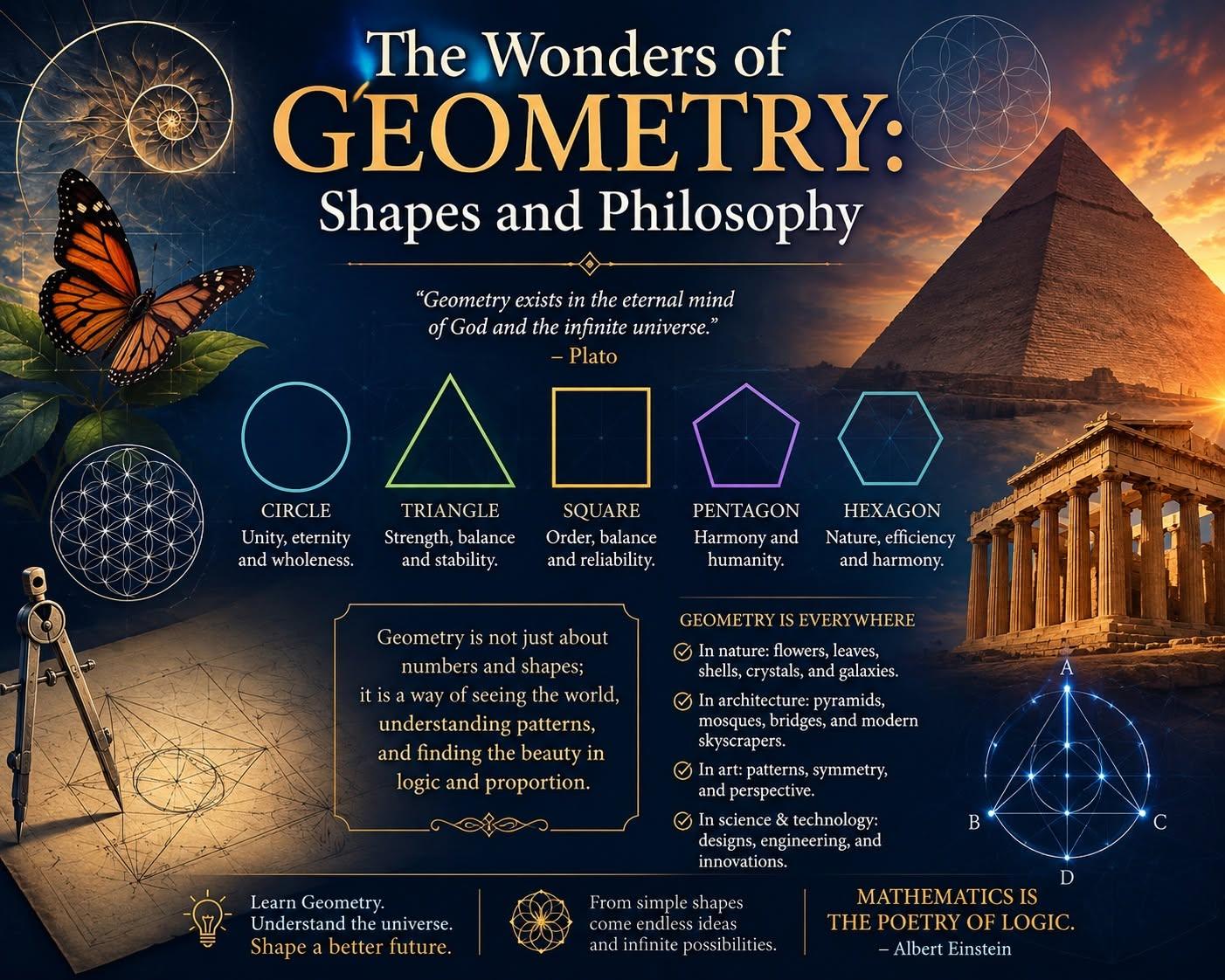
    # The Wonders of Geometry: Shapes and Philosophy

    Geometry is far more than a branch of mathematics—it is a language that describes the beauty, balance, and structure of the world around us. From the symmetry of a butterfly's wings to the towering pyramids of Egypt, geometric shapes are found everywhere in nature, architecture, art, and technology. Circles represent unity and infinity, triangles symbolize strength and stability, while squares and rectangles reflect order, balance, and reliability. These timeless shapes help us understand space, design, and the hidden patterns that shape our universe.

    Beyond calculations and formulas, geometry also carries a deep philosophical meaning. Ancient philosophers believed that geometric forms reflected the harmony and perfection of creation. Studying shapes encourages logical thinking, creativity, and problem-solving while inspiring us to see the connections between mathematics, nature, and human life. Whether you're exploring basic polygons or the mysteries of symmetry, geometry reminds us that beauty and knowledge often share the same foundation. Discover the fascinating world of shapes and uncover the philosophy that has inspired scientists, artists, architects, and thinkers for centuries.

    Rehan School Islamabad Campus
    Asma Shaheen EducationWali
    Irum Asim
    Saima Happinesswali
    #rsisb Roll No.240 Story No.11 Foundation Level # The Wonders of Geometry: Shapes and Philosophy Geometry is far more than a branch of mathematics—it is a language that describes the beauty, balance, and structure of the world around us. From the symmetry of a butterfly's wings to the towering pyramids of Egypt, geometric shapes are found everywhere in nature, architecture, art, and technology. Circles represent unity and infinity, triangles symbolize strength and stability, while squares and rectangles reflect order, balance, and reliability. These timeless shapes help us understand space, design, and the hidden patterns that shape our universe. Beyond calculations and formulas, geometry also carries a deep philosophical meaning. Ancient philosophers believed that geometric forms reflected the harmony and perfection of creation. Studying shapes encourages logical thinking, creativity, and problem-solving while inspiring us to see the connections between mathematics, nature, and human life. Whether you're exploring basic polygons or the mysteries of symmetry, geometry reminds us that beauty and knowledge often share the same foundation. Discover the fascinating world of shapes and uncover the philosophy that has inspired scientists, artists, architects, and thinkers for centuries. Rehan School Islamabad Campus Asma Shaheen EducationWali Irum Asim Saima Happinesswali
    0 التعليقات 0 المشاركات 4164 مشاهدة
  • The world will not become right till Philosophers become kings or Kings become Philosophers ! - Plato
    The world will not become right till Philosophers become kings or Kings become Philosophers ! - Plato
    0 التعليقات 0 المشاركات 685 مشاهدة
  • Socrates, 399 BC

    On a day in 399 BC the philosopher Socrates stood before a jury of 500 of his fellow Athenians accused of "refusing to recognize the gods recognized by the state" and of "corrupting the youth." If found guilty; his penalty could be death. The trial took place in the heart of the city, the jurors seated on wooden benches surrounded by a crowd of spectators. Socrates accusers (three Athenian citizens) were allotted three hours to present their case, after which, the philosopher would have three hours to defend himself.

    Socrates
    Socrates was 70 years old and familiar to most Athenians. His anti-democratic views had turned many in the city against him. Two of his students, Alcibiades and Critias, had twice briefly overthrown the democratic government of the city, instituting a reign of terror in which thousands of citizens were deprived of their property and either banished from the city or executed.

    After hearing the arguments of both Socrates and his accusers, the jury was asked to vote on his guilt. Under Athenian law the jurors did not deliberate the point. Instead, each juror registered his judgment by placing a small disk into an urn marked either "guilty" or "not guilty." Socrates was found guilty by a vote of 280 to 220.

    The jurors were next asked to determine Socrates penalty. His accusers argued for the death penalty. Socrates was given the opportunity to suggest his own punishment and could probably have avoided death by recommending exile. Instead, the philosopher initially offered the sarcastic recommendation that he be rewarded for his actions. When pressed for a realistic punishment, he proposed that he be fined a modest sum of money. Faced with the two choices, the jury selected death for Socrates.

    The philosopher was taken to the near-by jail where his sentence would be carried out. Athenian law prescribed death by drinking a cup of poison hemlock. Socrates would be his own executioner.

    "What must I do?"

    Plato was Socrates most famous student. Although he was not present at his mentors death, he did know those who were there. Plato describes the scene through the narrative voice of the fictional character Phaedo.

    "When Crito heard, he signaled to the slave who was standing by. The boy went out, and returned after a few moments with the man who was to administer the poison which he brought ready mixed in a cup. When Socrates saw him, he said, Now, good sir, you understand these things. What must I do?

    Just drink it and walk around until your legs begin to feel heavy, then lie down. It will soon act. With that he offered Socrates the cup.

    The latter took it quite cheerfully without a tremor, with no change of color or expression. He just gave the man his stolid look, and asked, How say you, is it permissible to pledge this drink to anyone? May I?

    The answer came, We allow reasonable time in which to drink it.

    I understand, he said, we can and must pray to the gods that our sojourn on earth will continue happy beyond the grave. This is my prayer, and may it come to pass. With these words, he stoically drank the potion, quite readily and cheerfully. Up till this moment most of us were able with some decency to hold back our tears, but when we saw him drinking the poison to the last drop, we could restrain ourselves no longer. In spite of myself, the tears came in floods, so that I covered my face and wept - not for him, but at my own misfortune at losing such a man as my friend. Crito, even before me, rose and went out when he could check his tears no longer.

    Apollodorus was already steadily weeping, and by drying his eyes, crying again and sobbing, he affected everyone present except for Socrates himself.

    He said, You are strange fellows; what is wrong with you? I sent the women away for this very purpose, to stop their creating such a scene. I have heard that one should die in silence. So please be quiet and keep control of yourselves. These words made us ashamed, and we stopped crying.

    Jacques-Louis David, 1787
    The Death of Socrates

    Socrates walked around until he said that his legs were becoming heavy, when he lay on his back, as the attendant instructed. This fellow felt him, and then a moment later examined his feet and legs again. Squeezing a foot hard, he asked him if he felt anything. Socrates said that he did not. He did the same to his calves and, going higher, showed us that he was becoming cold and stiff. Then he felt him a last time and said that when the poison reached the heart he would be gone.

    As the chill sensation got to his waist, Socrates uncovered his head (he had put something over it) and said his last words: Crito, we owe a cock to Asclepius. Do pay it. Dont forget.

    Of course, said Crito. Do you want to say anything else?

    There was no reply to this question, but after a while he gave a slight stir, and the attendant uncovered him and examined his eyes. Then Crito saw that he was dead, he closed his mouth and eyelids.

    This was the end of our friend, the best, wisest and most upright man of any that I have ever known"

    References:
    Platos description appears in: Tredennick, Hugh (translator)The last days of Socrates : Euthyphro, The apology, Crito, Phaedo / Plato (1959); Freeman, Charles, The Greek Achievement (1999); Stone, I.F., The Trial of Socrates (1988).

    Socrates, 399 BC On a day in 399 BC the philosopher Socrates stood before a jury of 500 of his fellow Athenians accused of "refusing to recognize the gods recognized by the state" and of "corrupting the youth." If found guilty; his penalty could be death. The trial took place in the heart of the city, the jurors seated on wooden benches surrounded by a crowd of spectators. Socrates' accusers (three Athenian citizens) were allotted three hours to present their case, after which, the philosopher would have three hours to defend himself. Socrates Socrates was 70 years old and familiar to most Athenians. His anti-democratic views had turned many in the city against him. Two of his students, Alcibiades and Critias, had twice briefly overthrown the democratic government of the city, instituting a reign of terror in which thousands of citizens were deprived of their property and either banished from the city or executed. After hearing the arguments of both Socrates and his accusers, the jury was asked to vote on his guilt. Under Athenian law the jurors did not deliberate the point. Instead, each juror registered his judgment by placing a small disk into an urn marked either "guilty" or "not guilty." Socrates was found guilty by a vote of 280 to 220. The jurors were next asked to determine Socrates' penalty. His accusers argued for the death penalty. Socrates was given the opportunity to suggest his own punishment and could probably have avoided death by recommending exile. Instead, the philosopher initially offered the sarcastic recommendation that he be rewarded for his actions. When pressed for a realistic punishment, he proposed that he be fined a modest sum of money. Faced with the two choices, the jury selected death for Socrates. The philosopher was taken to the near-by jail where his sentence would be carried out. Athenian law prescribed death by drinking a cup of poison hemlock. Socrates would be his own executioner. "What must I do?" Plato was Socrates' most famous student. Although he was not present at his mentor's death, he did know those who were there. Plato describes the scene through the narrative voice of the fictional character Phaedo. "When Crito heard, he signaled to the slave who was standing by. The boy went out, and returned after a few moments with the man who was to administer the poison which he brought ready mixed in a cup. When Socrates saw him, he said, 'Now, good sir, you understand these things. What must I do?' 'Just drink it and walk around until your legs begin to feel heavy, then lie down. It will soon act.' With that he offered Socrates the cup. The latter took it quite cheerfully without a tremor, with no change of color or expression. He just gave the man his stolid look, and asked, 'How say you, is it permissible to pledge this drink to anyone? May I?' The answer came, 'We allow reasonable time in which to drink it.' 'I understand', he said, 'we can and must pray to the gods that our sojourn on earth will continue happy beyond the grave. This is my prayer, and may it come to pass.' With these words, he stoically drank the potion, quite readily and cheerfully. Up till this moment most of us were able with some decency to hold back our tears, but when we saw him drinking the poison to the last drop, we could restrain ourselves no longer. In spite of myself, the tears came in floods, so that I covered my face and wept - not for him, but at my own misfortune at losing such a man as my friend. Crito, even before me, rose and went out when he could check his tears no longer. Apollodorus was already steadily weeping, and by drying his eyes, crying again and sobbing, he affected everyone present except for Socrates himself. He said, 'You are strange fellows; what is wrong with you? I sent the women away for this very purpose, to stop their creating such a scene. I have heard that one should die in silence. So please be quiet and keep control of yourselves.' These words made us ashamed, and we stopped crying. Jacques-Louis David, 1787 The Death of Socrates Socrates walked around until he said that his legs were becoming heavy, when he lay on his back, as the attendant instructed. This fellow felt him, and then a moment later examined his feet and legs again. Squeezing a foot hard, he asked him if he felt anything. Socrates said that he did not. He did the same to his calves and, going higher, showed us that he was becoming cold and stiff. Then he felt him a last time and said that when the poison reached the heart he would be gone. As the chill sensation got to his waist, Socrates uncovered his head (he had put something over it) and said his last words: 'Crito, we owe a cock to Asclepius. Do pay it. Don't forget.' 'Of course', said Crito. 'Do you want to say anything else?' 'There was no reply to this question, but after a while he gave a slight stir, and the attendant uncovered him and examined his eyes. Then Crito saw that he was dead, he closed his mouth and eyelids. This was the end of our friend, the best, wisest and most upright man of any that I have ever known" References: Plato's description appears in: Tredennick, Hugh (translator)The last days of Socrates : Euthyphro, The apology, Crito, Phaedo / Plato (1959); Freeman, Charles, The Greek Achievement (1999); Stone, I.F., The Trial of Socrates (1988).

    0 التعليقات 0 المشاركات 2898 مشاهدة
  • John Perry Barlow, song-writer (lyricist for The Grateful Dead), philosopher and activist, wrote the Principle of Adult Behavior as standard code of conduct when he was 30 years old.

    1. Be patient. No matter what.
    2. Don’t badmouth: Assign responsibility, not blame. Say nothing of another you wouldn’t say to him.
    3. Never assume the motives of others are, to them, less noble than yours are to you.
    4. Expand your sense of the possible.
    5. Don’t trouble yourself with matters you truly cannot change.
    6. Expect no more of anyone than you can deliver yourself.
    7. Tolerate ambiguity.
    8. Laugh at yourself frequently.
    9. Concern yourself with what is right rather than who is right.
    10. Never forget that, no matter how certain, you might be wrong.
    11. Give up blood sports.
    12. Remember that your life belongs to others as well. Don’t risk it frivolously.
    13. Never lie to anyone for any reason. (Lies of omission are sometimes exempt.)
    14. Learn the needs of those around you and respect them.
    15. Avoid the pursuit of happiness. Seek to define your mission and pursue that.
    16. Reduce your use of the first personal pronoun.
    17. Praise at least as often as you disparage.
    18. Admit your errors freely and soon.
    19. Become less suspicious of joy.
    20. Understand humility.
    21. Remember that love forgives everything.
    22. Foster dignity.
    23. Live memorably.
    24. Love yourself.
    25. Endure.

    HOW MANY OF THESE RULES DO YOU STRIVE TO LIVE BY?
    John Perry Barlow, song-writer (lyricist for The Grateful Dead), philosopher and activist, wrote the Principle of Adult Behavior as standard code of conduct when he was 30 years old. 1. Be patient. No matter what. 2. Don’t badmouth: Assign responsibility, not blame. Say nothing of another you wouldn’t say to him. 3. Never assume the motives of others are, to them, less noble than yours are to you. 4. Expand your sense of the possible. 5. Don’t trouble yourself with matters you truly cannot change. 6. Expect no more of anyone than you can deliver yourself. 7. Tolerate ambiguity. 8. Laugh at yourself frequently. 9. Concern yourself with what is right rather than who is right. 10. Never forget that, no matter how certain, you might be wrong. 11. Give up blood sports. 12. Remember that your life belongs to others as well. Don’t risk it frivolously. 13. Never lie to anyone for any reason. (Lies of omission are sometimes exempt.) 14. Learn the needs of those around you and respect them. 15. Avoid the pursuit of happiness. Seek to define your mission and pursue that. 16. Reduce your use of the first personal pronoun. 17. Praise at least as often as you disparage. 18. Admit your errors freely and soon. 19. Become less suspicious of joy. 20. Understand humility. 21. Remember that love forgives everything. 22. Foster dignity. 23. Live memorably. 24. Love yourself. 25. Endure. HOW MANY OF THESE RULES DO YOU STRIVE TO LIVE BY?
    0 التعليقات 0 المشاركات 884 مشاهدة
الصفحات المعززة