• #rsisb
    Roll no.247
    story post . 11
    Foundation level

    **How Did Trade Routes Shape the History of the World? **

    **Discover the Incredible Story of Trade Routes!**

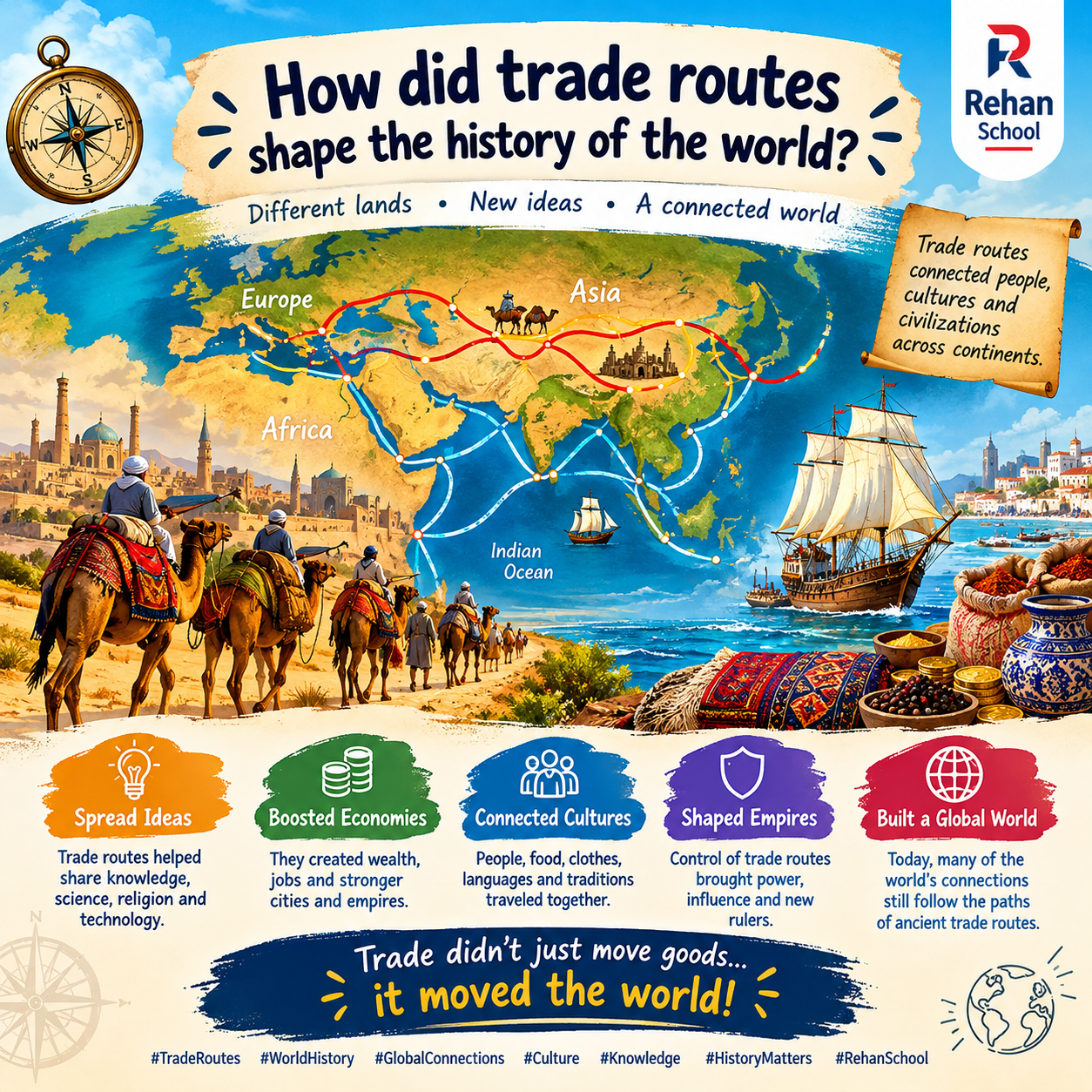
    Have you ever wondered how people from different parts of the world shared their goods, ideas, cultures, and knowledge hundreds or even thousands of years ago? Long before airplanes, cars, and modern technology, trade routes connected distant civilizations and helped shape the world we live in today!

    Trade routes were pathways that allowed merchants, travelers, and explorers to transport valuable goods from one region to another. These routes crossed deserts, mountains, rivers, and oceans, connecting Asia, Africa, Europe, and other parts of the world.

    **1. The Famous Silk Road **

    The Silk Road was one of the most famous trading networks in history. It connected China with Central Asia, the Middle East, and Europe. Merchants transported silk, spices, precious stones, ceramics, and other valuable products. But the Silk Road was about much more than goods! It also helped spread religions, scientific knowledge, artistic traditions, and cultural ideas between civilizations.

    **2. Maritime Trade Routes **

    Sea routes allowed traders to transport goods across oceans and along coastlines. Ships carried spices, textiles, tea, porcelain, and many other products between distant ports. The Indian Ocean became an important center of international trade, connecting merchants from East Africa, Arabia, India, Southeast Asia, and China.

    **3. The Spice Trade 🫚**

    Spices such as pepper, cinnamon, cloves, and nutmeg were highly valued in many parts of the world. Their demand encouraged merchants to travel long distances and helped develop important trading cities and ports. The search for new sources of spices also encouraged European maritime exploration, changing global connections and history.

    **4. The Rise of Cities and Empires **

    Trade routes helped cities grow into busy centers of commerce, learning, and culture. Merchants, craftspeople, and travelers brought wealth and new opportunities to trading centers. Governments and empires also gained influence by controlling important roads, ports, and markets.

    **5. The Exchange of Ideas and Knowledge **

    One of the greatest contributions of trade routes was the exchange of knowledge. Mathematics, astronomy, medicine, inventions, languages, and artistic styles traveled with merchants and scholars. People learned from one another, developed new skills, and expanded their understanding of the world.

    **6. The Sharing of Food and Culture **

    Trade helped introduce new foods, ingredients, clothing styles, artistic traditions, and customs to different societies. Over time, these exchanges influenced local cuisines, languages, architecture, and everyday life. The cultures of the world became connected in countless ways!

    **7. Trade Routes Had Challenges Too **

    Travel along trade routes was not always easy. Merchants faced dangerous weather, difficult landscapes, bandits, political conflicts, and long journeys. Trade could also contribute to the spread of diseases, while some trading systems were connected to conquest, exploitation, and slavery. Understanding these challenges helps us learn about both the achievements and the painful realities of history.

    **8. From Ancient Roads to Modern Global Trade **

    Today, goods move around the world through highways, railways, cargo ships, and airplanes. Modern trade networks are far more advanced, but they continue the same basic idea: connecting people, places, and markets. The ancient trade routes helped establish many of the connections that later shaped our interconnected world.

    **What Can We Learn from Trade Routes?**

    Trade routes teach us that no civilization developed completely on its own. People have always learned, exchanged ideas, explored new places, and depended on connections with others. History reminds us that cooperation, curiosity, and cultural exchange can transform societies and influence future generations.

    **Final Thought:** Trade routes were more than paths for transporting goods. They were bridges between civilizations, carrying stories, discoveries, beliefs, technologies, and traditions across the world. Their legacy continues to influence our lives today!

    **Question for You:** If you could travel along one ancient trade route, would you choose the Silk Road or the Indian Ocean trade routes? Why? Tell us in the comments!

    Like, share, and follow for more fascinating stories about history, geography, science, and the world around us!

    #TradeRoutes #HistoryOfTheWorld #SilkRoad #AncientHistory #WorldHistory #IndianOceanTrade #SpiceTrade #HistoryFacts #DidYouKnow #EducationalContent #LearningIsFun #ExploreHistory #CulturalExchange #AncientCivilizations #Geography #GlobalTrade #HistoryLovers #KnowledgeIsPower #WorldCultures #StoryPost #Education #DiscoverThePast #ExploreTheWorld #LearnSomethingNew #SocialMediaPost
    #rsisb Roll no.247 story post . 11 Foundation level 🌍✨ **How Did Trade Routes Shape the History of the World? 🚢🐪** 📜🌏 **Discover the Incredible Story of Trade Routes!** 🌏📜 Have you ever wondered how people from different parts of the world shared their goods, ideas, cultures, and knowledge hundreds or even thousands of years ago? 🤔✨ Long before airplanes, cars, and modern technology, trade routes connected distant civilizations and helped shape the world we live in today! 🌎🚢🐪 Trade routes were pathways that allowed merchants, travelers, and explorers to transport valuable goods from one region to another. These routes crossed deserts, mountains, rivers, and oceans, connecting Asia, Africa, Europe, and other parts of the world. 🏜️⛰️🌊 🐪 **1. The Famous Silk Road 🧵🏮** The Silk Road was one of the most famous trading networks in history. It connected China with Central Asia, the Middle East, and Europe. Merchants transported silk, spices, precious stones, ceramics, and other valuable products. 🎎🧵💎 But the Silk Road was about much more than goods! It also helped spread religions, scientific knowledge, artistic traditions, and cultural ideas between civilizations. 📚🕌🎨 🌊 **2. Maritime Trade Routes 🚢⚓** Sea routes allowed traders to transport goods across oceans and along coastlines. Ships carried spices, textiles, tea, porcelain, and many other products between distant ports. The Indian Ocean became an important center of international trade, connecting merchants from East Africa, Arabia, India, Southeast Asia, and China. 🌴🌏⛵ 🌶️ **3. The Spice Trade 🌶️🫚** Spices such as pepper, cinnamon, cloves, and nutmeg were highly valued in many parts of the world. Their demand encouraged merchants to travel long distances and helped develop important trading cities and ports. The search for new sources of spices also encouraged European maritime exploration, changing global connections and history. 🗺️⛵✨ 🏙️ **4. The Rise of Cities and Empires 🏛️👑** Trade routes helped cities grow into busy centers of commerce, learning, and culture. Merchants, craftspeople, and travelers brought wealth and new opportunities to trading centers. Governments and empires also gained influence by controlling important roads, ports, and markets. 💰🏙️📈 📚 **5. The Exchange of Ideas and Knowledge 🧠🔬** One of the greatest contributions of trade routes was the exchange of knowledge. Mathematics, astronomy, medicine, inventions, languages, and artistic styles traveled with merchants and scholars. People learned from one another, developed new skills, and expanded their understanding of the world. 🌟📖🌍 🍲 **6. The Sharing of Food and Culture 🎭🍇** Trade helped introduce new foods, ingredients, clothing styles, artistic traditions, and customs to different societies. Over time, these exchanges influenced local cuisines, languages, architecture, and everyday life. The cultures of the world became connected in countless ways! 🌮🍜🎨 ⚖️ **7. Trade Routes Had Challenges Too ⛈️** Travel along trade routes was not always easy. Merchants faced dangerous weather, difficult landscapes, bandits, political conflicts, and long journeys. Trade could also contribute to the spread of diseases, while some trading systems were connected to conquest, exploitation, and slavery. Understanding these challenges helps us learn about both the achievements and the painful realities of history. 📜🌧️ 🌐 **8. From Ancient Roads to Modern Global Trade 🚚✈️** Today, goods move around the world through highways, railways, cargo ships, and airplanes. Modern trade networks are far more advanced, but they continue the same basic idea: connecting people, places, and markets. The ancient trade routes helped establish many of the connections that later shaped our interconnected world. 🌍📦🚢 💡 **What Can We Learn from Trade Routes?** Trade routes teach us that no civilization developed completely on its own. People have always learned, exchanged ideas, explored new places, and depended on connections with others. History reminds us that cooperation, curiosity, and cultural exchange can transform societies and influence future generations. 🤝💖🌏 ✨ **Final Thought:** Trade routes were more than paths for transporting goods. They were bridges between civilizations, carrying stories, discoveries, beliefs, technologies, and traditions across the world. Their legacy continues to influence our lives today! 🌍🛤️💫 💬 **Question for You:** If you could travel along one ancient trade route, would you choose the Silk Road or the Indian Ocean trade routes? Why? 🐪🚢 Tell us in the comments! 👇 ❤️ Like, share, and follow for more fascinating stories about history, geography, science, and the world around us! 📚🌍🚀 #TradeRoutes #HistoryOfTheWorld #SilkRoad #AncientHistory #WorldHistory #IndianOceanTrade #SpiceTrade #HistoryFacts #DidYouKnow #EducationalContent #LearningIsFun #ExploreHistory #CulturalExchange #AncientCivilizations #Geography #GlobalTrade #HistoryLovers #KnowledgeIsPower #WorldCultures #StoryPost #Education #DiscoverThePast #ExploreTheWorld #LearnSomethingNew #SocialMediaPost 🌍📚✨🐪🚢💫
    0 Commentarios 0 Acciones 10025 Views
  • 15 big challenges, 15 big opportunities

    Great questions by Shahjahan Chaudhary

    NIC Karachi is a pro-innovation knowledge hub. We see startups as research teams focused on solving big problems and pursuing opportunities at scale.

    We like to start with questions. Here are some questions and challenges you should consider working on.

    1. How to build a 1000 sq ft house for Rs 350 per square foot?

    2. How to offer near-free public transport to all 20 million citizens of Karachi?

    3. How to offer electricity to citizens of Karachi for Rs 1 per unit?

    4. How to convert Karachi slums, where over 50% of the population lives, into happy, clean, liveable spaces where even our Prime Minister would like to stay?

    5. How can a startup lift 1 million people into prosperity? How about 10 million?

    6. How can we nurture a measurable growth mindset in the 40 million children going to public schools with a total budget of $250,000?

    7. How can we "follow the money" in federal and provincial governments using Blockchain and make governance more transparent and effective?

    8. How can we save and enhance the mangrove forests profitably for the City of Karachi?

    9. How can we create Cyberdefence to reduce our need for conventional and nuclear weapons?

    10. How can we measure and improve health outcomes for all of Pakistans citizens - increase lifespan, reduce infant mortality, become less prone to getting sick?

    11. How can we promote Sindhs Heritage and History and make it a top travel destination for the world?

    12. How can Pakistan Railways leverage technology to become the backbone of Pakistans transport ecosystem? How can we creatively fund a 100x capacity increase in Railways?

    13. How can we build a robot that cleans public streets continuously at close to zero cost?

    14. If we were to give up roads and cars, what could replace them that costs less and enhances universal well-being?

    15. If you think there is a question or opportunity more interesting and challenging than the above, what is it and how would you tackle it?

    Yusuf Hussain, Murtaza Zaidi, Jawwad Farid, Zia Imran
    15 big challenges, 15 big opportunities Great questions by Shahjahan Chaudhary NIC Karachi is a pro-innovation knowledge hub. We see startups as research teams focused on solving big problems and pursuing opportunities at scale. We like to start with questions. Here are some questions and challenges you should consider working on. 1. How to build a 1000 sq ft house for Rs 350 per square foot? 2. How to offer near-free public transport to all 20 million citizens of Karachi? 3. How to offer electricity to citizens of Karachi for Rs 1 per unit? 4. How to convert Karachi slums, where over 50% of the population lives, into happy, clean, liveable spaces where even our Prime Minister would like to stay? 5. How can a startup lift 1 million people into prosperity? How about 10 million? 6. How can we nurture a measurable growth mindset in the 40 million children going to public schools with a total budget of $250,000? 7. How can we "follow the money" in federal and provincial governments using Blockchain and make governance more transparent and effective? 8. How can we save and enhance the mangrove forests profitably for the City of Karachi? 9. How can we create Cyberdefence to reduce our need for conventional and nuclear weapons? 10. How can we measure and improve health outcomes for all of Pakistan's citizens - increase lifespan, reduce infant mortality, become less prone to getting sick? 11. How can we promote Sindh's Heritage and History and make it a top travel destination for the world? 12. How can Pakistan Railways leverage technology to become the backbone of Pakistan's transport ecosystem? How can we creatively fund a 100x capacity increase in Railways? 13. How can we build a robot that cleans public streets continuously at close to zero cost? 14. If we were to give up roads and cars, what could replace them that costs less and enhances universal well-being? 15. If you think there is a question or opportunity more interesting and challenging than the above, what is it and how would you tackle it? Yusuf Hussain, Murtaza Zaidi, Jawwad Farid, Zia Imran
    0 Commentarios 0 Acciones 3080 Views
  • World is changing for sure !

    I am not sure about these numbers ! Forwarding as found !

    *India Collapsing*

    *While everyone is busy debating on*
    *India-Pakistan*
    *370-Kashmir*
    *Hindu-Muslim*
    *CAA, NRC, NPR, etc*
    *shaheen bagh*

    *We miss to notice whats happening to INDIA*

    *India - Recent data & Situation*

    *External Debt of India* *500 + Billion Dollars.*

    *Vodafone* is in loss of ₹50,000 Crore.

    *Airtel* is in loss of ₹23,000 Crore.

    *BSNL* is in loss of ₹14,000 Crore.

    *MTNL* is in loss of ₹755 Crore.

    *BPCL* is in loss of ₹750 Crore.

    *SAIL* is in loss of ₹286 Crore.

    *AIR India* is in loss of ₹4600 Crore.

    *Spice Jet* is in loss of ₹463 Crore.

    *Indigo* is in loss of ₹1062 Crore.

    *BHEL* is in loss of ₹219 Crore.

    *India Post* is in loss of ₹15,000 Crore.

    *GMR Infra* is in loss of ₹561 Crore.

    *YES Bank* is in loss of ₹600 Crore.

    *Union Bank* is in loss of ₹1190 Crore.

    *PNB Bank* is in loss of ₹4750 Crore।

    *Axis Bank* is in loss of ₹112 Crore.

    *J P Group finished*

    *Videocon bankrupt*

    *Aircel & Docomo is dead*

    *Tata Docomo perished*

    *Jet Airways closed*

    *Airports Sold*
    5 airports sold to Adani.

    *Railways are on sale*

    *Heritage Renting*
    Heritages including Red Fort

    *Nationalized Banks Merger*
    Many nationalized banks have merged, many branches have literally closed,

    *ATM Rooms*
    Huge numbers of ATM Rooms are set down,

    *All Banks*
    incurring huge losses.

    *36 largest debtors*
    missing from country.

    *Few Corporates*
    Rs 2.4 lakh crores loan waived off

    *BSNL*
    54,000 may cut more jobs.

    *Auto Industry*
    1 million to be laid off

    *Maruti*
    Largest car maker cuts production.

    *Car Inventory*
    Rs 55000 crores car inventory lying at factories, with no buyers.

    *Houses Unsold*
    12.76 lakhs houses unsold in 30 major cities.

    *Builders Suicide*
    All over stressed. Some committing suicide, no buyers. Construction Stopped due Mat cost rise (GST at 18% to 28%).

    *CCD founder*
    *V G Siddhartha committed Sucide*
    due to huge debt.

    *HAL*
    No money to pay salary for employees.

    *ONGC*
    Most profitable company in India is now making losses.

    *OFB*
    Under corporatization affecting over 1.5 lac employee & families.

    *Biscuits Companies*
    like Parle-G on the verge of terminating it’s employees.

    *Unemployment*
    Millions unemployed due to Demonetization.

    *Highest unemployment in 45 years*

    *Domestic Stagflation*
    Highest recorded

    *Leaving India*
    Record HNI individuals leaving India.

    *May be many more...*

    *Nothing is shown in media. Media is busy debating India Vs Pakistan, and Hindu Vs Muslims who were living peacefully with tranquility till recently.*
    World is changing for sure ! I am not sure about these numbers ! Forwarding as found ! *India Collapsing* *While everyone is busy debating on* *India-Pakistan* *370-Kashmir* *Hindu-Muslim* *CAA, NRC, NPR, etc* *shaheen bagh* *We miss to notice what's happening to INDIA* *India - Recent data & Situation* *External Debt of India* *500 + Billion Dollars.* *Vodafone* is in loss of ₹50,000 Crore. *Airtel* is in loss of ₹23,000 Crore. *BSNL* is in loss of ₹14,000 Crore. *MTNL* is in loss of ₹755 Crore. *BPCL* is in loss of ₹750 Crore. *SAIL* is in loss of ₹286 Crore. *AIR India* is in loss of ₹4600 Crore. *Spice Jet* is in loss of ₹463 Crore. *Indigo* is in loss of ₹1062 Crore. *BHEL* is in loss of ₹219 Crore. *India Post* is in loss of ₹15,000 Crore. *GMR Infra* is in loss of ₹561 Crore. *YES Bank* is in loss of ₹600 Crore. *Union Bank* is in loss of ₹1190 Crore. *PNB Bank* is in loss of ₹4750 Crore। *Axis Bank* is in loss of ₹112 Crore. *J P Group finished* *Videocon bankrupt* *Aircel & Docomo is dead* *Tata Docomo perished* *Jet Airways closed* *Airports Sold* 5 airports sold to Adani. *Railways are on sale* *Heritage Renting* Heritages including Red Fort *Nationalized Banks Merger* Many nationalized banks have merged, many branches have literally closed, *ATM Rooms* Huge numbers of ATM Rooms are set down, *All Banks* incurring huge losses. *36 largest debtors* missing from country. *Few Corporates* Rs 2.4 lakh crores loan waived off *BSNL* 54,000 may cut more jobs. *Auto Industry* 1 million to be laid off *Maruti* Largest car maker cuts production. *Car Inventory* Rs 55000 crores car inventory lying at factories, with no buyers. *Houses Unsold* 12.76 lakhs houses unsold in 30 major cities. *Builders Suicide* All over stressed. Some committing suicide, no buyers. Construction Stopped due Mat cost rise (GST at 18% to 28%). *CCD founder* *V G Siddhartha committed Sucide* due to huge debt. *HAL* No money to pay salary for employees. *ONGC* Most profitable company in India is now making losses. *OFB* Under corporatization affecting over 1.5 lac employee & families. *Biscuits Companies* like Parle-G on the verge of terminating it’s employees. *Unemployment* Millions unemployed due to Demonetization. *Highest unemployment in 45 years* *Domestic Stagflation* Highest recorded *Leaving India* Record HNI individuals leaving India. *May be many more...* *Nothing is shown in media. Media is busy debating India Vs Pakistan, and Hindu Vs Muslims who were living peacefully with tranquility till recently.*
    0 Commentarios 0 Acciones 1874 Views
  • India has a rich and complex history spanning over 5,000 years, marked by the rise and fall of civilizations, empires, and cultural transformations. Here is a concise historical overview of India’s development:

    1. Ancient India (c. 3000 BCE – 600 BCE)

    Indus Valley Civilization (c. 3000–1500 BCE)

    • One of the world’s earliest urban civilizations, centered in present-day Pakistan and northwestern India.
    • Cities like Harappa and Mohenjo-Daro featured advanced urban planning, drainage systems, and trade networks.
    • The script remains undeciphered, and the civilization’s decline around 1500 BCE is linked to environmental changes and other factors.

    Vedic Period (c. 1500–600 BCE)

    • Arrival of Indo-Aryans who composed the Vedas, the foundational texts of Hinduism.
    • Development of early political structures, social stratification (caste system), and religious practices.
    • Transition from a pastoral to agrarian society.

    2. Classical Period (600 BCE – 1200 CE)

    Rise of Kingdoms and Empires (600 BCE – 300 BCE)

    • Mahajanapadas: 16 powerful kingdoms and republics like Magadha and Koshala.
    • Buddhism and Jainism emerged in the 6th century BCE as reformist movements against Vedic orthodoxy, led by Gautama Buddha and Mahavira.

    Maurya Empire (321–185 BCE)

    • Founded by Chandragupta Maurya, it was one of India’s largest empires.
    • Under Ashoka the Great, Buddhism spread across Asia, and pillars and edicts promoting nonviolence and dharma were erected.

    Gupta Empire (c. 320–550 CE)

    • Known as the “Golden Age” of India, it was a period of immense cultural, scientific, and artistic achievements.
    • Advances in mathematics (concept of zero), astronomy, literature (Kalidasa), and medicine occurred during this time.
    • Hinduism flourished, and major texts like the Puranas and Ramayana were written or codified.

    3. Medieval India (1200–1757)

    Early Medieval Period (600–1200)

    • Emergence of regional kingdoms such as the Chalukyas, Pallavas, Rashtrakutas, and Cholas in southern India.
    • The Chola dynasty expanded maritime trade and cultural influence to Southeast Asia.

    Islamic Invasions and Delhi Sultanate (1206–1526)

    • Islamic rule began with invasions by Mahmud of Ghazni (11th century) and Muhammad Ghori (12th century).
    • Establishment of the Delhi Sultanate, which saw the spread of Islam in India.
    • Significant cultural syncretism, with the fusion of Indian and Islamic traditions in art, architecture (e.g., Qutub Minar), and language.

    Mughal Empire (1526–1757)

    • Founded by Babur in 1526 after defeating the Delhi Sultanate.
    • Reached its zenith under Akbar, who implemented policies of religious tolerance and administrative reforms.
    • Cultural achievements under Shah Jahan (Taj Mahal) and Aurangzeb, though his reign saw the beginning of the empire’s decline.

    4. Colonial Period (1757–1947)

    British East India Company (1757–1857)

    • Following the Battle of Plassey (1757), the British East India Company gained control over Bengal and expanded its influence.
    • Exploitation of India’s resources led to famines, economic decline, and widespread discontent.

    British Raj (1858–1947)

    • After the 1857 Rebellion (India’s First War of Independence), the British Crown took direct control.
    • Infrastructure like railways, telegraphs, and canals developed, but largely served colonial interests.
    • Rise of Indian nationalism, with reform movements led by figures like Raja Ram Mohan Roy and Swami Vivekananda.

    Indian Independence Movement

    • Indian National Congress (1885) and Muslim League (1906) emerged as political platforms.
    • Leaders like Mahatma Gandhi, Jawaharlal Nehru, and Subhas Chandra Bose played key roles in mobilizing the masses.
    • Partition of Bengal (1905), Jallianwala Bagh massacre (1919), and Quit India Movement (1942) were significant events.
    • India gained independence on August 15, 1947, but was partitioned into India and Pakistan.

    5. Modern India (1947–Present)

    Post-Independence (1947–1991)

    • Adoption of the Constitution of India in 1950, establishing a secular, democratic republic.
    • Economic policies focused on self-reliance and industrialization under leaders like Jawaharlal Nehru.
    • Social reforms included the abolition of untouchability and the promotion of women’s rights.
    • Wars with Pakistan (1947, 1965, 1971) and China (1962) shaped foreign policy.
    • Green Revolution in the 1960s improved agricultural productivity but widened inequality.

    Economic Liberalization (1991–Present)

    • In 1991, economic reforms under P. V. Narasimha Rao and Manmohan Singh shifted India from a socialist to a market-oriented economy.
    • Rapid economic growth, fueled by IT, services, and industrial sectors, made India a global player.
    • Challenges include income inequality, environmental degradation, and political polarization.

    21st Century Developments

    • India’s space program (ISRO) achieved milestones like Chandrayaan and Mangalyaan missions.
    • Rise of India as a global economic power, with advancements in technology, healthcare, and infrastructure.
    • Political shifts under leaders like Narendra Modi, emphasizing nationalism, economic reforms, and a strong global presence.

    Summary of Contributions:

    1. Religion and Philosophy: Birthplace of Hinduism, Buddhism, Jainism, and Sikhism.
    2. Science and Mathematics: Innovations in astronomy, mathematics (concept of zero, decimals), and medicine.
    3. Art and Culture: Flourished under various dynasties; notable for architecture, literature, and music.
    4. Modern Global Influence: A rising power in technology, economy, and geopolitics.

    India’s history is a testament to its resilience, diversity, and enduring cultural richness.
    India has a rich and complex history spanning over 5,000 years, marked by the rise and fall of civilizations, empires, and cultural transformations. Here is a concise historical overview of India’s development: 1. Ancient India (c. 3000 BCE – 600 BCE) Indus Valley Civilization (c. 3000–1500 BCE) • One of the world’s earliest urban civilizations, centered in present-day Pakistan and northwestern India. • Cities like Harappa and Mohenjo-Daro featured advanced urban planning, drainage systems, and trade networks. • The script remains undeciphered, and the civilization’s decline around 1500 BCE is linked to environmental changes and other factors. Vedic Period (c. 1500–600 BCE) • Arrival of Indo-Aryans who composed the Vedas, the foundational texts of Hinduism. • Development of early political structures, social stratification (caste system), and religious practices. • Transition from a pastoral to agrarian society. 2. Classical Period (600 BCE – 1200 CE) Rise of Kingdoms and Empires (600 BCE – 300 BCE) • Mahajanapadas: 16 powerful kingdoms and republics like Magadha and Koshala. • Buddhism and Jainism emerged in the 6th century BCE as reformist movements against Vedic orthodoxy, led by Gautama Buddha and Mahavira. Maurya Empire (321–185 BCE) • Founded by Chandragupta Maurya, it was one of India’s largest empires. • Under Ashoka the Great, Buddhism spread across Asia, and pillars and edicts promoting nonviolence and dharma were erected. Gupta Empire (c. 320–550 CE) • Known as the “Golden Age” of India, it was a period of immense cultural, scientific, and artistic achievements. • Advances in mathematics (concept of zero), astronomy, literature (Kalidasa), and medicine occurred during this time. • Hinduism flourished, and major texts like the Puranas and Ramayana were written or codified. 3. Medieval India (1200–1757) Early Medieval Period (600–1200) • Emergence of regional kingdoms such as the Chalukyas, Pallavas, Rashtrakutas, and Cholas in southern India. • The Chola dynasty expanded maritime trade and cultural influence to Southeast Asia. Islamic Invasions and Delhi Sultanate (1206–1526) • Islamic rule began with invasions by Mahmud of Ghazni (11th century) and Muhammad Ghori (12th century). • Establishment of the Delhi Sultanate, which saw the spread of Islam in India. • Significant cultural syncretism, with the fusion of Indian and Islamic traditions in art, architecture (e.g., Qutub Minar), and language. Mughal Empire (1526–1757) • Founded by Babur in 1526 after defeating the Delhi Sultanate. • Reached its zenith under Akbar, who implemented policies of religious tolerance and administrative reforms. • Cultural achievements under Shah Jahan (Taj Mahal) and Aurangzeb, though his reign saw the beginning of the empire’s decline. 4. Colonial Period (1757–1947) British East India Company (1757–1857) • Following the Battle of Plassey (1757), the British East India Company gained control over Bengal and expanded its influence. • Exploitation of India’s resources led to famines, economic decline, and widespread discontent. British Raj (1858–1947) • After the 1857 Rebellion (India’s First War of Independence), the British Crown took direct control. • Infrastructure like railways, telegraphs, and canals developed, but largely served colonial interests. • Rise of Indian nationalism, with reform movements led by figures like Raja Ram Mohan Roy and Swami Vivekananda. Indian Independence Movement • Indian National Congress (1885) and Muslim League (1906) emerged as political platforms. • Leaders like Mahatma Gandhi, Jawaharlal Nehru, and Subhas Chandra Bose played key roles in mobilizing the masses. • Partition of Bengal (1905), Jallianwala Bagh massacre (1919), and Quit India Movement (1942) were significant events. • India gained independence on August 15, 1947, but was partitioned into India and Pakistan. 5. Modern India (1947–Present) Post-Independence (1947–1991) • Adoption of the Constitution of India in 1950, establishing a secular, democratic republic. • Economic policies focused on self-reliance and industrialization under leaders like Jawaharlal Nehru. • Social reforms included the abolition of untouchability and the promotion of women’s rights. • Wars with Pakistan (1947, 1965, 1971) and China (1962) shaped foreign policy. • Green Revolution in the 1960s improved agricultural productivity but widened inequality. Economic Liberalization (1991–Present) • In 1991, economic reforms under P. V. Narasimha Rao and Manmohan Singh shifted India from a socialist to a market-oriented economy. • Rapid economic growth, fueled by IT, services, and industrial sectors, made India a global player. • Challenges include income inequality, environmental degradation, and political polarization. 21st Century Developments • India’s space program (ISRO) achieved milestones like Chandrayaan and Mangalyaan missions. • Rise of India as a global economic power, with advancements in technology, healthcare, and infrastructure. • Political shifts under leaders like Narendra Modi, emphasizing nationalism, economic reforms, and a strong global presence. Summary of Contributions: 1. Religion and Philosophy: Birthplace of Hinduism, Buddhism, Jainism, and Sikhism. 2. Science and Mathematics: Innovations in astronomy, mathematics (concept of zero, decimals), and medicine. 3. Art and Culture: Flourished under various dynasties; notable for architecture, literature, and music. 4. Modern Global Influence: A rising power in technology, economy, and geopolitics. India’s history is a testament to its resilience, diversity, and enduring cultural richness.
    0 Commentarios 0 Acciones 4550 Views
  • History of Pakistan’s Development Over 5,000 Years

    The land that is now Pakistan has a rich history, serving as the cradle of ancient civilizations, a center of Islamic culture, and a battleground for empires. Modern Pakistan emerged as an independent nation in 1947, but its historical roots stretch back over 5,000 years.

    1. Ancient Civilizations (c. 3000 BCE – 1500 BCE)

    Indus Valley Civilization (c. 3000–1500 BCE)

    • The Indus Valley Civilization, one of the world’s earliest urban societies, thrived in the region now comprising Pakistan.
    • Major cities like Mohenjo-Daro, Harappa, and Mehrgarh (even earlier) showcased advanced urban planning, drainage systems, and trade.
    • The civilization’s economy was based on agriculture, trade (with Mesopotamia), and craftsmanship.
    • Declined around 1500 BCE due to climate change, flooding, or possible Aryan migrations.

    2. Vedic and Early Historical Period (1500 BCE – 500 BCE)

    • After the decline of the Indus Valley Civilization, the Indo-Aryans migrated into the region, introducing the Vedic culture, which became the foundation of Hinduism.
    • The region was part of the early Mahajanapadas, ancient republics or kingdoms.
    • Early Persian influence arrived with the Achaemenid Empire (c. 500 BCE), incorporating the area into their empire.

    3. Classical Period (500 BCE – 711 CE)

    Maurya Empire (322–185 BCE)

    • Under the Mauryan Empire (founded by Chandragupta Maurya), the region became part of a unified Indian subcontinent.
    • Ashoka, the most famous Mauryan ruler, promoted Buddhism and established stupas and inscriptions in areas like Taxila.

    Greco-Bactrian and Kushan Empires (200 BCE – 300 CE)

    • Alexander the Great invaded in 326 BCE, leaving behind Greek cultural influences.
    • The region came under the Greco-Bactrian Kingdom and later the Kushan Empire, which spread Buddhism and facilitated trade on the Silk Road.

    Gupta and Hindu Rule (300–711 CE)

    • Parts of modern Pakistan were influenced by the Gupta Empire, though local dynasties maintained control in areas like Sindh.
    • Hinduism and Buddhism coexisted, with Taxila becoming a major center for education and culture.

    4. Islamic Era (711–1857 CE)

    Arrival of Islam (711 CE)

    • Muhammad bin Qasim conquered Sindh in 711 CE, introducing Islam to the Indian subcontinent.
    • Sindh became a part of the Umayyad Caliphate and later other Islamic empires, with local Muslim rulers integrating Islamic culture into the region.

    Delhi Sultanate (1206–1526)

    • The region was incorporated into the Delhi Sultanate, a major Islamic empire that ruled northern India.
    • Persian culture, language, and Islamic architecture began to flourish.

    Mughal Empire (1526–1857)

    • Under the Mughals, Pakistan became an integral part of their empire.
    • Cities like Lahore became cultural and administrative centers, with stunning architectural achievements like the Badshahi Mosque and the Shalimar Gardens.
    • Mughal influence shaped the region’s art, cuisine, and administration, creating a lasting Islamic identity.

    5. Colonial Period (1857–1947)

    British East India Company and British Raj

    • After the 1857 Rebellion, the British took direct control of India, including what is now Pakistan.
    • The region became vital to British interests due to its strategic location and fertile lands.
    • Infrastructure like railways, canals, and cities such as Karachi were developed, but largely to serve British economic interests.
    • The All-India Muslim League (1906) was formed to protect Muslim interests under British rule.

    Struggle for Independence

    • The idea of a separate Muslim state emerged under Sir Syed Ahmed Khan, who advocated for Muslim education and identity.
    • Under leaders like Muhammad Iqbal and Muhammad Ali Jinnah, the Pakistan Movement gained momentum.
    • The Lahore Resolution (1940) formally called for an independent state for Muslims in the Indian subcontinent.
    • Partition of British India in 1947 led to the creation of Pakistan, a separate homeland for Muslims.

    6. Modern Pakistan (1947–Present)

    Post-Independence Period (1947–1971)

    • 1947 Partition: Pakistan was divided into East Pakistan (now Bangladesh) and West Pakistan (present Pakistan), separated by 1,600 km of Indian territory.
    • Challenges: The country faced massive migration, violence, and the task of nation-building.
    • Constitution of Pakistan: The country adopted its first constitution in 1956, declaring itself an Islamic Republic.

    Military and Political Instability

    • Frequent military coups and political instability marked early decades.
    • The Indo-Pak Wars (1947, 1965, 1971) strained resources and defined relations with India.
    • 1971 Civil War: East Pakistan, with support from India, gained independence as Bangladesh.

    Development and Growth (1972–2000)

    • Economic Growth: Focused on industrialization, agricultural reforms, and trade.
    • Nuclear Program: Pakistan became a nuclear power in 1998 under Prime Minister Nawaz Sharif.
    • Islamic Policies: Under Zia-ul-Haq (1977–1988), Pakistan underwent Islamization, with laws reflecting Sharia principles.

    Post-2000s: Modern Challenges and Achievements

    • War on Terror: Pakistan became a key U.S. ally after 9/11, facing both economic aid and internal challenges due to extremism.
    • Economic Growth: Investments in infrastructure (e.g., CPEC, a China-Pakistan partnership) and industries like textiles and IT.
    • Political Landscape: Transition between military rule and civilian governments, with leaders like Benazir Bhutto, Nawaz Sharif, and Imran Khan shaping policies.

    Key Contributions of Pakistan

    1. Cultural Identity: Fusion of ancient heritage (Indus Valley, Buddhist sites) with Islamic culture, reflected in architecture, art, and festivals.
    2. Education and Science: Pioneered nuclear technology; notable scientists like Abdus Salam, a Nobel laureate.
    3. Geopolitical Importance: Strategic location as a gateway to Central Asia and South Asia.
    4. Economic Aspirations: Focus on trade, infrastructure development, and industrialization.

    Summary Timeline

    1. Ancient Civilizations: Indus Valley (3000 BCE – 1500 BCE).
    2. Islamic Arrival: Muhammad bin Qasim’s conquest (711 CE).
    3. Mughal Golden Age: 16th–17th centuries.
    4. Colonial Rule: British Raj (1857–1947).
    5. Modern Era: Formation of Pakistan (1947) to present.

    Pakistan’s history reflects a dynamic interplay of ancient heritage, Islamic culture, and modern statehood, making it a unique and diverse nation.
    History of Pakistan’s Development Over 5,000 Years The land that is now Pakistan has a rich history, serving as the cradle of ancient civilizations, a center of Islamic culture, and a battleground for empires. Modern Pakistan emerged as an independent nation in 1947, but its historical roots stretch back over 5,000 years. 1. Ancient Civilizations (c. 3000 BCE – 1500 BCE) Indus Valley Civilization (c. 3000–1500 BCE) • The Indus Valley Civilization, one of the world’s earliest urban societies, thrived in the region now comprising Pakistan. • Major cities like Mohenjo-Daro, Harappa, and Mehrgarh (even earlier) showcased advanced urban planning, drainage systems, and trade. • The civilization’s economy was based on agriculture, trade (with Mesopotamia), and craftsmanship. • Declined around 1500 BCE due to climate change, flooding, or possible Aryan migrations. 2. Vedic and Early Historical Period (1500 BCE – 500 BCE) • After the decline of the Indus Valley Civilization, the Indo-Aryans migrated into the region, introducing the Vedic culture, which became the foundation of Hinduism. • The region was part of the early Mahajanapadas, ancient republics or kingdoms. • Early Persian influence arrived with the Achaemenid Empire (c. 500 BCE), incorporating the area into their empire. 3. Classical Period (500 BCE – 711 CE) Maurya Empire (322–185 BCE) • Under the Mauryan Empire (founded by Chandragupta Maurya), the region became part of a unified Indian subcontinent. • Ashoka, the most famous Mauryan ruler, promoted Buddhism and established stupas and inscriptions in areas like Taxila. Greco-Bactrian and Kushan Empires (200 BCE – 300 CE) • Alexander the Great invaded in 326 BCE, leaving behind Greek cultural influences. • The region came under the Greco-Bactrian Kingdom and later the Kushan Empire, which spread Buddhism and facilitated trade on the Silk Road. Gupta and Hindu Rule (300–711 CE) • Parts of modern Pakistan were influenced by the Gupta Empire, though local dynasties maintained control in areas like Sindh. • Hinduism and Buddhism coexisted, with Taxila becoming a major center for education and culture. 4. Islamic Era (711–1857 CE) Arrival of Islam (711 CE) • Muhammad bin Qasim conquered Sindh in 711 CE, introducing Islam to the Indian subcontinent. • Sindh became a part of the Umayyad Caliphate and later other Islamic empires, with local Muslim rulers integrating Islamic culture into the region. Delhi Sultanate (1206–1526) • The region was incorporated into the Delhi Sultanate, a major Islamic empire that ruled northern India. • Persian culture, language, and Islamic architecture began to flourish. Mughal Empire (1526–1857) • Under the Mughals, Pakistan became an integral part of their empire. • Cities like Lahore became cultural and administrative centers, with stunning architectural achievements like the Badshahi Mosque and the Shalimar Gardens. • Mughal influence shaped the region’s art, cuisine, and administration, creating a lasting Islamic identity. 5. Colonial Period (1857–1947) British East India Company and British Raj • After the 1857 Rebellion, the British took direct control of India, including what is now Pakistan. • The region became vital to British interests due to its strategic location and fertile lands. • Infrastructure like railways, canals, and cities such as Karachi were developed, but largely to serve British economic interests. • The All-India Muslim League (1906) was formed to protect Muslim interests under British rule. Struggle for Independence • The idea of a separate Muslim state emerged under Sir Syed Ahmed Khan, who advocated for Muslim education and identity. • Under leaders like Muhammad Iqbal and Muhammad Ali Jinnah, the Pakistan Movement gained momentum. • The Lahore Resolution (1940) formally called for an independent state for Muslims in the Indian subcontinent. • Partition of British India in 1947 led to the creation of Pakistan, a separate homeland for Muslims. 6. Modern Pakistan (1947–Present) Post-Independence Period (1947–1971) • 1947 Partition: Pakistan was divided into East Pakistan (now Bangladesh) and West Pakistan (present Pakistan), separated by 1,600 km of Indian territory. • Challenges: The country faced massive migration, violence, and the task of nation-building. • Constitution of Pakistan: The country adopted its first constitution in 1956, declaring itself an Islamic Republic. Military and Political Instability • Frequent military coups and political instability marked early decades. • The Indo-Pak Wars (1947, 1965, 1971) strained resources and defined relations with India. • 1971 Civil War: East Pakistan, with support from India, gained independence as Bangladesh. Development and Growth (1972–2000) • Economic Growth: Focused on industrialization, agricultural reforms, and trade. • Nuclear Program: Pakistan became a nuclear power in 1998 under Prime Minister Nawaz Sharif. • Islamic Policies: Under Zia-ul-Haq (1977–1988), Pakistan underwent Islamization, with laws reflecting Sharia principles. Post-2000s: Modern Challenges and Achievements • War on Terror: Pakistan became a key U.S. ally after 9/11, facing both economic aid and internal challenges due to extremism. • Economic Growth: Investments in infrastructure (e.g., CPEC, a China-Pakistan partnership) and industries like textiles and IT. • Political Landscape: Transition between military rule and civilian governments, with leaders like Benazir Bhutto, Nawaz Sharif, and Imran Khan shaping policies. Key Contributions of Pakistan 1. Cultural Identity: Fusion of ancient heritage (Indus Valley, Buddhist sites) with Islamic culture, reflected in architecture, art, and festivals. 2. Education and Science: Pioneered nuclear technology; notable scientists like Abdus Salam, a Nobel laureate. 3. Geopolitical Importance: Strategic location as a gateway to Central Asia and South Asia. 4. Economic Aspirations: Focus on trade, infrastructure development, and industrialization. Summary Timeline 1. Ancient Civilizations: Indus Valley (3000 BCE – 1500 BCE). 2. Islamic Arrival: Muhammad bin Qasim’s conquest (711 CE). 3. Mughal Golden Age: 16th–17th centuries. 4. Colonial Rule: British Raj (1857–1947). 5. Modern Era: Formation of Pakistan (1947) to present. Pakistan’s history reflects a dynamic interplay of ancient heritage, Islamic culture, and modern statehood, making it a unique and diverse nation.
    0 Commentarios 0 Acciones 3032 Views
  • Story of Pakistan

    Before Names and Nations

    Long before flags or frontiers, there was a river —
    the mighty Indus, flowing like a silver serpent through the cradle of civilization.

    Along its banks, more than 5,000 years ago, people built cities of wonder —
    Harappa, Mohenjo-Daro, Mehrgarh.
    They paved streets, drained water, traded with distant lands.
    They knew peace before they knew war, order before kings, and culture before conquest.
    Theirs was a civilization of balance — between nature and humanity.
    This was the first Pakistan — not in name, but in spirit.

    ⸻

    The Coming of New Peoples

    Time passed. Rivers shifted, empires rose and fell.
    Aryans came from the north; Persians from the west; Greeks under Alexander marched through its valleys.
    Each wave left a trace — in blood, in language, in legend.

    The land of the Indus became a mosaic of races and faiths:
    Buddhism flourished in Taxila, monasteries filled the hills of Swat,
    and travelers from China carried back stories of peace and wisdom.
    It was a land where monks meditated, merchants traded, and thinkers dreamed.

    Then came the Muslims, bringing with them the message of unity, equality, and the oneness of God.
    Arab traders in Sindh sowed the first seeds of Islam,
    and later, the great Sufi saints watered those seeds with love —
    Lal Shahbaz Qalandar in Sehwan, Data Ganj Bakhsh in Lahore,
    Baba Farid in Pakpattan —
    they taught not by sword, but by song and service.
    The land became a tapestry of faith and tolerance, woven by the hands of saints and poets.

    ⸻

    The Age of Empires and Sufis

    When the Delhi Sultanate rose, the Indus Valley joined the heart of the Muslim world.
    Mosques stood beside temples, caravans moved across deserts, and Lahore became a crown jewel of culture.

    Then came the Mughals — emperors of vision and art.
    They built gardens that mirrored paradise, forts that touched the clouds, and cities that still breathe their glory.
    From Akbar’s tolerance to Aurangzeb’s devotion, the spirit of Islam merged with the soul of South Asia —
    creating a civilization of harmony and contradiction, power and poetry.

    Here, Persian met Punjabi, Arabic met Sanskrit,
    and the people of the Indus learned to speak in a language of faith and beauty — Urdu.

    ⸻

    The Age of Colonization

    But no empire lasts forever.
    From across the seas came new conquerors — the British.
    They built railways, schools, and bureaucracy — but also chains.
    They extracted wealth, divided communities, and rewrote destinies.

    Yet even under the colonial shadow, light persisted.
    Reformers, poets, and dreamers emerged —
    Sir Syed Ahmed Khan lit the candle of modern education;
    Allama Iqbal dreamed of revival through faith and selfhood;
    and Muhammad Ali Jinnah, the man of law and resolve, rose to lead a people seeking dignity.

    The idea of Pakistan was born — not merely as a land,
    but as a vision: a home where Muslims could live by their faith,
    free from fear, free from domination,
    free to shape their own destiny.

    ⸻

    The Birth of a Nation

    The struggle was fierce.
    Blood was spilled. Families torn. Trains full of refugees crossed burning borders.
    But amidst the chaos, a new nation took its first breath.

    August 14, 1947.
    Pakistan — the Land of the Pure.
    The crescent rose above the horizon; the star shone with hope.

    Jinnah’s words echoed:
    “Faith, Unity, Discipline.”
    A call to build not only a country, but a civilization reborn —
    where Islam’s spirit of justice, equality, and compassion would guide the future.

    But freedom was only the beginning.
    The nation was poor, divided, and wounded.
    Yet, like the Indus itself, Pakistan kept flowing —
    sometimes calm, sometimes wild, but always alive.

    ⸻

    The Age of Struggle and Strength

    In its youth, Pakistan faced wars, migrations, and political storms.
    It lost a wing — East Pakistan — which became Bangladesh.
    It faced dictatorships and democracies, floods and famines, crises and courage.

    Yet through every trial, it stood again.
    It built dams across deserts, sent scientists into the stars,
    and gave the world heroes — in sports, science, and sacrifice.
    It sheltered refugees, fought terrorism, and still prayed for peace.

    Its poets reminded the nation of its purpose —
    Faiz, Habib Jalib, Parveen Shakir —
    their verses became weapons sharper than swords.

    From the alleys of Karachi to the peaks of Hunza,
    from the deserts of Thar to the shrine of Sehwan,
    Pakistan learned again and again:
    its real strength lies not in power, but in resilience.

    ⸻

    The Age of Reawakening

    Today, Pakistan stands at a new crossroad —
    between the old and the new, the broken and the becoming.

    Its youth are wired to the world, coding dreams into reality.
    Its entrepreneurs, artists, and thinkers are rediscovering the same truth
    that guided its ancestors beside the Indus:
    that faith and knowledge together can build civilizations.

    The call of Iqbal still rings true:
    “Khudi ko kar buland itna…”
    Raise your selfhood so high that destiny itself asks for your permission.

    The spirit of Pakistan lives in the call to prayer echoing from the minarets,
    in the laughter of children under banyan trees,
    in the hands of the farmer planting wheat,
    and in every heart that believes tomorrow can be brighter than today.

    ⸻

    Epilogue — The Land of Spirit

    From the dawn of Harappa to the hum of data centers,
    Pakistan’s story is not a tale of borders — it is a journey of becoming.
    A journey of soul through centuries of change.

    It is the same river, wearing many names, but flowing toward one sea —
    toward unity, toward peace, toward the Divine.

    For nations are born from geography,
    but civilizations are born from vision.
    And Pakistan — like the Indus — was born to flow endlessly,
    carrying in its current the dream of a just, peaceful, and awakened humanity.
    Story of Pakistan 🇵🇰 🌊 Before Names and Nations Long before flags or frontiers, there was a river — the mighty Indus, flowing like a silver serpent through the cradle of civilization. Along its banks, more than 5,000 years ago, people built cities of wonder — Harappa, Mohenjo-Daro, Mehrgarh. They paved streets, drained water, traded with distant lands. They knew peace before they knew war, order before kings, and culture before conquest. Theirs was a civilization of balance — between nature and humanity. This was the first Pakistan — not in name, but in spirit. ⸻ 🔥 The Coming of New Peoples Time passed. Rivers shifted, empires rose and fell. Aryans came from the north; Persians from the west; Greeks under Alexander marched through its valleys. Each wave left a trace — in blood, in language, in legend. The land of the Indus became a mosaic of races and faiths: Buddhism flourished in Taxila, monasteries filled the hills of Swat, and travelers from China carried back stories of peace and wisdom. It was a land where monks meditated, merchants traded, and thinkers dreamed. Then came the Muslims, bringing with them the message of unity, equality, and the oneness of God. Arab traders in Sindh sowed the first seeds of Islam, and later, the great Sufi saints watered those seeds with love — Lal Shahbaz Qalandar in Sehwan, Data Ganj Bakhsh in Lahore, Baba Farid in Pakpattan — they taught not by sword, but by song and service. The land became a tapestry of faith and tolerance, woven by the hands of saints and poets. ⸻ 🕌 The Age of Empires and Sufis When the Delhi Sultanate rose, the Indus Valley joined the heart of the Muslim world. Mosques stood beside temples, caravans moved across deserts, and Lahore became a crown jewel of culture. Then came the Mughals — emperors of vision and art. They built gardens that mirrored paradise, forts that touched the clouds, and cities that still breathe their glory. From Akbar’s tolerance to Aurangzeb’s devotion, the spirit of Islam merged with the soul of South Asia — creating a civilization of harmony and contradiction, power and poetry. Here, Persian met Punjabi, Arabic met Sanskrit, and the people of the Indus learned to speak in a language of faith and beauty — Urdu. ⸻ ⛓️ The Age of Colonization But no empire lasts forever. From across the seas came new conquerors — the British. They built railways, schools, and bureaucracy — but also chains. They extracted wealth, divided communities, and rewrote destinies. Yet even under the colonial shadow, light persisted. Reformers, poets, and dreamers emerged — Sir Syed Ahmed Khan lit the candle of modern education; Allama Iqbal dreamed of revival through faith and selfhood; and Muhammad Ali Jinnah, the man of law and resolve, rose to lead a people seeking dignity. The idea of Pakistan was born — not merely as a land, but as a vision: a home where Muslims could live by their faith, free from fear, free from domination, free to shape their own destiny. ⸻ 🇵🇰 The Birth of a Nation The struggle was fierce. Blood was spilled. Families torn. Trains full of refugees crossed burning borders. But amidst the chaos, a new nation took its first breath. August 14, 1947. Pakistan — the Land of the Pure. The crescent rose above the horizon; the star shone with hope. Jinnah’s words echoed: “Faith, Unity, Discipline.” A call to build not only a country, but a civilization reborn — where Islam’s spirit of justice, equality, and compassion would guide the future. But freedom was only the beginning. The nation was poor, divided, and wounded. Yet, like the Indus itself, Pakistan kept flowing — sometimes calm, sometimes wild, but always alive. ⸻ ⚙️ The Age of Struggle and Strength In its youth, Pakistan faced wars, migrations, and political storms. It lost a wing — East Pakistan — which became Bangladesh. It faced dictatorships and democracies, floods and famines, crises and courage. Yet through every trial, it stood again. It built dams across deserts, sent scientists into the stars, and gave the world heroes — in sports, science, and sacrifice. It sheltered refugees, fought terrorism, and still prayed for peace. Its poets reminded the nation of its purpose — Faiz, Habib Jalib, Parveen Shakir — their verses became weapons sharper than swords. From the alleys of Karachi to the peaks of Hunza, from the deserts of Thar to the shrine of Sehwan, Pakistan learned again and again: its real strength lies not in power, but in resilience. ⸻ 💡 The Age of Reawakening Today, Pakistan stands at a new crossroad — between the old and the new, the broken and the becoming. Its youth are wired to the world, coding dreams into reality. Its entrepreneurs, artists, and thinkers are rediscovering the same truth that guided its ancestors beside the Indus: that faith and knowledge together can build civilizations. The call of Iqbal still rings true: “Khudi ko kar buland itna…” Raise your selfhood so high that destiny itself asks for your permission. The spirit of Pakistan lives in the call to prayer echoing from the minarets, in the laughter of children under banyan trees, in the hands of the farmer planting wheat, and in every heart that believes tomorrow can be brighter than today. ⸻ 🕊️ Epilogue — The Land of Spirit From the dawn of Harappa to the hum of data centers, Pakistan’s story is not a tale of borders — it is a journey of becoming. A journey of soul through centuries of change. It is the same river, wearing many names, but flowing toward one sea — toward unity, toward peace, toward the Divine. For nations are born from geography, but civilizations are born from vision. And Pakistan — like the Indus — was born to flow endlessly, carrying in its current the dream of a just, peaceful, and awakened humanity.
    0 Commentarios 0 Acciones 2421 Views
  • If you have travelled on highways you will see trucks and trucks and the smoke that they generate !

    One train service can change a lot of cargo and logistics cost of Pakistan

    I would like to request you to go to citizen portal and make an application and recommendation to the government to steer this on priority service under private sector and offer 4 cargo trains to steet on the track one of them can be National Logistics Cell Pakistan

    The truck companies can be the owner of these train services and make profit from it.

    Please paste the link to this video as speaks more than anything else !

    #letsmakepakiatangreatagain #trains #railways
    If you have travelled on highways you will see trucks and trucks and the smoke that they generate ! One train service can change a lot of cargo and logistics cost of Pakistan I would like to request you to go to citizen portal and make an application and recommendation to the government to steer this on priority service under private sector and offer 4 cargo trains to steet on the track one of them can be National Logistics Cell Pakistan The truck companies can be the owner of these train services and make profit from it. Please paste the link to this video as speaks more than anything else ! #letsmakepakiatangreatagain #trains #railways
    0 Commentarios 0 Acciones 429 Views 0
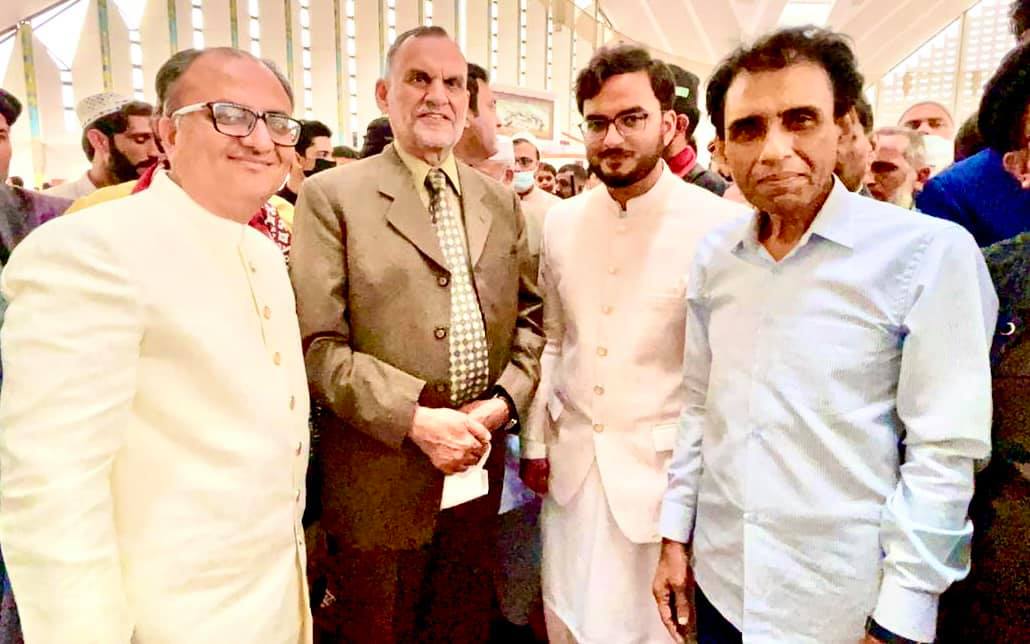
  • Thank you Dr Khalid Maqbool Siddiqui Chairman Mqm Pakistan and former Minister of IT OF Pakistan for attending wedding today of Abdullah Allahwala along with Minister of Railways Azam Khan Swati !
    Thank you Dr Khalid Maqbool Siddiqui Chairman Mqm Pakistan and former Minister of IT OF Pakistan for attending wedding today of Abdullah Allahwala along with Minister of Railways Azam Khan Swati !
    0 Commentarios 0 Acciones 601 Views
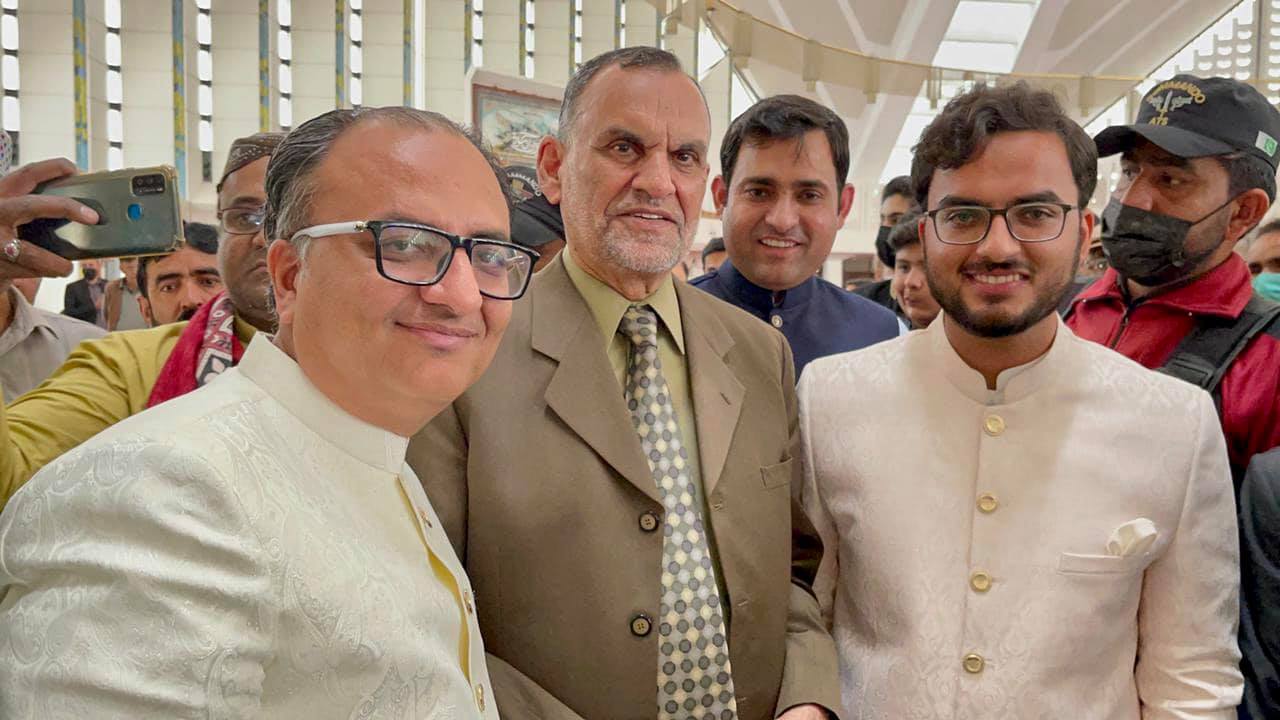
  • Thank you Minister of Railways Azam Khan Swati for attending marriage ceremony of my son Abdullah Allahwala today at Faisal Mosque
    Thank you Minister of Railways Azam Khan Swati for attending marriage ceremony of my son Abdullah Allahwala today at Faisal Mosque
    0 Commentarios 0 Acciones 291 Views
  • Pavel Verbnyak is a professional speaker on personal development, goal-setting, the law of attraction and leadership. He is a success expert, life coach, Vice President of JCI Russia, Brian Tracy Academys expert and partner, the founder of “Successful Thinking”, the author of several books, seminars on unlocking human potential and personal efficiency.
    Pavel specializes in training and development of individuals and organizations, helping to set and achieve personal and professional goals faster and easier, to eliminate limiting beliefs and fears, increase sales etc.
    Pavel Verbnyak is an award-winning speaker and an internationally recognized leader in personal development and peak performance strategies. For over 15 years, he has been teaching entrepreneurs, educators, corporate leaders, and people from all walks of life how to create the life they desire.
    He speaks also to corporate and public audiences on the subjects of Personal and Professional Development, including the executives and staff of many of Worlds largest corporations. His exciting talks and seminars on Leadership, Selling, Self-Esteem, Goals, Strategy, Creativity and Success Psychology bring about immediate changes and long-term results.
    Since 2005 Pavel has been studying the lives of successful people and applied the knowledge and ideas he’s learned into his own life.
    He is the graduate of Jack Canfield’s 2014 Train the Trainer live program (USA).
    Pavel will teach you how to get complete control of your time and your life, increase your income, simplify your work, maximize your special talents and abilities, and achieve financial independence.
    The maximum amount of audience for Pavel’s speech is more than 1000 people.
    He worked with top Russian & international brands: Sberbank, MTS, Russian Railways, Lukoil, Rostelekom, Renault, Volkswagen etc. Consulted famous Russian and CIS top managers.
    Most of Pavel’s core strategies for creating breakthroughs have come from modeling and distilling the strategies of leaders in some of the fastest growing companies in the world. He has used these distinctions to help optimize and grow enterprises to new and more profitable levels.
    Pavel lives in Moscow, Russia, where he continually raises the bar on his own potential by increasing and expanding his comfort zone with continued personal and professional development.
    Pavel Verbnyak is happily married and has son. He is active in community and national affairs.
    He wants to empower you to have a larger vision for your life by connecting to and unleashing the greatness within you.
    Pavel’s goal is to help people achieve your personal, professional, and financial goals faster and easier than you ever imagined.
    Pavel Verbnyak is a professional speaker on personal development, goal-setting, the law of attraction and leadership. He is a success expert, life coach, Vice President of JCI Russia, Brian Tracy Academy's expert and partner, the founder of “Successful Thinking”, the author of several books, seminars on unlocking human potential and personal efficiency. Pavel specializes in training and development of individuals and organizations, helping to set and achieve personal and professional goals faster and easier, to eliminate limiting beliefs and fears, increase sales etc. Pavel Verbnyak is an award-winning speaker and an internationally recognized leader in personal development and peak performance strategies. For over 15 years, he has been teaching entrepreneurs, educators, corporate leaders, and people from all walks of life how to create the life they desire. He speaks also to corporate and public audiences on the subjects of Personal and Professional Development, including the executives and staff of many of World's largest corporations. His exciting talks and seminars on Leadership, Selling, Self-Esteem, Goals, Strategy, Creativity and Success Psychology bring about immediate changes and long-term results. Since 2005 Pavel has been studying the lives of successful people and applied the knowledge and ideas he’s learned into his own life. He is the graduate of Jack Canfield’s 2014 Train the Trainer live program (USA). Pavel will teach you how to get complete control of your time and your life, increase your income, simplify your work, maximize your special talents and abilities, and achieve financial independence. The maximum amount of audience for Pavel’s speech is more than 1000 people. He worked with top Russian & international brands: Sberbank, MTS, Russian Railways, Lukoil, Rostelekom, Renault, Volkswagen etc. Consulted famous Russian and CIS top managers. Most of Pavel’s core strategies for creating breakthroughs have come from modeling and distilling the strategies of leaders in some of the fastest growing companies in the world. He has used these distinctions to help optimize and grow enterprises to new and more profitable levels. Pavel lives in Moscow, Russia, where he continually raises the bar on his own potential by increasing and expanding his comfort zone with continued personal and professional development. Pavel Verbnyak is happily married and has son. He is active in community and national affairs. He wants to empower you to have a larger vision for your life by connecting to and unleashing the greatness within you. Pavel’s goal is to help people achieve your personal, professional, and financial goals faster and easier than you ever imagined.
    0 Commentarios 0 Acciones 398 Views
Resultados de la búsqueda