The Forty Rules of Love.
1. **How we see God** is a direct reflection of how we see ourselves. If God brings to mind mostly fear and blame, it means there is mostly fear and blame within us.
2. **The path to the Truth** is a labor of the heart, not of the head. Make your heart your primary guide, not your mind. Meet, challenge, and ultimately prevail over your nafs (ego) with your heart.
3. **You can study God** through everything and everyone in the universe because God is not confined in a mosque, synagogue, or church. But if you are still in need of knowing where exactly His abode is, there is only one place to look for Him: in the heart of a true lover.
4. **Intellect and love** are made of different materials. Intellect ties people in knots and risks nothing, but love dissolves all tangles and risks everything.
5. **Most of the problems** of the world stem from linguistic mistakes and simple misunderstandings. Don’t ever take words at face value. When you step into the zone of love, language as we know it becomes obsolete. That which cannot be put into words can only be grasped through silence.
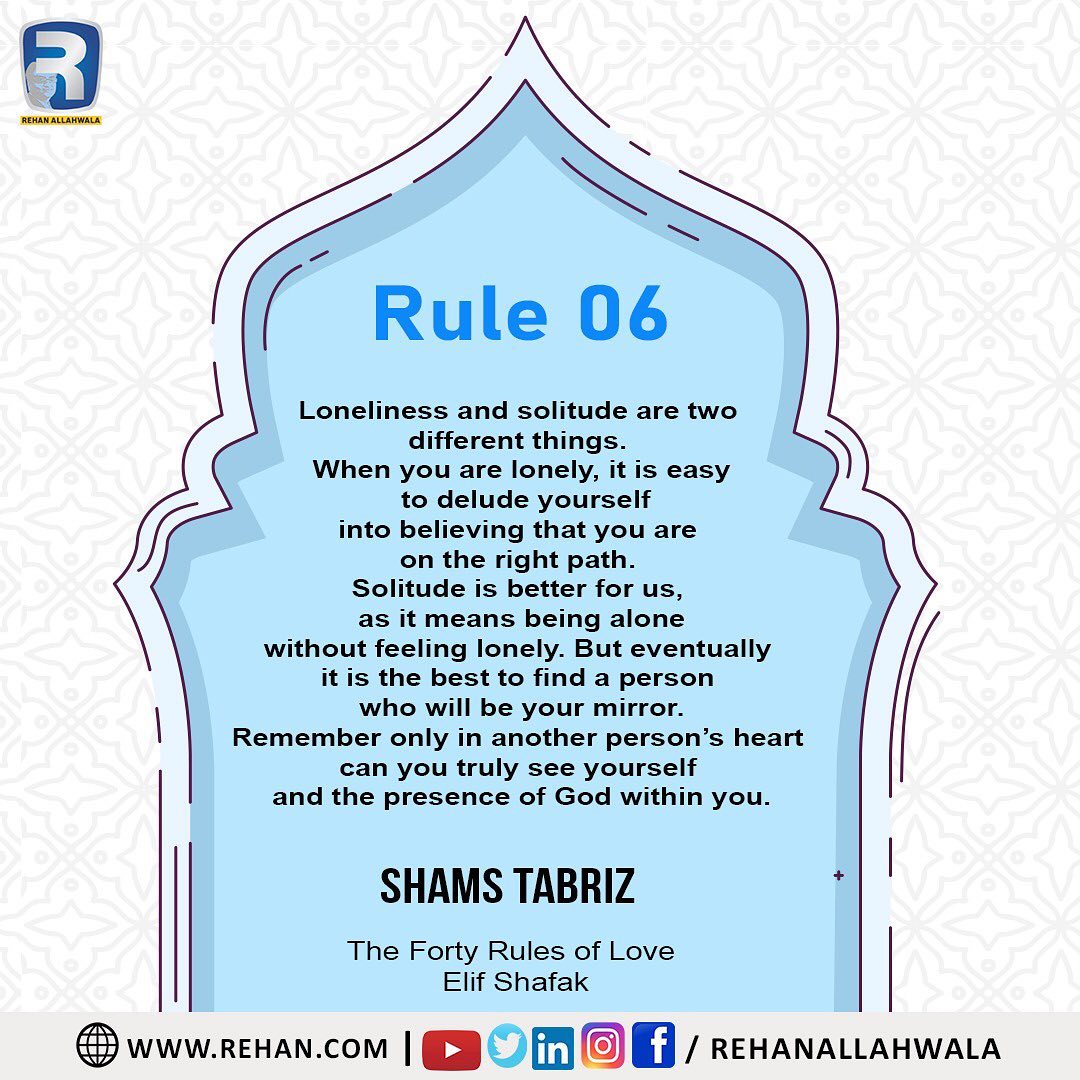
6. **Loneliness and solitude** are two different things. When you are lonely, it is easy to delude yourself into believing that you are on the right path. Solitude is better for us, as it means being alone without feeling lonely.
7. **Whatever happens in your life, no matter how troubling things might seem, do not enter the neighborhood of despair.** Even when all doors remain closed, God will open up a new path only for you. Be thankful!
8. **Patience does not mean to passively endure.** It means to look at the end of a process. What does patience mean? It means to look at the thorn and see the rose, to look at the night and see the dawn. Impatience means to be shortsighted as to not be able to see the outcome.
9. **East, west, south, or north** makes little difference. No matter what your destination, just be sure to make every journey a journey within. If you travel within, you’ll travel the whole wide world and beyond.
10. **The midwife knows** that when there is no pain, the way for the baby cannot be opened, and the mother cannot give birth. Similarly, for a new Self to be born, hardship is necessary. Just as clay needs to go through intense heat to become strong, Love can only be perfected in pain.
11. **The quest for love** changes user. There is no seeker among those who search for love who has not matured on the way.
12. **There are more false guides** and teachers in this world than stars in the visible universe. Beware of impostors. And know that it is only real guidance that can lead you to the Love that you seek.
13. **Not all suffering** is harmful. There are some that cleanse us and purify us, and there are some that drag us down and lead us into more darkness.
14. **It is easy to love** a perfect God, unblemished and immaculate that He is. What is far more difficult is to love fellow human beings with all their imperfections and defects.
15. **The true lover is** the one who can thrill you by kissing your forehead or smiling into your eyes or just staring into space.
16. **Try not to resist the changes** which come your way. Instead, let life live through you. And do not worry that your life is turning upside down. How do you know that the side you are used to is better than the one to come?
17. **Love is a travel.** All travelers whether they want or not are changed. No one can travel into Love and remain the same.
18. **If you want to change the way others treat you**, you should first change the way you treat yourself. Unless you learn to love yourself, fully and sincerely, there is no way you can be loved.
19. **Real filth is the one inside.** The rest simply washes off.
20. **The whole universe is contained within a single human being – you.** Everything that you see around, including the things you might not be fond of and even the people you despise or abhor, is present within you in varying degrees. Therefore, do not look for Sheitan (Satan) outside yourself either. The devil is not an extraordinary force that attacks from outside. It is an ordinary voice within.
21. **The world is like a snowy mountain** that echoes your voice. Whatever you speak, good or evil, will somehow come back to you. Therefore, if there is someone who harbors ill thoughts about you, saying similarly bad things about him will only make matters worse. You will be locked in a vicious circle of malevolent energy. Instead, for forty days and nights, say and think nice things about that person. Everything will be different at the end of the forty days.
22. **The past is an interpretation.** The future is an illusion. The world does not move through time as if it were a straight line, proceeding from the past to the future. Instead, time moves through and within us, in endless spirals. Eternity does not mean infinite time but simply timelessness. If you want to experience eternal illumination, put the past and the future out of your mind and remain within the present moment.
23. **Fate does not mean** that your life has been strictly predetermined. Therefore, to leave everything to fate and not actively contribute to the music of the universe is a sign of sheer ignorance.
24. **Never forget that God is a meticulous clockmaker.** So precise is His order that everything on earth happens in its own time. Neither a minute late nor a minute early. And everything is created with a divine wisdom. We are all just like clocks, including our main springs. Therefore, be patient about your perplexities and wait for the unraveling of the mysteries of your life.
25. **As long as we keep getting lost in our own desires,** fears, and worries, we will not be able to find the real self. Therefore, surrender to the flow of the rivers of life without any reservations.
26. **The past is a distant shore, and the future is an imaginary horizon.** Only the present is real. Therefore, take heed to your present thoughts and actions, for they will become your destiny.
27. **Suffering is not a punishment; it is a gift.** Within suffering is hidden mercy and blessings.
28. **Be grateful to those who have hurt or wronged you**, for they have helped you learn about patience and compassion.
29. **What is true of the individual will be tomorrow true of the whole nation.** If falsehood brings calamity to one person, it will be a greater evil for an entire people.
30. **If you want to change the world**, you should first change yourself. Change and transformation start within, not outside.
31. **Peace is not the absence of conflict but the presence of creative alternatives for responding to conflict** — alternatives to passive or aggressive responses, alternatives to violence.
32. **The purpose of the existence of every person is to realize God within oneself.** It is the knowledge of this that brings enlightenment and peace to the soul.
33. **Love is the water of life.** And a lover is a soul of fire! The universe turns differently when fire loves water.
34. **When you love someone, there is no way you can distance yourself from the pain of the other.** When someone suffers, you too feel the pain. And if you can stay unaffected by the pain, that is not love.
35. **The ultimate aim of life is to find the divine truth that lies within.** No matter what happens in life, you need to always seek the higher self within you.
36. **All religious practices are meant to be only a means to an end.** They are merely our human ways of making the divine reality visible to our finite minds. However, it is not the outward appearance of religious practices that is important, but their inward essence.
37. **Once you embark on the path of truth,** be prepared for both hardships and joy. They will be your inseparable companions.
38. **You will learn to live through both sorrow and joy, like an empty bell which makes a sound only when it is hit.** The more you are pained, the more the instrument of your soul will be refined and the better you will be able to express yourself.
39. **The true essence of love lies beyond words and expressions.** The more you try to express it, the more it will elude you. Words can only be symbols for the inexpressible truth.
40. **When you come face-to-face with the real essence of love, you will no longer be searching for it.** For the search will become unnecessary, and you will be immersed in the divine truth of love.
These rules emphasize the themes of love, spirituality, and the inner journey, aligning with the teachings of Sufism and the spiritual bond between Rumi and Shams of Tabriz.
The Forty Rules of Love.
1. **How we see God** is a direct reflection of how we see ourselves. If God brings to mind mostly fear and blame, it means there is mostly fear and blame within us.
2. **The path to the Truth** is a labor of the heart, not of the head. Make your heart your primary guide, not your mind. Meet, challenge, and ultimately prevail over your nafs (ego) with your heart.
3. **You can study God** through everything and everyone in the universe because God is not confined in a mosque, synagogue, or church. But if you are still in need of knowing where exactly His abode is, there is only one place to look for Him: in the heart of a true lover.
4. **Intellect and love** are made of different materials. Intellect ties people in knots and risks nothing, but love dissolves all tangles and risks everything.
5. **Most of the problems** of the world stem from linguistic mistakes and simple misunderstandings. Don’t ever take words at face value. When you step into the zone of love, language as we know it becomes obsolete. That which cannot be put into words can only be grasped through silence.
6. **Loneliness and solitude** are two different things. When you are lonely, it is easy to delude yourself into believing that you are on the right path. Solitude is better for us, as it means being alone without feeling lonely.
7. **Whatever happens in your life, no matter how troubling things might seem, do not enter the neighborhood of despair.** Even when all doors remain closed, God will open up a new path only for you. Be thankful!
8. **Patience does not mean to passively endure.** It means to look at the end of a process. What does patience mean? It means to look at the thorn and see the rose, to look at the night and see the dawn. Impatience means to be shortsighted as to not be able to see the outcome.
9. **East, west, south, or north** makes little difference. No matter what your destination, just be sure to make every journey a journey within. If you travel within, you’ll travel the whole wide world and beyond.
10. **The midwife knows** that when there is no pain, the way for the baby cannot be opened, and the mother cannot give birth. Similarly, for a new Self to be born, hardship is necessary. Just as clay needs to go through intense heat to become strong, Love can only be perfected in pain.
11. **The quest for love** changes user. There is no seeker among those who search for love who has not matured on the way.
12. **There are more false guides** and teachers in this world than stars in the visible universe. Beware of impostors. And know that it is only real guidance that can lead you to the Love that you seek.
13. **Not all suffering** is harmful. There are some that cleanse us and purify us, and there are some that drag us down and lead us into more darkness.
14. **It is easy to love** a perfect God, unblemished and immaculate that He is. What is far more difficult is to love fellow human beings with all their imperfections and defects.
15. **The true lover is** the one who can thrill you by kissing your forehead or smiling into your eyes or just staring into space.
16. **Try not to resist the changes** which come your way. Instead, let life live through you. And do not worry that your life is turning upside down. How do you know that the side you are used to is better than the one to come?
17. **Love is a travel.** All travelers whether they want or not are changed. No one can travel into Love and remain the same.
18. **If you want to change the way others treat you**, you should first change the way you treat yourself. Unless you learn to love yourself, fully and sincerely, there is no way you can be loved.
19. **Real filth is the one inside.** The rest simply washes off.
20. **The whole universe is contained within a single human being – you.** Everything that you see around, including the things you might not be fond of and even the people you despise or abhor, is present within you in varying degrees. Therefore, do not look for Sheitan (Satan) outside yourself either. The devil is not an extraordinary force that attacks from outside. It is an ordinary voice within.
21. **The world is like a snowy mountain** that echoes your voice. Whatever you speak, good or evil, will somehow come back to you. Therefore, if there is someone who harbors ill thoughts about you, saying similarly bad things about him will only make matters worse. You will be locked in a vicious circle of malevolent energy. Instead, for forty days and nights, say and think nice things about that person. Everything will be different at the end of the forty days.
22. **The past is an interpretation.** The future is an illusion. The world does not move through time as if it were a straight line, proceeding from the past to the future. Instead, time moves through and within us, in endless spirals. Eternity does not mean infinite time but simply timelessness. If you want to experience eternal illumination, put the past and the future out of your mind and remain within the present moment.
23. **Fate does not mean** that your life has been strictly predetermined. Therefore, to leave everything to fate and not actively contribute to the music of the universe is a sign of sheer ignorance.
24. **Never forget that God is a meticulous clockmaker.** So precise is His order that everything on earth happens in its own time. Neither a minute late nor a minute early. And everything is created with a divine wisdom. We are all just like clocks, including our main springs. Therefore, be patient about your perplexities and wait for the unraveling of the mysteries of your life.
25. **As long as we keep getting lost in our own desires,** fears, and worries, we will not be able to find the real self. Therefore, surrender to the flow of the rivers of life without any reservations.
26. **The past is a distant shore, and the future is an imaginary horizon.** Only the present is real. Therefore, take heed to your present thoughts and actions, for they will become your destiny.
27. **Suffering is not a punishment; it is a gift.** Within suffering is hidden mercy and blessings.
28. **Be grateful to those who have hurt or wronged you**, for they have helped you learn about patience and compassion.
29. **What is true of the individual will be tomorrow true of the whole nation.** If falsehood brings calamity to one person, it will be a greater evil for an entire people.
30. **If you want to change the world**, you should first change yourself. Change and transformation start within, not outside.
31. **Peace is not the absence of conflict but the presence of creative alternatives for responding to conflict** — alternatives to passive or aggressive responses, alternatives to violence.
32. **The purpose of the existence of every person is to realize God within oneself.** It is the knowledge of this that brings enlightenment and peace to the soul.
33. **Love is the water of life.** And a lover is a soul of fire! The universe turns differently when fire loves water.
34. **When you love someone, there is no way you can distance yourself from the pain of the other.** When someone suffers, you too feel the pain. And if you can stay unaffected by the pain, that is not love.
35. **The ultimate aim of life is to find the divine truth that lies within.** No matter what happens in life, you need to always seek the higher self within you.
36. **All religious practices are meant to be only a means to an end.** They are merely our human ways of making the divine reality visible to our finite minds. However, it is not the outward appearance of religious practices that is important, but their inward essence.
37. **Once you embark on the path of truth,** be prepared for both hardships and joy. They will be your inseparable companions.
38. **You will learn to live through both sorrow and joy, like an empty bell which makes a sound only when it is hit.** The more you are pained, the more the instrument of your soul will be refined and the better you will be able to express yourself.
39. **The true essence of love lies beyond words and expressions.** The more you try to express it, the more it will elude you. Words can only be symbols for the inexpressible truth.
40. **When you come face-to-face with the real essence of love, you will no longer be searching for it.** For the search will become unnecessary, and you will be immersed in the divine truth of love.
These rules emphasize the themes of love, spirituality, and the inner journey, aligning with the teachings of Sufism and the spiritual bond between Rumi and Shams of Tabriz.