• Accl Foundation Level (Rehan School Urdu Bazar Campus)
    Day : 83 Story post no : 11
    Roll no : 17
    Accl task
    Here is a beautiful story on The Wonders of Geometry Shapes and Philosophy
    ---
    ### The Language of the Universe
    A long time ago, a young student asked the great philosopher Plato,
    "Master, why do we study shapes? Are they not just lines and circles?"
    Plato smiled and drew a Circle in the sand.
    "This Circle," he said, "has no beginning and no end. It teaches us about Unity, Infinity, and Wholeness. Just like life and the soul, it is eternal."
    Then he drew an Equilateral Triangle.
    "This triangle has three equal sides. It represents Trinity, Fire, and Manifestation. It teaches us balance. The mind, the body, and the spirit — all three must be in balance to create something new."
    Next, he drew a Square.
    "This Square stands for Earth, Stability, and Matter. It has four strong corners. It teaches us that to build a strong life, you need a strong foundation."
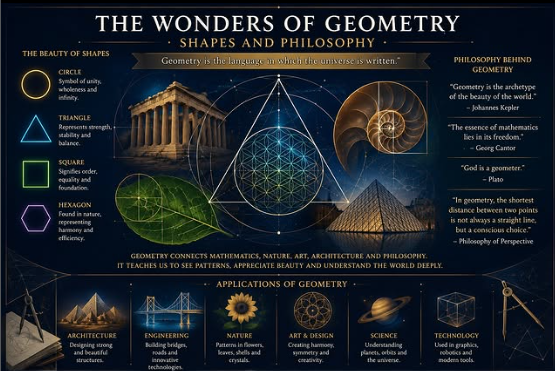
    The student was amazed. Then Plato showed him the most magical thing — The Golden Ratio, φ = 1.618...
    He showed him a seashell, a flower, and the stars in the sky.
    "Look closely," Plato said. "Nature weaves itself in the proportion of harmony — the same ratio found in galaxies, petals, and seashells. This is the Divine Proportion. It proves that the universe is not random, it is art."
    Finally, he showed him the Platonic Solids — the five sacred shapes that build the entire universe: Tetrahedron (Fire ), Cube (Earth ), Octahedron (Air ), Icosahedron (Water ), and Dodecahedron (Universe ).
    Plato whispered his most famous quote:
    > “Geometry will draw the soul toward truth and create the spirit of philosophy.”
    The student understood. Geometry is not just math. It is the secret language that God used to write the universe.
    And so, the saying goes:
    "As Above, So Below — The Cosmos is Order, Pattern, and Meaning. To study geometry is to contemplate the mind of the universe."

    ### کائنات کی زبان
    بہت پرانے زمانے کی بات ہے، ایک چھوٹے سے شاگرد نے اپنے استاد افلاطون سے پوچھا،
    "استاد، ہم شکلیں کیوں پڑھتے ہیں؟ کیا یہ صرف لکیریں اور گول دائرے نہیں ہیں؟"
    افلاطون مسکرائے اور ریت پر ایک دائرہ بنایا۔
    "بولو، اس دائرے کا کوئی شروع یا ختم ہے؟"
    "نہیں استاد،" شاگرد نے جواب دیا۔
    "بالکل، یہ اکتا، بے انتہا اور مکمل ہونے کا سبق دیتا ہے۔ جیسے ہماری روح، اس کا نہ کوئی آغاز ہے نہ اختتام۔"
    پھر انہوں نے ایک مثلث بنایا۔
    "یہ تین برابر سائیڈ والا ہے۔ یہ دماغ، جسم اور روح کا توازن سکھاتا ہے۔ جب تک تینوں میں توازن نہ ہو، کچھ نیا نہیں بنتا۔"
    اس کے بعد انہوں نے ایک مربع بنایا۔
    "یہ زمین، استحکام اور مضبوطی کی علامت ہے۔ اس کے چار کونے ہیں۔ یہ سکھاتا ہے کہ مضبوط زندگی کے لیے مضبوط بنیاد ضروری ہے۔"
    پھر افلاطون نے اسے سب سے جادوئی چیز دکھائی — گولڈن ریشو، 1.618
    انہوں نے ایک سیپ، ایک پھول اور آسمان کے ستارے دکھائے۔
    "دیکھو، قدرت اسی تناسب سے بنتی ہے۔ یہی تناسب کہکشاؤں میں، پھولوں کی پنکھڑیوں میں اور سیپ میں ہے۔ اس کا مطلب ہے کہ کائنات اتفاق نہیں، بلکہ ایک بہترین فن پارہ ہے۔"
    آخر میں انہوں نے پانچ مقدس شکلیں دکھائیں جو پوری کائنات کو بناتی ہیں: آگ، مٹی، ہوا، پانی اور کائنات۔
    اور افلاطون نے اپنا مشہور قول کہا:
    > "جیومیٹری روح کو سچائی کی طرف کھینچتی ہے اور فلسفے کی روح پیدا کرتی ہے۔"
    تب شاگرد کو سمجھ آیا۔ جیومیٹری صرف ریاضی نہیں، بلکہ وہ زبان ہے جس سے خدا نے اس پوری کائنات کو لکھا ہے۔
    "جیسا اوپر، ویسا نیچے — کائنات نظم، پیٹرن اور معنی کا نام ہے۔ جیومیٹری پڑھنا دراصل کائنات بنانے والے کے ذہن کو سمجھنا ہے۔
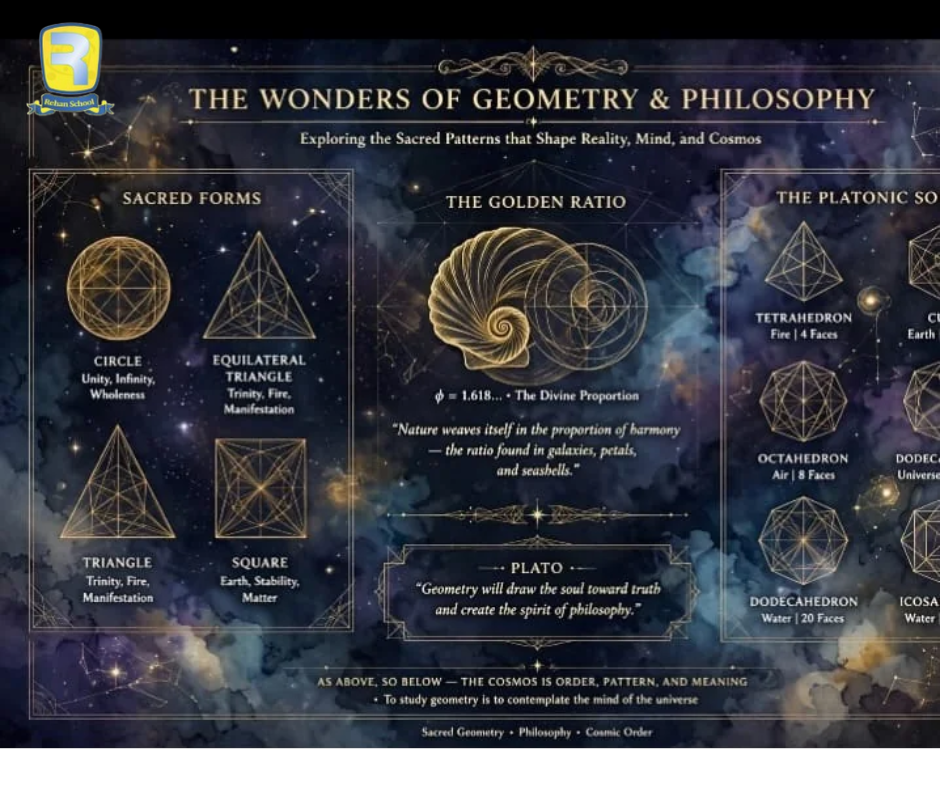
    Accl Foundation Level (Rehan School Urdu Bazar Campus) Day : 83 Story post no : 11 Roll no : 17 Accl task Here is a beautiful story on The Wonders of Geometry Shapes and Philosophy ✨📐 --- ### The Language of the Universe A long time ago, a young student asked the great philosopher Plato, "Master, why do we study shapes? Are they not just lines and circles?" Plato smiled and drew a Circle in the sand. ⭕ "This Circle," he said, "has no beginning and no end. It teaches us about Unity, Infinity, and Wholeness. Just like life and the soul, it is eternal." Then he drew an Equilateral Triangle. 🔺 "This triangle has three equal sides. It represents Trinity, Fire, and Manifestation. It teaches us balance. The mind, the body, and the spirit — all three must be in balance to create something new." Next, he drew a Square. ◼️ "This Square stands for Earth, Stability, and Matter. It has four strong corners. It teaches us that to build a strong life, you need a strong foundation." The student was amazed. Then Plato showed him the most magical thing — The Golden Ratio, φ = 1.618... 🐚✨ He showed him a seashell, a flower, and the stars in the sky. "Look closely," Plato said. "Nature weaves itself in the proportion of harmony — the same ratio found in galaxies, petals, and seashells. This is the Divine Proportion. It proves that the universe is not random, it is art." Finally, he showed him the Platonic Solids — the five sacred shapes that build the entire universe: Tetrahedron (Fire 🔥), Cube (Earth 🌍), Octahedron (Air 🌬️), Icosahedron (Water 💧), and Dodecahedron (Universe 🌌). Plato whispered his most famous quote: > “Geometry will draw the soul toward truth and create the spirit of philosophy.” The student understood. Geometry is not just math. It is the secret language that God used to write the universe. And so, the saying goes: "As Above, So Below — The Cosmos is Order, Pattern, and Meaning. To study geometry is to contemplate the mind of the universe." 🌟 ### کائنات کی زبان بہت پرانے زمانے کی بات ہے، ایک چھوٹے سے شاگرد نے اپنے استاد افلاطون سے پوچھا، "استاد، ہم شکلیں کیوں پڑھتے ہیں؟ کیا یہ صرف لکیریں اور گول دائرے نہیں ہیں؟" افلاطون مسکرائے اور ریت پر ایک دائرہ بنایا۔ ⭕ "بولو، اس دائرے کا کوئی شروع یا ختم ہے؟" "نہیں استاد،" شاگرد نے جواب دیا۔ "بالکل، یہ اکتا، بے انتہا اور مکمل ہونے کا سبق دیتا ہے۔ جیسے ہماری روح، اس کا نہ کوئی آغاز ہے نہ اختتام۔" پھر انہوں نے ایک مثلث بنایا۔ 🔺 "یہ تین برابر سائیڈ والا ہے۔ یہ دماغ، جسم اور روح کا توازن سکھاتا ہے۔ جب تک تینوں میں توازن نہ ہو، کچھ نیا نہیں بنتا۔" اس کے بعد انہوں نے ایک مربع بنایا۔ ◼️ "یہ زمین، استحکام اور مضبوطی کی علامت ہے۔ اس کے چار کونے ہیں۔ یہ سکھاتا ہے کہ مضبوط زندگی کے لیے مضبوط بنیاد ضروری ہے۔" پھر افلاطون نے اسے سب سے جادوئی چیز دکھائی — گولڈن ریشو، 1.618 🐚 انہوں نے ایک سیپ، ایک پھول اور آسمان کے ستارے دکھائے۔ "دیکھو، قدرت اسی تناسب سے بنتی ہے۔ یہی تناسب کہکشاؤں میں، پھولوں کی پنکھڑیوں میں اور سیپ میں ہے۔ اس کا مطلب ہے کہ کائنات اتفاق نہیں، بلکہ ایک بہترین فن پارہ ہے۔" آخر میں انہوں نے پانچ مقدس شکلیں دکھائیں جو پوری کائنات کو بناتی ہیں: آگ، مٹی، ہوا، پانی اور کائنات۔ اور افلاطون نے اپنا مشہور قول کہا: > "جیومیٹری روح کو سچائی کی طرف کھینچتی ہے اور فلسفے کی روح پیدا کرتی ہے۔" تب شاگرد کو سمجھ آیا۔ جیومیٹری صرف ریاضی نہیں، بلکہ وہ زبان ہے جس سے خدا نے اس پوری کائنات کو لکھا ہے۔ "جیسا اوپر، ویسا نیچے — کائنات نظم، پیٹرن اور معنی کا نام ہے۔ جیومیٹری پڑھنا دراصل کائنات بنانے والے کے ذہن کو سمجھنا ہے۔
    0 Comentários 0 Compartilhamentos 432 Visualizações
  • day:83
    task: create a story post
    story: # The Wonders of Geometry: Shapes and Philosophy
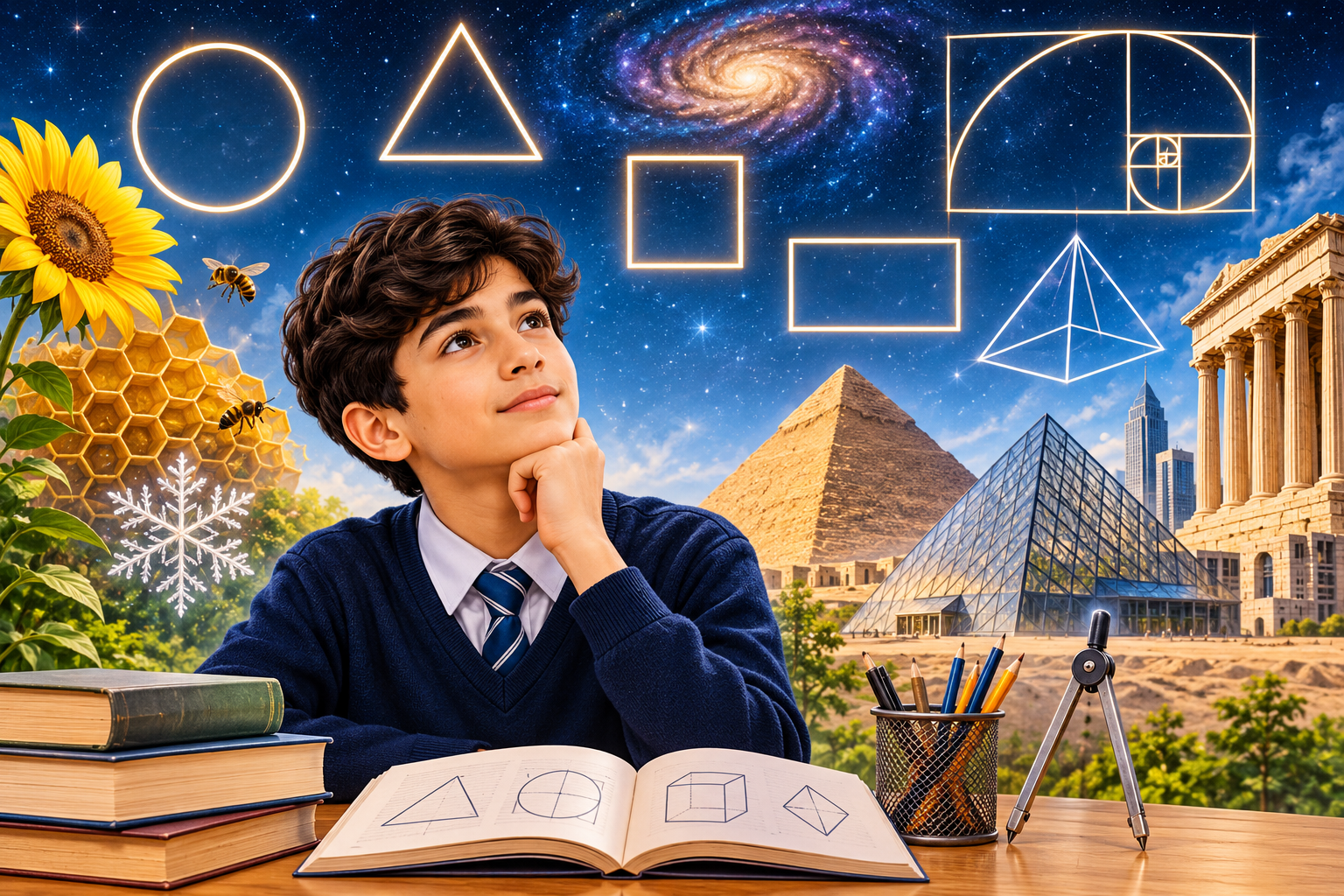
    Geometry is one of the most fascinating branches of mathematics. It helps us understand the world through shapes, lines, angles, and patterns. From the round shape of the Sun to the square windows of buildings, geometry is everywhere around us. Even nature uses beautiful geometric patterns in flowers, honeycombs, and snowflakes.
    One day, a young student named Ali became curious about geometry. His teacher showed him different shapes, including circles, triangles, squares, and rectangles. She explained how each shape has its own special properties. Ali discovered that triangles make buildings strong, circles help wheels move smoothly, and rectangles are useful in designing houses and classrooms.
    As Ali learned more, he realized that geometry was not only about mathematics but also about philosophy. Every shape had a deeper meaning. A circle could represent unity and eternity, a triangle could represent strength and balance, and a square could represent stability and order. These shapes encouraged him to think about the beauty and harmony of the universe.
    From that day, Ali began seeing the world differently. He understood that geometry connects mathematics, art, architecture, science, and nature. He learned that every line and shape tells a story about the world around us. The greatest wonder of geometry is that it teaches us not only how to measure the world but also how to understand its beauty.
    day:83 task: create a story post story: # The Wonders of Geometry: Shapes and Philosophy Geometry is one of the most fascinating branches of mathematics. It helps us understand the world through shapes, lines, angles, and patterns. From the round shape of the Sun to the square windows of buildings, geometry is everywhere around us. Even nature uses beautiful geometric patterns in flowers, honeycombs, and snowflakes. One day, a young student named Ali became curious about geometry. His teacher showed him different shapes, including circles, triangles, squares, and rectangles. She explained how each shape has its own special properties. Ali discovered that triangles make buildings strong, circles help wheels move smoothly, and rectangles are useful in designing houses and classrooms. As Ali learned more, he realized that geometry was not only about mathematics but also about philosophy. Every shape had a deeper meaning. A circle could represent unity and eternity, a triangle could represent strength and balance, and a square could represent stability and order. These shapes encouraged him to think about the beauty and harmony of the universe. From that day, Ali began seeing the world differently. He understood that geometry connects mathematics, art, architecture, science, and nature. He learned that every line and shape tells a story about the world around us. The greatest wonder of geometry is that it teaches us not only how to measure the world but also how to understand its beauty.
    0 Comentários 0 Compartilhamentos 476 Visualizações
  • RSIF8
    Roll no:14
    song no:15
    song topic:Chemical Bonding: The Relationship of Molecules

    # Chemical Bonding: The Relationship of Molecules

    Discover the fascinating world of **Chemical Bonding: The Relationship of Molecules**, where atoms come together to create the substances that make up our universe! Chemical bonding is one of the most important concepts in chemistry because it explains how atoms connect, interact, and form molecules and compounds.

    In this educational journey, we explore the major types of chemical bonds, including **ionic bonds, covalent bonds, and metallic bonds**. Learn how atoms share or transfer electrons, how molecules form, and why chemical bonds are essential for the existence of water, air, minerals, and living organisms.

    From the simplest molecules to complex chemical compounds, every bond tells a story of connection, stability, and transformation. Understanding these relationships helps us discover the secrets behind chemical reactions and the amazing properties of different materials.

    Whether you are a student, a science enthusiast, or simply curious about the world around you, this topic will make chemistry more interesting, understandable, and exciting!

    **Watch, learn, and explore the incredible connections that hold matter together!**

    Like, share, and subscribe for more educational content about chemistry, physics, biology, and the wonders of science.

    #ChemicalBonding #Chemistry #Molecules #IonicBond #CovalentBond #MetallicBond #ScienceEducation #Atoms #ChemicalReactions #LearnChemistry
    RSIF8 Roll no:14 song no:15 song topic:Chemical Bonding: The Relationship of Molecules # 🧪 Chemical Bonding: The Relationship of Molecules 🔬 Discover the fascinating world of **Chemical Bonding: The Relationship of Molecules**, where atoms come together to create the substances that make up our universe! 🌍✨ Chemical bonding is one of the most important concepts in chemistry because it explains how atoms connect, interact, and form molecules and compounds. In this educational journey, we explore the major types of chemical bonds, including **ionic bonds, covalent bonds, and metallic bonds**. Learn how atoms share or transfer electrons, how molecules form, and why chemical bonds are essential for the existence of water, air, minerals, and living organisms. 💧🌱 From the simplest molecules to complex chemical compounds, every bond tells a story of connection, stability, and transformation. Understanding these relationships helps us discover the secrets behind chemical reactions and the amazing properties of different materials. 🎓 Whether you are a student, a science enthusiast, or simply curious about the world around you, this topic will make chemistry more interesting, understandable, and exciting! 🌟 **Watch, learn, and explore the incredible connections that hold matter together!** 👍 Like, share, and subscribe for more educational content about chemistry, physics, biology, and the wonders of science. #ChemicalBonding #Chemistry #Molecules #IonicBond #CovalentBond #MetallicBond #ScienceEducation #Atoms #ChemicalReactions #LearnChemistry
    0 Comentários 0 Compartilhamentos 1031 Visualizações 9
  • RSIF8
    Roll no 94
    Song no 11
    Song topic
    Chemical Bonding: The Relationship of Molecules

    Atoms may be tiny, but the bonds they form create the world around us! Chemical bonding is the force that connects atoms together, forming molecules that make up everything from water and food to plants and even our own bodies ‍.

    Through ionic, covalent, and metallic bonds, atoms interact and achieve stability, creating countless substances with unique properties. Understanding chemical bonding helps us learn how matter is formed, why chemical reactions happen, and how science improves our daily lives.

    This song celebrates the amazing relationships between molecules and the invisible connections that make life possible. From the smallest atom to the largest living organism, chemistry is everywhere!

    Let's explore the wonders of science and discover how molecules work together to build the universe around us.

    #ChemicalBonding #RelationshipOfMolecules #Chemistry #Science #Molecules #Atoms #ChemicalReactions #STEM #ScienceEducation #LearningIsFun #FutureScientists #ScienceProject #EducationalContent #ExploreScience #ChemistryLovers #Innovation #Knowledge #StudentLife #ScienceFacts #LearningJourney
    RSIF8 Roll no 94 Song no 11 Song topic 🔬🎶 Chemical Bonding: The Relationship of Molecules 🎶🔬 Atoms may be tiny, but the bonds they form create the world around us! ⚛️🌍 Chemical bonding is the force that connects atoms together, forming molecules that make up everything from water 💧 and food 🍎 to plants 🌱 and even our own bodies 🧑‍🔬. Through ionic, covalent, and metallic bonds, atoms interact and achieve stability, creating countless substances with unique properties. 🧪✨ Understanding chemical bonding helps us learn how matter is formed, why chemical reactions happen, and how science improves our daily lives. 💡📚 This song celebrates the amazing relationships between molecules and the invisible connections that make life possible. From the smallest atom to the largest living organism, chemistry is everywhere! 🌟🔬 Let's explore the wonders of science and discover how molecules work together to build the universe around us. 🚀⚛️🌎 #ChemicalBonding #RelationshipOfMolecules #Chemistry #Science #Molecules #Atoms #ChemicalReactions #STEM #ScienceEducation #LearningIsFun #FutureScientists #ScienceProject #EducationalContent #ExploreScience #ChemistryLovers #Innovation #Knowledge #StudentLife #ScienceFacts #LearningJourney 🔬🧪⚛️📚✨🌍🚀
    0 Comentários 0 Compartilhamentos 1952 Visualizações 27
  • **Roll No: 2**
    **Batch: 14**
    **Book: ACCL**
    **Task No: 69**

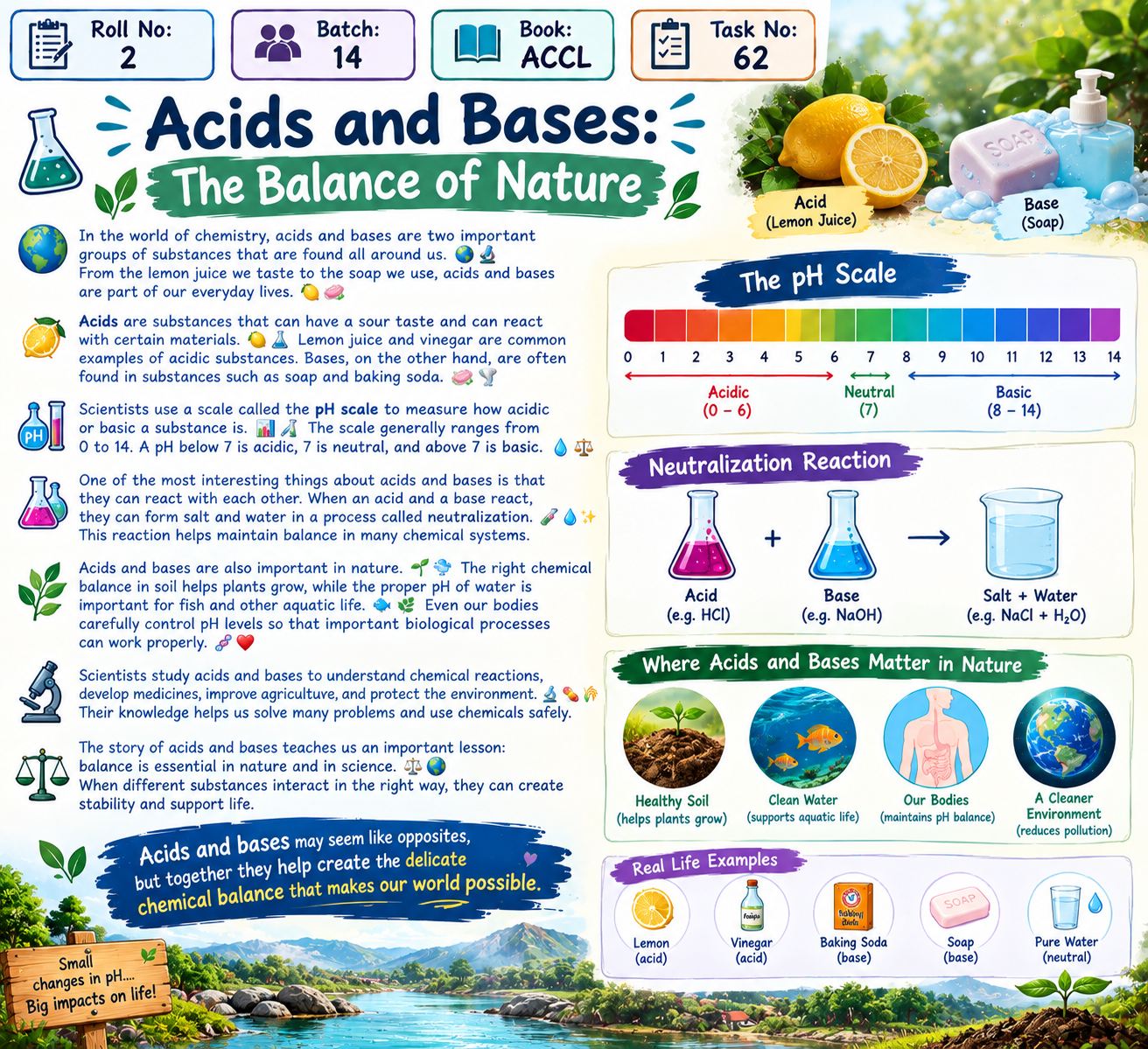
    # Acids and Bases: The Balance of Nature

    In the world of chemistry, acids and bases are two important groups of substances that are found all around us. From the lemon juice we taste to the soap we use, acids and bases are part of our everyday lives.

    Acids are substances that can have a sour taste and can react with certain materials. Lemon juice and vinegar are common examples of acidic substances. Bases, on the other hand, are often found in substances such as soap and baking soda.

    Scientists use a scale called the **pH scale** to measure how acidic or basic a substance is. The scale generally ranges from **0 to 14**. A pH below 7 is acidic, 7 is neutral, and above 7 is basic.

    One of the most interesting things about acids and bases is that they can react with each other. When an acid and a base react, they can form **salt and water** in a process called neutralization. This reaction helps maintain balance in many chemical systems.

    Acids and bases are also important in nature. The right chemical balance in soil helps plants grow, while the proper pH of water is important for fish and other aquatic life. Even our bodies carefully control pH levels so that important biological processes can work properly.

    Scientists study acids and bases to understand chemical reactions, develop medicines, improve agriculture, and protect the environment. Their knowledge helps us solve many problems and use chemicals safely.

    The story of acids and bases teaches us an important lesson: **balance is essential in nature and in science.** When different substances interact in the right way, they can create stability and support life.

    **Acids and bases may seem like opposites, but together they help create the delicate chemical balance that makes our world possible. **
    **Roll No: 2** **Batch: 14** **Book: ACCL** **Task No: 69** # 🧪 Acids and Bases: The Balance of Nature 🌿⚖️ In the world of chemistry, acids and bases are two important groups of substances that are found all around us. 🌍🔬 From the lemon juice we taste to the soap we use, acids and bases are part of our everyday lives. 🍋🧼 Acids are substances that can have a sour taste and can react with certain materials. 🍋⚗️ Lemon juice and vinegar are common examples of acidic substances. Bases, on the other hand, are often found in substances such as soap and baking soda. 🧼🥄 Scientists use a scale called the **pH scale** to measure how acidic or basic a substance is. 📊🧪 The scale generally ranges from **0 to 14**. A pH below 7 is acidic, 7 is neutral, and above 7 is basic. 💧⚖️ One of the most interesting things about acids and bases is that they can react with each other. When an acid and a base react, they can form **salt and water** in a process called neutralization. 🧪💧✨ This reaction helps maintain balance in many chemical systems. Acids and bases are also important in nature. 🌱🌧️ The right chemical balance in soil helps plants grow, while the proper pH of water is important for fish and other aquatic life. 🐟🌿 Even our bodies carefully control pH levels so that important biological processes can work properly. 🧬❤️ Scientists study acids and bases to understand chemical reactions, develop medicines, improve agriculture, and protect the environment. 🔬💊🌾 Their knowledge helps us solve many problems and use chemicals safely. The story of acids and bases teaches us an important lesson: **balance is essential in nature and in science.** ⚖️🌍 When different substances interact in the right way, they can create stability and support life. **Acids and bases may seem like opposites, but together they help create the delicate chemical balance that makes our world possible. 🧪🌎✨**
    0 Comentários 0 Compartilhamentos 1922 Visualizações
  • Mohsin #RSF8
    #Storypost10
    Class: Foundation level
    Made by Me
    rool no:13

    The Wonders of Geometry: Shapes and Philosophy

    Geometry is one of the oldest and most fascinating areas of mathematics. It is not simply the study of lines, angles, and shapes; it is a way of understanding the structure, patterns, balance, and beauty of the world around us. From the smallest natural patterns to huge buildings and bridges, geometry plays an important role in our everyday lives.

    The topic “The Wonders of Geometry: Shapes and Philosophy” explores the beautiful relationship between mathematics and the ideas that humans have developed about order, harmony, proportion, symmetry, and perfection.

    The Beauty of Circles

    The circle is one of the most recognizable geometric shapes. It has no corners and every point on its boundary is the same distance from its center. Because of its continuous form, the circle is often associated with ideas such as unity, completeness, continuity, and infinity. We can see circles in wheels, clocks, planets, coins, lenses, and many designs around us.

    The Strength of Triangles

    Triangles are simple but incredibly important shapes. Their strong structure makes them useful in architecture and engineering. Bridges, roofs, towers, and other structures often use triangular designs because triangles provide stability. In geometry, triangles also help us understand angles, lengths, proportions, and many important mathematical relationships.

    The Balance of Squares

    The square represents equality, balance, order, and structure. All four of its sides are equal, and all four angles are right angles. Squares are commonly found in buildings, floor designs, windows, screens, tiles, artwork, and patterns. They demonstrate how mathematical rules can produce simple yet powerful designs.

    ⬡ The Harmony of Hexagons

    Hexagons are another fascinating shape. They can be seen naturally in honeycombs and in various patterns found in science and nature. Hexagonal structures can efficiently cover a surface without leaving gaps, which makes them especially interesting from both mathematical and natural per
    Mohsin #RSF8🎓✨ #Storypost10 Class: Foundation level 📚 Made by Me 💻🚀 rool no:13 📐✨ The Wonders of Geometry: Shapes and Philosophy ✨📐 Geometry is one of the oldest and most fascinating areas of mathematics. It is not simply the study of lines, angles, and shapes; it is a way of understanding the structure, patterns, balance, and beauty of the world around us. From the smallest natural patterns to huge buildings and bridges, geometry plays an important role in our everyday lives. The topic “The Wonders of Geometry: Shapes and Philosophy” explores the beautiful relationship between mathematics and the ideas that humans have developed about order, harmony, proportion, symmetry, and perfection. 🔵 The Beauty of Circles The circle is one of the most recognizable geometric shapes. It has no corners and every point on its boundary is the same distance from its center. Because of its continuous form, the circle is often associated with ideas such as unity, completeness, continuity, and infinity. We can see circles in wheels, clocks, planets, coins, lenses, and many designs around us. 🔺 The Strength of Triangles Triangles are simple but incredibly important shapes. Their strong structure makes them useful in architecture and engineering. Bridges, roofs, towers, and other structures often use triangular designs because triangles provide stability. In geometry, triangles also help us understand angles, lengths, proportions, and many important mathematical relationships. ⬜ The Balance of Squares The square represents equality, balance, order, and structure. All four of its sides are equal, and all four angles are right angles. Squares are commonly found in buildings, floor designs, windows, screens, tiles, artwork, and patterns. They demonstrate how mathematical rules can produce simple yet powerful designs. ⬡ The Harmony of Hexagons Hexagons are another fascinating shape. They can be seen naturally in honeycombs and in various patterns found in science and nature. Hexagonal structures can efficiently cover a surface without leaving gaps, which makes them especially interesting from both mathematical and natural per
    0 Comentários 0 Compartilhamentos 3118 Visualizações
  • MohsinRSF8
    song title no:8
    Rool no:13
    Class: Foundation level

    Sure! Here is a **long English description** for your social media post:

    **Chemical Bonding: The Relationship of Molecules**

    Chemistry is one of the most fascinating branches of science because it helps us understand the materials, substances, and processes that surround us every day. From the water we drink and the air we breathe to the food we eat and the objects we use, everything is connected to atoms and molecules. But how do these tiny particles come together to form the world around us? The answer lies in **chemical bonding**.

    My song, **“Chemical Bonding: The Relationship of Molecules,”** presents this important chemistry concept in a creative, simple, and enjoyable way. Through this song, I have tried to explain how atoms interact with each other, how electrons are involved in bonding, and how different atoms combine to form molecules and compounds.

    Atoms are extremely small, but the relationships between them have a huge impact on the properties of matter. Atoms can form different types of chemical bonds depending on how their electrons interact. These bonds help determine the structure, stability, and many properties of the substances around us.

    One important type is **covalent bonding**, where atoms share electrons with each other. This type of bonding plays an important role in the formation of many molecules. Water is a familiar example in which hydrogen and oxygen atoms are connected through covalent bonds. Many other substances that are essential to life also depend on this type of bonding.

    Another important type is **ionic bonding**. In this type of bonding, one atom transfers electrons to another atom. This creates positively and negatively charged ions that attract each other. Sodium and chlorine provide a common example, forming sodium chloride, which is the salt we use in everyday life.

    We can also learn about **metallic bonding**, which helps explain the special properties of metals. The way electrons are arranged and shared among metal atoms contributes to characteristics such as electrical conductivity, strength, and metallic appearance.
    MohsinRSF8 song title no:8 Rool no:13 Class: Foundation level Sure! ❤️ Here is a **long English description** for your social media post: 🧪🎵 **Chemical Bonding: The Relationship of Molecules** 🎵🧪 Chemistry is one of the most fascinating branches of science because it helps us understand the materials, substances, and processes that surround us every day. From the water we drink and the air we breathe to the food we eat and the objects we use, everything is connected to atoms and molecules. But how do these tiny particles come together to form the world around us? The answer lies in **chemical bonding**. My song, **“Chemical Bonding: The Relationship of Molecules,”** presents this important chemistry concept in a creative, simple, and enjoyable way. Through this song, I have tried to explain how atoms interact with each other, how electrons are involved in bonding, and how different atoms combine to form molecules and compounds. 🎶🔬 Atoms are extremely small, but the relationships between them have a huge impact on the properties of matter. Atoms can form different types of chemical bonds depending on how their electrons interact. These bonds help determine the structure, stability, and many properties of the substances around us. One important type is **covalent bonding**, where atoms share electrons with each other. This type of bonding plays an important role in the formation of many molecules. Water is a familiar example in which hydrogen and oxygen atoms are connected through covalent bonds. Many other substances that are essential to life also depend on this type of bonding. 💧 Another important type is **ionic bonding**. In this type of bonding, one atom transfers electrons to another atom. This creates positively and negatively charged ions that attract each other. Sodium and chlorine provide a common example, forming sodium chloride, which is the salt we use in everyday life. 🧂 We can also learn about **metallic bonding**, which helps explain the special properties of metals. The way electrons are arranged and shared among metal atoms contributes to characteristics such as electrical conductivity, strength, and metallic appearance. ⚙️✨
    0 Comentários 0 Compartilhamentos 2083 Visualizações 86
  • Mohsin #RSF8
    #Storypost8
    Class: Foundation level
    Made by Me
    rool no:13

    ## ** Story Post Title: Acids and Bases: The Balance of Nature**

    **Acids and Bases: The Balance of Nature**

    Nature is built on balance, and one of the most fascinating examples of this balance is the relationship between **acids and bases**. Although they have opposite properties, both are essential for life on Earth. From the food we eat to the water we drink, from the soil that grows our crops to the blood flowing through our bodies, acids and bases work together to maintain harmony in the natural world.

    Acids are substances that release hydrogen ions and often have a sour taste, while bases release hydroxide ions and are usually bitter or slippery to the touch. When an acid and a base react, they form **salt and water**, a process called **neutralization**. This reaction helps maintain stability in many natural and industrial processes.

    Our bodies also depend on this delicate balance. For example, human blood maintains a nearly constant pH level, allowing organs to function properly. Even a small change in this balance can affect our health. In nature, rainwater, oceans, rivers, and soil all rely on the correct pH to support plants, animals, and aquatic life.

    Acids and bases are not just laboratory chemicals—they are part of our everyday lives. Lemon juice, vinegar, oranges, baking soda, toothpaste, soap, and many household products all demonstrate the amazing role these substances play in our daily routines.

    Learning about acids and bases helps us understand how science explains the world around us. It teaches us that balance is not only important in chemistry but also in life itself. Just as nature thrives through harmony, we too can achieve success by maintaining balance in our thoughts, actions, and decisions.

    **Science shows us that every reaction has a purpose, and every balance creates a stronger, healthier world. Keep learning, stay curious, and discover the wonders hidden in everyday life!**

    #Science #Chemistry #AcidsAndBases #BalanceOfNature #LearningEveryDay #Education #STEM #Nature #Curiosity #Knowledge #RSF8
    Mohsin #RSF8🎓✨ #Storypost8 Class: Foundation level 📚 Made by Me 💻🚀 rool no:13 ## **📖 Story Post Title: Acids and Bases: The Balance of Nature** 🧪🌿 **Acids and Bases: The Balance of Nature** 🌿🧪 Nature is built on balance, and one of the most fascinating examples of this balance is the relationship between **acids and bases**. Although they have opposite properties, both are essential for life on Earth. From the food we eat to the water we drink, from the soil that grows our crops to the blood flowing through our bodies, acids and bases work together to maintain harmony in the natural world. Acids are substances that release hydrogen ions and often have a sour taste, while bases release hydroxide ions and are usually bitter or slippery to the touch. When an acid and a base react, they form **salt and water**, a process called **neutralization**. This reaction helps maintain stability in many natural and industrial processes. Our bodies also depend on this delicate balance. For example, human blood maintains a nearly constant pH level, allowing organs to function properly. Even a small change in this balance can affect our health. In nature, rainwater, oceans, rivers, and soil all rely on the correct pH to support plants, animals, and aquatic life. Acids and bases are not just laboratory chemicals—they are part of our everyday lives. Lemon juice, vinegar, oranges, baking soda, toothpaste, soap, and many household products all demonstrate the amazing role these substances play in our daily routines. Learning about acids and bases helps us understand how science explains the world around us. It teaches us that balance is not only important in chemistry but also in life itself. Just as nature thrives through harmony, we too can achieve success by maintaining balance in our thoughts, actions, and decisions. 🌍 **Science shows us that every reaction has a purpose, and every balance creates a stronger, healthier world. Keep learning, stay curious, and discover the wonders hidden in everyday life!** 🔬✨ #Science #Chemistry #AcidsAndBases #BalanceOfNature #LearningEveryDay #Education #STEM #Nature #Curiosity #Knowledge #RSF8🎓✨
    0 Comentários 0 Compartilhamentos 3186 Visualizações
  • accl task
    day 69
    week 3
    task: story post 69
    topic:Acids and Bases: The Balance of Nature
    Title: Acids and Bases: The Balance of Nature

    One afternoon, a curious student named Ayan entered the chemistry laboratory.

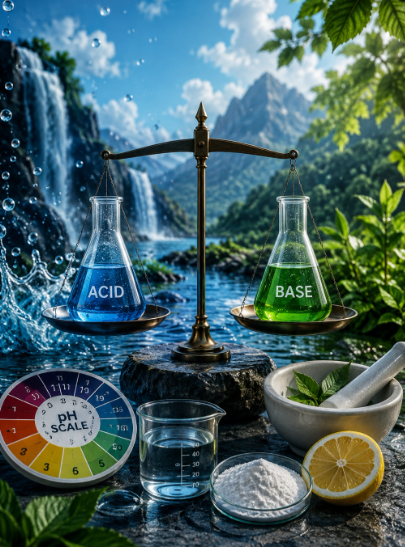
    On the table were several ordinary substances: lemon juice, vinegar, baking soda, soap, and pure water.

    Ayan looked at them and asked his teacher,

    “How can such different substances all be part of the same scientific system?”

    His teacher smiled.

    “Because many of them can be understood through the chemistry of acids, bases, and balance.”

    Ayan became curious.

    The World of Acids

    The teacher first placed a small amount of lemon juice on the table.

    “Lemon juice contains citric acid,” she explained.

    Acids are substances that, in water, increase the concentration of hydrogen ions (H⁺). Many acids have a sour taste, although scientists never identify an unknown chemical by tasting it.

    Ayan had seen acids in everyday life without realizing it.

    Vinegar contains acetic acid.

    The stomach naturally contains hydrochloric acid, which helps with digestion.

    Even some fruits contain naturally occurring acids.

    Ayan began to understand that the word “acid” did not always mean something dangerous.

    Discovering Bases

    Next, the teacher showed him a solution of baking soda.

    “This behaves as a base in water,” she said.

    Bases generally increase the concentration of hydroxide ions or accept hydrogen ions, depending on the chemical definition being used.

    Many basic substances are found around us.

    Some cleaning products are basic.

    Soap solutions are often basic.

    Certain minerals and compounds in nature can also behave as bases.

    Ayan realized that acids and bases were not simply opposites in a textbook.

    They were part of everyday chemistry.

    The pH Scale

    The teacher then drew a colorful scale on the board.

    It was the pH scale.

    “pH helps us describe how acidic or basic an aqueous solution is,” she explained.

    At about pH 7, a solution is considered neutral under standard conditions, such as pure water at around room temperature.

    Values below 7 are generally acidic.

    Values above 7 are generally basic.

    Ayan looked at the scale with fascination.

    The numbers seemed simple, but they represented important chemical differences.

    The teacher added:

    “The pH scale is logarithmic. A change of one pH unit represents a tenfold change in hydrogen-ion concentration.”

    Ayan suddenly realized that even a small numerical change could represent a significant chemical difference.

    When Acids and Bases Meet

    Then the teacher performed an experiment.

    She carefully combined an acid with a base.

    The two substances reacted.

    In many common acid-base reactions, the products include water and a salt. This type of reaction is often called neutralization.

    Ayan watched as the chemistry changed before his eyes.

    “So acids and bases can balance each other?” he asked.

    “In the right conditions, yes,” his teacher replied.

    “But neutralization does not always mean the final mixture has exactly pH 7. The result depends on the substances and their amounts.”

    Ayan nodded.

    Chemistry was more precise than he had imagined.

    Balance in Nature

    The teacher then showed Ayan pictures of lakes, soil, oceans, and living organisms.

    “Acid-base balance is important in nature too.”

    Soil chemistry can influence how nutrients are available to plants.

    The pH of freshwater can affect aquatic organisms.

    Ocean chemistry is also changing as the ocean absorbs carbon dioxide from the atmosphere, which leads to ocean acidification.

    This does not mean the ocean suddenly becomes a strong acid.

    Instead, its seawater chemistry shifts toward greater acidity, with important consequences for organisms that build shells or skeletons from calcium carbonate.

    Ayan began to see that chemistry was connected to the entire environment.

    Balance Inside the Human Body

    The teacher then explained that acid-base balance is also essential inside the human body.

    Blood normally stays within a narrow pH range.

    The body uses several systems—including the lungs and kidneys—to help regulate this balance.

    The lungs influence carbon dioxide levels, while the kidneys help regulate acids and bases over longer periods.

    Ayan was amazed.

    “Even our bodies have their own chemical balancing systems?”

    “Exactly,” said his teacher.

    The Power of Buffers

    There was one final concept.

    The teacher added:

    “Some solutions contain buffers.”

    Buffers help resist large changes in pH when relatively small amounts of acid or base are added.

    Ayan learned that buffer systems are important in chemistry, biology, medicine, and many natural environments.

    They help keep chemical conditions within useful ranges.

    The Lesson of Balance

    As the lesson ended, Ayan looked again at the bottles on the laboratory table.

    Lemon juice.

    Vinegar.

    Baking soda.

    Water.

    They seemed ordinary.

    But behind each substance was a world of chemical reactions, ions, and equilibrium.

    Ayan finally understood the lesson.

    Acids and bases are not simply about “strong” and “weak” chemicals.

    They are part of a larger story about chemical balance.

    From a laboratory experiment to soil, oceans, and living organisms, acid-base chemistry helps explain how many systems behave.

    Final Thought

    Nature depends on balance.

    Too much of one chemical condition can change an entire system, while the right balance can help maintain stability.

    Acids and bases teach us an important scientific lesson:9 sometimes, understanding two different forces interact is the key to understanding the system as a when
    accl task day 69 week 3 task: story post 69 topic:Acids and Bases: The Balance of Nature Title: 🧪 Acids and Bases: The Balance of Nature One afternoon, a curious student named Ayan entered the chemistry laboratory. On the table were several ordinary substances: lemon juice, vinegar, baking soda, soap, and pure water. Ayan looked at them and asked his teacher, “How can such different substances all be part of the same scientific system?” His teacher smiled. “Because many of them can be understood through the chemistry of acids, bases, and balance.” Ayan became curious. 🍋 The World of Acids The teacher first placed a small amount of lemon juice on the table. “Lemon juice contains citric acid,” she explained. Acids are substances that, in water, increase the concentration of hydrogen ions (H⁺). Many acids have a sour taste, although scientists never identify an unknown chemical by tasting it. Ayan had seen acids in everyday life without realizing it. Vinegar contains acetic acid. The stomach naturally contains hydrochloric acid, which helps with digestion. Even some fruits contain naturally occurring acids. Ayan began to understand that the word “acid” did not always mean something dangerous. 🧼 Discovering Bases Next, the teacher showed him a solution of baking soda. “This behaves as a base in water,” she said. Bases generally increase the concentration of hydroxide ions or accept hydrogen ions, depending on the chemical definition being used. Many basic substances are found around us. Some cleaning products are basic. Soap solutions are often basic. Certain minerals and compounds in nature can also behave as bases. Ayan realized that acids and bases were not simply opposites in a textbook. They were part of everyday chemistry. 🌈 The pH Scale The teacher then drew a colorful scale on the board. It was the pH scale. “pH helps us describe how acidic or basic an aqueous solution is,” she explained. At about pH 7, a solution is considered neutral under standard conditions, such as pure water at around room temperature. Values below 7 are generally acidic. Values above 7 are generally basic. Ayan looked at the scale with fascination. The numbers seemed simple, but they represented important chemical differences. The teacher added: “The pH scale is logarithmic. A change of one pH unit represents a tenfold change in hydrogen-ion concentration.” Ayan suddenly realized that even a small numerical change could represent a significant chemical difference. ⚖️ When Acids and Bases Meet Then the teacher performed an experiment. She carefully combined an acid with a base. The two substances reacted. In many common acid-base reactions, the products include water and a salt. This type of reaction is often called neutralization. Ayan watched as the chemistry changed before his eyes. “So acids and bases can balance each other?” he asked. “In the right conditions, yes,” his teacher replied. “But neutralization does not always mean the final mixture has exactly pH 7. The result depends on the substances and their amounts.” Ayan nodded. Chemistry was more precise than he had imagined. 🌱 Balance in Nature The teacher then showed Ayan pictures of lakes, soil, oceans, and living organisms. “Acid-base balance is important in nature too.” Soil chemistry can influence how nutrients are available to plants. The pH of freshwater can affect aquatic organisms. Ocean chemistry is also changing as the ocean absorbs carbon dioxide from the atmosphere, which leads to ocean acidification. This does not mean the ocean suddenly becomes a strong acid. Instead, its seawater chemistry shifts toward greater acidity, with important consequences for organisms that build shells or skeletons from calcium carbonate. Ayan began to see that chemistry was connected to the entire environment. 🧬 Balance Inside the Human Body The teacher then explained that acid-base balance is also essential inside the human body. Blood normally stays within a narrow pH range. The body uses several systems—including the lungs and kidneys—to help regulate this balance. The lungs influence carbon dioxide levels, while the kidneys help regulate acids and bases over longer periods. Ayan was amazed. “Even our bodies have their own chemical balancing systems?” “Exactly,” said his teacher. 🔬 The Power of Buffers There was one final concept. The teacher added: “Some solutions contain buffers.” Buffers help resist large changes in pH when relatively small amounts of acid or base are added. Ayan learned that buffer systems are important in chemistry, biology, medicine, and many natural environments. They help keep chemical conditions within useful ranges. 🌍 The Lesson of Balance As the lesson ended, Ayan looked again at the bottles on the laboratory table. Lemon juice. Vinegar. Baking soda. Water. They seemed ordinary. But behind each substance was a world of chemical reactions, ions, and equilibrium. Ayan finally understood the lesson. Acids and bases are not simply about “strong” and “weak” chemicals. They are part of a larger story about chemical balance. From a laboratory experiment to soil, oceans, and living organisms, acid-base chemistry helps explain how many systems behave. ⚗️ Final Thought Nature depends on balance. Too much of one chemical condition can change an entire system, while the right balance can help maintain stability. Acids and bases teach us an important scientific lesson:9 sometimes, understanding two different forces interact is the key to understanding the system as a when
    0 Comentários 0 Compartilhamentos 4302 Visualizações
  • #rsisb
    Roll no.279
    story post no.12
    Foundation Level

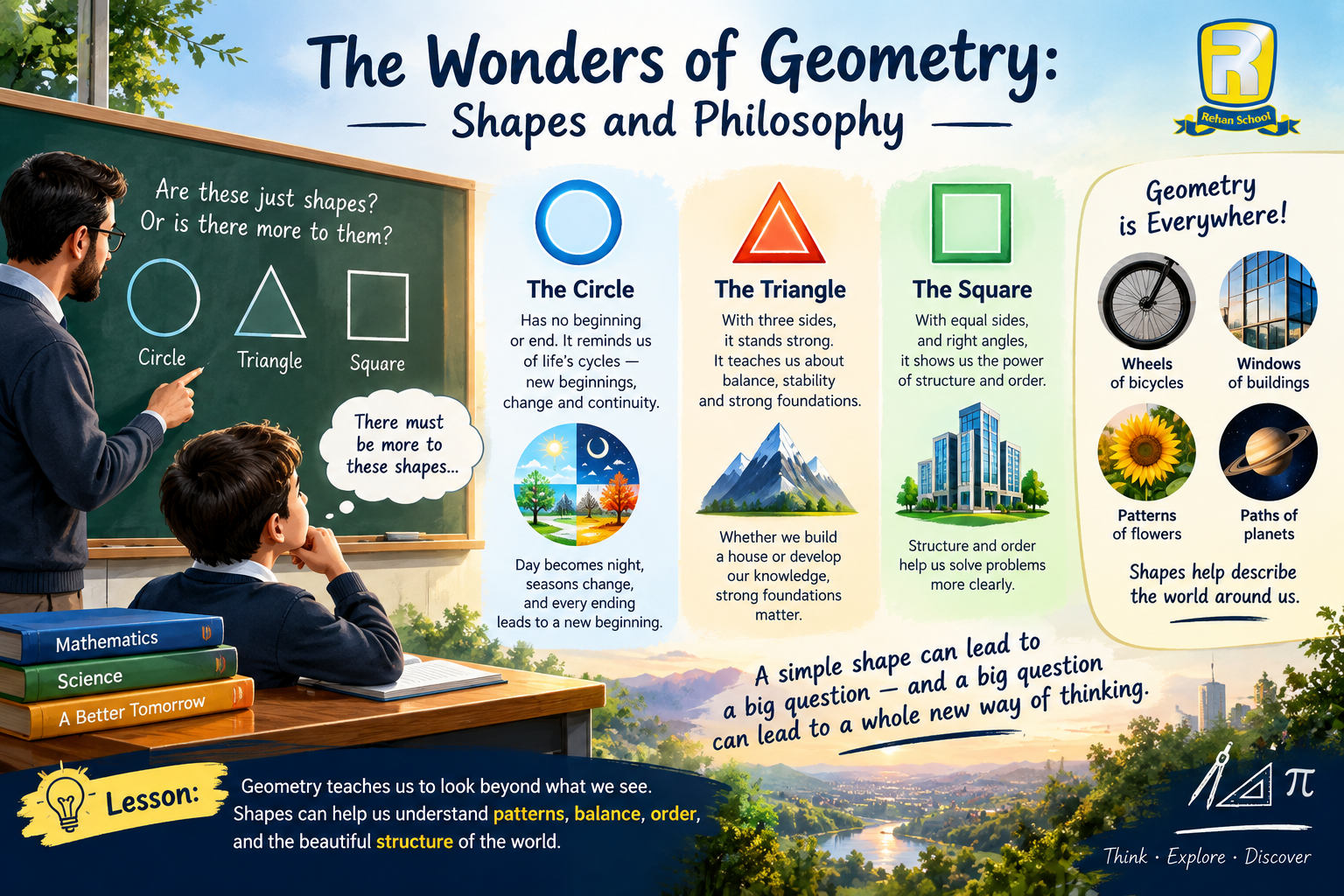
    Once upon a time, in a small village surrounded by green hills , there lived a curious student named Ayan. He loved asking questions about the world around him. One day, his teacher drew three simple shapes on the board: a **circle , a triangle , and a square **.
    “Are these just shapes?” the teacher asked.
    Ayan looked carefully and replied, “I think there must be more to them.”
    The teacher smiled. “Exactly! Geometry is not only about measuring lines and angles. It can also teach us interesting lessons about the way we think and see the world.”
    The **circle ** had no beginning or end. Ayan thought about how life is full of cycles—day becomes night , seasons change , and every ending can lead to a new beginning.
    Then he looked at the **triangle **. Its three sides stood firmly together. The teacher explained that a triangle can remind us of **balance and stability**. Ayan realized that strong foundations are important, whether we are building a house or developing our knowledge .
    Finally, there was the **square **. Its equal sides and right angles made it look perfectly organized. Ayan thought about how structure and order can help us solve problems more clearly.
    As the lesson ended, Ayan understood something important: **geometry is everywhere**. From the wheels of bicycles to the windows of buildings , from the patterns of flowers to the paths of planets , shapes help describe the world around us.
    He walked home with a smile and realized that sometimes a simple shape can lead to a big question—and a big question can lead to a whole new way of thinking.
    ### Lesson:
    **Geometry teaches us to look beyond what we see. Shapes can help us understand patterns, balance, order, and the beautiful structure of the world.**
    #Geometry #Shapes #Philosophy #Mathematics #Learning #ScienceAndMath #CreativeThinking #Education #Knowledge #GeometryWorld #ThinkDifferent
    Asma Shaheen EducationWali
    Saima Happinesswali
    Irum Asim Leadershipwali
    #rsisb Roll no.279 story post no.12 Foundation Level Once upon a time, in a small village surrounded by green hills 🌿🏔️, there lived a curious student named Ayan. He loved asking questions about the world around him. One day, his teacher drew three simple shapes on the board: a **circle ⭕, a triangle 🔺, and a square ⬜**. “Are these just shapes?” the teacher asked. Ayan looked carefully and replied, “I think there must be more to them.” 🤔 The teacher smiled. “Exactly! Geometry is not only about measuring lines and angles. It can also teach us interesting lessons about the way we think and see the world.” 🧠✨ The **circle ⭕** had no beginning or end. Ayan thought about how life is full of cycles—day becomes night 🌞🌙, seasons change 🍂🌸, and every ending can lead to a new beginning. 🔄 Then he looked at the **triangle 🔺**. Its three sides stood firmly together. The teacher explained that a triangle can remind us of **balance and stability**. ⚖️ Ayan realized that strong foundations are important, whether we are building a house 🏠 or developing our knowledge 📚. Finally, there was the **square ⬜**. Its equal sides and right angles made it look perfectly organized. Ayan thought about how structure and order can help us solve problems more clearly. 🧩💡 As the lesson ended, Ayan understood something important: **geometry is everywhere**. 🏙️🌉🌳 From the wheels of bicycles 🚲 to the windows of buildings 🪟, from the patterns of flowers 🌸 to the paths of planets 🌍✨, shapes help describe the world around us. He walked home with a smile and realized that sometimes a simple shape can lead to a big question—and a big question can lead to a whole new way of thinking. 🌟🧠 ### 💭 Lesson: **Geometry teaches us to look beyond what we see. Shapes can help us understand patterns, balance, order, and the beautiful structure of the world.** 📐🌍✨ #Geometry #Shapes #Philosophy #Mathematics #Learning #ScienceAndMath #CreativeThinking #Education #Knowledge #GeometryWorld #ThinkDifferent 🔺⭕⬜📐🧠🌟📚🚀 Asma Shaheen EducationWali Saima Happinesswali Irum Asim Leadershipwali
    0 Comentários 0 Compartilhamentos 1842 Visualizações
Páginas impulsionada