• #rsisb
    Roll no. 247
    Story post . 18
    Foundation level

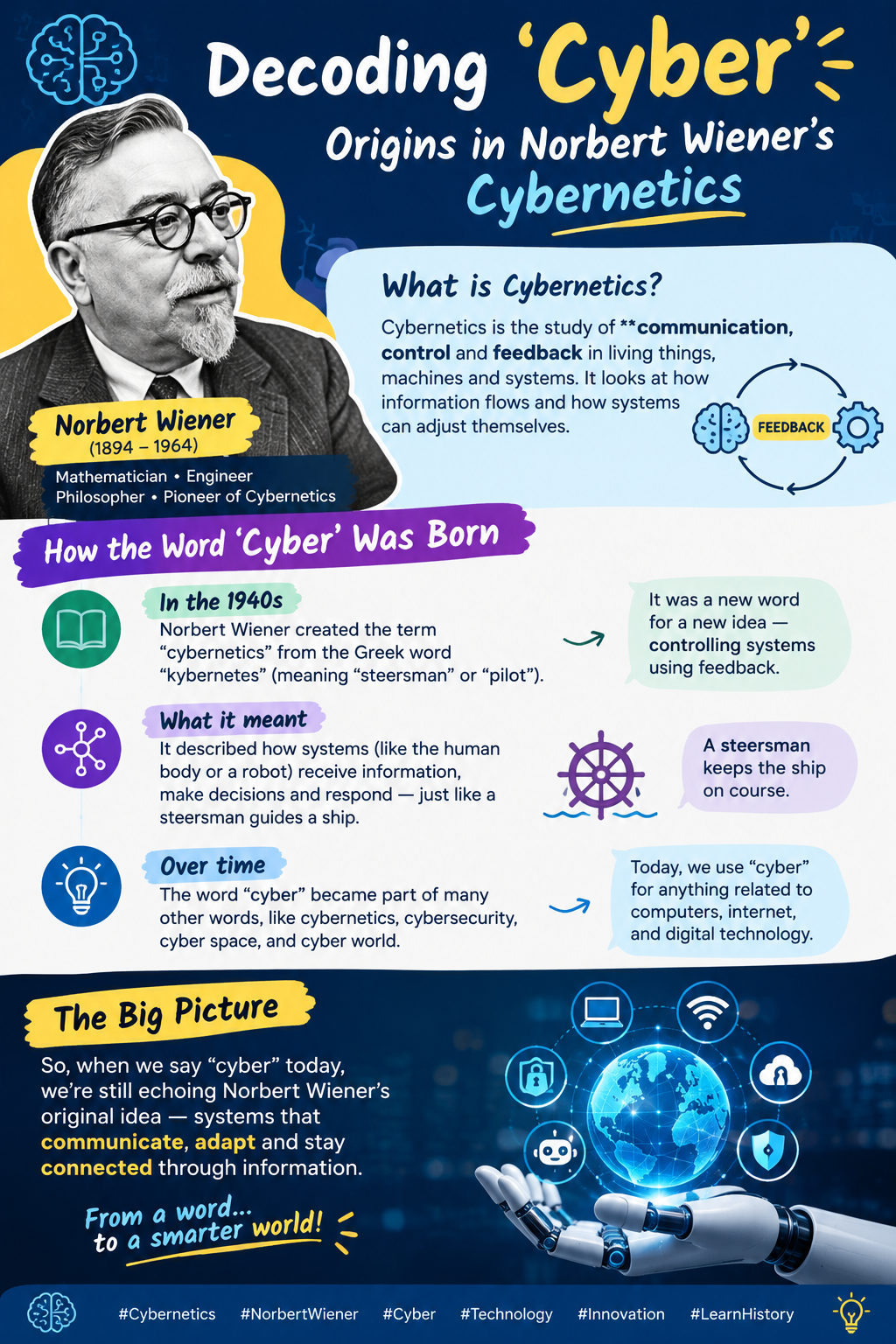
    **Story Post — Decoding “Cyber”: Origins in Norbert Wiener’s Cybernetics**

    **Have you ever wondered where the word “Cyber” comes from?**

    The word *Cyber* is connected to the fascinating world of **cybernetics**, a field that explores communication, control, and feedback in both living organisms and machines. It helps us understand how humans, computers, and other systems receive information, respond to changes, and make adjustments.

    **The Story Behind Cybernetics**

    The story takes us back to **Norbert Wiener (1894–1964)**, an American mathematician who helped establish the field of cybernetics. In 1948, he published his influential book *Cybernetics: Or Control and Communication in the Animal and the Machine*.

    Wiener explored how communication and control work in animals and machines. One important concept was **feedback**—when a system uses information about its results to adjust what it does next.

    For example, a thermostat checks the temperature of a room and adjusts the heating to maintain the desired temperature. Similarly, modern robots use sensors to understand their surroundings and adjust their movements. These ideas help us understand many technologies we use today!

    **How Did “Cyber” Become So Popular?**

    Over time, the word *cyber* became associated with computers, digital communication, and the internet. Today, we hear it in words such as:

    **Cybersecurity** — protecting computers, networks, and information from digital threats.

    **Cyberspace** — the digital environment where people communicate and interact online.

    **Cybercrime** — illegal activities involving computers or digital networks.

    **Cybernetics** — the study of control, communication, and feedback in systems.

    From the early ideas of cybernetics to today's connected digital world, this little word has become part of our everyday vocabulary!

    **Why Is This Story Important?**

    Understanding the history of the word *cyber* helps us appreciate how scientific ideas influence language and technology. It also reminds us that many modern inventions are built on ideas developed decades ago. Every time we use the internet, learn about artificial intelligence, or explore robotics, we encounter concepts connected to communication, information, and control.

    **Today's Learning Message:**
    Every word has a story, and every story can teach us something new! Keep asking questions, exploring history, and discovering how science shapes our world.

    **Question for You:**
    Which cyber-related topic interests you the most: cybersecurity, artificial intelligence, robotics, or the history of the internet? Share your answer in the comments!

    Like, share, and comment to help others discover the amazing story behind the word *Cyber*!
    #rsisb Roll no. 247 Story post . 18 Foundation level ๐ŸŒ๐Ÿค– **Story Post — Decoding “Cyber”: Origins in Norbert Wiener’s Cybernetics** ๐Ÿ’ป๐Ÿ“š โœจ **Have you ever wondered where the word “Cyber” comes from?** ๐Ÿš€ The word *Cyber* is connected to the fascinating world of **cybernetics**, a field that explores communication, control, and feedback in both living organisms and machines. ๐Ÿง โš™๏ธ It helps us understand how humans, computers, and other systems receive information, respond to changes, and make adjustments. ๐Ÿ“– **The Story Behind Cybernetics** The story takes us back to **Norbert Wiener (1894–1964)**, an American mathematician who helped establish the field of cybernetics. In 1948, he published his influential book *Cybernetics: Or Control and Communication in the Animal and the Machine*. ๐Ÿ“˜๐Ÿ”ฌ Wiener explored how communication and control work in animals and machines. One important concept was **feedback**—when a system uses information about its results to adjust what it does next. ๐Ÿ”„๐Ÿค– For example, a thermostat checks the temperature of a room and adjusts the heating to maintain the desired temperature. ๐ŸŒก๏ธ๐Ÿ  Similarly, modern robots use sensors to understand their surroundings and adjust their movements. These ideas help us understand many technologies we use today! ๐ŸŒ **How Did “Cyber” Become So Popular?** Over time, the word *cyber* became associated with computers, digital communication, and the internet. Today, we hear it in words such as: ๐Ÿ’ป **Cybersecurity** — protecting computers, networks, and information from digital threats. ๐ŸŒ **Cyberspace** — the digital environment where people communicate and interact online. ๐Ÿ•ต๏ธ **Cybercrime** — illegal activities involving computers or digital networks. ๐Ÿค– **Cybernetics** — the study of control, communication, and feedback in systems. From the early ideas of cybernetics to today's connected digital world, this little word has become part of our everyday vocabulary! ๐ŸŒŸ ๐ŸŽฏ **Why Is This Story Important?** Understanding the history of the word *cyber* helps us appreciate how scientific ideas influence language and technology. It also reminds us that many modern inventions are built on ideas developed decades ago. Every time we use the internet, learn about artificial intelligence, or explore robotics, we encounter concepts connected to communication, information, and control. ๐Ÿš€๐Ÿง  ๐Ÿ’ก **Today's Learning Message:** Every word has a story, and every story can teach us something new! Keep asking questions, exploring history, and discovering how science shapes our world. ๐Ÿ“šโœจ ๐Ÿ’ฌ **Question for You:** Which cyber-related topic interests you the most: cybersecurity, artificial intelligence, robotics, or the history of the internet? Share your answer in the comments! ๐Ÿ‘‡๐ŸŒ โค๏ธ Like, share, and comment to help others discover the amazing story behind the word *Cyber*!
    0 Commenti 0 condivisioni 7 Views

  • #rsisb
    Roll no. 247
    Story post . 18
    Foundation level

    **Story Post — Decoding “Cyber”: Origins in Norbert Wiener’s Cybernetics**

    **Have you ever wondered where the word “Cyber” comes from?**

    The word *Cyber* is connected to the fascinating world of **cybernetics**, a field that explores communication, control, and feedback in both living organisms and machines. It helps us understand how humans, computers, and other systems receive information, respond to changes, and make adjustments.

    **The Story Behind Cybernetics**

    The story takes us back to **Norbert Wiener (1894–1964)**, an American mathematician who helped establish the field of cybernetics. In 1948, he published his influential book *Cybernetics: Or Control and Communication in the Animal and the Machine*.

    Wiener explored how communication and control work in animals and machines. One important concept was **feedback**—when a system uses information about its results to adjust what it does next.

    For example, a thermostat checks the temperature of a room and adjusts the heating to maintain the desired temperature. Similarly, modern robots use sensors to understand their surroundings and adjust their movements. These ideas help us understand many technologies we use today!

    **How Did “Cyber” Become So Popular?**

    Over time, the word *cyber* became associated with computers, digital communication, and the internet. Today, we hear it in words such as:

    **Cybersecurity** — protecting computers, networks, and information from digital threats.

    **Cyberspace** — the digital environment where people communicate and interact online.

    **Cybercrime** — illegal activities involving computers or digital networks.

    **Cybernetics** — the study of control, communication, and feedback in systems.

    From the early ideas of cybernetics to today's connected digital world, this little word has become part of our everyday vocabulary!

    **Why Is This Story Important?**

    Understanding the history of the word *cyber* helps us appreciate how scientific ideas influence language and technology. It also reminds us that many modern inventions are built on ideas developed decades ago. Every time we use the internet, learn about artificial intelligence, or explore robotics, we encounter concepts connected to communication, information, and control.

    **Today's Learning Message:**
    Every word has a story, and every story can teach us something new! Keep asking questions, exploring history, and discovering how science shapes our world.

    **Question for You:**
    Which cyber-related topic interests you the most: cybersecurity, artificial intelligence, robotics, or the history of the internet? Share your answer in the comments!

    Like, share, and comment to help others discover the amazing story behind the word *Cyber*!

    #Cyber #Cybernetics #NorbertWiener #WordOrigins #HistoryOfTechnology #Technology #Science #ComputerScience #ArtificialIntelligence #AI #Cybersecurity #DigitalWorld #Internet #Robotics #Innovation #LearningEveryDay #EducationalContent #DidYouKnow #KnowledgeIsPower #TechHistory #DigitalLiteracy #StoryPost #RehanSchool #RSISB #RehanCodingWithAI
    #rsisb Roll no. 247 Story post . 18 Foundation level ๐ŸŒ๐Ÿค– **Story Post — Decoding “Cyber”: Origins in Norbert Wiener’s Cybernetics** ๐Ÿ’ป๐Ÿ“š โœจ **Have you ever wondered where the word “Cyber” comes from?** ๐Ÿš€ The word *Cyber* is connected to the fascinating world of **cybernetics**, a field that explores communication, control, and feedback in both living organisms and machines. ๐Ÿง โš™๏ธ It helps us understand how humans, computers, and other systems receive information, respond to changes, and make adjustments. ๐Ÿ“– **The Story Behind Cybernetics** The story takes us back to **Norbert Wiener (1894–1964)**, an American mathematician who helped establish the field of cybernetics. In 1948, he published his influential book *Cybernetics: Or Control and Communication in the Animal and the Machine*. ๐Ÿ“˜๐Ÿ”ฌ Wiener explored how communication and control work in animals and machines. One important concept was **feedback**—when a system uses information about its results to adjust what it does next. ๐Ÿ”„๐Ÿค– For example, a thermostat checks the temperature of a room and adjusts the heating to maintain the desired temperature. ๐ŸŒก๏ธ๐Ÿ  Similarly, modern robots use sensors to understand their surroundings and adjust their movements. These ideas help us understand many technologies we use today! ๐ŸŒ **How Did “Cyber” Become So Popular?** Over time, the word *cyber* became associated with computers, digital communication, and the internet. Today, we hear it in words such as: ๐Ÿ’ป **Cybersecurity** — protecting computers, networks, and information from digital threats. ๐ŸŒ **Cyberspace** — the digital environment where people communicate and interact online. ๐Ÿ•ต๏ธ **Cybercrime** — illegal activities involving computers or digital networks. ๐Ÿค– **Cybernetics** — the study of control, communication, and feedback in systems. From the early ideas of cybernetics to today's connected digital world, this little word has become part of our everyday vocabulary! ๐ŸŒŸ ๐ŸŽฏ **Why Is This Story Important?** Understanding the history of the word *cyber* helps us appreciate how scientific ideas influence language and technology. It also reminds us that many modern inventions are built on ideas developed decades ago. Every time we use the internet, learn about artificial intelligence, or explore robotics, we encounter concepts connected to communication, information, and control. ๐Ÿš€๐Ÿง  ๐Ÿ’ก **Today's Learning Message:** Every word has a story, and every story can teach us something new! Keep asking questions, exploring history, and discovering how science shapes our world. ๐Ÿ“šโœจ ๐Ÿ’ฌ **Question for You:** Which cyber-related topic interests you the most: cybersecurity, artificial intelligence, robotics, or the history of the internet? Share your answer in the comments! ๐Ÿ‘‡๐ŸŒ โค๏ธ Like, share, and comment to help others discover the amazing story behind the word *Cyber*! #Cyber #Cybernetics #NorbertWiener #WordOrigins #HistoryOfTechnology #Technology #Science #ComputerScience #ArtificialIntelligence #AI #Cybersecurity #DigitalWorld #Internet #Robotics #Innovation #LearningEveryDay #EducationalContent #DidYouKnow #KnowledgeIsPower #TechHistory #DigitalLiteracy #StoryPost #RehanSchool #RSISB #RehanCodingWithAI ๐Ÿš€๐Ÿ’ป๐Ÿ“š
    0 Commenti 0 condivisioni 8 Views
  • #rsisb
    Roll no. 247
    ChatGPT Image . 21
    Foundation level

    **Good Things Take Time**

    Remember, beautiful things take time to grow! Just like a tiny seed needs sunlight, water, and patience to become a beautiful flower , our dreams also need time, effort, dedication, and belief.

    In life, we sometimes want everything to happen quickly. We want success, happiness, and achievements right away. But the truth is that **great things are not built in one day.** Every small step, every lesson, and every challenge helps us grow stronger and wiser.

    Never compare your journey with someone else's journey. Everyone has a different path, a different speed, and a different story. Some flowers bloom early, while others take more time—but every flower has its own beauty!

    If you are learning something new, working on a dream, improving your skills, or trying to become a better person, keep going! Even when progress feels slow, remember that your efforts matter. Small steps can lead to big achievements!

    Be patient with yourself. Trust the process, stay positive, and never stop believing in your potential. Your hard work today can become your success tomorrow!

    **Keep growing. Keep learning. Keep believing. Your time will come!**

    **What is one dream you are working toward?** Share it in the comments!

    Like , Comment , Share , and Follow for more motivational thoughts and positive inspiration!

    #rsisb Roll no. 247 ChatGPT Image . 21 Foundation level ๐ŸŒฑโœจ **Good Things Take Time** โณ๐Ÿ’– ๐ŸŒธ Remember, beautiful things take time to grow! ๐ŸŒป๐ŸŒฟ Just like a tiny seed needs sunlight, water, and patience to become a beautiful flower ๐ŸŒทโ˜€๏ธ, our dreams also need time, effort, dedication, and belief. ๐Ÿ’ช๐Ÿ’ซ ๐Ÿš€ In life, we sometimes want everything to happen quickly. We want success, happiness, and achievements right away. But the truth is that **great things are not built in one day.** ๐Ÿ†โœจ Every small step, every lesson, and every challenge helps us grow stronger and wiser. ๐Ÿ“š๐Ÿง ๐Ÿ’ช ๐ŸŒˆ Never compare your journey with someone else's journey. Everyone has a different path, a different speed, and a different story. ๐Ÿ›ค๏ธ๐Ÿ’– Some flowers bloom early, while others take more time—but every flower has its own beauty! ๐ŸŒบ๐ŸŒผ ๐Ÿ’ก If you are learning something new, working on a dream, improving your skills, or trying to become a better person, keep going! ๐ŸŽฏ๐Ÿ”ฅ Even when progress feels slow, remember that your efforts matter. Small steps can lead to big achievements! ๐Ÿ‘ฃ๐Ÿ† โค๏ธ Be patient with yourself. Trust the process, stay positive, and never stop believing in your potential. ๐ŸŒŸ Your hard work today can become your success tomorrow! ๐ŸŒ…โœจ ๐ŸŒป **Keep growing. Keep learning. Keep believing. Your time will come!** ๐Ÿ’–๐Ÿš€ ๐Ÿ’ฌ **What is one dream you are working toward?** Share it in the comments! ๐Ÿ‘‡๐Ÿ˜Š ๐Ÿ“ฒ Like โค๏ธ, Comment ๐Ÿ’ฌ, Share ๐Ÿ”„, and Follow โž• for more motivational thoughts and positive inspiration! ๐ŸŒโœจ
    0 Commenti 0 condivisioni 12 Views
  • #rsisb
    Roll no. 247
    ChatGPT Image . 21
    Foundation level

    **Good Things Take Time**

    Remember, beautiful things take time to grow! Just like a tiny seed needs sunlight, water, and patience to become a beautiful flower , our dreams also need time, effort, dedication, and belief.

    In life, we sometimes want everything to happen quickly. We want success, happiness, and achievements right away. But the truth is that **great things are not built in one day.** Every small step, every lesson, and every challenge helps us grow stronger and wiser.

    Never compare your journey with someone else's journey. Everyone has a different path, a different speed, and a different story. Some flowers bloom early, while others take more time—but every flower has its own beauty!

    If you are learning something new, working on a dream, improving your skills, or trying to become a better person, keep going! Even when progress feels slow, remember that your efforts matter. Small steps can lead to big achievements!

    Be patient with yourself. Trust the process, stay positive, and never stop believing in your potential. Your hard work today can become your success tomorrow!

    **Keep growing. Keep learning. Keep believing. Your time will come!**

    **What is one dream you are working toward?** Share it in the comments!

    Like , Comment , Share , and Follow for more motivational thoughts and positive inspiration!

    #GoodThingsTakeTime #Motivation #DailyMotivation #PositiveMindset #NeverGiveUp #StayPatient #TrustTheProcess #BelieveInYourself #KeepGrowing #DreamBig #StayPositive #SuccessMindset #PersonalGrowth #InspirationalQuotes #LifeLessons #KeepLearning #SmallStepsBigResults #NeverStopLearning #PositiveVibes #MotivationalPost #GrowthMindset #DreamsComeTrue #PatienceIsPower #RehanSchool #RSISB
    #rsisb Roll no. 247 ChatGPT Image . 21 Foundation level ๐ŸŒฑโœจ **Good Things Take Time** โณ๐Ÿ’– ๐ŸŒธ Remember, beautiful things take time to grow! ๐ŸŒป๐ŸŒฟ Just like a tiny seed needs sunlight, water, and patience to become a beautiful flower ๐ŸŒทโ˜€๏ธ, our dreams also need time, effort, dedication, and belief. ๐Ÿ’ช๐Ÿ’ซ ๐Ÿš€ In life, we sometimes want everything to happen quickly. We want success, happiness, and achievements right away. But the truth is that **great things are not built in one day.** ๐Ÿ†โœจ Every small step, every lesson, and every challenge helps us grow stronger and wiser. ๐Ÿ“š๐Ÿง ๐Ÿ’ช ๐ŸŒˆ Never compare your journey with someone else's journey. Everyone has a different path, a different speed, and a different story. ๐Ÿ›ค๏ธ๐Ÿ’– Some flowers bloom early, while others take more time—but every flower has its own beauty! ๐ŸŒบ๐ŸŒผ ๐Ÿ’ก If you are learning something new, working on a dream, improving your skills, or trying to become a better person, keep going! ๐ŸŽฏ๐Ÿ”ฅ Even when progress feels slow, remember that your efforts matter. Small steps can lead to big achievements! ๐Ÿ‘ฃ๐Ÿ† โค๏ธ Be patient with yourself. Trust the process, stay positive, and never stop believing in your potential. ๐ŸŒŸ Your hard work today can become your success tomorrow! ๐ŸŒ…โœจ ๐ŸŒป **Keep growing. Keep learning. Keep believing. Your time will come!** ๐Ÿ’–๐Ÿš€ ๐Ÿ’ฌ **What is one dream you are working toward?** Share it in the comments! ๐Ÿ‘‡๐Ÿ˜Š ๐Ÿ“ฒ Like โค๏ธ, Comment ๐Ÿ’ฌ, Share ๐Ÿ”„, and Follow โž• for more motivational thoughts and positive inspiration! ๐ŸŒโœจ #GoodThingsTakeTime #Motivation #DailyMotivation #PositiveMindset #NeverGiveUp #StayPatient #TrustTheProcess #BelieveInYourself #KeepGrowing #DreamBig #StayPositive #SuccessMindset #PersonalGrowth #InspirationalQuotes #LifeLessons #KeepLearning #SmallStepsBigResults #NeverStopLearning #PositiveVibes #MotivationalPost #GrowthMindset #DreamsComeTrue #PatienceIsPower #RehanSchool #RSISB
    0 Commenti 0 condivisioni 17 Views
  • #rsisb
    Roll No.177
    Turkish Session No.2
    Level One

    **Learn Turkish Language | 50 Easy Turkish Questions for Beginners**

    Welcome to our Turkish language learning journey! In this session, we are practicing 50 easy and useful questions in Turkish to improve our speaking, reading, and communication skills. These questions are perfect for beginners who want to learn Turkish step by step and speak with confidence.

    Turkish is a beautiful language spoken by millions of people around the world. Learning Turkish helps us explore Turkish culture, make new friends, understand new words, and communicate with people from different backgrounds.

    In this learning session, we will practice simple Turkish questions about introducing ourselves , family ‍‍‍, school , hobbies , favorite foods , daily routines , and future dreams .

    Each question includes Turkish , Roman pronunciation , and English meaning , making it easier for students to read, understand, memorize, and practice speaking.

    Learning a new language takes patience, practice, and confidence! Don't be afraid to make mistakes because every mistake is an opportunity to learn something new. Practice a few questions every day, speak aloud, and continue improving your Turkish language skills.

    https://youtu.be/PRg23C6in-I
    #rsisb Roll No.177 Turkish Session No.2 Level One ๐Ÿ‡น๐Ÿ‡ทโœจ **Learn Turkish Language | 50 Easy Turkish Questions for Beginners** ๐Ÿ“š๐Ÿ—ฃ๏ธ๐ŸŒ Welcome to our Turkish language learning journey! ๐Ÿ‡น๐Ÿ‡ท๐ŸŽ‰ In this session, we are practicing 50 easy and useful questions in Turkish to improve our speaking, reading, and communication skills. ๐Ÿ“๐Ÿ’ฌ๐Ÿ˜Š These questions are perfect for beginners who want to learn Turkish step by step and speak with confidence. ๐Ÿ’ช๐ŸŒŸ Turkish is a beautiful language spoken by millions of people around the world. ๐ŸŒโค๏ธ Learning Turkish helps us explore Turkish culture, make new friends, understand new words, and communicate with people from different backgrounds. ๐Ÿค๐ŸŽŒ๐Ÿ“– In this learning session, we will practice simple Turkish questions about introducing ourselves ๐Ÿ‘‹, family ๐Ÿ‘จ‍๐Ÿ‘ฉ‍๐Ÿ‘ง‍๐Ÿ‘ฆ, school ๐Ÿซ, hobbies ๐ŸŽจโšฝ, favorite foods ๐Ÿ•๐Ÿฝ๏ธ, daily routines โฐ๐ŸŒ…, and future dreams ๐ŸŒˆ๐Ÿš€. Each question includes Turkish ๐Ÿ‡น๐Ÿ‡ท, Roman pronunciation ๐Ÿ”ค, and English meaning ๐Ÿ‡ฌ๐Ÿ‡ง, making it easier for students to read, understand, memorize, and practice speaking. ๐Ÿง ๐Ÿ“šโœ๏ธ Learning a new language takes patience, practice, and confidence! ๐ŸŒฑ๐Ÿ’ฏ Don't be afraid to make mistakes because every mistake is an opportunity to learn something new. ๐Ÿ’ก๐Ÿ’– Practice a few questions every day, speak aloud, and continue improving your Turkish language skills. ๐Ÿ—ฃ๏ธ๐ŸŽฏ https://youtu.be/PRg23C6in-I
    0 Commenti 0 condivisioni 10 Views
  • #rsisb
    Roll no. 247
    Story post . 18
    Foundation level

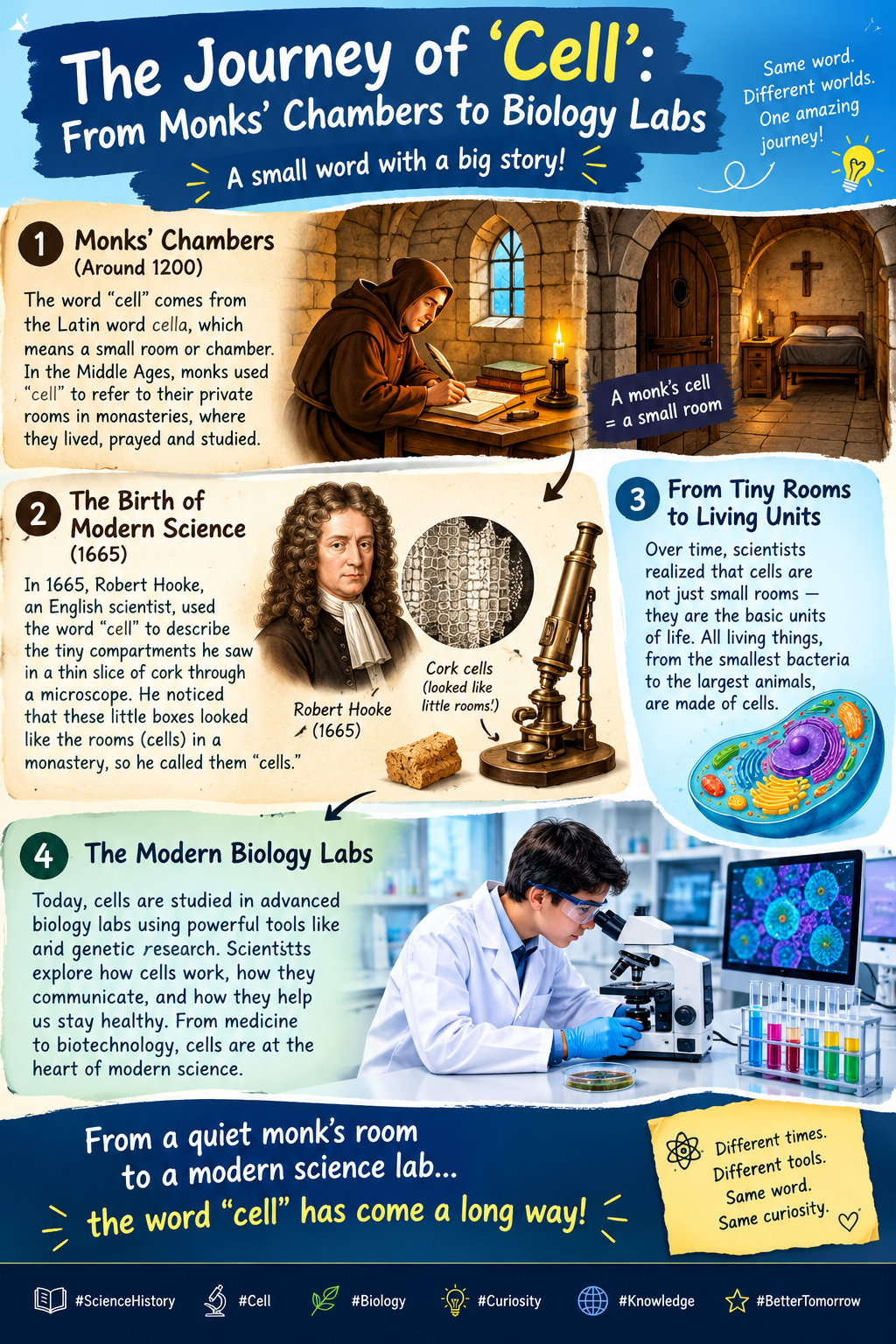
    **The Journey of “Cell”: From Monks’ Chambers to Biology Labs **

    **Have you ever wondered why the tiny building blocks of life are called “cells”?** The story behind this important scientific word takes us on a fascinating journey from the quiet chambers of monks to modern biology laboratories!

    The word **“cell”** comes from the Latin word *cella*, which means a small room or chamber. In the past, monks lived and prayed in small rooms called cells. These simple rooms inspired a name that would later become one of the most important words in biology! ‍

    In 1665, an English scientist named **Robert Hooke** made an important discovery. While examining a thin slice of cork under a microscope, he noticed many tiny, box-like compartments. They reminded him of the small rooms where monks lived, so he called them **“cells.”** This observation was published in his famous book *Micrographia*.

    But the story did not end there! Years later, scientists developed better microscopes and discovered that cells were not just empty compartments. They were the basic units of living things!

    ‍‍ Scientists such as **Antonie van Leeuwenhoek** observed living microscopic organisms, while other researchers helped build our understanding of cells. Over time, scientists developed the **cell theory**, which explains that all living organisms are made of one or more cells and that new cells come from existing cells.

    Today, cells are studied in laboratories all around the world. Scientists explore how cells grow, obtain energy, communicate, reproduce, and help our bodies function. From the cells in plants to the cells in humans , these tiny structures play an enormous role in life!

    **What makes this journey so amazing?** A word that once described a small room became the name for the fundamental unit of life. It reminds us that even the smallest observation can lead to a huge scientific discovery!

    **Learning Message:** Stay curious, keep asking questions, and never underestimate the power of observation. Every great discovery begins with someone noticing something others might overlook!

    **Question for You:** If you could look at any object under a powerful microscope, what would you choose to explore? Share your answer in the comments!

    Like, share, and comment to spread the love of science and learning! Let's inspire more young scientists to explore the amazing world around us.

    #rsisb Roll no. 247 Story post . 18 Foundation level ๐Ÿ”ฌ๐Ÿ“š **The Journey of “Cell”: From Monks’ Chambers to Biology Labs ๐Ÿงซโœจ** ๐ŸŒ๐Ÿค” **Have you ever wondered why the tiny building blocks of life are called “cells”?** The story behind this important scientific word takes us on a fascinating journey from the quiet chambers of monks to modern biology laboratories! ๐Ÿ›๏ธโžก๏ธ๐Ÿ”ฌ ๐Ÿ“–โœจ The word **“cell”** comes from the Latin word *cella*, which means a small room or chamber. In the past, monks lived and prayed in small rooms called cells. These simple rooms inspired a name that would later become one of the most important words in biology! ๐Ÿง‘‍๐Ÿซ๐Ÿ›๏ธ ๐Ÿ”๐Ÿงช In 1665, an English scientist named **Robert Hooke** made an important discovery. While examining a thin slice of cork under a microscope, he noticed many tiny, box-like compartments. They reminded him of the small rooms where monks lived, so he called them **“cells.”** ๐Ÿงซ๐Ÿ”ฌ This observation was published in his famous book *Micrographia*. ๐ŸŒŸ๐Ÿ”ฌ But the story did not end there! Years later, scientists developed better microscopes and discovered that cells were not just empty compartments. They were the basic units of living things! ๐Ÿฆ ๐ŸŒฑ ๐Ÿ‘จ‍๐Ÿ”ฌ๐Ÿ‘ฉ‍๐Ÿ”ฌ Scientists such as **Antonie van Leeuwenhoek** observed living microscopic organisms, while other researchers helped build our understanding of cells. Over time, scientists developed the **cell theory**, which explains that all living organisms are made of one or more cells and that new cells come from existing cells. ๐Ÿงฌ๐Ÿ’ก ๐ŸŒฟ๐Ÿพ Today, cells are studied in laboratories all around the world. Scientists explore how cells grow, obtain energy, communicate, reproduce, and help our bodies function. From the cells in plants ๐ŸŒฑ to the cells in humans ๐Ÿง, these tiny structures play an enormous role in life! ๐Ÿš€๐Ÿ’ญ **What makes this journey so amazing?** A word that once described a small room became the name for the fundamental unit of life. It reminds us that even the smallest observation can lead to a huge scientific discovery! ๐ŸŽฏ๐Ÿ“š **Learning Message:** Stay curious, keep asking questions, and never underestimate the power of observation. Every great discovery begins with someone noticing something others might overlook! ๐ŸŒˆ๐Ÿ” ๐Ÿ’ฌ **Question for You:** If you could look at any object under a powerful microscope, what would you choose to explore? ๐Ÿ”ฌ๐Ÿค” Share your answer in the comments! โค๏ธ๐Ÿ‘ Like, share, and comment to spread the love of science and learning! Let's inspire more young scientists to explore the amazing world around us. ๐ŸŒ๐Ÿงชโœจ
    0 Commenti 0 condivisioni 14 Views
  • #rsisb
    Roll no. 247
    Story post . 18
    Foundation level

    **The Journey of “Cell”: From Monks’ Chambers to Biology Labs **

    **Have you ever wondered why the tiny building blocks of life are called “cells”?** The story behind this important scientific word takes us on a fascinating journey from the quiet chambers of monks to modern biology laboratories!

    The word **“cell”** comes from the Latin word *cella*, which means a small room or chamber. In the past, monks lived and prayed in small rooms called cells. These simple rooms inspired a name that would later become one of the most important words in biology! ‍

    In 1665, an English scientist named **Robert Hooke** made an important discovery. While examining a thin slice of cork under a microscope, he noticed many tiny, box-like compartments. They reminded him of the small rooms where monks lived, so he called them **“cells.”** This observation was published in his famous book *Micrographia*.

    But the story did not end there! Years later, scientists developed better microscopes and discovered that cells were not just empty compartments. They were the basic units of living things!

    ‍‍ Scientists such as **Antonie van Leeuwenhoek** observed living microscopic organisms, while other researchers helped build our understanding of cells. Over time, scientists developed the **cell theory**, which explains that all living organisms are made of one or more cells and that new cells come from existing cells.

    Today, cells are studied in laboratories all around the world. Scientists explore how cells grow, obtain energy, communicate, reproduce, and help our bodies function. From the cells in plants to the cells in humans , these tiny structures play an enormous role in life!

    **What makes this journey so amazing?** A word that once described a small room became the name for the fundamental unit of life. It reminds us that even the smallest observation can lead to a huge scientific discovery!

    **Learning Message:** Stay curious, keep asking questions, and never underestimate the power of observation. Every great discovery begins with someone noticing something others might overlook!

    **Question for You:** If you could look at any object under a powerful microscope, what would you choose to explore? Share your answer in the comments!

    Like, share, and comment to spread the love of science and learning! Let's inspire more young scientists to explore the amazing world around us.

    #JourneyOfCell #HistoryOfScience #RobertHooke #CellDiscovery #CellTheory #Biology #ScienceEducation #Microscope #ScientificDiscoveries #LearningIsFun #YoungScientists #ExploreAndDiscover #ScienceForEveryone #BiologyFacts #KnowledgeIsPower #Curiosity #STEMEducation #RehanSchool #RSISB #RehanCodingWithAI
    #rsisb Roll no. 247 Story post . 18 Foundation level ๐Ÿ”ฌ๐Ÿ“š **The Journey of “Cell”: From Monks’ Chambers to Biology Labs ๐Ÿงซโœจ** ๐ŸŒ๐Ÿค” **Have you ever wondered why the tiny building blocks of life are called “cells”?** The story behind this important scientific word takes us on a fascinating journey from the quiet chambers of monks to modern biology laboratories! ๐Ÿ›๏ธโžก๏ธ๐Ÿ”ฌ ๐Ÿ“–โœจ The word **“cell”** comes from the Latin word *cella*, which means a small room or chamber. In the past, monks lived and prayed in small rooms called cells. These simple rooms inspired a name that would later become one of the most important words in biology! ๐Ÿง‘‍๐Ÿซ๐Ÿ›๏ธ ๐Ÿ”๐Ÿงช In 1665, an English scientist named **Robert Hooke** made an important discovery. While examining a thin slice of cork under a microscope, he noticed many tiny, box-like compartments. They reminded him of the small rooms where monks lived, so he called them **“cells.”** ๐Ÿงซ๐Ÿ”ฌ This observation was published in his famous book *Micrographia*. ๐ŸŒŸ๐Ÿ”ฌ But the story did not end there! Years later, scientists developed better microscopes and discovered that cells were not just empty compartments. They were the basic units of living things! ๐Ÿฆ ๐ŸŒฑ ๐Ÿ‘จ‍๐Ÿ”ฌ๐Ÿ‘ฉ‍๐Ÿ”ฌ Scientists such as **Antonie van Leeuwenhoek** observed living microscopic organisms, while other researchers helped build our understanding of cells. Over time, scientists developed the **cell theory**, which explains that all living organisms are made of one or more cells and that new cells come from existing cells. ๐Ÿงฌ๐Ÿ’ก ๐ŸŒฟ๐Ÿพ Today, cells are studied in laboratories all around the world. Scientists explore how cells grow, obtain energy, communicate, reproduce, and help our bodies function. From the cells in plants ๐ŸŒฑ to the cells in humans ๐Ÿง, these tiny structures play an enormous role in life! ๐Ÿš€๐Ÿ’ญ **What makes this journey so amazing?** A word that once described a small room became the name for the fundamental unit of life. It reminds us that even the smallest observation can lead to a huge scientific discovery! ๐ŸŽฏ๐Ÿ“š **Learning Message:** Stay curious, keep asking questions, and never underestimate the power of observation. Every great discovery begins with someone noticing something others might overlook! ๐ŸŒˆ๐Ÿ” ๐Ÿ’ฌ **Question for You:** If you could look at any object under a powerful microscope, what would you choose to explore? ๐Ÿ”ฌ๐Ÿค” Share your answer in the comments! โค๏ธ๐Ÿ‘ Like, share, and comment to spread the love of science and learning! Let's inspire more young scientists to explore the amazing world around us. ๐ŸŒ๐Ÿงชโœจ #JourneyOfCell #HistoryOfScience #RobertHooke #CellDiscovery #CellTheory #Biology #ScienceEducation #Microscope #ScientificDiscoveries #LearningIsFun #YoungScientists #ExploreAndDiscover #ScienceForEveryone #BiologyFacts #KnowledgeIsPower #Curiosity #STEMEducation #RehanSchool #RSISB #RehanCodingWithAI ๐Ÿ“š๐Ÿ”ฌ๐ŸŒฑโœจ
    0 Commenti 0 condivisioni 22 Views
  • #rsisb
    Roll No.177
    Chinese Session.4
    Level One

    **Learn Chinese Language | 50 Easy Chinese Questions for Beginners**

    ๆฌข่ฟŽๅคงๅฎถ๏ผ(Huฤnyíng dàjiฤ!) — Welcome, everyone!

    Welcome to our exciting Chinese language learning journey! In this session, we are practicing 50 easy and useful Chinese questions for beginners. These questions will help students improve their speaking, reading, listening, and communication skills step by step.

    Chinese, especially Mandarin, is one of the most widely spoken languages in the world. Learning Chinese can help us explore Chinese culture, communicate with new people, discover new opportunities, and develop valuable language skills.

    In this practice session, we will learn how to introduce ourselves , talk about our names and ages ‍, discuss family ‍‍‍, school , hobbies , favorite foods , daily routines , and future dreams .

    Each question includes Chinese characters , Pinyin pronunciation , and English meaning , making it easier for beginners to understand, memorize, and practice speaking Chinese with confidence.

    Learning a new language takes patience, consistency, and practice! Don't be afraid to make mistakes because every mistake is a chance to learn and improve. Practice a few questions every day, speak aloud, and continue building your confidence.

    Our goal is to make language learning fun, easy, and accessible for everyone! Let's learn together, grow together, and open the doors to a world full of knowledge and opportunities.

    **่ฐข่ฐขๅคงๅฎถ๏ผ**
    **Xièxie dàjiฤ! — Thank you, everyone!**

    **ๅŠ ๆฒน๏ผ**
    **Jiฤyóu! — Keep going!**

    Thank you for joining our Chinese language practice session! Keep learning, keep practicing, and never stop exploring new languages!

    **HASHTAGS**

    #LearnChinese
    #ChineseLanguage
    #ChineseQuestions
    #MandarinChinese
    #LearnChineseForBeginners
    #ChineseSpeaking
    #ChinesePractice
    #EasyChinese
    #ChineseVocabulary
    #ChineseConversation
    #SpeakChinese
    #ChineseLearning
    #ChineseCulture
    #PinyinPractice
    #LanguageLearning
    #DailyLearning
    #EducationForEveryone
    #AIEducation
    #RehanSchool
    #RehanSchoolIslamabad
    #LearningJourney
    #NeverStopLearning
    #KnowledgeIsPower

    https://youtu.be/-1emRMGAHwI
    #rsisb Roll No.177 Chinese Session.4 Level One ๐Ÿ‡จ๐Ÿ‡ณโœจ **Learn Chinese Language | 50 Easy Chinese Questions for Beginners** ๐Ÿ“š๐Ÿ—ฃ๏ธ๐ŸŒ ๆฌข่ฟŽๅคงๅฎถ๏ผ(Huฤnyíng dàjiฤ!) — Welcome, everyone! ๐ŸŽ‰๐Ÿ˜Š๐Ÿ‡จ๐Ÿ‡ณ Welcome to our exciting Chinese language learning journey! ๐ŸŒŸ๐Ÿ“– In this session, we are practicing 50 easy and useful Chinese questions for beginners. ๐Ÿ“๐Ÿ—ฃ๏ธ These questions will help students improve their speaking, reading, listening, and communication skills step by step. ๐Ÿ’ช๐ŸŽฏโœจ Chinese, especially Mandarin, is one of the most widely spoken languages in the world. ๐ŸŒ๐Ÿ‡จ๐Ÿ‡ณ Learning Chinese can help us explore Chinese culture, communicate with new people, discover new opportunities, and develop valuable language skills. ๐Ÿค๐ŸŒˆ๐Ÿš€ In this practice session, we will learn how to introduce ourselves ๐Ÿ‘‹, talk about our names and ages ๐Ÿ™‹‍โ™‚๏ธ, discuss family ๐Ÿ‘จ‍๐Ÿ‘ฉ‍๐Ÿ‘ง‍๐Ÿ‘ฆ, school ๐Ÿซ, hobbies ๐ŸŽจโšฝ, favorite foods ๐Ÿœ๐ŸฅŸ, daily routines โฐ๐ŸŒ…, and future dreams ๐ŸŒ ๐Ÿ’ญ. Each question includes Chinese characters ๐Ÿ‡จ๐Ÿ‡ณ, Pinyin pronunciation ๐Ÿ”ค, and English meaning ๐Ÿ‡ฌ๐Ÿ‡ง, making it easier for beginners to understand, memorize, and practice speaking Chinese with confidence. ๐Ÿง ๐Ÿ“š๐Ÿ’ฌ Learning a new language takes patience, consistency, and practice! ๐ŸŒฑ๐Ÿ’ฏ Don't be afraid to make mistakes because every mistake is a chance to learn and improve. ๐Ÿ’กโค๏ธ Practice a few questions every day, speak aloud, and continue building your confidence. ๐Ÿ—ฃ๏ธ๐Ÿ”ฅ๐Ÿ‘ Our goal is to make language learning fun, easy, and accessible for everyone! ๐ŸŒ๐ŸŽ“๐Ÿค– Let's learn together, grow together, and open the doors to a world full of knowledge and opportunities. ๐Ÿš€โœจ๐ŸŒˆ **่ฐข่ฐขๅคงๅฎถ๏ผ** โค๏ธ๐Ÿ™ **Xièxie dàjiฤ! — Thank you, everyone!** ๐Ÿ˜Š๐Ÿ‘ **ๅŠ ๆฒน๏ผ** ๐Ÿ’ช๐Ÿ‡จ๐Ÿ‡ณ **Jiฤyóu! — Keep going!** ๐ŸŒŸ๐Ÿ”ฅ Thank you for joining our Chinese language practice session! ๐Ÿ“š๐ŸŽ‰ Keep learning, keep practicing, and never stop exploring new languages! ๐ŸŒ๐Ÿ’–๐Ÿš€ **HASHTAGS** ๐Ÿ”ฅ๐Ÿ‘‡ #LearnChinese ๐Ÿ‡จ๐Ÿ‡ณ #ChineseLanguage ๐Ÿ—ฃ๏ธ #ChineseQuestions โ“ #MandarinChinese ๐Ÿ‰ #LearnChineseForBeginners ๐Ÿ“š #ChineseSpeaking ๐Ÿ’ฌ #ChinesePractice โœ๏ธ #EasyChinese ๐ŸŒธ #ChineseVocabulary ๐Ÿ“– #ChineseConversation ๐Ÿค #SpeakChinese ๐Ÿ—ฃ๏ธ #ChineseLearning ๐ŸŽ“ #ChineseCulture ๐Ÿฎ #PinyinPractice ๐Ÿ”ค #LanguageLearning ๐ŸŒ #DailyLearning ๐Ÿ“š #EducationForEveryone ๐ŸŽ“ #AIEducation ๐Ÿค– #RehanSchool ๐Ÿซ #RehanSchoolIslamabad ๐Ÿ‡ต๐Ÿ‡ฐ #LearningJourney ๐Ÿš€ #NeverStopLearning ๐Ÿ’ก #KnowledgeIsPower ๐Ÿง โœจ https://youtu.be/-1emRMGAHwI
    0 Commenti 0 condivisioni 42 Views
  • https://youtu.be/9AUay9rth8U
    https://youtu.be/9AUay9rth8U
    0 Commenti 0 condivisioni 22 Views
  • https://youtu.be/9v7c67PHPOk
    https://youtu.be/9v7c67PHPOk
    0 Commenti 0 condivisioni 22 Views
Pagine in Evidenza