• Day 10
    foundation level
    story post
    rool no 17
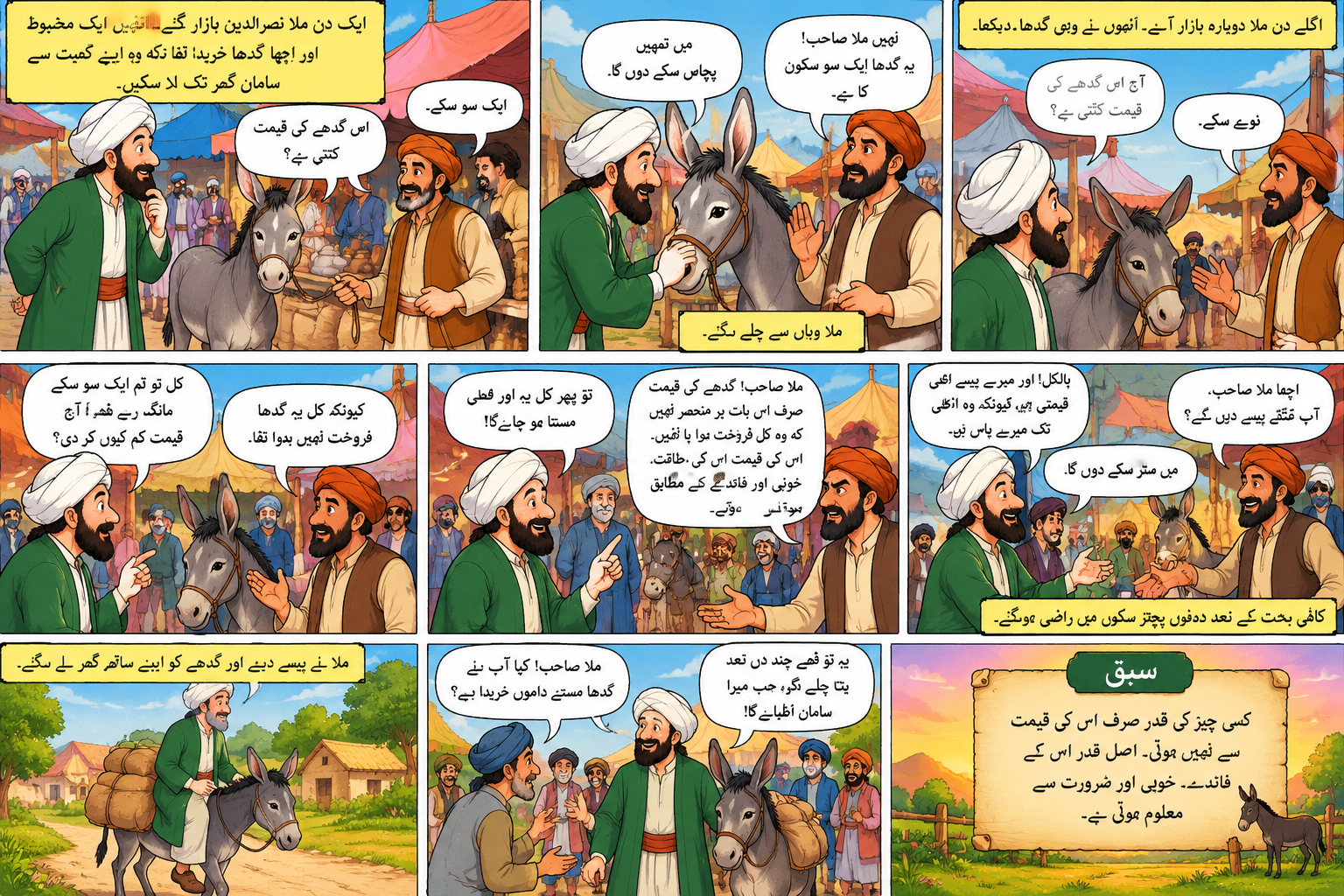
    The picture shows **Mulla Nasrudin in a busy village market** with a donkey seller. Mulla wants to buy a strong donkey, but he thinks the seller’s price is too high. They bargain over the donkey’s price, and Mulla uses his clever humor to negotiate. Finally, they agree on a lower price. The people around them laugh at Mulla’s funny words. The last part of the picture shows the moral: **the true value of something depends on its usefulness, quality, and need, not only on its price.**
    ### اردو میں وضاحت
    اس تصویر میں **ملا نصرالدین ایک مصروف گاؤں کے بازار میں** گدھے کے بیچنے والے کے ساتھ نظر آ رہے ہیں۔ ملا ایک مضبوط گدھا خریدنا چاہتے ہیں، لیکن انہیں دکاندار کی بتائی ہوئی قیمت زیادہ لگتی ہے۔ دونوں گدھے کی قیمت پر بحث اور بھاؤ تاؤ کرتے ہیں۔ ملا اپنی حاضر جوابی اور مزاحیہ باتوں سے قیمت کم کروانے کی کوشش کرتے ہیں۔ آخرکار دونوں ایک کم قیمت پر راضی ہو جاتے ہیں۔ آس پاس موجود لوگ ملا کی مزاحیہ باتوں پر ہنسنے لگتے ہیں۔ تصویر کے آخر میں سبق دیا گیا ہے کہ **کسی چیز کی اصل قدر صرف اس کی قیمت سے نہیں بلکہ اس کے فائدے، خوبی اور ضرورت سے معلوم ہوتی ہے۔**
    Day 10 foundation level story post rool no 17 The picture shows **Mulla Nasrudin in a busy village market** with a donkey seller. Mulla wants to buy a strong donkey, but he thinks the seller’s price is too high. They bargain over the donkey’s price, and Mulla uses his clever humor to negotiate. Finally, they agree on a lower price. The people around them laugh at Mulla’s funny words. The last part of the picture shows the moral: **the true value of something depends on its usefulness, quality, and need, not only on its price.** ### اردو میں وضاحت اس تصویر میں **ملا نصرالدین ایک مصروف گاؤں کے بازار میں** گدھے کے بیچنے والے کے ساتھ نظر آ رہے ہیں۔ ملا ایک مضبوط گدھا خریدنا چاہتے ہیں، لیکن انہیں دکاندار کی بتائی ہوئی قیمت زیادہ لگتی ہے۔ دونوں گدھے کی قیمت پر بحث اور بھاؤ تاؤ کرتے ہیں۔ ملا اپنی حاضر جوابی اور مزاحیہ باتوں سے قیمت کم کروانے کی کوشش کرتے ہیں۔ آخرکار دونوں ایک کم قیمت پر راضی ہو جاتے ہیں۔ آس پاس موجود لوگ ملا کی مزاحیہ باتوں پر ہنسنے لگتے ہیں۔ تصویر کے آخر میں سبق دیا گیا ہے کہ **کسی چیز کی اصل قدر صرف اس کی قیمت سے نہیں بلکہ اس کے فائدے، خوبی اور ضرورت سے معلوم ہوتی ہے۔**
    0 Комментарии 0 Поделились 151 Просмотры
  • Your next big step starts here.

    Your next big step starts here.

    Saifullah

    #business #growth #innovation #quality #trending
    Your next big step starts here. Your next big step starts here. Saifullah #business #growth #innovation #quality #trending
    0 Комментарии 0 Поделились 237 Просмотры
  • #rsisb
    Roll no.239
    Miss Zoya no.3
    Foundation Level

    **Human beings are one of the most remarkable parts of life on Earth.** Humans have the ability to think, learn, communicate, create, imagine, and solve problems. They can develop knowledge through education and experience and use that knowledge to improve their lives and the world around them.

    The **human body** is a complex system made up of many organs and body systems that work together. The brain helps humans think, remember, learn, and control the body. The heart pumps blood throughout the body, while the lungs help provide oxygen. Bones provide structure and support, muscles allow movement, and the nervous system helps control and coordinate many body functions.

    Humans also have **emotions and feelings**. People can experience happiness, sadness, fear, anger, love, excitement, and many other emotions. Understanding emotions is important because they influence how people communicate, make decisions, and interact with others.

    ### Learning and Intelligence

    Humans have a remarkable ability to learn. Children learn language, numbers, social skills, and many other things as they grow. Education helps people develop knowledge and skills, while experience teaches them how to deal with challenges and make better decisions.

    Humans can also use **creativity and imagination** to create art, music, literature, inventions, and new technologies. This ability to imagine new possibilities has played an important role in the development of human civilization.

    ### Health and Well-Being

    Good health is essential for a healthy and productive life. Humans need nutritious food, clean water, oxygen, enough sleep, physical activity, and a safe environment. Regular exercise can help keep the body strong, while healthy habits can support overall well-being.

    Mental and emotional well-being are also important. People need positive relationships, support, relaxation, and opportunities to express their feelings.

    ### ‍‍‍ Human Relationships

    Humans are social beings. Families, friends, classmates, teachers, colleagues, and communities all play important roles in people's lives. Communication and cooperation help people build strong relationships

    ### Humans and Technology

    Technology has become an important part of modern human life. Computers, smartphones, the internet, robotics, and artificial intelligence help people communicate, learn, work, and solve problems.

    Artificial intelligence can assist humans in many areas, but human judgment, responsibility, creativity, and ethical thinking remain extremely important. Technology should be used wisely and responsibly to benefit society.

    ### Humans and the Environment

    Humans depend on Earth for air, water, food, energy, and natural resources. Protecting the environment is therefore an important responsibility.

    Pollution, climate change, deforestation, and the loss of biodiversity can affect human life and other living organisms. People can help protect the planet by reducing waste, saving water and energy, recycling, planting trees, and using resources responsibly.

    ### The Future of Humanity

    The future of humanity will depend on the choices people make today. Education, science, technology, cooperation, peace, and responsible decision-making can help create a better future.

    Humans may continue to explore space, develop new medical treatments, create advanced technologies, and discover new ways to solve global problems. However, progress should always be balanced with ethics, safety, equality, and respect for life.

    ### **Conclusion**

    The study of humans is a broad and fascinating topic that includes the **human body, brain, emotions, health, learning, relationships, society, technology, and the future**.

    Understanding ourselves can help us become healthier, kinder, more responsible, and more thoughtful people. It can also teach us to respect others, appreciate differences, protect our planet, and work together to solve problems.

    **Key Message:**

    > **Human beings have the ability to learn, create, care, and make a difference. By using knowledge wisely and treating others with respect, humans can help build a healthier, kinder, and better world.**
    #rsisb Roll no.239 Miss Zoya no.3 Foundation Level **Human beings are one of the most remarkable parts of life on Earth.** Humans have the ability to think, learn, communicate, create, imagine, and solve problems. They can develop knowledge through education and experience and use that knowledge to improve their lives and the world around them. The **human body** is a complex system made up of many organs and body systems that work together. The brain helps humans think, remember, learn, and control the body. The heart pumps blood throughout the body, while the lungs help provide oxygen. Bones provide structure and support, muscles allow movement, and the nervous system helps control and coordinate many body functions. Humans also have **emotions and feelings**. People can experience happiness, sadness, fear, anger, love, excitement, and many other emotions. Understanding emotions is important because they influence how people communicate, make decisions, and interact with others. ### 🧠 Learning and Intelligence Humans have a remarkable ability to learn. Children learn language, numbers, social skills, and many other things as they grow. Education helps people develop knowledge and skills, while experience teaches them how to deal with challenges and make better decisions. Humans can also use **creativity and imagination** to create art, music, literature, inventions, and new technologies. This ability to imagine new possibilities has played an important role in the development of human civilization. ### ❤️ Health and Well-Being Good health is essential for a healthy and productive life. Humans need nutritious food, clean water, oxygen, enough sleep, physical activity, and a safe environment. Regular exercise can help keep the body strong, while healthy habits can support overall well-being. Mental and emotional well-being are also important. People need positive relationships, support, relaxation, and opportunities to express their feelings. ### 👨‍👩‍👧‍👦 Human Relationships Humans are social beings. Families, friends, classmates, teachers, colleagues, and communities all play important roles in people's lives. Communication and cooperation help people build strong relationships ### 💻 Humans and Technology Technology has become an important part of modern human life. Computers, smartphones, the internet, robotics, and artificial intelligence help people communicate, learn, work, and solve problems. Artificial intelligence can assist humans in many areas, but human judgment, responsibility, creativity, and ethical thinking remain extremely important. Technology should be used wisely and responsibly to benefit society. ### 🌱 Humans and the Environment Humans depend on Earth for air, water, food, energy, and natural resources. Protecting the environment is therefore an important responsibility. Pollution, climate change, deforestation, and the loss of biodiversity can affect human life and other living organisms. People can help protect the planet by reducing waste, saving water and energy, recycling, planting trees, and using resources responsibly. ### 🚀 The Future of Humanity The future of humanity will depend on the choices people make today. Education, science, technology, cooperation, peace, and responsible decision-making can help create a better future. Humans may continue to explore space, develop new medical treatments, create advanced technologies, and discover new ways to solve global problems. However, progress should always be balanced with ethics, safety, equality, and respect for life. ### **Conclusion** The study of humans is a broad and fascinating topic that includes the **human body, brain, emotions, health, learning, relationships, society, technology, and the future**. Understanding ourselves can help us become healthier, kinder, more responsible, and more thoughtful people. It can also teach us to respect others, appreciate differences, protect our planet, and work together to solve problems. **Key Message:** > **Human beings have the ability to learn, create, care, and make a difference. By using knowledge wisely and treating others with respect, humans can help build a healthier, kinder, and better world.**
    0 Комментарии 0 Поделились 337 Просмотры 5
  • Mohsin RS F8
    Story post NO:12
    Class: Foundation Level
    Made by Me

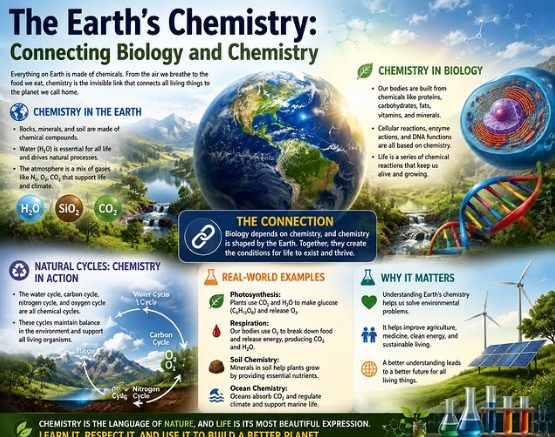
    The Earth’s Chemistry: Connecting Biology and Chemistry

    The Earth is a remarkable system where chemistry and biology are deeply connected. Everything around us—from the air we breathe and the water we drink to the soil, plants, animals, and even our own bodies—is made of chemical substances. Chemistry helps us understand what Earth is made of, while biology shows us how living organisms use these substances to survive, grow, reproduce, and interact with their environment.

    Water, carbon dioxide, oxygen, minerals, and many other chemical compounds play essential roles in life. Plants use water and carbon dioxide during photosynthesis to produce food and release oxygen. Animals and humans depend on oxygen and nutrients to obtain energy and maintain their bodies. At the cellular level, countless chemical reactions happen every moment, allowing cells to function and living organisms to remain healthy.

    Earth’s natural cycles also demonstrate the powerful connection between chemistry and biology. The water cycle, carbon cycle, nitrogen cycle, and oxygen cycle continuously move important substances through the atmosphere, oceans, soil, plants, animals, and microorganisms. These cycles help maintain balance in ecosystems and provide the materials that living things need.

    Soil chemistry is another important example. Plants require minerals and nutrients from the soil to grow, while microorganisms help break down organic matter and return nutrients to the environment. In the oceans, chemical processes influence water quality, carbon storage, climate, and marine ecosystems. Even the rocks and minerals beneath our feet are part of Earth’s ongoing chemical processes.

    Understanding the connection between chemistry and biology is also important for solving real-world problems. Scientists use this knowledge to improve agriculture, protect ecosystems, develop medicines, understand climate change, create cleaner technologies, and find sustainable ways to use Earth’s resources.

    In conclusion, chemistry is more than a subject studied in a laboratory—it is one of the fundamental languages of nature.
    Mohsin RS F8 🎓✨ Story post NO:12 Class: Foundation Level 📚 Made by Me 💻🚀 The Earth’s Chemistry: Connecting Biology and Chemistry The Earth is a remarkable system where chemistry and biology are deeply connected. Everything around us—from the air we breathe and the water we drink to the soil, plants, animals, and even our own bodies—is made of chemical substances. Chemistry helps us understand what Earth is made of, while biology shows us how living organisms use these substances to survive, grow, reproduce, and interact with their environment. Water, carbon dioxide, oxygen, minerals, and many other chemical compounds play essential roles in life. Plants use water and carbon dioxide during photosynthesis to produce food and release oxygen. Animals and humans depend on oxygen and nutrients to obtain energy and maintain their bodies. At the cellular level, countless chemical reactions happen every moment, allowing cells to function and living organisms to remain healthy. Earth’s natural cycles also demonstrate the powerful connection between chemistry and biology. The water cycle, carbon cycle, nitrogen cycle, and oxygen cycle continuously move important substances through the atmosphere, oceans, soil, plants, animals, and microorganisms. These cycles help maintain balance in ecosystems and provide the materials that living things need. Soil chemistry is another important example. Plants require minerals and nutrients from the soil to grow, while microorganisms help break down organic matter and return nutrients to the environment. In the oceans, chemical processes influence water quality, carbon storage, climate, and marine ecosystems. Even the rocks and minerals beneath our feet are part of Earth’s ongoing chemical processes. Understanding the connection between chemistry and biology is also important for solving real-world problems. Scientists use this knowledge to improve agriculture, protect ecosystems, develop medicines, understand climate change, create cleaner technologies, and find sustainable ways to use Earth’s resources. In conclusion, chemistry is more than a subject studied in a laboratory—it is one of the fundamental languages of nature.
    0 Комментарии 0 Поделились 1075 Просмотры
  • Mohsin #RSF8
    #Storypost10
    Class: Foundation level
    Made by Me
    rool no:13

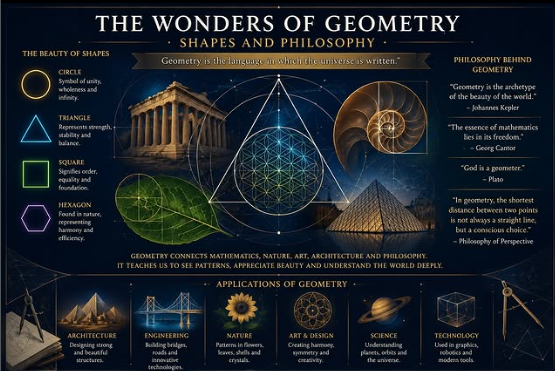
    The Wonders of Geometry: Shapes and Philosophy

    Geometry is one of the oldest and most fascinating areas of mathematics. It is not simply the study of lines, angles, and shapes; it is a way of understanding the structure, patterns, balance, and beauty of the world around us. From the smallest natural patterns to huge buildings and bridges, geometry plays an important role in our everyday lives.

    The topic “The Wonders of Geometry: Shapes and Philosophy” explores the beautiful relationship between mathematics and the ideas that humans have developed about order, harmony, proportion, symmetry, and perfection.

    The Beauty of Circles

    The circle is one of the most recognizable geometric shapes. It has no corners and every point on its boundary is the same distance from its center. Because of its continuous form, the circle is often associated with ideas such as unity, completeness, continuity, and infinity. We can see circles in wheels, clocks, planets, coins, lenses, and many designs around us.

    The Strength of Triangles

    Triangles are simple but incredibly important shapes. Their strong structure makes them useful in architecture and engineering. Bridges, roofs, towers, and other structures often use triangular designs because triangles provide stability. In geometry, triangles also help us understand angles, lengths, proportions, and many important mathematical relationships.

    The Balance of Squares

    The square represents equality, balance, order, and structure. All four of its sides are equal, and all four angles are right angles. Squares are commonly found in buildings, floor designs, windows, screens, tiles, artwork, and patterns. They demonstrate how mathematical rules can produce simple yet powerful designs.

    ⬡ The Harmony of Hexagons

    Hexagons are another fascinating shape. They can be seen naturally in honeycombs and in various patterns found in science and nature. Hexagonal structures can efficiently cover a surface without leaving gaps, which makes them especially interesting from both mathematical and natural per
    Mohsin #RSF8🎓✨ #Storypost10 Class: Foundation level 📚 Made by Me 💻🚀 rool no:13 📐✨ The Wonders of Geometry: Shapes and Philosophy ✨📐 Geometry is one of the oldest and most fascinating areas of mathematics. It is not simply the study of lines, angles, and shapes; it is a way of understanding the structure, patterns, balance, and beauty of the world around us. From the smallest natural patterns to huge buildings and bridges, geometry plays an important role in our everyday lives. The topic “The Wonders of Geometry: Shapes and Philosophy” explores the beautiful relationship between mathematics and the ideas that humans have developed about order, harmony, proportion, symmetry, and perfection. 🔵 The Beauty of Circles The circle is one of the most recognizable geometric shapes. It has no corners and every point on its boundary is the same distance from its center. Because of its continuous form, the circle is often associated with ideas such as unity, completeness, continuity, and infinity. We can see circles in wheels, clocks, planets, coins, lenses, and many designs around us. 🔺 The Strength of Triangles Triangles are simple but incredibly important shapes. Their strong structure makes them useful in architecture and engineering. Bridges, roofs, towers, and other structures often use triangular designs because triangles provide stability. In geometry, triangles also help us understand angles, lengths, proportions, and many important mathematical relationships. ⬜ The Balance of Squares The square represents equality, balance, order, and structure. All four of its sides are equal, and all four angles are right angles. Squares are commonly found in buildings, floor designs, windows, screens, tiles, artwork, and patterns. They demonstrate how mathematical rules can produce simple yet powerful designs. ⬡ The Harmony of Hexagons Hexagons are another fascinating shape. They can be seen naturally in honeycombs and in various patterns found in science and nature. Hexagonal structures can efficiently cover a surface without leaving gaps, which makes them especially interesting from both mathematical and natural per
    0 Комментарии 0 Поделились 1564 Просмотры
  • Make your Saturday extraordinary with the reliable quality you trust

    Make your Saturday extraordinary with the reliable quality you trust
    Make your Saturday extraordinary with the reliable quality you trust Make your Saturday extraordinary with the reliable quality you trust
    0 Комментарии 0 Поделились 253 Просмотры
  • #rsisb
    Roll No 253
    Foundation Level
    Story Post 22
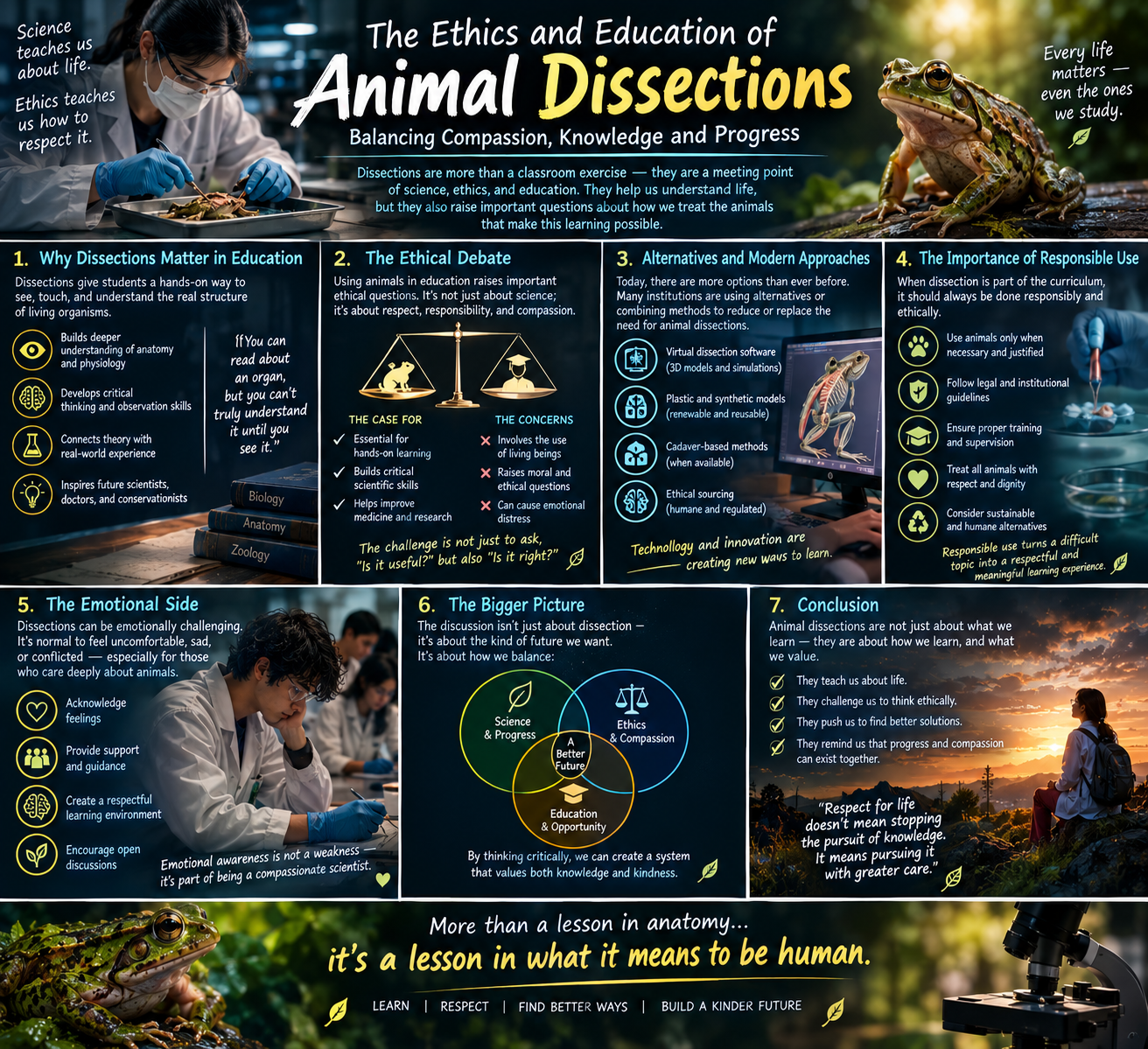
    # The Ethics and Education of Animal Dissections

    ## Balancing Knowledge, Compassion, and Scientific Progress

    Animal dissections have long been used to help students understand anatomy, physiology, and the remarkable complexity of living organisms.

    But dissection is more than a scientific technique.

    It also raises an important question:

    ### **How can we learn about life while treating life with respect?**

    Understanding both the educational value and the ethical considerations surrounding dissections allows us to approach biology with greater knowledge, responsibility, and compassion.

    ---

    ## 1. Why Dissections Matter in Education

    Dissections can provide students with a direct way to explore biological structures that are difficult to fully understand through diagrams or textbooks alone.

    They can help learners:

    Observe real anatomy
    Develop critical thinking
    Understand organ relationships
    Connect theory with physical structures
    Build curiosity about living systems

    Instead of simply memorizing the location of an organ, students can investigate how structures are positioned and connected.

    ### **It turns biological concepts into something tangible.**

    ---

    ## 2. The Ethical Debate

    Using animals for education creates a genuine ethical discussion.

    On one side, supporters may point to the educational benefits of direct anatomical study.

    On the other, concerns include:

    The use of living organisms
    Animal welfare
    Moral responsibility
    Whether alternatives can provide similar educational value

    The central question isn't simply:

    **“Is it useful?”**

    It is also:

    ### **“Is it justified, and can the same learning goals be achieved another way?”**

    Considering both questions encourages students to think scientifically **and ethically**.

    ---

    ## 3. Alternatives and Modern Approaches

    Technology has created new ways to study anatomy without always relying on traditional dissection.

    Modern educational approaches can include:

    Virtual dissection software
    3D anatomical models
    Synthetic or plastic models
    Interactive simulations
    Microscopic analysis
    High-quality anatomical imagery

    These tools can allow students to explore structures repeatedly, change viewpoints, and investigate complex systems in ways that may be difficult with a physical specimen.

    ### **Technology is creating new possibilities for learning.**

    ---

    ## 4. The Importance of Responsible Use

    When animal specimens are used for education or research, responsibility is essential.

    Important principles include:

    Following relevant laws and institutional guidelines
    Providing proper training and supervision
    Using animals only when scientifically or educationally justified
    Treating specimens respectfully
    Considering sustainable and humane alternatives

    Responsible scientific education isn't simply about obtaining knowledge.

    It is about **how that knowledge is obtained.**

    ---

    ## 5. The Emotional Side

    Dissection can affect students differently.

    Some may feel fascinated by anatomy.
    Others may feel uncomfortable.
    Some may experience sadness or conflict because they care deeply about animals.

    These reactions shouldn't automatically be dismissed.

    A respectful educational environment can encourage students to:

    Acknowledge their emotions
    Discuss concerns openly
    Support one another
    Maintain scientific curiosity
    Develop compassion

    ### **Emotional awareness can be part of becoming a responsible scientist.**

    ---

    # 6. The Bigger Picture

    The debate surrounding animal dissection isn't simply about choosing **science or compassion**.

    It is about finding ways for:

    **Scientific progress**
    **Ethical responsibility**
    **Education**
    **Compassion**

    to coexist.

    The goal is to create learning environments where students can develop strong scientific knowledge while also thinking carefully about the consequences of scientific practices.

    ### **Knowledge and compassion don't have to be opposites.**

    ---

    ## 7. What Dissections Can Teach Us

    When conducted appropriately, anatomical study can teach lessons that extend beyond individual organs.

    It can teach us about:

    The complexity of life
    Biological organization
    Interconnected systems
    Evolution and adaptation
    Scientific observation
    Ethical decision-making

    A specimen can become more than an anatomy lesson.

    It can become an opportunity to ask **how we learn, why we learn, and what responsibilities come with knowledge.**

    ---

    # 8. The Real Question

    Perhaps the deepest question isn't simply:

    **“Should animals be dissected?”**

    It is:

    How can we improve biological education?
    How can we reduce unnecessary harm?
    Which alternatives can provide meaningful learning?
    How should scientists balance discovery with responsibility?
    How can future generations learn with greater compassion?

    These questions don't have to end scientific exploration.

    They can make scientific exploration **more thoughtful.**

    ---

    # The Bigger Lesson

    Animal dissections can teach us about anatomy—but the discussion surrounding them can teach us something even larger.

    ### **Science teaches us how life works.**

    ### **Ethics asks us how we should treat it.**

    ### **Education gives us the opportunity to understand both.**

    The future of science isn't only about discovering more.

    It's also about learning to discover **responsibly.**

    So when we look inside an organism to understand its anatomy, we should also look beyond the specimen and consider the larger picture:

    **Respect life.**
    **Pursue knowledge.**
    **Think critically.**
    **Explore better alternatives.**
    **Build a more compassionate future.**

    ## **More than a lesson in anatomy—it's a lesson in what it means to learn responsibly.**


    Asma Shaheen EducationWali
    Saima Empowerment Wali
    Mishaal TrainingWali
    #rsisb Roll No 253 Foundation Level Story Post 22 # 🐸🔬 The Ethics and Education of Animal Dissections ## 🌿⚖️ Balancing Knowledge, Compassion, and Scientific Progress Animal dissections have long been used to help students understand anatomy, physiology, and the remarkable complexity of living organisms. 🧬🫀🔬 But dissection is more than a scientific technique. It also raises an important question: ### **How can we learn about life while treating life with respect?** 🐾❤️ Understanding both the educational value and the ethical considerations surrounding dissections allows us to approach biology with greater knowledge, responsibility, and compassion. --- ## 🎓🔬 1. Why Dissections Matter in Education Dissections can provide students with a direct way to explore biological structures that are difficult to fully understand through diagrams or textbooks alone. 📚➡️🔬 They can help learners: 👁️ Observe real anatomy 🧠 Develop critical thinking 🫀 Understand organ relationships 🔬 Connect theory with physical structures 🌱 Build curiosity about living systems Instead of simply memorizing the location of an organ, students can investigate how structures are positioned and connected. ### **It turns biological concepts into something tangible.** ✨ --- ## ⚖️🐾 2. The Ethical Debate Using animals for education creates a genuine ethical discussion. On one side, supporters may point to the educational benefits of direct anatomical study. 🎓🔬 On the other, concerns include: 🐾 The use of living organisms ❤️ Animal welfare 🧠 Moral responsibility 🌱 Whether alternatives can provide similar educational value The central question isn't simply: **“Is it useful?”** It is also: ### **“Is it justified, and can the same learning goals be achieved another way?”** ⚖️ Considering both questions encourages students to think scientifically **and ethically**. --- ## 💻🧬 3. Alternatives and Modern Approaches Technology has created new ways to study anatomy without always relying on traditional dissection. 🚀🔬 Modern educational approaches can include: 💻 Virtual dissection software 🧊 3D anatomical models 🧫 Synthetic or plastic models 🖥️ Interactive simulations 🔬 Microscopic analysis 📚 High-quality anatomical imagery These tools can allow students to explore structures repeatedly, change viewpoints, and investigate complex systems in ways that may be difficult with a physical specimen. ### **Technology is creating new possibilities for learning.** 💡🌍 --- ## 🧤🐸 4. The Importance of Responsible Use When animal specimens are used for education or research, responsibility is essential. ⚖️🔬 Important principles include: 📜 Following relevant laws and institutional guidelines 🎓 Providing proper training and supervision 🐾 Using animals only when scientifically or educationally justified ❤️ Treating specimens respectfully ♻️ Considering sustainable and humane alternatives Responsible scientific education isn't simply about obtaining knowledge. It is about **how that knowledge is obtained.** --- ## 💭❤️ 5. The Emotional Side Dissection can affect students differently. Some may feel fascinated by anatomy. 🔬 Others may feel uncomfortable. 😟 Some may experience sadness or conflict because they care deeply about animals. 🐾❤️ These reactions shouldn't automatically be dismissed. A respectful educational environment can encourage students to: 🧠 Acknowledge their emotions 💬 Discuss concerns openly 🤝 Support one another 🔬 Maintain scientific curiosity ❤️ Develop compassion ### **Emotional awareness can be part of becoming a responsible scientist.** --- # 🌍⚖️ 6. The Bigger Picture The debate surrounding animal dissection isn't simply about choosing **science or compassion**. It is about finding ways for: 🔬 **Scientific progress** ⚖️ **Ethical responsibility** 🎓 **Education** ❤️ **Compassion** to coexist. The goal is to create learning environments where students can develop strong scientific knowledge while also thinking carefully about the consequences of scientific practices. ### **Knowledge and compassion don't have to be opposites.** 🌱✨ --- ## 🧬📚 7. What Dissections Can Teach Us When conducted appropriately, anatomical study can teach lessons that extend beyond individual organs. It can teach us about: 🫀 The complexity of life 🧬 Biological organization 🔗 Interconnected systems 🌱 Evolution and adaptation 🔬 Scientific observation ⚖️ Ethical decision-making A specimen can become more than an anatomy lesson. It can become an opportunity to ask **how we learn, why we learn, and what responsibilities come with knowledge.** 🧠✨ --- # 🌅🌎 8. The Real Question Perhaps the deepest question isn't simply: **“Should animals be dissected?”** It is: ❓ How can we improve biological education? ❓ How can we reduce unnecessary harm? ❓ Which alternatives can provide meaningful learning? ❓ How should scientists balance discovery with responsibility? ❓ How can future generations learn with greater compassion? These questions don't have to end scientific exploration. They can make scientific exploration **more thoughtful.** 🔬❤️ --- # 🐸💚 The Bigger Lesson Animal dissections can teach us about anatomy—but the discussion surrounding them can teach us something even larger. ### **Science teaches us how life works.** 🔬 ### **Ethics asks us how we should treat it.** ⚖️ ### **Education gives us the opportunity to understand both.** 🎓 The future of science isn't only about discovering more. It's also about learning to discover **responsibly.** 🌍🧬 So when we look inside an organism to understand its anatomy, we should also look beyond the specimen and consider the larger picture: 🐾 **Respect life.** 🔬 **Pursue knowledge.** 🧠 **Think critically.** 💡 **Explore better alternatives.** 🌱 **Build a more compassionate future.** ## ✨ **More than a lesson in anatomy—it's a lesson in what it means to learn responsibly.** 🐸🔬❤️ Asma Shaheen EducationWali Saima Empowerment Wali Mishaal TrainingWali

    0 Комментарии 0 Поделились 2625 Просмотры
  • RSIF8
    Roll no 03
    Level 1
    Call anie no 24
    Call anie topic Being Fair to Everyone live on social media
    Being Fair to Everyone

    Today, I talked about the importance of being fair to everyone and treating people with equal respect, kindness, and understanding. Being fair means listening to others, avoiding favoritism, respecting different opinions, and giving everyone a fair chance to be heard and valued.

    Fairness creates trust, stronger relationships, and a more positive environment where everyone feels respected and included. Sometimes, a small act of fairness can make a big difference in someone’s life.

    Let’s choose kindness, respect, equality, and fairness in everything we do!

    #BeingFair #Fairness #Equality #RespectEveryone #KindnessMatters #TreatEveryoneEqually #PositiveVibes #LifeLessons #GoodValues #BeKind #Respect #SpreadKindness #PositiveMindset

    New to streaming or looking to level up? Check out StreamYard and get $10 discount! https://lnkd.in/dDbHNbts
    RSIF8 Roll no 03 Level 1 Call anie no 24 Call anie topic Being Fair to Everyone live on social media ⚖️✨ Being Fair to Everyone 🤝💙 Today, I talked about the importance of being fair to everyone and treating people with equal respect, kindness, and understanding. 🌍❤️ Being fair means listening to others, avoiding favoritism, respecting different opinions, and giving everyone a fair chance to be heard and valued. 🗣️✨ Fairness creates trust, stronger relationships, and a more positive environment where everyone feels respected and included. 🌱🤝 Sometimes, a small act of fairness can make a big difference in someone’s life. 💫 Let’s choose kindness, respect, equality, and fairness in everything we do! 💙⚖️🌟 #BeingFair #Fairness #Equality #RespectEveryone #KindnessMatters #TreatEveryoneEqually #PositiveVibes #LifeLessons #GoodValues #BeKind #Respect #SpreadKindness #PositiveMindset 🌍✨ 🎙️ New to streaming or looking to level up? Check out StreamYard and get $10 discount! 😍 https://lnkd.in/dDbHNbts
    1
    0 Комментарии 0 Поделились 1389 Просмотры 7
  • Untitled recording - 2026-09-30T215509.062RSIF 8

    Roll no 93

    Ted talk no 7

    Task topic: "How to be productive without burnout" – Cal Newport. **TEDx Talk Review — “How to Be Productive Without Burnout” by Cal Newport**


    Today, I watched a very useful TEDx Talk by **Cal Newport** about productivity, focus, time management, and avoiding burnout.


    The talk made me think about the difference between **being busy and being productive**. Sometimes we spend many hours working, studying, checking notifications, using social media, and switching between different tasks, but that does not always mean we are making meaningful progress.


    One of the most important ideas I learned is the value of **deep focus**. When we remove unnecessary distractions and give our full attention to one important task, we can improve the quality of our work and make better use of our time.


    Another important lesson is that **rest and recovery are part of productivity**. Taking breaks, getting enough sleep, and creating healthy boundaries can help us maintain our energy and concentration instead of constantly pushing ourselves until we become exhausted.


    This message is especially useful for students. Instead of studying for many hours while constantly checking a phone, we can choose an important task, focus on it for a specific period, take a short break, and then continue. Small changes in our daily routine can help us work more effectively.


    The talk also encouraged me to think about priorities. Instead of asking, “How much work can I do today?” we can ask, **“What is the most important thing I should accomplish today?”**


    My biggest takeaway from this talk is that productivity is not about doing everything. It is about focusing on what matters, managing our time wisely, reducing distractions, and taking care of ourselves.


    **I have recorded my review in both English and Urdu**, sharing the main ideas I learned and how they can be applied to everyday life.


    Thank you for watching my review!


    Keep learning, stay focused, manage your time wisely, and remember that **being productive should not mean sacrificing your well-being.**


    #TEDx #CalNewport #Productivity #Burnout #TimeManagement #De
    Untitled recording - 2026-09-30T215509.062RSIF 8 Roll no 93 Ted talk no 7 Task topic: "How to be productive without burnout" – Cal Newport.🎤 **TEDx Talk Review — “How to Be Productive Without Burnout” by Cal Newport** 🧠⏳ Today, I watched a very useful TEDx Talk by **Cal Newport** about productivity, focus, time management, and avoiding burnout. The talk made me think about the difference between **being busy and being productive**. Sometimes we spend many hours working, studying, checking notifications, using social media, and switching between different tasks, but that does not always mean we are making meaningful progress. One of the most important ideas I learned is the value of **deep focus**. When we remove unnecessary distractions and give our full attention to one important task, we can improve the quality of our work and make better use of our time. 📚💻 Another important lesson is that **rest and recovery are part of productivity**. Taking breaks, getting enough sleep, and creating healthy boundaries can help us maintain our energy and concentration instead of constantly pushing ourselves until we become exhausted. This message is especially useful for students. Instead of studying for many hours while constantly checking a phone, we can choose an important task, focus on it for a specific period, take a short break, and then continue. Small changes in our daily routine can help us work more effectively. 🎯 The talk also encouraged me to think about priorities. Instead of asking, “How much work can I do today?” we can ask, **“What is the most important thing I should accomplish today?”** My biggest takeaway from this talk is that productivity is not about doing everything. It is about focusing on what matters, managing our time wisely, reducing distractions, and taking care of ourselves. 🎥 **I have recorded my review in both English and Urdu**, sharing the main ideas I learned and how they can be applied to everyday life. Thank you for watching my review! ❤️ Keep learning, stay focused, manage your time wisely, and remember that **being productive should not mean sacrificing your well-being.** 🌟 #TEDx #CalNewport #Productivity #Burnout #TimeManagement #De
    0 Комментарии 0 Поделились 1471 Просмотры
  • RSIF8
    Roll no:14
    story post no:8
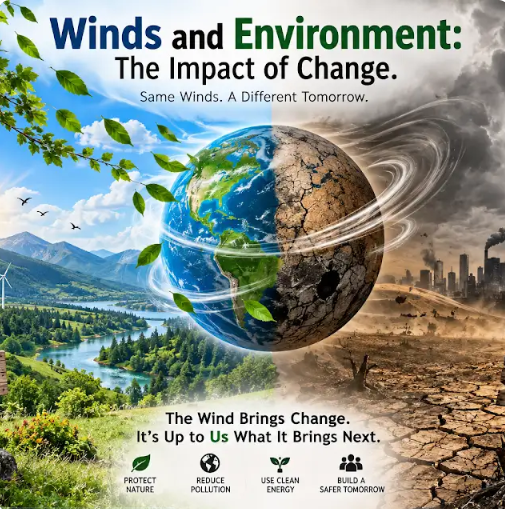
    story post topic:Winds and Environment: The Impact of Change

    # Winds and Environment: The Impact of Change

    I am happy to share that I have **successfully completed my Foundation Level task** on **“Winds and Environment: The Impact of Change.”**

    In this task, I explored the important relationship between **wind, environment, climate, and our daily lives**. I learned how wind plays an important role in our environment and how changes in wind patterns can affect **weather conditions, air quality, pollution, nature, and climate change**.

    I also learned about the importance of **renewable and clean energy**, especially **wind energy**. Wind turbines can help produce clean electricity while reducing our dependence on fossil fuels and helping to lower pollution.

    This task helped me understand that **small changes in our environment can have a big impact on the future of our planet**. It also taught me that protecting nature is not only the responsibility of governments or organizations, but something that **we all can contribute to**.

    Through this Foundation Level task, I improved my **research, creativity, communication, and learning skills**. I am proud to have completed this task and gained valuable knowledge about our environment and the importance of making responsible choices for a better future.

    **Protect Nature**
    **Use Clean Energy**
    **Reduce Pollution**
    **Save Our Environment**
    **Build a Better Future**

    **The wind brings change, but it is up to us to decide what kind of future that change will bring.**

    #WindsAndEnvironment
    #ImpactOfChange
    #FoundationLevel
    #TaskCompleted
    #EnvironmentalAwareness
    #ClimateChange
    #CleanEnergy
    #WindEnergy
    #RenewableEnergy
    #SaveOurPlanet
    #ProtectNature
    #ReducePollution
    #GreenFuture
    #SustainableFuture
    #LearningJourney
    #StudentAchievement
    #FutureReady
    #MakeADifference
    RSIF8 Roll no:14 story post no:8 story post topic:Winds and Environment: The Impact of Change # 🌬️🌍 Winds and Environment: The Impact of Change 🌱☀️ I am happy to share that I have **successfully completed my Foundation Level task** on **“Winds and Environment: The Impact of Change.”** 🎉✅ In this task, I explored the important relationship between **wind, environment, climate, and our daily lives**. 🌬️🌎 I learned how wind plays an important role in our environment and how changes in wind patterns can affect **weather conditions, air quality, pollution, nature, and climate change**. ☁️🌪️🌳 I also learned about the importance of **renewable and clean energy**, especially **wind energy**. 💨⚡ Wind turbines can help produce clean electricity while reducing our dependence on fossil fuels and helping to lower pollution. 🌱🔋 This task helped me understand that **small changes in our environment can have a big impact on the future of our planet**. 🌍💚 It also taught me that protecting nature is not only the responsibility of governments or organizations, but something that **we all can contribute to**. 🤝🌳 Through this Foundation Level task, I improved my **research, creativity, communication, and learning skills**. 📚💡✨ I am proud to have completed this task and gained valuable knowledge about our environment and the importance of making responsible choices for a better future. 🏆🙌 🌱 **Protect Nature** 💨 **Use Clean Energy** 🌍 **Reduce Pollution** ♻️ **Save Our Environment** 🤝 **Build a Better Future** ✨ **The wind brings change, but it is up to us to decide what kind of future that change will bring.** 🌬️🌍💚 #WindsAndEnvironment 🌬️ #ImpactOfChange 🌍 #FoundationLevel 🎓 #TaskCompleted ✅ #EnvironmentalAwareness 🌱 #ClimateChange 🌎 #CleanEnergy ⚡ #WindEnergy 💨 #RenewableEnergy 🔋 #SaveOurPlanet 🌍 #ProtectNature 🌳 #ReducePollution ♻️ #GreenFuture 💚 #SustainableFuture 🌱 #LearningJourney 📚 #StudentAchievement 🏆 #FutureReady 🚀 #MakeADifference 🤝
    0 Комментарии 0 Поделились 3185 Просмотры
Расширенные страницы