



• #rsisb
    Roll no.247
    story post . 11
    Foundation level

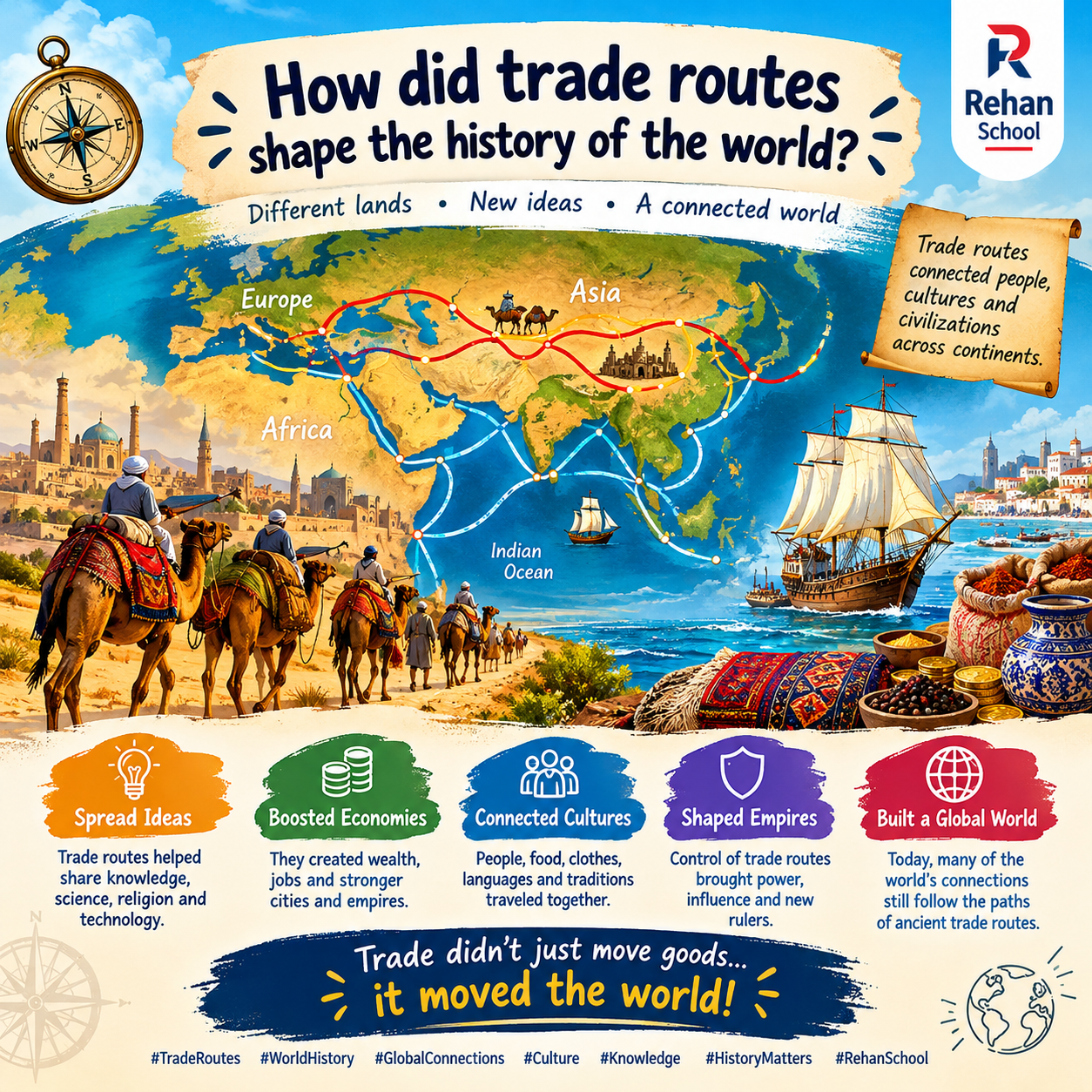
    **How Did Trade Routes Shape the History of the World? **

    **Discover the Incredible Story of Trade Routes!**

    Have you ever wondered how people from different parts of the world shared their goods, ideas, cultures, and knowledge hundreds or even thousands of years ago? Long before airplanes, cars, and modern technology, trade routes connected distant civilizations and helped shape the world we live in today!

    Trade routes were pathways that allowed merchants, travelers, and explorers to transport valuable goods from one region to another. These routes crossed deserts, mountains, rivers, and oceans, connecting Asia, Africa, Europe, and other parts of the world.

    **1. The Famous Silk Road **

    The Silk Road was one of the most famous trading networks in history. It connected China with Central Asia, the Middle East, and Europe. Merchants transported silk, spices, precious stones, ceramics, and other valuable products. But the Silk Road was about much more than goods! It also helped spread religions, scientific knowledge, artistic traditions, and cultural ideas between civilizations.

    **2. Maritime Trade Routes **

    Sea routes allowed traders to transport goods across oceans and along coastlines. Ships carried spices, textiles, tea, porcelain, and many other products between distant ports. The Indian Ocean became an important center of international trade, connecting merchants from East Africa, Arabia, India, Southeast Asia, and China.

    **3. The Spice Trade 🫚**

    Spices such as pepper, cinnamon, cloves, and nutmeg were highly valued in many parts of the world. Their demand encouraged merchants to travel long distances and helped develop important trading cities and ports. The search for new sources of spices also encouraged European maritime exploration, changing global connections and history.

    **4. The Rise of Cities and Empires **

    Trade routes helped cities grow into busy centers of commerce, learning, and culture. Merchants, craftspeople, and travelers brought wealth and new opportunities to trading centers. Governments and empires also gained influence by controlling important roads, ports, and markets.

    **5. The Exchange of Ideas and Knowledge **

    One of the greatest contributions of trade routes was the exchange of knowledge. Mathematics, astronomy, medicine, inventions, languages, and artistic styles traveled with merchants and scholars. People learned from one another, developed new skills, and expanded their understanding of the world.

    **6. The Sharing of Food and Culture **

    Trade helped introduce new foods, ingredients, clothing styles, artistic traditions, and customs to different societies. Over time, these exchanges influenced local cuisines, languages, architecture, and everyday life. The cultures of the world became connected in countless ways!

    **7. Trade Routes Had Challenges Too **

    Travel along trade routes was not always easy. Merchants faced dangerous weather, difficult landscapes, bandits, political conflicts, and long journeys. Trade could also contribute to the spread of diseases, while some trading systems were connected to conquest, exploitation, and slavery. Understanding these challenges helps us learn about both the achievements and the painful realities of history.

    **8. From Ancient Roads to Modern Global Trade **

    Today, goods move around the world through highways, railways, cargo ships, and airplanes. Modern trade networks are far more advanced, but they continue the same basic idea: connecting people, places, and markets. The ancient trade routes helped establish many of the connections that later shaped our interconnected world.

    **What Can We Learn from Trade Routes?**

    Trade routes teach us that no civilization developed completely on its own. People have always learned, exchanged ideas, explored new places, and depended on connections with others. History reminds us that cooperation, curiosity, and cultural exchange can transform societies and influence future generations.

    **Final Thought:** Trade routes were more than paths for transporting goods. They were bridges between civilizations, carrying stories, discoveries, beliefs, technologies, and traditions across the world. Their legacy continues to influence our lives today!

    **Question for You:** If you could travel along one ancient trade route, would you choose the Silk Road or the Indian Ocean trade routes? Why? Tell us in the comments!

    Like, share, and follow for more fascinating stories about history, geography, science, and the world around us!

    #TradeRoutes #HistoryOfTheWorld #SilkRoad #AncientHistory #WorldHistory #IndianOceanTrade #SpiceTrade #HistoryFacts #DidYouKnow #EducationalContent #LearningIsFun #ExploreHistory #CulturalExchange #AncientCivilizations #Geography #GlobalTrade #HistoryLovers #KnowledgeIsPower #WorldCultures #StoryPost #Education #DiscoverThePast #ExploreTheWorld #LearnSomethingNew #SocialMediaPost
    #rsisb Roll no.247 story post . 11 Foundation level 🌍✨ **How Did Trade Routes Shape the History of the World? 🚢🐪** 📜🌏 **Discover the Incredible Story of Trade Routes!** 🌏📜 Have you ever wondered how people from different parts of the world shared their goods, ideas, cultures, and knowledge hundreds or even thousands of years ago? 🤔✨ Long before airplanes, cars, and modern technology, trade routes connected distant civilizations and helped shape the world we live in today! 🌎🚢🐪 Trade routes were pathways that allowed merchants, travelers, and explorers to transport valuable goods from one region to another. These routes crossed deserts, mountains, rivers, and oceans, connecting Asia, Africa, Europe, and other parts of the world. 🏜️⛰️🌊 🐪 **1. The Famous Silk Road 🧵🏮** The Silk Road was one of the most famous trading networks in history. It connected China with Central Asia, the Middle East, and Europe. Merchants transported silk, spices, precious stones, ceramics, and other valuable products. 🎎🧵💎 But the Silk Road was about much more than goods! It also helped spread religions, scientific knowledge, artistic traditions, and cultural ideas between civilizations. 📚🕌🎨 🌊 **2. Maritime Trade Routes 🚢⚓** Sea routes allowed traders to transport goods across oceans and along coastlines. Ships carried spices, textiles, tea, porcelain, and many other products between distant ports. The Indian Ocean became an important center of international trade, connecting merchants from East Africa, Arabia, India, Southeast Asia, and China. 🌴🌏⛵ 🌶️ **3. The Spice Trade 🌶️🫚** Spices such as pepper, cinnamon, cloves, and nutmeg were highly valued in many parts of the world. Their demand encouraged merchants to travel long distances and helped develop important trading cities and ports. The search for new sources of spices also encouraged European maritime exploration, changing global connections and history. 🗺️⛵✨ 🏙️ **4. The Rise of Cities and Empires 🏛️👑** Trade routes helped cities grow into busy centers of commerce, learning, and culture. Merchants, craftspeople, and travelers brought wealth and new opportunities to trading centers. Governments and empires also gained influence by controlling important roads, ports, and markets. 💰🏙️📈 📚 **5. The Exchange of Ideas and Knowledge 🧠🔬** One of the greatest contributions of trade routes was the exchange of knowledge. Mathematics, astronomy, medicine, inventions, languages, and artistic styles traveled with merchants and scholars. People learned from one another, developed new skills, and expanded their understanding of the world. 🌟📖🌍 🍲 **6. The Sharing of Food and Culture 🎭🍇** Trade helped introduce new foods, ingredients, clothing styles, artistic traditions, and customs to different societies. Over time, these exchanges influenced local cuisines, languages, architecture, and everyday life. The cultures of the world became connected in countless ways! 🌮🍜🎨 ⚖️ **7. Trade Routes Had Challenges Too ⛈️** Travel along trade routes was not always easy. Merchants faced dangerous weather, difficult landscapes, bandits, political conflicts, and long journeys. Trade could also contribute to the spread of diseases, while some trading systems were connected to conquest, exploitation, and slavery. Understanding these challenges helps us learn about both the achievements and the painful realities of history. 📜🌧️ 🌐 **8. From Ancient Roads to Modern Global Trade 🚚✈️** Today, goods move around the world through highways, railways, cargo ships, and airplanes. Modern trade networks are far more advanced, but they continue the same basic idea: connecting people, places, and markets. The ancient trade routes helped establish many of the connections that later shaped our interconnected world. 🌍📦🚢 💡 **What Can We Learn from Trade Routes?** Trade routes teach us that no civilization developed completely on its own. People have always learned, exchanged ideas, explored new places, and depended on connections with others. History reminds us that cooperation, curiosity, and cultural exchange can transform societies and influence future generations. 🤝💖🌏 ✨ **Final Thought:** Trade routes were more than paths for transporting goods. They were bridges between civilizations, carrying stories, discoveries, beliefs, technologies, and traditions across the world. Their legacy continues to influence our lives today! 🌍🛤️💫 💬 **Question for You:** If you could travel along one ancient trade route, would you choose the Silk Road or the Indian Ocean trade routes? Why? 🐪🚢 Tell us in the comments! 👇 ❤️ Like, share, and follow for more fascinating stories about history, geography, science, and the world around us! 📚🌍🚀 #TradeRoutes #HistoryOfTheWorld #SilkRoad #AncientHistory #WorldHistory #IndianOceanTrade #SpiceTrade #HistoryFacts #DidYouKnow #EducationalContent #LearningIsFun #ExploreHistory #CulturalExchange #AncientCivilizations #Geography #GlobalTrade #HistoryLovers #KnowledgeIsPower #WorldCultures #StoryPost #Education #DiscoverThePast #ExploreTheWorld #LearnSomethingNew #SocialMediaPost 🌍📚✨🐪🚢💫
    0 Commentaires 0 Parts 3736 Vue
  • A very touching story!
    From the very childhood we use to listen stories from our grand parents. I use to talk a lot about very old time experiences with my Nani (grand mother) who was migrated from Pakistan (Un-divided) India in 1947 when she was about 14 years old.
    Every one knows what happened to those families & especially when they lost all assets, relatives, friends also lost of lifes of there family members. That whole story Ive discussed with my Nani many times.... She always said one thing at the end of the story that she still remember everything very clearly & if She reaches to the railway station (Mandi Bahuddin) she can find her house.
    Now Im young, I gave her challenge to prove whether she still can find her house or not???
    Im going to Pakistan tonight with my Nani & Sister. Should reach Lahore tomorrow. Moving to Mandi Bahuddin railway station on 30th Nov morning & lets see what will happen! !
    Initiative taken by me Gaurav Uppal to develop healthy relations to our neighbour country to promote love & peace!

    Pakistan - Kabool hai !!

    If you know anyone from Mandi Bhauddin please connect them with Gaurav !
    A very touching story! From the very childhood we use to listen stories from our grand parents. I use to talk a lot about very old time experiences with my Nani (grand mother) who was migrated from Pakistan (Un-divided) India in 1947 when she was about 14 years old. Every one knows what happened to those families & especially when they lost all assets, relatives, friends also lost of lifes of there family members. That whole story I've discussed with my Nani many times.... She always said one thing at the end of the story that she still remember everything very clearly & if She reaches to the railway station (Mandi Bahuddin) she can find her house. Now I'm young, I gave her challenge to prove whether she still can find her house or not??? I'm going to Pakistan tonight with my Nani & Sister. Should reach Lahore tomorrow. Moving to Mandi Bahuddin railway station on 30th Nov morning & let's see what will happen! ! Initiative taken by me Gaurav Uppal to develop healthy relations to our neighbour country to promote love & peace! Pakistan - Kabool hai !!👣🏁 If you know anyone from Mandi Bhauddin please connect them with Gaurav !
    0 Commentaires 0 Parts 607 Vue
  • Ek Railway Station Ke baher Ek aged bandha Ek darakt pe bitha hotha hai jo train Aatha hai us sey Kohe bi bandha nikal tha hai us ko Salam dykar Ek sawl Kar tha hai sawl hey hotha hai bhai kahan se aarhey ho wo ketha hai plaa jagha se Phr ketha hai howahn Ke logh kesey hain wo ketha hai logh bekar jhootey Phr hey reply Kar tha hai Waps jao Yahan Ke logh bi kafi ziydha bekar jhootey hai tu Waps jao aathe jathey Ek bandha Aatha hai us se hey Sam sawl Kar tha hai musam Ke barhey me wo ketha hai Acha musam hai Jahan se me Aarha hun Wahan Ke logh bi ache hai Phr ho reply me ketha hai Yahan ka musam bi kafi Acha hai logh bi ajao Tum ko well come karte hai....

    Insan Jesa hotha hai us ko logh bi wesey e mil te hai I hope app Samj jaye hungey

    By Basit Habib Allahwala
    Ek Railway Station Ke baher Ek aged bandha Ek darakt pe bitha hotha hai jo train Aatha hai us sey Kohe bi bandha nikal tha hai us ko Salam dykar Ek sawl Kar tha hai sawl hey hotha hai bhai kahan se aarhey ho wo ketha hai plaa jagha se Phr ketha hai howahn Ke logh kesey hain wo ketha hai logh bekar jhootey Phr hey reply Kar tha hai Waps jao Yahan Ke logh bi kafi ziydha bekar jhootey hai tu Waps jao aathe jathey Ek bandha Aatha hai us se hey Sam sawl Kar tha hai musam Ke barhey me wo ketha hai Acha musam hai Jahan se me Aarha hun Wahan Ke logh bi ache hai Phr ho reply me ketha hai Yahan ka musam bi kafi Acha hai logh bi ajao Tum ko well come karte hai.... Insan Jesa hotha hai us ko logh bi wesey e mil te hai I hope app Samj jaye hungey By Basit Habib Allahwala
    0 Commentaires 0 Parts 778 Vue
  • 15 big challenges, 15 big opportunities

    Great questions by Shahjahan Chaudhary

    NIC Karachi is a pro-innovation knowledge hub. We see startups as research teams focused on solving big problems and pursuing opportunities at scale.

    We like to start with questions. Here are some questions and challenges you should consider working on.

    1. How to build a 1000 sq ft house for Rs 350 per square foot?

    2. How to offer near-free public transport to all 20 million citizens of Karachi?

    3. How to offer electricity to citizens of Karachi for Rs 1 per unit?

    4. How to convert Karachi slums, where over 50% of the population lives, into happy, clean, liveable spaces where even our Prime Minister would like to stay?

    5. How can a startup lift 1 million people into prosperity? How about 10 million?

    6. How can we nurture a measurable growth mindset in the 40 million children going to public schools with a total budget of $250,000?

    7. How can we "follow the money" in federal and provincial governments using Blockchain and make governance more transparent and effective?

    8. How can we save and enhance the mangrove forests profitably for the City of Karachi?

    9. How can we create Cyberdefence to reduce our need for conventional and nuclear weapons?

    10. How can we measure and improve health outcomes for all of Pakistans citizens - increase lifespan, reduce infant mortality, become less prone to getting sick?

    11. How can we promote Sindhs Heritage and History and make it a top travel destination for the world?

    12. How can Pakistan Railways leverage technology to become the backbone of Pakistans transport ecosystem? How can we creatively fund a 100x capacity increase in Railways?

    13. How can we build a robot that cleans public streets continuously at close to zero cost?

    14. If we were to give up roads and cars, what could replace them that costs less and enhances universal well-being?

    15. If you think there is a question or opportunity more interesting and challenging than the above, what is it and how would you tackle it?

    Yusuf Hussain, Murtaza Zaidi, Jawwad Farid, Zia Imran
    15 big challenges, 15 big opportunities Great questions by Shahjahan Chaudhary NIC Karachi is a pro-innovation knowledge hub. We see startups as research teams focused on solving big problems and pursuing opportunities at scale. We like to start with questions. Here are some questions and challenges you should consider working on. 1. How to build a 1000 sq ft house for Rs 350 per square foot? 2. How to offer near-free public transport to all 20 million citizens of Karachi? 3. How to offer electricity to citizens of Karachi for Rs 1 per unit? 4. How to convert Karachi slums, where over 50% of the population lives, into happy, clean, liveable spaces where even our Prime Minister would like to stay? 5. How can a startup lift 1 million people into prosperity? How about 10 million? 6. How can we nurture a measurable growth mindset in the 40 million children going to public schools with a total budget of $250,000? 7. How can we "follow the money" in federal and provincial governments using Blockchain and make governance more transparent and effective? 8. How can we save and enhance the mangrove forests profitably for the City of Karachi? 9. How can we create Cyberdefence to reduce our need for conventional and nuclear weapons? 10. How can we measure and improve health outcomes for all of Pakistan's citizens - increase lifespan, reduce infant mortality, become less prone to getting sick? 11. How can we promote Sindh's Heritage and History and make it a top travel destination for the world? 12. How can Pakistan Railways leverage technology to become the backbone of Pakistan's transport ecosystem? How can we creatively fund a 100x capacity increase in Railways? 13. How can we build a robot that cleans public streets continuously at close to zero cost? 14. If we were to give up roads and cars, what could replace them that costs less and enhances universal well-being? 15. If you think there is a question or opportunity more interesting and challenging than the above, what is it and how would you tackle it? Yusuf Hussain, Murtaza Zaidi, Jawwad Farid, Zia Imran
    0 Commentaires 0 Parts 2692 Vue
  • World is changing for sure !

    I am not sure about these numbers ! Forwarding as found !

    *India Collapsing*

    *While everyone is busy debating on*
    *India-Pakistan*
    *370-Kashmir*
    *Hindu-Muslim*
    *CAA, NRC, NPR, etc*
    *shaheen bagh*

    *We miss to notice whats happening to INDIA*

    *India - Recent data & Situation*

    *External Debt of India* *500 + Billion Dollars.*

    *Vodafone* is in loss of ₹50,000 Crore.

    *Airtel* is in loss of ₹23,000 Crore.

    *BSNL* is in loss of ₹14,000 Crore.

    *MTNL* is in loss of ₹755 Crore.

    *BPCL* is in loss of ₹750 Crore.

    *SAIL* is in loss of ₹286 Crore.

    *AIR India* is in loss of ₹4600 Crore.

    *Spice Jet* is in loss of ₹463 Crore.

    *Indigo* is in loss of ₹1062 Crore.

    *BHEL* is in loss of ₹219 Crore.

    *India Post* is in loss of ₹15,000 Crore.

    *GMR Infra* is in loss of ₹561 Crore.

    *YES Bank* is in loss of ₹600 Crore.

    *Union Bank* is in loss of ₹1190 Crore.

    *PNB Bank* is in loss of ₹4750 Crore।

    *Axis Bank* is in loss of ₹112 Crore.

    *J P Group finished*

    *Videocon bankrupt*

    *Aircel & Docomo is dead*

    *Tata Docomo perished*

    *Jet Airways closed*

    *Airports Sold*
    5 airports sold to Adani.

    *Railways are on sale*

    *Heritage Renting*
    Heritages including Red Fort

    *Nationalized Banks Merger*
    Many nationalized banks have merged, many branches have literally closed,

    *ATM Rooms*
    Huge numbers of ATM Rooms are set down,

    *All Banks*
    incurring huge losses.

    *36 largest debtors*
    missing from country.

    *Few Corporates*
    Rs 2.4 lakh crores loan waived off

    *BSNL*
    54,000 may cut more jobs.

    *Auto Industry*
    1 million to be laid off

    *Maruti*
    Largest car maker cuts production.

    *Car Inventory*
    Rs 55000 crores car inventory lying at factories, with no buyers.

    *Houses Unsold*
    12.76 lakhs houses unsold in 30 major cities.

    *Builders Suicide*
    All over stressed. Some committing suicide, no buyers. Construction Stopped due Mat cost rise (GST at 18% to 28%).

    *CCD founder*
    *V G Siddhartha committed Sucide*
    due to huge debt.

    *HAL*
    No money to pay salary for employees.

    *ONGC*
    Most profitable company in India is now making losses.

    *OFB*
    Under corporatization affecting over 1.5 lac employee & families.

    *Biscuits Companies*
    like Parle-G on the verge of terminating it’s employees.

    *Unemployment*
    Millions unemployed due to Demonetization.

    *Highest unemployment in 45 years*

    *Domestic Stagflation*
    Highest recorded

    *Leaving India*
    Record HNI individuals leaving India.

    *May be many more...*

    *Nothing is shown in media. Media is busy debating India Vs Pakistan, and Hindu Vs Muslims who were living peacefully with tranquility till recently.*
    World is changing for sure ! I am not sure about these numbers ! Forwarding as found ! *India Collapsing* *While everyone is busy debating on* *India-Pakistan* *370-Kashmir* *Hindu-Muslim* *CAA, NRC, NPR, etc* *shaheen bagh* *We miss to notice what's happening to INDIA* *India - Recent data & Situation* *External Debt of India* *500 + Billion Dollars.* *Vodafone* is in loss of ₹50,000 Crore. *Airtel* is in loss of ₹23,000 Crore. *BSNL* is in loss of ₹14,000 Crore. *MTNL* is in loss of ₹755 Crore. *BPCL* is in loss of ₹750 Crore. *SAIL* is in loss of ₹286 Crore. *AIR India* is in loss of ₹4600 Crore. *Spice Jet* is in loss of ₹463 Crore. *Indigo* is in loss of ₹1062 Crore. *BHEL* is in loss of ₹219 Crore. *India Post* is in loss of ₹15,000 Crore. *GMR Infra* is in loss of ₹561 Crore. *YES Bank* is in loss of ₹600 Crore. *Union Bank* is in loss of ₹1190 Crore. *PNB Bank* is in loss of ₹4750 Crore। *Axis Bank* is in loss of ₹112 Crore. *J P Group finished* *Videocon bankrupt* *Aircel & Docomo is dead* *Tata Docomo perished* *Jet Airways closed* *Airports Sold* 5 airports sold to Adani. *Railways are on sale* *Heritage Renting* Heritages including Red Fort *Nationalized Banks Merger* Many nationalized banks have merged, many branches have literally closed, *ATM Rooms* Huge numbers of ATM Rooms are set down, *All Banks* incurring huge losses. *36 largest debtors* missing from country. *Few Corporates* Rs 2.4 lakh crores loan waived off *BSNL* 54,000 may cut more jobs. *Auto Industry* 1 million to be laid off *Maruti* Largest car maker cuts production. *Car Inventory* Rs 55000 crores car inventory lying at factories, with no buyers. *Houses Unsold* 12.76 lakhs houses unsold in 30 major cities. *Builders Suicide* All over stressed. Some committing suicide, no buyers. Construction Stopped due Mat cost rise (GST at 18% to 28%). *CCD founder* *V G Siddhartha committed Sucide* due to huge debt. *HAL* No money to pay salary for employees. *ONGC* Most profitable company in India is now making losses. *OFB* Under corporatization affecting over 1.5 lac employee & families. *Biscuits Companies* like Parle-G on the verge of terminating it’s employees. *Unemployment* Millions unemployed due to Demonetization. *Highest unemployment in 45 years* *Domestic Stagflation* Highest recorded *Leaving India* Record HNI individuals leaving India. *May be many more...* *Nothing is shown in media. Media is busy debating India Vs Pakistan, and Hindu Vs Muslims who were living peacefully with tranquility till recently.*
    0 Commentaires 0 Parts 1573 Vue
  • Next we need to remove pia, railway, steel mill, ptv, (15 buklin a gear loss) radio(5 billion a year loss) free street lights ! It’s a wastage and huge loss to government !

    Then should shut down all parks, sports complex’s, busses, pia
    Next we need to remove pia, railway, steel mill, ptv, (15 buklin a gear loss) radio(5 billion a year loss) free street lights ! It’s a wastage and huge loss to government ! Then should shut down all parks, sports complex’s, busses, pia
    0 Commentaires 0 Parts 678 Vue
  • roll no 80 Join us on an incredible journey through the **largest road, rail, sea, and air transportation networks** on Earth! Discover how billions of people and trillions of dollars worth of goods move across continents every day. 🌎 In this documentary, you'll explore: 🚛 The world's largest highway networks 🚆 Massive railway systems connecting entire nations 🚢 The busiest shipping routes and mega ports ✈️ The biggest airports and global aviation hubs 📊 Mind-blowing facts and comparisons 🔮 Future transportation technologies that could change the world forever Whether you're passionate about logistics, engineering, infrastructure, or global trade, this documentary will give you a fascinating look at the transportation systems that keep our world connected. 👍 Don't forget to **Like**, **Comment**, **Share**, and **Subscribe** for more amazing transportation and logistics documentaries!https://www.linkedin.com/posts/arham-naeem-transport-wala-3b5bb1398_transportation-logistics-documentary-ugcPost-7479752240040431616-iKQy/?utm_source=social_share_send&utm_medium=member_desktop_web&rcm=ACoAAGG1h_kBVD23UUFCoR_Jg29EeGDorI4zAmw
    WWW.LINKEDIN.COM
    #transportation #logistics #documentary #roadtransport #railways #shipping #aviation #globaltrade #supplychain #infrastructure #megaprojects #engineering #futuretransport #smartlogistics… | Arham Naeem Transport wala
    roll no 80 🌍🚛 The World's Biggest Transportation Systems Explained! ✈️🚢🚆 Join us on an incredible journey through the largest road, rail, sea, and air transportation networks on Earth! Discover how billions of people and trillions of dollars worth of goods move across continents every day. 🌎 In this documentary, you'll explore: 🚛 The world's largest highway networks 🚆 Massive railway systems connecting entire nations 🚢 The busiest shipping routes and mega ports ✈️ The biggest airports and global aviation hubs 📊 Mind-blowing facts and comparisons 🔮 Future transportation technologies that could change the world forever Whether you're passionate about logistics, engineering, infrastructure, or global trade, this documentary will give you a fascinating look at the transportation systems that keep our world connected. 👍 Don't forget to Like, Comment, Share, and Subscribe for more amazing transportation and logistics documentaries! #Transportation #Logistics #Documentary #RoadTransport #Railways #Shipping #Aviation #GlobalTrade #SupplyChain #Infrastructure #MegaProjects #Engineering #FutureTransport #SmartLogistics #TransportWala
    0 Commentaires 0 Parts 1747 Vue
  • India has a rich and complex history spanning over 5,000 years, marked by the rise and fall of civilizations, empires, and cultural transformations. Here is a concise historical overview of India’s development:

    1. Ancient India (c. 3000 BCE – 600 BCE)

    Indus Valley Civilization (c. 3000–1500 BCE)

    • One of the world’s earliest urban civilizations, centered in present-day Pakistan and northwestern India.
    • Cities like Harappa and Mohenjo-Daro featured advanced urban planning, drainage systems, and trade networks.
    • The script remains undeciphered, and the civilization’s decline around 1500 BCE is linked to environmental changes and other factors.

    Vedic Period (c. 1500–600 BCE)

    • Arrival of Indo-Aryans who composed the Vedas, the foundational texts of Hinduism.
    • Development of early political structures, social stratification (caste system), and religious practices.
    • Transition from a pastoral to agrarian society.

    2. Classical Period (600 BCE – 1200 CE)

    Rise of Kingdoms and Empires (600 BCE – 300 BCE)

    • Mahajanapadas: 16 powerful kingdoms and republics like Magadha and Koshala.
    • Buddhism and Jainism emerged in the 6th century BCE as reformist movements against Vedic orthodoxy, led by Gautama Buddha and Mahavira.

    Maurya Empire (321–185 BCE)

    • Founded by Chandragupta Maurya, it was one of India’s largest empires.
    • Under Ashoka the Great, Buddhism spread across Asia, and pillars and edicts promoting nonviolence and dharma were erected.

    Gupta Empire (c. 320–550 CE)

    • Known as the “Golden Age” of India, it was a period of immense cultural, scientific, and artistic achievements.
    • Advances in mathematics (concept of zero), astronomy, literature (Kalidasa), and medicine occurred during this time.
    • Hinduism flourished, and major texts like the Puranas and Ramayana were written or codified.

    3. Medieval India (1200–1757)

    Early Medieval Period (600–1200)

    • Emergence of regional kingdoms such as the Chalukyas, Pallavas, Rashtrakutas, and Cholas in southern India.
    • The Chola dynasty expanded maritime trade and cultural influence to Southeast Asia.

    Islamic Invasions and Delhi Sultanate (1206–1526)

    • Islamic rule began with invasions by Mahmud of Ghazni (11th century) and Muhammad Ghori (12th century).
    • Establishment of the Delhi Sultanate, which saw the spread of Islam in India.
    • Significant cultural syncretism, with the fusion of Indian and Islamic traditions in art, architecture (e.g., Qutub Minar), and language.

    Mughal Empire (1526–1757)

    • Founded by Babur in 1526 after defeating the Delhi Sultanate.
    • Reached its zenith under Akbar, who implemented policies of religious tolerance and administrative reforms.
    • Cultural achievements under Shah Jahan (Taj Mahal) and Aurangzeb, though his reign saw the beginning of the empire’s decline.

    4. Colonial Period (1757–1947)

    British East India Company (1757–1857)

    • Following the Battle of Plassey (1757), the British East India Company gained control over Bengal and expanded its influence.
    • Exploitation of India’s resources led to famines, economic decline, and widespread discontent.

    British Raj (1858–1947)

    • After the 1857 Rebellion (India’s First War of Independence), the British Crown took direct control.
    • Infrastructure like railways, telegraphs, and canals developed, but largely served colonial interests.
    • Rise of Indian nationalism, with reform movements led by figures like Raja Ram Mohan Roy and Swami Vivekananda.

    Indian Independence Movement

    • Indian National Congress (1885) and Muslim League (1906) emerged as political platforms.
    • Leaders like Mahatma Gandhi, Jawaharlal Nehru, and Subhas Chandra Bose played key roles in mobilizing the masses.
    • Partition of Bengal (1905), Jallianwala Bagh massacre (1919), and Quit India Movement (1942) were significant events.
    • India gained independence on August 15, 1947, but was partitioned into India and Pakistan.

    5. Modern India (1947–Present)

    Post-Independence (1947–1991)

    • Adoption of the Constitution of India in 1950, establishing a secular, democratic republic.
    • Economic policies focused on self-reliance and industrialization under leaders like Jawaharlal Nehru.
    • Social reforms included the abolition of untouchability and the promotion of women’s rights.
    • Wars with Pakistan (1947, 1965, 1971) and China (1962) shaped foreign policy.
    • Green Revolution in the 1960s improved agricultural productivity but widened inequality.

    Economic Liberalization (1991–Present)

    • In 1991, economic reforms under P. V. Narasimha Rao and Manmohan Singh shifted India from a socialist to a market-oriented economy.
    • Rapid economic growth, fueled by IT, services, and industrial sectors, made India a global player.
    • Challenges include income inequality, environmental degradation, and political polarization.

    21st Century Developments

    • India’s space program (ISRO) achieved milestones like Chandrayaan and Mangalyaan missions.
    • Rise of India as a global economic power, with advancements in technology, healthcare, and infrastructure.
    • Political shifts under leaders like Narendra Modi, emphasizing nationalism, economic reforms, and a strong global presence.

    Summary of Contributions:

    1. Religion and Philosophy: Birthplace of Hinduism, Buddhism, Jainism, and Sikhism.
    2. Science and Mathematics: Innovations in astronomy, mathematics (concept of zero, decimals), and medicine.
    3. Art and Culture: Flourished under various dynasties; notable for architecture, literature, and music.
    4. Modern Global Influence: A rising power in technology, economy, and geopolitics.

    India’s history is a testament to its resilience, diversity, and enduring cultural richness.
    India has a rich and complex history spanning over 5,000 years, marked by the rise and fall of civilizations, empires, and cultural transformations. Here is a concise historical overview of India’s development: 1. Ancient India (c. 3000 BCE – 600 BCE) Indus Valley Civilization (c. 3000–1500 BCE) • One of the world’s earliest urban civilizations, centered in present-day Pakistan and northwestern India. • Cities like Harappa and Mohenjo-Daro featured advanced urban planning, drainage systems, and trade networks. • The script remains undeciphered, and the civilization’s decline around 1500 BCE is linked to environmental changes and other factors. Vedic Period (c. 1500–600 BCE) • Arrival of Indo-Aryans who composed the Vedas, the foundational texts of Hinduism. • Development of early political structures, social stratification (caste system), and religious practices. • Transition from a pastoral to agrarian society. 2. Classical Period (600 BCE – 1200 CE) Rise of Kingdoms and Empires (600 BCE – 300 BCE) • Mahajanapadas: 16 powerful kingdoms and republics like Magadha and Koshala. • Buddhism and Jainism emerged in the 6th century BCE as reformist movements against Vedic orthodoxy, led by Gautama Buddha and Mahavira. Maurya Empire (321–185 BCE) • Founded by Chandragupta Maurya, it was one of India’s largest empires. • Under Ashoka the Great, Buddhism spread across Asia, and pillars and edicts promoting nonviolence and dharma were erected. Gupta Empire (c. 320–550 CE) • Known as the “Golden Age” of India, it was a period of immense cultural, scientific, and artistic achievements. • Advances in mathematics (concept of zero), astronomy, literature (Kalidasa), and medicine occurred during this time. • Hinduism flourished, and major texts like the Puranas and Ramayana were written or codified. 3. Medieval India (1200–1757) Early Medieval Period (600–1200) • Emergence of regional kingdoms such as the Chalukyas, Pallavas, Rashtrakutas, and Cholas in southern India. • The Chola dynasty expanded maritime trade and cultural influence to Southeast Asia. Islamic Invasions and Delhi Sultanate (1206–1526) • Islamic rule began with invasions by Mahmud of Ghazni (11th century) and Muhammad Ghori (12th century). • Establishment of the Delhi Sultanate, which saw the spread of Islam in India. • Significant cultural syncretism, with the fusion of Indian and Islamic traditions in art, architecture (e.g., Qutub Minar), and language. Mughal Empire (1526–1757) • Founded by Babur in 1526 after defeating the Delhi Sultanate. • Reached its zenith under Akbar, who implemented policies of religious tolerance and administrative reforms. • Cultural achievements under Shah Jahan (Taj Mahal) and Aurangzeb, though his reign saw the beginning of the empire’s decline. 4. Colonial Period (1757–1947) British East India Company (1757–1857) • Following the Battle of Plassey (1757), the British East India Company gained control over Bengal and expanded its influence. • Exploitation of India’s resources led to famines, economic decline, and widespread discontent. British Raj (1858–1947) • After the 1857 Rebellion (India’s First War of Independence), the British Crown took direct control. • Infrastructure like railways, telegraphs, and canals developed, but largely served colonial interests. • Rise of Indian nationalism, with reform movements led by figures like Raja Ram Mohan Roy and Swami Vivekananda. Indian Independence Movement • Indian National Congress (1885) and Muslim League (1906) emerged as political platforms. • Leaders like Mahatma Gandhi, Jawaharlal Nehru, and Subhas Chandra Bose played key roles in mobilizing the masses. • Partition of Bengal (1905), Jallianwala Bagh massacre (1919), and Quit India Movement (1942) were significant events. • India gained independence on August 15, 1947, but was partitioned into India and Pakistan. 5. Modern India (1947–Present) Post-Independence (1947–1991) • Adoption of the Constitution of India in 1950, establishing a secular, democratic republic. • Economic policies focused on self-reliance and industrialization under leaders like Jawaharlal Nehru. • Social reforms included the abolition of untouchability and the promotion of women’s rights. • Wars with Pakistan (1947, 1965, 1971) and China (1962) shaped foreign policy. • Green Revolution in the 1960s improved agricultural productivity but widened inequality. Economic Liberalization (1991–Present) • In 1991, economic reforms under P. V. Narasimha Rao and Manmohan Singh shifted India from a socialist to a market-oriented economy. • Rapid economic growth, fueled by IT, services, and industrial sectors, made India a global player. • Challenges include income inequality, environmental degradation, and political polarization. 21st Century Developments • India’s space program (ISRO) achieved milestones like Chandrayaan and Mangalyaan missions. • Rise of India as a global economic power, with advancements in technology, healthcare, and infrastructure. • Political shifts under leaders like Narendra Modi, emphasizing nationalism, economic reforms, and a strong global presence. Summary of Contributions: 1. Religion and Philosophy: Birthplace of Hinduism, Buddhism, Jainism, and Sikhism. 2. Science and Mathematics: Innovations in astronomy, mathematics (concept of zero, decimals), and medicine. 3. Art and Culture: Flourished under various dynasties; notable for architecture, literature, and music. 4. Modern Global Influence: A rising power in technology, economy, and geopolitics. India’s history is a testament to its resilience, diversity, and enduring cultural richness.
    0 Commentaires 0 Parts 3794 Vue
  • History of Pakistan’s Development Over 5,000 Years

    The land that is now Pakistan has a rich history, serving as the cradle of ancient civilizations, a center of Islamic culture, and a battleground for empires. Modern Pakistan emerged as an independent nation in 1947, but its historical roots stretch back over 5,000 years.

    1. Ancient Civilizations (c. 3000 BCE – 1500 BCE)

    Indus Valley Civilization (c. 3000–1500 BCE)

    • The Indus Valley Civilization, one of the world’s earliest urban societies, thrived in the region now comprising Pakistan.
    • Major cities like Mohenjo-Daro, Harappa, and Mehrgarh (even earlier) showcased advanced urban planning, drainage systems, and trade.
    • The civilization’s economy was based on agriculture, trade (with Mesopotamia), and craftsmanship.
    • Declined around 1500 BCE due to climate change, flooding, or possible Aryan migrations.

    2. Vedic and Early Historical Period (1500 BCE – 500 BCE)

    • After the decline of the Indus Valley Civilization, the Indo-Aryans migrated into the region, introducing the Vedic culture, which became the foundation of Hinduism.
    • The region was part of the early Mahajanapadas, ancient republics or kingdoms.
    • Early Persian influence arrived with the Achaemenid Empire (c. 500 BCE), incorporating the area into their empire.

    3. Classical Period (500 BCE – 711 CE)

    Maurya Empire (322–185 BCE)

    • Under the Mauryan Empire (founded by Chandragupta Maurya), the region became part of a unified Indian subcontinent.
    • Ashoka, the most famous Mauryan ruler, promoted Buddhism and established stupas and inscriptions in areas like Taxila.

    Greco-Bactrian and Kushan Empires (200 BCE – 300 CE)

    • Alexander the Great invaded in 326 BCE, leaving behind Greek cultural influences.
    • The region came under the Greco-Bactrian Kingdom and later the Kushan Empire, which spread Buddhism and facilitated trade on the Silk Road.

    Gupta and Hindu Rule (300–711 CE)

    • Parts of modern Pakistan were influenced by the Gupta Empire, though local dynasties maintained control in areas like Sindh.
    • Hinduism and Buddhism coexisted, with Taxila becoming a major center for education and culture.

    4. Islamic Era (711–1857 CE)

    Arrival of Islam (711 CE)

    • Muhammad bin Qasim conquered Sindh in 711 CE, introducing Islam to the Indian subcontinent.
    • Sindh became a part of the Umayyad Caliphate and later other Islamic empires, with local Muslim rulers integrating Islamic culture into the region.

    Delhi Sultanate (1206–1526)

    • The region was incorporated into the Delhi Sultanate, a major Islamic empire that ruled northern India.
    • Persian culture, language, and Islamic architecture began to flourish.

    Mughal Empire (1526–1857)

    • Under the Mughals, Pakistan became an integral part of their empire.
    • Cities like Lahore became cultural and administrative centers, with stunning architectural achievements like the Badshahi Mosque and the Shalimar Gardens.
    • Mughal influence shaped the region’s art, cuisine, and administration, creating a lasting Islamic identity.

    5. Colonial Period (1857–1947)

    British East India Company and British Raj

    • After the 1857 Rebellion, the British took direct control of India, including what is now Pakistan.
    • The region became vital to British interests due to its strategic location and fertile lands.
    • Infrastructure like railways, canals, and cities such as Karachi were developed, but largely to serve British economic interests.
    • The All-India Muslim League (1906) was formed to protect Muslim interests under British rule.

    Struggle for Independence

    • The idea of a separate Muslim state emerged under Sir Syed Ahmed Khan, who advocated for Muslim education and identity.
    • Under leaders like Muhammad Iqbal and Muhammad Ali Jinnah, the Pakistan Movement gained momentum.
    • The Lahore Resolution (1940) formally called for an independent state for Muslims in the Indian subcontinent.
    • Partition of British India in 1947 led to the creation of Pakistan, a separate homeland for Muslims.

    6. Modern Pakistan (1947–Present)

    Post-Independence Period (1947–1971)

    • 1947 Partition: Pakistan was divided into East Pakistan (now Bangladesh) and West Pakistan (present Pakistan), separated by 1,600 km of Indian territory.
    • Challenges: The country faced massive migration, violence, and the task of nation-building.
    • Constitution of Pakistan: The country adopted its first constitution in 1956, declaring itself an Islamic Republic.

    Military and Political Instability

    • Frequent military coups and political instability marked early decades.
    • The Indo-Pak Wars (1947, 1965, 1971) strained resources and defined relations with India.
    • 1971 Civil War: East Pakistan, with support from India, gained independence as Bangladesh.

    Development and Growth (1972–2000)

    • Economic Growth: Focused on industrialization, agricultural reforms, and trade.
    • Nuclear Program: Pakistan became a nuclear power in 1998 under Prime Minister Nawaz Sharif.
    • Islamic Policies: Under Zia-ul-Haq (1977–1988), Pakistan underwent Islamization, with laws reflecting Sharia principles.

    Post-2000s: Modern Challenges and Achievements

    • War on Terror: Pakistan became a key U.S. ally after 9/11, facing both economic aid and internal challenges due to extremism.
    • Economic Growth: Investments in infrastructure (e.g., CPEC, a China-Pakistan partnership) and industries like textiles and IT.
    • Political Landscape: Transition between military rule and civilian governments, with leaders like Benazir Bhutto, Nawaz Sharif, and Imran Khan shaping policies.

    Key Contributions of Pakistan

    1. Cultural Identity: Fusion of ancient heritage (Indus Valley, Buddhist sites) with Islamic culture, reflected in architecture, art, and festivals.
    2. Education and Science: Pioneered nuclear technology; notable scientists like Abdus Salam, a Nobel laureate.
    3. Geopolitical Importance: Strategic location as a gateway to Central Asia and South Asia.
    4. Economic Aspirations: Focus on trade, infrastructure development, and industrialization.

    Summary Timeline

    1. Ancient Civilizations: Indus Valley (3000 BCE – 1500 BCE).
    2. Islamic Arrival: Muhammad bin Qasim’s conquest (711 CE).
    3. Mughal Golden Age: 16th–17th centuries.
    4. Colonial Rule: British Raj (1857–1947).
    5. Modern Era: Formation of Pakistan (1947) to present.

    Pakistan’s history reflects a dynamic interplay of ancient heritage, Islamic culture, and modern statehood, making it a unique and diverse nation.
    History of Pakistan’s Development Over 5,000 Years The land that is now Pakistan has a rich history, serving as the cradle of ancient civilizations, a center of Islamic culture, and a battleground for empires. Modern Pakistan emerged as an independent nation in 1947, but its historical roots stretch back over 5,000 years. 1. Ancient Civilizations (c. 3000 BCE – 1500 BCE) Indus Valley Civilization (c. 3000–1500 BCE) • The Indus Valley Civilization, one of the world’s earliest urban societies, thrived in the region now comprising Pakistan. • Major cities like Mohenjo-Daro, Harappa, and Mehrgarh (even earlier) showcased advanced urban planning, drainage systems, and trade. • The civilization’s economy was based on agriculture, trade (with Mesopotamia), and craftsmanship. • Declined around 1500 BCE due to climate change, flooding, or possible Aryan migrations. 2. Vedic and Early Historical Period (1500 BCE – 500 BCE) • After the decline of the Indus Valley Civilization, the Indo-Aryans migrated into the region, introducing the Vedic culture, which became the foundation of Hinduism. • The region was part of the early Mahajanapadas, ancient republics or kingdoms. • Early Persian influence arrived with the Achaemenid Empire (c. 500 BCE), incorporating the area into their empire. 3. Classical Period (500 BCE – 711 CE) Maurya Empire (322–185 BCE) • Under the Mauryan Empire (founded by Chandragupta Maurya), the region became part of a unified Indian subcontinent. • Ashoka, the most famous Mauryan ruler, promoted Buddhism and established stupas and inscriptions in areas like Taxila. Greco-Bactrian and Kushan Empires (200 BCE – 300 CE) • Alexander the Great invaded in 326 BCE, leaving behind Greek cultural influences. • The region came under the Greco-Bactrian Kingdom and later the Kushan Empire, which spread Buddhism and facilitated trade on the Silk Road. Gupta and Hindu Rule (300–711 CE) • Parts of modern Pakistan were influenced by the Gupta Empire, though local dynasties maintained control in areas like Sindh. • Hinduism and Buddhism coexisted, with Taxila becoming a major center for education and culture. 4. Islamic Era (711–1857 CE) Arrival of Islam (711 CE) • Muhammad bin Qasim conquered Sindh in 711 CE, introducing Islam to the Indian subcontinent. • Sindh became a part of the Umayyad Caliphate and later other Islamic empires, with local Muslim rulers integrating Islamic culture into the region. Delhi Sultanate (1206–1526) • The region was incorporated into the Delhi Sultanate, a major Islamic empire that ruled northern India. • Persian culture, language, and Islamic architecture began to flourish. Mughal Empire (1526–1857) • Under the Mughals, Pakistan became an integral part of their empire. • Cities like Lahore became cultural and administrative centers, with stunning architectural achievements like the Badshahi Mosque and the Shalimar Gardens. • Mughal influence shaped the region’s art, cuisine, and administration, creating a lasting Islamic identity. 5. Colonial Period (1857–1947) British East India Company and British Raj • After the 1857 Rebellion, the British took direct control of India, including what is now Pakistan. • The region became vital to British interests due to its strategic location and fertile lands. • Infrastructure like railways, canals, and cities such as Karachi were developed, but largely to serve British economic interests. • The All-India Muslim League (1906) was formed to protect Muslim interests under British rule. Struggle for Independence • The idea of a separate Muslim state emerged under Sir Syed Ahmed Khan, who advocated for Muslim education and identity. • Under leaders like Muhammad Iqbal and Muhammad Ali Jinnah, the Pakistan Movement gained momentum. • The Lahore Resolution (1940) formally called for an independent state for Muslims in the Indian subcontinent. • Partition of British India in 1947 led to the creation of Pakistan, a separate homeland for Muslims. 6. Modern Pakistan (1947–Present) Post-Independence Period (1947–1971) • 1947 Partition: Pakistan was divided into East Pakistan (now Bangladesh) and West Pakistan (present Pakistan), separated by 1,600 km of Indian territory. • Challenges: The country faced massive migration, violence, and the task of nation-building. • Constitution of Pakistan: The country adopted its first constitution in 1956, declaring itself an Islamic Republic. Military and Political Instability • Frequent military coups and political instability marked early decades. • The Indo-Pak Wars (1947, 1965, 1971) strained resources and defined relations with India. • 1971 Civil War: East Pakistan, with support from India, gained independence as Bangladesh. Development and Growth (1972–2000) • Economic Growth: Focused on industrialization, agricultural reforms, and trade. • Nuclear Program: Pakistan became a nuclear power in 1998 under Prime Minister Nawaz Sharif. • Islamic Policies: Under Zia-ul-Haq (1977–1988), Pakistan underwent Islamization, with laws reflecting Sharia principles. Post-2000s: Modern Challenges and Achievements • War on Terror: Pakistan became a key U.S. ally after 9/11, facing both economic aid and internal challenges due to extremism. • Economic Growth: Investments in infrastructure (e.g., CPEC, a China-Pakistan partnership) and industries like textiles and IT. • Political Landscape: Transition between military rule and civilian governments, with leaders like Benazir Bhutto, Nawaz Sharif, and Imran Khan shaping policies. Key Contributions of Pakistan 1. Cultural Identity: Fusion of ancient heritage (Indus Valley, Buddhist sites) with Islamic culture, reflected in architecture, art, and festivals. 2. Education and Science: Pioneered nuclear technology; notable scientists like Abdus Salam, a Nobel laureate. 3. Geopolitical Importance: Strategic location as a gateway to Central Asia and South Asia. 4. Economic Aspirations: Focus on trade, infrastructure development, and industrialization. Summary Timeline 1. Ancient Civilizations: Indus Valley (3000 BCE – 1500 BCE). 2. Islamic Arrival: Muhammad bin Qasim’s conquest (711 CE). 3. Mughal Golden Age: 16th–17th centuries. 4. Colonial Rule: British Raj (1857–1947). 5. Modern Era: Formation of Pakistan (1947) to present. Pakistan’s history reflects a dynamic interplay of ancient heritage, Islamic culture, and modern statehood, making it a unique and diverse nation.
    0 Commentaires 0 Parts 2300 Vue
  • India & Pakistan: A Tale of Two Siblings

    In 1947, two siblings were born on the same day — India and Pakistan.
    They started with almost the same toys: the same railway system, the same education style, the same hospitals, even the same languages. But over 77 years, their paths have gone in different directions.

    ⸻

    Where India Runs Ahead
    1. Life Expectancy
    India today lives to about 70 years, while Pakistan stops at 68. It’s only a 2-year gap, but in human lives, that’s millions of birthdays missed.
    2. Infant Mortality
    In India, 26 babies per 1,000 don’t make it. In Pakistan, it’s still 54. That means Pakistan is living in India’s 1990s past.
    3. Median Age
    Indians are on average 29 years old, Pakistanis only 20. India looks like a grown-up young adult, while Pakistan is still a teenager.
    4. Electricity Access
    India lights up 98% of homes, Pakistan only about 80%. In some Pakistani villages, evenings still end when the sun sets.
    5. Internet Penetration
    India has 48% of people online, Pakistan only 30%. Imagine one sibling talking to the whole world, the other still struggling to get a signal.
    6. Human Development Index (HDI)
    India stands at 0.64, Pakistan at 0.54. That’s the difference between a university student and a struggling school kid.
    7. Industrial Scale
    India’s economy is ten times bigger — $3.7 trillion vs $375 billion. One sibling has become a giant, the other is still a teenager trying to start a business.

    ⸻

    Where Pakistan Surprises India
    1. Urbanization
    More Pakistanis live in cities (39%) than Indians (36%). Pakistan, though smaller, is moving to towns faster.
    2. Mobile Data Prices
    Pakistan sells 1 GB for 12–36 cents; India sells it around 17 cents. Both are cheap, but Pakistan matches or beats India here. For Americans paying $5–6, both siblings look like geniuses.
    3. Youthful Energy
    Pakistan’s average age is 20.6. India’s is 28.7. That means Pakistan has the youngest sibling on the block, full of raw energy and potential.
    4. Solar Power Share
    Pakistan gets 14% of its electricity from solar, India about 7%. In renewable adoption, Pakistan has taken a surprising lead.
    5. Freelancing
    Both are top freelancing nations, but Pakistan punches far above its weight. On Fiverr and Upwork, Pakistan’s youth compete neck-to-neck with India, even though India has 7 times more people.

    ⸻

    The Story of Today

    So today, India is like the elder sibling who went to college, got a stable job, and is building skyscrapers. Pakistan is like the younger sibling: still struggling with basics — health, electricity, education — but suddenly brilliant in odd places: internet costs, freelancing, solar energy, and youthful drive.

    Both started the race together, but they are running on different tracks. India’s path looks steadier; Pakistan’s looks chaotic but full of hidden shortcuts.

    And just like real siblings — they fight, they compete, but deep down, they can’t ignore each other. The future of South Asia is not one without the other.
    India & Pakistan: A Tale of Two Siblings In 1947, two siblings were born on the same day — India and Pakistan. They started with almost the same toys: the same railway system, the same education style, the same hospitals, even the same languages. But over 77 years, their paths have gone in different directions. ⸻ Where India Runs Ahead 1. Life Expectancy India today lives to about 70 years, while Pakistan stops at 68. It’s only a 2-year gap, but in human lives, that’s millions of birthdays missed. 2. Infant Mortality In India, 26 babies per 1,000 don’t make it. In Pakistan, it’s still 54. That means Pakistan is living in India’s 1990s past. 3. Median Age Indians are on average 29 years old, Pakistanis only 20. India looks like a grown-up young adult, while Pakistan is still a teenager. 4. Electricity Access India lights up 98% of homes, Pakistan only about 80%. In some Pakistani villages, evenings still end when the sun sets. 5. Internet Penetration India has 48% of people online, Pakistan only 30%. Imagine one sibling talking to the whole world, the other still struggling to get a signal. 6. Human Development Index (HDI) India stands at 0.64, Pakistan at 0.54. That’s the difference between a university student and a struggling school kid. 7. Industrial Scale India’s economy is ten times bigger — $3.7 trillion vs $375 billion. One sibling has become a giant, the other is still a teenager trying to start a business. ⸻ Where Pakistan Surprises India 1. Urbanization More Pakistanis live in cities (39%) than Indians (36%). Pakistan, though smaller, is moving to towns faster. 2. Mobile Data Prices Pakistan sells 1 GB for 12–36 cents; India sells it around 17 cents. Both are cheap, but Pakistan matches or beats India here. For Americans paying $5–6, both siblings look like geniuses. 3. Youthful Energy Pakistan’s average age is 20.6. India’s is 28.7. That means Pakistan has the youngest sibling on the block, full of raw energy and potential. 4. Solar Power Share Pakistan gets 14% of its electricity from solar, India about 7%. In renewable adoption, Pakistan has taken a surprising lead. 5. Freelancing Both are top freelancing nations, but Pakistan punches far above its weight. On Fiverr and Upwork, Pakistan’s youth compete neck-to-neck with India, even though India has 7 times more people. ⸻ The Story of Today So today, India is like the elder sibling who went to college, got a stable job, and is building skyscrapers. Pakistan is like the younger sibling: still struggling with basics — health, electricity, education — but suddenly brilliant in odd places: internet costs, freelancing, solar energy, and youthful drive. Both started the race together, but they are running on different tracks. India’s path looks steadier; Pakistan’s looks chaotic but full of hidden shortcuts. And just like real siblings — they fight, they compete, but deep down, they can’t ignore each other. The future of South Asia is not one without the other.
    0 Commentaires 0 Parts 668 Vue
Plus de résultats